162
NIT AND CAREER COUNSELING
ANCA ANDRONIC1, RĂZVAN-LUCIAN ANDRONIC2
Abstract
More and more, NIT play a significant role in career counseling, as a genuine instrument of information, a vast electronic library or a complex means of assessment. This is what counseling, assisted by NIT represents in most European countries. But what is available under electronic forms, in most cases, is based on what was already available as software packages and pencil-paper tests. The image of NIT in counseling is fragmented, and so far, at the national level there isn’t any uniform development in this area. However, a constructivist approach and new ways of learning, together with NIT, open new possibilities of computer use in career counseling and one of the most important is a persistent and flexible assistance given to any person in its development throughout life. This article aims to describe new dimensions and implications of NIT in education, mentoring and career counseling.
Keywords: counseling, NIT, career
The current background
Counseling services and career guidance have evolved significantly in the industrial, post-industrial and information society from several points of view – in what concerns the organization, methods, structure, policies and practices, considered human resources and available occupational structures. Moreover, educational and vocational counseling and guidance supports the individuals to build their own careers and thereby, helps in conceiving an optimal path in life. Currently, career counseling must meet the following categories of new situations and challenges: the globalization of the labor market, the extend of market economy in most of world’s countries, organizational transformation of the workplace, the growing importance of knowledge, communication skills – not only verbal ones, but also the use of NTI, progressive learning, demographic growth and rising unemployment, the implementation of the policy of women emancipation, migration and border mobility for labor, and recently, the implementation of new government policies regarding the overcoming of the current crisis. These issues have already made considerable changes considering the expectations, micro and macro structures, and the task of counseling and vocational
1
“Spiru Haret” University of Braşov, Faculty of Psychology-Pedagogy. E-mail: [email protected]
2
“Spiru Haret” University of Braşov, Faculty of Psychology-Pedagogy. E-mail: [email protected]
163
guidance is to properly appreciate the impact, to understand the phenomena in progress and to support individuals as they adapt to new challenges.
Therefore, under the aforementioned factors and the directions stipulated by the EU Council between 2003 and 2004 on strengthening policies, systems and counseling practices throughout life in Europe, it is emphasized the need of putting the individual in the center of counseling services. The key recommendation is the absolute need to facilitate access to career guidance services and continuous improvement of their quality. Given that in Romania there is an important increase in the use of NIT, it can significantly facilitate this effort. Most of the specific content of counseling and career guidance can be operationalized by using advanced information technologies. Thus, the main challenges to be respond to by any system of career counseling are switching the focus from the direct assistance of school or professional decision, to the development of the individuals’ ability to manage their own careers, and finding inexpensive ways to broaden access to counseling services for the beneficiaries (according to the reports compiled by the World Bank and the European Training Foundation) [Laroche et al., 2006].
The use of NIT in career counseling
Using the new information technologies in career counseling is dependent on technological developments in Informatics (computers with large mnesic possibilities and therefore, able to maintain large databases, the development of information storage on CD-ROM industry, of multimedia systems, networking computers via Internet). In 1998 Offer [Jigău, 2001, pp. 285-286] made a classification of types of software used in career counseling:
games and simulation programs (designed to be used as commercial games,
for training in vocational schools with educational themes related to career); programs for “correspondence” for search and “choice” from a list of jobs of the “appropriate one” for a client according to his characteristics, personal profiles obtained through self-evaluation: programs that “accomplish” a psychological profile based on questionnaires; programs for searching information: programs for (re)finding stored data, by certain criteria, within database of different sizes and complexity, programs for providing information in order to increase awareness regarding certain opportunities; information programs regarding the network of schools and educational institutions and vocational training; programs to support decision making: programs which help individuals to analyze the factors that influence or to be taken into account in making a decision, also “proposing” ways or options to be taken; programs to support the development of a curriculum vitae, writing a letter of presentation or filling standard forms; programs for the development of skills search for jobs; cross-curricular applications; psychometric tests for measuring certain skills, personality tests, etc;
164
multimedia systems: complex programs incorporating several types of data (sound, image, text). Currently, the situation is different: due to the expansion of the Internet – it covers the whole world, it has the possibility of unlimited, permanent extending, and has a great potential for everything pertaining to human communication, information, documentation etc. [Lemeni and Miclea, 2004, p. 108], many of the aforementioned computer products are now available to a wider public. Some of the research findings undertaken by us in Brasov county on career counseling – impact on educational actors – come to support the above.
Comparative study
The research was undertaken in Brasov, on a number of 1223 persons: 358 eighth grade students, 258 high school students (18-19 years old), 370 adults (parents of the children enrolled in the research), 172 class masters of the eighth and the twelfth grade and 65 school counselors. One of the items with pre-coded response in the survey applied to the target groups aimed at identifying sources called upon by the respondents to inform themselves regarding career counseling and guidance.
Figure 1. Histogram representing the sources to which the eighth grade students resort to learn about careers
Figure 1 represents the choices made by eighth grade students and highlights the preference for the Internet (77%), which is explained by the ease, speed and diversity of information that can be accessed by computer. The family ranks second (72%), and third- friends (47%). The NGOs in the field rank last, although in Brasov county, this sector is well represented, we find that the information does not properly reach the target audience. 38% of the respondents say that they read the field literature and 28% of the children say they resort to the school counselor's office to inform themselves.
Sources of information the eighth grade students resort to
43 27 38 39 28 25 47 72 77 15 8 24 27 1 4 0 25 50 75 100 TV, rad io new spap ers field literat ure teach ers educat ional coun selin g classma tes frien ds fami ly inte rnet Coun ty A gen cy fo r Emp loymen t NGO Open Gat es Day Job Fai r I do not inform my self Non R P erc entage
165
In the responses of young people between18-19 years old was revealed the same ranking of given alternatives: first is preference for internet (78%), the family ranks second (53%), and friends, third (48%). Only 17% say that they appeal to the school counselor's office for information in the field, and the field NGOs rank last (9%). From the analysis of the sources that the parent resorts to during this period in order to obtain information on career orientation (Figure 2), the Internet is the third, in percentage of 48.33%. The family has a percentage of 76.66%, and teachers – 50% of the respondents, the remaining percentage being equaly split between the other sources.
Figure 2. Structure circle representing the information sources the parents resort to on career counseling
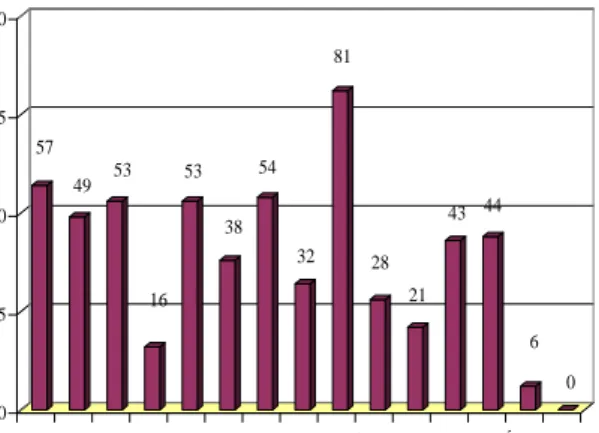
Regarding the sources the class masters resort to (Figure 3) in order to learn more about career counseling and guidance, the internet ranks the first (81%), and then the information provided by television, radio (57%) and friends (54%). More than half of the teachers resort to field literature and to the support of school counselors and 43 - 44% of the respondents participate to job fairs and to other events organized by various educational institutions for promoting educational offers.
Sources of information the parents resort to regarding carrer counseling (values expressed in percentage)
30 28,33 33,33 50 40 30 38,33 76,66 48,33 25 21,66 38,33 38,33 0 1,66 TV, radio newspapers field literature teachers school counselour coleagues friends family Internet
County Agency for Employment NGO
Open Gates Day Job Fair
I do not inform myself NonR
166
Figure 3. Histogram representing sources that class masters of eighth and twelfth grades
resort to on career counselling
Regarding the choices made by counselors from Brasov, a percentage of 79% of the respondents stated that they resort to the field literature, about half of them use the Internet and 33% inform themselves within the meetings with their colleagues, through trainings and Masters in the field. Note that the information is obtained through informal channels and so is the personal effort to inform oneself (using the skills of NIT).
57 49 53 16 53 38 54 32 81 28 21 43 44 6 0 0 25 50 75 100 P e rc e ntage Tv, r adio new spape rs field li
teraturestudents
educ ationa l counse ling cole ague s frie nds fami ly Inte rne t County Age ncy f or Empl oymentNGO Ope n Ga tes D ay Job F air I do n ot i nfor m myse lf NonR
Sources the class masters resort to on career counseling and guidance
Information sources the school counselors resort to on career counseling
79 48 33 33 33 6 6 Field literature Internet Trainings
Meeting and discussion with the coleagues Masters Tv, mass media County Agency for Employment
167
Figure 4. Structure circle representing the information sources the counselors resort to on career counseling
Conclusions and perspectives
More and more, NIT play a significant role in career counseling, as a genuine instrument of information, a vast electronic library or a complex means of assessment. This is what counseling, assisted by NIT represents in most European countries. But what is available under electronic forms, in most cases, is based on what was already available as software packages and pencil-paper tests. The image of NIT in counseling is fragmented, and so far, at the national level there isn’t any uniform development in this area. However, a constructivist approach and new ways of learning, together with NIT, open new possibilities of computer use in career counseling and one of the most important is a persistent and flexible assistance given to any person in its development throughout life.
BIBLIOGRAPHY
Jigău, M., 2001, Consilierea carierei, Editura Sigma, Bucureşti.
Jigău, M., (coord.), 2002, Tehnologiile informatice şi de comunicare în consilierea
carierei, Institutul de Ştiinţe ale Educaţiei, Bucureşti.
LaRoche, M., Botnariuc, P. Muscă, A. Tăsică, L şi Ţibu, S., 2006, Analiza nevoilor
de consiliere pe toată durata vieţii. Institutul de Ştiinţe ale Educaţiei, Bucureşti.
Lemeni, G. şi Miclea, M., (coord.), 2004, Consiliere şi orientare. Ghid de educaţie