THE GRADUATE INSTITUTE OF INTERNATIONAL STUDIES 40, Bd. du Pont d’Arve PO Box, 1211 Geneva 4 Switzerland Tel (++4122) 312 09 61 Fax (++4122) 312 10 26 http: //www.fame.ch E-mail: [email protected] November 2005
FAME - International Center for Financial Asset Management and Engineering
Dennis Y. CHUNG
Simon Fraser University Canada Dusan ISAKOV
University of Fribourg and FAME
Research Paper N°162
Repurchasing Shares on a
Second Trading Line
Christophe PERIGNON
Repurchasing Shares on a
Second Trading Line
∗Dennis Y. CHUNG Simon Fraser University, Canada
Dušan ISAKOV
University of Fribourg and FAME, Switzerland Christophe PÉRIGNON
Simon Fraser University, Canada
Abstract: This paper studies a unique buyback method allowing firms to reacquire their own
shares on a separate trading line where only the firm is allowed to buy shares. This temporary trading platform is opened concurrently with the original trading line on the stock exchange. This share repurchase method is called the Second Trading Line and has been extensively used by Swiss companies since 1997. This type of repurchase is unique for two reasons. First, unlike open market programs, the repurchasing company does not trade under the cover of anonymity. Second, all transactions made by the repurchasing firm are publicly available in real time to every market participant. This is a case of instantaneous disclosure which contrasts sharply with other markets characterized by delayed or no disclosure. Using actual repurchase data from all buybacks implemented through second trading lines, we find that managers exhibit timing ability for the majority of programs. We also document that the daily repurchase decision is statistically associated with short-term price changes. However, we reject the opportunistic repurchase hypothesis and find no evidence that managers exploit their information advantage when reacquiring shares. We also find that repurchases on the second trading line have a beneficial impact on the liquidity of repurchasing firms (i.e., higher trading volumes, smaller bid-ask spreads, and thicker total depths). Exchanges and regulators may consider the second trading line an attractive share reacquisition mechanism because of its transparency and positive liquidity effects.
Draft: November 22, 2005
JEL Classification: G14, G35
Keywords: Share Repurchases, Disclosure Environment, Information Asymmetry, Liquidity
∗
We thank the SWX Swiss Exchange and Thomas Schaeren for providing the repurchase data and Jorge Cruz for capable research assistance. We thank George Blazenko, Paul Brockman, Francois Derrien, Pierre-André Dumont, Thomas Gilbert, Michael King, William McNally, Roni Michaely, Amir Rubin, Daniel Smith, Chris Veld, Theo Vermaelen, seminar participants at University of Lausanne (Brown Bag), and participants at 2005 Northern Finance Association meeting and 3rd Corporate Finance Day K.U. Leuven for helpful comments and suggestions. We are grateful to several officers from the Swiss Tax Authorities and Swiss Takeover Board, as well as portfolio managers from major Swiss banks, for providing background information on second trading lines. We remain responsible for all errors and omissions. Emails: [email protected] (Chung), [email protected] (Isakov), [email protected] (Pérignon). The corresponding author is Chris Pérignon (Tel.: +1-604-291 3471, Fax: +1-604-291 4920).
Executive Summary
Stock repurchases are nowadays a common way for companies to distribute cash to their shareholders. They are also frequently used to signal undervaluation, mitigate agency problems, finance or counter the dilution effects of stock option plans, alter leverage ratios, or fend off takeovers. Recent empirical research has made tremendous progress in understanding the main motives for firms to repurchase their own shares. Careful attention has also been devoted to the usually positive stock return drift observed subsequent to share buyback announcements but not much is known about the timing.
The vast majority of buybacks are implemented through open market programs, in which listed companies directly buy their own shares in the stock market. This buyback method represents 90% of all repurchase programs in the US and 87% of all repurchase programs in the rest of the world. The main features of the open market programs are that (1) the repurchasing firm trades anonymously in the stock market and (2) the actual number of repurchased shares and the repurchase price are not always disclosed. These two reasons imply that not much is known about the timing of repurchases and their impact on liquidity. This paper studies a unique buyback method allowing firms to reacquire their own shares on a separate trading line where only the firm is allowed to buy shares. This temporary trading platform is opened concurrently with the original trading line on the stock exchange. This share repurchase method is called the Second Trading Line and has been extensively used by Swiss companies since 1997. This type of repurchase is unique for two reasons. First, unlike open market programs, the repurchasing company does not trade under the cover of anonymity. Second, all transactions made by the repurchasing firm are publicly available in real time to every market participant. This is a case of instantaneous disclosure which contrasts sharply with other markets characterized by delayed or no disclosure. Using actual repurchase data from all buybacks implemented through second trading lines, we find that managers exhibit timing ability for the majority of programs. We also document that the daily repurchase decision is statistically associated with short-term price changes. However, we reject the opportunistic repurchase hypothesis and find no evidence that managers exploit their information advantage when reacquiring shares. We also find that repurchases on the second trading line have a beneficial impact on the liquidity of repurchasing firms (i.e., higher trading volumes, smaller bid-ask spreads, and thicker total depths). Exchanges and regulators may consider the second trading line an attractive share reacquisition mechanism because of its transparency and positive liquidity effects.
Repurchasing Shares on a Second Trading Line
1. Introduction
Stock repurchases are nowadays a common way for companies to distribute cash to their shareholders. They are also frequently used to signal undervaluation (Vermaelen, 1981), mitigate agency problems (Jensen, 1986), finance or counter the dilution effects of stock option plans (Kahle, 2002), alter leverage ratios (Bagwell and Shoven, 1988), or fend off takeovers (Bagwell, 1991). Recent empirical research has made tremendous progress in understanding the main motives for firms to repurchase their own shares.1 Careful attention has also been devoted to the usually positive stock return drift observed subsequent to share buyback announcements.2
The vast majority of buybacks are implemented through open market programs, in which listed companies directly buy their own shares in the stock market. This buyback method represents 90% of all repurchase programs in the US (Stephens and Weisbach, 1998) and 87% of all repurchase programs in the rest of the world (Vermaelen, 2005). The main features of the open market programs are that (1) the repurchasing firm trades anonymously in the stock market and (2) the actual number of repurchased shares and the repurchase price are not always disclosed.3 An implication of this opaque environment is that open market programs may lower the liquidity of repurchasing firms. Indeed, the presence of informed managers in the stock market increases the adverse selection component of the bid-ask spread (Barclay and Smith, 1988). This assertion has been recently corroborated by Brockman and Chung (2001) in their empirical study of actual buyback data from the Hong Kong stock market. They find that spreads increase on average by more than 10% on repurchase days. A similar conclusion is reached by Ginglinger and Hamon (2005) using French data.
1 See Dittma r, 2000, Grullon and Michaely, 2002, Jagannathan, Stephens and Weisbach, 2000, Brav, Graham,
Harvey and Michaely, 2005.
2
See Ikenberry, Lakonishok and Vermaelen, 1995, Rau and Vermaelen, 2002, Maxwell and Stephens, 2003, Chan, Ikenberry and Lee, 2004, Eberhart and Siddique, 2004, Grullon and Michaely, 2004, McNally and Smith, 2005, and Peyer and Vermaelen, 2005a,b.
3
Stephens and Weisbach (1998) show that most of the U.S. companies do not complete their buybacks, 10% of the firms repurchase less than 5% of the number of shares targeted, and a substantial number of firms reacquire no share at all.
Another implicatio n of the lack of information on open market programs is that little is known about the actual implementation of stock repurchase programs. In the U.S. stock market, since most companies repurchase their shares through open market programs with no disclosure requirement, researchers are forced to use monthly or quarterly proxies for share repurchase activity (Stephens and Weisbach, 1998) or questionnaires returned by repurchasing companies (Cook, Krigman and Leach, 2003, 2004).4 In particular, it is still an open question whether managers opportunistically use their information advantage around corporate announcements when reacquiring shares on behalf of the company.
We present in this paper an alternative repurchase method. This technique allows firms to reacquire shares on a separate market segment, called second trading line, where the repurchasing company is the only entity authorized to acquire shares. This temporary trading platform is opened concurrently with the original trading line on the stock exc hange. The second trading line technique has been used by Swiss companies since 1997 and is now the most popular share acquisition method in Switzerland. This type of repurchase is unique for two reasons. First, unlike open market programs, the repurchasing company does not act under the cover of anonymity. As a result, this institutional design creates a natural experiment to study the effect of buybacks on the liquidity of the original trading line in absence of the adverse selection problem identified by Barclay and Smith (1988). Second, these separate trading lines offer a unique resource for analyzing the actual implementation of share repurchases. Indeed, all transactions made by the repurchasing firm on a second trading line are recorded by the Swiss stock exchange and are instantaneously disclosed to all market participant s.5
There are other important features of the second trading line. The price paid by the firm on the second trading line can differ from the concurrent price on the standard first trading line. The premium on the second trading line is limited by law to 5% and turns out to be rather small in practice. As a result, this type of repurchase fulfills the principle of equal treatment of all shareholders, i.e., those who participate in the buyback program and those who do not. Indeed, unlike Dutch auction offers or tender offers, there is no damaging dilution effects on
4
Current research has investigated actual buyback implementation in countries with more stringent disclosure requirements such as Canada (Ikenberry, Lakonishok and Vermaelen, 2000), Hong Kong (Brockman and Chung, 2001, Zhang, 2005), Japan (Zhang, 2002), and France (Ginglinger and Hamon, 2005).
5
This contrasts greatly with the U.S. market where there is no disclosure requirement, or even with countries with compulsory periodic disclosures where information on actual repurchases is delayed.
non-selling shareholders caused by substantial premia paid to selling shareholders.6 Furthermore, no disclosure requirements are needed since market participants and financial regulatory authorities can follow in real time the firm’s repurchases. On the practical side, the second trading lines allow the repurchasing companies to easily collect the withholding tax that has to be transferred to the Swiss tax authorities in every buyback leading to the cancellation of the shares.
The first objective of this paper is to study the timing of stock repurchases. We investigate whether managers exhibit buyback implementation skills when repurchasing shares. We define buyback implementation skills as the capability to purchase shares at a relatively low price. We use two measures of skills: the first one simply contrasts the actual cost of a given buyback program to the average cost of a random buyback plan that yields the same number of reacquired shares; the second one is a novel measure that is consistent with the fact that a buyback program is an option owned by the firm to buyback stock, as suggested in Ikenberry and Vermaelen (1996). In our sample, we find that managers exhibit timing ability for the majority of programs. In particular, some companies are able to repurchase shares at the lowest possible price during their buyback.
Buyback implementation skills can be demonstrated by active repurchase activities following price drops or in advance of price increases. Such trading patterns may be related to managers’ inside information. Indeed, when implementing buyback programs, management teams have the opportunity to exploit their information advantage around corporate announcements on behalf of the repurchasing firm. The opportunistic repurchase hypothesis would be corroborated by particularly intense repurchase activities around the release of firm specific information, and especially prior to the release of good firm-specific news, and following the release of bad firm-specific news. To the best of our knowledge, there is only one empirical study (Cook, Krigman and Leach, 2004) that analyzes the relationship between firm-specific news and the daily repurchase decision of firms. They report that firms refrain from repurchasing around public announcements. Since their dataset has been voluntary disclosed by the companies, this result is not overwhelmingly surprising. Using our unique
6
In Dutch auction offers, shareholders submit to the firm quantities and prices at which they are willing to sell their shares (Comment and Jarrell, 1991). The share price eventually paid is the minimum one allowing the repurchasing firms to reacquire the targeted number of shares. Tender offers are fixed-price offers (Vermaelen, 1984). When the number of tendered shares exceeds the targeted number of shares , the company can either expand its offer or buy shares proportionally.
dataset, we examine this question using an innovative methodology contrasting pre- and post-announcement periods, as well as trading patterns around good and bad news releases. We uncover evidence that the daily repurchase decision is strongly associated with (past and future) short-term price changes. However, in our sample, we reject the opportunistic repurchase hypothesis and find no evidence of firms increasing their repurchases before releasing good news or after disclosing bad news.
Our second objective is to analyze the impact of share buybacks on the liquidity of the repurchasing firm on the first trading line. As second trading lines are open concurrently with first trading lines in the Swiss stock exchange, it is likely that this parallel trading affects in some way the liquidity of the underlying stock. When share buybacks take place on a separate trading line, existing theories linking buybacks and market liquidity do not straightforwardly apply. Repurchasing firms do not compete directly with the liquidity providers on the first trading line (Barclay and Smith, 1988, and Cook, Krigman, and Leach, 2004). Furthermore, this type of repurchase does not increase the probability of trading with an informed trader on the first trading line (Barclay and Smith, 1988, and Brockman and Chung, 2001). In this paper, we posit that the impact of firms’ repurchases on the liquidity of the underlying stock is generated in part by the information effect of actual buybacks. Since actual buybacks are instantaneously disclosed to all market participants, the firm sends a positive signal to the market every time it trades. We hypothesize that this signal attracts more investors to the market in reaction to firms’ repurchases and consequently improve market liquidity. Furthermore, the expected impact of repurchases on stock market liquidity also depends on the identity of the sellers. First, if second trading lines capture a substantial part of the trading volume of institutional investors, that otherwise would have taken place on the first trading line, the liquidity on the first trading line is likely to worsen. Second, if most transactions on second trading lines are made by arbitrageurs, who simultaneously buy on the first trading line and resell to the firm, the liquidity of the underlying stock is likely to improve. Indeed, arbitrage activity maintains a minimum price in the stock market, which tends to raise trading volumes and lower bid-ask spreads.
Our empirical results confirm that repurchases on the second trading line have an important impact on the liquidity of repurchasing firms. Specifically, the repurchasing firms’ trading volumes and total depths on the first trading line tend to be higher on repurchase days and
bid-ask spreads tend to be smaller on repurchase days. The evidence confirms that this unique parallel trading mechanism improves the liquidity of the underlying stock.
To the best of our knowledge, our paper is the first to analyze share repurchases implemented on an exchange with instantaneous buyback disclosure. While this method is only used in Switzerland, it can be of interest for exchanges and regulators in other countries because of its transparency and positive liquidity effects. The remainder of the paper proceeds as follows. Section 2 describes the institutional and legal setting of stock repurchases in Switzerland, along with the participation rules for all types of stock market participants. Section 3 provides a detailed description of the dataset. We study the timing of share repurchases in Section 4. Specifically, we assess the buyback implementation skills of managers and we study the effect of stock price evolution and firm-specific news on repurchase activity. We analyze the liquidity effects of stock repurchases in Section 5. Finally, Section 6 offers some concluding comments.
2. Share Repurchases in Switzerland
2.1. Institutional and Legal Setting
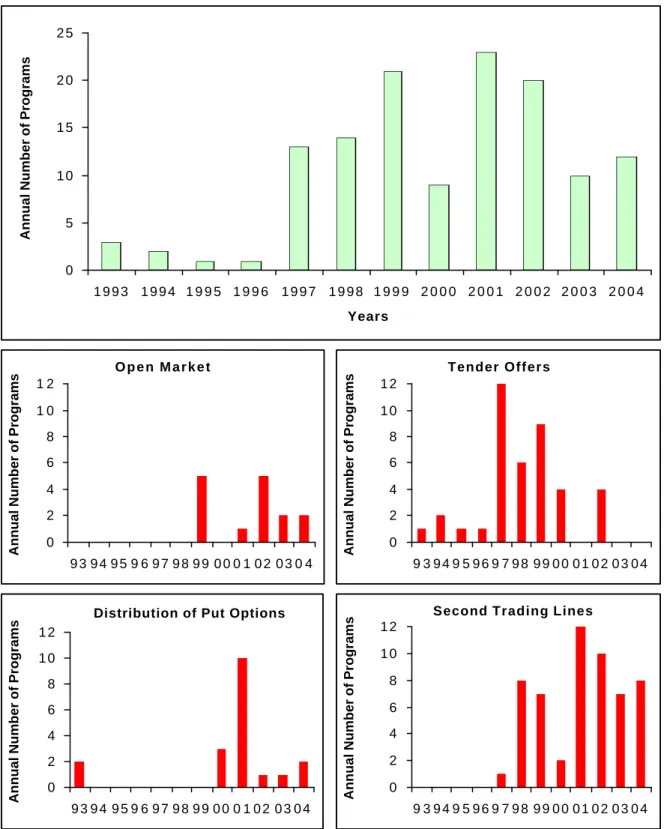
The first share repurchase program implemented by a company listed on the Swiss stock exchange took place in 1993 and since then 129 programs have been carried out (see Figure 1, upper graph). Swiss firms buy their own shares using four different buyback methods: open market, distribution of tradable European put options to all shareholders, tender offers, and repurchases on a second trading line. This last repurchasing technique was initiated in 1997 and has become very popular since then (see Figure 1, lower graphs).7
< Insert Figure 1 >
Swiss corporate law states that, when shares are repurchased on a second trading line, share buybacks should not exceed 10% of the votes and firm’s issued share capital, they should not take place ten days prior to the earnings announcement date, and the premium paid on a second trading line should not exceed 5% of the price prevailing in the stock market at the
7
The interruption in the use of put options between 1994 and 1999 is due to the fact that put options used to be taxed twice: first when granted and later when exercised. In 2000, the highest court in Switzerland ruled that options should only be taxed at the exercise date.
same time. Moreover, the firm shall interrupt repurchases if it is in possession of price sensitive information. Furthermore, any repurchase program exceeding 2% of the share capital has to get the approval of the Swiss Takeover Board since a buyback program is considered as a takeover of the company of its own shares. Once approval is granted, the program can be implemented on the stock exchange, typically under the operational control of an investment bank. According to Swiss exchange regulations, when a second trading line is open, off-exchange transactions are prohibited. When the program is completed, the cancellation of shares (if any) has to be approved by the shareholders during the following annual general meeting (see Appendix for an example).
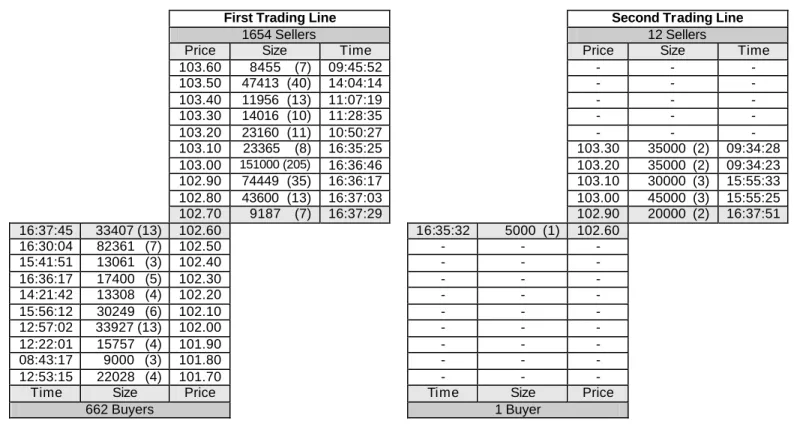
As an illustration, we present in Figure 2 the concurrent order books on the first and second trading lines for UBS recorded on July 11, 2005 at 4:40 p.m. Both trading lines are open on the Virt-X, which is a fully electronic, order-driven trading platform.8 Orders are entered into the trading system by the various participants and automatically routed to a central order book. Execution of the orders takes place in keeping with the principle of price-time priority. Market participants can submit different types of orders: market orders, limit orders, hidden orders, and fill-or-kill orders. The observation of the two order books illustrates different aspects of this share repurchase mechanism. First, as expected, the firm is the only buyer on the second trading line. Second, first trading lines are much more active than second trading lines and, as a consequence, spreads tend to be wider on second trading lines. Third and unlike on first trading lines, posted orders are round lots on second trading lines. This is due the fact that only professional investors are selling shares on the second line as will be shown in the next subsection.
< Insert Figure 2 >
The growing popularity of the second trading line is mostly due to its great flexibility. Unlike distributions of put options or tender offers, second trading line programs do not commit the firm to acquire a specified number of shares at a fixed price. The length of the program also offers some flexibility since a given program implemented on a second trading line can easily be extended. Finally, trading on the first trading line is not interrupted. As a result, any
8
Virt-X is a pan-European stock market for European Blue Chips which was launched on June 25, 2001. Swiss firms can be traded (first and second trading lines) either on the Swiss Stock Exchange (SWX) or on Virt -X.
investor willing to sell her shares can, in theory, trade on both market segments. However, we will see that for tax reasons this choice may in some cases only be on paper.
Before discussing the tax treatment of share repurchases in Switzerland, a few basic tax principles have to be explained. Generally, share buybacks are taxed as capital gains in countries where individuals are subject to taxes on capital gains and as dividends elsewhere (for an excellent review of the relevant issues, see Vermaelen, 2005). In Switzerland, capital gains are not taxed for individual investors, while dividends are taxed as income. Technically speaking, whe n paying dividends a company retains 35% of the amount (i.e., the withholding tax), which are directly paid to the tax authorities. As long as the shareholder declares the dividend as income, she is able to reclaim her withholding tax in full.9 The dividend will then be taxed as ordinary income for individual investors. On the other hand, institutional investors are taxed on both dividends and capital gains.10 At the end of the fiscal year, institutional investors are also entitled to full reimbursement of the withholding tax.
The tax treatment of share buybacks depends on their purpose. If companies repurchase shares to hold them as treasury stock, then no withholding taxes are levied and stock repurchases are considered ordinary sales.11 This situation is encountered for instance when shares are repurchased to finance stock option plans, to guarantee the execution of convertible bonds, or to prepare future acquisitions. In this case, open market buyback is the most flexible repurchase method. Otherwise, if companies repurchase shares to cancel them, then the difference between the repurchase price and the nominal value, or par value, of the stock is treated as a liquidation dividend.12 The withholding tax is then equal to 0.35 × (P2,t – V),
where P2,t is the stock price on the second trading line and V is the nominal value of the stock.
The repurchasing company has to transfer the withholding tax to the tax authorities. When the firm is not able to identify the seller of the stock, the firm is personally responsible for paying the withholding tax. As fiscal authorities consider that the amount paid to shareholders has been deduced from withholding taxes, the company bears a 53.85% tax rate, i.e., 0.35 × (1 / 0.65) = 0.5385. This specific tax regime called for the creation of a new share acquisition
9 For foreign investors, the portion that can be reclaimed is determined by bilateral tax treaties. For instance, U.S.
and British investors are eligible for a 20 percent points tax return.
10
Some institutional investors, such as pension funds and holdings, are totally exempted from taxes on dividends and capital gains. They still face the withholding tax though.
11
Swiss companies can hold treasury stock for up to six years. However, if at the end of this period the shares have not been resold in the market, the firm will have to pay the withholding tax.
12
mechanism allowing the firm to pay only the net price to the shareholders. The goal for the firm is to be able to collect immediately the withholding tax when the stock is tendered while keeping a flexible "open-market type” program.13 Actually, on a second trading line, participating shareholders only get the price net of the withholding tax so that the company does not bear the risk of paying additional taxes. From the firm’s perspective, the use of a second trading line is a tax-efficient way of cancelling shares.
2.2. Buyback Participation Rules
In order to better understand the functioning of the second trading line buybacks from a tax point of view, we study the conditions under which a given market participant may take part in a second trading line repurchase program. In particular, we wonder by which percentage (i.e., premium) the price on the second trading line has to exceed the current stock price to make the second trading line attractive to this participant. We consider successively individual investors, institutional investors, and arbitrageurs. We compute the reserve premium of each participant, which is defined as the premium for which the after-tax price on the second trading line is equal to the after-tax price on the first trading line. Consequently, when the actual premium p exceeds the reserve premium, the investor is better off selling her shares on the second trading line rather than in the stock market.14
When an individual investor sells some shares in the stock market at the current stock price, no taxes are paid since capital gains are tax free for individual investors. If the same investor tenders her shares on the second trading line, she receives today the second trading line price net of the withholding tax. At the end of the fiscal year, she will be entitled to a full refund of the withholding tax and the difference between the repurchase price and the nominal value of the stock will be taxed as income. Therefore, an individual investor would prefer the second trading line if and only if:
4 4 3 4 4 2 1 4 4 4 3 4 4 4 2 1 4 4 4 4 4 3 4 4 4 4 4 2 1 tax income of value Present I refund tax ng withholdi of value Present tax ng withholdi less price line trading 2nd d V]t -p) [P(1 -V]0.35d -p) [P(1 V]0.35 -p) [P(1 -p) P(1 P < + + + + + or equivalently, 13
Tender offers or put option-based repurchase programs also allow the company to pay only the net price but with much less flexibility since both the price and the number of shares are fixed.
14
The following analysis remains valid for foreign investors but they usually would not be entitled to a full refund of the withholding tax. As a result, their reserve premium is higher than the one of their domestic counterparts.
(
)
* I I p d t d 35 . 0 65 . 0 P V 1 d t P V 1 d 1 35 . 0 p = − + − + − − > (1)where p* is the reserve premium for an individual investor, P is the market stock price, and tI
is the marginal income tax rate. The discount factor d is defined as (1 + r)-τ where r is the risk- free rate with a τ maturity and τis the time period from the transaction day to the end of the fiscal year.
When an institutional investor sells some shares in the stock market, capital gains are taxed at the effective marginal rate tG. If the same investor tenders her shares on the second trading
line, she receives today the second trading line price minus the withholding tax. At the end of the fiscal year, she will be entitled to a full refund of the withholding tax and the difference between the repurchase price and the acquisition price will be taxed as capital gains. Therefore, an institutional investor would prefer the second trading line if and only if:
4 4 4 3 4 4 4 2 1 4 4 4 3 4 4 4 2 1 4 4 4 4 4 3 4 4 4 4 4 2 1 4 4 3 4 4 2 1 tax gain capital of value Present G refund tax ng withholdi of value Present tax ng withholdi less price line trading 2nd price market stock tax -After Gd P(1 p)-[P(1 p)-V]0.35 [P(1 p)-V]0.35d - [P(1 p)-A]t d A)t -(P -P < + + + + + * * G p d t d 35 . 0 65 . 0 P V 1 ) d 1 ( 35 . 0 p = − + − − > (2)
where p** is the reserve premium for an institutional investor and A is the acquisition price of the stock. Notice that, since the acquisition price does not appear in the expression for the reserve premium, the latter is independent of the investor’s capital gains or loss. In the eventuality that the institutional investor is exempted from capital gain tax, the participation rule becomes: 4 4 4 3 4 4 4 2 1 4 4 4 4 4 3 4 4 4 4 4 2 1 refund tax ng withholdi of value Present tax ng withholdi less price line trading 2nd V]0.35d -p) [P(1 V]0.35 -p) [P(1 -p) P(1 P< + + + + * * * p d 35 . 0 65 . 0 P V 1 ) d 1 ( 35 . 0 p = + − − > (3)
where p*** is the reserve premium for a tax-exempted institutional investor. As expected the reserve premium is smaller when the institutional investor is exempted from taxes on capital gains.
As the firm’s shares are traded concurrently on two parallel market segments, arbitrageurs may seek to exploit any significant price difference. A professional arbitrageur will accept to buy one share on the first trading line and to sell it on the second trading line if and only if her arbitrage profit is strictly positive:
0 d P]t -p) [P(1 -V]0.35d -p) [P(1 V]0.35 -p) [P(1 -p) P(1 P -tax gain capital of value Present G refund tax ng withholdi of value Present tax ng withholdi less price line trading 2nd > + + + + + + 1444442444443 14 244 4 344 14 24 4 34 .
By simplifying the inequality above, we get Equation (2). Therefore, the reserve premium for an arbitrageur is equal to the reserve premium for an institutional investor.
The three reserve premia obtained above share a common structure. The numerator is the same in Equations (2) and (3) and this term also appears in Equation (1). This term corresponds to the opportunity cost of the withholding tax to the investor. Of course, the actual reserve premia will depend on the marginal tax rate of the different types of investors. In two particular cases this opportunity cost is equal to zero. First, if the withholding tax was immediately returned to the seller (d = 1), which is equivalent to no withholding tax, the reserve premium of any institutional investor or arbitrageur would boil down to zero (p** =
p*** = 0). In the case where d = 1, the reserve premium for an individual investor would remain strictly positive (p* > 0). This is due to the fact that an individual investor needs to be compensated for the income tax she has to pay on the difference between V and P when selling on a second trading line. Second, if the current stock price and the nominal value of the stock were equal (V / P = 1), the reserve premium of all market participants would be zero. This would correspond to the case where there would be no tax basis for paying the withholding tax. This result emphasizes the central role played by the V / P ratio in determining the magnitude of the premium.
We plot in Figure 3 the reserve premia for different market participants. For each market participant, we plot the associated reserve premium for a time period until the end of the fiscal year (τ) ranging from 0 to 1 year, different risk- free interest rate levels, r = 1%, 3%, and 5%, and different income tax rates (tI) or capital gain tax rates (tG), 30% and 50%. The value of the
current stock price (P) is assumed to be 100 and the nominal value of one share (V) is assumed to be 1. The reserve premium of an individual investor turns out to be very large, regardless of the magnitude of the key parameters. Since the premium is limited by law to
5%, we conclude that it is never optimal for an individual investor to sell shares on a second trading line. On the other hand, the reserve premium of institutional investors and arbitrageurs always remain below the legal threshold. As a result, the other market participants may accept to participate in a second trading line buyback program. In particular, if p** < p, institutional investors and arbitrageurs may sell shares on the second trading line, and if p*** < p < p**, only tax-exempted institutional investors may sell shares on the second trading line. The bottom line is that the tax treatment of second line trading makes it attractive for institutional and professional investors only.
< Insert Figure 3 >
3. Characterizing Repurchase Trading
Our sample contains all buybacks implemented by firms listed on the Swiss stock exchange (SWX) or Virt-X through a second trading line between its introduction in December 1997 and August 2004. For each of the 55 programs, we obtained from SWX the daily transaction price on the second trading line and the Swiss Franc repurchase, which is the total amount spent in repurchasing shares by the firm on a given day. Our sample contains a total of 11,742 day/program observations. In addition, we collect from the Swiss Takeover Board website (www.copa.ch), the start and the end dates, the maximum cost and the percentage issued share capital reduction of each program, along with the main motives for repurchasing shares claimed by each firm. We also retrieve contemporaneous daily stock prices on the first trading line for all repurchasing companies from Thomson Financial Datastream. Furthermore, we collect from the same source the market capitalizations and book-to-market value ratios of the repurchasing companies during all programs.
Within a given repurchase program i, we measure the trading activity using four different variables, which capture different facets of stock repurchases. The first variable is a dummy variable that is assigned a value of one if the company repurchases any stock on day t, and 0 otherwise:
where SRi is the Swiss Franc repurchase. The second variable captures the intensity of the
repurchase activity and is defined as the fraction of the announced program size repurchased on day t: i t , i t , i SR /Program Size Intensity = (5)
where Program Sizei is the maximum cost of program i announced and authorized prior to the
program implementation. The third variable is the percentage premium paid on the second trading line on a given day:
Premiumi,t = (P2,i,t - P1,i,t) / P1,i,t (6)
where P1,i is the stock price on the first trading line while P2,i is the stock price on the second
trading line. The fourth variable is the completion rate, which is the percent of the program completed to date: i t start i t s s , i t , i SR /Program Size Completion
∑
= = (7)where tistart is the start date of program i.
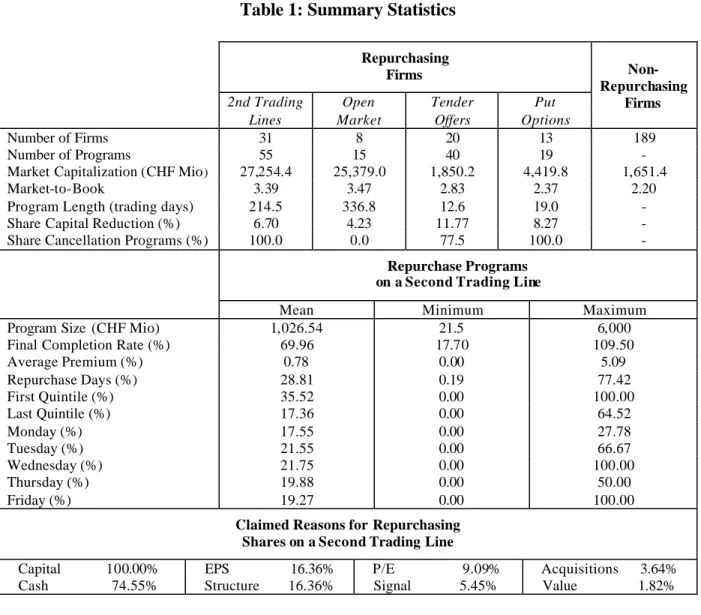
Table 1 presents some descriptive statistics on the repurchasing firms and their repurchase activity. A salient feature of our dataset is that repurchasing firms tend to be larger and have larger market-to-book value ratio s (growth firms) than non-repurchasing firms. Among repurchasing firms, the largest caps primarily use the second trading line or the open market methods. Typically, these buyback programs last between six months and a year. Regardless of the selected technique, each program targets a significant portion of the firms’ share capital ranging from 4% to 12%. As expected all second trading lines program aim at canceling the repurchased shares.
During our sample period, all programs conducted on a second trading line have amounted for a total cost of 56.5 billion Swiss Francs (hereafter CHF). While repurchase programs exhibit great diversity in their size, the average program size is slightly above CHF1 billion. The average share capital reduction is 6.70%, which is comparable with the target percentage of shares in the US (Cook, Krigman, and Leach, 2004). The typical completion rate of 70% is slightly below the figures reported by Stephens and Weisbach (1998) for U.S. firms, which range from 74% to 82%. Firms acquiring shares on a second trading line pay an average
premium of 0.78% on top of the stock market price. On average, firms buy 28.81% of the trading days, but repurchasing frequencies vary considerably across firms. Swiss companies tend to repurchase shares more aggressively at the beginning of the buyback program but do not seem to favor any particular day of the week.
Firms set up second trading lines so that they can cancel their shares. Share buybacks for cancellation and cash dividends are complementary tools for returning cash to shareholders. As reported in the lower panel of Table 1, companies cancel their repurchased shares to show improvement in financial ratios and to alter capital structure. Another reason for canceling the shares is that a heavy tax penalty would be levied if firms keep the reacquired shares as treasury stock beyond a specified period (see Section 2.1).
< Insert Table 1 >
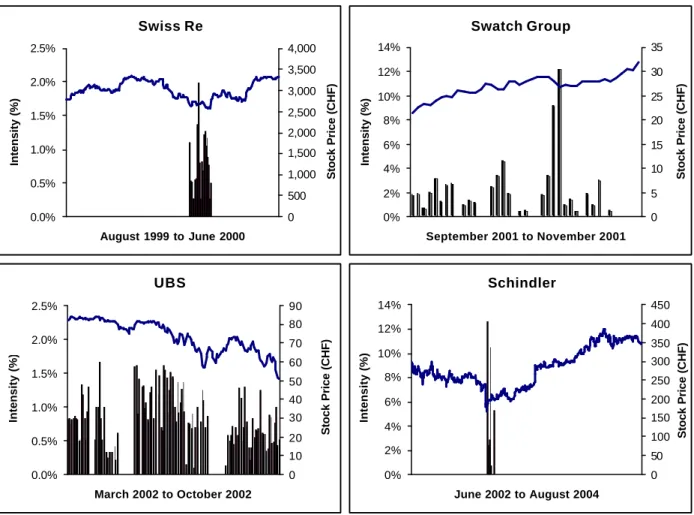
Figure 4 displays the daily repurchase activity of Swiss Re, Swatch Group, UBS, and Schindler. We clearly see in this figure that these firms adopt a variety of execution styles. For instance, Swiss Re and Schindler concentrate their repurchase activity during a single short period following a strong bearish period for the companies. This trading pattern is consistent with the price-support hypothesis. Both firms have been able to repurchase shares at the lowest possible price during their buyback. Differently, actual repurchases of Swatch Group and UBS are more evenly spread out during the course of their program. UBS repurchase between 0.5% and 1.5% of the program on a daily basis with only two blackout periods preceding the firm’s earnings announcements.
Figure 5 presents the premia paid by Helvetia and Ciba Specialty Chemicals on the second trading line, along with the cumulative percentage of the program completed by Novartis and Credit Suisse Group. While the premia always remain below the 5% legal threshold, the ones paid by Helvetia tend to be larger than the ones paid by Ciba Specialty Chemicals. This is mainly caused by the drop in the Swiss risk-free interest rate from 3% in June 2001 to 0.5% in August 2003. The lower graphs in Figure 5 present one firm (Novartis) that fully completes its buyback program and one company (Credit Suisse Group) that stops repurchasing after completing only 20% of its buyback program. While both companies seem to favor the first portion of the program to reacquire shares, Novartis keeps buying shares until the very end of its program.
< Insert Figure s 4 and 5 >
4. Repurchase Timing
4.1. Buyback Implementation Skills
We define the buyback implementation skills of managers as their ability in selecting repurchase days over the course of a given buyback program. In this context, a particularly skilled manager is able to reacquire shares at historical low prices.15 In order to assess managers’ timing skills, we first contrast the actual cost of a given buyback program, which is measured by adding up all daily Swiss Franc repurchases, Ci, to the average cost of a random
buyback plan that yields the same number of reacquired shares, Ci. We call the Ci /Ci ratio the buyback implementation skills (BIS) variable. Applying this approach to data from the Hong Kong stock exchange, Brockman and Chung (2001) find that managers pay on average less than the average cost of a random repurchase strategy leading to the same number of reacquired shares.
In this paper, we propose a novel measure of managers’ buyback implementation skills that is consistent with the fact that a buyback program is an option owned by the firm to buyback stock, as suggested in Ikenberry and Vermaelen (1996).16 Indeed, open market and second trading lines programs give managers give the opportunity – but not the obligation – to buyback shares during a given time period. In particular, they provide managers with the flexibility to forego repurchasing stock. Consistent with this analogy between buybacks and financial options, we compare on each repurchase day the price paid by the firm (i.e., the “strike price”) to the average price during the rest of the buyback program (i.e., during the “remaining life of the repurchase option”). For each buyback program, we assess the managers’ timing skills by computing:
∑
∑
= = + × = × = = i T start i t t i t , i t , i , 2 i T : t , i , 2 i i T start i t t t , i i T : t , i , 2 i i i C SR P~ P~ C N P~ C C OBIS (8) 15Our test for the implementation skills focuses on the managers’ ability in minimizing costs. We recognize that firms can have other objectives when they repurchase shares . The presence of these firms in our sample will bias against us in finding significant implementation skills in our empirical tests .
16
where Ci is the actual cost of the program and Ci+ is the average cost of a random buyback plan that yields the same number of reacquired shares except that the average price is computed over the period following a given repurchase day. In addition, Ti is the end date of
the program, i T : t , i , 2
P~ denotes the average price on the second trading line between the current
date and the end of the program, and Ni,t is the number of shares repurchased on a given day.
Since the stock price on the second trading line is only observed when a transaction takes place on this market segment, we define P~2i, as P~2,i,t =P2,i,t if SRi,t > 0 and
) p 1 ( P
P~2i,,t = 1,it, × + i,t if SRi,t = 0 where pit, is the average premium paid during this program.17 The average price on the second trading line can then be extracted from the time-series of P~2i,.
We can grasp the essence of the OBIS measure intuitively. The first term in Equation (8) captures whether the price paid by the company at a given point in time is less than the average price over the remainder of the program. Note that we only consider future stock prices in order to be consistent with the idea that, when repurchasing, the firm exercises an option to buy a stock that may have been exercised at any point until the expiration of the buyback program. The second term in Equation (8) is a weighting factor reflecting the relative importance of a given daily repurchase.
For each variable of buyback implementation skills (BIS and OBIS), we interpret a value greater than one as evidence of buyback implementation skills whereas ratios smaller than one can mean either no skills or incompetence. To assess the statistical significance of each skills measure, we compute a t-statistic for each program using the bootstrapping approach of Brockman and Chung (2001). We consider as given for each program (1) the repurchasing period, (2) the total number of reacquired shares, and (3) the number of reacquired shares during each repurchase day. For each program, we randomly generate 50,000 repurchase strategies holding constant (1), (2), and (3) and we only allow the timing of the strategy to vary from simulation to simulation.18 From the bootstrapped distribution of the average cost, we compute for each program the standard-deviation of the skills measure and the t-statistic.
17
We compute a weighted-average premium where the weight on a given day is equal to the fraction of the buyback program repurchased on that day.
18
For the BIS measure, we bootstrap using all possible prices whereas for the OBIS measure we associate the number of shares repurchased on day t only with future prices that are observed between t and T.
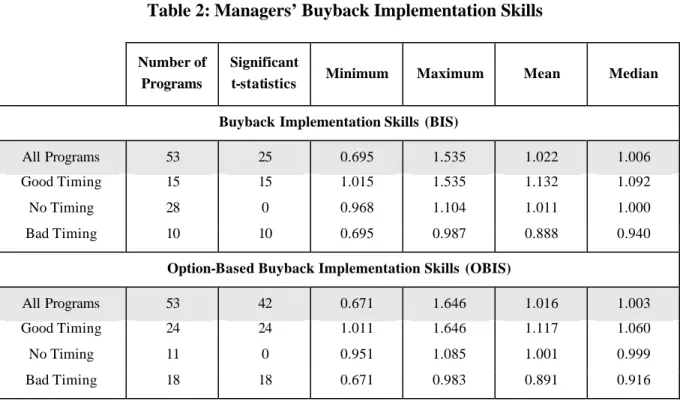
We show in Table 2 that the BIS measure identifies 15 programs for which managers display significant buyback implementation skills, whereas the OBIS measure classifies 24 programs as programs with significant implementation skills.19 For the programs with significant BIS, the mean (median) cost represents on average 113.2% (109.2%) of the actual cost. According to the OBIS measure, the actual cost paid by firms with significant buyback implementation skills is 11.7% less than the mean cost and 6.0% less than the median cost. Depending on the measure of timing ability, we find that the proportion of the programs that display significant buyback implementation skills at the 5% level is between 28% and 45%, which is comparable to the timing perfo rmance of managers in Hong Kong analyzed in Brockman and Chung (2001). The remaining programs in our sample display either no buyback implementation skills or some significant bad timing. A simple regression analysis (results not reported) shows that buyback implementation ability is significantly positively associated with the program length and share capital reduction but not associated with the average premium. In the following subsection, we question whether buyback implementation skills reflect the strategic behavior of the managers in charge of implementing the buybacks.
< Insert Table 2 > 4.2. Strategic Trading
In order to pursue one step further our analysis of the timing of buybacks, we study the relationship between stock repurchase activity, stock prices, and firm-specific information. Most of the empirical studies on insider trading analyze the impact on share prices or market liquidity of individuals with private information (Meulbroek, 1992, Cornell and Sirri, 1992, and Fishe and Robe, 2004) and insiders’ abnormal performance when trading on their own account (Seyhun, 1986, and Jeng, Metrick and Zeckhauser, 2003). For instance, Lee, Mikkelson and Partch (1992) find that officers and directors of repurchasing firms tend to reduce their selling and, in some cases, increase their buying prior to fixed-price offers in order to personally benefit from the buybacks.
19
Among the four programs detailed in Figure 4, only Swiss Re (BIS = 1.333 with t-statistic = 7.14) and Schindler (BIS = 1.471, t-statistic = 3.86) exhibit significant timing ability according to the BIS measure. Swatch Group is characterized by a BIS of 1.025 and a t-statistic of 1.17, while UBS displays a BIS of 1.001 and a t-statistic of 0.09. According to the OBIS measure, Swiss Re, Schindler, and Swatch Group exhibit significant implementation skills.
When implementing buyback programs, management teams can opportunistically use their information advantage around corporate announcements on behalf of the company (Barclay and Smith, 1988). Their actions may however be restricted by guidelines or safe harbor’s bounds established by stock exchanges, or even blackout periods preceding earnings disclosures.20 If managers make use of private information to time share repurchases, one would expect higher repurchase activities around the release of firm specific information, but especially prior to the release of good specific news, and after the release of bad firm-specific news. The abnormal repurchase activities should be particularly high if the market overreacts to bad news. Cook, Krigman and Leach (2004) show for a sample of U.S. firms that repurchase activity is significantly curtailed around firm-specific information releases. They conclude that trading on private information is not evident in their sample.
To detect any abnormal trading activity around the release of firm-specific news, we pool all the programs and estimate the following PROBIT regression model:
Buybacki,t = α + β1 Ri,t-5,t-1 + β2 Ri,t + β3 Ri,t+1,t+5 + γ1 Newsi,t -5,t-1 + γ2 Newsi,t + γ3 Newsi,t +1,t+5
+δ1−5 Controlsi,t + ei,t (9)
where Buybackiis a binary variable equal to one if the firm repurchases some shares and zero
otherwise and Ri is the return of firm i on a given day. The variable News is a binary variable
set to one if the firm makes a public announcement on a given day and zero otherwise. We retrieve every news item using the Dow Jones & Reuters Factivadatabase.21 We break down the period surrounding a firm-specific information release into a five day pre-release period, a release day, and a five day post-release period. Controls represents a set of control variables including the firm’s market capitalization and market-to-book ratio, the program length and percentage share capital reduction, and the buyback completion rate up to date.
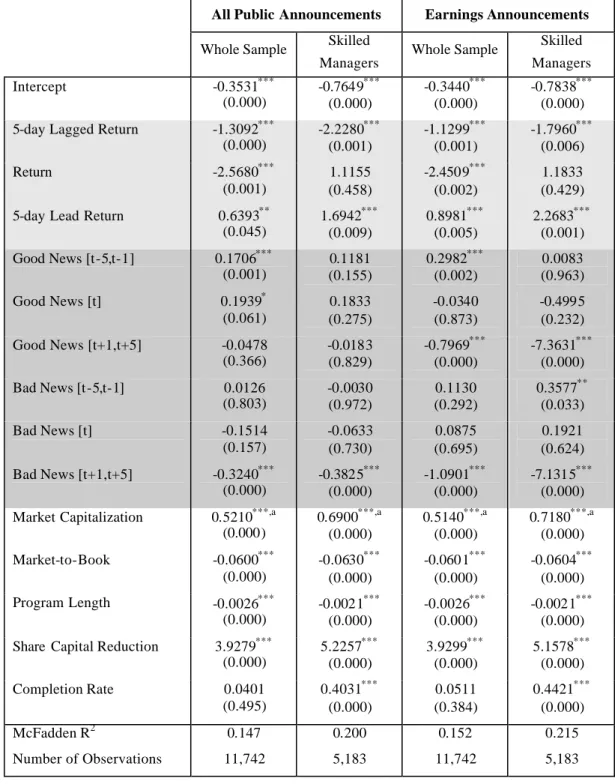
We report in Table 3 the parameter estimates for all programs, as well as for programs with significant buyback implementation skills. We find that firms repurchase more frequently in
20 Cook, Krigman and Leach (2003) use questionnaires returned by U.S. repurchasing firms to document claimed
and actual compliance to the Securities and Exchange Commission (SEC) guidelines. For their set of fifty-four companies, they show that virtually all firms violate at one time or at another the safe harbor’s bounds advised by the SEC.
21
We limit the search to news items announced by the Swiss News Agency (ATS). We only consider firm-specific news items and do not include general news items in which a company is only mentioned. In the eventuality that the release takes place after the closing time of the stock market, we use the following day as the announcement day.
days following price drops (βˆ1 <0). This behavior is even more pronounced for those firms with significant implementation skills.22 This result is consistent with U.S. and Canadian evidence reported by Stephens and Weisbach (1998) and Ikenberry, Lakonishok and Vermaelen (2000) using quarterly and monthly data, respectively. It is also consistent with the few studies using daily repurchase data (Cook, Krigman and Leach, 2004 and Zhang, 2005). Furthermore, we find that firms repurchase more frequently when the contemporaneous return on the stock is negative (βˆ2 <0). These first two pieces of evidence are consistent with the price-support hypothesis.
Unlike previous empirical studies, we find that repurchasing firms appear to consistently repurchase in advance of price increases (βˆ3 >0). This unusual result may be caused by the very nature of the second trading line method. Indeed, as transactions on second trading lines are instantaneous public information, market participants can interpret a repurchase as a positive signal revealing that the company’s management team estimates that the stock is currently undervalued. Alternatively, the evidence may suggest that Swiss managers can anticipate future price changes. Overall we conclude that the firms included in our sample are price-sensitive repurchasers.
< Insert Table 3 >
For the full sample of programs, we find that repurchasing firms are more active after a public announcement and less active prior to a public announcement. We observe a similar trading pattern when we only focus on programs with implementation skills. This general reluctance to trade before a news release is particularly strong prior to quarterly and annual earnings announcements. This last point supports the idea that Swiss companies strictly conform to Swiss regulation prohibiting repurchasing during the 10-day period preceding earnings announcements or the release of any price-sensitive information.
The findings regarding control variables are generally consistent with expectations. For instance, large firms, which have been very active in repurchasing shares over our sample period, tend to trade more frequently, everything else being constant. Moreover, the daily
22
We use the BIS variable to select the firms exhibiting significant implementation skills since this measure is the more conservative than the OBIS measure.
repurchase decision turns out to be negatively related to the length of the program and positively related to the relative size of the buyback program.
To investigate further the effect of public announcements on the daily buyback decision, we contrast trading patterns around good news and bad news. To do so, we estimate the following PROBIT regression model:
Buybacki,t = α + β1 Ri,t -5,t -1 + β2 Ri,t + β3 Ri,t+1,t+5 + γ1 Good Newsi,t -5,t -1 + γ2 Good Newsi,t + γ3 Good Newsi,t +1,t+5 + γ4 Bad Newsi,t -5,t -1 + γ5 Bad Newsi,t + γ6 Bad Newsi,t +1,t+5 + δ1−5 Controlsi,t + ei,t (10)
where Good News (respectively Bad News) is a binary variable that is assigned a value of one if the firm releases a good (bad) news on a given day. We designate every piece of news as good (respectively bad) if the return of the concerned company is positive (negative) on the announcement day. In this regression model, four estimates allow us to detect whether managers behave opportunistically when implementing repurchase programs. Strategic trading would consist in repurchasing before good news releases (γ3 > 0) since stock prices are
likely to increase after such announcements, and after bad news releases (γ4 > 0) since stock
prices are likely to decrease after such announcements. For similar reasons, it would also imply not to repurchase right after a good news release (γ1 < 0) and just before a bad news
release (γ6 < 0).
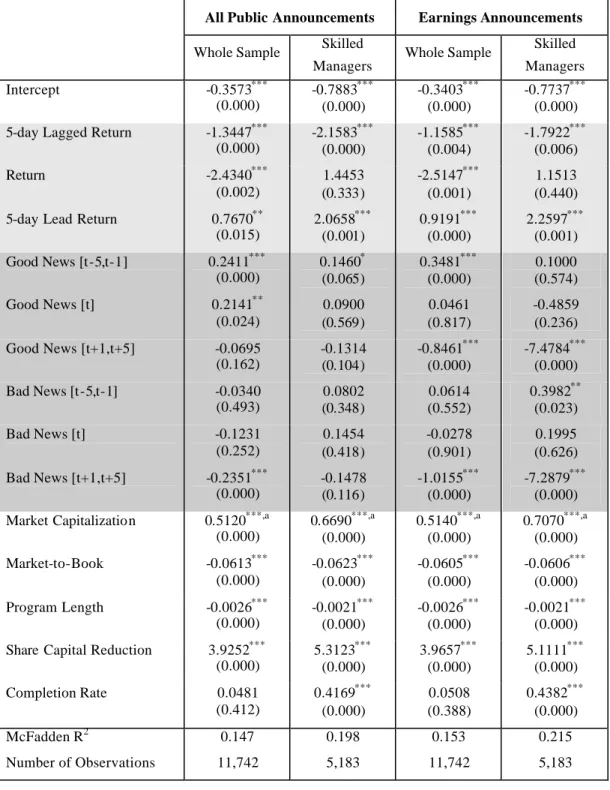
Table 4 presents the regression results. We see that firms are more likely to repurchase their shares after releasing good news and less likely to do so prior to releasing good news, which is in clear opposition to the opportunistic repurchase hypothesis. Moreover, we do not detect any abnormal repurchase activity following bad news releases. The only piece of supportive evidence of the opportunistic repurchase hypothesis is that firms in our sample curtail their repurchases in the five-day period preceding the release of bad news (γˆ6 < 0). We reach similar conclusions when we limit the analysis to earnings announcements only. However, in this case, the pre-announceme nt trading blackout is much stronger and independent of the news content.
As a robustness check, we repeat the same analysis using abnormal returns in excess of the market return instead of raw returns to separate good news and bad news. In that case, a given
piece of news is said to be good (respectively bad) if the abnormal return of the concerned company is positive (negative) on the announcement day. We see in Table 5 that our conclusions remain unchanged.
< Insert Tables 4 and 5 >
Our methodology allows us to analyze the timing of buybacks controlling for the possibility of opportunistic trading based on private information. While implementation ability is the faculty to repurchase stock at a relatively low price, typically after a price drop or prior to a price increase, opportunistic trading consists of using private information around corporate announcements to time actual repurchases. We claim that, once implementation ability has been identified, the burden of the proof of opportunistic trading is still upon researchers’ shoulders. It requires a careful analysis of the daily repurchase decision around public announcements. In our sample, we find that managers exhibit implementation ability for the majority of programs. We also document that the daily repurchase decision is statistically associated with short-term price changes. However, we reject the opportunistic repurchase hypothesis and find no evidence of firms increasing their repurchases before releasing good news or after disclosing bad news.
5. Trading Activity and Corporate Liquidity
While in the previous section we intended to answer the question “When do firms repurchase?”, we now consider the related question “Is the liquidity on the first trading line different when firms repurchase?”. Two contending hypotheses have been developed in the literature to explain the liquidity effect of open market share buybacks. Barclay and Smith (1988) posit that a repurchasing company can narrow the bid-ask spread by maintaining a minimum price on the market, and thus tends to increase the market liquidity. Alternatively, Barclay and Smith suggest that the presence of a repurchasing firm with superior information may widen spreads, and thus decrease the stock market liquidity, because the probability of trading with an informed trader increases. The empirical evidence on the effects of open market repurchases on stock market liquidity is conflicting. On one hand, Franz, Rao and Tripathy (1995), and Cook, Krigman and Leach (2004) conclude that open market repurchases by U.S. firms positively contribute to market liquidity by narrowing bid-ask spreads. On the other hand, Barclay and Smith (1988), Brockman and Chung (2001), and
Ginglinger and Hamon (2005) find that open market repurchases in the US, Hong Kong, and France respectively, have a detrimental effect on liquidity. Differently, Wiggins (1994), Singh, Zaman and Krishnamurti (1994), and Miller and McConnell (1995) find no impact on the bid-ask spread of repurchasing firms.
As far as second trading lines are concerned, the two aforementioned hypotheses do not straightforwardly apply. Indeed, when trading on a separate trading line, the company is not competing directly with the liquidity providers, nor is it increasing the probability of trading with an informed trader in the stock market. We claim that the existence of the second trading line affects the liquidity of the first trading line (1) through the information effect of actual buybacks and (2) through the identity of the sellers on the second trading line.
The information effect works as follows. Since actual buybacks on the second trading line are instantaneous ly disclosed to all market participants, the firm sends a positive signal to the market every time it trades. If the firm’s managers are assumed to be better informed than the rest of the market, the positive signal from the firm attracts more investors on the first trading line which ceteris paribus tends to increase trading activity and improve liquidity.
The impact of second trading line programs on the stock market liquidity also depends on the identity of the sellers on the second trading line. First, if second trading lines capture a substantial part of the trading volume of institutional investors, that otherwise would have taken place in the stock market, stock market liquidity is likely to deteriorate. Second, if most of the trading on second trading lines is made by arbitrageurs, who simultaneously buy in the stock market and resell on the second trading line, stock market liquid ity is likely to benefit from this parallel trading. Indeed, arbitrage activity maintains a minimum price in the stock market, which tends to raise trading volumes and lower bid-ask spreads. As shown in Section 2.2, institutional investors and arbitrageurs are equally likely to participate in a second trading line program since their reserve premium are equal. We then conduct an empirical analysis to see which scenario is born out by the data.
We first analyze the effects of actual buybacks on the repurchasing firms’ trading volumes on the first trading line. The key variable is the firm’s trading volume measured in number of shares. Daily trading volumes, closing bid and ask prices, and opening prices have been collected from Thomson Financial Datastream. In order to contrast the trading activity during
repurchase days and non-repurchase days, we compare the average and median trading volumes when the company does repurchase with the average level of the variable when the company does not repurchase.23 When computing the mean and median of the firm-specific scaled liquidity measures across programs. We find that, on average, trading volumes are higher on repurchase days than on non-repurchase days. Around 84.6% of the firms in our sample experience a rise in average trading volumes on the buyback execution dates. Moreover, standard univariate tests show that this increase is statistically significant for average trading volumes (Student Test p-value = 0.052) and median trading volumes (Kruskal-Wallis Test p-value = 0.000).
To pursue our investigations of the effects of repurchases on trading volumes, we estimate the following regression model:
Volumei,t = α + β Buybacki,t + δ1 Pricei,t +δ2 Volatilityi,t +δ3 Market Capitalizationi,t + ei,t (11)
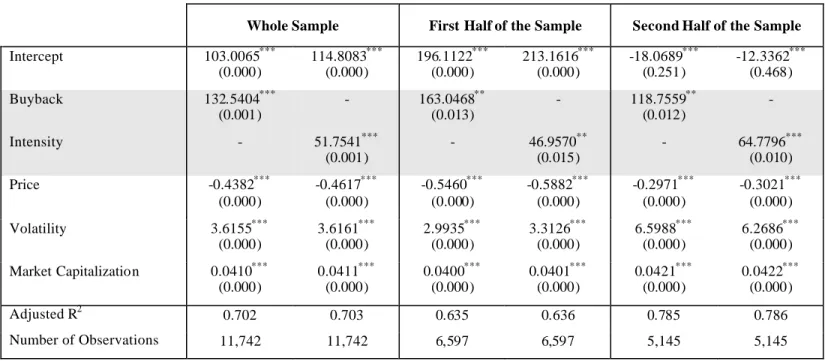
where Volume represents the daily number of shares traded on the first trading line. The parameter estimate that captures any systematic effect of buybacks on trading activity is the one associated with the Buyback variable, which is a binary variable equal to one if the firm repurchases some shares and zero otherwise. Note that we also use the Intensity variable in replacement of the Buyback variable to check whether our conclusions depend on the portion of buyback program reacquired on a given day. The control variables used in our regression model are rather standard: Price denotes the closing price of the stock, Volatility is the absolute open-close return of the stock, and Market Capitalization is the market value of the firm.
Table 6 presents the OLS parameter estimates and associated p-values for Equation (11). Consistent with the univariate tests, we find that repurchasing on a second trading line contributes to increase trading activity in the stock market (p- value = 0.001). We reach a similar conclusio n when the portion of the buyback program reacquired on a given day,
23 In order not to give an excessive weight to firms with large trading volumes, we scale the liquidity measures in
each sample by the firm’s unconditional average liquidity measure. As an illustration, consider firms A and B. Let firm A’s average trading volume be 100 (in million CHF), average trading volume on repurchase days be 120, and average trading volume on non-repurchase days be 80. Let firm B’s average trading volume be 15 (in million CHF), average trading volume on repurchase days be 20, and average trading volume on non-repurchase days be 10. The scaled average trading volume on repurchase days is 1.20 for firm A and 1.33 for firm B and the scaled average trading volume on non-repurchase days is 0.80 for firm A and 0.66 for firm B.
Intensity, is used in place of the repurchase-day dummy variable, Buyback. Furthermore, the signs of the coefficient estimates associated with the control variables are consistent with microstructure theory. Moreover, the subperiod analysis indicates that our results are robust over time.
< Insert Table 6 >
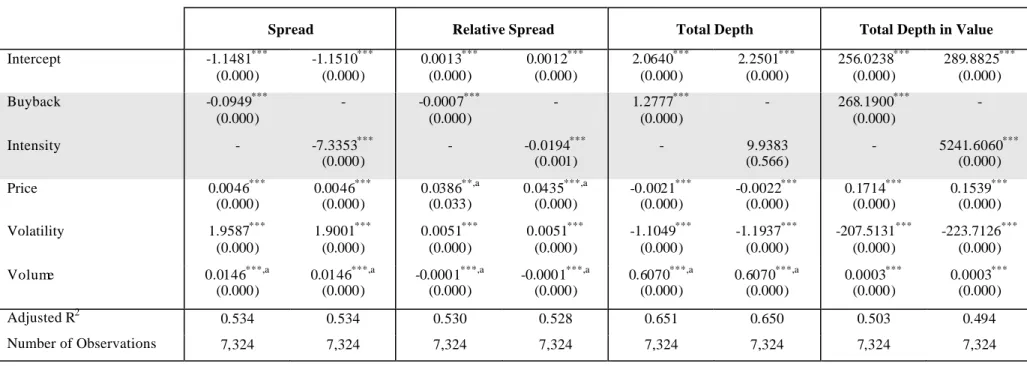
To study the liquidity effects of actual buybacks on the first trading line, we compile bid-ask spread and depth measures using trade and quote data over a 21- month period from October 1, 2002 to June 30, 2004. Seventeen of our buyback programs occurred during this period. We collect detailed intraday data for this subset of firms from the Bloomberg financial information network. For each firm over each trading day, we obtain the median measures across all trades on four liquidity variables: bid-ask quoted spread, relative bid-ask quoted spread, total depth in number of shares, and total depth in value. Bid-ask quoted spread is the difference between the lowest ask price and highest bid price. Relative bid-ask quoted spread is the quoted spread divided by the bid-ask midpoint. Total depth is the number of shares offered at the highest bid price plus the number of shares offered at the lo west ask price. Total depth in value is the number of shares at the bid and ask multiplied by their respective prices. Following prior research, we also use price, volatility and volume as control variables in our analysis. Price is the median transaction price across all trades during the day, volatility is the intraday volatility of trade-by-trade logarithmic returns across all trades, and volume is the daily trading volume in number of shares.
We examine the liquidity effects using the following regression:
Liquidityi,t = α + β Buybacki,t + δ1 Pricei,t +δ2 Volatilityi,t +δ3 Volumei,t + ei,t (12)
where Liquidity represents alternatively the bid-ask quoted spread, relative bid-ask quoted spread, total depth in number of shares, and total depth in value. As in the Volume regression above, we also use the Intensity variable in replacement of the Buyback variable. Table 7 presents the OLS parameter estimates and associated p- values for Equation (12). When the explained variable is Spread or Relative Spread, the estimated coefficient associated with the
Buyback dummy variable or the Intensity variable is negative and highly significant. This suggests that the spreads on the first trading line tend to be smaller when the company
repurchases on the second trading line. When the explained variable is Total Depth or Total Depth in Value, the estimated coefficient associated with the Buyback dummy variable or the
Intensity variable is positive and highly significant. This result also indicates that buyback activity on the second trading line have a beneficial effect on the firm liquidity on the first trading line. Furthermore, the estimated coefficients on the control variables have generally the expected sign. In particular, higher volumes are associated with higher firm liquidity and higher volatility is associated with lower liquidity. Furthermore, as expected, price is positively correlated with spread and depth measures that are expressed in value.
< Insert Table 7 >
Results presented in Tables 6 and 7 are clear and unambiguo us evidence that repurchases on second trading lines improve the liquidity of the repurchasing firms. We find that when one controls for the key variables affecting stock liquidity, trading volumes and total depth on the first trading lines tend to be higher on repurchase days and bid-ask spreads tend to be smaller on repurchase days. Our results are consistent with the presence of arbitrageurs taking simultaneous positions on both market segments. The evidence is also supportive of the beneficial impact on market liquidity resulting from new investors entering the market in reaction to the firms’ actual repurchases.
6. Conclusion
This paper studies a unique buyback method allowing firms to reacquire shares on a separate trading line where only the firm is allowed to buy shares. This temporary trading platform is opened concurrently with the original trading line on the stock exchange. This method is called the Second Trading Line and has been extensively used by Swiss companies since 1997. We theoretically derive the buyback participation rules for every type of stock market participant and we show that it is never optimal for an individual investor to sell her shares on a second trading line. Using actual repurchase data from all buyback programs implemented through a second trading line on the Swiss stock market, we find that managers exhibit buyback implementation skills for the majority of programs. We also report that the daily repurchase decision is statistically associated with short-term price changes. In particular, we find that firms increase repurchasing in days following price drops and in advance of price