How to Increase Student Retention in MBA Programs
with an Online Element?
Nitza Geri Orr Mendelson David Gefen
[email protected] [email protected] [email protected] The Department of
Management and Economics & Chais Research center
for the Integration of Technology in Education The Open University of Israel
Faculty of Management Tel-Aviv University & The Department of Management
and Economics The Open University of Israel
Management Department LeBow College of Business Drexel University, Philadelphia
Increasing retention in MBA programs and having the students recommend it to others is crucial for the ongoing financial success of these programs. E-learning has been proposed as one way of doing so and many universities are investing heavily in improving the website quality of their courses. This study probes the effectiveness of these investments, examining how various aspects of the online learning experience contribute to and compare with overall satisfaction with the learning assistance quality at the websites.
The data, collected from MBA students who participated in a blended distance learning MBA program which included online courses as an integral part of the program support the model, shows that the most important thing to influence both retention and recommendations was overall satisfaction with the quality of the learning tools. The quality of the auxiliary technical, teaching, and communication services of the websites contributed to the quality of learning but did not contribute to retention or recommendation. This was so, even after controlling for the students’ grades and their inclination to stay or leave the MBA program. The indirect contribution of satisfaction with e-learning tools highlights the importance of the teaching aspects also in blended online MBA courses, and shows the mostly background influence of the technology itself.
Introduction
E-learning is a growing phenomenon. It is a social process which substitutes both distance learning and traditional face-to-face education (Alavi & Leidner, 2001; Hiltz & Turrof, 2005). MBA programs seem natural candidates for e-learning due to the flexibility they offer in terms of time and place of learning, which suits the students who usually work full time and study for practical reasons. Furthermore, E-learning is perceived as increasing student satisfaction in general and especially in distance learning environments (Simpson, 2003; Levy, 2007). Online interaction is supposed to overcome the "loneliness of the long-distance learner" (Eastmond, 1995) problem and increase retention (Guri-Rosenblit, 2005). Nevertheless, student dropout is a major concern in distance education (Rovai, 2002; Tresman, 2002), as well as the quality of e-learning (Hirschheim, 2005).
Many universities are investing heavily in improving the website quality of their courses. This study probes the effectiveness of these investments, and examines whether distance learning tools are prone to the phenomenon called "the productivity paradox of information technology" (Brynjolfsson 1993; Brynjolfsson & Hitt 1998). This debate has resurfaced lately with the claim that "IT doesn't matter" (Carr 2003), meaning that information technology (IT) cannot provide organizations with a competitive advantage. Although IT researchers and practitioners mostly reject the productivity paradox assertion, still there are many IT projects that fail to provide their expected benefits (Geri, 2006, pp. 153-163). E-learning effectiveness research examines issues such as the effect of e-learning on the learning process (Hiltz & Turoff, 2002), technology adoption and continuance of use, and learners' satisfaction with online activities (Levy, 2006). It also compares alternative distance learning environments (Alavi et al., 2002; Rovai & Jordan, 2004). This study, in contrast, takes a managerial perspective and so analyses the impact of e-learning on student retention and loyalty, arguably the critical managerial objectives of any MBA program. Surveying MBA students who participated in a blended distance learning MBA program which included online courses as an integral part of the program, this study examines the impact of various aspects of the online learning experience on student retention and loyalty. Loyalty is defined as the willingness to recommend the program.
The Research Model and Hypotheses
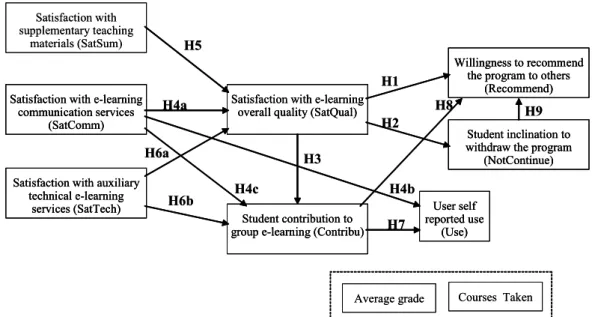
The proposed research model, outlining the influence of e-learning on student retention is presented in figure 1.
Figure 1: The Proposed Research Model Satisfaction with supplementary teaching materials (SatSum) H5 CONTROL VARIABLES Courses Taken Average grade
Satisfaction with e-learning communication services
(SatComm)
Satisfaction with auxiliary technical e-learning
services (SatTech)
Student contribution to group e-learning (Contribu)
User self reported use
(Use)
Student inclination to withdraw the program
(NotContinue) Satisfaction with e-learning
overall quality (SatQual)
Willingness to recommend the program to others
(Recommend) H3 H6b H6a H4b H4c H4a H7 H8 H9 H1 H2 Satisfaction with supplementary teaching materials (SatSum) H5 CONTROL VARIABLES Courses Taken Average grade
Satisfaction with e-learning communication services
(SatComm) Satisfaction with e-learning
communication services (SatComm)
Satisfaction with auxiliary technical e-learning
services (SatTech) Satisfaction with auxiliary
technical e-learning services (SatTech)
Student contribution to group e-learning (Contribu)Student contribution to group e-learning (Contribu)
User self reported use (Use) User self reported use (Use) Student inclination to withdraw the program
(NotContinue) Student inclination to withdraw the program
(NotContinue) Satisfaction with e-learning
overall quality (SatQual) Satisfaction with e-learning
overall quality (SatQual)
Willingness to recommend the program to others
(Recommend) Willingness to recommend
the program to others (Recommend) H3 H6b H6a H4b H4c H4a H7 H8 H9 H1 H2
Online courses are expected to increase student retention in distance learning, and one key to increasing this retention should be the interactivity with the course team, as well as among students (Simpson, 2003, pp. 128-130).
H1: Satisfaction with the overall quality of e-learning tools increases student willingness to recommend the program to others.
H2: Satisfaction with the overall quality of e-learning tools decreases student inclination to withdraw the program.
H3: Satisfaction with the overall quality of e-learning tools increases student participation and contribution to group e-learning.
Student satisfaction with particular e-learning tools should positively influence their satisfaction with the overall quality of e-learning tools. These tools were divided to three constructs (see appendix 1): • Satisfaction with e-learning communication services (SatComm) which enable improved
communication of students with course teams and classmates.
• Satisfaction with supplementary teaching materials (SatSum), which the course coordinator decides on their extent and content. This can be viewed as a replacement of printed material, and it does not involve learning, just one-way information exchange.
• Satisfaction with auxiliary technical e-learning services (SatTech), which include optional activities that enhance the learning process or interaction among students, and represent more advanced use of e-learning.
Accordingly, we propose the following:
H4a: Satisfaction with e-learning communication services increases student satisfaction with the overall quality of e-learning tools.
H4b: Satisfaction with e-learning communication services intensifies student self reported use of course websites.
H4c: Satisfaction with learning communication services increases student contribution to group e-learning.
H5: Satisfaction with e-learning supplementary teaching materials increases student satisfaction with the overall quality of e-learning tools.
H6a: Satisfaction with auxiliary technical e-learning services increases student satisfaction with the overall quality of e-learning tools.
H6b: Satisfaction with auxiliary technical e-learning services increases student contribution to group e-learning.
Moreover, students who actively engage in e-learning are expected to use the course websites more extensively and also to be more loyal to the program.
H7: Contribution to group e-learning intensifies student self reported use of course websites.
H8: Contribution to group e-learning increases student willingness to recommend the program to others.
Finally, our last hypothesis relates to the link between loyalty and retention:
H9: Student inclination to withdraw the program reduces student willingness to recommend the program to others.
The following control variables were added to the model: • The student average grade.
• The student inclination to withdraw the program was controlled for the number of successfully completed courses.
Methodology
The research model was tested with a sample of students enrolled in the MBA program at the Open University of Israel. This distance learning institute offers its students the choice of a fully distance learning model or a blended model which combines face-to-face meetings with traditional means of distance education such as books and study guides, as well as online support through course websites. The MBA program, which started offering courses in October 2002, accepts applicants with an average undergraduate GPA of 80 or above out of 100. Candidates from other disciplines are required to take up to six supplementary courses, and complete these with an average grade of 75 or above. Toward the end of 2005, about 5,000 people were accepted into the program. The survey concentrated only on those students who were enrolled in at least one course of the MBA program (i.e. excluding those who were still studying just supplementary courses) in the spring of 2006.
A preliminary questionnaire was reviewed by three course coordinators, slightly adjusted and then answered by 44 students. The pilot results were presented at a Chais Research Center seminar at the Open University (Geri et al., 2005). Following the feedback analysis, the questionnaire was refined. The data were collected by an online survey from 520 students, out of the 1,916 students enrolled in the Open University MBA program courses, who were contacted by email (27.1% response rate) in April 2006. Non response bias was assessed by comparing the 390 early respondents and the remaining 130 who responded only after a reminder email was sent to them based on Armstrong and Overton (1977). The MANOVA comparing the answers to all the questions in the model between these two groups showed an insignificant difference (Wilks’ Lambda =.798, F=1.157, p=.172). There were no gender or age differences in the model. The items are shown in Appendix 1.
Results
Table 1 presents demographic characteristics of the 520 MBA program students who answered the survey. As shown in table 1, it took 80.4% of the students up to an hour to arrive at class, and 77.5% of them chose to attend most or all of the class meetings.
Table 1: Demographic Characteristics of Survey Participants Men Women Gender 50.8% 49.2% Below 21 21-25 26-30 31-35 36-40 41-50 Over 50 Age - 3.7% 32.9% 34.0% 14.0% 12.7% 2.7% Less than an hour 1-3 hours 4-7 hours 8-10 hours 10-15 hours 15-20 hours Over 20 hours
Average weekly study time during the
semester 5.4% 34.4% 35.0% 14.4% 6.7% 3.7% 0.4%
Less than 30
minutes 30-60 minutes 1-1.5 hours
more than 1.5 hours
live abroad
Average time required to arrive at class
32.3% 48.1% 11.7% 4.6% 3.3%
None 1-2 meetings 3-4 meetings 5-6 meetings Attended all meetings
Number of average attended class
meetings per course 5.8% 7.7% 9.0% 20.4% 57.1%
None 1-3 courses 4-6 courses 7-9 courses 10-12 courses
Over 12 courses
Number of completed courses (15 courses
required for an MBA) 17.5% 26.0% 18.8% 15.0% 11.2% 11.5%
just started
Less than
70 70-75 76-80 81-85 86-90 91-95 96-100
Average MBA grade
18.1% .4% 6.7% 19.0% 28.9% 20.2% 5.2% 1.5%
We used partial least square (PLS-Graph 3.00 Build 1126) to analyze the data. PLS is a structured equation modeling method that analyzes how the items load on their constructs simultaneously with estimating all the paths in the model. PLS is widely used in MIS research. PLS estimates all paths, loadings, the Average Variance Extracted (AVE) of principal constructs, and construct reliability. Convergent and discriminant validity are shown when each item loads much higher on its assigned factor than on any other factor and when the square root of the AVE of each construct is much larger than the correlation of that construct with all other constructs (Chin, 1998; Chin, et al., 2003; Gefen, et al., 2000; Gefen & Straub, 2005). Item loadings are shown in Appendix 2. The mean, standard deviation, and PLS reliability together with the correlation among the constructs and their square root of the AVE are shown in Appendix 3. All these psychometric measures are above the suggested thresholds (Gefen, et al. 2000).
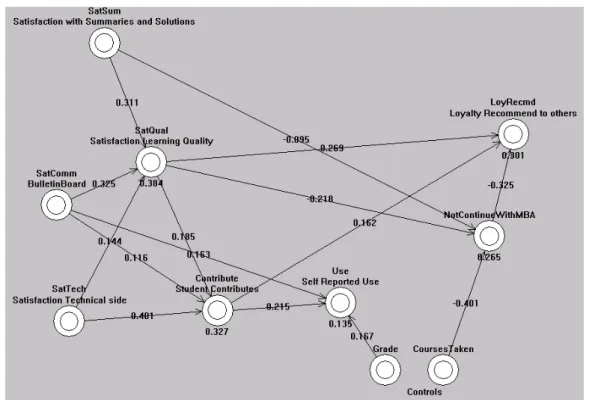
All the items loaded significantly on their assigned constructs. The standardized PLS path coefficients are presented in figure 2, which shows that the most important thing to influence both retention and recommendations was overall satisfaction with the quality of the learning tools, even after controlling for the inclination of the student to stay or leave the MBA program and grade. This satisfaction was increased by better communication with the course teams through online bulletin boards and forums, instructor summaries, and enhanced technical aspects of the course websites. These technical aspects also increased student contribution to the online discussions, and hence also to their use of the online environment. All the other paths among pairs of constructs were insignificant. A possible direct
influence of the three e-learning constructs (SatSum, SatComm and SatTech) on continuity and willingness to recommend the program was also examined and shown to be insignificant. The coefficient of each path is shown on the line and the R squared below each construct. All these paths are significant at least at the .05 level.
Figure 2: PLS Results of the Proposed Research Model
Discussion and conclusion
Retention, loyalty, and self reported use were all significantly affected by overall e-learning quality (SatQual). The effect of auxiliary technical services (SatTech) was less than both supplementary teaching materials (SatSum) and communication services (SatComm). The latter two are basically enhancement of face-to-face learning and information exchange (Salmon, 2004, pp. 24-50). As expected, students who were more sophisticated and active in their use of e-learning reported higher levels of course websites use. Most importantly, these students were more willing to recommend the MBA program to others. The practical implications are twofold. First, it is recommended to nurture an online environment which encourages student contribution. Second, the program should seek appropriate channels to amplify the impact of these students' loyalty.
As Simpson (2003, p. 15, and p. 140), citing Woodley, says "Student dropout… is a multi-causal problem that requires multiple partial solutions" (Woodley, 1987). So even though our findings indicate that those who are satisfied with e-learning quality are less inclined to withdraw from the MBA program, students may still quit due to other more profound reasons (Tinto, 1975). The unique contribution of this study is in its empirical validation of the link between e-learning quality and
student willingness to recommend the program to others, which is crucial to ensure future student enrollment. The indirect contribution of satisfaction with e-learning tools to student retention, highlights the importance of the teaching aspects also in blended and online MBA courses, and shows the mostly background influence of the technology itself.
Acknowledgement: The authors gratefully acknowledge the support and partial funding of this research by the Chais Research Center for the Integration of Technology in Education, The Open University of Israel.
References
Alavi, M., & Leidner, D. E. (2001). Research commentary: Technology mediated learning - a call for greater depth and breadth of research. Information Systems Research, 12(1), 1-10.
Alavi, M., Marakas, G. M., & Yoo, Y. (2002). A comparative study of distributed learning environments on learning outcomes. Information Systems Research, 13(4), 404-415.
Armstrong, J. S., & Overton, T. S. (1977). Estimating nonresponse bias in mail surveys. Journal of Marketing Research, 14 (August), 396-402.
Brynjolfsson, E. (1993). The productivity paradox of information technology. Communications of the ACM, 36(12): 67-77.
Brynjolfsson, E. and Hitt, L. M. (1998). Beyond the productivity paradox. Communications of the ACM, 41(8): 49-55.
Carr, N. (2003). IT doesn’t matter. Harvard Business Review, 81(5): 5-12.
Chin, W. W. (1998). Issues and opinions on structural equation modeling. MIS Quarterly, 22(1), 7– 16.
Chin, W. W., Marcolin, B. L., & Newsted, P. R. (2003). A partial least squares latent variable modeling approach for measuring interaction effects: Results from a Monte Carlo simulation study and an electronic mail adoption study. Information Systems Research, 14(2), 189–217.
Eastmond, D. V. (1995). Alone but Together: Adult Distance Study through Computer Conferencing. Cresskill, NJ: Hampton Press.
Gefen, D., & Straub, D. W. (2005). A practical guide to factorial validity using PLS-graph: Tutorial and annotated example. Communications of the AIS, 16(5) 91–109.
Gefen, D., Straub, D. W., & Boudreau, M. C. (2000). Structural equation modeling and regression: Guidelines for research practice. Communications of the AIS, 4(7), 1-78. http://www.cis.gsu.edu/~dstraub/Papers/Resume/Gefenetal2000.pdf
Geri, N. (2006). Selected Topics in Economics of Information Goods. Raanana, Israel: The Open University of Israel (Hebrew).
Geri, N., Gefen, D., & Mendelson, O. (2005). Probing the influence of e-learning tools on student retention in the MBA program. Presented at a Research in Action seminar, Chais Research Center for the Integration of Technology in Education, The Open University of Israel, December 26, 2005.
Guri-Rosenblit, S. (2005). Eight paradoxes in the implementation process of e-learning in higher education. Higher Education Policy, 18(1), 5-29.
Hiltz, S. R., & Turoff, M. (2002). What makes learning networks effective?. Communications of the ACM, 45(4), 56-59.
Hiltz, S. R., & Turoff, M. (2005). Education goes digital: The evolution of online learning and the revolution in higher education. Communications of the ACM, 48(10), 59-64.
Hirschheim, R. (2005). The internet-based education bandwagon: Look before you leap. Communications of the ACM, 48(7), 97-101.
Levy, Y. (2006). The top 10 most valuable online learning activities for graduate MIS students. International Journal of Information and Communication Technology Education, 2(3), 27-44. Levy, Y. (2007). Comparing dropouts and persistence in e-learning courses. Computers & Education,
45(2), 185-204.
Rovai, A. P. (2002). Building sense of community at a distance. International Review of Research in Open and Distance Learning, 3(1),
www.irrodl.org/index.php/irrodl/article/viewPDFInterstitial/79/153.
Rovai, A. P., Jordan, H. (2004). Blended learning and sense of community: A comparative analysis with traditional and fully online graduate courses. International Review of Research in Open and Distance Learning, 5(2), http://www.irrodl.org/index.php/irrodl/article/view/192/274.
Salmon, G. (2004). E-Moderating: The Key to Teaching and Learning Online (2nd ed.). London, UK: RoutledgeFalmer, Taylor and Francis Group.
Simpson, O. (2003). Student Retention in Online, Open and Distance Learning, London and Sterling, VA: Kogan Page.
Tinto, V. (1975). Dropout form higher education: A theoretical synthesis of recent research. Review of Education Research, 45(1), 89-125.
Tresman, S. (2002). Towards a strategy for improved student retention in programmes of open, distance education: A case study from the Open University UK. International Review of Research in Open and Distance Learning, 3(1). http://www.irrodl.org/index.php/irrodl/article/view/75/544
Woodley, A. (1987). Understanding adult student dropout. In Thorpe, M. and Grugeon, D. (eds) Open Learning for Adults, pp. 110-124. Harlow UK Longman Open Learning.
Appendix 1: Survey Items
SATQUAL
This is the overall quality of the websites in providing learning assistance.
E1 The Course websites help me overcome difficulties with my studies
םיסרוקהירתא לערבגתהלילםירזוע
םידומילבםיישק E1
E2 So far, I am satisfied with the usefulness of the course websites
תלעותהמהצורמ ינא הכדעיתקפהש
םיסרוקהירתאמ E2
E3 I am satisfied with the level of learning support provided by the course websites
תמרמ הצורמ ינא ירתא לש הכימתה
הדימלבםיסרוקה E3
E4 the course websites enrich my learning experience םיסרוקהירתא
היווחה תא םירישעמ
ילשתידומילה E4
E5 I was disappointed with the service provided by the course websites תורישהמ יתבזכאתה םיקפסמ םתוא ירתא םיסרוקה E5
A4.1 3 The academic level of the course websites' content is adequate
המרב אוה םיסרוקה ירתא ןכות התואנתימדקא A4.1
A4.2 The Information provided in the course websites is accurate
קיודמםיסרוקהירתאבעדימה A4.2
A4.3 The content of the course websites is reliable ןימאםיסרוקהירתאבןכותה
A4.3 SATTECH
Auxiliary technical services provided by the websites.
E6.02 Discussion board group activities level of contribution to learning
דומיללהמורתהתמר תולעפהלש
םורופבתויתצובק E6.02
E6.03 Links to other websites level of contribution to learning
דומיללהמורתהתמר תוינפההלש
םירחאםירתאל E6.03
E6.04 Glossary of course terms level of contribution to learning
דומיללהמורתהתמר ןולימלש
םיחנומה E6.04
E6.07 Electronic reader level of contribution to learning דומילל המורתה תמר
הארקמה לש
תינורטקלאה E6.07
E6.10 Personal notepad level of contribution to learning דומיללהמורתהתמר
ישיאהסקנפהלש E6.10
E6.13 Current newspaper articles examples level of contribution to learning
דומיללהמורתהתמר תובתכלש
רתאבתועיפומהםינותיעהמ E6.13
E6.15 Course instant messaging tool level of contribution to learning דומיללהמורתהתמר צהלש ' טא E6.15 SATSUM
Auxiliary teaching services provided by the websites.
E6.05 Sample exams level of contribution to learning תהתמר
דומיללהמור תוניחבהלש
אמגודל E6.05
E6.06 Task solutions level of contribution to learning דומיללהמורתהתמר
תונורתפהלש
תולטמל E6.06
E6.08 Meeting summaries and presentations level of contribution to learning דומיללהמורתהתמר םימוכיסלש םישגפממתוגצמו E6.08 SATCOMM
This construct measures student satisfaction with the auxiliary communication services provided by the websites.
E6.01 Bulletin board level of contribution to learning המורתהתמר
תועדוההחוללשדומילל E6.01
E6.09 Discussion board level of contribution to learning דומיללהמורתהתמר
ןוידהתצובקלש E6.09
Contribute
This construct measures self reported student contribution levels to various types of online class discussions.
B4.1 When I could contribute to the discussion, I responded to other students' messages at the course forum
םורתליתלוכישכ ןוידל , יתמשר לשתועדוהלםורופבתובוגת םירחאםיטנדוטס B4.1
B4.2 The course websites enable me to contribute knowledge to my colleagues and vice versa םיסרוקהירתא
ילםירשפאמ
יתימעלילשעדיהמםורתל ךפיהלו
B4.2
B4.3 the experience I gained in using course websites enables me to initiate group activities at the website יתרבצשןויסינה ירתאבשומישב תוליעפםוזילילרשפאמםיסרוקה רתאבתיתצובק B4.3 Use
This construct measures self reported student use of the websites.
A6.1 Frequency of MBA websites visits ילשהסינכהתורידת יסרוקירתאל ה -MBA איה : A6.1
A6.3 Frequency of course discussion board visits ירתאבםורופלךתסינכתורידת
םיסרוקה
:
A6.3
Retention
This construct measures student intention to LEAVE the program
K1.1 I will probably successfully complete the MBA studies החלצהבםייסאשיאדוולבורק תא הידומיל -MBA K1.1
K1.2 I will probably continue the MBA studies in another institute תאךישמאשהארנכ הידומיל -MBA רחאדסומב K1.2
K1.3 I will probably have to quit the MBA studies ץלאאשיאדוולבורק תאקיספהל הידומיל -MBA K1.3 Recommendations
This construct measures whether the student will recommend the program to others
K2.1 I will recommend the Open University MBA program to others תינכותלעץילמא ה -MBA לש םירחאלהחותפההטיסרבינואה K2.1 (Loyalty)
K2.2 I will encourage others to study in the Open University MBA program
דומללםירחאדדועא תינכותב ה -MBA החותפההטיסרבינואהלש K2.2 (Loyalty)
K2.3 If my friends were looking for an MBA program, I would recommend the Open University MBA program ושפחיירבחםא ינכות ת MBA תינכותלעםהלץילמא החותפההטיסרבינואה K2.3 (Word of mouth)
Appendix 2: Convergent and Discriminant Analysis
Recomm
end
Continue Use SatQual Sa
tT
ec
h
SatSum Contribute SatComm
K2.1 I will recommend the Open University MBA
program to others 0.98 -0.40 0.09 0.44 0.26 0.24 0.29 0.22
K2.2 I will encourage others to study in the Open
University MBA program 0.98 -0.40 0.08 0.43 0.27 0.24 0.29 0.22
K2.3 If my friends were looking for an MBA program, I
would recommend the Open University MBA program 0.97 -0.42 0.10 0.40 0.26 0.23 0.29 0.24 K1.1 I will probably successfully complete the MBA
studies 0.39 -0.82 0.03 0.27 0.12 0.22 0.13 0.16
K1.2 I will probably continue the MBA studies in
another institute -0.34 0.83 -0.06 -0.26 -0.05 -0.22 -0.01 -0.15
K1.3 I will probably have to quit the MBA studies -0.31 0.87 -0.02 -0.23 -0.09 -0.23 -0.05 -0.19 A6.1 Frequency of MBA websites visits 0.08 -0.02 0.82 0.20 0.12 0.09 0.18 0.19 A6.3 Frequency of course discussion board visits 0.08 -0.05 0.92 0.20 0.13 0.09 0.28 0.28 A4.1 The academic level of the course websites' content
is adequate 0.38 -0.30 0.15 0.78 0.30 0.39 0.26 0.39
A4.2 The Information provided in the course websites is
accurate 0.34 -0.27 0.12 0.69 0.21 0.39 0.20 0.33
A4.3 The content of the course websites is reliable 0.30 -0.29 0.12 0.72 0.23 0.35 0.21 0.36 E1 The Course websites help me overcome difficulties
with my studies 0.28 -0.12 0.16 0.76 0.38 0.36 0.41 0.42
E2 So far, I am satisfied with the usefulness of the
course websites 0.30 -0.22 0.21 0.78 0.33 0.44 0.34 0.46
E3 I am satisfied with the level of learning support
provided by the course websites 0.32 -0.23 0.20 0.83 0.30 0.40 0.39 0.43 E4 the course websites enrich my learning experience 0.39 -0.14 0.24 0.75 0.39 0.36 0.41 0.42 E5 I was disappointed with the service provided by the
course websites -0.24 0.25 -0.11 -0.61 -0.16 -0.33 -0.10 -0.21
E6.02 Discussion board group activities level of
contribution to learning 0.15 -0.02 0.17 0.33 0.72 0.30 0.45 0.31
E6.03 Links to other websites level of contribution to
learning 0.22 -0.15 0.15 0.32 0.76 0.26 0.38 0.36
E6.04 Glossary of course terms level of contribution to
learning 0.21 -0.15 0.08 0.32 0.70 0.37 0.33 0.33
E6.07 Electronic reader level of contribution to learning 0.23 -0.14 0.07 0.30 0.69 0.38 0.28 0.22 E6.10 Personal notepad level of contribution to learning 0.14 0.08 0.02 0.09 0.57 0.07 0.32 0.19 E6.13 Current newspaper articles examples level of
contribution to learning 0.23 -0.12 0.10 0.29 0.72 0.32 0.36 0.27
E6.15 Course instant messaging tool level of
contribution to learning 0.11 0.05 0.06 0.20 0.63 0.12 0.35 0.20
E6.05 Sample exams level of contribution to learning 0.21 -0.25 0.07 0.47 0.26 0.89 0.21 0.32 E6.06 Task solutions level of contribution to learning 0.19 -0.18 0.11 0.43 0.28 0.87 0.22 0.39 E6.08 Meeting summaries and presentations level of
contribution to learning 0.20 -0.24 0.09 0.37 0.48 0.74 0.28 0.37
B4.1 When I could contribute to the discussion, I
responded to other students' messages at the course forum 0.25 -0.11 0.31 0.24 0.38 0.20 0.81 0.31 B4.2 The course websites enable me to contribute
knowledge to my colleagues and vice versa 0.25 -0.06 0.19 0.44 0.44 0.32 0.82 0.39 B4.3 the experience I gained in using course websites
enables me to initiate group activities at the website 0.21 -0.02 0.14 0.27 0.44 0.13 0.77 0.17 E6.01 Bulletin board level of contribution to learning 0.22 -0.10 0.15 0.38 0.33 0.27 0.30 0.81 E6.09 Discussion board level of contribution to learning 0.19 -0.22 0.30 0.49 0.36 0.44 0.34 0.89
Appendix 3: Mean, Standard Deviation, and PLS reliability together with the correlation among the constructs and their square root of the AVE
M
ean Deviation Standard Reli PLS
ab ili ty Recomm end Not
Continue Use SatQual Sa
tT
ec
h
SatSum Contribu Course
s
Taken SatComm Grade
Recommend 4.920 1.764 .98 .978 Not C i 1.883 1.140 .88 -0.419 .840 Use 3.414 0.939 .87 0.093 -0.042 .875 SatQual 5.605 0.943 .91 0.432 -0.301 0.225 .743 SatTech 3.849 1.261 .86 0.270 -0.105 0.147 0.398 .685 SatSum 6.240 0.995 .87 0.243 -0.268 0.104 0.508 0.395 .837 Contribute 3.774 1.476 .84 0.298 -0.082 0.270 0.404 0.521 0.279 .799 Courses T k 3.11 1.608 Single 0.064 -0.435 0.082 0.087 -0.005 0.157 0.045 1.000 SatComm 5.322 1.324 .84 0.231 -0.197 0.275 0.517 0.402 0.429 0.373 0.107 .852 Grade 3.29 1.855 Single 0.048 -0.261 0.190 0.170 -0.005 0.189 -0.039 0.544 0.191 1.000