Influence of the Implementation of the Performance-Based
Budgeting on the Performance Accountability of the Regional
Government Institutions (Study at the City Goverment of Banda
Aceh)
Jalaluddin Muslim A Djalil* Rahmah Maulana
Accounting Dept, Faculty of Economics and Business,Universitas Syiah Kuala, Banda Aceh, Indonesia
Abstract
This study aims to determine the influence of the performance-based budgeting implementation on performance accountability of local government institutions in the city of Banda Aceh, either simultaneously or partially. Using a census method as a collecting data instrument, the researcher takes all working units of the city goverment of Banda Aceh as the research population. It is therefore selects entire 38 working units with 114 respondents. The analytical method used in this research is multiple regression analysis with a SPSS software as a software tool for data processing. The results of this study indicated that the implementation of performance-based budgeting has simultaneously positive influence on performance accountability of local government institutions in city of Banda Aceh.Indonesia
Keywords: Performance-Based Budgeting, Budget Planning, Budget Implementation, Reporting Budget and Accountability.
1.INTRODUCTION
Budget is a tool to control the performance of all the government units based on predetermined planning. Budgets are made because there is a need and desire of the public that grows over the years. The quality of budget is very crucial in achieving the goals that have been set to ensure that the government responsibility toward public.
Each organizational performance must be able to be measured and expressed its relevance to the achievement of the organization's direction in the future and should be expressed in the vision and mission of the organization. In a private organization, in some circumtances, budget are still keep secret in their implementation. However for the government organization, budget of importance to be known by the public to be evaluated, criticized, and given feedback in order to improve the performance of government agencies.
Law Number 32 of 2014 on Regional Governance and Law No. 33 of 2004 on Financial Balance between the Central and Local Government, provides a change in the area of regional financial management so that there will be a reform in the area of financial management. In addition to the changes in the regional financial management system, both laws have changed the accountability of local governments, from vertical accountability (to central government) to horizontal accountability (to the public through Parliament).
Performance-based budgeting is not a stand-alone concept, but part of a great reformation concept of how to maximize the public services through the systematic management and it does not simply focus on the internal processes of the organization. The implementation of Performance-Based Budgeting is considered successful, if the budget realization is maximally achieved and all the entire process carried out can be accounted to the public under stages of budget planning, budget execution, budget reporting, and performance evaluation to provide a process for assessing performance. The application of rigorous performance-based budgeting is a functional response to meet budget targets (Johansson and Siverbo, 2014). Thus, accountability for performance can be achieved in the real practice.
Public accountability is the provision of information and disclosure on the activities and financial performance of the government to the public. The government is required to increase the public accountability through the evaluation and provision of information to the public (Aikins, 2011). So the disclosure of financial information is provided to meet the right of the society, the right to obtain information, right to give aspirations, rights to be given an explanation, and the right to demand accountability.
There are several studies that tested the effects of performance-based budgeting to performance accountability of government agencies, including the research done by (Haspiarti, 2012), who found that the budget planning and budget reporting affect the performance accountability of government agencies. While the budget implementation and performance evaluation does not affect the performance accountability of government agencies. On the other hand, a research conducted by (Lester, 2014) found budget planning, budget execution, reporting budget, and performance evaluation has a significant effect on performance accountability of government agencies.
Based on the phenomena above, it needs to deeply investigate the influence of the performance based budget implementation on organizational performance accountability particularly in public sector or
govermental agency.
2.LITERATURE REVIEW 2.1 Performance-Based Budgeting
Performance-based budgeting is one of the worldwide leading reforms which are also adopted by the developed countries like the United States for more than a decade now (Andrews, 2004). The outputs of the performance-based budgeting system are oriented to the organization outputs, and are closely related to the vision, mission and strategic plan of the organization (Bastian, 2007: 171).
Performance-based budgeting is a budgeting method used by management to associate each funding as outlined in the activities with outputs and results as it is expected, including the efficiency in achieving the results of the output itself (Kurniawan, 2009). Performance-based budgeting approach was established to address the existing weaknesses in traditionally used budget, in particular are due to the absence of benchmarks that normaly can be used to measure the performance in achieving the goals and objectives of public services. A budget with performance approach emphasizes the concept of value for money and the monitoring of performance output. This approach also prioritizes the mechanisms for determining and prioritizing objectives and the systematic and rational approach in decision-making process (Mardiasmo, 2002: 84). This includes dimensions of budget planning, budget execution, budget reporting, and evaluation of performance to represent their overall performance perceived (Yahya, et. Al, 2008).
2.2 Budget Planning
Budget planning is the selection of organizational goal and determination of strategies, policies, projects, programs, procedures, methods, systems, budgets and standards needed to achieve the goal (Handoko, 2003: 88). The planning stage is done by estimating the expenditure on the basis of estimated revenue available. Budget planning begins with the preparation of the strategic plan of the organization. Strategic planning is a process to determine the vision, mission, goals, and the organization's strategic objectives and establish strategies that will be used to achieve goals and objectives. Strategic planning made should be oriented to the wishes and needs of society as key stakeholders. In general, strategic plans generally have a period of a few years and the component at least contains the vision, mission, goals, objectives and strategies in the form of policies and programs to achieve them as well as providing performance indicators as a gauge of success or failure of a program (Friska, 2012).
The strategic plan is the process of deciding how to implement the strategy. Based on the strategic plan that are assigned annually are put into an annual performance plan. The performance plan is a further elaboration of the strategic plan which includes the entire performance indicators and targets to be achieved in one year. The performance plan is a benchmark that will be used to assess the success and failure of institutions in organizing government organizations for the annual period (Anthony 2005: 89).
Based on the performance plan, the institution plans the necessary budget to realize the results (outcomes) to be achieved in the current year. The budget prepared is the performance based budget because the performance in this budget can reflect the relationship between the financial aspects of all activities with strategic objectives and annual performance plan (Munandar, 2001: 11).
2.3 Budget Implementation
Implementation of the budget is the phase that involves the political process which is quite complicated and quite heavy. Executives are required not only for having the managerial skills, but also havingadequate political skills, salesman ship, and coalition building (Mardiasmo, 2005: 70). Therefore, the implementation of the budget should guarantee, adjust, adjudicate and the budget that will be implemented in accordance with the authority vested in both the finance and policy aspects. Key to the implementation of the budget in terms of accountability is tightening control of the government, in which the government is able to implement activities and capable to be agreed upon by the public. The decline in accountability will change the public's view of government (Stewart, 2014).
Proper budget implementation depends on many factors among which are the ability to cope with changes in the macroeconomic environment and the ability to execute work units. Implementation of the budget involves more people than in the preparations and consider feedback from actual experience (Yuniarto, 2012: 77). Implementation of performance-based budgeting is difficult to achieve the optimum without supported by the application of performance incentives and penalties for failing to achieve. The application of incentives in the public sector is not easy to implement because the application of the incentive system needs to be supported by non-financial mechanisms, particularly the desire and need for achievement performance. It can be grown for instance if there is a rule that the institutions that achieve good performance can take priority over the next budget even though the budget allocation has been determined by the priority policies and programs (Nabila, 2014).
2.4 Budget Report
Reporting is one of the management function in the form of provision of development or results of operations or the provision of information on all matters related to the duties and functions to the higher authorities (Gulick 1965). The information are both oral and written so that the receipt of the report can get a picture of how the implementation of the tasks of the person who gave the report. In addition, reporting is a record that provides information about the specific activities and the results communicated to the appropriate authorities or relating to certain activities (Siagian, 2014).
Reporting is an activity that is done by the staff to convey things that are related to the work that has been done during a specific period. Reporting is done to the superior to whom the subordinate is responsible. Reporting is an activity which is the opposite direction of supervision, if supervision is done by the supervisor to determine all matters relatedto the implementation of the work of subordinates, the reporting is the answer to the supervisory activities (Bastian, 2007: 112). ßThe report can accurately show the implementation and results as a consequence of the application of performance-based budgeting in doing so is also useful to utilize Fiji Quality Award as a framework for performance-based budgeting. It is used as a basis for evaluating performance and quality of government performance (Hoque, 2002).
2.5 Performance Evaluation
The performance evaluation is a measuring tool to determine the realization, progress and constraints encountered or the reasons for not achieving the performance of achieving the mission that has been planned. In this sense, the institutions can be expected to improve its performance in the future (Julianto, 2010). So the programs that are good when it was evaluated can receive additional funding, while the poor evaluated program should receive a reduction of fund in the upcoming years (Zamfirescu and Zamfirescu, 2013).
The performance evaluation is also an objective and systematic process while collecting, analyzing and using the information to determine how effective and efficient the services implemented by government either or not it has achieved the goals and objectives that have been set. A consequence of performance-based budgeting that links the strategic planning (contained in the program) with budgeting (embodied in the activities that are carried out) is an obligation to determine the programs and activities clearly (Nordiawan, 2006: 109). Performance evaluation is aimed to reveal the realization, progress and obstacles encountered in achieving the mission, to be assessed and studied for the improvement of the implementation of activities in the future. Performance evaluation conducted on the analysis of efficiency by comparing the output with input both for planning and their realization (Halim, 2002: 57).
The performance evaluation has been able to develop well, so the contract of the performance can start to be implemented. Government, can carry on the contract on the achievement of the performance with the other technical. However, a performance contract system must be supported by a clear definition of the services contracted and authority exist for the unit's performance in managing existing resources. Those criteria can be achieved when public finance management reforms have created conditions that can increase the desire and need for achievement of the performance (Taufiqurrahman, 2014). In evaluating the performance of public sector it is important to provide transparency in estimating the budget that has been achieved (Kossova and Sheluntcova, 2015).
2.6 Accountability
Accountability is the embodiment of one's or organizational duties to take responsibility of management and control of resources and the implementation of policies entrusted in order to achieve the goals or objectives that have been set out in plans periodically (Bastian, 2007: 99). To ensure accountability, each fund must be established by a specific division that has enough power to be responsible in accordance with the target. In order the flexibility with reference to the performance report and work plan. Moreover, they should monitor the staff in order to increase accountability in the achievement of an estimated target of its activities (Marshalleck and Lehan, 2006). In order for the implementation of performance accountability system to be more effective for government institutions, strong commitment from the organization that has the authority are needed and is responsible for the supervision and assessment of performance accountability of government agencies (Putra, 2010).
Accountability of government institutions is the obligation of an employee, agent, or other person to prepare a satisfactory report, often periodic, of any action or failure following the authority. Therefore, government accounting, designation account or the number of officers who are responsible for it. The size of the responsibilities or other obligations is expressed in term of money, property unit, or any other that has been determined. Liabilities proven by good management, control or other performance imposed by law, regulation, agreement or custom (Cooper and Ijiri, 1984: 7).
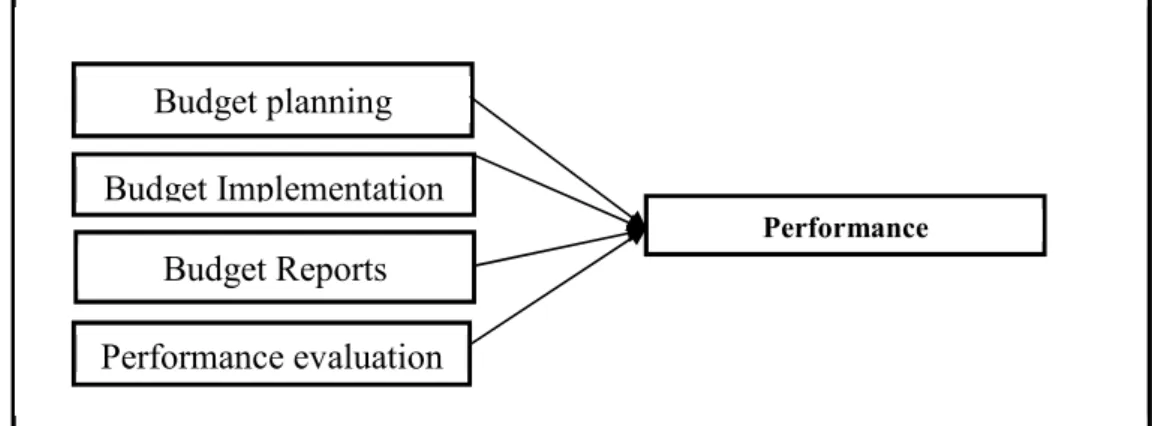
The effect of adoption of a performance-based budgeting on the performance accountability of government agencies which are measured through the stages of the budget cycle in accordance with the principle
of accountability in regional financial management, starting from budget planning, budget execution, reporting budget, and performance evaluation so that it will create better performance accountability of government agencies. This causal relationship between budget planning, budget implementation, budget report, and performance evaluation on performance accountability of regional govermance agency that are derived from various theoritical reviews can be formulated in a theoritical framework as shown in Figure 2.1 below:
Figure 2.1 Conceptual Framework
2.7 Hypothesis
Based on the theoretical basis and the framework which has been described above, the hypothesis of the study can be formulated as follows:
H1 Budget Planning, Budget Implementation, Budget Report and Performance Evaluation have a
simultaneous influence on the Performance Accountability of Government Agencies. H2 : Budget Planning has an influence on the Accountability of Government Performance. H3 : Budget Implementation has an influence on the Accountability of Government Performance. H4 : Budget Reporting has an influence on Government Performance Accountability.
H5 : Performance Evaluation has an influence on Accountability of Government Performance.
3.RESEARCH METHOD 3.1 Population and Sample
Population is the generalization area that consists of the objects / subjects that have certain qualities and characteristics defined by the researchers to be studied and then drawn conclusions (Sugiono, 2007). The population in this study are all Working Units in the city (SKPK) within the scope of the city government of Banda Aceh which account for 38 SKPD. The number of samples in this study are 76 respondents by using purposive sampling because the respondents selected only those that relates to the Local Government Budget Team (TAPD). Samples were heads of agencies, treasurer, and the staff in every SKPK Banda Aceh.
Based on the above criteria the total population and the sample in this study can be seen in table 3.1 below.
Budget planning
Budget Implementation
Budget Reports
PerformancePerformance evaluation
Tabel 3.1
List of Population and Sample Study at SKPKD
No Nama SKPD Jumlah Responden
1 The Regional Secretariat 3
2 Secretariat of the City House of Representatives 3
3 Secretariat of Baitul Mal (Islamic Charities) 3
4 Secretariat of the Assembly of Islamic Clerics 3
5 Customary Council Secretariat Aceh 3
6 Secretariat of the Regional Education Council 3
7 Department of Education, and Sports 3
8 Public health Office 3
9 Public Works Service 3
10 The Department of transportation, communication and informatics 3
11 Social and Labor Agency 3
12 Department of Population and Civil Registration 3
13 Department of Industry, Trade, Cooperatives and Small and Medium
Enterprise 3
14 Department of Marine, Fisheries and Agriculture 3
15 Department of culture and tourism 3
16 Department of Hygiene and City Beautification 3
17 Department of Islamic Sharia 3
18 Development Planning Agency at Sub-National Level 3
19 Regional Personnel, Education and Training Agency 3
20 Community Empowerment Board 3
21 National Unity Politics, Public Protection and Disaster Affairs 3
22 Office of Licensing Services 3
23 Office of Women's Empowerment and Family Planning 3
24 Office of Library and Archives 3
25 Office of fire department 3
26 Office of the Environment 3
27 Office of the Civil Service Police Unit and the Sharia Police 3
28 Inspectorate Office 3
29 Regional General Hospital Meuraxa 3
30 Regional Hospital for Mother and Child 3
31 Baiturrahman Sub-District 3
32 Kuta Alam Sub- District 3
33 Syiah Kuala Sub-District 3
34 Meuraxa Sub-District 3
35 Ulee Kareng Sub-District 3
36 Lueng Bata Sub-District 3
37 Banda Raya Sub-District 3
38 Jaya Baru Sub-District 3
Total 114
Source: LAKIP of Banda Aceh Year 2015
3.3 Sources and Data Collection Techniques
Source of data to be used in this research is the primary data in the form of respondents' answers to the items of questions contained in 5 (five) research instruments, i.e. the performance-based budgeting implementation as measured by four variables, namely (budget planning, budget execution, budget report, performance evaluation and performance accountability of government agencies.
The primary data is used, in the form of respondents’ perceptions on the variables used. Communication mode to obtain data from respondents in this study is that by using a questionnaire. A questionnaire contains a number of questions that will be distributed to the Local Government Budget Team (TAPD). Each questionnaire distributed to respondents accompanied by a written request for filling the questionnaire.
3.4 Operationalization of Variable 3.4.1 Dependent Variable
Accountability performance of government institution is the embodiment of the institution duties to take responsibility of the success and failure of the implementation of policies entrusted in achieving the goals or objectives that have been set out in plans periodically. Performance-based budgeting is a budgeted activities carried out by organizations that put more emphasis on the output (Komang et al., 2014).
Budget at government agencies is not only functioned as a means of planning and controlling tools, but also functioned as an instrument of public accountability for the management of public funds and the implementation of programs funded by public money as a means of public accountability (Bahri, 2012). The implementation of performance-based budgeting is expected for the budget prepared by the government can be realized well in accordance with the objectives and targets (Komang et al., 2014).
3.4.2 Independent Variable 3.4.2.1 Budget Planning
Budget planning is the phase that estimate the expenditures for carrying out the activities that must be in line with the vision, mission, goals, objectives, and policies that have been formulated in the strategic plan of the organization. Budget planning is the selection or organizational goal setting and determination of strategies, policies, projects, programs, procedures, methods, systems, budgets and standards needed to achieve the goal (Handoko, 2003: 88).
Strategic planning made should be oriented on the desires and needs of the society as core stakeholders. In general, strategic plans generally have a period of a few years whose component at least contains the vision, mission, goals, objectives and strategies in the form of policies and programs to achieve them as well as providing performance indicators a measure of success or failure of a program (Friska, 2012).
3.4.2.2 Budget Implementation
During the implementation phase, the leader of the agency is responsible for monitoring the implementation of activities and the accounting department keep records of the use of the budget (input) and output in the financial accounting system. Implementation of the budget is the stage in which resources are used to implement the budget policies. One thing that may happen is that the well-prepared budgets may not be carried out properly, but it is impossible for the poorly-prepared budget to be carried out properly (Mardiasmo, 2005: 70).
Implementation of performance-based budgeting is difficult to achieve without the support of the implementation of incentives for the success and penalties for failure. The implementation of incentives in the public sector is not easy to maintained because the implementation of the incentive system needs to be supported by non-financial mechanisms, particularly the desire and need for achieving the performance. It can be grown for instance if there is a rule that the agency / unit, which achieve good performance can take priority over the next budget even though the budget allocation has been determined by the priority policies and programs (Nabila, 2014).
3.4.2.3 Reporting Budget
Reporting in this case includes the amount of budget allocation unit, the amount of budget expenditure as well as the achievement of the work or activities or programs that have been implemented, performance measurement, performance reporting. Performance reporting is depicted in the report of performance accountability. Accountability performance, according to the Centre for Education and Training Supervision / Financial Supervisory Agency and Development (2011: 2) is the embodiment of one's or organization duties to take responsibility of management and control of resources and the implementation of policies entrusted in order to achieve the goals or objectives that have been set out in plans periodically.
Reporting is an activity that carried on by the staff to convey things that are related to the work that has been done during a specific period. Reporting is done to the superior to whom the subordinate is responsible. Reporting is an activity which is the opposite direction of supervision, if supervision is done by the supervisor to determine all matters relating to the implementation of the work of subordinates, the reporting is the answer to the supervisory activities (Bastian, 2007: 112)
3.4.2.4 Performance Evaluation
The performance evaluation is done on evaluation performance report so that they can find and analyze the achievement of the goals set, the irregularities or obstacles in the implementation of the budget, then the leaders can take the step or policies to address the irregularities or obstacles. The performance evaluation is a measuring tool in order to determine the realization, progress and constraints encountered or reasons for not achieving the performance in order to achieve the mission that has been planned so that these institutions can be expected to improve its performance in the future (Julianto, 2010).
Taufiqurrahman (2014) stated that performance based budget has been able to develop well, so that the performance of the contract can started to be implemented. Government can carry on the contract on the performance achievement of agencies / services / other technical office. However, a performance contract system must be supported by a clear definition of the services contracted and authority available to the agency /
department / office to manage existing resources. Criteria can be done when public finance management reforms have created conditions that can increase the desire and need for achievement performance.
3.3 Analysis
Information
: Accountability Performance of government institution : Constanta ,
,
,
: Regression Coefficients : Budget Planning : Budget Implementation : Budget Report : Performance Evaluation : Error Term4.RESEARCH RESULT AND DISCUSSIONS
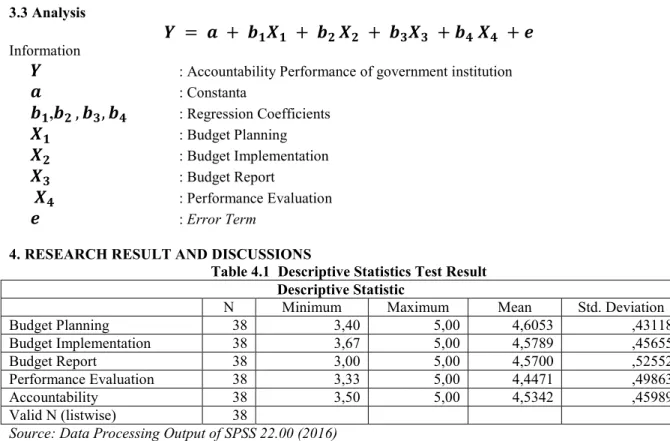
Table 4.1 Descriptive Statistics Test Result Descriptive Statistic
N Minimum Maximum Mean Std. Deviation
Budget Planning 38 3,40 5,00 4,6053 ,43118 Budget Implementation 38 3,67 5,00 4,5789 ,45655 Budget Report 38 3,00 5,00 4,5700 ,52552 Performance Evaluation 38 3,33 5,00 4,4471 ,49863 Accountability 38 3,50 5,00 4,5342 ,45989 Valid N (listwise) 38
Source: Data Processing Output of SPSS 22.00 (2016)
Table 4.2 Output of Multiple Linear Regresion
R = 0.880 R2 = 0.775
Adjusted R2 = 0.748 Sig F = 0.000
Source: Data Processing Output of SPSS 22.00 (2016)
Notes: Perencanaan (Budget Planning), Pelaksanaan (Budget Pmplementation), Pelaporan (Reporting), Evaluasi (Budget Evaluation), Akuntabilitas (Accountability)
Based on Table 4.1 above, it can be seen the minimum and maximum value, average, and standard deviation for each variable with a total sample of 114 respondents, the sample was narrowed back to 38 as adjusted by the amount SKPK Banda Aceh. The dependent variable, namely accountability as measured by the indicators obtained the lowest score of 3.50 occurred in SKPK Banda Aceh. The highest value of 5.00 occurred on SKPK Banda Aceh. The average value of 4.5342 with a standard deviation of 0.45989, which means that data variation accountability to the average is high.
The independent variable (X1) is the Budget Planning showed the lowest value of 3.40 occurred in SKPK Banda Aceh. The highest value of 5.00 occurred on SKPK Banda Aceh. The average value of 4.6053 with a standard deviation of 0.43118 larger than the average, which means that data variation accountability to the
Coefficientsa -,575 ,485 -1,185 ,244 ,341 ,113 ,319 3,014 ,005 ,607 1,649 ,346 ,110 ,343 3,154 ,003 ,575 1,740 ,204 ,092 ,233 2,220 ,033 ,621 1,611 ,231 ,098 ,250 2,343 ,025 ,598 1,673 (Constant) Perencanaan Pelaksanaan Pelaporan Evaluasi Model 1 B Std. Error Unstandardized Coefficients Beta Standardized Coefficients
t Sig. Tolerance VIF
Collinearity Statistics
Dependent Variable: Akuntabilitas a.
average is high.
The independent variable (X2) is the execution of the budget showed the lowest value of 3.67 occurred in SKPK Banda Aceh. The highest value of 5.00 occurred on SKPK Banda Aceh. The average value of 4.5789 with a standard deviation of 0, 45 655 larger than average value, which means that data variation accountability to the average is high.
The independent variable (X3) is reporting the Budget showed the lowest value of 3.00 occurred in SKPK Banda Aceh. The highest value of 5.00 occurred on SKPK Banda Aceh. The average value of 4.5700 with a standard deviation of 0.52552 larger than the average value, which means that data variation accountability to the average is high.
The independent variable (X4) is the Performance Evaluation showed the lowest value of 3.33 SKPK occurred in Banda Aceh. The highest value of 5.00 occurred in SKPK Banda Aceh. The average value of 4.4471 with a standard deviation of 0.49863 larger than average value, which means that data variation accountability towards the average is higher.
Further more from the table No. 4.2, it can also be formulated following research regresion equation as folllow: Y = -0.575 + 0.341X1 + 0.346X2 + 0.204X3+ 0.231X4 + Y = Performance Accountability : Budget Planning : Budget Implementation : Budget Report : Performance Evaluation : Error Term 5. CONCLUSION 5.1 Conclusion
1) Perceived by simultaneously statistical test, it reveals that budget planning, budget implementation, budget report, and evaluation have a significant simultaneous effect on the performance accountability of government of Banda Aceh.
2) Perceived by partially statistical test, it also indicated that each of budget planning, budget implementation, budget report, and evaluation has a significant partial effect on the performance accountability of government of Banda Aceh.
5.2 Recommendation
1) In preparing the budget planning, government of Banda Aceh should prioritize in creating programs or activities that are more beneficial to the welfare of society.
2) In the implementation of the budget, the government of Banda Aceh should monitor the implementation of
the extent to which the implementation has been executed and improve the area of financial accounting system in terms of the record of the budget used.
3) In reporting the budget, the government of Banda Aceh should be more careful and ensure that the financial
statements prepared are sound and justifiable
4) In evaluating the performance, the government of Banda Aceh should be in line with the plan,
implementation, and report.
5) For the next researcher interested in examining the same problem, it is recommended to reach other subjects, with other variables - that affect the performance accountability of government agencies and could take a broader sampling.
REFERENCES
Anthony, N. Robert dan Govindarajan, Vijay. 2011. Management Control Systems in Sistem Pengendalian Manajemen. Jilid 2. Tanggerang: Karisma Publishing Group.
Andrews, Matthew. 2004. Authority, Acceptance, Ability, and Performance-based Budgeting Reforms.
International Journal of Public Sector Management. 17(4): 332-344. Indra, Bastian. 2007, Accounting for Public Sector.3 rd. Edition, Jakarta: Erlangga.
Bahri,Syambudi Prasetia.2012. The Influence of Performance based Budget on the Performance Accountability
of Goverment Agency (a Study at Revenue and Finance Agency), City of Cirebon, University of Pasundan, Bandung, Indonesia
Cholifah. 2013. The Design Model of the Effectiveness of Performance based Budget Implementation at
Revenue Agency, Province of East Java. Journal of WIGA. 3(2): 20-30.
Accounting Review and Research. 6(2): 150-174.
Espinoza. 2014. The Influence of Performance based Budget on the Financial Performance of Medan City,
Unpublished Paper. Medan. Indonesia
Edith G. Marshalleck Edward A. Lehan. 1988. Introducing Performance Budgeting in Jamaica. International Journal of Public Sector Management. 1(2): 53 – 68.
Yulia, Friska Indriani. 2012. The Influence of Performance based Budget on the Performance Accountability with Organizational Commitment as Moderating Variable (a Study at Govermental Working Units, Unpublished Paper. Province of Jambi, Indonesia.
Gujarati, Damodar, 2003. Basic Econometric. Translated bySumarno Zain, Jakarta: Erlangga.
Umesh Sharma ZahirulHoque, Ummesh Sharma Zairul. 2002. TQM Implementation in a Public Sector Entity in Fiji. International Journal of Public Sector Management. 15(5): 340-360.
Kurniawan. 2009. The Influence of Performance based Budget on the Performance Accountability of Provincial
Goverment Agency at Area of IV Priangan. Unpublished Paper. Jakarta, Indonesia
Kluvers, Ron. 2010. Mechanisms of Accountability in Local Government: An Exploratory Study. International
Journal of Business and Management. 5(7): 49-59.
Komang, Nyoman, dan I Made. 2014. P The Influence of Performance based Budget on the Performance Accountability of Goverment Agency (a Study at Forestry of UPT KPH, Central Bali, City of Singaraja). E-Journal S1 Ak Universitas Pendidikan Ganesha. 2(1)
Kossova, Tatiana dan Sheluntcova, Maria. 2015. Evaluating Performance of Public Sector Project in Russia: The Choice of a Social Discount Rate. International Journal of Project Management. 34: 403-411.
Lestari, Indah Puji. 2014. The Influence of Performance based Budget on the Performance Accountability of Goverment Agency (a Survei at Govermental Working Unit), City of Bandung, Indonesia. Unpublished Paper. Bandung, Indonesia
Mardiasmo. 2002. Controlling, Monitoring, and Auditing of Provincial Govermental Performance in Regional
Autonomy Implementation. Journal Business and Accounting. 3(2) :441-456
Muda, TaufikDjundjung. 2005. The Influence of Budget Planning and Budget Implementation on Performance
Accountability Govermance Agency at the City Secretariat No. 81, Municality of Southern Jakarta, Indonesia.
Yahya, Ahmad, dan Fatima, Abdul Hamid. 2008. Budgetary Participation and Performance: Some Malaysian Evidence. International Journal of Public Sector Management. 21(6): 658-673.
Nabila. 2014. The Implementation of Performance based Budget in East Java Province. Indonesia. Public Administration Network. 4(2): 529-545.
Nugroho. 2011. The Design and Implementation of Data Based System. Yogyakarta, Indonesia CV Andi Offset,:
Nordiawan, Deddy. 2006, Public Sector Accounting., Jakarta: Salemba Empat
Putra.2010. The Influence of Implementation of Performance based Budget and Regional Financial Information
System on the Performance Governmental Working Units in the District of Simalungun, Unpublished Thesis. Graduate Program, Faculty of Economics, University of North Sumatra, Medan, Indonesia Operation Manual for Preparing of Peformance Based Provincial Budget. Deputy of IV. State Development Audit Agency(BPKP), BPKP IV. 2005.
Government Law No. 41/2007 Regarding Regional Organizational Structure
Yuniarto, Saiful Rahman.2012.Modul for Government Accounting: Accounting/Public Finance. Universitas
Brawijaya, in Sugiyono. Business Research Method Bandung, Indonesia: Alfabeta
Siagian, Adrian. 2014. Performance Based Budgetting in Order to Achieve Performance Target. Public Administration Network. 6(1): 488-495.
Sekaran, Uma and R. Bougie. 2010. Research Method for Business. West Sussex, United Kingdom: Wiley.
Sugiono (2007). Business Research Method Bandung, Jakarta: PT Gramedia.
Stewart , Jenny. 2014. Implementing an Innovative Public Sector Program. International Journal of Public Sector Management. 27(3): 241-250.
Teguh, Muhammad. 2005. Research Method for Economics. Jakarta: Raja Grafindo Persada Publishing Company
Taufiqurrahman. 2014. The Implementation of Performance Based Budgetting : Challenges and Barriers in the
Provincial Level. Public Administration Network6(2): 511-519.
Republic of Indonesia Laws No. 32/2004 Regarding Regional Autonomy. Jakarta: Directorate General for Regional Autonomy.
Republic of Indonesia Laws No. 33/2004 Regarding the Development Balance Regional between Central
Government and Provincial Government. Dept of Finance, Republic of Indonesia
Republic of Indonesia Laws No.17/2003 Regarding Public Finance. Dept of Finance, Republic of Indonesia Republic of Indonesia Laws No.25/2004 Regarding National Development Planning System.Dept of Finance,