A Private Ordering Solution to Blockholder Disclosure
Joshua Mitts*Abstract
The recent debate over reforming the Securities Exchange Act section 13(d) ten-day filing window demonstrates the importance of balancing the costs and benefits of delayed blockholder disclosure in both
consequentialist and deontological terms. While hedge fund activism may create shareholder value, short-termism is a very real problem for firms today. Rather than a rigid mandatory rule, the duration of the blockholder disclosure window should be set through a shareholder amendment to the corporate bylaws that empowers shareholders to set an optimal maximum length for each firm. To internalize the economic and moral costs to society of permitting trading on asymmetric information, the SEC should impose a filing fee on blockholders utilizing the delayed disclosure window and use the proceeds to compensate investors who sold shares while a blockholder engaged in a stealth accumulation.
*
J.D. Candidate, 2013, Yale Law School. [email protected]. The author would like to thank Ian Ayres, Alidad Damooi, and Eric Robinson for providing valuable comments.
2
T
ABLE OFC
ONTENTSI. INTRODUCTION...3
II. DELAYEDBLOCKHOLDERDISCLOSUREUNDERSECTION13(D)OF THESECURITIESEXCHANGEACTOF1934...6
A. SECTION 13(D) OF THE SECURITIES EXCHANGE ACT OF 1934 AND STEALTH ACQUISITIONS DURING THE TEN‐DAY WINDOW ... 7
B. LEGISLATIVE HISTORY:THE WILLIAMS ACT OF 1968 AND SECTION 929R OF THE DODD‐FRANK ACT OF 2010 ... 14
C. THE ACADEMIC AND POLICY DEBATE OVER SHORTENING THE TEN‐DAY WINDOW ... 18
III. THECOSTSANDBENEFITSOFDELAYEDBLOCKHOLDER DISCLOSURE...21
A. CREATING VALUE BY MONITORING AND DISCIPLINING MANAGEMENT ... 21
1. AgencyCosts,HedgeFundActivismandShareholderValue...21
2. InefficientMarketsandLong‐TermValueCreation...24
B. DESTROYING VALUE THROUGH SHORT‐TERMISM:ASUMMARY OF THE MANAGEMENT AND ACCOUNTING RESEARCH ... 27
C. THE SOCIAL EXTERNALITIES OF DELAYED BLOCKHOLDER DISCLOSURE ... 31
1. ImpairingLiquidity,HigherTransactionCostsandChillingEffects.31 2. DeprivingCounterpartiesofAutonomy...35
IV. PRIVATEORDERING,FEESANDCOMPENSATION...38
A. WHY A SINGLE MANDATORY DISCLOSURE DURATION IS SUBOPTIMAL ... 39
B. PRIVATE ORDERING FOR FIRM‐SPECIFIC DELAYED DISCLOSURE ... 43
1. PrivateOrdering:BackgroundandProxyAccess...43
2. ImplementingPrivateOrderingforBlockholderDisclosure...47
C. INTERNALIZING THE SOCIAL COST OF DELAYED BLOCKHOLDER DISCLOSURE:A FILING FEE AND COMPENSATION PROPOSAL ... 53
1. ASliding‐ScaleFilingFeeforDelayedDisclosure...53
2. CompensatingVictimsofDelayedDisclosure...61
V. CONCLUSION...65
VI. APPENDIX:ASIMPLEMODELANDCHALLENGESOFSTATISTICAL INFERENCE...67
I.
I
NTRODUCTIONThe latest round in the corporate governance tug-of-war between management and activist shareholders is the controversy over reforming the Securities Exchange Act of 1934 section 13(d) filing window. In fall 2010, activist hedge funds exploited the ten-day window to acquire 26.7% of J.C. Penney and 10.9% of Fortune Brands. By engaging in massive purchases between crossing the 5% threshold and the required disclosure ten days later, these hedge funds stealthily accumulated shares at a discount of nearly $230 million from the post-disclosure market price.1 More recently, in October 2012, Carl Ichan exploited the ten-day window to stealthily acquire 9.98% of Netflix, yielding $52 million in potential profit on the stake acquired during the filing window alone.2
In a recent petition submitted to the Securities and Exchange Commission (“SEC”), the law firm Wachtell, Lipton, Rosen & Katz (“Wachtell Lipton”) requested that the SEC exercise its rulemaking powers under the Dodd-Frank Act and shorten the window for filing a notice of beneficial ownership to one day.3 Wachtell Lipton argued that examples such as J.C. Penney and Fortune Brands demonstrate the potential for hedge funds to exploit the ten-day window and stealthily accumulate massive blocks of ownership. Such stealth accumulations deprive those who sold shares during the filing window of the premium they could have received upon disclosure of the hedge fund’s stake.
In response to Wachtell Lipton’s proposal, law professors Lucian A. Bebchuk and Robert J. Jackson articulated economic justifications for the ten-day window.4 Bebchuk and Jackson argued that announcements of hedge fund activism correlates with higher share prices, suggesting that it
1See
discussion infra Section II.A. 2See id.
3
Letter from Wachtell, Lipton, Rosen & Katz to Elizabeth M. Murphy, Secretary, U.S. Sec. & Exch. Comm’n 6 (Mar. 7, 2011), available at
http://www.sec.gov/rules/petitions/2011/petn4-624.pdf. 4E.g.
,Lucian A. Bebchuk & Robert J. Jackson Jr., The Law and Economics of Blockholder Disclosure, 2 HARV.BUS.L.REV. (forthcoming, 2012), available at http://papers.ssrn.com/sol3/papers.cfm?abstract_id=1884226.
is beneficial for target firms.5 However, because hedge funds do not acquire a controlling stake, they cannot capture the entire benefits of intervention.6 Bebchuk and Jackson claimed that enabling activist shareholders to buy shares at a discount during the ten-day window is essential compensation for the beneficial intervention they bring to target firms.7 In response, Wachtell Lipton asserted that economic analysis does not justify undermining the purpose of the Williams Act.8
This Article advocates a balanced approach to this debate and a novel proposal for regulatory reform. Securities regulation should neither solely promote the historical goals of the 1960s nor consider only the benefits of hedge fund activism. If delayed blockholder disclosure functions as compensation for hedge fund activism, determining the optimal length of the disclosure window necessitates considering the costs
and benefits of hedge fund activism—not solely one or the other. The benefits are well-known. As Bebchuk, Jackson, and a
growing number of empirical finance studies demonstrate, hedge funds are particularly effective at mitigating agency costs and increasing shareholder value. They are free from the regulatory restraints and structural
limitations of traditional institutional investors like mutual funds and have strong incentives to obtain outstanding objective returns.
On the other hand, hedge funds are preoccupied with short-term results. Two scholars put it nicely: “Hedge funds come close to being the archetypal short-term investor. For some funds, holding shares for a full day represents a ‘long-term’ investment.”9 It is hard to believe that managers ignore the pressure from short-term investors simply because the efficient markets hypothesis says they should. But there’s no need to resort to intuition: numerous empirical studies in the management and 5Id. at *13. 6Id. at *16. 7Id. at *17. 8
Adam O. Emmerich, Theodore N. Mirvis, Eric S. Robinson & William Savitt, Fair Markets and Fair Disclosure: Some Thoughts on the Law and Economics of Blockholder Disclosure, and the Use and Abuse of Shareholder Power at *2 (Columb. L. & Econ. Working Paper No. 428, Aug. 27, 2012), available at
http://papers.ssrn.com/sol3/papers.cfm?abstract_id=2138945. 9
Marcel Kahan & Edward B. Rock, Hedge Funds in Corporate Governance and Corporate Control, 155 U.PA.L.REV.1021, 1085 (2006)
accounting disciplines have shown that short-termism is a problem in corporate America. Even if finance theory says they shouldn’t, managers do feel the pressure of short-term earnings. It is hard to believe that hedge funds’ demands for immediate results will have no effect on the long-term profitability of target firms.
Delayed blockholder disclosure also imposes a cost on society. Hedge funds stealthily buying shares during the ten-day window are trading on asymmetric information, and information asymmetries harm everyone in the market by reducing liquidity and raising bid/ask spreads. These stealth accumulations are not doctrinally insider trading, but their effects are quite similar. In addition to the chilling effect caused by playing a losing game with the deck stacked against unknowing retail investors, trading on asymmetric information is fundamentally unfair. It deprives market participants of autonomy by exploiting the non-disclosure of material facts regarding the share accumulation by an activist investor. Mere participation in a market that legally permits trading on asymmetric information does not imply a subjective waiver of the moral entitlement to a fully informed decision. In short, hedge funds profit from inducing others to trade on a deceptive premise regarding the status quo when they actually intend to upend it—and that imposes a moral cost on society.
To balance the costs and benefits of delayed blockholder disclosure, this Article proposes a private ordering solution akin to the approach taken for proxy access under Rule 14a-8. It may be
economically efficient for certain firms to permit some delay. Rather than imposing a rigid mandatory rule, the SEC should let shareholders make this decision through a shareholders amendment to the corporate bylaws. Allowing each firm to decide how long after acquiring a 5% stake
blockholders can trade before mandating disclosure would empower shareholders to incentivize the level of hedge fund activism that would maximize the value of their shares.
Regulators, on the other hand, should focus on the price society pays when blockholders engage in stealth accumulations and profit by trading on asymmetric information. This Article proposes imposing a filing fee to induce the socially optimal disclosure duration for each firm. Under this proposal, hedge funds filing schedule 13D disclosures after passing the 5% threshold would pay a fee based on an approximation of
the cost this delay imposes on society. Like a carbon tax on pollution-emitting factories, a delayed disclosure fee forces hedge funds to
internalize the social cost of stealth accumulations and tacit deception of trading counterparties.
The proceeds of this delayed disclosure fee should be used to establish a compensation fund to ameliorate the injury to shareholders who sold during the delayed disclosure window. While this fund would not make injured investors perfectly whole, it would go a long way towards offsetting the exploitation of information asymmetries permitted by the private ordering system. The combination of empowering shareholders to determine the length of the disclosure window, imposing a filing fee on stealth accumulations and compensating victims would bring society the benefits of hedge fund activism while minimizing collateral consequences to the extent possible.
Part II of this Article presents an overview of delayed blockholder disclosure under section 13(d) of the Securities Exchange Act of 1934. Part III discusses the costs and benefits of hedge fund activism, the primary justification for permitting delayed blockholder disclosure. Part IV presents this Article’s private ordering solution and the filing fee and compensation proposals. Part V concludes this Article.
II.
D
ELAYEDB
LOCKHOLDERD
ISCLOSUREU
NDERS
ECTION13(
D)
OF THES
ECURITIESE
XCHANGEA
CT OF1934
This Part presents an overview of section 13(d) of the Securities Exchange Act of 1934, which requires disclosing the acquisition of beneficial ownership of more than 5% of a class of reporting company’s stock. It discusses the recent exploitation of this window by two hedge funds and the immense profit they obtained. In addition, this Part summarizes the legislative history of the ten-day disclosure window and the Dodd-Frank provision that grants the SEC the authority to shorten the disclosure window. It concludes by describing the academic and policy debate over this issue.
A. Section 13(d) of the Securities Exchange Act of 1934 and
Stealth Acquisitions During the Ten‐Day Window
Section 13(d) of the Securities Exchange Act of 1934, as amended, provides:
Any person who, after acquiring directly or indirectly the beneficial ownership of any equity security of a class which is registered pursuant to section 78l. . . or otherwise
becomes or is deemed to become a beneficial owner of any of the foregoing upon the purchase or sale of a security-based swap that the Commission may define by rule, and is directly or indirectly the beneficial owner of more than 5 per centum of such class shall, within ten days after such acquisition or within such shorter time as the Commission may establish by rule, file with the Commission, a
statement containing . . . the following information . . . .10 The statute defines a series of required disclosure items, including identifying information regarding the beneficial owner;11 the source and amount of the funds for the purchase;12 whether the purpose of the acquisition is to acquire control, liquidate, or perform other “major changes” to the “business or corporate structure” of the issuer;13 and the number of shares beneficially owned.14 The Securities and Exchange Commission has implemented this statute in Regulation 13D of the Securities Exchange Act of 1934, which provides for filing the beneficial ownership disclosure in Schedules 13D and 13G and sets forth the technical requirements for filing.15
Crucially, section 13(d) does not require filing the disclosure statement until ten days after the acquisition of beneficial ownership of 10 15 U.S.C.A. § 78m(d)(1) (West 2012). 11Id. at § 78m(d)(1)(A). 12Id. at § 78m(d)(1)(B). 13Id. at § 78m(d)(1)(C). 14Id. at § 78m(d)(1)(D). 15See 17 C.F.R. § 240.13D-1 to 240.13D-102 (2012).
more than 5% of the shares of any class. This permits investors to acquire a block of shares substantially greater than 5% prior to the expiration of the ten-day window. As noted in a recent petition to the SEC by the law firm Wachtell, Lipton, Rosen & Katz (“Wachtell Lipton”), the recent examples of hedge fund acquisitions of J.C. Penney and Fortune Brands stock dramatically illustrate this phenomenon.16 Two activist hedge funds—Pershing Square Capital Management and Vornado Realty Trust17—acquired 26.7% ownership of J.C. Penney by exploiting the ten-day window. Prior to crossing the 5% threshold, Pershing Square held 4.9% of J.C. Penney. During the window, Pershing and Vornado made a series of rapid purchases to reach the 26.7% level.18 Similarly, Pershing Square went from under 5% to over 10% ownership in Fortune Brands during the delayed disclosure window.19
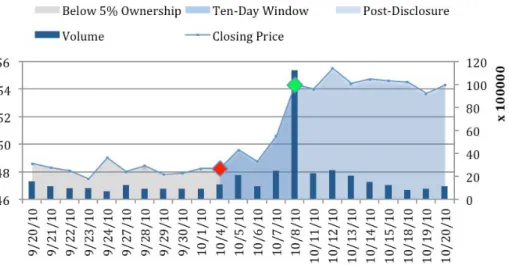
The following graphs of the share prices of J.C. Penney and Fortune Brands during this time period vividly illustrate these stealth acquisitions and profit potential:
16See
Letter from Wachtell, Lipton, Rosen & Katz to Elizabeth M. Murphy, Secretary, U.S. Sec. & Exch. Comm’n (Mar. 7, 2011), available at
http://www.sec.gov/rules/petitions/2011/petn4-624.pdf. 17
While Vornado Realty Trust is technically a real estate investment trust, it functions as an activist hedge fund. See Brad Thomas, Vornado Realty Trust: Simply A Hedge Fund In A REIT Wrapper, SEEKING ALPHA (Oct. 15, 2012),
http://seekingalpha.com/article/923481-vornado-realty-trust-simply-a-hedge-fund-in-a-reit-wrapper.
18Id.
at 6 (citing Maxwell Murphy, Deal Journal, How Bill Ackman Stalked J.C. Penney, WALL ST.J., October 8, 2010; Joann S. Lublin & Karen Talley, Big Shoppers Bag 26% of J.C. Penney, WALL ST.J., October 9, 2010).
19Id.
(citing Matt Phillips, MarketBeat, Ackman in Action, WALL ST.J. (Oct. 8, 2010); David Kesmodel, Fortune Brands Plans to Split Up, WALL ST.J. (Dec. 8, 2010)).
Figure 1: J.C. Penney Company Inc. (JCP)
Data Source: Yahoo! Finance. Date Range: 9/20/2010 – 10/20/2010.20
This chart shows the closing price of J.C. Penney prior to, during, and following the ten-day window and section 13(d) blockholder disclosure. Pershing Square’s announcement occurred following the close of trading on October 7, 2010, as indicated by the green diamond on that day.21 Both Pershing Square and Vornado crossed the 5% threshold on September 28, 2010, as indicated by the red diamond.22 The chart demonstrates that the
20
YAHOO!FINANCE, J. C. Penney Company Inc.(JCP): Historical Prices, http://finance.yahoo.com/q/hp?s=JCP+Historical+Prices (last visited 11/3/2012). 21
Pershing Square’s schedule 13D was filed with the SEC on October 8, 2010 at 9:15 AM. EDGAR Filing Documents: 0000950123-10-092199, Form SC 13D, U.S. SECURITIES AND EXCHANGE COMMISSION (Oct. 8, 2010),
http://www.sec.gov/Archives/edgar/data/1166126/000095012310092199/0000950123-10-092199-index.htm. Vornado Realty Trust’s schedule 13D was filed at on October 8, 2010 at 5:10 PM. EDGAR Filing Documents: 0000903423-10-000566, Form SC 13D, U.S.SECURITIES AND EXCHANGE COMMISSION (Oct. 8, 2010),
http://www.sec.gov/Archives/edgar/data/899689/000090342310000566/0000903423-10-000566-index.htm.
22See
J.C. Penney Co., Schedule 13D: Pershing Square Capital Management, L.P. (Sep. 28, 2010), available at
http://www.sec.gov/Archives/edgar/data/1166126/000095012310092199/y04041sc13d.ht m; J.C. Penney Co., Schedule 13D: Vornado Realty Trust (Sep. 28, 2010), available at
price of J.C. Penney’s stock remained well below its post-disclosure high of $32.49 for much of the ten-day window, permitting these hedge funds to acquire much of their 26.7% stake at a substantial discount to the post-disclosure price.
A chart of Fortune Brands’s stock price demonstrates the same phenomenon:23
Figure 2: Fortune Brands Inc. / Beam, Inc. (BEAM)
Data Source: Yahoo! Finance. Date Range: 9/20/2010 – 10/20/2010.24
As with J.C. Penney, this chart shows the closing price of Fortune Brands Inc. prior to, during, and following the ten-day window and section 13(d) blockholder disclosure. The announcement occurred after the close of trading on October 8, 2010, as indicated by the green diamond on that http://www.sec.gov/Archives/edgar/data/899689/000090342310000566/vornado13d_100 8.htm.
23
Following Bill Ackman’s intervention, Fortune Brands Inc. was broken up and renamed to Beam, Inc. Bruce Schreiner, Fortune Brands Becomes Beam Inc., Sticks To Liquor, BUSINESS WEEK (Oct. 3, 2011), available at
http://www.businessweek.com/ap/financialnews/D9Q52TT01.htm. 24
YAHOO!FINANCE, Beam, Inc.(BEAM),
day.25 However, Pershing Square did not pass the 5% threshold until October 4, 2010, as indicated by the red diamond.26 Nonetheless, the chart shows that Pershing Square was able to acquire the remainder of its stake at a substantial discount from October 4 – 7, 2010, as the share price remained well below its post-disclosure level during this period.
The date range for these charts was chosen to demonstrate
important aspects of Wachtell Lipton’s proposal to reform the blockholder disclosure window. The period prior to crossing the 5% beneficial
ownership threshold—from the left edge of the chart (i.e., September 20, 2010) to the red diamond—would remain untouched by any reform to the blockholder disclosure window. During this period of time, hedge funds would be under no obligation to report because they have not crossed the 5% threshold. In the debate over reforming the blockholder disclosure window, there is no suggestion to lower the 5% disclosure threshold.27
Indeed, the purchases of the initial 5% ownership stake by hedge funds prior to crossing the disclosure threshold can be at prices that are a substantial discount to the market prices that follow the initial public announcement of their acquisitions. In J.C. Penney’s case, for example, Pershing Square acquired an initial 4.9% block at an average price of $20.69 prior to crossing the 5% level on September 28, 2010, and
Vornado acquired an initial 6.6% stake in a single call options transaction
25
Pershing Square’s schedule 13D was filed with the SEC on October 8, 2010 at 5:!0 PM. EDGAR Filing Documents: 0000950123-10-092199, Form SC 13D, U.S. SECURITIES AND EXCHANGE COMMISSION (Oct. 8, 2010),
http://www.sec.gov/Archives/edgar/data/789073/000095012310092375/0000950123-10-092375-index.htm.
26See
Fortune Brands, Inc., Schedule 13D: Pershing Square Capital Management, L.P. (Oct. 4, 2010), available at
http://www.sec.gov/Archives/edgar/data/789073/000095012310092375/c06741sc13d.ht m.
27
In light of the extraordinary profit that hedge funds can obtain prior to crossing the 5% threshold and the economic analysis infra Part III on the costs and benefits of hedge fund activism, it is possible that the very existence of a minimum disclosure threshold
encourages too much hedge fund activism. Yet changing the disclosure threshold for section 13(d) would require congressional action. Accordingly, this Article focuses on the policy debate that is currently being conducted over reforming the section 13(d) filing window by SEC rulemaking action alone under section 929R of the Dodd-Frank Act.
at an underlying purchase price of $26.72 on the same date.28 This would have still yielded an impressive profit. If these hedge funds had sold at $33.30, the closing price ten days after disclosure,29 they would have made a profit of approximately $147 million and $102 million on their initial stakes, respectively.30 Similarly, Pershing Square bought its initial 4.9%
28
All of the calculations in this Subsection are on file with the author. The share prices are taken from Item 5(c) of each hedge fund’s J.C. Penney schedule 13D filing and exhibits attached thereto. J.C. Penney Co., Schedule 13D: Pershing Square Capital Management (Sep. 28, 2010), available at
http://www.sec.gov/Archives/edgar/data/1166126/000095012310092199/y04041sc13d.ht m; J.C. Penney Co., Schedule 13D: Vornado Realty Trust (Sep. 28, 2010), available at http://www.sec.gov/Archives/edgar/data/899689/000090342310000566/vornado13d_100 8.htm. For call options, the “purchase price” is calculated based on intrinsic value, i.e., the sum of the cost of acquiring the option and its strike price, as this represents the minimum price at which the buyer could acquire the underlying shares. Admittedly, calculating profit based on call options’ intrinsic value will understate the potential profit because the option itself has value. But the option value is difficult to estimate in these cases, as many were over-the-counter options that lack a market price. Rather than include option value in some cases and not others, this calculation errs on the side of caution and utilizes the intrinsic value alone.
29
In most cases, hedge funds would not have sold this quickly. The existence of this higher share price reflects investor expectations that the hedge fund activism will yield some type of payoff for shareholders, which presumably takes longer than ten days. (That said, the mere entrance of an activist hedge fund could prompt certain reforms that shareholders might consider beneficial.) As discussed below, researchers who believe the efficient markets hypothesis often rely on event-day studies which look to share price returns in a certain post-event window, e.g., 10 days, to determine whether the event creates long-term shareholder value. See discussion infra Section III.A.1. While I criticize the efficient markets hypothesis, see discussion infra Section III.A.2, it is rational to use such a window to calculate a hedge fund’s hypothetical profit. Even if this higher share price does not reflect the creation of fundamental value because markets are inefficient, hedge funds could still “sell into” this wave and dispose of the initial 5%. Moreover, they could still obtain this profit on the remainder of their shares if the share price remained at this level several months later, if, for example, the market had not yet internalized the damage that excessive activism would cause. For a discussion of markets’ temporal inefficiency, see discussion infra Section III.A.2.
30
This is computed by subtracting the total purchase price each hedge fund paid prior to and contemporaneously with crossing the 5% threshold from the product of the number of shares acquired during this period and a closing price of $33.30 on October 18, 2010. The exact trading data utilized for this computation is included in the schedule 13D filings and the calculations are on file with the author. See J.C. Penney Co., Schedule
of Fortune Brands at an approximate average price of $42.52.31 If it had sold at the 10-day post-disclosure closing price of $54.51,32 it would have made a profit of approximately $86.5 million.33 While the latter figure is less than the former two,34 both reflect a sizeable payoff for these activist hedge funds for acquiring the initial 5% stake at significant discount to the post-disclosure price.
Again, this payoff would remain untouched by Wachtell Lipton’s proposal. Rather, the petition focuses on the additional profit that would result from stealthily acquiring additional shares during the ten-day disclosure window. To illustrate how much is at stake, the average price of the J.C. Penney shares acquired by Pershing Square and Vornado from September 28, 2010 to October 7, 2010 was $29.27 and $27.39,
respectively. If Pershing Square and Vornado had sold at the ten-day post-disclosure closing price of $33.30, they would have made a profit of approximately $193 million and $43 million on the stake that they acquired during the 10-day window, respectively.35 Similarly, Pershing 13D: Pershing Square Capital Management, supra note 22; J.C. Penney Co., Schedule 13D: Vornado Realty Trust, supra note 22.
31
The calculations are on file with the author. 32
This price has been adjusted for stock splits and dividends. 33
As with J.C. Penney, the computation utilizes the actual purchase price included in the trading data attached to Pershing Square’s schedule 13D filing. See Fortune Brands, Inc., Schedule 13D: Pershing Square Capital Management, L.P., supra note 25.
34
This may have been because the hedge funds took a smaller stake in Fortune Brands than J.C. Penney (11% as opposed to 27%), making it less certain that they could bring about the type of improvements that would increase shareholder value (at least over the short-term).
35
The calculations are on file with the author. As with the initial period profit, this utilizes the actual trading data reported on the schedule 13D filings. The computation subtracts the total purchase price each hedge fund paid subsequent to crossing the 5% threshold (and prior to the 13D filing) from the product of the total number of shares and the closing price of $33.30 on October 18, 2010. The computation treats cash-settled total return swaps as common stock for purposes of this calculation, since the hedge funds the long party would be able to realize their potential profit by unwinding the swaps and acquiring the underlying shares. One might criticize the use of the $33.30 closing price as unrealistic because the hedge funds could not sell 21% of the stock instantly without moving the price down. If it is a rough approximation, however, of investors’ anticipation of value creation—a proposition this Article accepts with respect to short-term expectations—the price would not fall significantly upon liquidation.
Square acquired the remainder of its 10.9% stake in Fortune Brands at the average price of $49.80 during the period from October 4, 2010 to October 7, 2010. Had it sold at the ten-day post disclosure price of $54.51,
Pershing Square would have made a profit of approximately $51.6 million on the stake it acquired during the delayed disclosure period.36 This additional profit would be eliminated under Wachtell Lipton’s proposal.
Finally, shareholder activists continue to exploit the delayed disclosure window to acquire large blocks of ownership at a substantial discount to the post-disclosure market price. Most recently, in October 2012, Carl Ichan stealthily acquired 9.98% of Netflix at an average price of $60.01 after crossing the 5% threshold.37 Had he sold at the ten-day post-disclosure price of $78.19, Ichan would have made a profit of approximately $52 million on the stake he acquired during the delayed disclosure period alone.
B. Legislative History: The Williams Act of 1968 and Section
929R of the Dodd‐Frank Act of 2010
The legislative history of the ten-day window suggests that Congress did not intend for it to be exploited through stealth
accumulations. The ten-day window was enacted by the Williams Act of 1968, which arose out of a concern with the increasing use of cash tender offers to effect hostile takeovers.38 The legislation initially was introduced in the 111th Congress by Senator Williams, who condemned “the cloak of Accordingly, these reflect a form of hypothetical profit. It is also a useful measure of the injury to trading counterparties who could have sold at the $33.30 closing price. See discussion infra Section IV.C.2.
36
The calculations are on file with the author, and utilize the same methodology as the prior profit computations.
37See
Greg Bensinger & Ian Sherr, Icahn Takes Stake in Netflix, WALL ST.J. (Nov. 1, 2012),
http://online.wsj.com/article/SB10001424052970203707604578091032309599550.html. 38
For a summary of the legislative history of the Williams Act of 1968, see Andrew E. Nagel, Andrew N. Vollmer & Paul R.Q. Wolfson, The Williams Act: A Truly "Modern" Assessment, HARV.L.SCH.FORUM ON CORP.GOVERNANCE &FIN.REG., at *5-7 (Oct. 22, 2011), http://blogs.law.harvard.edu/corpgov/files/2011/10/The-Williams-Act-A-Truly-Modern-Assessment.pdf.
secrecy under which” a corporate raider is “permitted to operate while obtaining the shares needed to put him on the road to successful capture of a company.”39
As originally proposed, the bill would have required prior notice to the Securities and Exchange Commission twenty days before making a cash tender for over five percent of the a class of outstanding shares as well as disclosure upon acquiring five percent beneficial ownership through open market purchases.40 The prior notice requirement led to strong opposition from the SEC, which argued that a five-day post-acquisition notification window would be “less burdensome” and more realistic in situations where prior notice might be impossible.41
Senator Williams subsequently introduced a modified bill to require disclosure within seven days of acquiring ten percent beneficial ownership,42 followed by another amendment to lengthen the disclosure window to ten days.43 These were the substantive terms that were ultimately enacted as the Williams Act of 1968.44 Two years later, the disclosure threshold was lowered to five percent.45 In Senator Williams’s words, “Stock holdings of between 5 and 10 percent in [large public] companies are in many instances a controlling interest. Here the need for the full disclosure requirements of the Securities Exchange Act are necessary for adequate investor protection.”46 This is the disclosure requirement that applies today.47
The ten-day blockholder disclosure window remained undisturbed for thirty years. In 2010, Congress passed the Dodd-Frank Wall Street Reform and Consumer Protection Act, which provided in section 929R:
39
111 Cong. Rec. 28258 (Oct. 22, 1965). 40Id.
; S. 2731, §2, 89th Cong. (1965). 41
112 Cong. Rec. 19004 (Aug. 11, 1966) (“Indeed, we envision some types of situations in which compliance with an advance notice requirement would be impossible, such as acquisitions by inheritance or by gift of which the recipient had no advance notice.”). 42
113 Cong. Rec. 856 (Jan. 18, 1967); S. 510, § 1, 90th Cong. (1967). 43
113 Cong. Rec. 24664 (Aug. 30, 1967). 44
Pub. L. No. 90-439, 82 Stat. 454 (1968). 45
Pub. L. No. 91-567, 84 Stat. 1497 (1970). 46
116 Cong. Rec. 3023 (1970). 47
(a) BENEFICIAL OWNERSHIP REPORTING.—Section 13 of the Securities Exchange Act of 1934 (15 U.S.C. 78m) is amended— (1) in subsection (d)(1)—(A) by inserting after ‘‘within ten days after such acquisition’’ the
following: ‘‘or within such shorter time as the Commission may establish by rule’’48
This language was found in the initial draft of the Investor Protection Act of 2009 submitted by House Committee on Financial Services.49 In the “section-by-section analysis of the legislation,” the Committee explained the rationale behind the inclusion of this provision:
Section 105. Beneficial ownership and short swing profit reporting
This section provides the SEC with the authority to adopt rules to shorten reporting timeframes and help the markets receive more timely information concerning substantial ownership interests in issuers. This change is important for purposes of obtaining more accurate pricing of listed securities.50
It thus appears that the Committee was concerned with the potential for mispricing during the ten-day window. Indeed, as the example of J.C. Penney and Fortune Brands demonstrates, the difference between the average price during the ten-day window and the price following disclosure can be substantial. In the case of J.C. Penney,
exploiting this difference led to over $200 million in profit for two activist hedge funds. The Committee’s intent seems plainly directed to drawing the SEC’s attention to the potential exploitation of this pricing differential.
The Dodd-Frank Act also displayed concern for the growing use of synthetic instruments such as cash-settled total return swaps, which permit the rapid accumulation of equity ownership via indirect means with a
48
Dodd-Frank Wall Street Reform and Consumer Protection Act, Public Law 111-203, 124 Stat. 1866, § 929R (Jul. 21, 2010).
49
H. Rep. No. 111-687, at 6 (2010). 50Id.
minimal impact on share prices.51 These have been used by hedge funds to acquire large blocks of shares at minimal cost,52 and were utilized by Pershing Square in its stealth accumulation of J.C. Penney shares.53 Section 766(e) of the Dodd-Frank Act specifically authorizes the SEC to include “security-based swaps” within the definition of beneficial ownership under section 13(d).54 However, such swaps constitute beneficial ownership only if the SEC so designates:
[A] person shall be deemed to acquire beneficial ownership of an equity security based on the purchase or sale of a security-based swap, only to the extent that the
Commission, by rule, determines after consultation with the prudential regulators and the Secretary of the Treasury, that the purchase or sale of the security-based swap . . . provides incidents of ownership comparable to direct ownership of the equity security, and that it is necessary to achieve the purposes of this section that the purchase or sale of the security-based swaps, or class of security-based swap, be deemed the acquisition of beneficial ownership of the equity security.55
51
Cash-settled total return swaps are a form of equity derivatives that transfer the entire credit risk and market risk of an asset to the holder without actually acquiring ownership of the underlying security. See, e.g., PATRICIA A.KOVAL,TORYS ON MERGERS AND ACQUISITIONS:USE OF DERIVATIVES BY SHAREHOLDER ACTIVISTS (2011), available at http://www.torys.com/Publications/Documents/Publication%20PDFs/MA2011-3.pdf (describing the use of these swaps by hedge fund activists to acquire exposure to the underlying securities without constituting beneficial ownership and explaining how they may be easily converted to voting securities).
52See, e.g.
, Andrew Ross Sorkin, Dealbook, Big Investors Appear Out of Thin Air, N.Y. Times (Nov. 1, 2010) (“The use of derivatives to create stealth positions is even more worrisome.”).
53See
J.C. Penney Co., Schedule 13D: Pershing Square Capital Management, supra note 22; Maxwell Murphy, Deal Journal, How Bill Ackman Stalked J.C. Penney, WALL ST. J., October 8, 2010 (mentioning Bill Ackman’s use of cash-settled total return swaps). 54
15 U.S.C.A § 78m; Dodd-Frank Wall Street Reform and Consumer Protection Act, § 766(e).
55Id.
In a recent decision, the Second Circuit left unresolved the question of whether cash-settled total return equity swaps constitute beneficial ownership under the existing section 13(d) and rule 13d-3.56 The potential for rapid stealth accumulations during the ten-day window in light of the increasing use of cash-settled total-return swaps led to a vibrant academic and policy debate as discussed in the next Section.
C. The Academic and Policy Debate Over Shortening the
Ten‐Day Window
The current debate surrounding shortening the disclosure window began with a rulemaking petition submitted by Wachtell Lipton to the Securities and Exchange Commission.57 Wachtell Lipton argued that the ten-day window contravenes the purpose of the Williams Act by
permitting rapid stealth acquisitions of quasi-controlling blocks, which was precisely what Congress sought to prohibit by enacting the
blockholder disclosure reporting requirements.58 Moreover, Wachtell Lipton claimed, the recent examples of J.C. Penney and Fortune Brands vividly demonstrate that the ten-day window is no longer suited to an age where large blocks of shares may be rapidly accumulated, particularly when synthetic ownership, e.g. derivatives, permit even faster
accumulation of net long equity positions.59
In response, Professors Lucian A. Bebchuk and Robert J. Jackson criticized Wachtell Lipton’s petition and advocated that the current
56
CSX Corp. v. Children's Inv. Fund Management (UK) LLP, 654 F.3d 276, 284 (2d Cir. 2011) (remanding to the district court on different grounds). But see id. at 301 (Winter, J., concurring) (“In the absence of some other agreement governing the disposition of shares purchased to hedge a swap position, merely having a long position in a cash-settled total-return equity swap does not constitute having the power, directly or indirectly, to direct the disposition of shares that a counterparty purchases to hedge its swap positions, and thus does not constitute having “investment power” for purposes of Rule 13d–3(a).”).
57
Letter from Wachtell, Lipton, Rosen & Katz to Elizabeth M. Murphy, supra note 16. 58Id.
at *2. 59Id.
day period remain unchanged.60 Bebchuk and Jackson claim that the SEC should evaluate the suitability of the blockholder disclosure window in light of academic research regarding the beneficial role of activist investors in public companies.61 They discuss the empirical financial literature finding a correlation between hedge fund activism and
shareholder value62 and argue that the ten-day window functions as a form of compensation to blockholders for monitoring and disciplining
management. They argue that such compensation is essential because as non-controlling shareholders activist blockholders only share pro rata in the benefits of their activism.63
This Article advocates a balanced approach to resolving this debate. Wachtell Lipton correctly points out that the purpose of the disclosure requirements in the Williams Act was to prevent stealth acquisitions. Yet while the Dodd-Frank Act explicitly empowered the Securities and Exchange Commission to shorten the disclosure window, the Act did not limit the SEC’s discretion to conforming to the historical purpose of the Williams Act. As a matter of positive law, agency
rulemaking is more than a historical inquiry into congressional intent. Administrative agencies are obligated to consider the costs and benefits of various policy alternatives and enact rules that further the public interest.
More fundamentally, Wachtell Lipton’s descriptive claim (what “is”) does not imply a normative outcome (what “should be”). Even under the extreme assumption that the SEC must, as a matter of positive law,
60
Lucian A. Bebchuk & Robert J. Jackson Jr., The Law and Economics of Blockholder Disclosure, 2 HARV.BUS.L.REV. 39 (2012), available at
http://papers.ssrn.com/sol3/papers.cfm?abstract_id=1884226. In a recent reply, four partners from Wachtell Lipton reiterate their argument that Bebchuk & Jackson’s cost-benefit analysis is flawed because it is “missing” “any explanation of how their position – their conception of how the Section 13(d) reporting rules should operate – is consistent with the clear purpose of the statute.” Adam O. Emmerich, Theodore N. Mirvis, Eric S. Robinson & William Savitt, Fair Markets and Fair Disclosure: Some Thoughts on the Law and Economics of Blockholder Disclosure, and the Use and Abuse of Shareholder Power, (Columb. L. & Econ. Working Paper No. 428, Aug. 27, 2012), available at http://papers.ssrn.com/sol3/papers.cfm?abstract_id=2138945.
61Id. at *12. 62
See discussion infra Section III.A. 63
shorten the disclosure window because technological innovations render the letter of the law no longer effective at fulfilling its purpose, this does not imply that a shorter disclosure window necessarily would be in firms’ or society’s best interest. Put differently, Congress may have erred. Blockholder disclosure ultimately may not be socially beneficial. Apart from the doctrinal question of what the SEC is bound by law to consider as an administrative agency, it is essential to address the normative question of what is best for society.
Answering this normative question requires finding a justification external to the descriptive content of the law itself. The
law-and-economics methodology prevalent in corporate and securities law generally assumes that promoting Kaldor-Hicks efficiency—i.e., producing gains to society that exceed losses—should be the normative goal that the law advances.64 A proposal to shorten the blockholder disclosure window should be justified through economic analysis, not solely by pointing to the descriptive content of legislative history.
To their credit, Bebchuk and Jackson cite to economic and financial research to make a normative claim that the ten-day window is better for society than a shorter alternative.65 Yet they look solely at the benefits of hedge fund activism without considering the costs that activism—particularly excessive activism—may impose.66 It is impossible to compare the ten-day window to a shorter period without evaluating the costs and benefits of both alternatives.
As described in Sections III.B and III.C, if the current regime encourages excessive activism, there are two potential sources of costs: (1) harm to target firms in the form of managerial short-termism, which may not be reflected in empirical event-day studies if markets are inefficient; and (2) social externalities such as chilling effects among market
participants resulting from trading on asymmetric information and the non-economic harm of depriving trading partners of autonomy. Without
64See generally
Richard A. Posner, The Ethical and Political Basis of the Efficiency Norm in Common Law Adjudication, 8 HOFSTRA L.REV.487, 488 (1979).
65
Bebchuk & Jackson, supra note 21, at *12 (citing studies). 66
Interestingly, when Bebchuk & Jackson discuss “costs,” they are referring to the potential costs of Wachtell Lipton’s proposal, not to the social cost imposed by the status quo of ten-day delayed disclosure on firms and society. Id. at *17.
discussing these potential costs, the net social utility resulting from the ten-day window remains unknown, even if empirical studies suggest that hedge fund activism does bring value to firms under certain conditions.
III.
T
HEC
OSTS ANDB
ENEFITS OFD
ELAYEDB
LOCKHOLDERD
ISCLOSUREThis Part discusses the costs and benefits of delayed blockholder disclosure. Hedge fund activism may create value by monitoring and disciplining management, but these benefits must be balanced against the potential for inducing short-termism among target firms. Moreover, delayed blockholder disclosure imposes economic and non-economic costs on society that must be considered as well.
A. Creating Value by Monitoring and Disciplining
Management
1. Agency Costs, Hedge Fund Activism and Shareholder Value
Many scholars consider hedge fund activism beneficial because large blockholders have natural incentives to monitor and discipline management, which can reduce the principal/agent problem inherent in corporate governance. Ever since Jensen & Meckling’s seminal discussion of agency costs resulting from the separation of ownership from control,67 corporate governance scholars have sought ways to
encourage monitoring incentives in firms with disparate ownership such as publicly traded companies.68 Many have pointed to the threat of a hostile takeover as an effective means of disciplining management, noting that “[e]conomic analysis and evidence indicate that the market for corporate control is benefitting shareholders, society, and the corporate form of
67
Michael C. Jensen & William H. Meckling, Theory of the Firm: Managerial Behavior, Agency Costs And Ownership Structure, 3 J.FIN.ECON.305, 308 (1976).
68
Leading studies on this problem include Eugene F. Fama, Agency Problems and the Theory of the Firm, 88 J.POL.ECON.288 (1980); Eugene F. Fama & Michael C. Jensen, Separation of Ownership and Control, 26J.L.&ECON.301 (1983).
organization.”69 The basic theory is that unhappy shareholders can sell their shares to a hostile bidder and thereby effect a change of management once that bidder obtains a controlling block of stock. Empirical event-day studies have shown support for the hypothesis that hostile bidders create value for target firms.70
There are many similarities between takeovers and hedge fund activism, most notably that blockholders have a greater incentive than other shareholders to monitor management in order to maximize the value of their shares.71 However, regulatory and structural constraints such as conflicts of interests limit the effectiveness of activism by traditional institutional investors like mutual funds, e.g., when the target firm’s management is a client of these funds’ parent financial institutions.72 Recently, hedge funds have stepped into this void, largely free of these constraints and with compensation structures that make them able to “benefit directly and substantially from achieving high absolute returns.”73
Consistent with this hypothesis, empirical studies have found a correlation between announcements of hedge fund activism and stock price increases. In a recent study, Alon Brav, Wei Jiang, Frank Partnoy
69
Michael C. Jensen, Takeovers: Their Causes and Consequences, 2J.ECON. PERSPECTIVES 21(1988); see also FRANK EASTERBROOK &DANIEL FISCHEL,THE ECONOMIC STRUCTURE OF CORPORATE LAW (1996); Michael C. Jensen, Agency Costs of Free Cash Flow, Corporate Finance, and Takeovers, 76AM.ECON.REV.323(1986). 70
Clifford G. Holderness & Dennis P. Sheehan, Raiders or Saviors? The Evidence on Six Controversial Investors, 14 J.FIN.ECON. 555 (1985).
71
For a comprehensive discussion, see Marcel Kahan & Edward B. Rock, Hedge Funds in Corporate Governance and Corporate Control, 155 U.PA.L.REV.1021, 1048-69 (2006).
72Id.
at 1048 (citing Bernard S. Black, Agents Watching Agents: The Promise of Institutional Investor Voice, 39 UCLAL.REV.811, 813-816 (1992); Edward B. Rock, The Logic and (Uncertain) Significance of Institutional Shareholder Activism, 79 GEO. L.J.445 (1991)); see also Stuart Gillan & Laura T. Starks, Corporate Governance Proposals And Shareholder Activism: The Role Of Institutional Investors, 57J.FIN. ECON.275 (2000); see generally Anat R. Admati et al., Large Shareholder Activism, Risk Sharing, and Financial Market Equilibrium, 102 J. POL.ECON. 1097 (1994); Bernard S. Black, Shareholder Passivity Reexamined, 89 MICH.L.REV.520 (1990); Ronald J. Gilson & Reinier Kraakman, Reinventing the Outside Director: An Agenda for Institutional Investors, 43 STAN L.REV. 863 (1991).
73
and Randall Thomas found abnormal returns of 7% from 13D filings revealing activist hedge fund investments using an event-day methodology with a window of +/- 20 days.74 This study utilized an original dataset and contains several interesting findings, including that a median maximum ownership stake of 9.1% and a 95th percentile ownership stake of 31.5%, suggesting that activist hedge funds are not seeking to acquire their targets.75 Similarly, April Klein and Emanuel Zur find that targets of activist investors (including hedge funds and other types of private investors) “earn 10.2% average abnormal stock returns during the period surrounding the initial Schedule 13D.”76 Both of these studies find that abnormal results hold in the one-year period following the schedule 13D announcement.77 Other studies show indirect benefits from outside blockholder activism.78
74
Alon Brav et al., Hedge Fund Activism, Corporate Governance, and Firm Performance, 63J.FIN.1729,1730 (2008); see also Alon Brav et al., Hedge Fund Activism: A Review, 4 FOUNDATIONS AND TRENDS IN FINANCE 185 (2009). 75Id.
at 1732. 76
April Klein & Emanuel Zur, Entrepreneurial Shareholder Activism: Hedge Funds and Other Private Investors, 64 J.FIN. 187, 188 (2009).
77
Brav et al., supra note 74, at 1730-31; Klein & Zur, supra note 76, at 188. Brav et al. maintain an updated table reporting long-term average returns for targets of hedge fund activism and claim that “the evidence clearly refutes the market over-reaction hypothesis and supports the hypothesis that hedge fund activism creates value for shareholders.” Brav et al., Hedge Fund Activism: Updated Tables and Figures, at *10, available at http://faculty.fuqua.duke.edu/%7Ebrav/HFactivism_March_2012.pdf (last visited Sep. 16, 2012). However, Brav et al. utilize a calendar-time portfolio holding methodology. Id. (“We report regression estimates and t-statistics from equal- and value-weighted calendar-time portfolio regressions.”). The use of a calendar-time portfolio method has been criticized because “in nonrandom samples, the calendar-time portfolio methods often yield misspecified test statistics.” John D. Lyon, Brad M. Barber & Chih-Ling Tsai, Improved Methods for Tests of Long-Run Abnormal Stock Returns, 54 J.FIN.165, 193 (1999). The dataset utilized by Brav et al. is plainly a nonrandom sample, as it consists of “236 activist hedge funds and 1,059 hedge fund-target pairs for the period 2001 to 2006, involving 882 unique target companies.” Brav et al., supra note 74, at 1739. Accordingly, long-run inference based on calendar-time portfolio methods should be viewed with suspicion.
78
Bebchuk & Jackson, supra note 21, at *13-14 (citing Marianne Bertrand & Sendhil Mullainathan, Are CEOs Rewarded for Luck? The Ones Without Principals Are, 116 Q.J. ECON. 901, 903 (2001); Lucian A. Bebchuk et al., Lucky CEOs and Lucky Directors, 65 J.FIN. 2363, 2365 (2010); James A. Brickley et al., Ownership Structure and Voting on
While it is not without controversy,79 the use of event-day studies is prevalent in corporate governance studies.80 As two prominent scholars put it, “Event studies, relying on the efficient markets hypothesis, assume that public information is incorporated into stock prices and that stock prices change when new information is revealed.”81 The efficient markets hypothesis implies that the positive abnormal returns found in the studies by Brav et al. and Klein and Zur reflect the creation of fundamental value.82 The market’s response to hedge fund activism—bidding up the price of target firm shares—is efficient. It is incorporating all available public information and concluding that hedge fund activism will improve the future cash flow of shareholders of target firms. Brav et al. and Klein and Zur generally assume that the efficient markets hypothesis is accurate, as indicated by their conclusion that these abnormal returns unequivocally establish that hedge fund activism creates shareholder value.83
2. Inefficient Markets and Long‐Term Value Creation The problem with relying on event-day studies as conclusive evidence that hedge funds create shareholder value is that there is a vast Antitakeover Amendments, 20 J.FIN.ECON. 267 (1988); Anil Shivdasani, Board
Composition, Ownership Structure, and Hostile Takeovers, 16 J. ACCT.&ECON. 167 (1993); Anup Agrawal & Tareque Nasser, Blockholders on Boards and CEO Compensation, Turnover and Firm Valuation (Nov. 27, 2011), available at http://bama.ua.edu/~aagrawal/IDB-CEO.pdf (unpublished manuscript)). 79See infra
Subsection III.B.2. 80See
Sanjai Bhagat & Roberta Romano, Event Studies and the Law: Part II: Empirical Studies of Corporate Law, 4 AM.L.&ECON.REV.380 (2002).
81Id. at 398. 82
For a traditional overview of the efficient markets hypothesis from one of its most ardent defenders, see Eugene F. Fama, Efficient Capital Markets: II, 46J.FIN.1575 (1991); Eugene F. Fama, Efficient Capital Markets: A Review of Theory and Empirical Work, 25 J.FIN.383(1970).
83
Brav et al., supra note 74, at 1732 (“Our findings have important implications for the policy debate about hedge fund activism. . . . our results suggest that activist hedge funds are not short-term holders. Activists also appear to generate substantial value for target firm shareholders.”); Klein & Zur, supra note 76, at 192 (“Generally, a firm’s stock price increases around the 13D filing date that identifies a new blockholder, indicating that the market interprets this event as value increasing.”).
body of behavioral finance literature that calls the efficient market
hypothesis into question.84 This research began with drawing attention to empirical anomalies in the data utilized to support the efficient markets hypothesis in the traditional studies.85 Behavioral finance scholars found evidence supporting short-term momentum and “feedback,” the tendency for asset prices to form a bubble based on ever-increasing expectations of higher prices, only to come crashing down thereafter.86 Theoretical models were developed to demonstrate the limitations of arbitrage to correct these anomalies as predicted by the efficient markets hypothesis, and these models were supported by empirical studies.87 The asset bubbles of the late 1990s and 2000s in technology stocks and the housing market led to a rejection of the efficient markets hypothesis yet again.88
84
For an overview of the behavioral finance criticism of the efficient markets hypothesis, see Robert J. Shiller, From Efficient Markets Theory to Behavioral Finance, 17 J.ECON. PERSPECTIVES 83 (2003).
85See id.
at 84 (discussing the empirical anomalies in Eugene F. Fama, Efficient Capital Markets: A Review of Theory and Empirical Work, 25 J.FIN.383(1970)); Lawrence H. Summers, Does the Stock Market Rationally Reflect Fundamental Values?, 41 J.FIN.591 (1986).
86E.g.
, Werner F. M. De Bondt & Richard H. Thaler, Does the Stock Market Overreact?, 40 J.FIN.793 (1985); Narasimhan Jegadeesh & Sheridan Titman, Returns to Buying Winners and Selling Losers: Implications for Stock Market Efficiency, 48 J.FIN.65 (1993). See generally Shiller, supra note 84, at 96.
87E.g.
, Nicholas Barberis & Andrei Shleifer, Asset Pricing Model with Stochastic Consumption and Investment Opportunities, 7 J.FIN.ECON.265 (2000); J. Bradford De Long, Andrei Shleifer, Lawrence H. Summers & Robert J. Waldmann, Noise Trader Risk in Financial Markets, 98J.POL.ECON.703(1990); William N. Goetzmann & Massimo Massa, Daily Momentum And Contrarian Behavior Of Index Fund Investors, 37J.FIN.& QUANT.ANALYSIS 375(2002). See generally Shiller, supra note 84, at 96-97.
88E.g.
, ROBERT J.SCHILLER,IRRATIONAL EXUBERANCE (2000); Paul Krugman, How Did Economists Get It So Wrong?, N.Y.TIMES (Sep. 2, 2009),
http://www.nytimes.com/2009/09/06/magazine/06Economic-t.html. Paul Krugman summed it up nicely: “In a 2007 interview, Eugene Fama, the father of the efficient-market hypothesis, declared that ‘the word ‘bubble’ drives me nuts,’ and went on to explain why we can trust the housing market . . . In short, the belief in efficient financial markets blinded many if not most economists to the emergence of the biggest financial bubble in history. And efficient-market theory also played a significant role in inflating that bubble in the first place.” Krugman, supra. See also Geoffrey Hodgson, Reforming Economics after the Financial Crisis, 2 GLOBAL POLICY 190 (May 2011).
These developments in behavioral finance suggest that the empirical results championed in support of the notion that hedge fund activism creates shareholder value should be viewed with suspicion. Increases in target firm share prices upon schedule 13D announcements may be irrational rather than reflecting increased fundamental value. Purchasers may be overly optimistic regarding the long-term benefits of hedge fund activism or anticipate that counterparties in future transactions will be overly optimistic and pay more than the fundamental value of these shares. In the latter case, bidding up the price of the stock would be rational for current purchasers who anticipate an irrational overpayment by subsequent acquirers. Indeed, empirical studies have found that investors systematically overvalue takeover targets.89 An intertemporal transfer payment from future to current shareholders does not reflect an increase in fundamental value.
Incidentally, a schedule 13D filing signals that it is more likely that a firm will undergo a takeover or other change-of-control transaction where a control premium would be paid. Filing a schedule 13D disclosure rather than a schedule 13G disclosure implies that the purchaser has the “purpose” or “effect” of “changing or influencing the control of the issuer.”90 The implied control intent in a schedule 13D filing and the increased likelihood of a control premium payoff likely explains much of the share price bounce.91 But this sheds no light on whether hedge fund activism creates fundamental value for target firms over the long-term.
89E.g.
, James S. Ang & Yingmei Cheng, Direct Evidence On The Market-Driven Acquisition Theory, 29 J.FIN.RESEARCH 199 (2006); Ming Dong et al., Does Investor Misvaluation Drive the Takeover Market?, 61 J.FIN.725 (2006); Andrei Shleifer & Robert W. Vishny, Stock Market Driven Acquisitions, 70J.FIN.ECON.295(2003). 90
17 C.F.R. § 240.13d-1(c)(1). Rule 13d-1 permits filing a schedule 13G if the acquirer “[h]as not acquired the securities with any purpose, or with the effect, of changing or influencing the control of the issuer, or in connection with or as a participant in any transaction having that purpose or effect . . . other than activities solely in connection with a nomination under § 240.14a–11.” Id.
91Cf.
Adam O. Emmerich, et al., supra note 53, at *10 (“[A]ctivist 13D filers often agitate for some corporate change – for example, a sale of the company or
recapitalization – that may be expected to have a short-term, positive effect on a company’s stock price.”); see also Andrei Shleifer & Robert W. Vishny, Large Shareholders and Corporate Control, 94J.POL.ECON.461 (1986) (discussing the dynamics of large blockholders and the likelihood of a change-of-control).
More fundamentally, a balanced approach to evaluating the optimality of the blockholder disclosure window requires considering whether hedge fund activism always benefits target firms. Even if hedge fund intervention sometimes creates value, there might be an aggregate level of activism that on balance does more harm than good. As discussed in the next Section, the potential for hedge fund activism to induce short-termism suggests that it may not always be beneficial.
B. Destroying Value Through Short‐Termism: A Summary of
the Management and Accounting Research
Largely missing from the legal debate over shortening the
blockholder disclosure window is the body of management and accounting research that demonstrates that short-termism is a very real problem faced by firms today. The legal literature has recognized short-termism as a possibility: a well-known law review article on hedge fund activism identified short-termism as the only “potentially serious problem” that might require regulatory redress but concluded that “a sufficient case for legal intervention has not been made.”92 These authors argued that it is unclear whether the stock market suffers from myopia, i.e., whether it undervalues long-term profit in favor of short-term profit.93 They remained unconvinced that myopia exists and raised the possibility that “allegations of myopia are a foil for managerial failure to deliver results.”94 However, they acknowledge the theoretical and empirical
92
Kahan & Rock, supra note 38, at 1022, 1068, 1089. For additional analyses of short-termism, see Lynne Dallas, Short-Termism, The Financial Crisis, and Corporate Governance, 37 J.CORP.L.264 (2011); Emeka Duruigbo, Tackling Shareholder Short-Termism and Managerial Myopia (unpublished manuscript, Apr. 4, 2011), available at http://papers.ssrn.com/sol3/papers.cfm?abstract_id=1802840; Kent Greenfield, The Problem of Short-Termism (unpublished manuscript, Oct. 1, 2011), available at http://lawdigitalcommons.bc.edu/cgi/viewcontent.cgi?article=1378&context=lsfp (last visited Sep. 16, 2012).
93Id.
at 1084-85. 94Id.
at 1085 (citing Barry Rosenstein, Activism Is Good for All Shareholders, FIN. TIMES, Mar. 10, 2006, at 17).
support in the finance literature for the existence of market myopia95 and suggest that the growth of private equity firms indicates that myopia indeed may be a “serious problem.”96
Yet there is a body of management and accounting research dedicated specifically to short-termism.97 In a 1996 article, management scholar Kevin J. Laverty developed five theoretical explanations for how suboptimal short-termism might exist within a firm: flawed management practices, managerial opportunism, stock market myopia, fluid and impatient capital, and information asymmetries.98 Laverty argued that short-termism results from the problem of “intertemporal choice,” when there are “decisions in which, with respect to maximizing profit or achieving some other objective, the course of action that is best in the short term is not the same course of action that is best over the long run.”99 Laverty concluded that short-termism is caused by a complex interaction of individual, organizational, and economic factors, necessitating a research agenda that focuses specifically on how managers respond to the challenge of intertemporal choice.100
95Id.
(citing Richard E. Kihlstrom & Michael L. Wachter, Why Defer to Managers? A Strong-Form Efficiency Model (Univ. Pa. Law Sch. Inst. for Law & Econ., Research Paper No. 05-19, 2005); Andrei Shleifer & Robert W. Vishny, Equilibrium Short Horizons of Investors and Firms, 80AM.ECON.REV.148 (1990); Jeremy C. Stein, Efficient Capital Markets, Inefficient Firms: A Model of Myopic Corporate Behavior, 104 Q.J.ECON. 655 (1989); Jeremy C. Stein, Takeover Threats and Managerial Myopia, 96 J. POL.ECON. 61 (1988)). Nonetheless, despite citing the accounting literature
demonstrating the empirical existence of myopia as we describe infra, Kahan & Rock maintain that “the empirical evidence on the extent and magnitude of myopia is sketchy at best.” Id.
96Id.
at 1086. 97
Adherents to the efficient markets hypothesis will likely object that markets “see through” accounting techniques and should internalize all available information about the effect of short-termism, such that finance is the only discipline required to determine whether a given phenomenon increases shareholder value. Yet as explained supra Section III.A.2, the efficient market hypothesis largely lacks empirical support whereas the existence of market myopia is based on theoretical and empirical research.
98
Kevin J. Laverty, Economic “Short-Termism”: The Debate, The Unresolved Issues, and the Implications For Management Practice And Research, 21ACADEMY OF MGM’T REV.825, 835 (1996).
99Id. at 828. 100Id.
Management scholar Brian Bushee at the Wharton School
subsequently found substantial empirical support for the link between the short-term orientation of certain institutional investors (e.g. hedge funds) and managerial short-termism within firms. In a 1998 article published in the Accounting Review, Bushee showed that “predominant ownership by ‘transient’ institutions—which have high portfolio turnover and use momentum trading strategies . . . significantly increases the likelihood that managers cut R&D to manage earnings.”101 Hedge funds are the
prototypical type of “transient” institutional investor, often holding shares for less than one day.102 In a subsequent piece, Bushee found further empirical support for a correlation between transient institutional blockholding and managerial myopia:
The results indicate that high levels of ownership by transient institutions are associated with overweighting of the near-term earnings component of value and
underweighting of the long-term earnings component. The future-returns test finds trading strategy returns that are consistent in sign with mispricing and statistically significant two, three, and four years after the portfolio formation date. Thus, transient institutions not only exhibit strong preferences for near-term earnings, but these
preferences also translate into significant misvaluations.103
Bushee’s findings are consistent with other empirical studies that suggest a correlation between transient institutional ownership and a willingness to inflate short-term earnings.104
101
Brian Bushee, The Influence of Institutional Investors on Myopic R&D Investment Behavior, 73 ACCTG.REV.305, 307 (1998).
102
Kahan & Rock, supra note 38, at 1083 (“Hedge funds come close to being the archetypal short-term investor. For some funds, holding shares for a full day represents a ‘long-term’ investment.”) (citing Raagas De Ramos, Concerns over Hedge Funds Rise as Market Volatility Rises Globally, WALL ST.J., June 15, 2006, at C5).
103
Brian J. Bushee, Do Transient Investors Prefer Near-Term Earnings over Long-Run Value?, 18 CONTEMP.ACCTG.RESEARCH 207 (2001).
104E.g.
, Victor L. Bernard & Jacob K. Thomas, Evidence That Stock Prices Do Not Fully Reflect The Implications Of Current Earnings For Future Earnings, 13 J.ACCTG.&
These results do not imply that markets always inefficiently ascribe more value to short-term results. The finance research cited by Bebchuk and Jackson is not necessarily erroneous. Even if hedge fund activism has historically benefitted companies on average, technological advances and innovations in synthetic ownership may have just now rendered the ten-day window an incentive for a superoptimal level of activism. Markets may have not yet internalized the detrimental effects of aggregate levels of excessive hedge fund activism. While empirical research demonstrates that short-termism may impose a cost on firms subject to hedge fund intervention, this cost need not be constant and may rise proportionately with the overall level of hedge fund activism. This could occur, for example, if managers tend to be more myopic to the extent they observe higher aggregate levels of aggregate activism.
This relationship may not be linear or even continuous: it may “jump up” at certain levels of aggregate activism if, for example, CEOs observe a “critical mass” of hedge fund activism and dramatically increase the focus on short-term earnings after this level. The historically positive correlation between hedge fund schedule 13D announcements and target firm share prices may simply indicate that the market is inefficiently misestimating the shape of this “cost curve,” i.e., the distribution of the cost of short-termism resulting from this higher aggregate level of overall hedge fund intervention.105 Regulatory policy must take into
consideration the potential for detrimentally excessive activism in the future, even if markets have yet to do so.
In short, despite the difficulty of reconciling short-termism with the efficient markets hypothesis, a substantial body of research suggests that hedge funds’ focus on short-term earnings encourages managerial myopia. As a matter of regulatory policy, any consideration of the costs and benefits of delayed blockholder disclosure would be incomplete without weighing the potential harm caused by short-termism.
ECON. 305 (1990); Katherine Guthrie & Jan Sokolowsky, Large Shareholders and the Pressure to Manage Earnings, 16 J.CORP.FIN. 302 (2010); see also Lynn Stout, The Mythical Benefits Of Shareholder Control, 93 VIRGINIA L.REV.789 (2007).
105