© 2018 URPI Faculty of Education and Teacher Training Universitas Islam Negeri Raden Intan Lampung
Improving the Concept Understanding and Scientific Attitudes through
the Implementation of Scientific Approach
Syarifah Zahara1, Abdul Gani Haji2*, Muhammad Syukri3
1Postgraduate Program, Universitas Syiah Kuala, Banda Aceh, Aceh
2Faculty of Education and Teacher Training, Universitas Syiah Kuala, Banda Aceh, Aceh 3Faculty of Mathematics and Natural Science, Universitas Syiah Kuala, Banda Aceh, Aceh
______________ Article History: Received: March 22th, 2018 Revised: April 8th, 2018 Accepted: May 30th, 2018 Published: June 29th, 2018 _________ Keywords: Concept understanding, Scientific approach, Scientific attitude. ________________________ *Correspondence Address: [email protected]
Abstract: This study aims to determine the improvement of
conceptual understanding and scientific attitude of students through the application of scientific approach in junior high school. This research uses the quasi-experiment method with non-equivalent control group design. This research of scientific approach to science learning has been done in SMPN 1 Teunom and Pasie Raya. The population of this study was all students in both schools and class VIIA and VIIB was selected as the samples through purposive sampling. The data of this study were collected by using multiple choice test and observation sheet of students' scientific attitude. Data were analyzed using N-gain test and t-test after normality and homogeneity test were conducted using the SPSS program. The results showed that the application of scientific approach can improve the understanding of the concept and scientific attitude of the students with a value of t 0,000 < 0.05. The result of scientific attitudes obtained 76 and 70 % within the good category. This study concluded that an effective scientific approach can be used to improve understanding of students' concepts and scientific attitudes.
INTRODUCTION
The science lesson emphasizes the provision of experience directly to students in learning about events occurring in the surrounding and daily life (Susilo & Atun, 2017; Vitria & Utami, 2014). It need learning that leads to the growth of creativity and innovation of the students with the guidance from the teachers, so that scientific understanding and scientific attitudes such as wanting to know, open-minded, critical thinking, the desire to solve problems, build a sensitive attitude to the environment, and can respond to an action (Anggareni, Ristiati, & Widiyanti, 2013; Dewi, 2016). In reality, nowadays science lessons have not been taught maximally according to
the nature of the scientific approach, but more to how to transfer the knowledge
only. Students’ difficulties in
understanding the material about what they learn, resulting in the understanding of the concept that less the expectation and tend to get a low score (Irwandani & Rofiah, 2015). The low mastery of the concept is due to the lack of process skills taught in the learning process, and the learning itself is oriented only on cognitive aspects through exercise. Thus, it is necessary to create innovations or variations in learning (Sulastra, Wiarta, & Manuaba, 2015).
One of the important parameters that should be examined is the result of the national exam. In the implementation
56 | Tadris: Jurnal Keguruan dan Ilmu Tarbiyah 3 (1): 55-66 (2018) of the national exam, Aceh ranks first
nationally as an index of integrity, but the academic grade achieved by the average student is still relatively low. The average score of the national exam for science subjects in Aceh in 2015 was in the 8th rank nationally, in 2016 the rank fell to the 22nd. Aceh Jaya average score was 71.94 in the national exam in 2016 (Heriansyah, 2018). The average score of science subject of the national exam in Aceh Jaya, especially in SMPN 1 Teunom in 2015 was 72.4; in 2016 was 71.8, and in 2017 was 43.9. SMPN 1 Pasie Raya scored an average of 73.7 in 2015, 63.2 in 2016, and in 2017 was 56.3. In 2017 the
score for both schools dropped
dramatically from the previous 2 years (Puspendik (Pusat Penilaian Pendidikan), 2017).
The results of the observations and interviews with some students and teachers of science in SMPN 1 Teunom and Pasie Raya were conducted in June 2016. It showed that: 1) the learning process in the classroom was still dominated by lectures from teachers, 2) the teachers said that delivering the lesson by lecturing is easier to apply in class, 3) when the teacher explained the learning materials, there were some less serious students that fooled around with their classmates, 4) the students were rarely willing to ask about the things that they had not understood, 5) the students were not able to express their opinions. The data of the average score of daily examination of the seventh-grade students was 60% which was still below the average of criteria of minimum mastery (KKM) that required the students to gain score 70 for science subjects.
Although the 2013 curriculum has been implemented, the teachers have not applied the scientific approach maximally so, as the result, the students’ conceptual understanding is still low and not yet able to develop a scientific attitude (Qomariyah, 2014). The students’failure
to follow the learning is caused by many factors (Aprilliyah & Wahjudi, 2014). One of the main factors is the application of the scientific approach that has not been optimal. In terms of facilities and infrastructure, the school is quite adequate, but teachers are still applying lessons only inside the classroom. Actually, in science teaching, teachers should use the laboratory. Furthermore, teachers are rarely getting used to asking questions, so students tend to be passive
and the atmosphere becomes
uninteresting. Availability of facilities and infrastructure such as learning media used in the learning process to help students to understand the concept is necessary (Kurniawan, 2013; Sohibun & Ade, 2017).
Some proven learning approaches that can improve students' understanding of scientific concepts and attitudes in junior high schools such as contextual, constructivism, STEM, and scientific (Khoeruningtyas, Permanasari, &
Hamidah, 2016). One alternative
approach to learning that allows the students to develop a scientific attitude and understanding of measurement materials is the scientific approach. The approach received positive responses from teachers and students, thereby positively impacting the improvement of students' conceptual understanding (Fauziah, Abdullah, & Hakim, 2013). Student's scientific attitude is based on knowledge, belief, or mindset in responding to knowledge, (Dewi, 2016; Muhaimin, Susilawati, & Soeprianto, 2015). The involvement of students plays an active role in scientific work such as observing, recording, and asking, it can support the development of students’ scientific attitude (Aulia, Fadiawati, & Tania, 2017). The scientific approach can facilitate the students to increase the scientific activities, can provide
understanding and knowledge by
Tadris: Jurnal Keguruan dan Ilmu Tarbiyah 3 (1): 55-66 (2018) | 57 (Munggah, Rati, & Suarni, 2016;
Palengka & Arsyad, 2016; Wanna & Djadir, 2016; Wina, Hindarto, & Prasetyo, 2017).
The scientific method makes it easier for the teacher to improve the learning process by breaking down the process to the detailed stages that contain instructions for the students to carry out the learning activities (Atsnan & Gazali, 2013). In addition, it can support the formation of students' scientific attitude (Pitafi & Farooq, 2012). Attitudes are generally defined as the continuous traits expressed in a range of possible expressions, such as the range from the dislike to the like or favor to an object or phenomenon (Ergul et al., 2012). Students’ attitudes affect individual behavior, especially the scientific actions they choose and establish a decision (Jho, Yoon, & Kim, 2014). Students’ workbook-based scientific approach can stimulate the scientific attitude so that it can foster the active participation of the students in learning (Wati, Wuryastuti, & Suzanti, 2016).
Active students generally have a better understanding of concepts than the passive ones (Olatunde, 2009). Many factors influence students’ scientific attitude by using student-centered learning, students' scientific attitude has a significant improvement (Yenice & Saydam, 2010). Scientific attitudes such as curiosity, honesty in an experiment related to the way they act and solve problems. Through the scientific attitudes in solving problems, the understanding of the concepts obtained is forced to the maximum. Measurement is one of the materials taught in the seventh grade. The measurement materials have the potential to be taught in an integrated way through the scientific approach. Difficulty in learning measurement and unit is often faced for example the difficulty in understanding the important numbers and unit conversion calculations, while the
material is needed as a basic knowledge when solving problems related to the calculation (Mukhlis, 2017).
Based on several factors causing the problem, it is necessary to apply the scientific approach in order to improve the students’ conceptual understanding and scientific attitude. Realizing science learning that can stimulate students to be actively involved by choosing a learning approach in accordance with the characteristics of science. The scientific approach is a way of gaining knowledge based on a scientific method. This approach is expected to match the science lesson that emphasizes the process of discovery of a concept so that the students' scientific attitude will arise. Therefore, the application of the scientific approach to the measurement material can improve the conceptual understanding and scientific attitude of the junior high school students.
METHOD
This research used the quasi-experimental method with non-equivalent control group design. The research took place at SMPN 1 Teunom and Pasie Raya for 3 meetings. The population of this study is all students in SMPN 1 Teunom and Pasie Raya with the students of class VIIA and VIIB as the samples selected using purposive sampling. The reason and consideration of choosing the sample were that they have been taught using the scientific approach. Researchers also paid attention to the number of students that should not be too many because the researchers wanted to see an increase in concept understanding and the scientific attitude. Students also had the same level of understanding. The students for the experimental class at SMPN 1 Teunom consisted of 27 students and 26 students for the control class. The students for the control class at SMPN 1 Pasie Raya consisted of 25 students and 29 students for the control class.
58 | Tadris: Jurnal Keguruan dan Ilmu Tarbiyah 3 (1): 55-66 (2018)
The instruments used were
scientific observation and observation sheet. The test used was an objective test of multiple-choice questions. Observation sheet of students' scientific attitudes consisted of 4 aspects namely the curiosity, respect for data/facts, critical thinking, attitudes toward new discoveries and creativity. The test and observation sheet of scientific attitude was validated by three science education experts. The data were analyzed using against and t-test after normality and homogeneity t-test using SPSS program had been conducted. Observational data of students' scientific attitude was analyzed using percentage formula.
RESULT AND DISCUSSION
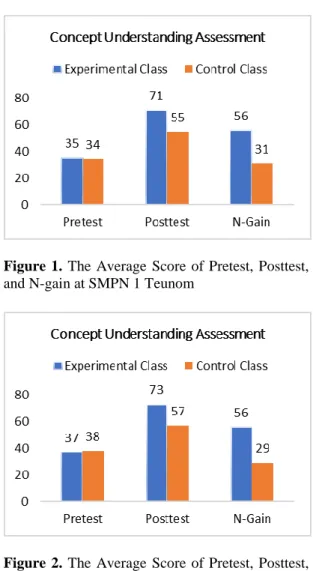
The results of students concept understanding at SMPN 1 Teunom and Pasie Raya were gained through pretest, posttest, and N-gain to know the improvement of students' conceptual understanding. An overview of the increase in the average score in the conceptual understanding of experimental class and control class can be seen in Figures 1 and 2.
Figure 1. The Average Score of Pretest, Posttest,
and N-gain at SMPN 1 Teunom
Figure 2. The Average Score of Pretest, Posttest,
and N-gain at SMPN 1 Pasie Raya
The mean difference of pretest, posttest, and N-gain for the improvement of the conceptual understanding are shown in Table 1.
Table 1. The Mean Difference Test Results of Pretest, Posttest, N-gain of the Students’ Conceptual
Understanding
Data Source School Sig. Conclusion
Pretest SMPN 1 Teunom 0,992 No difference
SMPN 1 Pasie Raya 0,924
Posttest SMPN 1 Teunom 0,000 There is a difference
SMPN 1 Pasie Raya
N-gain SMPN 1 Teunom 0,000 There is a difference
SMPN 1 Pasie Raya
Based on Figures 1 and 2 it is clear that the N-gain of the students’ concept of understanding in each school as seen in the experimental classes were higher than the control classes. Table 1 shows the results of the mean difference test for the
two classes with the t value of 0.000 < 0.05. So there is a significant difference in the students' concept understanding score between the experimental class and the control class. Thus, it can be concluded that there is a significant difference. The
Tadris: Jurnal Keguruan dan Ilmu Tarbiyah 3 (1): 55-66 (2018) | 59 difference in averages scores of pretests
and posttests are a tangible achievement as an improvement from the application of the scientific approach. This is supported by Verawaty et al. (2016) that there are differences in science learning outcomes between students who learn through scientific approach and students who learn through conventional approach, and simultaneously, there are differences of scientific attitude and science learning outcomes between students who learn through scientific approach and students who learn through conventional approach (Verawaty, Dantes, & Suastra, 2016).
The scientific approach through observation, questioning, experimenting, associating, and communicating can
improve students' conceptual
understanding of science materials, the improvement can be seen during the learning process where students' cognitive responses are increasing (Ardaya, 2016). The questioning stage is aimed to create a question and answer session between students and teacher and from one student to another. Question-asking activities can be based on students’ observations in creating questions that they want to understand. Teachers can guide each student to create their questions, ranging from sentence questions to ideas they want. The experimenting activities are activities that allow students to experiment and explore to find answers to their questions. Associating activities are activities where the students summarize and analyze the results to draw conclusions. This activity involves grouping different findings from different experiments in order to find results that will answer the questions. Therefore, reflection is important because in this step, the students will look back at what has been hypothesized and they will compare their hypotheses and findings (Gerde, Schachter, & Wasik, 2013).
There are differences in biology learning outcomes between students who
learn through the scientific approach and the students who learn through direct learning model. Then it can be concluded that the learning through scientific approach is better than the direct learning model in improving biology learning outcomes and science process skills (Marjan, Arnyana, & Setiawan, 2014). There is a difference in conceptual understanding between groups of learners who learn through inquiry learning strategies and groups of students who learn through direct learning strategies (Anggareni et al., 2013), the results of
learning activities and concept
understanding are increasing. The research on teaching using scientific approach assisted by Gmail can improve student learning result and conceptual
understanding of electromagnetic
induction (Hartini, Ashari, & Nurhidayati, 2016). The control class did not apply the scientific approach and the teacher explained the material briefly with a demonstration, followed by group discussion. There is no linkage of learning with direct experience so that the learning process impact on the less efficient concept understanding so that the concept understanding was lower than the experimental class.
Some observers conducted
observations when the learning process took place, the experimental classes with the scientific approach and the control classes with the conventional approach (discussion) to identify the students’ scientific attitude. The observed scientific attitude consisted of four aspects: curiosity, respect for data/facts, critical thinking, attitudes toward new discoveries and creativity. Every aspect of this students’ scientific attitude was observed in each meeting to see the average score. The results of the scientific attitude percentage of students in each school are shown in Figures 3 and 4.
60 | Tadris: Jurnal Keguruan dan Ilmu Tarbiyah 3 (1): 55-66 (2018)
Figure 3. Percentage of Scientific Attitude at
SMPN 1 Teunom
Figure 4. Percentage of Scientific Attitude at
SMPN 1 Pasie Raya
Based on Figure 3 and 4 it can be seen that in each dimension of scientific attitude obtained different averages score both in the experimental and control classes. In the experimental class, the students' curiosity dimension obtained a high percentage of 81% within good criteria. In the control class, the dimension of curiosity was also more prominent with the percentage of 77% within good criteria. This might be because students are given stimuli with new things, the students' mind becomes active, thus making students more enthusiastic in following the lesson. Curiosity is a desire to know more and more about something and can provide encouragement and support in learning (Philips, 2014). A similar point was made by Harrison. He states that teacher questions play an important role in encouraging students' curiosity to create a
questioning process toward the
investigation (Harrison, 2014). Teacher’s questions are given as early triggers for students, then students are required to find answers to the questions and make more in-depth questions. Discussion activities provide a space to cultivate students' curiosity that begins with the onset of student curiosity (Philips, 2014).
The curiosity function as a source of intrinsic motivation to study, explore and investigate the environment (Baruch, Levy, & Mashal, 2016). The student's curiosity indicator in this research is an interested attitude toward the discussion, trying to solve problems, ask questions, and seek information from various sources. In line with the Jirout & Klhar opinion of students' scientific curiosity, there are two main methods for analyzing curiosity, namely through self-assessment questionnaires and through observation of attitude or behavior measurement (Jirout & Klhar, 2012). The ability of students to reason and explain information well can indicate the level of understanding and is needed to develop a person's ability to perform scientific explanations (Sutopo & Waldrip, 2014). The averaged percentage of students' scientific attitude was 70 and 62 within the good category. Applying scientific approach has made students' scientific attitude to emerge (Khotimah, Maftukhin, & Ashari, 2015). Since the students were directly involved, they became more active. Students are required to observe various events in their surrounding, given the freedom to ask questions, conduct an experiment, analyze, and present the results that they have done in the worksheet.
There is a difference in the scientific attitude between students who learn through scientific approach and students who learn through conventional learning (Ratnasari & Liana, 2017; Verawaty et al., 2016). The results showed that there was a significant difference in the scientific attitude
Tadris: Jurnal Keguruan dan Ilmu Tarbiyah 3 (1): 55-66 (2018) | 61 between the experimental classes and the
control classes, there was a significant difference in the scientific attitude of the students before and after the learning using the scientific inquiry approach (Mexico & Padmaningrum, 2013). There is a high correlation between the scientific
attitude and the attitude of science teaching, the learning environment also positively influences the scientific attitude (Erdogan, 2017). The percentage of the four dimensions of students' scientific attitudes for each meeting can be seen in Table 2.
Table 2. Percentage Average Scientific Attitude of Students
School Class Scientific Attitude (%)
SMPN 1 Teunom Experiment 76
Control 65
SMPN 1 Pasie Raya Experiment 70
Control 67
Table 2 shows that the experimental classes obtained the average percentage for the four dimensions of students' scientific attitudes of 76% and 65% for the control class at SMPN 1 Teunom. SMPN 1 Pasie Raya obtained 70% and 67% for each class, so it can be said that the students' scientific attitude in the experimental classes was not much different from the control class. The description of the results of the recapitulation at each meeting indicates that there is an increase. It occurs both in the experimental class and in the control class, it can be stated that the scientific approach has a positive influence on students' scientific attitude. This is in accordance with the results of research by Widiadnyana et al that there are significant differences in scientific attitudes between students who learn through discovery learning model with students who learn through direct teaching model (Widiadnyana, Sadia, & Suastra, 2014).
Significant differences in scientific attitudes between students who learn through the scientific approach and those who learn through conventional learning. Simultaneously, there are differences in scientific attitudes and significant learning outcomes of science between those who learn through the scientific approach and those who learn through conventional
learning (Musaropah, 2014). So, the learning process affects the scientific attitude and science learning outcomes (Sumaedi, Dantes, & Suma, 2015). In line with the results of research by Olasehinde et al., which shows that there is a significant positive relationship between scientific attitudes and attitudes toward science; The relationship between scientific attitudes and science achievement was positive, the relationship between attitudes toward science and science achievement was also positive but not significant (Olasehinde, John, Olatoye, & Ademola, 2014).
There is a significant difference between the experimental class and the control class in every dimension of students' scientific attitude. In the dimensions of curiosity, critical thinking, respect for data/facts, attitudes toward new discoveries and creativity, overall are in good criteria with percentages above 70 and 60%. Thus it can be said that the scientific approach gives a positive influence on students' scientific attitude (Marta, Rosilawati, & Kadaritna, 2017). One of the factors that influence the learning outcome is the students’ internal attitude which is the scientific attitude (Lestari, Utami, & Masykuri, 2014; Widiyarini & Wilujeng, 2015). Curiosity is one dimension of scientific attitude (Anwar, 2009), the science students there
62 | Tadris: Jurnal Keguruan dan Ilmu Tarbiyah 3 (1): 55-66 (2018) exist a high scientific attitude in terms of
openness, discovery, and curiosity (Lacap, 2015).
The dimension of the new discovery attitude and the creativity of both classes obtained the lowest percentage. This was caused by lack of training and unfamiliar with the activities. Students tended to stop the experiment when results were obtained. However, although there is no significant difference in the control classes and experimental classes' scientific attitudes, the overall scientific attitude of the students was already in the good criteria based on the average score percentage obtained. It may be the same as previously described that the experimental and control classes were treated differently by using the scientific approach and conventional learning.
Teachers as educators in this case must be able to apply scientific approach that can integrate the high curiosity character, creative, critical, willing to try, confident , honest, responsible toward the task, cooperative, discipline, hard-working, able to organize themselves, and able to work with others (Cheriani, Mahmud, Tahmir, Manda, & Dirawan, 2015). Students' scientific attitudes in learning can influence understanding of concepts (Fakhruddin, Eprina, & Syahril, 2010). The scientific attitudes are the supporting factors in the students’ concept understanding, the better concept understanding possessed, the better scientific attitude will increase. This study looks at the differences in students' conceptual understanding between pretest and posttest, where students experience an excellent understanding of improvement. Based on the observation, the students' scientific attitude also obtained a good percentage in both sample classes. Thus, this study can be concluded that a good conceptual understanding can be obtained from a good percentage of scientific attitudes.
CONCLUSION
Based on the data analysis and discussion, it can be concluded that the scientific approach can improve the students’ conceptual understanding and scientific attitude. This indicates that the scientific approach is effective to be applied in SMPN 1 Teunom and Pasie Raya. Future the teachers as educators must be able to apply a scientific approach and can integrate the high curiosity character, creative and critical thinking.
ACKNOWLEDGMENTS
The researchers would like to express their gratitude to Dr. A. Halim M.Si. and Dra. Susanna, M.Pd. who has helped to validate the research instruments. Acknowledgment is also conveyed to Mahrami, Khairul, and Saipul for their participation as observers during the study. Furthermore, the researchers' gratitude is also conveyed to Ms. Agus Diana, S.Pd and Kamariah S. Pd who have participated in the implementation of the research.
REFERENCES
Anggareni, W., Ristiati, N. ., & Widiyanti. (2013). Implementasi Strategi Pembelajaran Inkuiri terhadap Kemampuan Berpikir Kritis dan Pemahaman Konsep IPA Siswa SMP. Jurnal Program Pascasarjana
Universitas Pendidikan Ganesha,
3(1), 1–11.
Anwar, H. (2009). Penilaian Sikap Ilmiah dalam Pembelajaran Sains. Jurnal
Pelangi Ilmu, 2(5), 103–114.
Aprilliyah, & Wahjudi, E. (2014). Pengembangan Media Pembelajaran Modul Interaktif pada Materi Jurnal Khusus Kelas X Akutansi di SMK Negeri Mojoagung. UNESA, 1–7.
Ardaya, D. . (2016). Penerapan
Pendekatan Saintifik untuk
Meningkatkan Pemahaman Konsep Materi IPA Siswa Sekolah Dasar.
Tadris: Jurnal Keguruan dan Ilmu Tarbiyah 3 (1): 55-66 (2018) | 63 Jurnal Pendidikan Guru Sekolah
Dasar, 1(1), 72–83.
Atsnan, M. ., & Gazali, R. . (2013). Penerapan Pendekatan Scientific dalam Pembelajaran Matematika SMP Kelas VII Materi Bilangan (Pecahan. In Prosiding Seminar
Nasional Matematika dan
Pendidikan Matematika. Yogyakarta.
Aulia, N. ., Fadiawati, N., & Tania, L. (2017). Efektivitas Pendekatan
Saintifik dalam Meningkatkan
Pemahaman Konseptual pada Materi
Pemisahan Campuran. Jurnal
Pendidikan Dan Pembelajaran
Kimia, 6(1), 130–144.
Baruch, Y. ., Levy, O. ., & Mashal, N. (2016). Pre-Schoolers Verbal and Behavioral Responses as Indicators of Attitudes and Scientific Curiosity. International Journal of Science and
Mathematics Education2, 14(125),
125–148.
Cheriani, Mahmud, A., Tahmir, S., Manda, D., & Dirawan, G. D. (2015). Problem-Based
Learning-Buginese Cultural Knowledge
Model-Case Study: Teaching
Mathematics at Junior High School.
International Education Studies,
8(4), 104–110.
Dewi, P. S. (2016). Perspektif Guru Sebagai Implementasi Pembelajaran
Inkuiri Terbuka dan Inkuiri
Terbimbing terhadap Sikap Ilmiah dalam Pembelajaran Sains. Tadris:
Jurnal Keguruan Dan Ilmu
Tarbiyah, 1(2), 179–186.
Erdogan, S. . (2017). Science Teaching Attitudes and Scientific Attitudes of Pre-Service Teachers of Gifted Students. Journal of Education and
Practice2017, 8(6), 164–170.
Ergul, R., Simskeli, Y., Calis, S., Ozdilek, Z., Gocmencelebi, S., & Sanli, M. (2012). The Effect of Inquiry-Based Science Teaching on Elementary School Student’s Science Process Skills and Science Attitudes.
Bulgarian Journal of Science and
Education Policy, 5(1), 48–68.
Fakhruddin, Eprina, E., & Syahril. (2010).
Sikap Ilmiah Siswa dalam
Pembelajaran Fisika dengan
Penggunaan Media Komputer
melalui Model Kooperatif Tipe Stad pada Siswa Kelas X¬-3 SMA Negeri 1 Bangkinang Barat. Jurnal Geliga
Sains, 4(1), 18–22.
Fauziah, R., Abdullah, A. ., & Hakim, D. . (2013). Pembelajaran Saintifik Elektronika Dasar Berorientasi Pembelajaran Berbasis Masalah.
Invotec, 9(2), 165–178.
Gerde, H. ., Schachter, R. ., & Wasik, B. . (2013). Using the Scientific Method to Guide Learning: an Integrated
Approach to Early Childhood
Curriculum. Early Childhood
Education Journal, 41(5), 315–323.
Harrison, C. (2014). Assesment of Inquiry Skill in the SAILS Project. Journal
of Science Education International,
25(1), 112–122.
Hartini, S., Ashari, & Nurhidayati.
(2016). Upaya Meningkatkan
Pemahaman Konsep Fisika melalui Pendekatan Cerpenkom Berbantuan Alat Gmail Siswa Kelas IX SMP Negeri 4 Magelang Tahun Pelajaran 2015/2016. Radiasi, 9(2), 76–80. Heriansyah, M. (2018). Peringkat
Kelulusan UN SMP, Banda Aceh Tak Masuk Lima Besar.
Irwandani, & Rofiah, S. (2015). Pengaruh
Model Pembelajaran Generatif
Terhadap Pemahaman Konsep Fisika Pokok Bahasan Bunyi Peserta Didik MTS Al-Hikmah Bandar Lampung. Jurnal Ilmiah Pendidikan Fisika
Al-BiRuNi, 4(2), 165–177.
https://doi.org/10.24042/jpifalbiruni. v4i2.90
Jho, H., Yoon, H. ., & Kim, M. (2014).
The Relationship of Science
Knowledge, Attitude and Decision Making on Socio-Scientific Issues: The Case Study of Students’ Debates
64 | Tadris: Jurnal Keguruan dan Ilmu Tarbiyah 3 (1): 55-66 (2018) on a Nuclear Power Plant in Korea.
Science and Education, 23, 1131–
1151.
Jirout, J., & Klhar, D. (2012). Children’s Scientific Curiosity: in Search of an Operational Definition of an Elusive Concept. Developmental Review, 32(125–160).
Khoeruningtyas, N., Permanasari, A., & Hamidah, I. (2016). STEM learning in Material of Temperature and its Change to Improve Scientific Literacy of Junior High School.
Jurnal Pendidikan IPA Indonesia,
5(1), 94–100.
https://doi.org/10.15294/jpii.v5i1.57 97
Khotimah, K., Maftukhin, A., & Ashari.
(2015). Penerapan Pendekatan
Scientific Berbasis Project untuk Meningkatkan Sikap Ilmiah dan Hasil Belajar Siswa Kelas X SMA Negeri 3 Purworejo Tahun Pelajaran 2014/2015. Radiasi, 7(1), 13–16. Kurniawan, A. . (2013). Metode Inkuiri
Terbimbing dalam Pembuatan Media
Pembelajaran Biologi untuk
Meningkatkan Pemahaman Konsep dan Kreativitas Siswa SMP. Jurnal
Pendidikan IPA Indonesia, 2(1), 8–
11.
Lacap, M. . (2015). The Scientific Attitudes of Students Major in
Science in the New Teacher
Education Curriculum. Asia Pacific
Journal of Multidisciplinary
Research, 3(5), 7–15.
Lestari, W. T., Utami, B., & Masykuri, M.
(2014). Penerapan Model
Pembelajaran Kooperatif Tipe
Numbered Head Together (NHT) Disertai dengan Media Lembar Kerja Siswa (LKS) untuk Meningkatkan Prestasi Belajar dan Kreativitas Siswa pada Materi Kelarutan dan Hasil Kali Kelarutan Siswa Kelas XI IPA 4 SMA. Jurnal Pendidikan
Kimia, 3(2), 28–35.
Marjan, J., Arnyana, P., & Setiawan, N.
(2014). Pengaruh Pembelajaran Pendekatan Saintifik terhadap Hasil Belajar Biologi dan Keterampilan Proses Sains Siswa MA Mu’allimat
NW Pancor Selong Kabupaten
Lombok Timur Nusa Tenggara Barat. Jurnal Program Pascasarjana
Universitas Pendidikan Ganesha,
4(1), 1–12.
Marta, N. ., Rosilawati, I., & Kadaritna, N. (2017). LKS Asam Basa Berbasis
Pendekatan Ilmiah dalam
Meningkatkan KPS Ditinjau dari Sikap Ilmiah. Jurnal Pendidikan
Dan Pembelajaran Kimia, 6(3), 521–
535.
Mexico, & Padmaningrum, R. . (2013). Efektivitas Penerapan Pendekatan Pembelajaran Scientific Inquiry terhadap Sikap Ilmiah dan Prestasi Belajar Kimia Peserta Didik. Jurnal
Program Studi Pendidikan Kimia,
3(2), 29–34.
Muhaimin, A., Susilawati, & Soeprianto, H. (2015). Pengembangan Media Kapasitor dan Pengaruhnya terhadap Pemahaman Konsep dan Sikap Ilmiah Siswa. Jurnal Pendidikan
Fisika Indonesia, 11(1), 59–72.
Mukhlis. (2017). Pembelajaran Model Inquiri Terbimbing pada Materi
Besaran dan Satuan untuk
Meningkatkan Keterampilan Generik Sains dan Hasil Belajar Mahasiswa.
Jurnal Lantanida, 5(1), 29–41.
Munggah, I. G. ., Rati, N. ., & Suarni, N. . (2016). Penerapan Saintifik Berbasis Lingkungan sebagai Sumber Belajar untuk Meningkatkan Hasil Belajar IPA Siswa Kelas V. Jurnal PGSD
Universitas Pendidikan Ganesha,
4(1), 1–10.
Musaropah, N. (2014). Pengembangan
Lembar Kerja Siswa Berbasis
Pendekatan Scientific pada Sub Tema Gaya dan Gerak. Jurnal
Pendidikan, 2(2), 74–76.
Olasehinde, John, K., Olatoye, & Ademola, R. (2014). Scientific
Tadris: Jurnal Keguruan dan Ilmu Tarbiyah 3 (1): 55-66 (2018) | 65 Attitude, Attitude to Scienceand
Science Achievement of Senior Secondary School Students in Katsina State, Nigeria. Journal of
Educational and Social Research,
4(1), 445–452.
Olatunde, Y. . (2009). Students Attitude Towards Mathematics and Academic Achievement in Some Selected Secondary Schools in Southwestern Nigeria. European Journal of
Scientific Research, 36(3), 336–341.
Palengka, I., & Arsyad, N. (2016).
Comparison of Mathematics
Learning Result of Students Taught by Employing Scientific Approach, Problem Posing, and Open Ended in Problem Based Learning Model In Class X At SMAN 2 Makale. Jurnal
Daya Matematis, 4(2), 143–156.
Philips, R. (2014). Space for Curiosity. Journal of Progress in Human
Geography, 38(4), 493–512.
Pitafi, A. ., & Farooq, M. (2012). Measurement of Scientific Attitude of Secondary School Students in
Pakistan. Academic Research
International, 2(2), 379–392.
Puspendik (Pusat Penilaian Pendidikan). (2017). Rekap Hasil Ujian Nasional Tingkat Sekolah. Retrieved from https://puspendik.kemdikbud.go.id/h asil-un/
Qomariyah. (2014). Kesiapan Guru dalam
Menghadapi Implementasi
Kurikulum 2013. Jurnal Pendidikan
Ekonomi IKIP Veteran Semarang,
2(1), 21–35.
Ratnasari, E., & Liana, C. (2017). Pengaruh Pendekatan Saintifik
terhadap Sikap Ilmiah dalam
Pembelajaran Sejarah Kelas XI IPS 1 Di SMA Ma’arif Sukorejo. E-Jurnal
Pendidikan Sejarah, 5, 1–14.
Sohibun, & Ade, F. Y. (2017). Pengembangan Media Pembelajaran Berbasis Virtual Class Berbantuan Google Drive. Pengembangan Media Pembelajaran Berbasis Virtual Class
Berbantuan Google Drive, 02(2),
121–129.
Sulastra, K., Wiarta, I. ., & Manuaba, I. B. . (2015). Penerapan Pendekatan Saintifik dengan Penilaian Proyek untuk Meningkatkan Kemampuan
Pemahaman Konsep dan Hasil
Belajar Keterampilan Matematika Siswa Kelas IV SD. Jurnal PGSD
Universitas Pendidikan Ganesha,
3(1), 1–10.
Sumaedi, K., Dantes, N., & Suma, K.
(2015). Pengaruh Pendekatan
Saintifik terhadap Sikap Ilmiah dan Hasil Belajar IPA pada Siswa SD Kelas VI Di Gugus VI Kecamatan Sawan Tahun Pelajaran 2014/2015.
Jurnal Pendidikan Dasar, 5(1), 1–
10.
Susilo, A., & Atun, S. (2017). Pengembangan LKS IPA untuk Meningkatkan Ketrampilan Proses Sains Dan Kemampuan Berpikir Kritis Siswa SMP. Jurnal Edukasi
Matematika Dan Sains, 5(1), 7–17.
Sutopo, & Waldrip, B. (2014). Impact of a Representational Approach on Students’ Reasoning and Conceptual
Understanding in Learning
Mechanics. International Journal of
Science and Mathematics Education,
12(4), 741–765.
Verawaty, M. ., Dantes, N., & Suastra, I. .
(2016). Pengaruh Pendekatan
Saintifik terhadap Sikap Ilmiah dan Hasil Belajar IPA pada Siswa SD Kelas V Di Gugus VI Kecamatan Sawan Tahun Pelajaran 2014/2015.
Jurnal Pascasarjana Undiksa, 6(1),
1–11.
Vitria, L. N., & Utami, B. (2014). Penerapan Metode Pembelajaran
Kooperatif Team Assisted
Individualization ( TAI ) Dilengkapi
Handout Untuk Meningkatkan
Kualitas Proses Dan Prestasi Belajar Siswa Pada Materi Larutan Peyangga
Kelas XI IPA 4 SMAN 2
66 | Tadris: Jurnal Keguruan dan Ilmu Tarbiyah 3 (1): 55-66 (2018)
Kimia (JPK), 3(4), 59–65.
Wanna, & Djadir. (2016). Comparison of The Effectivines of Cooperative Learning Two Stay Two Stray and
Jigsaw Type with Scientific
Approach on Learning Mathematics Learning to Grade XI MIA At MAN Pangkep. Jurnal Daya Matematis, 4(3), 280–305.
Wati, F. ., Wuryastuti, S., & Suzanti, L. (2016). Pengaruh LKS Berbasis Saintifik terhadap Keterampilan Proses Siswa Sekolah Dasar. Jurnal
Kalimaya, 4(2), 1–12.
Widiadnyana, W., Sadia, W., & Suastra,
W. (2014). Pengaruh Model
Discovery Learning terhadap
Pemahaman Konsep IPA dan Sikap Ilmiah Siswa SMP. Jurnal Program
Pascasarjana Universitas
Pendidikan Ganesha, 4(1), 1–13.
Widiyarini, A., & Wilujeng, I. (2015). Pengembangan LKS IPA Berbasis
Scientific Approach untuk
Mengoptimalkan Learning Outcome Siswa Mts Kelas VII. Jurnal
Pendidikan Matematika Dan Sains,
3(2), 169–181.
Wina, D. ., Hindarto, N., & Prasetyo, A. P. . (2017). Studi Kasus Pendekatan Saintifik dalam Pembelajaran IPA pada Kurikulum 2013 di SMP Negeri 5 Semarang. Journal of
Innovative Science Education, 6(1),
1–11.
Yenice, N., & Saydam, G. (2010). 8th Grade Students’ Science Attitudes and Views about Nature of Scientific Knowledge. Journal of Qafqaz