Robot Communication:
Issues and Implementations
by
Holly A. Yanco
B.A. Wellesley College (1991)
Submitted to the Department of Electrical Engineering and
Computer Science
in partial fulllment of the requirements for the degree of
Master of Science in Computer Science and Engineering
at the
MASSACHUSETTS INSTITUTE OF TECHNOLOGY
May 1994
c
Massachusetts Institute of Technology 1994. All rights reserved.
Author
::::::::::::::::::::::::::::::::::::::::::::::::::::::::::::Department of Electrical Engineering and Computer Science
May 12, 1994
Certied by
::::::::::::::::::::::::::::::::::::::::::::::::::::::::Lynn Andrea Stein
Class of 1957 Assistant Professor of Computer Science
Thesis Supervisor
Accepted by
:::::::::::::::::::::::::::::::::::::::::::::::::::::::Frederic R. Morgenthaler
Chairman, Departmental Committee on Graduate Students
Robot Communication:
Issues and Implementations
by
Holly A. Yanco
Submitted to the Department of Electrical Engineering and Computer Science on May 12, 1994, in partial fulllment of the
requirements for the degree of
Master of Science in Computer Science and Engineering
Abstract
In this thesis, we demonstrate that robots can develop their own languages for commu-nication. We call the languages developed by the robots Adaptable Synthetic Robot Languages (ASRLs). The basic ASRL is a simple one-to-one mapping of signals to concepts. We then present two ASRL types that use small amounts of additional structure to reduce learning times for ASRLs. In the context dependent ASRL, the robots use sensor values to help determine the meaning of a signal. In the composi-tional ASRL, the robot uses a simple grammar to build up concepts from words.
The robots develop their languages using reinforcement learning. Since the lan-guage learning task is a dependent problem, the traditional method of individual reinforcement fails. We introduce task-based reinforcement, which is able to handle dependent learning problems.
Thesis Supervisor: Lynn Andrea Stein
Robot Communication:
Issues and Implementations
by
Holly A. Yanco
Submitted to the Department of Electrical Engineering and Computer Science on May 12, 1994, in partial fulllment of the
requirements for the degree of
Master of Science in Computer Science and Engineering
Abstract
In this thesis, we demonstrate that robots can develop their own languages for commu-nication. We call the languages developed by the robots Adaptable Synthetic Robot Languages (ASRLs). The basic ASRL is a simple one-to-one mapping of signals to concepts. We then present two ASRL types that use small amounts of additional structure to reduce learning times for ASRLs. In the context dependent ASRL, the robots use sensor values to help determine the meaning of a signal. In the composi-tional ASRL, the robot uses a simple grammar to build up concepts from words.
The robots develop their languages using reinforcement learning. Since the lan-guage learning task is a dependent problem, the traditional method of individual reinforcement fails. We introduce task-based reinforcement, which is able to handle dependent learning problems.
Thesis Supervisor: Lynn Andrea Stein
Acknowledgments
First and foremost, I would like to thank Lynn Stein for her guidance during the past three years.
To my parents, I present my \paper." Mom and Dad, it's nally nished! Thanks to Nancy Ross, who taught me that robots need cr^epes.
Many people have been supportive throughout the course of this thesis. They have listened to practice talks, read drafts of the thesis, given useful advice, and provided distractions. These people include Dave \Bud" Baggett, David Beymer, Rod Brooks, Joanna Bryson, Matt Domsch, Greg Galperin, Andy Gavin, Eric Grim-son, Ian Horswill, Tina Kapur, Greg Klanderman, Lynne Parker, Nancy Pollard, Joe Marks, Maja Mataric, Brian Reistad, Jason Rubin, Marika Santagata, Tim Tang, Peter Todd, Mark Torrance, Pearl Tsai, Mike Wessler, Stewart Wilson, Rick Yanco, Catherine Young, the members of How to Solve AI, and everyone that I have inad-vertently omitted from this list.
Special thanks to Oded Maron.
The author was partially supported by Digital Equipment Corporation. This material is based upon work supported by the National Science Foundation under National Science Foundation Young Investigator Award Grant No. IRI{9357761. Any opinions, ndings, conclusions or recommendations expressed in this material are those of the author(s) and do not necessarily reect the views of the National Science Foundation. Professor Stein's research is also supported by the Gordon S. Brown fund, by the Mitsubishi Electric Research Laboratories, by the General Electric Foundation Faculty for the Future Award, and by the Class of 1957 Career Development Chair.
The research described here was conducted at the Articial Intelligence Labo-ratory of the Massachusetts Institute of Technology. Support for the laboLabo-ratory's articial intelligence research is provided in part by the Advanced Research Projects Agency of the Departmentof Defense under Oce of Naval Research contract N00014{ 91{J{4038.
Contents
1 Introduction
10
1.1 Overview of the problem : : : : : : : : : : : : : : : : : : : : : : : : : 10
1.2 Overview of the thesis : : : : : : : : : : : : : : : : : : : : : : : : : : 12
2 Experimental setup
14
2.1 Experimental assumptions : : : : : : : : : : : : : : : : : : : : : : : : 14
2.2 Language development scenario : : : : : : : : : : : : : : : : : : : : : 16
2.3 Data collection methods : : : : : : : : : : : : : : : : : : : : : : : : : 19
3 Reinforcement Learning
20
3.1 Introduction : : : : : : : : : : : : : : : : : : : : : : : : : : : : : : : : 20
3.2 Kaelbling's Interval Estimation : : : : : : : : : : : : : : : : : : : : : 23
3.3 Reinforcement of multiple agents : : : : : : : : : : : : : : : : : : : : 25
3.3.1 Credit assignment in dependent learning problems : : : : : : : 25
3.3.2 Individual reinforcement : : : : : : : : : : : : : : : : : : : : : 27
3.3.3 Task-based reinforcement: : : : : : : : : : : : : : : : : : : : : 29
3.4 Input Generalization : : : : : : : : : : : : : : : : : : : : : : : : : : : 30
3.5 Who reinforces the robots? : : : : : : : : : : : : : : : : : : : : : : : : 31
4 Basic ASRL Experiments
33
4.1 Introduction : : : : : : : : : : : : : : : : : : : : : : : : : : : : : : : : 33
4.2 Implementation : : : : : : : : : : : : : : : : : : : : : : : : : : : : : : 33
4.3 Results and Discussion : : : : : : : : : : : : : : : : : : : : : : : : : : 34
4.3.1 Development of dierent dialects : : : : : : : : : : : : : : : : 35
4.3.2 Adaptability of language : : : : : : : : : : : : : : : : : : : : : 37
4.3.3 Adding more concepts to the ASRL : : : : : : : : : : : : : : : 38
4.3.4 Task-based vs. individual reinforcement : : : : : : : : : : : : 40
4.3.5 All robots have knowledge of other robots' actions : : : : : : : 43
4.3.6 Scaling up the group size : : : : : : : : : : : : : : : : : : : : : 44
4.4 Future work : : : : : : : : : : : : : : : : : : : : : : : : : : : : : : : : 45
5 Context Dependent Language Experiments
47
5.1 Introduction : : : : : : : : : : : : : : : : : : : : : : : : : : : : : : : : 47
5.2 Implementation : : : : : : : : : : : : : : : : : : : : : : : : : : : : : : 48
5.3 Results and Discussion : : : : : : : : : : : : : : : : : : : : : : : : : : 49
5.3.1 Context dependent ASRL vs. basic ASRL : : : : : : : : : : : 51
5.3.2 Non-optimal languages : : : : : : : : : : : : : : : : : : : : : : 51
5.4 Future Work : : : : : : : : : : : : : : : : : : : : : : : : : : : : : : : : 53
6 Compositional Language
55
6.1 Introduction : : : : : : : : : : : : : : : : : : : : : : : : : : : : : : : : 55
6.2 Implementation : : : : : : : : : : : : : : : : : : : : : : : : : : : : : : 57
6.3 Results and discussion : : : : : : : : : : : : : : : : : : : : : : : : : : 58
6.3.1 Distribution of words over slots : : : : : : : : : : : : : : : : : 62
6.3.2 Phrase reinforcement vs. word reinforcement : : : : : : : : : : 63
6.3.3 Compositional ASRL vs. basic ASRL : : : : : : : : : : : : : : 65
6.4 Future Work : : : : : : : : : : : : : : : : : : : : : : : : : : : : : : : : 66
7 Related Work
67
7.1 Introduction : : : : : : : : : : : : : : : : : : : : : : : : : : : : : : : : 67
7.2 Articial life: evolving communication : : : : : : : : : : : : : : : : : 67
7.3 Multi-agent reinforcement learning : : : : : : : : : : : : : : : : : : : 69
7.4 Multi-agent robotics : : : : : : : : : : : : : : : : : : : : : : : : : : : 70
7.5 Distributed Articial Intelligence : : : : : : : : : : : : : : : : : : : : 72
8 Conclusion
74
A Robots
75
A.1 Introduction : : : : : : : : : : : : : : : : : : : : : : : : : : : : : : : : 75
A.2 Hardware : : : : : : : : : : : : : : : : : : : : : : : : : : : : : : : : : 75
A.3 Programmed robot abilities : : : : : : : : : : : : : : : : : : : : : : : 77
A.4 Impact of hardware limitations on research : : : : : : : : : : : : : : : 77
B Data tables and graphs
79
List of Figures
2-1 The experimental scenario : : : : : : : : : : : : : : : : : : : : : : : : 16
2-2 Programs running on the robots in the experiments : : : : : : : : : : 17
3-1 Sample learning table : : : : : : : : : : : : : : : : : : : : : : : : : : : 21
3-2 Kaelbling's Interval Estimation algorithm: : : : : : : : : : : : : : : : 24
3-3 Experimental scenario using individual reinforcement : : : : : : : : : 27
3-4 Experimental scenario using task-based reinforcement : : : : : : : : : 29
4-1 Learning times for the development of basic ASRLs by two robots and
by three robots using individual reinforcement : : : : : : : : : : : : : 40
4-2 Learning times for the development of basic ASRLs by two robots and
by three robots using task-based reinforcement : : : : : : : : : : : : : 41
4-3 Learning times for task-based reinforcement and individual
reinforce-ment methods in the developreinforce-ment of basic ASRLs by three robots.: : 42
4-4 Learning times for two robots developing the basic ASRL with and
without knowledge of what the other robot is doing : : : : : : : : : : 44
4-5 Learning times for the development of three and four concept basic
ASRLs with group sizes varying from 2 to 8 robots : : : : : : : : : : 45
5-1 Learning times for 12 concept context dependent ASRLs using diering
numbers of sensors to interpret signals : : : : : : : : : : : : : : : : : 50
5-2 Comparison of learning times for context dependent ASRLs and basic ASRLs : : : : : : : : : : : : : : : : : : : : : : : : : : : : : : : : : : : 51
6-1 Learning times for a compositional ASRL and the number of concepts
that can be represented in the ASRL : : : : : : : : : : : : : : : : : : 63
6-2 Learning times for 12 word compositional ASRLs : : : : : : : : : : : 64
6-3 Learning times for learning of compositional and basic ASRLs with
phrase reinforcement : : : : : : : : : : : : : : : : : : : : : : : : : : : 65
7-1 Comparison of methods that allow robots to start communicating : : 71
A-1 Two of the Sensor Robots used in this research : : : : : : : : : : : : 76
List of Tables
4.1 The development of a two concept basic ASRL by two robots: : : : : 35
4.2 The development of a two concept basic ASRL by three robots : : : : 36
4.3 Adapting a two concept ASRL : : : : : : : : : : : : : : : : : : : : : : 39
5.1 The development of two signal context dependent ASRLs by two robots 49 5.2 Learning times for context dependent ASRLs which are able to
repre-sent more concepts than are necessary : : : : : : : : : : : : : : : : : 52
6.1 Learning two concepts whose words can be used to form 27 concepts : 59
6.2 Learning a 35 concept compositional ASRL in 25 iterations : : : : : : 61
6.3 Even distribution of words over slots provides more concepts in less learning time : : : : : : : : : : : : : : : : : : : : : : : : : : : : : : : 62
B.1 Values of points graphed in gures 4-2 and 4-4 : : : : : : : : : : : : 79
B.2 Values of points graphed in gures 4-2 and 4-3 : : : : : : : : : : : : 80
B.3 Values for points graphed in gure 4-1 : : : : : : : : : : : : : : : : : 80
B.4 Values for points graphed in gure 4-3 : : : : : : : : : : : : : : : : : 80
B.5 Values for points graphed in gure 4-4 : : : : : : : : : : : : : : : : : 81
B.6 Values for points graphed in gure 4-5 : : : : : : : : : : : : : : : : : 81
B.7 Values for points graphed in gure 4-5 : : : : : : : : : : : : : : : : : 81
B.8 Values for points graphs in gure 5-1 : : : : : : : : : : : : : : : : : : 82
B.9 Values of points graphed in gure 6-1 : : : : : : : : : : : : : : : : : 82
B.10 Values for points graphed in gure 6-2 : : : : : : : : : : : : : : : : : 83
B.11 Values for points graphed in gure 6-3 : : : : : : : : : : : : : : : : : 83
Chapter 1
Introduction
This thesis gives evidence that robots can develop languages for communication. We introduce a new reinforcement technique better suited to multi-agent tasks involving dependent learning problems. Using this technique, we demonstrate that both phys-ical and simulated robots can learn adaptable synthetic robot languages (ASRLs). We show further the introduction of small amounts of additional structure { context and grammar { signicantly decreases the amount of time required to learn ASRLs.
1.1 Overview of the problem
Robots can and will fail.
We can use multiplerobots instead of relying on one all-purpose robot. The group of robots may work together to complete a task more expediently or simply act as backups for one another. Most often, the robots work as a team to reach their goals. However, when we choose to use multiple robots instead of a single robot, we have a new problem to consider: communication. When multiple robots must cooperate in order to complete a task, communication may expedite cooperation. Some tasks may not even be able to be completed without communication. For example, if only one of the robots knows which task needs to be completed and can not complete the task by itself, this robot needs to nd a way to communicate this information to the other robots in order for the task to be accomplished.
In previous work with multiple agents, robots are usually given a language de-veloped by a human programmer. However, the provided language may not be well-suited to the robots or to the tasks they are to perform. A programmer may not anticipate all of the communication needs of the robots if the robots encounter novel situations they can not talk about, the mission could fail. Robots that develop their own languages could overcome this problem since they develop their language as they try to complete tasks in the world. Robots usually can not adapt human provided languages. Robot developed languages will be adaptable since once the robots have the ability to develop a language, they have the ability to modify that language.
In order to develop a language, the robots need to be able to learn. The devel-opment of language can be viewed as a learning problem in which a group of robots learn to agree on an interpretation for signals. We call the communication languages that our robots develop Adaptable Synthetic Robot Languages (ASRLs). We call them \adaptable" because the languages can change in dynamic environments and \synthetic" to distinguish them from so-called natural languages (like English) that
people use. We will present three types of ASRLs that the robots can develop: basic,
context dependent, andcompositional. The context dependent and compositional AS-RLs are extensions of the basic ASRL in which we use additional structure to speed up learning.
We have chosen to use reinforcement learning as our learning method since it provides incremental learning. We also selected this method since we were interested in exploring multi-agent reinforcement learning. In reinforcement learning, an agent selects an action to perform on a given input. The agent then receives a reinforcement value which tells the agent if it has acted properly. In our work, the robots receive either a \good robot" or \bad robot" reinforcement. In reinforcement learning, re-inforcement values can vary over a spectrum of values and need not be binary. (We discuss reinforcement learning in depth in Chapter 3.)
In single agent reinforcement learning, it is clear that the lone robot deserves all of the credit if a task is completed properly. In multi-agent reinforcement learning, how should the robots be reinforced? One traditional method gives each robot an
individual reinforcement based only on their individual action. It seems that this method would guarantee reliable reinforcement, but we will show that this method fails to work for dependent learning problems. We introduce a new method for
re-inforcement, which we call task-based reinforcement. In this method, the group of
robots only receives one reinforcement value. The value is positive only if the robots complete the given task and negative if the robots do not complete the task properly. This method requires only a simple decision to determine reinforcement: was the task completed properly? Conversely, the individual reinforcement method requires someone (or something) to determine each individual robot's contribution towards the completion of the desired task. We will show that our new reinforcement method is eective in the language learning task and that it succeeds where individual rein-forcement fails.
1.2 Overview of the thesis
In Chapter 2, we describe the experimental scenario, discuss the experimental as-sumptions, and discuss our methods for data collection.
In Chapter 3, we give an overview of reinforcement learning and discuss the par-ticular algorithm that we have used, Kaelbling's Interval Estimation. We also present two multi-agent reinforcement schemes: individual reinforcement and task-based re-inforcement.
The following three chapters present communication experiments in the develop-ment of ASRLs and results. Chapter 4 describes the basic ASRL experidevelop-ments. In Chapters 5 and 6, we show how adding additional structure to the language improves learning times. Chapter 5 discusses the context dependent ASRL experiments where the additional structure involves using sensor values to determine the meanings of sig-nals. Chapter 6 presents the compositional ASRL experiments where the additional structure is a simple grammar. Each chapter also suggests directions for future work on the particular ASRL type.
In Chapter 7, we discuss how the work described in this thesis relates to previous 12
work in several areas of Articial Intelligence and Computer Science. Our conclusions are in Chapter 8.
Appendix A describes the robots we used in a few of the basic ASRL experiments. Appendix B contains data tables for points graphed in the thesis.
Chapter 2
Experimental setup
In this chapter, we describe the methods we have used in our experiments. First, we discuss the assumptions that we have made. Then we present our experimental language development scenario and discuss our data collection mechanisms.
2.1 Experimental assumptions
Since we have focused on language learning in this thesis, we have made several assumptions to simplify the problem:
Assumption 1
We assume that communication is perfect. In fact, in our work on real robots, we did have perfect communication within a 10-foot range.Assumption 2
We assume turn-taking | i.e. the robots will not talk over one another. Turn-taking is the mechanism that allows communication between two or more people to be heard and understood. If everyone were to talk at once, many of the messages would be lost and many of the messages that got through might be incorrect. This assumption is necessary to ensure perfect communication. If more than one robot could broadcast at the same time on the same channel, the communication would be very noisy.Assumption 3
The robots do not acknowledge messages from other robots. Since the communication is assumed to be perfect, we assume that the signal is received by the intended robotic audience.The issues we ignore by using assumptions 2 and 3 have been and are currently extensively researched in the Distributed Systems area (see, for example, Mullender, 1993]).
Assumption 4
We do not address plan recognition in which an agent attempts to determine the goals of another agent by watching the other agent. Plan recognition can be thought of as another form of communication, much as humans rely on body language to oer clues to what another person is thinking or feeling.Assumption 5
We assume that the robots have an audience to address. Without this assumption, the robot sending a signal to other robots would not know if there were other robots listening to it unless it was able to recognize its fellow robots (which is known as kin recognition).Assumption 6
In our experiments, the tasks the robots are to perform are atomic. Atomic tasks do not require planning and complicated task decomposition. Since we primarily want to investigate the language problem, this atomic action set is useful. In physical robots, the atomic actions we use are movement based. Our work in simulation continued the action paradigm for consistency.While we have concerned ourselves with the development of the language, other researchers have explored how systems can learn to build up the actions that we assume the robots have at the outset. Just as children seem to learn to interact with the world through actions before they start to talk about the world, a robotic system could be developed that learned how to act in the world and then start to learn to talk about what it has learned. Both Drescher, 1993] and Drescher, 1991] address the development of primitives using the Schema mechanism which builds up representations of observations about the world. Pierce, 1991] and Pierce and
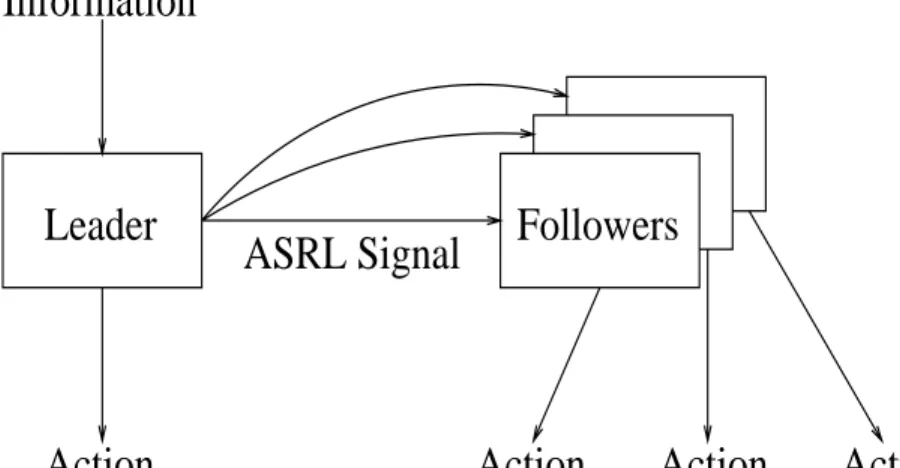
Information Task ASRL Signal Action Action Action Action Followers Leader
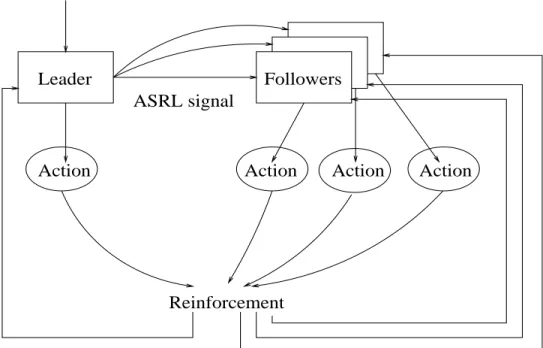
Figure 2-1: Flow of the signals in the experiments
Kuipers, 1991] discuss how robots can learn to use their motors to move around the world.
Assumption 7
All reinforcement is immediate. Together with Assumption 6, this means that reinforcement will always pertain to the most recent action taken. This assumption simplies the learning problem and allows us to focus on the development of ASRLs. It could be relaxed through the use of temporal dierencing methods such as Sutton, 1984].2.2 Language development scenario
The language development experiments were performed with the following experi-mental scenario, illustrated in gure 2-1. We have a group of robots that need to perform a task. The task information is only given to one of the group members this
robot is theleader. The leader must communicate the task information to the rest of
the group, who are followers.
The leader and followers share a common set of action capabilities. The leader also has a xed but uninterpreted set of signals that can be sent to the followers. The group as a whole needs to agree on mappings from the signals to concepts representing tasks. In these experiments, the concepts map to actions. The leader must also learn
Leader's program:
1. Listen for task information
2. On task signal,
(a) select signal to send to followers
(b) send selected signal to followers
(c) select action
(d) perform action
3. Wait for reinforcement
4. On reinforcement, update learning tables
5. Goto 1
Follower's program:
1. Listen for robot signal
2. On robot signal,
(a) choose an action
(b) perform the selected action
3. Wait for reinforcement
4. On reinforcement, update learning tables
5. Goto 1
Figure 2-2: Description of the programs running on the robots in the experiments. a mapping from the task information to its action and to the signal it needs to send to the followers.
The programs running on the robots require them to sit and wait until they hear a signal. The leader waits to hear the task signal while the followers wait for an ASRL signal. Once the leader receives the task signal, it selects a signal to send to the followers and sends it. After sending the signal, the leader selects an action to perform and executes that action. When a follower receives an ASRL signal, it selects an action to perform and executes it. After the robots act, each waits to receive a reinforcement value, after which it updates its reinforcement tables. (The control of the robot programs is given in gure 2-2.)
The task information given to the leader may come from a human signal if a human is running the experiments or may come from the environment if the robots are deciding what to do based on the state of the world. An example of a human signal is \move the furniture." An environmental signal may come in the form of a
threat to the robots' safety. It could also come from observations about the world | e.g. \the wastebaskets are overowing in the oces, so we should clean up."
Let's consider a simple example in the framework of our experimental scenario. We'll have one leader and two followers. The robots need to learn a two concept language i.e. they need to be able to understand two signals and execute the proper task on those signals. The two tasks will be \all spin" and \all straight". For the \all spin" task, each robot must choose to spin in place. Similarly, for \all straight", each robot must move forward.
In this example, the leader receives a signal from a human which tells the it what task it needs to perform. Initially, the leader does not understand the human signal, so it will need to learn the proper behavior as it tries to act on human commands.
For example, the human gives the leader \all spin" as the rst command. The leader will then choose a signal to send to the followers. The leader selects a signal from a set of initially uninterpreted signals that it is given. The leader makes this choice by using previous experiences if it has acted properly before, it will use this information to try to act properly again. This selection of the \proper behavior" is made using reinforcement learning we discuss this technique in Chapter 3. The leader also needs to select an action to perform, again using reinforcement learning. As the learning begins, no action or signal is better than any other, so the robot will select randomly from the possible signals and actions.
After the leader has sent a signal, the followers will hear this signal and each needs to act upon it. To do this, each follower needs to select the best action from its action set to perform given the ASRL signal from the leader robot. Again, as the learning begins, each follower will select an action randomly until it begins to receive positive reinforcement informing it that certain actions are better than others.
The robot ASRL is developing as the leader is learning to understand the hu-man input and the followers are learning to understand the leader. This concurrent learning introduces dependencies in the learning that cause simple individualized re-inforcement methods to fail. We will discuss this problem in Chapter 3.
There are several things that are being learned in this scenario. The leader needs 18
to learn to interpret the task information given to it. This interpretation involves performing some action and sending a signal to the followers. The followers need to learn to interpret the leader's signals, which may have diering meanings during the initial evolution of the language. For the followers, interpretation involves only performing an action. The signals that the leader sends to the followers are what we call the ASRL.
In our experimental scenario, only one of the robots can be the leader. An alter-nate method would allow all of the robots to assume the leadership role. Whenever a robot had information it needed to communicate to the other group members, it would take on the leadership position. Once it had communicated its information, the robot would go back to acting as a follower. We have not implemented this alternate scenario in the current research.
2.3 Data collection methods
For data collection, all experiments have been done in simulation. Average times to convergence for all experiments were collected over 100 runs of the experiment.
We dene convergence to be the point at which all of the inputs have each been acted upon properly three times. This measure of convergence tends to inate the number of iterations to convergence. However, since we use this denition consis-tently, all of the results are comparable to one another.
Once the reinforcement learning has converged upon a solution, it will continue to execute that solution until it receives an amount of negative reinforcement signicant enough to outweigh the previous positive reinforcement that has been received. Once all of the inputs have been acted upon properly three times, the learning algorithm will not try new actions for those inputs unless the robot begins to receive negative reinforcement, indicating that it needs to adapt to changing circumstances.
Chapter 3
Reinforcement Learning
3.1 Introduction
If we want robots to be adaptable, they need to have the ability to learn. Many
dier-ent learning methods have been developed and are currdier-ently being explored1. In this
work, we have chosen to use reinforcement learning. One advantage of reinforcement learning is that it is an on-line method i.e. the robots can learn incrementally as they explore, whereas other methods require large batches of examples from which to learn. Another advantage is that the world only needs to provide a reinforcement value that tells the agent how good the action performed was, while in most supervised learning methods, a teacher must tell the agent the correct action.
We can think of reinforcement learning in terms of human experience. If a parent wants to teach a child to make the bed, the parent needs to provide some form of positive reinforcement to the child for a task well done. The parent may also wish to provide positive reinforcement if the child merely makes an attempt at the task. The key is that the child receives feedback from the world, in this case through the parent, that serves as an indicator to whether the child is acting properly. Positive reinforcement is a reward such as an ice cream cone. Negative reward is a penalty such as not being allowed to play Nintendo.
1For an overview of machine learning, see Shavlik and Dietterich, 1990].
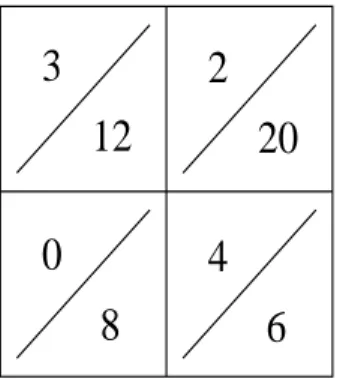
6 4 8 0 20 2 12 3 Straight Spin Bar Foo
Figure 3-1: Sample reinforcement learning table for two inputs, \Foo" and \Bar", and two outputs, \Spin" and \Straight."
In reinforcement learning, the learning agents try to maximize future rewards based on experience. In other words, once the child learns that making the bed brings good results and not making the bed brings bad results, the child will want to continue to make the bed since that will bring the positive results.
The learner maintains aninputoutput table to store information on what outputs
have been tried for particular inputs and the reinforcement values that were received. A sample reinforcement table is given in gure 3-1. The numerator keeps track of the amount of reinforcement that has been received and the denominator stores the number of times that output has been tried for the given input. We see that on input \foo", the agent has tried \spin" 12 times and has received positive reinforcement 3 times for this action. In our experiments, reinforcement is either 0 or 1 where 0 is negative reinforcement and 1 is positive reinforcement. Many other reinforcement payos are possible. The fractions 3/12 and 2/20 are used to select the action that should be executed the next time input \foo" is seen.
When the robot needs to select an action to perform, it looks for the row in the table that corresponds to the current input. For example, if the current input is \foo", it looks the rst row in the table. It uses the values in this table to determine the best action to perform. (While our gure represents the tables as containing fractions, the robots actually keep two tables { one for reinforcement values and one for the number of trials.) The best action may be the highest ratio, the action that has been tried the
least, or some other criterion. The particulars of the action selection depend upon the reinforcement learning technique the agent is using. In this work, we have selected Kaelbling's interval estimation method.
Reinforcement can either be immediate or delayed by some number of time steps. For example, in chess, an agent only receives reinforcement at the end of the game. If the agent wins the game, it receives a positive reinforcement value. If it loses, it receives a negative reinforcement value. At the time the agent receives reinforcement, it does not know which of the moves it made during the game helped it to win. Delayed reinforcement requires the agent to assign credit to particular moves that it made during the course of the game. Temporal dierencing (TD) is a reinforcement
method which can handle this credit assignment problem. For examples of TD work,
see Sutton, 1984], Sutton, 1988], Watkins, 1989], Watkins and Dayan, 1992], and Tesauro, 1992].
We assumed immediate reinforcement to avoid this problem of temporal credit assignment. The robots are told if they have performed the task properly as soon as they try to perform it. We ensure this immediate reinforcement in our programs by requiring the robots to wait for reinforcement after completing a task before moving on to the next task.
As we described in section 3.3, multi-agent learning presents a credit assignment problem similar to the one described above for delayed reinforcement. However, rather than assigning credit across a series of moves when a delayed reinforcement value is received, a multi-agent learning algorithm must assign credit across a number of agents. Our work in this thesis introduces a reinforcement method, task-based reinforcement, that does not need to assign credit to particular robots.
For some overviews of reinforcement learning, see Kaelbling, 1993], Watkins, 1989], Sutton, 1992], and Matari!c, 1991].
3.2 Kaelbling's Interval Estimation
The reinforcement learning method used in this research is Kaelbling's interval
esti-mation Kaelbling, 1993]. In interval estiesti-mation, two tables of inputsoutputs are
maintained. (In the examplein gure 3-1, we represented these two tables as one table of fractions.) One of the tables stores the number of times that an output has been performed on a given input and the other stores the number of times that positive reinforcement has been received when performing that output for the input. Each time an input is received, the expected \best" output is selected and the counter for that input/output pair is incremented. If positive reinforcement is received, a second counter for that input/output pair is also incremented. The \best" output given some
input is selected by the ub optimization function, which is given in gure 3-2. This
function favors actions which have received positive reinforcement. However, even if one output results in positive reinforcement, the algorithm will continue to explore the untried outputs in an attempt to attain the maximum reinforcement. When no output has received positive reinforcement yet, outputs are selected randomly.
We extend the algorithm given in gure 3-2 in three dimensions. We allow for multiple inputs by selecting the appropriate line in the table for a given input, where the basic algorithm in gure 3-2 is for only one input. We also allow for more than two outputs by extending the tables in this dimension. To extend this algorithm for multiple agents, each of the agents maintains its own set of tables from which it uses the optimization function to select the best action.
In the interval estimation reinforcement learning method, the agents will continue
to explore the space of inputsactions until it has experienced everything at least
once. Once the agent is convinced that it has found the action that brings the most reward, it will converge upon that action as the best action for the input and begin to exploit this discovery.
During this exploitation phase, agents may begin to receive negative reinforcement for outputs that formerly produced positive results. In order for agents to start exploring again, the amount of negative reinforcement must outweigh the amount of
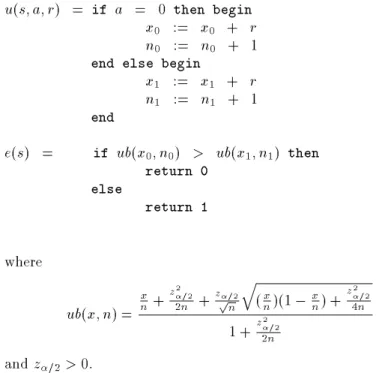
The initial state,s
0, consists of the integer variables x 0, n 0, x 1, and n 1, each initialized to 0. u(sar) = if a = 0 then begin x 0 := x 0 + r n 0 := n 0 + 1 end else begin
x 1 := x 1 + r n 1 := n 1 + 1 end e(s) = if ub(x 0 n 0) > ub(x 1 n 1) then return 0 else return 1 where ub(xn) = x n+ z 2 =2 2n + z =2 p n q (x n)(1 ; x n) + z 2 =2 4n 1 +z 2 =2 2n andz =2 >0.
Figure 3-2: Kaelbling's original interval estimation algorithm from page 52 of Kael-bling 93]. This algorithm works on one agent that is trying to learn which of two actions should be performed on one input. We extend this algorithm to multiple inputs over multiple agents.
positive reinforcement. However, if the agents have receiveda large amount of positive reinforcement,they must receivean equivalent amount of negative reinforcement. One solution to this problem is the use of memory windows in learning in which agents only remember a xed number of previous steps. Another solution would throw out learned values as soon as an unexpected reinforcement value is received however, this method could have problems in an environment where incorrect reinforcement is occasionally received. We did not implement a relearning strategy in our use of the interval estimation algorithm since we were mostly interested in the initial development of the ASRLs.
3.3 Reinforcement of multiple agents
Multi-agent learning is a relatively new subproblem in the reinforcement learning eld. It introduces the issue of how to reinforce more than one agent as discussed above, this is a credit assignment problem. In single agent learning, it is obvious that the single agent should receive the reinforcement. However, in multi-agent learning, which of the agents should receive positive reinforcement? Should it be only the robots that contribute towards the completion of a task? If so, how do we make this determination? Alternatively, should all robots only receive positive reinforcement if the task is completed? Previous work in multi-agent learning is discussed in Chapter 7.
3.3.1 Credit assignment in dependent learning problems
We dene a learning problem to bedependentwhen the success or failure of one agent's
actions depends on the actions undertaken by other agents. The language learning problem addressed in this thesis is dependent since all of the agents need to agree on the ASRL. Learning time for a dependent problem increases as the number of agents increases. During the initial random selection phase, additional agents decrease the chance that the agents will hit upon a good random selection quickly.
In a dependent problem, we need to determine the proper reinforcement to give 25
the agents. How can we decide which robots should receive positive reinforcementand which should receive negative reinforcement? We'll consider a situation with children and an adult rst, and then discuss how that problem relates to this multi-agent learning problem.
A child has several friends over to play. After a few hours, the child's parent comes into the room to nd that the oor is covered with toys. Since the parent hopes to avoid having to clean the room, the children are oered ice cream if the room is cleaned. The parent then leaves the children to complete the task. When the parent returns, if the room is cleaned, which of the children should receive ice cream? The task has been completed, so all can receive reward. However, it may be the case that only one child cleaned while the others continued to play. How can the parent know which children contributed towards the goal of a clean room? If the parent only cares whether or not the room is clean, and rewards on the basis of that task being
completed, the reinforcement method used is task-based reinforcement. However, if
the parent oers ice cream only to the children who helped clean, the children will
receive individual reinforcement. Individual reinforcement requires that the parent
remain in the room to determine which of the children are helping to reach the group goal. (We assume that the children will not give accurate information when asked who helped to clean the room since they want to receive ice cream even if they did not help clean.)
The multi-agent learning problem is basically the same as the problem described above. If we give a group of robots a task that needs to be accomplished, we need to determine how to assign reinforcement. This introduces a credit assignment problem analogous to the temporal credit assignment issues of delayed reinforcement. The tra-ditional approach is individual reinforcement. For dependent problems, this breaks. In the next section, we show why it does not work, and in the following section, we introduce task-based reinforcement and show how it solves the credit assignment problem in dependent learning problems.
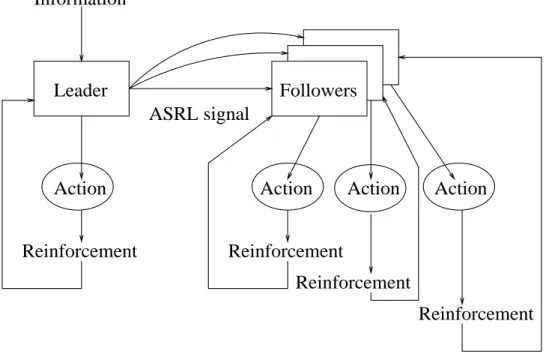
Information Task Reinforcement Reinforcement Reinforcement Reinforcement ASRL signal Action Action Action Action Followers Leader
Figure 3-3: Flow of the signals in the experiments using individual reinforcement.
3.3.2 Individual reinforcement
Individual reinforcement is a traditional method for providing reinforcement to a group of agents. Each agent receives a reinforcement value that depends only on the actions it has performed. If it is possible to decompose the task into clearly dened subtasks that can be assigned to agents in the group, this method has the advantage of providing an accurate reinforcement value to each robot. However, even if this determination can be made, it may require a large amount of overhead. Additionally, for tasks that are dependent learning problems, it is often dicult to determine which agent contributed towards the group goal. The development of ASRLs is a dependent learning problem.
A diagram of our experimental scenario using individual reinforcement is given in gure 3-3. Note that the individualreinforcementsdepend only on each agent's action. The leader receives reinforcementfor the ASRL signal, but the particular signal that is sent does not matter in the reinforcement value calculation for each individual agent. This causes a problem for individual reinforcement in this experimental scenario.
Let's consider what can happen when two followers receiving individual reinforce-27
ment are trying to converge upon a language with the leader of the group. We have three robots, one leader and two followers, that are trying to develop a two concept basic ASRL using individual reinforcement. The leader rst receives the command \all spin". The leader selects an action straight, and sends a signal, say low, to the
followers. Follower 1 chooses to perform the straight action on the low signal and
follower 2 chooses to perform the spin action. Both the leader and follower 1 receive
negative reinforcement for their actions while follower 2 receives a positive reinforce-ment value. The leader receives negative reinforcereinforce-ment on the signal it broadcast since only one of the two followers performed the correct action. Note that follower 2 receives positive reinforcement relative to an ASRL signal that receives negative reinforcement. The next time the leader is given the command \all spin", it will
most likely send the signal high since it has not explored that possibility yet. This
time, follower 1 chooses to spin on thehigh signal and follower 2 chooses to perform
the straight action. Follower 1 receives positive reinforcement and follower 2 receives negative reinforcement.
Follower 1 is now inclined to spin on the high signal while follower 2 is inclined to spin on thelowsignal. If this learning trend continues, the robots will fail to converge upon a language. The problem is that the positive reinforcement that is correct in relation to the given signal becomes problematic when the signal is negatively reinforced. In other words, the follower is learning to associate a correct output with an incorrect input | i.e. learning an invalid association. So, the follower learns a meaning for a signal that may need to change in order for all of the robots to agree on a basic ASRL.
As we will see in Chapter 4, this situation does arise in our experiments. Since the ASRL is evolving at the same time that the followers are learning their responses, individual reinforcement values that are correct at the particular moment in time may not be correct in the long run.
While individual reinforcement appears to be correct based upon the follower's action at the time it is given, it can be a \false positive" since the ASRL is still being developed | i.e. we are reinforcing the wrong association. Since the development
InformationTask Reinforcement ASRL signal Action Action Action Action Followers Leader
Figure 3-4: Flow of the signals in the experiments using task-based reinforcement of ASRLs is a dependent learning problem, it is impossible to know how to reinforce the followers without the knowledge of what the leader intended the decision as to whether a follower's action is right depends on the leader's signal. Traditional reinforcement methods do not take this into account.
3.3.3 Task-based reinforcement
Task-based reinforcement can handle dependent learning problems since it only pro-vides positive reinforcement when all of the robots act properly and thus avoids the \false positive" problem of individual reinforcement. The group of robots can not receive positive reinforcement until all of the robots complete the task properly | i.e. all of the robots move together in the desired manner. The robots are reinforced relative to what will now become a stable ASRL signal. A positive reinforcement under task-based reinforcement is guaranteed to be 100% correct. A diagram of our experimental scenario using task-based reinforcement is given in gure 3-4.
Using this method, it is possible for an individual to act correctly, even relative to an appropriate ASRL signal, but still receive negative reinforcement. However, this
\false negative" does not present the same problem that the \false positive" of the individual reinforcement does. If the robot fails to receive a positive reinforcement value, it will continue to select actions randomly. Through the continued selection of random actions, the group will eventually hit upon a solution that results in positive reinforcement as long as the space of solutions is discrete and nite. If the robots have an innite selection of actions, they might never hit upon a valid solution. Conversely, if a robot receives a \false positive" reinforcement using the individual method, the robot becomes predisposed to the selection of that action, even though it may not contribute to the ultimate global goal in which all of the robots act together.
Task-based reinforcement also provides us with the advantage of a binary rein-forcement decision. If the task is completed properly, the robots are given positive reinforcement. If the task is not completed properly, the robots are given negative reinforcement. This scheme does not require any credit assignment amongst the robots.
3.4 Input Generalization
Most often in learning, there is a large input space i.e. there are many inputs that can have many values. However, usually only a few of these bits are relevant.
In general reinforcement learning, the algorithm explores the whole inputoutput
space in an attempt to maximize the reinforcement that will be received (since an unexplored state may be a state with a reinforcement value far greater than anything that has been experienced). So, if there are irrelevant input bits, the algorithm will explore the extra space without making an attempt to judge whether or not it should be exploring in that area. Two of the papers that address the issue of input generalization in reinforcement learning are Mahadevan and Connell, 1991] and Chapman and Kaelbling, 1991].
Chapman and Kaelbling, 1991] developed a tree-structured reinforcement table to allow for input generalization At the outset, the algorithm assumes that all input space is identical. As the learner sees examples, it builds a binary tree using input
bits that are judged to be relevant.
In Mahadevan and Connell, 1991], they show that learning individual behaviors results in better performance than \monolithic" learning. The advantage of learning individual behaviors comes from the ability to have separate reinforcement functions for each behavior. Each of these reinforcement functions is much simpler than the function that is required for the \monolithic" global behavior. By building up smaller behaviors, we have input generalization. Each function pays attention to only relevant inputs where a global behavior would need to respond to all of the inputs (or learn to ignore certain outputs).
We did not implement any generalization algorithm in our system. We will see in the context dependent chapter that irrelevant sensor information can not be detected using our current algorithm. If the system could generalize, it could learn that only certain sensor inputs are valid. For example, it may only matter if a room is light or dark. The robot may have a large number of other sensor readings available to it, including heat sensors, touch sensors, and infrared sensors. The values from all of these other sensors should not be used to determine the meaning of a signal, since only the light value is important. In our current system, the robot must explore the space of possible sensor values | i.e. all possible combinations of sensor values.
3.5 Who reinforces the robots?
In order to learn, the robots require reinforcement values. These values can be pro-vided by a human trainer, the world or another source. So long as the values are reasonably reliable, the robots will be able to learn the task. (Since most reinforce-ment learning algorithms can handle noise, we say \reasonably reliable".)
In the experiments on physical robots, the reinforcement was provided to the robots by a human instructor. The human instructor acted the same way as the computerized critic of the simulations. The human instructor knew the desired task for each human input and reinforced the robots based upon their actions and the re-inforcement scheme in use. Because this is time consuming, most data-gathering over
large numbers of runs were performed in simulation, but the results were comparable to results on the real robots.
In our simulations, reinforcement is provided to the robots by a computerized critic. This critic knows the tasks that should be performed for each task signal given to the leader of the group. The critic uses this information to determine what rein-forcement to give the robots, based upon what the robots did and the reinrein-forcement scheme in use (in our case, either task-based reinforcement or individual reinforce-ment).
The experimental scenario we have constructed requires an external critic to pro-vide reinforcement. Not even the leader knows the desired task for a given input until after it has learned by receiving reinforcement. Additionally, in the current scenario, none of the robots know what other robots in the group have done. Unless one robot had the knowledge of the proper tasks to be performed on each input and could determine what each robot did, the robots can not reinforce themselves. With the physical robots we used in the experiments (see Appendix A), it is not easy or even possible for the robots to sense what other robots have done. To simpliy this problem, the robots could broadcast their actions to a robot that would determine the reinforcement that each robot should receive. However, giving one robot the knowledge of the correct tasks and telling it what every robot did simply turns that robot into an external critic.
The world can act as a powerful reinforcement mechanism. If the robots do not perform the correct task, they may receive the ultimate negative reinforcement: destruction. For example, if a robot needs to gather rocks from the edge of a cli, executing the wrong movement may result in a plunge to its demise. While the world should be considered a source of potential reinforcement, we do not want to destroy robots just to avoid the requirement for an external critic. The issue regarding the type of reinforcement mechanism that should be used has been addressed in previous reinforcement learning work.
Chapter 4
Basic ASRL Experiments
4.1 Introduction
The simplest type of language that robots can develop is a one-to-one mapping of
signals to actions. We call this simple language type the basic ASRL 1. Portions of
this chapter were joint work with Lynn Andrea Stein Yanco and Stein, 1993]. We gain simplicity at the expense of learning times. In later chapters, we will present two other ASRL types that are more complicated and require more structure to learn, but that converge more quickly than the basic ASRL. Even though the basic language takes longer to learn, we can explore this simpler language to see how increasing the size of the robot group and increasing the number of concepts in the ASRL will aect learning time. These results demonstrate that robots can successfully develop a language.
4.2 Implementation
The experimental scenario was discussed in section 2.2. Recall that the leader of the group sends signals to the followers to communicate the task to be accomplished. The followers need to interpret the signal by determining the concept that maps to each
1Our initial experiments in the development of the basic ASRL were inspired by the work of John
Shewchuk Shewchuk, 1991]
signal. The learning problem is to match the signals to concepts. In our experiments, concepts map directly to actions due to Assumption 6 in Chapter 2. The ASRL evolves as the leader and followers are learning the task.
Real and simulated robots have developed the basic ASRL. Our statistical data collection was done in simulation. Since the scenario we have set up does not depend on the world at all, the results using the simulation are comparable to results using real robots. While operating in the world usually results in some amount of noise (for example, communication noise), the assumptions we made in section 2.1 guarantee that real-world operation and simulation are comparable in these experiments.
4.3 Results and Discussion
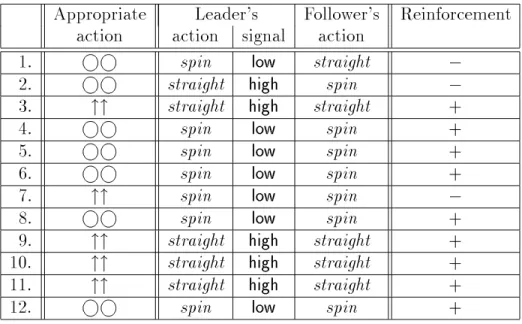
An example of the development of a two concept basic ASRL by two robots is given
in table 4.1. The two task signals given to the leader are and "" . On input
, both robots should spin in place. On input"", both robots should go straight.
The leader has a set of two initially uninterpreted signals to send to the follower: high
and low. Each robot selects from two possible actions to perform: straightand spin.
Using task-based reinforcement,the robots either receivepositive reinforcement,+, or
negative reinforcement,;. Task-based reinforcement only reinforces the correct total
action as can be seen in line 2 of this table. The leader executed the proper action,
spin, but it receives negative reinforcement since the entire task was not completed
correctly because the follower chose the action straight. After twelve iterations, the
robots converge upon an ASRL where low maps to the concept spin and high maps
to the conceptstraight.
Table 4.2 shows an example of the development of a two concept basic ASRL by
three robots using task-based reinforcement. The task signals are meaning
\all spin" and """ meaning \all straight." It takes longer for three robots to
learn the two concept language because there is now another robot that must act correctly in order for the robots to receive positive reinforcement using the task-based reinforcement method. For example, in line 5 of table 4.2, the leader and follower 1
Appropriate Leader's Follower's Reinforcement
action action signal action
1. spin low straight ;
2. straight high spin ;
3. "" straight high straight +
4. spin low spin +
5. spin low spin +
6. spin low spin +
7. "" spin low spin ;
8. spin low spin +
9. "" straight high straight +
10. "" straight high straight +
11. "" straight high straight +
12. spin low spin +
Table 4.1: A sample run demonstrating the development of a two concept basic
ASRL by two robots using task-based reinforcment. The desired behavior is both
spin on input, both go straight on input"". After twelve iterations, convergence
is reached. The ASRL agreed upon by the two robots is low ! spin and high !
straight.
both choose straight. In the previous example with two robots, these outputs would
have resulted in positive reinforcement. However, since the third robot, follower 2, choosesspin, the group receivesnegative reinforcement. After 24 iterations, the robots
converge upon an ASRL where low maps to the concept straight and high maps to
the concept spin.
4.3.1 Development of dierent dialects
As would be expected, the robots develop dierent mappings for words to actions in dierent runs due to the initial random selections of actions. These dierent mappings can be considered dierent dialects. In table 4.1, the robots agreed upon a basic ASRL
in which low mapped to straight and high mapped to spin. In table 4.2, the robots
converged upon a basic ASRL in which low mapped to spin and high mapped to
straight. Robots trained separately that develop dierent dialects would not be able 35
Appropriate Leader's Follower 1's Follower 2's Reinforcement
action action signal action action
1. """ straight low straight spin ;
2. """ spin high spin straight ;
3. """ spin high straight spin ;
4. """ straight low spin straight ;
5. """ straight low straight spin ;
6. spin high spin spin +
7. """ spin high spin spin ;
8. """ straight low spin straight ;
9. """ spin high straight straight ;
10. """ spin high spin spin ;
11. """ straight low straight spin ;
12. straight low spin straight ;
13. spin high spin spin +
14. spin high spin spin +
15. """ straight low spin spin ;
16. """ spin high spin spin ;
17. """ spin high spin spin ;
18. spin high spin spin +
19. """ straight low straight straight +
20. """ straight low straight straight +
21. spin high spin spin +
22. """ straight low straight straight +
23. spin high spin spin +
24. """ straight low straight straight +
Table 4.2: A sample run of the development of a two concept ASRL by three robots (one leader and two followers) using task-based reinforcement. The desired behavior isall spin on input,all go straight on input""". After twenty-four iterations,
convergence is reached. The robots agree upon the ASRL in which low ! straight
and high ! spin.
to eectively communicate with one another. However, since the learning of dierent dialects is typical of independent populations, we would expect to see this result.
4.3.2 Adaptability of language
We have performed experiments on the robots in which we change the meaning of task inputs after the robots have learned a language. For example, after the robots have learned to perform the task \all spin" on human input 1 and the task \all straight" on human input 2 correctly, we change the desired behavior for human input 1 from \all spin" to \leader spin, followers straight". Since the command is simply a monolithic idea that can not be broken down into smaller parts, the robots will try to continue to execute the old behavior for the input until enough negative reinforcement has been received to force the robots to try new actions. If we implement a memory window in our reinforcement learning algorithm, the robots would only remember a given number of trials. Alternatively, we could weight reinforcement values with the most recent reinforcement values weighted more heavily than older reinforcement values. This allows for relearning to occur much more expediently than it would if the meaning of a signal changed after 1,000,000 correct trials in which a large amount of positive reinforcement would have been collected.
In our robotic trials, we changed the meanings of signals very soon after the robots had learned the original meanings, so that using a memory window or dis-counted rewards was not necessary. Had the robots been working in the real world instead of controlled experiments, we would have needed a memorywindow or another method to allow the robots to relearn in a reasonable amount of time. Other methods could throw out previously learned information after a given number of unexpected reinforcement values since the surprise would cause the robots to want to relearn the proper behavior or could use large negative values for negative reinforcement to quickly decrement the built up reinforcement for a behavior.
An example of this relearning behavior in a robotic trial is given in table 4.3. The
two robots need to learn to both spin on and to both go straight on "". The
robots converge after twelve iterations to an ASRL wherelow maps to spin and high
maps to straight. On step 13, the task signal "" is changed to mean \both spin."
We denote this in the table as ""! . In steps 13{18, the robots are adapting
to this change. The solution involves using the high signal which was previously
mapped to spin in the ASRL. It provides a quick solution since the followers already
had learned to spin on the high signal. For this adaptation, the leader learns to say
something dierent. Then, in steps 19{34, the task signal is changed to mean
\both straight." The solution this time is to remap thehighsignal in the language to mean straight | the followers learn to interpret the signal dierently, providing the language with shifting meanings. Once this remapping occurs, the solution found in steps 13{18 for ""! is no longer valid. The robot will need to adapt further if
the ""!command is given again with the same expected output. This example
shows two ways that the robots are able to adapt. It also shows that long strings of one input can cause learning problems without competition, one signal can ip back and forth to two concepts while the other signal goes unused.
4.3.3 Adding more concepts to the ASRL
In learning problems, the addition of new concepts to be learned increases the time required to reach convergence. To explore what happens as we scale up the language size, we have run experiments in which we vary the number of concepts in a language from two to twenty using two and three robots.
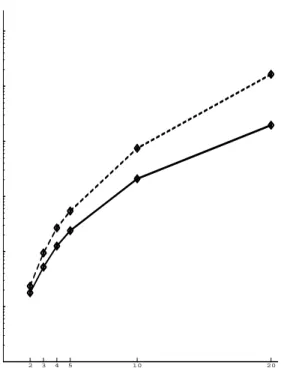
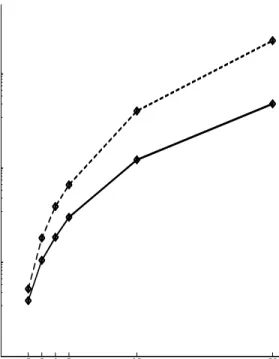
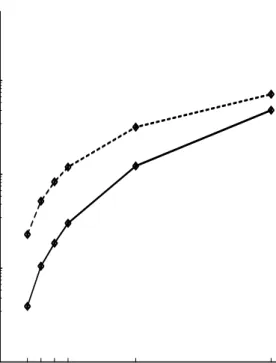
A comparison between two robot and three robot development of basic ASRLs varying in size from two to twenty concepts using individual reinforcement is graphed in gure 4-1 and the data is given in tables B.3 and B.4. A comparison between two robot and three robot development of basic ASRLs varying in size from two to twenty concepts using task-based reinforcement is graphed in gure 4-2 and the data is given in tables table B.1 and B.2. The amount of time necessary to learn is sub-exponential in the number of concepts in the language.
Due to these quickly increasing learning times, we will explore other language types that try to overcome some of these problems. In Chapter 5, we discuss the development of a context dependent ASRL. In Chapter 6, we discuss the development
Appropriate Leader's Follower's Reinforcement
action action signal action
1. straight low straight ;
2. "" straight low spin ;
3. spin high straight ;
4. "" spin high spin ;
5. "" straight low straight +
6. spin high straight ;
7. "" straight low straight +
8. "" straight low straight +
9. straight low straight ;
10. spin high spin +
11. spin high spin +
12. spin high spin +
13. ""! straight low straight ;
14. ""! straight low straight ;
15. ""! straight low spin ;
16. ""! spin high spin +
17. ""! spin high spin +
18. ""! spin high spin +
19. ! "" spin high spin ;
20. ! "" spin high spin ;
21. ! "" spin high spin ;
22. ! "" straight high spin ;
23. ! "" spin low straight ;
24. ! "" straight high spin ;
25. ! "" spin high straight ;
26. ! "" spin low straight ;
27. ! "" straight high spin ;
28. ! "" spin high spin ;
29. ! "" straight low straight +
30. ! "" spin high spin ;
31. ! "" straight low straight +
32. ! "" straight high straight +
33. ! "" straight high straight +
34. ! "" straight high straight +
Table 4.3: A sample run demonstrating the developmentand adaptation of a two con-cept basic ASRL by two robots using task-based reinforcement. This gure demon-strates two ways that the robots can adapt.
2 3 4 5 10 20 # of concepts 1 10. 100. 1000. 10000. 100000. 6 1. 10 iterations to convergence
Figure 4-1: Comparison of running times for the development of basic ASRLs using individual reinforcement. The solid line graphs results using two robots and the dashed line graphs results using three robots.
of a compositional ASRL. Both of these language types use some built-in structure to produce better learning times.
4.3.4 Task-based vs. individual reinforcement
The robots have developed basic ASRLs using both task-based reinforcement and individual reinforcement. As mentioned previously, task-based reinforcementis better suited to the dependent learning problem the robots face in the experimentalscenario. In individual reinforcement, each robot receives a reinforcement value that de-pends on its action in relation to the task that needs to be completed. Consider the task of \all spin". An individual robot receives positive reinforcement when it spins, since it is acting properly towards the completion of the group task. In our scenario, the robots are evolving their language as they learn to complete the task. The ASRL signal is reinforced in a task-based manner since the signal is not a good one unless all of the followers act in the proper manner.
For the two robot case, there are no convergence problems. Since there is only 40
2 3 4 5 10 20 # of concepts 1 100. 10000. 6 1. 10 iterations to convergence
Figure 4-2: Comparison of running times for the development of basic ASRLs using task-based reinforcement. The solid line graphs results using two robots and the dashed line graphs results using three robots.
one follower, there is no possibility of falling into an alternating and non-converging scenario as described in section 3.3.2.
However, we see in the three robot case that convergence problems are very real. To collect 100 runs for our average 20 concept basic ASRL data point, we needed to throw away 445 runs i.e. only 100 of 545 runs converged. Clearly, this is unacceptable. We want the robots to learn a language as quickly as possible so that they will be working reliably as fast as they can however, the apparent speed up in learning times for individual reinforcement over task-based reinforcement is inconsequential when we must throw away four-fths of the runs as non-converging. A comparison of the learning times for the development of basic ASRLs by three robots using task-based reinforcement vs. individual reinforcement is given in gure 4-3 and data is given in tables B.3 and B.4.
Individual reinforcement is dicult to use when tasks can not be decomposed as easily as our example of \all spin." For example, if the task is \move the couch", how do we determine which of the robots actually helped move the couch? Perhaps
2 3 4 5 10 20 # of concepts 1 100. 10000. 6 1. 10 8 1. 10 iterations to convergence 445 71 6 4 2 0
Figure 4-3: Comparison of running times for task-based reinforcement and individual reinforcementin the developmentof basic ASRL by three robots. The solid line graphs results of basic ASRL development using task-based reinforcement. The dashed line graphs results using individual reinforcement. The numbers next to the individual reinforcement points give the numbers of non-converging runs that needed to be thrown away in order to collect 100 converging runs for our average.
we should just reward any robot that touches the couch since they are attempting to help. A robot on the wrong side of the couch may be preventing movement or it could actually be helping to balance inequities in the pushing capabilities of the robots on the other side of the couch. Even if it's dicult to determine which of the robots that come in contact with the couch assist in the completion of the task, it should be easy to say that robots that did not touch the couch did not help, right? Wrong. A robot may remove itself from the pushing task if it knows it would do more harm than good by attempting to assist. It may also remove itself from the task in order to move away an obstacle blocking the path that the other robots will use to move the couch. Moving the couch is a dependent problem the success of one robot depends upon the action of other robots.
The advantage of task-based reinforcement is that it can handle the problems of individual reinforcement. In the couch moving problem, the robots only receive