NBER WORKING PAPER SERIES
SUDDEN STOPS AND OUTPUT DROPS V.V. Chari
Patrick J. Kehoe Ellen R. McGrattan Working Paper 11133 http://www.nber.org/papers/w1113
NATIONAL BUREAU OF ECONOMIC RESEARCH 1050 Massachusetts Avenue
Cambridge, MA 02138 February 2005
The authors thank the National Science Foundation for its support and Kathy Rolfe for excellent editorial assistance. The views expressed herein are those of the authors and not necessarily those of the Federal Reserve Bank of Minneapolis or the Federal Reserve System. The views expressed herein are those of the author(s) and do not necessarily reflect the views of the National Bureau of Economic Research.
© 2005 by V. V. Chari, Patrick J. Kehoe, and Ellen R. McGrattan. All rights reserved. Short sections of text, not to exceed two paragraphs, may be quoted without explicit permission provided that full credit, including © notice, is given to the source.
Sudden Stops and Output Drops
V. V. Chari, Patrick J. Kehoe, and Ellen R. McGrattan NBER Working Paper No. 11133
February 2005
JEL No. F4, F41, E3, E32
ABSTRACT
In recent financial crises and in recent theoretical studies of them, abrupt declines in capital inflows, or sudden stops, have been linked with large drops in output. Do sudden stops cause output drops? No, according to a standard equilibrium model in which sudden stops are generated by an abrupt tightening of a country's collateral constraint on foreign borrowing. In this model, in fact, sudden stops lead to output increases, not decreases. An examination of the quantitative effects of a well-known sudden stop, in Mexico in the mid-1990s, confirms that a drop in output accompanying a sudden stop cannot be accounted for by the sudden stop alone. To generate an output drop during a financial crisis, as other studies have done, the model must include other economic frictions which have negative effects on output large enough to overwhelm the positive effect of the sudden stop. V.V. Chari Department of Economics University of Minnesota Minneapolis, MN 55455 and NBER [email protected] Patrick J. Kehoe Research Department
Federal Reserve Bank of Minneapolis 90 Hennepin Avenue Minneapolis, MN 55480-0291 and NBER [email protected] Ellen R. McGrattan Research Department
Federal Reserve Bank of Minneapolis 90 Hennepin Avenue
Minneapolis, MN 55480 and NBER
Recentfinancial crises in emerging markets have included two features: abrupt declines in capital inflows, commonly known as sudden stops (Guillermo Calvo, 1998), and large declines in output. Here we ask whether theory predicts that these two features are related; do sudden stops necessarily lead to output drops? We ask this in a standard equilibrium model in which sudden stops are generated by an abrupt tightening of a country’s collateral constraint on foreign borrowing. Theory’s answer is no; sudden stops, by themselves, do not lead to decreases in output, but rather to increases. To generate an output drop during a financial crisis, the model must include other frictions which have negative effects on output that are large enough to overwhelm the positive effect of the sudden stop.
We begin by setting up a standard model of a small open economy in which foreign borrowing is subject to a collateral constraint. We view fluctuations in this collateral con-straint as arising from fluctuations in a country’s reputation. In the model, the country’s budget constraint implies that an abrupt decrease in capital inflows produces an abrupt in-crease in net exports. Following our earlier approach (in V. V. Chari, Patrick Kehoe, and Ellen McGrattan, 2004), we show that the equilibrium outcomes in the small open economy are equivalent to those of a closed-economy prototype growth model of the kind widely used in the business cycle literature. In particular, we show that a rise in net exports in the small open economy corresponds to a rise in government consumption in the prototype model. It is well known that an increase in government consumption produces an increase in output in models like our prototype growth model. A sudden stop that produces an increase in net exports in the small open economy thus also leads to an increase in output. We demonstrate this quantitatively with data from Mexico in the mid-1990s.
in which sudden stops lead to output drops. In these studies, however, output drops because of other frictions that overwhelm the direct effect on output from sudden stops. In all three studies, firms must borrow in advance to pay for inputs to production. In Pablo Neumeyer and Fabrizio Perri (2004), firms must borrow to pay for a fraction of the wage bill, while in Lawrence Christiano, Christopher Gust, and Jorge Roldos (2004) and Enrique Mendoza (2004), firms must borrow to pay for foreign intermediate inputs. This payment-in-advance requirement, by itself, does not introduce a friction because firms can simply borrow at the market interest rate to make the payments. In Neumeyer and Perri (2004) and Mendoza (2004), the key friction is thatfirms are effectively required to put the funds in a non—interest-bearing escrow account. In Neumeyer and Perri, this requirement introduces a wedge between the marginal product of labor and the marginal rate of substitution between leisure and consumption. In Mendoza, this requirement produces a shock to total factor productivity. In Christiano, Gust, and Roldos, the payment-in-advance requirement interacts with the collateral constraint to produce a shock to total factor productivity. Here we demonstrate in a version of our model that the output drops in these studies are not due to the sudden stops alone.
I. Collateral Constraints
Here we develop a model with a collateral constraint facing a small open economy. We show that equilibrium allocations in this original model coincide with those in a closed-economy prototype growth model with shocks to government consumption. Specifically, a decline in net exports resulting from a tightening of the collateral constraint corresponds to a rise in government consumption in the prototype growth model.
A. Original Economy
Consider the following model of a small open economy embedded in a world economy with a single homogenous good in each period. The economy experiences one offinitely many events st, which index the shocks. We denote by st = (s0, . . . , st) the history of events up
through and including period t. The probability, as of period 0, of any particular history st
is π(st). The initial realization s
0 is given.
The representative consumer in this economy has preferences
X
βtπ(st)U(c(st), l(st)), (1)
where c(st)and l(st)denote consumption and labor. The country’s budget constraint is
c(st) +b(st) +k(st)≤F(k(st−1), l(st)) + (1−δ)k(st−1) + X
st+1|st
q(st+1)b(st+1), (2)
whereb(st+1) denotes the amount of state-contingent debt, or borrowing from the rest of the world by the country in period t, q(st+1) denotes the corresponding state-contingent price,
and k(st) denotes the capital stock chosen in period t for use in period t+ 1. The country
faces a collateral constraint on borrowing of
b(st+1)≤V (st+1),
(3)
where the maximal amount of borrowing V (st+1) depends on the shock in period t+ 1. To
avoid Ponzi schemes, we assume that V (st+1) is uniformly bounded above. The constraint
(3) implies that having more collateral allows the country to borrow more. We interpret shocks to this collateral constraint as arising from changes in the relationship between the country and internationalfinancial markets (or the country’s financial reputation).
The government of this country maximizes the utility of the representative consumer (1) subject to the country’s budget constraint (2) and collateral constraint (3). The world gross interest rate is constant and equal toR across both states and time. Arbitrage requires that, in equilibrium, q(st+1) = π(s t+1 |st) R . (4)
An equilibrium for the original economy is a set of allocations(c(st), k(st), l(st), b(st+1))and
prices(q(st))such that these allocations solve the government’s problem and the prices satisfy
the arbitrage condition (4).
In this economy, a sudden stop is defined as an abrupt increase in net exports. Here, net exports are clearlyF(k(st−1), l(st))
−[k(st)
−(1−δ)k(st−1)]
−c(st),which from (2) equals
b(st)− X
st+1|st
q(st+1)b(st+1). (5)
Thus, a sudden stop is equivalently defined as an abrupt decrease in new borrowing. From (3), we know that a sudden drop inV(st+1)leads to a drop inb(st+1)and, when the collateral
constraint is binding, to a sudden stop.
To understand how the collateral constraint affects the equilibrium, consider the first-order conditions of the government’s problem. Let βt+1π(st+1)µ(st+1) be the multiplier on
the collateral constraint, so that µ(st+1) is positive when the collateral constraint is binding and zero when it is not. Then thefirst-order conditions imply that
−Ul(s t) Uc(st) =Fl(st), (6) Uc(st) = X st+1|st βπ(st+1|st)Uc(st+1) h Fk(st+1) + 1−δ i , (7)
and
Uc(st) =βR[Uc(st+1) +µ(st+1)].
(8)
Notice that the collateral constraint does not distort either thefirst-order condition (6), gov-erning labor supply, or the intertemporal Euler equation (7), govgov-erning capital accumulation. As can be seen from (8), the collateral constraint affects only the intertemporal marginal rate of substitution in consumption.
B. Associated Prototype Economy
Now consider a closed-economy prototype model with an exogenous stochastic variable, government consumption g(st), which we call the government consumption wedge. In this
economy, consumers maximize (1) subject to the budget constraint
c(st) +k(st)≤w(st)l(st) +hr(st) + 1−δik(st−1) +T(st), (9)
where w(st), r(st), and T(st) are the wage rate, the capital rental rate, and the lump-sum
transfers. In each state st, firms choose k and l to maximize F(k, l)−r(st)k−w(st)l. The
government’s budget constraint is
g(st) +T(st) = 0. (10)
The resource constraint for this economy is
c(st) +g(st) +k(st) = F³k(st−1), l(st)´+ (1−δ)k(st−1). (11)
Anequilibrium of the prototype economy consists of allocations(c(st), k(st), l(st), g(st), T(st))
and prices (w(st), r(st))such that these allocations are optimal for consumers andfirms and
The following proposition shows that the government consumption wedge in the pro-totype economy consists of net exports in the original economy:
Proposition1. Consider an equilibrium of(c(st), k(st), l(st), b(st+1))and(q(st))for the original
economy. Let the government consumption wedge be
g(st) =F³k(st−1), l(st)´−hk(st)−(1−δ)k(st−1)i−c(st), (12)
let the wage and capital rental rates bew(st) =F
l(st) andr(st) =Fk(st), and let the
lump-sum transfers T(st) be defined by (10). Then the allocations (c(st), k(st), l(st), g(st), T(st))
and the prices (w(st), r(st)) are an equilibrium for the prototype economy.
Proof. The first-order conditions for the prototype economy are (6) and (7). Under the construction of the government consumption wedge in (12), the resource constraint (11) is equal to (2). The proposition then follows. Q.E.D.
Now consider a sudden stop, as in the original economy. In the prototype economy, this sudden stop manifests itself as an abrupt increase in the government consumption wedge. As is well known from the business cycle literature, an increase in government consumption by itself leads to an increase in labor and an increase in output. (See, for example, S. Rao Aiyagari, Lawrence Christiano, and Martin Eichenbaum, 1992.) Thus, in this economy, a sudden stop does not generate an output drop; it generates an output rise.
Note that for simplicity we have abstracted from any government consumption in the original economy. If we let the original economy have government consumption, then the government consumption wedge in the prototype economy is the sum of government consumption and net exports in the original economy.
Note also that given an equilibrium in the prototype economy, we can construct the associated equilibrium in the original economy if Uc(st)/βR −Uc(st+1) is nonnegative for
all st+1 for some choice of R > 1. This R serves as the world interest rate in the original
economy, and at such anR, the multiplier on the collateral constraint is nonnegative. In this constructed equilibrium, the value of the initial debt in the original economy is set equal to the present discounted value of government consumption in the prototype economy. The debt in the original economy at state st is, of course, the present discounted value of net exports
and, hence, in the prototype economy corresponds to the present discounted value of future government consumption.
Proposition 1 is closely related to a proposition in our earlier work (Chari, Kehoe, and McGrattan, 2004). In that proposition, we consider an original economy with no collateral constraint but with a fluctuating world interest rate. We establish a similar equivalence proposition there. In the original economy, fluctuations in the world interest rate lead to fluctuations in net exports. In the prototype economy, thesefluctuations in net exports show up as fluctuations in the government consumption wedge.
C. Extensions to Uncontingent Asset Markets
Consider now a version of the original economy in which we replace the state-contingent debt with uncontingent debt. Here the budget constraint becomes
c(st) +b(st−1) +k(st)≤F(k(st−1), l(st)) + (1−δ)k(st−1) +q(st)b(st), (13)
where nowb(st)denotes the amount of state-uncontingent debt owed to the rest of the world
then becomes
b(st)≤V (st+1) for allst+1.
(14)
Hereq(st) = 1/R. The first-order conditions associated with the problem are (6), (7), and
Uc(st) =βR X st+1|st π(st+1|st)hUc(st+1) +µ(st+1) i .
With this setup, the analog of Proposition 1 immediately applies. In particular, in the prototype economy,fluctuations in the government consumption wedge play the same role as fluctuations in net exports in the original economy.
II. A Quantitative Analysis of a Sudden Stop
Here we use the logic of Proposition 1 to examine the quantitative effects of a well-known sudden stop episode, in Mexico in the mid-1990s.
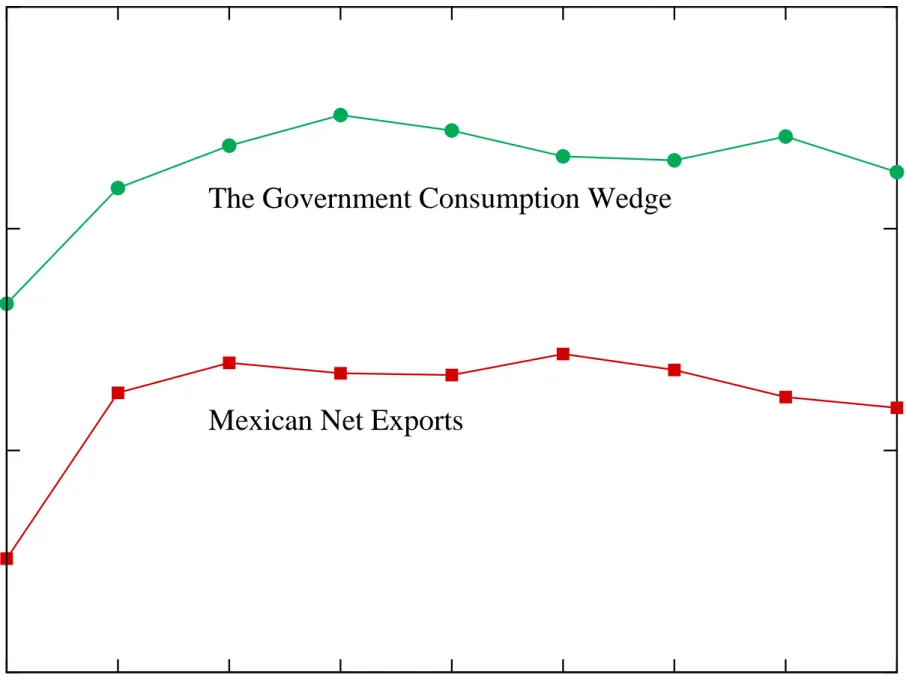
In Figure 1, we plot Mexican data on real net exports and the government consumption wedge (the sum of real government consumption and real net exports) between the last quarters of 1994 and 1996. We normalize both series by the level of real GDP in 1994:4. The figure shows an abrupt and dramatic increase in the government consumption wedge in the first quarter of 1995 and suggests that this increase was due almost entirely to the sharp rise in net exports. That is, Mexico experienced a sudden stop.
We study the quantitative effects of this sudden stop in a prototype growth model. We use a version of the model in Chari, Kehoe, and McGrattan (2004), in which the stochastic processes for the government consumption wedge, the labor wedge, the efficiency wedge, and the investment wedge are estimated using the model and Mexican data from 1980:1 to 2003:4. (For details, see Chari, Kehoe, and McGrattan, 2005.)
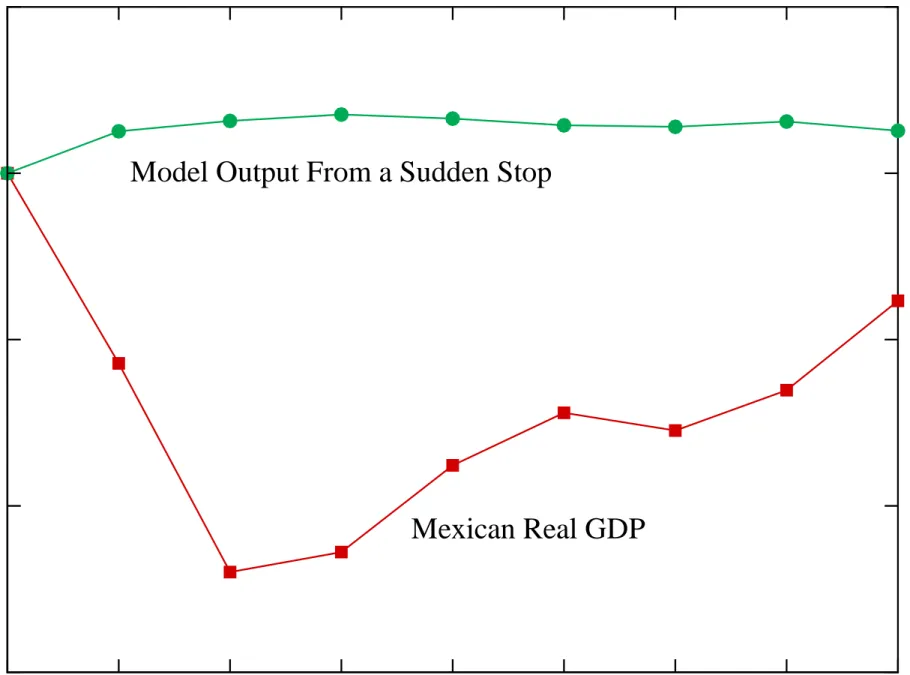
To assess the effects of the sudden stop, we feed the realized values of the Mexican government consumption wedge over the period from 1994:4 to 1996:4 into our prototype growth model, holding the values of the other Mexican wedges fixed at their 1994:4 levels. Figure 2 shows the result: Given that historical Mexican data, the model predicts that the sudden stop, by itself, leads to a small increase in output. Figure 2 also shows what actually happened to Mexican real GDP in 1995: it fell sharply. This analysis clearly demonstrates that the sharp output drop is not due to the sudden stop alone.
III. Other Frictions
We have shown that in our simple model with a collateral constraint on foreign bor-rowing, sudden stops do not lead to output drops. Now we consider adding other frictions to the simple model and ask if sudden stops, interacting with these frictions, lead to output drops. Wefirst consider an economy with an endogenous collateral constraint and show that this constraint corresponds to a subsidy to investment in the prototype growth model and, therefore, to an increase in output. We then consider the role of an advance-payment con-straint. We show that such a constraint can lead to output drops from sudden stops only when coupled with yet other frictions.
A. Investment Wedges from Endogenous Collateral Constraints
Consider a version of the original economy with one change, that the collateral con-straint (3) is replaced by an endogenous collateral concon-straint:
b(st+1)≤V ³k(st), st+1
´
. (15)
Here the maximal amount that can be borrowed, V (k(st), s
t+1), depends on the capital
strictly increasing ink, so that having more collateral allows a country to borrow more, and that V (k(st), s
t+1) is uniformly bounded above, to avoid Ponzi schemes. This formulation is
similar to that of Nobuhiro Kiyotaki and John Moore (1997) and is motivated by the idea that a portion of the capital stock can effectively be seized by foreign lenders in the event of default; hence, foreign lenders will not lend more than the value of the seizable portion.
An equilibrium in this endogenous collateral-constraint economy is defined as before. The first-order conditions here are the same as in the original economy except that the intertemporal Euler equation (7) is replaced by
Uc(st) = X st+1|st βπ(st+1|st)Uc(st+1) h (Fk(st+1)−δ) + 1 i + X st+1|st βπ(st+1|st)µ(st+1)Vk(st+1). (16)
The associated prototype economy has an investment wedge 1−τk(st), resembling
a tax on capital income, along with the government consumption wedge. The consumers’ budget constraint is now
c(st) +k(st)≤w(st)l(st) +h³1−τk(st)
´ ³
r(st)−δ´+ 1ik(st−1) +T(st). (17)
The government’s budget constraint is now
g(st) +T(st) =τk(st)
³
r(st)−δ´k(st−1), (18)
and the resource constraint is unaffected. An equilibrium of the prototype economy is defined as before.
The following proposition shows that the endogenous collateral constraint manifests itself as an investment wedge in the associated prototype economy:
the investment wedge be τk(st+1) =− µ(st+1)V k(st+1) Uc(st+1) (Fk(st+1)−δ) , (19)
let T(st) be defined by (18), and let the rest of the variables be as in Proposition 1. Then
the resulting allocations, prices, and wedges are an equilibrium for the associated prototype economy.
The proof of the proposition follows immediately from a comparison of thefirst-order conditions, budget constraints, and resource constraints of the two economies.
Note that if the endogenous collateral-constraint economy is in the neighborhood of a steady state, thenFk(st+1)−δ is positive, so that in this neighborhood, a binding collateral
constraint (µ(st+1)>0)corresponds to a subsidy to capital accumulation (τ
k(st+1)<0).The
intuition for this result is that if the collateral constraint in the original economy is binding in period t+ 1,then capital accumulation in period t helps to relax the collateral constraint in period t + 1 and, hence, provides an additional benefit beyond that from the marginal product of capital.
Consider a sudden stop in the endogenous collateral-constraint economy generated by a tightening of the collateral constraint. Proposition 2 shows that such a sudden stop corresponds to a subsidy to capital accumulation along with an increase in government con-sumption. A well-known result in the business cycle literature is that a subsidy to capital accumulation stimulates investment and output. We have already argued that an increase in government consumption also stimulates output. Thus, in the endogenous collateral-constraint economy, sudden stops do not lead to output drops.
The literature on sudden stops has introduced various forms of constraints involving payments in advance and has shown that sudden stops interacting with these constraints and other frictions can produce output drops. Neumeyer and Perri (2004) introduce advance-payment constraints on wages, together with an escrow provision, and Christiano, Gust, and Roldos (2004) and Mendoza (2004) introduce them on payments of intermediate goods. Christiano, Gust, and Roldos subject these payments to collateral constraints. Mendoza has both an escrow provision and a collateral constraint. Here we introduce an advance-payment constraint on wages and show that alone it does not produce simultaneous sudden stops and output drops.
In the business cycle literature, it has been widely argued that requiring firms to pay workers in advance of production introduces a wedge between the marginal product of labor and the marginal rate of substitution between leisure and consumption; we have called this a labor wedge (Chari, Kehoe, and McGrattan, 2004). Here we argue that such a requirement, by itself, does not introduce a labor wedge, but it does so when coupled with a requirement that firms escrow future wages in non—interest-bearing accounts.
Consider the following deterministic version of our economy with an advance-payment constraint together with an escrow provision. In this economy, in period t−1, a firm must escrow with the government its wage billwtlt due in periodt. To do so, thefirm borrows wtlt
at t−1 from foreign lenders at the world (gross) interest rate Rt and escrows these funds
with the government. (Note that the firm’s cash flows in period t−1 with respect to these transactions net out to zero.) In periodt,thefirm uses the escrowed funds to pay its workers, and it must repay the foreign lenders Rtwtlt. The firm’s problem is to maximize profits at t
given by
F(kt, lt)−Rtwtlt−rtkt.
The government rebates the interest on escrowed funds as a lump-sum transfer to consumers. Consumers maximize utility PβtU(ct, lt) subject to the budget constraint
ct+Rtbt+kt ≤wtlt+ [rt+ (1−δ)]kt+bt+1+Tt.
The resultingfirst-order conditions imply that −UUlt
ct
= Flt
Rt
.
This economy is equivalent to a prototype economy with tax rate on labor τlt equal to
1−(1/Rt). The advance-payment constraint with an escrow provision induces a labor wedge
of 1−τlt = 1/Rt.
To see that an advance-payment constraint, by itself, does not introduce a labor wedge, let the government pay interest on the escrow accounts at rate Rt. Here the firms borrow
wtlt/Rt at t−1, their problem is to maximize F(kt, lt)−wtlt−rtkt, and there is no labor
wedge.
It is easy to show that an advance-payment constraint on intermediate goods, by itself, does not distort decisions. When coupled with other frictions, such as subjecting advance payments to collateral constraints, these constraints on intermediate goods manifest themselves as efficiency wedges that resemble shocks to total factor productivity.
IV. Conclusion
We have shown theoretically and empirically that in standard equilibrium models, sudden stops of capital inflows lead to increases, not drops, in output. The key frictions that
generate output drops in the existing literature on sudden stops are subtle ones for which so far there is little direct evidence. Finding that evidence is a challenge for future research.
Another challenge for future research is to explore a quite different view, one which, in fact, reverses the causation from that in the sudden stop literature. In this alternative view, private agents see events that lead them to predict future drops in a country’s output, and as a result, these agents pull their capital from the country. In this view, in other words, anticipated output drops drive the sudden stops, rather than the reverse. While this view may seem reasonable, whether quantitative evidence can be found to support it is an open issue.
REFERENCES
Aiyagari, S. Rao; Christiano, Lawrence J. and Eichenbaum, Martin. “The Out-put, Employment, and Interest Rate Effects of Government Consumption.” Journal of Monetary Economics, October 1992, 30(1), pp. 73—86.
Calvo, Guillermo A. “Capital Flows and Capital-Market Crises: The Simple Economics of Sudden Stops.” Journal of Applied Economics, November 1998,1(1), pp. 35—54.
Chari, V.V.; Kehoe, Patrick J. and McGrattan, Ellen R. “Business Cycle Account-ing.” Research Department Staff Report 328, Federal Reserve Bank of Minneapolis, 2004.
Chari, V.V.; Kehoe, Patrick J. and McGrattan, Ellen R. “Sudden Stops and Output Drops.” Research Department Staff Report, Federal Reserve Bank of Minneapolis, 2005.
Christiano, Lawrence J.; Gust, Christopher and Roldos, Jorge. “Monetary Policy in a Financial Crisis.”Journal of Economic Theory,November 2004,119(1), pp. 64—103.
Kiyotaki, Nobuhiro and Moore, John. “Credit Cycles.” Journal of Political Economy, April 1997, 105(2), pp. 211—48.
Mendoza, Enrique G. “ ‘Sudden Stops’ in an Equilibrium Business Cycle Model with Credit Constraints: A Fisherian Deflation of Tobin’s q.” Manuscript, University of Maryland, 2004.
Neumeyer, Pablo A. and Perri, Fabrizio. “Business Cycles in Emerging Economies: The Role of Interest Rates.” National Bureau of Economic Research (Cambridge, MA) Working Paper 10387, 2004.