The British Call Option
G. Peskir & F. Samee
Quant. Finance Vol. 13, No. 1, 2013, (95–109)
Research Report No. 2, 2008,Probab. Statist. Group Manchester (25 pp)
Alongside the British put option [11] we present a new call option where the holder enjoys the early exercise feature of American options whereupon his payoff (deliverable immediately) is the ‘best prediction’ of the European payoff under the hypothesis that the true drift of the stock price equals a contract drift. Inherent in this is a protection feature which is key to the British call option. Should the option holder believe the true drift of the stock price to be unfavourable (based upon the observed price movements) he can substitute the true drift with the contract drift and minimise his losses. The practical implications of this protection feature are most remarkable as not only can the option holder exercise at or below the strike price to a substantial reimbursement of the original option price (covering the ability to sell in a liquid option market completely endogenously) but also when the stock price movements are favourable he will generally receive high returns. We derive a closed form expression for the arbitrage-free price in terms of the rational exercise boundary and show that the rational exercise boundary itself can be characterised as the unique solution to a nonlinear integral equation. In addition we derive the ‘British put-call symmetry’ relations which express the arbitrage-free price and the rational exercise boundary of the British call option in terms of the arbitrage-free price and the rational exercise boundary of the British put option where the roles of the contract drift and the interest rate have been swapped. These relations provide a useful insight into the British payoff mechanism that is of both theoretical and practical interest. Using these results we perform a financial analysis of the British call option that leads to the conclusions above and shows that with the contract drift properly selected the British call option becomes a very attractive alternative to the classic European/American call.
1. Introduction
The purpose of the present paper is to introduce a new call option which endogenously provides its holder with a protection mechanism against unfavourable stock price movements. This mechanism is intrinsically built into the option contract using the concept of optimal prediction (see e.g. [4] and the references therein) and we refer to such contracts as ‘British’ for the reasons outlined in [11] where the British put option was introduced. Similarly to the British put option most remarkable about the British call option is not only that it provides a unique protection against unfavourable stock price movements (endogenously covering the ability of an European call holder to sell his contract in a liquid option market), but also when the stock
Mathematics Subject Classification 2000. Primary 91B28, 60G40. Secondary 35R35, 45G10, 60J60.
Key words and phrases: British call option, European/American call option, arbitrage-free price, rational exercise boundary, the British put-call symmetry, liquid/illiquid market, geometric Brownian motion, optimal stopping, parabolic free-boundary problem, nonlinear integral equation, local time-space calculus, non-monotone free boundary.
price movements are favourable it enables its holder to obtain high returns. This reaffirms the fact noted in [11] that the British feature of optimal prediction acts as a powerful tool for generating financial instruments which aim at both providing protection against unfavourable price movements as well as securing high returns when these movements are favourable (in effect by enabling the seller/hedger to ‘milk’ more money out of the stock). We recall that in view of the recent turbulent events in the financial industry and equity markets in particular, these combined features appear to be especially appealing as they address problems of liquidity and return completely endogenously (reducing the need for exogenous regulation).
The paper is organised as follows. In Section 2 we present a basic motivation for the British call option. It should be emphasised that the full financial scope of the option goes beyond these initial considerations (especially regarding the provision of high returns that appears as an additional benefit). In Section 3 we formally define the British call option and present some of its basic properties. This is continued in Section 4 where we derive a closed form expression for the arbitrage-free price in terms of the rational exercise boundary (the early-exercise premium representation) and show that the rational early-exercise boundary itself can be characterised as the unique solution to a nonlinear integral equation (Theorem 1). Many of these arguments and results stand in parallel to those of the British put option [11] and we follow these leads closely in order to make the present exposition more transparent and self-contained (indicating the parallels explicitly where it is insightful). In Section 5 we derive the ‘British put-call symmetry’ relations which express the arbitrage-free price and the rational exercise boundary of the British call option in terms of the arbitrage-free price and the rational exercise boundary of the British put option where the roles of the contract drift and the interest rate have been swapped (Theorem 2). These relations provide a useful insight into the British payoff mechanism (at the level of put and call options) that is of both theoretical and practical interest. We note that similar symmetry relations are known to be valid for the American put and call options written on stocks paying dividends (see [2]) where the roles of the dividend yield and the interest rate have been swapped instead. Using these results in Section 6 we present a financial analysis of the British call option (making comparisons with the European/American call option). This analysis provides more detail/insight into the full scope of the conclusions briefly outlined above.
2. Basic motivation for the British call option
We begin our exposition by explaining a basic economic motivation for the British call option. We remark that the full financial scope of the option goes beyond these initial consid-erations (see Section 6 below for a fuller discussion).
1. Consider the financial market consisting of a risky stock X and a riskless bond B whose prices respectively evolve as
dXt =µXtdt+σXtdWt (X0 =x) (2.1)
dBt=rBtdt (B0 = 1) (2.2)
where µ∈IR is the appreciation rate (drift), σ >0 is the volatility coefficient, W = (Wt)t≥0 is a standard Wiener process defined on a probability space (Ω,F,P) , and r > 0 is the
interest rate. Recall that a European call option (cf. [1, 8, 13]) is a financial contract between a seller/hedger and a buyer/holder entitling the latter to sell the underlying stock at a specified strike price K >0 at a specified maturity time T > 0 . Standard hedging arguments based on self-financing portfolios imply that the arbitrage-free price of the option is given by
(2.3) V =eEe−rT(XT−K)+
where the expectation ˜E is taken with respect to the (unique) equivalent martingale measure ˜
P (see e.g. [7] for a modern exposition). After receiving the amount V from the buyer, the seller can perfectly hedge his position at time T through trading in the underlying stock and bond, and this enables him to meet his obligation without any risk. On the other hand, since the holder can also trade in the underlying stock and bond, he can perfectly hedge his position in the opposite direction and completely eliminate any risk too (upon exercising at T ). Thus, the rational performance is risk free, at least from this theoretical standpoint.
2. There are many reasons, however, why this theoretical risk-free standpoint does not quite translate into the real world markets. Without addressing any of these issues more explicitly, in this section we will analyse the rational performance from the standpoint of a true buyer. By ‘true buyer’ we mean a buyer who has no ability or desire to sell the option nor to hedge his own position. Thus, every true buyer will exercise the option at time T in accordance with the rational performance. For more details on the motivation and interest for considering a true buyer in this context see [11].
3. With this in mind we now return to the European call holder and recall that he has the right to sell the stock at the strike price K at the maturity time T . Thus his payoff can be expressed as
(2.4) e−rT(X
T(µ)−K)+
where XT =XT(µ) represents the stock/market price at time T under the actual probability
measure P. Recall also that the unique strong solution to (2.1) is given by (2.5) Xt=Xt(µ) = xexp ¡ σWt+ ¡ µ−σ2 2 ¢ t¢
under P for t ∈ [0, T] where µ ∈ IR is the actual drift. Note that µ 7→ XT(µ) is strictly
increasing so that µ 7→ e−rT(X
T(µ)−K)+ is (strictly) increasing on IR (when non-zero).
Moreover, it is well known that Law(X(µ)|P˜) is the same as Law(X(r)|P) . Combining this with (2.3) above we see that if µ=r then the return is ‘fair’ for the buyer, in the sense that (2.6) V =Ee−rT(XT(µ)−K)+
where the left-hand side represents the value of his investment and the right-hand side represents the expected value of his payoff. On the other hand, if µ > r then the return is ‘favourable’ for the buyer, in the sense that
(2.7) V <Ee−rT(XT(µ)−K)+
and if µ < r then the return is ‘unfavourable’ for the buyer, in the sense that (2.8) V >Ee−rT(XT(µ)−K)+
with the same interpretations as above. Recall that the actual drift µ is unknown at time
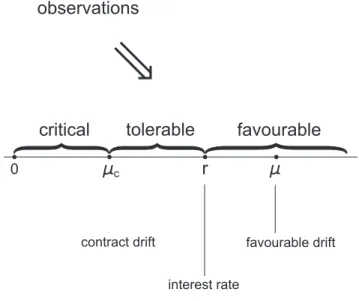
r c favourable drift tolerable critical favourable interest rate contract drift observations 0
Figure 1. An indication of the economic meaning of the contract drift.
4. The brief analysis above shows that whilst the actual drift µ of the underlying stock price is irrelevant in determining the arbitrage-free price of the option, to a (true) buyer it is crucial, and he will buy the option if he believes that µ > r. If this turns out to be the case then on average he will make a profit. Thus, after purchasing the option, the call holder will be happy if the observed stock price movements reaffirm his belief that µ > r.
The British call option seeks to address the opposite scenario: What if the call holder observes stock price movements which change his belief regarding the actual drift and cause him to believe that µ < r instead? In this contingency the British call holder is effectively able to substitute this unfavourable drift with a contract drift and minimise his losses. In this way he is endogenously protected from any stock price drift smaller than the contract drift. The value of the contract drift is therefore selected to represent the buyer’s expected level of tolerance for the deviation of the actual drift from his original belief (see Figure 1). It will be shown below that the practical implications of this protection feature are most remarkable as not only can the British call holder exercise at or below the strike price to a substantial reimbursement of the original option price (covering the ability to sell in a liquid option market completely endogenously) but also when the stock price movements are favourable he will generally receive high returns (see Section 6 for further details).
5. Releasing now the true-buyer’s perspective and considering the real world buyer instead, observe that a call holder who believes (based upon his observations) that µ < r may choose/attempt to sell his contract. However, in a real financial market the price at which he is able to sell will be determined by the market (as the bid price of the bid-ask spread) and this may also involve additional transaction costs and/or taxes. Moreover, unless the exchange is fully regulated, it may be increasingly difficult to sell the option when out-of-the-money (e.g. in most practical situations of over-the-counter trading such an option will expire worthless). The latter therefore strongly correlates the buyer’s risk exposure to the liquidity of the option market. We remark that the liquidity of the option market (alongside possible transaction costs
•
Buyer•
Seller V E(
( -K)+ -F)
T X cFigure 2. Definition of the British call option in terms of its price and payoff.
and tax considerations) can change during the term of the contract. This for example can be caused by extreme news events either specific (to the underlying stock) or systemic in nature (such as the recent turbulent events in the financial industry). The protection afforded to the British call option holder, on the other hand, is endogenous, i.e. it is always in place regardless of whether the option market is liquid or not.
3. The British call option: Definition and basic properties
We begin this section by presenting a formal definition of the British call option. This is then followed by a brief analysis of the optimal stopping problem and the free-boundary problem characterising the arbitrage-free price and the rational exercise strategy. These considerations are continued in Sections 4 and 5 below.
1. Consider the financial market consisting of a risky stock X and a riskless bond B
whose prices evolve as (2.1) and (2.2) respectively, where µ ∈ IR is the appreciation rate (drift), σ >0 is the volatility coefficient, W = (Wt)t≥0 is a standard Wiener process defined on a probability space (Ω,F,P) , and r > 0 is the interest rate. We assume that the stock does not pay dividends and there are no transaction costs associated with its trade. Let a strike price K >0 and a maturity time T >0 be given and fixed.
Definition 1. TheBritish call option is a financial contract between a seller/hedger and a buyer/holder entitling the latter to exercise at any (stopping) time τ prior to T whereupon his payoff (deliverable immediately) is the ‘best prediction’ of the European payoff (XT−K)+
given all the information up to time τ under the hypothesis that the true drift of the stock price equals µc (see Figure 2).
The quantity µc is defined in the option contract and we refer to it as the ‘contract drift’.
Recalling our discussion in Section 2 above it is natural that the contract drift satisfies the right-hand inequality in
(3.1) 0< µc< r
since otherwise the British call holder could beat the interest rate r by simply exercising im-mediately (a formal argument confirming this economic reasoning will be given shortly below). We will also show below that the left-hand inequality in (3.1) must be satisfied as well since
otherwise it would be optimal to exercise at time T and the British call option would reduce to the European call option. Recall also from Section 2 above that the value of the contract drift is selected to represent the buyer’s expected level of tolerance for the deviation of the true drift µ from his original belief (see Figure 1). It will be shown in Section 6 below that this protection feature has remarkable implications both in terms of liquidity and return.
2. Denoting by (Ft)0≤t≤T the natural filtration generated by X (possibly augmented by
null sets or in some other way of interest) the payoff of the British call option at a given stopping time τ can be formally written as
(3.2) Eµc¡(X
T−K)+| Fτ
¢
where the conditional expectation is taken with respect to a new probability measure Pµc
under which the stock price X evolves as
(3.3) dXt=µcXtdt+σXtdWt
with X0 = x in (0,∞) . Comparing (2.1) and (3.3) we see that the effect of exercising the British call option is to substitute the true (unknown) drift of the stock price with the contract drift for the remaining term of the contract.
3. Stationary and independent increments of W governing X imply that
(3.4) Eµc¡(X
T−K)+| Ft
¢
=Gµc(t, X t)
where the payoff function Gµc can be expressed as
(3.5) Gµc(t, x) = E(xZµc T−t−K)+ and Zµc T−t is given by (3.6) Zµc T−t= exp ³ σWT−t+ (µc−σ 2 2 )(T−t) ´
for t∈[0, T] and x∈(0,∞) . Hence one finds that (3.5) can be rewritten as follows
Gµc(t, x) =xeµc(T−t)Φ µ 1 σ√T−t h log¡x K ¢ +(µc+σ 2 2 )(T−t) i¶ (3.7) −KΦ µ 1 σ√T−t h log¡x K ¢ +(µc−σ 2 2)(T−t) i
for t∈[0, T) and x∈(0,∞) where Φ is the standard normal distribution function given by Φ(x) = (1/√2π)R−∞x e−y2/2
dy for x∈IR.
It may be noted that the expression for Gµc(t, x) multiplied by e−µc(T−t) coincides with
the Black-Scholes formula for the arbitrage-free price of the European call option (written for the remaining term of the contract) where the interest rate equals the contract drift µc. Hence
the British call option can be formally viewed as an American option on the undiscounted European call option written on a stock paying dividends at rate δ = r−µc > 0 . Since the
payoff (i.e. the European call value) is undiscounted we see that a direct financial interpretation in terms of compound options is not possible (cf. [11, Subsection 3.3] for further details).
4. Standard hedging arguments based on self-financing portfolios (with consumption) imply that the arbitrage-free price of the British call option is given by
V = sup 0≤τ≤T e E£e−rτEµc¡(X T−K)+| Fτ ¢¤ (3.8)
where the supremum is taken over all stopping times τ of X with values in [0, T] and ˜E is taken with respect to the (unique) equivalent martingale measure ˜P. Making use of (3.4) above and the optional sampling theorem, upon enabling the process X to start at any point
x in (0,∞) at any time t ∈[0, T] , we see that the problem (3.8) extends as follows
V(t, x) = sup 0≤τ≤T−t e Et,x £ e−rτGµc(t+τ, X t+τ) ¤ (3.9)
where the supremum is taken over all stopping times τ of X with values in [0, T−t] and ˜
Et,x is taken with respect to the (unique) equivalent martingale measure ˜Pt,x under which
Xt=x. Since the supremum in (3.9) is attained at the first entry time of X to the closed set
where V equals Gµc , and Law(X(µ)|P˜) is the same as Law(X(r)|P) , it follows from the
well-known flow structure of the geometric Brownian motion X that
V(t, x) = sup 0≤τ≤T−t E£e−rτGµc(t+τ, xX τ) ¤ (3.10)
for t∈[0, T] and x∈(0,∞) where the supremum is taken as in (3.9) above and the process
X =X(r) under P solves
(3.11) dXt=rXtdt+σXtdWt
with X0 = 1 . As it will be clear from the context which initial point of X is being considered, as well as whether the drift of X equals r or not, we will not reflect these facts directly in the notation of X (by adding a superscript or similar).
5. We see from (3.5) that
(3.12) x7→Gµc(t, x) is convex
and strictly increasing on (0,∞) with Gµc(t,0) = 0 and Gµc(t,∞) = ∞ for any t ∈ [0, T]
given and fixed. One also sees that Gµc(T, x) = (x−K)+ for x ∈ (0,∞) showing that the
British call payoff coincides with the European/American call payoff at the time of maturity. Moreover, if µc ≤0 then from (3.5) and (3.6) we see that
(3.13) Gµc(t, x)<e−r(T−t)E(xZr
T−t−K)+
for t ∈[0, T) and x∈(0,∞) where the term on the right-hand side can be recognised as the payoff obtained by choosing τ =T−t in (3.10). From the strict inequality in (3.13), and the fact that the supremum in (3.13) is attained at the first entry time of X to the (closed) set where V equals Gµc , we therefore see that it is not optimal to stop in (3.10) before the time
of maturity when µc ≤ 0 (i.e. the optimal stopping time τ∗ in (3.10) equals T−t). This establishes the claim about the left-hand inequality following (3.1) above. Denoting by VE(t, x)
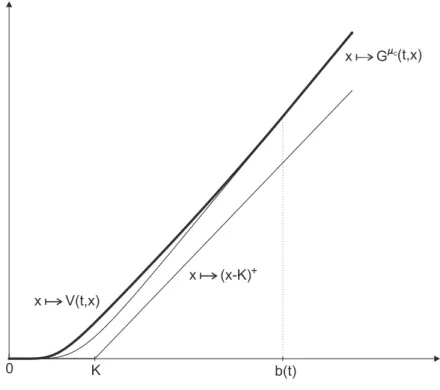
0 b(t) x V(t,x)
x (x-K)+
x G (t,x)mc
K
Figure 3. The value/payoff functions of the British/European call options.
(3.13) above) it follows therefore using (3.5) and (3.6) that V(t, x) =VE(t, x) if µc ≤0 and
V(t, x) > VE(t, x) if µc > 0 for all t ∈ [0, T) and x ∈ (0,∞) . In particular, this confirms
that the British call option is more expensive than the European call option whenever (3.1) holds. While this fact is to be expected (due to the presence of the early exercise feature) it may be noted that V and Gµc tend to stay much closer together than the two functions for
the European call option (a financial interpretation of this phenomenon will be addressed in Section 6 below). Finally, from (3.10) and (3.12) we easily find that
(3.14) x7→V(t, x) is convex
and (strictly) increasing on (0,∞) with V(t,0) = 0 and V(t,∞) = ∞ for any t ∈ [0, T) given and fixed, and one likewise sees that V(T, x) = (x−K)+ for x∈(0,∞) . In this sense the value function of the British call option is similar to the value function of the European call option (a snapshot of the former function is shown in Figure 3). The most important technical difference, however, is that whilst the formal American call boundary bA is trivial
(non-existing) this is not the case for the British call boundary b whenever (3.1) holds. 6. To gain a deeper insight into the solution to the optimal stopping problem (3.10), let us note that Itˆo’s formula yields
(3.15) e−rsGµc(t+s, X t+s) =Gµc(t, x) + Z s 0 e−ruHµc(t+u, X t+u)du+Ms
where the function Hµc =Hµc(t, x) is given by
(3.16) Hµc =Gµc
t +rx Gµxc+ σ
2
and Ms = σ
Rs
0 e−ruXuGµxc(t+u, Xt+u)dWu defines a continuous martingale for s ∈ [0, T−t]
with t∈[0, T) . By the optional sampling theorem we therefore find (3.17) E£e−rτGµc(t+τ, xX τ) ¤ =Gµc(t, x) +E h Z τ 0 e−ruHµc(t+u, xX u)du i
for all stopping times τ of X solving (3.11) with values in [0, T−t] with t ∈ [0, T) and
x ∈(0,∞) given and fixed. On the other hand, it is clear from (3.5) that the payoff function
Gµc satisfies the Kolomogorov backward equation (or the undiscounted Black-Scholes equation
where the interest rate equals the contract drift)
(3.18) Gµc
t +µcx Gµxc +σ
2
2 x2Gµxxc = 0
so that from (3.16) we see that
(3.19) Hµc = (r−µ
c)x Gµxc −rGµc.
This representation shows in particular that if µc ≥ r then Hµc < 0 so that from (3.17)
we see that it is always optimal to exercise immediately as pointed out following (3.1) above. Moreover, inserting the expression for Gµc from (3.7) into (3.19), it is easily verified that
Hµc(t, x) =rKΦ µ 1 σ√T−t h log¡x K ¢ +(µc−σ 2 2 )(T−t) i¶ (3.20) −µcxeµc(T−t)Φ µ 1 σ√T−t h log¡x K ¢ +(µc+σ 2 2 )(T−t) i¶ for t∈[0, T) and x∈(0,∞) .
A direct examination of the function Hµc in (3.20) shows that there exists a continuous
(smooth) function h: [0, T]→IR such that (3.21) Hµc(t, h(t)) = 0
for all t ∈ [0, T) with Hµc(t, x) < 0 for x > h(t) and Hµc(t, x) > 0 for x < h(t) when
t ∈[0, T) is given and fixed. In view of (3.17) this implies that no point (t, x) in [0, T)×(0,∞) with x < h(t) is a stopping point (for this one can make use of the first exit time from a sufficiently small time-space ball centred at the point). Likewise, it is also clear and can be verified that if x > h(t) and t < T is sufficiently close to T then it is optimal to stop immediately (since the gain obtained from being below h cannot offset the cost of getting there due to the lack of time). This shows that the optimal stopping boundary b separating the continuation set from the stopping set satisfies b(T) = h(T) and this value equals rK/µc
as is easily seen from (3.20). Note that rK/µc> K since µc satisfies (3.1) above.
7. Standard Markovian arguments lead to the following free-boundary problem (for the value function V =V(t, x) and the optimal stopping boundary b =b(t) to be determined):
Vt+rxVx+σ
2
2 x2Vxx−rV = 0 for x∈(0, b(t)) and t∈[0, T) (3.22)
V(t, x) =Gµc(t, x) for x=b(t) and t ∈[0, T] (instantaneous stopping)
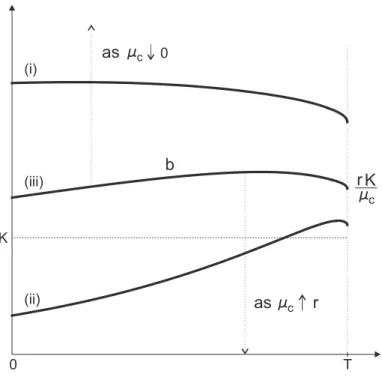
T c r K 0 K b as c 0 c as r (i) (ii) (iii)
Figure 4. A computer drawing showing how the rational exercise boundary of the British call option changes as one varies the contract drift.
Vx(t, x) =Gµxc(t, x) for x=b(t) and t ∈[0, T] (smooth fit)
(3.24) V(T, x) = (x−K)+ for x∈(0, b(T)) with b(T) = rK µc (3.25) V(t,0) = 0 for t∈[0, T] (3.26)
where we also set V(t, x) = Gµc(t, x) for x > b(t) and t ∈ [0, T] (see e.g. [12]). It can be
shown that this free-boundary problem has a unique solution V and b which coincide with the value function (3.10) and the optimal stopping boundary respectively. This means that the continuation set is given by C = {V > Gµc} ={(t, x) ∈ [0, T)×(0,∞) | x < b(t)} and the
stopping set is given by D={V =Gµc}={(t, x)∈[0, T]×(0,∞)|x≥b(t)} ∪ {(T, x)|x∈
(0, b(T))} so that the optimal stopping time in (3.10) is given by (3.27) τb = inf{t∈[0, T]|Xt≥b(t)}.
This stopping time represents the rational exercise strategy for the British call option and plays a key role in financial analysis of the option.
Depending on the size of the contract drift µc satisfying (3.1) we distinguish three different
regimes for the position and shape of the optimal stopping boundary b (see Figure 4). Firstly, when µc ∈(0, r) is close to 0 then b is a decreasing function of time. Secondly, if µc∈(0, r)
is close to r then b is a skewed S-shaped function of time. Thirdly, there is an intermediate case where b can take either of the two shapes depending on the size of T . Moreover, the second regime becomes dominant when T is large in the sense that b(0) tends to 0 as T → ∞. These three regimes are not disconnected and if we let µc run from 0 to r then the optimal
stopping boundary b moves from the ∞ function to the 0 function on [0, T) gradually passing through the three shapes above and always satisfying b(T) = rK/µc (exhibiting also a
singular behaviour at T in the sense that b0(T−) = −∞). We will see in Section 6 below that the three regimes have three different economic interpretations and their fuller understanding is important for a correct/desired choice of the contract drift µc in relation to the interest rate
r and other parameters in the British call option. Note that this structure differs from the three-regime structure in the British put option [11] where the optimal stopping boundary bp
can be skewed U-shaped so that bp(0) tends to ∞ as T → ∞.
Fuller details of the analysis above go beyond our aims in this paper and for this reason will be omitted. It should be noted however that one of the key elements which makes this analysis more complicated (in comparison with the American put option) is that b is not necessarily a monotone function of time. In the next section we will derive simpler equations which characterise V and b uniquely and can be used for their calculation (Section 6).
8. We conclude this section with a few remarks on the choice of the volatility parameter in the British payoff mechanism. Unlike its classical European or American counterpart, it is seen from (3.7) that the volatility parameter σ appears explicitly in the British payoff (3.2) and hence should be prescribed explicitly in the contract specification. Note that this feature is also present in the British put option (cf. [11]) and its appearance can be seen as a direct consequence of ‘optimal prediction’. Considering this from a practical perspective, a natural question (common to all options with volatility-dependent payoffs) is what value of the parameter σ should be used in the contract specification/payoff? Both counterparties to the option trade must agree on the value of this parameter, or at least agree on how it should be calculated from future market observables, at the initiation of the contract. However, whilst this question has many practical implications, it does not pose any conceptual difficulties under the current modelling framework. Since the underlying process is assumed to be a geometric Brownian motion, the (constant) volatility of the stock price is effectively known by all market participants, since one may take any of the standard estimators for the volatility over an arbitrarily small time period prior to the initiation of the contract. This is in direct contrast to the situation with stock price drift µ, whose value/form is inherently unknown, nor can be reasonably estimated (without an impractical amount of data), at the initiation of the contract. In this sense, it seems natural to provide a true buyer with protection from an ambiguous (Knightian) drift rather than a ‘known’ volatility, at least in this canonical Black-Scholes setting. We remark however that as soon as one departs from the current modelling framework, and gets closer to a more practical perspective, it is clear that the specification of the contract volatility may indeed become very important. In this wider framework one is naturally led to consider the relationship between the realised/implied volatility and the ‘contract volatility’ using the same/similar rationale as for the actual drift and the ‘contract drift’ in the text above. Due to the fundamental difference between the drift and the volatility in the canonical (Black-Scholes) setting, and the highly applied nature of such modelling issues, these features of the British payoff mechanism are left as the subject of future development.
4. The arbitrage-free price and the rational exercise boundary
In this section we derive a closed form expression for the arbitrage-free price V in terms of the rational exercise boundary b (the early-exercise premium representation) and show that the rational exercise boundary b itself can be characterised as the unique solution to a nonlinear integral equation (Theorem 1). We note that the former approach was originally applied in the
pricing of American options in [6, 5, 3] and the latter characterisation was established in [10] (for more details see e.g. [12]).
We will make use of the following functions in Theorem 1 below:
F(t, x) =Gµc(t, x)−e−r(T−t)Gr(t, x) (4.1) J(t, x, v, z) =−e−r(v−t) Z ∞ z Hµc(v, y)f(v−t, x, y)dy (4.2)
for t∈[0, T) , x > 0 , v ∈(t, T) and z >0 , where the functions Gr and Gµc are given in
(3.5) and (3.7) above (upon identifying µc with r in the former case), the function Hµc is
given in (3.16) and (3.20) above, and y 7→ f(v−t, x, y) is the probability density function of
xZr
v−t from (3.6) above (with µc replaced by r and T−t replaced by v−t) given by
(4.3) f(v−t, x, y) = 1 σy√v−tϕ µ 1 σ√v−t h log¡yx¢−(r−σ2 2 )(v−t) i
for y > 0 (with v−t and x as above) where ϕ is the standard normal density function given by ϕ(x) = (1/√2π) e−x2/2
for x ∈ IR. It should be noted that J(t, x, v, b(v)) >0 for all t ∈[0, T) , x >0 and v ∈(t, T) since Hµc(v, y)<0 for all y > b(v) as b lies above h
(recall (3.21) above). Finally, it can be verified using standard means that
J(t, x, T−, z) =µcxΦ µ 1 σ√T−t h log¡ x z∨K ¢ +(r+σ2 2 )(T−t) i¶ (4.4) −rKe−r(T−t)Φ µ 1 σ√T−t h log¡ x z∨K ¢ +(r−σ2 2 )(T−t) i
for t ∈ [0, T) , x > 0 and z > 0 . This expression is useful in a computational treatment of the equation (4.6) below. The main result of this section may now be stated as follows.
Theorem 1. The arbitrage-free price of the British call option admits the following early-exercise premium representation
(4.5) V(t, x) =e−r(T−t)Gr(t, x) +
Z T
t
J(t, x, v, b(v))dv
for all (t, x) ∈ [0, T]×(0,∞), where the first term is the arbitrage-free price of the European call option and the second term is the early-exercise premium.
The rational exercise boundary of the British call option can be characterised as the unique continuous solution b : [0, T]→IR+ to the nonlinear integral equation
(4.6) F(t, b(t)) = Z T
t
J(t, b(t), v, b(v))dv
satisfying b(t)≥h(t) for all t∈[0, T] where h is defined by (3.21) above.
Proof. The proof given below is similar to the proof of Theorem 1 in [11] and we present all details for completeness (as well as to demonstrate a full symmetry between the arguments).
Alternatively, one could also exploit the British put-call symmetry relations derived in Section 5 below and deduce either of the two theorems from the existence of the other. In the present proof we first derive (4.5) and show that the rational exercise boundary solves (4.6). We then show that (4.6) cannot have other (continuous) solutions.
1. Let V : [0, T]×(0,∞) → IR and b : [0, T] → IR+ denote the unique solution to the free-boundary problem (3.22)-(3.26) (where V extends as Gµc above b), set C
b ={(t, x)∈
[0, T)×(0,∞)|x < b(t)} and Db ={(t, x)∈[0, T)×(0,∞)|x > b(t)}, and let ILXV(t, x) =
r x Vx(t, x) +σ
2
2 x2Vxx(t, x) for (t, x) ∈ Cb ∪Db. Then V and b are continuous functions satisfying the following conditions: (i) V is C1,2 on C
b∪Db ; (ii) b is of bounded variation;
(iii) P(Xt = c) = 0 for all t ∈[0, T] and c > 0 ; (iv) Vt+ILXV−rV is locally bounded on
Cb∪Db (recall that V solves (3.22) and coincides with Gµc on Db ); (v) x7→V(t, x) is convex
on (0,∞) for every t∈[0, T] (recall (3.14) above); and (vi) t 7→Vx(t, b(t)±) = Gµxc(t, b(t)) is
continuous on [0, T] (recall that V satisfies the smooth-fit condition (3.24) at b). From these conditions we see that the local time-space formula [9] is applicable to (s, y)7→e−rsV(t+s, xy)
with t∈[0, T) and x >0 given and fixed. This yields e−rsV(t+s, xXs) =V(t, x) (4.7) + Z s 0 e−rv¡V t+ILXV−rV ¢ (t+v, xXv)I(xXv =6 b(t+v))dv+Msb +1 2 Z s 0 e−rv¡V x(t+v, xXv+)−Vx(t+v, xXv−) ¢ I(xXv =b(t+v))d`bv(Xx) where Mb s =σ Rs
0 e−rvxXvVx(t+v, xXv)I(xXv 6=b(t+v))dBv is a continuous local martingale for s ∈ [0, T−t] and `b(Xx) = (`b
v(Xx))0≤v≤s is the local time of Xx = (xXv)0≤v≤s on the
curve b for s∈[0, T−t] . Moreover, since V satisfies (3.22) on Cb and equals Gµc on Db,
and the smooth-fit condition (3.24) holds at b, we see that (4.7) simplifies to (4.8) e−rsV(t+s, xX s) =V(t, x) + Z s 0 e−rvHµc(t+v, xX v)I(xXv> b(t+v))dv+Msb for s∈[0, T−t] and (t, x)∈[0, T)×(0,∞) . 2. We show that Mb = (Mb
s)0≤s≤T−t is a martingale for t ∈ [0, T) . For this, note that
from (3.7), (3.19) and (3.20) (or calculating directly) we find that
(4.9) Gµc x (t, x) = eµc(T−t)Φ µ 1 σ√T−t h log¡x K ¢ +(µc+σ 2 2 )(T−t) i
for t∈[0, T) and x >0 . Moreover, by (3.14) and (3.24) we see that (4.10) 0≤Vx(t, x)≤Gµxc(t, b(t))
for all t∈[0, T) and all x∈(0, b(t)) . Combining (4.9) and (4.10) we conclude that (4.11) 0≤Vx(t, x)≤eµc(T−t)
for all t∈[0, T) and all x >0 (recall that V equals Gµc above b). Hence we find that
EhMb, Mbi T−t=σ2x2E µ Z T−t 0 e−2rvX2 vVx2(t+v, xXv)I(xXv 6=b(t+v))dv ¶ (4.12)
≤σ2x2eµc(T−t) Z T−t 0 EX2 v dv =σ2x2eµc(T−t) Z T−t 0 ervdv = σ2x2 r e µc(T−t)¡er(T−t)−1¢ <∞
from where it follows that Mb is a martingale as claimed.
3. Replacing s by T−t in (4.8), using that V(T, x) =Gµc(T, x) = (x−K)+ for x > 0 ,
taking E on both sides and applying the optional sampling theorem, we get e−r(T−t)E(xX T−t−K)+ =V(t, x) + Z T−t 0 e−rvE£Hµc(t+v, xX v)I(xXv> b(t+v)) ¤ dv (4.13) =V(t, x)− Z T t J(t, x, v, b(v))dv
for all (t, x)∈[0, T)×(0,∞) . Recognising the left-hand side of (4.13) as e−r(T−t)Gr(t, x) we
see that this yields the representation (4.5). Moreover, since V(t, b(t)) = Gµc(t, b(t)) for all
t ∈[0, T] we see from (4.5) that b solves (4.6). This establishes the existence of the solution to (4.6). We now turn to its uniqueness.
4. We show that the rational exercise boundary is the unique solution to (4.6) in the class of continuous functions t 7→ b(t) on [0, T] satisfying b(t) ≥ h(t) for all t ∈ [0, T] . For this, take any continuous function c: [0, T]→ IR which solves (4.6) and satisfies c(t)≥ h(t) for all t ∈ [0, T] . Motivated by the representation (4.13) above define the function Uc :
[0, T]×(0,∞)→IR by setting (4.14) Uc(t, x) = e−r(T−t)E£Gµc(T, xX T−t) ¤ − Z T−t 0 e−rvE£Hµc(t+v, xX v)I(xXv> c(t+v)) ¤ dv
for (t, x) ∈ [0, T]×(0,∞) . Observe that c solving (4.6) means exactly that Uc(t, c(t)) =
Gµc(t, c(t)) for all t∈[0, T] ( recall that Gµc(T, x) = (x−K)+ for all x >0 ).
(i) We show that Uc(t, x) = Gµc(t, x) for all (t, x) ∈ [0, T]×(0,∞) such that x ≥ c(t) .
For this, take any such (t, x) and note that the Markov property of X implies that (4.15) e−rsUc(t+s, xX s)− Z s 0 e−rvHµc(t+v, xX v)I(xXv> c(t+v))dv
is a continuous martingale under P for s ∈[0, T−t] . Consider the stopping time (4.16) σc= inf{s∈[0, T−t]|xXs≤c(t+s)}
under P. Since Uc(t, c(t)) = Gµc(t, c(t)) for all t ∈[0, T] and Uc(T, x) = Gµc(T, x) for all
x >0 we see that Uc(t+σ
c, xXσc) =Gµc(t+σc, xXσc) . Replacing s by σc in (4.15), taking
E on both sides and applying the optional sampling theorem, we find that
Uc(t, x) =E£e−rσcUc(t+σ c, xXσc) ¤ −E µZ σc 0 e−rvHµc(t+v, xX v)I(xXv> c(t+v))dv ¶ (4.17) =E£e−rσcGµc(t+σ c, xXσc) ¤ −E µZ σc 0 e−rvHµc(t+v, xX v)dv ¶ =Gµc(t, x)
where in the last equality we use (3.17). This shows that Uc equals Gµc above c as claimed.
(ii) We show that Uc(t, x)≤V(t, x) for all (t, x)∈[0, T]×(0,∞) . For this, take any such
(t, x) and consider the stopping time
(4.18) τc = inf{s ∈[0, T−t]|xXs ≥c(t+s)}
under P. We claim that Uc(t+τ
c, xXτc) = Gµc(t+τc, xXτc) . Indeed, if x ≥ c(t) then
τc = 0 so that Uc(t, x) = Gµc(t, x) by (i) above. On the other hand, if x < c(t) then the
claim follows since Uc(t, c(t)) = Gµc(t, c(t)) for all t ∈ [0, T] and Uc(T, x) = Gµc(T, x) for
all x > 0 . Replacing s by τc in (4.15), taking E on both sides and applying the optional
sampling theorem, we find that
Uc(t, x) =E£e−rτcUc(t+τ c, xXτc) ¤ −E µZ τc 0 e−rvHµc(t+v, xX v)I(xXv> c(t+v))dv ¶ (4.19) =E£e−rτcGµc(t+τ c, xXτc) ¤ ≤V(t, x)
where in the second equality we used the definition of τc. This shows that Uc≤V as claimed.
(iii) We show that c(t) ≤ b(t) for all t ∈ [0, T] . For this, suppose that there exists
t ∈[0, T) such that c(t)> b(t) . Take any x≥c(t) and consider the stopping time (4.20) σb = inf{s∈[0, T−t]|xXs≤b(t+s)}
under P. Replacing s with σb in (4.8) and (4.15), taking E on both sides of these identities
and applying the optional sampling theorem, we find E£e−rσbV(t+σ b, xXσb) ¤ =V(t, x) +E µZ σb 0 e−rvHµc(t+v, xX v)dv ¶ (4.21) E£e−rσbUc(t+σ b, xXσb) ¤ =Uc(t, x) +E µZ σb 0 e−rvHµc(t+v, xX v)I(xXv> c(t+v))dv ¶ . (4.22)
Since x≥c(t) we see by (i) above that Uc(t, x) =Gµc(t, x) = V(t, x) where the last equality
follows since x lies above b(t) . Moreover, by (ii) above we know that Uc(t+σ
b, xXσb) ≤
V(t+σb, xXσb) so that (4.21) and (4.22) imply that
(4.23) E µZ σb 0 e−rvHµc(t+v, xX v)I(xXv≤c(t+v))dv ¶ ≥0.
The fact that c(t) > b(t) and the continuity of the functions c and b imply that there exists ε > 0 sufficiently small such that c(t+v) > b(t+v) for all v ∈ [0, ε] . Consequently the P-probability of Xx = (x+X
v)0≤v≤ε spending a strictly positive amount of time (w.r.t.
Lebesgue measure) in this set before hitting b is strictly positive. Combined with the fact that b lies above h this forces the expectation in (4.23) to be strictly negative and provides a contradiction. Hence c≤b as claimed.
(iv) We show that b(t) = c(t) for all t ∈ [0, T] . For this, suppose that there exists
t ∈[0, T) such that c(t)< b(t) . Take any x∈(c(t), b(t)) and consider the stopping time (4.24) τb = inf{s ∈[0, T−t]|xXs ≥b(t+s)}
under P. Replacing s with τb in (4.8) and (4.15), taking E on both sides of these identities
and applying the optional sampling theorem, we find E£e−rτbV(t+τ b, xXτb) ¤ =V(t, x) (4.25) E£e−rτbUc(t+τ b, xXτb) ¤ =Uc(t, x) +E µZ τb 0 e−rvHµc(t+v, xX v)I(xXv> c(t+v))dv ¶ . (4.26)
Since c ≤ b by (iii) above and Uc equals Gµc above c by (i) above, we see that Uc(t+
τb, xXτb) =G
µc(t+τ
b, xXτb) = V(t+τb, xXτb) where the last equality follows since V equals
Gµc above b (recall also that Uc(T, x) =Gµc(T, x) =V(T, x) for all x >0 ). Moreover, by
(ii) we know that Uc≤V so that (4.25) and (4.26) imply that
(4.27) E µZ σb 0 e−rvHµc(t+v, xX v)I(xXv> c(t+v))dv ¶ ≥0.
But then as in (iii) above the continuity of the functions c and b combined with the fact that c lies above h forces the expectation in (4.27) to be strictly negative and provides a contradiction. Thus c=b as claimed and the proof is complete. ¤
5. The British put-call symmetry
In this section we derive the ‘British put-call symmetry’ relations which express the arbi-trage-free price and the rational exercise boundary of the British call option in terms of the arbitrage-free price and the rational exercise boundary of the British put option where the roles of the contract drift and the interest rate have been swapped (Theorem 2). We note that similar symmetry relations are known to be valid for the American put and call options written on stocks paying dividends (see [2]) where the roles of the dividend yield and the interest rate have been swapped instead. The idea to examine these relations in the British option setting is due to Kristoffer Glover.
1. In the setting of Section 3 let us put
Gµc c (t, x;K) =E(xZTµc−t−K)+ (5.1) Gµc p (t, x;K) =E(K−xZTµc−t)+ (5.2)
to denote the payoff functions of the British call and put options respectively, where the contract drift µc>0 and the strike price K >0 are given and fixed, (t, x)∈[0, T]×(0,∞) , and ZTµc−t
is given in (3.6) above. Let us also put
Vµc c (t, x;K, r) = sup 0≤τ≤T−t E£e−rτGµc c (t+τ, xXτr;K) ¤ (5.3) Vµc p (t, x;K, r) = sup 0≤τ≤T−t E£e−rτGµc p (t+τ, xXτr;K) ¤ (5.4)
to denote the arbitrage-free prices of the British call and put options respectively, where the interest rate r > 0 is given and fixed, (t, x) ∈ [0, T]×(0,∞) , and the process Xr solves
(3.11) above with Xr
0 = 1 . Recall that the supremums in (5.3) and (5.4) are taken over all stopping times τ of Xr with values in [0, T−t] . The following lemma lists basic properties
Lemma 1. The following relations are valid: Gµc a (t, x;K) =x Gµac(t,1;Kx) (5.5) Gµc a (t, x;K) =K Gµac(t,Kx; 1) (5.6) Gµc a (t, x;K) =G0a(t, xeµc(T−t);K) (5.7) G0 c(t, x; 1) =x G0p(t,x1; 1) (5.8) G0p(t, x; 1) = x G0c(t, 1 x; 1) (5.9)
for all values of the parameters, where the subscript a in (5.5)-(5.7) stands for either c or p.
Proof. Since (5.5)-(5.7) are evident from the definitions (5.1) and (5.2) we focus on (5.8). For this, note that by the Girsanov theorem we have
Gc0(t, x; 1) =E(xZT0−t−1)+ =xE h ZT0−t¡1− 1 xZ0 T−t ¢+i (5.10) =xE h eσBT−t−σ 2 2 (T−t)¡1−1 xe −σBT−t+σ 2 2 (T−t)¢+ i =xeE ³ 1−1 xe −σ(BT−t−σ(T−t))−σ2(T−t)+σ 2 2 (T−t) ´+ =xeE³1−1 xe −σBeT−t−σ 2 2 (T−t) ´+ =xE(1−1 xZ 0 T−t)+ =x G0p(t,x1; 1)
where ˜E is taken with respect to ˜P given by dP˜ = eσBT−t−σ
2
2 (T−t)dP and ˜Bs = Bs−σs is a standard Brownian motion under ˜P for s ∈ [0, T−t] (recall also that −B˜T−t =law B˜T−t
under ˜P ). This establishes (5.8) from where (5.9) follows as well. ¤
The main result of this section may now be stated as follows.
Theorem 2. The arbitrage-free price of the British call option with the contract drift µc
and the interest rate r satisfying (3.1) can be expressed in terms of the arbitrage-free price of the British put option with the contract drift r and the interest rate µc as
(5.11) Vµc
c (t, x;K, r) = Kx eµc(T−t)Vpr(t,K
2
x e−(r+µc)(T−t);K, µc)
for all (t, x)∈[0, T]×(0,∞).
The rational exercise boundary of the British call option with the contract drift µc and the
interest rate r satisfying (3.1) can be expressed in terms of the rational exercise boundary of the British put option with the contract drift r and the interest rate µc as
(5.12) bµc,r c (t) =e−(r+µc)(T−t) K2 br,µc p (t) for all t∈[0, T].
Proof. We first derive the identity (5.11). For this, fix any (t, x)∈[0, T]×(0,∞) and take any stopping time τ of Xr with values in [0, T−t] . Using the facts from Lemma 1 indicated
below and applying the Girsanov theorem we find that E£e−rτGµc c (t+τ, xXτr;K) ¤ (5.6) = KE£e−rτGµc c (t+τ,Kx Xτr; 1) ¤ (5.13)
(5.7) = KE£e−rτG0 c(t+τ,Kx e µc(T−t−τ)Xr τ; 1) ¤ (5.8) = KE£e−rτ xK eµc(T−t−τ)Xr τ G0p(t+τ,Kx e −µc(T−t−τ) 1 Xr τ; 1) ¤ =xeµc(T−t)E£eσBτ−σ 2 2 τe−µcτG0 p(t+τ,Kx e −µc(T−t)e−σBτ+(µc−r+σ 2 2 )τ; 1)¤ =xeµc(T−t)eE£e−µcτG0 p(t+τ,Kx e −µc(T−t)e−σ(Bτ−στ)−σ2τ+(µc−r+σ 2 2 )τ; 1)¤ =xeµc(T−t)eE£e−µcτG0 p(t+τ,Kx e−µc(T−t)e −σBeτ+(µc−r−σ 2 2 )τ; 1)¤ =xeµc(T−t)eE£e−µcτG0 p(t+τ,Kx e −(r+µc)(T−t)er(T−t−τ)e−σBeτ+(µc−σ 2 2 )τ; 1)¤ (5.7) = xeµc(T−t)Ee£e−µcτGr p(t+τ,Kx e−(r+µc)(T−t)Xeτµc;KK) ¤ (5.6) = x Ke µc(T−t)Ee£e−µcτGr p(t+τ,K 2 x e −(r+µc)(T−t)Xeµc τ ;K) ¤ where ˜E is taken with respect to ˜P given by dP˜ = eσBτ−σ
2
2 τdP and ˜Bt = Bt−σt is a standard Brownian motion under ˜P for t ∈ [0, T] (recall also that −B˜ =law B˜ under ˜P ). Taking the supremum over all stopping times τ of Xr with values in [0, T−t] on both sides
of (5.13) we obtain the identity (5.11) as claimed.
To prove (5.12) note that by setting τ ≡0 in (5.13) we find that (5.14) Gµc c (t, x;K) = Kx e µc(T−t)Gr p(t,K 2 x e −(r+µc)(T−t);K)
for all (t, x)∈[0, T]×(0,∞) . A direct comparison of (5.11) and (5.14) shows that
(5.15) Vµc
c (t, x;K, r)> Gµcc(t, x;K)
if and only if the following inequality is satisfied
(5.16) Vr p(t,K 2 x e−(r+µc)(T−t);K, µc)> Grp(t,K 2 x e−(r+µc)(T−t);K)
for all (t, x)∈[0, T]×(0,∞) . As the two relations (5.15) and (5.16) characterise the continu-ation sets for the optimal stopping problems (5.3) and (5.4) respectively, it follows that (5.12)
holds and the proof is complete. ¤
Remark 3. Note that the previous arguments extend to the case when the strike price in (5.1)+(5.3) is not necessarily equal to the strike price in (5.2)+(5.4). More precisely, replacing the strike price K in (5.1)+(5.3) by Kc>0 and the strike price K in (5.2)+(5.4) by Kp >0 ,
and noting that the final equality in (5.13) remains valid if we replace K/K by Kp/Kp , we
obtain the following extensions of (5.11) and (5.12) respectively:
Vµc c (t, x;Kc, r) = Kxp eµc(T−t)Vpr(t, KcKp x e−(r+µc)(T−t);Kp, µc) (5.17) bµc,r c (t) = e−(r+µc)(T−t) KcKp br,µc p (t) (5.18)
for all (t, x)∈[0, T]×(0,∞) . This can be rewritten in a more symmetric form as follows:
Vµc
c (t, xKpe−µc(T−t);yKc, r) = Vpr(t, yKce−r(T−t);xKp, µc)
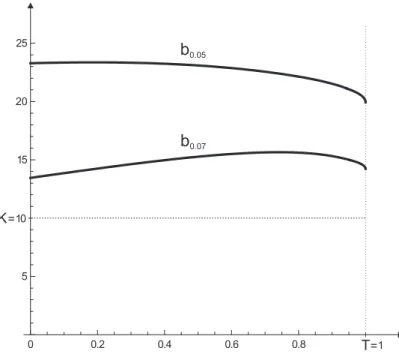
T=
K=
b0.05
b0.07
Figure 5. A computer drawing showing the rational exercise boundaries of the British call option with K = 10 , T = 1 , r = 0.1 , σ = 0.4 when the contract drift µc equals 0.05 and 0.07 .
bµc,r
c (t)br,µp c(t) = e−(r+µc)(T−t)KcKp
(5.20)
for all t∈[0, T] and all x, y ∈(0,∞) .
6. Financial analysis of the British call option
In the present section we firstly discuss the rational exercise strategy of the British call option, and then a numerical example is presented to highlight the practical features of the option. We draw comparisons with the European call option in particular because the latter option is widely traded and well understood (recalling that the American call option written on a stock paying no dividends reduces to the European call option since it is rational to exercise at maturity). In the financial analysis of the option returns presented below we mainly address the question as to what the return would be if the stock price enters the given region at a given time (i.e. we do not discuss the probability of the latter event nor do we account for any risk associated with its occurrence). Such a ‘skeleton analysis’ is both natural and practical since it places the question of probabilities and risk under the subjective assessment of the option holder (irrespective of whether the stock price model is correct or not).
1. In Section 3 above we saw that the rational exercise strategy of the British call option (the optimal stopping time (3.27) in the problem (3.10) above) changes as one varies the contract drift µc. This is illustrated in Figure 4 above. To explain the economic meaning of the three
regimes appearing on this figure, let us first recall that it is natural to set µc < r . Indeed,
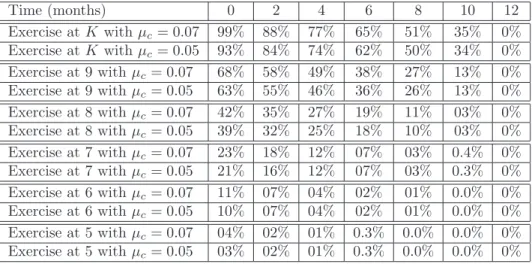
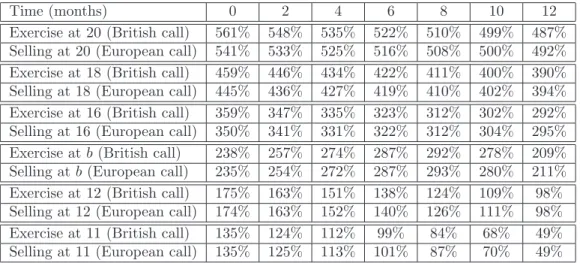
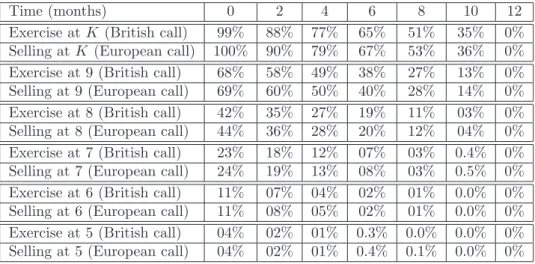
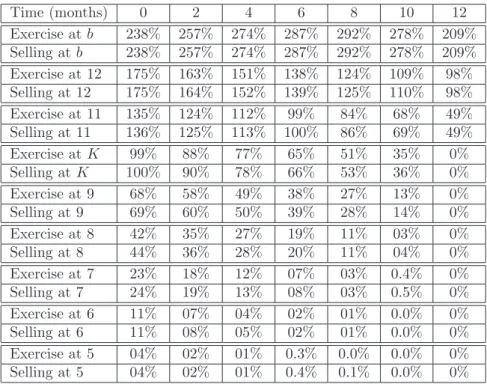
Time (months) 0 2 4 6 8 10 12 Exercise atK withµc= 0.07 99% 88% 77% 65% 51% 35% 0% Exercise atK withµc= 0.05 93% 84% 74% 62% 50% 34% 0% Exercise at 9 withµc = 0.07 68% 58% 49% 38% 27% 13% 0% Exercise at 9 withµc = 0.05 63% 55% 46% 36% 26% 13% 0% Exercise at 8 withµc = 0.07 42% 35% 27% 19% 11% 03% 0% Exercise at 8 withµc = 0.05 39% 32% 25% 18% 10% 03% 0% Exercise at 7 withµc = 0.07 23% 18% 12% 07% 03% 0.4% 0% Exercise at 7 withµc = 0.05 21% 16% 12% 07% 03% 0.3% 0% Exercise at 6 withµc = 0.07 11% 07% 04% 02% 01% 0.0% 0% Exercise at 6 withµc = 0.05 10% 07% 04% 02% 01% 0.0% 0% Exercise at 5 withµc = 0.07 04% 02% 01% 0.3% 0.0% 0.0% 0% Exercise at 5 withµc = 0.05 03% 02% 01% 0.3% 0.0% 0.0% 0%
Table 6. Returns observed upon exercising the British call option at and below the strike price K. The returns are expressed as a percentage of the original option price paid by the buyer (rounded to the nearest integer), i.e. R(t, x)/100 = Gµc(t, x)/V(0, K) . The
parameter set is the same as in Figure 5 above (K = 10 , T = 1 , r = 0.1 , σ = 0.4 ) and the initial stock price equals K.
is overprotected. By exercising immediately he will beat the interest rate r and moreover he will avoid any discounting of his payoff. We also noted above that the rational exercise boundary b in Figure 4 satisfies b(T) =rK/µc. In particular, when µc =r then b(T) =K
and b extends backwards in time to zero. The interest rate r represents a borderline case and any µc > 0 strictly smaller than r will inevitably lead to a non-trivial rational exercise
boundary (when the initial stock price is sufficiently low). It is clear however that not all of these situations will be of economic interest and in practice µc should be set further away from
r in order to avoid overprotection (note that most generally overprotection refers to the case where the initial stock price lies above b(0) ). On the other hand, when µc ↓ 0 then b(T)
increases up to infinity and b disappears in the limit, so that it is never optimal to stop before the maturity time T and the British call option reduces to the European call option. In the latter case a zero contract drift represents an infinite tolerance of unfavourable drifts and the British call holder will never exercise the option before the time of maturity. This brief analysis shows that the contract drift µc should not be too close to r (since in this case the buyer is
overprotected) and should not be too close to zero (since in this case the British call option effectively reduces to the European call option). We remark that the latter possibility is not fully excluded, however, especially if sharp increases in the stock price are possible or likely.
2. Further to our comments above, consider the position and shape of the rational exercise boundaries in Figure 4, and assume that the initial stock price equals K . In this case the boundary (ii) represents overprotection. Indeed, although not larger than r, the contract drift µc is favourable enough so that the additional incentive of avoiding discounting makes it
rational to exercise immediately. On the other hand, it may be noted that the position of the boundaries (i) and (iii) suggests that the buyer should exercise the British call option rationally when observed price movements are favourable. As this effect is analogous to the same effect in the British put option we refer to [11] for further details. In addition we remark that the