Deep Neural Networks for Visual Reasoning, Program
Induction, and Text-to-Image Synthesis
by
Scott Ellison Reed
A dissertation submitted in partial fulfillment of the requirements for the degree of
Doctor of Philosophy
(Computer Science and Engineering) in The University of Michigan
2016
Doctoral Committee:
Assistant Professor Honglak Lee, Chair Professor Benjamin Kuipers
Assistant Professor Emily Mower Provost Associate Professor Clayton Scott
c
Scott Ellison Reed 2016
ACKNOWLEDGEMENTS
I would like to sincerely thank all of the CSE faculty and staff, and family and friends whose support made this thesis possible. There are too many people to list all of them here, but I will highight a few:
Dumitru Erhan, Christian Szegedy, Andrew Rabinovich, Dragomir Anguelov and many others who were on the Photos and Brain team at Google when I was there. Their
relent-less focus on developing vision systems thatactually work, motivated directly by solving
problems for millions of people, resulted in high-impact research breakthroughs in large-scale visual recognition and detection. Although our work on large-large-scale object detection is not part of my thesis, working with them had a transformative impact on my research philosophy and subsequent productivity.
Nando de Freitas at DeepMind, who inspired me to work on neural program “libraries”, which led to our joint work on Neural Programmer-Interpreters.
My adviser and dissertation committee chair Honglak Lee, who I have worked with since the start of my PhD, who gave lots of valuable research advice and guidance on many successful projects, and pushed me to accomplish more in graduate school.
Benjamin Kuipers, Emily Mower-Provost, and Clayton Scott who generously served on my dissertation committee and provided very valuable feedback on this dissertation and thought-provoking research discussions.
Thanks to all of my lab mates for many great collaborations and discussions: Kihyuk Sohn, Yuting Zhang, Xinchen Yan, Lajanugen Logeswaran, Yi Zhang, Junhyuk Oh, Ruben Villegas, Kibok Lee, Rui Zhang, Changhan Wang, Jimei Yang, Roni Mittelman, Wenling
Shang, Daniel Walter, Yong Peng, Forest Agostinelli, Sami Abu-El-Haija, Kyoungah Kim, Chansoo Lee.
Zeynep Akata and Bernt Schiele at the Max Planck Institute for Informatics, with whom we had three very enjoyable and successful collaborations.
This work was supported mainly by a Rackham Fellowship during my first year, NSF GRFP under Grant No. DGE 1256260 during my second and third years, and also by NSF CAREER IIS-1453651, ONR N00014-13-1-0762 and NSF CMMI-1266184.
TABLE OF CONTENTS
ACKNOWLEDGEMENTS . . . ii
LIST OF FIGURES . . . viii
LIST OF TABLES . . . xiii
LIST OF APPENDICES . . . xv
ABSTRACT. . . xvi
CHAPTER I. Introduction . . . 1
1.1 Motivation . . . 1
1.1.1 The disentangling Restricted Boltzmann Machine (Chap-ter III) . . . 3
1.1.2 Deep networks for disentangling and visual analogy-making (Chapter IV) . . . 4
1.1.3 Learning a neural programmer and interpreter (Chapter V) 5 1.1.4 Learning to represent fine-grained visual descriptions (Chapter VI) . . . 6
1.1.5 Generating images from informal text descriptions (Chap-ter VII) . . . 6
1.2 Organization of the Thesis . . . 7
1.3 Related Publications . . . 7
II. Preliminaries . . . 9
2.1 Restricted Boltzmann machine . . . 9
2.2 Long short-term memory (LSTM) . . . 10
3.1 Introduction . . . 11
3.2 Related Work . . . 13
3.2.1 Energy function . . . 15
3.2.2 Inference and learning . . . 16
3.2.3 Computing gradients via backpropagation . . . 17
3.3 Training strategies for disentangling . . . 17
3.3.1 Learning with correspondence . . . 18
3.4 Experiments on face image data sets . . . 19
3.4.1 Reasoning about factors of variation . . . 20
3.4.2 Discriminative performance . . . 21
3.4.3 Invariance and sensitivity analysis . . . 24
3.5 Discussion . . . 26
IV. Deep convolutional encoder-decoder models for disentangling and vi-sual analogy-making . . . 27
4.1 Introduction . . . 27
4.2 Related Work . . . 29
4.3 Deep encoder-decoder models for visual analogy-making . . . 31
4.3.1 Making analogies by vector addition . . . 31
4.3.2 Making analogy transformations dependent on the query context . . . 32
4.3.3 Analogy-making with a disentangled feature represen-tation . . . 34
4.4 Analogy-making Experiments . . . 36
4.4.1 Transforming shapes: comparison of analogy models . . 36
4.4.2 Generating 2D video game sprites . . . 38
4.4.3 3D car analogies . . . 41
4.4.4 Evans ANALOGY program . . . 43
4.4.5 Limitations and ambiguous analogies . . . 44
4.4.6 Conclusions . . . 44
V. Learning to represent and execute programs . . . 45
5.1 Introduction . . . 45 5.2 Related work . . . 47 5.3 Model . . . 49 5.3.1 Inference . . . 50 5.3.2 Training . . . 53 5.4 Experiments . . . 54
5.4.1 Task and environment descriptions . . . 54
5.4.2 Sample complexity and generalization . . . 57
5.4.3 Learning new programs with a fixed core . . . 60
5.4.4 Solving multiple tasks with a single network . . . 61
VI. Learning to represent fine-grained visual descriptions . . . 62
6.1 Introduction . . . 62
6.2 Related work . . . 64
6.3 Deep Structured Joint Embedding . . . 66
6.4 Text encoder models . . . 68
6.4.1 Text-based ConvNet (CNN) . . . 69
6.4.2 Convolutional Recurrent Net (CNN-RNN) . . . 69
6.4.3 Long Short-Term Memory (LSTM) . . . 70
6.4.4 Baseline representations . . . 71
6.5 Experimental results . . . 72
6.5.1 Collecting fine-grained visual descriptions . . . 73
6.5.2 CUB zero-shot recognition and retrieval . . . 74
6.5.3 Effect of visual description training set size . . . 76
6.5.4 Effect of test visual description length . . . 77
6.5.5 Flowers zero-shot recognition and retrieval . . . 78
6.5.6 Qualitative results . . . 79
6.5.7 Comparison to the state-of-the-art . . . 80
6.6 Discussion . . . 81
VII. Generating Images from Text Descriptions . . . 82
7.1 Introduction . . . 82
7.2 Related work . . . 84
7.3 Background . . . 86
7.3.1 Generative adversarial networks . . . 87
7.3.2 Deep symmetric structured joint embedding . . . 87
7.4 Method . . . 88
7.4.1 Network architecture . . . 88
7.4.2 Matching-aware discriminator (GAN-CLS) . . . 89
7.4.3 Learning with manifold interpolation (GAN-INT) . . . . 91
7.4.4 Inverting the generator for style transfer . . . 91
7.5 Experiments . . . 93
7.5.1 Qualitative results . . . 94
7.5.2 Disentangling style and content . . . 94
7.5.3 Pose and background style transfer . . . 96
7.5.4 Sentence interpolation . . . 96
7.5.5 Beyond birds and flowers . . . 97
7.6 Conclusions . . . 99
VIII. Conclusion . . . 100
LIST OF FIGURES
Figure
3.1 Illustration of our approach for modeling pose and identity variations in
face images. When fixing identity, traversing along the corresponding “fiber” (red ellipse) changes the pose. When fixing pose, traversing across the vertical cross-section (blue rectangle) changes the identity. Our model captures this via multiplicative interactions between pose and identity co-ordinates to generate the image. . . 12
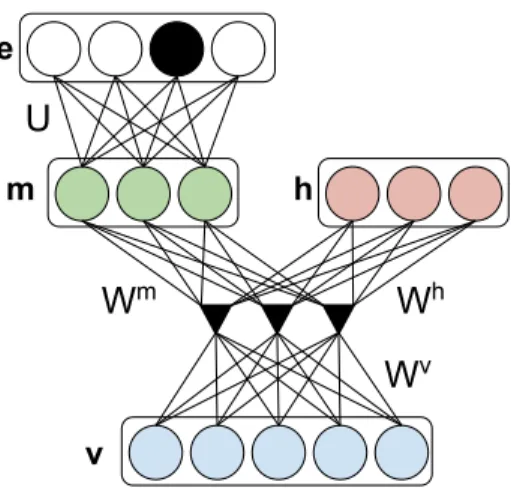
3.2 An instance of our model with two groups of hidden units. We can
op-tionally include label units (e.g., labels e are connected to hidden units
m). . . 14
3.3 Visualization of the RNN structure of our model. Arrows show the
direc-tion of the forward propagadirec-tion. . . 17
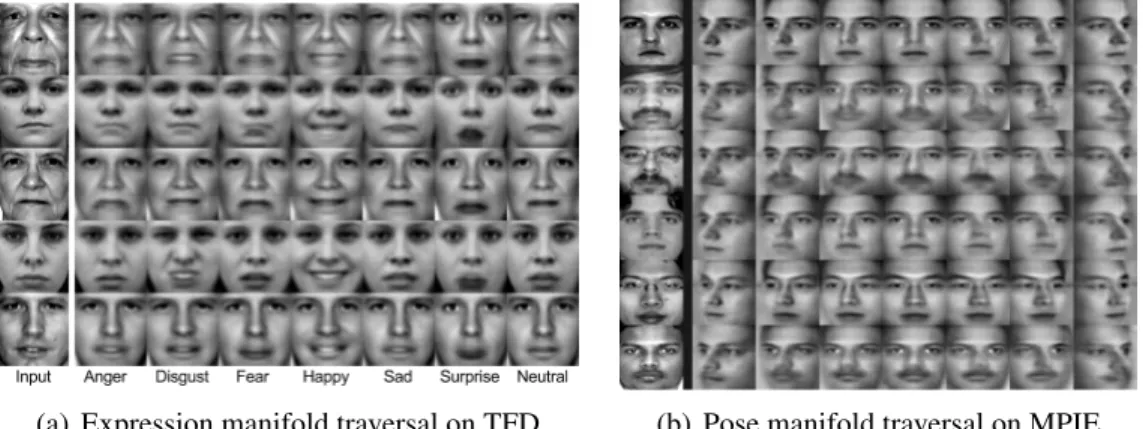
3.4 Visualization of (a) expression and (b) pose manifold traversal. Each row
shows samples of varying expressions or pose with same identity as in input (leftmost). . . 20
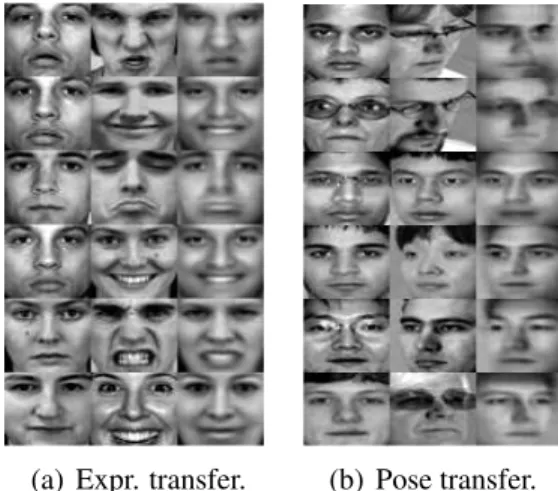
3.5 Identity units from left column are transferred to (a) expression units
and (b) pose units from middle column. Reconstructions shown in right columns. . . 21
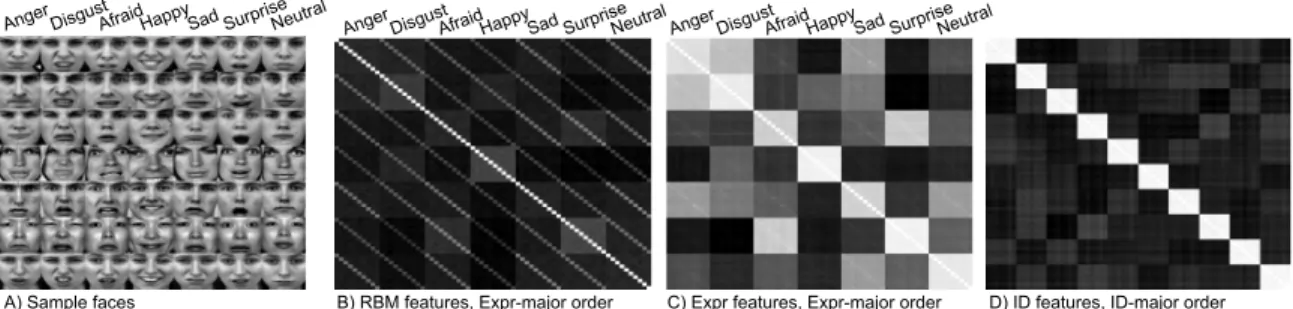
3.6 A) A sample of several identities with each of the 7 emotions in TFD.
We drew 100 such samples and averaged the results. B) Similarity matrix using RBM features. C) Using our expression-related features (Expr). D) Using our identity-related features (ID). . . 23
3.7 Comparison of pose transfer results between 2-way and (2+3)-way disBM
models on Multi-PIE. The task is pose transfer from faces in the second
column onto the face in the first column. . . 25
3.8 A scatter plot of average sensitivity of ID units (blue) and pose units
(red) on Multi-PIE. The black line through the origin has slope 1, and approximately separates ID unit responses from pose unit responses. . . . 26
4.1 Visual analogy making concept. We learn an encoder functionf mapping
images into a space in which analogies can be performed, and a decoder
4.2 Illustration of the network structure for analogy making. The top portion shows the encoder, transformation module, and decoder. The bottom
por-tion illustrates the transformapor-tions used forLadd,Lmul andLdeep. The
N
icon inLmul indicates a tensor product. We share weights with all three
encoder networks shown on the top left. . . 34
4.3 The encoderf learns a disentangled representation, in this case for pitch,
elevation and identity of 3D car models. In the example above, switches
swould be a block[0;1;1]vector. . . 35
4.4 Analogy-making with disentangled features. Left: Analogy
transforma-tion operates on the pose only (in blue), separated from the identity (in green). Right: Identity units can also take the form of an attribute vector, e.g. for 2D sprite characteristics. . . 36
4.5 Analogy predictions made byLdeep for rotation, scaling and translation,
respectively by row.LaddandLmul perform as well for scaling and
trans-formation, but fail for rotation. The model is able to extrapolate along scale to smaller shapes than were in the training data. . . 37
4.6 Mean-squared prediction error on repeated application of rotation
analo-gies. . . 37
4.7 Transferring animations. The top row shows the reference, and the
bot-tom row shows the transferred animation, where the first frame (in red) is the starting frame of a test set character. . . 39
4.8 Few shot prediction with 48 training examples. . . 40
4.9 A cartoon visualization of the “shoot” animation manifold for two
differ-ent characters in differdiffer-ent viewpoints. The model can learn the structure of the animation manifold by forming analogy tuples during training;
ex-ample tuples are circled in red and blue above. . . 41
4.10 Extrapolating animations by analogy. The model is shown the reference
and output pair, and repeatedly applies the inferred transformation to the query image, which advances the animation frame through time. Note that this kind of inference requires learning the manifold of animation poses, and cannot be done by simply combining and decoding disentan-gled features. . . 41
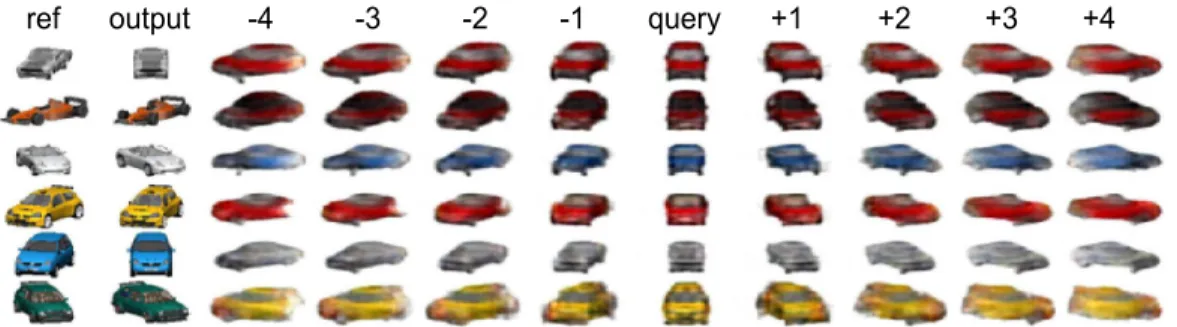
4.11 3D car analogies. The column “GT” denotes ground truth. . . 42
4.12 Repeated rotation in forward and reverse directions, starting from frontal. 42
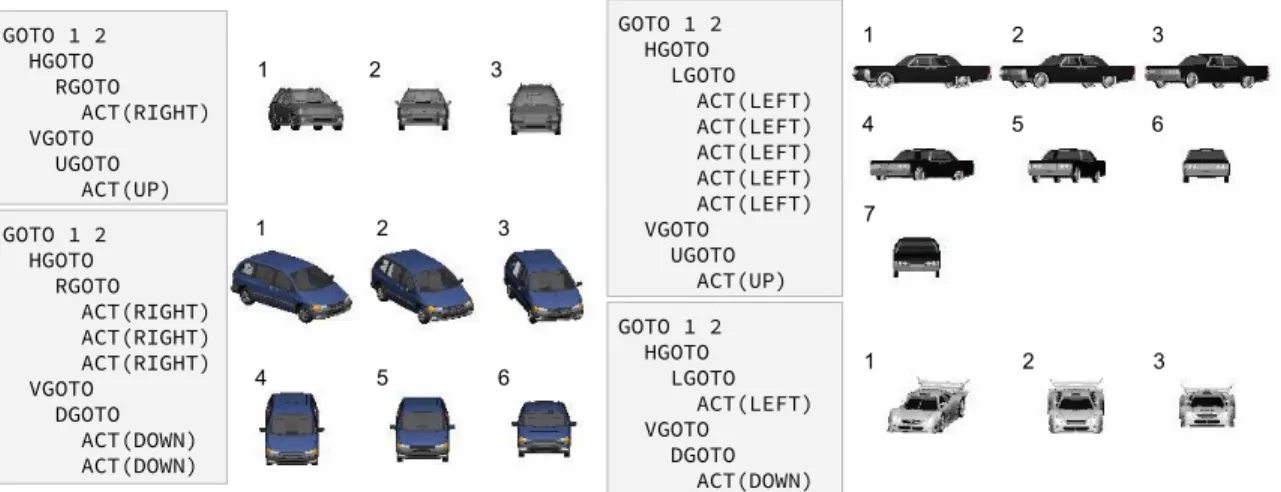
4.13 Concept figure from Evans’s 1964 paper. The task is to correctly predict
which of shapes 1 - 6 makes the analogy A : B :: C : D true. . . 43
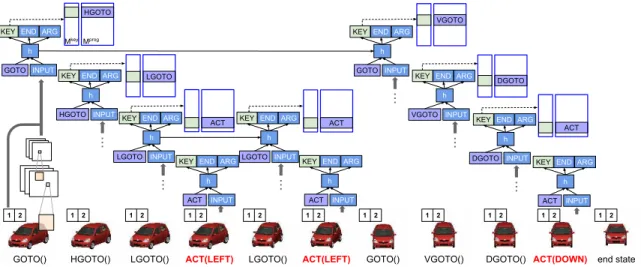
5.1 Example execution of canonicalizing 3D car models. The task is to move
the camera such that a target angle and elevation are reached. There is a read-only scratch pad containing the target (angle 1, elevation 2 here). The image encoder is a convnet trained from scratch on pixels. . . 47
5.2 Single-digit addition. The task is to perform a single-digit add on the
numbers at pointer locations in the first two rows. The carry (row 3) and output (row 4) should be updated to reflect the addition. At each time step, an observation of the environment (viewed from each pointer on a scratch pad) is encoded into a fixed-length vector. . . 47
5.3 Example scratch pad and pointers used for computing “96 + 125 = 221”. Carry step is being implemented. . . 55
5.4 Actual trace of addition program generated by our model on the problem
shown to the left. Note that we substituted the ACT calls in the trace with more human-readable steps. . . 55
5.5 Example scratch pad and pointers used for sorting. . . 56
5.6 Excerpt from the trace of the learned bubblesort program. . . 56
5.7 Sample complexity. Test accuracy of sequence-to-sequence LSTM ver-sus NPI on length-20 arrays of single-digit numbers. Note that NPI is able to mine and train on subprogram traces from each bubblesort example. 58 5.8 Strong vs. weak generalization. Test accuracy of sequence-to-sequence
LSTM versus NPI on varying-length arrays of single-digit numbers. Both models were trained on arrays of single-digit numbers up to length 20. . . 58
5.9 Example canonicalization of several different test set cars, of different
appearance than the train set cars. The network is able to generate and execute the appropriate plan based on the starting car image. This NPI
was trained on trajectories starting at azimuth (−75◦...75◦) , elevation
(0◦...60◦)in 15◦ increments. The training trajectories target azimuth0◦
and elevation15◦, as in the generated traces above. . . 59
6.1 A conceptual diagram of our framework for learning visual description
embeddings. Our model learns a scoring function between images and natural language descriptions. A word-based LSTM is shown, but we evaluate several alternative models. . . 63
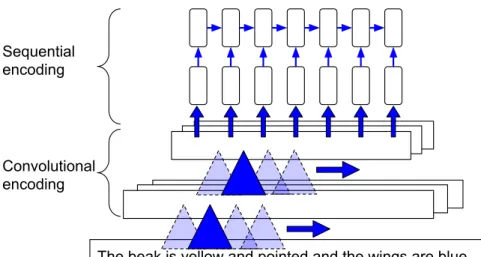
6.2 Our proposed convolutional-recurrent net. . . 70
6.3 Example annotations of birds and flowers. . . 72
6.4 Top: Performance impact of increasing the number of training sentences.
Bottom: Increasing the number of test sentences used at test time. . . 74
6.5 Zero-shot retrieval given a single query sentence. Each row corresponds
to a different text encoder. . . 78
6.6 t-SNE embedding oftest classdescription embeddings from Oxford-102
(left) and CUB (right), marked with corresponding images. Best viewed
with zoom. . . 80
7.1 Examples of generated images from text descriptions. Left: captions are
from zero-shot (held out) categories, unseen text. Right: captions are from the training set. . . 83
7.2 Our text-conditional convolutional GAN architecture. Text encodingϕ(t)
is used by both generator and discriminator. It is projected to a lower-dimensions and depth concatenated with image feature maps for further stages of convolutional processing. . . 88
7.3 Zero-shot (i.e. conditioned on text from unseen test set categories)
gener-ated bird images using GAN, GAN-CLS, GAN-INT and GAN-INT-CLS. We found that interpolation regularizer was needed to reliably achieve visually-plausible results. . . 92
7.4 Zero-shot generated flower images using GAN, GAN-CLS, GAN-INT and GAN-INT-CLS. All variants generated plausible images. Although some shapes of test categories were not seen during training (e.g. columns
3 and 4), color is preserved. . . 92
7.5 ROC curves using cosine distance between predicted style vector on same vs. different style image pairs. Left: image pairs reflect same or different pose. Right: image pairs reflect same or different average background color. . . 95
7.6 Transfering style from the top row (real) images to the content from the text, withGacting as a deterministic decoder. The bottom three captions are made up by us. . . 97
7.7 Generating images of general concepts using our GAN-CLS on the MS-COCO validation set. Unlike the case of CUB and Oxford-102, the net-work must (try to) handle multiple objects and diverse backgrounds. . . . 98
7.8 Left: Generated bird images by interpolating between two sentences (within a row the noise is fixed). Right: Interpolating between two randomly-sampled noise vectors. . . 98
B.1 Repeated application of analogies from the example pair (first two columns), in both forward and reverse mode, using a model trained withLdeep. . . . 108
B.2 Repeated application of multiple different analogies from two different example pairs (first four columns) using a model trained withLdeep. . . . 108
B.3 Repeated application of analogies from the example pair (first two columns), in both forward and reverse mode, using three models trained respectively withLadd,Lmul,Ldeep. . . 109
B.4 2D PCA projections of the image embeddings along the rotation mani-fold. Each point is marked with an image generated by the model, trained withLdeep. . . 110
B.5 UsingLdis+cls, our model can generate sprites with fine-grained control over character attributes. The above images were generated by using f to encode the leftmost source image for each attribute, and then changing the identity units and re-rendering. . . 111
B.6 Shooting a bow. . . 111
B.7 Walking. . . 112
B.8 Casting a spell. . . 112
B.9 Animation analogies and extrapolation for all character animations plus rotation. The example pair (first two columns) and query image (third column) both come from the test set of characters. Ldeep was used for analogy training of pose units, jointly withLdis+clsto learn a disentangled representation. . . 113
C.1 Generated execution trace from our trained NPI sorting the array [9,2,5]. . 114
E.1 Zero-shot accuracies for image encoders trained on GAN samples. . . 118
E.2 Samples from GAN-INT-CLS (top) and end-to-end version (bottom). . . . 119
E.3 Samples from GAN-INT-CLS (top) and end-to-end version (bottom). . . . 120
E.4 Additional samples from our GAN-CLS trained on MS-COCO. . . 121
E.6 t-SNE embedding visualization of extract style features on CUB. It ap-pears to be insensitive to the appearance of the birds (which should be captured by the text content), and mainly varies according to the primary background color. . . 123
LIST OF TABLES
Table
3.1 Control experiments of our method on Multi-PIE, with naive
genera-tive training, clamping identity-related units (ID), using labels for pose-related units (Pose) and using the manifold-based regularization on both groups of units. . . 22
3.2 Control experiments of our method on TFD, with naive generative
train-ing, clamping identity-related units (ID), using labels for expression-related units (Expr) and using the manifold-based regularization on both groups of units. . . 22
3.3 Performance comparison of discriminative tasks on Multi-PIE. RBM stands
for the second layer RBM features trained on the first layer RBM features. 23
3.4 Performance comparison of discriminative tasks on TFD. RBM stands
for the second layer RBM features trained on the first layer OMP features. 24
3.5 Comparison of face verification AUC (top) and pose estimation %
ac-curacy (bottom) between 2-way and (2+3)-way disBM with increasingly
many factors of variation (e.g., pose, jittering, illumination) on Multi-PIE. 25
4.1 Comparison of squared pixel error of Ladd, Lmul and Ldeep on shape
analogies. . . 37
4.2 Mean-squared pixel error on test analogies, by animation. . . 39
4.3 Mean-squared pixel-prediction error for few-shot analogy transfer of the
“spellcast” animation from 4 viewpoints. . . 40
4.4 Disentangling performance on 3D cars. Pose AUC refers to area
un-der the ROC curve for different pose, and ID AUC for
same-or-different car. . . 42
5.1 Per-sequence % accuracy. “+ Max” indicates performance after addition
of the additional max-finding subprograms to memory. “unseen” uses a test set with disjoint car models from the training set, while “seen car” uses the same car models but different trajectories. . . 61
6.1 Zero-shot recognition and retrieval on CUB. “DS-SJE” and “DA-SJE”
re-fer to symmetric and asymmetric forms of our joint embedding objective, respectively. . . 74
6.2 Zero-shot % recognition accuracy and retrieval average precision on
6.3 Summary of zero-shot % classification accuracies. Note that different
features are used in each work, although [2] uses the same features as in
this work. . . 79
C.1 Programs learned for addition, sorting and 3D car canonicalization. Note
the ACT program has a different effect depending on the environment
LIST OF APPENDICES
A. Derivation of variational approximation to disBM posterior inference . . . . 104
B. Additional examples of visual analogy-making . . . 107
C. NPI program listing and sorting execution trace . . . 114
D. Zero-shot text-based retrieval . . . 116
ABSTRACT
Deep Neural Networks for Visual Reasoning, Program Induction, and Text-to-Image Synthesis
by
Scott Ellison Reed
Chair: Honglak Lee
Deep neural networks excel at pattern recognition, especially in the setting of large scale supervised learning. A combination of better hardware, more data, and algorithmic im-provements have yielded breakthroughs in image classification, speech recognition and other perception problems. The research frontier has shifted towards the weak side of neu-ral networks: reasoning, planning, and (like all machine learning algorithms) creativity. How can we advance along this frontier using the same generic techniques so effective in pattern recognition; i.e. gradient descent with backpropagation? In this thesis I de-velop neural architectures with new capabilities in visual reasoning, program induction and text-to-image synthesis. I propose two models that disentangle the latent visual factors of variation that give rise to images, and enable analogical reasoning in the latent space. I show how to augment a recurrent network with a memory of programs that enables the learning of compositional structure for more data-efficient and generalizable program in-duction. Finally, I develop a generative neural network that translates descriptions of birds, flowers and other categories into compelling natural images.
CHAPTER I
Introduction
1.1
Motivation
Deep neural networks have enabled transformative breakthroughs in speech and image recognition in the past several years, fueled by increases in training data and computational power in addition to algorithmic improvements. While deep networks excel at pattern recognition, often with comparable performance to humans in some tasks, the research frontier has shifted to the current weak side of neural networks: reasoning, planning and creativity. In this thesis I propose several approaches to advance along this frontier.
Reasoning and planning are the subject of decades of research in artificial intelligence. The classical approaches rely mainly on symbolic representations of the world; for search-based problem solving and game playing, logical reasoning systems, theorem proving, and
many planning problems [129]. For problems involving high-dimensional, noisy perceptual
data such as image classification and speech recognition, connectionist approaches (i.e. neural networks) have enjoyed the most success. Further progress in AI can likely be found at the intersection of these fairly disparate research communities. Service robots and digital assistants will need connectionist approaches to distill useful representations of images, speech and text. They will also require symbolic notions; e.g. a knowledge graph of grounded concepts and their relationships, in order to function in the real world. Many research problems will require aspects of both; one that I consider inthis thesis is visual
analogy making.
In addition to reasoning and planning, the notion ofcreativityI refer to in the context of
this work should be specified. In this work I am only referring to the creation of something novel and of interest to humans in the context of conditional generative models of images.
I explore this in several ways; mainly by (1) conditioning a generator network on a
disen-tangled representation of causal factors, which can be recombined arbitrarily and thereby allow the model to generalize combinatorially, and (2) conditioning on informal text de-scriptions. Clearly this is only a small part of what we mean colloquially by creativity, but research progress here could apply to automatic generation of novel and useful artifacts in other domains as well.
The first problem I study is how to reason about the relevant visual factors of variation that give rise to an image. Given an image of an object, one would like for an image understanding system to not only be able to robustly recognize the object under variations in lighting, pose and scale; but also predict what the scene would look like if one or several
of those factors were changed. I develop a variant of Restricted Boltzmann Machine [135]
(RBM) that explicitly separates the latent factors into separate groups of units, and apply the model to pose and expression transfer on human faces.
To investigate the reasoning capability of neural networks, I develop a model for visual analogy making: given an image analogy problem A : B :: C : ?, the network predicts the pixels of the image D that completes the analogy. For example, the analogy could involve rotating 3D shapes or animating a video game sprite. In contrast to previous works on analogy-making, this is the first end-to-end differentiable architecture for pixel-level anal-ogy completion. We also show that by learning to disentangle the latent visual factors of variation (e.g. pose and shape), our model can more effectively relate images and perform image transformations.
To improve neural-network-based planning (e.g. mapping percepts to action sequences), I propose a modification to recurrent neural networks that enables them to capture
com-positional structure in the output space. Our proposed network, the Neural Programmer-Interpreter (NPI) is augmented with a memory of program, each consistning of environment-dependent actions and calls to other programs. It learns to execute these programs from example execution traces. By exploiting compositionality, we demonstrate improved data efficiency and strong generalization compared to previous recurrent networks for program induction. We apply our model, the Neural Programmer-Interpreter (NPI), to generating execution trajectories for multi-digit addition, sorting arrays of numbers, and canonical-izing the pose of 3D car models from image renderings. Notably, a single NPI can learn and execute these programs and associated subprograms across very different environments with different affordances.
To more accurately capture the relation between images and text, in another project I implement and evaluate several deep architectures for encoding text descriptions of birds and flowers. We show that using only informal text descriptions, we can learn highly dis-criminative text features comparable in performance to carefully-engineered and domain-specific attribute vector representations. Next, we leverage these text encoders to improve the usefulness of neural nets for creative tasks. Specifically, I develop several new variants of Generative Adversarial Networks capable of text-to-image synthesis; i.e. generating plausible images from informal descriptions. For example, “a bright yellow bird with a black head and beak”. Our system can generate plausible depictions of birds, flowers and many other objects given only textual descriptions. By learning to invert the generator network, we also show how to synthesize images by transferring the style of an unseen photograph (e.g. background appearance) onto the content of a text description.
1.1.1 The disentangling Restricted Boltzmann Machine (Chapter III)
The Restricted Boltzmann Machine [135] (RBM) has gained popularity as an effective
model for natural images and image patches [85,62], and as a fundamental building block
However, the standard RBM formulation only models the pairwise interactions between units in a single observation vector and units in a single hidden unit vector. For the purpose of modeling higher-order interactions among multiple factors of variation given a single image observation, e.g. pose, expression and identity of human faces, in this project we extend the basic RBM formulation.
We want to preserve the nice properties of the RBM; i.e. efficient and parallelizable inference, simple procedures for generating image samples, and efficient approximation to the likelihood gradient. In addition to preserving these properties, we want to endow the model with new generative capabilities; namely the ability to fix a subset of factors of variation while varying the others, thus traversing image manifolds in a controllable way. Our main contributions are (1) an RBM formulation in which the energy function incorporates both additive and multiplicative interactions among latent factors, (2) a new regularizer encouraging distinct groups of hidden units to represent different concepts (i.e. become disentangled), and (3) a simple and effective method of training the model via backpropagation by casting its inference procedure as a recurrent neural network.
1.1.2 Deep networks for disentangling and visual analogy-making (Chapter IV)
While our disentangling extension to the RBM showed encouraging results, it did not take advantage of recent advances in deep convolutional networks for modeling images. Therefore, in this line of work we explore a deep convolutional model that also learns a disentangled latent representation. Instead of directly optimizing the likelihood for training a fully generative model, we set as the target the actual generative tasks that we would like
our model to perform: namely, making analogies [56] and traversing image manifolds [31].
For example, in analogy making we may want to transform a query face image to have the same expression as an example face. For manifold traversal, given a query face, we may want to repeatedly rotate the face in 3D to produce images from novel viewpoints. Since faces were studied in our disentangling Boltzmann machine work, in this work we
studied several non-face datasets: a toy set of colored 2D shapes for control experiments, a set of video game character sprites with many controllable attributes, and a set of 3D car CAD models. We study several transformation mechanisms for our deep convolutional encoder-decoder model: additive, multiplicative and deep multilayer. We demonstrate that a deep multilayer transformation mechanism achieves the best performance in extrapolating repeated image transformations along a manifold, such as repeated rotations of 2D shapes and 3D cars and even extrapolations of sprite animations.
1.1.3 Learning a neural programmer and interpreter (Chapter V)
Visual analogies can be viewed as a form of one-shot program induction followed by execution of that same program on a new query image. In this case, the “program”, e.g.
rotating an object by 15◦, can be represented by a difference of embeddings between the
example input and output image transformation pair, as we show in Chapter IV. However, more complex programs with multiple steps and compositional structure are unlikely to be solvable by such a simple approach. Recurrent neural networks (sequence-to-sequence models) have shown some capability to learn simple programs such as sorting very short arrays or addition of binary numbers, but have not scaled to learning more complex tasks and suffer from poor generalization ability.
To tackle this problem, I show how to construct a recurrent neural network with a persistent memory of program embeddings, which I call the Neural Programmer-Interpreter (NPI). At each time step of processing, NPI outputs the next program, optional arguments, and whether to halt the current program, conditioned on a feature representation of the current environment state and the current program. NPI trains on program execution traces
consisting of calls of each program to its immediate subprograms (notthe entire execution
subtree) conditioned on the input. I demonstrate that asingleNPI can learn programs for
addition, sorting and canonicalization of 3D car models, and all 21 associated subprograms. By exploiting compositionality, NPI achieves improved sample complexity and stronger
generalization performance compared to baseline sequence-to-sequence models.
1.1.4 Learning to represent fine-grained visual descriptions (Chapter VI)
State-of-the-art methods for zero-shot visual recognition formulate learning as a joint embedding problem of images and side information. In these formulations the current best complement to visual features are attributes: manually-encoded vectors describing shared characteristics among categories. Despite good performance, attributes have limitations: (1) finer-grained recognition requires commensurately more attributes, and (2) attributes do not provide a natural language interface. We propose to overcome these limitations by training neural language models from scratch; i.e. without pre-training and only consuming words and characters. Our proposed models train end-to-end to align with the fine-grained and category-specific content of images. Natural language provides a flexible and compact way of encoding only the salient visual aspects for distinguishing categories. By training on raw text, our model can do inference on raw text as well, providing humans a familiar mode both for annotation and retrieval. Our model achieves strong performance on zero-shot text-based image retrieval and significantly outperforms the attribute-text-based state-of-the-art for zero-shot classification on the Caltech-UCSD Birds 200-2011 dataset.
1.1.5 Generating images from informal text descriptions (Chapter VII)
Automatic synthesis of realistic images from text would be interesting and useful, but current AI systems are still far from this goal. However, in recent years generic and power-ful recurrent neural network architectures have been developed to learn discriminative text feature representations. Meanwhile, deep convolutional generative adversarial networks (GANs) have begun to generate highly compelling images of specific categories such as faces, album covers, room interiors and flowers. In this work, we develop a novel deep architecture and GAN formulation to effectively bridge these advances in text and image modeling, translating visual concepts from characters to pixels. We demonstrate the
ca-pability of our model to generate plausible images of birds and flowers from detailed text descriptions. We also extend our model to a more general dataset of captioned web images.
1.2
Organization of the Thesis
This thesis is organized as follows. In chapter II, I provide background information about restricted Boltzmann machines (RBMs) and Long short-term Memory neural net-works (LSTMs). In chapter III, I describe an extension of the RBM that learns to disentan-gle factors of variation from image data, resulting in improved discriminative performance and yielding new generative capabilities. In chapter IV, I show how deep convolutional net-works can be used to learn to disentangle visual factors of variation and also perform visual analogies. In chapter V I show how to learn representations of compositional programs, and demonstrate their effectiveness on addition, sorting, and camera trajectory planning for ro-tating 3D CAD models. In chapter VI I describe our work on learning deep representations of fine-grained visual descriptions, which achieve superior predictive performance even compared to costly attribute annotations. These sentence embeddings are then used to help generate images. In chapter VII I provide an overview of our text-to-image synthesis model and show results on generating birds, flowers and common scenes.
1.3
Related Publications
The content of this thesis is mostly derived from papers that were published in top-tier machine learning and computer vision conferences. The list that follows connects these publications to their corresponding chapter.
• Chapter III: Scott Reed, Kihyuk Sohn, Yuting Zhang, Honglak Lee. Learning to
Disentangle Factors of Variation with Manifold Interaction. In Proceedings of the
• Chapter IV: Scott Reed, Yi Zhang, Yuting Zhang, Honglak Lee. Deep Visual
Analogy-Making. InNeural Information Processing Systems, Montreal, Canada, 2015.
• Chapter V: Scott Reed, Nando de Freitas. Neural Programmer-Interpreters. In
Inter-national Conference on Learning Representations, San Juan, Puerto Rico, 2016.
• Chapter VI: Scott Reed, Zeynep Akata, Honglak Lee, Bernt Schiele. Learning Deep
Representations of Fine-grained Visual Descriptions. InIEEE Computer Vision and
Pattern Recognition, Las Vegas, USA, 2016.
• Chapter VII: Scott Reed, Zeynep Akata, Xinchen Yan, Lajanugen Logeswaran, Bernt
Schiele, Honglak Lee. Generative Adversarial Text-to-Image Synthesis. Under
re-view for Proceedings of the 31st International Conference on Machine Learning,
New York, USA, 2016.
In addition, the following co-author publications are also closely related to the material in this thesis. These are also published at top-tier machine learning and vision conferences, and are linked in the following list to the related chapter:
• Chapter IV: Jimei Yang, Scott Reed, Ming-hsuan Yang, Honglak Lee.
Weakly-supervised Disentangling with Recurrent Transformations for 3D View Synthesis. InNeural Information Processing Systems, Montreal, Canada, 2015.
• Chapter VI: Zeynep Akata, Scott Reed, Daniel Walter, Honglak Lee, Bernt Schiele.
Evaluation of Output Embeddings for Fine-Grained Image Classification In IEEE
CHAPTER II
Preliminaries
In this section I briefly review two building blocks used in this dissertation. The first is a type of probabilistic graphical model, the RBM, that recently gained popularity in modeling image patches, as well as audio and text data. I extend this model in Chapter III. The second is a version of recurrent neural network designed to mitigate the vanishing and exploding gradients problem. This module is used in Chapters V, VI and VII.
2.1
Restricted Boltzmann machine
The restricted Boltzmann machine (RBM) is a bipartite undirected graphical model
composed ofDbinary visible units1v∈ {0,1}D andK binary hidden unitsh ∈ {0,1}K.
The joint distribution and the energy function are defined as follows:
P(v,h) = 1 Z exp(−E(v,h)), E(v,h) = − D X i=1 K X k=1 viWikhk− K X k=1 bkhk− D X i=1 civi,
where Z is the partition function, Wik is a weight between i-th visible and k-th hidden
units, bk are hidden biases, and ci are visible biases. In the RBM, the units in the same
layer are conditionally independent given the units in the other layer: P(vi = 1|h) = σ( X k Wikhk+ci), P(hk = 1|v) = σ( X i Wikvi+bk),
where σ(x) = 1+exp(1 −x) is a logistic function. The RBM can be trained to maximize
the log-likelihood of data using stochastic gradient descent. Although the gradient is
in-tractable, we can approximate it using contrastive divergence (CD) [58].
2.2
Long short-term memory (LSTM)
The LSTM [61] is a recurrent model designed to overcome limitations of the basic
RNN, namely the problem of exploding and vanishing gradients. The LSTM stores state
information in its memory cell c ∈ Rd, which is written to and read from via pointwise
multiplications with several gating variables: input gatei, forget gatef and output gateo,
which yields the output hidden stateh ∈ Rd. Having observed inputx, the overall update
step at timetproceeds as follows:
it =σ(Wixxt+Wihht−1) (2.1)
ft =σ(Wf xxt+Wf hht−1) (2.2)
ot =σ(Woxxt+Wohht−1) (2.3)
ct =ftct−1+ittanh(Wcxxt+Wchht−1) (2.4)
ht =otct (2.5)
where the W... are learnable weights, σ(x) = 1/(1 +e−x) is the sigmoid function and
denotes pointwise multiplication. Intuitively, LSTMs can model very long temporal
dependences by learning to gate the memory cell updates. LSTMs are commonly used for sequence modeling tasks such as next-word prediction. For example, one could compute
CHAPTER III
Disentangling factors of variation with Restricted
Boltzmann Machines
3.1
Introduction
A key challenge in understanding sensory data (e.g., image and audio) is to tease apart
many factors of variation that combine to generate the observations [15]. For example,
pose, shape and illumination combine to generate 3D object images; morphology and ex-pression combine to generate face images. Many factors of variation exist for other modal-ities, but here we focus on modeling images.
Most previous work focused on building [90] or learning [71,116,85,83,63,62,137]
invariant features that are unaffected by nuisance information for the task at hand. How-ever, we argue that image understanding can benefit from retaining information about all underlying factors of variation, because in many cases knowledge about one factor can improve our estimates about the others. For example, a good pose estimate may help to accurately infer the face morphology, and vice versa.
When the input images are generated from multiple factors of variation, they tend to lie on a complicated manifold, which makes learning useful representations very challenging. We approach this problem by viewing each factor of variation as forming a sub-manifold by itself, and modeling the joint interaction among factors. For example, given face images
Pose manifold coordinates Identity manifold coordinates Input Input images Fixed ID Fixed Pose Learning
Figure 3.1: Illustration of our approach for modeling pose and identity variations in face im-ages. When fixing identity, traversing along the corresponding “fiber” (red ellipse) changes the pose. When fixing pose, traversing across the vertical cross-section (blue rectangle) changes the identity. Our model captures this via multiplicative interactions between pose and identity coordinates to generate the image.
with different identities and viewpoints, we can envision one sub-manifold for identity and another for viewpoint. As illustrated in Figure 3.1, when we consider face images of a single person taken from different azimuth angles (with fixed altitude), the trajectory of images will form a ring-shaped fiber. Similarly, changing the identity while fixing the angle traverses a high-dimensional sub-manifold from one fiber to other.
Concretely, we use a higher-order Boltzmann machine to model the distribution over image features and the latent factors of variation. Further, we propose
correspondence-based training strategies that allow our model to effectively disentangle the factors of
variation. This means that each group of hidden units is sensitive to changes in its cor-responding factor of variation, and relatively invariant to changes in the others. We
re-fer to our model variants as disentangling Boltzmann machines (disBMs). Our disBM
model achieves state-of-the-art emotion recognition and face verification performance on the Toronto Face Database (TFD), as well as strong performance in pose estimation and face verification on CMU Multi-PIE.
3.2
Related Work
Manifold learning methods [152,126,54] model the data by learning low-dimensional
structures or embeddings. Existing manifold learning methods can learn low-dimensional structures such as viewpoint manifolds from face images of a single person, but it becomes challenging to model complex high-dimensional manifolds such as the space of face images from millions of people. Deep learning has shown to be effective in learning such
high-dimensional data manifolds, as suggested by Rifai et al. [122]. However, it remains a
challenge to jointly model multiple factors of variation and their interacting manifolds.
Our work is related to multi-task learning [17, 6] if one views each factor as a “task”
feature to be learned jointly. However, our approach considers joint interaction among the factors, and benefits from a synergy in which knowledge of one factor can help infer about the others. In addition, our model is generative and can answer higher-order queries involving the input and multiple factors.
There are several related works that use higher-order interactions between multiple
la-tent variables. For example, bilinear models [151] were used to separate style and content
within face images (pose and identity) and speech signals (vowels and speaker identity).
The tensor analyzer (TA) [150] extended factor analysis by introducing a factor loading
tensor to model the interaction among multiple groups of latent factor units, and was ap-plied to modeling lighting and face morphology. Our approach is complementary to these, and is also capable of exploiting correspondence information.
The higher-order spike and slab RBM (ssRBM) [28] extends the ssRBM [23] with
higher-order interactions. Our motivation is similar, but our model formulation is different and we propose novel training strategies that significantly improve the disentangling. Fi-nally, we show state-of-the-art performance on several discriminative tasks on face images.
The factored gated Boltzmann machine (FGBM) [94,144] models the relation between
data pairs (e.g. translation, rotation of images, facial expression changes) via 3-way in-teractions. Both the FGBM and disBM are variants of higher-order Boltzmann machines,
v Wm Wh Wv U m h e
Figure 3.2: An instance of our model with two groups of hidden units. We can optionally
include label units (e.g., labelseare connected to hidden unitsm).
but the FGBM assumes two sets of visible units interacting with one set of hidden units, whereas the disBM assumes multiple sets of hidden units interacting with a single set of visible units.
The point-wise gated Boltzmann machine [138] is an instance of a higher-order
Boltz-mann machine that jointly learns and selects task-relevant features. Contractive
discrimi-native analysis [123] also learns groups of task-relevant and irrelevant hidden units using
a contractive penalty, but only uses additive interactions between the input and each group of hidden units. These models are complementary to ours in that they learn to separate task-relevant from task-irrelevant features.
The disBM is an undirected graphical model with higher-order interactions between observations and multiple groups of hidden units, as in Figure 3.2. Each group of hidden units can be viewed as manifold coordinates for a distinct factor of variation. Our proposed
model is shown in Figure 3.2. For simplicity, we assume two groups of hidden unitshand
m, although it is straightforward to add more groups. If labels are available, they can be
3.2.1 Energy function
As shown in Figure 3.2, our model assumes 3-way multiplicative interaction between
Dvisible unitsv∈ {0,1}D and two groups of hidden unitsh∈ {0,1}K andm∈ {0,1}L.
We define the energy function as:
E(v,m,h) =−X f (X i Wifvvi)( X j Wjfmmj)( X k Wkfh hk) −X ij Pijmvimj− X ik Pikhvihk (3.1)
We have used factorization of 3D weight tensorW ∈ RD×L×K into three weight matrices
Wv ∈ RD×F,Wm ∈RL×F,Wh ∈RK×F withF factors as Wijk = F X f=1 WifvWjfmWkfh (3.2)
to reduce the number of model parameters [94]. We also include additive connections with
weight matrices Pm ∈
RD×L andPh ∈ RD×K between visible units and each group of
hidden units. We omit the bias terms for clarity of presentation. Although the hidden units are not conditionally independent given the visible units, units in each group are conditionally independent given units in all other groups. The conditional distributions are
as follows:1 P(vi = 1 |h,m) =σ( X jk Wijkmjhk +X j Pijmmj+ X k Pikhhk) (3.3) P(mj = 1|v,h) = σ( X ik Wijkvihk+ X i Pijmvi) (3.4) P(hk= 1 |v,m) = σ( X ij Wijkvimj + X i Pikhvi) (3.5) 1W
The conditional independence structure allows efficient 3-way block Gibbs sampling.
3.2.2 Inference and learning
Inference. The exact posterior distribution is intractable sinceh andm are not
con-ditionally independent given v. Instead, we use variational inference to approximate the
true posterior with a fully factorized distributionQ(m,h) = Q
j Q
kQ(mj)Q(hk). A
de-tailed derivation is presented in Appendix A. By minimizing KL(Q(m,h)kP(m,h|v)),
we obtain the following fixed-point equations:
ˆ hk =σ( X ij Wijkvimˆj + X i Pikhvi) (3.6) ˆ mj =σ( X ik Wijkviˆhk+ X i Pijmvi) (3.7)
where hˆk = Q(hk = 1) and mˆj = Q(mj = 1). Initialized with all 0’s, the mean-field
update proceeds by alternately updatinghˆandmˆ using Equation (3.6) and (3.7) until
con-vergence. We found that 10 iterations were enough in our experiments.
Learning. We train the model to maximize the data log-likelihood using stochastic
gra-dient descent. The gragra-dient of the log-likelihood for parametersΘ ={Wv, Wm, Wh, Pm, Ph}
can be computed as:
−EP(m,h|v) ∂E(v,m,h) ∂θ +EP(v,m,h) ∂E(v,m,h) ∂θ
Unlike in the RBM case, both the first (i.e., data-dependent) and the second (i.e., model-dependent) terms are intractable. We can approximate the data-dependent term with
vari-ational inference and the model-dependent term with persistent CD [153] by running a
3-way sampling using Equation (3.3),(3.4),(3.5). A similar approach has been proposed
v v h(1) m(1) v v v v h(2) m(2) h(3) m(3)
Figure 3.3: Visualization of the RNN structure of our model. Arrows show the direction of the forward propagation.
3.2.3 Computing gradients via backpropagation
When the training objective depends on hidden unit activations, such as correspondence
(Section 3.3.1) or sparsity [84, 59], the exact gradient can be computed via
backpropaga-tion through the recurrent neural network (RNN) induced by mean-field inference (See Figure 3.3). The forward propagation proceeds as:
ˆ h(kt+1) =σ(X ij Wijkvimˆ (t) j + X i Pikhvi) (3.8) ˆ m(jt+1) =σ(X ik Wijkviˆh (t) k + X i Pijmvi) (3.9)
A similar strategy was rigorously developed byStoyanov et al.[141] and was used to train
deep Boltzmann machines [48].
3.3
Training strategies for disentangling
Generative training of the disBM does not explicitly encourage disentangling, and gen-erally did not yield well-disentangled features in practice. However, we can achieve better disentangling by exploiting correspondences between images (e.g. matching identity, ex-pression or pose), and by using labels.
3.3.1 Learning with correspondence Clamping hidden units for pairs
If we know two data points v(1) and v(2) match in some factor of variation, we can
“clamp” the corresponding hidden units to be the same for both data points. For example,
given two images from the same person, we clamp thehunits so that they focus on
model-ing the common face morphology while other hidden units explain the differences such as pose or expression. To do clamping, we augment the energy function as follows:
Eclamp(v(1),v(2),m(1),m(2),h)
= E(v(1),m(1),h) +E(v(2),m(2),h) (3.10)
The fixed-point equations are the same as before, except that Equation (3.6) changes to
reflect the contributions from bothv(1) andv(2):
ˆ hk =σ( X ij Wijkvi(1)mˆ (1) j + X i Pikhv(1)i +X ij Wijkv(2)i mˆ (2) j + X i Pikhv(2)i ) (3.11)
The model is trained to maximize the joint log-likelihood of data pairslogP(v(1),v(2)).
Manifold-based training
In the manifold learning perspective, we want each group of hidden units to be a useful embedding with respect to its factor of variation. Specifically, corresponding data pairs should be embedded nearby, while the non-corresponding data pairs should be far apart. Clamping forces corresponding pairs into exactly the same point within a sub-manifold, which may be too strong of an assumption depending on the nature of the correspondence. Furthermore, clamping does not exploit knowledge of non-correspondence. Instead, we
propose to learn a representationhsuch that ||h(1)−h(2)||22 ≈0 , if (v(1),v(2))∈ Dsim ||h(1)−h(3)||2 2 ≥β , if (v (1),v(3))∈ D dis
whereDsimis a set of corresponding data pairs andDdisis a set of non-corresponding data
pairs. Formally, the manifold objective forhis written as:
||h(1)−h(2)||2
2+ max(0, β− ||h
(1)−h(3)||
2)2 (3.12)
This approach does not directly use label units, but labels can be used to construct
corre-spondence setsDsim andDdis. The formulation is similar to the one proposed byHadsell
et al.[54]. However, our goal is not dimensionality reduction and we consider multiple fac-tors of variation jointly. Furthermore, we can combine the manifold objective together with the generative objective. Since our model uses mean-field inference to compute the hidden units, we compute gradients via RNN backpropagation as discussed in Section 3.2.3.
3.4
Experiments on face image data sets
We evaluated the performance of our proposed model on several image databases:
• Flipped MNIST. For each digit of the MNIST dataset, we randomly flipped all pixels (0’s to 1’s and vice versa) with 50% probability. The dataset consists of 50,000 training images, 10,000 validation images, and 10,000 test images.
• Toronto Face Database (TFD) [143]. Contains 112,234 face images with 4,178
emotion labels and3,874identity labels. There are seven possible emotion labels.
• CMU Multi-PIE [52]. Contains 754,200 high-resolution face images with varia-tions in pose, lighting, and expression. We manually aligned and cropped the face
images.2
2We annotated two or three fiducial points (e.g., the eyes, nose, and mouth corners) and computed the 2-D
similarity transform that best fits them to the predefined anchor locations, which are different for each pose. Then, we warped the image accordingly, and cropped the major facial region with a fixed 4:3 rectangular box.
(a) Expression manifold traversal on TFD (b) Pose manifold traversal on MPIE
Figure 3.4: Visualization of (a) expression and (b) pose manifold traversal. Each row shows samples of varying expressions or pose with same identity as in input (leftmost).
3.4.1 Reasoning about factors of variation
A good generative model that can disentangle factors of variation should be able to traverse the manifold of one factor while fixing the states of the others. For the case of face images, the model should be able to generate examples with different pose or expression while fixing the identity. It should also be able to interpolate within a sub-manifold (e.g.
across pose) and transfer the pose or expression of one person to others. Bengio et al.
[16] showed that linear interpolation across deep representations can traverse closer to the
image manifold compared to shallow representations. We would like our model to have
these properties with respect toeachfactor of variation separately.
To verify that our model has these properties, we constructed a 2-layer deep belief network (DBN), where the first layer is a Gaussian RBM with tiled overlapping receptive
fields similar to those used by Ranzato et al. [117] and the second layer is our proposed
disBM. For TFD, our model has identity-related hidden units h and expression-related
hidden units m. For Multi-PIE, our model has identity-related units h and pose-related
units which we will also denotem. For some control experiments we also use label units
e, corresponding to 1-of-7 emotion labels in TFD and 1-of-15 pose labels in Multi-PIE.
(a) Expr. transfer. (b) Pose transfer.
Figure 3.5: Identity units from left column are transferred to (a) expression units and (b) pose units from middle column. Reconstructions shown in right columns.
We first examined how well the disBM traverses the pose or expression manifolds while
fixing identity. Given an input imagevwe perform posterior inference to computehand
m. Then we fixed the pose or emotion label units e to the target and performed Gibbs
sampling betweenvandm. Example results are shown in Figure 3.4(a) and 3.4(b). Each
row shows input image and its generated samples after traversing to the specific target emotion or pose. The identity of the input face image is well preserved across the rows while expressing the correct emotion or pose.
We also performed experiments on pose and expression transfer. The task is to transfer the pose or expression of one image onto the person in a second image. Equivalently, the
identity of the second image is transferred to the first image. To do this, we inferhandm
for both images. Using the pose or expression units mfrom the first and identity unitsh
from the second image, we compute the expect inputv|h,m. We visualize the samples in
Figure 3.5(a) and 3.5(b).
3.4.2 Discriminative performance
To measure the usefulness of our features and the degree of disentangling, we apply our model to emotion recognition, pose estimation and face verification on TFD and
Multi-Table 3.1: Control experiments of our method on Multi-PIE, with naive generative training, clamping identity-related units (ID), using labels for pose-related units (Pose) and using the manifold-based regularization on both groups of units.
MODEL POSE UNITS POSE EST. POSE UNITS VERIFICATION IDUNITS POSE EST. IDUNITS VERIFICATION NAIVE 96.60±0.23 0.583±0.004 95.79±0.37 0.640±0.005 LABELS(POSE) 98.07±0.12 0.485±0.005 86.55±0.23 0.656±0.004 CLAMP(ID) 97.18±0.15 0.509±0.005 57.37±0.45 0.922±0.003 LABELS(POSE) + CLAMP(ID) 97.68±0.17 0.504±0.006 49.08±0.50 0.934±0.002 MANIFOLD(BOTH) 98.20±0.12 0.469±0.005 8.68±0.38 0.975±0.002
Table 3.2: Control experiments of our method on TFD, with naive generative training, clamping identity-related units (ID), using labels for expression-related units (Expr) and using the manifold-based regularization on both groups of units.
MODEL EXPR. UNITS EMOTION REC. EXPR. UNITS VERIFICATION IDUNITS EMOTION REC. IDUNITS VERIFICATION NAIVE 79.50±2.17 0.835±0.018 79.81±1.94 0.878±0.012 LABELS(EXPR) 83.55±1.63 0.829±0.021 78.26±2.58 0.917±0.006 CLAMP(ID) 81.30±1.47 0.803±0.013 59.47±2.17 0.978±0.025 LABELS(EXPR) + CLAMP(ID) 82.97±1.85 0.799±0.013 59.55±3.04 0.978±0.024 MANIFOLD(BOTH) 85.43±2.54 0.513±0.011 43.27±7.45 0.951±0.025
PIE. For experiments on TFD, we built a 2-layer model whose first layer is constructed with
convolutional features extracted using the filters trained with OMP-1 followed by 4×4 max
pooling [20]. We used the same model in Section 3.4.1 for the tasks on Multi-PIE.
We did control experiments of our proposed training strategies and provide summary results in Table 3.1 and 3.2. We report the performance of pose estimation and face ver-ification for Multi-PIE, and emotion recognition and face verver-ification for TFD. For pose estimation and emotion recognition, we trained a linear SVM and reported the percent ac-curacy. For face verification, we used cosine similarity for the image pair and report the AU-ROC. Both numbers are averaged over 5 folds.
We observed that the naive training without any regularization gets mediocre perfor-mance on both datasets. By adding pose or emotion labels, we see improvement in pose
B) RBM features, Expr-major order
Anger
A) Sample faces C) Expr features, Expr-major order D) ID features, ID-major order AfraidHappySad SurpriseNeutral
Disgust AngerDisgustAfraidHappySad SurpriseNeutral
AngerDisgustAfraidHappySad SurpriseNeutral
Figure 3.6: A) A sample of several identities with each of the 7 emotions in TFD. We drew 100 such samples and averaged the results. B) Similarity matrix using RBM features. C) Using our expression-related features (Expr). D) Using our identity-related features (ID). Table 3.3: Performance comparison of discriminative tasks on Multi-PIE. RBM stands for the second layer RBM features trained on the first layer RBM features.
MODEL POSE ESTIMATION FACE VERIFICATION RBM 93.06±0.33 0.615±0.002 DISBM 98.20±0.12 0.975±0.002
estimation and emotion recognition as expected, but also slightly better verification per-formance on both datasets. In addition, we observed a modest degree of disentangling (e.g., ID units performed poorly on pose estimation). The clamping method for ID units between corresponding image pairs showed substantially improved face verification results on both datasets. Combined with labels connected to the pose or expression units, the pose estimation and emotion recognition performance were improved. Finally, the best perfor-mance is achieved using manifold-based regularization, showing not only better absolute performance but also better disentangling. For example, while the expression units showed the best results for emotion recognition, the ID units were least informative for emotion recognition and vice versa. This suggests that good disentangling is not only useful from a generative perspective but also helpful for learning discriminative features.
We provide a performance comparison to the baseline and other existing models. Ta-ble 3.3 shows a comparison to a standard (second layer) RBM baseline using the same first layer features as our disBM on Multi-PIE. We note that face verification on Multi-PIE is challenging due to the pose variations. However, our disentangled ID features surpass this
Table 3.4: Performance comparison of discriminative tasks on TFD. RBM stands for the second layer RBM features trained on the first layer OMP features.
MODEL EMOTION REC. FACE VERIFICATION RBM 81.84±0.86 0.889±0.012 DISBM 85.43±2.54 0.951±0.025 Rifai et al.[123] 85.00±0.47 − Ranzato et al.[116] 82.4 − Susskind et al.[144] − 0.951
baseline by a wide margin. In Table 3.4, we compare the performance of our model to other works on TFD. The disBM features trained with manifold objectives achieved state-of-the-art performance in emotion recognition and face verification on TFD.
To highlight the benefit of higher-order interactions, we performed additional control experiments on Multi-PIE with more factors of variation, including pose, illumination and jittering. We evaluated the performance of the disBM and its 2-way counterpart by setting the higher-order weights to 0, where both are trained using the manifold objective. The summary results in face verification and pose estimation are given in Table 3.5. When the data have few modes of variation, we found that the 2-way model still shows good pose estimation and face verification performance. However, the higher-order interactions provide increasing benefit with the growth in modes of variation, i.e., joint configurations of pose, lighting or other factors. Such a benefit can be verified in the pose transfer task as well. In Figure 3.7, we visualize the pose transfer results of 2-way and (2+3)-way disBM models. The (2+3)-way model (fourth column) predicts the pose with given identity well, whereas the 2-way model (third column) produces significantly worse qualitative results, showing overlapping face artifacts and ambiguous identity.
3.4.3 Invariance and sensitivity analysis
We computed a similarity matrix by randomly selecting 10 identities (that had at least 7 distinct expressions) at a time, computing the cosine similarity for all pairs across all
MODEL 2-WAY (2+3)-WAY POSE 0.971±0.002 0.975±0.002 POSE+ JITTER 0.871±0.005 0.903±0.006 POSE+ JITTER 0.773±0.004 0.822±0.003 + ILLUMINATION POSE 97.73±0.20 98.20±0.12 POSE+ JITTER 82.58±0.53 83.68±0.69 POSE+ JITTER 76.42±1.09 80.34±1.29 + ILLUMINATION
Table 3.5: Comparison of face verification AUC (top) and pose estimation % accuracy (bottom) between 2-way and (2+3)-way disBM with increasingly many factors of variation (e.g., pose, jittering, illumination) on Multi-PIE.
Figure 3.7: Comparison of pose transfer results between 2-way and (2+3)-way disBM models on Multi-PIE. The task is pose transfer from faces in the second column onto the face in the first column.
IDs and expressions. Then we averaged this feature similarity matrix over 100 trials. In Figure 3.6, we show average cosine similarity of several features across expression and
identity variation. In ID-major order, the similarity matrix consists of7×7-sized blocks;
for each pair of IDs we compute similarity for all pairs among 7 different emotions. In
Expr-major order, the similarity matrix consists of10×10-sized blocks; for each pair of
emotions we compute similarity for all pairs among 10 different IDs.
The ID features show a clear block-diagonal structure in ID-major order, indicating that they maintain similarity across changes in emotion but not across identity. In Expr-major order, our Expr features show similar structure, although there are apparent off-diagonal similarities for (anger, disgust) and (afraid, surprised) emotion labels. This makes sense because those emotions often have similar facial expressions. For the RBM features we see
0 0.1 0.2 0.3 0.4 0.5 0 0.1 0.2 0.3 0.4 0.5
Pose change response
ID change response
ID units Pose units
Figure 3.8: A scatter plot of average sensitivity of ID units (blue) and pose units (red) on Multi-PIE. The black line through the origin has slope 1, and approximately separates ID unit responses from pose unit responses.
only a faint block diagonal and a strong single band diagonal corresponding to same-ID, same-expression pairs.
To see whether our disBM features can be both invariant and sensitive to changes in different factors of variation, we generated test set image pairs (1) with the same identity, but different pose, and (2) with different identity, but the same pose. Then we measured the average absolute difference in activation within pose units and within ID units. For every
unitk and image pair(v(1),v(2)), we compute the average|h(1)
k −h
(2)
k |. Figure 3.8 shows
that ID units are more sensitive to change in ID than to pose, and pose units are likewise more sensitive to pose change than ID change.
3.5
Discussion
We introduced a new method of learning deep representations via disentangling factors of variation. We evaluated several strategies for training higher-order Boltzmann machines to model interacting manifolds such as pose, expression and identity in face images. We demonstrated that our model learns disentangled representations, achieving strong perfor-mance in generative and discriminative tasks.
CHAPTER IV
Deep convolutional encoder-decoder models for
disentangling and visual analogy-making
4.1
Introduction
Humans are good at considering “what-if?” questions about objects in their environ-ment. What if this chair were rotated a few degrees clockwise? What if I dyed my hair blue? We can easily imagine roughly how objects would look according to various hy-pothetical questions. However, current generative models of images struggle to perform this kind of task without encoding significant prior knowledge about the environment and restricting the allowed transformations.
Infer Relationship Transform query
Figure 4.1: Visual analogy making concept. We
learn an encoder functionf mapping images into
a space in which analogies can be performed, and
a decoderg mapping back to the image space.
Often, these visual hypothetical questions can be effectively answered
by analogical reasoning1. Having
ob-served many similar objects rotating, one could learn to mentally rotate new objects. Having observed objects with different colors (or textures), one could
learn to mentally re-color (or re-texture) new objects.
Solving the analogy problem requires the ability to identify relationships among images and transform query images accordingly. In this paper, we propose to solve the problem by directly training on visual analogy completion; that is, to generate the transformed image output. Note that we do not make any claim about how humans solve the problem, only that in many cases thinking by analogy is enough to solve it, without exhaustively encoding first principles into a complex model.
We denote a valid analogy as a 4-tuple A : B :: C : D, often spoken as “A is to B as C is to D”. Given such an analogy, there are several questions one might ask:
• A?B ::C ?D- What is the common relationship?
• A:B ?C :D- Are A and B related in the same way that C and D are related?
• A:B ::C :?- What is the result of applying the transformationA:B toC?
The first two questions can be viewed as discriminative tasks, and could be formulated as classification problems. The third question requires generating an appropriate image to make a valid analogy. Since a model with this capability would be of practical interest, we take this to be our focus.
Our proposed approach is to learn a deep encoder function f : RD → RK that maps
images to an embedding space suitable for reasoning about analogies, and a deep decoder
function g : Rk →
RD that maps from the embedding back to the image space. (See
Figure 4.1.) Our encoder function is inspired by word2vec [98], GloVe [114] and other
embedding methods that map inputs to a space supporting analogies by vector addition. In those models, analogies could be performed via
d=argmax
w∈V
cos(f(w), f(b)−f(a) +f(c))
whereV is the vocabulary and(a, b, c, d)form an analogy tuple such thata :b ::c:d.
Other variations such as a multiplicative version [87] on this inference have been proposed.