EVALUATION OF EOL/USED CELL PHONES MANAGEMENT
& DISPOSAL ALTERNATIVES: AN ANP AND BALANCED
SCORECARD APPROACH
By
ARVIND JAYANT
Associate Professor & Head
Department of Mechanical Engineering
Sant Longowal Institute of Engineering and Technology
OUTLINES OF PRESENTATION
•
Introduction
•
Issues in mobile phone remanufacturing
•
Mobile phone remanufacturing process chain
•
Reverse logistics
•
The decision environment
•
Application of ANP Methodology
•
Balance Score Card
•
Discussion and managerial implications
REVERSE SUPPLY CHAIN MANAGEMENT
Reverse supply chain management
(RSCM) is defined as the effective and
efficient management of the series of
activities required to retrieve a
product from a customer and either
dispose of it or recover value.
REVERSE LOGISTICS
•
Management of reduction and
disposal
•
Reverse distribution
– Collection of damaged or
unsold products.
– Recycling of used
products.
– The manufacturer takes
responsibility for delivery
as well as take-back.
•
Two reverse channels
– Recycling / reuse (back to
the suppliers).
– Disposal (shipment of
non-Customers
Su
pp
ly
Ch
ai
n
Suppliers
Recyc
ling /
Re
use
Disposal
REVERSE LOGISTICS………
•
A reverse logistics system comprises a series of
activities, which form a continuous process to treat
return products until they are properly recovered or
disposed of.
•
These activities
include
collection, cleaning,
disassembly, test and sorting, storages, transport,
and recovery operations
.
•
The latter can also be represented as one or a
combination of several main recovery options, like
reuse,
repair,
refurbishing,
remanufacturing,
cannibalization and recycling[3-5]
REASONS FOR RETURNING USED
PRODUCTS
•
End-of-Life Returns
.
These are returns that are taken back from the
market to avoid environmental or commercial damage. These used
products are often returned as a result of take back laws.
•
End-of-Use Returns
.
These are used products or components that
have been returned after customer use. These used products are
normally traded on an aftermarket or being remanufactured.
•
Commercial Returns
.
These returns are linked to the sales process.
Other reasons for the returns include problems with products
under warranty, damage during transport or
Product recalls.
•
Re-Usable Components
. These returns are related to consumption,
use or distribution of the main product. The common characteristic
is that they are not part of the product itself, but contain and/or
carry the actual product; an example for this kind of return is
remanufactured toner cartridges [14].
REVERSE LOGISTICS DRIVERS
•
In the last decades, economic, legislative and social engaging
incentives have driven industrial sectors and governments to
become active in reverse logistics.
•
Economic incentives
, because the implementation of reverse
logistics represents direct incomes from reduced consumption of
raw-materials, from adding value to recovered material and from
cost reduction on waste treatment and/or disposal.
•
Legislative incentives
, because the recent legislation addressing
take-back responsibilities, recycling quotas and packaging
regulations, that must be accomplished by companies. The
engagement of companies with society and environmental issues
also can generate incentives to manage return flows in a supply
chain.
•
Marketing, competitiveness and strategic issues
are other
incentives for companies to become active in reverse logistics. All
incentives are not mutually exclusive and might be present as a
mixture in one industrial sector[10].
REVERSE LOGISTICS PRACTICES IN INDIA
•
Today,
India is the fourth largest country
in terms of purchasing power parity
(PPP) and constitutes one of the fastest growing markets in the world [5].
However, RL is yet to receive the desired attention and is generally carried out
by the unorganized sector for some recyclable materials such as paper and
aluminum.
•
Some companies in consumer durables and automobile sectors
have
introduced exchange offers to tap customers who already own such products.
The returned products are sold either as it is or after refurbishment by third
parties. Ravi et al (2005) opine that reverse logistics, which is the ability to
handle customer returns in one of the major challenges faced by the Indian
industries.
•
The concerns to the environment have increased in the recent times with
many
Indian companies adopting ISO 14000 practices
in their organization.
•
Also,
legislations (E-Waste, Handling & Disposal Rules, 2012)
has been
implemented gradually for proper disposal of products for the cause of
environmental concern. Thus reverse logistics is an issue which holds a great
relevance for India companies.
PROBLEM EXPLANATION
•
Present work focused on the end-of-life options market for cell phones, and considered Indian
legislations as well as global design trends that affect the economic and environmental outcomes of
various management schemes.
•
The management of electronic waste is emerging as a global environmental problem due to the
hazardous materials contained in electronic products and increasing consumption of these products. Cell
phones are a unique niche in the e-waste stream not only because of their high rate of displacement by
consumers, but also because they have viable reuse and recycling markets.
•
The main objective of this work is to recommend an optimal end-of-life (EOL) management
strategy/option for cell phones within the Indian business environment.
•
In the present work five end-of-life management options for mobile phones has been considered:
•
Repair, Refurbishing & Reuse (RRR),
•
Cannibalization, Remanufacturing & Reuse (CRR),
•
Incineration with energy recovery for most of the elements & disposal to landfill for a few elements
(INC),
•
Recycling of complete mobile phone for material recovery (REC) and :
•
Disposal of Whole Product to Landfill (LND).
•
Data was collected and analyzed in order to quantify the environmental and economic outcomes of the
current market situation. Based on a literature survey, interview process and mobile phones industries
field study, the key variables were determined and used to construct five scenarios which examine the
market outcomes under different conditions using analytic network process analysis (ANP).
REVERSE LOGISTICS PRACTICES FOR EOL
MOBILE PHONES: A CASE STUDY
•
The ANP model that is presented in this research has been evaluated
for mobile phones manufacturing/remanufacturing industries, these
industries were interested in the implementation of the reverse
logistics operations for used mobile phones.
•
Due to the limited budget constraints, the industries wanted a
systematic way to determine the best possible option for conducting
the reverse logistics operations to used mobile phones.
•
The case experience helps us to understand in a better way the
advantages and disadvantages of the methodology from a practical
point of view. The analysis and the implementation of the ANP model
are presented in the following nine steps.
ANP Model for Reverse Logistics Operations for EOL
Mobile phones
REMANUFACTURING STRATEGIES
•
SCENARIO 1:
Repair, Refurbishing & Reuse (RRR) of Mobile
Phone
•
SCENARIO 2:
Cannibalization, Remanufacturing & Reuse
(CRR) of Mobile Phone
•
SCENARIO3:
Incineration with energy recovery (INC) for
most of the elements & disposal to landfill for a few
elements of the mobile phone
•
SCENARIO4
: Recycling of complete mobile phone for
material recovery (REC)
ANALYTIC NETWORK PROCESS (ANP)MODEL
•
Analytic network process (ANP) based decision model presented in this work structures the
problem related to options in reverse logistics for EOL mobile phones in a hierarchical form and
links the determinants, dimensions, and enablers of the reverse logistics with alternatives available
to the decision maker.
•
In the proposed model, uncertainties regarding quantity and conditions of mobile phones,
reliability of capacities, processing times, and demand are considered. The few dimensions of
reverse logistics for the EOL mobile phones have been taken from four perspectives derived from
balanced scorecard approach
, viz. finance, social, green business and internal operational
perspective.
•
The present approach links the financial and non-financial, tangible and intangible, internal and
external factors, thus providing a holistic framework for the selection of an alternative for the
reverse logistics operations for EOL cell phones. Many criteria, sub-criteria, determinants, etc. for
the selection of reverse manufacturing options are interrelated.
•
The ability of ANP to consider interdependencies among and between levels of decision attributes
makes it an attractive multi-criteria decision-making tool. Thus, a combination of balanced
scorecard and ANP-based approach proposed in this work provides a more realistic and accurate
representation of the problem for conducting remanufacturing logistics operations for EOL cell
phones.
BALANCE SCORECARD APPROACH
In the present work author inherit the few dimensions
of the balanced score card, which allow the managers
to look at the business from four important
perspectives, namely, financial perspective, social
perspectives, green business perspective and internal
operation business perspectives (Kaplan & Norton,
1992). Although Kaplan & Norton has been used the
concept of balanced scorecard primarily designed for
the measurement of the system performance, in
present model, we have used these dimensions to
evolve a holistic framework towards the conduct of
reverse logistics operations for EOL mobile phones
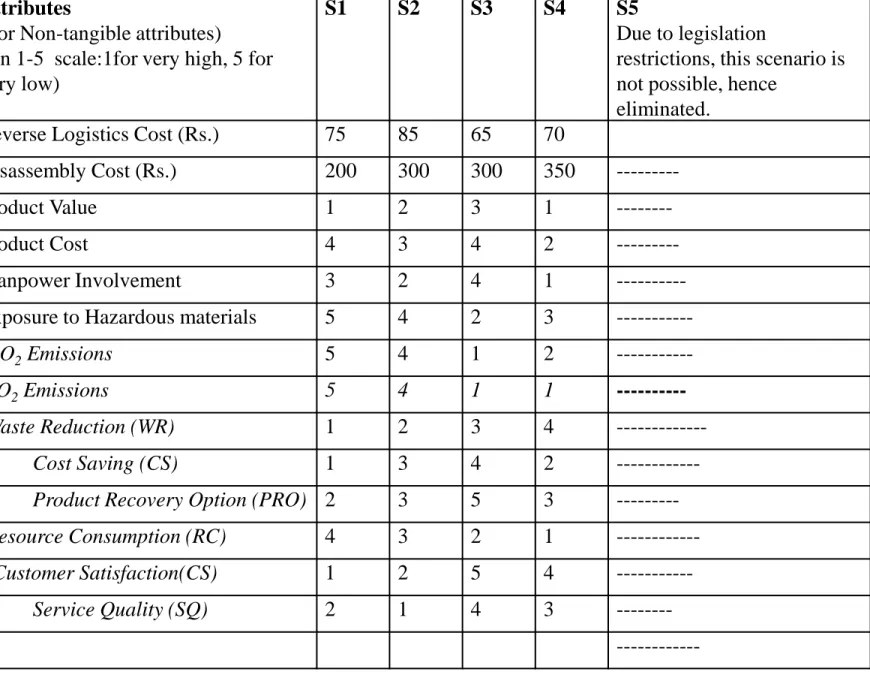
Table Data Collection for the EOL Scenario Evaluation for Mobile Phones
Attributes
(For Non-tangible attributes)
: on 1-5 scale:1for very high, 5 for very low)
S1 S2 S3 S4 S5
Due to legislation
restrictions, this scenario is not possible, hence
eliminated. Reverse Logistics Cost (Rs.) 75 85 65 70
Disassembly Cost (Rs.) 200 300 300 350 ---Product Value 1 2 3 1 ---Product Cost 4 3 4 2 ---Manpower Involvement 3 2 4 1 ---Exposure to Hazardous materials 5 4 2 3
---CO2 Emissions 5 4 1 2
---SO2 Emissions 5 4 1 1
---Waste Reduction (WR) 1 2 3 4
---Cost Saving (CS) 1 3 4 2
---Product Recovery Option (PRO) 2 3 5 3
---Resource Consumption (RC) 4 3 2 1
---Customer Satisfaction(CS) 1 2 5 4
---Service Quality (SQ) 2 1 4 3
---
ANP ANALYSIS AND SOLUTION METHODOLOGY
•
Step 1:
Model construction and problem structuring
•
Steps 2:
Pair wise comparisons matrices between
component/ levels
•
Steps
-3 Pair wise comparison matrices of
interdependencies
•
Step-4
Super matrix formulation and analysis
•
Step-5
Pair wise comparison for different alternatives
•
Step-6
: Selection of best alternative
•
Step –7
Relative importance weight for the relationship
The matrix showing pair-wise comparison of determinants
along with the e-vectors of these determinants
DETERMINENTS
ECBP
LF
OP
OLC/LF
E-VECTER
ECBP
1
1/5
1/5
1/4
0.0656
LF
5
1
1
2
0.3638
OP
5
1
1
2
0.3638
OLC/LF
4
1/2
1/2
1
0.2069
CR= 0.011
Pair wise Comparison for dimensions under Environmentally Conscious Business
Practices (ECBP)
ECBP
FP
SP
GBP
IOP
E-VECTER
FP
1
2
3
1
0.3507
SP
½
1
2
1/2
0.1892
GBP
1/3
1/2
1
1/3
0.1093
IOP
1
2
3
1
0.3507
CR= 0.0039
Pair-wise Comparison for Green Business Perspective under
Environmentally Conscious Business Practices(ECBP) determinant
ECBP/GBP
RC
SO2
CO2
WR
E-VECTER
RC
1
3
5
1
0.3935
SO2
1/3
1
2
1/3
0.1376
CO2
1/5
1/2
1
1/5
0.0754
WS
1
3
5
1
0.3935
CR=0.0016
•
Table Reverse Logistics overall weighted Index
•
It is observed from Table that
EOL-S1 (Repair, Refurbishing & Reuse (RRR) of
Mobile Phone )
is the most-suited alternative for the reverse logistics
operations for used mobile phones for the mobile
manufacturing/remanufacturing industries. Alternatives EOL-S4, EOL-S2 and
EOL-S3 in sequence follow alternative EOL-S1 respectively.
•
It is observed from Table that
legislative factors
and
operating performance
factors plays a major role in the conduct of reverse logistics operations for
used mobile phones.
•
It is further observed from the second column of this table that EOL-S1
(0.1078929) performs business in the more environmentally conscious RL
operation as compared to S2 (0.0871902), S3 (0.038042) and
EOL-Logistics overall weighted Index
Alternatives ECBP LF OP OLC/LF LOW I Normalized
values for LOW I
Weights 0.0656 0.3638 0.3638 0.2069
EOL-S1 0.1078929 0.1981808 0.1030396 0.1078929 0.138985 0.3403
EOL-S2 0.0871902 0.1242377 0.0788480 0.0871902 0.097642 0.2391
EOL-S3 0.038042 0.067707 0.040589 0.038042 0.049765 0.1218
RESULTS AND CONCLUSIONS
•
The proposed methodology provides for simplification of a complex multi-criteria
decision-making problem.
•
It may also be used to quantify many subjective judgments, which are necessary to evaluate
different EOL mobile remanufacturing alternatives/strategies.
•
Another advantage of this methodology is that it not only supports group decision-making but
also enables us to document the various considerations in the process of decision making.
•
In this study, the results indicate that EOL Scenario 1 (Repair, Refurbishing & Reuse (RRR) of
Mobile Phone) is the best End-of-life remanufacturing strategy for mobile phones collected by
the case company.
•
This option may be attributed to its more environmentally conscious business practices (ECBP),
legislative factors, and organizational performance and operation life cycle/logistics focus
capabilities.
•
The option of EOL-S4 (Recycling of complete mobile phone for material recovery) in the framing
of environmentally conscious business practices (ECBP), legislative Factors and operation life
cycle/logistics focus capabilities policy also supports this result.
•
It is pertinent here to discuss the priority values of the dimensions, which influence this decision.
From Table 50 , it is observed that
financial perspective (0.3507) and internal operation
performance (0.3507)
is found to be equal and most important dimensions in the selection of an
EOL Scenario for used mobile phones. It is followed by social perspective SP (0.1892) and Green
business perspective (0.1093).
FUTURE SCOPE OF WORK
•
For future research, it would be worthwhile to implement the ANP model with a
decision maker or a set of decision makers. Such research endeavour could be used to
validate the effectiveness of the ANP model.
•
More importantly, managerial implications can be empirically derived regarding the
selection of best remanufacturing strategy/option for used mobile phones collected by
the concerned companies. Such research should include a comprehensive sensitivity
analysis to examine the significance of individual attributes to the selection decision.
•
It is also worthwhile to compare the proposed ANP approach with other evaluation
approaches. Here ANP approach illustrated in this paper has a few limitations as well.
•
For example, the model result efficiency is dependent on the inputs provided by the
reverse logistics manager of the particular industry segments. The possibility of bias of
the decision-maker towards any particular strategy/option cannot be ruled out while
applying this model.
•
Therefore, group decisions should be preferred in the pair-wise comparison.
Moreover, the formation of pair-wise comparison matrices is a time-consuming and
tedious task. Inconsistency and human error may also occur in calculating the
pair-wise comparison of matrices, which may give wrong results.
REFERENCES
1. Franke, C., B. Basdere, M. Ciupek, and S. Seliger; "Remanufacturing of Mobile Phones—Capacity, Program and Facility Adaptation Planning" Omega, 2004
2. Kaplan, R. S., & Norton, D. P. (1992). The balanced scorecard—Measures that drive performance. Harvard Business Review, 70(1), 71–79.
3. Directive 2002/96/EC of the European Parliament and of the council on waste electrical and electronic equipment (WEEE) of 27 January, 2003.
4. Westkämper E, Alting L, Arndt G. Life cycle management and assessment, approaches and visions towards sustainable manufacturing. Annals of the CIRP 2000; 49/2:501–26.
5. Fleischmann M. Quantitative models for reverse logistics. Berlin: Springer Verlag; 2001. p. 11–5. 6. Kharif O. Where recycled cell phones ring true. Business Week Online, 07-25-2002.
7. Marcussen CH. Mobile Phones, WAP and the Internet—The European Market and Usage Rates in a Global Perspective 2000–2003. http://www.crt.dk/uk/staff/chm/wap.htm, 11-25-2003.
8. Ba dere B, Chan K, Morrow R, Prasitnarit A, Seliger G, Skerlos S. Economic and environmental characteristics of global cellular telephone remanufacturing. In: Proceedings of the IEEE international symposium on electronics & environment, Boston, 2003.
9. Seliger G, Ba dere B, Ciupek M, Franke C. Remanufacturing of cellular phones. In: CIRP Seminar on Life Cycle Engineering, Copenhagen, 2003.
10. Seliger G, Ba dere B, Keil T, Rebafka U. Innovative processes and tools for disassembly. Annals of the CIRP 2002; 51/1: 37–40.
11. Kim HJ, Lee DH, Xirouchakis P, Züst R. Disassembly scheduling with multiple product types. Annals of CIRP 2003; 52/1:403–6.
12. Hentschel C, Seliger G, Zussman E. Grouping of used products for cellular recycling systems. Annals of the CIRP 1995; 41/1:11–4.
CONTINUE..
14. Saaty TL. The analytic hierarchy process. New York, NY: McGraw-Hill; 1980.
15. Saaty TL. Decision making with dependence and feedback: the analytic network process. Pittsburgh, PA: RWS Publications; 1996.
16. Sarkis J. Evaluating environmentally conscious business practices. European Journal of Operational Research 1998; 107:159–74.
17. Sarkis J. Manufacturing strategy and environmental consciousness. Technovation 1995; 15(2):79–97.
18. Thompson TJ. An analysis of third party logistics and implications for USAF logistics. Unpublished Masters Thesis, Air Force Institute of Technology/GTM/LAL/96S-15, September, Wright-Patterson Air Force Base, Ohio, 1996, submitted.
19. Thomas L. Saaty, the Analytic Hierarchy Process, RWS Publications, Pittsburg, 1990, pp. 184–192. 20. Thomas L. Saaty. Fundamentals of the Analytic Network Process. ISAHP Japan, 1999, pp. 12–14.
21. Saaty L. Thomas, Niemira P. Michael, An analytical network process model for financial-crisis forecasting, Int. J. Forecasting 20(2004) 573–587.
22. Saaty TL. Theory and applications of the analytic network process: decision making with benefits, opportunities, costs, and risks. USA: RWS Publications; 2005.
23. V. Ravi, Ravi Shankar, M.K. Tiwari (2005). Analyzing alternatives in reverse logistics for end-of-life
computers: ANP and balanced scorecard approach” Computers & Industrial Engineering 48 (2005) 327–356 24. Gopal Agarwal and Lokesh Vijayvargy (2012) Green Supplier Assessment in Environmentally Responsive Supply Chains through Analytical Network Process, proceedings of International multi-conference for engineers & computer scientists, Volume II, March 12-14, 2012, Hongkong.
25. Amini M, Retzalff-Roberts D, Bienstock C., 2005. Designing a reverse logistics operation for short cycle time repair services. International Journal of Production Economics. 96:367–80.