Early-Stage Technology Ventures in India:
Opportunities and Issues
by
Aparna Chennapragada
Bachelor of Technology in Computer Science, Indian Institute of Technology, Madras (1997) Master of Science in Computer Science, University of Texas, Austin, USA (1999)
Submitted to the System Design and Management Program in Partial Fulfillment of the Requirements for the Degree of Master Of Science In Engineering And Management
at the
Massachusetts Institute Of Technology May 2008
© 2008 Aparna Chennapragada. All rights reserved.
The author hereby grants to MIT permission to reproduce and to distribute publicly paper and electronic copies of this thesis document in whole or in part in any medium not known or hereafter created.
Signature of Author Certified by Accepted by MASACHU:ETS INST OF TEOCHNOLOGY
JUL
0 3 2008
M
LIBRARIES
S/ Apana Chennapragada System Design and Management ProgramMay 2008
Michael Cusumano Thesis Supervisor Sloan School of Management
kPatrick Hale
Director System Design and Management Program
Early-Stage Technology Ventures in India:
Opportunities and Issues
by
Aparna Chennapragada
Submitted to the System Design and Management Program in Partial Fulfillment of the Requirements for the Degree of
Master Of Science In Engineering And Management
ABSTRACT
High-technology Entrepreneurship has been a key driver of innovation and economic growth in the US. Aided by factors such as the success in IT and IT-enabled services industries and a booming economy, India has seen a sharp increase in activity in technology entrepreneurship. This thesis explored the opportunities and issues in building and growing technology startups in India. Money, market, manpower, and mentors were identified as the broad areas in which startups face challenges. The specific issues within these areas were analyzed from entrepreneurs' and investors' perspectives and potential solutions were recommended. While many of the issues faced by startups in India turned out to be similar to those faced by startups in the US, a few issues were found to be unique to India. The sources for data included in-depth interviews with participants in the Indian entrepreneurial ecosystem as well as existing research on entrepreneurship in US and India.
Thesis Advisor: Michael Cusumano
ACKNOWLEDGEMENTS
I would like to extend my gratitude to everyone who agreed to be interviewed for the thesis. This thesis could not have been possible without the interviewees' valuable time and rich perspectives. I would like to thank my advisor Professor Michael Cusumano for his advice and guidance throughout the process. I would also like to thank Sramana Mitra
for sharing her thoughts and helping me reach out to many of the interviewees.
I would like to thank Pat Hale, the director of the System Design and Management (SDM) program who has supported me in charting an academic path tailored to my professional goals and interests. I am grateful for the opportunity I have had, to learn from my professors and fellow students. In particular, I deeply admire and thank Professor David Simchi-Levi (MIT), Professor Paul Asquith (MIT) and Professor Felda Hardymon (HBS) for their passion for the subjects they taught and their love for teaching.
I would like to thank my friends from the SDM program and across MIT for enriching my experience the last two years. I would also like to thank my manager Dr. Ramesh Sitaraman and other colleagues at Akamai for their support and understanding while I juggled work and school.
I would like to express my deep gratitude to my family - my husband Charan for his love and understanding, my mother for never ever failing to believe in me, my sister and brother for their love and constant encouragement of their little sister. Finally, I thank God and my spiritual teachers for sustaining me in life.
Table of Contents
ABSTRACT ... 2 ACKNOWLEDGEMENTS ... 3 1. INTRODUCTION ... 6 2. APPROACH ... 8 M otivation ... 8 M ethodology ... 9 L im itations ... 13 3. ANALYSIS ... 14Fram ew ork for A nalysis ... ... 14
Explanation of Term s... ... 16
Application of Fram ew ork ... ... 17
4. ENTREPRENEURIAL LENS ... 18
5. INVESTOR LENS ... 34
6. CONCLUSION AND FUTURE WORK ... 55
APPENDIX A: INTERVIEW GUIDES... 62
Introduction Provided To Interviewees ... ... ... 62
Interview Guide For Entrepreneurs ... ... ... 64
Interview Guide For Investors ... 68
APPENDIX B: INTERVIEW EXCERPTS ... 73
APPENDIX C: RESOURCES FOR RESEARCH ... .... 118
List of Figures
Figure 1: 4M Fram ew ork ... 15
Figure 2: 4M Framework: Key Issues Through Entrepreneurial Lens ... 19
Figure 3: 4M Framework: Key Issues Through Investors Lens ... 35
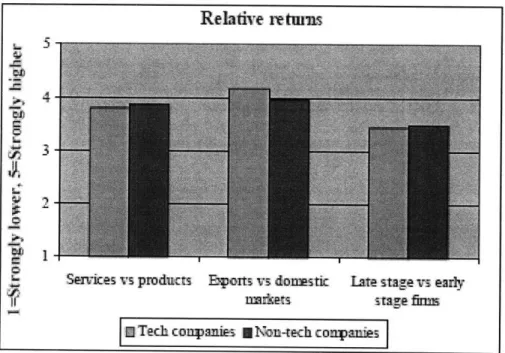
Figure 4: Relative Returns from Export versus Domestic Markets ... 47
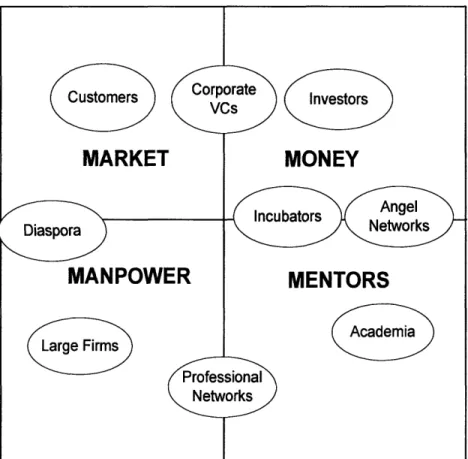
Figure 5: 4M Framework: Potential Resources ... ... 58
List of Tables
Table 1: Entrepreneurs/Startup Representation ... ... 12Table 2: Investor/Expert Representation ... ... 12
Table 3: US Venture Deals by Stage of Investment (2007)... ... 39
Table 4: Value of Indian Deals ($M) by Stage of Investment... 39
Table 5: Number of Early-stage Indian VC Deals by Stage of Investment... 40
1.
INTRODUCTION
Entrepreneurship has been a key driver of innovation and economic prosperity in the
United States. Countries across the world have begun to adopt this approach toward
economic growth. Over the last several years, India has taken active measures to
liberalize its economy, invigorating its private sector. In the last decade, India has
achieved tremendous success in IT and IT enabled services industries'. For this growth to
be sustainable, Indian firms need to expand beyond cost arbitrage and service delivery
into innovation and value creation. While innovation can and does occur within large
corporations, the biggest contributor to innovation-driven growth is a thriving
entrepreneurial environment.
The success of high-technology entrepreneurship in the US, particularly Silicon Valley
and the Route-128 area in Boston has been studied to understand the ingredients of such
an ecosystem and to identify recipes to replicate this success elsewhere in the country.
The key elements of an entrepreneurial system are entrepreneurs, venture capital firms, corporate and academic research institutions, professional service firms such as legal and
accounting firms.
When examining the potential for high-technology entrepreneurship in India, it can be seen that many elements are in place - large technology talent pool, relatively stable
capital. Other elements have more room for improvement - university-based innovation, intellectual property development etc.
This thesis is a step toward assessing the environment for high-technology
entrepreneurship in India. Questions such as -- How well do cross-border startups work?
What role do seed-stage investors, angels, and incubators play? What is the impact of
diaspora entrepreneurs and serial entrepreneurs? What business models have worked and
what have not? - can be better answered by examining the interaction between an
individual startup and the external environment, which is the focus of this thesis.
The rest of the document is organized as follows. Chapter 2 describes the motivation and
scope of the thesis and describes the research methodology and its limitations. Chapter 3
presents the framework used for analyzing the data. Chapter 4 and 5 examine the
framework from the perspective of the entrepreneur and the investor respectively, and
identify the key issues. Chapter 6 presents the conclusion and provides recommendations
for entrepreneurs and investors. The appendix contains the interview guide used for data
2. APPROACH
"Where most entrepreneurs fail is on the things they don 't know they don't know"
U Vinod Khosla
Motivation
The goal of the thesis is to understand the challenges and opportunities for an early-stage
technology venture based in India. While there is existing research on topics such as
environment for risk capital in India, policies to promote innovation, and studies of
entrepreneurs and small business owners across industries, this thesis is intended to build
on this broad understanding of Indian entrepreneurship by presenting the views of the
participants in that ecosystem such as entrepreneurs, investors, experts, academia and
professionals in the industry, using in-depth interviews.
The scope of the thesis is limited to observing an individual startup and its interaction
with the external environment and analyzing its implications for private sector players such as an entrepreneur, investor, or a professional in the industry. In analyzing the
challenges faced by a startup, the thesis focuses on the external issues - i.e. the
interaction between entrepreneurs and the external environment, specifically around the activities of selling, hiring, seeking advice, and raising capital. Internal issues such as product development processes and organizational challenges were not the focus of this study, for two reasons: 1) the internal issues have been observed to be similar to the
issues faced by startups in the US or other environments. 2) While internal issues can
largely be examined and worked out by an individual player in the system, addressing the
external issues requires understanding the perspectives of different players in the
environment, which this thesis can help identify and present.
The thesis does not cover peripheral issues such as the role of a strong university research
system or the role of public capital markets and the legal infrastructure -- issues that
involve concerted government action over a long horizon to bring about real change.
These are key factors in supporting or dissuading entrepreneurship in any country.
However, defining the scope to private sector challenges and specifically, interaction
between entrepreneurs and the other players such as investors and academia helped me
delve into insights and actionable recommendations for individual entrepreneurs, investors, professionals, and startups.
Methodologv
The approach consisted of two phases.
* Phase I (Review of Research)
This phase consisted of surveying existing literature on high-technology entrepreneurship in the US and in India, particularly the trends in venture capital, and the activity around innovation.
The primary resources used during this phase were academic reports and books on the
topics. Other resources for this phase include articles and blogs on innovation and Indian
entrepreneurship and venture capital activity, relevant academic courses, conferences and
informal discussions with faculty. (Details can be found in Appendix C).
The work during the first phase helped the author develop a broad understanding of the
ingredients of an entrepreneurial ecosystem and explore trends in entrepreneurship and venture capital in India.
* Phase II- Interviews
During this phase, the author examined the key issues for an individual startup interacting
with the external environment. Building on the knowledge from the first phase, the author
conducted in-depth interviews with individuals in the Indian entrepreneurial system.
o Interview Guide Design
Based on the first phase, the author identified the key areas to explore and prepared a detailed interview guide for each of entrepreneurs, investors, and experts.
For an entrepreneur, the topics identified were related to the entrepreneur's and company's background, the central issues faced by the startup when interacting with the external environment (raising capital, selling, hiring talent, seeking advice).
For an investor, the topics identified were related to the investor's and firm's
background, investment focus, the central issues faced by the investing firm when
assisting the startups (through deal sourcing, due diligence, deal structuring, and
portfolio-support and exit phases). (Complete interview guides are included in
Appendix A)
After updating the guide based on feedback from the advisor, the author
conducted a pilot of the interview guide with a couple of interviewees. Based on
the results, the guide was refined and the key questions were finalized with some
flexibility to dig deeper into specific areas where the interviewee could contribute
his/her experiences most.
o Interviewee Selection
Request for interviews were sent out via popular India and entrepreneurship
focused blog (www.sramanamitra.com) as well as offline channels and
professional networks. The selection of the interviewees was such that there was
representation from entrepreneurs (experienced and first-time, consumer and enterprise, domestic market and global market), investors (seed funds, traditional venture capital firm, corporate venture firm) and local experts (university faculty, incubators, leaders of entrepreneurial networking organizations) etc.
Over a period of three months, the author conducted one-on-one interviews with over twenty individuals -- entrepreneurs, investors, experts from academia and
and typically lasted one-to-two hours. A few of them were conducted via detailed
email responses to the questionnaire and phone follow-ups on specific questions.
After around twenty interviews, the author felt that there was convergence in the
themes and only marginal gains were seen from conducting more interviews.
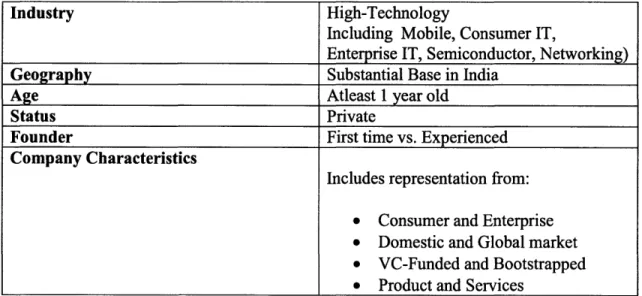
Table 1: Entrepreneurs/Startup Representation
Industry High-Technology
Including Mobile, Consumer IT,
Enterprise IT, Semiconductor, Networking) Geography Substantial Base in India
Age Atleast 1 year old
Status Private
Founder First time vs. Experienced
Company Characteristics
Includes representation from:
* Consumer and Enterprise * Domestic and Global market * VC-Funded and Bootstrapped * Product and Services
Table 2: Investor/Expert Representation
Investors Includes representation from:
* Domestic Indian Venture Capital Firm (i.e. India-focused fund) * Global Venture Capital Firm * Corporate Venture Capital Firm * Seed Funds
* Angel Network * Incubator programs
Experts * Academic Faculty in India and US * Incubator Program
Limitations
The decision to use in-depth interviews for data collection is appropriate for the goal of
gathering multiple and rich perspectives on a complex subject. However, the data does
not yield any statistically significant results that other data collection methods, e.g. large
sample of short quantitative surveys, could. Since the goal of this phase of the thesis was
to draw out the key trends, examine core issues, and identify potential recommendations, the interview method was conducive to collecting opinions and experiences of the
interviewees.
The interviewee selection is also influenced by the channels to which the author had
access to request for participation. There is also an unavoidable self-selection bias since
most of the respondents were already plugged into online resources for entrepreneurship
and were accessible via those channels. A more comprehensive effort involving multiple
organizations and channels may have yielded a larger and hence more balanced
3. ANALYSIS
Framework for Analysis
The thesis examined the challenges faced by a nascent startup in the Indian context, with a specific focus on the interaction between a nascent startup and the external
environment. The core activities through which an individual startup interacts with the
external entities are
-* Selling (to customers)
* Fund-raising (from investors) * Hiring (employees)
* Seeking advice (from mentors and peers)
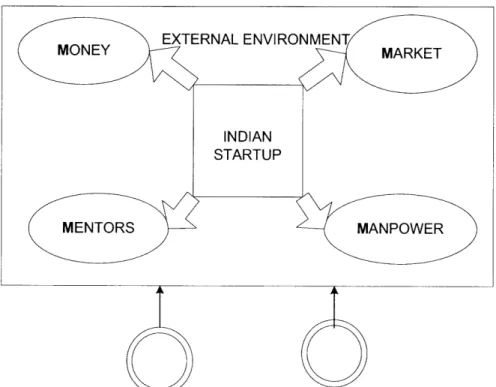
Accordingly, the findings from the interviews with entrepreneurs, investors, and experts were categorized into four major dimensions along which startups face challenges - Money, Market, Manpower, and Mentors. (Four Ms)
The challenges and issues along these four dimensions were then examined from two lenses -- that of an entrepreneur and an investor, since they are the two primary agents that can control the direction of the startup, benefit from its success and hence have a significant stake in removing these bottlenecks.
This chapter introduces the 4M framework used to present the key issues and the
subsequent chapters further examine the implications and potential solutions, from the
perspective of an entrepreneur and that of an investor.
ENTREPRENEURIAL LENS INVESTOR LENS
Explanation of Terms
As mentioned, the thesis focused on analyzing the key forces at play when forming
and growing a startup.
MONEY: This dimension encompasses all the issues and challenges related to
financing the formation and growth of a startup. It does not include other peripheral
financial aspects such as the state and health of public capital markets or the financial
services industry as customers etc.
MARKET: This dimension captures a collection of issues related to addressing and
capturing the market i.e. understanding customer needs, marketing products, selecting
and adapting to the right business models etc. Note that the term 'market' refers to the
product-market and not the financial market i.e., the term is used in the management/business sense and not in the finance/economics sense.
MANPOWER: This dimension represents the challenges related to human capital. The issues range from difficulties in finding the founding team, to retaining talent in a
competitive labor market, to the transferability of employee skills from successful large companies to future startups.
MENTORS: This dimension represents challenges related to accessing professional connections, guidance, and advice from experienced mentors and peers in the environment. The importance of mentorship and role models has been studied in the
case of other entrepreneurial hotbeds such as Silicon Valley and the Route 128 area in
Boston and is acknowledged to be an integral part of nurturing a startup ecosystem.
Application
of
Framework
When attempting to understand a broad area such as the Indian entrepreneurial
ecosystem, several complex issues interact to produce the challenges observed. Hence, this framework offers an abstraction of the broad themes around which the issues seem
to coalesce. As such, the framework is not meant to be comprehensive but a useful
tool to understand the major difficulties faced by the startup and identify potential
solutions and strategies that can correspondingly make a significant impact.
The next two chapters will use the framework to present detailed findings and
4. ENTREPRENEURIAL LENS
"Entrepreneurs do more than anyone thinks possible, with less than anyone thinks
possible. " - John Doerr, Venture Capitalist
The previous chapter introduced the 4M framework that categorizes the key challenges in
building and growing an Indian startup. This chapter examines the framework through
the Entrepreneurial Lens - identifying they key bottlenecks, their implications and
possible solutions, from the perspective of an entrepreneur
Recall that the framework identifies four key factors at play for a startup interacting with
the external environment - Money, Market, Manpower and Mentors.
The rest of the chapter elaborates on the issues along these dimensions. The findings
were synthesized from interviews with entrepreneurs and early employees in Indian
startups and from surveying existing resources on Indian entrepreneurs.
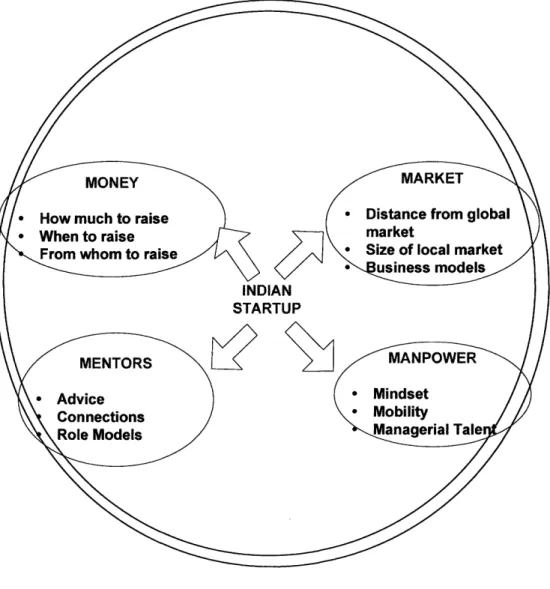
The following figure highlights the key issues along the four forces, as viewed through
Figure 2: 4M Framework: Key Issues Through Entrepreneurial Lens
Money
For an entrepreneur, especially a first-time founder, raising capital from investors is
interviewed felt that fund-raising posed many questions around - how much, when and
from whom to raise money.
* How much money to raise?
As interviewees pointed out, venture money is a crucial step for an entrepreneur and
should not be done lightly. Raising too much capital at a very early stage often masks
the underlying issues (wrong market, poor or indefensible product ideas, or an
ineffective management team). In addition, raising a large amount of capital at an
early stage (and hence at a low valuation), forces the entrepreneur to significantly
dilute his or her ownership in the company. It is ideal to tie the amount of capital to
that required to reach a specific product and customer milestone in the startups'
roadmap.
* When to raise money?
As Sushanto Mitra, the Chief Executive Officer of Society for Innovation and
Entrepreneurship (SINE) an incubator program, observed, even though there is an
abundance of private equity available in the market over all, there is a dearth of
capital at a specific stage of a startup.
At the earliest stage, startup founders have resources such as personal loans and
savings, friends and family or bank loans for the small amount of capital required to
kick off the venture. A relatively later stage startup looking to expand the operations
capital firms in the market. However, startups in between these two stages have few
venues to raise money today.
Capital needs in this range have traditionally been served by angel groups and seed
and early-stage funds in a mature venture capital market such as the US but have yet
to thrive in number and accessibility in the Indian environment. The recent past has
however seen the growth of organizations such as the Indian Angel Network, Mumbai Angels, and seed-stage venture funds such as Erasmic fund, Venture East
and Seed Fund.
Padmaja Ruparel, the executive director of Indian Angel Network (IAN) explained
that startups at the seed stage require a combination of capital as well as mentorship.
While professional organizations such as The Indus Entrepreneurs (TiE) or the
National Entrepreneurs Network (NEN) offer platforms for networking and
mentorship, they are not involved in providing capital. On the other hand, a majority
of the Indian VC firms can provide ample capital but tend toward later-stage deals
and relatively lesser mentorship across their portfolio.
* From whom to raise money?
While interviewees were divided (and presumably biased by their personal fund-raising experience) about the specific investors to approach, there were a few common themes that emerged during the discussions. A key suggestion echoed by several entrepreneurs was to choose an investing source that offers "more than just money".
As Kumar from Vignani, a high-end engineering services startup, noted, this is
particularly important for Indian startups attempting to target a global market and thus
benefiting from connections to key customers and vendors. A well-connected investor
(such as a corporate venture capital firm or a global VC firm with a strong track
record and connections via operating partners or previous portfolio companies)
Entrepreneurs also emphasized that a fund-raising event is as much strategic as it is
financial. Investment from a reputed source can be used as a signal of the credibility
of the firm with its customers, vendors, partners, and even potential employees.
Market
Another key force the entrepreneur has to reckon with is the nature and attractiveness of
the market his or her startup addresses. When discussing the role of the market in the
success of a startup, interviewees pointed to several challenges (and a few opportunities)
encompassing activities such as accessing and acquiring customers, finding the right
business models and avoiding the wrong ones, relative strengths and weaknesses of
market segments within the technology industry.
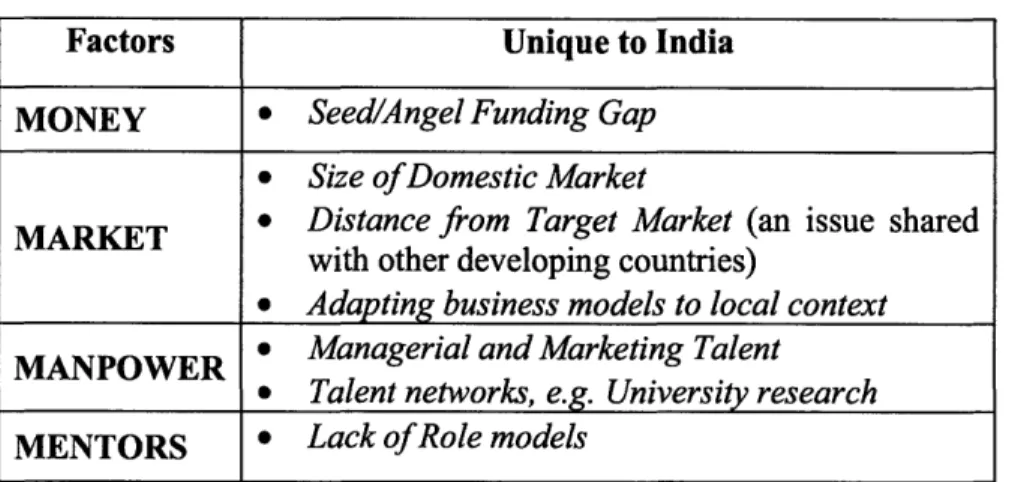
The key issues that emerged through the conversations were - distance from the global
market, the small size of the domestic market, and the importance of adapting business
models to the Indian context (e.g. infusing online business models with offline
e Distance from Global Market
Successful startups need to 1) target large and growing markets and 2) listen carefully
to the customers. Indian technology startups targeting the global or the US market
have a large and attractive market to target but are too far away from the customer.
This is observed to be a worse problem for consumer-facing technology startups than
for business-to-business technology startups since the latter often deal with relatively
more standard requirements and practices.
As Anand Deshpande, founder of an outsourced product development firm
observed
-Especially for companies targeting the global market, it is vital for the team to understand the nuances of product marketing - pricing, promotion, channel
strategy, product line extensions etc. Many rookie entrepreneurs make the mistake of starting with cool technology and failing to evolve to the essential question of what the market for the product is and how it can be sold. This is a problem even for US startups with ample access to the market but it gets much worse when the
product team is in India and attempting to target a remote market.
Indian startups have attempted to work around this "Distance from Market" issue
o Kitchen - Restaurant
As Professor Sadagopan (Faculty, IIIT, Bangalore) terms this approach, the
'kitchen-restaurant' model is one that has the product development carried out in
India while the core business operations of the startup are close to the market (e.g.
in the US). While this model can result in better access to customers through the
business development outfit and cost savings through the outsourced product
development operations, it creates two problems
-i) In the early stage of a startup, this model may impose very high coordination
costs and affect the products' time-to-market ii) Even if this model allows an
Indian startup to successfully access the target market, much of the learning may
remain in the remote location and not transferred to the Indian context.
o Start Local, Expand Global
Some other startups (Tejas networks, an Indian telecommunication equipment
startup, for example) have adopted an approach of starting out addressing the
local market and building on that success to expand to other emerging markets
and eventually the global market. This approach has the advantage of using the access to the local market to improve the product and achieve scale. Building on the success in the domestic market, the startup can expand the product line and set up operations closer to the global market.
This advantage is however restricted to those startups that can tap into markets
global market. This can also lead to an unexpected benefit of optimizing product
development for a more-constrained, more-demanding, and cost-conscious local
market and leveraging that as an advantage when competing with global players
in the overseas market.
o Stay Local, Target Global
Other startups have chosen to remain local but address the global market from
within the Indian operations. While this approach runs the risk of running blind
without the ability to access the market and understand customer needs in context,
it can work effectively in a couple of scenarios -- i) the startup targets a
well-understood and well-established (and hence possibly low-margin) market ii) the
startup is a whitespace opportunity and is focused on building specific
product/features. The company could then be a target for acquisition by a large
global firm that has the ability to market and distribute the product. (An approach
that has worked very well in commercializing Israeli R&D)
* Size of the Domestic Market
While startups targeting the domestic Indian market have the advantage of being
close to the customer, the market itself in many cases is small. Barring market
segments such as telecommunication equipment and niche consumer Internet
properties, there are strong underlying barriers such as the relatively slow uptick in
promising because of the huge install base is still limited by the carrier-controlled
business models leaving little room for innovation by independent startups.
An entrepreneur targeting the domestic market thus has to evaluate the timing of the
startup in the context of the macro-level factors such as technology adoption and plan
the evolution of the company accordingly (e.g. the entrepreneur focuses on a niche
consumer Internet transactional website but actively supplements an advertising
revenue model with other short-term revenue streams)
* Bricks-and-Clicks Business Models
There have been many instances of Indian startups taking a business that was proven
successful in a developed economy and transplanting it within the Indian context.
(For example, Baazee.com was an online auction market place modeled after and
eventually acquired by eBay). The process has usually required an adaptation of the
business model and operation to the Indian context, particularly in adding an
offline/physical equivalent of a technology-enabled or automated product or service.
Paraphrasing Pravin Gandhi, a partner in Seed Fund, bricks-and-clicks business
models have evolved to be more successful than pure online plays. For example, many of the consumer Internet websites that started out as purely online ventures
have supplemented their businesses with offline features or substitutes and achieved
greater user adoption and success. This is partly because of the relatively low comfort
level with purely online transactions, partly because of the labor advantage and the
Manpower
Nearly all the entrepreneurs interviewed have underscored that hiring talent is often the
biggest challenge in growing a startup in the Indian context. Some of the key contributing
factors that emerged during the discussions were - mindset of risk-aversion, high degree
of labor mobility and a dearth of managerial talent.
* Mindset
Successful entrepreneurial environments such as Silicon Valley are typically
characterized by an absence of stigma attached to honest failure. It has been observed
that entrepreneurs are measured by what they are currently doing, not by what they
did in the past, whether their previous venture was a success or a failure. The stigma
associated with failure is depersonalized. 3
Entrepreneurs interviewed observed that technology professionals are still averse to
risk-taking in India. A few maintained that the mindset was not necessarily due to any
deep societal conditioning but shaped by factors like the lack of safety net against
failure, when compared to a developed economy such as the US (with its social
security system and cultural acceptance of risk-taking and failure). To an extent, this is changing, as there are more success stories and recent examples of entrepreneurs
* Mobility
Given the booming economy and the attractive compensation packages offered by the
large multi-national companies and local IT services giants, professionals in
technology industry have enjoyed high degree of choice and mobility. However, some of the startups have found that they can counter the attraction of larger pay
packages in giant companies, by working to provide a more attractive work
environment - work that is more challenging, ownership, and camaraderie.
Deap Ubhi, Founder of Burrp, a consumer Internet company noted that - Hiring has
been a major challenge in this country, especially on the engineering side. Unfortunately, this country is not the burgeoning bank of engineering talent that one might expect. The main "perk" that resources are starving for in India is a positive work culture and environment where they do not always feel like subordinates. We all work as peers here, and although people inherently understand and respect the hierarchy, we are all friends and intellectual equals in the company. Work accountability is highly performance based, so ifpeople want to work from home one day a week, we do not care. We don't track vacation days, etc. - because all that
matters is that you 're performing at a very high level, that you are execution oriented and hands-on, no matter what your position, and that you're generally gelling and getting along with everyone else. When any of those things erode, it is usually time foryou to leave
* Managerial Talent
Entrepreneurs also have found that it is difficult to find and attract managerial talent, particularly those that can bring skills in high-tech product development and product
marketing. Some of this difficulty is mitigated by the increase in the number of US
diaspora returnees with relevant experience. Silicon Valley owes part of its success to
the availability of experienced professionals moving from across companies and
transferring key domain expertise and managerial abilities (needs citation). Given
such importance of senior and middle management in growing a startup, the
availability of managerial and functional talent will continue to be an important factor
in determining the successful growth of the entrepreneurial ecosystem in India.
Mentors
Entrepreneurs, especially first-timers, gain much from having access to experienced executives, academic experts and professionals, either as informal advisors or as members of a formal board. From conversations with the entrepreneurs, three primary modes of mentorship emerged as beneficial to the growth of the startup - advice, connections and role models.
* Advice
Entrepreneurs often have to make key decisions under uncertainty and insufficient information. An active board of advisors or informal mentors can play a crucial role in offering strategic and tactical advice that influences the growth of the startup. Depending on the origins of the startup and its stage of growth, the advisory role
could be informal or formal and can be served by different sources - e.g. a startup
seeded in a university incubator program can greatly benefit from the advice and
support from the incubator executives and university faculty. A later stage startup can
often rely on its investors and the advisory board for ongoing advice. Startups can
also seek advisory help from industry executives.
Entrepreneurs can use networks such as TiE (The Indus Entrepreneurs), business plan
contests and events such as HeadStart and Proto to seek adhoc advice from potential
investors and experts but will need to establish a more structured relationship with a
chosen set of advisors for longer-term support.
Consequently, an issue that startups seem to wrestle with is how and when to put
together a formal board of directors and advisors. There are clear benefits to having a
strong board early on in the process but there are downsides to spending time and
effort on putting together the board rather than the product. Some of the entrepreneurs
cautioned that if the incentives are not aligned and the board members are not vested
in the startup, it could be a costly distraction especially at an early-stage startup.
As Anand Deshpande from Persistent systems noted - I even used the initial
customers as mentors. The company has a formal board of directors, which is invaluable for corporate governance and strategic advice. I recommend putting together a formal board after the startup reaches a certain scale and size (50 people).
* Connections
Another key benefit startups gain by interacting with mentors is connections - to
potential customers, employees, investors, and partners. Entrepreneurs need to
proactively seek mentors that can help establish connections. These resources can
range from individuals such as motivated local entrepreneurs, established industry
executives, and US diaspora entrepreneurs to institutions such as incubators, angel
associations, venture capital firms, professional services firms, and non-profit
entrepreneurial organizations.
Successful entrepreneurs and industry executives are good sources who can help
the startups establish connections with relevant constituents, especially target
customers. However, as Aditya Mishra, an active member of local
entrepreneurship organizations commented -- It is difficult to find such mentors,
partly because there are so few successful entrepreneurs/executives to begin with and then you need to find willing and motivated ones, among these few. Quasi investors are few in number and US-based angels not looking at Indian market closely yet.
Angel networks such as Indian Angel Network or business incubators such as the one administered by IIT Bombay SINE (Society for Innovation and Entrepreneurship) can help their member startups using the umbrella organization's partnerships with large technology companies, connections to investors as well as industry executives.
Startups funded by corporate venture capital firms (or global venture capital firms
with track record and connections) can potentially benefit from their investors' access
to successful companies and executives.
In Silicon Valley, Professional services firms such as law firms have played a strong
role in establishing connections between startups and potential investors and key
executive hires in some cases4. While such a support system has yet to evolve in
India, a well-established legal and professional services community will be an
integral part of the ecosystem and can be a great resource for deal-making, counseling, and connecting startups with other players in the system.
Entrepreneurs with rich professional networks in the US (Silicon Valley in particular)
find those networks valuable in connecting with key customers and potential partners, particularly if the startups target global markets.
* Role Models
The presence of role models is an intangible but vital resource that startups benefit
from. In established entrepreneurial regions such as Silicon Valley and the Boston
area, the importance of role models has been studied and recognized as a key
ingredient in the success of the startups.
As Professor Ed Roberts from MIT observes in his book, Entrepreneurs in High
Technology: Lessons from MIT and Beyond -- A critical influence on
entrepreneurship in Greater Boston is the effect of "positive feedback" arising from the early role models and successes. Entrepreneurship, especially when successful,
begets more entrepreneurship. Schumpeter observed -- "The greater the number of
people who have already successfully founded new businesses, the less difficult it becomes to act as an entrepreneur. It is a matter of experience that successes in this sphere, as in all others, draw an ever-increasing number of people in their wake" (1936, page 198).
In the Indian context, the current lack of role models can largely be explained by the
fact that the startup activity has only begun and it is going to take several years for a
generation of successful entrepreneurs to emerge and serve as inspiration for the
5. INVESTOR LENS
In this business ifyou are good, you are right six times out often. You are never going to be right nine times out often.
U Peter Lynch, Investor
Chapter 3 introduced the 4M framework to identify the key forces acting on a startup
interacting with the external environment. Chapter 4 examined the issues and
implications from the entrepreneur's perspective. This chapter examines the issues and
implications from the investor's perspective. The observations are drawn from interviews
with investors and experts playing an active part in the Indian ecosystem, as well as
existing studies on the environment for venture capital in India.
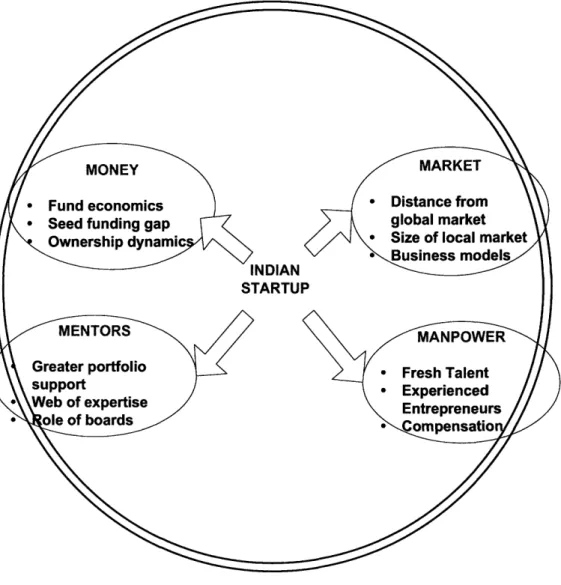
The following figure highlights the key issues along the four forces, as viewed through
* Fund economics * Seed funding gap
~ Ownership dynami
STARTUP
Figure 3: 4M Framework: Key Issues Through Investors Lens
Money
Among the four factors in the framework, money is the one directly tied to an investor's
function and role in the entrepreneurial ecosystem. As such, much of the analysis from
with the interest and ability to address bottlenecks related to raising capital. In the context
of financing startups, the term investors largely refers to the most common source of
capital -- venture capital firms, although startups often take advantage of other sources of
capital such as individual investors, personal funds, banks, government-sponsored
financing schemes, university-based funds etc.
A brief recap of the operation of a VC firm is helpful in noting the incentives and
motivations of the investors: Venture capital firms are typically organized as
partnerships. Limited partners such as institutions (pension funds, family offices) invest
pools of money into these firms. The general partners within the VC firm are
compensated two ways - management fees as a percentage of the fund raised, and a carry
i.e. a percentage of the returns earned from investing the fund. Typically, VCs provide
the first professional round of financing toward product development. Often, funds invest
in subsequent rounds of financing geared more toward expanding operations. They may
also occasionally put in seed money to prove an entrepreneur's idea and vet the viability of the venture. Firms vary on the relative weight they place on seed, early-stage, and late-stage financing (where seed, early-late-stage and late-late-stage venture financing phases are defined by a few factors -- the size of the funding round, the development stage of the
startup, the valuation etc.5
Interviewees have pointed out three key issues related to capital - fund economics that stack against early-stage investing in India, the funding gap in the seed/angel rounds, and entrepreneurs' views on equity ownership.
* Fund Economics
Interviewees have pointed out that many of the VC firms in India today have in fact not
been operating as venture capital firms in the traditional sense. Instead, they have been
focused on later-stage private equity investments as well as non-technology-based ones
e.g. retail/services etc. Entrepreneurs observed that Indian VCs are seen as passive
investors unwilling to take the risks involved in early-stage technology investing.
As Alok Mittal from Canaan Partners noted -- Venture financing is a relatively recent
phenomenon. The model and investment parameters are not yet understood. Hence, it is a matter of time requiring patience and the process can get accelerated only to a certain extent.
On examining the reasons for this situation, three points are worth noting.
One - Although VC firms are often expected to make heavy investments in the startup
phase, in reality, even in established VC industries such as in the US, VC investment has
always skewed toward the later-stage (i.e. funding existing companies that have built a
product and acquired a few initial customers).6
Two - Early-stage technology investing in India is riskier because of additional factors such as less entrepreneurial history, less developed local market, relatively low support for intellectual property and research-backed innovation etc.
Three - Limited partners in most of the venture capital firms targeting India are US-based institutions such as pension funds and university endowment funds. These limited partners may find that the absolute dollar returns from early-stage investments (higher
risk, lesser capital, longer time to exit) are not as attractive as traditional private equity
investments (with lower risk and more capital put to work and faster exits). This edge in
performance could be important for a relatively new VC fund trying to establish its
reputation and a strong initial track record in the market.
Given these factors, it is not surprising that the majority of investments made by venture
capital firms in India today skew toward non-technology sectors and later stages. Left
unaddressed, however, this trend can cause some problems. In the long-term, investors
may overlook a potentially attractive sector such as high-tech, which could exploit the
local technology talent pool. In addition, a tough funding environment in the early-stage
dries up the pipeline for later stage activity and stunts the growth of a healthy local
technology industry.
* Seed Funding Gap
Another issue that affects the quality and quantity of deal flow for early-stage venture
capital is the dearth of funding options at the prior stages of development of a venture. In the US, private investors (individual VCs, angel investors), seed funds, university incubator programs provide the necessary financial and strategic support for the initial stages of a startup and thus create a healthy pipeline of deal flow for subsequent financing by venture capital firms.
Seed-stage funding mechanisms can help grow an entrepreneur's idea beyond a
conceptual stage to a working prototype, and to help the entrepreneur(s) build out the
management team and develop a business plan for the venture. Seed-stage financing
institutions can also support VC's by providing access to high quality deal flow and
ongoing operational support and advice to the startups.
Interviewees have pointed out that the infrastructure for seed-stage investing is slow to
fall in place. It should be pointed out that this is an issue even in an established investing
environment such as the US. For example, from the investment distribution across the
different stages in the year 2007 shown below, a majority of the deals funded are skewed
toward expansion and later-stage financing.
Table 3: US Venture Deals by Stage of Investment (2007)
2007 Deals Seed Stage Early Stage Expansion Stage Late Stage
% in Deal Volume 11% 26% 32% 31%
% in Dollars 4% 18% 27% 41%
Source: MoneyTree Report by PricewaterhouseCoopers and the US National Venture Capital Association
The situation is similar if not worse in India. Even though there has been an increase in
the overall private equity investments flowing into the country, it is mostly geared toward
later-stage deals as seen in the figure below.
Year 2000 2001 2002 2003 2004 2005 2006
(Q1-Q2)
Early and Mid Stage VC 342 78 81 48 150 103 86
Late Stage and PIPEs 819 859 510 422 1500 2097 3394
Source: Evalueserve, Indian Venture Capital Association (IVCA) and Venture Intelligence India
Further, even with the early-stage investments, seed-stage investment by venture capital
firms has been very low, as seen in the figure below.
Table 5: Number of Early-stage Indian VC Deals by Stage of Investment
Source: Evalueserve, Indian Venture Capital Association (IVCA) and Venture Intelligence India
To address this seed-funding gap, a couple of approaches have emerged -- Angel
Angel investing in general in India has been sporadic, unorganized, and particularly
so in technology investing. This is changing with more organized effort such as Indian
Angel Network (formerly known as Band of Angels), Mumbai Angel network etc.
As Padmaja Ruparel, the executive director of the Indian Angel Network observed,
Angel investing is both old and new. There have been instances of rich individual businessmen who invested their personal money into other small businesses but the
current wave of angel investing is more organized and more focused on technology-driven opportunities. There are an increasing number of angels who are looking at private investing as an asset class to and support organized and a wider deal flow (versus investing in the few entrepreneurs who they knew personally), resulting in a new class of high-risk high-gain investment and grouping together to hedge the risks.
By offering mentorship, access to the network of industry executives and
entrepreneurs, angel networks help bridge the gap between the idea stage and a fully
formed venture ready to be funded by a venture capital firm.
Another recent trend is the emergence of India-based seed funds such as Seed Fund, Erasmic Fund, Mentor Partners, and global firms such as Tandem Entrepreneurs, who
provide mentorship as well as financial support for startups.
As Professor Ed Roberts notes in Entrepreneurs in High-Technology, Seed or zero
stage funds help put together the startups, working closely with the founders to round out their team, more sharply define their business objectives, and help develop a
completed business plan. Seed funds often provide more value in advice and "sleeves rolled up " assistance than in the capital itself
Thus, the partners in such funds require a unique combination of skills, typically prior
experience as entrepreneurs and informal financiers and advisors of startups, along
with investment acumen. The partners in such funds tend to be motivated by their
interest in advising and supporting ventures and long-term monetary payoffs, since
any ongoing compensation from asset management is much less than what can be
earned managing larger VC funds. The limited partners in seed funds in India have
typically been high net-worth individuals, larger VC firms, or global technology
companies.
As Aditya Mishra, an active member in the local entrepreneurship network observed
--One particular class of limited partners interested in investing in seed funds for strategic reasons along with financial returns are large US technology companies such as Motorola, Google, IBM etc. These firms are looking to get into the Indian market and gain early and inexpensive access to the Indian startup ecosystem.
* Ownership Dynamics
Another key issue that investors have pointed out is the resistance of entrepreneurs to relinquishing control and ownership in their venture. Entrepreneurs, especially first-timers, are very wary of giving up a significant equity stake for the relatively small
terms enforcing control rights and triggers for various possible scenarios. This often puts
the entrepreneurs in conflict with the investors during the process of structuring the deal.
Investors feel that this is a case of educating the entrepreneur on i) the significant benefits
of the resources bought in exchange for the equity (capital, connections, credibility, and
counseling) and ii) the tremendous risks undertaken by the investors. In the book The
Money of Invention, the authors point out the four key risk factors that force investors to
demand a high premium for their capital, along with a complex set of terms to protect
their rights: uncertainty about the future, information gap, soft assets, and market
conditions.
Uncertainty about the future implies that the startup can produce a range of possible
outcomes, from complete failure to success. Startups face uncertainty about the
technology feasibility, market potential, and competitive responses etc., all of which
affect the financing decisions as well as the riskiness of the venture. Since entrepreneurs
in their optimism may overlook or underestimate the risks and potential pitfalls in
executing their plan, investors need to account for this by structuring and staging the deal
appropriately.
Information gaps, that is, differences in what entrepreneurs and investors know about the
company's internal state, technology and market trends, can lead to conflicting views on
the risks involved and lead investors to impose additional constraints (either more corporate control or higher risk premium) to account for this gap.
Soft Assets such as patents, trademarks, or even human capital (key employees) are
harder to value and monetize than hard assets. Many of the innovation-driven startups are
heavy in the soft assets making the investors wary of overestimating the asset value of the
company.
Market conditions, both financial and product-market, can drastically affect the future of
the startup in unpredictable ways. In such cases, despite flawless execution by
entrepreneurs, investors may very well lose their investment. Investors use tools such as
staged financing or syndicating the investment with other VC firms, to account for such
outcomes.
While entrepreneurs have good reason to be skeptical about diluting their ownership or
raising too much capital too soon, investors need to promote better understanding of the
risks and reasoning involved in the deal structuring.
Market
When investors examine the issues around the product-market conditions, they see the
same issues that entrepreneurs see, as noted in the previous chapter on the entrepreneur's
perspective - distance from the global market, size of the local market, the need for
business models to adapt to the Indian context. What is different is the vantage point of
the investors (across a portfolio of companies, multiple sectors, longer-term trends)
opportunities). Hence, the implications and the actions for an investor are different from
those for an entrepreneur.
* Distance from the Global Market
As observed in the previous chapter, startups targeting the global market (more commonly, the US) have the opportunity to tap into a large and attractive market but face
the drawback of being too far away from the customers.
Investors screening such startup opportunities for investment have two choices. Some
investors, recognizing the disadvantages for startups trying to reach a distant market, have chosen to define their investment focus on local opportunities. Other investors have
chosen to invest in global startups and are actively exploring ways to help their portfolio
companies address this market-access issue.
As an entrepreneur interviewed pointed out, venture firms may be in a good position to
overcome this problem since they manage a portfolio of startups, many facing similar
issues.
Venture capital firms well-established in the US may be able to use their connections to
past and present portfolio companies, large customers, or parent companies (in case of corporate venture arms) to connect their Indian portfolio companies with the right
resources. For example, Intel Capital conducts an annual portfolio-wide CEO summit
executives, Intel executives and the portfolio company management. It also organizes
"Technology days", events to connect portfolio companies with potential customers and
technology partners worldwide.
Another approach is for the venture capital firm to explore ways to aggregate the
distribution and market access mechanisms across the subset of their portfolio of
companies that share the same needs. For example, connecting with large advertising
networks on behalf of multiple consumer-facing web startups in the portfolio or
temporarily using a common set of sales and distribution force in the US on behalf of
multiple enterprise software startups in the portfolio etc. A possible alternative suitable
for incubated startups is collaboration with counterpart incubators programs in the target
market.
* Size of the Local Market
Startups focusing on the domestic market do have the benefit of staying close to the
market and customers. However, in many of the high-technology sectors, e.g.
consumer-Internet, enterprise software, the local market is limited in size at this point and depends
on other complementary factors falling in place (notably broadband Internet access, PC
penetration, growth in local enterprise customers etc.) Investors therefore still largely
prefer export-oriented and services markets over domestic and product markets, as
r~
Figure 4: Relative Returns from Export versus Domestic Markets
Source: Investor Survey Data from "Accessing Early-stage Risk Capital in India", a report by Rafiq Dossani (Stanford) and Asawari Desai (TiE), 2006
Given the market realities, investors are better off defining and following a broad investment thesis that includes global opportunities. However, investors should stay involved in the domestic market, even if many of the opportunities are niche plays. The domestic consumer or enterprise technology market is small right now but the market can be potentially large over time. Investors can thus use their capital and time to gain insights into product development, identify effective business models, and establish a track record of attracting promising opportunities.
is
d
Serdces vs prodc p dmsic Iate st
OTecla wqsanis 3N--n:-ech congap es
tge3 fiU
* Business Models
Many of the startups, particularly in the consumer Internet space, are based on "concept
arbitrage" i.e. transplanting product and business models from the US. Often, the models
cannot be directly imported and need adaptation to the Indian context, a big one being
that most of the online portal businesses tend to do better with strong offline presence.
From the investor's perspective, this has implications on the amount of capital to invest, the execution risk involved in establishing physical distribution channels etc.
Additionally, while concept arbitrage plays are low-hanging fruit and good for increasing
the demand for Internet usage, innovation-driven opportunities that cater to the local
needs yield better financial and strategic results for investors.
Manpower
Interviewees have pointed out two broad issues they face, related to manpower
-identifying strong entrepreneurs, and helping their portfolio companies hire and retain
employee talent.
* Finding Founders
From an investor's perspective, the biggest challenge related to human capital is finding a
strong team of founders to invest. When deciding whether to invest in a deal, investors
encourage talented professionals to be entrepreneurs since a strong management team
significantly improves the odds of the success of the startup.
The desired background, abilities, and experience of the founders depend on the
particular startup and its sector of focus. Investors should tap into both fresh talent and
experienced entrepreneurs according to the opportunities being pursued.
o Fresh Talent
Many innovative startups in the US are born out of university-based talent
networks. Even in the absence of such a strong university and research-driven
commercial innovation, local universities are a source of young and ambitious
students. Investors should cultivate relationships with universities as well as
affiliated incubator programs and promote the idea of early-career
entrepreneurship. Even if most of the startups coming from the young
professionals and college graduates fail, they gain valuable experience and are
better prepared to be part of another growing startup.
o Experienced Entrepreneurs
Particularly given the challenges in the product-market and the few resources
available for entrepreneurs, investors prefer funding entrepreneurs with prior
experience in venture-backed startups. Experienced entrepreneurs understand the
uncertainties involved, the importance of time-to-market, the relevance of staged financing, stock compensation incentives etc. Experienced entrepreneurs also
typically tend to team up again with their past co-founders and thus begin the new
venture with a strong team in place. From the investor's perspective, this is a big
advantage since the team has a proven working relationship. (Moreover, multiple
founder teams are believed to generally perform far better than single founders
do7) Investors however note that there are very few such experienced
entrepreneurs, other than founders of IT services firms or US returnees with
startup experience.
Hiring and Retaining Employees
Investors interviewed have also echoed the concerns of the entrepreneurs that it is
difficult to hire and retain employees in a startup, because of an attitude of risk-aversion
and the availability of other more stable job opportunities with attractive compensation
and perks. Investors can address hiring issues using their network of connections and
employee motivation and retention using effective compensation structures.
o Hiring Managerial and Marketing Talent
Another issue noted by entrepreneurs and investors alike is the dearth of talent, particularly managerial experience in product development, and expertise in sales
and marketing.
As Sudheer Kuppam, the managing director of Intel Capital Asia-Pacific observed -- A key issue for our portfolio companies is the lack of a large group of
professional managers but their skills are not entirely applicable to an innovative early-stage product company.
Similarly, particularly for startups aiming at global market, there is a dearth of
professionals with product management, marketing and sales skills. Investors with
a strong network of connections can help their startups find the right talent. The
availability overall is slowly improving, with some experienced US diaspora
returning and local professionals gaining experience.
o Compensation
Technology professionals are hard to hire and retain in today's competitive labor
market. This is a worse problem for startups that are strapped for financial
resources and cannot afford to match cash-heavy compensation schemes of
multinational companies. Employee stock options are not valued much, since
there are no stock success stories yet. Traditional startup compensation (largely
equity, below-market salary) is often not adequate in retaining talent. To address
this, investors and founders could design compensation schemes to ratchet up the cash compensation but perhaps introduce a vesting schedule for salary increases
-essentially trying to ensure alignment of incentives to the long-term success of the company.