Faculty Publications, Department of Child,
Youth, and Family Studies
Child, Youth, and Family Studies, Department of
3-2020
Typically Developing Preschoolers’ Behavior Toward Peers with
Typically Developing Preschoolers’ Behavior Toward Peers with
Disabilities in Inclusive Classroom Contexts
Disabilities in Inclusive Classroom Contexts
Soo-Young Hong
Jungwon Eum
Yanjie Long
Chaorong Wu
Greg Welch
Follow this and additional works at: https://digitalcommons.unl.edu/famconfacpub
Part of the Developmental Psychology Commons, Family, Life Course, and Society Commons, Other
Psychology Commons, and the Other Sociology Commons
This Article is brought to you for free and open access by the Child, Youth, and Family Studies, Department of at DigitalCommons@University of Nebraska - Lincoln. It has been accepted for inclusion in Faculty Publications, Department of Child, Youth, and Family Studies by an authorized administrator of DigitalCommons@University of
Published in Journal of Early Intervention 42:1 (March 2020), pp. 49–68; doi: 10.1177/1053815119873071 Copyright © 2019 SAGE Publications. Used by permission.
First published September 21, 2019.
Typically Developing Preschoolers’ Behavior
Toward Peers with Disabilities in Inclusive
Classroom Contexts
Soo-Young Hong,
1Jungwon Eum,
1Yanjie Long,
1Chaorong Wu,
2and Greg Welch
31. University of Nebraska–Lincoln, Lincoln, Nebraska, USA 2. University of Iowa, Iowa City, Iowa, USA
3. University of Nebraska, Omaha, Nebraska, USA
Corresponding author – Soo-Young Hong, Department of Child, Youth and Family Studies, College of Education and Human Sciences, University of Nebraska–Lincoln, 241 Louise Pound Hall, Lincoln, NE 68588-0366, USA, email [email protected]
Abstract
This study aimed to investigate typically developing preschoolers’ behavior toward peers with dis-abilities in inclusive classrooms, focusing on the co-occurrence of the interactions between children with and without disabilities with various classroom contexts. Behaviors of 22 typically developing preschoolers were observed and coded on two different days in both indoor and outdoor classrooms during free play, small group activities, transitions, and meals/snack. Typically developing children interacted with peers with disabilities for a small amount of time; the interactions were significantly more likely in the outdoor classroom, in either child- or teacher-directed activities, and in play activ-ities. There was a lack of adults’ intentional scaffolding for social interactions between children with and without disabilities even when they were near the children. Activity contexts contribute to chil-dren’s social behavior, and teachers need more support and training with inclusive and collaborative practices.
Keywords: preschool, inclusion, descriptive observational methods, social development, teacher in-tervention, eco-behavioral analysis, classroom contexts
According to the social-cultural theory, learning and development are socially mediated (Vygotsky, 1978). Children learn concepts and skills through interactions with other mem-bers of society, especially with people more competent than themselves including parents, teachers, and peers. Without providing sufficient opportunities to interact with peers at similar ages, it would be hard to expect children to become successful members of society. During preschool years, children begin developing an awareness of others as well as their peer preferences and choices (Guralnick, Gottman, & Hammond, 1996). In addition, they start to form more solid and reciprocal friendships with peers (Hartup & Abecassis, 2002). Early social acceptance facilitates social competence, and social competence is frequently associated with success in school and society as well as in their peer relationships (Odom et al., 2006).
An increasing number of young children with disabilities attend an early childhood program with their typically developing peers (U.S. Department of Education, 2013). High-quality inclusive practices promote the physical and social integration of children with disabilities in classrooms and communities, so they can build a sense of community as a member of the society and form positive relationships with their typically developing peers (Guralnick, 2001; Koller, Le Pouesard, & Rummens, 2018; Odom, Buysse, & Soukakou, 2011). However, children with disabilities are not frequently socially included by their typ-ically developing peers in classroom interactions especially during the time when peer in-teractions were more likely to occur than adult-child inin-teractions, such as free play time (Brown, Odom, Li, & Zercher, 1999; Guralnick, 1999; Odom, Favazza, Brown, & Horn, 2000; Odom et al., 2004). The frequency of social interactions between children with and without disabilities was found to be very low.
Children with disabilities tended not to initiate social interactions with their counter-parts (Odom et al., 2006) and may rely on typically developing children to initiate social interactions. Thus, typically developing children’s behavior toward their peers with disa-bilities may be critical for actualizing the social integration between children with and without disabilities in inclusive preschool settings, which is one of the desired outcomes of preschool inclusion. Previous studies have examined the nature and the frequency of social participation of children with disabilities and typically developing children’s atti-tudes toward their peers with disabilities. However, few studies have examined typically developing children’s behaviors toward peers with disabilities or teachers’ role in the in-teractions in naturalistic classroom environments.
Contexts of Interactions between Children with and without Disabilities
Characteristics of both physical and social context variables are associated with the occur-rence of social interactions between typically developing children and children with disa-bilities (Odom et al., 2006). For example, children with disadisa-bilities who were engaged with one or more peers exhibited high-level peer play more frequently than those who engaged more with a teacher or with a group of peers with a teacher (Kontos, Moore, & Giorgetti, 1998). In addition, child-initiated activities promoted more social interactions among chil-dren than adult-initiated activities (Tsao et al., 2008). The structure of the activities was
also associated with the social and reciprocal engagement between children with and with-out disabilities in that small group activities were more likely to elicit mutual engagement between children with and without disabilities than any other structure (McCormick, Noonan, & Heck, 1998). In addition, in some studies, children with disabilities were more engaged in peer interactions when involved in sociodramatic play and games than in more functional or constructive activities (McCormick et al., 1998), whereas others found that more structured activities were positively associated with the frequency of interactions between children with and without disabilities compared with less structured and child-directed activities (DeKlyen & Odom, 1989). The nature and the type of the activity where children interact with one another seem to be an important factor to consider (Kontos, 1999; Kontos, Burchinal, Howes, Wisseh, & Galinsky, 2002).
Children’s awareness of the extent to which disability-related limitations influence class-room activities has also been associated with their decisions to include peers with disabil-ities in their play (Diamond & Tu, 2009; Gasser, Malti, & Buholzer, 2014). The physical demand embedded in different activity contexts affected preschool children’s decisions to include the peer with a disability in activities (e.g., Diamond, Hong, & Tu, 2008). More specifically, children without disabilities were more likely to include a hypothetical peer with a disability when the disability did not interfere or only minimally interfered with the activity (e.g., putting puzzle pieces together) than when it interfered with the proposed activity (e.g., kicking a ball). Therefore, one of the goals for this study is to investigate how classroom activity contexts are associated with typically developing children’s social inter-actions with peers with disabilities.
Teacher’s Scaffolding of Social Interactions
Teachers’ intentional scaffolding helps children with disabilities participate and engage in play and learning activities with peers (Berk & Winsler, 1995; Division for Early Child-hood/National Association for the Education of Young Children [DEC/NAEYC], 2009). However, research provides conflicting findings regarding the role of adults’ social prompts and intervention in the interactions between children with and without disabili-ties (Sontag, 1997). More specifically, children who tended to exhibit more high-level peer play were less likely to be with a teacher (Kontos et al., 1998; McCormick et al., 1998), which could be mistakenly interpreted that teacher presence or support did not promote interac-tions between typically developing children and children with disabilities. However, there is a possibility that teachers were more likely to initiate social interactions with a child with a disability when and if the child was not involved in social interactions with typically developing peers (Harper & McCluskey, 2003). This interpretation is consistent with the notion proposed by social-cultural theory that development and learning is socially medi-ated (Vygotsky, 1978) in that teachers may intentionally prompt social interactions among children when there are immediate opportunities to develop them or when children were not engaged in peer interactions (Goble et al., 2016). Therefore, another focus of the current study is the frequency of teacher support promoting social interactions between children with and without disabilities because the lack of interactions may have resulted from the
fact that adults present in the classroom either missed or misused the opportunities to pro-mote social interactions between the two groups of children (Giangreco, Edelman, Luiselli, & MacFarland, 1997). It is critical that adults facilitate peer interactions, so children with disabilities can meaningfully engage with peers without disabilities (Feldman & Matos, 2013). Thus, the role of teachers and other adults in the classroom also seems important in promoting the interactions between children with and without disabilities.
Current Study
Although young children have positive attitudes toward including peers with disabilities in their play and their attitudes may be associated with their actual behavior, this relation has not been systematically examined. In the current study, we investigated typically de-veloping children’s actual behavior and talk toward their peers with disabilities in natu-ralistic, inclusive classroom settings and examined what kinds of context variables, both indoor and outdoor, were associated with children’s interactions with peers with disabili-ties. Our research questions are as follows:
Research Question 1: How are classroom context variables associated with the likeli-hood of social interactions between children with and without disabilities in inclusive preschool settings?
Research Question 2: How often do typically developing children interact with their peers with disabilities? When the interaction occurs, what is the nature of their social behaviors?
Research Question 3: When a teacher is near both children with and without disabili-ties, how often does the teacher support the interaction between them?
Method
Participants
Twenty-two typically developing 4- and 5-year-old children (12 girls; mean age = 52.95 months; SD = 6.10) and their teachers and parents participated in this study. More than half of the children were European American (54.5%), and other ethnicities included Afri-can AmeriAfri-can (18.2%), Hispanic/Latino (4.5%), Asian/Asian AmeriAfri-can (9.1%), and multiple ethnicities (9.1%). Parents’ education levels included some college (59.1%), college degree (18.2%), high school diploma (13.6%), and master’s degree (4.5%). Parent’s ethnicity in-cluded European American (59.1%), African American (22.7%), Hispanic/Latino (9.1%), and Asian/Asian American (9.1%). Eight out of 22 participating children (36.4%) were from families living below the U.S. federal poverty level.
Participating children were enrolled in seven public preschool classrooms. The class-rooms were receiving funding from multiple sources including Head Start, Title I Pre-school, State funding, and special needs funding. Their mission was to help children and families become successful in a safe and inclusive environment and help everyone grow and learn together. Each class served many children from low-income families and four to
six children with at least one identified disability (i.e., 33 children with disabilities: four in three classrooms, five in three classrooms, and six in one classroom) including develop-mental delay, speech language impairment, and Other Health Impairments, and this num-ber reflects typical public early childhood classrooms in the area. Teachers reported the severity of disabilities on 22 children, and disability levels varied including mild (n = 8), moderate (n = 11), significant (n = 2), and severe (n = 1). The proportion of children with disabilities to those without disabilities was approximately 1 to 4, and the number of chil-dren who participated from each classroom varied with a minimum of 1 to a maximum of 5 (i.e., two from three classrooms, three from one classroom, four from two classrooms, and five from one classroom). In each classroom, at least four adults were present includ-ing a head teacher, a teacher aid or an assistant teacher, an itinerant special education teacher, and a student volunteer. A speech and language pathologist occasionally visited the classroom to work with a small group of children. The head teachers had at least a BS or BA degree in Inclusive Early Childhood Education or Elementary Education/Early Childhood and 3 to 15 years of early childhood teaching experience. The special educator was in the classroom for a limited amount of time and primarily worked with children with disabilities on a one-on-one basis at a place where there were minimal interruptions from other children. As for the structure of the settings, each classroom was divided into several learning centers, a large-group activity area, and an area with multiple round tables used for small group or art activities or meals and snack. The outdoor classroom was rather small and consisted of a large play structure and several riding vehicles (e.g., trikes, wag-ons). Teachers brought out additional materials such as chalks and balls.
Procedures
The researchers sent a recruitment flyer to half-day inclusive preschool classrooms located in 34 public elementary school buildings in a Midwestern city, and seven classrooms lo-cated in five public schools responded to participate in this study. Once teachers provided permission to recruit families enrolled in their classroom, we asked teachers to distribute recruitment packets containing a study flyer, a parent questionnaire, a parent informed consent form, and a letter from the principal investigator that explained the study. Parents were asked to submit their signed consent form and completed questionnaire in a sealed envelope to their child’s teacher, and researchers visited the classroom to pick them up from the teachers and schedule visits for observations. Out of 80 packets distributed to parents of children without disabilities, we received signed consent forms and completed parent surveys from 22 families (i.e., 27.5% return rate).
Each participating child and his or her teachers were observed in their classroom on two different days for the entire class hours. We observed children in the 2011–2012 school year to intentionally view two different seasons with multiple contexts and activities. We did not observe children during large-group circle time to avoid observing activities that are mostly teacher-directed and highly structured, which usually makes it harder to observe children’s spontaneous social behaviors. Teachers’ behavior and talk likely to prompt so-cial interactions between children with and without disabilities were coded when the teacher was within 3 ft from the target child. The 3-ft criterion was used to guarantee a clear opportunity for the teacher and children to interact with one another (Kontos, 1999).
In between the first and the second rounds of observations, a research assistant who had been to the classroom visited with each participating child to assess his or her expressive vocabulary knowledge. The assessment was conducted in a quiet corner of the child’s classroom and took 5 min per child. In addition, teachers were asked to complete a ques-tionnaire about their educational background and experience. Once all parts of data col-lection were finished, the classrooms and the participating children received a colcol-lection of picture books on children with disabilities.
Measures
Observation coding systems
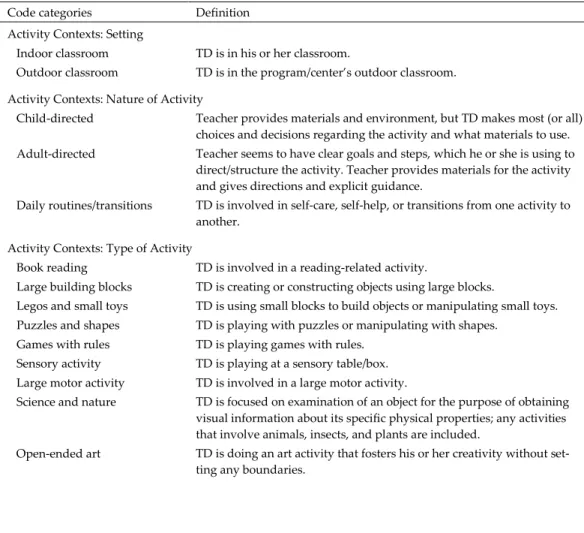
We created three sets of coding systems based on information from previous studies to record specific behavior and talk of typically developing children and their teachers and to capture specific classroom contexts that co-occurred with the behavior and talk (see Ta-ble 1; DeKlyen & Odom, 1989; Heidemann & Hewitt, 1992; Kontos, 1999; Odom et al., 2000; Odom et al., 2006; Powell, Burchinal, File, & Kontos, 2008; Rubin, 2001).
Table 1. Coding Systems to Record Activity Contexts and Children’s Behavior and Talk Code categories Definition
Activity Contexts: Setting
Indoor classroom TD is in his or her classroom.
Outdoor classroom TD is in the program/center’s outdoor classroom. Activity Contexts: Nature of Activity
Child-directed Teacher provides materials and environment, but TD makes most (or all) choices and decisions regarding the activity and what materials to use. Adult-directed Teacher seems to have clear goals and steps, which he or she is using to
direct/structure the activity. Teacher provides materials for the activity and gives directions and explicit guidance.
Daily routines/transitions TD is involved in self-care, self-help, or transitions from one activity to another.
Activity Contexts: Type of Activity
Book reading TD is involved in a reading-related activity.
Large building blocks TD is creating or constructing objects using large blocks.
Legos and small toys TD is using small blocks to build objects or manipulating small toys. Puzzles and shapes TD is playing with puzzles or manipulating with shapes.
Games with rules TD is playing games with rules. Sensory activity TD is playing at a sensory table/box. Large motor activity TD is involved in a large motor activity.
Science and nature TD is focused on examination of an object for the purpose of obtaining visual information about its specific physical properties; any activities that involve animals, insects, and plants are included.
Open-ended art TD is doing an art activity that fosters his or her creativity without set-ting any boundaries.
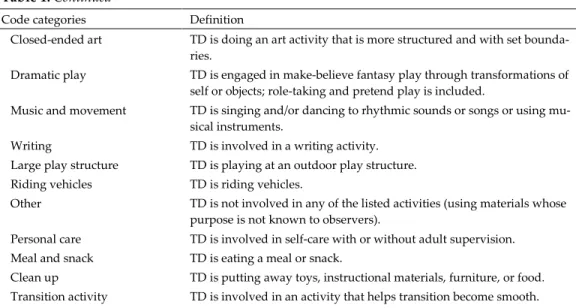
Table 1. Continued
Code categories Definition
Closed-ended art TD is doing an art activity that is more structured and with set bounda-ries.
Dramatic play TD is engaged in make-believe fantasy play through transformations of self or objects; role-taking and pretend play is included.
Music and movement TD is singing and/or dancing to rhythmic sounds or songs or using mu-sical instruments.
Writing TD is involved in a writing activity. Large play structure TD is playing at an outdoor play structure. Riding vehicles TD is riding vehicles.
Other TD is not involved in any of the listed activities (using materials whose purpose is not known to observers).
Personal care TD is involved in self-care with or without adult supervision. Meal and snack TD is eating a meal or snack.
Clean up TD is putting away toys, instructional materials, furniture, or food. Transition activity TD is involved in an activity that helps transition become smooth. Activity Contexts: Type of Social Play
Unoccupied or wandering TD has no focus or intent; TD may be staring blankly into space or wan-dering with no specific purpose, only slightly interested in ongoing ac-tivities; TD is not playing.
Onlooker TD watches activities of others but does not enter the activity for the en-tire interval (15 s). TD may offer comments or laugh but does not become involved in the actual activity.
Parallel play or on-task
behavior TD is engaged in an activity beside but not interacting with other chil-dren, usually present within a distance of 3 ft or less; TD is playing next to another child with similar materials.
Engaged with T(s) only TD is engaged with adults only; no interactions are observed between TD and a peer nearby.
Engaged with 1 Pa TD is engaged with 1 peer.
Engaged with Ps onlya TD is engaged with 2 or more peers; no interactions are observed be-tween TD and adult(s).
Engaged with T(s) and 1 Pa TD is engaged with adult(s) and 1 peer. Engaged with T(s) and Psa TD is engaged with adult(s) and 2 or more peers.
Without materials or toysa TD is engaged with adult(s) or peer(s) without any materials or toys. Child’s Behavior and Talk: Nature of Peer Interaction
Simple acknowledgment TD provides or receives simple acknowledgments; supports peers’ state-ment; gains attention of peer; shows pride to peer.
Shows interests in peer TD imitates a peer’s verbalization or action; physically follows a peer; or shows interest in what the peer does; initial stage of engagement. Joins and/or invites peer TD joins peer (who is alone) in a specific activity or invites peer to an
ac-tivity; beginning/initial stage of play.
Ask simple questions TD asks a question to another peer; the question should not be a help-seeking question.
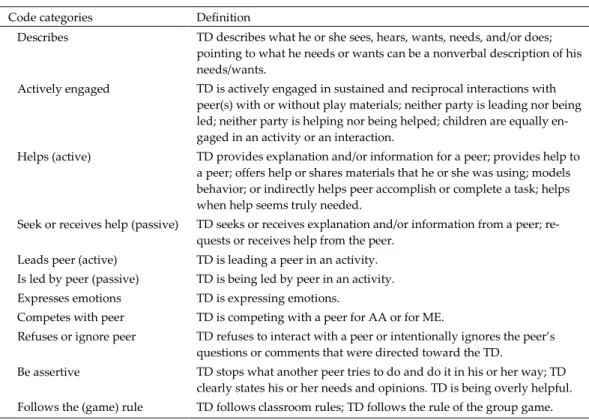
Table 1. Continued
Code categories Definition
Describes TD describes what he or she sees, hears, wants, needs, and/or does; pointing to what he needs or wants can be a nonverbal description of his needs/wants.
Actively engaged TD is actively engaged in sustained and reciprocal interactions with peer(s) with or without play materials; neither party is leading nor being led; neither party is helping nor being helped; children are equally en-gaged in an activity or an interaction.
Helps (active) TD provides explanation and/or information for a peer; provides help to a peer; offers help or shares materials that he or she was using; models behavior; or indirectly helps peer accomplish or complete a task; helps when help seems truly needed.
Seek or receives help (passive) TD seeks or receives explanation and/or information from a peer; re-quests or receives help from the peer.
Leads peer (active) TD is leading a peer in an activity. Is led by peer (passive) TD is being led by peer in an activity. Expresses emotions TD is expressing emotions.
Competes with peer TD is competing with a peer for AA or for ME.
Refuses or ignore peer TD refuses to interact with a peer or intentionally ignores the peer’s questions or comments that were directed toward the TD.
Be assertive TD stops what another peer tries to do and do it in his or her way; TD clearly states his or her needs and opinions. TD is being overly helpful. Follows the (game) rule TD follows classroom rules; TD follows the rule of the group game. Note: TD = typically developing child (target child); T = teacher or adult; P = peer; AA = adult’s attention; ME = materials or equipment.
a. Also coded whether the TD was interacting with peer(s) with disabilities (PWD) or another TD.
For “Activity Contexts,” our coding categories included Setting (indoor, outdoor), Na-ture of Activity (adult-directed, child-directed, daily routine, and transition), Type of Activity (e.g., books, sensory, small toys, large building blocks, dramatic play), Group Composition (e.g., with one adult and one peer, with peers), and Type of Social Play (e.g., engaged with one peer, engaged with adult(s) and peer). We clearly defined that the Type of Activity should be focused on what the child was actually doing rather than on the area of the classroom in which the child was. For example, when a child was engaged in a dramatic play while she was in the block area, the behavior was coded as dramatic play rather than block play.
For “Child’s Behavior and Talk,” the Nature of Peer Interaction (e.g., asks simple ques-tions, helps, expresses emoques-tions, seeks help, refuses, or ignores) was coded in each interval. When we developed these codes, we focused specifically on social nature of the behavior excluding behaviors with other foci or intentions. The codes for Nature of Peer Interaction were not mutually exclusive, so we coded all categories observed during each interval.
For “Teachers’ Behavior and Talk,” codes included Teaches or Models (explains or models to the typically developing children how to interact with a peer); Participates (facilitates interactions between the typically developing children and the peer by becoming an active
participant in children’s play or conversation); Promotes Communications (explicitly encour-ages or instructs child to use language); Redirects (directs the typically developing children to interact with a peer or redirects them to another activity, area, or behavior); Praises (ex-presses praise, appreciation, or satisfaction to the typically developing children or his or her socially competent behavior); Comments/Suggests/Questions (makes suggestions, com-ments, or questions, from outside the children’s play, about child’s play, or other activity); Refers to a Peer (refers the former to help or to be helped by the latter, by pointing out that a peer needs someone to play with, or pointing out a peer as a model); Interprets (explicitly interprets to the typically developing children the meaning, intent, or perspective on behalf of the peer); Disciplines (provides corrections to inappropriate or negative behavior dis-played by the typically developing children toward the peer; may restate class rules); Mon-itors (visually attends to the child/group; with no direct contact/involvement in the typi-cally developing children’s activity). These behaviors were coded only when the teacher used one or more of these strategies to promote social interactions. The codes for teachers’ behavior and talk were not mutually exclusive, so we coded all categories observed during each interval.
We used the time-sampling observational method to code classroom contexts and be-havior and talk of participating children and teachers. We first observed participating child’s behavior and talk, teachers’ behavior and talk, and classroom contexts for each ob-servational interval (20 s) and then coded the observation for the following 30 s. This cycle of 20-s observation and 30-s coding continued throughout the observation of each child. Previous research used the similar time-sampling method for the same purpose (Early et al., 2006; Kontos, 1999), and, according to our piloting of different lengths of time, 20 s provided proper amount of information regarding children’s activities and interactions in comparison with 10, 15, or 30 s, and we needed at least 30 s to accurately record observed behaviors and interactions. Each child was observed for approximately 6 hr on two differ-ent days which enabled us to collect up to 360 min of data per child. Due to various reasons (e.g., some children being dropped off late and picked up early, extended large-group ac-tivities), however, the number of intervals during which each child was observed ranged from 172 to 353 min (M = 266.14; SD = 46.68).
Three research assistants were trained to use these coding systems using four 1-hr vid-eotapes of a group of preschoolers at a university laboratory school. Training videos in-cluded a variety of contexts and activities, such as indoor and outdoor free play, small group activities, meals, snacks, and transitions. After several sessions of thorough discus-sion and practice coding, we reached 85% to 100% agreements on all codes before begin-ning the data collection. All researchers met to check inter-coder reliability every 3 weeks with two 20-min videotapes with various contexts to ensure that the inter-coder reliability stayed at least at 80% for all categories. When there were disagreements during reliability checks, we stopped data collection and met to discuss those particular codes and resolved the issues. The reliability check could not be conducted in the classrooms where the actual data were collected due to the time restraints of the data collectors and the teachers’ request not to overcrowd their already crowded classroom. The average percent agreement ranged from 75% (Nature of Peer Interaction) to 100% (Setting, Nature of Activity).
Vocabulary knowledge
We assessed children’s vocabulary knowledge using the Woodcock-Johnson III Picture Vocabulary Test. The administrator asked the child to label each picture presented to them. It took about 5 min to complete the assessment with each child with varying ability levels. This variable was used as a child-level covariate in the analysis to control for the effect that children’s language may have on their social interactions. In the analysis, the standardized score, t, was used (M = 50; SD = 10).
Parent and teacher questionnaires
Parents were asked to complete a questionnaire regarding their education level and their child’s age, gender, and ethnicity. A dichotomous variable was created for child’s ethnic-ity, as the majority of the participating children were European American (1 = EA; 0 = non-EA). Mothers’ educational level was coded as 1 = BA degree or 0 = no BA degree. Teachers provided information about their education level, years of teaching experience, and the numbers of children with disabilities and adults in the classroom.
Study Variables
Frequencies and percentages were calculated for each of the individual behavior, talk, and context variables. Using the frequency information as well as conceptual meaning of each code, we created composite variables to be entered in the main analyses. As for Setting, indoor versus outdoor classroom was used in the analysis. As for Nature of Activity, child-directed, adult-child-directed, and daily routines were used. In terms of Type of Activity, which was defined as the activity in which the typically developing target child was participating, three categories were created: Academic activity (e.g., book, science); Play activity (e.g., large building blocks, sensory, Legos, dramatic, large motor, riding); and Transitions and routines (e.g., meal, clean-up, transition) (Powell et al., 2008). Codes for typically develop-ing children’s behavior and talk toward peers with disabilities were collapsed into seven composite variables on the basis of their conceptual congruence: (a) active engagement (joins or invites peer, asks simple questions, describes, actively engaged, follow the game rule); (b) low level–positive (simple acknowledgment, shows interest in peer); (c) helping or leading (helps [active], leads peer [active]); (d) expressing emotions; (e) being assertive; (f) low level–negative (competes with peer for adult’s attention or materials, refuses, or ignores peer); and (g) being helped or led (seeks or receives help–passive; is led by peer– passive). Codes for teacher talk and behavior were combined to create one dichotomous variable that indicates whether the adult provided support for children with and without disabilities to interact with each other when the adult was close to them. Individual codes could not be used due to the low frequency of teachers’ behavior and talk even when the teacher was within 3 ft from the target child and his or her peer(s) with disabilities (i.e., 101 out of 2,750 intervals; 3.67%). Out of 101 intervals, the teacher initiated the interactions during 78 intervals (cf. response = 23 intervals).
The dependent variable, Interactive Play [IP] with Peers with Disabilities, was created by combining intervals that included the interactive nature of play between children with and without disabilities (i.e., IP with one peer with a disability, IP with peers with disabilities,
disabilities, and PI with a peer with disabilities without play materials) and coded as 1 (interaction with peer(s) with disabilities) or 0 (no interaction). Finally, we included child’s gender, ethnicity, and parent education as control variables and children’s expressive lan-guage skills as a covariate in the analyses because of the known associations of family and demographic factors and children’s language skills with children’s social competence.
Results
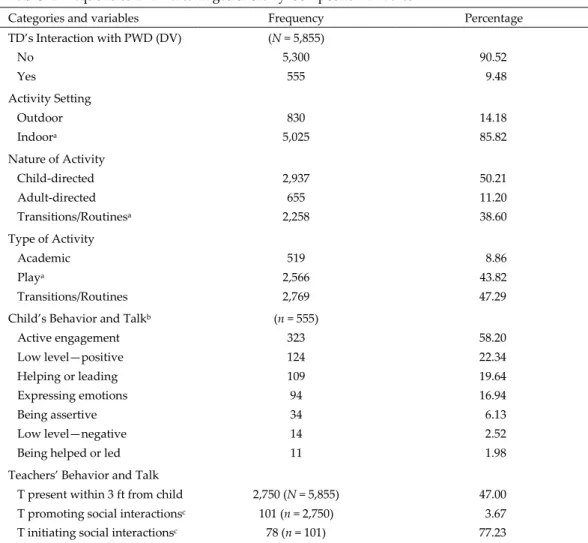
Children were interacting with one or more peers for 41.96% of the intervals and with chil-dren with disabilities for approximately 9.49% of the intervals (n = 2,457 and 555, respec-tively), which means that, of the 41.96% of intervals with peer interactions, 22.59% con-tained interactions with a peer with disabilities. Most observations were conducted indoors (85.82% of the total number of intervals), and the nature of the half of the activities was child-directed (50.21%) followed by transitions and routines (38.60%). About 44% of the intervals were devoted to play activities in comparison with the 9% of the intervals spent on more academic content, such as reading, writing, science, and music. Activities related to transitions and routines took up about 47% of the entire observation intervals (see Table 2). The frequencies of intervals where social interactions occur did not vary be-tween the Fall and the Spring observations (i.e., n = 296 vs. 259, respectively), which indi-cates that the duration of relationships did not make a difference in the frequency of social interactions. Therefore, we did not include the timing/season of the observations in the analyses.
Contexts Where Children Interacted With Peers with Disabilities
We conducted two multilevel logistic regression analyses. Our data were structured so that observations were nested within children and that within-subject and between-subject servations were evident. Thus, the data contained within-subject and between-subject ob-servations. Multilevel modeling approach (Bryk & Raudenbush, 1992) was selected, choos-ing SAS Proc Glimmix for its flexibility in modelchoos-ing generalized linear mixed model (GLMM). Specifically, a logistic link was used because the outcome variables were dichot-omous. The probability of answering “yes” (rather than “no”) was modeled. A random in-tercept was included for each model, under the assumption that individuals differ at their logit at the reference group. Containment method was selected as the method for compu-ting the denominator degrees of freedom for the tests of fixed effects. Residual pseudo-likelihood with a subject-specific expansion was chosen as the estimation technique.
Table 2. Frequencies and Percentages of Study Composite Variables
Categories and variables Frequency Percentage
TD’s Interaction with PWD (DV) (N = 5,855) No 5,300 90.52 Yes 555 9.48 Activity Setting Outdoor 830 14.18 Indoora 5,025 85.82 Nature of Activity Child-directed 2,937 50.21 Adult-directed 655 11.20 Transitions/Routinesa 2,258 38.60 Type of Activity Academic 519 8.86 Playa 2,566 43.82 Transitions/Routines 2,769 47.29
Child’s Behavior and Talkb (n = 555)
Active engagement 323 58.20 Low level—positive 124 22.34 Helping or leading 109 19.64 Expressing emotions 94 16.94 Being assertive 34 6.13 Low level—negative 14 2.52
Being helped or led 11 1.98
Teachers’ Behavior and Talk
T present within 3 ft from child 2,750 (N = 5,855) 47.00 T promoting social interactionsc 101 (n = 2,750) 3.67 T initiating social interactionsc 78 (n = 101) 77.23
Note: TD = typically developing child; PWD = peer(s) with disabilities; DV = dependent variable; T = teacher/adult a. Reference.
b. Codes are not mutually exclusive.
c. Coded only when a teacher/adult was present within 3 ft from the target child and PWD.
The dependent variable was a dichotomous variable that represented whether or not the target child was interacting with at least one peer with a disability (i.e., interaction vs. no interaction). Independent variables were also dichotomous variables including indoor (vs. outdoor) and daily routines and transitions (vs. child-directed or adult-directed) for our first model and indoor (vs. outdoor) and play activities (vs. academic activities or tran-sitions/routines) for our second model. We controlled for child age, child gender, child ethnicity, child language, and parent education (child level) and by adding them to the models before the main independent variables (behavior level) were entered. We decided to develop two different models to answer the first question rather than including all in-dependent variables in one model because of the interdependence between two coding categories, Type of Activity and Nature of Activity. More specifically, if the Nature of Activity
was coded as daily routines and transition, only one from four codes included in Type of Activity can be coded (i.e., personal care, meal snack, clean up, or transition activity). The equation for Model 1 is shown below, where i is for the ith person and t is for the tth inter-val. Model 2 is similar to Model 1 except that Type of Activity replaces Nature of Play in the model. The estimates for both models are shown in Tables 3 and 4.
Level 1: For the ith child at the tth interval/behavior, the probability of observing the interaction between the target child and a peer with disabilities is as follows:
𝑃𝑃(𝑌𝑌𝑡𝑡𝑡𝑡= 1) = 𝑒𝑒 β0𝑖𝑖
1 +𝑒𝑒β0𝑖𝑖
Level 2: For the ith child, the second-level equation is as follows: β0i = γ00 + γ01(Indoori) + γ02(NatureOfPlayi) + γ03(ChildAgei)
+ γ04(ChildGenderi) + γ05(ChildExpVocabi) + γ06(ChildEthnicityi) + γ07(ParentEducationi) + U0i,
where U0i ~ N(0,σ2).
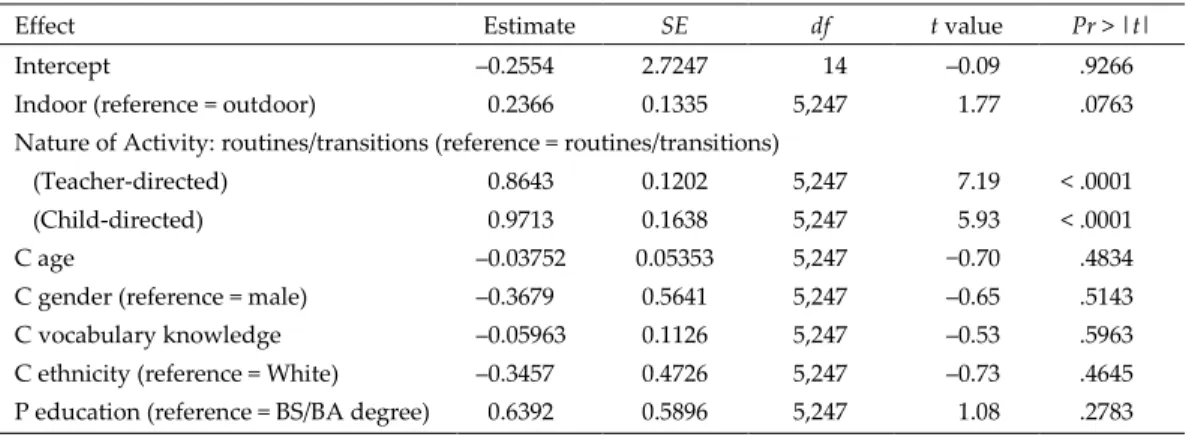
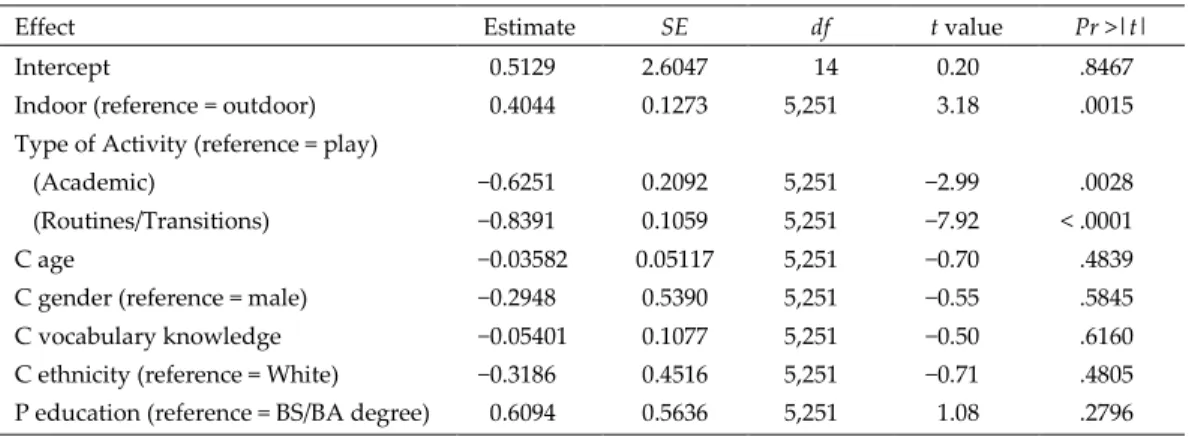
Analyses revealed that typically developing children were more likely to interact with at least one peer with disabilities in an outdoor classroom than in an indoor classroom, t(5,251) = 3.18, p = .002, in adult-directed or child-directed activities rather than during daily routine and transition times, t(5,247) = 7.19, p < .0001; t(5,247) = 5.93, p < .0001, respectively, and in play activities rather than during academic activities or during transition and rou-tine times, t(5,251) = –2.99, p = .003; t(5,251) = −7.92, p < .0001, respectively (see Table 3).
Table 3. Estimates and Standard Errors from Analyses of Interactive Play with Peers in Model 1
Effect Estimate SE df t value Pr > |t|
Intercept –0.2554 2.7247 14 –0.09 .9266
Indoor (reference = outdoor) 0.2366 0.1335 5,247 1.77 .0763 Nature of Activity: routines/transitions (reference = routines/transitions)
(Teacher-directed) 0.8643 0.1202 5,247 7.19 < .0001 (Child-directed) 0.9713 0.1638 5,247 5.93 < .0001
C age –0.03752 0.05353 5,247 −0.70 .4834
C gender (reference = male) –0.3679 0.5641 5,247 –0.65 .5143 C vocabulary knowledge –0.05963 0.1126 5,247 –0.53 .5963 C ethnicity (reference = White) –0.3457 0.4726 5,247 –0.73 .4645 P education (reference = BS/BA degree) 0.6392 0.5896 5,247 1.08 .2783 Note:C = child; P = parent
Table 4. Estimates and Standards Errors from Analyses of Interactive Play with Peers in Model 2
Effect Estimate SE df t value Pr >|t|
Intercept 0.5129 2.6047 14 0.20 .8467
Indoor (reference = outdoor) 0.4044 0.1273 5,251 3.18 .0015 Type of Activity (reference = play)
(Academic) −0.6251 0.2092 5,251 −2.99 .0028
(Routines/Transitions) −0.8391 0.1059 5,251 −7.92 < .0001
C age −0.03582 0.05117 5,251 −0.70 .4839
C gender (reference = male) −0.2948 0.5390 5,251 −0.55 .5845 C vocabulary knowledge −0.05401 0.1077 5,251 −0.50 .6160 C ethnicity (reference = White) −0.3186 0.4516 5,251 −0.71 .4805 P education (reference = BS/BA degree) 0.6094 0.5636 5,251 1.08 .2796 Note: C = child; P = parent
Nature of Social Behaviors When Interactions Occurred
Overall, there were infrequent interactions between children with and without disabilities (555 intervals; 9.48% of the intervals observed). However, when interactions occurred, the most frequent type of interaction was active engagement (58.20%), which means that the typically developing child was actively engaged in reciprocal and sustained interactions with a peer with a disability. In addition, most interactions were positive with a few neg-ative behaviors observed. Typically developing children were helping or leading the peer with disabilities for approximately 20% of the intervals, expressing positive emotions for about 17% of the intervals and were being helped or led by a peer with a disability for about 2% of the intervals. Typically developing children were sometimes acting assertively by overly helping or leading a peer with a disability (6.13%) which was coded separately from “helping or leading.”
Teachers’ Behavior and Talk When Near the Children
Frequencies of the teacher talk and behavior variables revealed that the teacher was near children with and without disabilities for approximately 47% of the intervals (2,750 out of 5,855 observation intervals). We found out that 319 out of these 2,750 intervals overlapped with the 555 intervals where children interacted with peers with disabilities (χ2 = 27.19, p < .001) although this does not provide the information about what was happening in the preced-ing interval. Of the 2,750 intervals, however, teachers were actually intervenpreced-ing the inter-actions between children with and without disabilities for about 3.67% of the intervals (101 out of 2,750 intervals), and, during most of the intervals, the teacher initiated the interac-tions as opposed to responding to the social behaviors that the target child was exhibiting (78 out of 101 intervals).
Discussion
Although typically developing children play an important role in actualizing the social integration in inclusive early childhood settings, their behavior and talk have not been
social behavior and talk toward their peers with disabilities in inclusive classrooms. The target of the observations, therefore, was on those without disabilities. In addition, although previous research focused on the lack of interactions initiated or responded to by children with disabilities, we focused on contexts where the interactions between children with and without disabilities were likely to occur. This is one of the unique contributions of this study because the detailed observations of typically developing children in inclusive class-room settings would inform researchers and practitioners in developing an intervention or professional development program that involves naturalistic contexts and activities as a venue for promoting social interactions between children with and without disabilities. Contexts Where Children Interacted with Peers with Disabilities
Children with and without disabilities had minimal interactions throughout the day as found in previous literature on preschool inclusion (e.g., Odom et al., 2004, 2006). Our main findings conclude that children without disabilities were more likely to interact with peers with disabilities: (a) outdoors than indoors, (b) during child-directed or adult-directed ac-tivities rather than transitions and routines, and (c) during play acac-tivities rather than either academic activities or transitions or routines.
Indoors versus outdoors
Young children’s social interactions have been studied both indoors and outdoors. Although indoor space might increase the possibility for children to bump into their peers due to its higher social density than outdoor contexts, several researchers primarily studied children during outdoor recess time, rationalizing that social interactions were encouraged more frequently outdoors than indoors (Fanger, Frankel, & Hazen, 2012; Li, Hestenes, & Wang, 2016). It may be possible that typically developing children might have been more accept-ing of their peers with disabilities outdoors than indoors because an outdoor context pro-vides an extended interactive space and allows more large-scale play that can include more peers, such as playing tag and climbing on a large play structure. Others also found that outdoor games encouraged children’s social interactions and physical activity (Verhaegh, Soute, Kessels, & Markopoulos, 2006) and that a more complex level of play interactions (i.e., interactive and dramatic play) between different age groups were more likely to occur in the outdoor classrooms than in the indoor ones (Shim, Herwig, & Shelley, 2001). Studies have examined the demands of physical activity contexts affecting children’s decision to include or not to include a peer with a physical disability (e.g., Diamond & Tu, 2009). The hypothetical child in a wheelchair used in Diamond and Tu (2009) study was unlikely to be included in physically demanding activities although included in physically less de-manding activities. In the current study, participating classrooms included children with various disabilities at different levels, and outdoor classrooms provided options other than a play structure requiring various motor skills. Little research investigated the affordances that outdoor classroom environment might provide children with various activities includ-ing physical and nonphysical. Outdoor contexts seem to encourage interactions among young children no matter what levels of abilities they have; therefore, further investigation of outdoor environment in relation to children’s inclusive interactions is needed.
Nature of Activity
The activities that were either child-directed or teacher-directed were more likely to elicit social interactions as compared with transitions and routines. This result is partly con-sistent with that of DeKlyen and Odom (1989), where the extent to which the teacher struc-tured the activities was positively associated with the frequency of peer interactions. We also found a similar positive association between child-directed activities and social inter-actions as in Booren, Downer, and Vitiello (2012), where children were more engaged with peers during child-directed activities than transitions and routines. Our speculations for the lack of social interactions during transitions and routines include that, for task-related activities, children may exhibit more on-task behavior than interactive play as found in several other studies (e.g., McWilliam, Scarborough, & Kim, 2003).
Type of Activity
Play activities were better contexts for social interactions between children with and with-out disabilities as compared with academic activities or transitions and rwith-outines. This find-ing is consistent with that of Odom and Peterson (1990) and is somewhat similar to what Kemp, Kishida, Carter, & Sweller (2013) and Innocenti et al. (1986) found, where more social interactions were exhibited during free play time than other times of the day. How-ever, there is room for further discussion. Kemp et al. (2013) made an assumption that free play activities would all be child-directed activities. In the current study, we emphasized that the Type of Activity (e.g., open-ended art, dramatic play, science, book-reading) should be separately and independently coded from the Nature of Activity (e.g., child-directed, adult-directed, routines) except for transitions and daily routines because, even during free play time, adult-directed interactions can happen. In a high-quality preschool classroom, free play (or center) time usually consists of both play activities and academic activities. Therefore, the current study adds more specifics to the previous studies in terms of the contexts that were more likely to facilitate social interactions. That is, whether those social interactions happened during free play time or other times of the day, play activities were the context where social interactions between children with and without disabilities were more likely to occur than the other contexts.
Play is an important context where children learn social knowledge and interpersonal skills including collaboration, negotiation, entry or invitation to peer play, and pretend play (e.g., Schuler & Wolfberg, 2000). Researchers have found that children with disabili-ties were more likely to be engaged in peer interactions when involved in sociodramatic play and games than in more functional or constructive activities (DeKlyen & Odom, 1989; McCormick et al., 1998). The finding from the current study seems to support this result because play activities rather than academic activities or transitions and routines would afford more opportunities for sociodramatic play and collaborative games. Activities with specific academic content, however, can also support the interactions between children with and without disabilities. A short-term longitudinal case study with a group of pre-school children with and without disabilities showed a possibility by using inclusive writ-ing communities where children sit together to “create marks, drawwrit-ings, words, and sto-ries while talking and listening to each other” (McCloskey, 2012, p. 52). However, our
finding suggests that more free play which in turn supports play-based learning may ben-efit social interactions between children with and without disabilities.
Nature of Social Behaviors When Interactions Occurred
Although typically developing children were engaged in interactions with peers with dis-abilities for only 10% of the observed intervals, the observed social interactions may pro-vide us with better ideas regarding how the children actually interacted with one another. The positive finding is that the typically developing children were actively engaged with peers with disabilities when an interaction occurred, which means that their interactions were reciprocal and sustained for the entire interval. Participating children and their peers with disabilities were playing together (e.g., play games) and sharing materials and con-versations. They shared positive emotions, and typically developing children helped and were helped by a peer with a disability. Most social interactions were positive in nature when they occurred. These indicators of behavioral intentions seem to reflect young chil-dren’s generally positive attitudes toward people with disabilities found in previous stud-ies (e.g., Hong, Kwon, & Jeon, 2014), although the positive attitudes did not seem readily connected to the frequency of their social behaviors and interactions.
In addition, children enrolled in an inclusive preschool expressed an increased sensitiv-ity and responsiveness to others (Diamond & Carpenter, 2000; Peck, Carlson, & Helmstet-ter, 1992). The current study extended these results in that children without disabilities were sometimes helped and led by a peer with a disability, although the frequency was very low. The helping behavior was coded as “help” only when it was a true helping be-havior compared with being overly helpful (i.e., coded as “being assertive”) to ensure that the unnecessarily helpful behavior was not seen as positive social behavior. An unclear part is, however, whether helping behavior was elicited by an adult (e.g., asking a peer with a disability to help the child without disabilities) or exhibited spontaneously by the child. Because it is possible that children’s interpretation of their own behavior does not always match with adult assessments, it would be critically important to further examine how typically developing children define and interpret helping behavior and use it to in-teract with peers with disabilities and how that supports or inhibits the development of children with disabilities.
Teachers’ Behavior and Talk When Near the Children
Overall, there were many opportunities available for teachers to intentionally promote so-cial interactions between children with and without disabilities because an adult was pre-sent within 3 ft of both children with and without disabilities for approximately 47% of the intervals observed. Despite the large number of intervals in which teachers had access to both groups of children, teachers exhibited behavior and talk to elicit or sustain social in-teractions in only 3.67% of those intervals with opportunities. Our speculation is that a teacher who was close to a child with a disability might have focused mostly on working with that child (e.g., working on specific skills) without involving other children in the same area, especially if that adult was a special education teacher, speech and language pathologist, or an early intervention specialist. However, this result provides early child-hood professionals with an opportunity to reflect more deeply on the important goal of
inclusion and the issue around partnerships between early childhood educators and early childhood special educators serving the same group of young children and families. Early childhood communities have already recognized a gap in professional development op-portunities provided to early childhood teachers on working with children with varying levels of abilities (Wei, Darling-Hammond, & Adamson, 2010). In addition, teachers’ atti-tudes toward disabilities and inclusion were positively and significantly associated with their training and prior experience working with children with disabilities (Kwon, Hong, & Jeon, 2017). All these findings call support for greater teacher training focused on inclu-sive and collaborative early childhood teaching practices.
Limitations and Future Directions
First, in the current study, the types and the severity of disabilities were not taken into account in analyzing the likelihood of social interactions between children with and with-out disabilities. Typically developing children tend to be more sensitive to the physical demand of different activities when they interact with peers with disabilities (Diamond & Hong, 2010); therefore, the types and the severity of disabilities that peers have may affect the decisions that typically developing children make. The evidence supporting the asso-ciation of disability types with the amount of interactive play include McGaha and Farran’s (2001) study where interactive play increased for children without visual impairments but decreased for children with visual impairments in the outdoor space compared with in-door space. However, more than 80% of children with disabilities in the current study had mild or moderate disabilities and either developmental delays or speech-language impair-ments. Only a few had significant or severe disabilities. Thus, typically developing chil-dren’s behaviors toward peers with disabilities might have looked different from the plau-sible case of having children with various disabilities in the classroom. In addition, the gender of children with disabilities was not taken into account in the current study although we know that preschool children tend to show their preferences for same-sex playmates at a young age (e.g., Maccoby, 1988). In future studies, the characteristics of children with disabilities would need to be examined in studies of peer interactions between children with and without disabilities.
Second, in the current study, target children’s vocabulary knowledge was added to the model as a covariate rather than their general levels of social skills. Although children’s language skills have been associated with children’s social interactions and communica-tions (e.g., Craig-Unkefer, & Kaiser, 2002), it may be more helpful to include a measure of social competence as a covariate especially due to significant associations often found be-tween children’s social competence and their social interactions in the classroom (Dia-mond, Hong, & Baroody, 2008).
Third, classroom-level predictors, such as teacher training and classroom environment, were not taken into account in the current study due to the small sample size. A larger classroom-level sample with a sufficient number of children in each classroom sample would enable us to examine how teacher practices and experiences are associated with children’s social interactions with peers with disabilities. For example, predictors such as
teacher, special education teacher, and paraprofessional) and their experiences in terms of their pre-service education, in-service training, and their attitudes toward specific class-room practices may eventually affect their behaviors in the classclass-room. In the current study, any adult present near the children with and without disabilities was considered a teacher whose behavior was coded. This was based on the belief that any adults in the classroom should be responsible for the promotion of effective social interactions among children. However, we know from research that the level of education and in-service training makes a difference in terms of how the interactions work (Barnett, 2004; Bueno, Darling-Ham-mond, & Gonzales, 2010; Early et al., 2006). Therefore, it would benefit the field to take a closer look at the different characteristics of each classroom and how those classroom char-acteristics are associated with the frequency and the nature of social interactions between children with and without disabilities. It would also be beneficial to investigate what the teacher was doing in the intervals immediately preceding when the two children acted and also to examine the contexts immediately preceding when the children inter-acted. This idea was briefly introduced in the “Discussion” section where the contingent responsivity concept was introduced; however, this analysis could not be conducted using the current data set because of the infrequent number of intervals of teacher behavior and the sparse occurrences that prevented us from examining the lagged effects of teachers’ influences on children’s behavior.
Fourth, teachers’ behavior and talk may need to be analyzed and interpreted in relation to the child’s behavior and talk. Not all teachers’ prompting seems helpful or effective. Rather, it seems more important to consider the timing and the specific interactional con-texts in promoting social interactions between children with and without disabilities. Alt-hough the likelihood was very low that children without disabilities were interacting with children with disabilities, it is possible that, at some point, teachers must have waited a bit longer until intervening in their social interactions without prompting their behavior and talk. This becomes an even more plausible explanation for the lack of teacher intervention as we found in our data that most teachers’ prompting, if any, was to initiate rather than to respond to a child’s behavior and talk. This analysis needs further attention. A larger number of settings and classrooms/teachers may make it more meaningful to examine teachers’ behavior and talk in relation to child’s behavior and talk. It is also critical to ex-amine the association among teachers’ attitudes toward inclusion, their educational and training experiences, and their practices promoting social interactions between children with and without disabilities (Hsien, Brown, & Bortoli, 2009; Jeon & Peterson, 2003).
Finally, previous studies have examined preschool children’s attitudes toward peers with disabilities that helped us reflect on how children made inclusion and exclusion de-cisions. The current study shows the context where these children were more likely to in-teract with peers with disabilities (i.e., outdoors than indoors; play activities than academic activities or transitions/routines; teacher- or child-directed activities than transitions/rou-tines). Attitudes are associated with behaviors in complicated ways (Yu, Ostrosky, & Fowler, 2012) as represented through three interconnected dimensions: cognitive (beliefs and un-derstanding), affective (feelings and emotional reactions), and behavioral (a predisposition to act in a certain way), which contributes to the exhibited behavior (Ajzen, 1988). A study
that combines the investigation of behaviors and multiple dimensions of attitudes will pro-vide a clearer picture of the important factors associated with the social interactions be-tween children with and without disabilities in inclusive preschool classrooms. Some di-rect discussion with the children themselves about their choices and observations and individual interviews and reflections with the teachers about their choices, opportunities, and practices would enrich the findings from the current study.
Implications for Practice
In the current study, we found that children were more likely to socially interact with peers with disabilities in outdoor spaces (vs. indoor spaces) and during play activities (vs. aca-demic activities). It might be beneficial to intentionally promote social interactions in those contexts and examine whether the contexts make a difference in children’s social interac-tions. In addition, transitions and routines may not be the best context to promote social interactions in. It seems more likely for social interactions to occur during activities that either children or teachers direct and that involve active play and/or instruction. Further-more, our findings about teachers’ behavior and talk provide us with an opportunity to think more about the effect of training on how frequently or effectively teachers interact with children to support and scaffold their peer interactions. All adults in the classroom were expected to interact with all children at some point during the class time to intention-ally help children build relationships and participate in interactions with one another. A constant reminder and training about building a strong interdisciplinary team of all early childhood professionals may promote more effective early childhood inclusive instruc-tional methods and enhance the interactions between children with and without disabili-ties. Finally, the value of inclusive settings is to support all children. It is important to have typically developing children experience interactions with children who have different levels of abilities and vice versa while creating a truly beneficial educational experience for everyone. Therefore, it would be critical for all early childhood teacher preparation pro-grams to utilize evidence-based professional standards (e.g., NAEYC and CEC/DEC) to strengthen the quality of early childhood workforce prepared to work with all children (Guralnick & Bruder, 2016).
Declaration of Conflicting Interests – The author(s) declared no potential conflicts of interest with respect to the research, authorship, and/or publication of this article.
Funding – The author(s) received no financial support for the research, authorship, and/or publica-tion of this article.
References
Ajzen, I. (1988). Attitudes, personality, and behavior. Milton Keynes, UK: Open University Press. Barnett, W. S. (2004). Better teachers, better preschools: Student achievement linked to teacher qualifications.
Preschool Policy Matters, 2. New Brunswick, NJ: National Institute for Early Education Research. Retrieved from
http://nieer.org/policy-issue/policy-brief-better-teachers-better-preschools-student-Berk, L. E., & Winsler, A. (1995). Scaffolding children’s learning: Vygotsky and early childhood education. Washington, DC: National Association for the Education of Young Children.
Booren, L. M., Downer, J. T., & Vitiello, V. E. (2012). Observations of children’s interactions with teachers, peers, and tasks across preschool classroom activity settings. Early Education and Devel-opment, 23, 517–538. doi:10.1080/10409289.2010.548767
Brown, W. H., Odom, S. L., Li, S., & Zercher, C. (1999). Ecobehavioral assessment in early childhood programs: A portrait of preschool inclusion. The Journal of Special Education, 33, 138–153. Bryk, A. S., & Raudenbush, S. W. (1992). Hierarchical linear models in social and behavioral research:
Ap-plications and data analysis methods (1st ed.). Newbury Park, CA: SAGE.
Bueno, M., Darling-Hammond, L., & Gonzales, D. (2010, March). Education Reform Series. A matter of degree: Preparing teachers for the pre-k classroom. Washington, DC: PEW Center on the States. Re-trieved from https://www.pewtrusts.org/~/media/legacy/uploadedfiles/wwwpewtrustsorg/reports/ pre-k_education/pkneducationreformseriesfinalpdf.pdf
Craig-Unkefer, L. A., & Kaiser, A. P. (2002). Improving the social communication skills of at-risk preschool children in a play context. Topics in Early Childhood Special Education, 22, 3–13.
DeKlyen, M., & Odom, S. L. (1989). Activity structure and social interactions with peers with devel-opmentally integrated play groups. Journal of Early Intervention, 13, 342–352.
Diamond, K., Hong, S.-Y., & Baroody, A. E. (2008). Early childhood curricular approaches to promote young children’s social competence. In W. H. Brown, S. Odom, & S. R. McConnell (Eds.), Social competence of young children: Risk, disability, and intervention (2nd ed., pp. 165–184). Baltimore, MD: Paul H. Brookes.
Diamond, K. E., & Carpenter, E. S. (2000). Participation in inclusive preschool programs and sensi-tivity to the needs of others. Journal of Early Intervention, 23, 81–91. doi: 10.1177/10538151000 2300203
Diamond, K. E., & Hong, S.-Y. (2010). Young children’s decisions to include peers with physical dis-abilities in play. Journal of Early Intervention, 32, 163–177. doi: 10.1177/1053815110371332
Diamond, K. E., Hong, S.-Y., & Tu, H. (2008). Context influences preschool children’s decisions to include a peer with a physical disability in play. Exceptionality, 16, 141–155. doi: 10.10801093628 30802198328
Diamond, K. E., & Tu, H. (2009). Relations between classroom context, physical disability and pre-school children’s inclusion decisions. Journal of Applied Developmental Psychology, 30, 75–81. doi: 10.1016/j.appdev.2008.10.008
Division for Early Childhood/National Association for the Education of Young Children. (2009). Early childhood inclusion: A joint statement of the Division for Early Childhood (DEC) and the National Association for the Education of Young Children (NAEYC). Chapel Hill: FPG Child Development Institute, The University of North Carolina at Chapel Hill.
Early, D. M., Bryant, D. M., Pianta, R. C., Clifford, R. M., Burchinal, M. R., Ritchie, S., & Barbarin, O. (2006). Are teachers’ education, major, and credentials related to classroom quality and children’s academic gains in pre-kindergarten? Early Childhood Research Quarterly, 21, 174–195.
Fanger, S. M., Frankel, L. A., & Hazen, N. (2012). Peer exclusion in preschool children’s play: Natu-ralistic observations in a playground setting. Merrill-Palmer Quarterly, 58, 224–254.
Feldman, E. K., & Matos, R. (2013). Training paraprofessionals to facilitate social interactions between children with autism and their typically developing peers. Journal of Positive Behavior Interven-tions, 15, 169–179. doi: 10.1177/1098300712457421
Gasser, L., Malti, T., & Buholzer, A. (2014). Swiss children’s moral and psychological judgments about inclusion and exclusion of children with disabilities. Child Development, 85, 532–548. doi: 10.1111/cdev.12124
Giangreco, M. F., Edelman, S. W., Luiselli, T. E., & MacFarland, S. Z. C. (1997). Helping or hovering? Effects of instructional assistant proximity on students with disabilities. Exceptional Children, 64, 7–18.
Goble, P., Hanish, L. D., Lynn Martin, C., Eggum-Wilkens, N. D., Foster, S. A., & Fabes, R. A. (2016). Preschool contexts and teacher interactions: Relations with school readiness. Early Education and Development, 28, 64–79.
Guralnick, M. J. (1999). The nature and meaning of social integration for young children with mild developmental delays in inclusive settings. Journal of Early Intervention, 22, 70–86.
Guralnick, M. J. (2001). Early childhood inclusion. Baltimore, MD: Paul H. Brookes.
Guralnick, M. J., & Bruder, M. B. (2016). Early childhood inclusion in the United States: Goals, current status, and future directions. Infants & Young Children, 29, 166–177.
Guralnick, M. J., Gottman, J. M., & Hammond, M. A. (1996). Effects of social setting on the friendship formation of young children differing in developmental status. Journal of Applied Developmental Psychology, 17, 625–651. doi: 10.1016/S0193-3973(96)90019-2
Harper, L. W., & McCluskey, K. S. (2003). Teacher-child and child-child interactions in inclusive pre-school settings: Do adults inhibit peer interactions? Early Childhood Research Quarterly, 18, 163–184. Hartup, W. W., & Abecassis, M. (2002). Friends and enemies. In P. K. Smith & C. H. Hart (Eds.),
Handbook of social development (pp. 285–306). Malden, MA: Blackwell.
Heidemann, S., & Hewitt, D. (1992). Pathways to play: Developing play skills in children. St. Paul, MN: Redleaf Press.
Hong, S.-Y., Kwon, K., & Jeon, H. (2014). Children’s attitudes toward peers with disabilities: Associ-ations with personal and parental factors. Infant and Child Development, 23, 170–193. doi: 10.1002/ icd.1826
Hsien, M., Brown, P. M., & Bortoli, A. (2009). Teacher qualifications and attitudes toward inclusion. The Australasian Journal of Special Education, 33: 26–41. Retrieved from http://search.informit.com .au/documentSummary;dn=525003579785064;res=IELHSS
Innocenti, M. S., Stowitschek, J. J., Rule, S., Killoran, J., Striefel, S., & Boswell, C. (1986). A naturalistic study of the relation between preschool setting events and peer interaction in four activity con-texts. Early Childhood Research Quarterly, 1, 141–153.
Jeon, H. J., & Peterson, C. A. (2003). Pre-service teachers’ attitudes toward inclusion: Early childhood education and elementary education programs. Journal of Early Childhood Teacher Education, 24, 171–179. doi: 10.1080/1090102030240306
Kemp, C., Kishida, Y., Carter, M., & Sweller, N. (2013). The effect of activity type on the engagement and interaction of young children with disabilities in inclusive childcare settings. Early Childhood Research Quarterly, 28, 134–143. doi: 10.1016/j.ecresq.2012.03.003
Koller, D., Le Pouesard, M., & Rummens, J. A. (2018). Defining social inclusion for children with disabilities: A critical literature review. Children & Society, 32, 1–13. doi: 10.1111/chso.12223 Kontos, S. (1999). Preschool teachers’ talk, roles, and activity settings during free play. Early Childhood
Research Quarterly, 14, 363–382.
Kontos, S., Burchinal, M., Howes, C., Wisseh, S., & Galinsky, E. (2002). An eco-behavioral approach to examining the contextual effects of early childhood classrooms. Early Childhood Research Quar-terly, 17, 239–258.