Robert G. Picard
Most studies of new media for the past decade have concentrated on technological issues, on new media companies, and on content providers. Because it is based on contemporary developments, most of the literature has concentrated on the characteristics of new media, their technological underpinnings, and their perceived potential to affect society and markets.
The authors of these studies have come primarily from technological and social sciences and their work has generally ignored the commercial requirements for the success of information and communication technologies (ICT) and new media products and services in market economies. Most of the studies have been highly positivistic in their approach, have asserted wide-ranging benefits from new media, and have assumed their attractiveness to the public.
The scholarly and governmental studies mirrored the enthusiasm within the emerging industry. High new media growth rates in the second half of the 1990s were fuelled by relatively easy access to venture capital and stock funds that were made possible by booming national economies. Persons --primarily young-- with innovative ideas but little business experience and business education led companies for which seemingly endless possibilities existed. New technological breakthroughs, products, and services were introduced almost weekly.
And then the dot.com bubble burst. The collapse in 2000 was led to companies in which basic business logic or ability to manage the business were absent. In many cases, problems in the companies had been unseen or ignored by novice
managers who were blinded by growth rates, easy money, and their own optimism. Some had good ideas that were surpassed by better ideas, most financed their research and development through risk capital, and most were technology-driven rather than consumer-driven firms. In the end, the firms ran out of capital to
continue operations, lacked workable business models, and often faced consumer indifference to their products or services.
To be fair, however, the failure rates for new media firms were about the same for start-up firms in any industry. Among new firms, about two thirds die within 3 years and about three quarters within 5 years. After the bubble burst, the surviving new media companies tended to be those with better ideas, better products, better business practices, and better managers.
Today, it is clear that new media must be understood as commercial entities that operate in the market economy. The basic requirement of a market economy is the existence of a market, that is, consumers willing to consume the product or service. A truism--apparently forgotten in much of the emergent industry--is that sellers must have a product worth acquiring, that there must be buyers who want to purchase, and that the product must be offered at a price buyers are willing to pay. Although the truism seems trite, the history of new media in recent years indicates that many companies did not comprehend this basic business logic and that the lack of comprehension was responsible for a good deal of the difficulties the industry has faced.
Supply and Demand
In recent years, literature on business strategies for new media and the operation of firms for commercial gain has begun to emerge from business scholars, economists, and practitioners. Although generally supportive of ICT and new media, they have taken a more critical and realistic view of the technologies and their potential for success and failure. These studies have begun to lay out the necessities and requirements for successful introductions and operations of new media. Central to these studies has been the analysis of new media business models and strategies.
Effective business models encompass how a business operates, its underlying foundations, it value-creation processes, its cost structures, the resources upon which it is dependent, its creative and production elements, its distributive activities and mechanisms, and its exchange activities and financial flows. They include a description of the potential benefits for the various business actors and the sources of revenues.
Theoretical and applied analyses have investigated business models for new media activities and a number of significant contributions have appeared. Timmers (1998) explored 11 models that can be utilised in electronic commerce. Failures and changes in four fundamental business models employed by online content providers were explored by Picard (2000). Recently four models for mobile voice and data services, based on continuity of basic business models and their
expansion across telecommunications technological generations have been suggested (Ballon, et al., 2002) and Afuah amd Tucci (2001) identified three generic strategies for firms attempting to gain advantages from Internet
commercial opportunities. The application of business models in firms has led to in-depth examinations of the business models of nearly two dozen access
providers, online portals, online content providers, online retailers, online brokers, and other firms were recently completed (Eisenmann, 2002).
A basic element of the models is that the firms must have revenue streams to survive and grow. The primary sources can be consumers, advertisers, e-commerce activities, or a parent company that operates the new medium as an extension of existing products or services. There are many different means in which a business model can be constructed to provide necessary revenue. A much-tried method is the transfer of the advertising-support model from
established print and broadcast media. The result has not been highly successful. Despite Internet use nearing an average of 25% across Europe, online advertising expenditures represent less than 2% of total European advertising expenditures (World Advertising Trends, 2002).
Electronic commerce models have had limited success for some retailers and today reach nearly €2 trillion. Although this can be considered a success, e-commerce sales still accounts for less than 1% of total retail sales in the European Union.
Part of the difficulty results from the explosive proliferation of new media, that is dramatically fragmenting audiences. Millions of ICT users spread their use among millions of host sites. The result is illustrated by the situation of online content sites. National content sites gaining 250,000 daily visitors are considered enormous successes and only about 3 or 4 sites in a nation achieve such visit rates. Taken in context, however, these 250,000 visitors represent only 2.5% of the population in a nation with 10 million inhabitants or of 1% in a nation with
50,000,000 inhabitants. Some advertisers are interested in audiences of these sizes, but have been unwilling to transfer large amounts of advertising
expenditures to new media to reach them.
The supply side of new media thus faces a variety of challenges in finding revenue, controlling costs, and developing sustainable business models. Good planning and good management alone are not enough to overcome the market and ensure success of new media, however.
The biggest challenges come not from the supply side of new media but from the demand side. The choices of consumers will determine what consumer resources
are devoted to new media and those choices will influence choices of marketers and advertisers who are critical to many business models.
Unfortunately, a significant understanding of consumer behaviour is absent from most analyses of new media. This has produced two major problems in the views of consumers in most new media studies. First, there is an assumption of universal interest in the new products and services. Second, there is an assumption of universal adoption at some point. Both ideas are highly suspect because no media or communication device has ever achieved 100% adoption and nothing in
consumer behaviour theory or research supports either idea.
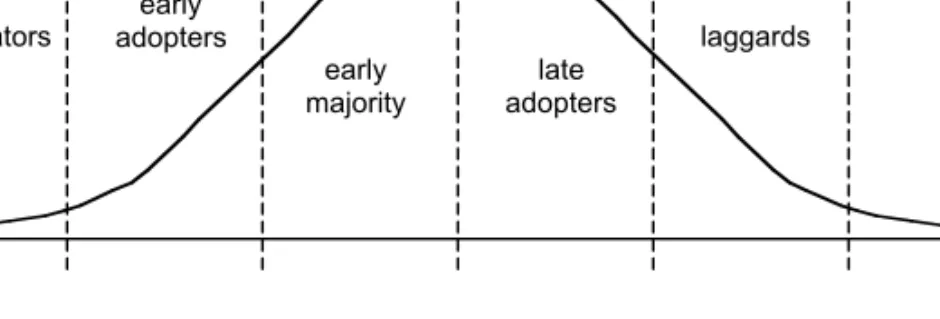
Most new media studies by non-consumer scholars are based on the adoption curve and uncritically accept the notion that this Bell curve represents adoption by 100% of the population or households (Figure 1). The problem with this view is that the curve does not represent the entire population but only those who ultimately adopt the new product or service.
Figure 1: The Adoption Curve
Many proponents of new information and communication technologies seem convinced that because the technologies can serve good purposes, they will be automatically embraced by the public. The problem is that there are a range of impediments to success of ICT technologies brought on by competing interests in the technologies and that individual choices of consumers determine what
consumer resources are devoted to new media (Figure 2). Ultimately, consumer choices will influence choices of marketers and advertisers, which are critical to many market-based business plans for digital media (Albarran, 2000; Picard, 2002). Only if the interests of the various stakeholders converge or can be
innovators early adopters early majority late adopters laggards
accommodated and if consumers become willing to make expenditures does the likelihood of successful market introduction increase (Picard, 1998).
Figure 2: Convergence of Interests in Communication Technologies
The introduction of new ICT devices is not all just a matter of communications technologies, but also a matter of how digitalisation and modern communication devices are changing communication functions and abilities. They are changing communication from one-way to two-way communication and from passive to interactive communication. They are changing media from mass media to specialised media, are moving us from access to few media to many media, and freeing us from fixed location media and communication devices to mobile media and devices. At the same time, we are moving from having separate mass and personal communication media into mixed technologies that have multiple
Copyright 1998 Robert G. Pi card Equipment Manufacturers Programming and Editorial Packagers Distribution Services and Systems Content Producers Audiences or Customers Advertisers Area of Greatest Convergence
functions. And the technologies are changing the content available from merely national media to global media as well.
Despite these significant functional changes, if one actually looks at the results of this situation we see that the digitalisation, new media, and information and communication technologies are part of an evolutionary rather than revolutionary change in communication ability. No real new communication ability is being created. They are not affecting communications in such fundamental ways as did the arrival of the printing press, the telegraph and telephone, photography and motion pictures, and broadcasting. What the information revolution is primarily doing is increasing the speed, flexibility and integration of existing forms of
communication. The most revolutionary aspects are new economies of scope and integration that are changing the economics of production and distribution.
These factors play significant roles in the choices of audiences and consumers regarding new media access and use.
Audiences and Consumers Increasingly Play the
Central Role
Perhaps the most critical change brought on by the functions and capabilities of ICT is the change in locus of control over the communication. And it is this change that is moving audiences and consumers to the centre of all business aspects of ICT. In the new bi-directional communications environment, ICT users can play a more active role in the information creation and selection process. Audiences influence the content of media more directly, gain selectivity and control, choose their own communications, use it in their own ways, and filter and personalise communication. Firms communicating with these users can learn more about their customers, provide better service, and more effectively customise and personalise services for specific recipients.
If digital media are to be successful, consumer needs must be central parts of digital media strategies. One must be able to answer questions such as: What will they get they aren’t getting now? How is the technology or service relevant to their lives? How does it improve life or help them? Why is it valuable for them? Why should they use and pay for the new service?
Many new media/ICT products and services have failed or had slow acceptance because they were searching for wants and needs to satisfy rather than answering those kinds of consumer questions. Trying to find wants and needs to satisfy reverses the normal pattern of product/service creation to fill wants and needs. It is
not a problem-solution approach that more often leads to success for new technologies.
Customer value is created through use of new communication capabilities. It provides immediacy that was previously absent. It provides flexibility in use and information handling, it provides mobility, makes it possible for common platforms to carry different types of content and communication, provides more control to users, provides response ability to communications, and permits more rapid searching for information.
One also needs to understand that there are great differences between groups of consumers. The first purchasers are innovators and enthusiasts who love
technology or want high performance, but these enthusiasts don’t represent all consumers. General consumers want solutions to their wants and needs and convenience of use. Success in new media products typically does not occur until general consumers acquire and use them.
Economics and Consumer Expenditures
We also need to recognise that digitalisation does not change the laws of
economics. It may change in business models and it often alters costs structures (particularly production and distribution costs), but it does not change any
economic laws or remove need for capital, operational financing, or effective management. Because digital media lower costs and ease distribution, they actually make market investments more risky by increasing competition and removing existing advantages from economies of scale and scope and lower transaction cost.
Digital media shift media from variable to fixed cost economics less affected by economies of scale, economies of scope, and transaction costs. As a result
competitors tend to have similar costs and competition tends to focuses on quality, service, and image. Only a few large suppliers can typically become successful in such an environment.
Consumer acceptance of media and communication products and services are determined by the extent to which they serve consumer wants and needs, the willingness of consumers to invest in hardware and software, their willingness to pay use charges, and their willingness to use their time differently. Thus,
understanding consumer behaviour is a critical issue in the successful introduction of ICT.
A significant but often ignored factor in consumer behaviour involves temporal expenditures. The time available for media and communications use is constrained by consumers’ overall time use. Many daily activities compete for this highly limited resource. Because humans spend about one third of the day sleeping and use another third for work, school, or other subsistence needs, only about one third of their day is available for activities ranging from household maintenance, daily travel, eating, and leisure (Areese and Albarran, 2003). Although there tended to be greater differences in the past, time use patterns are generally converging across the developed world and national and individual differences are diminishing (Gershun, 2002).
Temporal expenditures for media tend to come from leisure time, travel time, and work time, but not all media and ICT can be used equally during these activities and the media use must be compatible with the time from which it is taken. Many of the new ICT technologies are having to find a place in the available time use or are being introduced with the thought of changing time use patterns.
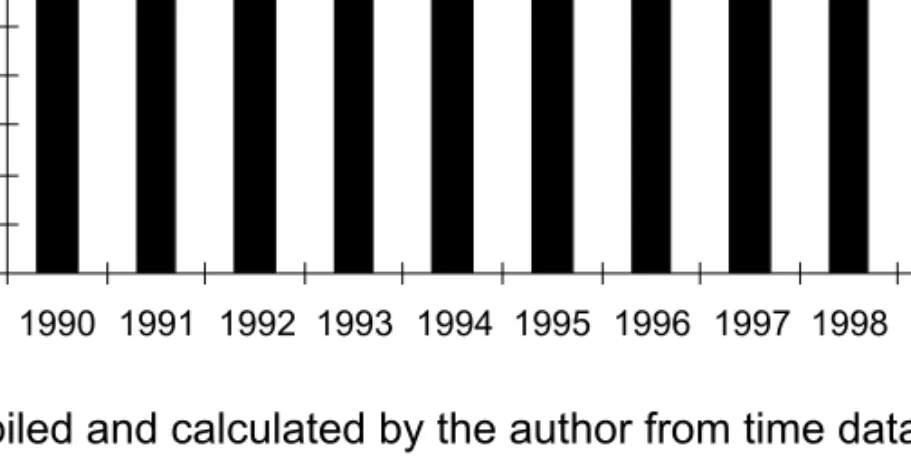
It is very difficult, however, to change personal time use patterns. An example of this is seen in television during the 1990s. The number of television channels in Europe nearly tripled and satellite and cable services were widely subscribed. The supply of television programmes to viewers jumped dramatically because
broadcasters also increased their broadcast days and the total amount of programming hours offered increased proportionally with the number of new channels. Nevertheless, television viewing time increased only an average of 2 minutes per year, less than one half hour programme over the course of the decade (Figure 3).
Figure 3: Average Daily Viewing Time (Minutes) in EU nations,
1990-1999
0 20 40 60 80 100 120 140 160 180 200 1990 1991 1992 1993 1994 1995 1996 1997 1998 1999Source: Compiled and calculated by the author from time data in
TV
International Sourcebook 2001
. London: Informa Media Group, 2001.
In order to be successful, then, new media and ICT products and services must displace part of existing time use, must provide the same or better communications in a more advantageous manner, must be easily used at the time in which current use is made, or must find new time that can be allocated to the
media/communications product.
As a result one cannot expect consumers to use mobile Internet while driving a motorcycle or to use a computer while painting a bedroom, but these new media and devices can be used while riding on a bus or replace some television viewing time.
In addition to time issues, consumers increasingly face monetary issues in new media. Although traditional print media are relatively low priced due to advertising, and free-to-air broadcasting or a low license fee broadcasting are available, new media require significant hardware and software expenditures. Consumers’
spending on all media comes from the personal spending involves a wide range of expenditures for food, housing, clothing, household and personal care goods, transportation, medical care, and other items. Their capacity to switch significant amounts of expenditures to media and ICT is somewhat limited.
Today, Europeans expend about 4% of personal spending on media, and telephony expenditures are about 1%. The amount spent is slightly higher in Northern Europe than in the rest of Europe.
When consumers consider new media and ICT, a number of factors are critical in their choices: whether the new technology is an improvement in providing
functions on existing communication devices, whether the product or service is desirable, whether it is compatible with existing technology they own, the amount of use they anticipate will be made of the new technology, what types of switching costs would be involved (would one have to repurchase video recordings in a new format, for example), their level of belief in success of the technology, and the temporal and financial resources they have available.
Because these types of questions are answered differently, patterns of acceptance of different media vary widely by nation and individual. So it is unrealistic to expect that everyone will have every new digital media and communication product and service.
This is illustrated by the penetration patterns of current media and communication technologies in Europe. Even with these basic media and communication devices there is a wide difference in acceptance (Figure 4). Telephones, television and radio exceed 95% penetration in households and VCRs, magazines and CD players have between 50 and 90% penetration. Computers, Internet, mobile phones, newspapers, and cable and satellite services are available in fewer than half the homes.
Figure 4: Household Penetration Rates of Selected Media and ICT
products and Services in Europe
Source: Eurostat, 2001
The range of new digital media and information and communications technologies being offered is stunning and increasing rapidly. It is tempting to argue that
consumers will get used to the new technologies and acquire them. This is a highly positivistic view that ignores the significant gap between the rate of change in technology and changes in human attitudes and behaviour. Although the technologies of communication are changing rapidly, the responses to them by consumers are much slower.
Part of this is occurring because the introduction of much ICT is based on market expenditures on both the production and consumption sides. Digital media
development and operation are today relying primarily on market funding and must be understood within the context of financing all analogue and digital media. A classic example of the problems that occur when the market’s role in ICT is not recognised can be seen in the introduction of digital terrestrial television. Digital television has been implemented in a number of nations as an ill-conceived and doomed effort for policy and technology to triumph over the market. This effort has primarily been promoted by governments to support frequency reallocation, to
0 0.2 0.4 0.6 0.8 1 Telephone Radio Television Magazines VCR CD Player Cable/Satellite
Personal Computer Internet
Access
support industrial development of their ICT sectors, and to promote national or regional images of ICT leadership for political and economic purposes.
In the introduction digital television broadcasting requirements placed on
broadcasters by policymakers made public service broadcasters bear the brunt of this digital transformation. Few public service broadcasters received additional financial support for the effort and were forced to rely on their existing license fees and advertising sales for financial resources. The increased costs of developing and operating digital transmission capabilities and digital channels have been the major cause of negative overall results for European public service broadcasters in recent years (Figure 5).
Figure 5: Financial Results of EU Public Services Broadcasters
Source: Compiled from data in European Audiovisual Observatory (2002).
Statistical Yearbook 2002
. Strasbourg: European Audiovisual Observatory.
Even in markets where commercially funded introductions have taken place, there has been a wholesale rejection of digital terrestrial television costs by consumers, with notable failures in the United Kingdom and Spain. As a result, some European governments are responding to this case of market failure by considering
subsidised distribution of digital TV boxes to speed the switch to digital television and the US is seeking to require TV manufacturers to put digital receivers in new television receivers. These are classic examples of forcing consumers to bear the costs for a technology they have clearly not embraced.
-600 -400 -200 0 200 400 600 1997 1998 1999 2000
Net profit (million
€ ) -3 -2 -1 0 1 2 3 profit margin (%)
Policymakers and broadcasters in some nations are taking notice of the problem and are making efforts to delay implementation of digital terrestrial television and in others nations they are trying to delay previously planned switch-offs of analogue broadcasting because of the lack of consumer switching to digital.
These problems of funding digital television are part of broader issues of consumer willingness to purchase the range of media and communication products being offered. We must recognize that technologies, policies, and business plans themselves do not create demand and that the choices to purchase will be determined by consumer behaviour, not the wishes of technology manufacturers and policymakers.
One of the ignored issues of new media and ICT products and services is that they increasingly transfer costs to users that were previously borne elsewhere or they require additional expenditures above current media and communication
expenditures. And the current expenditures on these products are not insubstantial.
Television reception, for example, is free or funded through a relatively low, broad-based license fee. But television viewing also typically involves new hardware purchases an average of every 7-10 years, with a €25-€50 annualised cost. In addition, radio listening is free with new receivers being purchased an average of every 7-10 years, at an annualized cost of €5-€10. On the print media side, newspapers cost European consumers €200-€300 annually for news-stand purchases and €300-€600 annual for subscriptions, while magazines cost €2-€5 per issue at news-stand and €12-€35 for annual subscription.
If one looks at the consumer costs that are currently being expended and those that will incur for new digital media and communications, one immediately sees that they will increase substantially.
A simple CD player requires a €50 to €250 hardware investment and then payment of €15 to €20 per title purchased. Purchase of a DVD player means a €250 to
€1,000 hardware investment, with costs of €20 to €30 per title purchased and €3 to
€5 per title rented.
Because of changes preparing the way for digital television, consumers need to reinvest in receivers for wide screen television. This represents a €1,000 to €5,000 hardware investment. Where digital television is available, consumers must make an additional €300 to €500 hardware investment and then spend €180 to €360 average annual cost for advanced services.
To access the Internet, consumers must make a €1,000 to €2,500 investment in a personal computer, plus pay €300 to €1,000 annual costs for access and phone fees. If consumers want mobile Internet services, they must make a €330 to
€1,000 hardware investment and then pay €600 to €1,200 average annual cost for advanced services.
These are not minor costs in term of average household expenses. Selecting the range of digital media and communication spending would approximately triple current annual household expenditures. To anyone who has followed personal spending changes over time, this represents a completely unrealistic expectation for any category of spending.
The costs included in this description are only for major technologies that currently exist and do not include any new types of digital products or services that will require expenditures. Nevertheless, it is abundantly clear that consumers will be unable to fund the entire range of the growing number of ICT possibilities and will thus make individual choices among them.
Another factor promoting different use patterns and wide differences in demand are variations in costs of using ICT products and services. An example of this is seen in the cost for using the Internet (Figure 6), where costs in some European nations are double those of others. The law of supply and demand thus becomes a factor in the choice to use and the amount of use.
Figure 6: Costs for Internet Access in Selected European Nations
Source: OECD
Comparison based on 40 hours, usage in peak time, including VAT
$0 $10 $20 $30 $40 $50 $60 $70 $80 Portugal United Kingdom France Greece
Germany Sweden Australia Spain Mexico
Italy Finland
In addition, expenditures will be influenced by income levels, which vary widely among segments of the populations and nations. Even within the European Union average income levels vary.
These types of financial limitations are particularly problematic to the view of widespread uptake of ICT because consumers and market funding are the basis of nearly every current business plan. Because of the expenditure issues, consumers can be expected to make individual choices among the technologies and some technologies that could be beneficial will fail. This will occur because when new media are introduced, they must become successful in a relatively short period of time (often 2 to 4 years) or their producers and financiers will abandon the
products and services for ventures with more revenue-producing and profitability potentials.
Ultimately, the choices made may not reflect the wishes of policymakers and social engineers who wish to have specific parts of the technologies adopted to support their social, political, or cultural agendas.
Summary
Creating successful business from new media and communication technologies and services is a far more difficult activity then merely developing a good technology or service, creating a business plan, and offering the new media to consumers. It requires convincing them to part with their time and money.
If new media are to become successful commercial activities, companies offering the products and services and policymakers supporting them will have to devote more attention to consumers and the market. They will need to recognise limits to acceptance of the new technologies and plan accordingly. Firms will need to target groups of consumers more selectively and governments will need to consider policies that respond to market failure for those information and communication products and services that are most important for social and political goals.
There is great potential in ICT but that potential must be viewed realistically, within the constraints of the market economies that are being asked to introduce and support them.
References
Afuah, Allan, and Christopher L. Tucci (2001), Internet Business Models and Strategies. Boston: McGraw-Hill/Irwin.
Areese, Angel, and Alan B. Albarran (eds.) (2003), Time and Media Markets. Mahweh, N. J.: Lawrence Erlbaum Publishers.
Ballon, Pieter, Sandra Helmus, Roland van de Pas, Henk-Jan van de Meeberg (2002), ‘Business Models for Next-Generation Wireless Services’, Trends in Communication, No. 9.
Davis, William (1999), The European TV Industry in the 21st Century. London: Informa Publishing Group.
Eisenmann, Thomas R. (2002), Internet Business Models: Text and Cases. Boston: McGraw-Hill/Irwin.
European Audiovisual Observatory (2002), Statistical Yearbook 2002. Strasbourg: European Audiovisual Observatory.
Gershun, Jonathan (2000), Changing Times: Work and Leisure in Postindustrial Society. Oxford University Press.
IP Deutschland (2002), European Key Facts. Internet 2001. Köln, Germany: IP Deutschland.
Picard, Robert G. (2000), ‘Changing Business Models of Online Content Services: Their Implications for Multimedia and Other Content Producers,’
JMM—International Journal on Media Management,” 2(2):60-66.
Picard, Robert G. (2002), The Economics and Financing of Media Companies. New York: Fordham University Press.
Picard, Robert G. (1998), ‘Interacting Forces in the Development of Communication Technologies: Business Interests and New Media Products and Services,’ European Media Management Review (No. 1), pp. 16-22.
Timmers, Paul (1998), ‘Business Models for Electronic Markets,’ Electronic Markets, Vol. 8, No. 2, pp. 3-8.
TV International Sourcebook 2001, London: Informa Media Group.