Sector Chart S&P 500 10/21/15 2,300.00 2,200.00 2,100.00 2,000.00 1,900.00 1,800.00 1,700.00 N ov-14 D ec-14 Ja n-15 Fe b-15 M ar -1 5 A pr -1 5 M ay-15 Ju n-15 Ju l-1 5 A ug -1 5 S ep -1 5 O ct -1 5 Price
Topic of Discussion:
Blockchain Technology Contributing Analysts Spencer Bogart, CFA (415) 262-4877 [email protected] Kerry Rice (415) 262-4890 [email protected]Companies Mentioned in Report: ■ Amazon.com, Inc. (AMZN: $560.88, PT: NA) ■ eBay Inc. (EBAY: $24.42, PT: NA)
■ Alphabet Inc. (GOOG: $650.28, PT: $740.00) ■ Seagate Technology (STX: $38.52, PT: $50.00)
■ Cisco Systems, Inc. (CSCO: $28.50, PT: NA) ■ Facebook, Inc. (FB: $97.00, PT: $115.00)
■ LinkedIn Corporation (LNKD: $197.60, PT: $260.00)
Internet/Financial Technology
The Blockchain Report: Welcome to the Internet of Value
Blockchain technology is a radical innovation that enables direct value exchange over the internet. This is a powerful departure from the status quo, where digital value exchange has always necessitated a middleman and, consequently, incurred their inherent friction in the form of cost, delays, and risk. In this respect, blockchain is a disintermediating technology that is removing friction in the exchange of value over the internet. In this report we examine the essence of blockchain technology, identify eleven use cases and applications, highlight drivers and hurdles for mainstream adoption, and profile some of the leading companies in the space.
As a result of several structural advantages such as durability, transparency, and immutability we believe that blockchain technology will have a significant impact on many industries including Payments, Exchanges, Cybersecurity, IoT, and Smart Contracts. Emerging trends in the industry such as early enterprise adoption, usage trends, R&D expenditure, and venture capital activity, suggest that blockchain technology is approaching an inflection point toward greater mainstream and enterprise adoption.
A major factor for realizing the full potential of blockchain technology—and a critical portion of our thesis and expectations—is the permissionless innovation that is enabled by public blockchains. In the same way the openness of the internet and the freedom to build upon it enabled a rich ecosystem of innovative information applications and services, so too do we expect an open value exchange network to develop into a rich ecosystem with previously impossible and hard-to-imagine money/ value applications and services. We believe this is happening and the innovative use cases described throughout this report are early evidence of the potential ahead. We see blockchain technology as a disruptive innovation whose impact will ultimately be profound. Similar to how the proliferation of internet accessibility created the opportunity for new business models for information exchange in the likes of Facebook, Twitter and LinkedIn, so too will the rise of blockchain technology present new business opportunities of similar scale for value exchange.
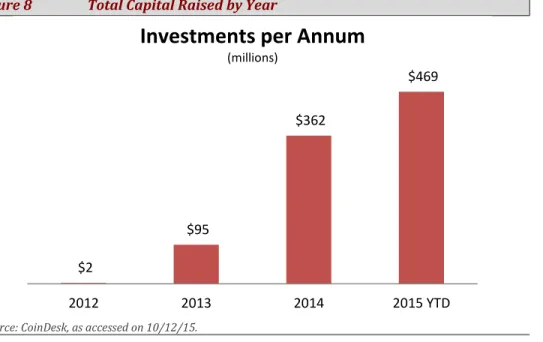
Venture capital invested in blockchain-related companies has accelerated considerably over the past three years and is on track to top $600 million in 2015. We expect venture capital flows to accelerate in 2016 and lead to further development of the foundational and infrastructure services necessary to create a fertile “plug and play” ecosystem for entrepreneurs and innovation that will ultimately escalate enterprise adoption from a trickle in 2016 to a multi-year boom starting in 2017.
The Blockchain Report:
Welcome to the Internet of Value
Introduction
Blockchain technology first emerged as the backbone of Bitcoin in 2009 and lived a relatively quiet existence in its early years. As the new technology established a formidable track record, its true potential began to emerge and gain wider recognition beyond a core group of passionate followers. Since then, there has been a flurry of advancements, new use cases, and applications of blockchain technology. Emerging trends such as early enterprise adoption, usage trends, R&D expenditure, and venture capital activity suggest that blockchain technology is approaching an inflection point toward greater mainstream and enterprise adoption. While public investment opportunities for pure-play blockchain opportunities are minimal today, the technology has potentially far-reaching implications for public companies across a broad swath of sectors and industries.
The pace and magnitude of venture capital flowing to blockchain-related companies is rapidly accelerating, and there are dozens of private companies at the very early stages of disrupting massive markets.
Currently, the foundational layer and infrastructure necessary to support a rich ecosystem of blockchain-based applications and services is being established. As they mature, we expect to see blockchain-enabled companies flourish and bring new economic efficiencies and possibilities into the mainstream.
As with any new technology that fosters a rapidly developing market, there’s significant confusion regarding blockchain technology, its advantages, and the significance of potential applications. We hope to clear the muddied waters by providing a useful explanation of the technology, by highlighting its structural advantages, and by outlining how those advantages manifest in applications. In this report, we provide our interpretation of the current blockchain landscape, highlight emerging themes, provide an analysis of blockchain capital formation and, finally, profile some of the leading private companies in the industry. The overarching purpose of the report is to explore the disruptive impact of blockchain technology across a range of applications and use cases.
What is Blockchain Technology?
Blockchains come in many shapes and sizes with vast structural differences. Our comments and analysis here pertain largely to public blockchains and, specifically, the Bitcoin blockchain because it has a proven track record and an established network effect with a rapidly expanding and diversifying ecosystem. However, we also address the uses, advantages, and disadvantages of private, permissioned, and federated blockchains throughout this report. While private, permissioned, and federated blockchains do not have an extensive track record, they have garnered an increasing amount of enterprise attention and venture capital activity.
What Is a Blockchain?
Generically, a blockchain is a distributed ledger: a chronological chain of “blocks” where each “block” contains a record of valid network activity since the last block was added to the chain.
More Specifically…
The Bitcoin blockchain is a distributed chronological ledger of valid network transactions that anyone can review, anyone can add to (by transacting on the network), but nobody can change. As a result, it is a complete and immutable history of activity (transactions) within the network.
Which Is Significant Because…
This complete and immutable history is used to obviate trust and middlemen. It enables two or more entities that don’t necessarily know or trust each other to securely exchange value over the internet without involving a third party.
This is a significant departure from the status quo where secure value exchange over the internet has always required an intermediary, a trusted third party. Removing these intermediaries also removes the inherent friction of middlemen that come in the form of costs, delays, and risk. In this respect, blockchain is a disintermediating technology that eliminates friction in value exchange over the internet.
Network Effect
An important characteristic of most blockchains is that they thrive on the network effect and become increasingly robust, secure, valuable and attractive with greater adoption—a critical factor in analyzing the future viability of the vast array of blockchains in existence.
Decentralized
Among the most important qualities of a blockchain is that it is decentralized— meaning that no single entity is in control of the record. Instead of a central authority holding and maintaining the record—where concentrated power can be abused, hacked, or simply neglected—it is distributed among a network of independent computers and constantly validated by network participants.
Distributed Consensus
Therefore, among the greatest achievements of blockchain technology is the ability to reach distributed consensus. That is, the ability to get a distributed network to come to agreement/consensus regarding the state of data without involving a central authority. By removing the need for a trusted third party or central authority to monitor and retain control, blockchain facilitates peer-to-peer, consensus-based exchange and record-keeping.
Relative to Status Quo
This is a profound difference from the status quo of how centralized systems operate today. In centralized systems, access is based on trust: Access is heavily restricted for people, businesses, and administrators that want to connect to the system—anything less could compromise its integrity. Under this model, the more people that have access to the network, the greater the risk to the network.
In contrast, the Bitcoin blockchain uses an alternative model for access: It trusts no one but is open everyone. That’s because blockchains are built with the goal that the only feasible way to gain is to play by the rules—nefarious behavior costs more than it’s worth. Moreover, not only does the Bitcoin blockchain welcome everyone but it relies on the pursuit of interest to secure the network. So rather than self-interest being the primary threat, it is the basis of security.
Permissionless Innovation
Perhaps the single greatest catalyst for the growth and development of public blockchains and their relative ecosystems is that they enable permissionless innovation: Anyone can connect to the network and build products, services, and applications off the open network.
From the Internet of Information to the Internet of Value
In the same way that the internet enabled permissionless innovation for all things regarding information exchange, so too do public blockchains enable permissionless innovation for all things regarding value exchange. Just as TCP/IP became the foundational standard for an open network of information exchange (what we know as the internet today), so too will the Internet of Value rely on a common foundational standard which will likely be a public blockchain—Bitcoin being the current forerunner.
Intessa Sanpaolo in response to ESMA Call for Evidence)
Jeff Garzik, Bitcoin Core Developer
Blockchain Beyond Currency
While the Bitcoin blockchain was built to be a payment network, blockchain technology is now being applied for many other use cases. For example, Nasdaq Private Market is working with the company Chain to leverage blockchain technology for the issuance, trading, and settlement of private market securities, and Guardtime uses blockchain technology as a cybersecurity tool to verify systems integrity. To address these and the other uses highlighted throughout this report, there are many different blockchain strategies being pursued.
“The same way TCP-IP imposed itself as the main protocol in the early days of the creation of internet, and no other (even better) protocol could develop enough network effect to overcome it ever since, so Bitcoin is the first and the most important of “Internet of Value” protocols, and there are high chances that it can establish itself as a global standard, as it leverages at least four powerful network effects: Bitcoin network has by far the largest hashing power (and so the greatest security), the higher capitalization, the largest user (and merchant) adoption, the best and largest developing and maintenance effort around it.”
“Bitcoin protocol and network today is that foundational layer. It is value transfer network. Beyond that, it is a core, backbone security service securing contracts, physical and digital property, equities, bonds, robot A.I. and an enormous wave of applications which have not yet been conceived. Inventing bitcoin-the-currency, securing bitcoin-the-token, was the Minimum Viable Product, the necessary first step towards building a universe of secure, decentralized services.”
The Bitcoin Blockchain, Alternative Blockchains, and Other
Strategies
There are many blockchains in existence—some competing and some complementary with one another. The most famous of these and the most widely used is the Bitcoin blockchain. This was the original implementation of blockchain technology, and Bitcoin was the first application of blockchain technology. Far from being currency-specific, the Bitcoin blockchain is now being used for many applications beyond currency.
However, perceived weaknesses of the Bitcoin blockchain have led to the creation of alternative blockchains that are entirely independent of the Bitcoin blockchain and that seek to remedy real or perceived shortcomings of the Bitcoin blockchain. These alternative blockchains tout features such as even faster settlement times, larger transaction sizes, different consensus methods, varying degrees of anonymity/pseudonymity, more advanced functionality, permissioning features, etc.
Seeing as how the Bitcoin blockchain was built to facilitate the exchange of a digital currency, the question that arises isn’t whether blockchain technology will be used for other uses (it already is) but what the best approach is for facilitating other applications.
We note three main approaches currently being pursued in the industry: 1) alternative blockchains—which seek to create new blockchains independent of the Bitcoin blockchain; 2) colored coins—which use the Bitcoin blockchain and Bitcoins themselves to represent assets other than digital currency; and 3) sidechains— which use a two-way peg between the Bitcoin blockchain and alternative blockchains in order to get the best of both worlds (the network effect and security of the Bitcoin blockchain and the opportunity to build/try new capabilities and functions that comes with an independent blockchain).
Each of these approaches is worthy of a research paper of its own, so here we will suffice with a brief description of the three.
Alternative Blockchains
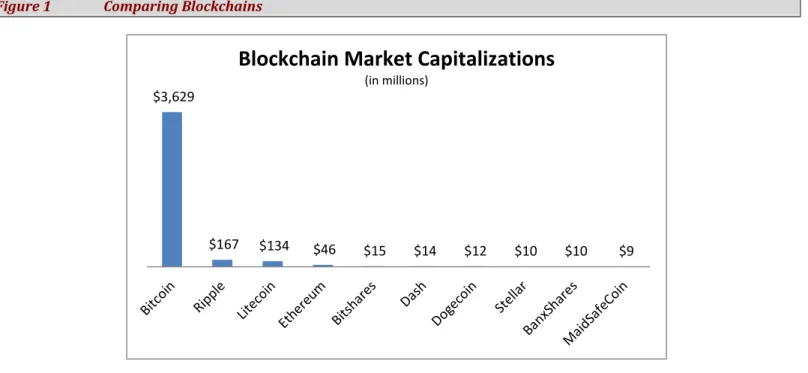
Alternative blockchains (“alt chains”) is one approach to leveraging blockchain technology for applications beyond Bitcoin the digital currency. In this case, “alternative blockchains” refers to any blockchain other than the most popular one— the Bitcoin blockchain. They come in a wide variety of forms—each designed to either improve on a real or perceived weakness of the Bitcoin blockchain (e.g., transaction size/speed) or to facilitate functionality that isn’t natively supported by the Bitcoin blockchain. The question is whether the advantages of these blockchains will be sufficient to overcome the huge network effect advantage of the Bitcoin blockchain. Furthermore, the Bitcoin blockchain protocol is not static and could incorporate the features of alternative blockchains and potentially render them obsolete. To date, no alternative blockchain has come close to the value/size of the Bitcoin blockchain. While we see it as highly unlikely that an alternatively blockchain will supplant the Bitcoin blockchain as an open payment network, we recognize that, for certain use cases, the advantages of an alternative blockchain (public or private) could be sufficient to justify an alternative independent blockchain.
Figure 1 Comparing Blockchains
Source: Coinmarketcap.com, 10/11/2015.
While none of these alternative blockchains comes close to the value of the Bitcoin blockchain, a direct comparison isn’t appropriate for all. For example, Litecoin competes directly and is designed to be a better Bitcoin, but Ripple and Ethereum address different use cases altogether: private blockchains and smart contracts, respectively.
Alternative blockchains is a broad term that encompasses many different blockchain strategies. One subset of alternative blockchains is private, permissioned or federated blockchains. In contrast to the completely open and permissionless nature of public blockchains (where anyone can participate in the network and/or validate transactions), this strategy restricts transparency, access, and/or transaction validators on the network. The basic concept is to leverage blockchain technology for use cases where the perceived risk of complete openness and accessibility outweighs the risk of trusting one entity or a group of entities. As transaction validation is restricted from an unlimited number (as on the Bitcoin blockchain) to a group of validators (as on a federated blockchain) to a single validator (as on completely private blockchains) network participants place an increasing amount of trust on the validators: from none in the case of the Bitcoin blockchain to a very high level of trust in the case of a completely private blockchain. For some use cases, particularly where the counterparties on the network know each other, this introduction of trust may not be problematic. This partly explains why there has been heavy exploration of private blockchains as a means for banks to conduct business with each other.
Colored Coins
Colored coins is another approach to extending blockchain technology beyond the transacting of digital currency. In contrast to “alt chains,” the colored coins approach uses the Bitcoin blockchain. Colored coins are miniscule, cryptographically unique fractions of a Bitcoin that have been explicitly demarcated to represent another asset (other than the trivial amount of Bitcoin that it is tied to) such as shares of a company, bonds, currencies, or another asset.
The advantage of the colored coins approach is that it captures the network effect of the Bitcoin blockchain, uses regular Bitcoin transactions, and will inherently leverage
$3,629
$167 $134 $46 $15 $14 $12 $10 $10 $9
Blockchain Market Capitalizations
(in millions)
future advances of the Bitcoin protocol. The downside is that transacting directly on the Bitcoin blockchain limits the features and functionality of colored coins to that of the Bitcoin protocol. Additionally, there’s concern that widespread adoption of such an approach could “bloat” the Bitcoin blockchain (a concern that revolves around the current size limit and transaction speed of blocks on the Bitcoin blockchain). Nasdaq is using the colored coins approach as part of an enterprise-wide blockchain initiative whose first goal is to leverage colored coins and the Bitcoin blockchain to trade private company (pre-IPO) shares.
Sidechains
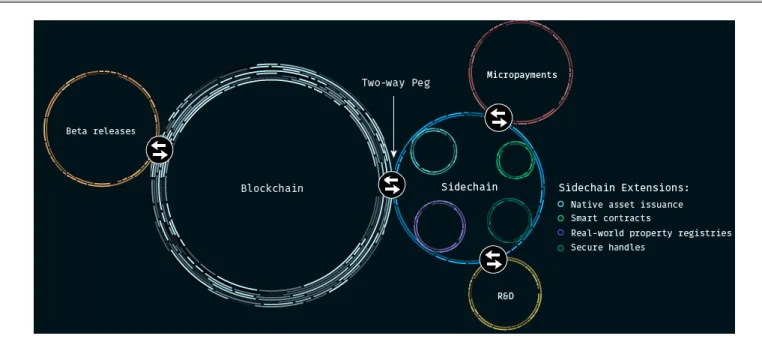
Sidechains are alternative blockchains that are linked to the Bitcoin blockchain via a two-way peg—thus allowing users to seamlessly transition between the alternative blockchain and the Bitcoin blockchain. If successful, sidechains could be the Goldilocks approach, as it would allow sidechains the freedom to optimize their respective blockchain for specific features while also allowing them to leverage the network effect of the Bitcoin blockchain. While this functionality is new to digital currency, it is a centuries-old solution in that the relationship between a sidechain and the Bitcoin blockchain is fundamentally analogous to the relationship between a gold-backed currency and gold itself.
Figure 2 Visual Illustration of Sidechains
Source: Blockstream.
The Show Will Go On
While this is a notable area of uncertainty whose resolution will be determined by the market as businesses select an approach to build toward, the debate will largely go unnoticed by end-users and should not greatly affect the development of applications. Regardless of whether alternative blockchains, sidechains, colored coins, or another development are the way forward for blockchain technology, these competing projects have more in common than they have in difference and whatever differences they have are greatly overshadowed by their common structural advantages.
Simon McNamara, Chief Administrative Officer, RBS
Brief Technical Explanation
We offer a brief step-by-step description of how a Bitcoin transaction is added to the Bitcoin blockchain. For a more detailed technical explanation of how the Bitcoin blockchain works, we recommend the original Bitcoin whitepaper by Satoshi Nakamoto and other resources from Bitcoin.org. While other blockchains function similarly, they each have their own intricacies. We recommend addressing the original whitepapers for each of these blockchains for complete technical explanations.
A Bitcoin transaction:
1. Alice wants to send Bitcoin to Bob. She submits a transaction to the network.
Alice is attempting to change the record of ownership of the Bitcoin in
question from herself to Bob. To do this, she sends a message to the network and uses her public and private key (public key cryptography) to prove that she is the current valid owner of the Bitcoin in question. Alice identifies the receiver by including Bob’s public key in the transaction. Once the transaction is processed, Bob will use his private key to prove he is the owner of the public key to which Alice has ascribed ownership.
2. This transaction information is broadcast out to the nodes on the network.
3. Nodes receive information about this transaction and all other
transactions occurring around the same time and verify that for each transaction the person who is sending Bitcoin is the rightful owner and has not already spent it.
4. Nodes work to incorporate the transaction into the ledger of all valid transactions that have ever occurred.
5. Nodes take all the transactions that have occurred recently and aggregate
them into a block, which each node will independently try to add to the publicly recognized valid ledger (blockchain).
6. The transaction processors (miners) then try to solve a proof-of-work that
is essentially a randomized math problem that requires computing power (and the associated energy consumption) to solve.
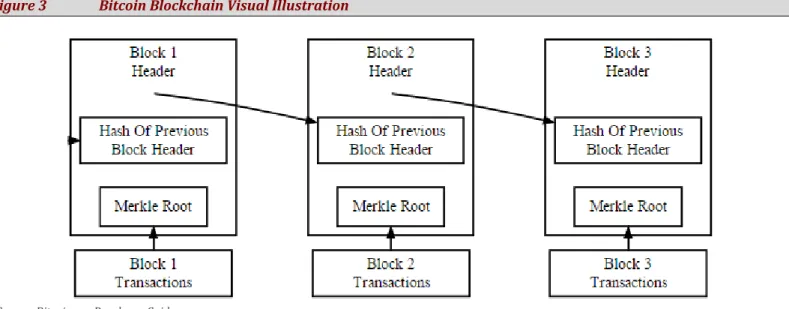
7. Once a miner solves the proof of work, they broadcast the solution and group of transactions to all the other nodes who then incorporate the block into their versions of the ledger—thereby adding it to the blockchain and validating the transaction. This block is then a necessary input into the mathematical puzzle for the next block to be added, thus linking the blocks together and creating a “blockchain.”
“I don’t know what’s going to succeed. What I’m certain of is that we are going to see blockchain solutions, peer-to-peer solutions emerging in our industry and we want to be close to that development.”
Figure 3 Bitcoin Blockchain Visual Illustration
Source: Bitcoin.org Developer Guide.
Structural Advantages of Blockchain Technology
As we’ll see throughout the various applications that follow, there are several recurring advantages of blockchain technology. However, because blockchains differ structurally from one another in several important ways, the advantages that follow manifest to varying degrees (or not at all) in any given blockchain. The broad, frequently recurring advantages that we have identified include durability, process integrity, transparency, immutability, longevity, reliability, and availability. For now, only the Bitcoin blockchain can claim them all.
Durability
Public blockchains operate on decentralized networks as opposed to a central server or network of servers. Without a central point of failure, distributed ledgers are significantly more durable than today’s centralized systems and better able to withstand anything from malicious network attacks to power outages. The Bitcoin blockchain, for example, runs on thousands of nodes (over 5K) around the world.
Process Integrity
By nature, distributed open-source protocols execute exactly as their code dictates— removing the need to trust a third party to execute any given transaction (money, data or otherwise). With a robust blockchain like the Bitcoin blockchain, users can be certain that transactions will be executed exactly as the protocol commands. Relative to trusting a third party, this greatly improves process integrity/execution surety. One implication of this process integrity improvement (quicker adoption timelines) is described in the implications section that follows.
Transparency
As distributed publicly viewable ledgers, public blockchains have inherent transparency advantages in that any changes to the ledger are public so, whether the service utilizing the blockchain is a smart contracts platform or a value transfer application, any changes are apparent and traceable. Private blockchains tend to optimize this transparency for their various applications—some being relatively opaque and others being nearly as transparent as a public blockchain.
Immutability
Records that are validated onto a well-distributed public blockchain—such as the Bitcoin blockchain—are practically immutable. This allows processes and applications enabled by blockchains to operate with the highest degree of confidence that they have a complete and unaltered history of activity. This is crucial for many applications enabled by blockchain technology such as payments protocols, securities settlement networks, and systems integrity applications. In these instances, anything less than a complete and unaltered history of transactions/activity on the blockchain creates a huge risk for honest users and a huge opportunity for potentially fraudulent users.
Longevity
Devices, services, and applications that offload their critical transaction processing functionality to a public blockchain that is independent of the device manufacturer, service provider, or application developer, can instill confidence in consumers and users that the device, service, or application will continue to function for a long time—even if the device manufacturer, service provider, or application developer goes out of business, loses interest in it, or subsequently wishes to manipulate the transaction processing function. This is particularly relevant to device manufacturers for the Internet of Things, where the confluence of long lifespan and low-cost products coupled with the burden of centralized operation (such as the maintenance of server-farms) drive a strong incentive to offload critical transaction processing functionality to a blockchain.
Reliability & Availability
A well-distributed blockchain with a high level of redundancy can be considered highly reliable because the failure of any particular node or group of nodes does not compromise the blockchain’s transaction processing capabilities. Similarly, because the data and information contained within a well-distributed blockchain is available for access from hundreds or thousands of nodes, it is also highly available.
Implications of Structural Advantages
Disintermediation & “Trustless” Exchange
Among the greatest gains of blockchain technology and perhaps the single greatest contributor to its economic advantage stems from its ability to instill trust between two transacting parties without third-party intermediation. Said simply, blockchain technology allows one entity to confidently transact value directly with another entity without relying on a third party to stand between them and ensure that each honors the transaction agreement. Eliminating the need for third-party intermediation goes a long way toward removing friction and creating efficiency in all types of value exchange.
Empowered Users
A common theme evident in the applications of blockchain technology that are discussed in this report—and a direct effect of disintermediation—is that users are increasingly in the driver seat and in control of all their information and transactions. Examples throughout this report showcase users in control of their own financial data, their money, their personal documents, and their personal identity.
Data Will Be Better than Ever
Blockchain data is high quality in terms of completeness, validity, consistency, timeliness, accuracy and availability. Furthermore, because the data is essentially stored in a giant public data base (the distributed ledger), it is highly accessible. Aside from data contained within a blockchain, what can be done with proprietary data will also be greatly improved: individuals and businesses will be able to leverage blockchain technology to store data in the cloud without any complete copies in any one place—eliminating the opportunity for the dataset to be compromised by hackers or insiders. Businesses will also be able to run analytics in the cloud without revealing the complete dataset to anyone—thereby eliminating the inherent vulnerability of centralized storage and analytics.
Faster Growth and Adoption Times
Traditionally, businesses grow and attract users by operating honestly and building trust over time. Depending on the business or industry, this can be a long process that hinders the growth and adoption of new businesses and services—particularly at the outset. What would be helpful for these businesses would be the ability to independently prove that they will do what they claim to do, that they’ve handicapped their own role to prevent interference, and that their device, service, or application will continue to perform its critical function even if the company goes out of business. Blockchain enables businesses to do this. Device manufacturers, service providers, and application developers can offload their critical transaction processing function to a blockchain such that it can be independently reviewed, cannot be interfered with, and will continue to function independent of its original sponsor.
Blockchain Applications & Use Cases
The potential applications of blockchain technology are vast and the most fruitful applications of the technology may yet be developed. We have identified eleven applications of blockchain technology that we think are particularly interesting to explore in greater depth. At the back of this report, we profile some of the leading companies and services in several of these application areas.
As a framework for identifying the most promising applications of blockchain technology, we examined the areas where the advantages of blockchain technology are greatest relative to the status quo—the applications where blockchain best
addresses pain points and adds value. We expect that much of the initial success
with blockchain technology will center on applications that improve existing processes and services. That is, applying the disruptive technology (blockchain) to sustaining innovations.
We believe that the second stage of innovation for blockchain technology will more fully leverage the opportunities of an open and permissionless value layer of the internet to create truly innovative processes, services, and applications that were not previously possible.
Payments
To the payments industry, and the $425 billion in transaction-related revenues
generated1 blockchain technology could bring improvements in security (users fully
1Global Payments 2014, The Boston Consulting Group (September 2014)
in control of payment info), speed (faster settlement times), access (no bank account required), and cost (reduced/more efficient infrastructure).
In terms of privacy and security, blockchain-based payments are “push” rather than “pull” transactions: Users send defined funds (push) without providing the merchant with their personal bank account information which the merchant otherwise stores and uses to withdraw funds (pull). Consequently, using a blockchain for payments allows a user to isolate their payment information and pay without disclosing and storing their financial or credit card information with the merchant—stored data that creates an attraction for thieves and hackers. In light of recent high-profile breaches at the likes of Home Depot (56 million cards compromised), Target (40 million cards compromised), Michael’s (2.6 million affected), and many others, this could be one of the most important features of blockchain technology for the payments industry. Forward-thinking companies have picked up on this security feature: Apple Pay and Google Pay are “token” systems that allow a user to pay without giving the merchant their financial information. Instead, Apple (or Google or PayPal) stores the information and uses a cryptographic token that represents your financial/credit information. The token is used to charge your card for that transaction but it can’t be used again. While this greatly reduces the number of places that a user’s payments information is stored (and, consequently, the number of breach opportunities), it still leaves one centralized risk: Apple and Alphabet (GOOG – BUY) themselves.
In contrast, with a blockchain-based payments system, the user stays fully in control of their account information and is never forced to provide it to third parties—which otherwise store the payment information and consequently attract thieves and hackers.
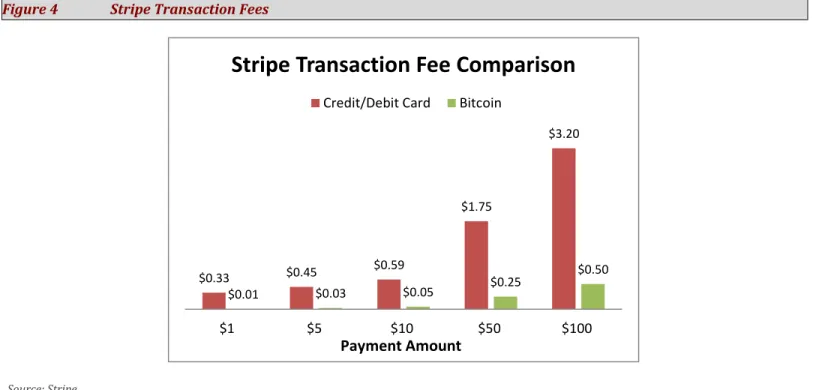
From a merchant point of view, blockchain-based payment networks may be preferred because there’s no inherent processing fee (although some services will automatically process digital currency payments and convert to local currency for around 0.50%), they can open their business to users worldwide, avoid chargeback fraud, and circumvent the cost and risk of storing users’ payment information. Delving deeper into the issue of cost: Merchants that rely on payment processors can save 80-90% on transaction fees with Bitcoin payments relative to traditional credit/debit card payments. Merchants are charged an average of roughly 3% to accept a credit/debit card at their business but can accept Bitcoin payments for much less. For example, Stripe normally charges merchants a 2.9% processing fee in addition to a flat $0.30 per transaction, but the company only charges 0.5% to accept Bitcoin payments. Similarly, Braintree (PayPal subsidiary) doesn’t charge a fee for the first $1 million that a merchant accepts in Bitcoin and subsequently charges 1% per transaction after the $1 million threshold is passed. Both services leverage Coinbase (private company) to enable this functionality.
Figure 4 Stripe Transaction Fees
Source: Stripe.
The cost advantage manifests in a similar fashion for corporate payments, where blockchain-based networks could become the connective tissue that allows what are otherwise relatively siloed payment systems to communicate and exchange in real-time with complete confidence.
The other big advantage that blockchain technology brings to the payments industry is settlement time. Most credit and debit card transactions don’t settle for several days after a payment. However, Bitcoin-based payments settle much faster: anywhere from near-instantly to a couple of hours (depending on the degree of confidence necessary for the transaction).
In turn, this quicker settlement time is the source of another big cost advantage of blockchain technology for the corporate payments market: the cost of float. International payments typically take over two days to settle and during that settlement time companies are forced to let cash sit idle instead of earning a return. Furthermore, foreign exchange costs could be reduced by two factors: 1) quicker settlement times reduce exchange risk; and 2) the introduction of competitive foreign exchange marketplaces (such as Ripple’s) could produce more competitive rates for cross-border corporate payments.
Not only can blockchain-based payment systems improve on traditional industry metrics, they are also enabling new functions such as “micropayments” or “nanopayments.” Historically, there’s been a fixed cost associated with payments that has made it economically impractical to use traditional payment networks for very small transactions (usually a fixed fee of around $0.30 per transaction). However, with blockchain-based payment networks, users could transact very small amounts such as micro- or nanopayments for each page viewed on a website (paid seamlessly in real-time).
For example, blockchain-based payment services present the possibility of paying for access, such as to the Wall Street Journal, not on a monthly subscription basis but on a per-article basis or, perhaps even more likely, on a per-page-read basis. From a user standpoint, this is a favorable closer alignment between value received and cost paid
$0.33 $0.45 $0.59 $1.75 $3.20 $0.01 $0.03 $0.05 $0.25 $0.50 $1 $5 $10 $50 $100
Stripe Transaction Fee Comparison
Credit/Debit Card BitcoinPayment Amount
and is a further extension of an ongoing trend in other industries, such as the shift in software from perpetual licenses deals to subscription models.
This is just one of the potentially many opportunities that will contribute to a large expansion in digital value exchange as blockchain technology reduces friction and drives down cost significantly.
Trends on the Bitcoin network (as seen in Figure 5) are generally up and to the right—especially in terms of average daily transaction count and the number of unique addresses used. There’s a slight slowdown in 2015 for estimated daily transaction volume and in total transaction volume. Because other usage metrics have increased significantly, we attribute the slowdown to the price of Bitcoin which is down more than 50% from an average of $527 in 2014 to an average of $248 in 2015.
In addition to the cost, speed, and security/privacy advantages, blockchain-based payments have an access advantage and a potential innovation advantage. Permissionless blockchain-based payment networks like Bitcoin have an access advantage because they don’t require a bank account—thus opening the networks to the half of the world’s population without a bank account. Lastly, as a particular network achieves critical mass, there is an innovation advantage from being an open network on which entrepreneurs and developers are free to build.
Figure 5 Bitcoin Market Data
Average Daily Unique Addresses Used Average Number of Daily Transactions
Median Daily Transaction Volume (thousands) Total Transaction Volume (millions)
Source: Blockchain.info 10/6/15. 10,317 23,351 67,476 154,565 226,422 2011 2012 2013 2014 2015 5,207 23,081 53,805 69,200 112,275 2011 2012 2013 2014 2015 $408 $1,349 $19,845 $53,671 $50,776 2011 2012 2013 2014 2015 $418 $607 $14,767 $23,160 $19,515 2011 2012 2013 2014 2015E Page 14 of 57
Exchanges
Blockchain technology’s most natural application is in digital value exchange, and we believe it will have a profound impact on the structure of financial markets— specifically in regard to clearing and settlement processes. There are two primary types of blockchain-related applications to discuss here. First, there’s digital currency exchanges, which facilitate the buying and selling of digital currencies like Bitcoin. Second, there are the companies creating the platforms and software to facilitate the exchange of other digital assets (equity securities, bonds, energy credits, gift cards, mobile minutes, etc.).
Bob Greifeld, CEO, Nasdaq
Digital currency exchanges—which facilitate the buying and selling of digital currencies such as Bitcoin—are tangentially related to blockchain technology in that they serve as strategically positioned on- and off-ramps to the world of digital currencies. There are only two ways to acquire Bitcoin, for example: mine for it by processing transactions and collecting the associated Bitcoin rewards or buy it with another currency. However, considering that transaction processing is confined largely to specialists with highly optimized equipment, the vast majority of digital currency acquisition ultimately takes place through an exchange. Some of the most popular digital currency exchanges in the world include Coinbase, itBit, Kraken, Bitstamp and Bitfinex.
These digital currency exchanges are well positioned in the emerging blockchain ecosystem where, regardless of the use case, digital currency serves largely as the lifeblood of blockchain applications.
In terms of disruptive impact, however, blockchain technology’s biggest contribution is likely in the exchange of assets beyond digital currencies. Blockchain technology will likely have a drastic impact on post-trade processes such as clearing and settlement for a broad array of digital assets, including equity securities (private and public), debt securities, energy credits, gift cards, and mobile minutes.
When applied to digital asset exchange, blockchain technology could bring significant improvements in speed and cost. In stark contrast to the traditional three-day settlement timeframe that dominates modern financial markets, a clearing and settlement network built on blockchain technology could facilitate near instant settlement. The U.S. moved to a three-day framework in 1996 (from a five-day process) and considering the advancements in speed, connectivity, and technology since then, a major upgrade is in order.
Adam Ludwin, CEO, Chain
“As blockchain technology continues to redefine not only how the exchange sector
operates, but the global financial economy as a whole, Nasdaq aims to be at the
center of this watershed development. The benefits to the industry are immense
and cannot be ignored”
"While the technology to exchange messages for trade is fast, the technology to
actually move the asset and settle them is slow and very expensive. The
opportunity here is to bring asset transfer into the 21st century and that's
something we couldn't do easily before the blockchain
."
As it stands, trading a digital security such as a stock requires a series of intermediaries that add cost, delays, points of failure, and vulnerability to the exchange process. Consultancy Oliver Wyman estimates that globally these processes add $65-80 billion in costs each year2. Fundamentally, blockchain technology was built to cut through these intermediaries and allow counterparties to confidently transact directly with one another.
The post-trade process consists largely of distributing and duplicating data across relevant counterparties to transfer the title of an asset in a way that protects counterparties from each other. However, this results in costly and time-consuming reconciliation processes across intermediaries. In contrast, blockchains are shared infrastructure that solve the data synchronization and trust problem by replicating data throughout a network. This shared blockchain infrastructure performs the function of many intermediaries, facilitates real-time information exchange and drastically minimizes error rates—all of which should reduce settlement times (to nearly instant) and bring significant cost savings to the exchange of digital assets. Beyond the exchange of securities, blockchains are also being used to register digital asset ownership and to issue digital assets—which are necessary first steps before these assets can be exchanged on a blockchain. For example, Digital Asset Holdings recently helped Pivit (a live-odds and prediction platform) issue a portion of its latest funding round directly on a blockchain. Similarly, Nasdaq private markets is working with Chain to leverage blockchain solutions for the exchange of private market securities—Chain also plans to issue its own pre-IPO shares directly on this blockchain. Lastly, Overstock.com leveraged its own cryptosecurities trading platform, tØ, to issue a $5 million “cryptobond” via blockchain technology.
Among the companies creating the software, platform and networks to facilitate blockchain-enabled clearing and settlement processes, we note leading companies Chain, Digital Asset Holdings, itBit (Bankchain), Ripple Labs, and tØ.
Smart Contracts
Blockchain-enabled smart contracts could bring tremendous advantages and innovation to the digital world. The basic premise of smart contracts is to reduce mutual agreements between businesses, individuals, or machines to software code that self-executes and self-enforces. This functionality could greatly reduce costs and risks for businesses and individuals.
Smart contracts can be viewed as a software protocol that performs a function when certain conditions are met. In his 1997 paper, “Smart Contracts: Building Blocks for
Digital Markets,”3 the pioneering thought leader behind smart contracts, Nick Szabo,
described vending machines as operating via a basic smart contract mechanism in that they deterministically release an item when the correct value is submitted and the selection is made.
Outlining the future potential of embedded smart contracts, Szabo highlighted (in 1997) an example that today may not be far from reality: A smart contract between a bank and a car buyer which specifies that the customer has rights to the car so long as they make their payments and, if they fail to do, the contract returns control of the car’s digital keys to the bank. This process happens automatically, transparently, and at a lower cost than alternative measures.
Blockchain-based smart contracts can add this same functionality to a broad array of daily tasks and applications. The idea of smart contracts is relatively straightforward: A software protocol performs an action (releases funds, sends information, makes a
2The Capital Markets Industry, Oliver Wyman (2014)
3 Nick Szabo, Smart Contracts: Building Blocks for Digital Markets, (1996)
purchase, etc.) when certain conditions are met (a payment is received, the outcome of an event is determined, etc.).The advantage of blockchain-based smart contracts is that they reduce the amount of human involvement (billable hours from attorneys and accountants) required to create, execute and enforce a contract—thereby lowering its cost while raising the surety of execution and enforcement.
One of the challenges of smart contracts is how to ingest the trigger event to fire up the engine of the smart contract. For digital events and transactions, the solution is relatively simple: For example, a record of payment can easily be recorded and ingested with little dispute. The task becomes more challenging as we move to events in the physical world to trigger the contract. Solutions for this functionality include multi-signature transactions, prediction markets, and oracles.
Multi-signature transactions simply require some subset of the parties to agree that the terms have been met, thereby triggering execution of the contract. An example is a digital transaction between a buyer and seller that may also involve a third party “trust/escrow agent.” In this instance, the payment will be transferred to the seller if two of the three parties agree that the terms have been met: First, it will be between the buyer and seller and if they both agree there’s no need to involve a third party but, in the case of a dispute, a third party can step in to cast a tie-breaking vote as to whether or not the terms of the contract have been honored. In the marketplaces section that follows we highlight how an open marketplace of escrow or trust agents could provide this service reliably at low cost.
Prediction markets: The basic premise behind prediction markets is that the wisdom of the crowd is more accurate at predicting events than any expert. Prediction markets take this premise and add an economic incentive for genuine participation: Individuals can take the “yes” or “no” side of any event occurring and receive a payout according to the probability of the event occurring relative to its ultimate outcome. Traditional prediction markets are dogged by securities regulation in the U.S. but some decentralized alternatives, such as Augur (which is enabled by smart contracts platform Ethereum) aim to provide the same service and avoid regulatory burden by being strictly peer-to-peer.
Oracle services are another potential solution as to how events from the physical world could reliably be registered in the digital realm. Oracle services are third-parties that verify the outcome of events and feed the data to smart contracts data services.In short, smart contracts automate an exchange of value based on pre-specified conditions. They have a vast array of use cases in ecommerce, funding, gambling, legal services, digital property, machine-to-machine (M2M) communications, and access/admission control, among others. We’ve included a brief explanation of a few use cases below:
Ecommerce: Smart contracts help facilitate trade and business between consumers on the internet by reducing counterparty risk (self-executing contracts that boil down to transparent logic) and reducing the costs of transacting by minimizing the amount of human involvement in the process.
Internet of Things (IoT): Smart contracts could also be instrumental to machine-to-machine communications, where devices transact with each other autonomously according to predefined criteria. For example, an autonomous vehicle could pay for its own parking spot after it has dropped off a passenger. (We explore this further in the “Internet of Things” section.)
Access/admission control: An AirBnB host could automatically provide digital keys to their smart-home after receiving payment and buildconditions such that the digital keys become inoperable after the paid length of stay.
Funding (scholarship funds, unemployment, etc.) could be released according to conditions such as classroom attendance or anything else that can be verified digitally.
Gambling: Blockchain-based gambling inherently uses smart contracts to release funds to winning parties according to the outcome of the game.
Estate planning: Smart contracts could be used to release a will to the appropriate parties, or to disperse assets, upon death.
Digital property (such as digital art): Smart contracts could be used to facilitate the transfer and licensing of proprietary content.There are several different companies, groups and organizations forming platforms to facilitate smart contracts—the most prominent being Ethereum. Aside from the platform for smart contracts, leading companies such as IBM, Samsung and UBS are exploring how to integrate smart contracts into their products and services.
Internet of Things
Arvind Krishna, Sr., Vice President and Director of IBM Research
As we move from billions of connected devices to hundreds of billions of connected devices, the mode of governance and operation of these devices’ smart functionality and connectivity will be increasingly important. Traditional centralized computing models (cloud or otherwise) are sub-optimal for the Internet of Things in many regards, including security, privacy, scalability, longevity, and interconnectivity. At the forefront of this problem is the issue of privacy and security. As consumers connect everything from their cars to their thermostats, they simultaneously produce a rich data history that includes intimate details of their daily life. Used correctly, this rich data is very valuable but the challenge is preventing its abuse. The best way to prevent the abuse of smart devices and the data that they generate is to avoid collecting it on and processing it through centralized systems. The centralization itself inherently enables governments, insiders, and other intruders to use and abuse the devices and generated data—with or without consent of the centralized entity itself.
There are many other significant drawbacks of a centralized model for the Internet of Things, including the fact that centralized systems inherently create points of failure, have a tendency to create walled gardens (which could limit interconnectivity between devices from different manufacturers), a lack of transparent and independently verifiable operational integrity, and a longevity challenge.
The points of failure inherent in centralized systems and the tendency to create walled gardens that limit interconnectivity are relatively straightforward and
well-"[Blockchain is] a completely novel architecture for business—a foundation for
building a new generation of transactional applications that establish trust and
transparency while streamlining business processes. We believe blockchain is an
extraordinarily important phenomenon, which is why IBM is deeply engaged in
moving it forward."
understood, but the other challenges of verifiable operational integrity and longevity warrant further discussion.
In regards to operational integrity, the problem lies in verifying that a smart, connected device has not been altered to operate outside its proper function. For example, it is important for the passenger of an autonomous vehicle to be able to independently verify that the vehicle’s systems have not been altered to operate differently than intended—such as an alteration to drive at unsafe speeds or to deliver the passenger to the wrong location. Given that anything “connected” is potentially vulnerable to manipulation, the solution here is not security through obscurity, but instead, security through transparency, which then allows the state or integrity of a device to be independently verified against a history of previously valid states. Companies like Guardtime are already using blockchain technology to do this for customers and partners such as Lockheed Martin and Raytheon, which need to be absolutely certain of the operational integrity of their defense systems. While defense systems are an extremely high-value-add use case and, consequently, the first implementation, we expect that this same type of systems integrity solution will be critical for consumers and businesses in the Internet of Things.
In regards to the longevity challenge, the problem lies in the ongoing operational costs associated with maintaining connected devices in a centralized fashion. Consumers of smart products want to be sure that their device’s smart functionality will continue to operate properly far into the future. In a centralized model, it will be difficult for all but the world’s largest device manufacturers to convince consumers that the company will still be operational and able to maintain the device’s functionality for the next 3, 5, or 10 years (aside from the question of whether this is economically feasible or desirable for the manufacturer). Furthermore, this is particularly concerning in that it creates a very high barrier to entry and, consequently, limits the speed on innovation in the industry.
To address the longevity challenge, device manufacturers are arguably better off discharging some of this burden to a distributed blockchain in a way that consumers can be confident that their device’s smart functionality will continue to operate regardless of whether the original manufacturer is around (not out of business) or retains an interest (economic incentive) to do so.
Figure 6 Blockchain and the IoT
Source: Veena Pureswaran and Paul Brody, Device Democracy, IBM Institute for Business Value.
The operation of connected devices and all computing ultimately boils down to data transaction processing. That is, with input X, perform action Y. That data transaction could be anything from sending and posting a Facebook (FB – Buy) update to uploading a file to Dropbox. However, as we move to a world of increasingly connected devices we need a way to eliminate trust from the data transaction in order to remove any uncertainty around processing. In the same way that blockchain technology solved the “trust” challenge of value transactions over the internet (via Bitcoin), blockchain technology can also solve the “trust” problems associated with other transaction over the internet—in this case, the data transactions originating from the Internet of Things.
In a research paper, IBM highlights this possible future for the Internet of Things: “In our vision of a decentralized IoT, the blockchain is the framework facilitating transaction processing and coordination among interacting devices. Each manages its own roles and behavior, resulting in an ‘Internet of Decentralized, Autonomous Things’ – and thus the democratization of the digital world”.4
The blockchain could ultimately play three critical roles for connected devices: 1) immutable record of device identity; 2) the foundation for smart contracts; and 3) the exchange of value between devices.
For a more detailed evaluation of the benefits of a decentralized foundation for the Internet of Things, we recommend IBM research paper “Device Democracy: Saving the Future of the Internet of Things” and Filament’s “Declaration of Device Independence.”
Cybersecurity
In the same way that the integrity of a Bitcoin transaction is confirmed by an audit of the blockchain before it is processed, so too can the integrity of data, systems, and networks be verified with a blockchain. This powerful verification ability enables real-time detection of data manipulation and real-time verification of systems integrity.
Figure 7 CIA Triad of Cybersecurity
Source: Guardtime.com.
4 Veena Pureswaran and Paul Brody, Device Democracy, IBM Institute for Business Value (2015).
Within the CIA triad (confidentiality, integrity, availability) of data security, blockchain technology is particularly well suited to address the integrity aspect. This is done by verifying the state of data, systems or networks against their previous states (which are recorded on a blockchain) and against the record of valid “transactions” (data actions such as transportation, processing, etc.) that has happened since (also recorded on a blockchain).
We note Guardtime as the leader in this space with its KSI blockchain and solutions.
Documentation
Record keeping is the very essence of blockchain technology and, consequently, it has tremendous potential value as an immutable and chronological documentation tool. We touch on this feature of blockchain technology in other sections of this report but are dedicating a section here in order to more explicitly detail the value of blockchain technology in this respect.
First, a point of clarification: Immutability is the primary advantage that blockchain technology brings to documentation. However, any given blockchain can only be described as immutable if its records are secured and cannot be changed. At this point in time, only the Bitcoin blockchain can be described as immutable. This is because the Bitcoin blockchain is secured by “proof of work” calculations which are performed dynamically by thousands of high performance computers around the world.
Using the immutable chronological record that is the Bitcoin blockchain, a time-stamped record of existence can be created in such a way that the creator of the record can later prove irrefutably that a particular document (or image, video, etc.) was in existence at that point in time. This is done by creating a hash of the document which is then stored in the memo field of a deminimis Bitcoin transaction. When that transaction is recorded into the Bitcoin blockchain, so too is the hash of the document. That hash (not the document itself) is now essentially written in stone—a stone that anyone can see and verify. At any later point in time, the user can produce the document and prove that it existed at the time of the transaction by matching the hash of the document they’ve produced to the one stored in the blockchain. The hashes will only match if the document has not been changed and is in exactly the same state as when it was hashed onto the blockchain, thus verifying and ensuring the document’s integrity.
This immutable record-keeping functionality could be particularly appealing for a wide variety of legal documents, for verifying intellectual property and, more broadly, for any time-sensitive documents that require verification and time-stamping (traditionally served by notaries). It could also be used as a measure to counter corruption and retain better records for internal purposes within an enterprise or government body.
For example, the Honduran government has explored, via a proof-of-concept, whether Factom’s blockchain-based record-keeping service could help counter corruption in the country’s land registry—where some officials with access to the land registry awarded themselves premium property unjustly.
Digital Identity
Blockchain technology could provide the infrastructure to scale digital identity at extremely low costs with significant improvements in security. Think of it as next-generation passwords. Given that consumers rely on passwords to access everything from social media to smart-homes to payment verification, the potential use cases for
blockchain-based digital identity services are vast and of increasing importance as digital identity verification becomes a several-times-a-day task.
The technology also has repercussions for businesses and individuals. Previously, reputation and identity systems have been maintained on a site-by-site basis. A seller on Amazon must build up a good reputation by being honest and serving their customers. Unfortunately, that reputation isn’t portable. If they want to start selling their goods on eBay, they have to start from scratch to build their reputation. Now, several blockchain-based identity services are providing this service in a highly portable way so that reputation can be established through all honest dealings on the internet.
The advantage for users is that a blockchain-based digital identity service could enable consumers to retain better control of their information (both their payment and identity information), as well as enabling seamless payments (for digital identity services that are tied to a digital wallet). In terms of information control, users will better be able to isolate the personal information they’re willing to share with a website by using an independent blockchain-based identity service as opposed to social media accounts. Further, because blockchain-based identity verification services can operate at a fraction of the cost of traditional providers (discussed below), merchants and credit card companies are likely to verify identities more frequently—which consequently reduces the risk of fraud for all honest people that transact on the internet.
For businesses, a blockchain-based digital identity service could facilitate more seamless payments and lower the costs of identity verification. In terms of payments, if a user logs in with a blockchain-based identity service that’s tied to a payment method, it eliminates a step (entering payment info) in the transaction process relative to existing identity verification tools (i.e., login with Facebook, LinkedIn (LNKD – Buy), or Twitter), which subsequently require the user to input their payment information and, consequently, increase the probability of cart abandonment. Using a blockchain-based payments service also has the other advantages for merchants (lower processing fees, no chargeback fraud, global access, etc.) that we highlighted in the preceding “payments” section. In terms of cost, blockchain-based identity services can perform the same verification at a lower cost because of the speed, automation, and security provided by blockchain-based providers relative to existing time consuming, and largely manual fraud prevention measures.
To imagine the privacy benefits to consumers, think of the number of times and places that you’re asked to provide your social security number—potentially your single most important personal identifier. As the saying goes, the security of your identity is only as strong as the weakest leak, and the more places your social security and other identity information is provided, the more likely hackers or others will be able to access it for nefarious purposes.
A Javelin Strategy & Research report5 estimates there were 13.1 million fraud victims in 2013. The report estimates that one in three people who received a data breach notification (from a retailer, for example) became an identity fraud victim. The problem is known and being addressed on one side: damage control. While the number of fraud victims rose to 13.1 million (from 12.6 million in 2012), the amount of damage fell by $3 billion to $18 billion, “reflecting more aggressive actions from financial institutions identity theft protection providers and consumers.” This data suggests that the industry is successfully tackling the symptoms—but the real challenge is to address the cause. In order to do that, users need to have better control over access to their personal information. Blockchain is one solution that enables users to retain better control of their personal identifying information (PII).
52014 Identity Fraud Study, Javelin Strategy & Research (February 2014).
Delivery & Consumption of Media and Professional Services
Blockchain technology brings new possibilities to streaming and the broader media industry in the form of direct-to-consumer, real-time, pay-as-you-go services. This new possibility stems from the peer-to-peer functionality of blockchain technology coupled with the low cost of transacting on a blockchain. The former could disrupt media distribution channels by connecting creators direct to consumers while the latter could enable micropayments and a closer alignment between media consumed and price paid.
In fact, content delivery platforms such as Apple Music and Amazon Kindle are already paying their content creators in this fashion: Apple pays artists based on the number of times users listen to their song and Amazon pays some Kindle authors based on the number of pages that users read. Again, blockchain technology is another extension of the present trend: Users paying according to actual usage metrics. As discussed in the preceding “Payments” section, these fees would be funded via a series of micropayments that are aggregated into a larger payment at the conclusion of a session.
Aside from connecting media creators more directly to consumers, this blockchain functionality could usher in a new era for services offered over the internet. Instead of booking a 30-minute or 60-minute appointment with the doctor (or lawyer or developer or a tutor), which the patient pays for entirely regardless of the amount of the professional’s time actually consumed (let alone the opportunity cost of commuting and wait-time), the patient could digitally conference their doctor and pay them directly, but only for the time they actually consume—all via a series of micropayments.
Decentralized Cloud Storage & Data Analysis
To cloud storage, blockchain technology could help facilitate new advantages in efficiency, price, durability security, and longevity. Decentralized, blockchain-based storage companies can leverage existing hardware storage to more securely store data with greater availability at a significantly lower cost. Instead of paying Amazon Web Services (AMZN - Hold), DropBox, or Google Drive to construct and maintain multi-million-dollar data centers, what if you could securely store your files on your neighbor’s hard drive? That’s the opportunity that decentralized, blockchain-based cloud storage presents.
This model has obvious efficiency and cost-advantages: Leveraging free capacity on hard drives already in existence is naturally more cost effective than building massive new data centers from the ground up. In the same way that RelayRides helps car owners generate income by granting others use of their vehicles, so too can decentralized, blockchain-based cloud storage services help computer owners generate income (however minimal) by allowing others to store files on their excess hard drive space.
Not only could a decentralized, blockchain-based storage service be more cost-effective than existing models, they’re likely more secure than existing services as well. That’s because mainstream cloud storage services maintain centralized servers where anyone who gets through external security (an admittedly difficult task) has access to complete versions of the documents stored within. In contrast, decentralized, blockchain-based storage services turn this model upside down by replacing expensive security measures with a software protocol. Instead of storing your document in one place, such as your own computer or on Dropbox servers, decentralized, blockchain-based storage providers shred your document into