and Loan-Related Documents
This report was commissioned by Christian Aid. The views expressed in this paper are those of the authors and do not necessarily reflect the view of Christian Aid.
Adrian Hewitt and Ian Gillson
1. Introduction ... 2
2. Objectives and Method ... 5
3. Results of the Study ... 6
3.1 Is Trade Policy Treated Explicitly in PRSPs?... 6
3.2 Is Trade Policy Being Informed by Descriptions and Analyses of Poverty? ... 6
3.3 Do PRSPs Discuss Trade Policy Options Explicitly?... 8
3.4 Do PRSPs Discuss Other National and International Factors Affecting Trade?... 8
3.5 How is the Content of any Trade Policy in PRSPs Formed and is it Consistent with the Views Expressed in the World Bank PRSP Sourcebook on International Trade? ... 8
3.6 Do the Trade Policy Components in PRSPs Inform Loan Documents (PRS-C and PRGF)? ... 9
4. The Influence of the WB and IMF on the PRSP Process ... 10
4.1 IMF and WB Analytical Work ... 10
4.2 The Consultative Process... 13
4.3 Trade Capacity Building in Developing Countries: The Integrated Framework ... 15
5. Conclusions and Recommendations... 16
Appendix 1: Country Notes ... 18
Albania ... 18 Bolivia ... 24 Burkina Faso ... 29 Ethiopia ... 37 Guinea ... 40 Guyana... 42 Honduras ... 51 Malawi... 56 Mozambique... 62 Nicaragua... 66 Rwanda ... 71 Tajikistan ... 75 Tanzania ... 79 Uganda... 82 Vietnam ... 86 Yemen ... 99 Zambia... 103
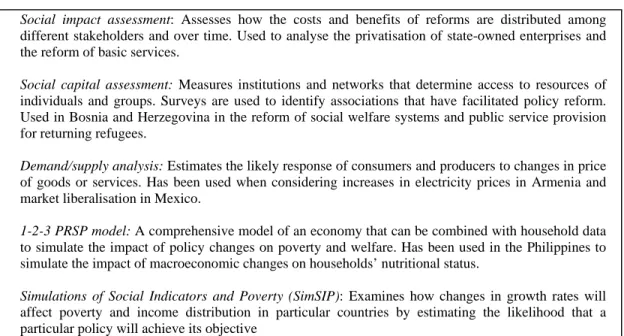
Appendix 2: Poverty and Social Impact Analysis... 114
Appendix 3: WB and IMF Approaches to Trade in PRSPs ... 117
References ... 118
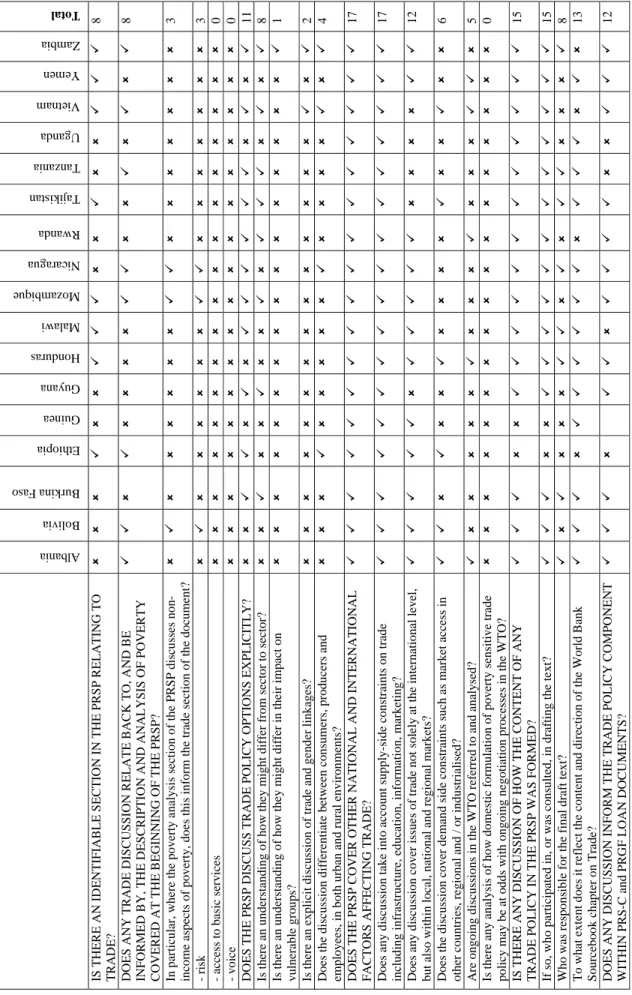
Figure 1: Summary Matrix of Trade and Poverty Content in PRSPs ... 7
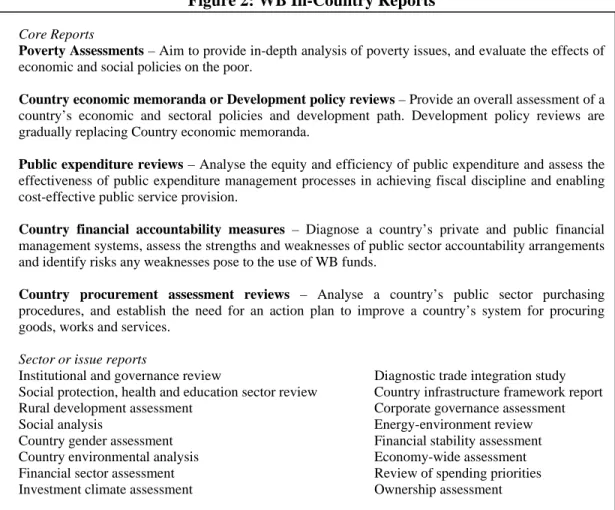
Figure 2: WB In-Country Reports ... 11
1
The authors would specifically like to thank Paul Ladd, Head of the Development Policy Unit and Chief Economist for Christian Aid, for his support and Zaza Curran, Research Assistant for the PRSP Monitoring and Synthesis Project at ODI, for helping to access the documents required for this report.
1. Introduction
It is an old adage that beggars cannot be choosers, but creditors have powers over
debtors too. This was seen most starkly in North-South relations in the two decades
which succeeded the brief era of ‘commodity power’ (1973-79) when structural
adjustment policies imposed on the weaker developing countries a ‘Post-Washington
Consensus’. This included among its ingredients trade liberalisation and market
openness without any of the preferential asymmetry to which poor developing debtor
countries, especially in Africa, would have been entitled to before or since.
The conditionalities associated with structural adjustment are now acknowledged by
both the World Bank (WB) and the International Monetary Fund (IMF) to have not
been a thoroughgoing success. With the urgent need for more flexible debt relief amid
continuing commodity earnings declines, came HIPC; with the renewed donor focus
on poverty came the Comprehensive Development Framework (CDF); and finally in
the late nineties, a donor- and creditor-led restructuring and refocusing of
development assistance and debt relief was devised and implemented based on
poverty reduction strategies and the related agreed national programmes and papers
(PRSPs). Aside from their spending-focus on domestic social (rather than
international, traded and production) sectors, PRSPs ostensibly had the distinctive
feature that they were ‘owned’ by the developing country concerned and generated
there by consultation within government and between government and the private
sector and civil society, not handed down from Washington. Logically, the lending
programmes which have followed on from (eventually donor grant-funded) PRSPs
should have similar or at least complementary orientations. If there is a mismatch
between the trade, international or even production focus between PRSPs and the
succeeding lending, that might be a concern as great as the previous, sometimes
unhelpful, bias towards external trade liberalisation of the previous Structural
Adjustment Programmes and Structural Adjustment Loans. The aim of this study,
therefore, is to investigate the trade and poverty content of existing PRSPs and
loan-related documents.
Thus, responding to widespread demands that the development and recovery process
in HIPC countries be locally owned, and recognising that Structural Adjustment
Programmes of the previous two decades had had mixed results, especially in
Sub-Saharan Africa, the International Financial Institutions (the WB and IMF, hereafter
called the IFIs) with the consent of leading bilateral aid donors introduced the PRSP
process in 1999. The objectives of PRSPs include improving donor coordination and
ensuring that governments and civil society groups take the lead in defining policies.
PRSPs aim to put poverty alleviation at the core of national spending priorities by
integrating macroeconomic, social and sectoral policies.
Although the WB and IMF maintain that they have moved away from a
one-size-fits-all approach to policymaking, partly through decentralising operations and adopting
consultation exercises, many commentators have complained that macroeconomic
policy choices have not been adequately debated and that few countries have deviated
from the Washington Consensus (Whaites (2002); DFID (2002)). This could be for a
number of reasons. The main criticism often put forward is that the IFIs and donors
hold the purse strings, and influence what developing country governments sign up to
in exchange for lending. In conformation with the new poverty focussed approaches
of PRSPs, following Structural Adjustment Lending the WB has developed the
Poverty Reduction Support Credit (PRS-C), whereas the IMF transformed the
Enhanced Structural Adjustment Facility into the Poverty Reduction Growth Facility
(PRGF). Both of these instruments might be expected to be in support of the PRSPs
of developing countries. However, the possible folding in of the PRGF and PRS-C
conditionalities within the HIPC Completion Point triggers is a source of worry for
some stakeholders, concerned that PRSPs will be inviolable as the centrepiece of
national policy while the IFIs continue to possess the leverage of their lending
instruments.
A second criticism is that the IFIs no longer need rely on financial incentives alone,
as their influence in the PRSP process may be winning arguments upstream. Through
global and national-level studies, and extensive networks of contacts, the IFIs have a
strong influence on policy debates. In addition to their knowledge advantage the most
influential position is where their lending function, imposing conditions, supports this
advice.
Trade liberalisation and economic openness have continued to be key elements of IFI
supported programs over the past quarter-century. It is an article of faith of the
Washington Consensus that trade liberalisation plays a key role in achieving
sustainable economic growth. There has also been discussion about the impact on the
poor of structural reform in general and trade policy reform in particular. The
assumption on the linkage between trade and poverty is that trade liberalisation is
good for growth allowing resource allocation consistent with the exploitation of
comparative advantage, thereby increasing productivity and permitting the import of
diverse and modern technologies that are important for productivity improvements. In
turn, it is also assumed that growth in incomes of the poor is strongly related to the
overall growth of the economy. The emphasis, therefore is on trade liberalisation
helping the poor overall through trickle-back if not through trickle-down effects.
However, while cross-country studies have generally indicated the growth
effectiveness of outward-looking policies, recent criticisms have called this
conclusion into question. In a detailed review of the most influential studies on trade
liberalisation and growth, Rodriguez and Rodrik (1999) express scepticism “that there
is a strong negative relationship in the data between trade barriers and economic
growth, at least for levels of trade restrictions observed in practice”. Moreover, they
“view the search for such a relationship as futile”. They conclude that indicators of
openness generally confuse trade volumes with particular policy stances, so that the
results found in such studies fail to be robust. They advocate that no single
relationship between trade policy and growth rates holds for different countries across
different time periods. Lutz (2001) analyses recent theoretical and empirical
approaches on the relationship between trade liberalisation and growth. He finds no
evidence for convergence in growth rates between liberalising economies. He
concludes that neither theory nor evidence provides robust proof of a positive
relationship between openness and growth. Harrison and Hanson (1999) examine the
impact of trade liberalisation on employment and the distribution of costs of reform
across different groups. They argue that recent studies examining the link between
openness and growth are inconclusive because indicators of trade openness are
flawed. Finally, in a recent contribution, Chang (2002) asserts that interventionist
trade policy has been instrumental in determining the success of most industrialised
countries during their development. He cites the case of the US, which in the late 19
thand early 20
thcentury imposed some of the highest import tariffs in the world.
Similarly, the temporary industrial protection allowed to countries like Korea during
their growth phase as NICs is widely documented and cited.
While maintaining that adjustment costs are low relative to the gains from trade, the
IFIs concede that in the short run liberalisation may have an adverse effect on some
groups of poor people, depending on their sources of income and the impact on the
prices of goods and services that they consume. Thus, there is a need to examine the
impact of trade liberalisation in some detail to help design policies that protect those
among the poor who may be adversely affected by trade. The WB and IMF suggest
that there are at least three ways to deal with these possible negative impacts.
First is to plan trade policy reform in a sequenced manner and in the context of a
comprehensive and domestically owned development agenda encompassing financial
reform, institutional change and improved delivery of social services.
Second is to compensate those who are hurt by trade reforms. The World Bank PRSP
Sourcebook Chapter on International Trade emphasises the importance of combining
trade liberalisation with effective safety nets.
Third is to analyse the impact of proposed trade policy measures through conducting
Poverty and Social Impact Analysis (PSIA). The IFIs, under pressure from NGOs and
some donors, have agreed to introduce more systematic analysis of the likely poverty
impact of policies proposed in their loans. This analysis is to help inform national
debate about social and economic policies, and make explicit and accessible the logic
underpinning reform proposals and conditions. PSIA attempts to assess the
consequences of policy interventions – before, during and after – on the well-being of
different social groups, with a special focus on the vulnerable and the poor. Amongst
the structural and sectoral reforms and policies that could be subject to PSIA are those
related to international trade. When policies are expected to have adverse effects on
the poor countervailing measures can be built into programs.
NGOs, however, have expressed concern that their objectives of opening up debates
about different social and economic policy options are not being met through such
approaches. Bilateral donors too, while being contributing members of the IFIs
themselves, also harbour and sometimes express doubts; while developing country
governments themselves express their doubts less overtly for the reasons outlined
earlier.
The structure of this report is as follows. Section 2 sets out the objectives of the
research in more detail and section 3 discusses the results of our audit. Section 4
continues by providing an overview of the influence of IFIs on the PRSP process.
Finally section 5 provides a summary of conclusions and policy recommendations
based on the findings of this report.
2. Objectives and Method
The objectives of this study are to review the trade and poverty content of existing
PRSPs and loan-related documents (such as PRS-Cs and PRGF Memoranda of
Understanding), and to assess how any discussion of trade policy has been informed
by an understanding and analysis of poverty in each country. The research questions
include:
1)
Is there an identifiable section in the PRSP relating to trade?
2)
Does any trade section relate back to, and is it informed by, the description
and analysis of poverty covered at the beginning of the PRSP?
•
In particular, where the poverty analysis section of the PRSP discusses
non-income aspects of poverty (risk, access to services and voice),
does this inform the trade section of the document?
3)
Does the PRSP discuss trade policy options explicitly?
•
Is there an understanding of how they might differ from sector to
sector?
•
Is there an understanding of how they might differ in their impact on
vulnerable groups?
•
Is there an explicit discussion of trade and gender linkages?
•
Does the discussion differentiate between consumers, producers and
employees, in both urban and rural environments?
4)
Does the PRSP cover other national and international factors affecting trade?
•
Does any discussion take into account supply-side constraints on trade
including infrastructure, education, information and marketing?
•
Does any discussion cover issues of trade not solely at the international
level, but also within local, national and regional markets?
•
Does the discussion cover demand side constraints such as market
access in other countries, regions and / or industrialised countries?
•
Are ongoing discussions in the WTO referred to and analysed?
•
Is there any analysis of how domestic formulation of poverty sensitive
trade policy may be at odds with ongoing negotiation processes in the
WTO?
5)
Is there any discussion on how the content of any trade section in the PRSP
was formed?
•
If so, who participated in, or was consulted, in drafting the text?
•
Who was responsible for the final draft of the text?
•
To what extent does it reflect the content and direction of the World
Bank Sourcebook Chapter on International Trade?
6)
To what extent, and in what depth, does any of the trade / poverty analysis of
completed PRSPs (including trade policy reform measures and
recommendations) inform and determine the content of the creditors’ and
donors’ lending intrsuments, the PRS-C and the PRGF? Are the loan
conditions relating to exports, commodities, international trade, foreign
exchange revenues, and so on, shaped in any way by the preceding PRSPs?
3. Results of the Study
For seventeen countries (nine in Africa, four in the western hemisphere, two in Asia
and two transitional) which had completed their PRSPs, a number of policy
documents were analysed. These were the PRSPs, the review of the PRGF, the PRS-C
documents and the World Bank Sourcebook Chapter on International Trade.
We analysed the documents with respect to six main issues. First, we examined
whether trade policy is explicitly treated as a section in the document. Second, we
looked at whether any trade discussion was reflected and influenced by definitions of
poverty covered within the documents i.e. whether the poverty impact of trade policy
had been mentioned. Third, we observed whether the documents discussed trade
policy options explicitly and fourth we noted whether other demand or supply-side
factors that could influence international trade had been considered. Fifth, we
examined whether any evidence had been provided in the documents as to how the
content of any trade discussion had been formulated and the extent to which this
content reflected the views of the IFIs. Finally, we analysed whether any trade /
poverty analysis within completed PRSPs had influenced the content of any related
loan documents.
The results of this report are presented in individual country notes (see appendix 1).
These notes contain supporting evidence for the judgements made in the summary
matrix (figure 1) that presents the main results. In brief, these are the findings.
3.1 Is Trade Policy Treated Explicitly in PRSPs?
Trade policy was generally not treated as an autonomous section in most of the PRSPs
that were analysed. The only cases where trade policy had been covered as an
identifiable section in PRSPs were for Ethiopia, Honduras, Malawi, Mozambique,
Tajikistan,Vietnam, Yemen and Zambia. Overall such sections were found to be brief
and subsumed within a much broader discussion of the macroeconomic environment.
However, all the PRSPs did include at least some mention of trade policy which was
often spread thinly throughout the documents. Similarly, even for those countries
which possessed an identifiable trade section within their PRSP elements of trade
policy frequently arose throughout different sections dealing with, for example,
agriculture, tourism and infrastructure. In general the focus of trade policy discussion
was on (the promotion of) exports. Very little coverage of policy regarding
(liberalisation of) imports was provided for other than support for broadly defined
trade liberalisation.
3.2 Is Trade Policy Being Informed by Descriptions and Analyses of Poverty?
Generally, the attention paid to the poverty impact of trade reform in PRSPs, even for
those countries with an identifiable trade section, was found to be very weak.
Although all PRSPs were found to have discussed and analysed both income and
non-income aspects of poverty this rarely informed trade policy. The most common
exception, e.g. for Bolivia and Nicaragua, was discussion and limited analysis of the
effect of external price shocks on the poor. Linkages between trade policy and access
to basic services and voice were found to be absent in all of the documents
A Review of t h e Trade a nd P ove rt y Co n te n t in P R S P s a n d Loan-R ela te d D o cu m en ts 7
Figure 1: Su
mmary Matri
x
of
Tr
a
d
e and
Po
verty C
o
ntent
i
n
PRSPs
Albani a Boliv ia Burkin a Faso Eth iop ia Guinea Guyana Hondu ras Malawi Mozambi qu e Nica ragua Rwanda Tajikistan Tanzania Uganda Viet nam Yemen Zambia IS THER E AN I D E N T IFI ABL E SEC T ION IN THE PR S P R E LATING TO TR AD E? 8 8 8 9 8 8 9 9 9 8 8 9 8 8 9 9 9 D O ES ANY TR A D E DISC USSI O N R E LATE B A CK T O , A ND BE IN FO RMED B Y , T H E DESCR IPT IO N A N D ANA LYSIS OF POV E R T Y COV E R E D AT T H E B E GINNI N G OF THE PR SP? 9 9 8 9 8 8 8 8 9 9 8 8 9 8 9 8 9 In part icu lar, w h ere t h e p overt y a n aly sis secti o n o f th e P R S P dis cu ss es n o n -in com e as pect s o f po vert y, d o es th is inf o rm th e t rade s ecti o n o f th e d o cu m ent? 8 9 8 8 8 8 8 8 9 9 8 8 8 8 8 8 8 - ri sk 8 9 8 8 8 8 8 8 9 9 8 8 8 8 8 8 8 - acces s t o b as ic serv ices 8 8 8 8 8 8 8 8 8 8 8 8 8 8 8 8 8 - v o ice 8 8 8 8 8 8 8 8 8 8 8 8 8 8 8 8 8 DOE S TH E PR SP DISCUS S T R ADE P O LICY OP TION S E X P L IC ITLY? 8 8 9 9 8 9 8 9 9 9 9 9 9 8 9 8 9 Is th ere an u n d erstan d ing o f h o w th ey mi ght diff er f rom sect or to secto r? 8 8 9 8 8 9 8 8 9 8 9 9 9 8 9 8 9 Is th ere an u n d erstan d ing o f h o w th ey mi ght diff er i n t h e ir im p act o n vu lne ra b le g rou ps? 8 8 8 8 8 8 8 8 8 8 8 8 8 8 8 8 9 Is th ere an ex plicit discu ss io n of trad e and gen d er lin kages ? 8 8 8 8 8 8 8 8 8 8 8 8 8 8 9 8 9 D o es the discus si on d iff erenti ate b etw een co nsu m ers, prod ucers and em pl oy ees, in both urban and rural env iro n m ent s? 8 8 8 9 8 8 8 8 8 9 8 8 8 8 9 8 9 D O ES TH E PR SP C OVER O T HE R NATIO N A L AND INTE R NAT IO N A L F A CT ORS A FFE CT IN G T R ADE ? 9 9 9 9 9 9 9 9 9 9 9 9 9 9 9 9 9 D o es any d iscussi on tak e in to accou n t su pp ly -side con st rai n ts o n trade in clu d in g inf rastructu re, edu cati o n , inf o rm ation, m ark etin g? 9 9 9 9 9 9 9 9 9 9 9 9 9 9 9 9 9 D o es any d iscussi on cov er issu es o f trad e no t so le ly at th e i n te rnation al l evel, but al so wi th in local, natio nal an d regio n al m arket s? 9 9 9 9 9 8 9 9 9 9 9 8 8 8 8 9 9 D o es the discus si on cov er dem an d side cons trai n ts s u ch as m ark et acces s i n oth er co u n tr ie s, re gion al a n d / or in d u str ia lise d ? 9 9 8 9 8 8 9 8 8 8 8 9 8 8 9 8 8 A re on goi ng d iscu ss ion s in th e WTO ref erred to and analy sed ? 9 8 8 8 8 8 9 8 8 8 9 8 8 8 9 9 8 Is th ere any analysi s o f h o w dom es ti c fo rm ulation o f po verty sen siti v e tr ade po lic y m ay b e at od ds wi th on go in g ne g o tia tion p roc es se s in the WTO? 8 8 8 8 8 8 8 8 8 8 8 8 8 8 8 8 8 IS THER E ANY DISC USSI ON OF HO W THE CO NTEN T OF ANY T R AD E PO L IC Y IN T H E PR SP W A S FORM ED? 9 9 9 8 8 9 9 9 9 9 9 9 9 9 9 9 9 If s o , who p a rt ic ip at ed in , or was co nsu lt ed, in draf ti ng th e te x t? 9 9 9 8 8 9 9 9 9 9 9 9 9 9 9 9 9 Who was respon si ble f o r the final dra ft t ex t? 9 8 9 8 8 8 9 9 8 9 8 9 9 8 8 8 9 T o w h a t extent d o es it re fl ect th e co nten t an d direct io n of th e W o rld Bank S o urcebo o k cha p ter on T ra d e? 9 9 9 8 9 9 9 9 9 9 8 9 9 9 8 9 8 D O ES ANY DI SCU SSIO N IN FORM T H E TRA D E POLICY C O MPO N E N T WIT H IN PRS-C a n d PRG F L O A N DOCUM ENT S ? 9 9 9 8 9 9 8 9 9 9 9 8 8 9 9 93.3 Do PRSPs Discuss Trade Policy Options Explicitly?
About half of the PRSPs reviewed discussed trade policy options. With the exceptions
of Ethiopia, Nicaragua, Vietnam and Zambia these discussions took place for the
various approaches that could be used to enhance the export performance of various
sectors (typically agriculture, manufacturing and tourism). The PRSPs for Ethiopia
and Nicaragua placed some emphasis on trade policy being used to promote the
well-being of the rural poor, although no distinction was made between the impact such
policy would have on consumers and producer groups. Vietnam’s PRSP went further
to also include a brief discussion about how trade promotion could be used to benefit
female entrepreneurs. The PRSP for Zambia, in addition, considered how trade policy
would be used to benefit smallholder farmers which it perceived to be a particularly
vulnerable target group.
3.4 Do PRSPs Discuss Other National and International Factors Affecting Trade?
An area of consistency in the trade policy of all the PRSPs reviewed was that other
significant measures that affect trade were found to be discussed. Development of
infrastructure (ports, telecommunications, road, rail and air networks) were found to
be thoroughly covered in all the documents and, although the link was not always
made explicit, such measures facilitate trade through the reduction of transactions
costs. Most countries also made some attempt at examining issues of trade not solely
at the international level. Where relevant, this often consisted of trade policy in the
context of regional agreements that had either recently come into force or were being
planned for the future. About half of the countries complained of market access
restrictions in foreign markets, commonly associated with failure to meet strict
standards or compete under conditions of high transport costs. With the exceptions of
Albania, Honduras, Rwanda, Vietnam and Yemen, commitments under the WTO
were absent from any discussion of trade policy
2. For the preceding countries, where
such an analysis had been found to have taken place, (usually within the context of an
application or recent acceptance of membership) no PRSP took into account whether
domestic formulation of poverty sensitive trade policy would be in contradiction to
WTO rules.
3.5 How is the Content of any Trade Policy in PRSPs Formed and is it Consistent
with the Views Expressed in the World Bank PRSP Sourcebook on International
Trade?
The PRSPs for Ethiopia and Guinea did not provide any discussion of the consultation
process which had been adopted in the formulation of the documents. Other than
Malawi, all other PRSPs reviewed contained some information about how the
documents as a whole had been derived. Malawi was the only country to list
membership for each of its thematic working groups which had been responsible for
writing specific sections (e.g. on trade) of the draft. For those countries which had
indicated the group responsible for drafting the final text (for the PRSP as a whole)
this was found to be often based in a Ministry of Finance or its equivalent.
2 Of the 17 countries examined, Ethiopia, Tajikistan, Vietnam and Yemen are not members of the WTO.
In terms of direction, discussions in all the PRSPs reviewed were either entirely or
broadly consistent with the WB and IMF line on trade policy (see appendix 3 for a
summary of IFI approaches to trade in PRSPs). However, for four countries we found
a number of issue-specific deviations from the Washington concensus on trade.
First, in the case of Ethiopia, ADLI
3constituted the main departure from WB
philosophy through advocating the use of protection with offsetting policies for
exporters (e.g. duty drawback). The WB considers such an approach to be second best
to a liberalised import regime. Second, for Rwanda, the use of subsidies for coffee
inputs was justified in the PRSP, against the WB stance which views such
intervention as costly and distortionary. Third, for Vietnam, antidumping tariffs were
suggested as a means to counter “unfair competition”, the use of which the WB views
with scepticism for fear of capture by domestic lobbies. Finally, the PRSP for Zambia
placed emphasis on the use of Export Promotion Zones, which the WB assesses to
have been poorly managed and unsuccessful throughout Africa as a whole.
3.6 Do the Trade Policy Components in PRSPs Inform Loan Documents (PRS-C and
PRGF)?
In order to answer the preceding question for the seventeen selected countries a
number of loan documents were analysed: PRGF and PRS-C documents, Letters of
Intent (including the memorandum of economic and financial policies) and
Development Letters. Access to loan documents for the study was limited since not all
documentation had been made available on the IFI or national websites. Furthermore,
since documents are generally put on the websites several months after their
publication we encountered problems with obtaining loan documents for recently
completed PRSPs due to their sequencing. However, we believe that it is possible to
draw conclusions on the basis of the available loan-related documents that were found
for all countries except Guinea.
Overall the loan documentation appeared to focus on macroeconomic and structural
polices, while PRSPs took these policies as a point of departure and added a poverty
component. The loan documents often set conditions on trade reform that failed to be
underpinned by sufficient analysis of the links between poverty and trade policy e.g.
the PRS-Cs of Albania and Burkina Faso propose that continued trade liberalisation is
a causa sine qua non for growth and poverty reduction without any discussion of
policy alternatives. Only one of the PRS-C arrangements studied included a PSIA
related to trade policy (Vietnam).
In a number of cases we observed that PRSPs were consistent with PRGF and PRS-C
programs. We noted four exceptions where PRGF and PRS-C trade policy
components were not based on a similar discussion in the PRSP. First, for Ethiopia,
the ADLI macroeconomic program referred to in the PRSP was not mentioned in the
loan documents. This may have been a reflection of the inconsistencies between
ADLI and the IFI’s preferred approach to economic management and trade policy.
Second, in the case of Malawi, the loan documents referred to food import subsidies
and adjustments in trade taxes that were not discussed under the PRSP. Third, for
Tanzania, the Letter of Intent provided much more sectoral discussion of trade policy
than did the PRSP. The PRSP also failed to provide any commentary on SADC, EAC
and unification of the tariff structure which were elaborated upon in the Letter of
3
Intent. Similarly, the Ugandan Letter of Intent also discussed regional and preferential
trade agreements (EAC, AGOA and EBA) which were overlooked in its PRSP.
4. The Influence of the WB and IMF on the PRSP Process
A result of our audit suggests that the trade content of existing PRSPs is broadly
consistent with the stances taken on trade policy by the WB and IMF, often set out as
conditions within loan documents. This observation begs the question as to the
influence that the IMF and WB have had on the nationally owned PRSP process. This
section proceeds to outline the various pathways of their influence and the extent to
which this has been perceived to be a problem by donors, NGOs and civil society
groups. In particular we discuss how IFI roles in analytical work, the PRSP
consultation process and trade capacity building in developing countries has allowed
them to shape the trade and poverty content of national poverty strategies.
4.1 IMF and WB Analytical Work
In theory, the IFIs are now prepared to let borrowing developing country governments
set their own policies. In practice, these institutions and the bilateral donors
(especially when operating in consortium) have strong influence over the choices
made in PRSPs. Their role in setting lending conditions and being the most prominent
development research institutions issuing data and studies on a wide range of topics is
well known. IMF and WB studies make recommendations that have to be taken very
seriously by developing countries negotiating funding with donors. Are these studies
being produced without the involvement of those officials in governments and civil
society groups who are presupposed to be the main stakeholders in the PRSP process?
The WB has long conducted analysis in developing countries. This analysis serves as
a building block for Country Assistance Strategies (CAS) which set out programmes
for each country and policy changes that must be made in exchange for WB support.
The WB’s Economic and Sector Work – the studies it carries out or commissions in
its client countries to examine economic policy, institutions and reforms – may be the
source of official views which dominate the PRSP process at the expense of civil
society inputs. Since the introduction of the PRSP process the WB is increasing its
output (IBRD/IDA (2001)) and scope (Martin (2000)) of such studies. However, very
few studies appear to examine the link between trade, growth and poverty.
The WB’s country studies feed into its Country Policy and Institutional Assessment
exercises that rate and determine how much money countries receive. The rating is
based on 20 criteria, covering economic management, structural policies, policies for
social inclusion, public sector management and institutions. Under this system the
WB rates the extent to which governments comply with the creditor community’s
definition of good policies, and then allocates more funds to governments that score
well. In 2001 the WB allocated almost five times more money to governments that
achieved its ‘A’ rating compared to those rated ‘F’ (Globalization Challenge Initiative
(2002)). The WB argues that it must carry out certain assessments to ensure that its
funds are properly used and will be repaid. These include reviews of public
expenditure, financial accountability and procurement (IBRD/IDA (2001)). There is
also a case to be made that it must undertake these studies since few others are doing
serious policy analyses in these areas (World Bank (2001a)). These reports have the
advantage of accessibility and transparency to a level unknown two decades ago.
The WB conducts two main forms of analysis in its client countries: core reports
which are national in scope and carried out for all countries, and sector- or
issue-specific reports which are done only in selected countries (see figure 2). The WB also
produces some regional reports and less formal policy notes, often resulting from
workshops and conferences.
Figure 2: WB In-Country Reports
Core ReportsPoverty Assessments – Aim to provide in-depth analysis of poverty issues, and evaluate the effects of economic and social policies on the poor.
Country economic memoranda or Development policy reviews – Provide an overall assessment of a country’s economic and sectoral policies and development path. Development policy reviews are gradually replacing Country economic memoranda.
Public expenditure reviews – Analyse the equity and efficiency of public expenditure and assess the effectiveness of public expenditure management processes in achieving fiscal discipline and enabling cost-effective public service provision.
Country financial accountability measures – Diagnose a country’s private and public financial management systems, assess the strengths and weaknesses of public sector accountability arrangements and identify risks any weaknesses pose to the use of WB funds.
Country procurement assessment reviews – Analyse a country’s public sector purchasing procedures, and establish the need for an action plan to improve a country’s system for procuring goods, works and services.
Sector or issue reports
Institutional and governance review Diagnostic trade integration study Social protection, health and education sector review Country infrastructure framework report Rural development assessment Corporate governance assessment
Social analysis Energy-environment review
Country gender assessment Financial stability assessment Country environmental analysis Economy-wide assessment Financial sector assessment Review of spending priorities Investment climate assessment Ownership assessment
Source: World Bank (2001b)
IFI research is widely disseminated and respected among international audiences
(World Bank (2000b)). There is by now a countervailing body of work which is
beginning to raise concerns about WB and IMF analyses, viewed as being limited in
scope (see Hildyard (1998); Tandon (2000); Mehta (2001); Bretton Woods Project
(2001)). Some commentators argue that the IFIs have difficulty understanding and
acting on the concerns of the poor because they are politically dominated by the US
and other G7 countries (Griffith-Jones (2002)) and because the need to cross physical
and social boundaries inherently complicates efforts to predict (Lohmann (1998)).
Ellerman (2001) argues that “experimentation, debate and the exercise of critical
reason [of WB studies] are curtailed to stay within the safe boundaries of official
wisdom”. A more favourable suggestion, however, is that not all studies suffer from
these shortcomings, when policy “spaces” are “autonomously created [by] less
powerful actors [who] set agendas” rather than by “powerful actors from above”
(Brock and McGee (2002)).
Other authors argue that IFI in-country research simply serves to crowd out local
capacity (Randel et al. (2002)). Gosovic (2001), suggests that “…global intellectual
hegemony should be of special concern to developing countries. Their intellectual
dependency means that they tend to rely wholly on a handful of sources in the North
for data, analysis, explanation, policy and prescriptions, including in relation to their
own national development”. This is a particular concern in francophone countries
(and for France herself). Specifically in the case of Benin, but equally valid for other
developing countries, Bierschenk et al. (2003) propose that donor responses to the
capacity problem linked to the PRSP process (technical assistance and establishment
of parallel implementation units) result in a high cost for governments in terms of lack
of ownership and increased dependency. They argue that “for a given agreed policy
measure, there is a general tendency for the government to reduce its own
contributions to the process every time donors increase their financial engagement”.
Relatively few civil society organisations seem to be involved with WB studies in a
substantive way. A recent WB evaluation recognised that “there has been less
participation in Public Expenditure Reviews and other aspects of economic and sector
work” (World Bank (2001c)). Other WB publications also recognise that analytical
work has not changed sufficiently in line with the principles of ownership and
participation which underlie the PRSP process (World Bank (2001c); World Bank
(2000a)).
Many officials and NGOs support the concept of the introduction of Poverty and
Social Impact Analysis (PSIA) which the WB has announced, under pressure from
NGOs and some governments, as its new approach. Oxfam and the UK’s Department
for International Development are among those who have recommended that the WB
make available further analysis of the likely poverty impact of proposed policies to
help foster an informed national debate, and make explicit and accessible the
economic logic underpinning policy proposals (Oxfam International (2001); DFID
(2001)). Ministers in the HIPC Finance Ministers Network recently urged the WB and
the IMF to “dramatically accelerate PSIA in HIPCs, [since] analysis of the links
between macroeconomic and structural policies and poverty reduction remains among
the weakest areas of most PRSPs.” The WB defines PSIA as the “analysis of the
distributional impact of policy reforms on the well-being or welfare of different
stakeholder groups, with particular focus on the poor and vulnerable” (World Bank
(2002a)). PSIA aims to make more transparent the links between policy and poverty
and to improve public understanding of the reasoning behind policy choices. This is
supposed to encourage the use of more diverse analytical approaches as well as
promoting greater transparency and accountability in the process of making policy
recommendations (see Appendix 2 for a discussion on PSIA).
4.2 The Consultative Process
Concerns have also been raised about the extent of in-country consultations and the
influence the IFIs are having on the nationally-owned PRSP process (see Bretton
Woods Project (1999); Bretton Woods Project (2000)). Craig and Porter (2001)
observe that “PRSPs from wildly divergent countries reveal great universality in
vocabulary, process, form, content and even prescription. With some exceptions,
PRSPs provide a good deal of evidence of the macro still driving the national, the
global the local, the rational the practical, the technical driving the political and
economic”. Many contributions of the recent official review of PRSPs recognise that
“in several cases countries put forward macroeconomic and structural policies that
were similar to those of the recent past” (World Bank and IMF (2001). Even official
donors in strong support of the IFIs have expressed concern on behalf of development
partners. DFID (2002) point out that “increasingly, national NGOs and CSOs are
expressing concern that the new agenda around PRSPs has failed to deliver both a
different way of doing business and a real dialogue around a broader choice of policy
options. It is a matter of concern if NGOs and CSOs become disenchanted and
disengage at an early stage in the formulation of a PRSP”. Abugre (2000) adds that “if
the PRS process were a government-led process, why would the Bank and the Fund
send numerous missions to the country to develop the PRS? Why would the Bank
develop a 1000 page Sourcebook to tell developing country groups how to create a
PRS?”
A growing body of country studies are beginning to emerge which appear to support
these views. A recent study on the Ugandan PRSP process found that
mutli-stakeholder discussions led to very little substantive policy change. The conditionality
embodied in the WB’s loans to Uganda did not match the conclusions of the PRSP
discussions but appeared to come from an inside track of analysis and discussion
(Nyamugasira and Rowden (2002)).
In the case of Malawi, Jenkins and Tsoka (2003) suggest that “there are few grounds
for believing that the implicit hypothesis contained within the PRSP approach – that
PRSPs will change the nature of conditionality, leading to enhanced ownership of the
strategies themselves, and therefore more effective implementation – will hold true in
the case of Malawi.” They continue by arguing that “the development of Malawi’s
PRSP got off to a slow start in the latter part of 2000, hamstrung initially by the
extremely non-consultative nature of the process…” with “…almost complete
exclusion of civil society (and indeed bilateral donors as well, who had complained
bitterly about excessive Bank intervention), turf battles between the National
Economic Council and the Ministry of Finance, and the reliance on previous Policy
Framework Papers, which had been fairly crudely assembled into an iPRSP under the
direction of a small group of officials working with World Bank Staff members”. In
terms of the drafting of the final PRSP they contend that “it is worth noting how large
a role donor relations played in this phase of the PRSP’s development. First, the
macroeconomic framework i.e. trade and balance of payments of the PRSP was
required, under the terms of continued conditionality, to rely on the already agreed
IMF/WB framework. This was unrealistic in a variety of – sometimes contradictory –
ways. Not least of these was the tendency for growth and trade projections to be
tailored to show that Malawi could expand and export its way out of indebtedness if it
were granted the recommended level of debt relief.”.
For Benin, Bierschenk et al. (2003) suggest that for many people the PRSP is viewed
as a replacement for adjustment programmes, simply serving to increase demands on
governments with the “…IFIs taking the lead role in the political and macroeconomic
spheres”. Similarly, for the case of Mali, Dante et al. (2003) find that “some civil
servants…judged the PRSP to be a ‘political thing’, an instrument of the Mali
Government and the World Bank” casting doubt on the nationally-owned process.
Although they concede that the WB and IMF had limited their influence on the
process voluntarily they argue that “the IFIs still have their own lending institutions
[PRGF, PRS-C], which will allow them a close engagement with the patterns of
public expenditures even if their conditionalities are not directly included in the
PRSP”. It is even suggested that the Malian authorities went as far as “…reading the
PRSPs already accepted (like those of Burkina Faso or Mauritania, available on the
IFIs’ websites)..” so that “…the Malian authorities…could obtain a precise idea of
what the IFIs wanted”.
In Tanzania Evans and Ngalwea (2003) summarise the PRSP as “…being a relatively
modest document that commits the government to little that is new…”. They criticise
the preparation of the iPRSP as having been hurried and non-consultative “…written
with the help of Bank staff based largely on the policy framework set out in the Policy
Framework Paper”. The full PRSP process took just six months with “representation
from both the World Bank and IMF participating in working group meetings…” and
“..the Dar-based leading adviser for the World Bank playing a pivotal role in moving
the draft through its various stages”.
For Mozambique Falck et al. (2003) suggest that the WB and IMF commented on all
successive drafts of the PRSP which progressively “took into account [their]
comments”. They criticise the consultative exercise on the grounds that “…neither the
parliament nor the political parties were brought into the PRSP process” and
“…awareness among civil society institutions of the content and role of the [PRSP] is
low”. They suggest that “even if the World Bank and IMF step back and avoid undue
interference in the [PRSP] process, there is still a danger that they, by nature of the
support and advice they are able to provide, and the close relationship they have with
the Ministry of Planning and Finance, become the dominant influence on both the
process and content”.
Mutebi et al. (2003), for Rwanda, suggest that following the first draft of the full
PRSP “there followed considerable debate over several months particularly from the
IMF, mainly concerning the macroeconomic framework and the deployment of three
public expenditure scenarios. The World Bank also had concerns about some of the
sectoral substance, about the need for more prominent attention to governance as a set
of cross-cutting issues, and more minor matters of presentation”. They argue that such
intervention was perceived by the Rwandan government as being unreasonable and
late especially since “in March 2002, the Bank insisted that the PRSP be revised
before it could be submitted for endorsement”.
However, a case can be made for the reluctance of the WB and IMF to fully endorse a
hands-off approach to PRSPs. Jenkins and Tsoka (2003) are of the view that there are
few grounds for believing that the implicit hypothesis contained within the PRSP
approach – that PRSPs will change the nature of conditionality, leading to enhanced
ownership and therefore more effective implementation of the strategies themselves –
will hold true for many developing countries due to the absence of high-level political
commitment in developing countries. As a result if conditionalities are not enforced
there could be “…the worst of both worlds : no ownership, but no responsibilty
either”.
All of the above critiques concern the process of engagement in PRSPs. Nevertheless
it is still remarkable that the critics of the IFIs and the PRSP process almost
entirely neglect the core subject of our study: international trade and its impact
on poverty. Almost all of the 21 debtor countries which have successfully negotiated
with the IFIs PRSPs are themselves heavily trade-dependent if only to service foreign
debt, let alone pursue plausible recovery and development strategies.
4.3 Trade Capacity Building in Developing Countries: The Integrated Framework
The role of the IFIs has also become increasingly dominant in trade capacity-building
in PRSPs. In February 2002, the heads of the WB, IMF, WTO, UNDP, UNCTAD and
ITC met to discuss the Integrated Framework (IF) – an initiative to enable these
agencies to collaborate to help governments in poorer countries understand
increasingly complex trade policy areas and better participate in multilateral trade
negotiations. Their statement “reaffirmed the lead role of the World Bank in
supporting the process to mainstream trade into development plans and strategies for
poverty reduction” (World Bank (2002b)).
The IF process begins with the WB leading Diagnostic Trade Integration Studies
(DTIS) to “identify specific technical assistance activities and investments that will
enhance trade capacities” (World Bank (2002c)). The results of these studies – which
will be carried out by WB staff or by consultants – are then expected to be integrated
into PRSPs and tabled at donor coordination meetings.
The IF recently received $18 million from official donors, despite achieving very little
in its first phase from 1996 to 2000, according to officials and critics alike (Solignac
Lecomte (2001);Prowse (2002)). The first phase of the new IF has recently been
completed in Cambodia, Madagascar and Mauritania. Integration studies are
underway in 11 other LDCs and are likely to start soon in the remaining 35 LDCs and
perhaps also in middle-income countries (WTO (2002)).
The relationship between the DTIS and PRSPs has raised concerns. Rather than
shaping trade policies to achieve poverty reduction goals, Wolfensohn (2002)
suggests that DTIS “can become important building blocks for governments as they
formulate their poverty reduction strategies.” When framed in this way, the choice of
models to analyse the benefits of the accepted wisdom of trade liberalisation will
profoundly impact the PRSP. Concerns have already been raised that the WB is
pursuing its traditional agenda of tariff reduction through these studies, overlooking
supply-side measures related to diversification and protection of new industries (Tan
(2002)). Rodrik (2000) has criticised the limitations of prominent WB studies on
trade, saying that they assume “misleading indicators of trade policy selected to
systematically bias results in favour of trade liberalisation and growth.”
NGOs signed a statement in March 2002 arguing that the allocation of the lead role in
trade capacity-building to the WB was “a cause for concern” even though the UNDP
and UNCTAD endorsed it. Such groups have urged that developing governments be
given “the flexibility to choose the agency and the form of assistance that they feel to
be most appropriate.” (Bretton Woods Project (2002a)). This resonates with the
recommendations of developing country Trade Ministers for an increase in the
“resources for UNCTAD to carry out in a full and effective manner the technical
assistance and capacity-building activities on trade related issues” (Zanzibar
Declaration (2001)). Our own experience on the ground, through the ODI Fellowship
Scheme, is that developing country governments derive more advantage from
technical assistance which supplies disinterested competence and expertise; all the
more relevant to trade policy where the usual domestic versus international interests
and inducements collude.
5. Conclusions and Recommendations
Based on the observations derived from our audit of the trade and poverty content of
PRSPs and loan-related documents and from evidence on the influence of the IFIs on
the PRSP process, a number of conclusions can be drawn.
First, the extent and depth of trade coverage in completed PRSPs is limited. Most
PRSPs tend to focus more on expenditure rather than economic growth. IFI loan
instruments appear to be responsible for the asymmetry between the heavy outward
orientation in loan conditions, whilst there being a strong emphasis on social spending
and redistributive mechanisms, rather than production and growth stimuli, in the
PRSPs themselves. This is possibly a result of bilateral donor or NGO pressure and
ideologies. Issues such as employment and wages are given more attention in PRSPs
but the important linkages between these with production and trade have been
omitted. There is a strong economic reasoning to include growth components in
PRSPs and these should derive from inputs from national authorities, the productive
sector and civil society.
One of the present authors took the opportunity of this study to question the WB’s
Vice President for Economics and Chief Economist, Nicholas Stern, in a closed but
on-the-record meeting at the Agence Française de Développement in Paris on 19
December 2002, at which he was the sole speaker
4. His response to the query of why
is there so little trade content in current PRSPs while the external orientation and trade
policy conditions of PRS-C and other IFI loans is manifest was:
a)
To agree. PRSPs and particularly I-PRSPs are weak on trade policy content;
b)
Early PRSPs were even weak on growth – which made it rather unlikely that they
could be distributive at all, given they were for poor indebted countries.
c)
The WB have recognised their own inadequacies in this area and have just created
an International Trade Department (after 50 years and as a result of the lessons
learned of the post-Washington Consensus, as these featured in nearly half of the
Stern speech) “to help in the PRSP process”.
d)
The WB’s involvement in PRSPs is in supporting change. The WB is definite that
there will be a bigger role for international trade in PRSPs in the future.
4
Second, the trade content that does exist within PRSPs is rarely underpinned by
poverty analysis. In terms of conditionalities it is difficult to see how international
trade-related conditions such as fiscal reform, supplementary trade taxes e.g. VAT,
tariff reductions and standard trade facilitation measures are justified analytically if
they are not underpinned by ex-ante analysis of the likely poverty impact brought
about by trade reform. There is, therefore, a need to strengthen such analysis in
PRSPs. This can be achieved though an increased use of Poverty and Social Impact
Assessments of trade reform and by more vigorous debate about policy options and
potential trade-offs between competing interests of sectors and urban and rural
populations.
Third, within existing PRSPs, some trade policy choices have been considered, but
few developing countries go beyond a simple discussion of standard export promotion
measures. Supply-side issues which facilitate trade and complement trade policy e.g.
infrastructure, marketing etc. appear to be well covered in PRSPs and, therefore,
require urgent donor attention and resources.
For further study the authors recommend that in-country case studies be carried out in
three sample cases. Firstly, for Malawi and Zambia, whose PRSPs provide adequate
(although still limited) assessment for trade-based recovery. Both countries represent
cases where there is heavy reliance on single commodity exports (copper for Zambia
and tobacco for Malawi) and where there is a clear priority to diversify. Such
countries have, in addition, become poorer because of economic mismanagement and
volatile commodity markets. Secondly, in contrast to the above, the case of Ethiopia
presents an interesting departure from the Washington consensus on trade policy with
its emphasis on Agricultural Development Led Industrialisation (ADLI).
Appendix 1: Country Notes
Albania
IS THERE AN IDENTIFIABLE SECTION IN THE PRSP RELATING TO TRADE?
No, although a rather vague coverage is outlined under the Macroeconomic Framework (p. 52): ‘In the context of its foreign economic relations, the government plans to make a gradual reduction of the current account deficit to 6.7% in 2004. Over the past few years a part of imported products have been replaced by domestic products, mainly building material and products of light and foodstuff industry. On the other hand, the government will step up its efforts to create conditions for export promotion. This would help to ensure that a considerable part of the remittances from the Albanian emigrants will no longer flow out of the country to finance imports, but would be invested in the country. The trade balance as a share of GDP is forecast to decrease from 21.7% in 2000 (after an increase in the years 2001-2003) to 21.1% in 2004. The private transfers are forecast to amount to $600 million by 2004, accounting for more than 35% of the volume of imports.’
Other discussion of trade policy in the document concerns reforms relating to Albania’s transition to a market economy and objectives for European integration. In particular trade liberalisation - elimination of quantitative restrictions and reductions in tariffs (p. 4).
‘The opening up of Albania to the international economy has been a factor of critical importance for all transformation processes in the country. It has helped Albania not merely to cope with emergency situations, but also to receive macroeconomic stability and support the economic recovery and growth. The imports account for about one third of the goods and services delivered to Albanian consumers. With exports amounting to only one fourth of import financing, the economic opening has helped to ensure that most of the imports are financed through one-sided private (emigrants’ remittances) and official transfers and the support programs of the international institutions’ (p. 39).
‘Albanian total exports increased by 129.3% in the 1993-2000 period, at an average growth arte of 16.2%, whereas during the same period imports increased by 77.8%, at an annual growth rate of 9.7%. The difference in the average growth rates is due to the considerable increase of imports in the first years of transition. Despite higher average export growth rates, the trade balance during this entire period has been characterised by a high and rising deficit: from $490 million in 1993 to $814.1 million in 2000. The export weaknesses are related to both the exporters’ smaller volume than imports and its structure. The export of actively processed goods accounts for the highest share of total exports. The exports of domestic products are low and are mainly composed of mining products, vegetables and medicinal herbs. A positive trend in the import structure is the growing share of machineries and equipment. This has been favoured by the reduction of import tariffs on this category of goods from 5% in 2000 to 2% in 2001. However, it should be noted that the trade policy during the whole transition period, especially until 1999, has been dominated by fiscal objectives. Albania’s WTO membership and its regional and European integration efforts are having their favourable effect on the promotion of development-driven objectives of trade policies’ (pp. 39-40).
‘A characteristic of the 1993-2000 period has been the high level of private transfers, which have financed a considerable part of imports. They amounted to $438.6 million in 2000. In contrast with the previous years, the balance of services for the years 1999 and 2000 has been closed with a positive surplus, $101.3 million (under the influence of Kosovo events) and $2.4 million, respectively. The balance of payments current account has closed with deficit every year, mainly due to the increase of imports. The current account deficit amounted to $151.8 million in 2000’ (p. 40).
‘The liberalisation of foreign trade is one of the first measures taken by the Albanian Government in the transition to a market economy. Albania became a member of the World Trade Organisation in 2000. The country’s trade regime is assessed to be rather liberal, with a moderate level of customs tariffs, easy system of licenses and an almost complete absence of non-tariff barriers. Nevertheless, the situation of the trade balance has worsened. The import/export relation is nearly four to one. The volume of exports remains at low levels and the base of export products is not diversified’ (pp. 63-64). ‘A government’s priority in the medium-term in regard to the deepening liberalisation and the promotion of exports will be: 1) the free trade agreements with the countries of the region and the EU; 2) the facilitation of the border procedures; 3) approval of the strategy for the promotion of exports and
the revision of the legislation with the aim of facilitating and promoting the exports; 4) the establishment of an export promotion agency and the introduction of mechanisms to guarantee export transactions and 5) the development of export promotion programs’ (p. 67).
DOES ANY TRADE DISCUSSION RELATE BACK TO, AND BE INFORMED BY, THE DESCRIPTION AND ANALYSIS OF POVERTY COVERED AT THE BEGINNING OF THE PRSP?
Yes. In the context of assessing transition reforms ‘the experience…in the last 10 years shows that the private property and the market mechanism stimulate the free initiative of the people and create conditions for an effective use of the production resources. But during their implementation process the transition reforms have also been accompanied, especially at the beginning, with the deterioration of some living standard indicators for some particular groups of the population and certain areas of the country…..the opening of the country to world trade and culture has led to an explosive increase of the needs of the people, who used to be happy with little in the past. Multiplied needs have been converted into multiple economic activities of many people and, ultimately, into increased well-being. But to many other people, who have limited opportunities, the increase of needs had been merely experienced as an increase of their poverty’ (p. 31).
In particular, where the poverty analysis section of the PRSP discusses non-income aspects of poverty, does this inform the trade section of the document? No
- risk No
- access to basic services No
- voice No
DOES THE PRSP DISCUSS TRADE POLICY OPTIONS EXPLICITLY? No
Is there an understanding of how they might differ from sector to sector? No Is there an understanding of how they might differ in their impact on vulnerable groups? No Is there an explicit discussion of trade and gender linkages? No Does the discussion differentiate between consumers, producers and employees, in both urban
and rural environments? No
DOES THE PRSP COVER OTHER NATIONAL AND INTERNATIONAL FACTORS
AFFECTING TRADE? Yes
Does any discussion take into account supply-side constraints on trade including infrastructure, education, information, marketing?
1) Infrastructure: ‘The development of the economic infrastructure is of an essential importance to support growth and the economic development of the country through trade facilitation, the reduction of production costs, and the increased level of the economy’s competitiveness. The objective is to gradually create a network of modern infrastructure (telecommunications, energy, roads, ports, airports) and to set up effective systems for their management and maintenance’ (p. 79).
2) Customs: ‘Improvements of fiscal administration is considered an aspect of special importance. Reforms in the tax and customs administration will be deepened’ (p. xxi). ‘The facilitation of business access procedures…will be achieved through…increased transparency of the tax and customs administration bodies in their relations with business’ (p. 64).
3) Marketing: (p. xxiv)
Does any discussion cover issues of trade not solely at the international level, but also within local, national and regional markets?
Yes, ‘Regional and European integration have become realistic, short-term prospects’ (p. 3). ‘The fundamental objective of the long-term policies of the Albanian Government, which is based on popular consensus, is Albania’s European integration. The fulfilment of the criteria for Albania’s association and, subsequently, for its full membership in the EU requires….continued steps for further trade liberalisation’ (p. 5).
Does the discussion cover demand side constraints such as market access in other countries, regional and / or industrialised?
Yes. ‘The Albanian economy still suffers from the use of backward technology, especially in the countryside. The institutional problems of the land, the low level of credit, the weak infrastructure and lack of access to market are serious obstacles to agriculture’ (p. 38).
Are ongoing discussions in the WTO referred to and analysed?
Yes. ‘After becoming a WTO member in September 2000, Albania began to advance rapidly on trade liberalisation and on further opening up its economy’ (p. 3). ‘Albania’s membership of the WTO is an important step towards the institutionalisation of the country’s trade relations, promotion of foreign investments, reformation of the entire market system and the acceleration of Albania’s regional and European integration process’ (p. 39).
Is there any analysis of how domestic formulation of poverty sensitive trade policy may be at odds with ongoing negotiation processes in the WTO?
No, but under the Action Plan (p. 108), ‘Improvements of trade balance situation by considering appropriate policies and instruments for substitution of a part of imports…’ fails to rule out the use of tariffs or NTBs.
IS THERE ANY DISCUSSION OF HOW THE CONTENT OF ANY TRADE POLICY IN THE PRSP
WAS FORMED? Yes
If so, who participated in, or was consulted, in drafting the text?
Only mentioned in broad terms. ‘The GPRS is a product of the coordinating efforts of the central government, the local government, civil society, the private sector, and representatives from the groups that are mostly affected by poverty and international partners’ (p. 7).
‘The institutional structure of the preparation of the GPRS is composed of: 1) Steering Committee, 2) Working Group and 3) Sector Technical Working Groups.
The Steering Committee is composed of some of the members of the Inter-Ministerial Committee of Economic Policies, one representative of the donor community and one representative of the Civil Society. It is chaired by the Prime Minister.
The Working Group, set up by the Steering Committee, is responsible for the coordination of the operational activity of all institutional links in the process of the strategy’s preparation and implementation. The Working Group, chaired by the Minister of Finance in his role as the GPRS National Coordinator, is composed of the deputy ministers and one department director each from the Ministries of Finance, Health, Education, Labour and Social Affairs, Local Government and Decentralisation, Agriculture, Public Economy and Privatisation, Economic Cooperation and Trade, Transport, Public Works and Tourism. In addition the Working Group appointed two non-government organisations as consultants for the preparation of the strategy: The Institute for Contemporary Studies and the Institute for Fiscal Education.
The Sector Technical Working Groups, set up in the aforementioned ministries, are responsible for the elaboration of the sector issues of the strategy and for the supply of the relevant information. The Sector Technical Working Groups in the Ministries of Labour and Social Affairs, Health, Agriculture and Education and Science are composed of 9-10 members: half of the members are representatives of the ministries, while the other half are representatives of the Civil Society Advisory Groups.’ (p. 10). Consultations also involved parliament, local government and the business community. (p. 14)