Research report
Cognitive versus exposure
therapy for problem gambling:
A pilot randomised controlled trial
Prepared by
Professor Malcolm Battersby Mr David Smith
Professor Peter Harvey Dr Rene Pols
Flinders Human Behaviour and Health Research Unit, Flinders University
© Copyright Flinders University, July 2013
Published by the Victorian Responsible Gambling Foundation for Flinders University.
This study was originally funded and managed by the Department of Justice through the Grants for Gambling Research Program. Management of the study was transferred to the Victorian Responsible Gambling Foundation on 1 July 2012.
For information on the Victorian Responsible Gambling Foundation Research Program visit responsiblegambling.vic.gov.au.
This publication is copyright. No part may be reproduced by any process except in accordance with the provisions of the Copyright Act 1968.
Disclaimer:
The opinions, findings and proposals contained in this report represent the views of the author/s and do not necessarily represent the attitudes or opinions of the Victorian Responsible Gambling Foundation or the State of Victoria. No warranty is given as to the accuracy of the information. The Victorian Responsible Gambling Foundation specifically excludes any liability for any error or inaccuracy in, or omissions from, this document and any loss or damage that you or any other person may suffer.
To cite this report:
Battersby M, Smith D, Harvey P, Pols R (2013). Cognitive versus exposure therapy for problem gambling: A pilot randomised controlled trial. Victoria, Australia: Victorian Responsible Gambling Foundation.
Victorian Responsible Gambling Foundation
6, 14-20 Blackwood Street North Melbourne, Victoria, 3051 PO Box 2156
Royal Melbourne Hospital Victoria, 3050
Tel +61 3 9452 2600 Fax +61 3 9452 2660 ABN: 72 253 301 291
1
Cognitive and exposure therapy for problem gambling
1.
ACKNOWLEDGEMENTS
The researchers would like to acknowledge the Victorian Department of Justice who originally commissioned this study and made it possible. Management of the study was transferred to the Victorian Responsible Gambling Foundation on its establishment on 1 July 2012. We thank the participants who gave freely of their time and made this
research possible. We owe a great depth of gratitude to our colleagues in the Statewide Gambling Therapy Service (SGTS) who provided support in recruitment, delivery of therapy and follow-up.
We would also like to acknowledge the assistance and support of the Office for Problem Gambling in South Australia, the Gambling Helpline and Gaming Care. We thank Professor Robert Ladouceur for contributing to the development phase of the project, training of cognitive therapists and treatment fidelity checks. We would like to acknowledge the dedication and contribution of therapists Kirsten Dunn and Gaston Antezana who provided cognitive therapy and Jane Oakes and Amii Larsen who provided exposure therapy. Mitch Durbridge provided on-site supervision for the cognitive therapy group and treatment fidelity checks. Administrative support and assistance with client recruitment and the project generally was ably provided by Margie Blackwood.
To cite this report:
Battersby M, Smith D, Harvey P, Pols R (2013). Cognitive versus exposure therapy for problem gambling: A pilot randomised controlled trial. Victoria, Australia: Victorian Responsible Gambling Foundation
2
Cognitive and exposure therapy for problem gambling
2.
C
ONTENTS 1. ACKNOWLEDGEMENTS...1 2. CONTENTS...2 3. GLOSSARY...3 4. EXECUTIVE SUMMARY...6 5. BACKGROUND...106. SYSTEMATIC LITERATURE REVIEW...12
METHODS... 12 RESULTS OF SEARCH... 12 VALIDITY OF EVIDENCE... 18 IMPLICATIONS... 18 STUDY OBJECTIVES... 18 7. RESEARCH METHODS ...20 STUDY DESIGN... 20
PARTICIPANT RECRUITMENT AND RANDOM ASSIGNMENT... 20
SAMPLE SIZE CALCULATION... 21
STUDY TREATMENTS... 21
MASKING... 23
TRAINING AND TREATMENT INTEGRITY... 25
MEASURES... 25
FOLLOW-UP... 29
DATA ANALYSES... 31
HANDLING MISSING DATA... 32
QUALITATIVE COMPONENT... 33
8. RESULTS...34
PARTICIPANT RECRUITMENT AND FLOW... 34
BASELINE CHARACTERISTICS... 37
IMPLEMENTATION OF INTERVENTIONS... 38
TREATMENT FIDELITY... 42
ANALYSIS OF PRIMARY TREATMENT OUTCOME... 43
ANALYSIS OF SECONDARY TREATMENT OUTCOMES... 48
TEST OF MEDIATION... 57
9. QUALITATIVE EVALUATION AND PRELIMINARY FINDINGS...60
METHODS... 60
FINDINGS... 61
10. DISCUSSION ...67
STRENGTHS AND LIMITATIONS... 67
RESEARCH IMPLICATIONS AND CLINICAL TRANSLATION... 68
11. REFERENCES...70
3
Cognitive and exposure therapy for problem gambling
3.
G
LOSSARYAs treated analysis: Whenparticipants in a clinical trial are analysed according to treatment actually received and not treatment allocated to when randomised.
Binary logistic regression: A regression model where the outcome of interest or dependent variable is in categorical form with two levels such as 0 = absent and 1 = present.
Bootstrap method: Builds a dataset of estimators (e.g. mean values) from repeated random sampling of the raw data and then a measure of precision is calculated. It is particularly useful for calculating robust standard errors when there is potential threat to the validity of underlying assumptions for a statistical method.
Cognitive behavioural therapy: A class of psychological therapies that focus on maladaptive thought processes (cognitive) and behaviours (behavioural) using a systematic and goal oriented approach. The therapies comprise of action-oriented techniques that can be cognitive, behavioural or a combination of these approaches.
Confounder: A factor that is associated with both therapy and outcome and can
influence estimates of treatment effects if not properly adjusted for in a statistical model.
Covariance patterns: For repeated measure data, the covariance matrix contains correlations between each pair of time points. A major goal of fitting mixed-effects models is in producing a reliable estimate of these correlations and there are a number of patterns that may be considered. For example, an unstructured pattern contains unique variances and correlations between pairs of time points. Alternatively, for the toeplitz structure, time points that are the same distance apart have the same amount of correlation.
Generalised mixed-effects model: Mixed-effects models contain both fixed effects and random effects. The fixed effects are analogous to standard regression coefficients and are estimated directly. For example, treatment group, age and sex are fixed effects. Random effects are not estimated directly but are summarised according to their
estimated variance. For example, the upward or downward shift in individual trajectories of recovery from illness over time from an averaged regression line is a random effect. The term ‘generalised’ means the outcome variable can be continuous, categorical or count data. Mixed-effects models may also be referred to as multilevel or hierarchal models.
Imputation: When missing data are replaced with estimates that are derived from available data. For example, replacing a participant’s missing outcome data at a given time point with the most recently available value.
Intent-to-treat: An analytic approach where participant outcomes are analysed based on original study group assignment. The aim is to preserve the properties of randomisation regardless of what treatment condition was actually received.
Intermittent missingness: When data are missing for a participant at some point in time but available on a future occasion.
4
Cognitive and exposure therapy for problem gambling
In-vivo exposure: Repeated confrontation of a patient to problematic stimuli in the real or live setting.
Likelihood-ratio test: Measuring the difference in overall goodness-of-fit between two statistical models.
Maximum likelihood estimation: A method for estimating the parameters of a statistical model that maximises the agreement with the observed data.
Mediation analysis: In a randomised controlled trial a mediation analysis may be used to determine if the translation of treatment to outcome is through a hypothesised
mechanism of change variable. This modelling process tests for causal relationships that may explain the specific therapeutic benefit of a treatment.
Missing at random: When the probability of data being missing may only depend on values at a previous occasion, but not on the responses we would have observed had they not been missing. For example, a participant may be less likely to show up to future therapy based on minimal or no response to prior therapy.
Missing not at random: When the probability of missing is dependent on the variables that were not measured. For example, a participant who has relapsed at the time follow-up is due may be less likely to show follow-up for that appointment.
Monotone missingness: When data for a participant are missing at some time onward.
Multivariate model: A statistical model where more than one factor or independent variable is assumed to be associated with the outcome or dependent variable.
Ordinal logistic regression: A regression model where the outcome of interest or dependent variable is in categorical form and has more than two levels with natural ordering. For example, a survey question where response can be either agree = 1, neutral = 2 or disagree =3 may be analysed as an ordinal outcome variable.
Pattern-mixture models: A method used to model the differences between missing and observed data to assess the sensitivity of departure from assumptions about missing data.
Per protocol analysis: An analysis thatincludes only those participants who adhered to the study protocol and their assigned therapy.
Phase III trial: A clinical trial designed to test the relative efficacy of an intervention against a standard or control condition.
Randomisation: Allocation of participants to two or more study groups by chance alone.
Stratified blocked randomisation: A technique to ensure a balance in study group numbers based on a pre-specified ratio such as 1:1 and a balance between groups on potential confounding variables.
5
Cognitive and exposure therapy for problem gambling
Univariate model: A statistical model where only one factor or independent variable is assumed to be associated with the outcome or dependent variable.
6
Cognitive and exposure therapy for problem gambling
4.
E
XECUTIVES
UMMARYBackground
Problem gambling and gambling-related disorders are a public health concern at an international level. Because maladaptive gambling behaviour is disruptive to individuals, families, and communities there is an acute need to identify and develop effective
treatments for this disorder. The current evidence-base for gambling treatments suggests that psychological interventions, particularly variations of cognitive behavioural therapy (CBT), are most promising. The theoretical underpinnings of CBT include cognitions (e.g. erroneous thoughts) and psychobiological states (e.g. physiological arousal) and are two dominant approaches to explaining gambling disorders. Based on these approaches, a range of cognitive-behavioural programs for treating problem gambling have
comprised of two principal treatments: cognitive therapy (CT) where cognitive
restructuring plays an important role and behavioural (exposure-based) therapy (ET) that targets psychobiological related gambling pathology. However, the data from meta-analyses offered to support these interventions are clouded due to methodological limitations and no randomised studies to date have investigated the relative efficacy of these important treatments. This indicates the need for more well-designed trials in order that CT, ET, and CBT may continue to be improved and potentially reduce the high treatment drop-out rates commonly reported for problem gamblers. Also, it is important to dismantle combined CBT approaches to determine if a) each core component can be delivered independently, b) if one is more efficacious than the other, c) what are the mechanisms of change that can be isolated or shared by each technique, d) what are the most parsimonious approaches, e) what technique benefits who as determined by retention in therapy, and f) match therapy with aetiological models.
Therefore, objectives of this pilot randomised controlled trial were to establish high quality recruitment methods, treatment techniques and manuals, research protocols, data collection methods and preliminary data in preparation for applications to national or international funding bodies for phase III randomised controlled trials in the field of problem gambling practice and research. Specifically, we sought to establish high quality treatment methods and research protocols which will contribute to answering the primary research question: Among treatment seeking problem gamblers can exposure therapy alone improve gambling related outcomes over 9-months compared with cognitive therapy? Our secondary questions related to the research process i.e., what is the rate of recruitment, therapy sessions required, drop outs, data collection and data completion and level of treatment fidelity achieved by a number of clients and therapists.
Comparing benefits of cognitive and exposure therapy for problem gambling is a single-site two-group randomised, parallel design, with treatment seeking problem gamblers presenting to the Statewide Gambling Therapy Service (SGTS) in South Australia. The study aimed to recruit 130 participants: 65 to be randomised to receive up to 12 weekly, individual face-to-face cognitive therapy sessions, and 65 participants to be randomised to receive exposure therapy in an identical treatment format. The outpatient SGTS programme offers one-on-one therapy for problem gamblers in key metropolitan and rural regions that are associated with significant problem gambling activity.
7
Cognitive and exposure therapy for problem gambling
Methods
Study eligibility was based on the following inclusion criteria: 18 years of age or older; treatment seeking for problem gambling with electronic gaming machines (EGM’s); not involved in a concurrent gambling treatment program; not received psychological treatment for problem gambling in the previous 12 months; willing to participate in the study; a willingness to read and respond to self-rated questionnaires written in English; willing to be randomised to one of two psychological treatments; gambled in the past month using EGM’s; willing to provide follow-up data; willing to have treatment sessions audio recorded; scoring 5 or greater on the South Oaks Gambling Screen; and not suicidal or experiencing mental distress such as mania which would indicate that the problem gambler would not be able to participate fully in the treatment offered.
The trial comprised of two manualised interventions: cognitive therapy (CT) and
exposure therapy (ET). Cognitive therapy focused on correcting misconceptions relating to gambling such as the basic notion of randomness. Key components of cognitive correction involved: understanding the concept of randomness, understanding the erroneous beliefs held by gamblers, awareness of inaccurate perceptions and cognitive correction of erroneous perceptions. Cognitive therapy has been empirically validated as an efficacious treatment of problem gambling. Exposure therapy was based on the theory that problem gambling is the result of the development of a psychophysiological urge to gamble in response to environmental triggers or cues. The theoretical mechanism of behavioural therapy is de-conditioning of the urge using exposure to gambling cues, and resisting gambling which results in habituation of the urge within a session and
ultimately extinguishing of the urge if the exposure task is repeated. All treatment sessions were audio recorded.
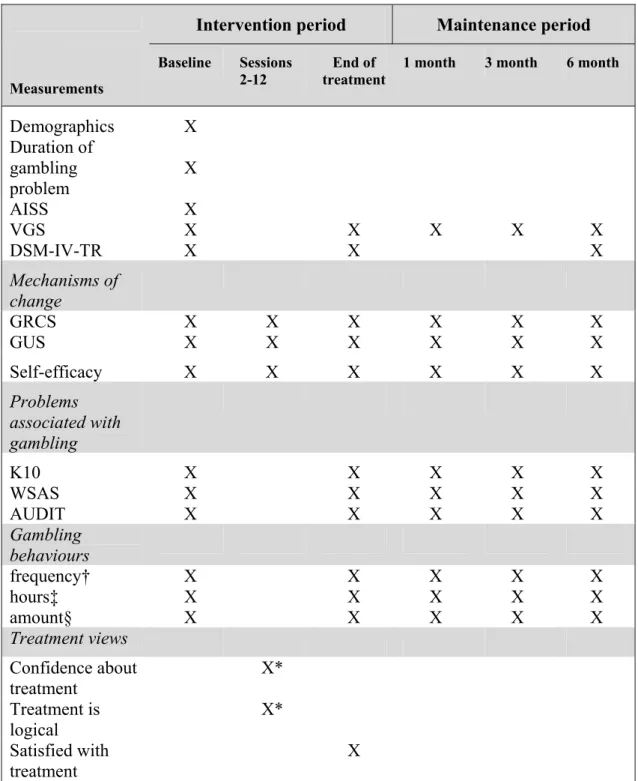
The primary research question, based on an intent-to-treat principle, was: Among treatment seeking problem gamblers is exposure therapy more effective in reducing gambling severity symptoms (harm to self-subscale of the Victorian Gambling Screen (VGS)) over the 9-month study period (intervention and maintenance effects) compared with cognitive therapy? It was estimated that 50 participants were required in each group to detect a clinically meaningful difference and a further 15 participants per group to account for expected treatment dropout rate giving a total sample size of 130 participants. Primary outcome measure VGS is a self- reported questionnaire measuring the extent gambling behaviour has impeded an individual’s life. The 21 items relate to the person’s experiences in the previous 4 weeks and scores range from 0 = no harm to self to 60 = high harm to self. A score of 21+ identifies a person as problem gambler. Participant assessments for primary (VGS) and secondary outcomes (gambling behaviours, gambling related problems and DSM-IV diagnosis of pathological gambling) were conducted at baseline, end of treatment (intervention period) and follow-up at 1, 3 and 6 months (maintenance period).
Individuals assessed as eligible for study participation were randomly assigned to one of two treatment groups with 1:1 allocation ratio using stratified blocked randomisation. A biostatistician independently generated random sequences for each stratum and delivered these to a clinical trials call centre of a centrally located hospital pharmacy. Staff
enrolling and referring participants, collecting and entering data and administering interventions did not know in advance which treatment the next participant would receive.
8
Cognitive and exposure therapy for problem gambling
The study received approval from the Southern Adelaide Health Service / Flinders University Human Research Ethics Committee, and was registered with the Australian New Zealand Clinical Trials Registry (ACTRN12610000828022) at the trials inception.
Results
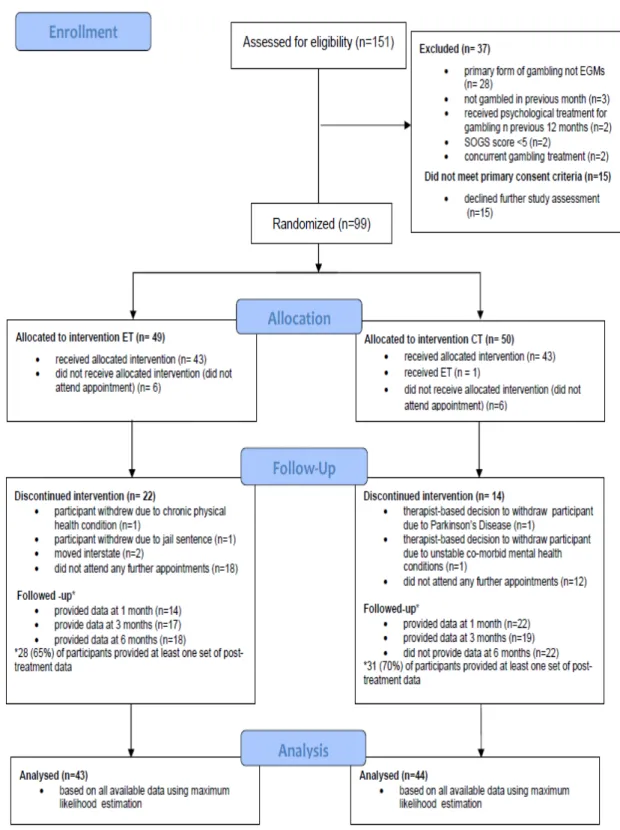
Participants were recruited from 151 consecutive referrals to SGTS from April 4th, 2011 to 30th March, 2012. Of the 99 participants randomised, 49 were allocated to ET and 50
to CT. Of these, 87 participants started an intervention (CT = 44; ET = 43) and 12
participants were non-starters. Mean age of ET starters was 45.5 (SD= 12) years and 47.5 (SD=13.9) years for CT and 50% were female in both groups. Median time for
participant’s enrolment in the study was 40.9 weeks with 50% of participants having times between 17 and 59 weeks and 25% less than 6.9 weeks. For CT participants, VGS data were available for 70% (31/44) on at least one follow-up occasion post-treatment and 65% (28/43) for ET participants. Of all the interventions started, recorded treatment sessions of 52 out of 87 participants (25 for CT, 27 for ET) were randomly selected for independent scoring of treatment fidelity. The overall mean treatment integrity score was high for both CT (98%) and ET (99%).
Baseline characteristics for 87 participants included 81(94.2%) classified as problem gamblers when stratifying VGS at cut score 21. For DSM-IV criteria there were 83(95.4%) diagnosed as pathological gamblers when assessed by a therapist at study commencement. For participants that did not meet problem or pathological gambling criteria, three had DSM ratings of 3 and corresponding VGS scores 12, 16 and 17. One individual had a DSM score of 1 and a self-reported VGS score of 31, and two had VGS scores of 20 and 14 with corresponding DSM scores of 6 and 10 respectively.
Based on all available data, the main findings of the trial were that gambling severity symptoms in participants in both groups as measured by VGS dropped substantially from baseline (CT: M= 33.4, SD=2.0; ET: M= 33.9, SD= 2.1) to end of treatment (CT: M= 26.1, SD= 1.8; ET: M= 26.2, SD=1.8) and 6 month follow-up (CT: M= 11.4, SD= 3.0; ET: M= 10.9, SD=2.3), but the drops were very similar in both groups. The estimated mean difference between CT and ET at end of treatment was -0.18 (95% CI: -4.47 – 4.10) and 1.47 (95% CI: -4.43 – 7.38) at 6 month follow-up. Similarly, secondary measures of gambling related behaviours, psychological distress, work and social
functionality, and alcohol consumption improved substantially across time, but there was no statistically significant or clinically meaningful difference between groups. For both groups, there was also a clinically significant reduction in the rate of DSM-IV diagnoses of pathological gambling from baseline to treatment end and 6 month-follow-up.
Discussion
Through this two-group randomised, parallel design, involving treatment seeking problem gamblers, we have developed high quality recruitment methods, treatment techniques, manuals, research protocol and data collection methods. The outcome data collected covered the domains of gambling behaviours, problems caused by gambling, and mechanisms of change. The robust implementation of randomisation was
demonstrated by the similarity in group characteristics on potential confounding variables at study screening and baseline demographic and clinical characteristics of treatment starters. One of the key strengths of this study was that all treatment seeking problem gamblers meeting eligibility criteria received an active treatment and a
9
Cognitive and exposure therapy for problem gambling
significant proportion of the sample had co-occurring gambling-related problems and this enhanced the generalisability of findings. One of the main limitations of this study was loss of power due to an under representative sample size. The incomplete uptake of trial interventions meant that randomised groups potentially had more similar experiences than intended, and resulted in outcome differences to be smaller than if there was better uptake.
The wide range of data collected in this trial has provided high quality evidence to contribute to the development of more optimal combination of cognitive-behavioural therapies. Trial findings will also inform the design of a phase III trial to investigate the relative efficacy of cognitive, behavioural (exposure-based) and combined cognitive-behavioural approaches with a standard control condition. No previous studies have compared combined cognitive and behavioural (exposure) therapies with purely cognitive and exposure therapy on their own in the field of problem gambling.
10
Cognitive and exposure therapy for problem gambling
5.
B
ACKGROUNDProblem gambling is defined by the American Psychiatric Association DSM-IV-TR as “…persistent and recurrent maladaptive gambling behaviour that disrupts personal, family and vocational pursuits” (1) and has been identified as an addictive disorder with similarities to substance use disorders in terms of neurocognitive and physiological pathways (2, 3). The ubiquity of different forms of gambling, including online and community based electronic gaming machines (EGMs), makes gambling readily accessible (4). It is also a serious public health concern at an international level where population prevalence rates average 2% or more and occurs more frequently in younger populations (5-10). Co-morbid mental health disorders such as depression and anxiety are common in both treatment seeking and general populations of problem gamblers (11).
Research into problem gambling has expanded in the past 10 to 15 years and findings have become more accessible in the public domain including those from treatment efficacy studies (4, 12). Treatment approaches are similar to those for other addictions and include psychological, peer-support, and pharmacological interventions (13, 14). To date, the best evidence for gambling treatments exists for psychological interventions where variations of cognitive behavioural therapy (CBT) have been the most researched (15). The current CBT evidence-base has been endorsed as “…trusted to guide practice in most situations” using NHMRC (National Health and Medical Research Council) assessment grades for developers of guidelines (16).
The theoretical underpinnings of CBT include cognitive and psychobiological processes which are two dominant approaches to explaining gambling disorders (17). The cognitive approach is based on the principle that problem gamblers hold erroneous perceptions of randomness; erroneous beliefs (e.g. ‘luck helps me win’) and inaccurate perceptions (e.g. ‘gambling makes things better for me’) (18, 19) which are rewarded, learned, and
become habitual. Evidence for this approach has come predominantly from ‘think aloud’ techniques where gamblers have verbalised their perceptions and beliefs during gambling activities (20). Cognitive therapy (CT) for problem gambling focuses on teaching the concept of randomness, increasing awareness of inaccurate perceptions and restructuring erroneous gambling beliefs (18) and is a dominant mode in a number of cognitive-behavioural programs for problem gamblers (21). Cognitive restructuring plays an important role in CT and has been shown to be clinically efficacious in treating a range of mental health conditions (22).
Treatments that target gambling related psychobiological states (e.g. urge to gamble) are predominantly behavioural (exposure-based) (23-25). Exposure therapy (ET) is grounded in a classical conditioning paradigm and cue-exposure with extinction processes (e.g. elimination of gambling urge) has been proposed as more beneficial than other types of therapy (e.g. aversive therapy) in treating gambling addiction (26). Exposure therapy has been shown to be clinically effective in treating psychological conditions such as post-traumatic stress disorder (PTSD) (27) and specific phobias (28).
Both CT and ET have similar hypothesised mechanisms of therapeutic change in anxiety disorders as they do in gambling disorders (23). ET and CT have been shown to be equally effective in the treatment of PTSD, obsessive compulsive disorder (OCD) and panic disorder (PD). It has been suggested that CT is superior to ET in the treatment of
11
Cognitive and exposure therapy for problem gambling
social phobia, although findings are limited due to heterogeneity between studies including therapy-specific expertise of individual research groups and modality of treatment (individual versus group) (28).
Cognitive-behavioural therapies (CBT) for problem gambling typically comprise a combination of ET and CT techniques based on an ostensible evidence-base (e.g. (29-31)). Whilst CBT in general has shown to be clinically superior to control conditions such as wait-list groups (30) and self-help groups (e.g. gamblers anonymous (GA)) (32), there remains uncertainty as to the validity of evidence for core components of this approach. For example, the most recent review of CBT for gambling disorders suggested CT had an “added advantage” relative to other treatment elements. However, evidence was tentative due to heterogeneity between studies and this may have attenuated the effects of other treatments with comparable importance (15).
A more recent Cochrane review (2012) of psychological therapies specific to gambling disorders further supported the clinical efficacy of CBT (21). Of the 12 studies included for meta-analysis, 3 were focused on CT (18, 33, 34). However, studies with a focus on an exposure-based approach were excluded (35-37) as they did not meet eligibility criteria of having a control condition such as “no treatment controls, referral to Gamblers Anonymous and non-specific treatment component controls”. It has been suggested that behavioural therapies are, in general, more parsimonious in terms of delivery than CT (38). Therefore it is important that the evidence for these core treatment approaches is elucidated.
The best evidence to inform clinical practice has come from ‘gold standard’ randomised clinical trials (RCTs) (39). However, clear conclusions are often difficult to draw due to a common lack of transparency in reporting RCT findings which “compounds problems arising from poor methodology” (40). In response to this and in order to improve the reporting of parallel group randomisation trials and enable readers to critically appraise the validity of findings, an international group of experts including journal editors, clinical epidemiologists and statisticians developed CONsolidated Standards Of Reporting Trials (CONSORT) (41). Since inception in 1996, the checklist has been shown to be associated with significant improvement in reporting of RCTs (42) and has evolved with revisions in 2001 (43) and 2010 (40). CONSORT has been extended for appraisal of cluster randomised trials (44), non-inferiority and equivalence randomised trials (45), non-pharmacological treatments (46) and is endorsed by “many journals, influential editorial groups, such as the World Association of Medical Journals, and translated into several languages” ( http://www.consort-statement.org/).
The objective of the following systematic review was to examine the existing evidence from randomised clinical trials on the following research question. Among problem gamblers (population) how accurate and valid is the evidence-base on cognitive and exposure-based therapies in terms of the CONSORT checklist for randomised trials of non-pharmacologic treatment (46).
12
Cognitive and exposure therapy for problem gambling
6.
S
YSTEMATICL
ITERATURER
EVIEWMethods Data Sources
The search for primary studies used the OVIDSP interface with two databases
(MEDLINE and psycINFO) from inception to September 2012. A list of keywords and MeSH terms were generated to identify studies of cognitive and/or behavioural
treatments for gambling disorders. The Cochrane Library was also searched for reviews involving psychological treatments of gambling disorders. The results from the search were then merged within reference management software (EndNote X4).
Study selection
The titles and abstracts of the studies identified through the aforementioned searches were assessed by one researcher. Eligibility criteria for initial study inclusion were based on the Cochrane Handbook for Systematic Reviews (47) in the following order of
importance: published, or in press, in a refereed journal; participants were treated for a primary gambling disorder including pathological gambling and problem gambling in either an inpatient or outpatient setting; at least one intervention comprising a cognitive, behavioural, or combined cognitive-behavioural approach; allocation of participants to either treatment and control or to two or more active treatments including
non-inferiority, equivalence, factorial, cluster, and crossover trials. No criterion relating to random allocation of participants was included at initial screening due to the potential of being unstated in a study abstract or title.
The full text of selected reports were then retrieved and independently examined by two researchers for compliance with eligibility criteria for inclusion in the final review. The criteria were specific to the administration of an exposure therapy (ET) or cognitive therapy (CT) approach to a primary gambling disorder. Only randomised trials involving at least one of these approaches were included. Modality of treatment delivery was limited to face-to-face, either individual or group format and conducted in outpatient or inpatient settings. No limitations were placed on the theoretical nature of comparative treatments or control conditions.
All full-text articles that met eligibility criteria were independently appraised by two researchers. The CONSORT guidelines for randomised trials of non-pharmacologic treatment (46) were used in conjunction with more recent CONSORT guidelines for reporting parallel group randomised trials (40) in order to critically assess the accuracy and validity of results reported within each study. CONSORT statements for parallel group randomised trials as well as extensions are available at
http://www.consort-statement.org/. For each study included in this review, individual CONSORT items were rated as either ‘absent’, ‘present with some limitations’, or ‘present’.
Results of search
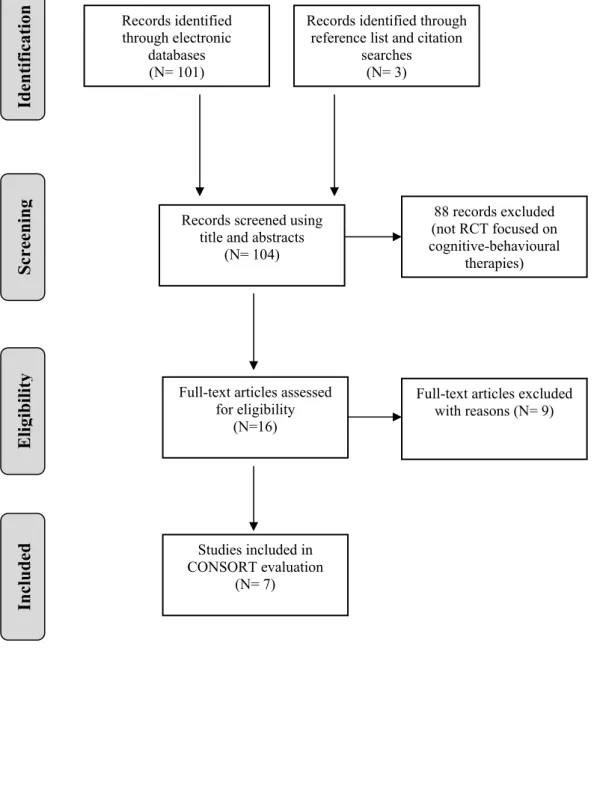
The search resulted in a deduped set of 104 citations. Systematic searches yielded 7 papers (RCTs) for CONSORT evaluation (Figure 1). One study comprised of a treatment with both cognitive restructuring and behavioural components (problem-solving training and social-skills training) (34). However, authors made explicit that the central focus of
13
Cognitive and exposure therapy for problem gambling
treatment was correction of erroneous gambling related cognitions and therefore the study was included in this review.
The 7 included studies are summarised in Table 1. Three were conducted in Australia using imaginal desensitisation (ET) and published between 1983 and 1991(35-37), one in Spain (1996) comprising of individual and combined cognitive restructuring (CT) and in-vivoexposure with response prevention (ET) (48) and three in Canada with a main focus on cognitive restructuring (CT) between 1997 and 2003 (18, 33, 34). The mode of
delivery for all ET interventions was individual format and three of these were conducted in an inpatient psychiatric facility (35-37). Cognitive treatments were delivered in
outpatient settings for both individual (18, 34) and group (33, 48) formats. All trials reported that participants were randomly allocated to either a treatment or control group. Participants across the studies were drawn from populations with a spectrum of gambling disorders. All CT interventions were based on clinician diagnosed pathological gambling at study screening (18, 33, 34, 48) as was one of the ET interventions (48). The
remaining ET interventions were conducted on the strength of self- reported problem gambling (35-37). The proportion of males across study samples ranged from 44.4% to 100% with an overall average of 81.6%. The main type of gambling reported was gaming machines in three studies (18, 34, 48), horse and dog racing in two studies (35, 36), and no information was provided in two studies (33, 37).
14
Cognitive and exposure therapy for problem gambling
Figure 1. Selection of studies
Records identified through electronic
databases (N= 101)
Records identified through reference list and citation
searches (N= 3)
Records screened using title and abstracts
(N= 104)
Full-text articles assessed for eligibility
(N=16)
Studies included in CONSORT evaluation
(N= 7)
Full-text articles excluded with reasons (N= 9) 88 records excluded (not RCT focused on cognitive-behavioural therapies) Identification Screenin g Eli gibilit y Included
15 Cognitive and exposure therapy for problem gambling
Table 1. Summary of included studies
Study Population, setting, design Inclusion criteria Primary gambling type Conditions Outcomes
McConaghy et al. (1983)(35)
Age, mean (range), years: 35 (20 - 63) % female: 20
Population: Compulsive gamblers requesting behavioural therapy.
Country: Australia
Design: Two group, randomised trial. Time points: Baseline, 1 and 12 months
Persons who:
considered they were unable to control their gambling;
wished to gain control or cease gambling;
were not overtly psychotic.
60% (12/20) horse and dog racing. Other gambling forms were gaming machines, card games in casinos, and two-up.
Therapy types: Imaginal desensitisation.
Mode of therapy: Individual Session no: Treatments administered during one week’s admission to a psychiatric unit. Two sessions on first day and three on subsequent four days. Session duration: 15 minutes
Urge to gamble
Gambling behaviour
STAI
McConaghy et al
(1988)(36) Age, mean (range), years: 35 (18 - 58) % female: 5 Population: Persons who were seeking treatment for problem gambling.
Country: Australia
Design: Two group, randomised trial. Time points: Baseline, 1 and 12 months.
Persons who:
considered they were unable to control their gambling;
wished to gain control or cease gambling;
were not overtly psychotic.
70% (14/20) gambled mainly or exclusively on horse and dog racing. 20% (4/20) gambled on both horse and dog racing and poker machines. 10% (2/20) on poker machines.
Therapy types: Imaginal desensitisation
Mode of therapy: Individual Session no: Treatments administered during one week’s admission to a psychiatric unit. Two sessions on first day and three on subsequent four days. Session duration: 15 minutes
Urge to gamble
Gambling behaviour
STAI
McConaghy et al
(1991) (37) Age, mean, years: 42.5 % female: 9.2
Population: Persons who were seeking treatment for problem gambling.
Country: Australia
Design: Two group, randomised trial. Time points: Baseline, one follow-up between 2 - 9 years.
Persons who:
considered their problem sufficiently serious to make a commitment to 5-day inpatient stay;
were not untreated for active psychosis.
NA Therapy types: Imaginal
desensitisation
Mode of therapy: Individual Session no: Treatments administered during one week’s admission to a psychiatric unit. Two sessions on first day and three on subsequent four days. Session duration: 20 minutes
EPQ
STAI
SCL-90
BDI
Gambling behaviour and related problems.
16 Cognitive and exposure therapy for problem gambling
Echeburua et al. (1996)(48)
Age, mean(SD), years: 35 (11) % female: 55.6
Population: Pathological gamblers Country: Spain
Design: Four group, randomised trial. Time points: Baseline, 3 weeks in-treatment, post treatment, 1, 3, 6, and 12 month follow-up for experimental groups. Baseline and 6 months for wait-list control group.
Diagnosis of pathological gambling.
Scored 8 or more on the South Oaks Gambling Screen (SOGS).
Not suffering from another psychopathological disorder.
Gamble primarily with slot machines.
Gaming machines. Therapy types:
a) Individual stimulus control and exposure with response prevention. b) Group cognitive restructuring. c) Combined treatment A+B
Mode of therapy: Individual, group and combined formats.
Session no: 6 for individual treatments and 12 for combined treatment. Session duration: Exposure therapy, 65 minutes. Cognitive therapy, 60 minutes.
Gambling behaviours and related thoughts
STAI
BDI
Adaptation Scale
Sylvain et al. (1997)(34)
Age range, mean (SD), years: treatment group: 37.6 (10.3) control group: 42.6 (12.1) % female: 0
Population: Pathological gamblers Country: Canada
Design: Two group, randomised trial. Time points: Baseline, end of treatment, 6 and 12 month follow-up.
Primary diagnosis of pathological gambling
Answer “yes” to the following question: “Are you willing to make an effort to reduce or stop gambling?” In addition, they had to rate their motivation to change at 7 or more on a scale of 0 to 10.
Video poker machines. Therapy type: Cognitive Mode of therapy: Individual Session no: One or two weekly sessions until participants developed an adequate perception of gambling and chance and ceased gambling.
Session duration: 60 to 90 minutes
DSM-III-R SOGS Perception of control Desire to gamble Self-efficacy perception Frequency of gambling Ladouceur et al. (2001)(18)
Age, mean (SD), years: treatment group: 40.8 (10.2) control group: 43.4 (10.2) % female: 17.2
Population: Pathological gamblers contacting study treatment centre and referred by other health professionals.
Country: Canada
Design: Two group, randomised trial. Time points: Baseline, end of treatment. 6 and 12 month
follow-up for treatment group.
Primary diagnosis of pathological gambling.
No evidence of immediate suicidal intent.
No evidence of current or past schizophrenia, bipolar disorder or organic mental disorder.
Willing to undergo randomisation.
85% gaming machines. Other forms included cards, horse races, sports, blackjack, bingo, skill games, and keno.
Therapy type: Cognitive Mode of therapy: Individual Session no: Maximum of 20 weekly sessions.
Session duration: 60 minutes
DSM-IV Self-efficacy perception Perception of control Desire to gamble SOGS Frequency of gambling Ladouceur et al. (2003)(33)
aAge, mean (SD), years:
treatment group: 42.56 (10.48) pathological gambling. Primary diagnosis of
NA Therapy type: Cognitive
17 Cognitive and exposure therapy for problem gambling
control group: 44.56 (10.7) % female: 22
Population: Pathological gamblers contacting study treatment centre and referred by other health professionals.
Country: Canada
Design: Two group, randomised trial. Time points: Baseline, end of treatment. Six, 12 and 24 month
follow-up for treatment group.
No evidence of current or past schizophrenia, bipolar disorder or organic mental disorder.
Willing to undergo randomisation.
Session no: 10 weekly sessions. Session duration: 120 minutes
perception
Perception of control
Desire to gamble
Frequency of gambling
Abbreviations: DSM-III-R, Diagnostic and Statistical Manual of Mental Disorders (3rd edition, revised);DSM-IV,Diagnostic and Statistical Manual of Mental
Disorders (4th edition);STAI, Spielberger State-Trait Anxiety Inventory; EPQ, Eysenck Personality Questionnaire; SCL-90, Symptom Checklist-90; BDI,
Beck Depression Inventory; SOGS, South Oaks Gambling Screen.
18
Cognitive and exposure therapy for problem gambling
Validity of evidence
A number of methodological shortcomings were identified in the literature which focussed on ET and CT approaches of treatment specific to problem gambling. That is, 71% of the CONSORT items rated as ‘absent’ were specific to the methods section across the studies. None of the studies under examination provided sufficient information about randomisation to allow the reader to assess whether the treatment groups were approximately comparable in terms of known and unknown prognostic factors such as severity of gambling behaviours or co-morbid conditions. Also, sample sizes were generally small and although three of the studies (35, 36, 48) reported participant groups that were exactly equivalent in numbers, no information was provided on how this was achieved (e.g. blocked randomisation). Such limitations pose a major threat to internal validity and generalisability of trial findings. The methodological deficits identified were further compounded by the absence of reported sample size calculations and clear differentiation between primary and secondary outcome measures. As different hypotheses and outcome measures require different sample sizes to achieve sufficient power, any conclusions drawn from these studies are limited in terms of causal inferences.
Implications
The results of this review have important implications for the application of
cognitive-behavioural therapies in gambling disorders. Whilst the evidence-base has recommended CBT to address gambling disorders in “most situations” (16), the data from meta-analyses offered to support this recommendation are clouded due to methodological limitations. Despite the partial evidence for CT and ET, a range of cognitive-behavioural programs that involve a combination of these techniques have become available in recent years (29-31). These findings indicate the need for more well-designed trials in order that CT, ET, and CBT approaches may continue to be improved and potentially reduce the high dropout rates commonly reported for problem gamblers (49).
Study objectives
To further improve the evidence-base for specific CBT techniques in treating gambling disorders (12, 50-52), we designed a study titled “Cognitive versus Exposure Therapy for Problem Gambling: A Pilot Randomised Controlled Trial” which is a randomised trial comparing efficacies of CT and ET to improve gambling related symptoms. The trial was motivated by the uncertainty about the clinical superiority of CT over ET. Based on this uncertainty, the concept of equipoise existed and participants were not disadvantaged from randomisation to either treatment group. The study is the first randomised trial to compare these treatments in a population of treatment seeking gamblers.
The objectives of this pilot randomised controlled trial were to establish high quality recruitment methods, treatment techniques and manuals, research protocols, data collection methods and preliminary data in preparation for phase III randomised controlled trials in the field of problem gambling practice and research. Specifically, we sought to establish high
19
Cognitive and exposure therapy for problem gambling
quality treatment methods and research protocols to contribute to answering the primary research question:
Among treatment seeking problem gamblers can exposure therapy alone improve gambling related outcomes over 9 months compared with cognitive therapy?
Our secondary questions related to the research process i.e., what is the rate of recruitment, therapy sessions required, drop outs, data collection and data completion and level of treatment fidelity achieved by a number of clients and therapists.
20
Cognitive and exposure therapy for problem gambling
7.
R
ESEARCHM
ETHODSStudy design
Comparing outcomes of cognitive and exposure therapy for problem gamblers is a two-group randomised, parallel design, with treatment seeking problem gamblers presenting to the Statewide Gambling Therapy Service (SGTS) in South Australia. The study aimed to recruit 130 participants: 65 to be randomised to receive up to 12 weekly, individual face-to-face cognitive therapy sessions, and 65 participants to be randomised to receive exposure therapy in an identical treatment format. The outpatient SGTS programme offers one-on-one and group therapy for problem gamblers in key metropolitan and rural regions that are associated with significant problem gambling activity. The primary referral sources of clients presenting to SGTS are self, Gambling Helpline and related agencies, and general practitioners. The service is staffed by a psychiatrist and therapists with professional registration in psychology, nursing, or social work. All therapists have graduate qualifications and clinical experience in CBT (23).
The study received approval from the Southern Adelaide Health Service / Flinders University Human Research Ethics Committee, and was registered with the Australian New Zealand Clinical Trials Registry (ACTRN12610000828022) at the trials inception. Participants were given an information statement regarding the study and asked to provide written informed consent before data collection began. Participants were offered the alternative therapy to their randomised treatment if they had not experienced a clinically meaningful improvement on outcome measures by 6 month follow-up as determined jointly by the participant and therapist.
Participant recruitment and random assignment
Participants were recruited over a 12 month period that commenced April 2011. To assess study eligibility, an independent clinician conducted semi-structured interviews with
treatment seeking problem gamblers presenting to SGTS during the recruitment period. The interview included assessment of individual demographics, recent gambling activities, and administration of the well-validated South Oaks Gambling Screen (SOGS) (53). The SOGS is a 20 item questionnaire based on DSM criteria for pathological gambling. A score of 5 or more is indicative of probable pathological gambler. In gambling treatment samples the scale has good reliability, exhibits high correlations with DSM-IV diagnostic criteria, and good to excellent classification accuracy (54).
Study eligibility was based on the following inclusion criteria: 18 years of age or older; treatment seeking for problem gambling with electronic gaming machines (EGM’s); not involved in a concurrent gambling treatment program; not received psychological treatment for problem gambling in the previous 12 months; willing to participate in the study; a willingness to read and respond to self-rated questionnaires written in English; willing to be randomised to one of two psychological treatments; gambled in the past month using
EGM’s; willing to provide follow-up data; willing to have treatment sessions audio recorded; scoring 5 or greater on the South Oaks Gambling Screen; and not suicidal or experiencing
21
Cognitive and exposure therapy for problem gambling
mental distress such as mania which would indicate that the problem gambler would not be able to participate fully in the treatment offered.
Individuals assessed as eligible for study participation were randomly assigned to one of two treatment groups with 1:1 allocation ratio. From the trial outset, randomisation was blocked to increase the likelihood of equal group sizes, using a standard permutated block algorithm in which block sizes were randomly chosen from 2, 4, and 6 to protect concealment. To ensure balance on potential confounders, block randomisation within strata was used, stratifying at median age, gender, and median SOGS scores for problem gambling severity. Based on previous SGTS data, age was stratified as 18 - 42 years, and 43 years or more (55). Recent population data for South Australia showed a median age of 39.5 years (56).
Gambling severity was stratified according to previous treatment seeking problem gamblers SOGS scores of either 5 - 11, and between 12 and 20 (57). A biostatistician independently generated random sequences for each stratum using Stata version 11.1 software (58) and delivered these to the clinical trials call centre of a centrally located hospital pharmacy. Staff enrolling and referring participants, collecting and entering data and administering
interventions did not know in advance which treatment the next participant would receive.
Sample size calculation
The primary research question was: Among treatment seeking problem gamblers is exposure therapy more effective in reducing gambling severity symptoms (harm to self-subscale of the VGS) over the 9-month study period (intervention and maintenance effects) compared with cognitive therapy?
In our sample size calculations, we assumed a correlation between follow-up measures of r = 0.7 (59). Based on a type I error rate of 5% , power of 90%, two-tailed test, and a VGS standard deviation of 10.2 units (55), to detect a significant difference of 8% (i.e. 4.8 points on the scale) in mean VGS scores between the ET and CT groups, 50 participants were required in each group. Given the treatment dropout rate experienced in the SGTS treatment programme (approximately 30%) we therefore needed to recruit 65 participants in each group of the study giving a total sample size of 130 participants. A recent meta-analysis of 25 studies on cognitive-behavioural interventions for problem gambling found that attrition over the studies ranged from 0 to 45.7% with a medium of 14.0% (15). Also, total sample sizes in these studies varied considerably with a range of 5 to 169 and median of 43 for studies with a specified baseline sample size.
Study treatments
The trial comprised of two interventions: cognitive therapy (CT) and exposure therapy (ET) and are described in the following sections and a summary of treatment sessions provided in Table 2.
CT. Cognitive therapy focused on correcting misconceptions relating to gambling such as the basic notion of randomness. Key components of cognitive correction involved: (i)
understanding the concept of randomness: the therapist explained the concept of randomness with examples, such as the independence and impossibility of controlling outcomes in tossing a coin; (ii) understanding the erroneous beliefs held by gamblers: the therapist
22
Cognitive and exposure therapy for problem gambling
explained how the illusion of control contributed to the maintenance of gambling habits, and then corrected these erroneous beliefs; (iii) awareness of inaccurate perceptions: the problem gamblers were informed that erroneous perceptions, mainly making links between
independent events, predominate when gambling, and weretaught to distinguish between adequate and inadequate verbalisations; and (iv) cognitive correction of erroneous perceptions: the therapist was trained the problem gambler to correct inadequate
verbalisations and faulty beliefs (33). Cognitive therapy has been empirically validated as an efficacious treatment of problem gambling (60). Previous studies have indicated that
cognitive factors play a significant role in problem gambling pathways (61).
ET. Exposure therapy was based on the theory that problem gambling is the result of the development of a psychophysiological “urge” to gamble in response to environmental triggers or cues, analogous to craving in substance addiction. The theoretical mechanism of
behavioural therapy is de-conditioning of the urge using exposure to gambling cues, and response prevention (resisting gambling) which results in habituation of the urge within a session and ultimately extinguishing of the urge if the exposure task is repeated. Remission of problem gambling occurs by eliminating the gambling “urge” rather than through a reduction in gambling cognitions (23, 24). The initial procedure comprised of a therapist guiding the client through a scene, usually audiotaped and then instructing the client to imagine a typical gambling scenario (imaginal exposure). The client was asked to rate his or her urge to gamble at regular intervals while verbalising the scenario and stay with the urge until habituation occurred. Once the client had habituated to the urge in imagination, clients habituated to their urge to gamble using a variety of live tasks at gambling venues (in-vivo exposure) to
challenge the triggers of their urges (23).
Participants in each treatment group were to receive up to 12 60-minute individual treatment sessions conducted at weekly intervals. Both treatments were manualised in order to
facilitate replication and clinical application. The SGTS had already developed treatment methods and a treatment manual for the conduct of ET for up to 12 individual weekly sessions which was in use by therapists (24, 62). The therapists at SGTS had previous experience in administering CT in groups that is facilitated by a manual which outlined procedures over 12 weekly sessions and was based on a workshop attended by one of our senior therapists presented by Robert Ladouceur, a widely published international clinician and researcher in the field of cognitive therapy for gambling disorders (18, 33, 61). The CT manual for individual therapy in this study was developed in collaboration with Robert Ladouceur and based on his cognitive-behavioural manual with co-author Stella Lachance (2007) (63).
For this study, both CT and ET manuals were intended as a session-by-session guide for therapists treating individuals with a gambling disorder where electronic gaming machines were the main form of gambling problem. It was intended that therapists deliver treatment according to each manuals content and sequencing of techniques in a face-to-face format. Due to the expected heterogeneity often experienced in individuals with a gambling disorder, there was flexibility for duration and frequency of techniques within treatment sessions. Participants in both treatment groups were given home exercises set with rationale and instructions and a review of these were conducted at the beginning of each session. Also, handouts summarising main session points were provided to participants. Each treatment was presented in a practical manner and technical language was used with parsimony.
23
Cognitive and exposure therapy for problem gambling
Participants in both ET and CT groups were provided with a screening interview at study commencement. The interview comprised of a gambling focused cognitive behavioural assessment including DSM-IV-TR criteria for identifying a gambling disorder. Participants were also assessed for any co-morbid mental health problems such as alcohol dependence, anxiety and depression. At the beginning of each session an agenda for the session was negotiated and the time available for the session clarified. The last two sessions for each treatment group l comprised of relapse prevention strategies.
Masking
Statistical analyses were conducted according to pre-specified guidelines (provided in Section 3.8). In this trial, therapists knew what treatment they were administering and participants were provided with information that rationalised and described their assigned therapy protocol. As all participants were assigned to an active treatment of unknown efficacy relative to the alternate treatment, the potential for “overly optimistic responses” may have been reduced (64). Also, it was intended that participants were masked to the study hypothesis in order to further limit the likelihood for self-report bias. Participant information sheets referred to treatments as “well known and commonly used psychological treatments”. A robust level of masking was expected as both treatments were well established
psychological treatments with similar intervention structures including a manualised approach, same number of sessions and homework tasks. To avoid contamination of
masking, SGTS administration staff was instructed to not reveal specific treatment labels to any participants and therapists to not reveal the alternative treatment label. Independent evaluators assessed the degree to which masking to the study hypothesis was achieved by addressing the questions: Did the participant mention their therapy by name and/or the other study therapy and, did the therapist mention the other study therapy? This evaluation was conducted as part of treatment integrity checks which are discussed in the following section.
24
Cognitive and exposure therapy for problem gambling
Table 2. Intervention schedule
Weekly
Sessions Cognitive Therapy (CT) Exposure Therapy (ET) Session 1: Pre-treatment assessment to identify problem
gambling and any co-morbid conditions. Rationale and protocol of cognitive therapy explained.
Pre-treatment assessment to identify problem gambling and any co-morbid conditions. Rationale and protocol of exposure therapy explained.
Session 2: Development of participant’s measurable problems and goals. Analysis of a gambling session to identify erroneous thoughts. Commence daily self-monitoring diary.
Development of participant’s measurable problems and goals. Establish cash restrictions to ensure participant has no cash. First exposure task set using images. Commence daily self-monitoring diary. Session 3: Psycho-education: clarification of the concept of
chance and establish the distinction between games of skill and games of chance.
Review participant’s attempt at first exposure task. Finalise cash restriction strategies if not already in place. In-session imagery exposure task with therapist guidance.
Session 4: Psycho-education/cognitive awareness: introduce ABCD (situation, thoughts, behaviour, consequences) model and exercises to focus on the gambling thoughts or ‘inner dialogue’.
Review imagery exposure task. Finalise cash restriction strategies if not already in place. Imagery exposure task with therapist guidance.
Session 5: Identifying erroneous thoughts or ‘gambling traps’ that lie behind emotions taking over reason using ABCD model. Participants are encouraged to challenge these thoughts, perceptions, and beliefs in this session.
Review imagery exposure task. Introduction of next exposure task involving image and sounds of gambling-related cues.
Session 6: Identifying erroneous cognitions. Practical exercise to help participant organise and act upon thoughts
Introduction to first of the in-vivo exposure tasks. This task to take place outside of participant’s usual gambling venue(s). The participant utilises principles of exposure therapy from imaginal tasks to assist in identifying what is happening to them at the time of the in-vivo task.
Session 7: Identifying erroneous cognitions. Practical exercise to help participant organise and act upon thoughts (continued).
Fine tuning of in-vivo exposure task outside of venue. Introduction to in-vivo exposure task to take place inside venue without cash.
Session 8: Develop skills for challenging and casting doubt on the erroneous thoughts that lead to excessive gambling
Fine tuning of in-vivo exposure task inside venue without cash. Introduction to next in-vivo task taking place inside a gambling venue with a small amount of cash.
Session 9: Develop skills for challenging and casting doubt on the erroneous thoughts that lead to excessive gambling (continued).
Fine tuning of in-vivo exposure task inside venue with a small amount of cash. Introduction to next in-vivo task taking place inside a gambling venue changing a small amount of cash for Poker machine coins.
Session 10 Develop skills for challenging and casting doubt on the erroneous thoughts that lead to excessive gambling (continued).
Review in-vivo exposure tasks. Introduction to next in-vivo task taking place inside a gambling venue changing a small amount of cash for coins and placing in Poker machine.
Sessions 11- 12
Explore gambling relapse and develop relapse prevention strategies.
Explore gambling relapse and develop relapse prevention strategies.
25
Cognitive and exposure therapy for problem gambling
Training and Treatment integrity
In order to train and supervise cognitive therapists for the intervention, Professor Robert Ladouceur visited the research team at the beginning of the project and again later in the project once recruitment and intervention was underway. Professor Ladouceur’s initial visit concentrated on refining the skills of the newly recruited cognitive therapists in order for them to deliver a consistent, manualised treatment program. In addition, the treatment manuals were modified and refined and the combined team of cognitive and exposure therapists worked together to plan the overall intervention strategy. Once therapists were trained, Professor Ladouceur assumed a supervisory / mentoring role and also contributed to the reviewing audio tapes of treatment sessions to ensure that treatment processes adhered to the prescribed manualised treatment protocols designed for the intervention program.
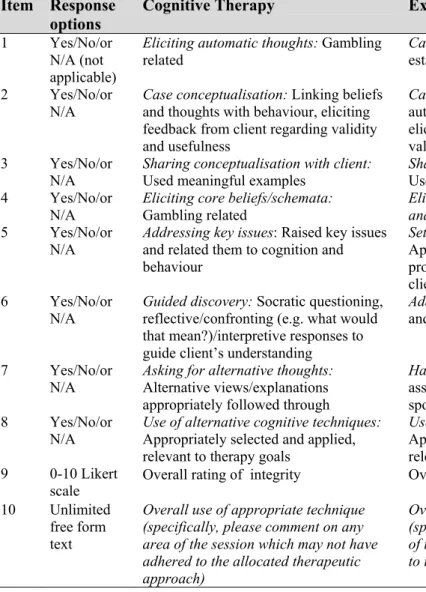
It was intended that all treatment sessions were to be audio recorded and 20% randomly selected from early, mid, and late study phases and evaluated by two independent clinicians for each study group. A preliminary checklist for treatment fidelity was developed based on the Cognitive Therapy Scale (CTS) which is an 11-item instrument with good reliability when used by experienced clinicians (65). The CTS provided a framework for the first version of a checklist and then using an iterative process between study therapists and clinical supervisors, consensus was achieved for a final checklist (Table 3). Items 1 to 8 relate to case conceptualisation for each therapy and item 9 relates to overall integrity. Inter-rater reliability was assessed within each therapy and evaluators were to also conduct
integrity checks of the alternative treatment to further enhance validity of treatment integrity checks.
Measures
Baseline assessment included demographic variables such as gender, age, marital status, highest education level, employment status, and living arrangements. Data for duration of gambling problem was also collected. As previous studies have identified a significant association between treatment drop out and impulsivity/sensation seeking personality traits (55, 66, 67), the Arnett Inventory of Sensation Seeking (AISS) was administered at baseline. This was to enable a better understanding of any relationships between treatment drop out within treatment groups and personality traits under controlled study conditions. The AISS is a 20 item self-report questionnaire that measures sensation seeking personality trait. Within the tool there are two subscales, intensity and novelty, consisting of 10 items each. The scale has been shown to be free from social desirability bias (68).
This study utilised validated problem and pathological gambling screening instruments. In accordance with the minimum features required for reporting treatment efficacy in gambling research, measures covered the domains of gambling behaviours, such as financial losses;
problems caused by gambling, for example psychological distress; and mechanisms of change where the hypothesised mechanisms of treatment actions were assessed. This meant for ET participants, a greater reduction in urge to gamble was expected to be associated with a clinically meaningful improvement in treatment outcomes than in CT participants. For CT participants, a more accurate set of beliefs relating to gambling is expected to be associated with a clinically meaningful improvement in treatment outcomes than in ET participants. A reasonable assumption was made that non-specific effects were approximately similar
26
Cognitive and exposure therapy for problem gambling
between study groups due to similar therapy structures, therapist’s background and
experience, and therapeutic environment. The administration of measures during intervention period was to be conducted prior to commencement of each treatment session. The specific measures are summarised in the following sections and measurement occasions are presented in Table 4.
Table 3. Treatment integrity checklist items
Item Response options
Cognitive Therapy Exposure Therapy
1 Yes/No/or N/A (not applicable)
Eliciting automatic thoughts: Gambling related
Cash Management: Effective plan established and agreed by the client 2 Yes/No/or
N/A Case conceptualisation: Linking beliefs and thoughts with behaviour, eliciting feedback from client regarding validity and usefulness
Case conceptualisation: linking autonomic responses with behaviour, eliciting feedback from client regarding validity and usefulness
3 Yes/No/or
N/A Sharing conceptualisation with client: Used meaningful examples Sharing conceptualisation with client: Used meaningful examples 4 Yes/No/or
N/A Eliciting core beliefs/schemata: Gambling related Eliciting autonomic symptoms, thoughts, and behaviours: Gambling related 5 Yes/No/or
N/A Addressing key issues: Raised key issues and related them to cognition and behaviour
Setting and conduct of exposure tasks : Appropriately graded, focussed, prolonged, and repeated; agreed by the client; relevant to therapy goals 6 Yes/No/or
N/A Guided discovery: Socratic questioning, reflective/confronting (e.g. what would that mean?)/interpretive responses to guide client’s understanding
Addressing key issues: Raised key issues and related them to urge and behaviour 7 Yes/No/or
N/A Asking for alternative thoughts: Alternative views/explanations appropriately followed through
Habituation: Evidence that the therapist assisted client to identify and habituate to spontaneous urges
8 Yes/No/or
N/A Use of alternative cognitive techniques: Appropriately selected and applied, relevant to therapy goals
Use of alternative behavioural techniques: Appropriately selected and applied, relevant to therapy goals
9 0-10 Likert
scale Overall rating of integrity Overall rating of integrity 10 Unlimited
free form text
Overall use of appropriate technique (specifically, please comment on any area of the session which may not have adhered to the allocated therapeutic approach)
Overall use of appropriate technique (specifically, please comment on any area of the session which may not have adhered to the allocated therapeutic approach)
Primary outcome measure
Victorian Gambling Screen (VGS): In order to detect change in problem gambling severity on a continuum during treatment and at follow up, the VGS was utilised as a primary outcome measure. The VGS is a self- reported questionnaire measuring the extent gambling behaviour has impeded an individual’s life. The screen comprises three sub-scales
(enjoyment of gambling, harm to partner and harm to self) with a total of 21 items. For purposes of this study, only the ‘harm to self’ sub-scale was used as an outcome measure. Items on the self-harm subscale relate to the person’s experiences in the previous 4 weeks and therefore enhance sensitivity to treatment outcomes on a continuum. This sub-scale has