The University of Bradford Institutional
Repository
http://bradscholars.brad.ac.uk
This work is made available online in accordance with publisher policies. Please refer to the repository record for this item and our Policy Document available from the repository home page for further information.
To see the final version of this work please visit the publisher’s website. Access to the published online version may require a subscription.
Link to publisher’s version: http://dx.doi.org/10.1108/JAAR-10-2015-0079
Citation: Kim H-J, Kotb A and Eldaly MK (2016) The use of generalized audit software by Egyptian external auditors: the effect of audit software features. Journal of Applied Accounting Research. 17(4): 456-478.
Copyright statement: This article is © Emerald Group Publishing and permission has been granted for this version to appear here: https://bradscholars.brad.ac.uk. Emerald does not grant permission for this article to be further copied/distributed or hosted elsewhere without the express permission from Emerald Group Publishing Limited.
The Use of Generalized Audit Software by Egyptian External Auditors:
The Effect of Audit Software Features
Kim, Hyo-Jeong; Kotb, Amr; Eldaly, Mohamed Khaled Abstract
Purpose - This study aims to explore: the actual usage of GAS features among Egyptian external auditors, through the technology acceptance model (TAM); how the conceptual complexity of GAS features impact its actual usage; and what factors influencing the GAS use by Egyptian external auditors.
Design/methodology/approach - External audit professionals at twelve international audit firms, including the Big 4 and eight medium-sized firms, in Egypt were surveyed.
Findings - The results show that the basic features including database queries, ratio analysis, and audit sampling were higher in GAS use, perceived usefulness, and perceived ease of use among Egyptian external auditors than the advanced features: digital analysis, regression/ANOVA, and data mining classification. The SEM analysis by GAS features suggests that perceived ease of use has a stronger effect on GAS use when the conceptual complexity of GAS features is high. The analysis also support that the use of GAS by Egyptian external auditors is more affected by co-worker, supervisor, or organization through perceived usefulness, but not by job relevance, output quality, and result demonstration.
Research limitations/implications - Although Egyptian external auditors participated in this study may limit the extent to which the findings may be generalized, the responses provide an insight into the actual usage of GAS features by external auditors and the impact of conceptual complexity of GAS features, which is consistent with the literature concerning the relatively low level of utilizing the advanced features of GAS by internal auditors, suggesting that the issues revealed should be of concern.
Practical implications - The results reported in this paper are useful to audit software developers and audit firms in their understanding of factors influencing GAS usage in a different audit context.
Originality/value - The study adds value to prior research by providing context-contingent insight into the application of technology acceptance model in an unexplored audit context.
1. Introduction
In today’s global business environment, advances in client information technology (IT) are rapidly intensifying the need for audit firms to employ various computer-assisted auditing tools and techniques (CAATTs). One of the most commonly and widely used types of CAATTs, in recent years, is generalized audit software (GAS) such as: ACL, IDEA, CA’s Easytrieve, Statistical Analysis System (SAS), and Statistical Package for Social Sciences (SPSS) (Debreceny et al., 2005; Singleton, 2006). These software packages are employed by auditors to perform specific audit routines such as: browse, analyze, sort, summarize, stratify, sample, apply calculations, convert, and carry out other operations of data extraction and data analytics to audit a full set of client data, as opposed to relying on sampling (Ahmi and Kent, 2013). Despite the widely adopted IT applications in today’s businesses; the functionality and benefits of GAS products; and the given support of audit standards to employ GAS, the relevant literature suggests that the extent to which external auditors utilize GAS still remains relatively low and under-investigated (Carmichael, 2004; Debreceny et al. 2005; Kim et al., 2009; Payne and Curtis, 2010; Kotb and Roberts, 2011; Ahmi and Kent, 2013).
Prior information systems (IS) research indicates that technology cannot achieve its benefits if it is not accepted and frequently/systematically used by end-users (Davis et al., 1989; Venkatesh et al., 2003). As such, IS scholars have developed several theoretical models to predict and investigate users’ acceptance and usage of IT developments (Davis, 1986; Davis et al., 1989; Venkatesh and Davis, 2000; Venkates et al., 2003). The Technology Acceptance Model (TAM), introduced by Davis (1986), provides an explanation of the determinants of end-user computing technology’s acceptance. However, there is an apparent literature gap in using TAM to understand the acceptance enablers of GAS by external auditors. In particular, most prior TAM research investigates the end-users’ acceptance of
non-auditing related technology such as word-processing (Davis et al., 1989; Adams et al., 1992), personal
computing (Igbaria et al., 1997), data retrieval systems (Venkatesh and Morris, 2000), and accounting systems (Venkatesh and Morris, 2000; Venkatesh et al., 2003). While some extant GAS acceptance research has been done, most of this research either focuses on the use of GAS for internal auditing (Kim et al., 2009; Ahmi et al., 2014), or on a mixture of internal and external auditing (Janvrin et al.,
2008; Ahmi and Kent, 2013). Also, this prior research does not give a weight to the factor of technology
features and their possible impact on the acceptance enablers, with exception to Kim et al. (2009) that
was also focusing on GAS acceptance by internal auditors. Moreover, most prior TAM and GAS research focuses on audit markets in developed economies, with very less attention being given to emerging auditing markets. Motivated by this existing literature gap, this study extends previous
research to empirically evaluating the behaviours of accepting/using GAS through the TAM in the Egyptian external audit profession as an example of emerging audit markets.
This study investigates the actual usage of GAS among external auditors in Egypt and the impact of GAS features on their usage behaviours and the factors influencing the use of GAS by Egyptian external auditors, using a sample of 118 external auditors from Egyptian international audit firms, representing the Big 4 and eight medium tier international firms. A comparison of previous study leads to a conclusion that the effect of GAS features is same within the Egyptian external audit context but factors influencing the use of GAS are different in this context. The use of basic features was higher than that of advanced features and perceived ease of use is more important when using advanced features in this professional group. The use of GAS is more affected by social factors through perceived usefulness in the Egyptian external audit profession.
This study substantially contributes to the IS and the auditing research in three ways. First, this study attempts to extend previous research as examining individual external auditors’ behaviours of using GAS in Egypt and providing empirical evidence on the effect of GAS features on the use of GAS within the Egyptian external audit context. Second, findings of this study are beneficial to IT researchers and practitioners as expanding the overall understanding of the underutilization of GAS and factors influencing the GAS acceptance/usage by external audit professionals. Third, this type of research is necessary in IS and auditing research as investigating the behaviours of audit professionals from Big 4 and other international medium-tier firms and in underexplored audit context.
The remainder of this paper is organized as follows. The next section reviews the theoretical background to the research and develops the hypotheses and the research model. Following this, the research design section outlines the sample, the research instrument, and the research procedures. Section four presents empirical results of data analysis. The final section concludes the paper, discusses implications of the study, and offers additional research directions.
2. Background and Research Hypotheses Development
Over the last few decades, businesses have been transformed by advances in IT, moving to so-called ‘now economy’, which is characterized by real-time globalized business operations, interaction with customers, and management decision-making (Vasarhelyi et al., 2010, p.7). This technological transformation in the business world has intensified the need for audit firms to employ several GAS products as part of their audit procedures that can provide users of auditing services with relevant,
reliable, and timely information (Elliott, 2002), as well as improve the efficiency (cost) and effectiveness (quality) of an audit service (Banker et al., 2002; Debreceny et al., 2005). Furthermore, the auditing standards issued by the American Institute of Certified Public Accountants (AICPA) and Auditing Practices Board (APB) encourage the utilization of CAATTs. Janvrin et al. (2009), Ahmi and Kent (2013), and Bierstaker et al. (2014) identified a number of different functions of CAATTs according to these auditing standards. These functions are: evaluate fraud risk, identify journal entries and other adjustments to be tested, evaluate inventory existence and completeness (AICPA, 2002; APB, 2004a, 2004b, 2004c), select sample transactions from key electronic files, sort transactions with specific characteristics, test an entire population instead of a sample, obtain evidence about control effectiveness (APB, 2004a, 2004e, 2006; PCAOB, 2010), check the accuracy of electronic files, and reperform procedures such as aging of accounts receivables (AICPA, 2001; APB, 2004a, 2004d, 2006). Despite the widely adopted IT applications in the business environment and the functionality and benefits of GAS products, audit literature indicates that auditors do not use GAS as expected (Carmichael, 2004; Debreceny et al., 2005; Payne and Curtis, 2010; Ahmi and Kent, 2013). A number of theoretical models to explain the user acceptance and usage of IT developments were developed (Davis, 1986; Davis et al., 1989; Venkatesh and Davis, 2000; Venkates et al., 2003).
Following the theory of reasoned action (TRA) (Fishbein and Ajzen, 1975), the TAM (Davis, 1986) provides an explanation of the determinants of end-user computing technology’s acceptance in general and a basis for tracing the impact of external factors on internal beliefs, attitudes, and intentions to use (Davis et al., 1989). The TAM follows four stages in investigating the decision to accept and use a particular end-user computing technology. During the first stage, users consider external variables (e.g. individual abilities, the type of computing technology, the task, situational constrains) to evaluate the consequences of using a particular computing technology. Their evaluation is reflected in their internal beliefs about the usefulness (perceived usefulness) and the ease of use (perceived ease of use) of that computing technology. In the second stage, these two internal beliefs drive the users’ attitude/affection toward behaviour, while their favorable or unfavorable attitude towards using the computing technology influences the extent to which they intend to use it (the third stage). Finally, users’ intention to use the technology drives whether they will actually use it. According to the TAM, the actual usage of the end-user computing technology is the primary indicator of the technology acceptance, and is measured by frequency and volume of the usage (Davis et al., 1989). The two belief constructs - perceived usefulness and perceived ease of use - are fundamental
and distinct constructs that are influential in decisions to use computing technologies, fully mediating the influence of external variables of computer usage behaviour. Perceived usefulness was defined as ‘the prospective user’s subjective probability that using a specific application system will increase his or her job performance within an organizational context’ (Davis et al., 1989, p.985) and perceived ease of use was defined as ‘the degree to which the prospective user expects the target system to be free of effort’ (Davis et al., 1989, p.985). Therefore, they have a positive association with technology acceptance (Davis et al., 1989). Hence, we hypothesized the positive relationship between perceived usefulness and GAS use on one hand, and perceived ease of use and GAS use on the other hand, in the Egyptian external audit profession.
H1. Perceived usefulness has a positive effect on GAS use by Egyptian external auditors.
H2. Perceived ease of use has a positive effect on GAS use by Egyptian external auditors.
Within the TAM, perceived usefulness and perceived ease of use are two distinct constructs but empirical association between them has been observed (Davis et al., 1989). Several studies have found a significant positive relationship between external variables (e.g. system characteristics) and measures similar to perceived usefulness (Miller, 1977; Benbasat and Dexter, 1986; Benbasat et al., 1986). Thus, perceived usefulness can be affected by various external variables over and above perceived ease of use. Further, perceived ease of use not only has a direct effect on computing technology acceptance but also an indirect effect through perceived usefulness, as improvements in a technological application to make it more easier could contribute to improved performance. Therefore, we hypothesized this direct effect of perceived ease of use on perceived usefulness among Egyptian external auditors.
H3. Perceived ease of use has a positive effect on perceived usefulness of the GAS by Egyptian external auditors.
Prior IS research (Davis, 1989; Davis et al., 1989; Thompson et al., 1991; Igbaria et al., 1997; Malhotra and Galletta, 1999; Venkatesh and Davis, 2000; Venkatesh et al., 2003; Burton-Jones and Hubona, 2005) indicates that the original TAM (Davis, 1986) is incomplete as it does not account for the influence of external variables on the adoption and utilization of computing technology. To address this, Kim et al. (2009) has identified fifteen external variables from extended TAM research, and grouped them into three categories: organizational factors, social factors, and individual factors. However, it can be argued that, by its definition, organizational factors (i.e. training and support from organizations) can be viewed as part of social factors (i.e. influences from other people including coworkers, management, or the organization). So we only examine the effect of social factors (i.e. influences from co-workers, management, or organizations including training and support) and individual factors as external variables influencing the use of GAS by Egyptian external auditors.
Igbaria et al. (1997) extended the TAM to examine the effect of intra-organizational factors (i.e. internal support, internal training, and management support) and extra-organizational factors (i.e. external support and
external training) in promoting personal computing acceptance in small firms. The results demonstrate that both intra- and extra-organizational factors, particularly management support and external support, have positive effects on the acceptance of personal computing through perceived usefulness and perceived ease of use. Further, the effect of facilitating conditions (i.e. users’ expectations regarding the existence of an organizational and technical infrastructure to support system use) on technology acceptance was also examined. Thompson et al. (1991) found a small negative effect of facilitating conditions on personal computing utilization. However, using unified theory of acceptance and use of technology (UTAUT), Venkatesh et al. (2003) and Bierstaker et al. (2014) found a positive effect of facilitating conditions on usage behaviours regarding to personal computing and CAATTs, which was moderated by gender, age, experience, and voluntariness. Further, Janvrin et al. (2009) found that developing training programs has a positive effect on behavioural usage through increasing the degree of ease. And, according to Global Audit Executives Survey Report (ACL 2006), auditors will be reluctantly use CAATTs if the firm lacks qualified technical staff familiar with the software
In contrast to Davis et al. (1989), Malhotra and Galletta (1999) have found that all three processes of social influence had direct effects on the user’s attitude and indirect effects on their behavioural intention via attitude. It was found that identification and internalization had a strong positive effect on attitude, while compliance1 2 3 has a weaker negative effect on attitude toward using technology. Additionally, subjective norm4 was also considered an external social variable. However, its effect on the acceptance of computing technology had conflicting results. For example, while Davis et al. (1989) found that social norms had no effect on usage because of the weak psychometric properties, Venkatesh and Morris (2000) reported a strong relationship between subjective norm and technology usage decisions. Overall, Venkatesh and Davis (2000), through the TAM2, reported a significant effect of social factors on technology acceptance through perceived usefulness. Based on this relationship, we hypothesized a positive impact of social factors on perceived usefulness and perceived ease of use of GAS in the Egyptian external audit profession.
H4a. Social factors have a positive effect on perceived usefulness of GAS by Egyptian external auditors.
H4b. Social factors have a positive effect on perceived ease of use of GAS by Egyptian external auditors.
There is no common definition of individual factors as part of external variables in the extant IS literature. Individual factors have been known as cognitive factors (Venkatesh and Davis, 2000) while known as
1
‘... when an individual accepts influence because he wants to establish or maintain a satisfying self-defining relationship to another person or group’ (Kelman, 1958, p.53).
2 ‘. when an individual accepts influence because the content of the induced behaviour - the ideas and actions of which it is composed - is intrinsically rewarding’ (Kelman, 1958, p.53).
3
‘... when an individual accepts influence because he hopes to achieve a favorable reaction from another person or group’ (Kelman, 1958, p.53).
4 ‘... degree to which an individual believes that people who are important to her/him think she/he should perform the behaviour in question’ (Fishbein and Ajzen, 1975, p.302).
personal factors in social cognitive theory (Compeau and Higgins, 1995). However, through the TAM2, Venkatesh and Davis (2000) reported individual factors (i.e. job relevance, output quality, and result demonstrability) as significant determinants of technology acceptance through perceived usefulness. Building on this relationship, we hypothesized a positive effect of individual factors on GAS use through their perceived usefulness and perceived ease of use.
H5a. Individual factors have a positive effect on perceived usefulness of GAS by Egyptian external auditors.
H5b. Individual factors have a positive effect on perceived ease of use of GAS by Egyptian external auditors.
Following Kim et al. (2009), we also examine the effect that GAS features could have on the use of GAS in the Egyptian external audit profession. Any hardware and/or software is characterized by its features, which are notable properties resulting from choices during the design process and intended to improve the expected benefits of that device/application. For example, in the electronic communication media, Griffith and Northcraft (1994, 273) define features as the objective and psychosocial characteristics of a communication medium and provide the distinguishing (core) attributes of the medium. In this sense, technology features are the building blocks or components of the technology (Griffith and Northcraft, 1994). This was echoed by Griffith (1999, p.476), as defining technology as ‘a combination (constellation) of features: distinct parts, and qualities.’ Further, Harrison and Datta (2007, p. 300) define features as ‘vendor-created software tools designed to complete tasks on behalf of the user.’ They further add ‘an application, in turn, is a bundle of features compiled to provide users with the ability to complete a set of specialized tasks’ (Harrison and Datta, 2007, p.300). While this study is concerned with the influence of GAS features on GAS use, we adopt Harrison and Datta’s (2007) definition of technology features as the definition of GAS features. GAS features are the software tools of GAS products created by GAS vendors to complete audit tasks on behalf of the auditors.
As noted earlier, external auditors are encouraged to use various features of GAS products to complete different audit tasks, such as data extraction, fraud detection, internal control evaluation, etc. However, there has been little research, (both in the IS literature and the auditing literature) examining the influence of technology features and their level of complexity on technology acceptance and usage. Kay and Thomas (1995) investigated the use of a system, Sam editor (a Unix-based text editor) in a longitudinal time frame, by over 2,000 users. They found that users adopted more commands when their experience increased, and the features adopted late tended to be more complex and powerful. Jasperson et al. (2005) indicated most users employ quite a narrow band of features of IT applications, operate at low levels of features use, and rarely initiate technology- or task-related extensions of the available features. Complexity5 is an aspect of the technology feature that could also have an influence on the technology adoption and utilization. Tornatzky
5 ‘... the degree to which an innovation is perceived as relatively difficult to understand and use’ (Rogers and Shoemaker, 1971, p. 154).
and Klein (1982) reported a significant negative relationship between the innovation complexity and the innovation adoption. Similarly, Thompson et al. (1991) found a significant negative relationship between perceived complexity of use and the utilization of personal computing. More specifically, Kim et al. (2009) found that as complexity of technology features increased, internal auditors became less likely to use those complex features due to a decrease in the perceived ease of use; therefore system usage decreased. Thus, we hypothesized the negative relationship between the conceptual complexity of GAS features and GAS use by Egyptian external auditors.
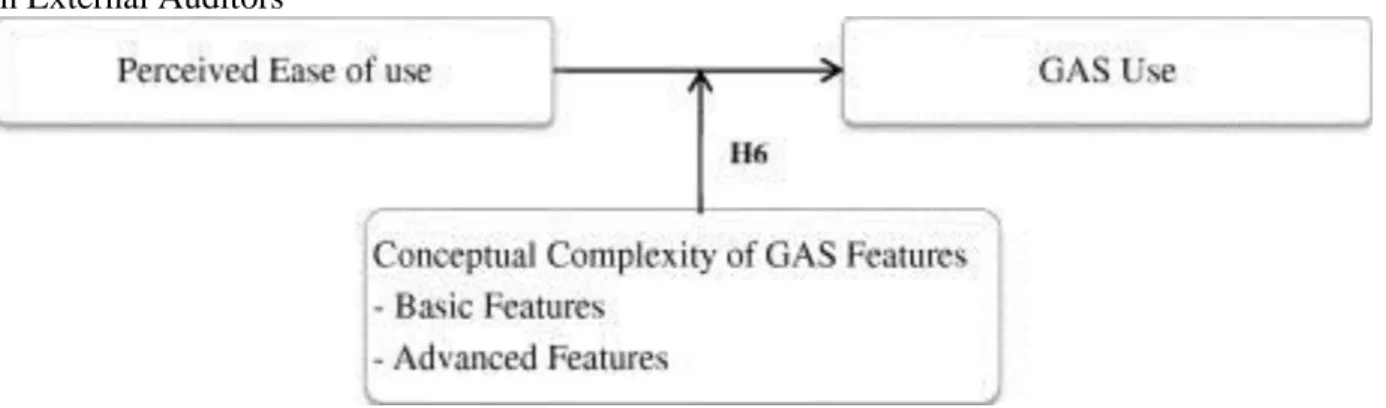
H6. When the conceptual complexity of GAS features is high, perceived ease of use has a stronger effect on GAS use by Egyptian external auditors.
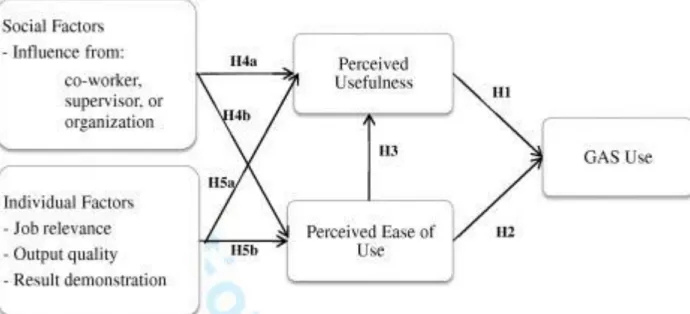
To sum it up, Figure 1 combines all the variables together showing the GAS acceptance model for Egyptian external auditors. The model incorporates GAS use, perceived usefulness, perceived ease of use, social factors, and individual factors. Social factors are defined as influence from other people, including co-workers, supervisors, or support from the organizations a user belongs to. Individual factors are defined as cognitive factors related to outcomes of audit software, including job relevance, output quality, and result demonstration.
Figure 2 presents the effect of conceptual complexity of GAS features that is separately analyzed in the data analysis section. Six different GAS features were adopted from Kim et al. (2009) and categorized into two groups based on the conceptual complexity of GAS features, namely: basic features (i.e. database queries, ratio analysis, and audit sampling) and advanced features (i.e. digital analysis, regression/ANOVA, and data mining classification). While the basic features of GAS are mostly taught within the accounting curriculum in Egyptian business schools, the advanced features are not traditionally part of the external auditors’ education and/or professional training requiring a mathematical background and prerequisite knowledge (e.g. information theories).
3. Research Design
3.1. Sample
We have gathered data through questionnaires. We delivered a total of 240 questionnaires to external audit professionals at twelve international audit firms including the Big 46 7 and eight medium-sized international audit firms in Egypt, as twenty questionnaires per audit firm . After following up respondents with telephone calls, we had a final sample of 118 external auditors with a response rate of 49%. This sample size is more than five times the number of variables being analyzed in our structural equation model (Hatcher, 1994).
The demographic data shows that 62% of the respondents are experienced auditors with six or more years in their profession at varied levels, ranging from auditor, to partner, to junior auditor. Moreover, 46% of the respondents are employed by Big 4 audit firms and 54% work at medium-sized international audit firms. Almost all (98%) respondents have an accounting-major bachelor’s degree as their highest educational level. The majority of respondents (61%) have indicated their IT expertise as intermediate, while 20% have stated they are IT experts.
6 On the basis of pilot short telephone interviews with audit firms, we have come to the conclusion that there is very limited use of IT in audit work by smaller and/or local audit firms. Therefore, we have decided to exclude smaller/local audit firms that are unlikely to make significant use of GAS, and focus only on Big 4 and medium-sized international audit firms in Egypt, which account for auditing the majority of companies listed in the Egyptian Stock Exchange.
7 Past experience proves that twenty is the maximum number of questionnaires to be distributed and/or likely collected.
Figure 2: Conceptual Model for the Moderating Effect of Conceptual Complexity of GAS Features by Egyptian External Auditors
3.2. Research Instrument and Procedures
The measurement of GAS use, perceived usefulness, and perceived ease of use were adopted from the original TAM (Davis et al., 1989) and other extended TAMs (Taylor and Todd, 1995). GAS use is measured by two indicator variables: the frequency to use GAS and the actual time spent on GAS per day. The frequency to use GAS is measured with the seven-point Likert scale ranging from “not at all” to “several times each day.” The actual amount of time spent on GAS per day is measured with the seven-point Likert scale ranging from “almost never” to “more than 4 hours.” Both indicator variables include a N/A (not available) option for those who do not have an access to GAS. Perceived usefulness and perceived ease of use are measured by three indicator variables respectively with the seven-point Likert scale ranging from “strongly disagree” to “strongly agree”.
The measurement items for external factors are adopted from Kim et al. (2009) and modified to meet the needs of this research. We grouped social and organizational factors under the social factors group, as social factors and organizational factors are highly correlated due to the influence from organizations in both factors. Thus, social factors are measured by four indicator variables: two from organizational factors (training and support)8, and two from social factors (influences from co-workers, management, or the organization)9. Individual factors are measured by four indicator variables; one from job relevance, two from output quality, and one from result demonstration10. All variables are measured with the seven-point Likert scale ranging from “strongly disagree” to “strongly agree.”
The list of GAS features was delivered with the questionnaires, including the description and the audit example for each feature. The questionnaire and the list of GAS features were produced in English with an Arabic translation for only those items/terms that seemed difficult to understand or likely to cause confusion. The authors double-checked the translation with audit professionals in the pilot phase. Participants were asked to answer GAS use, perceived usefulness, and perceived ease of use by GAS features and check social and individual factors that affect the use of GAS. The data collected was analyzed using a structural equation model, ANOVA, and regression analysis.
4. Results
4.1. Test of Measurement
As shown in Table 1, all measures have high Cronbach’s Alpha coefficients, exceeding .70, which indicates reasonable internal consistency of measurement items (Fornell and Larcker, 1981).
8 These organizational factor questions are originally from Igbaria et al. (1997). 9
These social factor questions are originally from Thompson et al. (1991). 10 These individual factors are originally from Venketash and Davis (2000).
The convergent and discriminant validity of the measurement items of GAS use, perceived usefulness, and perceived ease of use is tested using correlation matrix. The statistical results indicate that the correlation between frequency and time (r FREQ, TIME=.638) is stronger than their correlations with perceived usefulness,
ranging from .440 to .461, and perceived ease of use, ranging from .428 to .492. While the correlations among perceived usefulness (r PU1, PU2=.797; r PU1, PU3=.784; r PU2, PU3=.908) are stronger than their correlations with GAS use, ranging from .440 to .477, the correlations among perceived ease of use (r PEOUI, PEOU2=.797; r PEOUI,
PEOU3=.768; r PEOU2, PEOU3=.731) are stronger than their correlations with GAS use, ranging from .428 to .492. GAS use and perceived usefulness, and GAS use and perceived ease of use are distinct due to strong correlations among associated items and weak correlations among unassociated items (Igbaria et al., 1997). Although perceived usefulness and perceived ease of use are not distinct with high correlation (.678 to .840), we analyzed these constructs separately as often seen in prior TAM research.
The convergent and discriminant validity of the measurement items of social factors and individual factors is also tested using principal component analysis with Varimax rotation. The statistical results show that the first factor is highly correlated to social factors and the second factor is highly correlated to individual factors.
4.2. Structural Equation Model
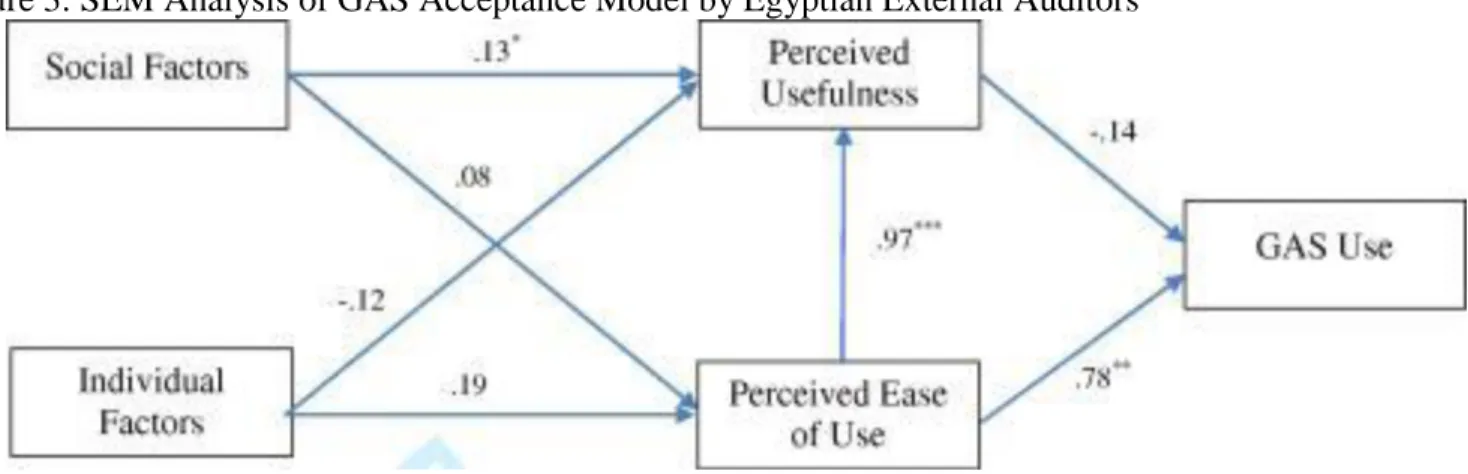
Figure 3 presents the structural relationships among social factors, individual factors, perceived usefulness, perceived ease of use, and GAS use. Inconsistent with Hypothesis 1, the relationship between perceived usefulness and GAS use (P=-.14, p=.582) is not significant in the Egyptian external audit profession11. However, consistent with Hypothesis 2, perceived ease of use is positively related to GAS use by Egyptian external auditors (P=-.78, p=.003), and consistent with Hypothesis 3, perceived ease of use is positively related to perceived usefulness of the GAS (P=.99, p=.000). Consistent with Hypothesis 4a, social factors have a positive influence on perceived usefulness of GAS by Egyptian external auditors (P=.141, p=.030). Inconsistent with Hypothesis 4b, social factors have no influence on perceived ease of use of GAS by Egyptian external auditors. Inconsistent with Hypothesis 5a and Hypothesis 5b, individual factors have no influence on perceived usefulness and perceived ease of use of GAS by Egyptian external auditors.
11 The lack of clarity of the measurement has contributed to lack of support for the relationship between perceived usefulness and GAS use. The detailed reasons are explained in the limitation section of this study.
Table 1: Reliability statistics of measurement Cronbach's
Alpha
Cronbach's Alpha (Based on Standardized Items)
N of Items
GAS use .779 .799 2
Perceived usefulness .936 .936 3
Perceived ease of use .908 .908 3
Social factors .906 .907 4
4.3. Generalized Audit Software Use by GAS Features
As can be seen from Table 2, based on the means of frequency to use GAS, audit sampling (m=4.43) was most frequently used, ratio analysis (m=3.82) and classification (m=3.25) are relatively more frequently used, and database queries (m=3.18), digital analysis (m=2.45) and regression/ANOVA (m=2.39) are relatively less frequently used by Egyptian external auditors. Consistently, Egyptian external auditors spend more time on audit sampling (m=3.96) and ratio analysis (m=3.47) while they spend relatively less time on classification (m=3.17), database queries (m=2.85), regression/ANOVA (m=2.71), and digital analysis (m=2.54).
Using ANOVA, as shown in Table 3, GAS use was significantly affected by GAS features in the Egyptian external audit profession. GAS features have a significant influence on the frequency to use GAS (F=18.973; p=.000) and the time spent on GAS (F=7.775; p=.000) among Egyptian external auditors.
Figure 3: SEM Analysis of GAS Acceptance Model by Egyptian External Auditors
Table 2: Descriptive statistics of frequency and time by GAS features
Software Features Frequency Time
Mean Std. Deviation N Mean Std. Deviation N
Database Queries 3.18 2.084 115 2.85 1.827 115 Ratio Analysis 3.82 1.904 115 3.47 1.703 115 Audit Sampling 4.43 1.738 115 3.96 1.851 115 Digital Analysis 2.45 1.825 112 2.54 1.954 112 Regression/AN OVA 2.39 1.889 114 2.71 2.073 114 Classification 3.19 2.154 112 3.17 2.040 112 Total 3.25 2.061 683 3.12 1.965 683
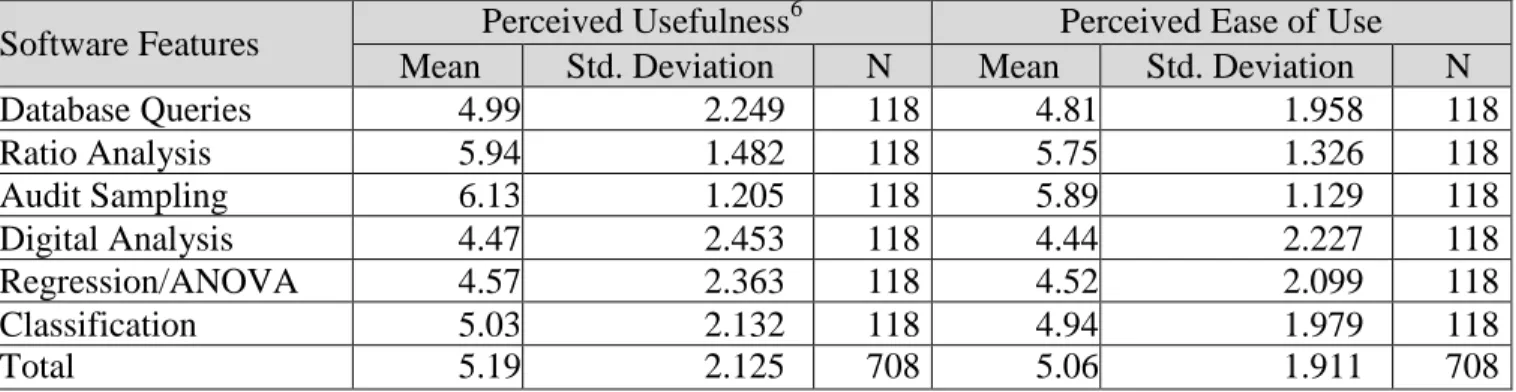
The means and standard deviations for perceived usefulness and perceived ease of use are presented in Table 4. Egyptian external auditors perceived that audit sampling (m=6.13) is most useful, ratio analysis (m=5.94) is more useful, while classification (m=5.03), database queries (m=4.99), regression/ANOVA (m=4.57), and digital analysis (m=4.47) are perceived relatively less useful. On the contrary, Egyptian external auditors perceived that audit sampling (m=5.89) and ratio analysis (m=5.75) are relatively easy to use, but they perceived classification (m=4.94), database queries (m=4.81), regression/ANOVA (m=4.52), and digital
analysis (m=4.44) are relatively less easy to use.
b
Perceived usefulness includes PU1, PU2, and PU3. c Perceived ease of use includes PEOU1, PEOU2, and PEOU3.
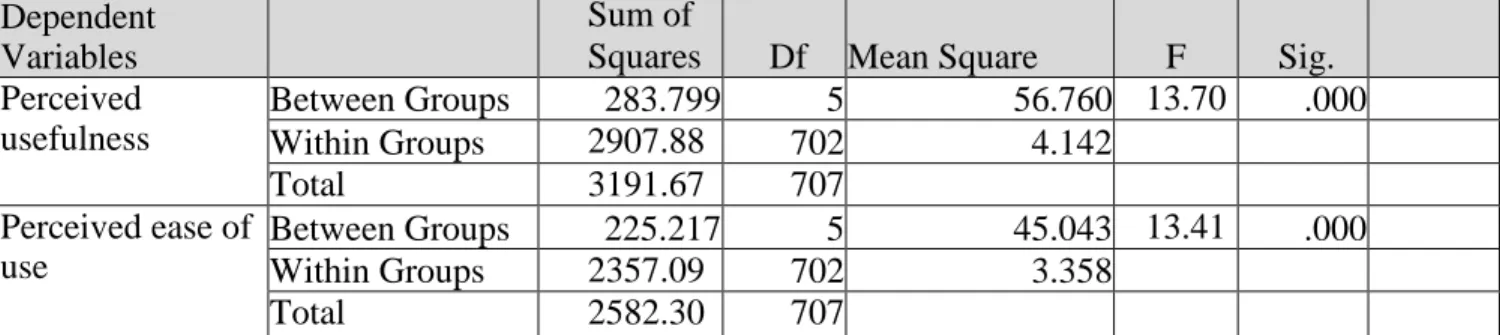
Further, Table 5 shows that GAS features have a significant influence on the perceived usefulness (F=13.703; p=.000), and the perceived ease of use (F=13.415; p=.000) among Egyptian external auditors.
Dependent Variables Sum of Square s
Df Mean Square F Sig.
Frequency Between Groups 355.681 5 71.136 18.973 .000
Within Groups 2560.757 683 3.749
Total 2916.438 688
Time Between Groups 143.850 5 28.770 7.775 .000
Within Groups 2560.759 692 3.701
Total 2704.609 697
Table 3: ANOVA results of GAS use by GAS features
Software Features Perceived Usefulness
6
Perceived Ease of Use
Mean Std. Deviation N Mean Std. Deviation N
Database Queries 4.99 2.249 118 4.81 1.958 118 Ratio Analysis 5.94 1.482 118 5.75 1.326 118 Audit Sampling 6.13 1.205 118 5.89 1.129 118 Digital Analysis 4.47 2.453 118 4.44 2.227 118 Regression/ANOVA 4.57 2.363 118 4.52 2.099 118 Classification 5.03 2.132 118 4.94 1.979 118 Total 5.19 2.125 708 5.06 1.911 708
Table 6 summarizes the result of Structural Equation Modeling (SEM) analysis by GAS features. The use of digital analysis and regression/ANOVA is not influenced by perceived usefulness (P=.00, p=.999; P=-.02, p=.949) but significantly influenced by perceived ease of use (P=.71, p=.047, P=.66, p=.019) in the Egyptian external audit profession.
a
The numbers shown in the table are beta weights after GAS use, perceived usefulness, and perceived ease of use are standardized.
4.4. Generalized Audit Software Use by Conceptual Complexity of GAS Features
The means and standard deviations for frequency and time by the conceptual complexity of GAS features are presented in Table 7. Results show that basic features (m=3.81) are more used, while advanced features (m=2.67) are less used by Egyptian external auditors. Consistent with this, Egyptian external auditors spend more time on basic features (m=3.43), while they spend less time on advanced features (m=2.80).
Table 5: ANOVA results of perceived usefulness and perceived ease of use by GAS featuresa Dependent
Variables
Sum of
Squares Df Mean Square F Sig.
Perceived usefulness Between Groups 283.799 5 56.760 13.70 3 .000 Within Groups 2907.88 0 702 4.142 Total 3191.67 9 707 Perceived ease of use Between Groups 225.217 5 45.043 13.41 5 .000 Within Groups 2357.09 2 702 3.358 Total 2582.30 9 707 a
The average of three measurement items is used for the ANOVA test
Table 6: SEM analysis of GAS features a
GAS Features
Perceived
Usefulness ^ GAS Use
Perceived Ease of Use ^ GAS Use
Perceived Ease of Use ^ Perceived Usefulness Database Queries .47 .10 .98*** Ratio Analysis -.59 .99 .94*** Audit Sampling .14 .11 .92*** Digital Analysis .00 .71* T " *** .94 Regression/AN OVA -.02 .66* .92*** Classification -.33 1.01 .98*** P< .05; P< .01; P< .001
The GAS use by the conceptual complexity of GAS features is examined using the regression analysis. As shown in Table 8, the conceptual complexity of GAS features is negatively related to the frequency (P=-1.113, p=.000) and the time (P=-.581, p=.000).
Further, the means and standard deviations for perceived usefulness and perceived ease of use by the conceptual complexity of GAS features are presented in Table 9. Egyptian external auditors perceived that basic features (m=5.69) are more useful, while advanced features (m=4.69) are less useful. Also, they perceived basic features (m=5.48) as easier to use, but advanced features (m=4.63) as less easy to use.
Conceptual Complexity of GAS Features
Frequency Time Mean Std. Deviation N Mean Std. Deviation N Basic Features 3.81 1.976 345 3.43 1.846 345 Advanced Features 2.67 1.988 338 2.80 2.035 338 Total 3.25 2.061 683 3.12 1.965 683
Table 7: Descriptive statistics of frequency and time by conceptual complexity of GAS features
Table 8: Regression analysis of GAS use by conceptual complexity of GAS features
Dependent Variable Parameter B Std. Error t Sig.
Frequencya Intercept 4.900 .238 20.567 .000 Conceptual Complexity -1.113 .151 -7.363 .000 Timeb Intercept 4.004 .233 17.171 .000 Conceptual Complexity -.581 .148 -3.936 .000 a
R squared = .073 (Adjusted R Squared=.072) b squared = .148 (Adjusted R Squared=.024)
Table 9: Descriptive statistics of perceived usefulness and ease of use by conceptual complexity of GAS features
Feature Complexity Perceived Usefulness Perceived Ease of Use
Mean Std. Deviation N Mean Std. Deviation N
Basic Features 5.69 1.771 354 5.48 1.582 354
Advanced Features 4.69 2.326 354 4.63 2.109 354
Perceived usefulness and perceived ease of use are also examined by the conceptual complexity of GAS features. Table 10 indicates that perceived usefulness and perceived ease of use are significantly affected by the conceptual complexity of GAS features. Further, the conceptual complexity of GAS features is negatively related to perceived usefulness (P=-.995, p=.000) and perceived ease of use (P=- .850, p=.000).
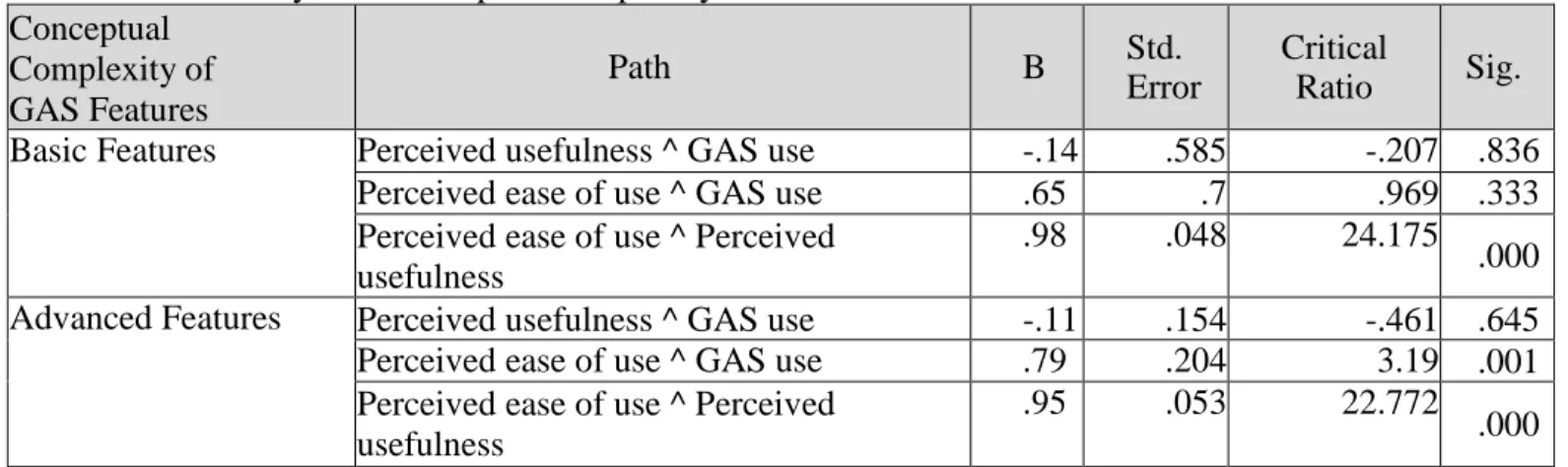
Table 11 summarizes the result of SEM analysis by the conceptual complexity of GAS features. The use of GAS use is significantly influenced by perceived ease of use (P=.95, p=.000), not by perceived usefulness (P=-.11, p=.645) when Egyptian external auditors use advanced features. However, the use of GAS is not influenced by perceived ease of use (P=.65, p=.333) and perceived usefulness (P=-.14, p=.836) when they use basic features. Consistent with Hypothesis 6, when the conceptual complexity of GAS features is high, perceived ease of use has a stronger effect on GAS use by Egyptian external auditors.
Table 10: Regression analysis of perceived usefulness and ease of use by conceptual complexity of GAS features
Dependent Variable Parameter B Std. Error t Sig.
Perceived Usefulnessa Intercept 6.68 3 .246 27.204 .000 Conceptual Complexity -.995 .155 -6.406 .000 Perceived Ease of Useb Intercept 6.33
4 .222 28.584 .000 Conceptual Complexity -.850 .140 -6.067 .000 a
R squared = .055 (Adjusted R Squared=.054) b R squared = .050 (Adjusted R Squared=.048)
Table 11: SEM analysis of conceptual complexity of GAS features Conceptual Complexity of GAS Features Path B Std. Error Critical Ratio Sig.
Basic Features Perceived usefulness ^ GAS use -.14 .585 -.207 .836
Perceived ease of use ^ GAS use .65 .7 .969 .333
Perceived ease of use ^ Perceived usefulness
.98 .048 24.175
.000
Advanced Features Perceived usefulness ^ GAS use -.11 .154 -.461 .645
Perceived ease of use ^ GAS use .79 .204 3.19 .001
Perceived ease of use ^ Perceived usefulness
.95 .053 22.772
5. Discussion, Implications, and Future Research
The results of our study lead to a conclusion that Egyptian external auditors have a different usage behaviour compared to internal auditors (Kim et al., 2009). They are more influenced by perceived ease of use, not by perceived usefulness while both perceived usefulness and perceived ease of use are important in the context of internal auditors. Also the effect of external factors on perceived usefulness and perceived ease of use is different in the Egyptian external audit profession. They perceive that GAS is useful when influenced by co-worker, supervisor, or organization while internal auditors perceive that GAS is easy to use when influenced by support, training, or management support and useful when influenced by cognitive factors that related to outcomes of GAS. On the contrary, the impact of GAS features on the actual usage of GAS is similar in the Egyptian external audit profession. When they use the basic features of GAS which have low conceptual complexity, they more frequently use and spent more time on them. They perceive that those features are more useful and easier to use than GAS features with high conceptual complexity. As the conceptual complexity of GAS features increased, perceived ease of use has stronger effect on GAS use by Egyptian external auditors.
Findings reported in this study help to further understand the GAS usage behaviours by external audit professionals. The usage behaviours of GAS are different within the Egyptian external audit context. The core structure of the TAM (GAS use, perceived usefulness, and perceived ease of use) and the effect of external factors (social and individual factors) are influenced by this cross-context factor. Thus, the result of this research can help software developers or auditing companies to understand which factors are more important when Egyptian external auditors use the GAS products. This research also strengthens the result of previous research by empirically providing evidence that the impact of GAS features is consistent throughout different contexts and adds the value to previous research by providing context-contingent insight in the application of TAM. This research also provides useful insights into the actual usage of GAS as recruiting professional participants from Big 4 and other international medium-tier firms in Egypt.
The results of the current study contribute to a growing stream of research on the GAS acceptance by external auditors. This contribution stems from the applicability of its results to, relatively underexplored, an emerging market setting, unlike prior research that has been undertaken in developed audit markets. The results are particularly relevant, and may be of interest, to auditing professionals, regulators, audit software developers, and academia to enhancing the quality of financial statements audit using audit software. Although the study explores the acceptance of GAS by international auditing firms operating in a single setting - Egypt, the results can be generalized to similar markets, due to the inclusion of the international Big 4 and non-Big 4 affiliates. International audit firms adopt and apply an international audit approach, which refers to similar application of technical audit work (e.g. the use of GAS).
However, there might be some difference in perceptions of audit professionals with regard to factors enabling/inhibiting them from applying technical audit methods (e.g. GAS). However, collected responses provide an insight into the actual usage of GAS features by external auditors (working in international audit firms) and the impact of conceptual complexity of GAS features, which is applicable/generalizable in similar contexts and indicative to a boarder context, as a matter of concern to the macro audit market.
As with all research, our results must be interpreted in light of a number of limitations. First, all constructs are measured by self-report in a survey, so respondents’ lack of understanding of GAS features or specific items could be of influence on the answers that respondents provided and the relations between the constructs that were measured. The construct validity of GAS use can be increased by monitoring the actual usage of GAS instead of using self-reported frequency and time. Second, we investigated the GAS usage behaviours within the Egyptian external audit context, so two cross-context factors (i.e. profession and country) are considered at the same time. Further examination with professions only or countries only is needed to clarify the effect of both factors. Third, organizations’ audit methodology and practice are not taken into consideration in this study. GAS adoption is completely voluntary in Egyptian audit firms so the voluntary usage of GAS was examined, which is more likely to be different in mandatory settings. Also only international audit firms had to be selected since local audit firms did not apply GAS and mainly use basic tools such as Excel. And the extent to which the audit client’s lack of willingness to
cooperate with auditors may affect their GAS use in the case of embedded and integrated CAATTs. Fourth, six features of GAS were averaged to calculate the GAS use, perceived usefulness, and perceived ease of use in the structural equation model since we assumed that GAS features have no influence on social and individual factors. Hence, the complex structure to measure the GAS use, perceived usefulness, and perceived ease of use for six features may influence an insignificant relationship between perceived usefulness and GAS use. Finally, this study does not cover all features associated with GAS, but the common ones.
This research offers a number of opportunities for future research. By consolidating this result with prior studies, there is a possibility to develop a context-contingent theory with different software and software features, professional groups, and countries. The acceptance of GAS by external auditors can
be compared to internal auditors and the acceptance of GAS can be compared in developing countries to in developed countries. Also more cross-context extensions will be available with different software packages and software features. Further, general TAM can be theorized/tested in a software specific context with contextual factors (e.g. software use, software usefulness, and software ease of use) and mediating factors (e.g. software features, type of profession, and countries).
References
ACL Services Ltd. (2006), New demands, new priorities: The evolving role of Internal Audit. Global Audit Executives Survey Report.
Adams, D. A., Nelson, R. R., and Todd, P. A. (1992), “Perceived usefulness, ease of use, and usage of information technology: A replication”, MIS Quarterly, Vol. 16 No. 2, pp. 227-247.
Ahmi, A., and Kent, S. (2013), “The utilization of generalized audit software (GAS) by external auditors”,
Managerial Auditing Journal, Vol. 28 No. 2, pp. 88-113.
Ahmi, A., Saidin, S. Z., and Abdullah, A. (2014), “IT adoption by internal auditors in public sector: A conceptual study”, Procedia - Social and Behavioral Sciences, Vol. 164 December, pp. 591599. American Institute of Certified Public Accountants (AICPA). (2001), The effect of information
technology on the auditor's consideration of internal control in a financial statement audit. Statement of Auditing Standard (SAS), No. 94. New York, NY: AICPA.
American Institute of Certified Public Accountants (AICPA). (2002), Consideration of fraud in financial statement audit. Statement of Auditing Standard (SAS), No. 99. New York, NY: AICPA.
Auditing Practices Board. (2004a), International Standard on Auditing (UK and Ireland) 240: The Auditor’s Responsibilities Relating to Fraud in an Audit of Financial Statements. London: APB. Auditing Practices Board. (2004b), International Standard on Auditing (UK and Ireland) 300: Planning an
Audit of Financial Statements. London: APB.
Auditing Practices Board. (2004c), International Standard on Auditing (UK and Ireland) 315: Understanding the Entity and Its Environment and Assessing the Risks of Material Misstatement. London: APB.
Auditing Practices Board. (2004d), International Standard on Auditing (UK and Ireland) 500: Audit Evidence. London: APB.
Auditing Practices Board. (2004e), International Standard on Auditing (UK and Ireland) 530: Audit Sampling and Other Means of Testing. London: APB.
Auditing Practices Board. (2006), International Standard on Auditing (UK and Ireland) 330: The Auditor’s Procedures in Response to Assessed Risks. London: APB.
Banker, R. D., Chang, H. and Kao, Y. C. (2002), Impact of information technology on public accounting firm productivity. Journal of Information Systems, 16 (2), 209-222.
Benbasat, I., and Dexter, A. S. (1986), “An investigation of the effectiveness of color and graphical presentation under varying time constraints”, MIS Quarterly, Vol. 10 No. 1, pp. 59-84.
Benbasat, I., Dexter, A. S., and Todd, P. (1986), “An experimental program investigating color- enhanced and graphical information presentation: An integration of the findings”, Communications of the ACM, Vol. 29 No. 11, pp. 1094-1105.
Bierstaker, J., Janvrin, D. D., and Lowe, J. (2014), “What factors influence auditors' use of computer- assisted audit techniques?” Advances in Accounting, Vol. 30 No. 1, pp. 67-74.
Burton-Jones, A., and Hubona, G. S. (2005), “Individual differences and usage behavior: Revisiting a technology acceptance model assumption”, Data Base for Advances in Information Systems, Vol. 36 No. 2, pp. 58-77.
Carmichael, D. R. (2004), “The PCAOB and the social responsibility of the independent auditor”,
Accounting Horizons, Vol. 18 No. 1, pp. 127-133.
Compeau, D. R., and Higgins, C. A. (1995), “Computer self-efficacy: Development of a measure and initial test”, MIS Quarterly, Vol. 19 No. 2, pp. 189-211.
Davis, F. D. (1986), “A technology acceptance model for empirically testing new end-user information systems: theory and results”, Doctoral dissertation. Massachusetts, United States: Sloan School of Management, Massachusetts Institute of Technology.
Davis, F. D. (1989), “Perceived usefulness, perceived ease of use, and user acceptance of information technology”, MIS Quarterly, Vol. 13 No. 3, pp. 319-339.
Davis, F. D., Bagozzi, R. P., and Warshaw, P. R. (1989), “User acceptance of computer technology: A comparison of two theoretical models”, Management Science, Vol. 35 No. 8, pp. 982-1002. Debreceny, R., Lee, S., Neo, W., and Toh, J. S. (2005), “Employing generalized audit software in the
financial services sector challenges and opportunities”, Managerial Auditing Journal, Vol. 20 No. 6, pp. 605-618.
Elliott, R. K. (2002), “Twenty-first century assurance”, Auditing: A Journal of Practice & Theory, Vol. 21 No. 1, pp. 139-146.
Fishbein, M., and Ajzen, I. (1975), Belief, Attitude, Intentions and Behavior: An Introduction to Theory
and Research, MA: Addison-Wesley.
Fornell, C., and Larcker, D. F. (1981), “Evaluating structural equation models with unobservable variables and measurement error”, Journal of Marketing Research, Vol. 18 No. 1, pp. 39-50. Griffith, T. L. (1999), “Technology features as triggers for sensemaking”, Academy of Management
Review, Vol. 24 No. 3, pp. 472-488.
Griffith, T. L., and Northcraft, G. B. (1994) “Distinguishing between the forest and the trees: Media, features, and methodology in electronic communication research”, Organization Science, Vol. 5 No. 2, pp. 272-285.
Hatcher, L. A. (1994), Step-by-Step Approach to Using the SAS(R) System for Factor Analysis and
Structural Equation Modeling, Cary, NC: SAS Institute.
Harrison, M. J., and Datta, P. (2007), “An empirical assessment of user perceptions of feature versus application level usage”, Communication of the Association for Information Systems, Vol. 20, pp. 300-321.
Igbaria, M., Zinatelli, N., Cragg, P., and Cavaye. A, (1997), “Personal computing acceptance factors in small firms: A structural equation model”, MIS Quarterly, Vol. 21 No. 3, pp. 279-302.
Janvrin, D., Bierstaker, J., and Lowe, D. J. (2008), “An examination of audit information technology use and perceived importance”, Accounting Horizons, Vol. 22 No. 1, pp. 1-21.
Janvrin, D., Bierstaker, J., and Lowe, D. J. (2009), “An investigation of factors influencing the use of computer-related audit procedures”, Journal of Information Systems, Vol. 23 No. 1, pp. 97-118. Jasperson, J., Carter, P. E., and Zmud, R. W. (2005), “A comprehensive conceptualization of post-
adoptive behaviors associated with information technology enabled work systems”, MIS
Quarterly, Vol. 29 No. 3, pp. 525-557.
Kay, J., and Thomas, R. C. (1995), “Studying long-term system use”, Communications of the ACM, Vol. 38 No. 7, pp. 61-69.
Kelman, H. C. (1958), “Compliance, identification, and internalization: three processes of attitude change?”,
Journal of Conflict Resolution, Vol. 2 No. 1, pp. 51-60.
Kim, H., Mannino, M., and Nieschwietz, R. J. (2009), “Information technology acceptance in the internal
audit profession: Impact of technology features and complexity”. International Journal of
Accounting Information Systems, Vol. 10 No. 4, pp. 214-228.
Kotb, A., and Roberts, C. (2011), “The impact of e-business on the audit process: An investigation of the factors leading to change”, International Journal of Auditing, Vol. 15 No. 2, pp. 150-175.
Malhotra, Y., and Galletta, D. F. (1999), Extending the technology acceptance model to account for social influence: Theoretical bases and empirical validation. Proceedings of the 32nd Annual Hawaii International Conference on System Sciences, 5-8 January 1999, Vol. 1, p. 1006. Florida Atlantic University, Boca Raton, FL, USA.
Miller, L. H. (1977), A study in man-machine interaction. AFIPS '77 Proceedings of the June 13-16, 1977, National Computer Conference, 409-421. NY, USA: ACM, New York.
Payne, E. A., and Curtis, M. B. (2010), Can the unified theory of acceptance and use of technology help us understand the adoption of computer-aided audit techniques by auditors? Working paper, University of Louisville and University of North Texas.
Public Company Accounting Oversight Board (PCAOB). (2010), The Auditor's Response to the Risks of Material Misstatement. Auditing standard, No. 13. Washington D.C.: PCAOB.
Rogers, E. M., and Shoemaker, F. F. (1971), Communication of innovations: A cross-cultural approach.
New York: Free Press.
Singleton, T. (2006), “Generalized audit software: Effective and efficient tool for today’s IT audits”,
Information Systems Control Journal, Vol. 2, pp. 1.
Thompson, R. L, Higgins, C. A., and Howell, J. M. (1991), “Personal computing: Toward a conceptual model of utilization”, MIS Quarterly, Vol. 15 No. 1, pp. 125-143.
Tornatzky, L., and Klein, K. (1982), “Innovation characteristics and innovation adoption- implementation: A meta-analysis of findings”, IEEE Transactions on Engineering Management EM, Vol. 29 No. 1, pp. 28-43
Vasarhelyi, M. A., Alles, M., and Williams, K. T. (2010), Continuous Assurance for the Now Economy, Sydney, Australia: The Institute of Chartered Accountants in Australia.
Venkatesh, V., and Davis, F. D. (2000), “A theoretical extension of the technology acceptance model: Four longitudinal field studies”, Management Science, Vol. 45 No. 2, pp. 186-204.
Venkatesh, V., and Morris, M. G. (2000), “Why don't men ever stop to ask for directions? Gender, social influence, and their role in technology acceptance and usage behavior”, MIS Quarterly, Vol. 24 No. 1, pp. 115-139.
Venkatesh, V., Morris, M. G., Davis, G. B., and Davis, F. D. (2003), “User acceptance of information technology: Toward a unified view”, MIS Quarterly, Vol. 27 No. 3, pp. 425-478.