Be
ha
vio
ura
l p
rob
lem
s in
De
m
en
tia
Ca
reg
ive
r Is
su
es
Behavioural problems in Dementia: Caregiver Issues
Be
ha
vio
ura
l p
rob
lem
s in
De
m
en
tia
Ca
reg
ive
r Is
su
es
Behavioural problems in Dementia: Caregiver Issues
Caregiver
issues
Caregiver
issues
Behavioural
problems
in dementia
Behavioural
problems
in dementia
Graag nodig ik u uit voor het bijwonen van de
openbare verdediging van mijn proefschrift:
De verdediging vindt plaats op woensdag 15
september 2004 om 16:00u in de aula van de
Universiteit Maastricht, Minderbroederweg 4-6
te Maastricht.
Na afloop is er een receptie ter plaatse.
Paranimfen
Sascha Rasquin (06 - 114 618 78)
Dorine Slaats Willemse (06 - 216 822 55)
Marjolein de Vugt
Nijhofflaan 37
5624 JJ Eindhoven
040 - 269 22 52
[email protected]
Neuropsych Publishers
ISBN 90-75579-19-5
Marjolein de Vugt
UITNODIGING
M
arjo
lein
de
Vu
gt
Behavioural and psychological problems in dementia are difficult to manage for family caregivers and are a major
source of caregiver stress. Caregivers differ in their competence to adequately manage these patient problems, and
may even adversely affect problem behaviours.
The aim of this thesis is to investigate the two-way interaction between patient behavioural problems and
caregiver functioning. The study in this thesis is part of a 2-year longitudinal study into the course and risk factors of
behavioural problems in dementia, entitled the Maastricht Study of Behaviour in Dementia (MAASBED). On one
hand results show that patient behavioural problems have a negative impact on caregiver functioning, with patient
apathy being one of the most important symptoms in this regard. On the other hand, it turns out that several
aspects of caregiver functioning, such as care management strategy, expressed emotion and cognitive functioning,
play a role in the emergence of patient behavioural problems, in particular patient hyperactivity. Furthermore, a
literature review of caregiver intervention studies suggests that patient problem behaviours can be improved by
teaching caregivers adequate management skills. This underlines the importance of the MAASBED results for
clinical practice: the identification of vulnerable patient-caregiver couples can be used as a starting point for
caregiver interventions to improve caregiver functioning and reduce patient problem behaviour.
Behavioural problems in dementia
Caregiver issues
© M.E. de Vugt, Maastricht 2004
Cover design / layout A. Weisscher
Production Ponsen & Looijen BV, Wageningen ISBN 90-75579-19-5
Neuropsych Publishers is a nonprofit organisation , which aims at promoting the science of ‘Brain and Behaviour’ and improving the application of the products of this science in health care and education. Neuropsych Publishers accomplishes these aims by publishing books, dissertations and other products of scientific activity, by disseminating educational materials and publication of tests, assessment scales and other psychometric instruments in the field of Neuropsychology, Neuropsychiatry and other areas within the domain of Brain and Behaviour.
Postal address: Neuropsych Publishers
Department of Psychiatry and Neuropsychiatry Maastricht University
P.O. Box 616 NL-6200 MD Maastricht
The Netherlands
Behavioural problems in dementia
Caregiver issues
PROEFSCHRIFT
ter verkrijging van de graad van doctor aan de Universiteit Maastricht, op gezag van de Rector Magnificus, Prof. mr. G.P.M.F. Mols,
volgens het besluit van het college van Decanen, in het openbaar te verdedigen op woensdag 15 september 2004 om 16.00 uur
door
Marjolein Elisabeth de Vugt
Prof. dr. J. Jolles
Co-promotor
Dr. F. Stevens
Beoordelingscommissie
Prof. dr. R. Kempen (voorzitter) Dr. N.A. Nicolson
Prof. dr. J. van Os
Prof. dr. J.M.G.A. Schols (Universiteit van Tilburg)
Dr. M. Vernooy-Dassen (Katholieke Universiteit Nijmegen)
The research described in this thesis was performed in the Maastricht Brain & Behaviour Institute, and the department of Psychiatry and Neuropsychology, Maastricht University, Maastricht, the Netherlands, in collaboration with the Academic Hospital Maastricht and the geriatric division of the Regional Institute for Community Mental Health (RIAGG), Maastricht.
The Netherlands Organisation for Scientific Research (NWO; grant 940-33-039) financially supported the research described in this thesis.
Deloitte., Novartis Neuroscience, Lundbeck BV, Janssen–Cilag BV, Sigma Tau Ethifarma BV, Alzheimer Nederland and Alzheimer Afdeling stadsgewest Breda financially supported the publication of this thesis.
Contents
0. Prologue... 7
Case descriptions... 8
1. Introduction ... 9
Behavioural problems in dementia ... 10
Aims and outline of this thesis... 13
2. Aims, design and methods ... 17
Introduction... 18
Embedding and aims of the study... 18
Sample... 18
Assessment... 22
Data-management... 25
3. Factor analysis of the Neuropsychiatric Inventory (NPI)... 27
Abstract... 28
Introduction... 29
Methods ... 30
Results... 32
Discussion ... 35
4. Salivary cortisol patterns in caregivers... 41
Abstract... 42
Introduction... 43
Methods ... 44
Results... 47
Discussion ... 51
5. Behavioural disturbances in dementia patients and quality of the marital relationship ... 55
Abstract... 56
Introduction... 57
Methods ... 57
Results... 60
Discussion ... 64
6. Impact of behavioural problems on spousal caregivers: a comparison between Alzheimer disease and Frontotemporal dementia ... 67
Abstract... 68
Introduction... 69
Methods ... 70
Results... 71
Discussion ... 75
7. The effects of behavioural symptoms on institutionalisation in dementia ... 79
Abstract... 80
Discussion ...88
8. Influence of caregiver management strategies on patient behaviour in dementia...91
Abstract...92
Introduction...93
Methods ...94
Results...97
Discussion ...102
9. Expressed emotion in the caregiver as predictor of behavioural problems in dementia...105
Abstract...106
Introduction...107
Methods ...108
Results...111
Discussion ...115
10. Consequences of cognitive functioning in spousal caregivers of dementia patients ...119
Abstract...120
Introduction...121
Methods ...122
Results...125
Discussion ...131
11. Impact of caregivers on behavioural problems in dementia: a qualitative review...135
Abstract...136 Introduction...137 Methods ...138 Results...139 Discussion ...145 12. General discussion...149 Introduction...150 Summary of findings...150 Methodological considerations ...153 Conceptual considerations...157 Clinical implications...158 Future directions...160 Conclusions...160 Summary ...163 Samenvatting ...169 References ...177 Dankwoord ...189 Curriculum Vitae ...195
0
Case descriptions
Mister A. is 75 years old and referred to a memory clinic by his physician because he is increasingly forgetful. During the interview his wife complains that her husband is very withdrawn. He hardly responds to her questions and sits on the couch all day. They used to go out often together, but now he has no interest at all. She does not understand why he has become so lazy and indifferent.
Mister B. is 68 years old. He takes care of his wife suffering from dementia. She is still doing most of the household chores but with difficulty. For example, she often burns food while cooking dinner or forgets to cook the vegetables. Mister B. now keeps an eye on her in the kitchen and helps her when things go wrong. He does not want to interfere too much with her daily activities and not give her the feeling that he is checking on her.
Mrs. C. is 50 years old and asks help because of problems with her 80 year old mother. She often visits her mother, but she finds these visits increasingly difficult. Her mother is very forgetful and continuously tells stories that are not true. Mrs. C. tries to correct her mother who then reacts irritated or even aggressive. Mrs. C. does not know how to react to her mother in a different way and asks for help.
The patients in these case descriptions were all diagnosed with dementia and cared for by a relative at home. These caregivers mention different cognitive, functional and behavioural problems in the patient and approach these problems in different ways. The question arises what the impact is of dementia related problems on the caregiver and if caregiver functioning can influence the onset and course of these problems. The two-way interaction between patient behavioural problems and caregiver functioning is the main topic of the research described in this book.
1
Behavioural problems in dementia
Alois Alzheimer wrote in 1906 his famous case description of Auguste D., a 55-year old female patient with dementia (Alzheimer 1906). In his brief report he described several psychiatric symptoms, such as delusions, hallucinations and screaming, as important features of her disease. Surprisingly, cognitive symptoms in dementia have traditionally taken a far more prominent place in diagnostic classification systems and clinical research than the psychiatric or behavioural symptoms. Only in the 1980’s the interest in behavioural changes in dementia increased and several scales were developed to measure these symptoms (IPA 2003).
The terminology of the behavioural and psychiatric symptoms in dementia has been the subject of debate since. At first, they were described as the non-cognitive symptoms to underline the distinction with the cognitive aspects of dementia. Sometimes they were also referred to as secondary symptoms or complications of dementia. However, these terms tone down the importance of the symptoms, which are now considered to be among the core features of dementia. At a consensus meeting in 1996 of the International Psychiatric Association (IPA) the term Behavioural and Psychological Symptoms of Dementia (BPSD) was suggested, and defined as: symptoms of disturbed perception, thought content, mood or behaviour that frequently occur in patients with dementia (Finkel et al. 1996). This consensus statement provided an umbrella term referring to the wide range of behavioural and psychiatric symptoms that occur in dementia, such as delusions, hallucinations, depression, apathy, aggression, and restlessness.
The term BPSD has shed light on the importance to study and treat these symptoms in dementia. But with the growing understanding of the occurrence, etiology and implications of BPSD, the focus of attention has to expand beyond BPSD to specific symptoms or syndromes. More refinement is needed in research on possible contributing factors, consequences and management of these specific symptoms. This thesis deals with these issues.
In this thesis predictors and consequences of specific behavioural and psychological symptoms or syndromes in dementia are considered, and for practical reasons they will be in general terms referred to as behavioural problems or symptoms.
Importance of behavioural problems in dementia
Behavioural symptoms in dementia are of major clinical importance for several reasons. First, they are very common in dementia, with most dementia patients presenting one or more behavioural symptoms during the course of the disease. In a study of Mega et al. (Mega 1996) it was found that as much as 84% of the dementia patients displayed any behavioural problem. Second, behavioural symptoms are known to cause considerable suffering for both patients and caregivers and decrease their quality of life (Donaldson et al. 1997). Symptoms such as delusions, anxiety and depression are in clinical practice often reported as distressing to patients (Eriksson et al. 2000). Furthermore, behavioural symptoms reduce the functional level of the patient and thus increase disability. Behavioural symptoms are also recognized as major sources of stress in caregivers (Draper et al. 1995). These symptoms are the most difficult problems to manage for family carers, and consequently a common cause of patient institutionalisation (Chan et al. 2003). Behavioural problems are not only affecting family caregivers at home. Also in an institutional setting caring for a patient with behavioural symptoms can be very demanding and distressing for the professional staff. In addition, behavioural problems have a major economic impact, since they increase the risk for institutionalisation, which is the most important source of health care costs in dementia. Finally, as the treatment possibilities of the cognitive symptoms in dementia are limited and often ineffective, the greatest improvement in symptoms can be gained by treating the behavioural problems in the patient.
Behavioural problems and caregiver burden
The majority of dementia patients are living at home and are usually cared for by family or friends. The terms ‘primary caregiver’ or ‘informal caregiver’ have been used to denote someone who voluntary takes on the principal role of taking care for the dementia patient at home. Day-to-day care for a relative with dementia is extremely demanding and has detrimental consequences for the caregiver. Caregivers have high risks for depression and other mental health problems, an increased physical morbidity, higher health-care related costs, and feel more isolated than non-caregivers (Brodaty and Luscombe 1998; Schulz et al. 1995).
Different concepts have been applied in this context to capture the negative aspects of caregiving (Ballard et al. 2001). A distinction has been made between objective and subjective burden. The term objective burden refers to the practical problems associated
with caregiving such as the patient functional dependence and problem behaviours. Subjective burden refers to the emotional reaction of the caregiver to the demands of the situation, such as feelings of incompetence or exhaustion. Furthermore, the concept of subjective burden can be distinguished from psychiatric symptoms in the caregiver, such as anxiety and depression.
The distinction between objective and subjective burden is important because the association between the severity of impairment in the dementia patient and caregiver well-being is not straightforward. The multi-dimensional changes in the dementia patient have differential effects on the caregiver. It has been shown that the presence of behavioural problems in the dementia patient rather than the cognitive problems or functional dependence appears to be the major contributor to caregiver subjective burden (Coen et al. 1997). Many caregivers do not know how to respond to difficult patient behaviour and, consequently, become frustrated and distressed. These negative emotions may change the caregiver’s feelings towards the patient and adversely affect the patient-caregiver relationship. Furthermore, behavioural symptoms have been reported to play an important role in the decision to institutionalise the patient.
The majority of the studies focussing on the association between behavioural problems and caregiver distress have assessed behavioural symptoms in general. Less is known on the differential impact of individual symptoms. Furthermore, caregivers’ reaction to problem behaviour is not uniform, some problems may be distressing for some caregivers but not to others. Therefore, studies focusing upon this area have to look not only at behavioural symptoms themselves but also at the reaction of the caregiver to specific behavioural problems.
Behavioural problems and the care environment
The role of caregivers in the onset and course of patient behavioural problems is less well-researched than the impact of patient behaviour on caregiver functioning. Behavioural symptoms probably arise from a complex interaction between biological, psychological, and social factors, including caregiver functioning (Lawlor 1996).
Lawton described an ecological model of aging in which a person's behaviour is a function of characteristics of the person and the environment and the interaction between the two (Taft, 1997). According to this model, a person becomes more sensitive
to the environment when the personal competence decreases, as in dementia patients. The environment includes both the physical and the social care environment, but in dementia research most emphasis has been placed on the physical environment, such as the development of specialized dementia care units. Research into caregiver factors that may cause or exacerbate problem behaviours in the patient is lacking. Still, many caregiver interventions are based upon the assumption that teaching caregivers management skills can reduce patient problem behaviours. The effectiveness of these caregiver interventions is still unclear and needs to be elucidated.
We conclude from this overview that research on the association between behavioural problems in dementia patients and caregiver functioning has gained increased attention, but most studies addressed patient behaviour in general terms and focussed on the unidirectional negative impact of patient behaviour on caregivers. A differential impact of distinct behavioural syndromes may exist and therefore this needs further study. Furthermore, studies on the emergence of patient behavioural problems have mainly focussed on biological and psychological risk factors. Research into the role of social factors, such as caregiver functioning, has been neglected in this area. To examine the complex interaction between patient behaviour and caregiver functioning, we conducted a longitudinal study into the course and risk factors of behavioural problems in dementia, entitled the Maastricht Study of Behaviour in Dementia (MAASBED).
Aims and outline of this thesis
The following two main questions concerning both sides of the two-way interaction between patient behavioural problems and caregiver functioning are the focus of the present thesis and examined in MAASBED:
1. What are the consequences of behavioural problems in dementia patients for their caregivers?
As noted earlier, behavioural problems rather than cognitive disorders or functional impairment have a negative impact on caregiver functioning. Most studies addressing this issue assessed behavioural problems as a unitary syndrome, but less is known on the differential impact of specific behavioural syndromes. Furthermore, the focus of caregiver studies has to expand beyond Alzheimer’s disease to other dementia types such as Frontotemporal dementia, as caregiver experiences may differ between specific diagnostic categories.
2. Can caregiver functioning influence the onset or course of behavioural problems in the patient?
The underlying cause of behavioural changes in dementia patients is probably an interactive model of genetic, neurobiological, psychological and social factors. Little is known about the role of social aspects, such as caregiver factors, to the etiology of behavioural problems. Caregiver factors related to care management and interpersonal interactions between the patient and caregiver are likely to affect behavioural problems.
Based on these two main questions, several aspects of both sides of the patient-caregiver interaction were examined separately (see figure 1).
Figure 1. Aspects of the two-way interaction between patient and caregiver as examined in this thesis
The following research questions were posed concerning these aspects of the interaction between patient and caregiver:
1.1 What specific behavioural syndromes can be identified in dementia?
The further refinement of research on behavioural problems in dementia, involves the identification of specific sub-syndromes. In the study described in chapter 3 of this thesis, clusters of symptoms were examined using the 12-item Neuropsychiatric Inventory (NPI) to detect distinct behavioural syndromes.
• Care strategies • Expressed Emotion • Cognition Behavioural syndromes 1 2 • Objective stress • Relationship quality • Alzheimer vs. Frontotemporal dementia Institutionalisation
Caregiver predictors Caregiver
consequences Patient
1.2 What is the impact of behavioural problems in dementia on caregiver distress? Caregiver distress can be assessed by subjective as well as objective measures. Little is known about the influence of problem behaviours on the physiological stress response in caregivers. One of the most well-known physiological stress responses is the change in activity of the hypothalamic-pituitary-adrenocortical axis, as reflected in cortisol secretion. The primary goal of the study in chapter 4 was to examine the influence of patient behavioural symptoms on cortisol levels in the caregiver.
In addition, behavioural problems are often considered as a unitary syndrome, but specific symptoms have probably a differential impact on caregivers. Furthermore, as the manifestation of behavioural changes differs between diagnostic groups, there may also be a difference in related caregiver distress. Therefore, the aim of chapter 6 was to examine the impact of individual symptoms in Alzheimer’s disease (AD) and Frontotemporal dementia (FTD) on caregiver reported distress, as behavioural problems are a key factor in distinguishing both diagnostic groups.
1.3 What is the differential impact of specific behavioural syndromes in dementia on the quality of the spousal relationship?
Behavioural problems are known to have a negative influence on the relationship between patient and family caregiver. The extent to which behavioural problems are related to negative relationship changes may, however, vary for distinct behavioural syndromes. Identification of this possible differential impact may provide a better understanding of the underlying mechanisms. For this reason, the specific influence of different behavioural syndromes was examined in chapter 5 by means of quantitative as well as qualitative methods.
1.4 Do behavioural problems in dementia influence the decision to institutionalise the patient?
Behavioural symptoms are often reported to be one of the leading risk factors for nursing home admission. However, a review of the literature has shown conflicting results. These contradictory findings may be explained two-fold. First, the differential impact of specific behavioural symptoms has often been neglected. Second, patient institutionalisation may not depend on the presence of behavioural symptoms on itself, but rather on the caregivers’ emotional perception of the symptoms. These two hypotheses are tested in chapter 7.
2.1 Is the interpersonal interaction between patient and caregiver a predictor of patient behavioural problems?
The next question addressed in this thesis is whether a poor interpersonal interaction between patient and caregiver may provoke or exacerbate dysfunctional patient behaviours. An important factor in this regard might be the way caregivers manage their care for the patient. Research into what constitutes a successful strategy is lacking. In chapter 8 distinct care management strategies are identified and examined as possible predictors of patient behavioural problems. Another aspect of interpersonal interaction is the emotional climate between patient and caregiver, as indicated by Expressed Emotion (EE) of the caregiver. EE has already been identified as a risk factor for relapse in schizophrenic and depressed patients. In chapter 9 caregiver EE is studied as a potential risk factor for an adverse course of behavioural problems in dementia.
2.2 What is the impact of caregiver cognitive functioning on patient behavioural problems?
Spousal caregivers are usually of the same age as the dementia patient and therefore at risk for some cognitive decline. Cognitive compromised caregivers may not be able to provide adequate care and to respond accurately to the complex problems they are confronted with every day. However, cognitive status in caregivers has hardly been studied. The aim of the study in chapter 10 is to examine cognitive functioning in spousal caregivers of dementia patients and the consequences for patient behavioural functioning.
2.3 Do patient behavioural problems decline after caregiver interventions?
Finally, evidence for the influence of caregiver functioning on patient behavioural problems may be sought in the intervention literature. Many interventions are aimed at learning caregivers skills to manage and reduce patient problem behaviours. A review of caregiver intervention studies is provided in chapter 11. Surprisingly, the majority of the caregiver intervention studies have focussed on caregiver outcomes and relatively few studies assessed the impact of the intervention on patient behavioural problems.
2
Introduction
The importance of the behavioural and psychological symptoms of dementia and the gaps in the literature concerning this issue were stressed in the previous chapter. As stated, we conducted a longitudinal study into the course and risk factors of behavioural problems in dementia, entitled the MAAstricht Study of BEhaviour in Dementia (MAASBED). The study described in this thesis is one of two related projects that stem from MAASBED. In this chapter the MAASBED study is described.
Embedding and aims of the study
MAASBED is a study into the course and risk factors of behavioural problems in dementia. In this longitudinal project, 199 dementia patients and 119 primary caregivers were psychologically and neuropsychologically examined every six months during the course of two years. The project was a collaboration between the Brain and Behaviour Institute of the Maastricht University, the Memory clinic of the Academic Hospital of Maastricht, and the geriatric division of the Regional Institute for Community Mental Health, Maastricht, the Netherlands. The main aim of MAASBED is to identify risk factors for the behavioural problems in dementia. The study consists of two parts. Part one focuses on the course of the behavioural problems and the impact of patient characteristics on the onset and course of these problems. Several patient factors were examined as possible predictors, such as awareness, pre-morbid personality, neuro-anatomical variables and cognitive functioning. In part two patient behavioural problems were studied in relation to caregiver functioning, which is the focus of this thesis. Several caregiver characteristics were examined as possible predictors of patient behaviour, such as care management strategies, expressed emotion and cognitive functioning. Furthermore, the impact of behavioural problems on caregiver subjective and objective (cortisol) stress and relationship quality was assessed.
Sample
Characteristics
Patients were consecutively referred by the Memory Clinic of the Academic Hospital Maastricht or the geriatric division of the Regional Institute for Community Mental Health (RIAGG). All patients were diagnosed with dementia and living at home at baseline. Data on clinical symptoms, neuropsychological testing, laboratory studies and neuro-imaging were discussed in plenary clinical rounds to diagnose patients with dementia according
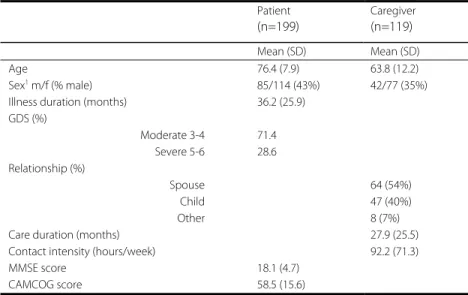
to DSM-IV criteria (American Psychiatric Association 1994). Diagnoses of Alzheimer's disease, vascular dementia, and dementia with Lewy bodies (DLB) were made in accordance with NINCDS/ADRDA (McKhann et al. 1984), NINDS/AIREN (Roman et al. 1993), and DLB Consensus criteria (McKeith et al. 1996) respectively. Of the 199 participating patients there were 146 patients with Alzheimer's Disease (AD), 32 vascular dementia, 3 Frontotemporal dementia, 5 Parkinson's dementia, 2 Lewy Body dementia, 4 primary progressive aphasia, 1 alcohol dementia and 6 mixed dementia (AD/vascular). There were 119 informal caregivers participating in part two of the study. Caregivers were included if they were the primary caregiver and had contact with the patient at least once a week. Patient and caregiver characteristics are shown in table 1.
Table 1. Baseline characteristics of patients and caregivers
Patient (n=199) Caregiver (n=119) Mean (SD) Mean (SD) Age 76.4 (7.9) 63.8 (12.2) Sex1 m/f (% male) 85/114 (43%) 42/77 (35%)
Illness duration (months) 36.2 (25.9) GDS (%) Moderate 3-4 Severe 5-6 71.4 28.6 Relationship (%) Spouse Child Other 64 (54%) 47 (40%) 8 (7%)
Care duration (months) 27.9 (25.5)
Contact intensity (hours/week) 92.2 (71.3)
MMSE score 18.1 (4.7)
CAMCOG score 58.5 (15.6)
GDS = Global Deterioration Scale | MMSE = Mini-Mental State examination | CAMCOG = Part B of CAMDEX-R-N 1. values represent number of males and females
Refusal
Of the 199 dementia patients included in the study at baseline, 161 (80%) had a primary caregiver. Hundred-nineteen (73.9 %) primary caregivers agreed to participate in part two of the study and 42 (26.1 %) refused. Reasons for refusal were: no time (10; 23.8 %), too distressing (14; 33.3 %), no gain (8; 19 %), and 10 (23.8 %) caregivers gave no reason.
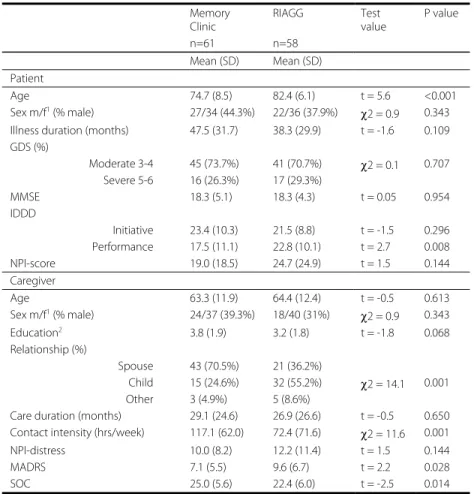
Table 2. Baseline differences between patients and caregivers of the Memory Clinic (n= 61) and the RIAGG (n= 58)
Memory Clinic n=61 RIAGG n=58 Test value P value Mean (SD) Mean (SD) Patient Age 74.7 (8.5) 82.4 (6.1) t = 5.6 <0.001 Sex m/f1 (% male) 27/34 (44.3%) 22/36 (37.9%) χ2 = 0.9 0.343 Illness duration (months) 47.5 (31.7) 38.3 (29.9) t = -1.6 0.109 GDS (%) Moderate 3-4 Severe 5-6 45 (73.7%) 16 (26.3%) 41 (70.7%) 17 (29.3%) χ2 = 0.1 0.707 MMSE 18.3 (5.1) 18.3 (4.3) t = 0.05 0.954 IDDD Initiative Performance 23.4 (10.3) 17.5 (11.1) 21.5 (8.8) 22.8 (10.1) t = -1.5 t = 2.7 0.296 0.008 NPI-score 19.0 (18.5) 24.7 (24.9) t = 1.5 0.144 Caregiver Age 63.3 (11.9) 64.4 (12.4) t = -0.5 0.613 Sex m/f1 (% male) 24/37 (39.3%) 18/40 (31%) χ2 = 0.9 0.343 Education2 3.8 (1.9) 3.2 (1.8) t = -1.8 0.068 Relationship (%) Spouse Child Other 43 (70.5%) 15 (24.6%) 3 (4.9%) 21 (36.2%) 32 (55.2%) 5 (8.6%) χ2 = 14.1 0.001 Care duration (months) 29.1 (24.6) 26.9 (26.6) t = -0.5 0.650 Contact intensity (hrs/week) 117.1 (62.0) 72.4 (71.6) χ2 = 11.6 0.001 NPI-distress 10.0 (8.2) 12.2 (11.4) t = 1.5 0.144 MADRS 7.1 (5.5) 9.6 (6.7) t = 2.2 0.028 SOC 25.0 (5.6) 22.4 (6.0) t = -2.5 0.014
GDS = Global Deterioration Scale | MMSE = Mini-Mental State examination | IDDD = Interview of Daily living activities in Dementia | NPI = NeuroPsychiatric Inventory | MADRS = Montgomery Asberg Depression Rating Scale | SOC = Sense of Competence
1. values represent number of males and females | 2. ranging from (1) primary school to (8) university degree
Memory clinic versus RIAGG
Hundred-and-nineteen caregivers and patients were included in the second part of MAASBED of which 61 (51.3%) patients were referred by the Maastricht Memory Clinic and 58 (48.7%) patients by the RIAGG. Using patients from both sites may have caused a referral bias, because a difference exists in reasons for referral between both populations. Patients with behavioural problems are probably more often referred to the RIAGG, while patients of the memory clinic are often referred for early diagnostics. Examination of differences between both groups showed that patients from the RIAGG group were older
and performed less ADL activities; their caregivers were more often children, had less contact hours with the patient, and reported more depressive symptoms and lower feelings of competence compared to the memory clinic group (table 2).
Table 3. Measures assessed per visit to patient and caregiver
Informant Screening Months
0 6 12 18 24
Patient measures
Informed Consent P(atient) / C(aregiver) y In/exclusion criteria P/C y DSM-IV y Psychiatric (hetero)anamnesis P y Medical (hetero)anamnesis P/C y Demographic variables P/C y NPI C y y y y y MMSE P y y y y y IDDD C y y y GDS P/C y y y Treatment information C y y y y y Caregiver measures In/exclusion criteria C y Informed Consent C y Demographic variables C y Neuropsychological tests C y NPI-Distress C y y y y y SCL-90 C y y y y y MADRS C y y y RAND 36 C y y y NEO-FFI C y UCL C y Mastery C y FMSS C y y y CAS C y y y y y SOC C y y y y y SSL12-I C y y y Social network C y y y Sleep quality C y y y y y Cortisol C y y y PSS C Qualitative interview C y y y
NPI = Neuropsychiatric Inventory | MMSE = Mini Mental State Examination | IDDD = Interview of Daily living activities in Dementia | GDS = Global Deterioration Scale | SCL-90 = Symptom Checklist-90 | MADRS = Montgomery Asberg Rating Scale | NEO-FF-I = Neuroticism-Extroversion-Openness Five Factor personality Inventory | UCL = Utrecht Copinglist | FMSS = Five Minute Speech Sample | CAS = Caregiver Activities Scale | SOC = Sense of Competence Questionnaire | SSL12-I = Social Support List | PSS = Perceived Stress Scale
Assessment
Procedure
Informed consent was obtained from all subjects. Patient and caregiver assessment were conducted at baseline, 6-, 12-, 18-, and 24 months follow-up by independent, clinically experienced, trained psychologists. Assessments at baseline, 12-, and 24 months were more extensive than at 6-, and 18 months. Patient assessment consisted of a neuropsychological examination; caregiver assessment consisted of a structured and semi-structured interview, and questionnaires. In addition a neuropsychological examination was performed in a sub-sample of only spousal caregivers, because spouses were usually of the same age as the patient and therefore at risk for some age-related cognitive decline. Furthermore, later on in the study it was decided to assess salivary cortisol as a measure of objective stress, thus these data were also collected in only a sub-sample of the caregivers. Main outcome measures were the Neuropsychiatric Inventory (NPI) to assess behavioural symptoms in the patient and caregiver distress, and the Short Sense of Competence Questionnaire (SOC) to assess caregiver feelings of competence to care for the patient. These instruments were administered at all visits. All measures assessed per visit are shown in table 3. Not all measures were used in the studies described in this thesis. The most important measures are discussed in the next paragraph.
Measures
• NeuroPsychiatric Inventory
The NPI was used to assess patient’s behavioural and psychological problems (Cummings 1997). Several rating scales have been developed for this purpose; however the NPI is widely used and assesses a wide range of behaviours. In addition, the NPI distinguishes symptom frequency and severity, and facilitates rapid behavioural assessment through the use of screening questions. The NPI is based on a structured interview with a caregiver who is familiar with the patient's daily functioning. After explaining the purpose of the interview, a screening question is asked for each neuropsychiatric domain, followed by sub-questions if the response to the screening question suggests the presence of abnormalities in that domain. The behavioural domains assessed with the NPI are: delusions, hallucinations, dysphoria, anxiety, agitation, euphoria, apathy, irritability, disinhibition, aberrant motor behaviour, night-time disturbances and changes in eating
behaviours. For each domain, the caregiver is asked to rate the frequency on a scale from 1 (occasionally) to 4 (very frequently), and the severity on a scale from 1 (mild) to 3 (severe). A total score is obtained by multiplying the frequency and severity score for each domain (maximum score per domain is 12), and adding them up (maximum total score is 144). In addition, for each domain a caregiver distress score is rated on a six-point scale from 0 (no distress) to 5 (extreme distress). Recently, several psychometric aspects of the Dutch translation of the NPI were published (Kat et al. 2002).
• Short Sense of Competence Questionnaire
The SOC is a shortened form of the 27-item Sense of Competence Questionnaire (Vernooij-Dassen et al. 1999) and assesses caregivers’ feelings of being capable of caring for a demented person. The advantage of the SOC is that it refers to the specific situation of caregiving and does not measure a general characteristic of the caregiver. In addition, the concept of competence is preferred because it refers to caregiver capabilities, while caregiver burden is more related to the patient (Vernooij-Dassen et al. 1996). The SOC is based on the family-crisis model and includes issues from the Zarit’s Burden Scale. Three domains are distinguished: (1) satisfaction with the demented person as a care recipient; (2) satisfaction with one’s own performance as a caregiver; and (3) consequences of involvement in care for the personal life of the caregiver. The SOC consists of 7 items rated on a 5-point scale from 1 (agree very strongly) to 5 (disagree very strongly). The validity and reliability of the SOC were assessed in a study of 141 caregivers of community-living dementia patients (Vernooij-Dassen et al. 1999).
• Montgomery Asberg Rating Scale
The MADRS (Montgomery and Asberg 1979), a structured interview, was used to assess depressive symptoms in the caregiver. As the MADRS contains relatively few somatic items, it is particularly suitable for the wide range in our sample, including elderly caregivers. Ratings from 0 to 6 on 10 items were summed.
• Five Minute Speech Sample
Level of Expressed Emotion was assessed by the FMSS (Magana et al. 1986). This instrument is a less time consuming alternative to the Camberwell Family Interview (CFI) to measure Expressed Emotion. In the FMSS, a caregiver is asked to speak freely for 5 min about the patient and how they get along together. The speech sample is audiotaped and transcribed verbatim. A qualified rater then codes the sample for 4 dimensions: (1) the
initial statement, (2) quality of the relationship, (3) criticism, and (4) emotional over-involvement (EOI). Caregivers are classified as high EE if they scored on the critical scale and/or the EOI scale, otherwise they are classified as low EE.
• Qualitative interviews
Qualitative interviews were used in addition to quantitative methods to study the experiences of the caregiver, relational changes between patient and caregiver, and the context of patient problem behaviours. Qualitative methods are particularly appropriate to describe experiences of illness in the context of everyday life, issues of process, and underlying factors of associations (Britten 1995). Since caregiver experiences and the social context of patient behaviour are the main issues of this study, qualitative methods are considered to be useful in addition to quantitative methods. A semi-structured interview was used with questions addressing the way caregivers manage the caregiving situation and how they deal with dementia-related problems. The interviews were tape-recorded and then transcribed verbatim for analysis.
• Neuropsychological examination
Cognitive functioning in spousal caregivers was assessed by means of neuropsychological tasks measuring verbal memory (Auditory Verbal Learning Test; Brand and Jolles 1985), speed of information processing (Letter Digit Coding Test; Smith 1968), cognitive flexibility (Stroop; Houx et al. 2002; Stroop 1935), global cognitive functioning (MMSE; Folstein et al. 1975), and general intelligence (shortened GIT; Luteijn and van der Ploeg 1983) .
• Cortisol
Cortisol secretion was assessed to measure the physiological stress response in caregivers. Cortisol was assessed from saliva collected with a cotton dental roll, stored in a capped plastic vial (Salivette; Sarstedt, Etten-Leur, the Netherlands). Saliva collection is non-invasive and interferes only minimally with normal daily routines, in contrast to blood sampling. Salivary cortisol represents the unbound (“free”), biologically active fraction of total cortisol; it correlates highly with free plasma cortisol (Kirschbaum and Hellhamer 1994).
Loss to follow-up
Of the 119 primary caregivers included in the study at baseline, there were 97 (81.5%) caregivers still participating at 1 year up and 75 (63%) caregivers at 2 year follow-up. Missing values in the follow-up were due to refusal (18; 15.1%) or death of the patient (26; 21.8%). Caregivers lost to follow-up were significantly older (t = -2.8, p = 0.006). Furthermore, dementia in the patients was more severe, as measured with the Global Deterioration Scale (t = -2.0, p = 0.045), and patients were more cognitively impaired on the MMSE (t = 2.1, p = 0.034). There were no other differences in patient or caregiver characteristics.
Practical considerations
Patient and caregiver assessments were mostly conducted simultaneously in the home of the participants by two independent raters. The extensive assessments took approximately 2 hours, while the duration of the other assessments was around 1 hour. Caregivers were asked to fill in a booklet with questionnaires during the next week. Caregiver and patient assessments were performed by two teams of two psychologists. They received training in test administration from a highly experienced test assistant. During the course of the study problems and other issues were discussed. Psychologists attended the weekly clinical rounds, to ensure enrolment of new patients in the study. Feedback of the individual test results was given to the clinician concerned by means of a standardized report. Study participants received a Christmas card every year in appreciation of their participation.
Data-management
Data from structured interviews, questionnaires and neuropsychological assessments were entered into a FileMaker Pro 5 database. Data integrity was ensured by matching double entered data. The database was password protected. Data was converted to SPSS 10.0 for statistical analyses.
3
Published in Dementia and Geriatric Cognitive Disorders, 2003; 15: 99-105
Factor analysis of the Neuropsychiatric
Inventory (NPI)
Abstract
Objectives: Behavioural problems in dementia can be diagnosed at both a symptomatic and syndromal level. Several rating scales have been designed to assess behavioural symptoms, of which the Neuropsychiatric Inventory (NPI) is often used. The aim of this study was to detect behavioural sub syndromes of the 12-item NPI.
Methods:Cross-sectional data of 199 patients with dementia living in the community
were collected. Behavioural problems were measured with the NPI. Principal component analysis (with Varimax-rotation) was used for factor analysis.
Results:Results showed the presence of three behavioural sub syndromes: mood/apathy,
psychosis, and hyperactivity. Anxiety was regarded as a separate symptom. The sub syndrome mood/apathy was the most common, occurring in almost 80% of the patients, versus psychosis and hyperactivity, which occurred in 37% and 60% of the patients, respectively.
Conclusions: Our study provides evidence for the existence of behavioural sub syndromes in dementia. The three sub syndromes can give insight into possible relationships between behavioural symptoms, their underlying cause and risk factors, and clinical correlates.
Introduction
Non-cognitive, or behavioural and psychological symptoms in dementia, often abbreviated as BPSD (Finkel 1998), are associated with more caregiver distress and increase the likelihood of institutionalization (Benoit 1999; Cummings 1994; De Deyn 1998; Finkel 1998; Kaufer 1998; Mega 1996; Tariot et al. 1995). Such problems are diagnosed at both a symptomatic and syndromal level. Several rating scales have been designed to assess behavioural and psychological symptoms, of which the Neuropsychiatric Inventory (NPI) is most often used to date (Cummings 1994).
It is important to study behavioural sub syndromes in dementia instead of investigating separate behavioural symptoms because these sub syndromes may point to a common neurobiological pathogenesis, or may react to the same treatment (Lawlor and Ni Bhriain 2001). For example pharmacological studies (Kaufer et al. 1998; Lawlor and Ni Bhriain 2001; Street et al. 2000) have shown that treatments have a consistent effect on behavioural problems in dementia when studying behavioural sub syndromes, but not when studying individual symptoms. Data reduction, through the reduction of a number of symptoms into sub syndromes, leads to greater possibility of finding associations. In the DSM-IV (American Psychiatric Association 1994), dementia is sub typed in terms of the sub syndromes of uncomplicated dementia, or dementia with depressed mood, delusions, or delirium. The aggregation of symptoms into clusters as proposed by the DSM-IV stems from the traditional nosological classification of general psychiatry, and therefore does not necessarily apply directly to patients with dementia. It needs to be determined whether behavioural sub syndromes, i.e. clustering of psychopathological symptoms, occur in populations of patients with representative dementia.
Studies involving factor analysis, have been published recently (Devanand 1992b; Frisoni et al. 1999; Fuh et al. 2001; Hope 1997; Kaufer et al. 1998; McShane 2000). These earlier studies made use of a variety of assessment instruments to diagnose BPSD, including an earlier shorter version of the NPI (Frisoni et al. 1999). The aim of this study was to identify behavioural sub syndromes of the current version of the Neuropsychiatric Inventory (NPI) in consecutive patients with dementia referred to a mental outpatient service for the elderly.
Methods
Patients
Subjects were 199 ambulatory patients with dementia according to DSM-IV (American Psychiatric Association 1994). Standardized clinical diagnostic criteria were used to characterize the type of dementia. Diagnoses of Alzheimer's disease, vascular dementia, and dementia with Lewy bodies (DLB) were made in accordance with NINCDS/ADRDA (McKhann et al. 1984), NINDS/AIREN (Roman et al. 1993), and DLB Consensus criteria (McKeith et al. 1996) respectively.
The patients were included in the Maastricht Study of Behaviour in Dementia (abbreviated as MAASBED). MAASBED focuses on the course and risk factors of behavioural problems in dementia. The project, funded by the Dutch National Research Council (NWO), is a 2-year prospective follow-up study of 199 patients with dementia and 119 informal caregivers. Patients and their caregivers are seen at 6- month intervals. Patients were enrolled from the Maastricht Memory Clinic of the University Hospital Maastricht, and the Department of Mental Health for the Elderly of the regional Institute of Ambulatory Mental Health of Maastricht. Both are psychiatric based clinics. Most of the patients were referred by a local general practitioner because of cognitive deficits, while in some cases the presence of behavioural problems was the reason for referral. The included patients were a representative sample of dementia patients living in the community. Because the presence of behavioural syndromes in a consecutive demented population in need of care was our main point of interest, all dementia patients, regardless of etiology, were included.
Patients were excluded if they lived in a nursing home at the beginning of the study and if there was no caregiver who had contact with the patient at least once a week. Written consent was given by the caregiver, and when possible also by the patient. This study was approved by the Medical Ethics Committee of the University Hospital Maastricht. The cross-sectional data from the baseline data of MAASBED were used for this study.
Neuropsychiatric Inventory
The NPI (Cummings 1994) is a short, reliable, informant-based rating scale developed to assess psychopathology in dementia patients. The original NPI assesses ten behavioural symptoms. The current 12-item version (Cummings 1997) evaluates 12 Neuropsychiatric symptoms which are commonly observed in dementia: delusions, hallucinations, agitation / aggression, dysphoria / depression, anxiety, apathy, irritability, euphoria,
disinhibition, aberrant motor behaviour, night- time behaviour disturbances, and appetite and eating abnormalities. The two latter mentioned symptoms are added in the current version. The severity and frequency of each neuropsychiatric symptom were scored on the basis of structured questions administered to the patient's caregiver. The score for each symptom was obtained by multiplying severity (1-3) with frequency (1-4). The summed symptom scores give the total NPI score. The NPI also assesses the amount of caregiver distress related to each neuropsychiatric symptom. The content validity, concurrent validity, inter-rater reliability, and test-retest reliability of the NPI have been established earlier (Cummings and McPherson 2001). The NPI may help to distinguish between different causes of dementia and is sensitive to treatment effects (Cummings 1997).
Procedure
Trained psychologists administered cognitive tests to the patients and additional information was gathered from the primary caregivers.
Cognitive tests administered to the patients included the Mini-Mental State Examination (Folstein et al. 1975) and part B of the Cambridge Examination for Mental Disorders of the Elderly (Derix et al. 1991). The severity of dementia was rated with the Global Deterioration Scale (GDS)(Reisberg et al. 1982). The Cornell Scale for Depression in Dementia (CSDD) (Alexopoulos 1988) was administered to the caregivers.
Data analysis
Statistical analysis was performed with the Statistical Package for Social Sciences (SPSS), version 10. To detect behavioural sub syndromes, we performed a principal component analysis on the NPI items, using an orthogonal rotational procedure (Varimax). Factors were selected on the basis of eigenvalues greater than 1. Factor loadings equal or greater than 0.45 were included.
At first, the analysis was performed on the total dementia population because behaviour problems were the starting point of the study, regardless of etiology.
Secondly, in order to assess possible differences between patient subgroups, three separate analyses were performed for mild (Global Deterioration Scale (GDS) 3-4) and severe (GDS 5-6) dementia stages and for Alzheimer patients only. Cronbach's alpha coefficients were used to assess the internal consistency of the factors. Spearman's rank correlations were calculated between the factors and the Cornell Scale for Depression in
Dementia, to determine the correlation between the factor including depression and an external validation measure.
Results
Characteristics of the subject group
Of the 199 subjects, 89 were recruited through the Maastricht Memory Clinic and 110 through the Department of Mental Health of the Elderly, from the regional Institute of Ambulatory Mental Health of Maastricht.
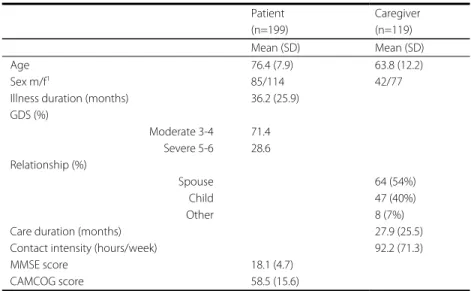
Of the 199 referrals, 146 met the DSM-IV criteria for dementia of the Alzheimer's type. Thirty-two patients had vascular dementia, 6 patients with mixed Alzheimer's disease and vascular etiology, 3 frontal dementia, 5 Parkinson dementia, 2 Lewy body dementia, 4 primary progressive aphasia, and 1 alcohol dementia. Most patients had a mild form of dementia (71.4%). Patient characteristics are described in table 1.
Table 1. Baseline characteristics of patients (n=199) and caregivers (n=119)
Patient (n=199) Caregiver (n=119) Mean (SD) Mean (SD) Age 76.4 (7.9) 63.8 (12.2) Sex m/f1 85/114 42/77
Illness duration (months) 36.2 (25.9) GDS (%) Moderate 3-4 Severe 5-6 71.4 28.6 Relationship (%) Spouse Child Other 64 (54%) 47 (40%) 8 (7%)
Care duration (months) 27.9 (25.5)
Contact intensity (hours/week) 92.2 (71.3)
MMSE score 18.1 (4.7)
CAMCOG score 58.5 (15.6)
GDS - Global Deterioration Scale | MMSE - Mini-Mental State examination | CAMCOG - Part B of CAMDEX-R-N 1. values represent number of males and females
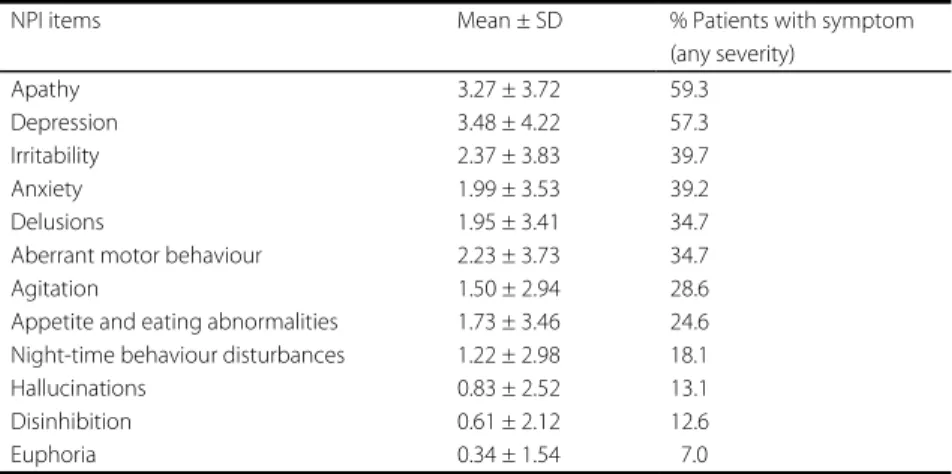
Apathy and depression were the most common symptoms, each being present in about 60 % of the patients (table 2). The rarest symptoms were euphoria (7%), disinhibition (13%), and hallucinations (13%). Eighteen patients did not have any NPI symptoms.
Table 2. Mean NPI scores (severity * frequency; range 0-12) and % patients with symptoms; n= 199
NPI items Mean ± SD % Patients with symptom (any severity) Apathy 3.27 ± 3.72 59.3 Depression 3.48 ± 4.22 57.3 Irritability 2.37 ± 3.83 39.7 Anxiety 1.99 ± 3.53 39.2 Delusions 1.95 ± 3.41 34.7
Aberrant motor behaviour 2.23 ± 3.73 34.7
Agitation 1.50 ± 2.94 28.6
Appetite and eating abnormalities 1.73 ± 3.46 24.6 Night-time behaviour disturbances 1.22 ± 2.98 18.1 Hallucinations 0.83 ± 2.52 13.1 Disinhibition 0.61 ± 2.12 12.6
Euphoria 0.34 ± 1.54 7.0
Factor analyses
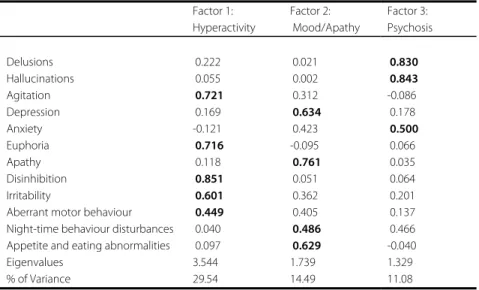
The results of the exploratory factor analyses of the total patient group are shown in table 3. Principal component analysis, using the criterion of eigenvalues greater than 1, reduced the 12 variables to three factors. The three factors explained 55.1 % of the variance in the data. The first factor (29.5% of the total variance) denoted a dimension representing 'hyperactivity', and had high loadings on agitation, euphoria, irritability, disinhibition, and aberrant motor behaviour. The second factor (14.5% of the total variance) represented a 'mood/apathy' dimension and had high loadings on depression, apathy, night-time behaviour disturbances, and appetite and eating abnormalities. The third factor (11.1% of the total variance) represented a 'psychosis' dimension and had high loadings on delusions, hallucinations, and anxiety. However, comparable factor loadings on different factors were found for the symptoms anxiety, aberrant motor behaviour, and night- time behaviour disturbances. The loading of anxiety on the psychosis factor was 0.50 and on the mood factor 0.42. In addition, a reliability analysis revealed that if anxiety was omitted from the factor psychosis, the Cronbach's alpha coefficient increased substantially (from 0.64 to 0.72). Therefore, anxiety was excluded from the factor psychosis. Cronbach's alpha
did not show improvements if motor behaviour or night-time behaviour disturbances were removed from the factors hyperactivity (Cronbach's alpha: 0.73) and mood/apathy (Cronbach's alpha: 0.63) respectively.
Separate analyses were performed for patients with mild (GDS 3-4) or severe (GDS 5-6) dementia. They resulted in only slightly different factor structures. In mild dementia, aberrant motor behaviour was not included in factor 1 'hyperactivity' but in factor 2 'mood/apathy', whereas 'night-time behaviour disturbances' was not included in factor 2 but in factor 3 'psychosis'. In severe dementia, aberrant motor behaviour had the highest correlation with the factor 3 'psychosis', and anxiety was not included in factor 3 but in factor 2 'mood/apathy'.
The analysis for patients with Alzheimer's disease (n=146) revealed a factor structure analogous to that found for the total patient group, and in particular resembled that of the mild dementia stages. Reliable sub analysis of the non-Alzheimer patient groups could not be done because of the small sample sizes.
Table 3. Factor analysis of the NPI variables in the total group
Factor 1: Hyperactivity Factor 2: Mood/Apathy Factor 3: Psychosis Delusions 0.222 0.021 0.830 Hallucinations 0.055 0.002 0.843 Agitation 0.721 0.312 -0.086 Depression 0.169 0.634 0.178 Anxiety -0.121 0.423 0.500 Euphoria 0.716 -0.095 0.066 Apathy 0.118 0.761 0.035 Disinhibition 0.851 0.051 0.064 Irritability 0.601 0.362 0.201
Aberrant motor behaviour 0.449 0.405 0.137 Night-time behaviour disturbances 0.040 0.486 0.466 Appetite and eating abnormalities 0.097 0.629 -0.040
Eigenvalues 3.544 1.739 1.329
% of Variance 29.54 14.49 11.08
External validation of the factor 'mood/apathy' was examined by calculating the Spearman's rank correlation between this factor and the score on the Cornell Scale for Depression in Dementia. This correlation was 0.79 (p< 0.05), which can be regarded as high. The correlation with the factors 'hyperactivity' and 'psychosis' was 0.43 (p< 0.05) and
0.29 (p< 0.05), respectively. These correlations, although significant, were much lower than the correlation with the factor 'mood/apathy'. Therefore, the correlation was specific for the factor 'mood/apathy'.
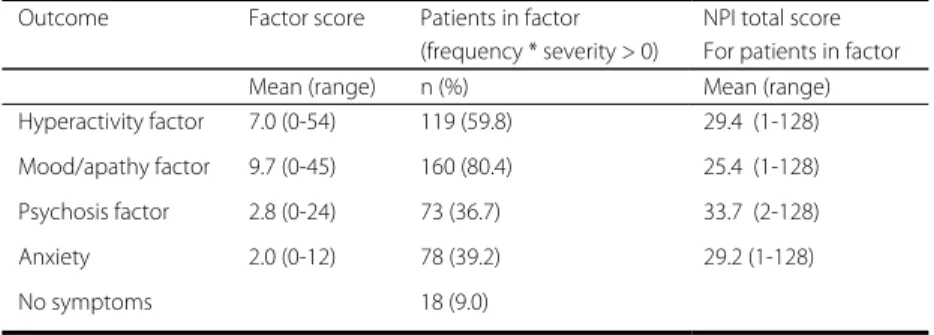
The descriptions of the three factors and the separate symptom 'anxiety' are given in table 4. The factor scores are based on the summed NPI scores for each factor. The factor score for 'psychosis' was based on the summed score for delusions and hallucinations. Most patients (n=181) had a score of 1 or more for at least one behavioural sub syndrome. Only 18 patients did not have any behavioural sub syndrome. The most common sub syndrome was the 'mood/apathy' sub syndrome (80.4%), followed by 'hyperactivity' (60%), 'anxiety' (almost 40%), and 'psychosis' (37%).
The patients with the 'psychosis' sub syndrome had the highest mean NPI total score. The combination of the sub syndromes 'mood/apathy' and 'hyperactivity' was present in 53% of the patients. Mood and psychosis were present in 32% of the patients, and 26% of the patients had a score of 1 or more on both hyperactivity and psychosis. Anxiety most often co-occurred with the sub syndrome 'mood/apathy'.
Table 4. Description of the three NPI factors and anxiety
Outcome Factor score Patients in factor (frequency * severity > 0)
NPI total score For patients in factor Mean (range) n (%) Mean (range) Hyperactivity factor 7.0 (0-54) 119 (59.8) 29.4 (1-128) Mood/apathy factor 9.7 (0-45) 160 (80.4) 25.4 (1-128) Psychosis factor 2.8 (0-24) 73 (36.7) 33.7 (2-128) Anxiety 2.0 (0-12) 78 (39.2) 29.2 (1-128) No symptoms 18 (9.0)
Discussion
The main finding of our study was that factor analysis indicated the presence of three behavioural sub syndromes 'mood/apathy', 'psychosis' and 'hyperactive behaviour'. Most symptoms had high factor loadings and give support to the differentiation between the three sub syndromes. The majority of patients had at least one sub syndrome. 'Mood/apathy' was the most common and co-occurred very often with 'hyperactivity'.
The sub syndrome 'psychosis' was less prevalent and was associated with more severe total behavioural problems.
The attribution of the symptoms aberrant motor behaviour, night-time behaviour disturbances and anxiety to one of the sub syndromes can be argued. In this study, aberrant motor behaviour had high loadings for the sub syndromes ‘hyperactivity’ and 'mood/apathy', and thus could not be used to distinguish between the two sub syndromes. Likewise, night-time behaviour disturbances and anxiety had high loadings for the sub syndromes 'mood/apathy' and 'psychosis'. The internal consistency of the three sub syndromes was sufficient. However, because of a substantial improvement of Cronbach's alpha for the 'psychosis' sub syndrome when 'anxiety' was omitted, we decided that anxiety can best be regarded as a separate symptom, although it can co-occur with different sub syndromes.
The presence of the three ambiguous symptoms aberrant motor behaviour, anxiety, and night-time behaviour disturbances seems to be dependent on the severity of dementia, whereas the other nine symptoms were consistently attributed to the sub syndromes regardless of disease severity. However, because the three ambiguous symptoms were not able to clearly differentiate between the different sub syndromes in the total group, it cannot necessarily be concluded that the three symptoms are dementia stage specific. This deserves further study.
Because the presence of behavioural sub syndromes in a dementia population in need of care was our main point of interest, the factor analysis was performed on the etiologically heterogeneous group. However we are aware that behavioural syndromes may differ among patients with different etiologies. For example, hallucinations and delusions are more common in dementia with Lewy bodies and disinhibition in frontal dementia. Post-hoc analyses were performed on Alzheimer patients, vascular dementia patients and other etiologies, but because of sample size and power it was only possible to perform a separate analysis for the Alzheimer patients. This resulted in a factor structure analogous to that found for the total patient group, and in particular resembled that of the mild dementia stages. Future studies must pay attention to the generalization of the sub syndromes to other dementia etiologies.
The three sub syndromes have face validity. In clinical practice the distinction between mood disorders, psychosis, and agitated behaviours is recognizable. The high correlation between the sub syndrome 'mood/apathy' and the Cornell Scale for Depression in Dementia also provided evidence for external validity. There was some instability of the symptoms in all three sub syndromes; however, the internal stability of the sub
syndromes was satisfactory. Furthermore, each sub syndrome was characterized by two or more stable symptoms.
The factor structure of this study is consistent with that found in other studies. The factor we found to represent mood/apathy corresponds to factors proposed by other authors in factor analytic studies (Frisoni et al. 1999; Hope 1997; McShane 2000). Frisoni and colleagues (1999) found a sub syndrome 'mood' including depression and anxiety. Hope et al.(1997), using the Present Behavioural Examination (PBE) segregated depression as a separate factor. McShane et al. (2000), also using the PBE, found a factor depression, including anxiety. The finding of the factors hyperactivity and psychosis also seem to be consistent because in some kind the studies mentioned above agreed on the existence of these two factors. Frisoni et al. (1999) found a frontal and psychosis sub syndrome resembling our hyperactivity and psychosis sub syndromes, respectively. Hope et al. (1997) and McShane et al. (2000) also found a factor representing hyperactivity. Devenand and colleagues (1992a) found a disinhibition sub syndrome that has similarities with the 'hyperactivity' sub syndrome of our study.
There were also some differences between our results and those of previous studies. Fuh and colleagues (2001), using the NPI, found three factors. The first combined mood and psychosis, the second factor 'psychomotor regulation' resembled our hyperactivity factor, and the third factor represented 'social engagement' and included apathy and disinhibition. Hope et al. (1997) and McShane et al. (2000) distinguished aggressive behaviour as a separate sub syndrome. McShane and colleagues also did not find a factor 'psychosis'. The factor psychosis found in the study of Frisoni et al. (1999) included symptoms of our factor 'psychosis' and symptoms of our factor 'hyperactivity'.
The differences between studies may be related to the use of different measures, designs, and relatively small number of included patients for factor analytic purposes.
Frisoni et al. (1999)and Fuh et al. (2001) also studied the presence of sub syndromes of the NPI, but Fuh et al. used a very small sample (95 patients) for their factor analysis and Frisoni used the original 10-item version of the NPI. We performed a factor analysis of our data for the 10-item version of the NPI to determine whether the difference in factor structure reported by Frisoni et al. and that found in our study was the result of using different versions of the NPI. The same sub syndromes were found as, when the current 12-item version was used.
Lyketsos et al. (2001a; 2001b) performed a latent class analysis to identify symptom patterns which co-occur in individual Alzheimer patients, using a population-based study.
This resulted into the classification of patients into three groups based on their neuropsychiatric symptom profile: an affective syndrome, a psychotic syndrome and a group with no neuropsychiatric symptoms or with a mono-symptomatic disturbance. The first two mentioned syndromes broadly resembled respectively our mood/apathy and psychosis sub syndrome. However, they did not find a group of patients with having predominantly agitated behaviours, like the hyperactive sub syndrome in our study. Agitation was regarded as a non-specific symptom. But the results reinforce the likely existence of behavioural sub syndromes in dementia patients, as well as in the population as in a clinical population.
When interpreting and using sub syndromes of dementia, one has to realize that differences can arise after controlling for, for example, stage of illness, sex, diagnosis, etc. Furthermore, the inclusion of rare variables with little variance in the analysis can affect the factor structure, especially for those factors with low eigenvalues (McShane 2000). This may have been the case for the symptom 'night-time behaviour disturbances' in our study. Overall it can be concluded that there are behavioural sub syndromes in dementia. Neurobiological correlates of behavioural symptoms in dementia have been found which support the existence of behavioural sub syndromes (Cummings 1997; Mega 2000; Sultzer 1996; Sultzer et al. 1995; Sultzer 1995; Zubenko et al. 1991).
This study had some limitations. For this study we applied a cross-sectional design without including data on the course of the sub syndromes; however, when follow-up data become available, it will be possible to examine the stability of the sub syndromes over time. In addition, the NPI is an observer-rated instrument. This can lead to information bias if the caregiver lacks or distorts information. However, it is generally acknowledged that behavioural problems in dementia are best assessed by interviewing informants who know the subject well (Zarit 1996).
Our study provides additional evidence of the existence of behavioural sub syndromes in dementia. The three sub syndromes can give insight into possible relationships between behavioural symptoms and their underlying cause and risk factors. The reduction of symptoms into sub syndromes can lead to greater ease in finding associations between behavioural disturbances and correlations with clinical variables (Frisoni et al. 1999). Furthermore, interventions may be more effective when targeting sub syndromes, rather than individual symptoms. However some caution is in order here. For example, data suggest an overlapping cholinergic-sensitive pathophysiology linking delusions and hallucinations, but these data also highlight potential differences in these symptoms with respect to differential response patterns to cholinergic treatment (Kaufer et al. 1998).
Key points
• Three behavioural sub syndromes are identified: mood/apathy, psychosis, and hyperactivity
• Anxiety is regarded as a separate symptom
• The mood/apathy syndrome occurs in 80%, hyperactivity in 60%, and psychosis in 37%
4
Accepted for publication in Journal of Neuropsychiatry and Clinical Neurosciences
Abstract
Objectives: The main purpose of the present study was to examine salivary cortisol patterns in caregivers of dementia patients and patients' behavioural and psychological symptoms (BPSD).
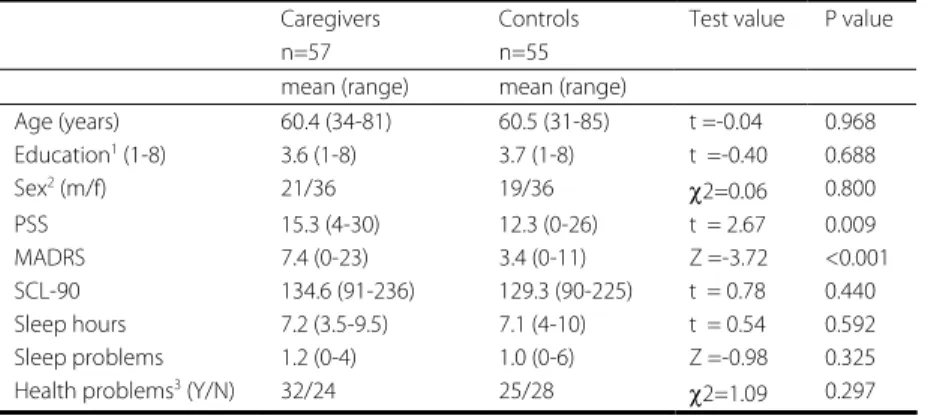
Methods:Diurnal cortisol profiles and response to awakening were measured in 57
caregivers and 55 non-caregiver controls. Cortisol was assessed from saliva collected with a cotton dental roll. Behavioural problems were assessed with the NeuroPsychiatric Inventory (NPI).
Results:Caregivers showed significantly higher levels of cortisol at the time of morning
awakening than controls, with a smaller increase after awakening. Higher morning cortisol levels were found in caregivers of patients with high vs. low levels of BPSD; this effect was mediated by greater distress experienced by caregivers in relation to the BPSD.
Conclusions:These data suggest that high levels of behavioural problems in dementia
patients influence the physiological stress response in caregivers. The observed elevation of morning cortisol levels could predispose caregivers to negative health consequences, with caregivers of patients with high levels of BPSD at even greater risk.