Bipolar Depression: Treatment Options
Lakshmi N Yatham, MBBS, FRCPC, MRCPsych1, Vivek Kusumakar, MBBS, FRCPC, MRCPsych2,
Sagar V Parikh, MD, FRCPC3, David RS Haslam, MSc, MD4, Raymond Matte, MD, FRCPC5,
Verinder Sharma, MBBS, FRCPC6, Sidney Kennedy, MD, FRCPC7
Objective: To review studies on treatments for bipolar depression and make recommendations for practising clinicians treating patients with bipolar depression.
Method: Studies that examined various treatments for bipolar depression were evaluated and rated for evidence of efficacy using Periodic Health Examination criteria. The rating for classification of recommendation for an intervention was made taking both the efficacy and the side effects into consideration.
Results: Mood stabilizers, cyclic antidepressants, monoamine oxidase inhibitors (MAOIs), and electroconvulsive therapy (ECT) are all effective in treating bipolar depression. Almost all antidepressant treatments with the exception of mood stabilizers have been reported to induce a manic–hypomanic switch and rapid cycling. Conclusions: Mood stabilizers, lithium in particular, are recommended as the first-line treatment. Addition of a second mood stabilizer or a cyclic antidepressant would be an appropriate next step. Newer agents such as lamotrigine offer considerable promise in treating bipolar depressed patients.
(Can J Psychiatry 1997;42 Suppl 2:87S–91S)
Key Words: bipolar depression, lithium, antidepressants, mania
B
ipolar depression is defined as the occurrence of a majordepressive episode in a patient who has had at least one hypomanic or manic episode (1). This condition affects approximately 1% of the general population (2). Depression may be the first affective episode in more than 50% of patients with bipolar disorder (3). In such cases, factors such as bipolar
family history, presence of psychotic features, chronicity of depressive episode, early age at onset, and presence of atypical symptoms, such as hypersomnia, hyperphagia, and a significant psychomotor retardation, may be helpful in pre-dicting a bipolar course (4,5).
This condition is associated with considerable morbidity and mortality. The mean duration of bipolar depressive epi-sodes is considerably longer than manic epiepi-sodes, and more than 20% of bipolar depressive episodes run a chronic course (6). Despite this, few controlled clinical trials have rigorously examined the effectiveness of specific interventions in treat-ment of bipolar depression. Most of our current state of knowledge about treatment of depression is derived from clinical trials that systematically excluded bipolar depressed patients. Although no consistent biochemical abnormalities have emerged between unipolar and bipolar depressed patients (7), several other lines of evidence pertaining to symptoms (8–10), course of illness (11–14), and response to treatment (15,16) have accumulated over the past few dec-ades, supporting the bipolar–unipolar dichotomy. Recent long-term follow-up studies examining the course and out-come (17) and the stability of polarity distinction (5) provided further support for the unipolar–bipolar distinction. Effective treatments for unipolar depressed patients, therefore, may or may not be effective for bipolar depressed patients.
In view of the concerns about generalizability of data, the evidence used to formulate treatment recommendations in this paper was based mainly on studies of bipolar depressed Manuscript received April 1997, revised and accepted July 1997.
1Assistant Professor and Director, Mood Disorders Clinical Research Unit, Department of Psychiatry, University of British Columbia, Vancouver, British Columbia.
2Associate Professor and Head, Division of Child and Adolescent Psychia-try; Director, Mood Disorders Group, Department of Psychiatry, Dalhousie University, Halifax, Nova Scotia.
3Assistant Professor, Department of Psychiatry, University of Toronto; Head, Bipolar Clinic, Clarke Institute of Psychiatry, Toronto, Ontario. 4Resident, Department of Psychiatry, Dalhousie University, Halifax, Nova Scotia.
5Associate Professor (Clinical) and Head, Outpatient Services and Mood Disorders Clinic, Department of Psychiatry, University of Sherbrooke, Sher-brooke, Quebec.
6Assistant Professor and Director, Mood Disorders Unit, Department of Psychiatry, University of Western Ontario, London, Ontario.
7Professor, Department of Psychiatry, University of Toronto; Head, Mood and Anxiety Disorders Division, Clarke Institute of Psychiatry, Toronto, Ontario.
Address for correspondence: Dr LN Yatham, Department of Psychiatry,
University of British Columbia, 2255 Wesbrook Mall, Vancouver, BC V6T 2A1
email: [email protected]
Can J Psychiatry, Vol 42, Supplement 2
patients. In cases where data were not available on bipolar depressed patients, data from studies of unipolar depressed patients were used, mainly out of necessity. This necessity is less problematic if the limitations of generalization of data are kept in mind. Apart from a potential difference in the effec-tiveness of antidepressant treatments for 2 conditions, the treatment of bipolar depression is often complicated by the fact that many antidepressant medications have been reported to induce a manic or hypomanic switch and rapid cycling in this population (18–22). This was the paramount issue in devel-oping an algorithm for the treatment of bipolar depression.
Although extensive data are available on the efficacy of psychosocial treatments in unipolar depression, little is known about their efficacy in bipolar depression. This review will briefly touch on the role of such treatments (see the article by Parikh and others [p 74S] for a more detailed discussion) and then examine the efficacy of various medications in treating bipolar depression. We will then suggest clinical recommendations and an algorithm for a clinician to treat patients with bipolar depression.
Psychosocial Interventions
Bipolar disorder is associated with severe occupational and social deficits. Such deficits may represent residual temperamental disturbances of a “subaffective” nature and/or the psychological sequelae of illness episodes (for example, shame, low self-esteem) (23,24). Mild depressive symptoma-tology may be successfully treated with cognitive–behav-ioural or interpersonal therapy, most often in combination with pharmacological interventions. Each of these psychoso-cial interventions requires some tailoring to the needs of individual patients. Controlled experimental trials of “manualized” interventions (that is, written guidelines for how and when treatment should be administered) are cur-rently being conducted (23). These standardized approaches may optimize the implementation of psychosocial interven-tions by providing practical and reproducible approaches that have empirically proved effectiveness in bipolar patients. The quality of evidence for psychotherapy was rated as “3,” and recommendation for clinical practice was determined to be “C” (Table 1).
Pharmacological Treatments Lithium
An open study (25) and 7 of 8 double-blind, placebo-controlled crossover studies (15,16,26–31) reported lithium to be superior to placebo in treating bipolar depression. In these trials, response rates to lithium ranged from 64% to 100%, and relapse of depressive symptoms ranged from 38% to 70% when switched to placebo. In the only double-blind, placebo-controlled parallel-group trial that compared lith-ium to imipramine, reductions in mean depressive scores were 32% and 58% for lithium and imipramine, respectively (32). In summary, clinical trials suggest that lithium is superior
to placebo in treating bipolar depression, but the efficacy of lithium in comparison to antidepressants remains uncertain. Overall, the quality of the evidence for lithium treatment rates as “1,” and the classification of recommendations was deter-mined to be “A” (see Table 1).
MAOIs
Double-blind trials involving subjects with anergic bipolar depression have demonstrated response rates of approxi-mately 75% and 50% with tranylcypromine and imipramine interventions, respectively (33–35). Fewer dropouts and lower switch rates were noted in the tranylcypromine-treated group compared with imipramine-treated subjects. Phenel-zine has been reported to be effective in case studies of patients with bipolar depression (36). In the only double-blind trial that examined the efficacy of moclobemide, a reversible inhibitor of monoamine oxidase A, 53% of patients with bipolar depression responded compared with 60% in the imipramine-treated group (37). MAOIs have been reported to cause a switch of mood, but hypomania is more common than mania. Overall, the quality of evidence for MAOI treatment is “1,” and the classification of recommendations was set at “D” in view of the concern about a manic or hypomanic
Table 1. Quality of evidence and recommendations for treatments: bipolar depression
Treatment
Quality of evidencea
Working group classification of recommendationb
Psychotherapy 3 C
Lithium 1 A
Divalproex 2.3 C
Carbamazepine 1 C
Alone With mood stabilizer
Lamotrigine 2.3 C B TCAs 1 D C MAOIs 1 D B SSRIs 1 D B Bupropion 1 D B Serotonergic norad-renergic reuptake inhibitors (SNRIs) 3 D C ECT 2.3 B B Light therapy 3 D C Sleep deprivation 3 D C
aQuality of evidence rating system:
1 At least one randomized controlled trial.
2.1 Well-designed controlled trial without randomization.
2.2 Well-designed cohort or case-controlled studies, preferably multicentre or from more than one research group.
2.3 Very significant results from uncontrolled trials from more than one centre comparing results with and without intervention.
3 Opinions of respected clinical authorities based on clinical experience, descriptive studies, or reports of expert committees.
bClassification of recommendations:
A Good support for the intervention to be considered in clinical practice. B Fair support for the intervention to be considered in clinical practice. C Poor support for the intervention to be considered in clinical practice. D Fair support for the intervention to be excluded from clinical practice. E Good support for the intervention to be excluded from clinical practice.
switch. The use of MAOIs in combination with a mood stabilizer, however, received a “B”-level classification.
Heterocyclic Antidepressants
A number of double-blind trials investigating the efficacy of the tricyclic antidepressant (TCA) imipramine reported an average response rate of 55% (34,35,37–38). The response rate in fluoxetine-treated subjects may be marginally higher than in those treated with TCAs (38,39), with switches reported in both groups. Case reports, as well as results of a double-blind trial, suggest that bupropion may be effective in treatment of bipolar depressed patients (40,41). Although no study directly compared the switch rate in patients on TCAs with those on selective serotonin reuptake inhibitors (SSRIs), data from clinical trials suggest that TCAs more commonly cause a switch into mania (more than 10%) than SSRIs (less than 5%) (21), and TCAs more commonly induce rapid cycling (22). In view of this, there is growing consensus that TCAs should be avoided in bipolar depression. As depression is a common first mood disorder episode in early-onset bipo-lar disorder, and because there is little evidence for the efficacy of TCAs in adolescents, TCAs should be avoided. The quality of evidence concerning these treatment interven-tions is strong: “1.” The working group classification of recommendations was “D” in view of the concern about a switch into mania or hypomania. When used in combination with a mood stabilizer, however, the rating is “B” for SSRIs and bupropion, and it is “C” for TCAs.
Anticonvulsants and Benzodiazepines
Double-blind, placebo-controlled trials report an approxi-mate 70% response rate to carbamazepine and a 50% relapse rate with placebo substitution in the treatment of bipolar depression (42–44). In patients with rapid-cycling bipolar disorder, 47% had antidepressant response to divalproex sodium in an open prospective trial (45). Despite the optimis-tic report of a small case series (46), there is little robust current evidence to support the use of divalproex in acute bipolar depression. In 2 large open-labelled series from at least 3 centres (47,48), lamotrigine has been reported to be a promising agent in the treatment of bipolar depression, although in a significant number of the cases, lamotrigine was added to either divalproex or lithium. Double-blind control-led studies are currently under way to test the efficacy of lamotrigine in bipolar depression. There is no published literature on gabapentin, although studies are currently being conducted with this compound.
Although a double-blind trial has demonstrated a response rate of 60% in adinazolam-treated bipolar depressed patients, the use of this agent as an antidepressant is not recommended given the risk of abuse potential and dependency and the availability of other effective agents with a more favourable risk-to-benefit profile (49). There is little or no evidence that other benzodiazepines have any efficacy in bipolar depres-sion. Overall, the quality of evidence for carbamazepine is
“1” and for divalproex and lamotrigine is “2.3.” The working group recommended a classification for all 3 agents of “C,” but the recommendation would be “B” for lamotrigine if used in combination with another mood stabilizer such as lithium or divalproex sodium.
Miscellaneous Treatments
A small double-blind trial reported levosulpiride to have a comparable response rate (90%) to that of amitriptyline in bipolar depressed patients (50). Much less robust evidence of varying rates of response to dopamine receptor agonists (51,52), total (53) and partial sleep deprivation (54,55), and light therapy (56) have also been reported. Dopamine recep-tor agonism has been associated with a high switch rate into hypomania or mania (51,52). Clozapine has been reported to be effective in bipolar depression in multiple case series studying refractory bipolar depression (57). Studies with olanzapine are currently being conducted, but as yet there is no published literature with this compound.
Pharmacological Augmentation and Combinations
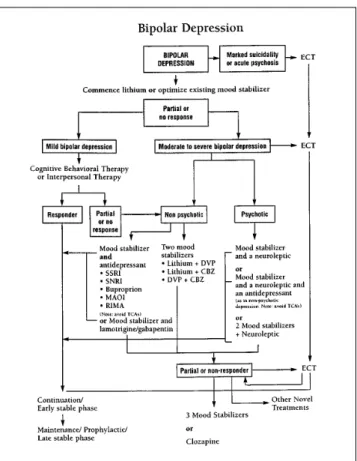
Lithium augmentation of TCA- (58) and carbamazepine-resistant patients (59) is reported to have led to marked improvement in 36% and 46% of study subjects, respectively. The use of TCAs is not advisable, however, because they Figure 1. Treatment algorithm for bipolar depression reproduced
courtesy of the Canadian Network for Mood and Anxiety Treatments (CANMAT).
carry a risk of switch into mania and induction of rapid cycling. Although the superiority of bupropion augmentation of mood stabilizers has been inconsistent, conversion of nonresponder to responder rates has exceeded 60% in 2 open studies (60,61) and a double-blind trial (41). Further, bupropion appears to have a lower risk of switching patients into mania or accelerating cycles. Case reports involving subjects receiving antidepressants suggest that car-bamazepine administered concurrently with lithium may be effective in lithium-resistant bipolar depressed patients (62,63).
ECT
Several open prospective trials and a number of retrospec-tive studies have reported the efficacy rate of ECT in bipolar depression to be at least 50% and as high as 100% (64–69). The rate of switch to elevated mood of bipolar depressed patients treated with ECT appears equivalent to that associ-ated with conventional antidepressant treatment (18). ECT is a bimodal treatment, however, and continuing with the course of ECT can produce euthymia. The ratings for quality of evidence and treatment recommendations were “2.3” and “B” for ECT.
Switch into Hypomania or Mania during Treatment for Depression
ECT is no more likely than antidepressants to precipitate a switch into hypomania or mania and to induce rapid cycling, whereas SSRIs may have decreased rates of switch compared with TCAs (18,21). A recent study reported that mania in one-third and rapid cycling in one-fourth of refractory bipolar patients was attributable to antidepressants and not to the expected course of illness (70). There is growing clinical consensus that in patients with depression who have no prior history of bipolar disorder, a switch into mania or hypomania while they are on antidepressants may reflect an underlying bipolar diathesis. Although there is a continuing debate as to the best treatment strategy for such patients, many experi-enced clinicians and experts in the field treat these patients as suffering from a bipolar disorder, and the guidelines group concurs with such practice.
Clinical Recommendations
The quality of evidence and the working group classifica-tion of recommendaclassifica-tion for each treatment modality are summarized in Table 1. The working group recommends that the mood stabilizer lithium should be the first choice in the treatment of bipolar depression (Figure 1) (71). In depressions with marked suicidality or severe psychosis, ECT should be considered earlier in the treatment algorithm. TCAs have the greatest predilection to induce a switch into mania and rapid cycling, so they should be avoided in the treatment of bipolar depression. If a patient with bipolar depression has been started on a TCA and appears to be responding well, the
robust use of concomitant mood stabilizers such as lithium or divalproex is advisable.
Should treatment with an antidepressant become neces-sary to resolve depressive symptoms, SSRIs and bupropion are preferable because they may have a lower propensity to induce a mood switch. Bupropion is available in Canada directly from the manufacturers, although the sustained-release form is expected to be available shortly. There is no evidence that one class of antidepressants is better than another in terms of efficacy in the treatment of bipolar depres-sion. It is inadvisable to use antidepressants without mood stabilizers in bipolar disorder. The consensus of the group was that the antidepressant medication should be gradually reduced and withdrawn completely within 6 to 12 weeks of remission of depressive symptoms. Despite the promising results with lamotrigine in the case series reported, further study of this compound is needed both in monotherapy and in combination with either divalproex or lithium.
References
1. American Psychiatric Association. Diagnostic and statistical manual of mental disorders. 4th ed. Washington (DC): American Psychiatric Association; 1994.
2. Goodwin FK, Jamison KR. Manic-depressive illness. New York: Oxford University Press; 1990.
3. Roy-Byrne P, Post RM, Uhde TW, Porcu T, Davis D. The longitudinal course of recurrent affective illness: life chart data from research patients at the NIMH. Acta Psychiatr Scand 1985;71 Suppl 317:1S–34S.
4. Akiskal HS, Walker P, Puzantian VR, King D, Rosenthal TL, Dranon M. Bipolar outcome in the course of depressive illness: phenominologic, familial, and pharmacological predictors. J Affect Disord 1983;5:115–28.
5. Coryell W, Endicott J, Maser JD, Keller MB, Leon AC, Akiskal HS. Long-term stability of polarity distinctions in the affective disorders. Am J Psychiatry 1995;152:385–90.
6. Keller MB, Lavori P, Coryell W, Andreasen NC, Endicott J, Clayton PJ, and others. Differential outcome of pure manic, mixed/cycling, and pure depressive episodes in patients with bipolar illness. JAMA 1986;255:3138–42.
7. Yatham LN, Srisurapanont M, Zis AP, Kusumakar V. Biological distinction between unipolar and bipolar depression: a review of comparative studies. Life Sci 1997. Forthcoming.
8. Kupfer DJ, Weiss BL, Foster FG, Detre TP, Delgado J, McPartland R. Psychomotor activity in affective states. Arch Gen Psychiatry 1974;30:765–8.
9. Katz MM, Robins E, Croughan J, Secunda S, Swann A. Behavioural measurement and drug response characteristics of unipolar and bipolar depression. Psychol Med 1982;12:25–36. 10. Brockington IF, Altman E, Hillier V, Meltzer HY, Nand S. The clinical picture of bipolar
affective disorder in its depressed phase: a report from London and Chicago. Br J Psychiatry 1982;141:558–62.
11. Angst J. The course of affective disorders. Psychopathology 1986;19 Suppl 2:47S–52S. 12. Egeland JA, Blumenthal RL, Nee J, Sharpe L, Endicott J. Reliability and relationship of various
ages of onset criteria for major affective disorder. J Affect Disord 1987;12:159–65. 13. Coryell W, Andreasen NC, Endicott J, Keller M. The significance of past mania or hypomania
in the course and outcome of major depression. Am J Psychiatry 1987;144:309–15. 14. Winokur G, Coryell W, Keller M, Endicott J, Akiskal H. A prospective follow-up of patients
with bipolar and primary unipolar affective disorder. Arch Gen Psychiatry 1983;50:457–65. 15. Goodwin FK, Murphy DL, Dunner DL, Bunney WE Jr. Lithium response in unipolar versus
bipolar depression. Am J Psychiatry 1972;15:187–93.
Clinical Implications
• Bipolar depression can be treated effectively with medication.
• Switch into mania or hypomania is a common problem with antidepressant medication.
• Antidepressant medication should be withdrawn within 6 weeks of remission of depressive symptoms.
Limitations
• Many studies had a small number of subjects.
• Many antidepressant medications have not been tested in bipolar depressed patients.
16. Noyes R, Dempsey GM, Blum A, Cavanaugh GL. Lithium treatment in depression. Compr Psychiatry 1974;15:187–93.
17. Goldberg JF, Harrow M, Grossman LS. Course and outcome in bipolar affective disorder: a longitudinal follow up study. Am J Psychiatry 1995;152:379–84.
18. Srisurapanont M, Yatham LN, Zis AP. Treatment of acute bipolar depression: a review of the literature. Can J Psychiatry 1995;40:533–44.
19. Wher TA, Goodwin FK. Can antidepressants cause mania and worsen the course of affective illness? Am J Psychiatry 1987;144:1403–11.
20. Angst J, Angst K, Baruffol IK, Meinherz-Surbeck R. ECT-induced and drug-induced hypoma-nia. Convuls Ther 1992;8:179–85.
21. Peet M. Induction of mania with selective serotonin re-uptake inhibitors and tricyclic antide-pressants. Br J Psychiatry 1994;164:549–50.
22. Kukopulos A, Reginaldi D, Laddomada P, Floris G, Serra G, Tondo L. Course of manic depressive cycle and changes caused by treatments. Pharmokopsychiatr Neuropsychophar-makol 1980;13:156–67.
23. Miklowitz DJ. Psychotherapy in combination with drug treatment for bipolar disorder. J Clin Psychopharmacol 1996;16(2 Suppl 1):56S–66S.
24. Akiskal HS, Akiskal K. Cyclothymic, hyperthymic, and depressive temperaments as subaffec-tive variants of mood disorders. In: Tasman A, Riba MB, editors. American Psychiatric Press review of psychiatry. Washington (DC): American Psychiatric Press; 1992. p 43–62. 25. Mendels J, Frazer A. Intracellular lithium concentration and clinical response: towards a
membrane theory of depression. J Psychiatr Res 1973;10:9–18.
26. Goodwin FK, Murphy DL, Bunney WE. Lithium-carbonate treatment in depression and mania: a longitudinal double-blind study. Arch Gen Psychiatry 1969;21:486–96.
27. Greenspan K, Schildkraut JJ, Gordon EK, Baer L, Aronoff MS, Durell J. Catecholamine metabolism in affective disorder—III: MHPG and other catecholamine metabolites in patients treated with lithium carbonate. J Psychiatr Res 1970;7:171–83.
28. Baron M, Gershon ES, Rudy V, Jonas WZ, Buchsbaum M. Lithium carbonate response in depression. Arch Gen Psychiatry 1975;32:1107–11.
29. Mendels J. Lithium in the treatment of depression. Am J Psychiatry 1976;133:373–8. 30. Donnelly EF, Goodwin FK, Waldman IN, Murphy DL. Prediction of antidepressant responses
to lithium. Am J Psychiatry 1978;135:552–6.
31. Stokes PE, Shamoian CA, Stoll PM, Patton MJ. Efficacy of lithium as acute treatment of manic-depressive illness. Lancet 1971;1:1319–25.
32. Fieve RR, Platman SR, Plutchik RR. The use of lithium in affective disorders, I: acute endogenous depression. Am J Psychiatry 1968;125:487–91.
33. Himmelhoch JM, Fuchs CZ, Symons BJ. A double-blind study of tranylcypromine treatment of major anergic depression. J Nerv Ment Dis 1982;170:628–34.
34. Himmelhoch JM, Thase ME, Mallinger AG, Houck P. Tranylcypromine versus imipramine in anergic bipolar depression. Am J Psychiatry 1991;148:910–6.
35. Thase ME, Mallinger AG, McKnight D, Himmelhoch JM. Treatment of imipramine-resistant recurrent depression, IV: a double-blind crossover study of tranylcypromine for anergic bipolar depression. Am J Psychiatry 1992;149:195–8.
36. Quitkin FM, McGrath P, Liebowitz MR, Stewart J, Howard A. Monoamine oxidase inhibitors in bipolar endogenous depressives. J Clin Psychopharmacol 1981;1:70–3.
37. Baumhachl U, Biziere K, Fischbach R, Geretsegger C, Hebenstreit G, Radmayr E, and others. Efficacy and tolerability of moclobemide compared with imipramine in depressive disorder (DSM-III): an Austrian double-blind, multicentre study. Br J Psychiatry 1989;155 Suppl 6:78S–83S.
38. Cohn JB, Collins G, Ashbrook E, Wernicke JF. A comparison of fluoxetine imipramine and placebo in patients with bipolar depressive disorder. Int Clin Psychopharmacol 1989;4:313–22. 39. Simpson SG, DePaulo JR. Fluoxetine treatment of bipolar II depression. J Clin
Psychopharma-col 1991;11:52–4.
40. Shopsin B. Bupropion’s prophylactic efficacy in bipolar affective illness. J Clin Psychiatry 1983;44:163–9.
41. Sachs GS, Lafer B, Stoll A, Banov M, Thibault AB, Tohen M, and others. A double-blind trial of bupropion versus desipramine for bipolar depression. J Clin Psychiatry 1994;55:391–3. 42. Ballenger JC, Post RM. Carbamazepine in manic-depressive illness: a new treatment. Am J
Psychiatry 1980;137:782–90.
43. Post RM, Uhde TW, Ballenger JC, Chatterji DC, Greene RF, Bunney WE. Carbamazepine and its -10,11- epoxide metabolite in plasma and CSF: relationship to antidepressant response. Arch Gen Psychiatry 1983;40:673–6.
44. Post RM, Uhde TW, Roy-Byrne PP, Joffe RT. Antidepressant effects of carbamazepine. Am J Psychiatry 1986;143:29–34.
45. Calabrese JR, Delucchi GA. Spectrum of efficacy of valproate in 55 patients with rapid cycling bipolar disorder. Am J Psychiatry 1990;147:431–4.
46. Sachs G. Is divalproex sodium an appropriate initial treatment for bipolar depression. Psychi-atric Annals 1996;26(7 Suppl):454S–459S.
47. Calabrese JR. Lamotrigine in treatment-refractory bipolar disorder. In: 149th Annual Meeting of the American Psychiatric Association; 1996 May 4–9; New York, NY. Washington (DC): American Psychiatric Press; 1996. p 15–6.
48. Kusumakar V, Yatham LN. Lamotrigine in treatment of refractory bipolar depression. Psychia-try Res 1997. Forthcoming.
49. Dunner D, Myer SJ, Khan A, Avery D, Ishiki D, Pyke R. Adinazolam—a new antidepressant: findings of a placebo-controlled, double-blind study in outpatients with major depression. J Clin Psychopharmacol 1987;7:170–2.
50. Bocchetta A, Bernardi F, Burrai C, Pedditzi M, Del Zompo M. A double-blind study of L-sulpiride versus amitriptyline in lithium-maintained bipolar depressives. Acta Psychiatr Scand 1993;88:434–9.
51. Post RM, Gerner RH, Carman JS, Gillin GS, Jimerson DC, Goodwin FK, and others. Effects of a dopamine agonist piribedil in depressed patients: relationship of pretreatment homovanillic acid to antidepressant response. Arch Gen Psychiatry 1978;35:609–15.
52. Silverstone T. Response to bromocriptine distinguishes bipolar from unipolar depression [letter]. Lancet 1984;1:903–4.
53. Post RM, Kotin J, Goodwin FK. Effects of sleep deprivation on mood and central amine metabolism in depressed patients. Arch Gen Psychiatry 1976;33:627–32.
54. Wehr TA, Wirz-Justice A, Goodwin FK. Phase advance of the circadian sleep-wake cycle as an antidepressant. Science 1979;206:710–3.
55. Szuba MP, Baxter LR, Fairbanks LA, Guze BH, Schwartz JM. Effects of partial sleep deprivation on the diurnal variation of mood and motor activity in major depression. Biol Psychiatry 1991;30:817–29.
56. Deltito JA, Moline M, Pollak C, Martin LY, Maremmani I. Effects of phototherapy on non-seasonal unipolar and bipolar depressive spectrum disorders. J Affect Disord 1991;23:231–7.
57. Zarate CA Jr, Tohen M, Baldessarini RJ. Clozapine in severe mood disorders. J Clin Psychiatry 1995;56:411–7.
58. Price LH, Charney DS, Heninger GR. Variability of response to lithium augmentation in refractory depression. Am J Psychiatry 1986;143:1387–92.
59. Kramlinger KG, Post RM. The addition of lithium to carbamazepine: antidepressant efficacy in treatment-resistant depression. Arch Gen Psychiatry 1989;46:794–800.
60. Haykal RF, Akiskal HS. Bupropion as a promising approach to rapid cycling bipolar II patients. J Clin Psychiatry 1990;51:450–5.
61. Fogelson DL, Bystritsky A, Pasnau R. Bupropion in the treatment of bipolar disorders: the same old story. J Clin Psychiatry 1992;53:443–6.
62. Folks DG, King LD, Dowdy SB, Petrie WM, Jack RA, Koomen JC, and others. Carbamazepine treatment of selected affectively disordered inpatients. Am J Psychiatry 1982;139:115–7. 63. Kwamie Y, Persad E, Stancer H. The use of carbamazepine as an adjunctive medication in the
treatment of affective disorders: a clinical report. Can J Psychiatry 1984;29:605–8. 64. Greenblatt M, Grosser GH, Wechsler H. A comparative study of selected antidepressant
medications and EST. Am J Psychiatry 1962;119:144–53.
65. Bratfos O, Haug JO. Electroconvulsive therapy and antidepressant drugs in manic-depressive disease. Acta Psychiatr Scand 1965;41:588–96.
66. Avery D, Winokur G. The efficacy of electroconvulsive therapy and antidepressants in depression. Biol Psychiatry 1977;12:507–23.
67. Homan S, Lachenbruch PA, Winokur G, Clayton P. An efficacy study of electroconvulsive therapy and antidepressants in the treatment of primary depression. Psychol Med 1982;12:615–24.
68. Zorumski CF, Rutherford JL, Burke WJ, Reich T. ECT in primary and secondary depression. J Clin Psychiatry 1986;47:298–300.
69. Black DW, Winokur G, Nasrallah A. The treatment of depression: electroconvulsive therapy v antidepressants: a naturalistic evaluation of 1,495 patients. Compr Psychiatry 1987; 28:169–82.
70. Altshuler LL, Post RM, Leverich GS, Milkalauskas K, Rosoff A, Ackerman L. Antidepressant induced mania and cycle acceleration: a controversy revisited. Am J Psychiatry 1995; 152:1130–8.
71. Kusumakar V, Yatham LN, Parikh S, Matte R, Sharma V, Silverstone P, and others. Bipolar disorder: a summary of clinical issues and treatment options. CANMAT Monograph. Halifax (NS): 1997. 04. 001. p 28−39.
Résumé
Objectif : Examiner des études sur les traitements de la dépression bipolaire et faire des recommandations aux cliniciens en exercice qui traitent des patients atteints de dépression bipolaire.
Méthode : Des études ayant porté sur divers traitements de la dépression bipolaire ont été évaluées et cotées en fonction des résultats relatifs à l’efficacité et au moyen des critères de l’examen médical périodique. On a créé une échelle de classement des recommandations d’intervention en tenant compte à la fois de l’efficacité et des effets secondaires.
Résultats : Les psychorégulateurs, les antidépresseurs cycliques, les inhibiteurs de la monoamine oxydase et l’électrochoc sont tous efficaces afin de traiter la dépression bipolaire. Presque tous les traitements antidépressifs, à l’exclusion des psychorégulateurs, provoqueraient le passage de la manie à l’hypomanie et des cycles rapides. Conclusions : Les psychorégulateurs, en particulier le lithium, sont recommandés comme traitement de prédilection. L’ajout d’un deuxième psychorégulateur ou d’un antidépresseur cyclique serait indiqué à l’étape suivante. De nouveaux agents, comme la lamotrigine, sont très prometteurs en vue de traiter les patients atteints de trouble bipolaire déprimé.