Centre for Understanding Behaviour Change
Organisational Change Management: A rapid literature review
Matt Barnard, National Centre for Social Research
Naomi Stoll, National Centre for Social Research
October 2010
Short Policy Report No. 10/01
(Funded by Department for Education)
Centre for Understanding Behaviour Change
Centre for Market and Public Organisation
Bristol Institute of Public Affairs
University of Bristol
2 Priory Road
Bristol
BS8 1TX
UK
CUBeC delivers evidence and insight into the drivers of behaviour change to inform and improve policy-making. The Centre combines expertise in a wide range of academic disciplines: economics,
psychology, neuroscience, sociology, education, and social research.
Organisational Change Management : A rapid literature review
In the current climate of economic pressure and evolving political priorities, organisational change within public bodies is becoming an increasing priority. However, change is a complex process that can have negative as well as positive outcomes and as such it is worth looking at the available evidence so that the process is conducted as efficiently and
effectively as possible. In order to help manager access the vast range of literature on organisation change, this short paper sets out the findings of a rapid literature review that it is hoped will provide a starting point for those wishing to become familiar with the evidence. It starts by discussing the literature on change management from an organisation-wide perspective, before going on to look at the concept of the psychological contract. The paper next discusses the research on sustaining change and behavioural change theories more generally, before concluding by setting out a number of options for taking the work forward in terms of a more comprehensive exploration of the literature and possible empirical research.
Organisational change management
Against a background of rapid technological development, a growing knowledge workforce and the shifting of accepted work practices, change is becoming an ever-present feature of organisational life (Burnes, 2004). However, whilst many organisations appreciate the need for change, as many as 70% of the change programmes do not achieve their intended outcomes (Balogun and Hope Hailey, 2004). In response to the increasing importance organisational change, there is a growing body of literature looking at the concept and processes of change management and factors that contribute to its success. Drawing from a wide range of disciplines and theoretical perspectives this literature has been described as abounding in complexities and containing many contradictory and confusing theories and research findings (Todnem, 2005, Fernandez & Rainey, 2006).
Within the literature, one of the most influential perspectives within what are known as ‘planned approaches’ to change is that of Lewin (1952, in Elrod II and Tippett, 2002) who argued that change involves a three stage process: firstly, unfreezing current behaviour; secondly, moving to the new behaviour; and, finally, refreezing the new behaviour. The three-step model was adopted for many years as the dominant framework for
understanding the process of organisational change (Todnem, 2005). Since its formulation, the theory has been reviewed and modified, with stages being divided to make more specific steps. For example, Bullock and Batten (1985) developed a four stage model consisting of exploration, planning, action and integration.
Despite it’s popularity, Lewin’s original theory has been criticised for being based on small scale samples, and more importantly the fact that it is based on the assumption that organisations act under constant conditions that can be taken into consideration and planned for. As a consequence of such criticisms an alternative to planned approaches to organisational change was developed that is known as the ‘emergent approach’. An
emergent approach to organisational change sees change as so rapid and unpredictable that it cannot be managed from the top down. Instead, it is argued, change should be seen as a process of learning, where the organisation responds to the internal and external
environmental changes. Todnem (2005) suggests that this approach is more focused on “change readiness and facilitating for change” than for providing specific pre-planned steps for each change project and initiative.
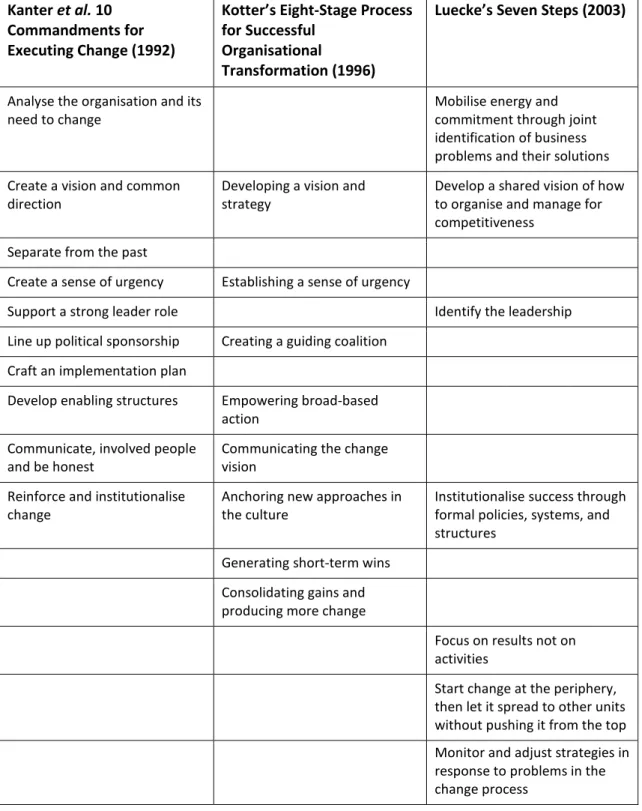
Despite not advocating pre-planned steps for change, several proponents of the emergent school have suggested a sequence of actions that organisations should take to increase the chances of change being successful (Kotter, 1996, Kanter et al., 1992, Luecke, 2003). Although they vary in terms of number and type, a set of suggested actions are shared, including creating a vision, establishing a sense of urgency, creating strong leadership and empowering employee ( Figure 1).
Figure 1: A comparison of three models of emergent change, from Todnem (2005)
Kanter et al. 10
Commandments for Executing Change (1992)
Kotter’s Eight-Stage Process for Successful
Organisational
Transformation (1996)
Luecke’s Seven Steps (2003)
Analyse the organisation and its need to change
Mobilise energy and commitment through joint identification of business problems and their solutions Create a vision and common
direction
Developing a vision and strategy
Develop a shared vision of how to organise and manage for competitiveness
Separate from the past
Create a sense of urgency Establishing a sense of urgency
Support a strong leader role Identify the leadership
Line up political sponsorship Creating a guiding coalition Craft an implementation plan
Develop enabling structures Empowering broad-based action
Communicate, involved people and be honest
Communicating the change vision
Reinforce and institutionalise change
Anchoring new approaches in the culture
Institutionalise success through formal policies, systems, and structures
Generating short-term wins Consolidating gains and producing more change
Focus on results not on activities
Start change at the periphery, then let it spread to other units without pushing it from the top Monitor and adjust strategies in response to problems in the change process
Although many of these points might be seen as common sense, research shows they are often overlooked, ignored or underestimated by change leaders. (Kotter,1995, 1996, Fernandez, 2006).
A key assumption underlying emergent theories is that in order to respond to change, managers must have an in-depth understanding of the organisation, its structures,
strategies, people and culture. Understanding these will allow managers to choosethe most appropriate approach to change and identify the factors that might act as facilitators or barriers to the change (Burnes, 1996). This focus on the organisation as a whole entity when considering change, is in line with the increasing prominence of organisational development (OD) as a framework for thinking about change. Holbeche, an expert in the OD field, explains that this rapidly developing discipline looks at “the total system and the linkage between all the parts of the organisation, and at how change in one part will affect the other parts” (Holbeche, 2009).
The emergent approach is itself not free from critics who question the usefulness of the broad-natured action sequences, and their application to unique organisational contexts. Others have suggested a more “situational” or “contingency” approach, arguing that the performance of an organisation depends heavily on situational variables. As these will vary from organisation to organisation, managers’ responses and strategies for change will also have to vary (Dunphy and Stace, 1993). However, this in turn has been criticised for overemphasising the importance of situational variables, and implying that there is no role for managers of the organisation.
The Psychological Contract
The psychological contract was defined by Rousseau (1989) as an individual’s belief regarding the terms and conditions of an exchange relationship with another party. Within the world of work it most often refers to the perceived fairness or balance (typically from the point of view of the employee) between how the employee is treated by the employer, and what the employee “puts in” to the job. For example, in addition to providing
remuneration, the employer’s side of the psychological contract might include the provision of training, security, interest and work-life balance in exchange for flexibility, effort, loyalty, commitment and innovation from the employee. Empirical evidence has found a positive relationship between the perception of a balanced psychological contract and employees’ commitment to the organisation (Coyle-shapiro and Kessler, 2000) and their trust in the organisation (Robinson, 1996). In contrast, a negative association was found with the neglect of in-role job duties (Turnley and Feldman, 2000) and turnover intentions (Turnley and Feldman, 1999).
The importance of the psychological contract in change management is twofold. Firstly, the content of the contract is informal, implicit and unwritten. Consequently, employees and employers may hold different views on the content of the contract and the degree to which each party has fulfilled their obligations. For example, in a study by Coyle-Shapiro and Kessler (2000) it was found that managers were more positive in their assessment of the employer’s fulfilment of their obligations than the employees were. Through creating an open working environment and effective channels of communication the manager can ensure that the expectations of both employees and the employer are clear and well communicated. The manager is then well placed to address the expectations of the
employees effectively. This openness about the contract is particularly crucial within a time of change, when employees often worry that a negative change in the psychological contract may occur, for example in terms of their job security or development opportunities. The
second way in which the concept of the psychological contract is useful when thinking about organisational change is that it forces manager to consider the balance of the contract. Consequently if an employer wants to make changes that will affect what employees are expected to “give” to the organisation, for example a change in working hours, by implication they should also consider changing what they will offer to the employees to maintain a balance, for example increased flexibility.
Resistance to change
Fundamental to the success of organisational change is the acceptance of the change by employees. Within this context, the work of Kubler-Ross (1973), who argued that all humans go through 5 stages of ‘grief’ (denial, anger, bargaining, depression and acceptance) when faced with a loss or change, has been seen as relevant and has been applied to the management of organisational change. Wiggins (2009) uses the model to help guide communication and support during the period of change, which she suggests should be tailored to the stage of change that the employees have reached. For example, after the news of change is delivered, employees need to be given information to tackle their denial. Once the information has sunk in and they experience anger, bargaining and depression they require various kinds of support. Once employees have begun accepting the situation they need a vision to put their commitment into.
Others take a more individualist approach to studying resistance to change, arguing individuals reactions are highly complex and vary greatly. One advocate of such thinking is Shaul Oreg who proposed that resistance to change is based both on personality and also the context in which the change occurs. In his initial study (2003) he developed and tested a scale called the “Resistance to Change Scale” (RTC) which he conceptualised as a stable personality trait. In his following study he found a positive and significant relationship between the individuals’ RTC score and their affective and behavioural resistance to a particular organisational change they were subject to.
As well as personality determinants affecting the level of resistance engendered by
organisational change, Oreg also found that context variables played a significant role. Trust in management was found to have a particularly strong effect on affective, cognitive and behavioural resistance, a finding that emphasises the importance of good management skills throughout a period of change. However, the study also found that an increased amount of information given to individuals about the change resulted in a worse evaluation of the change and an increased willingness to act against it. This last finding led Oreg to propose that there might be an optimal amount of information that can be given, after which employees feel overwhelmed. He also hypothesises that if the change has negative implications for the individual it would not be surprising if hearing more about the change increased resistance to it. This finding again highlights the important role of management, in this case regarding their communication strategy. It could also be argued, in line with emergent theory and OD advocates, that to make successful decisions about such issues an in-depth knowledge of the strategy, structures, personnel and culture of the organisation is required.
One strategy for reducing resistance in employees mentioned frequently in organisational change literature is to involve the employees in the change or to empower them to make changes themselves. Empirical studies have supported the efficacy of this strategy for successful implementation of change, especially within the public sector (Warwick, 1975, Denhardt and Denhardt, 1999; Poister and Streib, 1999). However, employee involvement alone is not sufficient with managers still playing a critical role encouraging and rewarding
innovation and expressing support the change (Thompson and Sanders, 1997). Bruhn, Zajaz and Al-Kazemi (2001) concur with this view, advising organisations that the involvement of employees should be widespread and span all phases of the change process, but also emphasising the importance of a supportive and engaged management team. Kotter and Schlesinger (1979) proposed a more emergent view to tackling employee
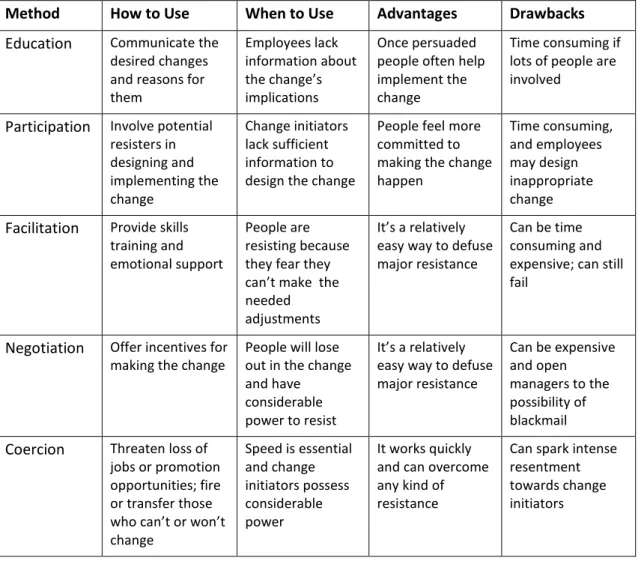
resistance, stating that the circumstances of the change and the content of the change itself will vary largely between organisations and that this should determine the appropriate response. They outline a number of approaches from education to coercion, describing who and when to use them to reduce resistance, and details the advantages and drawbacks of each. (Figure 2)
Figure 2 : Methods for Addressing Resistance from Kotter and Schlesinger (1979)
Method How to Use When to Use Advantages Drawbacks
Education Communicate the desired changes and reasons for them Employees lack information about the change’s implications Once persuaded people often help implement the change
Time consuming if lots of people are involved
Participation Involve potential resisters in designing and implementing the change Change initiators lack sufficient information to design the change
People feel more committed to making the change happen Time consuming, and employees may design inappropriate change Facilitation Provide skills
training and emotional support
People are resisting because they fear they can’t make the needed adjustments
It’s a relatively easy way to defuse major resistance
Can be time consuming and expensive; can still fail
Negotiation Offer incentives for making the change
People will lose out in the change and have
considerable power to resist
It’s a relatively easy way to defuse major resistance Can be expensive and open managers to the possibility of blackmail Coercion Threaten loss of
jobs or promotion opportunities; fire or transfer those who can’t or won’t change Speed is essential and change initiators possess considerable power It works quickly and can overcome any kind of resistance
Can spark intense resentment towards change initiators
It is worth mentioning at this point that in terms of strategies for addressing change it may be useful to consider the different personality ‘types’ that employees may correspond to. There is a vast literature on personality types, and a number of widely used tests for determining which type an individual is (see for example Myers 1998 and Bensinger 2000), though these are not without their critics. From an organisational change point of view, it is worth considering whether a particular set of employees might be more likely to be a
particular personality type and adjust the change management strategies to reflect that. It is likely, however, that any set of employees will encompass a range of personality types, which implies that a range of different strategies may be needed, and that at an individual line management level, managers need to consider carefully how an employee might react to change.
Sustaining change
Implementing new practices is one element of changing organisations, however evidence suggests that ‘initiative decay’, where gains made from change are lost from the
abandonment of new practices, is widespread (Buchanan et al., 1999, Doyle et al., 2000). As a result, considering how to sustain change is clearly a crucial component of the change management process. Surprisingly, though, while implementing change has been the subject of considerable research and theory, relatively little research has been carried out on the issue of sustainability. Buchanan et al. (2005) argued that this is due to the expense of longitudinal research, as well as the generally negative perception of stability as “inertia” and a lack of responsiveness to the changing environment. Reviewing the available evidence they concluded that there are 11 main factors affecting sustainability, and that the more of these factors that are addressed, the higher the likelihood of sustaining change. (Figure 3). Figure 3: Factors affecting sustainability, from Buchanan et al (2005)
Category Outline definition
Substantial Perceived centrality, scale, fit with organisation
Individual Commitment, competencies, promotions, expectations
Managerial Style, approach, preferences, behaviours Financial Contribution, balance of costs, benefits Leadership Setting vision, values, purpose, goals,
challenges
Organisational Policies, mechanisms, procedures, systems, structures
Cultural Shared beliefs, perceptions, norms, values, priorities
Political Stakeholder and coalition power and influence
Processual Implementation methods, project management structures
Contextual External conditions, stability, the threats, wider social norms
Temporal Cap timing, pacing, flow of events
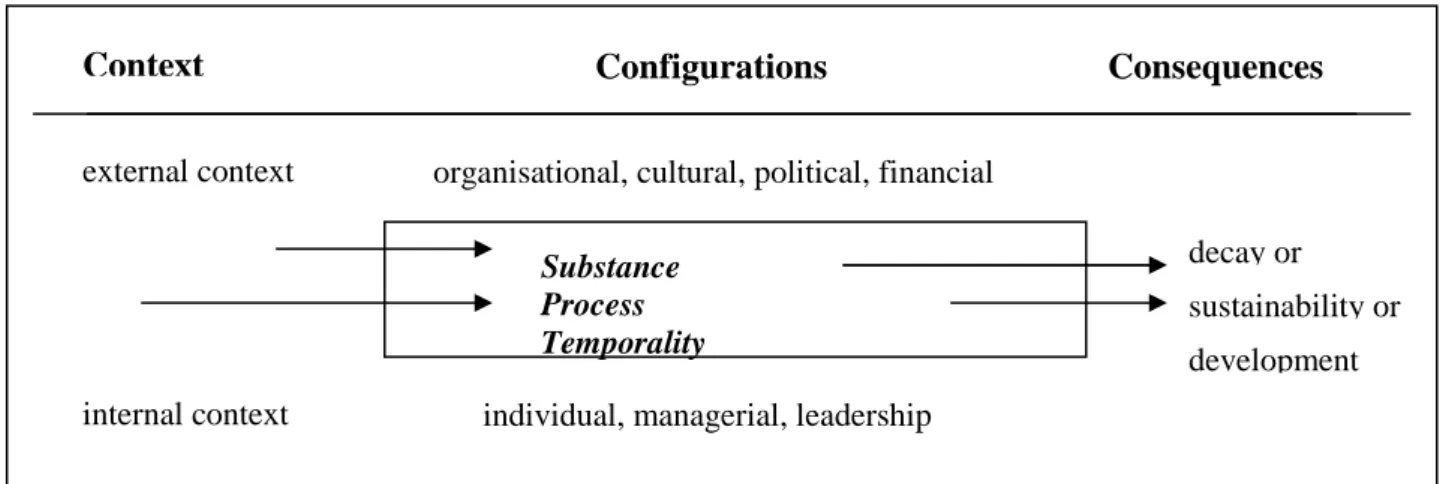
They then further developed these factors into a tentative model that displays both the relative weighting of these factors in terms of importance to sustainability of organisational change, and their interaction with one another. (Figure 4).
Figure 4 : the process of sustainability in context, from Buchanan et al (2005)
As is shown in Figure 4, the authors hypothesise that three issues have particular significance to sustaining change: the substance of the change (whether the change is central to the organisation and agreeable to stakeholders/ employees); the implementation process itself (how the change is managed and carried out); and, temporality or the time given for the change to occur (including the sequence and pacing of events). Despite developing a broad model of sustainability, the authors continue to stress that the nature, interaction and relative importance of contextual factors will vary in accordance with the unique context of each organisation. Thus, projections of sustainability made with this model still require an in-depth knowledge of the organisation and its internal and external environment.
Behavioural change literature
This review has focussed on literature relating specifically to organisational change. However, there is a vast body of work that examines behavioural change more broadly. Much of this literature has been summarised in a recent literature review by Darnton (2008), and this paper will not seek to cover ground that has already been thoroughly set out there. However, it is worth noting a few key points from that review that are relevant to the issues addressed in this paper. Firstly, the range of behaviour change theories set out indicate that it can be difficult to get people to change their behaviour even where there are good reasons to do so and even where the change is of manifest benefit to the individual. While the psychological contract provides a powerful analytical framework for understanding why employees might resist change if they do not feel the new ‘deal’ is fair, the general literature on behavioural change indicates that there can be resistance to change even if managers address those concerns and employees consider the new exchange to be a fair one.
Comprehensive behavioural change models such as Bagozzi et al’s (2002), indicate that there are a range of factors that influence the ability of an individual to change that go beyond their rational, conscious thought processes. These include unconscious desires and fears as well as conditioned behaviour and thinking. In addition, external factors, such as the degree to which a behaviour is socially desirable along with the degree to which someone believes a particular action is possible, will both influence their intention to change, irrespective of
Context Configurations Consequences
external context
internal context
organisational, cultural, political, financial
individual, managerial, leadership
decay or sustainability or development Substance Process Temporality
their personal feelings about it. Linked to this, but at a wider level, is the insight from
systems thinking that changing a particular set of behaviours or part of a system may require wholesale change of the system itself (Chapman 2004). This is because systems thinking has shown that a system is more than the sum of it’s parts, and that changing one part of the system may not lead to change because other parts of the system are primed to bring the whole back to its original state. This may sound abstract, but its practical applicability to issues such as obesity and reorganising the health service indicate that it is relevant to any complex organisation wanting to effect real change. Finally, it must also be noted that there may be very practical, but highly significant, barriers such as time and resource pressures that prevent behavioural change taking place even where all other barriers have been addressed.
Conclusion
This paper has set out the findings of a brief review of organisational change literature. As discussed, this literature is a large and somewhat contradictory body of work, but a number of general points emerge that are worth highlighting. Firstly, while change can be planned and introduced by managers, it is important to recognise that employees may perceive themselves to be working within a constantly shifting environment. This does not mean that it is not possible to introduce a programme of change, but it does indicate that it is
important to be aware of what other changes are also occurring and acknowledge the risk that any individual set of changes may be overwhelmed by the combination of other changes taking place.
A second key point emerging from the review is that the literature is consistent in indicating that change isn’t a single, continuous process, but rather is broken down into a number of different steps. The significance of this is that managers will need to consider what
strategies, in terms of communication, training, reinforcement etc, are appropriate for the different stages, rather than decide on a single approach that can be applied throughout the process, and at the same time remain flexible and reactive to changes as they happen. This of course will require more effort and preparation time, but the reward is likely to be that change happens more smoothly and efficiently. While planning these strategies, managers need to consider the nature of the psychological contract the organisation has with
employees and how the changes they are introducing might alter its balance. Crucially, if the balance is altered, managers need to consider how to rebalance it if they want to avoid resistance that could undermine the process. However, the situation is further complicated by an awareness that even where employees are not personally resistant to change, a wide range of other factors can prevent the change from taking place or being sustained, and these too need to be taken into account.
The aim of this paper has been to provide an initial review of the literature on organisational change and as a consequence the information set out is limited in terms of its specific recommendations. In part this is because the literature itself is relatively limited in terms of specific recommendations, and indeed there is a strong current of thought which argues that it is not possible to provide general, non-context based advice. Nevertheless, managers thinking of initiating a substantial programme of organisational change would be advised to become more acquainted with the literature as this would undoubtedly provide more in-depth and focussed guidance. In addition, it is important that managers have a really thorough grasp of the issues facing their employees before attempting change. Gathering this knowledge should be seen as a separate process to the type of engagement and consultation work that the literature recommends, as it should happen before the change
process begins so that it informs strategic planning. It is the belief of the authors of this paper that managers who are familiar with the research on organisational change and who have a clear and realistic view of the barriers and facilitators to change for their employees are the ones most likely to succeed in what is probably the most challenging process organisations will go through.
Bibliography
Armenakis, A. A., Harris, S. G and Field, H. S., ‘ Paradigms in Organizational Change: Change Agent and Change Target Perspectives’, in Golembiewski, T. T. (ed) Handbook of
Organizational Behaviour (New York: Marcel Dekker)
Bagozzi, R., Gurnao-Canli, Z., and Priester, J. (2002) The Social Psychology of Consumer Behaviour (Buckingham: Open University Press)
Balogun, J. and Hope Haily, V. (2004) Exploring Strategic Change, 2nd Edn (London: Prentice Hall)
Bensinger, K. (2000) Thriving in Mind: The Art & Science of Using Your Whole Brain (K B A Pub)
Bruhn, J. G, Zajac, G. and Al-Kazemi, A. A. (2001) ‘Ethical perspectives on employee participation in planned organizational change: A survey of two state public welfare agencies’, Public Performance and Management Review, 25, 2, pp. 208-28.
Buchanan, D., Fitzgerald, L., Ketley, D., Gollop, R., Louise Jones, J., Saint Lamont, S., Neath, a. and Whitby, E. (2005), ‘Not going back: A review of the literature on sustaining
organizational change’, International Journal of Management Reviews, 7, 3, pp.189 - 205 Buchanan, D., Cladon, T. and Doyle, M (1999) ‘Organizational development and change: The
legacy of the nineties’, Human Resource Management, 2, pp. 20-37
Burke, W. W. (2002) Organizational Change: Theory and Practice (Thousand Oaks, CA: Sage Publications)
Bullock, R.J. and Batten, D. (1985) ‘It’s just a phase we’re going through: a review and synthesis of OD phase analysis’, Group and Organization Studies, 10, December, pp. 383-412
Burnes, B. (1996) ‘No such thing as …a “one best way” to manage organizational change’,
Management Descision, 34, 10, pp.11-18
Burnes, B. (2004) Managing Change: A Strategic Approach to Organisational Dynamics, 4th edn (Harlow: Prentice Hall)
Chapman, J. 2004 Systems Failure 2nd Edn (London: Demos)
Coyle-Shapiro, K. and Kessler, I. (2000) ‘Consequences of the psychological contract for the empoloyment relationship: A large scale survey’, Journal of Management Studies, 37, pp. 903 – 930.
Darnton, A. (2008) Reference Report: An overview of behaviour change models and their uses
Research report for the Government Social Research Unit
Denhardt, R. B. and Denhardt, J. V. (1999) Leadership for Change: Case Studies in American Local Government. (Washington, DC: IBM Centre for the Business of Government) Doyle, M., Claydon, T. and Buchanon (2000) ‘Mixed results, lousy process: Contrasts and
contradictions in the management experience of change. British Journal of Management, 11, pp. 59 - 80
Dunphy, d. and Stace, D., (1993) ‘The strategic management of corporate change’, Human Relations, 46, 8, pp. 16-19
Elrod II, P. D. and Tippett, D. D. (2002) ‘The “death valley” of change’, Journal of Organizational Change Management, 3, pp. 273 - 291
Fernandez, R. and Rainey, H.G. (2006) ‘Managing Successful Organisational Change in the Public Sector’, Public Administration Review, March/April, pp 168 – 176
Fernandez, R. and Rainey, H.G. (2006) ‘Managing Successful Organisational Change in the Public Sector: An Agenda for Research Practice’, Public Administration Review, March/April, pp 168 – 176 (2)
Holbeche, L., (2009) ‘Organisational development – what’s in a name?’, Impact, 26, pp.6-9 Kanter, R.M., Stein, B. A. and Jick, T.D (1992) The Challenge of Organizational Change ( New
York: The Free Press)
Kotter, J.P. and Schlesinger, L. A (1979) ‘Choosing strategies for change’,
Harvard Business Review, 57, 2, pp. 106–114
Kotter, J.P. (1995) ‘Leading Change: Why Transformation Efforts Fail’, Harvard Business Review, 73, 2, pp. 59-67
Kotter, J.P. (1996) Leading Change (Boston, MA: Harvard Business School Press) Kübler-Ross, E. (1973) On Death and Dying, Routledge
Luecke, R. (2003) Managing Change and Transition (Boston, MA: Harvard Business School Press)
Oreg, S. (2003) ‘Resistance to change: Developing an individual differences measure’, Journal of Applied Psychology, 88, 4, pp. 587-604
Oreg, S. (2006) ‘Personality, context, and resistance to organizational change’, European Journal of Work and Organizational Psychology, 15, 1, pp. 73 -101
Myers, I. B., McCaulley, M.H., Quenk, N.L., Hammer, A. L. (1998) MBTI Manual: A Guide to the
Development and Use of the Myers-Briggs Type Indicator 3rd Edn (San Jose: Consulting Psychologists Press)
Poister, T.H., and Streib, G. (1999) ‘ Performance measurement in municipal government: Assessing the state of practice’, Public Administration review, 59, 4, pp. 325-45 Robinson, s. (1996) ‘ Trust and the breach of the psychological contract’, Administrative
Science Quarterly, 41, pp. 574-599
Rousseau, D. M (1989) ‘ Psychological and implied contracts in organizations’, Employee Responsibilities and Rights Journal, 2, pp. 121-39
Thompson, J. R. and Sanders, R. P. (1997) ‘Strategies for reinventing Federal agencies: Gardening vs. Engineering’, Public Productivity and Management Review, 21, 2, pp. 137 -55
Todnem, R. (2005) ‘Organisational Change Management: A Critical Review’, Journal of Change Management, 5, 4, pp.369 – 380
Turnley, W. H. and Feldman, D. C. (1999), ‘The impact of psychological contract violations on exit, loyalty and neglect’, Human Relations, 52, pp. 895-922
Turnley, W. H. and Feldman, D. C. (2000) ‘Re-examining the effects of psychological contract violations: Unmet expectations and job dissatisfaction as mediators’, Journal of Organizational Behavior, 21, pp. 25-42
Warwick, D. P. (1975) A Theory of Public Bureaucracy. (Cambridge, MA: Harvard University Press)
Wiggins, L. (2008/2009) ‘Managing the ups and downs of change communication’, Strategic Communication Management, 13, 1, pp20-23