Board Development Practices and Competent Board Members: Implications for Performance
DRAFT
William A. Brown Assistant Professor
School of Community Resources & Development Center for Nonprofit Leadership & Management
Arizona State University PO Box 874703 Tempe, AZ 85287-4703 480.965.2626 fax 480.965.5664 [email protected] http://nonprofit.asu.edu For Presentation at
Midwest Center for Nonprofit Leadership Nonprofit Governance Conference ‘05
Abstract
This article explores the underlying assumptions in the practitioner literature about board
development practices in nonprofit governance. A structural equation model is developed to test the extent to which organizations that use recommended recruitment, training, and evaluation practices report having more competent board members and that the presence of these board members leads to better board and organizational performance. The sample consists of 672 CEOs and 379 Board Chairs representing 713 credit unions. Credit Unions, a member benefit nonprofit organization, rely almost exclusively on voluntary board members in an oversight capacity. Results support the contention that board development practices do lead to more capable board members, and the presence of these board members tends to explain variance in board performance. The model positions board member competency as an intermediary between board development and performance, thereby supporting the implicit assumption that these practices lead to better quality board members which then contributes to effective board performance.
The board is a critical asset for every nonprofit organization and the need for governing boards to be informed, engaged, and effective has potentially never been greater. Increasing competition for resources, greater complexity and sophistication, and the potential of external regulation drive the need for high quality board members. It is also recognized that voluntary modes of engagement are shifting (Arrillaga 2004). Whether the spirit of volunteerism is declining or changing is not exactly clear, but evidently old forms of engagement are no longer the norm (Putnam, 2000). Consequently, nonprofits must continually attend to volunteer leadership development, but the best mechanisms to achieve that strength are not universally apparent. The nonprofit board governance literature encapsulates this responsibility of nurturing and strengthening the board to ensure its continued strength and viability as board development. This entails recruiting and selecting future board members, orienting and training existing
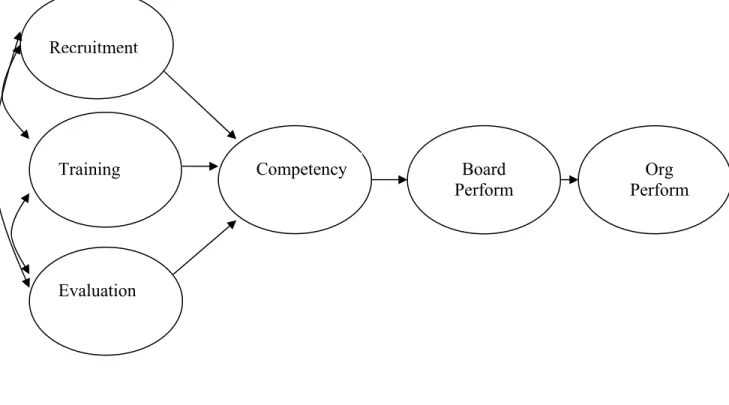
members, and evaluating performance of the board overall and members individually. This study will explore the relationship between the use of board development practices, which should lead to highly capable board members. We posit that effective recruitment and development activities lead to securing highly competent board members and furthermore, the presence of high quality board members should contribute to board and organizational performance (see figure 1).
________________ Insert Figure 1 here ________________ Board Development
Board Development entails the range of activities related to building and maintaining a strong board of directors. This includes: recruiting and selecting, training and preparing, monitoring performance, and removing board members (Lee & Phan, 2000; Metz, 1998;
Watson, 2004; Weisman, 2003). This section of the paper will review existing literature on the prevalence and importance of these factors. The discussion will draw on literature from
nonprofit board governance and more generally corporate governance literature; unfortunately, few studies have focused on these practices exclusively. Consequently, the paper will look to the wider human resource management literature that provides insight into best practices associated with human capital development and implications for performance. The applicability of this material is tempered by the recognition that some of these practices might not be applicable to volunteers. Therefore, volunteer management literature provides and additional resource to consider board development activities.
The first step in the process of securing board members entails determining the skills and competencies needed on the board and then developing procedures that facilitates the
identification and selection of appropriate members (Daily & Dalton, 2004; Lee & Phan, 2000; Metz, 1998). For instance Herman and Renz (2000) found that written expectations (of giving and soliciting) for board members was present in the most effective organizations. Similarly, human resource management and volunteer management recognize the importance of systematic job design and specification (e.g., Brannick & Levine, 2002; Heidrich, 1990). As stated in every human resource management textbook, clear specification of position requirements is the
backbone of effective recruitment (Pynes, 2004). The prevalence of these practices in nonprofit governance is not clear, but the best practice recommendation is fairly widely recognized (e.g., Inglis & Dooley, 2003; Watson, 2004).
Second is the recruitment and attraction of potential candidates. Recruitment is recognized as one of the most challenging aspects of volunteer management (Brudney 1993;
as a potential motivator for volunteer board members, Wise (2001) found that compensation was not necessarily a significant factor to inhibit engagement on nonprofit boards, but rather
concluded that there were a substantial number of willing individuals and that the perceived shortage was actually a limitation of an organizations’ ability to effectively recruit board members. Drawing on both volunteer management literature and human resource best practice we know that organizations must rely on a wide variety of strategies to publicize opportunities, while exploiting all available networks (Ryan & Tippins, 2004). Broadening the pool of
potential applicants strengthens the likelihood that a successful candidate will be identified. The messages expressed about the opportunity are likely to influence attitudes of potential applicants and mechanisms to ensure candidates recognize the scope of responsibilities for the position is necessary. For instance, Inglis and Dooley (2003) describe the importance of both public announcements and personal referrals, but recognize that referrals seem to result in the best applicants. Similarly, Ryan and Tippin (2004) explain that recruitment sources (i.e., referrals) do influence the quality of applicants.
Third is the selection process. Board governance literature recognizes the value of an independent nomination committee that screens potential applicants (Watson, 2004). Generally, it is recommended that the CEO is not an active participant on this committee. Herman, Renz, and Heimovics (1997) found that the use of a board development committee (i.e., nomination committee) and the assignment to a specific office or role for every board member was associated to CEO judgments of organizational performance. Similarly, Brown (2002) found that the use of a nomination committee is related to expanded stakeholder involvement in board governance. The committee serves as an unbiased mechanism to screen potential applicants. Typically, the committee will collect materials (i.e., resumes), interview applicants and provide
recommendations to the board for prospective candidates. Once a slate of potential applicants is identified the board or in the case of member benefit organizations the members’ at-large vote on the candidates. Sometimes the slate is not contested (i.e., the nomination committee
recommends/identifies only enough candidates to fill open positions) but decision-making literature recognizes the importance of providing options for effective decision-making and in general alternatives among candidates should lead to better board members (Bainbridge, 2002).
Once the ideal board member is identified the board needs to provide training of members to ensure adequate preparation for their role as a board member and to address the changing organizational environment (Roberts & Connors, 1998). This entails both orientations that provide basic guidance for new members and ongoing training that responds to needs of board members and the changing dynamics of organizational performance and environmental pressure. Jackson and Holland (1998) found that purposeful board training can influence board and organizational performance. Similarly, the volunteer management literature recognizes the importance of training opportunities to strengthen volunteer performance (Heidrich, 1990). The general human resource literature suggests that training must be directly tied to needs of the position holder and the more relevance to task requirements the more likely it will improve performance of individual board members (Pynes, 2004). The board also needs to address
leadership and develop needs (e.g., coaching/mentoring) that can facilitate leadership succession. For example, Inglis and Dooley (2003) describe a comprehensive nominating process in a single organization that “matches in-coming board members with ‘veteran’ board members who serve as mentors for at least the first year.” This process facilitates the integration of new board members into the culture and performance expectations of the board.
Finally boards need some kind of evaluation procedure to insure continued effective performance. Two types of evaluations are discussed in the nonprofit governance literature overall board performance and individual board member evaluations. By every indication, both practices are relatively rare in the board governance (Cornforth, 2001). The most basic
individual performance monitoring reflects recording and holding board members accountable for regular attendance. Secondarily, some organizations desire financial contributions from board members and consequently financial or in-kind donations are monitored and if a board member does not meet this expectation it can be a factor to remove a board member. Since many boards do not have systematic practices to assess individual member’s performance many typically rely on term limits as the default mechanism to remove/rotate board members off the board. This too is widely recognized as a best practice strategy, which will bring new ideas to the board (Watson, 2004).
Taken together these practices should explain the tendency of boards to secure members who are highly capable to perform their roles as a board member (Becker & Gerhart, 1998; Bowen & Ostroff, 2004). Much of the board governance literature has skipped over this
intermediary step that links these practices to optimal board performance. As organizations use “best practice” procedures they should result in securing highly competent members for the board. Those board members in turn should contribute to overall board performance and consequently influence the performance of the organization. This suggests the first three hypotheses which propose that board development practices should lead to having competent board member.
1a: Best practice recruitment strategies will lead to highly capable board members. 1b: Best practice training and orientation will lead to highly capable board members.
1c: Performance evaluation will lead to highly capable board members. Board Member Competencies
The majority of the research investigating board performance has identified group level indicators of performance (Herman, Renz & Heimovics 1997; Inglis, Alexander & Weaver, 1999; Jackson & Holland, 1998) as opposed to individual board member performance indicators. Bright and Brown (2005) drawing on both practitioner literature (Axelrod, 1994; Hohn, 1996; Ingram, 1996; Soltz, 1997), existing studies on board performance, and their own research proposed individual performance behaviors should be based on several features including
attendance, the quality of that attendance (i.e., come prepared), that board members contribute in constructive ways to conversations and the business of the board, and that board members have the necessary knowledge and skills to perform their roles. This last feature is reinforced in the work of Hillman and Dalziel (2003) who introduced a concept called “board capital,” which they explain as capital which “consists of both human capital (experience, expertise, reputation) and relational capital (network of ties to other firms and external contingencies)” (pg. 383). Factors that contribute to board capital include knowledge, skills, experience, and reputation. Research supports the fact that boards high in board capital are more inclined to provide necessary advice and counsel (Westphal, 1998), improve organizational legitimacy and reputation (e.g., Certo, Daily, & Dalton, 2001), provide channels of communication to external constituencies (Hillman, Zardkiihi & Bierman, 1999); and improve the ability of organizations to acquire necessary resources (Provan, 1980). Consequently, the intermediary assessment of board member competency logically follows from effective board development practices and these board members should also coincide with better board performance.
Board and Organizational Performance
The work of Bradshaw, Murray, and Wolpin (1992), Ingram (1996) and others provided a framework to consider and define some of the important functions of nonprofit boards. For instance, Herman and Renz (1997) identified 11 roles of the board, while Green and Griesinger (1996) proposed nine key functions. Cornforth (2001) identified five key functions (strategy, stewardship, monitoring, board maintenance, and external relations) and then considered inputs (board member time and skills), structures (board size, committees, etc.), and processes
(common vision, clear roles, and meeting practices) to explain board performance. Generally, in these studies and others (Brown, in press) there has been an association between the fulfillment of these functions and organizational performance.
There are several significant limitations to understanding performance in nonprofits (Herman & Renz, 1999; Forbes, 1998). For one, nonprofit status itself limits the accuracy of relying strictly in financial performance indicators. Furthermore, the ambiguous nature of organizational goals held by nonprofits mitigates universal criteria. Consequently, there is no easier answer to understanding performance, but rather each method provides one perspective on performance. Herman and Renz (1997) suggested that performance in nonprofit organizations is socially constructed and that any determination of performance is influenced by who you ask. This recognizes the subjective nature of performance in nonprofits. Operationally this has translated into developing a reasonable set of criteria related to performance and having knowledgeable individuals provide their assessment on an organization’s accomplishments across those areas. Such questions would cover areas related to mission or goal accomplishment and constituent benefits related to services provided. This was basically the strategy used by Nobbie and Brudney (2003) to assess goal attainment in organizations that had implemented
policy governance practices. Limitations of this strategy are that multiple perceptions can be contradictory and reflect respondent bias.
Methods and Participants
Two mail surveys were sent to 1600 chief executive officers in a national sample of credit unions in the fall of 2004. A total of 672 CEOs and 379 Board Chairs completed questionnaires for response rates of 42% and 24%, respectively. At least one individual
responded from 713 organizations, reflecting a 43% organizational response rate. In 338 of those organizations both a CEO and Board Chair responded. When more then one response was received from an organization the CEO response was used to provide organizational information. If that information was missing then the second respondent from the organization was used.
CEOs indicated an average tenure of 11.47 years in their current position and over 17 years experience in the credit union. Board members indicated an average of 7.28 years in the current position (median 4 years) with an average of over 25 years experience with the credit union. Assets of respondent organizations ranged from just over $5 million to nearly $500 million. Median asset for all participating organizations was $117,621,398. Similarly,
membership ranged from as few as 500 to over 500,000. Median membership size was 16,642. According to the Filene Center for Credit Union Research there are 10206 credit unions in the country. About 1/3 have assets under $5 million. In order to ensure participation from all size institutions, we over-sampled large institutions resulting in a fairly equal distribution of participants across five budget categories. This ensured adequate representation across the entire range of credit unions in the county.
Measures
Board development was conceptualized as having three features: recruitment, training, and evaluation. Using existing best practice guidelines questions were developed by the
researcher. The questions asked respondents to indicate on a five-point scale the extent to which their board reflected these practices. Recruitment and evaluation was assessed through three questions, while training included four questions. The resulting factor analysis (see Table 1) revealed that one of the training questions loaded weakly (a factor loading of .60 was used as a cut-off point) on the training factor, consequently that question was dropped from further analysis. All scales revealed sound reliability, above .77 on all scales.
Board performance was conceptualized as six general functions including fiscal
oversight, setting policy, and ensuring effective leadership (Herman & Renz, 1997; Cornforth, 2001). Participants were asked to indicate on a five-point scale the extent to which their board upheld these practices. Perceptions of organizational performance were assessed by asking participants to consider how well their organization performed when compared to other similar organizations across three key areas: fiscal performance, range of services provided, and member relations.
________________ Table 1 about here ________________
Results
A structural test of the study’s five causal hypotheses was undertaken with AMOS 5.0 (Arbuckle 1994). Chi-square results for fitting the structural model were χ2 = 982.1 (df 244; p <
(Root Mean Squared Error of Approximation [RMSEA] and Root Mean Squared Residual [RMR]) was used to determine the fit. “Rules of thumb” for these two criteria hold that RMSEA values should not exceed .06 and that RMR should be less than .08 (Hu and Bentler 1999, p. 1). Model results for both indices were within the advised cutoff range (RMSEA = .054 and RMR = .056), and confirmed the model’s overall integrity.
________________ Table 2 about here ________________
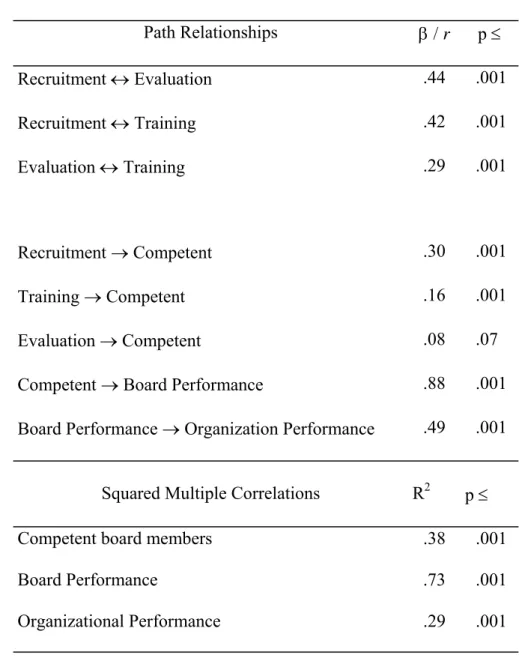
The first three hypotheses tested the impact of board development practices on the perceptions of board member competency. The strongest pathway was between recruitment practices and perceptions of board member competency (β = .30, p ≤ .001). Training also had a significant positive effect on whether board members were perceived as highly competent (β = .16, p ≤ .001). Evaluation practices, however, was not significantly related to perceptions of board member competency (β = .08, p ≤ .07). In sum, the three board development practices accounted for 38% of the variance exhibited in perceptions of board member competencies. This raises questions about whether the measures of board development adequately captured the construct, or whether additional factors should be considered as a feature of board development. Modification indices, however, failed to support any additional linkages (direct effects) between the formative factors and outcomes. This suggests the significant role of board development in contributing to perceptions of board member capabilities.
the variance in board performance (R2 = .73; p ≤ .001). This suggests the significant role of board member capabilities in contributing to perceptions of board performance. Finally, board performance was a significant predictor of overall perceptions of organizational performance (β = .49, p ≤ .001) accounting for about 1/3 of the variance exhibited in perceptions of board performance. Based upon this analysis and the corresponding fit indices we can conclude that the model is supported and that board development practices do account for perceptions of board member capabilities and that having highly capable board members will contribute to better board performance.
Discussion/Conclusion
This research contributes to understanding nonprofit governance in several ways. First, the study provides insight into the association between board development practices and perceptions of board member competencies. Specifically, it supports the contention that board development practices lead to stronger board members and stronger board members are a significant predictor of board performance. Second, this study provides statistically validated measurement tools to assess board development and board member quality. Practitioner literature is full of best practice recommendations with limited empirical support. The study provides practical guidance to nonprofit professionals as they seek to identify practices that lead to stronger boards. Simultaneously, it informs academic literature about board member
capabilities and board capital. The study provides insight into the link between board practices and performance, by recognizing the importance of board capital in contributing to board performance.
References
Arbuckle, J.L. (1994), “AMOS: Analysis of Moment Structures,” Psychometrika, 59, 135–137. Arrillaga, P. (July 11, 2004). A nation of bystanders: Americans are not participating in civic
life. Cape Cod Times, F-3, 6, 8.
Axelrod, N.R. (1994). Board leadership and board development. In R.D. Herman (Ed.), The Jossey-Bass handbook of nonprofit leadership and management, (pp. 119-136). San Francisco: Jossey-Bass Publishers.
Bainbridge, S. M. (2002). Why a board? Group decision-making in corporate governance. Vanderbilt Law Review, 55, 1-55.
Becker, B. E. & Huselid, M. A. (1998). High performance work systems and form performance: A synthesis of research and managerial implications. Research in Personnel and Human Resource Management, 16, 53-101.
Bowen, D. E. & Ostroff, C. (2004). Understanding HRM-Firm performance linkages: The role of “strength” of the HRM system. Academy of Management Review, 29, 203-221.
Bradshaw, P., Murray, V., & Wolpin, J. (1992). Do Nonprofit Boards Make a Difference? An Exploration of the relationships among board structure, process, and effectiveness. Nonprofit and Voluntary Sector Quarterly, 21, 227-249.
Brannick, M. T. & Levine, E. L. (2002). Job analysis: methods, research, and applications for human resource management in the new millennium. Thousand Oaks, CA: Sage
Publications.
Brown, W (In press). Exploring the Association between Board and Organizational Performance in Nonprofit Organizations. Nonprofit Management & Leadership, 15,
Brudney, J. L. (1993). Volunteer involvement in the delivery of public services: Advantages and disadvantages. Public Productivity & Management Review, 16(3), 283-297.
Certo, T., Daily, C., & Dalton, D. (2001). Signaling firm value through board structure: An investigation of initial public offerings. Entrepreneurship Theory and Practice, 26(2), 33-50.
Cornforth, C. (2001). What makes boards effective? An examination of the relationships
between board inputs, structure, processes and effectiveness on non-profit organizations. Corporate Governance, 9, 217-227.
Daily, C. M. & Dalton, D. R. (2004). Director recruitment: planning and process. The Journal of Business Strategy, 25(4), 8-9.
Forbes, D. P. (1998). Measuring the unmeasurable: Empirical studies of nonprofit organization effectiveness from 1977-1997. Nonprofit and Voluntary Sector Quarterly, 27, 183-202. Green, J. C. & Griesinger, D. W. (1996). Board performance and organizational effectiveness in
nonprofit social service organizations. Nonprofit Management & Leaderships, 6, 381-402.
Heidrich, K. W. (1990). Working with Volunteers. Champaign, IL: Sagamore.
Herman, R. D. & Renz, D.O. (2000). Board practices of especially effective and less effective local nonprofit organizations. American Review of Public Administration, 30, 146-160. Herman R. D. & Renz, D. O. (1999). Thesis on nonprofit organizational effectiveness. Nonprofit
Herman, R. D., Renz, D. O. & Heimovics, R. D. (1997). Board practices and board effectiveness in local nonprofit organizations, Nonprofit Management and Leadership, 7, 373-386. Hillman, A.J. & Dalziel, T. (2003). Boards of directors and firm performance: Integrating agency
and resource dependence perspectives. Academy of Management Review, 23, 383-396. Hillman, A., Zardkiihi, A, & Bierman, L., (1999). Corporate political strategies and firm
performance: Do stakeholder directors make a difference? Business & Society, 40, 295-314.
Hohn, H. G. (1996). Solving the board puzzle: How to select the 'right' directors. Chief Executive, 114, 58-61.
Hu, L. and Bentler, P.M. (1999), “Cutoff Criteria for Fit Indexes in Covariance Structure Analysis: Conventional Criteria Versus New Alternatives,” Structural Equation Modeling, 6 (1), 1–55.
Ingram, R. T. (1996). Ten basic responsibilities of nonprofit boards. Washington DC: National Center for Nonprofit Boards.
Inglis, S., Alexander, T., & Weaver, L. (1999). Roles and responsibilities of community nonprofit boards. Nonprofit Management & Leadership, 10, 153-167.
Inglis, S. & Sheelah, D. D. (2003). Working with a comprehensive nominating process. The Journal of Volunteer Administration, 21(1), 40-49.
Jackson, D. K. & Holland, T. P. (1998). Measuring the effectiveness of Nonprofit Boards. Nonprofit and Voluntary Sector Quarterly, 27, 159-182.
Lee S. H., & Phan, P. H. (2000). Competencies of directors in global firms: Requirements for recruitment and evaluation. Corporate Governance, 8, 204-214.
Metz, E. J. (1998). Designing succession systems for new competitive realities. Human Resource Planning, 21, 31-37.
Nobbie, P. D. & Brudney, J. L. (2003). Testing the implementation, board performance, and organizational effectiveness of the policy governance model in nonprofit boards of directors. Nonprofit and Voluntary Sector Quarterly, 32, 571-595.
Provan, K. G. (1980). Board power and organizational effectiveness among human service agencies. Academy of management Journal, 23 (2), 221-236.
Putnam, R. (2000), Bowling Alone: The Collapse and Revival of American Community, New York: Simon and Schuster.
Pynes, J. E. (2004). Human resources management for public and nonprofit organizations, 2nd Ed. San Francisco: Jossey-Bass.
Roberts, C. C, & Connors, E. J. (1998). Major challenges facing governing boards of healthcare delivery organizations. Journal of Healthcare Management, 43(4), 297-301.
Ryan, A. M. & Tippins, N. T. (2004). Attracting and selecting: What psychological research tells us. Human resource Management, 43, 305-318.
Soltz, B.A.B. (1997). The board of directors. In T.D. Conners (Ed.), The nonprofit handbook: Management, (2nd ed.). New York: Wiley.
Watson, E. (2004). Public-sector corporate governance: British Columbia's best-practices reforms. Ivey Business Journal Online,1.
Weisman, C. (2003). Building a board with a passion for the mission. Nonprofit World, 21(2), 27-29.
Westphal, J.D. (1998). Outside directors and CEO turnover. Journal of Financial Economics, 20, 431-460.
Wise, D. (2001). Would the payment of market rates for non-executive directors strengthen charity governance? International Journal of Nonprofit and Voluntary Sector Marketing, 6(1), 49-60.
Appendix
Figure 1 Model of Board Development, Board Member Competency, and Performance
Recruitment Training Evaluation Competency Board Perform Org Perform
Table 1 Factor Loading Scores
Factors 1 2 3 4 5 6
1) Competent Board Members (.92) Board members have appropriate skills to
understand complexities of CUs .753
Board members understand and contribute
constructively to discussion of issues .750 .349 Board members contribute to making the board
function effectively
.732 .329
Board members come to meetings prepared .725 .370 Board members commit sufficient time to perform
their responsibilities .714
Board members have needed experience and background to be effective
.690
2) Recruitment (.77)
Nomination committee works year round
identifying a wide variety of potential candidates
.816
Strategies are in place to insure diversity of new board members
.759
Competency/skill profiles developed and used to nominate new members
Table 1 Continued
Factors 1 2 3 4 5 6
3) Board Performance (.86)
Evaluating/selecting the senior executive .692
Ensure consistency and high quality leadership .419 .643
Marketing/promoting the organization .635 .250
Serving member interests and needs .322 .621
Setting mission, policies, and long-range strategy .338 .617 .271
Providing financial oversight .361 .610
4) Training & Orientation (.82)
Process for preparing new board members .783
Orientation for new board members .782
Have a plan strengthen the board .626 .279
Training provided so board members can effectively perform their role*
.536 .492
5) Evaluation (.81)
Evaluates individual board member's performance .264 .789
Evaluates the overall board performance .269 .785
Table 1 Continued
Factors 1 2 3 4 5 6
6) Organization Performance (.75)
Range/Quality of services offered .809
Member relations (i.e., met member needs) .805
Financial management/performance .689
Note: values less then .250 are not specified; *item not included in scale due to low factor loading; values in parentheses are alpha coefficients.
Table 2 Structure Results Structure Path Relationships β / r p ≤ Recruitment ↔ Evaluation .44 .001 Recruitment ↔ Training .42 .001 Evaluation ↔ Training .29 .001 Recruitment → Competent .30 .001 Training → Competent .16 .001 Evaluation → Competent .08 .07
Competent → Board Performance .88 .001
Board Performance → Organization Performance .49 .001
Squared Multiple Correlations R2 p ≤
Competent board members .38 .001
Board Performance .73 .001
Organizational Performance .29 .001
Model Fit Diagnostics
Chi-square Test = 982.1 (df = 244; p<.001) RMR = .056
RMSEA = .054