AP English Language and Composition Teachers’ Perceptions and Beliefs Concerning Preparation for Teaching Rhetoric and Composition
A Dissertation submitted to the Graduate School Valdosta State University
in partial fulfillment of requirements for the degree of
DOCTOR OF EDUCATION
in Curriculum and Instruction
in the Department of Curriculum and Instruction of the College of Education
December 2019
Jennifer Ballard
EdD, Curriculum and Instruction, Valdosta State University, 2019 MSEd, English, Valdosta State University, 2010
© Copyright 2019 Jennifer Ballard All Rights Reserved
ABSTRACT
The purpose of this study was to determine the strategies and practices used by veteran AP English Language and Composition teachers in South Georgia Title I high schools in rural communities with an AP open enrollment policy. The participants for this study were volunteer AP English Language and Composition teachers from
qualifying school districts. Data were collected through personal data forms, interviews, non-participatory observations, and document analyses. The inductive analysis model was used to analyze data collected from the interviews, observations, and documents. The key findings of this study were that participants have been influenced by a variety of sources from professional and personal experiences and that they practice strategies based on a variety of composition theories. Participants agreed students’ lack of
knowledge hinders their ability to help students successfully prepare for the rigors of the AP English Language and Composition exam. They also agreed time and school
TABLE OF CONTENTS
Chapter I: INTRODUCTION ...1
An Overview of the History of Composition-Rhetoric ...1
An Overview of the Advanced Placement Program ...4
AP English Language and Composition in Education Today ...6
The Need for Writing and Writing Instruction ...7
The Need for Writing Research and Current Deficiencies ...9
Problem Statement ...11
College Board Requirements ...13
The Role of Theory and Epistemology in Practice ...15
Purpose Statement ...18 Research Questions ...18 Significance...19 Conceptual Framework ...21 Summary of Methodology ...23 Limitations ...26 Definitions of Terms ...27 Summary… ...30
Chapter II: REVIEW OF LITERATURE ...32
Composition-Rhetoric and AP English Language and Composition: A History ...34
The Origins of Rhetoric ...36
Ancient rhetoric: An oral tradition ...36
The Middle Ages...41
The Renaissance Through the 18th Century ...42
Changes Were Coming . . . ...46
America and the 19th Century ...47
Composition and an American identity ...49
Composition-rhetoric in early American classrooms ...51
Classism and composition-rhetoric ...53
Politics and education ...53
Changes in composition-rhetoric ...55
America’s first literary crisis ...56
The birth of First Year Composition and its immediate effects ...58
The 20th Century Through Present-Day ...60
The professionalization of composition-rhetoric ...61
Helping gifted students ...62
Details are finalized ...65
“A greater defeat for our country than Pearl Harbor” (Edward Teller) ...66
Moving to the end of the 20th century ...67
Contemporary Literacy and Composition-Rhetoric Defined ...70
Prevalent Composition-Rhetoric Theories and Pedagogies ...72
The Connection Between Theory and Pedagogy ...73
Current-Traditional and Genre-Based Rhetoric ...74
Pedagogical implications ...75
Expressionism ...82
Pedagogical implications ...84
Cognitivism and Process Writing ...85
Pedagogical implications ...86
Social-Epistemic and Social Constructivism ...88
Pedagogical implications ...90
Critical Theory and Cultural Studies ...92
Pedagogical implications ...93 Current Trends ...95 Fundamental Concepts ...97 Postprocess ...98 Composition-Rhetoric Research ...99 Progress ...101
AP English Language and Composition ...104
Course Overview ...104
Curriculum ...105
Enrollment...106
Course Description ...107
Reading in AP English Language and Composition ...108
Curricular requirements ...109
Connections Between First Year Composition and AP English Language and Composition ...111
The argument essay...114
The analysis essay ...115
The synthesis essay ...116
Multiple-choice ...116
Scoring and scores ...118
Possible college credit...119
Students by Number ...122
Teacher Training, Experiences, and Pedagogy ...125
AP Teacher Characteristics ...125
Writing in the Classroom ...127
Writing instruction complications...127
“What teachers do, know, and care about” ...128
Formation of Teachers’ Composition Practices ...129
College and university experiences ...133
Personal experiences ...136
Ideology, values, and epistemology ...137
Contextual factors ...142
Teaching experiences ...143
Institutional requirements ...144
Professional development ...145
Final Commentary on the Development of Teacher Pedagogy ...146
Issues Related to Composition-Rhetoric and Classroom Instruction ...148
Issues Within the University ...151
Issues with Secondary Teachers ...154
AP English Language and Composition teachers ...156
Teachers’ beliefs about writing ...158
Grammar and Textbooks ...159
Grammar’s reign ...159
The business of textbooks ...161
Preponderance of Literature ...163
Philosophical Confusion ...166
Issues with Research Implementation ...167
Specific Issues with Secondary School Systems ...169
Issues with the AP English Language and Composition Course ...170
The College Board and the AP English Language and Composition exam ..172
Scoring and scores ...174
Essay commentary ...175
Opposition to AP and Some Alternatives ...177
Summary.. ...178
Chapter III: METHODOLOGY ...180
Research Questions ...180
Research Design ...182
Case Study ...183
Population. ...184
Sampling Procedure ...186 Data Collection ...188 Pilot Study ...188 Personal Data ...190 Interviews ...191 Interview protocol ...191 Observations ...194 Documents ...195 Data Analysis ...195 Interview Analysis ...196 Document Analysis ...199 Observation Analysis ...201 Validity…. ...202 Summary… ...204
Chapter IV: FINDINGS ...206
Research Questions ...207
Description of Sample ...207
Description of Participants ...208
Hester.. ...210
Becoming an AP English Language and Composition instructor ...211
Grammar and novels ...212
Teaching knowledge, teaching writing ...213
Professional development and AP experiences ...216
Reading and writing as kindred spirits ...217
Johnny and composition instruction ...219
Johnny’s goals and administration’s goals ...220
Tabitha ...220
College and College Board experiences ...222
Writing and time management ...222
Tabitha’s course ...224
Dan…. ...225
Dan’s AP experiences ...227
Dan on composition and time management ...227
Dan’s course...229
Lydia… ...230
AP experiences ...232
Active learning ...233
Composition: Lydia’s lens ...234
Lydia’s course ...235
Harriet. ...236
Writing instruction and time ...238
Harriet’s texts ...239
Data Collection ...240
Three-Phase Process ...241
Observations ...242
Documents ...242
Data Analysis ...242
Coding.. ...243
Presentation of Data ...244
Theme 1: Composition Theories and Pedagogies ...247
Current-traditional (genre-based) ...248
Social-epistemic ...250
Expressionism ...252
Cognitivism ...253
Invention and arrangement ...253
Frequency of writing ...254
Modeling and scaffolding ...255
Theme 2: Time and School Constraints ...256
Time management issues ...256
School-based issues ...259
Theme 3: Factors Influencing Instruction ...260
Participants’ education ...261
Teaching philosophies ...262
Composition beliefs ...263
Theme 4: Changed Perceptions ...263
Collegiate and professional experiences ...264
Theme 5: Students’ and Teachers’ Knowledge ...268
Student preparation ...269
Providing students with knowledge ...272
Teachers’ pursuits of knowledge ...274
Theme 6: Planning and Organization ...275
Planning and organizing the course ...276
Grading ...280
Additional Findings ...281
Comparing self to others ...281
Multiple-choice exam preparation ...282
Reading and composition strategies ...284
Summary… ...286
Chapter V: DISCUSSION, IMPLICATIONS, AND RECOMMENDATIONS ...289
Summary of Findings ...291
Discussion of Findings ...291
A Focus on Literary Works ...291
English degrees and a preference for literature ...293
A lack of training ...294
Uses of literature ...296
College Board Training Beneficial, Not Influential ...298
Variations in training ...299
The College Board’s goal for APSIs ...301
Current-traditional (genre-based) theory ...301
Social-epistemic theory ...303
Adopting multiple theories ...304
Invention and Arrangement: Most Important and Difficult Aspects of Composition ...305
Invention ...306
Arrangement ...307
Curriculum Varies Widely ...308
Course goals ...309
The sources of course variations ...310
Frustrations with Time, Schools, and Student Preparation ...311
Student preparation ...311
School-based issues ...312
Implications and Recommendations ...314
Composition Training ...315
Suggested requirements ...318
Knowledge of Composition Instruction ...320
Professional development ...321
Personal study ...322
Classroom strategies ...323
Getting Involved ...324
The College Board’s involvement ...324
Talking about it ...325
Future Research ...328
Summary… ...329
REFERENCES ...333
Appendix A: IRB Approval ...393
Appendix B: Letter to Superintendents ...395
Appendix C: Demographic Form...399
Appendix D: Interview Questions ...402
Appendix E: Observation Checklist and Notes ...405
Appendix F: Document Checklist and Notes...409
Appendix G: First Cycle Coding Categories and Subcategories ...413
LIST OF TABLES
Table 1: AP English Language and Composition Course Descriptors ...14
Table 2: A Map to Composition-Rhetoric: 1980-2014 ...81
Table 3: Georgia College and University AP English Language and Composition Score Requirements ...120
Table 4: AP English Language and Composition Score Analysis ...124
Table 5: Overview of Participants ...209
Table 6: Overview of Research Questions, Codes, and Themes ...246
Table 7: Participants’ Course Design–Composition Order ...277
LIST OF FIGURES
Figure 1: Composition and Classroom Procedures Development ...17
Figure 2: A Conceptual Framework of Composition Development for Teachers ...23
Figure 3: A Word-Cloud of Hester’s Interview ...214
Figure 4: A Word-Cloud of Johnny’s Interview ...218
Figure 5: A Word-Cloud of Tabitha’s Interview ...223
Figure 6: A Word-Cloud of Dan’s Interview ...228
Figure 7: A Word-Cloud of Lydia’s Interview ...233
Figure 8: A Word-Cloud of Harriet’s Interview ...238
ACKNOWLEDGEMENTS
I would like to thank Dr. Dianne Dees for her support throughout this dissertation process. I have learned much from you that I will have with me throughout my career. I always felt challenged as a student and teacher and feel more than grateful for this experience and your guidance. Also, my deepest appreciation goes to Dr. William F. Truby and Dr. Taralynn Hartsell for all of your help in the research and writing processes of this dissertation and your positive, heartfelt, and helpful commentary on my drafts.
I would also like to thank my parents for always supporting me through all of my educational pursuits, even when you may not have agreed in my continuing efforts. I could not have completed this process without your help in chauffeuring my sons around town to all of their band practices, piano lessons, football games, and snack runs. Your willingness to watch the boys and help them with their needs and requests when I needed to spend time on schoolwork is greatly appreciated.
To my friends at work, thanks for listening to me talk about my research when I know you did not really want to hear it. Especially for Elizabeth Moore, thanks for being an encouraging ear and voice. Your intelligence and camaraderie encouraged me
throughout this process. I love you dearly, and I cannot wait to have time to read Infinite Jest with you (or any book not about writing research, for that matter).
Finally, this dissertation is dedicated to my husband, Andy, and sons, Asa, Jack, and James. Thank you all for being patient and forgiving during this long process. I cannot wait to spend time with each and every one of you. No more nights and weekends hiding out and writing in the RV! I could not have done this without all of you and love you all beyond words.
Chapter I INTRODUCTION
An Overview of the History of Composition-Rhetoric
In ancient Greece, writing instruction became more than teaching students how to construct letters and arrange them into words. The ancient Greeks, specifically Aristotle, helped writing don a more rhetorical function, and, as a result, writing instruction
underwent a radical transformation from a craft skill to what has today become more of an art or a techné (technique) to gain–or maintain– social power and status (Enos, 2012). Though writing instruction has maintained a presence in education for several centuries, pedagogical requirements and directives for writing instructors have been personal and social ideological battles since Aristotle and Plato argued over the value of the written word.
Centuries later and worlds away from ancient Greece, Applebee, Auten, and Lehr (1981) published a report detailing the writing instruction practices of teachers in ninth and eleventh grade classrooms in America. In response to this National Council of Teachers of English (NCTE) publication, Hillocks Jr. (1986) researched the best
pedagogical composition methods and reported that when instructors prompted students with problems mirroring the skills they wanted students to learn, students performed better than when instructors delivered information through lectures. Soon afterward, the social construct of language and the role of the self within this ideology became a focus of the composition classroom (Berlin, 1988). More recently, self-assessment has played
a larger role in writing instruction to encourage students’ meta-cognition (Andrade & Valtcheva, 2009; Campillo, 2006; Graham, Harris, & Hebert, 2011; Nielson, 2014) and to help beginning writers improve their own work (Bloom, 1997; Graziano-King, 2007; Nicol & Mcfarlane-Dick, 2006; Nielson, 2014). This debate concerning the roles of the instructor and the writer has persisted in writing instruction for many years with moments of crisis resulting in several teacher initiatives, a turn to literacy, culture wars, feminist approaches, cultural awareness, and technology initiatives (Gold, Hobbs, & Berlin, 2012).
Regardless of pedagogical approach, composition standards and high-stakes tests require students to complete a difficult and sometimes arduous task. Composing,
especially composing well, requires the writer to recall a vast amount of information and gather it all together in a creative production (Miller, 1976). Sometimes students have the additional burden of completing these tasks under pressure of a timed assessment. Those tasks are difficult ones for young students learning their way around the written word.
Initially, composing was not viewed as an intellectual pursuit or as a source of social power but as a functional skill to help individuals navigate and facilitate the oral tradition of language so valued by Plato (Enos, 2012). As technologies slowly improved and the world became a more global society through exploration, writing became a source of social power and influence, taking its current place in politics, the university, and public education. The American educational system saw a similar transformation from orality to literacy between 1870 and 1900, as written exams quickly (within a generation) replaced oral exams (Brereton, 1995). In fact, the development of the
Department of Education in 1867 was, in part, an attempt to help implement a national, standardized exam; however, vehement adherence to states’ rights (and a desire to preserve the nation) halted the exam’s creation (Addison & McGee, 2015).
By the 19th century, pedagogical material had slowly moved away from classical texts, which focused on grammatical patterns and rhetorical effects, to more vernacular literature and forms of analysis focusing on textual aesthetics (Ferreira-Buckley, 2012). Rhetoric, nonetheless, would quickly return: the sheer difficulty of the task of writing and the increase in enrollment at universities and colleges at the turn of the 20th century eventually prompted the creation of writing admissions requirements for colleges, generating a resurgence of interest in rhetoric (Gold et al., 2012). In the 1870s, Harvard began educational reform on its own with a new writing-based entrance exam requiring demonstration of students’ writing abilities combined with a broad understanding of canonical literary texts (Jamison, 2015). Because Harvard changed the texts and written requirements each year, high school teachers’ main concern was the adequate preparation of students for these difficult entrance exams (Jamison, 2015). As a result of universities’ increased writing rigor, English departments at the university level began offering
composition as students’ first English courses (Coxwell-Teague & Lunsford, 2014; Gold et al., 2012).
Because the declining state of literacy in American high school and college students has long been on the forefront of political and educational concerns, periodic empirical studies (both large- and small-scale) have examined the state of literacy instruction in the United States (Addison & McGee, 2010). Addison and McGee (2010) listed the stakeholders interested in America’s literacy as the U. S. Department of
Education (National Assessment of Education Progress [NAEP], also known as the Nation’s Report Card), testing and assessment organizations (e.g., College Board), nonprofit educational organizations (e.g., National Survey of Student Engagement), professional organizations (e.g., Writing Program Administrators and Conference on College Composition and Communication [CCCC]), and individual institutions (e.g., Harvard University, Stanford University). This collective illustrates an increased commitment to writing instruction as well as an increased interest in vigorous literacy research in general; however, research has also pointed to a persistent shift away from writing instruction toward the reading process as the focus of literacy instruction
(Addison & McGee, 2010; Pytash, 2012). The emphasis placed on writing in both First Year Composition—and, eventually, the College Board’s intended high school
equivalent, Advanced Placement (AP) English Language and Composition—has made composition instruction a crucial element for both courses.
An Overview of the Advanced Placement Program
When composition became the university freshman’s first exposure to post-secondary-level English coursework, universities began to recognize the need for more cooperation with secondary schools. As a result, there was rapid initial development and expansion of educational testing and measurement as universities attempted to influence secondary curriculum to ensure students were better prepared for university-level written assignments (Addison & McGee, 2015). In 1900, the College Entrance Examination Board, later the College Board, was founded to adopt and publish a set of skills and content secondary schools should cover to better prepare students for university work (Addison & McGee, 2015; Bowman, 1911).
In the early 1950s, Harvard, Yale, Princeton, Swarthmore, Oberlin, Wesleyan, Andover, Exeter, Lawrenceville, and other institutions advised colleges and secondary schools to work together to better prepare society’s youth (College Board, 2003). They formulated a plan to develop rigorous, college-level courses secondary schools could offer to provide students the opportunity to earn college credit—thus the creation of the AP program (College Board, 2003). By May of 1954, the first AP examinations were administered (Addison & McGee, 2015; College Board, 2003; Jamison, 2015).
When the Soviet Union successfully launched Sputnik just a few years later in 1957, many in American society saw it as a sign of declining educational standards – mostly in math and science. The resulting resurgence of interest in educational standards allowed for the argument that education itself was a matter of national defense meriting federal intervention (Addison & McGee, 2015). On the heels of Sputnik, standardized testing became a national concern, and the Educational Testing Service (ETS), founded in 1947, was contracted to conduct exams in some experimental schools (Jamison, 2015).
AP English Language and Composition—a challenging course focusing on nonfiction texts; rhetorical situations, strategies, and analysis; and argument, analysis, and synthesis essays—was taught, and the exam was first administered, in 1980. Initially designed as a junior year high school English course, the AP English Language and Composition class began as a study of canonical texts and basic writing instruction (Puhr, 2010). Harvard’s continued need for improved articulation from high school to college, combined with society’s desire for an improved education system, significantly
influenced the inclusion of rhetoric and composition in the academy (Skinnell, 2014). In 2002, the AP English Test Development Committee met with several colleges’ writing
program administrators to discuss what college composition classes taught and, therefore, what the AP English Language and Composition course should teach as well. As a result of that conference, the AP English Language and Composition class transformed to focus on the study of nonfiction texts, with an emphasis on analysis, synthesis, and argument (Dennis, 2014; Puhr, 2010).
AP English Language and Composition in Education Today
In all 50 states, there has been a large and expanding movement (from 300,000 students in 1995 to over one million in 2015) to teach college-level courses in high schools (Balonon-Rosen, 2018). The AP program is one of the options available in many schools for students to earn this credit. Of the 38 AP courses currently offered, AP English Language and Composition is the largest (Total Registration, 2018). In the 2017-2018 school year, 22,612 high schools offered at least one AP course with 2,808,990 students taking 5,090,324 AP exams (College Board, 2018a). With 580,043 students enrolled in AP English Language and Composition in 2018, more students took this course than any other AP offering (College Board, 2018a).
The AP Program does, however, offer two courses in English, both of which were designed to engage students in typical introductory college English coursework. The AP English Language and Composition course specifically focuses on rhetorical analysis of nonfiction texts as well as “the development and revision of evidence-based analytic and argumentative writing” (College Board, 2019b, p. 7). According to the College Board (2019b), the intent of the course is to encourage students to become more flexible writers who can respond to a wide variety of writing situations; as such, students should learn
how to plan, organize, and construct compositions based on the rhetorical variables of audience, purpose, and situation. The College Board continues:
The reading and writing students do in the course should deepen and expand their understanding of how written language functions rhetorically: to communicate writers’ intentions and elicit readers’ responses in particular situations. (p. 11) Secondary teachers responsible for teaching this rigorous course often attend AP Summer Institutes or workshops to prepare content and curriculum. While the College Board (College Board, 2017e) strongly urges administrators to send prospective AP instructors to this professional development, it is not a requirement for teachers who teach AP courses (except for the new AP Seminar and AP Research courses). Yet, according to the most recently published data, in any given year many teachers attend College Board workshops and institutes through scholarships or school funding (Milewski & Gillie, 2002).
The Need for Writing and Writing Instruction
The importance of writing as a skill cannot be hyperbolized, and universities have not been the only institutions taking notice of the lack of writing skills in graduating high school seniors. In 2004, the National Commission on Writing sent a survey to the human resource directors of 120 American corporations of the Business Roundtable; combined, these companies employed almost 15 million people and generated more than six trillion dollars in annual revenue (Business Roundtable, 2017b). The survey results disclosed that two-thirds of employees in these companies had some writing responsibility, inadequate writing skills often inhibited promotion opportunities, a writing component was the norm in most positions, and three billion dollars was spent each year in writing
instruction (National Commission on Writing, 2004). There was, of course, a growing concern within the education, business, and political communities that the level of writing skill was not where it should have been and continued research into the problems
associated with the lack was needed (National Commission on Writing, 2003). Businesses’ concerns with the writing skills of their employees continued: the Business Roundtable’s (2017a) Education and Workforce Survey reported that 83% of businesses indicated research and writing skills were “very [or] somewhat relevant” for current job openings, and 42% of employers indicated finding applicants with qualifying research and writing skills was “somewhat [or] very problematic” (p. 6). Similarly, 100% of businesses indicated communication skills’ relevance as “very [or] somewhat important” while 71% of businesses noted finding applicants with these skills was “very [or] somewhat problematic” (p. 6). To counteract their employees’ shortages, businesses planned to spend an average of $1,645 per employee each year on learning programs; most also planned to increase this amount in the following two years (Business Roundtable, 2017a).
Writing, however, is an extremely nuanced, organic, and complex activity that evolves based on societal norms, cultural mores, and technological advancements. It has, however, been extraordinarily difficult to measure student achievement in any valid way over any period of time (Addison & McGee, 2015). Meanwhile, the expectations of employers and universities continue to require teachers to consider their writing instruction practices and philosophies to become more effective writing instructors. Troia, Shankland, and Heintz (2010) summarized the importance of committing to improving students’ writing skills:
Literacy in the 21st century requires facility with written expression for varied audiences and purposes in and out of educational and employment contexts; thus, the consequences of inadequate writing proficiency for personal and professional growth are dire. Professional development also is at the forefront of stakeholders’ agendas because many of today’s educators are unprepared to teach writing effectively. (p. 1)
The Need for Writing Research and Current Deficiencies
Although reading and writing are fundamental and analogous processes relying on common knowledge and cognitive processes (Graham & Hebert, 2010), years of research has examined, by a large margin, mostly reading pedagogy, processes, and difficulties. In fact, writing research has indicated persistent concerns about and a shift from writing in the classroom (Addison & McGee, 2010; Carnegie Mellon University, 2015; Maguire, 2016; Sanoff, 2006). Similarly, college students have reported limited exposure to essay writing practices in high school (Mathews, 2010; Sanoff, 2006). Yet, much of the instruction required in the AP English Language and Composition course centers on writing with a focus on rhetoric (College Board, 2003; College Board, 2019b). While many AP English Language and Composition teachers have attended the College Board’s Summer Institutes to improve their practices and learn course expectations, attendance is not required to teach the course (Byrd, Ellington, Gross, Jago, & Stern, 2007). And for those who have attended the training, an understanding and adoption of rhetoric may not have been the end result.
Research in K-12 composition is important because writing at any level generally begins in these schools (Russell, 2006). Certainly, elementary and secondary
composition research is completed, in part, as a way to better understand the origins of pedagogical practices in colleges (Russell, 2006). Juzwik (2010) promoted composition research as a means of providing readings in professional journals for teachers and professionals interested in improving their own practices.
For writing researchers, part of the difficulty of studying writing lies in the recursive nature of the writing process, where the automatic and intuitive aspects of the act result in its inherent complexity. There have been many limits to what researchers can draw from writers whether the researcher videos, interviews, or observes participants (Haswell, 2012). Although there are many research studies on reading in elementary and secondary schools (and few on reading in colleges and universities), they tended to treat composition parenthetically (Pytash, 2012; Russell, 2006), and few studies examined the preparation of students for high stakes writing assessments (Olinghouse, Zheng, & Reed, 2010).
Considering the contextual situation of today’s teachers formed by accountability and argumentation requirements, more research is needed to better understand and to shape writing instruction in secondary schools (Newell, VanDerHeide, & Olsen, 2014). A scarcity of research on the secondary level remains and even less has been completed on argumentative writing instruction (Juzwik et al., 2006). Studying composition pedagogy from anthologies and journals has been problematic as well. Listings of pedagogies have limited benefits because an explanation or reflection on pedagogies that existed at a specific moment is the best any bibliography or anthology is able to provide (Taggart, Hessler, & Schick, 2014), so this type of research always looks backward.
Additionally, more research is necessary to examine the connection between pedagogy and assessment (Taggart et al., 2014).
Besides the great lapses in secondary composition research, there are other challenges: the tendency of researchers to focus on what other researchers miss and their disregard for others’ methodologies (Juzwik, 2010). The result of these difficulties is composition’s neglect. The National Commission on Writing (2003) noted that even though writing is crucial for academic and career success, it has consistently been the most overlooked academic subject.
Problem Statement
AP English courses are based on foundational epistemologies and ideologies: AP Literature and Composition on literary analysis (College Board, 2019c) and AP English Language and Composition on rhetoric and composition (College Board, 2019b). Based on research, the ideologies and epistemologies of those who teach these classes should align with the teachers’ respective courses (Addison & McGee, 2010; Elbow, 1983; Englert, Mariage, & Dunsmore, 2006; Fulkerson, 1979; Hillocks & Shulman, 1999; Juzwik & Cushman, 2014; Newell et al., 2014). AP English Summer Institutes (APSIs) and workshops focus on core reading and writing skills such as close reading and analytical writing, but the College Board has posited there is no need for a course core curriculum (Greenblatt, 2007). Although there is no common curriculum, the AP English Language and Composition course culminates in a common College Board AP exam each spring (College Board, 2019b). For participating colleges and universities, this exam has helped determine how much, if any, English course credits students will receive.
Studies have shown that high-stakes, standardized tests such as the AP English Language and Composition exam can exert a strong influence on what teachers practice in their classrooms (assigned writing tasks; choice of genre; and decisions regarding curriculum, pedagogy, time strategies, writing theories, and rhetorical stances), which may nullify teacher ideologies and epistemologies resulting in a disconnect between instruction and pedagogy and in limited student performance (Hillocks, 2002;
Loofbourrow, 1994; Samuelson, 2009; Shohamy, Donitsa-Schmidt, & Ferman, 1996). The College Board (2019b) is explicit in the instructors’ and students’ need for an understanding of rhetoric:
The AP English Language and Composition course focuses on . . . the rhetorical analysis of nonfiction texts and the decisions writers make as they compose and revise. . . . They read and analyze rhetorical elements and their effects in
nonfiction texts—including images as forms of text—from a range of disciplines and historical periods. (p. 11) . . . [Moreover,] students must comprehend the major claims in the texts they consult, understand how these claims are
substantiated, and identify how they might appeal to intended or unintended audiences. Students then need to know how to develop their own original
arguments by acknowledging and responding to the claims they’ve encountered in their sources. (p. 90)
These requirements are complex and varied, necessitating an epistemological and ideological understanding of rhetoric that will impact pedagogical practices (Berlin, 1988; College Board, 2014c).
According to the College Board’s annual comments on AP English Language and Composition student exams since the year 2000 (College Board, 2017c), student essays have displayed a lack of understanding of rhetoric, the College Board’s declared
theoretical and practical basis for AP English Language and Composition. Likewise, Georgia students’ 2018 average score of 2.87 out of five (College Board, 2018c) demonstrated a discrepancy between class instruction and course descriptors and goals provided by the College Board. Additional commentary by the College Board asserted that student essays demonstrated a course focus on literature and textual aesthetics instead of the course required rhetoric and composition (College Board, 2017c). More specifically, students are not demonstrating success in a rhetoric and composition based course (College Board, 2014b, 2017a, 2017c), the foundation of AP English Language and Composition and First Year Composition (College Board, 2019b; Gold et al., 2012). College Board Requirements
Although the College Board does not have a prescribed curriculum for AP English Language and Composition, it does provide a set of descriptors, goals, and expectations to help instructors meet the goals of the course and better prepare students for successful course completion and for the annual exam in May. The AP Development Committee is responsible for creating clear connections between the class and the exam, and they emphasize the importance of focusing on the rhetorical analysis of nonfiction texts and the construction of “evidence-based analytic and argumentative writing” (College Board, 2019b, p. 11). Ultimately, reading and writing in the course should “deepen and expand [students’] understanding of how written language functions
rhetorically” (College Board, 2019b, p. 11) as evidenced by the course descriptors included in Table 1.
Table 1
AP English Language and Composition Course Descriptors
Text Requirements
Learning Objectives
Reading Composition
Represent a clear rhetorical situation
Speak to one another in a variety of genres
Could be read in an
introductory college course Rate upper-high school on a Lexile chart
Need teacher guidance to discern meaning
Require rereading as an interpretive strategy Should be nonfiction texts instead of imaginative literature
Should include pre-20th century, 20th century, and modern pieces
Analyze and interpret samples of purposeful writing, identifying and explaining an author’s use of rhetorical strategies Analyze images and other multimodal texts for rhetorical features Focus on reading as comprehension and interpretation
Recognize the social interaction of text
Use effective rhetorical strategies and techniques for a variety of purposes Respond to unique rhetorical/composition demands and translate into a writing plan
Create and sustain arguments based on synthesized information Demonstrate understanding of citation conventions Control various reading and writing processes
Converse/write about personal writing processes Understand/control
Standard English as well as stylistic maturity in writing Revise for a variety of audiences
Note. Course descriptors taken from “English Language and Composition: Course Description,” 2014.
The Role of Theory and Epistemology in Practice
For an AP English Language and Composition course to be effective for students, the AP teacher should adopt a rhetorical theory as a foundation for his or her
epistemology, ideology, and pedagogy to match the requirements of the College Board. In composition, epistemology refers to a person’s beliefs concerning “the roles that language, writing, and pedagogy play in constructing and communicating knowledge” (Ervin, 1996). Empirical studies in elementary through high school have demonstrated that teachers’ beliefs about writing and their perceptions about themselves as writers affected their writing instruction and their students’ development as writers (Bifuh-Ambe, 2013; Englert et al., 2006; Hillocks, 1986). More importantly, epistemologies created conditions in the classroom that inhibited or enhanced interactions among individuals and texts, and, of course, more dynamic interactions produced more refined and practiced forms of discourse (Ervin, 1996; Rose, 1985).
Juzwik and Cushman (2014) argued teacher epistemology involved more than a theory of knowledge and an understanding of how writing worked but also theories of knowledge and the “teaching of writing” (p. 89). The underlying beliefs teachers held about language and writing influenced their own learning and teaching practices in ways that affected what instructional practices they chose—and chose not—to adopt in their classrooms (Newell et al., 2014). Research suggested teachers with different
epistemologies interacted differently with different students, organized instruction differently, and made differing assumptions about how students learned and developed over time (Freedman, Delp, & Crawford, 2005; Hillocks & Shulman, 1999; Langer & Applebee, 1987; Newell et al., 2014). These findings suggest epistemologies may have
been an important factor in considering teachers’ comfort and adoption of AP English Language and Composition practices.
Kennedy (1998) found that the source of teachers’ beliefs may have likely been from their own experiences in classrooms and from the activities and theories practiced in other composition teachers’ classrooms, usually in elementary through high school. Heilker (2002) noted fortunate students had instructors who embodied composition theory and taught students how to connect composition theory and practice as both writers and teachers, but many lacked those instructors. As a result, writing teachers relied on their own experiences, which may or may not have correlated with the goals of the writing programs they represented. The parts of teaching repeated from generation to generation tended to be teacher-centered, focused on writing forms, and persistent— problems that arose largely from teachers’ beliefs about teaching and learning (Cuban, 1984). Another problem with composition theory in the classroom was that teachers claimed to hold one set of beliefs yet practiced another, interpreting situations based on their former teachers’ beliefs and practices regardless of their own proclaimed values (Kennedy, 1998). Figure 1 represents how all of these factors—teacher beliefs,
composition theories, and pedagogies—lead to classroom procedures (Fulkerson, 1979). The problems associated with composition at any level have derived from the
epistemological warfare that has occurred since the 1940s over “progressive theoretical and empirical research struggling with entrenched traditional pedagogy” (Connors, 1997, p. 102).
Figure 1: Composition and Classroom Procedures Development
Ideology, “choices of value in the economic, political, and cultural,” is also vital in writing teachers’ practices as they are based on “interpretations, not mere
transcriptions, of some external, verifiable certainty” (Berlin, 1988, p. 478). Composition’s (and rhetoric’s) role, according to Berlin, has been to address the
competing claims of value in the social, political, and cultural realms. Other rhetoricians have disagreed on the roles of composition and ideology, but few disregard the existence of a relationship. Regardless of a teacher’s viewpoint, he or she must have a defined opinion toward ideology and writing because ideology has been the guiding principle behind all of rhetoric and composition (McComiskey, 2002).
AP English Language and Composition asks much of its instructors partly because students who have learned higher-order thinking skills have teachers who possess higher-order thinking skills and deep content knowledge (Darling-Hammond, Wei, Andree, Richardson, & Orphanos, 2009). Additionally, if First Year Composition courses are grounded in contemporary rhetorical theory (Hansen, 2010), AP English Language and Composition courses should be taught with the intention of asking students to assume a more inquiry-based stance of critical thinking as well (College Board,
2014c). Pedagogy derived from an absence of rhetorical philosophies and theories looks and sounds different from pedagogy that asks students to produce rhetorically appropriate texts (Lindemann, 2002). For students and sometimes their instructors, learning new
Philosophy about writing Theory of what constitutes good writing Concept of pedagogical goals Classroom procedures
theories and ways of understanding text can, and should, interrupt and disrupt learned structures and internalized composition rules (College Board, 2014b).
Purpose Statement
The purpose of this study was to determine the strategies and practices used by veteran AP English Language and Composition teachers in rural South Georgia Title I high schools with an AP open enrollment policy. Lynch (2013) stated, “Teaching begins neither in practice nor in theory, but in experience” (p. xvii). As such, analysis of those experiences forms the hallmark of educational growth, especially in organic fields—like composition—based on techné rather than science. While the ability to speak, and therefore communicate, may be considered innate, practitioners can only realize the rhetorical and ideological context of language in a social context (Berthoff, 1981).
AP English Language and Composition students and instructors operate daily in a social context that forms and has been formed by experiences and interactions, all of which lead to growth for the individuals involved. Additionally, professional
development and trainings intend to assist teachers in navigating the waters of social interaction, ideology, epistemology, and practice. Despite these varied experiences, composition instructors fulfill their responsibilities as teachers when they recognize ideological questions associated with composition and analyze their own roles in developing students’ composition practices (Berlin, 1988).
Research Questions
1. What are the lived and career experiences of veteran AP English Language and Composition teachers in rural South Georgia Title I high schools with an AP open enrollment policy?
2. What are veteran AP English Language and Composition teachers’ beliefs, epistemologies, and ideologies about composition instruction in rural South Georgia Title I high schools with an AP open enrollment policy?
3. What changes or strategies for instruction have been implemented by veteran AP English Language and Composition teachers in rural South Georgia Title I high schools with an AP open enrollment policy following professional development for the AP English Language and Composition course?
4. What classroom practices are used by veteran AP English Language and
Composition teachers in rural South Georgia Title I high schools with an AP open enrollment policy?
Significance
The growing concern in the business, education, and policy-making communities that writing skills are not at a satisfactory level has encouraged educational policy makers and researchers to identify problems and search for solutions to the nation’s writing difficulties (Addison & McGee, 2010; National Commission on Writing, 2005). Composition instruction itself is a difficult process to analyze, as it requires teachers to consider every pedagogical option available while simultaneously ensuring they eliminate all but the best; these are often contradictory skills with the tendency to interfere with one another (Elbow, 1983). AP English Language and Composition
instructors face the additional difficulty of reconciling their own beliefs about writing and their instructional processes with the College Board’s charge to “[focus] on the
development and revision of evidence-based analytic and argumentative writing, the rhetorical analysis of nonfiction texts, and the decisions writers make as they compose
and revise” (College Board, 2019b, p. 7). As with much writing instruction, many of the problems associated with AP English Language and Composition hinge on a disconnect among teachers’ ideologies, epistemologies, and pedagogy, along with continued instruction in literary analysis instead of rhetorical analysis (Addison & McGee, 2010; College Board, 2014c; Johnson, 2008; Juzwik & Cushman, 2014).
According to previous research, teachers’ underlying belief systems and past experiences have created a set of difficult to alter assumptions about composition requiring intentional efforts to change (Berlin, 1988; Newell et al., 2014; Skorczewski, 2005). Not only does this study add to the existing educational literature on AP and the role of professional development and trainings in teachers’ instructional practices, but it also provides valuable insight concerning AP English Language and Composition teachers’ perceptions of their own preparation for teaching the course.
A focus on teachers’ epistemologies, professional development, and teaching practices has become especially important in a time when their knowledge, theories, and practices are “hyperscrutinized, undervalued, and grossly misunderstood, if taken into account at all” (Juzwik & Cushman, 2014, p. 89). Studies such as this one benefit not only teachers in classrooms but also the community of composition instructors at the high school and college levels because research questions can professionalize composition instructors as academics distinct from those who study literature (Johnson, 2008).
The information resulting from this study also provides information to develop implementation guidelines for a better evaluative instrument for current AP English Language and Composition teachers’ professional development experiences such as College Board Summer Institutes and workshops. Furthermore, the study offers
suggestions to improve professional development for AP English Language and Composition teachers. On a grander scale, the study prompts research beyond AP English Language and Composition. As teachers progress in their own courses and writing instruction methods, studying past experiences and personal beliefs could become a part of all writing teachers’ professional development.
Public schools’ ratings in national reports such as those published by Newsweek and US News & World Report are based, in part, on AP participation, resulting in an increased national interest in AP access and success (Jamison, 2015). Additionally, the state of Georgia emphasizes student access to and success on AP exams by including the number of students enrolled in AP courses and the percentage of students scoring a three or higher on AP exams in accountability measures for schools’ College and Career Readiness indices (Georgia Department of Education, 2015). This study provides guidance for high school principals and other administrators as they consider options for the training and professional development needs of their AP teachers. Further, as local and state administrative decisions are made concerning resource allocation, this study provides specific information to educational leaders at the local, district, and state levels who need to deal politically with stakeholders who seek research-based data and
processes that produce positive results.
Conceptual Framework
The AP English Language and Composition course is intended to mirror the rigor and pace of a college-introductory English course, usually First Year Composition. As such, the AP English Language and Composition course requires more of its teachers in terms of knowledge and preparation than other high school courses (Oberjuege, 1999;
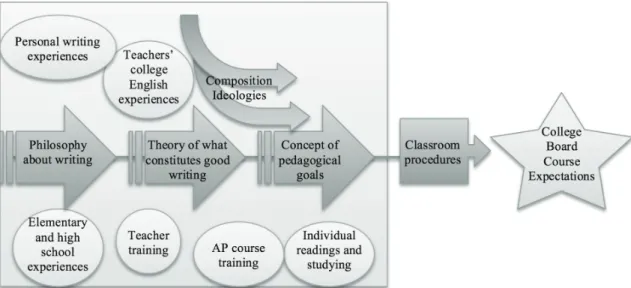
Page, 2015). Moreover, the course has the dual requirements of teaching an engaging college freshman English course and preparing high school juniors for the rigors of a three-hour standardized exam (Borenzweig, 2009). Successful rhetoric and composition instruction such as what is required in First Year Composition and AP English Language and Composition does not occur in a vacuum or overnight, though.
As depicted in Figure 2, successful teachers of such courses have had years of preparation developing background, philosophies, and practices that lead to classroom procedures, which, for AP English Language and Composition teachers, is hopefully a direct path to College Board suggested practices. The framework is comprised of several layers. The outer square depicts the elements of teachers’ experiences forming classroom practices. These elements include not only the basic tenets of classroom procedures such as philosophies, theories, and pedagogical goals, but also factors that influence these basic components such as teacher experiences and trainings. The interplay among these elements forms the foundation of a teacher’s writing practices in the classroom. The experiences and trainings of a teacher can directly influence these basic components, which may or may not affect the development of suggested College Board practices for AP English Language and Composition.
Summary of Methodology
Creswell (2014) argued the intent of qualitative research is “to make sense of (or interpret) the meanings others have about the world” (p. 8). This approach allowed for an examination of participants and data in the natural setting of the teachers’ classrooms, and it encouraged the qualitative element of using inductive reasoning to establish patterns and themes related to AP English Language and Composition training and professional development based on multiple sources of data (Creswell, 2014). This qualitative approach matched the nature of the research problem. More specifically, this study utilized the empirical inquiry model of the case study. Stake (1995) defined the case study as a “bounded” and “integrated system” with “working parts” (p. 2). Teachers who had participated in College Board trainings and were actively teaching the course provided the information and perceptions to examine these “working parts” (Stake, 1995, p. 2). As Stake (1995) suggested, the research began with an issue—AP English
Language and Composition teachers’ training—followed by a flexible approach to research with focused questions, data collection, and data analysis.
The research for this study was conducted in the natural setting of rural South Georgia Title I high schools. Once completed, the multiple viewpoints presented by teachers were studied for emerging patterns. A constructivist worldview informed this study as the intent of the research was to interpret how others make meaning of their world by inductively developing a theory and finding patterns that inform meaning (Creswell, 2014). The aim of this study was to study the relationship between the phenomenon and the contexts in which it arose; form conclusions based on observations of AP English Language and Composition teachers, interviews with teachers, and analysis of provided documents; interpret findings based on subject interactions; and reflect the perceptions and experiences of South Georgia AP English Language and Composition teachers. This case study addressed the role of professional development in teachers’ decision-making processes by interviewing and observing six AP English Language and Composition teachers.
To gain a detailed understanding of AP English Language and Composition teachers’ perceptions and perspectives, participants of this study were selected through purposeful sampling from all rural South Georgia Title I high schools. Additionally, since the College Board currently requires AP Readers to have at least two years of experience teaching their respective AP course (College Board, 2017d), this study required the same amount of experience. Likewise, only teachers who worked at schools with open-enrollment policies were selected.
This type of qualitative study allowed for the analysis of unexpected results and unforeseen issues. The primary sources of data consisted of interviews, observations, and data sources (both published information in the public-domain such as AP data and
unpublished personal materials of teachers such as planning documents, assignments, and lesson plans). Information obtained from interviews provided historical information, teacher perceptions and observations provided contextual information and observable behaviors, and document analysis provided a glimpse of the participants’ perceptions in their own language (Creswell, 2014). This information, in the form of a narrative, helped present a clear picture of the information shared.
Initially, I gained permission to conduct research on human subjects from an Institutional Review Board (IRB), and obtained permission from district superintendents to interact with school employees. Details of the study were explained to school
principals, when necessary, and data were collected. The collection and analysis of data from participants in the study began with an observational protocol of separate
descriptive (setting, demographics, activities, etc.) and reflective notes (Creswell, 2014). Open-ended, in-depth interviews provided data about AP English Language and
Composition teachers’ perceptions and perspectives about their professional development and college experiences related to rhetoric and composition. The interview protocol involved a prepared guide for questioning, audio recording of interviews, transcriptions of audio recordings, and handwritten notes. Documents such as lesson plans and classroom assignments were analyzed for composition pedagogy and ideology while notes were kept for compilation and analysis.
Data analysis occurred concurrently with data gathering: as interviews and transcriptions were completed, document analysis and observation analysis commenced. As data were read and analyzed, information not relevant to the research questions were eliminated and pertinent data were coded and organized into themes or categories
(Creswell, 2014). After coding, themes or patterns were disaggregated and organized to demonstrate the multiple perspectives discovered in the study. A narrative passage represented the findings of the study, and, finally, the research findings were interpreted based on the results of the study and the theories represented in relevant literature.
Limitations
There were several possible limitations to this study. First, my role as an AP English Language and Composition instructor in the South Georgia area resulted in the possibility of human bias. Maintaining neutrality and impartiality, implementing
triangulation techniques, emphasizing procedures, and focusing on the research questions helped eliminate or mitigate researcher bias (Creswell, 2014; Patton, 2002).
Another limitation was that interviewing could introduce inaccuracies. Interviewees could filter and limit information, and some interviewees may not have articulated their perceptions as well as others (Creswell, 2014). Using different data sources such as document analyses and observations helped curb the limitations of interviews, but interview limitations were not limited to articulation and point of view. Data limitations from interviews also included “possibly distorted responses due to bias, anger, anxiety, politics[;] . . . simple lack of awareness[;] . . . recall error[;] reactivity of the interviewee to the interviewer[;] and self-serving purposes” (Patton, 2002, p. 306). Additionally, document analysis could have introduced access restrictions, inaccuracies, and quality variations (Creswell, 2014; Patton, 2002). Using a variety of sources and resources combined with careful data collection, transcribing, and analysis minimized any weaknesses inherent in a single data collection method.
Definitions of Terms
For the purposes of this study, terms are defined as below:
Advanced Placement courses. These classes are college-level courses taught in the high school setting using standardized course syllabi requirements aligned with the AP examination (College Board, 2008).
Advanced Placement exam. The College Board administers the Advanced Placement exam once a year, usually in May. An exam is given for each of the courses offered in the AP program for a fee—some schools pay the fee while others require students to pay their own fees. Students receiving a passing score on the exam may be eligible for college credit in the subject of the exam (College Board, 2007b).
AP workshops. AP workshops are offered throughout the year to AP teachers (new and experienced), interested teachers, administrators, and AP coordinators. These are one- or two-day workshops offered in a variety of settings and usually taught by AP teachers (College Board, 2017a).
College Board. The College Board is a non-profit organization that has
continually developed and maintained the AP program; supported high schools, colleges and universities; and coordinated the administration of annual AP examinations since 1954 (College Board, 2008).
College and Career Readiness Index (CCRPI). The Georgia CCRPI is defined as a platform that promotes school accountability, comprehensive school improvement, and improved communication for all Georgia education stakeholders. Its purpose is to promote college and career readiness for Georgia public school students. The index is a rating each school receives to help stakeholders determine how well schools have been
preparing students for work or further education. Factors informing the index are based on four main components: achievement, progress, achievement gap, and challenge points (Georgia Department of Education, 2015).
Composition-rhetoric. Composition-rhetoric refers to the theory and practice of teaching writing, emphasizing the “function of rhetoric (with its 2,500-year tradition) as an underlying theory of composition” (Nordquist, 2016, par. 2).
Discourse. Discourse is any form of communication, verbal or written, that has the capacity to be analyzed (Fairclough, 1993).
Epistemology. Crowley (1990) referred to epistemology as a “worldview”: “some currently accepted theory of knowledge” (p. 2, 4). More specifically, it refers to the “roles that [individuals believe] language, writing, and pedagogy play in constructing knowledge” (Ervin, 1996).
Ideology. Ideology is a teachers’ beliefs concerning the way composition addresses “competing discursive claims of value in the social, political, and cultural” (Berlin, 1988, p. 477).
Passing score. An AP English Language and Composition passing score, for the purposes of this study, is a 3, 4, or 5 on a 5-point scale. The College Board (2019b) considers a score of 3 to mean a student is qualified for entry-level college work, a score of 4 means the student is well-qualified, and a score of 5 means the student is extremely well-qualified for entry-level college work.
Pedagogy. Elbow (1998) referred to pedagogy as the craft, mechanics, processes, rituals, and logistics of writing instruction. Briggs (1995) expanded Elbow’s definition
by stating that composition pedagogy is “the effective and meaningful application of technique” (p. 83).
Rhetoric. For the purposes of the AP English Language and Composition course and this study, rhetoric involves the ability to recognize the language choices a writer makes, analyze how those choices affect the intended audience, and use similar techniques to effectively communicate ideas to audiences (Roskelly, 2008).
Rhetorical analysis. In rhetorical analysis, students are expected to “attend to the pragmatic and stylistic choices writers make to achieve their purposes with particular audiences, or the effects these choices might have on multiple, even unintended audiences” (College Board, 2014b, pp. 18-19).
Rural school districts. The United States Census Bureau defines rural as a residual category of places “outside urbanized areas in open country, or in communities with less than 2,500 inhabitants,” or where the population density is “less than 1,000 inhabitants per square mile” (NCES, 1997, p. 3).
Summer Institute (APSI). The College Board offers three-day or week-long professional development opportunities to beginning and experienced AP teachers called AP Summer Institutes. Universities, colleges, and high schools sign quality and
consistency agreements with the College Board before receiving approval to offer the courses. The courses are taught by College Board-endorsed instructors who provide College Board materials to each participant (College Board, 2017a).
Teacher professional development. Professional development is attendance at a College Board sponsored training.
Title I. Title I school districts are those with high numbers or high percentages of children from low-income families. These districts and schools receive financial
assistance from the U. S. Department of Education to ensure that all students can meet state academic standards (U. S. Department of Education, 2015).
Veteran teacher. The College Board requires a teacher to have at least two years of experience teaching an AP course before he or she can apply to be a reader (College Board, 2017d). For the purposes of this study, veteran teachers are those who have at least two years of experience as well.
Summary
The inclusion of rhetoric in the AP English Language and Composition course has seen a rapid evolution in the relatively recent past. Teachers’ inclinations and tendencies to adopt literary analysis practices in their classrooms was not an unforeseen problem; however, understanding the role of AP English Language and Composition professional development in altering underlying ideologies and epistemologies has been largely unexamined in educational literature. This study attempted to address issues that present themselves in an analysis of AP English Language and Composition teachers’
perceptions of their own professional development and college trainings and experiences. This dissertation is divided into five chapters. This chapter provided an
introduction, a purpose statement, research questions, significance, a conceptual framework, a summary of methodology, a discussion of limitations, and a list of
definitions of terms for the study. Chapter 2 presents a review of available and relevant literature. Chapter 3 contains information about the study itself including the population sample, instruments used, and data analysis techniques, and Chapter 4 presents study
findings. Finally, Chapter 5 includes a summary of findings and a discussion of the implications of those findings.
Chapter II
REVIEW OF LITERATURE
Atwan (2015), editor of The Best American Essays series, argued that solidly defining the essay and listing its essential features is an impossible task. Despite the difficulty of the task, guest editors of the series—all of them essayists themselves—have attempted to define or describe this most inexact of genres: Wallace (2007) simply said we know one when we see one; Hitchens (2010) noted “an ‘essay’ is really a try, an attempt, even an adventure” (p. xvi); Levy (2015) argued “whatever its narrative shape, an essay must have an idea as its beating heart” (p. xv); Franzen (2016) contended the democratic and subjective nature of the essay combines with the prevalence of today’s instant communication to create an “essayistic golden age” (p. xv); and the most recent guest editor, Als (2018), maintained the essay is “indefinable, but you know an essay when you see it, and you know a great one when you feel it, because it is concentrated life” (pp. xxiv). This nebulous form of composition is the focus of writing instruction for high school, First Year Composition, and AP English students. It is the form high-stakes tests often use to assess a student’s writing ability, and it is the form that determines a student’s ability to communicate effectively in society.
Gold et al. (2012) stated that over the past century, the role of writing instruction in schools and colleges has been an ideological and pedagogical struggle largely because educators and policy makers have long known the integral role language and literature play in shaping meaning and experience. In fact, contests over the educational
endorsement of economic, political, and social formations often determine the role and practice of education in a democratic society (Gold et al., 2012). Yet, if literacy, as it has in the past, constitutes nothing more than learning how to read and write, writing
instruction would be simply memorizing a recording technique to help individuals recite oral text (Enos, 2012). Writing and writing instruction is much more nuanced and multi-faceted than memorization—it is a skill, an art (Enos, 2012; Miller, 1976). More than any other subject, decisions made about writing pedagogy reflect a teacher’s, school’s, and society’s beliefs about the purpose of not only written communication but also education in general (Gold et al., 2012).
Miller (1976) argued composition is the only art high schools demand “students attempt to master at a fairly high level of proficiency as a prerequisite for graduation” (p. 61). While the state of Georgia no longer requires a separate writing assessment or graduation test, writing plays a role in students’ End-of-Course assessments, AP exams, and common department assessments (College Board, 2018d; Georgia Department of Education, 2018). The pervasiveness of writing demonstrates there is a continued need for students to write and write in “a fairly specialized and demanding genre . . . [requiring students] to call up a large fund of information . . . [and] bring all that to bear in a
creative effort” (Miller, 1976, pp. 61-62).
While good writing involves the disparate skills of thinking of many possibilities and criticizing and rejecting all but the best, good writing instruction requires these skills along with mentalities that contradict and interfere with one another (Elbow, 1983). The sheer number of variables involved in writing instruction results in practices that change over time and from teacher to teacher. Writing instruction has drastically changed in the