Reconsidering Wireless Systems with Multiple Radios
Paramvir Bahl, Atul Adya, Jitendra Padhye, Alec Wolman
Microsoft Research, 1 Microsoft Way, Redmond, WA 98052
ABSTRACT
The tremendous popularity of wireless systems in recent years has led to the commoditization of RF transceivers (radios) whose prices have fallen dramatically. The lower cost allows us to consider using two or more radios in the same device. Given this, we argue that wireless systems that use multiple radios in a collaborative manner dramatically improve system performance and functionality over the traditional single radio wireless systems that are popular to-day. In this context, we revisit some standard problems in wire-less networking, including energy management, capacity enhance-ment, mobility manageenhance-ment, channel failure recovery, and last-hop packet scheduling. We show that a systems approach can alleviate many of the performance and robustness issues prevalent in cur-rent wireless LAN systems. We explore the implications of the multi-radio approach on software and hardware design, as well as on algorithmic and protocol research issues. We identify three key design guidelines for constructing multi-radio systems and present results from two systems that we have built. Our experience sup-ports our position that a multi-radio platform offers significant ben-efits for wireless systems.1
1.
INTRODUCTION
Wireless communication has become an indispensable part of mod-ern day-to-day life. As a consequence, the importance of building robust wireless systems cannot be overstated. Unfortunately, cur-rent wireless communication systems are not robust. Ask anyone who uses a wireless network regularly, whether in a corporate set-ting or in the home, and they will relate experiences of dropped connections; problems with authentication; reduction of through-put due to interference from other wireless devices; and loss of use of a device due to rapid battery drainage.
Previous attempts to rectify this situation have met with limited success. A fundamental shortcoming of many previous attempts is the implicit assumption that the underlying system has only a single radio, or in a few cases multiple radios that operate independently. We believe that future solutions to achieving robust wireless sys-tems do not have to rely on requiring major breakthroughs in radio technology, but instead require careful thinking about the demands of the task to be accomplished, an understanding of the limitations of the available components and the interactions between them, and innovation in combining these components in a way that uses their strengths constructively. The problems cannot be solved at the level of an individual component, rather they must be solved by consid-ering the behavior of the complete system. Thus, the challenge is to design systems that use all available resources (spectrum, energy, hardware, and software) efficiently while being general enough to support a wide variety of applications.
1
This paper is a product of over 3 years of research on multi-radio wireless LAN and wireless mesh systems.
It is our thesis that systems using multiple radios on each node, working in an integrated manner to accomplish a common task, provide significant benefits in terms of functionality and perfor-mance over systems with a single radio, or with multiple radios where the radios are used independently.
A current trend in the IEEE 802.11 [12] wireless LAN industry is to build products that support multiple standards. For example, both Netgear and Orinoco sell client adapters that support IEEE 802.11{a, b, and g}. Although these products contain multiple ra-dios, they do not meet our definition because the multiple radios cannot be used in an integrated manner. For example, when the card is operating in IEEE 802.11a mode, it cannot maintain connectivity to an IEEE 802.11b or an IEEE 802.11g network simultaneously. Today’s wireless LANs are built using radios that support high data rates, but these radios consume a large amount of energy [8, 25]. Wireless personal area networks (PANs) use radios that are energy efficient, but support low data rates [9, 17]. Systems containing both types of radios are starting to emerge in the market. How-ever, networking stacks treat these radios as two distinct network interfaces and broad classes of applications use these interfaces in-dependently. We show that a system combining both radios in an integrated manner can provide the benefits of both – high data rates with low energy consumption.
Our goal is to show that many standard problems in wireless net-working can be solved in a much better way if the wireless platform includes multiple radios and multiple physical channels. Not only are multiple-radio systems desirable in terms of the functionality they offer, they are also practical in terms of the component costs, because of impressive decreases in the cost of individual radios. In advocating the use of multi-radio systems, we do not recom-mend any particular radio technology. In some cases, it is desirable to have radios that differ in their physical characteristics, while in others multiple similar radios are useful. By adding appropriate support to the operating system, unmodified applications can take advantage of the increased functionality provided by such a system. On an as needed basis, the software either chooses the most appro-priate radio or uses multiple radios simultaneously, depending on the task that needs to be accomplished.
In the remainder of this paper, we investigate multi-radio solutions to five standard problems in wireless networking, and present our experiences building such systems for two of these problems. One system uses multiple radios to provide better energy management in a wireless LAN system; another uses multiple radios to improve capacity in multihop wireless mesh system. We also outline multi-radio solutions for mobility management, channel failure recovery, and last-hop packet scheduling. Our objective is to make a com-pelling case that a systems approach based on an integrated multi-radio platform can improve both functionality and performance of
future wireless systems.
2.
EXISTING WIRELESS TECHNOLOGIES
What follows is a very brief summary of existing wireless LAN and PAN technologies. The IEEE 802.11 standard, commonly referred to as the “WiFi Standard”, dominates the wireless LAN industry world-wide. There are three popular variants of this IEEE stan-dard: 802.11a, 802.11b, and 802.11g. IEEE 802.11a operates in the 5 GHz unlicensed frequency band whereas 802.11b and 802.11g operate in the 2.4 GHz unlicensed frequency band. 802.11a and 802.11g support a maximum data rate of 54 Mbps, whereas 802.11b supports a maximum data rate of 11 Mbps. The three standards differ in their choice of signal modulation but are similar in their choice of carrier sense multiple access technology as their medium access control (MAC) protocol. In Europe, there is another wireless LAN technology called Hi Performance LAN/2 (HIPERLAN/2) that provides up to 54 Mbps data rates in the 5 GHz band. Ra-dio modulation is similar to the IEEE 802.11a & g but the MAC is based on dynamic time division multiple access.
In the wireless PAN space, the Bluetooth standard, also operating at 2.4GHz, dominates. The IEEE recently standardized a low-power, low data rate radio as the IEEE 802.15.4 (Zigbee) standard [9]. Zigbee operates in two different frequency bands including the 915 MHz and the 2.4 GHz bands and supports comparatively low data rates of up to 220 Kbps. In addition to the standards, there are many other niche market radios available today, such as the RF Monolithics TR1100 radio [23], a low-power radio which operates at 915MHz and provides data rates up to 1 Mbps.
The main point of this review is that there is no “one shoe fits all” radio technology. There are a wide variety of radio technologies available to us today, each focused on certain classes of applica-tions, each making certain tradeoffs. We propose that system de-signers combine these technologies in a way so that the strengths of one radio can overcome the weakness of other radios to improve the overall performance of the system.
3.
THESIS AND DESIGN GUIDELINES
Our thesis is: Wireless systems performance and functionality can be improved significantly by designing a system that employs mul-tiple radios in the same network. Although these radios provide different communications links, the networking protocols and al-gorithms utilize the radios in conjunction to accomplish the same task. Such a system will be more dependable, more flexible, and al-low more innovation than traditional single radio wireless systems. Within this framework, we identify three specific design guidelines: • Design for Choice. Different radios with different properties
and characteristics should operate inside the same platform. The diversity yields significant system performance advan-tage.
• Design for Flexibility. Programming abstraction should
al-low applications to treat the radios as a single logical pipe, yet allowing networking protocols to access the radios di-rectly. The flexibility encourages innovation at all levels of the networking stack.
• Design for Separation. Where possible, separate the control
and the data traffic. Separate radios may be dedicated to each of the functions.
It is important to realize that additional hardware does not always improve system performance. When resources are shared, more hardware, without proper arbitration and safeguards can lead to lower performance. Wireless systems provide a good example of this: the spectrum or the communications link is a shared resource. Consequently, there is a limit beyond which more hardware will not help [1].
4.
REVISITING STANDARD PROBLEMS
We discuss five important problems in wireless networking: energy consumption, network capacity, mobility management, communi-cations robustness, and quality of service. We show that by using a multi-radio approach, system designers can deliver better solutions to these classic problems.
Note, multiple radio systems where the radios work independently are available today. Examples include the Atheros AR5001X Dual-Band 802.11a/b/g Wireless LAN Network Card [5] and the HP iPAQ h6315 Pocket PC - Phone Edition [18], which contains a Bluetooth radio, a WiFi radio and a quad-band GSM/GPRS ra-dio. In such systems, multiple radios might even work simulta-neously, but there is usually no explicit co-ordination of their activ-ities. The systems we propose in this paper are designed explicitly to co-ordinate the activities of multiple radios, to optimize overall system performance.
In the discussions that follow, we make two important assumptions: First, we assume that spectrum will always be limited and as a con-sequence, from Shannon’s theorem [24], channel capacity will also be limited. Second, we assume that the cost of including additional radios in a wireless system will continue to decline dramatically. Given the current trends in wireless technologies, both these as-sumptions are reasonable.
Finally, the ideas explored in this paper open new areas of research in protocol design, algorithms, and systems development. It is our hope, that others will share our enthusiasm by continuing research in these areas, which in turn will help deploy robust multi-radio systems in everyday life.
4.1
Energy Consumption
Several previous studies have established that high data rate wire-less LAN systems are energy inefficient (see [8] and the references therein). Consequently, researchers have proposed different tech-niques to improve energy efficiency. The various approaches to the problem can be broadly classified into the following categories: im-proving channel access mechanisms [26]; maximizing sleep times of wireless cards in accordance with the traffic pattern [14]; and us-ing the lowest possible power level for transmittus-ing and receivus-ing data [3]. There is also on-going research looking for ways to reduce the energy consumption of different RF circuitry components [21]. All of the prior work has focused on the single radio case and the effciency improvements have not been as dramatic as we would like them to be. Consequently, energy inefficiency continues to limit the
use of wireless LAN technology in battery powered mobile devices. For example, a PDA-based WiFi phone is impractical since it drains the battery at a rapid rate even in “standby mode”. Furthermore, battery capacities are unlikely to improve significantly in the near future [20].
With current 802.11 wireless technology, a significant amount of energy loss occurs while the network card is in idle mode, i.e., while it is waiting for messages to arrive. Based on this obser-vation, we propose the use of an additional low-power radio (LPR) along with a high-power 802.11 radio (HPR) for achieving energy efficiency in a wireless LAN system.
Figure 1 shows the idle power consumption of two commercially available radios – the TR1000 low-power radio [23] and a Cisco AIR-PCM350 802.11b radio. The TR1000 consumes significantly lower power than the 802.11b radio. Observing this, we briefly de-scribe three approaches that we have developed for using an ad-ditional low-power radio in a wireless LAN system. These ap-proaches adhere closely to the three design principals we discussed in Section 3.
A note of caution, radios using diverse communication technolo-gies may have different ranges. When employed together the mis-match in radio ranges can lead to situations where the performance of a multi-radio system is no longer compelling. We are exploring techniques to handle such scenarios. In the meantime, we note that in the case where all radios on the sender can communicate with all radios on the receiver, our system performs significantly better than a single radio system. In the case where range mismatch pre-vents all radios on the sender to communicate with the radios on the receiver, our system reverts to a single radio mode.
2 7 7 8 45 1080 1300 1875 1 10 100 1,000 10,000
Sleep Idle Receive Transmit
P o w e r (m W , lo g s c a le ) TR1000 Cisco AIR-PCM350
Figure 1: Power consumption by the TR1000 low-power radio
and an 802.11b card
4.1.1
Alert-On-LPR
Our first approach is called Alert-on-LPR. In this we use the low-power radio to wake up the mobile device when data is available for it. Since we previously published a detailed description of this approach [25], we provide only a short summary here.
When the mobile device is not in use, it is shut down along with the high-power wireless network card; the low-power radio is kept on. When some data is available for the mobile device, a wakeup message is sent to the LPR. The LPR wakes up the device along with the high-power network card and the rest of the protocols are executed using the HPR. Thus, instead of spending large amounts of energy on the HPR waiting for a message, the client expends
lower energy by idling on the low-power radio. The Alert-on-LPR strategy is useful for alert-based applications such as a PDA-based phone which can spend a significant fraction of the time waiting for calls.
Figure 2: A multi-radio system we built (a) Compaq IPAQ with a WiFi radio and a ASH TR1000 transreceiver (b) A ASH TR1000 transreceiver that plugs into the serial port of any com-puter
Proof of Concept
We implemented the Alert-On-LPR strategy by building a WiFi phone into a commercially available PDA (see Figure 2). Our phone shuts down the entire device except the LPR circuitry, using it to listens on the LPR for any incomping calls. The client part of the implementation consists of the TR1000 low-power radio (915 MHz frequency band) along with micro-controller that controls the radio and for sending/receiving messages when the PDA and the 802.11b card (high-power radio in the 2.4 GHz band) are off. Be-fore powering down, the device registers itself with an LPR proxy that can communicate with the mobile device using the TR1000 radio. The LPR proxy sends a registration request to a presence server and registers itself on behalf of the device. When a lookup for the device is received by the presence server, it sends a request to the LPR proxy who wakes up the PDA by communicating on the TR1000 radio. At this point, the device starts using the 802.11b card for normal communication.
0 20 40 60 80 100 0 2 4 6 8 10 12 14 Lifetime (Hours) P e rc e n ta g e B a tte ry R e m a in in g Alert-on-LPR Cellular BlueTooth 802.11b PS 802.11b CAM
Figure 3: Battery lifetime of a PDA-based phone with real
cell-phone usage data
Our experiments show that using the Alert-on-LPR strategy in-creases the “standby time” (i.e., duration of time that the battery lasts while waiting for calls) of a PDA-based phone significantly. A PDA with a regular 802.11b card in active mode (CAM) has a battery lifetime of less than 4 hours; with power-save mode (PSP), the lifetime increases to 14.5 hours. With the Alert-on-LPR strat-egy, the battery lifetime is more than 30 hours, i.e., much closer
to the regular battery lifetime (35 hours) of the PDA without any wireless connectivity. Thus, the Alert-on-Strategy enhances battery lifetime by more than 115% over power-save mode. From a user’s perspective, the battery needs to be recharged at a much lower fre-quency compared to a single-radio system. Figure 3 shows the bat-tery lifetime of the system using a realistic workload obtained from the monthly cell phone bills of two users.
IP and Above
V-MAC
Multi-Radio Virtualization layer
NIC NIC NIC
ARP
IP and Above
V-MAC
Multi-Radio Virtualization layer
NIC NIC NIC
ARP
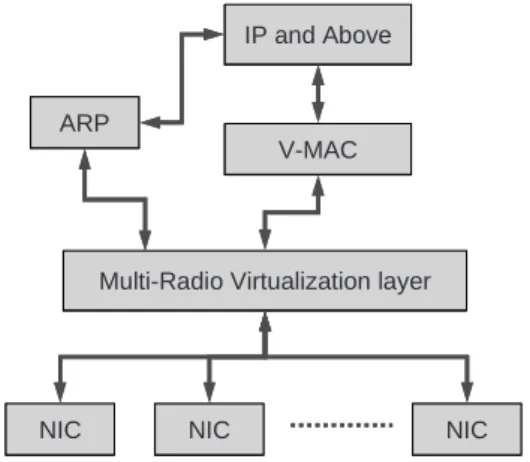
Figure 4: Multi-Radio Virtualization Architecture
4.1.2
Control-On-LPR
Our second approach, called Control-on-LPR, generalizes the pre-vious strategy and coordinates the wakeup of the HPR at a fine-grained level using the LPR. When a mobile node sends a message and is waiting for a reply, the HPR is switched off and the device waits for a wakeup message on the LPR (to reduce observed la-tency, the protocol can detect periods of high traffic and not switch off the HPR). Thus, energy consumption is significantly reduced because the mobile device idles on the LPR even while it is ac-tively communicating. Unlike Alert-on-LPR, this mechanism can be used for all applications.
4.1.3
Data-On-LPR
Our third approach, called Data-on-LPR, generalizes the previous scheme further and offloads some of the data communication work from the HPR to the LPR to save energy. This technique is based on the observation that the bandwidth provided by some of the current low-power radios is quite acceptable for a number of applications, e.g., the TR1100 radio can support a raw bandwidth of 1 Mbps and the upcoming IEEE 802.15.4 technology (Zigbee) [9] supports 220 Kbps. Data-on-LPR detects the current bandwidth requirements of the mobile device and uses the LPR for sends/receives if the re-quirements are low. By dynamically switching between the HPR and LPR according to the device’s bandwidth requirements, this strategy saves energy while ensuring that the user does not perceive a decrease in performance. Note that this strategy switches radios at a coarser-granularity than Control-on-LPR. However, it can be implemented without modifying the MAC on the HPR whereas the fine-grained switching in Control-on-LPR requires firmware mod-ifications.
Proof of Concept
We have implemented the Data-on-LPR technique as a user-level daemon process and a kernel-level driver that resides below the networking layer but above the data-link layer. The kernel-level
1127 Joules 697 Joules 7227 Joules 0 500 1000 1500 2000
802.11 Active 802.11 Power-Save Data-on-LPR
E n e rg y u s e d ( J o u le s )
Figure 5: Preliminary analysis indicates that significant power
savings are possible by using Data-on-LPR.
driver exposes the two radios as a single wireless network to the upper layer protocols and applications, as shown in Figure 4. The driver sends the packets on the radio as instructed by the daemon process. When a packet is received by the driver on one of the two radios, it simply sends the packet up to the higher layer networking protocols.
The main purpose of the user-level daemon is to determine which radio to use and then coordinate the switching of radios. The main reason to switch from the LPR to the HPR is when an application is experiencing congestion on the LPR. Similarly, it needs to switch from the HPR to LPR when a machine is not consuming significant bandwidth and the LPR is not congested.
We have conducted some preliminary experiments to evaluate dif-ferent switching strategies with an implementation and the NS-2 simulator [27]; we used network traffic collected from a developer’s machine. The simulation results of our system compared with a single radio system are shown in Figure 5. The Data-on-LPR tech-nique consumes 40% less energy than even the power-save mode (PSM) of 802.11b. By enabling PSM on the high-power radio, we believe that the energy savings can be improved further.
4.1.4
Summary
In this section we showed that by adhering to the three design prin-cipals i.e using radios with different properties and characteristics (Design for Choice); separating control from data (Design for
Sep-aration) and abstracting multiple radios to look like a single
wire-less network (Design for Flexibility), we are able to reduce the en-ergy consumption and enhance battery lifetimes on mobile devices substantially.
4.2
Capacity Enhancement
In this section, we focus on improving system throughput in multi-hop wireless mesh systems by co-ordinated use of multiple radios. Most existing wireless LAN standards divide the available spec-trum into chunks of 20 MHz, which are called “channels”. A sim-ple and effective way to improve the capacity of such a system is to use multiple radios, each of which is tuned to different non-interfering channel. Thus, a node with two radios can send pack-ets on two channels simultaneously. More importantly, forwarding nodes can both send and receive at the same time. Using appropri-ate protocols for channel selection and assignment, such a system can provide significantly greater capacity than a single radio
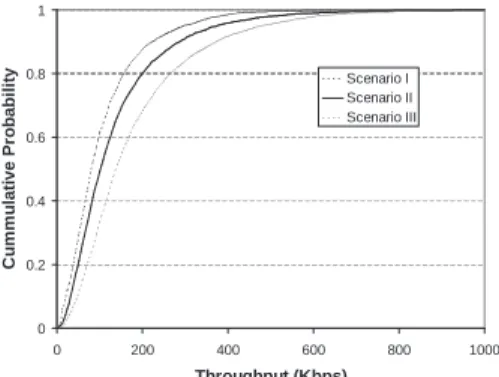
0 0.2 0.4 0.6 0.8 1 0 200 400 600 800 1000 Throughput (Kbps) C u m m u la ti v e Pr o b a b il it y Scenario I Scenario II Scenario III
Figure 6: Improvement in TCP throughput. Scenario 1: every
house has one radio; Scenario II: 50% of the houses have two radios; Scenario III: all houses have two radios
tem. Later in this section, we will present results from two systems that we have built that serve as a proof of this concept.
It is not necessary that all the radios in the system operate in the same general band but different channels. Radios that work in dif-ferent frequency bands may also be used, e.g., each node may have one 2.4 GHz radio and one 5 GHz radio. While co-ordinating such radios it is important to remember that the radios may have sig-nificantly different communication ranges and data rates. We are currently designing new routing protocols to fully exploit the po-tential of such heterogenous multi-radio systems [7].
Another way to improve capacity in multi-hop wireless meshes is to choose a combination of radios, such that one of the radios has significantly lower bandwidth, but much higher range than other radios in the system. The low-bandwidth radio on each node can then be used as a control channel to efficiently schedule data trans-missions on the high-bandwidth radios. Such a system can be sig-nificantly more efficient than present systems that use contention-based MAC protocols like IEEE 802.11. We are currently conduct-ing studies to understand the nuances involved in designconduct-ing such systems.
Many researchers have explored striping across multiple network interfaces to increase throughput (see [10] and the references therein). We present two different approaches to take advantage of multiple radios per node.
4.2.1
Multi-Radio Unification Protocol
In the first approach we propose a link layer protocol called the
Multi-radio Unification Protocol or MUP. The protocol coordinates
the operation of multiple wireless network cards tuned to non over-lapping frequency channels, using locally available information only.
Proof of Concept
The MUP virtualization architecture is illustrated in Figure 4. Us-ing a prototype implementation and detailed simulations we have shown that MUP provides significant performance improvement in a wide range of scenarios (see [1] for details). Here, we present a sample result.
We simulated a a real-world topology of a suburban neighborhood
0 500 1000 1500 2000 2500 3000 3500
WCETT ETX Minimum Hop Count T h ro u g h p u t (K b p s )
Figure 7: Median TCP throughput from 100 transfers in a
23-node multi-radio wireless mesh network
consisting of 35 houses. These houses connect to each other using 2 Mbps IEEE 802.11 wireless links. Wired Internet access is avail-able at one of the houses, and other houses share it using multi-hop routing over wireless links between the houses. We assume that there are four web users, located in four different houses, who ac-cessed the Internet using this shared link. We simulate web traffic using the model provided in NS-2 [27]. We consider three scenar-ios: in the first scenario, every house has only one radio. In the second scenario, half the houses are equipped with two radios each and run MUP, and in the third scenario, all houses have two radios and run MUP.
Figure 6 shows the CDF of the throughput achieved by the four web surfers in each of the three scenarios. The CDF is calculated over all web objects. The results show that when all houses the have two radios, median throughput increases by over 70%. Moreover, even when only half the houses have two radios, the median throughput increases by almost 30%.
4.2.2
Multi-Radio Link Quality Source Routing
The MUP protocol operates using locally available information only. In the second approach, we propose a routing metric called Weighted
Cumulative Transmission Time or WCETT, implemented in a
rout-ing protocol called Multi-Radio Link Quality Source Routrout-ing or MR-LQSR. MR-LQSR is a source routed, link-state protocol. The nodes in the network each have multiple wireless cards tuned to non-overlapping frequency channels. Information about bandwidth, loss rate, and the channel of every link in the network is dissemi-nated to every node in the network. The sender uses this infor-mation to calculate the WCETT values of all available paths to the destinations, and selects the path with the minimum WCETT value. The WCETT metric is designed to favor paths that have channel diversity. Channel-diverse paths tend to provide higher throughput due to reduced interference among hops along the path. In contrast to MUP, the the WCETT metric uses global information to make routing decisions that are optimal on a per-flow basis. More details about WCETT and MR-LQSR are available in [7].
Proof of Concept
We have built and deployed the MR-LQSR protocol in a 23-node multi-radio, multi-hop testbed network. Our results show that our routing metric significantly outperforms previously proposed met-rics such as ETX [6] and the minimum hop-count [13]. Here, we present a sample result.
In our testbed, each node was equipped with an 802.11a and an 802.11g radio. The range of the 802.11g radio is somewhat higher than the range of the 802.11a radios, and the data rate is somewhat lower. Thus, the routing metric needs to take both these factors into account. We carried out 100 2-minute long TCP transfers between randomly chosen pairs of nodes in our testbed. We repeated the test for three routing metrics: WCETT, ETX and minimum hop count. In Figure 7 we show the median throughput of the 100 transfers under each of the three metrics. We see that WCETT significantly outperforms the other two metrics.
4.3
Mobility Management
Wireless LAN standards usually do not address user mobility; it is handled by higher layer protocols. As a mobile node moves be-tween various Access Points (APs), it first breaks the connection and then scans all the channels to find candidate APs to which it can connect. This is called an “association”. During this break-scan-associate cycle, packets belonging to an on-going connection incur delay as they must wait in the mobile node’s buffer. Security protocols such as IEEE 802.1x [11] further aggravate this problem because they require the client to re-authenticate with the remote security server each time it associates with a new AP. For appli-cations such as an Internet phone or streaming video, this delay, which can be on the order of several hundred milliseconds, is not acceptable. There is vast literature on the handoff management and optimization [2, 19], but these approaches are sub-optimal as the researchers focus on single radio WLAN systems.
Ideally, if a mobile node can communicate with multiple APs at the same time, there need not be any delay or packet loss as it moves from one AP to another. Unfortunately, the physical layer of WLANs precludes such functionality.
Wireless systems with multiple radios can provide this functional-ity by taking advantage of the fact that in most wireless networks, APs are placed to provide some overlapping coverage. When the mobile node reaches an overlapping coverage area, the idle ra-dios detect new APs and start associating and authenticating with them. They complete the protocol before the active radio breaks the connection with the current AP. This approach converts a “hard-handoff” (break-scan-associate-authenticate) into a “soft-“hard-handoff” (scan-preassociate-authenticate-break-associate).
With proper network engineering and protocol design, zero delay and zero packet loss can be achieved even as the mobile node moves from one AP to another. We now present a simple set of conditions that can be used for deploying access points such that no packets are lost during the reassociation/reauthentication process.
Consider a mobile with two radios,R1andR2, with different ranges. Assume that R1 is supporting an on-going connection. Suppose that the mobile is currently associated with AP1 but is moving towardsAP2, whereAP1 andAP2 are neighboring APs sharing some areas of overlapping coverage. Now let,
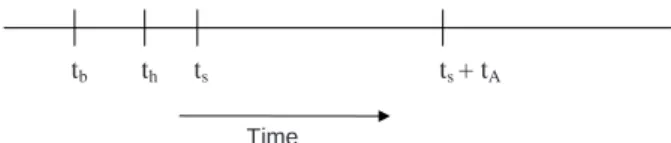
tb→time instant at whichR2sensesAP2
th→time instant at whichR2makes the determination thatAP2 is the AP with which it should associate (AP2has the higher SNR value)
ts→time instant at whichR1breaks connection withAP1
tA →amount of time it takes to complete the association and au-thentication protocol
Figure 8 illustrates the relationship between the various events.ts+
tA is the time at which the client has resumed normal operation (note thatts+tAis also the time when a single radio mobile would have re-established its connection after authentication).
Time
tb th ts ts + tA
Figure 8: Time relationship between different events taking place during a handoff
To achieve zero packet loss, the client should complete the associ-ation and authenticassoci-ation before it breaks from old AP, i.e.,
tA≤(ts−th)
This equation provides a value fortA that network system engi-neers can design for as they consider various authentication proto-cols.
Now let us represent,s →mobile’s speed; d1 →distance from
AP2up to where the first radioR1can stay associated withAP1; andd2 →distance fromAP2 at which the second radioR2 can detect a strong signal fromAP2(the new AP)
A desirable goal is to have the mobile detect a strong signal from the new AP (AP2) while still being connected to the old AP (AP1). This goal can be achieved ifd2 > d1; for system designers this means that the range of the radioR2 should be greater than the range of the radioR1.
IftAis determined empirically and a reasonable estimate ofsis made, then the amount of overlapping coverage can be determined by using the equationtA <(d2−d1)/s, i.e. the time it takes the mobile to travel a distance of(d2−d1)is greater than the time it takes to associate and authenticate the mobile.
In summary, to ensure a handoff without packet loss, network ad-ministrators can use the following two guidelines while configuring the networks. First, the client should complete the association and authentication before it breaks from the current AP. This condition provides an upper bound on the authentication time of a security protocol. Second, the time it takes for association and authentica-tion should be less than the time it takes for the client to travel the distance between when it first detects a strong signal from the new AP and when it breaks from the current AP. If the time for associa-tion and authenticaassocia-tion is determined empirically and a reasonable estimate of the client’s speed is made, the amount of overlapping coverage can be determined using the conditions described above. Thus, with proper network design, a dual radio system can achieve zero packet loss and minimal packet delay which in turn is similar to what soft handoff provides. With this property, time-sensitive applications such as Internet telephony can be supported in wireless
Phone on Phone on Phone on
Figure 9: Impact on TCP throughput of a Cisco IEEE 802.11b
WLAN when a 2.4 GHz wireless phone is operated close to it.
LAN settings even as the user moves inside the network.
4.4
Channel Failure Recovery
In wireless communications there are two broad sources of chan-nel errors. These are errors due to environmental interference and errors due to interference from other wireless networking devices. Figure 9 shows the impact on wireless LAN throughput of a nearby cordless phone operating on the same frequency band.
Graceful degradation and robustness against channel errors is pos-sible by employing frequency diversity. Frequency diversity can be achieved by using multiple radios and operating each on differ-ent frequencies. The key insight from our approach is to build the appropriate radio switching logic in such a way that the wireless devices can employ frequency diversity transparent to the applica-tions. Thus, a 2.4 GHz phone would not be able to destroy com-munication on a multi-radio wireless LAN, because whenever it causes interference in the 2.4 GHz band the software would seam-lessly switch to a different band (e.g. the 915 MHz or the 5 GHz band) and continue normal operation.
4.5
Packet Scheduling
IEEE 802.11 uses a contention-based MAC. When a client wants to transmit a packet, it senses the channel to see if it is busy. If busy, the client waits a random amount of time before attempting to grab control again. These unpredictable wait periods adversely affect the performance of time-sensitive applications, such as voice communications.
To combat this problem, researchers have proposed several fair scheduling algorithms [15, 16, 22]. The flavor of these algorithms is as follows: the AP is provided the exact state (e.g., number of packets in the queue, their deadlines and priorities) of every client it is servicing; it then schedules the channel for each client in a timely manner. The client state information and the AP schedules are sent over the same data channel.
While being better than IEEE 802.11, these approaches still have some inefficiencies. Since high priority control information has to contend for the channel in the same manner as regular data traffic, undesirable delays are unavoidable.
The multi-radio approach is slightly different. By using the ser-vices of the second radio operating on a different frequency
(De-sign for Choice), the system parallelizes the scheduling and
trans-mission operations (Design for Separation). Not only does this improve timeliness of data transmissions, but also as discussed in Section 4.1.2, it results in energy conservation for clients as they now know exactly when they are scheduled to receive packets or when they are scheduled to get the channel for transmission.
5.
CONCLUSION
The users of wireless networks continue to demand better perfor-mance and more features. We believe that the current single ra-dio wireless platform is incapable of meeting these growing de-mands. Despite significant ongoing research, no single technology, including the much-hyped ultra-wide band (UWB) standard [4], has emerged that allows a single radio to deliver high data rates at long range, while consuming low power. Some of the reasons behind this failure are regulatory, while others are more fundamen-tal, grounded in the laws of Physics.
In this paper, we have made a case for re-thinking the core design of the current wireless platform. We have presented a new design that includes multiple radios that work together to accomplish a common task. By using multiple radios, each of which does differ-ent things well, and by integrating them at the systems level, such a platform will provide improved performance and greater func-tionality to the users. We hope that this discussion will encourage further work on these ideas from other researchers.
6.
REFERENCES
[1] A. Adya, P. Bahl, J. Padhye, A. Wolman, and L. Zhou. A Multi-Radio Unification Protocol for IEEE 802.11 Wireless Networks. Technical report, July 2003, (also in IEEE BroadNets 2004).
[2] H. Balakrishnan, S. Seshan, and R. Katz. Improving Reliable Transport and Handoff Performance in Cellular Wireless Networks. ACM Wireless Networks 1995, 1(4), December 1995.
[3] N. Bambos and J. M. Rulnick. Mobile Power Management for Maximum Battery Life in a Wireless Communications Network. In IEEE INFOCOM, March 1996.
[4] F. C. Commission. FCC 02-48: Revision of Part 15 of the Commission’s rules regarding Ultra-Wideband transmission systems. http://www.uwb.org/files/new/FCC RandO.pdf, April 2002.
[5] A. Communications. Three WLAN Standards in a Single Solution - The AR50001X Combo WLAN Solution. http://www.atheros.com/pt/ar5001X.html, 2004. [6] D. De Couto, D. Aguayo, J. Bicket, and R. Morris.
High-throughput path metric for multi-hop wireless routing. In ACM MOBICOM, San Diego, CA, September 2003. [7] R. P. Draves, J. Padhye, and B. D. Zill. Routing in
multi-radio, multi-hop wireless mesh networks. In ACM
MOBICOM, Philadelphia, PA, September 2004.
[8] L. M. Feeney and M. Nilsson. Investigating the Energy Consumption of a Wireless Network Interface in an Ad Hoc Networking Environment. In IEEE INFOCOM, 2001. [9] J. A. Guitierrez et al. IEEE 802.15.4: A Developing Standard
for Low-Power Low-Cost Wireless Personal Area Networks. In IEEE Network Magazine, September 2001.
[10] H.-Y. Hsieh and R. Sivakumar. A Transport Layer Approach for Achieving Aggregate Bandwidths on Multi-homed Mobile Hosts. In ACM MOBICOM, Atlanta, GA, September 2002.
[11] IEEE. IEEE 802.1x-2001 IEEE Standards for Local and Metropolitan Area Networks: Port-Based Network Access Control, 1999.
[12] IEEE802.11b/D3.0. Wireless LAN Medium Access Control(MAC) and Physical (PHY) Layer Specification: High Speed Physical Layer Extensions in the 2.4 GHz Band, 1999.
[13] D. B. Johnson and D. A. Maltz. Dynamic source routing in ad-hoc wireless networks. In T. Imielinski and H. Korth, editors, Mobile Computing. Kluwer Academic Publishers, 1996.
[14] R. Krashinsky and H. Balakrishnan. Minimizing Energy for Wireless Web Access with Bounded Slowdown. In ACM
MOBICOM, September 2002.
[15] T. Nandagopal, S. Lu, and V. Bharghavan. A Unified Architecture for the Design and Evaluation of Wireless Fair Queueing Algorithms. In ACM MOBICOM, July 1999. [16] E. Ng, I. Stoica, and H. Zhang. Packet Fair Queueing
Algorithms for Wireless Networks with Location-Dependent Errors. In INFOCOM, March 1998.
[17] L. Nord and J. Haartsen. The Bluetooth Radio Specification
and The Bluetooth Baseband Specification. Bluetooth,
1999-2000.
[18] H. Packard. HP iPAQ h6315 Pocket PC - Phone Edition. http://www.shopping.hp.com, 2004.
[19] V. N. Padmanabhan and R. Caceres. Fast and Scalable Wireless Handoffs in Support of Mobile Internet Audio.
Mobile Networks and Applications, 3(4):180–188, December
1998.
[20] R. A. Powers. Batteries for Low Power Electronics. In
Proceedings of the IEEE 83(4), April 1995.
[21] J. Rabaey et al. PicoRadios for Wireless Sensor Networks: The Next Challenge in Ultra-Low-Power Design. In
Proceedings of the ISSCC, February 2002.
[22] P. Ramanathan and P. Agrawal. Adapting Packet Fair Queueing Algorithms to Wireless Networks. In ACM
MOBICOM, 1998.
[23] RF Monolithics. TR1000/TR1100 916.50 MHz Hybrid Transceivers. http://www.rfm.com.
[24] C. E. Shannon. A Mathematical Theory of Communications.
Bell System Technical Journal, 27:379–423 and 623–656,
July and October 1948.
[25] E. Shih, P. Bahl, and M. Sinclair. Wake On Wireless: An Event Driven Energy Saving Strategy for Battery Operated Devices. In ACM MOBICOM, September 2002.
[26] S. Singh and C. Raghavendra. PAMAS: Power Aware Multi-Access protocol with Signalling for Ad Hoc Networks.
ACM Computer Communications Review, 28(3), July 1998.
[27] The Network Simulator: NS-2. http://www.isi.edu/nsnam/ns.