Expert Reference Series of White Papers
Project Management
Best Practices for
Maximum Performance
Via Effective
Integration of Multiple
Disciplines
Project Management Best Practices for
Maximum Performance Via Effective
Integration of Multiple Disciplines
Dr. Sam A. Arafeh, Global Knowledge Senior Instructor
Introduction
During the past 60 years, organizations’ operations have become more complex. In response, enterprises have adopted new management techniques, often using Information Technology (IT) as a vehicle to enable these new approaches to management. During the past 30 years, IT and non-IT Project Management (PM) also evolved and reached a stage of self-discipline with its own knowledge base. Yet, in contrast, project management’s concepts of “Pre-Activity” (business analysis) and “Post-Activity” (business performance management) has only been around for about 10 years.
This discrepancy has caused a disconnect that is known as “Business/IT Misalignment.” As a result, many proj-ects have suffered. According to a report from The Standish Group, in 2009 24% of all projproj-ects failed, with 44% left challenged, and just 32% completed successfully (see figure 1). These failed or challenged projects could have meant lost opportunities for organizations, restricting them from meeting future business challenges and/ or taking advantage of new opportunities.
Figure 1. PM Industry Performance Statistics 1994 to 2009 – CHAOS Report*
• Successful: On time, on budget and with all promised requirements.
• Challenged: Off schedule, over budget, or does not provide all promised requirements. • Failed: No product was ever used.
* The Standish Group – The producer of the CHAOS Report since 1994.
This white paper will highlight how project managers can utilize effective integration of multiple disciplines to achieve maximum performance.
1994 2000 2004 2006 2009
S ucces s ful 16% 28% 29% 35% 32%
Challenged 53% 49% 53% 46% 44%
Major Roles Evolution and Best Practices Framework
In a natural response, businesses have been seeking solutions to the Business/IT Misalignment. Professional organizations have surfaced to compile, publish, and promote best practices – often called a “body of knowl-edge.” Two new roles have evolved to compliment the project manager role. The two new roles and the PM role are:
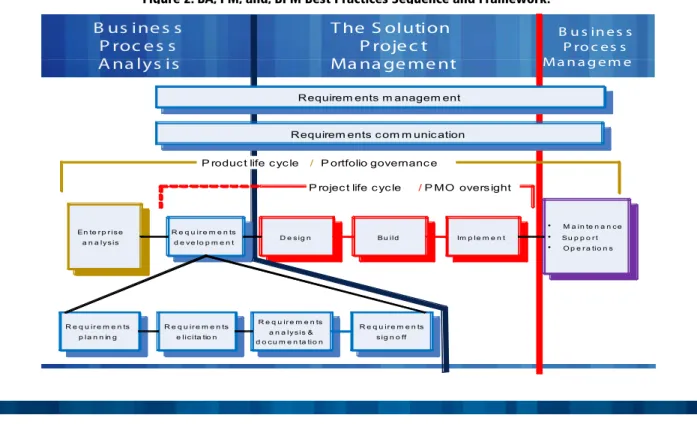
Business Analysis (BA)—coordinates the development and production of business requirements and solutions, as elicited from all related stakeholders. The results of these are “baseline requirements”, which are approved by all stakeholders. The BA continues to remain active during the “Project Management” and “Business Opera -tion” phases to collaborate and communicate the business goals with the PM and stakeholders.
Business Performance Management (BPM)—focuses on business operations by deploying, monitoring, and keeping-up with the enterprise’s key performance indicators (KPIs). A BPM’s goal is to optimize the enterprise’s operations—subject to the given tools, resources, and environment—as well as recommend future maintenance and enhancements initiatives.
Project Management (PM)—manages the product’s design, build, and implementation as a result of and in compliance with the approved business requirements and solution, as governed by the stakeholders’ change-control procedures. The PM’s role is also subject to predefined Triple or Hexagon Constraints, which are de -scribed later.
A new framework has evolved to encompass these three roles, as depicted in figure 2.
Figure 2. BA, PM, and, BPM Best Practices Sequence and Framework.
R e q u ir e m e n ts d e ve lo p m e n t Bu ild Im p le m e n t • M a in te n a n ce • Su p p o r t • O p e r a tio n s En te r p r ise a n a lysis D e sig n
P roject life cycle /P MO oversight P roduct life cycle / P ortfolio governance
R e q u ir e m e n ts p la n n in g R e q u ir e m e n ts sig n o ff R e q u ir e m e n ts a n a lysis & d o cu m e n ta tio n
Requirem ents m anagem ent Requirem ents com m unication
R e q u ir e m e n ts e licita tio n B us ine s s P roc e s s A na lys is T he S olution P roje c t Ma na ge me nt B u s in e s s P ro c e s s M a n a g e m e n t
Project Management Structures and Body of Knowledge
Project management structures follow their particular application. They can be described as follows: IT vs. Non-IT Project Management
While information technology projects might be the major recipients of PM, there are many instances where a business workflow requires PM to realign the workflow as needed. This could involve organizational flow, hu-man resources, and other assets allocation.
Project vs. Program Management
Project management is the single recognizable activity for a targeted application, organized by one project manager and a number of project members who accomplish the targeted goal. Program management is the col-lection of related projects coordinated under one umbrella called a program.
The Project Management Office (PMO)
The PMO is the office that defines, oversees, and maintains the standards of project management. It is the source of documentation, guidance, and metrics on the practice of project management and execution within an organization.
The Project Management Institute (PMI)
The PMI is the organization that focuses on accumulating the industry’s project management best practices. It issues the “Project Management Body of Knowledge”, also known as the PMBOK. This knowledge base is widely used in the industry by project managers.
Project Management Organizations
Five popular PM organizations are known as: Contiguous Organization
The PM is run within one department staffed to execute the project.
Matrix Organization
In matrix organizations, the project resources are shared, or borrowed, to execute the project.
Virtual Organization
The resources are spatially distributed and interconnect via some communication means, usually using electron-ics and the Internet to execute the project.
Co-Sourcing
An organization uses external resources to complement their internal resources and collaborate in executing the project under their own internal management.
S c o p e
R e s o u r c e S c h e d u le
Q u a lity
Outsourcing
Is when the organization resorts to a total external resource, with external management, to execute the project according to a contracted set of specifications, terms and conditions.
The Project Management Constraints
Triple Constraints
Classical PM is executed subject to three parametersknown as the Triple Constraints:
• Scope • Resources • Schedule
This describes the constraint imposed on the PM by the scope of the project, the resources to be used and the delivery schedule.
The Stiffler Hexagon Constraints™
Darrell Stiffler introduced the Hexagon Constraints, extending upon and reordering the Triple Contstraints as follows:
Quality iv. Resources Scope v. Risk Budget vi. Schedule
In this case the Constraints emphasize the first prior -ity as: “Qual-ity of Deliverables,” as expressed by the customer satisfaction.” In addition, the budget of the project and the assessment of risk have been added to the traditional Triple Constraints.
Communication for Leaders, Business Analysts, and Team
Members
Leadership Communication
Maintaining an upper management periodic briefing is essential for the project success. This will ensure sup-port and understating when adverse conditions takes place. Upper management could also be the key to bridge
Figure 3. The Triple Constraints.
Budg et Quality Resources R isks Sche dule Scop e Stiffler Hexagon Constraint Model ™
Customer’s Satisfaction Project , Phase , or Deliverable Other Constraints B y : D a rre ll G . S tiffle r , P M P O cto b e r 1 6 , 2 0 0 9
Business Analyst Communication
The BA role is to collaborate with the PM on the interpretation of the pre-approved formal Business Require -ments and to maintain the communication and liaison among all the stakeholders. This will enable the PM to focus on his/her main role and responsibilities and to delegate any issue of change or variation to the “Base-line” to the BA to coordinate with the stakeholders and the “Change Control Authority.”
Team Members Communication
A critical factor to success is the proper allocation of roles and responsibilities first, and then to maintain team members’ constant communication to anticipate work difficulties or other human factors affecting team performance. Planning and close observation of the day to day productivity and milestone is essential to spot if additional training is needed, change in role has become necessary or external expertise is needed. Neverthe -less, this will provide a vehicle for effective performance appraisals to the team members.
Project Management Environments
There are many PM environments, each suited to its particular application. In the following we briefly describe the four most popular.
Waterfall
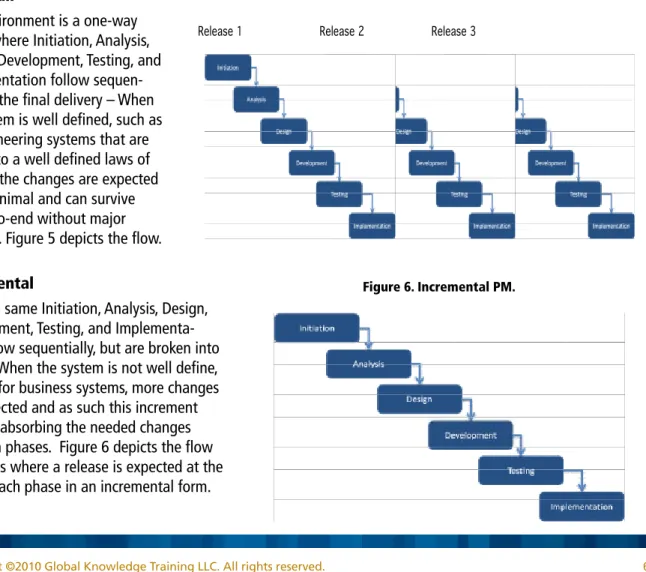
This environment is a one-way street, where Initiation, Analysis, Design, Development, Testing, and Implementation follow sequen-tially to the final delivery – When the system is well defined, such as for engineering systems that are subject to a well defined laws of physics, the changes are expected to be minimal and can survive a start-to-end without major changes. Figure 5 depicts the flow. Incremental
Here the same Initiation, Analysis, Design, Development, Testing, and Implementa-tion follow sequentially, but are broken into phases. When the system is not well define, such as for business systems, more changes are expected and as such this increment helps in absorbing the needed changes between phases. Figure 6 depicts the flow in phases where a release is expected at the end of each phase in an incremental form.
Release 1 Release 2 Release 3
Figure 5. Waterfall PM.
Agile
This method breaks tasks into smaller increments with minimal planning. Iterations are short time frames last-ing from one-to-four weeks. Each iteration involves a cross-functional and self-organizlast-ing team worklast-ing through a full software-development cycle including planning, requirements analysis, design, coding, unit testing, and acceptance testing when a working incremental product is demonstrated to stakeholders.
Service Oriented Architecture (SOA)
This method makes use of functions deployed in a “Service Oriented-based Architecture”, which provides a loosely-integrated suite of “Services” that can be integrated from multiple business domains. SOA separates functions into distinct “Services”, which developers make accessible over a network. The users will combine and reuse these services during their Applications run. These services and their users communicate by passing data in a well defined, shared format. When the Internet is used as the communication network, greater interoper-ability and more independence from proprietary software is provided and freed for use by any service-based technology.
Project Management
Performance
This section outlines the PM performance parameters that lead to a successful PM.
PM Main Activities
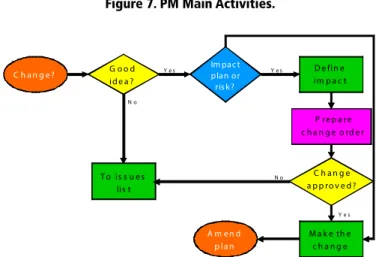
The main PM activities needed to lead Complex Projects is depicted in Figure 7. Keeping a balanced and proactive approach can solve PM difficulties in the face of the future unknowns.
Change Control Management
Inevitably, it is known that the only constant is “Change.” After establishing the “Baseline Requirements,” if a need for a project change is requested, a change control procedure is invoked. The procedure is governed by a “Change Control Authority” to reflect all stakeholder interest. Fig -ure 8 depicts a proced-ure that can determine the denial, approval, or accommodation along with the plan amendments.
C h a n g e? G o o did e a ? To is s u es lis t Y e s Y e s Y e s N o N o Im pac t plan or ris k? D e fin e im p a c t P rep a re c h a n g e o rd e r C h a n g e a p p ro v e d ? A m en d p la n M a k e th e c h a n g e Transfer Avoid Accept Mitigate Contingency plan
Figure 8. Change Control Managment Figure 7. PM Main Activities.
Risk Management
Project risks are handled proactively by determining the probability and impact if the event takes place. Mitigation considers the transfer of risk, avoidance, acceptance, and remedy. Risk identification, impact and mitigation are the inputs for the Contingency Plan. Project Audit • Scope Baseline • Schedule Baseline • Cost Baseline • Resource Baseline • Change Control • Quality Control • Risk Management Project Recovery
• Identify: Symptoms & Causes
• Redefine & Agree on: Goals, Objectives & Priorities • Generate: Options & Recommendations
• Agree on: a Recovery Plan Quality Management
Plan Quality for: • Availability • Capacity • Accuracy • Response Time • Usability • Interoperability Perform Quality Assurance Perform Quality Control Acceptance Testing Establish: • Standards • Policies • Procedures P lanning Direc ting Organizing S taffing Motivating C ontrolling C oordina ting
Determine : • Environment • Tests scenarios • Metrics • Testing process Execute the Testing Process Document Tests:
• Issues • Results
Training, Support, Pilot Test, Roll-Out, and Final Delivery
Training & Support should be delivered in ample time before the Pilot Test is ready. Thereafter it is expected that reasonable knowledge has been gained and all major rough edges in training, support, and critical malfunctions have been cleared. Senior management should be prepared and involved a-priori since a wider area of users will be affected and could impact live operation adversely. Calculated risk and mitigation should be deployed. Incre -mental roll-out should be exercised to enable adequate control while clearing unexpected problems or issues. Once enough confidence has been developed, final delivery and sign-off can take place to a full production. Postmortem
Going through the PM experience, time, and effort for a project deserves a postmortem to provide feedback for good and bad of a project. Postmortems should be conducted after both key stages of a project and after the final stage of delivery. The lessons learned should be documented for future reference, plans, avoidance, and mitigation. Nonetheless, the good should also be emphasized, to take advantage and reuse the best experiences and practices.
Conclusions and Recommendation
In this white paper, we attempted to highlight the historical state of affair of PM and the impact of the increas-ing complexity of today’s enterprises. A disciplined collaboration between the BA and BPM has become a pre-requisite for success. The PM is no longer in a silo, buffered from the business environment, except at delivery time where customer satisfaction, as well as stakeholder satisfaction, is the true measure of success.
The BA is the agent to coordinate the business analysis, communications, and solutions requirements develop-ment, as elicited and approved by all related stakeholders. The PM is included as one of the stakeholders to contribute and approve the feasibility of the requirements. The result of this stage is a formal requirements document reflecting the stakeholders’ needs and the feasibility of the project. The document is called a Baseline Requirements Document. Thereafter, if any change or variation is discovered, or demanded, a change-control authority is exercised to resolve the change issue and assess its impact on the project and the business. Note the PM does not start until the BA phase is complete and the “Baseline Requirements” are approve by all the stakeholders including the PM.
You have been taken on a fast tour of how to achieve maximum performance with your project via the integra-tion of the best practices of multiple disciplines. The tour covered the major, related roles and evoluintegra-tion of the best practices framework, PM’s various structures, PMI’s PMBOK®, the PM Organization, the Triple and Hexagon
Constraints, Leadership, the importance of the BA and team members’ communication, and the governing PM’s environments and performance.
You should now be equipped with a map to seek further in-depth knowledge and practice, in your specific area of interest, to achieve and maintain your desired level of PM excellence.
Learn More
Learn more about how you can improve productivity, enhance efficiency, and sharpen your competitive edge. Check out the following Global Knowledge courses:
Project Management Fundamentals (PM01) Applied Project Management (PM08) Business Analysis Essentials (BA10)
For more information or to register, visit www.globalknowledge.com or call 1-800-COURSES to speak with a sales representative.
Our courses and enhanced, hands-on labs and exercises offer practical skills and tips that you can immediately put to use. Our expert instructors draw upon their experiences to help you understand key concepts and how to apply them to your specific work situation. Choose from our more than 1,200 courses, delivered through Class -rooms, e-Learning, and On-site sessions, to meet your IT and business training needs.
About the Author
Dr. Sam Arafeh, is a senior instructor at Global Knowledge. He has over 30 years’ experience in Business Analysis and Project Management in public and private enterprises, managing and directing business applications from inception through implementation and operation. He has total involvement experience in enterprise architec -ture, analysis, strategic planning, business organization, development, and IT management. He is also affiliated with Systems Engineering & Management (www.ieSEAM.com), a consulting firm in Rolling Hills, California pro -viding management and technical services to major Fortune 500 companies. He was one of top executives who took a 30-years old private company public in 1996. He has held various positions in the US and abroad, and was a “Visiting Professor” with the University of California, Irvine for 15 years, and published over 40 research publications. He is an active “Information Technology Business Executive” involved in: originating, negotiating & structuring business deals; serving on boards of directors and advisors; assessing business plans and conduct -ing new IT business venture’s technical, financial, management, market-ing, feasibility, and due diligence. He was on the “Executive Committee” of the largest Angels Investment Group in the USA (www.TechCoastAngels.com) helping young entrepreneurs reach their goals. He earned a Ph.D. in Systems Engineering & M.Sc. Operations Research, from Southern Methodist University (SMU).