SURFACE
SURFACE
Dissertations - ALL SURFACE
5-14-2017
Facilitating High Performance Code Parallelization
Facilitating High Performance Code Parallelization
Maria Abi SaadSyracuse University
Follow this and additional works at: https://surface.syr.edu/etd
Part of the Engineering Commons
Recommended Citation Recommended Citation
Abi Saad, Maria, "Facilitating High Performance Code Parallelization" (2017). Dissertations - ALL. 712.
https://surface.syr.edu/etd/712
This Dissertation is brought to you for free and open access by the SURFACE at SURFACE. It has been accepted for inclusion in Dissertations - ALL by an authorized administrator of SURFACE. For more information, please contact
With the surge of social media on one hand and the ease of obtaining information due to cheap sensing devices and open source APIs on the other hand, the amount of data that can be processed is as well vastly increasing. In addition, the world of computing has recently been witnessing a growing shift towards massively parallel distributed systems due to the increasing importance of transforming data into knowledge in today’s data-driven world. At the core of data analysis for all sorts of applications lies pattern matching. Therefore, parallelizing pattern
matching algorithms should be made efficient in order to cater to this ever-increasing abundance of data. We propose a method that automatically detects a user’s single threaded function call to search for a pattern using Java’s standard regular expression library, and replaces it with our own data parallel implementation using Java bytecode injection. Our approach facilitates parallel processing on different platforms consisting of shared memory systems (using multithreading and NVIDIA GPUs) and distributed systems (using MPI and Hadoop). The major contributions of our implementation consist of reducing the execution time while at the same time being transparent to the user. In addition to that, and in the same spirit of facilitating high performance code parallelization, we present a tool that automatically generates Spark Java code from
minimal user-supplied inputs. Spark has emerged as the tool of choice for efficient big data analysis. However, users still have to learn the complicated Spark API in order to write even a simple application. Our tool is easy to use, interactive and offers Spark’s native Java API
performance. To the best of our knowledge and until the time of this writing, such a tool has not been yet implemented.
Parallelization
by
Maria Abi Saad
B.S. Lebanese American University, 2006
M.S. Lebanese American University, 2008
Dissertation
Submitted in partial fulfillment of the requirements for the degree of
Doctor of Philosophy in Electrical and Computer Engineering
Syracuse University
May 2017
Copyright © Maria Abi Saad 2017
All Rights Reserved
iv
Acknowledgements
Firstly, I would like to express my deepest appreciation to my advisor Professor C.Y. Roger Chen for his continuous support and advice. I am very grateful to have been the student of such a knowledgeable, enthusiastic, and ambitious visionary. Without his guidance and encouragement over the years, this dissertation would not have been possible.
Besides my advisor, my sincere thanks go to my dissertation committee members for taking the time to review my work and for their valuable insights, comments and suggestions. They are and in alphabetical order Prof. Ehat Ercanli, Prof. Erin Mackie, Prof. Qinru Qiu, Prof. Yanzhi Wang, and Prof. Edmond Yu.
I would also like to thank my colleagues at the Design and Modeling Lab who have accompanied me at different intervals of my research, and who have offered valuable
suggestions and stimulating discussions. In particular, I am grateful to Elie for his support, his encouragement, his sarcasm and his friendship. This would have been a much harder wave to ride without him.
I am also grateful to my friends who always remind me that there is more to life than work although at times the lines get blurred. I would like to specifically thank all the wonderful people whom I have met during my time at Syracuse. You have made the snowy winters much easier to bear. Sigue bailando!
Lastly, I would like to thank my parents, my sister, and my brother who have supported me throughout this journey and have always believed in me. I am grateful for their understanding, their patience, and mostly for their love. This is dedicated to them.
v
Table of Contents
Chapter 1: Introduction ... 1 1.1 Parallel Computing ... 1 1.2 Proposal ... 2 1.3 Objectives ... 4 1.4 Development Process ... 5 1.5 Outline ... 5Chapter 2: Automatic Parallel Matching using Java Bytecode Injection ... 7
2.1 Introduction ... 7
2.2 Pattern Matching ... 8
2.3 Motivation ... 12
2.4 Literature Survey ... 14
2.5 Java Bytecode and ASM ... 16
2.6 Implementation... 20
2.7 Experimental Results and Interpretations ... 26
2.8 Conclusion ... 28
Chapter 3: Parallel Pattern Matching on GPUs ... 29
3.1 Introduction ... 29
3.2 Introduction to GPUs ... 30
3.3 Literature Survey ... 35
3.4 Writing Java for GPUs ... 38
3.5 Mapping Approach ... 44
3.6 Performing Pattern Matching on the GPU ... 48
3.7 Experimental Results and Interpretations ... 51
3.8 Conclusion ... 55
Chapter 4: Parallel Pattern Matching using MPI ... 56
4.1 Introduction ... 56
vi
4.3 Literature Survey ... 64
4.4 Implementation... 67
4.5 Experimental Results and Interpretations ... 77
4.6 Introduction to Hadoop ... 84
4.7 Hadoop Comparison ... 87
4.8 Conclusion ... 90
Chapter 5: Generating Spark Java Code ... 91
5.1 Introduction ... 91
5.2 Related Work... 93
5.3 Spark... 95
5.4 Machine Learning ... 99
5.5 Implementation... 100
5.6 Graphical User Interface ... 114
5.7 Conclusion ... 125
Chapter 6: Conclusion ... 126
6.1 Summary ... 126
6.2 Suggestions for Future Work ... 129
vii
List of Figures
Figure 1-1: Parallel Systems ... 3
Figure 2-1: DFA vs NFA example diagram ... 10
Figure 2-2: Runtime graph of pattern matching backtracking example ... 13
Figure 2-3: Pattern matching code snippet ... 18
Figure 2-4: ASM code of Figure 2-3 ... 19
Figure 2-5: ASM process ... 20
Figure 2-6: Process illustration ... 21
Figure 2-7: Partitions with no boundary overlap ... 24
Figure 2-8: Partitions with boundary overlap ... 25
Figure 2-9: Runtimes vs number of threads ... 27
Figure 2-10: Percent improvement over single thread ... 28
Figure 3-1: Grid of thread blocks, taken from NVIDIA website ... 33
Figure 3-2: Workflow diagram ... 44
Figure 3-3: Runtimes of CPU vs GPU ... 54
Figure 4-1: MPI code template ... 61
Figure 4-2: Sample exec code ... 69
Figure 4-3: Overall execution process ... 70
Figure 4-4: Scatter illustrative example ... 74
Figure 4-5: Reduce illustrative example ... 77
Figure 5-1: Loading and parsing code example for word count ... 101
Figure 5-2: Word count code based on Spark implementation from documentation ... 102
viii
Figure 5-4: Program phases ... 104
Figure 5-5: Spark tool class diagram ... 110
Figure 5-6: Spark tool workflow... 111
Figure 5-7: Tool snapshot - machine learning ... 116
Figure 5-8: Tool snapshot – general purpose ... 118
Figure 5-9: Word count example: loading and parsing ... 119
Figure 5-10: Example of operations and corresponding feedback ... 121
Figure 5-11: Map example code ... 122
ix
List of Tables
Table 2-1: Runtimes of pattern matching backtracking example ... 12
Table 2-2: Primitive types and class representations ... 17
Table 2-3: Method descriptors ... 17
Table 2-4: Object locations ... 18
Table 2-5: VM specifications... 26
Table 2-6: Average runtimes and percent improvement ... 27
Table 3-1: Basic differences between a CPU and a GPUS ... 31
Table 3-2: Categorization of Java GPGPU solutions ... 42
Table 3-3: Limitations with current solutions ... 43
Table 3-4: Supported wildcards in CUDA-grep ... 49
Table 3-5: Cuda-grep high level algorithm, taken from developers’ documentation ... 49
Table 3-6: CPU and GPU specifications ... 52
Table 3-7: Runtimes and percent improvement with GPU ... 53
Table 3-8: Run times taking into consideration case sensitivity... 54
Table 3-9: Percent improvements of GPU over cases 1 and 2 ... 55
Table 4-1: VM specifications... 77
Table 4-2: Test cases process distribution ... 78
Table 4-3: Case 1 runtimes and percent improvement: VM1: 4 processes - VM2: 0 processes .. 79
Table 4-4: Case 2 runtimes and percent improvement: VM1: 8 processes - VM2: 0 processes .. 79
Table 4-5: Case 3 runtimes and percent improvement: VM1: 4 processes - VM2: 4 processes .. 80
Table 4-6: Case 4 runtimes and percent improvement: VM1: 8 processes - VM2: 8 processes .. 80
x
Table 4-8: Execution times (seconds) for Approach 1 ... 82
Table 4-9: Percent improvement comparison for Approach 1... 83
Table 4-10: Advantages and disadvantages of the three approaches ... 83
Table 4-11: Average runtimes and percent improvement for Hadoop implementation ... 89
Table 4-12: Runtime improvements ... 89
Table 5-1: Currently supported operations ... 103
Table 5-2: Transformation input and output types ... 106
Table 5-3: User information needed ... 108
Chapter 1:
Introduction
Traditionally, programs were written to be executed in a serial manner. A problem is broken down into a series of instructions which are executed sequentially one after the other. Hence only one instruction can execute at a time. These instructions execute on a single processor. Over the past twenty years, microprocessor technology has seen significant advances, such as increased clock rates, capability of processors to execute multiple instructions in the same cycle, and improved average number of cycles per instruction (CPI) [1]. This has led to an increase in the peak floating point execution rate (FLOPS). One of the issues that have arisen because of this improvement is the inability of the memory system to supply the processor with enough data at the required rate. Interest in parallelism for high performance computing has increased in recent years due to the physical constraints that prevent frequency scaling. As power consumption and heat generation become more and more of an issue, researchers are focusing on parallel
computing since it involves using multiple processing elements. In addition to that, parallel computing provides increased access to storage units whether memory or disk, has scalable performance, and potentially lower costs over high-end processing units.
1.1
Parallel Computing
In a nutshell, parallel computing consists of the simultaneous use of several compute resources to solve a large problem by dividing it into smaller sub-problems that can be solved at the same time. The processing elements usually consist of a single computer with multiple cores, several computers connected by a network, specialized hardware for acceleration, or a
Parallel computing is being used extensively in a wide range of applications. Large scale applications in science and engineering rely on large configurations of parallel computers to solve and model difficult problems in several areas such as physics, genetics, geology,
seismology, circuit design, weaponry… Parallel computing is also widely used in industrial and commercial applications which require processing large amounts of data. We mention a few examples: database or web servers, transaction processing, data mining, financial and economic modeling, medical imaging, image processing, applications in graphics and visualization…
Software developers therefore need to be familiar with a variety of parallel computing platforms and technologies to write efficient code capable of harnessing the parallel processing power. However, the development of parallel software is tedious, error-prone, time consuming, and non-trivial for programmers, especially if the aim is to develop an application that works well across several platforms.
We propose a system that facilitates the parallelization of high performance code.
1.2
Proposal
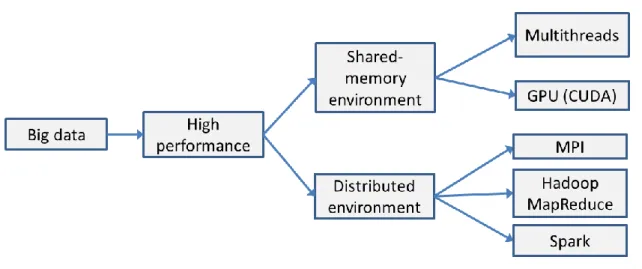
We propose a system that relieves the burden of dealing with parallel programming from the application developer. Our system handles both categories of main memory in parallel systems: shared-memory and distributed, as shown in Figure 1-1. Shared-memory systems have a uniform memory access meaning that each processing element can access memory with equal latency and bandwidth. Distributed systems exhibit a non-uniform memory access behavior since memory is logically and physically distributed. Parallel techniques that target shared-memory systems include multithreading and GPGPU computation. Parallel techniques that target distributed systems include message passing and map-reduce.
Figure 1-1: Parallel Systems
Our targets are Java developers. We have chosen Java since is mainly the language of choice for high performance applications, and it has gained popularity since its first inception due to several performance improvements to the Java Virtual Machine (JVM). Also and even though Java provides efficient yet difficult to program support for threads, it lacks complete and standardized support for GPUs and message passing. Hence, we saw an area where our contributions could be more significant.
Our central proposition revolves around parallelizing existing sequential Java code without having the user incur any extra effort other than using our library in order to obtain faster execution times. To validate our work, we have chosen the pattern matching application since pattern matching lies at the core of data analysis. However, our approach can be used with other applications, as we demonstrated in Chapter 2. We propose a method that detects a user’s
function call to search for a pattern using Java’s standard regular expression library, and replaces it with our own parallel implementation using bytecode injection. Our parallel implementation consists of multithreading, using a GPU, and using MPI. We also perform feasibility testing with Hadoop.
In order to seamlessly parallelize pattern matching, we have used bytecode injection.
Typically, injection can be done at the source code or at the bytecode level. We have selected the latter since the former suffers from the following shortcomings: (i) for the source code level injection to work, all the source code must be available which is not always the case, (ii) source code level injection is harder for complex transformations, (iii) with source code level, we will be manipulating strings, which have no particular meaning, and (iv) we would need a versatile parser. On the other hand, if injection is performed at the bytecode level, then (i) there is no need to have the actual source code, (ii) we can modify third party, closed-source classes, (iii) runtime performance is not affected, and (iv) we do not modify the original source files which is
appropriate if we need the changes to be applied only for a limited time.
In addition to what we mentioned, we present a tool that facilitates creating Spark code for the user by automatically generating Spark Java code from minimal user-supplied inputs. Spark has emerged as the tool of choice for efficient big data analysis. However, users still have to learn the complicated Spark API in order to write even a simple application. Code generation for parallel programming is a well-studied field that has been recently used to teach undergraduate students parallel programming, and is reported to have reduced programming errors [2].
1.3
Objectives
Our system achieves the following objectives:
- Correctness: Using our method does not change the output of the code.
- Transparency: The modifications are hidden from the user, as in the user is not required to do any source code modifications or implement or learn a new interface or API.
1.4
Development Process
Our workflow can be summarized by the following steps:
- Detect and intercept the user’s function call to search for a pattern by running java agent to intercept class files.
- Understand bytecode representations and use ASM to instrument class methods into parallelized version.
- Replace the original function call with our own parallel function (environment-dependent) that splits the input by injecting bytecode into the user’s code.
- Return results and control back to the user.
- Measure performance gain.
1.5
Outline
In this work, we present a method that facilitates the parallelization of high performance code under both shared-memory and distributed environments. Sequential legacy code written in Java is seamlessly mapped into a parallel program. Specifically, we have targeted the pattern matching application.
In addition to facilitating the transformation of existing code into a parallel application, we also implement a tool that helps developers write Spark Java code in an attempt to promote efficient and easy to implement parallel programming.
In Chapter 2, we discuss pattern matching in a broader view, and we present our motivation behind selecting it as the application to use. We also discuss Java bytecode and explain how we used ASM to implement bytecode injection. As well, we present our first approach of facilitating
parallelization in a shared-memory environment by using multithreading and we show our results.
In Chapter 3, we present another approach to shared-memory consisting of GPUs. We discuss GPGPU in general, CUDA in particular, the previous work done in this area and how it is different from what we propose, the challenges we faced, and our implementation and results.
In Chapter 4, we introduce distributed systems. We discuss MPI as the prominent
communication technology of choice in the industry. We show how we applied our method using MPI and display our results. In addition to that, we introduce Hadoop as an alternative to
message passing. We do not use Hadoop as a target environment for our method for reasons mentioned in the chapter; however we do compare its output to our multithreading results.
In Chapter 5, we present a tool that helps developers write Spark code that can run on a distributed environment. We introduce the Spark ecosystem, show our reasoning and workflow, and provide a machine learning plug-in to facilitate generating machine learning algorithms.
Finally, in Chapter 6 we summarize our work and our findings, and we suggest some directions for future work.
Chapter 2:
Automatic Parallel Matching using Java
Bytecode Injection
Shared memory systems describe a computer architecture in which all processors share a single view of the memory module and access the same logical memory locations irrespective of where the physical memory actually is. Communication (data sharing) in such systems is
efficient and fast since all the parallel tasks can share the same resources. In this chapter, we discuss implementing pattern matching in a shared memory environment using Java threads. Our contribution is summarized as follows: detect a user’s Java call to search for a pattern, instrument a parallelized multithreaded pattern matching code, and finally return control back to the
program.
2.1 Introduction
The importance of big data does not simply lie in the amount of data available. It stems from what can be done with that data, how to transform data into useful information, whether it be to reduce cost, reduce risk, make better calculated decisions, or increase efficiency. Pattern
matching is the basis for data mining upon which other more complex algorithms are built. Pattern matching consists of finding one, or several, occurrences of a pattern within a larger dataset. It has been extensively used in several applications from various domains. Some applications include citation matching, plagiarism detection, malware detection, virus scanners, content monitoring filters, intrusion detection, digital forensics tools, genetics….
Finding a way to parallelize pattern matching algorithms will result in more efficient usage. Parallelizing pattern matching can be done in one of two ways: either rewriting the algorithm to
make it inherently parallel or using data parallelism which consists of splitting the input and running the same serial algorithm on all parts. We have opted to do the latter since it is typically what programmers would try to do.
Our implementation deals with searching for a pattern within a text using Java’s standard regular expression library (regex) and parallelizing it using multiple threads without
compromising the integrity of the library. We have chosen the standard library, as opposed to other implementations, since it is widely and commonly used. Parallelizing it will not change the implementation and hence will preserve the integrity and correctness of the original code.
The rest of the chapter is divided into the following sections. Section two gives a brief overview of pattern matching. Section three presents the motivation behind our work. Section four consists of a literature review. Section five gives a brief description of Java bytecode and the ASM library. Section six discusses the parallel approach in our implementation. Section seven displays our working environment and results. Section eight concludes the chapter.
2.2 Pattern Matching
Pattern matching can be divided into two basic categories: exact pattern matching and regular expression pattern matching.
Exact pattern matching is more commonly used as string matching, since the pattern is well defined and most search applications are text-based. String matching (or string searching) algorithms constitute a crucial subclass of text processing since they are widely used in many applications pertaining to various domains, such as parsers, spam filters, word processors, search engines, digital libraries, natural language processing, and molecular biology [3]. String
where typically n >> m. Both pattern and text are composed of a finite alphabet set denoted by Ʃ, whose size is denoted by σ. This alphabet set could be for example the modern English alphabet (letters a through z), the binary alphabet (0 and 1) or the DNA alphabet (A, C, G, T), depending on the application. Although nowadays data is stored in many formats, text remains the main form for exchanging information. The main algorithms for exact pattern matching are: brute-force (BF), Knuth-Morris-Pratt (KMP), Karp-Rabin, Boyer-Moore (BM), and Horspool [4].
The BF method, also called naïve method for the simplicity of its implementation, is the only one among these that does not require a pre-processing phase. The way the BF works is by comparing the pattern to every character in the text between 0 and n-m and then by shifting one position to the right. The search time complexity is O(nxm). BF is the method used in the Java standard String library implementation of the highly used method indexOf. The indexOf method returns the location of the first occurrence of the pattern. Therefore, in order to find all occurrences of a pattern without inherently changing the underlying implementation, one must repeatedly check for each occurrence using a loop.
The second category of pattern matching is regular expression (regex) pattern matching. The difference between this and the exact approach is that regex searches for occurrences of multiple patterns in a text. Some applications include natural language processing, scanning for virus signatures, accessing information from digital libraries, filtering text, validating data-entry fields, and searching for markers in human genome [3]. Regular expression notations specify a set of strings and can be very expressive. They can be used in nearly infinite ways and include
characters, quantifiers, and meta-characters. For example, one can search for words that contain 2 x’s, or for fields representing a telephone number where the format is ddd-ddd-dddd, d being a digit, or for a part of a text not followed by another specific part of text.
We focus our research on regular expression pattern matching. According to the article in [5], there are two approaches to regular expression matching. The first is a backtracking
implementation used in several standard languages, such as Perl, Python, Java, PCRE, Ruby, and several others. The second, mainly used in implementations of awk and grep, uses finite
automata.
A finite automaton is another word for a finite state machine. Switching from a state to another depends on the sequence of characters of the string. There is a start state, and a matching state. If the matching state is reached, then a match has been found. If the machine ends in a state other than the matching state, then a match was not found.
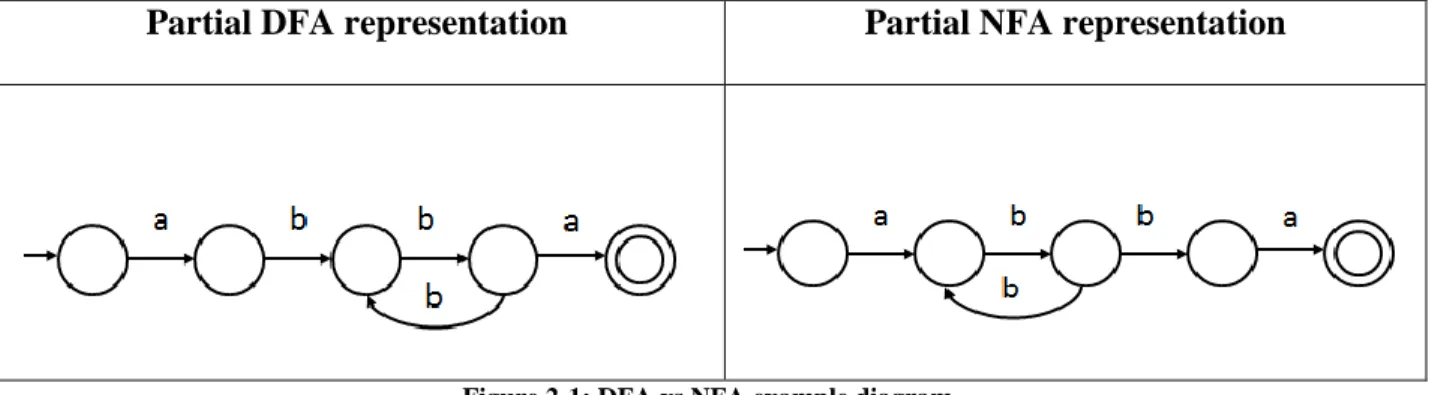
There are two types of automata: deterministic (DFA) and non-deterministic (NFA). In any state in DFAs, each possible input character leads to just one new state. In NFAs, there could be multiple choices for the next state. Figure 2-1is an example that shows the difference for the pattern a(bb)+a.
Partial DFA representation Partial NFA representation
Figure 2-1: DFA vs NFA example diagram
The circles in the diagram represent the states, and the arrows represent the state transitions based on the characters. The matching state is denoted by a double circle. The difference
between DFA and NFA can be shown from the transitions in state four. In the DFA, if an a is encountered, we reach the matching state; if a b is encountered, we go back to state three. In
contrast, in state three of the NFA, if a b is encountered, there are two possible solutions: either go back to state two or proceed to state four. The NFA does not know which decision is the correct one since it cannot peek to see the rest of the string. The machine will guess, and hence is labeled non-deterministic. To simulate guessing, one can allow the machine to guess one option and if that does not work, to try another option by backtracking. This is recursive though and might lead to a slow exponential runtime if there are many possible options. A better way would be to guess both options simultaneously. In this case, the NFA will be in multiple states at the same time, and runtime is linear.
DFAs are more efficient to execute because they can be in only one state at a time. DFAs are also faster than NFAs since there is a state transition for every possible character. This has not been shown in the diagram above. However, this also means that they require more memory to be stored. In NFAs, the number of states is at most equal to the length of the regular expression. An NFA can be converted into an equivalent DFA where each DFA state corresponds to several NFA states.
Java contains a regular expression standard library (java.util.regex). It is mainly composed of two classes: a Pattern class and a Matcher class. The Pattern class compiles the pattern, and the Matcher class contains the methods needed to perform and analyze the search for that pattern1.
1
It is also worth mentioning that the String class can also perform regular expression matching. However, it can only match the entire text against the pattern, using the text.matches(regex) function.
2.3 Motivation
Most of the times, a standard language implementation is fairly fast, however, there are some regular expressions that would make the algorithm run very slow. Most regular expressions library implementations (Java’s regex included) use a backtracking algorithm. Given a set of bad inputs, albeit simple, such algorithms can take exponential time to execute. The article in [5] goes on to show that for a particular regex, and for a 100-character string, trends show that a Thompson NFA implementation takes 200 microseconds, while a Perl implementation will take over 1015 years. This is because standard library implementations support backtracking and back references, which makes matching NP hard. To illustrate, we have tested the inputs from [6] on our local machine. We used the Java regular expression library with the pattern “(a|aa)*b”, and
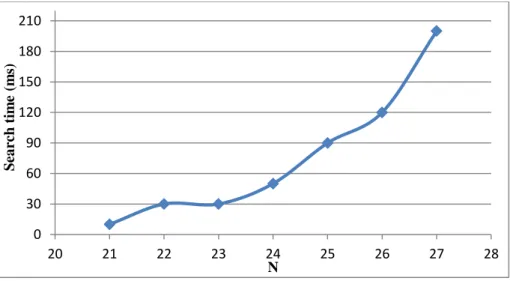
varied the length of the string text. Results are shown in Table 2-1 and Figure 2-2, where N is the number of characters of the text.
Table 2-1: Runtimes of pattern matching backtracking example
Text N Search time (ms)
aaaaaaaaaaaaaaaaaaaac 21 10 aaaaaaaaaaaaaaaaaaaaac 22 30 aaaaaaaaaaaaaaaaaaaaaac 23 30 aaaaaaaaaaaaaaaaaaaaaaac 24 50 aaaaaaaaaaaaaaaaaaaaaaaac 25 90 aaaaaaaaaaaaaaaaaaaaaaaaac 26 120 aaaaaaaaaaaaaaaaaaaaaaaaaac 27 200
Figure 2-2: Runtime graph of pattern matching backtracking example
For every character increase in N, the runtime increases exponentially. This happens because the whole pattern was not found. However, the first part was found, so the algorithm backtracks and tries to match the remaining part. When it does not find it, it goes back one more step to the last matched part and tries to match the whole pattern, and so on. Other more realistic similar cases can result from spam attacks and cause a denial of service.
Another reason for the exponential searching is the use of back-references. A back-reference matches the string matched by an earlier expression surrounded by parenthesis. For example, the regex (romeo|juliet)\1 matches romeoromeo or julietjuliet but not
romeojuliet or julietromeo. Back-references provide additional power but at a potentially much higher cost.
We believe the reason the standard tools have not considered implementing the more efficient finite automaton approach is two-fold. First of all, finite state machines cannot handle sub-match extraction that requires recursive backtracking. This means that they cannot
0 30 60 90 120 150 180 210 20 21 22 23 24 25 26 27 28 Sea rc h t im e (m s) N
distinguish the individual matches made by an expression surrounded by parenthesis for example. In the Java regex library, this can be done using matcher.group(). The other reason is back-references. Back-references, being an NP-complete problem with no current efficient implementation, are not represented in the finite state approach and are not implemented in grep for example. However, they are part of the POSIX standard for regular expressions and are available in standard tool implementations.
Since execution time increases exponentially with N, then having a smaller search space will immensely decrease runtime. Hence, dividing the string into smaller substrings will improve performance.
2.4 Literature Survey
We survey some of the work that involves parallelizing pattern matching in both shared and distributed environments. The paper in [7] implements parallel string matching with Java multi-threading with multi core processing, and performs a comparative study on KMP, BM and BF string matching algorithms on a gene sequence data set. In [8], the authors focus on detecting malware for unstructured data stored in Hadoop Distributed File System (HDFS) by developing a map-reduce approach to easily scan for viruses in HDFS in real time. They used Clam AV’s virus signature database to perform their experiments. Their mapper extracts the file type to obtain the correct signature and produces a key-value pair, where the key is the signature and the values are the lines from the files. The reducers aggregate the lines per key (signature) and do pattern matching on the list of values. They used three different algorithms for string matching: BM, KMP and RabinKarp. In [9], the authors present a citation matching method and scale it up using Hadoop. In [10], the authors present a parallel implementation for string matching using
MPI. They partition the string to search into a number of subtexts and have used the brute force method for searching. In [11], given a text and a pattern, the authors try to find if the pattern occurs in the text using a Hadoop cluster. If it does, they return the starting index. If not, then they find the longest prefix, suffix and substring of the pattern in the document and find the similarity between documents and the longest common subsequence of all documents. The algorithms they used are KMP and cosine similarity. In the blog post [12], the author uses a grep script in a Hadoop cluster to search for a string in the WorldCat.org record. In [13], the author implements, tests, and tries to optimize the three string matching algorithms (Brute-force, QuickSearch, Horspool) using CUDA. The methods applied to the development are: finding ways to parallelize the sequential code, minimize data transfer between host and device, coalesce global memory as much as possible, and avoid branch divergence within a CUDA warp. The paper in [14] implements KMP using a multicore processor and using a GPU. They partition the string into the number of processors that they have; however, they do several extra iterations after that to account for in-between occurrences. This could have been avoided by doing better partitioning. They implement their algorithm using four techniques: serial, multithreaded CPU, multicore CPU using OpenCL, and on a GPU using OpenCL. In [15], the authors propose to offload the processing of digital forensics tools to a GPU and compare the speedups obtained by simple threading schemes appropriate for multicore CPUs. The application they use is file carving. For the multicore machines, a thread was spawned for every carving rule (used the BM technique). On the GPU, each thread is responsible for searching for approximately 160 bytes of the 10 MB block. In [16], the authors implement the BF, KMP, Boyer-Moore-Horspool, and Quick-Search string matching algorithms on a GPU and record the performance. The data set consisted of three reference sequences: the bacterial genomes of Yersinia pestis, Bacillus
anthracis, and a simulated BAC built of the first 200,000 characters of NCBI build 26 of Homo sapiens’ chromosome 2. The query pattern was constructed of randomly chosen subsequences from each reference sequence. In [17], the authors propose the design, implementation, and evaluation of a pattern matching library running on the GPU. The library supports both string searching and regular expression matching using CUDA. They chose to implement a GPU-based pattern matching library for inspecting network packets in real time and returning any matches found back to the application. They have parallelized the DFA based matching process by splitting the input data stream into different chunks. Each chunk is scanned independently by a different thread using the same automaton that is stored in device memory.
2.5 Java Bytecode and ASM
When a Java code is compiled, the javac compiler generates a machine-independent intermediate format known as the bytecode. The bytecode is mainly composed of the instruction set that describes the program to the Java virtual machine. The JVM processes the bytecode instructions from the class files. Primitive types and objects are expressed with the
representations shown in Table 2-2. These representations are later used in constructing the method descriptors such as the examples in Table 2-3 which show the method declarations in a Java source file and their bytecode counterparts.
Table 2-2: Primitive types and class representations Type Representation void ‘V’ boolean ‘Z’ char ‘C’ byte ‘B’ short ‘S’ int ‘I’ float ‘F’ long ‘J’ double ‘D’ Class L<class>;
Table 2-3: Method descriptors
Method declaration in source file Method descriptor void methodName(int i, float f) (IF)V
int methodName(Object o) (Ljava/lang/Object;)I int[] methodName(int i, String s) (ILjava/lang/String;)[I
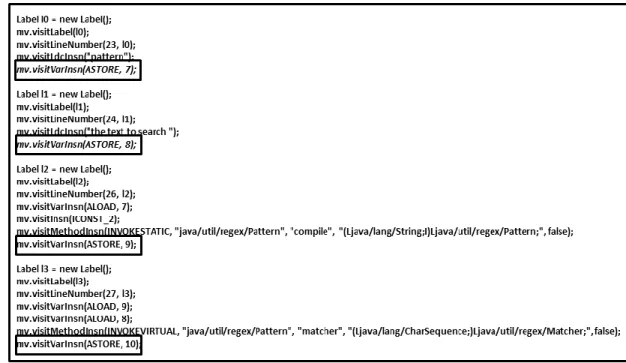
Bytecode instructions use a stack to exchange the data. The code snippet in Figure 2-3 shows a basic example of how one would typically implement the pattern matching function in Java, and the code in Figure 2-4 shows how ASM (discussed shortly) uses the bytecode
instructions to store the objects and then when needed, identify and use them based on their locations, as shown in Table 2-4.
Figure 2-3: Pattern matching code snippet Table 2-4: Object locations
Variable Object
7 pattern
8 text
9 p
Figure 2-4: ASM code of Figure 2-3
ASM [18] is a Java bytecode engineering library. It can be used to analyze and to
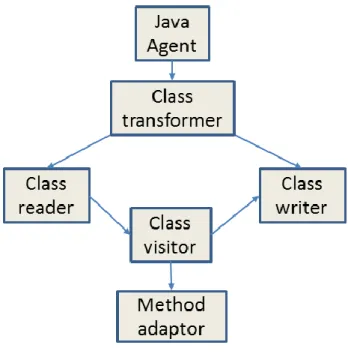
manipulate bytecode by modifying classes. First, a Java agent is created. The agent contains a pre-main method that implements a class transformer. The class transformer is composed of a class reader and a class writer. The class reader reads the bytecode from the class files in order to analyze the classes or the methods using a class visitor. If a class or a method needs to be
modified, the class visitor performs these modifications. Examples of such modifications include printing a method’s description, displaying the different object types in a class… These
modifications are then stored using the class writer. Bytecode injection consists of manipulating the bytecode by inserting constructs that change what a method does. A method visitor scans the classes in search of the desired method. It is identified based on its description. The description consists of the method return type and the types of its parameter list.
The overall process is shown in Figure 2-5. In our implementation, when we encounter the particular method that searches for a pattern, we use bytecode injection to replace it with our own parallel pattern matching implementation.
Figure 2-5: ASM process
2.6 Implementation
Because of the way it is implemented, the regex pattern matching find()function from the Java standard library can have an exponential search time based on the pattern and the text to be searched. We have devised a method that parallelizes this search without compromising the integrity of the library. Another main contribution is that this method is transparent to a user. Therefore, a coder does not need to put any extra effort using our method. All that is needed is for the user to run his/her code with an extra parameter that invokes our java agent. Our method will automatically detect the function to be parallelized and will instrument the parallel version of it instead of the user’s function. Control is then returned to the user’s code. All data structures,
objects, and primitives will be preserved. The advantage over other work is that users do not need to learn any new constructs, they do not need to implement any new interface or API, and they do not need to apply any changes to their code. A simple illustration of our process can be found in Figure 2-6. When we encounter the particular method that searches for a pattern, we use bytecode injection to replace it with our own parallel pattern matching implementation.
Figure 2-6: Process illustration
Multithreading is the ability of a CPU to execute several threads concurrently within the same program. It aims to increase the utilization of the CPU time using parallelism. The concept is similar to multitasking, but dealing with applications. A single application can be divided into separate operations, where each operation is assigned to a different thread. These threads can run in parallel with their own paths of executions but share resources. This sharing of computer and data resources is the main challenge of multithreading. Special attention needs to be given to threads wanting to read and write the same data simultaneously. However, the benefits of
multithreading are many. Some of them include: more efficient CPU usage, better system reliability, better resource utilization, and improved performance on multiprocessor computers.
Multithreading in Java is essential but not always simple. The Java platform is designed to support concurrent implementation. It supports basic concurrency in the language and the class libraries. Each application has at least one thread, the main thread, which has the ability to create other threads. In this chapter, we use multithreading to implement our parallel approach.
Originally, we had started off by trying to parallelize the Java Collections library. We focused on detecting and implementing the sort (library implementation is a merge sort), the replaceAll, the min, and the max functions. We used this as a basis to implement the pattern matching, and to prove that our algorithm works for several cases.
2.6.1 Challenges
The Java regex library proved to be more challenging than the Collections library, and we had to change the way we approached the problem several times in order to bypass both the standards privacy and restrictions.
The regex library contains two main classes: the Pattern class and the Matcher class. The Pattern class compiles the pattern, and the Matcher class contains the method find which searches for a pattern within the text.
The first issue we faced was having insufficient variables on the stack. When statement (28) from Figure 2-3 statement is executed, and if we look into the bytecode shown in Figure 2-4, only the matcher is on the stack. So if we wanted to replace the serial version of find with the parallel version, what we have on the stack will not be sufficient information. We will also need
to search for the ‘text’, push it on the stack and then pass it to our method. Preloading these variables was another issue we faced since it is not feasible without using some sort of dynamic parsing or creating an abstract syntax tree (AST). The reason for that is that when the compiler generates bytecode, it loads the variables into registers without using their names. Therefore, there is no simple way to know where the variable ‘text’ is stored. We could of course look it up after it is compiled, but that will remove the generality and the automatic detection property that we claim. Another way we thought about was to try and generate the ‘text’ from the matcher, since it is inherently used in the matcher class. However, we found that it is private and that we were unable to access it. Having all these troubles, we decided to implement the whole regex library with all its classes2. This would allow us to, first change the private property of ‘text’ to public, and second, to directly implement our parallel functions in the new library. Again, we hit a wall. We reached a point where we had to import Sun’s security libraries and we had
absolutely no access to that. Therefore, we decided to write our own wrapper method that runs the find method but takes both the text and the pattern as parameters.
2.6.2 Implementation
In what follows we discuss how our implementation achieves load balancing, correctness, and synchronization.
The original user code contains a single thread pattern matching search function that processes the entire text3. In our multithreaded implementation, we use a static mapping
2
The classes are: ASCII, Matcher, MatchResult, Pattern, PatternSyntaxException, and UnicodeProp
3
Instead of using the pattern matching method ‘find’ from the standard library (java.util.regex), we had to write our own based on running the ‘find’ method within a loop. This is because ‘find’ will only return the first occurrence of the pattern in the text and exit. If we need to locate all the occurrences, we will have to iterate over the whole text. The reason why such a function is not found in the standard library is that the library leaves it up to the users to determine what to do with the data they obtain, i.e. the locations ofthe pattern. Users can choose to store these integers in the data structure of their choice.We have chosen to store
approach that achieves load balancing. We divide this input text into t semi-equal subtexts, where t is the number of threads. Each thread receives the same amount of data proportional to the number of available runtime threads before execution starts.
Correctness is achieved in the following two ways: (i) After we distribute the data among the threads, each thread then implements the same function as the original one on the reduced substring. Hence, we did not change the algorithm’s implementation and can be sure of its correctness. (ii) However, we also need to account for boundary overlap otherwise strings that span over two partitions would be neglected and our output would be incorrect. Figure 2-7 shows a case where this might happen. Let us assume that the pattern to search for is ‘went’, which is composed of m = 4 characters. In this very simple example, the searched text is composed of n = 20 characters, and we are assuming that the system can run t = 2 threads. If we partition the text equally, then each subtext will be composed of n/t = 10 characters. The split will be where the arrow points to in Figure 2-7. Now when each thread performs the pattern matching on its subtext, the pattern will not be found, producing an incorrect output.
Figure 2-7: Partitions with no boundary overlap
thelocation in aHashmap that has the pattern as the key. This is to be consistent with Hadoop’s output format discussed in chapter 4.
Therefore, we need a more aware implementation that takes this issue into consideration. Figure 2-8 shows how this can be resolved. The modified partition takes the length of the pattern into consideration where each subtext will now be composed of (n/t) + (m – 1)
characters. Therefore, the partition from the previous example will contain now 13 characters and our algorithm will correctly identify the pattern. This division excludes the last partition since it is unnecessary and will merely consist of the remaining characters. It is worth
mentioning that this approach does not violate the load balancing property since typically pattern lengths are short, and are considered negligible especially when compared to large bodies of texts.
Figure 2-8: Partitions with boundary overlap
Each thread performs pattern matching independently on its own subtext, eliminating the need to access any shared variables. After all the threads complete their jobs, the results are synchronized before being aggregated and returned to the user application.
2.6.3 Working Environment and Benchmark
Implementation has been done using Java (jdk 8) on Eclipse IDE (Luna -release 4.4.0) and ASM v5. Single-threaded and multi-threaded testing was performed on a virtual machine with the specifications [19] shown in Table 2-5.
Table 2-5: VM specifications
Model Intel(R) Xeon(R) CPU E5-4650 0 @ 2.70GHz Architecture x86_64
Number of CPU cores 8 (2 logical cores per physical)
Number of threads 16
Cache size 20480 KB
As a benchmark, a text file of 142 MB was used. The file consists of concatenating the 11th edition of the Encyclopedia Britannica downloaded from the project Gutenberg website [20].
2.7 Experimental Results and Interpretations
For the Collections library, testing was done on our local machine. We randomly generated a list of various sizes (ranging from 500,000 to 20,000,000 items). We implemented our
multithreaded version using two and four threads. The max and the min functions attained lower performance over the serial implementation when run on smaller list sizes (<10,000,000 items), however achieved a performance gain of up to 32% when running on 20,000,000 items. The sort and the replaceAll methods showed an improvement when parallelized over all list sizes, with the highest improvement reaching 38%.
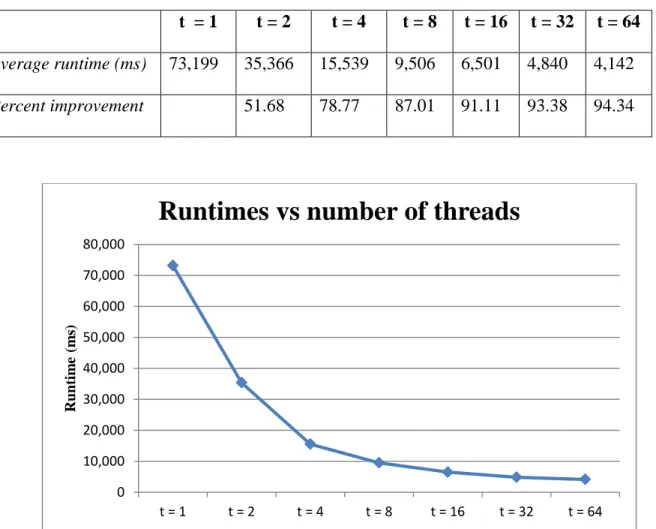
We now present the results for the pattern matching application. Table 2-6 shows the results for the average runtimes. The columns indicate the number of threads used while the first row is the average runtimes in milliseconds and the second row is the percent improvement over the single thread implementation. The first column corresponds to the single thread implementation. In this implementation, the whole input file is read into a string before the search is performed.
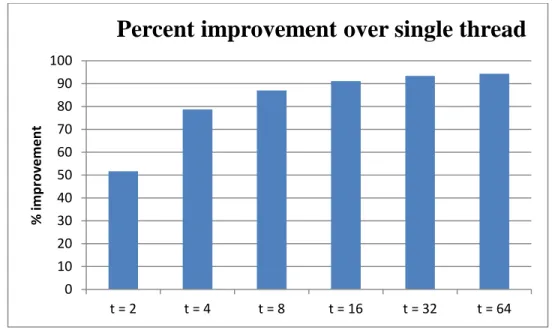
The other columns labeled as (t = number) correspond to the multithreaded implementation. We have plotted the results in Figure 2-9. Percent improvement is plotted in Figure 2-10 and is calculated as such:
% improvement =((sequential – multithreaded)/sequential)*100
Table 2-6: Average runtimes and percent improvement
t = 1 t = 2 t = 4 t = 8 t = 16 t = 32 t = 64
Average runtime (ms) 73,199 35,366 15,539 9,506 6,501 4,840 4,142
Percent improvement 51.68 78.77 87.01 91.11 93.38 94.34
Figure 2-9: Runtimes vs number of threads 0 10,000 20,000 30,000 40,000 50,000 60,000 70,000 80,000 t = 1 t = 2 t = 4 t = 8 t = 16 t = 32 t = 64 Runtim e (m s)
Figure 2-10: Percent improvement over single thread
Since the substring lengths for the multithreaded version are shorter than the original string, the multithreaded approach yields much better results than the single thread approach. We can observe that this gives an almost logarithmic improvement. When we double the number of threads, runtime is observed to be cut in about half. This is until we reach t = 16 threads, which is the number of threads supported by the test environment. Beyond 16 threads, the improvement is negligible.
2.8 Conclusion
In this chapter, we have presented a method that automatically detects a user’s function call to search for a pattern using Java’s standard regular expression library and seamlessly replaces it with our own parallel implementation. We developed a multithreaded implementation of the pattern matching function and have used bytecode injection to run our optimized implementation instead of the original function. Our experiments show a significant reduction in execution time, and we believe better speedup can be achieved with more powerful machines.
0 10 20 30 40 50 60 70 80 90 100 t = 2 t = 4 t = 8 t = 16 t = 32 t = 64 % im p ro ve m e n t
Chapter 3:
Parallel Pattern Matching on GPUs
In this chapter, we discuss implementing pattern matching on a GPU. Even though pattern matching might not be considered a purely computational problem in the sense that the actual matching time might not overcome the overhead of I/O for very simple patterns, we believe that it can benefit from parallelization when run on a big dataset and a complex pattern. Therefore, we have attempted to implement it on a GPU. Our contribution is summarized as follows: detect a user’s Java call to search for a pattern, instrument the pattern matching code to run on a GPU, and finally return control back to the program.
3.1 Introduction
General purpose computing on graphics processing units, or more commonly referred to as GPGPU, is a high performance computing approach that uses graphics processing units (GPUs) to perform extensive data operations in parallel, yielding better throughput. Programming GPUs is considered quite a challenging task to get right, since first of all it requires a low-level
language (CUDA or OpenCL) that can interface with the hardware, and second of all, since it is very different from parallel programming on the CPU. For example, in Java, one might use threads and concurrency (such as thread pool executors or fork-join pools) and then split and distribute the work among the threads and/or processors. However with GPUs, one has other extra low-level issues to consider such as register mapping, shared memory, memory coalescing, and occupancy. So even though GPGPU programming can make computations faster, it is not always the case. If the code is not properly written taking into consideration the issues
mentioned, and if the application is not suited to be run on a GPU, performance might degrade. Example applications that usually benefit from a GPU implementation include 3D rendering,
image and media applications, signal processing, and other data-parallel tasks that operate on large datasets in the fields of physics, computational finance or biology, to name a few.
Currently, there are two main programming models for GPU acceleration: OpenCL and CUDA. OpenCL is an open standard, cross-platform parallel programming model for GPGPU computing by the Khronos Group [21]. CUDA on the other hand was developed by NVIDIA and contains a more complete set of HPC libraries. We have chosen CUDA for two reasons. First, we have more experience writing it, and second, since it is the model of choice used in the pattern matching library we have used.
The rest of the document is organized into the following sections. Section two is an
introduction to GPUs and to the CUDA programming model. Section three surveys the literature with respect to pattern matching implementation performed on a GPU. Section four discusses the available solutions to run Java code on a GPU. Section five describes our approach. Section six details our implementation. Section seven shows our experimental results, and section eight concludes the chapter.
3.2 Introduction to GPUs
GPGPU computing has become so popular and prevalent due to GPUs evolving so rapidly and efficiently in order to satisfy the increasing market demand for real-time, high-definition 3D graphics. Based on NVIDIA’s definition, GPUs are “highly parallel, multi-threaded, many-core processors with tremendous computational horsepower and very high memory bandwidth. [21]”.
3.2.1 Difference between CPUs and GPUs
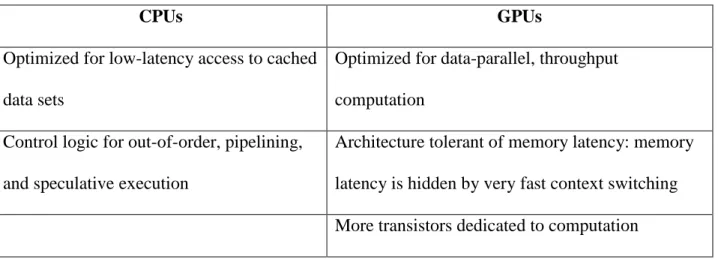
GPUs are dedicated to parallel compute-intensive applications. This is accomplished by having more transistors to process data than to deal with caching and control flow. Hence, more ALUs are present. GPUs are considered single-instruction multiple-thread (SIMT) processors. The same operation can be executed on each data element. Therefore, there is no need for
complex flow control. In addition, the memory access latency can be hidden by the computation. Table 3-1, based on NVIDIA’s website, summarizes the differences between a GPU and a CPU.
Table 3-1: Basic differences between a CPU and a GPUS
CPUs GPUs
Optimized for low-latency access to cached data sets
Optimized for data-parallel, throughput computation
Control logic for out-of-order, pipelining, and speculative execution
Architecture tolerant of memory latency: memory latency is hidden by very fast context switching More transistors dedicated to computation
In spite of the apparent advantages of GPUs, they do come with certain disadvantages. First, and in order to obtain speedup, algorithms need to be rewritten taking into account the GPU architecture. The challenge is to develop applications that scale parallelism to the many available cores. Not all algorithms are suitable to be run on a GPU. We will examine this further in the next section. Second, adding GPU hardware might increase power consumption, heat production, and cost.
3.2.2 CUDA Programming Model
NVIDIA introduced CUDA in 2006. CUDA is a low-level general purpose parallel
computing programming model built as an extension of the C language. Developers use a high-level programming language, such as C or C++ to interact with the CUDA API. Developers run their sequential code using C/C++ on the CPU, and call a CUDA kernel to run their parallel computation-extensive code on the GPU. After running, the results are returned to the CPU. This is called heterogeneous programming.
Heterogeneous programming involves execution on both the CPU and the GPU. The CPU and its memory are referred to as the host, whereas the GPU and its memory are referred to as the device. Typically, the following summarizes a sequence of operations:
- Allocate host input memory
- Initialize host input data
- Allocate device input memory
- Copy host input data to device input
- Allocate host output memory
- Allocate device output memory
- Execute kernel
- Copy device output data to host output
- Free memory on device
3.2.3 CUDA Architecture
CUDA abstracts three elements: streaming multiprocessors (SMs), barrier synchronization, and memory hierarchy.
3.2.3.1 Streaming Multiprocessors
CUDA architecture is built up of a number of multithreaded SMs which perform the actual computations. Each SM has cores, control units, schedulers, registers, execution pipeline and caches. The more multiprocessors a GPU has, the less the execution time will be. Each SM has an underlying logical model composed of grids of blocks, blocks of threads, and threads, as shown in Figure 3-1, taken from the NVIDIA website. When a kernel is invoked, the calling function has to specify the grid dimensions: the number of blocks in a grid, and the number of threads in a block. Based on available execution capacity, these blocks are distributed among the SMs. Threads of a thread block execute concurrently on one SM. Multiple blocks can execute concurrently on one SM. The dimension constitutes the parallelism, as in each kernel operation is executed N times in parallel, where
N = grid size x block size x number of threads per block
3.2.3.2 Barrier Synchronization
Threads in a block execute concurrently in batches of 32, known as threads warps. Threads belonging to the same block can synchronize their execution to coordinate memory accesses. Developers can specify synchronization points in the code by explicitly calling a function to synchronize threads. This acts as a barrier where all threads in that block must wait before proceeding with execution.
Unlike threads in a block, thread blocks are expected to execute independently. They can be executed in any order, in parallel, or in series, and can be scheduled across any number of cores.
3.2.3.3 Memory Hierarchy
Following the CUDA abstraction, threads each have their own private per-thread memories, threads in a block can also access shared memory, and threads in grids can access global
memory. Access to shared memory is typically much faster than global memory. That is why good CUDA programmers tend to place data in shared memory rather than in global memory. However, it is also much smaller. There are also two more memory modules: constant memory and texture memory. These are read-only and accessible by all threads. Each memory space is optimized for different usage.
3.2.4 Applications Suited for GPUs
Not all applications are suited for a GPU implementation. In other words, speedup while running on a GPU is not guaranteed. Certain types of problems will actually exhibit a reduction in performance if implemented on a GPU. We have mentioned a few of these applications in the introduction. Here we mention the properties that algorithms suited for a GPU implementation
share: data parallelism and throughput intensive. For problems that satisfy these properties, a GPU implementation can offer significantly faster computations.
3.2.4.1 Data Parallelism
There is a distinction between problems being task parallel or data parallel. Data parallelism involves several threads performing the same operation simultaneously, but on different parts of the data. GPUs are good for data parallel problems because they have many cores that can do the same operations on different parts of the input data.
3.2.4.2 Throughput Intensity
Problems can be either memory bound or compute bound. Memory bound refers to problems where I/O operations are predominant. These problems are not suited for GPU implementation because it is expensive, in terms of memory cycles, to transfer data back and forth from CPU to GPU. On the other hand, problems that are compute bound perform several instructions on a data element, hence offsetting the efforts of reading and writing to memory. These problems have a high order of complexity and will benefit from a GPU implementation.
3.3 Literature Survey
To the date of writing this dissertation, there has not been yet any official library form NVIDIA or the OpenCL community to perform pattern matching on GPUs. We believe the reason for that is that such a problem, if not used with massively data parallel computation, can be considered memory bound and will perhaps not map well to parallelism. However, several attempts have been made to efficiently perform pattern matching on a GPU. We differentiate
between three categories: commercial unavailable solutions, academic papers, and open source projects.
Commercially, HP [23] and IBM [24] have published presentations and videos on building finite automata and matching regexes respectively. However, the details were not exposed. The HP presentation simply mentions that they have achieved fast regex parsing; whereas the IBM video just reports on throughput, latency, and the effect of the pattern sizes. Their findings show that the GPU provides significant throughput boost compared to the CPU, the current GPU regex implementation they have is not suitable for latency sensitive applications, and that the problem is strongly workload dependent on both the data contents and the patterns.
The most prevalent work regarding pattern matching on GPUs has been purely academic. Our findings show that research in this area has been geared mostly towards network intrusion detection systems due to the nature of the problem wherein network packets are scanned against several known malicious attack patterns. This constitutes a problem of matching several patterns against several files of data, and hence tends well to a GPU implementation. The work in [25] provides a detailed evaluation study of GPU designs on practical datasets and explores
advantages and limitations of several techniques. It also suggests some schemes to avoid the limitations discussed. In [26], the authors propose a hierarchical GPU based approach to accelerate regular expression matching and to resolve the problem of state explosion that can incur from a DFA implementation. They target network intrusion detection systems. Keeping their application in mind, they have reduced regular expressions into two categories: the first involves the ‘.*’ wildcard and the second involves patterns with constraint repetitions. They have extended their previous PFAC (Parallel Failureless Aho-Corasick) algorithm to implement a hierarchical machine, where the master detects the first category and if found, the slave detects
the second from the intermediate result of the master. The same authors have expanded on their work in [27]. They introduced throughput efficiency techniques that include reducing global memory transactions, reducing the latency of the transition table lookup, eliminating output table accesses, avoiding bank conflicts, and enhancing communication between the CPU and the GPU. In [28], the authors present a ground up parallel NFA-based regular expression engine running on a GPU called iNFAnt. The difference between their work and previous implementations is that they were among the first to implement an NFA based state automata instead of a DFA one. Their work is general and does not only handle specific cases. Since they deal with NFAs that do not suffer from state explosion as opposed to DFAs, they were not constrained by the size or complexity of the rule sets. The authors in [29] propose a solution that tries to overcome the limitations of [28] by implementing a conceptual hybrid of a NFA-DFA implementation.
However, their implementation could only work for smaller datasets. In [30], the authors propose the design, implementation, and evaluation of a pattern matching library running on the GPU. The library supports both string searching and regular expression matching using CUDA. They chose to implement a GPU-based pattern matching library for inspecting network packets in real time and returning any matches found back to the application. They have parallelized the DFA based matching process by splitting the input data stream into different chunks. Each chunk is scanned independently by a different thread using the same automaton that is stored in device memory. They use synthetic network traces and synthetic patterns, in order to control the impact of the network packet sizes and the size of the patterns to the overall performance. The content of the packets, as well as the patterns, are completely random, following a uniform distribution from the ASCII alphabet. Other publications by the same authors [31] detail their
processing the DFA on the GPU, while implementing the NFA on the CPU. In [32], the authors implemented an XFA data structure on a GPU, and compared the performance of the XFA to a DFA. Their design is suited to a specific set of problems that can be broken down into non-overlapping sub-patterns separated by the ‘.*’ wildcard. In [33], the authors present an
implementation of the Aho-Corasick algorithm in CUDA, and discuss the various trade-offs and design decisions.
With respect to the open-source projects available that perform pattern matching on GPUs, we were able to only find one [34]. Cuda-grep is a CUDA implementation of the NFA automata on a GPU. We have decided to use it in our work. We will therefore postpone discussing it to a later section in which we provide a detailed analysis of the implementation and limitations.
3.4 Writing Java for GPUs
GPUs are programmed using usually either CUDA or OpenCL. These two languages support C and C++. However, Java programming is not inherently possible as a directly
available language to run on GPUs. In the following, we discuss why one might need to program GPUs in Java and how it can be done.
3.4.1 Why Java
There are several reasons why one might want to run a Java application on a GPU. Java developers would rather code in Java than in C/C++. They do not want to worry about pointers, destructors, memory models, or allocating and freeing memory [35]. In order to use a GPU, they will have to deal with the previously mentioned hassles. Java offers a level of abstracting the low level hardware details, and typically developers used to that mode of programming would like to
maintain that level. Another reason why developers might want to write Java code running on a GPU is to take advantage of the performance benefits of GPUs in their already existing Java application. Some areas in a project that require huge computational power could be mapped to a GPU to obtain better performance. That can be done without having to rewrite the whole
application in C or C++, just the relevant code segment.
3.4.2 Running Java code on a GPU
Basically, there exist two main ways of running code written in Java on a GPU.
The first method consists of using one of the available open-source projects that transform the Java code into low level code that runs on the GPU. This can be done in one of two ways: either use a library that performs the bindings for the users or use a library that hides the low level code from the users. This includes code to initialize the device, create data buffers, allocate memory on device, send the data to the device, execute the code, and transfer the results back to the host. The advantage of this is that we will not need to write any low level code ourselves. However, we will need to learn and use a new API. In addition to that, we will be restricted with the chosen solution’s hardware and programming requirements. In addition to that, and based on our survey, such solutions are not flexible in a sense that in some cases, only primitive datatypes are supported.
The second and basic method consists of implementing native methods in the Java code, and running the GPU kernel code from within these C/C++ native methods. The advantage of doing so is that it is more flexible with respect to the datatypes that can be used. And since all
implementation is ‘home-made’, we are not limited to an operating system, a programming model, a GPU device or a processor type. However, this requires us to write more complex code
consisting of JNI (Java Native Interface) functions and declarations, manually generate the object files, and correctly link everything together.
In what follows we survey the current available solutions, test some of them, and justify our method of choice.
3.4.3 Available Solutions
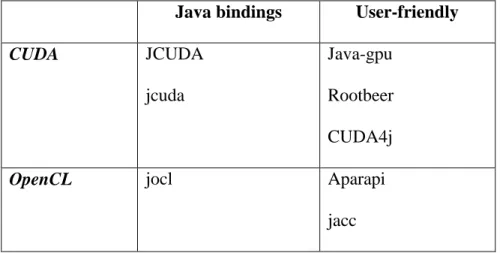
Several attempts have been made in order to allow programmers to write Java code that runs on GPUs. [21] and [36] have provided a summary of the most popular and widely used libraries. [21] also evaluates two representative Java GPGPU projects and draws some comparisons based on performance and programming effort. We have added some newer projects to the list and have summarized the most popular ones. They can be classified into three main categories based on their implementations:
3.4.3.1 Bytecode Translation and CUDA/OpenCL Code Generation
- Aparapi [37]: Aparapi is an open-source library by AMD. It translates Java code into OpenCL, without requiring users to know or write any OpenCL code. Users override a ‘kernel’ method which is to be implemented on the GPU, and the bytecode of this method is loaded at runtime and translated into OpenCL. If compilation to OpenCL is not
possible, the code will still be executed in parallel using a thread pool.
- Rootbeer [38]: Rootbeer is an open source library that converts Java code embedded in a ‘gpuMethod’ function into CUDA code. Users do not need to know CUDA.