using Machine Learning Techniques
Leandros A. Maglaras
Supervisor: Prof. Andrew Crampton
Department of Computing and Informatics
University of Huddersfield
A thesis submitted to the University of Huddersfield
in partial fulfillment of the requirements for the degree of
Doctor of Philosophy
Copyright statement
i. The author of this thesis (including any appendices and/or schedules to this thesis) owns any copyright in it (the “Copyright”) and s/he has given The University of Huddersfield the right to use such copyright for any administrative, promotional, educational and/or teaching purposes.
ii. Copies of this thesis, either in full or in extracts, may be made only in accordance with the regulations of the University Library. Details of these regulations may be obtained from the Librarian. This page must form part of any such copies made.
iii. The ownership of any patents, designs, trademarks and any and all other intellec-tual property rights except for the Copyright (the “Intellecintellec-tual Property Rights”) and any reproductions of copyright works, for example graphs and tables (“Reproductions”), which may be described in this thesis, may not be owned by the author and may be owned by third parties. Such Intellectual Property Rights and Reproductions cannot and must not be made available for use without the prior written permission of the owner(s) of the relevant Intellectual Property Rights and/or Reproductions
Leandros A. Maglaras April 2018
First of all, I want to thank the supervisor of my thesis, Professor Andrew Crampton, for his valuable help and guidance during my work. I am also grateful to the other members of the selection committee of my thesis, for careful reading of my work and for their valuable suggestions. I owe special thanks to Professor Jianmin Jiang, who helped throughout all my research and played a key role in the completion of my PhD. I also want to thank Ass. Professor T.J. Cruz whom we worked together in creating a cyber security framework that was tested on realistic scenarios in a Hybrid Testbed provided to us from IEC (Israel Electric Company).
Modern Supervisory Control and Data Acquisition (SCADA) systems are essential for monitoring and managing electric power generation, transmission and distribution. In the age of the Internet of Things, SCADA has evolved into big, complex and distributed systems that are prone to conventional in addition to new threats. So as to detect intruders in a timely and efficient manner a real time detection mechanism, capable of dealing with a range of forms of attacks is highly salient. Such a mechanism has to be distributed, low cost, precise, reliable and secure, with a low communication overhead, thereby not interfering in the industrial system’s operation.
In this commentary two distributed Intrusion Detection Systems (IDSs) which are able to detect attacks that occur in a SCADA system are proposed, both developed and evaluated for the purposes of the CockpitCI project. The CockpitCI project proposes an architecture based on real-time Perimeter Intrusion Detection System (PIDS), which provides the core cyber-analysis and detection capabilities, being responsible for continuously assessing and protecting the electronic security perimeter of each CI. Part of the PIDS that was developed for the purposes of the CockpitCI project, is the OCSVM module. During the duration of the project two novel OCSVM modules were developed and tested using datasets from a small-scale testbed that was created, providing the means to mimic a SCADA system operating both in normal conditions and under the influence of cyberattacks.
The first method, namely K-OCSVM, can distinguish real from false alarms using the OCSVM method with default values for parameters ν and σ combined with a recursive
K-means clustering method. The K-OCSVM is very different from all similar methods that required pre-selection of parameters with the use of cross-validation or other methods that ensemble outcomes of one class classifiers. Building on the K-OCSVM and trying to cope with the high requirements that were imposed from the CockpitCi project, both in terms of accuracy and time overhead, a second method, namely IT-OCSVM is presented. IT-OCSVM method is capable of performing outlier detection with high accuracy and low overhead within a temporal window, adequate for the nature of SCADA systems.
The two presented methods are performing well under several attack scenarios. Having to balance between high accuracy, low false alarm rate, real time communication requirements
and low overhead, under complex and usually persistent attack situations, a combination of several techniques is needed. Despite the range of intrusion detection activities, it has been proven that half of these have human error at their core. An increased empirical and theoretical research into human aspects of cyber security based on the volumes of human error related incidents can enhance cyber security capabilities of modern systems. In order to strengthen the security of SCADA systems, another solution is to deliver defence in depth by layering security controls so as to reduce the risk to the assets being protected.
-List of figures xv
List of tables xvii
1 Introduction 1
1.1 Aim and Objectives . . . 1
1.2 Industrial Control Systems . . . 1
1.3 SCADA Systems . . . 3
1.4 Real-world Attacks . . . 5
1.5 CockpitCi Project . . . 6
2 Related Work 11 2.1 Intrusion Detection Systems . . . 12
2.1.1 Anomaly Detection Systems . . . 13
2.1.2 Misuse Detection . . . 13
2.1.3 Clustering . . . 14
2.1.4 Data Mining for Intrusion Detection . . . 14
2.1.5 Support Vector Machines . . . 15
2.1.6 Discussion . . . 15 3 Proposed Methods 19 3.1 K-OCSVM Idea . . . 19 3.2 K-OCSVM Implementation . . . 21 3.3 IT-OCSVM Idea . . . 22 3.4 IT-OCSVM Implementation . . . 23 3.5 Summary . . . 25 4 Evaluation 27 4.1 Testbeds and Experiments . . . 27
4.1.1 Small-scale SCADA System . . . 27
4.1.2 Hybrid Test Bed (HTB) . . . 29
4.2 K-OCSVM Method Evaluation . . . 30
4.2.1 Testbed Scenario . . . 31
4.2.2 Hybrid Testbed Scenario . . . 31
4.3 IT-OCSVM Method Evaluation . . . 32
4.3.1 Testbed Scenario . . . 33
4.3.2 Hybrid Testbed Scenario . . . 38
4.4 Summary . . . 39
5 Conclusions and Future work 45 5.1 Summary of the Contributions . . . 45
5.1.1 K-OCSVM . . . 46
5.1.2 IT-OCSVM . . . 46
5.2 Future Work . . . 47
5.2.1 Future Work, K-OCSVM . . . 47
5.2.2 Future Work, IT-OCSVM . . . 50
5.3 Discussion . . . 54
References 57
1.1 A typical SCADA system . . . 4
1.2 High-level view of the CockpitCI PIDS architecture . . . 8
3.1 K-OCSVM module . . . 21
3.2 Architecture of detection mechanism . . . 24
4.1 Architecture of the testbed . . . 28
4.2 HEDVa networking architecture . . . 29
4.3 HEDVa grid scenario, with breakers and substation feeders . . . 30
4.4 Computational cost for the testbed scenario . . . 33
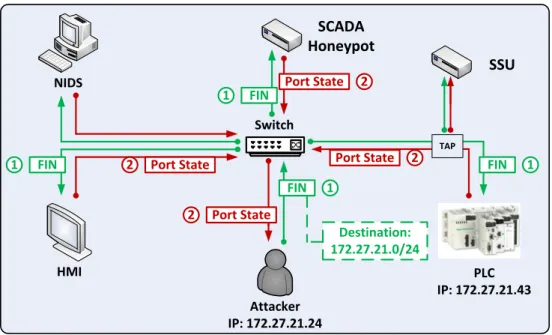
4.5 TCP FIN scan . . . 35
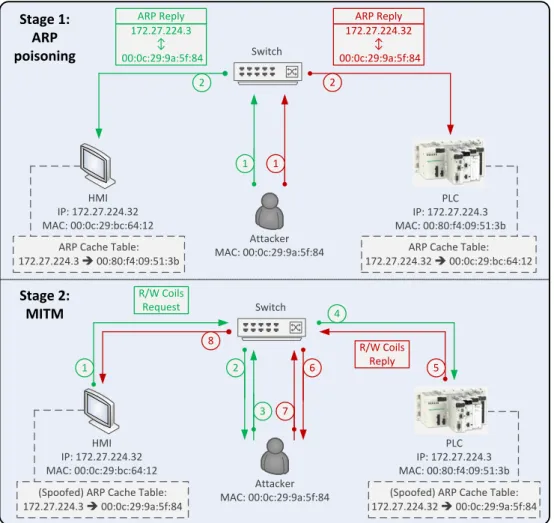
4.6 ARP-based, Man-in-the-Middle attack . . . 36
4.7 IT-OCSVM categorizes aggregated alarms. The left diagram shows aggre-gated alarms created by IT-OCSVM without the additional medium alarms and the right diagram illustrates all the final alarms created by the IT-OCSVM 41 4.8 Approximate execution time for the entire testing dataset . . . 42
4.9 FIN scan network trace . . . 42
4.10 IDMEF message from OCSVM . . . 43
4.11 SYN Flood attack . . . 43
5.1 Paramaterkthresaffects the performance of the K-OCSVM system (Testbed scenario with default parametersσ andν). . . 48
5.2 Architecture of a Multi-stage K-OCSVM . . . 49
5.3 Mean accuracy . . . 51
5.4 Adaptive IDS (A-IDS) . . . 52
5.5 Aggregated accuracy of static and the proposed A-IDS . . . 53
2.1 Differences between IT and CPS Intrusion Detection [6] . . . 16
4.1 Evaluation Parameters . . . 31
4.2 Performance evaluation of K-OCSVM and OCSVM forKthres=2 . . . 31
4.3 Performance evaluation of K-OCSVM and OCSVM forKthres=2 . . . 32
4.4 Evaluation parameters . . . 33
4.5 Performance evaluation of the IT-OCSVM module . . . 37
4.6 Aggregated alarms produced by IT-OCSVM are significantly decreased compared to the initial ones . . . 37
5.1 Configurations of the Network . . . 50
Glossary:
• ACK: ACKnowledge
• CI : Critical Infrastructure
• FIN : Finish
• ICS: Industrial Control System
• IDS : Intrusion Detection System
• OCSVM: One-Class SVM
• OSI: Open Systems Interconnection model
• PLC: Programmable Logic Controller
• RTU: Remote terminal unit
• RST: ReSeT
• SCADA : Supervisory Control and Data Acquisition
Introduction
1.1
Aim and Objectives
The current commentary is presenting two novel Intrusion Detection Systems (IDS) that were produced from the candidate in 2014. These IDS were designed to be a part of a Perimeter IDS that was developed for the purposes of the CockpitCI project (see Section 1.5). Both methods were developed and implemented from the candidate solely, using datasets and live testbeds that were produced from partners of the consortium. The main objectives of the research that was conducted in 2014 and led to the creation of these two novel methods, were the creation of an IDS that could cope with novel attacks, operate in real time, be accurate, could be easily integrated with the rest of the detection components, be distributed and induce low communication overhead. Initially the K-OCSVM method was developed, but the strict aforementioned requirements especially about high accuracy, led to the creation of the second method, namely IT-OCSVM that met all the objectives.
1.2
Industrial Control Systems
An Industrial Control System (ICS) is an umbrella term that refers to a group of process automation technologies, such as Supervisory Control and Data Acquisition (SCADA) systems and Distributed Control Systems (DCS). Unfortunately, they have been subject to a growing number of attacks in recent years [1]. As they deliver vital services to critical infrastructure, such as communications, manufacturing and energy among others, hostile intruders mounting attacks represent a serious threat to the day to day running of nation states [2, 3].
ICS have unique performance and reliability requirements and often use operating sys-tems, applications and procedures that may be considered unconventional by contemporary IT professionals. These requirements typically follow the priority of availability and integrity, followed by confidentiality and include the management of processes that, if not executed correctly, pose a significant risk to the health and safety of human lives, damage to the environment, as well as serious financial issues such as production losses [4–6]. Failure or security breaches of these systems could result in wide-reaching adverse impacts, not only for the system under attack, but for the community and economy at-large that depends on goods or services of the organization. For example, wide-scale blackouts due to a failure of the electricity grid or an environmental disaster such as an oil or sewage pipeline releasing its contents, plus any collateral impact. Cyber attacks could contribute towards the collapse of a state if they initiate or prolong the failure of critical national infrastructure [7, 8].
Cyber warfare which causes blackouts, cuts off supplies to safe drinking water, makes travelling dangerous or destabilises a national economy is clearly a threat to the stability of a nation and is therefore a threat to international peace and security [9]. Unavailability of critical infrastructure (e.g., electrical power, transportation) can have economic impact far beyond the systems sustaining direct and physical damage. These effects could negatively impact the local, regional, national, or possibly global economy [4]. When an incident occurs on a CI, the consequences can be catastrophic having an impact on the environment, economy and human life and a forensic investigation needs to take place [10, 11]. Taking one step further, Robinson et al. in [12] cyber warfare will threaten civilian peace and security long after a conflict has ended, and that existing peace operations will be required to evolve in order to address this threat.
Despite the apparent risk to critical infrastructure, the security of ICS is not considered a significant investment area. Naedele et al., in [13] argues that the costs involved in ICS security are prohibitive, especially within critical systems, when the perceived risks to an organisation or infrastructure cannot be adequately quantified and a business case not satisfac-torily articulated. This often leads to an underdeveloped incident response capability in the deployed operational ICS in particular within the SME supply chain. Larger infrastructures suffer from the insufficient understanding of the deployed components such as Programmable Logic Controllers (PLC) or similar Intelligent Electronic Devices (IED), Remote Terminal Units (RTU) and input/output (I/O) devices that are used to manage electromechanical equip-ment in either local or distributed environequip-ments. This unique environequip-ment, that combines large scale, geographically distributed, legacy and proprietary system components presents significant challenges to Security Operation Centers (SOCs) and Cyber Emergency Response Teams (CERTs)[14]. A SOC centralizes the roles responsible for protecting information
security in the organization, and includes prevention, detection, incident management and response, reporting, governance, risk, and compliance. A CERT is a centralized function for information security incident management and response in an organization. It may roll up under a SOC, or it may act as the main security organization depending on your company’s structure and security needs.
In the past, ICS were operated as separated networks unconnected to public commu-nication infrastructures [15], but as businesses have turned to exploiting the services and data provided by the Internet, such isolation that protected these systems has declined [16]. The benefits afforded by real time monitoring, peer to peer communications, multiple ses-sions, concurrency, maintenance and redundancy have enhanced the services provided for consumers and operators [17, 15]. Moreover, this interconnectedness will grow with the implementation of smart grids and execution of the Internet of Things (IoT) [18]. Hence, the previously isolated systems have become increasingly exposed to a range of threats [19, 20]. Regarding which, Byres et al,[21] cite that formerly isolated ICS now average 11 direct connections across networks with weak network segmentation.
IT security is generally focused on protecting networked computer assets with clear, shared attributes, but Zhu [22] argues that for securing ICS there needs to be a combination of conventional computer security and communication networking with control engineering. However, because of the of the current ICS systems, and their only having recently taken up IPbased communications and linked devices, where traditional IT security, communications security and the protection of control systems have their boundaries, remains unclear and hence, their efficacy is still to be proven [20, 23]. Luallen [24] reports that for a survey of 268 respondent organisations to a survey, most did not report critical ICS assets and relied on staff to detect issues, not tools.
1.3
SCADA Systems
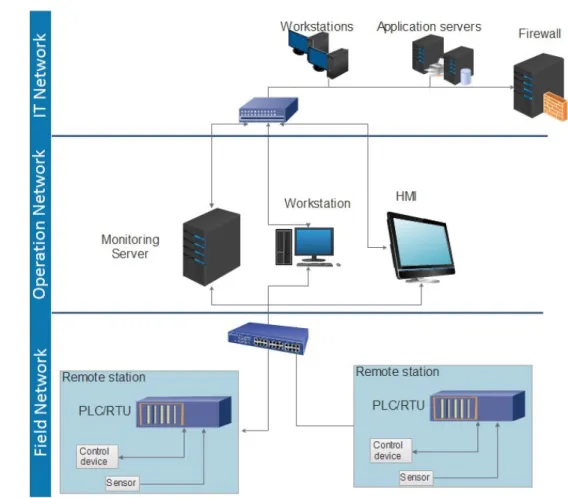
SCADA systems have traditionally been associated with a subset of ICS referred to as Wide Area Control systems (see Figure 1.1).
As aforementioned, security in SCADA systems is more salient than with most other computer systems owing to the potential severity of the outcomes due to a degrading of service as well as the disruption to day to day life. With older computer systems, reliability was the key concern and security was much further down the list. Today, with greater connectivity [25], security is now high on the agenda. Moreover, SCADA systems are not only becoming more connected to the internet; the communications within them operate
Fig. 1.1 A typical SCADA system
through shared Internet Protocol (IP) infrastructure [26]. A number of concerns in relation to implementing security in SCADA have been raised in the extant research:
• System reliability regularly takes precedence over threats to security and can result in high security vulnerability.
• Absence of encryption in earlier communication protocols (plain text is often utilised).
• The common used well-documented protocols, default passwords and off the shelf hardware solutions can threaten to undermine obscurity [27]. Whilst this is not a mechanism of security per se, the loss of it can lead to attacks becoming easier.
• The operation of an SCADA has to be ongoing, which makes it very hard to apply updates, perform patching or to modify system components.
• Today’s systems are lasting longer than in the past, which means that hardware and software are operating beyond their supported lifespan [28]. Also many experienced
workers possess critical know-how that, if lost, makes it costly—if not impossible—for the company to replace when retired or moved.
The aforementioned specific characteristics and constraints in relation to SCADA mean that a domain-specific approach is necessary. In-line security mechanisms (e.g. traditional network IDS utilization) or security tools at the host level (e.g. anti-virus) are not rec-ommended owing to possible latency impact or the occurrence of single points of failure along the vital communications path. Further, given the increasing sophistication of attacks, cyber-security no longer can depend on supervised, pattern-based detection algorithms to guarantee continuous security monitoring. There needs to be approaches that handle rogue threats, which provide a suitable balance between maintenance and detection power [23].
1.4
Real-world Attacks
Among the others, the STUXNET worm infection [29] perfectly represents the frailty of the regulatory systems devoted to control critical infrastructures. Although neither country has openly admitted responsibility, the worm is believed to be a jointly built American/Israeli cyberweapon First isolated in mid-June 2010, STUXNET was a computer virus specif-ically designed for attacking Windows based industrial computers and taking control of Programmable Logic Controller (PLCs), influencing the behaviour of remote actuators and leading to instability phenomena or even worse. The paradox is that critical infrastructures massively rely on newest interconnected (and vulnerable) Information and Communica-tion Technology (ICT) technologies, while the control equipment is typically old, legacy software/hardware. Such a combination of factors may lead to very dangerous situations, exposing the systems to a wide variety of attacks. The lesson the CIIP (Critical Information Infrastructure Protection) community has learned from the spread of the STUXNET worm is that, in order to effectively react to a specific low level menace, there is the need to consider both the global and the local perspectives. In fact, besides obtaining a wider perspective on the state of the System of Systems, there is the need to increase the intelligence of equipments and devices that are used to influence the behaviour of the system, such as RTUs, valves, etc. Taking in mind that such worms can be launched from national intelligence agencies with vast resources for performing persistent attacks [30], only solutions that combine several methods can have adequate detection and mitigation performance.
Moreover, as emphasised by several episodes [31], another effective way to paralyse a SCADA system via cyber attack is to saturate the bandwidth of the carrier used for the communication (this was, for example, the way in which the SLAMMER worm operated in 2003 to affect the SCADA of two United States (US) utilities and a nuclear power plant).
Indeed, as emphasised also by the ANSI/ISA.99 (American National Standards Institute/ International Society of Automation), availability is the most crucial attribute of information security. The lack of timely information to/from the field may cause dramatic consequences because the field is unable to receive the adequate command, hence even trivial episodes may provoke dramatic impact, as shown by the US black-out.
In an evaluation of the Mariposa botnet infection in an ICS organisation, the US Depart-ment of Homeland Security [32, 33] explained that they found that the infection occurred when an employee used a USB drive to download presentation materials to a corporate laptop. When the user connected the laptop to the corporate network upon returning to work, the virus spread to over 100 hosts.
The security of SCADA communications is becoming more complicated because the decision has been taken to link the SCADA networks with IT networks to allow better and faster communications. But these new features have increased the threats and risks on SCADA communications. There are presently no convinced solutions to enforce the security of SCADA communications in that perspective. The idea to add “intelligence” to the field is not new; electro-valves for gas pipelines are available on the market that, in the case they receive a rapid sequence of open-close commands, do not perform them in order to avoid the consequence of the mechanical shock and EU (European Union) projects such as the FP6 SAFEGUARD and FP7 CRUTIAL (CRitical UTility InfrastructurAL Resilience) and the SCADA-CSL project have explored the technical feasibility to improve cyber security of SCADA system by improving the smartness of the field devices. However, until now such solutions have been completely rejected by Critical Infrastructure (CI) operators because they fear that local automatic reactions may happen during “normal” activities inducing catastrophic behaviour.
To overcome such catastrophic vision, and in order to improve the resilience and the dependability of CIs solutions, like the design and the implementation of alerting Systems that provide CI operators an efficient tool to support them, must be designed. Such tool could provide the operators with capabilities to assist them: (i) in the prevention of cyber attacks, and (ii) in the implementation of consequence containment strategies in case of an attack.
1.5
CockpitCi Project
The CockpitCI project proposes an architecture based on real-time Perimeter Intrusion Detection System (PIDS), which provides the core cyber-analysis and detection capabilities, being responsible for continuously assessing and protecting the electronic security perimeter of each CI. The analysis and detection mechanisms for each PIDS are fed by several field
adapters and detection agents, deployed within each CI and providing the basic information from which the ongoing security status of the CI is inferred. The PIDS also encompasses semi-autonomous reaction capabilities, being able to deploy countermeasures, in line with predefined security reaction policies.
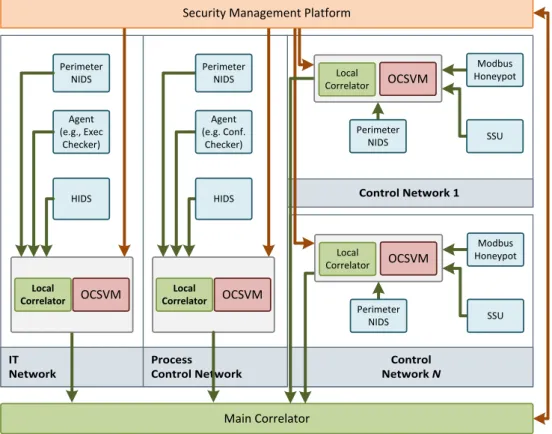
The CockpitCI PIDS (see Figure 1.2) is structured along the three different zones of the CI, each one with its own internal security perimeter: the Field Network, SCADA Process/Operations Network and the IT (Information Technology) Network. This distinction confers the PIDS the ability to deploy agents and security policies customized to the specific needs and characteristics of each network scope.
The architecture components are arranged in a two-level architecture with local instances fine-tuned for each network scope: local correlators perform the first step of correlation, receiving the events from local detection agents (e.g. Host IDS) on their network scope and process them accordingly with a set of rules, forwarding significant results to a global correlation engine. After local correlation, events are sent to the global correlators, which have access to a broad perspective of the whole infrastructure, covering all network scopes. This approach provides context separation, also allowing for better efficiency and scalability for (soft)real time event processing. This architecture was designed to deal with several attack scenarios, from known threats to rogue events, such as: man-in-the-middle attacks, device impersonation, non-authorized tampering, worms, trojans, denial-of-service attacks or flooding, among others. For this purpose, the PIDS is designed in such a way that it integrates different detection strategies, distributed along different levels, namely:
• Detection agents and field adaptors, including agents, adaptors and extensions for existing system components, as well as specialized probes and honeypots to be added to the network which are able to capture behaviour or traffic patterns (as performed by NIDS – Network IDS components) as well as host (using Host IDS, or antivirus software) and field device monitoring.
• A distributed multi-zone, multi-level rule-based correlation structure that processes the information provided by the security sensors, complemented by machine-learning capabilities, in the form of One-Class Support Vector Machines (OCSVM) anomaly detection module, based on machine learning.
• Aggressive usage of topology and system-specific detection mechanisms, based on the fact that the role and behaviour of each system component in an ICS are expected to be more consistent over time than on other types of networks, analysis components are fed with knowledge provided by a number of system specific sources, such as topology
databases, policy databases, and trust-based mechanisms, as well as strategically placed honeypots.
In the CockpitCI PIDS, computational intelligence is provided by means of the analysis components, which provide a way to extract information from the data collected by the agent layer or directly from network traces.
Control Network 1 Control Network N Process Control Network OCSVM Local Correlator IT Network OCSVM Local Correlator HIDS Agent (e.g. Conf. Checker) Perimeter NIDS HIDS Agent (e.g., Exec Checker) Perimeter NIDS Main Correlator Modbus Honeypot Perimeter NIDS SSU Local Correlator OCSVM Modbus Honeypot Perimeter NIDS SSU Local Correlator OCSVM
Security Management Platform
Fig. 1.2 High-level view of the CockpitCI PIDS architecture
Part of the PIDS that was developed for the purposes of the CockpitCI project, is the OCSVM module. During the duration of the project two novel OCSVM modules were developed and tested using datasets from a small-scale testbed that was created, providing the means to mimic a SCADA system operating both in normal conditions and under the influence of cyberattacks. Initial tests were conducted in order to evaluate the performance of the IT-OCSVM mechanism using three types of attacks, namely: network scan, Man-in-the-Middle (MITM) using ARP spoofing and Denial-of-Service (DoS). The Hybrid Environment for Development and Validation (HEDVa) that was designed by the Israeli Electric Company for the development and validation of CIs as well as security research projects, was used in a later stage in order to implement the attack use cases for the PIDS validation effort.
The following chapters describe in detail the two proposed IDS systems that are based on the OCSVM mechanism, namely the IT-OCSVM and the K-OCSVM. Both systems that are novel were developed by the candidate under the supervision of Professor Jiang during his work as research fellow in University of Surrey in 2014. Initially the K-OCSVM method was developed, but requirements about fast reaction of the IDS along with high accuracy, led to the creation of the second method, namely IT-OCSVM. This new method performed well both in terms of time and accuracy, was easily integrated in the PIDS and attracted the attention of the research community (Interview of the candidate by IET Electronics Letters (http://digital-library.theiet.org/content/journals/10.1049/el.2014.4062), keynote speech to ICAIDM 2014 conference, invited talk to CN group of TU WIEN in 2017 etc).
Related Work
SCADA systems that link facilities like oil and gas pipelines or water distribution and waste water collection systems might have been designed to be open, robust, and easily operated and repaired, but they are not necessarily secure. Cyber-attacks against these systems are considered extremely dangerous for CI (Critical Infrastructures) operation and must be addressed in a specific way [22]. Intrusion Detection Systems can be used in order to identify an attack and initiate proper alerts that may help take appropriate actions.
Artificial Intelligence, machine learning and data mining are commnly used in every day applications. From an intrusion detection perspective, analysts can apply machine learning, data mining and pattern recognition algorithms to distinguish between normal and malicious traffic [34]. Artificial Intelligence (AI) is about improving algorithms by employing novel problem solving techniques. AI systems integrate several tasks such as learning or gaining the ability to perform tasks from simple or complex examples and extensive training. Classifier systems attempt to learn how to classify future examples from a set of training data. Neural networks are characterized by highly connected networks which are trained on a set of data counting on the hypothesis that the network will correctly classify future examples. In literature, numbers of anomaly detection systems are developed based on many different machine learning techniques. For example, some studies use single learning techniques, such as neural networks, genetic algorithms, support vector machines, etc. As the amount of data that need to be monitored and analyzed, in real time, is huge, data mining techniques are used. Data mining is the process of discovering patterns in large data sets involving methods at the intersection of machine learning and artificial intelligence. There is a significant overlap between machine learning and data mining. These two terms are commonly confused because they often employ the same methods although the former focuses on classification and prediction and the latter on the discovery of previously unknown patters [35]. Modern
intrusion detection systems that can cope with zero days attacks in an efficient and accurate way rely on artificial intelligence, machine learning and data mining techniques.
2.1
Intrusion Detection Systems
Intrusion refers to actions geared towards challenging the integrity, discretion or accessibility of a resource [36]. Whereas intrusion protection pertains to the monitoring of events that occur in a computer system and analysing them so as to detect any possible intrusion [37]. An intrusion detection system (IDS) refers to the operation of intrusion detection principles and mechanisms across a network. It can have both software and hardware components running on host machines that track user activities. That is, it can have programs searching for potential insider threats to the host as well as distributed agents, that by scrutinizing network traffic, can detect threats from outsiders. The purpose of anIDSis to warn administrators about any suspect activity and in sometimes it even deals with an attack. In comparison to other types of security, e.g. firewalls, control of access or encryption, for which the purpose is one of securing the computer system, IDSs are tasked with detecting attackers that have already entered its internal network. Hence, it is strongly advised that the intrusion prevention and intrusion detection security practices be utilised in tandem, as this will enhance system security.
In the past, administrators manually controlled intrusion detectors (IDs). They monitored every activity on a console and identified inconsistencies. However, this was not effective and resulted in a high volume of errors, particularly as the amount of network activity steadily increased. Log file readers were developed to address this, which allowed for rapid detection of irregularities and unauthorised access. Audit log IDs introduced during the initial stages were a type of forensics. Whilst ID was post analysis and analysis of intrusions and changes to the structure of the system were detected some time after the event. This involved a long-winded process, being subject to error, particularly when system usage was heavy [38].
Work was carried out in the 1980s and 1990s to make IDSs more robust, with a solution being provided by Denning [39]. They created an IDS that could review audit data in real time, which thus was the first time that attacks could be pre-empted [37]. With the coming of the technological age, the IT security market expanded rapidly and IDSs were developed further and became widely available. Features, such as new alert modes, updating to attack pattern definitions, dedicated user friendly interfaces and methods that stopped identified attacks immediately were added. As various new attacks were generated across the web, such as the millennium bug, it soon became obvious that continuous innovation of security systems would be needed to protect computing networks.
There are two principle categories of IDSs and a compound one: anomaly, signature and hybrid/compound detection systems [40]. An IDS works using models to establish whether a series of actions can be classed in terms of good or bad and thus potentially be an intrusion. Anomaly detection systems are aimed at understanding the behaviour of the network traffic, whilst misuse detection systems compare the present situation with recognised misbehaviour patterns.
2.1.1
Anomaly Detection Systems
The decision making process in these systems is determined by taking into account the system or user’s normal profile. The detector establishes normal behaviour for the observed object of interest (application, user, resource usage etc.), subsequently flagging up the proportion of suspicious activity and taking appropriate action [41]. Because no previous knowledge of the intrusion is required this type of detector is effective for unknown attacks [42]. Nevertheless, it has a high rate of false positives and is incapable of providing details about attacks [43].
Lemaire et al [44] point out that, traditionally, intrusion data is inspected by human analysts who evaluate the alerts and take decisions accordingly. Machine learning, it is argued, has the capability to gather knowledge about new data and make predictions about the new data based on the knowledge of previous data, leading to a far more efficient self-learning process. This sentiment is echoed by Garitano [45] and Larkin et al [20] who note that whilst anomaly-based IDSs are not usually used on traditional IT networks because of their dynamic environment, the predictable traffic patterns of an ICS lend themselves to such an approach. However, this concept is based on the premise that ICS traffic is, indeed, predictable.
2.1.2
Misuse Detection
These systems, also called signature based detection systems, utilise patterns of known attacks or critical points so as to identify and match recognised intrusions. They provide much greater accuracy, also being able to identify variants of known attacks. Moreover, this type of IDS can provide useful diagnostics about an attack in terms of why an alarm has been triggered [46]. Nonetheless, there are some drawbacks, such as lacking the capacity to identify novel intrusions. Recently, a combination of misuse and anomaly systems have been deployed to improve the rates of both recognised and unrecognised intrusions as well as to lower the rate of false positives [47]. However, for the sake of convenience, most commercial systems only deploy misuse detection systems.
2.1.3
Clustering
Clustering refers to unsupervised learning algorithms which do not require pre-labeled data to extract rules for grouping similar data instances. When using clustering scholars follow one of the three following assumptions:
1. Purity assumption: we can create clusters of only normal data, and thus any data that don’t fit into one cluster are considered anomalous. This assumption is only valid when dealing with testbed scenarios and cannot be applied in real environments.
2. Robustness assumption: we can create clusters that contain both normal and anoma-lous data, but in this occasion using distance metrics we can spot anomaanoma-lous data since they lie far away from the centroids [48]. This assumption produces false positives especially in attack free scenarios.
3. Frequency assumption: we create clusters of various sizes and the small ones contain anomalous data since attacks are not the rule but rather the exception. This assumption is not valid when dealing with DoS or DDoS attacks when the volume of malicious packets is high.
Using all these assumptions and by calibrating several parameters and thresholds, scholars have managed to develop IDSs that are based on clustering techniques and that can perform well under several attack scenarios [49–51]. On the other hand such assumptions make these methods inappropriate for producing high accurate alarms, when dealing with several attacks simultaneously and when having to deal with high volumes of data in real time [52]. Exploiting the basic characteristic of clustering that is to group together similar things and having as one of the basic objectives to create and IDS that doesn’t overwhelm the medium with alarm messages, in the core of the two IDSs that are presented in this thesis lies the K-means method.
2.1.4
Data Mining for Intrusion Detection
The increasing deployment of data mining approaches has resulted in the creation of a whole host of algorithms for database analysis, machine learning and pattern identification, all of which can be utilised as an IDS. For instance, there is a range of algorithms available for mining audit data. To construct a model, these algorithms have to begin with analyis of the available data so as to identify any patterns or trends. The appropriate models are then created with the optimal parameters identified from the outcomes of the initial analysis The process of implementing an IDS through data mining is as follows: data collection, data
selection, preprocessing, transformation, data mining, evaluation and reporting, all of which were carried in the two proposed methods that are presented and analyzed in the following Chapters.
2.1.5
Support Vector Machines
SVMs utilise a method for classing data rapidly. First, training data are used to develop a model, which is then utilised to categorise new data. SVMs employ a kernel function for mapping data onto a higher dimensional feature space, whereby hyperplanes can be used to separate the different categories. Iteration is deployed to identify the best hyperplane for category distinction, which has the greatest margin between it and the data points that are nearest. The data points coinciding with this margin are named the support vectors.
Whilst it is feasible to have multiple classes for data allocation, the interest here lies in One-Class SVMS (OCSVM), which simply decides whether new data belongs to a single class or not. This gives it the capability of identifying previously unknown, suspicious behaviour and, rather than categorising it, just recognises it as not being good. Given the lack of any data points from another category, the approach takes the origin as the class 1 perfect vector and the optimal distance is between the origin and where the data point has left the category. It is essential to elicit appropriate values so as to obtain optimal outcomes with this model. This process is frequently improved by the use of other machine learning techniques to determine optimum values for the algorithm that can be obtained by utilising machine learning methods [53, 54].
2.1.6
Discussion
There has been a considerable amount of work undertaken regarding SCADA intrusion and anomaly detection, including Intrusion Detection Systems (IDSs) [55], or Distributed IDSs [56, 57, 57] device-level anomaly detection [58, 59] and classification [60], IDSs solutions combining network traces and physical process control data [61], detection based on traffic and protocol models [62] [63–65] and approaches based on machine-learning techniques [66, 67], just to mention a few. However, not all solutions are equally feasible: for instance, device-level anomaly detection requires adding hardware mechanisms for probing. Also, detecting attacks targeting loss of process visibility, such as Man-in-the-Middle (MITM) or process-level attacks (which attempt to disturb the SCADA process) is out of scope for several of these proposals.
Among other approaches, neural networks, support vector machines, K-nearest neighbor (KNN) and the hidden Markov model can be used for intrusion detection. While existing
Table 2.1 Differences between IT and CPS Intrusion Detection [6]
An IT IDS monitors host or network-level activity (e.g., an HTTP request or a web server
A CPS IDS monitors the physical processes (and hence the laws of physics) that govern
behaviour of physical devices that make certain behaviours more likely to be seen
than others. An IT IDS monitors user-triggered
activities, leading to unacceptably high false-positive rates due to the
unpredictability of user behaviours.
A CPS IDS monitors activities that are frequently automated and time driven in a
closed-loop setting, thus providing some regularity and predictability for behaviour
monitoring An IT IDS deals with mostly
non-zero-day attacks rendering knowledge-based detection effective.
A CPS IDS deals with zero-day or highly sophisticated attacks, rendering knowledge-based detection ineffective. An IT IDS often does not have to deal
with legacy components, making behaviour specification of the physical processes governing legacy components unnecessary.
A CPS IDS often must deal with legacy technology, making behaviour-specification detection an effective technique by precisely
specifying the physical processes governing the behaviour of legacy components.
signature-based network IDSs, such as Snort or Suricata can be effective in SCADA envi-ronments, they require specific customization for such a purpose [68, 69]. Also, they are not effective against rogue threats for which known patterns or signatures are not known. OCSVM principles have shown great potential in the area of anomaly detection [70], being a natural extension of the support vector algorithm in the case of unlabeled data, especially for the detection of outliers. As stated in [71] there is a need for developing a robust, and preferably real-time IDS technique that can work in unsupervised mode and have a high detection accuracy.
Mitchell et al. in in [6] and Cook et al. in [72] explore the viability of traditional IT secu-rity mechanisms in Cyber Physical Systems, such as ICS, and considers their effectiveness in supporting ICS cybersecurity incident response. Based on the findings in [6] it is obvious that IDSs that are designed for CPS systems differ compared to those that are developed for traditional IT (See Table 2.1).
The single-class categorisation is a particular case of a two class classification problem, whereby data from onle one class are present, known as the target class. A second category, called the outlier class, is sampled very sparingly, or maybe not at all. The data here indicate abnormal behaviour and hence, the possibility of an intrusion; OCSVM [66] has a number of positive attributes when processing data in a SCADA environment. The one-class
Support Vector Machine (OCSVM) [73] possesses several advantages for processing SCADA environment data and automates SCADA performance monitoring, which can be highlighted as follows:
• Regarding monitoring of SCADA performance the difference between what is normal and what is not might not be clear to the operators. Since OCSVM needs no data signatures, data for constructing the detection model it is very effective for identifying intrusion in SCADA environments.
• Because no previous information regarding anticipated types of attack is required, OCSVM can identify both recognised and unrecognised (new) intrusions.
• In reality, training data obtained in a SCADA environment can contain samples of noise, which most attack detection approaches are extremely sensitive to. OCSVM is robust to these samples during the process of training.
• The user can control the configuration of the algorithm in relation to the proportion of anticipated anomalies.
• OCSVM detectors are quick enough to perform online with SCADA performance monitoring, owing to the low computation time.
• Typical monitoring of data of SCADA systems consists of several attributes and OCSVM is capable of handling multiple-attributed data.
Based on this analysis and the need for an IDS that can be accurate, deal with novel attacks and work in real-time two novel methods that were based on the OCSVM mechanism were developed. In real-time systems, in addition to fast response and accuracy, limited communication between detection modules is also desirable. By sending an explicit message for every anomaly detected, the intrusion detection mechanism will flood the medium with messages that will cause a delay in the communication between entities in the SCADA system. Moreover, since the detection mechanism needs to be sited at several locations in the SCADA system in order to recognize the intrusion near the origin, the communication overhead caused by the detection mechanism is further increased. One solution is the addition of a control channel, whereby these messages can be communicated without affecting the system’s performance, but this is not always feasible. For this reason, the IT-OCSVM mechanism that was the second and more successful solution presented, includes an aggregation mechanism that groups initial alerts and sends a limited number of messages reporting the fault/intrusion accurately and on time. Both IT-OCSVM and K-OCSVM, that was the initial mechanism developed, are presented in the following chapters. Both mechanisms were developed in
order to work real-time in collaboration with other detection agents, as a part of a Perimeter IDS.
This commentary presents two novel IDSs systems that were developed under the scope of a PIDS. These mechanisms were developed in order to overcome the shortcomings of all current (back in 2014) methods, in terms of accuracy, overhead and efficient countering of zero days attacks. The IT-OCSVM method, which is the improved and final IDS method produced was evaluated under realistic scenarios and was found to be very efficient in terms of time overhead and accuracy under all kinds of attacks, making it a central part of the PIDS. In Appendix A, the articles that describe the methodology, the evaluation and the main findings of the two aforementioned methods along with the integration of the later into the PIDS that was implemented as part of the CockpitCI project are listed. The current commentary presents both methods, the need that led to the design and implementation of these novel techniques and the evaluation of later under realistic attack scenarios.
Proposed Methods
3.1
K-OCSVM Idea
OCSVM principles have shown great potential in the area of anomaly detection [70, 74, 75]. IDS can provide active detection and automated responses during intrusions [76]. Several extensions of the OCSVM method have been introduced lately [77, 78]. OCSVM, similar to other one-class classifiers e.g. GDE[79], PGA [80], suffer from false positive and over fitting situations. Intrusion detection systems (IDS) fail to deal with all kinds of attacks, while on the other hand, false alarms that are arisen from high sensitive IDS lead to high economic risks. A big number of false alarms fired from the IDS gives the impression that IDS technology itself is fundamentally flawed and that there is no possibility for a true false positive to exist. That way the IDS is ignored from the operator and the system is vulnerable to real attacks.For example when deploying a network based IDS, changes made to system files from an unauthorized user who uses the system console, goes unnoticed.
For the OCSVM with an Radial Basis Function (RBF) kernel, two parametersσ andν
need to be carefully selected in order to obtain the optimal classification result. Parameter
ν sets an upper bound on the fraction of outliers (training examples regarded out-of-class)
and, it is also a lower bound on the number of training examples used as Support Vectors. Parameterσ denotes the width of the Gaussian kernel (how tight the boundary fits over the
training data). OCSVM, similar to other one-class classifiers suffer from false positives and over fitting. The former is a situation that occurs when the classifier fires an alarm in the absence of any real anomaly in the system and happens when the parameterσ has too
large value. The latter is the situation when a model begins to memorize training data rather than learning to generalize from the trend and it shows up when the parameterσ is given a
A common strategy is to separate the data set into two parts, of which one is considered unknown. The prediction accuracy obtained from the unknown set more precisely reflects the performance on classifying an independent data set. An improved version of this procedure is known as cross-validation. Cross-validation is a model validation technique for assessing how the results of a statistical analysis will generalize to an independent data set. It is mainly used in settings where the goal is prediction, and one wants to estimate how accurately a predictive model will perform in practice.
Ink-fold cross-validation [82, 83], the training set is divided intoksubsets of equal size. Sequentially one subset is tested using the classifier trained on the remainingk.. 1 subsets . Thus, each instance of the whole training set is predicted once so the cross-validation accuracy is the percentage of data which are correctly classified. The cross-validation procedure can prevent the over fitting problem.
Using an ensemble of decision mechanisms with different parameters, is another method to have an optimal result. An ensemble of classifiers [84] is a set of classifiers whose individual decisions are combined in some way, in order to provide more trusted final decisions. Ensemble systems of classifiers are widely used for intrusion detection in networks. Classifier ensemble design aims to include mutually complementary individual classifiers which are characterized by high diversity, either in terms of classifier structure [85], internal parameters [86] or classifier inputs [87].
Unnthorsson et al. [88] proposed another method to select parameters for the OCSVM. In their method,ν was first set to a user-specified allowable fraction of misclassification of
the target class (e.g. 1% or 5%). Withν fixed,σ is adjusted until a classification accuracy
of 1−ν is obtained. The obtainedν andσ combination can then be used in the OCSVM
classification.
In this subsection we present a novel method that is based on the combination of the OCSVM method with recursive K-means clustering separating the real from false alarms in real time and with no pre-selection of parametersσ andν. The proposed method is a natural
extension of the support vector algorithm to the case of unlabeled data, especially for the detection of outliers. The novel K-OCSVM mechanism is trained offline by network traces, after the attributes are extracted from the network dataset. Output of the detection module is communicated to the system by IDMEF files that contain information about the source, time and severity of the intrusion. After the execution of the K-OCSVM method, only severe alerts are communicated to the system by IDMEF files that contain information about the source, destination, protocol and time of the intrusion. The main feature of the K-OCSVM module is that it can perform anomaly detection in a time-efficient way, with good accuracy
and low overhead. A detailed description and evaluation of the K-OSCVM method can be found in [67, 89, 90].
3.2
K-OCSVM Implementation
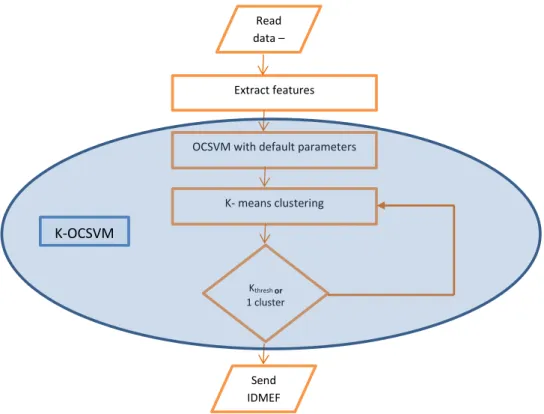
The proposed K-OCSVM combines the well known OCSVM classifier with the RBF kernel with a recursive K-means clustering module. Figure 3.1 illustrates the procedure of intrusion detection of our proposed K-OCSVM model.
Kthresh or 1 cluster Extract features
OCSVM with default parameters
K- means clustering Read data – Send IDMEF K-OCSVM
Fig. 3.1 K-OCSVM module
The OCSVM classifier runs with default parameters and the outcome consists of all possible outliers. These outliers are clustered using the k-means clustering method with2 clusters, where the initial means of the clusters are the maximum and the minimum negative values returned by the OCSVM module. From the two clusters that are created from the K-means clustering, the one that is closer to the maximum negative value (severe alerts) is used as input in the next call of the K-means clustering. This procedure is repeated until all outcomes are put in the same cluster or the divided set is big enough when compared to the initial one, according to the threshold parameterkthres.
The K-means clustering method divides the outcomes according to their values and those outcomes with the most negative values are kept. That way, after the completion of this recursive procedure, only the most severe alerts are communicated from the K-OCSVM. The division of the data need no previous knowledge about the values of the outcomes which may vary from-0.1to-160depending on the values assigned to the parametersσ andν. The
method can find the most important/possible outliers for any given values of parametersσ
andν.
As it shown in a later Chapter, the K-OCSVM method performs well in terms of low overhead and has good accuracy. K-OCSVM can detect all important variations in network traffic that may constitute an attack, but it achieves this by ignoring small fluctuations that may obscure low probing attacks. For this reason, and based on the high requirements of the CockPitCi project, a novel method that achieved both high accuracy and low overhead was developed. This new method, namely IT-OCSVM, is described in the next section.
3.3
IT-OCSVM Idea
Behavioral analysis is the
Social network analysis (SNA) can be used in order to discover security policy breaches in a network and refers to the use of network theory to analyze social networks. That is, it views social relationships in terms of network theory, consisting of nodes, representing individual actors within the network, and ties which represent relationships between the individuals, such as friendships, kinships, organizations and sexual relationships. By using comparative metrics of a network’s structure during normal and abnormal operation, we can discover security policy breaches. One can assume that network communication between nodes, constitutes a social network of users and their applications, so the appropriate methods of social network formal analysis can be applied [91]. In on-line social systems perpetrators of malicious behavior often display patterns of interaction that are quite different from regular users, which can be identified through the application of anomaly detection techniques. Thus, in accordance [92], network anomalies can be defined as patterns of interaction that significantly differ from the norm and in order to capture the appropriate patterns of interaction, specific aspects of entities’ behavior are used (e.g. email analysis).
Deviation from the normal protocol operation in communication networks has received considerable attention from the research community in recent years. A malicious node may use the vulnerabilities of the system architecture to perform different kinds of attacks. Hence, considering network reliability it is necessary to develop efficient techniques to detect misbehaving clients in a timely manner and the correlation coefficients between entities can
effectively detect malicious nodes [93]. Similar to this, in a SCADA system, individual entities demonstrate a quite different communication behavior when infected, in terms of mean packet generation frequency (traffic burst), protocol distribution or interaction pattern.
Discovering anomalies in the context of a network system is a challenging issue due to the complexity of the environment and the different nature of the induced attacks. Regarding node behavior related decisions it makes sense to ask more than one decision mechanism, since this practice assures a more trusted final decision. Ensemble systems of classifiers are widely used for intrusion detection in networks [94]. These aim to include mutually complementary individual classifiers, which are characterized by high diversity in terms of classifier structure [85], internal parameters [86] or classifier inputs[87].
As stated in the previous chapter one of the main objectives when implementing an IDS, along with fast response and high accuracy is low overhead. Since the solution of adding a control channel that is dedicated to the messages that are produced from the IDS, an aggregation mechanism that groups initial alerts and sends a limited number of messages reporting the fault/intrusion accurately and on time was also developed.
The present chapter presents a recently proposed intrusion detection mechanism, namely the IT-OCSVM [95], against the baseline OCSVM method. The mechanism uses a central OCSVM and a cluster of automatically produced ones, one for each source that induces signifficant traffic in the system, an embedded ensemble mechanism, social metrics, an aggregation method and a K-means clustering procedure that categorizes aggregated alerts. The mechanism runs in a distributed way and produces dedicated IDMEF (Intrusion Detection Message Exchange Format) messages that report the severity of the attack detected. The proposed mechanism is incorporated in a distributed IDS communicating with other detection and management components of the system.
3.4
IT-OCSVM Implementation
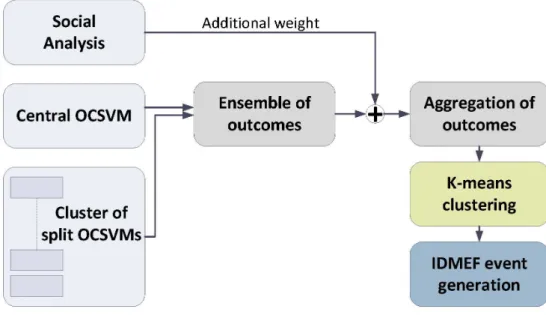
The main purpose of theIT-OCSVMdetection mechanism is to perform anomaly detection in a time-efficient way, with good accuracy and low overhead, within a temporal window adequate for the nature of SCADA systems. In order to achieve the aforementioned goals several operation stages need to be carried out (See Figure 3.2).
• Pre-processingof raw input data in order to feed theIT-OCSVMmodule. The attributes in the raw data of the testbed contain all forms: continuous, discrete, and symbolic, with significantly varying resolution and ranges. Most pattern classification methods are not able to process data in such a format. Hence, pre-processing is required before pattern classification models can be built. This consists of two steps: the first involves
Fig. 3.2 Architecture of detection mechanism
mapping symbolic-valued attributes to numeric-valued attributes and the second is implementing scaling. Different pre-processing techniques are used based on the characteristics of each feature type [96].
• Selection of the most appropriate featuresfor the training of theIT-OCSVMmodel. These features are divided into content and time based features. Since the majority of DoS and probing attacks may use hundreds of packets, time-based features are mostly used.
• Creation of cluster of OCSVM modelsthat are trained on discrete sources. There are many slow probing attacks that scan the hosts using much larger intervals, thus being able to merge into the overall traffic in the network. As a consequence, these attacks cannot be detected using derived time-based features and in order to capture them, the raw data after arriving in the module is split into different datasets according to the sender of the packet. An OCSVM module is created and trained for each split dataset. The cluster of split OCSVMs run in parallel with the central OCSVM and produce errors targeted to the specific source.
It is important to mention that a split OCSVM is not created for each source, but only for those sources that produce high traffic in the network during the training period. In order to separate significant nodes a thresholdPpacketsis used and every source that produces a number of packets over this threshold during the training period is marked
as a significant node. If during the testing period a source is showing big activity, while not being marked as significant, a medium alarm is fired for it.
• Testing of the traffic dataset that contains malicious attacks. Based on the models created from the training phase the new dataset is tested against normal patterns. Each OCSVM module returns a function f that takes the value +1 in a region capturing normal data points (i.e. for events implying normal behaviour of the SCADA system) and takes a negative value elsewhere (i.e. for events implying abnormal behaviour of the SCADA system).
• Ensemble of classifiersThe initial outcomes of the different OCSVM modules are combined by the ensemble based mechanism that uses mean majority voting.
• Social analysisSocial network analysis is executed based on the network traces and Spearman’s rank correlation coefficient is used in order to add weight to alerts produced from different sources.
• Fusion of the informationDue to the possible existence of multiple anomalies in a SCADA system, the outcomes of the different models are gathered and classified in terms of importance. This importance is derived through aggregation and k-means clustering of the outputs.
• Communication of the mechanism. In order to cooperate with other components of the IDS the mechanism sends IDMEF files. The created files describe the nature of the alert, in terms of importance, the position in the system, time etc.
A more detailed description of the proposed method and its evaluation after the deploy-ment in realistic SCADA systems can be found in [97, 95, 23]. In the next subsection the social analysis module that is embeded in the IT-OCSVM method is described.
3.5
Summary
This chapter presents the two novel methods, namely the K-OCSVM and the IT-OCSVM. The detection mechanisms, which run in a distributed way, can be used in large SCADA networks with no additional modifications.
The main feature of the K-OCSVM module is that it can perform anomaly detection in a time-efficient way, with good accuracy and low overhead. Low overhead is an important evaluation metric of a distributed detection module that is scattered in a real-time system, since frequent communication of IDMEF files from detection agents degrade the performance
of the SCADA network. On the other hand, since sometimes these fluctuations obscure real attacks, better methods that can classify them, instead of ignoring them was needed. This need led to the development of the second method, namely the IT-OCSVM.
Speaking for the IT-OCSVM, the combination of social network analysis metrics with machine learning classification techniques, enhances the performance of the detection mech-anism and improves accuracy for all the simulation scenarios investigated. Moreover, the aggregation procedure embedded in the proposed mechanism decreases the overhead of the IT-OCSVM and makes it easily incorporable in a soft real time system. That is, the method produces a small amount of final alerts and manages to detect all the simulated attacks.
Evaluation
In this chapter we present the different testbeds that were used in order to evaluate the performance of the proposed methods. Also all the experiments that were conducted, offline and online, and the several performance metrics are presented and critically analyzed.
4.1
Testbeds and Experiments
4.1.1
Small-scale SCADA System
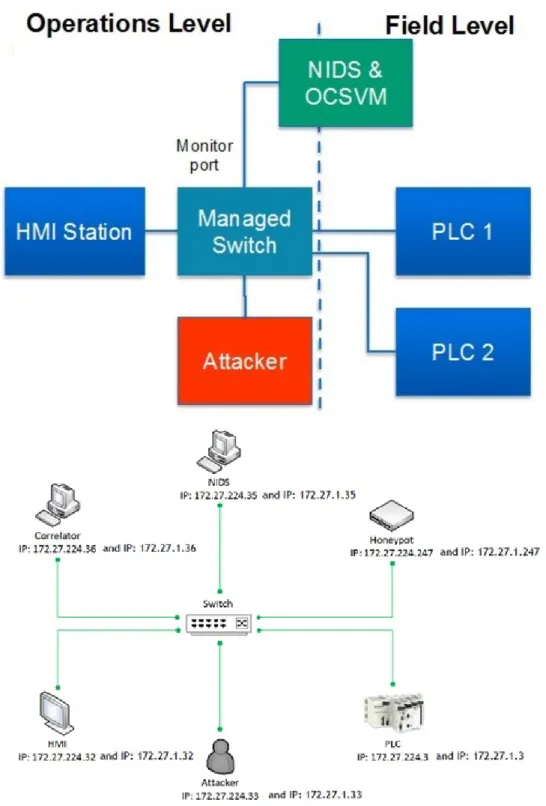
The testbed architecture mimics a small-scale SCADA system, comprising the operations and field networks, which include a Human-Machine Interface Station (for process monitoring), a managed switch (with port monitoring capabilities for network traffic capture), and two Programmable Logic Controller Units, for process control.
Three kinds of attacks are evaluated:
• Network scan attackIn a typical network scan attack, the attacker uses TCP/FIN scans to determine if ports are closed to the target machine; closed ports answer with RST packets while open ports discard the FIN message. FIN packets blend with background noise on a link and are hard to detect.
• ARP cache spoofing - MITM attack ARP cache spoofingis a technique where an
attacker sends fake ARP messages. The aim is to associate the attacker’s MAC address with the IP address of another host, thus causing any traffic meant for that IP to be sent to the attacker instead. The attacker could choose to inspect the packets, modify data before forwarding (man-in-the-middle attack) or launch a denial of service attack by causing some of the packets to be dropped.
Fig. 4.1 Architecture of the testbed
• DoS attackNetwork flood refers to the situation where the attacker floods the connec-tion with the PLC by sending SYN packets.
4.1.2
Hybrid Test Bed (HTB)
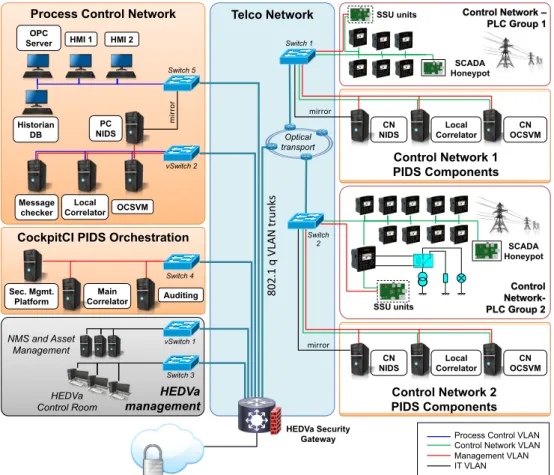
The Hybrid Environment for Development and Validation (HEDVa) was designed by the Israeli Electric Company for the development and validation of CIs as well as security research projects [23], being used to implement the attack use cases for the PIDS validation effort. Its architecture (see Figure 4.2) constitutes a hybrid approach, because of the existence of real/physical SCADA and network/telecom infrastructure components, which are used to implement a simulation model of the electric grid elements.
Process Control Network
Process Control VLAN Control Network VLAN Management VLAN IT VLAN Control Network- PLC Group 2 Control Network – PLC Group 1 Telco Network HEDVa management HMI 2 PC NIDS Local Correlator OPC Server Historian DB HMI 1 HEDVa Control Room NMS and Asset Management Optical transport Switch 1 vSwitch 2 vSwitch 1 Switch 3 HEDVa Security Gateway SSU units Message checker Switch 2 CN NIDS OCSVM CN OCSVM SCADA Honeypot Local Correlator Switch 5 mi rro r%
CockpitCI PIDS Orchestration
Sec. Mgmt.
Platform CorrelatorMain Auditing
Switch 4 802. 1%q %V LAN% tr un ks % Control Network 2 PIDS Components % CN
NIDS Correlator Local OCSVM CN Control Network 1 PIDS Components % mirror% mirror% SCADA Honeypot SSU units
Fig. 4.2 HEDVa networking architecture
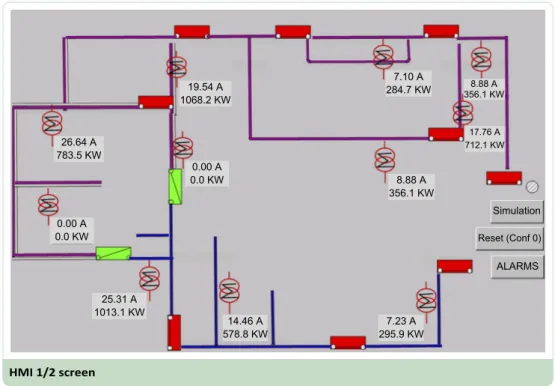
The CockpitCI emulated HEDVa scenario corresponds to an energy distribution grid, as shown in Figure 4.3. Its implementation required the development and testing of different modeling techniques, also including related key performance indicators, fine-tuned with data from production scenarios. Grid elements such as breakers and feeders are controlled by real PLCs in a simulation model, with voltage and current values for segments being calculated accordingly using a mathematical model of the physical grid. In case of failure, the scenario is reconfigured accordingly with the operator’s Fault Isolation and Service Restoration procedures.
HMI 1/2 screen 0.00 A 0.0 KW 19.54 A 1068.2 KW 0.00 A 0.0 KW 26.64 A 783.5 KW 25.31 A 1013.1 KW 14.46 A 578.8 KW 7.23 A 295.9 KW 8.88 A 356.1 KW 7.10 A 284.7 KW 17.76 A 712.1 KW 8.88 A 356.1 KW Simulation Reset (Conf 0) ALARMS
Fig. 4.3 HEDVa grid scenario, with breakers and substation feeders
From an implementation standpoint, the HEDVa scenario makes use of real SCADA and NMS elements, physical components of electrical and telecom infrastructure and emulated elements of electrical and telecom infrastructure, providing a test ground for the CockpitCI PIDS (see Figure 4.2). The Hybrid testbed architecture mimics a medium-scale SCADA sys-tem, comprising the operations and field networks and including Human-Machine Interface Stations (for process monitoring), six managed switches (with port monitoring capabilities, for network traffic capture), and several Programmable Logic Controller Units, for process control. The initial dataset consists of over3million rows, each representing a packet sent in the system, capturing network of several days. The dataset is split in65smaller ones of
50.000rows. The datasets that were used contain several attacks.
4.2
K-OCSVM Method Evaluation
We evaluate the performance of the method using data from a testbed that mimics a small-scale SCADA system and from a Hybrid testbed of a medium sized SCADA system. The parameters used for the evaluation of the performance of K-OCSVM are listed in Table 4.1.
Parameter Range of Values Default value
σ 0.1 - 0.0001 0.007
ν 0.002 - 0.05 0.01
kthresh 2 - 3 2
Table 4.1 Evaluation Parameters
4.2.1
Testbed Scenario
The second trial is conducted off line with the use of two datasets extracted from the testbed that we described earlier.
In Table 4.2 we show the number of alert messages (IDMEF) sent from OCSVM and K-OCSVM respectively. From this table it is shown how parametersσ,νaffect the performance
of OCSVM for the testbed scenario. While for the same network trace file OCSVM produces
from10529to10704alert messages according to the values of the parameters, K-OCSVM
produces the same120alert messages. All the reported attacks are concerning theDoSattack that creates the biggest fluctuation in the network traffic.
Parameterσ Parameterν K-OCSVM OCSVM
0.007 0.002 120 10529
0.007 0.01 120 10703
0.007 0.005 120 10584
0.0001 0.01 120 10602
0.1 0.01 120 10704
Table 4.2 Performance evaluation of K-OCSVM and OCSVM forKthres=2
4.2.2
Hybrid Testbed Scenario
The third trial is conducted off line with the use of large datasets extracted from a Hybrid Testbed (HT B) scenario. Both OCSVM and K-OCSVM are trained and tested with these datasets, using cross validation. The mean number of alert messages sent by the two modules is shown in Table 4.3. The datasets that were used contain several attacks, but the ones presented in this subsection contain only data from a normal operation of theHT B
Using real datasets of a medium sized HTB SCADA system the performance of the proposed K-OCSVM method is very stable compared to a simple OCSVM under the same configuration. This behavior is very promising since K-OCSVM method has a very low false