Copyright by
Elliot Keeler Meyerson 2018
The Dissertation Committee for Elliot Keeler Meyerson
certifies that this is the approved version of the following dissertation:
Discovering Multi-Purpose Modules through Deep
Multitask Learning
Committee:
Risto Miikkulainen, Supervisor Kristen Grauman
Greg Durrett Geo↵ Nitschke
Discovering Multi-Purpose Modules through Deep
Multitask Learning
by
Elliot Keeler Meyerson
DISSERTATION
Presented to the Faculty of the Graduate School of The University of Texas at Austin
in Partial Fulfillment of the Requirements
for the Degree of
DOCTOR OF PHILOSOPHY
THE UNIVERSITY OF TEXAS AT AUSTIN December 2018
Acknowledgments
This work would not be possible without Risto’s vast and unfaltering support. He has enabled me to keep an open mind and attack diverse problems, while showing me how to tell stories, so that more than three people get the point. I’d also like to thank Alex, Mark, and Joel, and also the entire team at Sentient, for their diverse perspectives, resources, and expertise that enabled this work to spin forward.
O↵ the playing field, I’d like thank to Kallan for her constant patience and understanding, and for being a sounding board through both the groovy and fractured times; Lena for teaching me the zen of not being in a hurry; my parents for showing me how to love systems and complexity; and Kay and George and my Austin family for making UT a homecoming.
Discovering Multi-Purpose Modules through Deep
Multitask Learning
Publication No.
Elliot Keeler Meyerson, Ph.D. The University of Texas at Austin, 2018
Supervisor: Risto Miikkulainen
Machine learning scientists aim to discover techniques that can be applied across diverse sets of problems. Such techniques need to exploit regularities that are shared across tasks. This begs the question: What shared regularity is not yet being exploited? Complex tasks may share structure that is difficult for humans to discover. The goal of deep multitask learning is to discover and exploit this structure automatically by training a joint model across tasks. To this end, this dissertation introduces a deep multitask learning framework for collecting generic functional modules that are used in di↵erent ways to solve di↵erent problems. Within this framework, a progression of systems is developed based on assembling shared modules into task models and leveraging the complementary advantages of gradient descent and evolutionary optimization. In experiments, these systems confirm that modular sharing
improves performance across a range of application areas, including general video game playing, computer vision, natural language processing, and genomics; yielding state-of-the-art results in several cases. The conclusion is that multi-purpose modules discovered by deep multitask learning can exceed those developed by humans in performance and generality.
Table of Contents
Acknowledgments v
Abstract vi
List of Tables xiii
List of Figures xvi
Chapter 1. Introduction 1
1.1 Motivation . . . 2
1.2 Challenges . . . 5
1.3 Approach . . . 7
1.4 Guide to the Reader . . . 14
Chapter 2. Background 16 2.1 Neuroevolution . . . 16
2.2 Deep Learning . . . 23
2.3 Training Multiple Deep Models . . . 33
2.3.1 Joint training of models for multiple tasks . . . 35
2.3.2 Separate training of multiple models for STL . . . 41
2.3.3 Joint training of multiple models for STL . . . 42
2.4 Conclusion . . . 44
Chapter 3. Framework: Functional Modules Solve Pseudo-tasks 45 3.1 Pseudo-tasks . . . 46
3.2 Functional Modules . . . 48
3.3 System Design Considerations . . . 50
3.4 Evaluation Criteria . . . 53
Chapter 4. General Reuse of Static Modules 57
4.1 Introduction . . . 58
4.2 Related Work in Transfer Learning . . . 60
4.2.1 Transfer Learning for Reinforcement Learning . . . 61
4.2.2 General Neural Structure Transfer . . . 62
4.3 Approach . . . 63
4.3.1 General ReUse of Static Modules (GRUSM) . . . 64
4.3.2 Enforced Subpopulations (ESP) . . . 66
4.3.3 GRUSM-ESP . . . 67
4.4 Experiments . . . 70
4.5 Discussion and Future Work . . . 78
4.6 Conclusion . . . 81
Chapter 5. Pseudo-task Augmentation 82 5.1 Introduction . . . 83
5.2 Pseudo-task Augmentation (PTA) . . . 84
5.2.1 A Classical Approach . . . 84
5.2.2 Pseudo-tasks Defined by Decoders . . . 87
5.2.3 Control of Multiple Pseudo-task Trajectories . . . 91
5.3 Experiments . . . 94
5.3.1 Omniglot Character Recognition . . . 94
5.3.1.1 Omniglot: Single-task Learning . . . 95
5.3.1.2 Omniglot: Multitask Learning . . . 96
5.3.2 IMDB Sentiment Analysis . . . 98
5.3.3 CelebA Facial Attribute Recognition . . . 100
5.4 Discussion and Future Work . . . 103
5.5 Conclusion . . . 104
Chapter 6. Soft Layer Ordering 106 6.1 Introduction . . . 107
6.2 Parallel Ordering of Layers in Deep MTL . . . 109
6.3.1 A Foil for the Parallel Ordering Assumption: Permuting
Shared Layers . . . 111
6.3.2 The increased expressivity of permuted ordering . . . . 112
6.3.3 Soft ordering of shared layers . . . 114
6.4 Empirical Evaluation of Soft Layer Ordering . . . 116
6.4.1 Disentangling related tasks: MNIST digit1-vs.-digit2 bi-nary classification . . . 117
6.4.2 Superficially Unrelated Tasks: Joint Training of Ten Pop-ular UCI Datasets . . . 119
6.4.3 Extension to Convolutions: Multi-alphabet Character Recognition . . . 120
6.4.4 Large-scale Application: Facial Attribute Recognition . 123 6.5 Visualizing the Behavior of Soft Ordering Layers . . . 125
6.6 Discussion and Future Work . . . 127
6.7 Conclusion . . . 130
Chapter 7. Multitask Architecture Search 132 7.1 Introduction . . . 133
7.2 Coevolution of Task-Specific Routings (CTR) . . . 135
7.2.1 Algorithm Overview . . . 136 7.2.2 Representation . . . 137 7.2.3 Initialization . . . 138 7.2.4 Variation . . . 138 7.2.5 Training . . . 139 7.2.6 An Ecological Perspective . . . 140
7.3 Coevolution of Modules and Task Routing (CMTR) . . . 140
7.4 Experiments . . . 142
7.4.1 Omniglot Character Recognition . . . 143
7.4.2 Experimental Setup . . . 143
7.4.3 Results . . . 144
7.5 Discussion and Future Work . . . 152
Chapter 8. Modular Universal Reparameterization 154
8.1 Motivation . . . 155
8.2 Reparameterization by Hypermodules . . . 157
8.2.1 Hypermodules . . . 157
8.2.2 Decomposition of Common Neural Network Layers . . . 159
8.2.3 Parameter Initialization . . . 162
8.2.4 Ensuring Consistent I/O Semantics across Pseudo-tasks 164 8.2.5 Model Complexity . . . 165
8.3 Theoretical Perspective on Optimizing Module Mappings . . . . 167
8.3.1 The Advantage of Problem Decomposition . . . 168
8.3.2 Determining the Optimal Number of Hypermodules . . 172
8.4 Integrated Algorithm for Hypermodule Mapping and Learning 174 8.4.1 The Softmax Surrogate Fitness for Hypermodules . . . . 175
8.4.2 Evolutionary Optimization of Hypermodule Mappings . . 177
8.5 Experiments: Synthetic Dataset . . . 181
8.5.1 Domain Descriptions . . . 182
8.5.2 Model Description . . . 184
8.5.3 Noiseless Domain Results . . . 184
8.5.4 Noisy Domain Results . . . 187
8.6 Experiments: Cross-modal Multitask Learning (Scale-up 1) . . 188
8.6.1 Domain Descriptions . . . 188
8.6.2 Model Description . . . 190
8.6.3 Results . . . 192
8.7 Experiments: Cross-modal Multitask Learning (Scale-up 2) . . 193
8.7.1 Domain Descriptions . . . 193
8.7.2 Model Description . . . 194
8.7.3 Results . . . 196
Chapter 9. Discussion and Future Work 202
9.1 Outline of Systems and Applications . . . 202
9.2 Tradeo↵s . . . 205
9.3 An Ecological Perspective . . . 209
9.4 O✏ine Analysis of Single-task Models . . . 212
9.5 Towards Lifelong Learning of Highly Diverse Tasks . . . 214
9.6 Conclusion . . . 216
Chapter 10. Conclusion 218 10.1 Contributions . . . 218
10.2 Big Picture . . . 222
List of Tables
4.1 For each game, average scores forscratch,random, andtransfer
from best source (subscripted). Interestingly, the best source for each target is unique. We also show human and DQN scores (Mnih et al., 2015a). Note: DQN uses deterministic ALE, so the most apt external comparison here may be to humans, who cannot deterministically optimize trajectories at the frame level. 78 5.1 Omniglot 50-task results. Test error averaged across all
tasks for each setup is shown. Overall, the performance gains from MTL complement those from PTA, with PTA-F again the highest-performing and most robust method. . . 98 5.2 IMDB Results. All PTA methods outperform the LSTM
baseline. The best performance is achieved by PTA-HGD with
D = 10. This method receives a substantial boost from in-creasing the number of decoders from 4 to 10, as the greedy algorithm gets to perform broader search. On the other hand, PTA-I and PTA-F do not improve with the additional decoders, suggesting that, without careful control, too many decoders can overconstrain F. . . 99 5.3 CelebA results. Comparison of PTA against state-of-the-art
methods for CelebA, with and without ensembling. Test error is averaged across all attributes. PTA-HGD outperforms all other methods, establishing a new state-of-the-art in this benchmark, and becoming the first method to crack the 8% barrier on this dataset. . . 102 6.1 UCI data set descriptions. The ten UCI tasks used in joint
training; the varying types of problems and dataset characteris-tics show the diversity of this set of tasks. . . 119 6.2 Example behavior of a soft order layer. For each task
t, and at each depth d, the e↵ect of increasing the activation of of this particular layer is to expand the left side of the “4” in a manner appropriate to the functional context (e.g., the magnitude of the e↵ect decreases with depth). Results for other layers are similar, suggesting that the layers implement functional primitives. . . 128
7.1 Average validation and test errors over all 20 tasks for each algorithm. CMTR performs the best as it combines both module and routing evolution. Pairwise t-tests show all di↵erences are statistically significant with p <0.05. . . 145 8.1 Runtime Complexity of Optimizing Hypermodule
Map-ping. This table gives the expected time to convergence of the (1 + 1)-EA on the problem of finding the optimal mapping of
L block locations to K hypermodules, in a joint model contain-ing T tasks. These theoretical results assume an ideal scoring function described in Section 8.3. The runtime of per-block decomposition (which assigns fitness to hypermodule mappings at the granularity of single-block pseudo-tasks) scales logarith-mically as the number of blocks in the joint model increases, providing significant speedup. . . 172 8.2 Problem Summaries for Universal Reparameterization.
This table summarizes the problems considered in experiments for reparameterization by hypermodules. The experiments begin with small models, and are scaled up in two steps. Importantly, the problems cover qualitatively di↵erent model architectures (Fully-connected vs. 1D Convolutional vs. 2D Convolutional vs. LSTM), input domains (Vision, Text, Genomic, and ar-bitrary Unstructured Features), and target metrics (Accuracy vs. Perplexity vs. MSE). With these diverse characteristics, the generality of the method introduced in Section 8.4 can be demonstrated. Note that models with non-dense core layer type may also contain reparameterized dense layers. Also note that a big source of the di↵erence in size between the NLP models and the other models is the high number of parameters in the word embedding (input adapter) layers. . . 182 8.3 Synthetic Noiseless Results. Evolution achieves a perfect
test loss equivalent to that of the perfect fixed (Oracle) grouping. This is a dramatic improvement over Single Task (i.e., sepa-rate hypermodule for each task), and Random Search, which is equivalent to evolution, except every iteration each hypermodule receives a random fitness instead of the softmax surrogate fitness. 185 8.4 Synthetic Noisy Results. Evolution provides a substantial
boost over the baselines in this domain, with results on par with the best known from the linear MTL literature. The fact that our Single Task Learning setup performs poorly and Oracle does not do quite as well as the best previous work, suggests the di↵erence is due to a feature in the setup, e.g., using a validation set, or lack of L2 regularization. Note also that Evolution learns the number of groups automatically, whereas in the previous work it was fixed. . . 187
8.5 Scale-up 1 Performance Summary. This table reports the test set results for each of the three tasks and models used in the experiments in this section. Although the single task baseline does best for MNIST, both versions of evolution outperform the baseline on IMDB, and multitask evolution outperforms the baseline on CRISPR. . . 193 10.1 Taxonomy of Systems. This table displays the six systems
developed in this work in a simplified taxonomy along five salient high-level dimensions: Universal indicates whether the discov-ered modules are intended for application across arbitrary tasks;
Count indicates the quantity of modules;Module Form gives the functional form of modules in the system; Optimizer describes how the system is trained, i.e., by evolution, by gradient de-scent, or by interleaving the two; Topology indicates whether the system alters the topology of task models when incorporating new modules. In particular, notice that GRUSM constituted an initial attempt at uncover universally applicable modules; an ambition that was finally revisited by MUiR, once more refined mechanisms were developed. . . 219
List of Figures
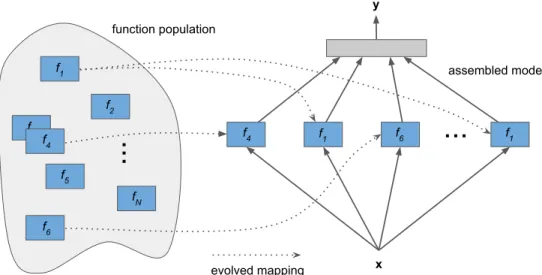
2.1 Functional View of SANE. This figure gives an overview of the SANE (Symbiotic Adaptive Neuroevolution) architecture (Moriarty & Miikkulainen, 1996). A set ofN functions is evolved (in practice, individual neurons), along with a set of blueprints, each of which specifies which function to use in each function location in a fixed architecture neural network. Blueprints receive fitness based on the performance of the assembled model, and fitness is percolated down to individual functions based on the performance of blueprints in which they are present. This architecture has been repeatedly shown to outperform evolution of a monolithic neural network representation, as well as many popular reinforcement learning methods. . . 20 2.2 Wide ResNet. As a relatively simple example of a
state-of-the-art deep architecture, this figure gives a graphical depiction of the Wide Residual Network architecture family (Zagoruyko & Komodakis, 2016). Functions containing trainable parameters are shown in blue. The architecture contains three groups Gi of N residual blocks Bi1, . . . , BiN. In turn, each block contains a pair of batch normalization layers, ReLU activation layers, and 2D convolutional layers, as well as a short-cut connection that allows information to pass through the block untouched. This example illustrates key features of modern neural network architectures: depth, modular design, shortcut connections, and various standard layer types. . . 26 2.3 LSTM Architecture. This figure gives a functional depiction
of the standard LSTM architecture. In this figure, xt is the input, ht is the output, and ct is the cell state, or memory, at thetth timestep. Functions in blue contain trainable parameters.
denotes elementwise addition, and ⌦ denotes elementwise multiplication, which enables the implementation of gates, for deciding how much to read from, update, and forget memory state. The construction of these gates rely on learning four functions f1, f2, f3, f4, which are implemented as fully-connected layers of equal shape. Dotted arrows indicate the recurrence induced by applying this function iteratively over many time steps. The LSTM architecture serves to illustrate the kinds of modular designs arising from humans manually encoding knowledge about the world. . . 29
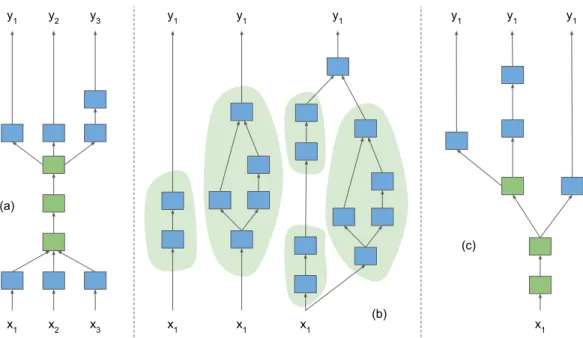
2.4 Three Paradigms that Train Multiple Deep Models. This figure gives a high-level view of three classes of methods that involve training multiple deep models. (a) Joint training of mod-els for multiple tasks trains a distinct model for each task, and these models can share some of there trained parameters, e.g., through shared layers (shown in green). This is the foundational setup considered in this dissertation; (b) Separate training of multiple models for a single task trains several disjoint models with the goal of finding a single best model for one task; reused topological discoveries are circled in green. Such model search techniques are used in this dissertation for learning how to better share learned structure; (c) Joint training of multiple models for a single task trains several models for a single task that share parameters (again shown in green), on the way to finding a single best model for that task. This third class of methods provides a bridge between a and b, motivating the development of techniques that combine their advantages to discover more general neural network modules. . . 34 2.5 Classes of existing deep multitask learning architectures.
(a)Classical approaches add a task-specific decoder to the output of the core single-task model for each task; (b) Column-based approaches include a network column for each task, and define a mechanism for sharing between columns; (c) Supervision at custom depths adds output decoders at depths based on a task hierarchy; (d) Universal representations adapts each layer with a small number of task-specific scaling parameters. Underlying each of these approaches is the assumption of parallel ordering of shared layers (Section 6.2): each one requires aligned sequences of feature extractors across tasks. . . 39 3.1 Pseudo-task Decomposition. Model M, for the underlying
task {xi,yi}Ni=1, induces a pseudo-task solved by a function f. The block E is an encoder that provides input to f, and D
is a decoder which uses the output of f to produce the final prediction. If f is e↵ective for many [task, encoder, decoder] combinations, then it demonstrates generic functionality. . . 47 4.1 The GRUSM-ESP architecture, showing the balance between
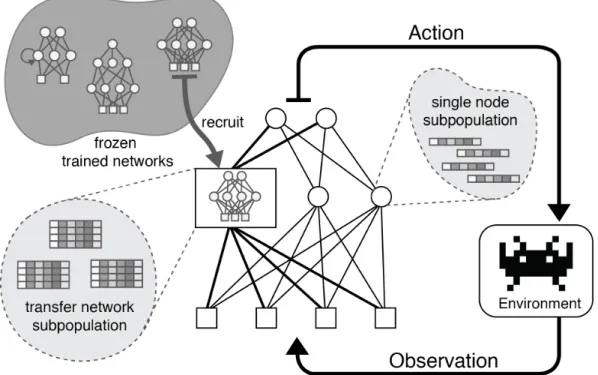
reused and new structure. In this example, the target network has three recruits: one source network, and two single nodes. Each bold edge between target network nodes and source network recruit indicate connections to multiple source nodes. The genome in each subpopulation encodes weight information for the connections from and to the corresponding recruit. . . 69
4.2 (left) Feature representation for each game, and (right) games partially-ordered by feature inclusion: every path from none to
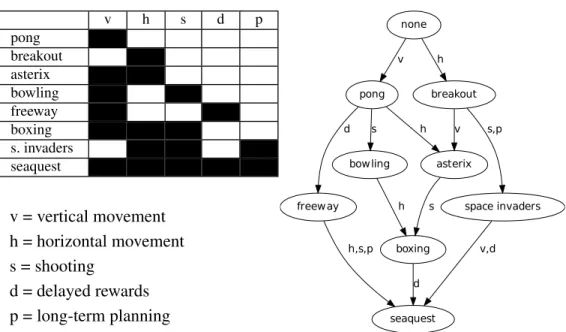
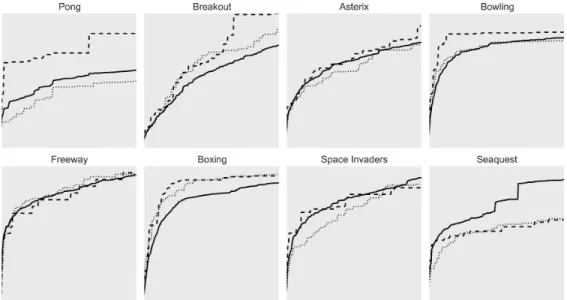
g contains along its edges each complexity feature of g exactly once, showing how games are related across the feature space. The existence of such a hierarchy motivates the use of atari for transfer. . . 73 4.3 Raw mean score learning curves by generation for each target
game aggregated over transfer(solid), random (dashed), and
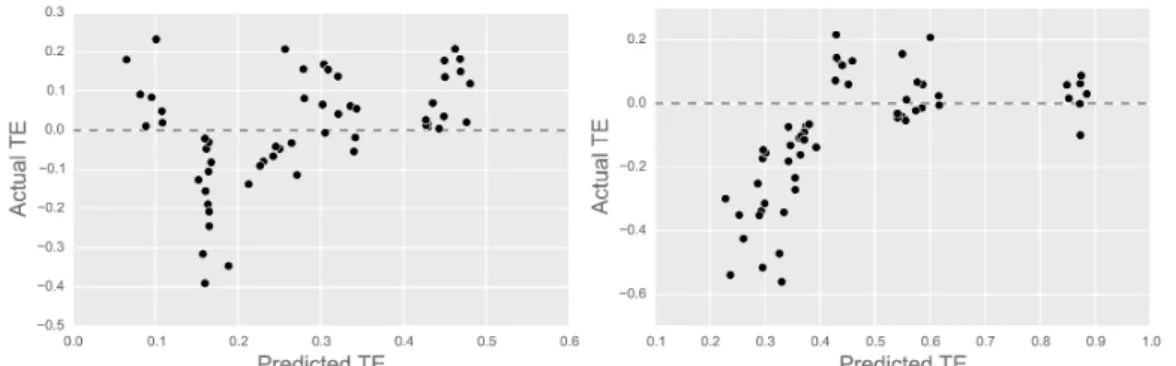
scratch (dotted) setups. The diversity of these learning curves shows the difficulty in comparing performance across games. . 75 4.4 Predicted vs. actual transfer e↵ectiveness with respect toscratch
(left) and random (right). Both predictors have a significant cor-relation between predicated and actual transfer e↵ectiveness. . 76 4.5 Transferability graphs over all pairs of tasks with respect to
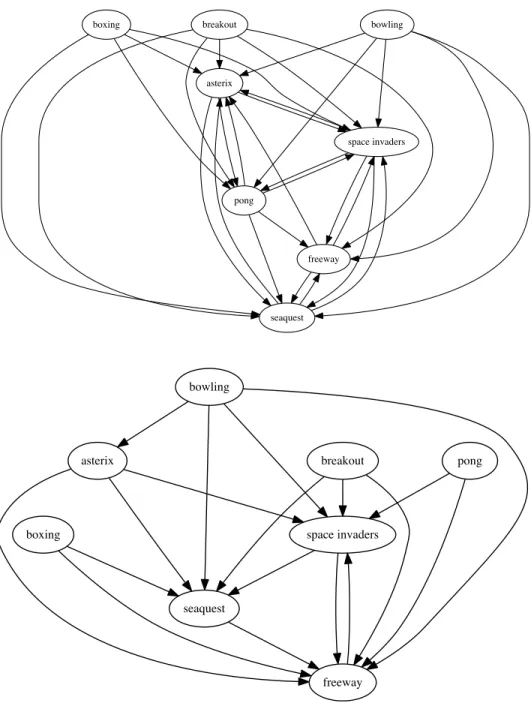
scratch (top) and random (bottom) illustrating the target-centric clustering of successful source-target pairs. Each graph includes a directed edge fromg1 tog2 () the TE (see Analysis) for g2 reusing g1 is positive. . . 77 5.1 General setup for pseudo-task augmentation with two tasks.
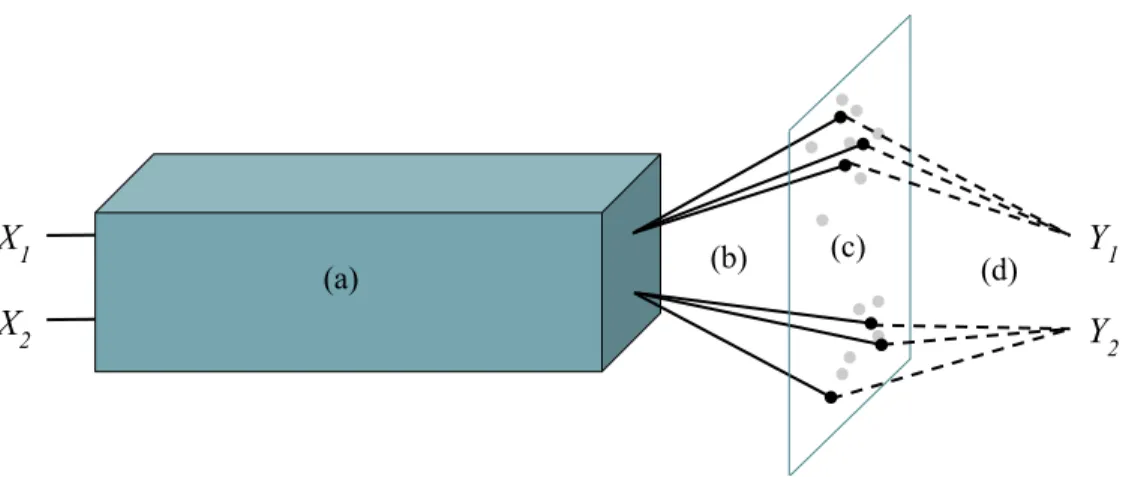
(a) Underlying model. All task inputs are embedded through an underlying model that is completely shared; (b) Multiple decoders. Each task has multiple decoders (solid black lines) each projecting the embedding to a distinct classification layer; (c) Parallel traversal of model space. The underlying model coupled with a decoder defines a task model. Task models populate a model space, with current models shown as black dots and previous models shown as gray dots; (d) Multiple loss signals. Each current task model receives a distinct loss to compute its distinct gradient. A task coupled with a decoder and its parameters defines a pseudo-task for the underlying model. . . 86 5.2 Omniglot single-task learning results. For each number of
decoders D, mean improvement (absolute % decrease in error) overD= 1 is plotted for each setup, averaged across all tasks. All setups outperform the baseline. PTA-F and PTA-FP performs best, as this problem benefits from strong regularization. The mean improvement across all methods also increases with D: 1.86% for D= 2; 2.33% for D= 3; and 2.70% forD = 4. . . . 96
5.3 Omniglot multitask learning results. For each number of decoders D, mean improvement (absolute % decrease in error) across all tasks is plotted over STL with D = 1. All setups outperform the STL baseline, and all except PTA-I with D= 2 outperform the MTL baseline. Again, PTA-F and PTA-FP perform best, and the mean improvement across all methods increases with D: 3.63% forD= 2; 4.07% for D= 3; and 4.37% for D= 4. . . 97 5.4 Pseudo-task Trajectories. t-SNE (van der Maaten & Hinton,
2008) projections of pseudo-task trajectories, for runs of PTA-I, PTA-F, and PTA-HGD on IMDB. Each shape corresponds to a particular decoder; each point is a projection of the length-129 weight vector at the end of an epoch, with opacity increasing by epoch. The behavior matches our intuition for what should be happening in each case: (a) When decoders are only initialized independently, their pseudo-tasks gradually converge; (b) when all but one decoder is frozen, the unfrozen one settles between the others; (c) when a greedy method is used, decoders perform local exploration as they traverse the pseudo-task space together. 100 5.5 CelebA dropout schedules. The thick blue line shows the
mean dropout schedule across all 400 pseudo-tasks in a run of PTA-HGD. Each of the remaining lines shows the schedule of a particular task, averaged across their 10 pseudo-tasks. All lines are plotted with a simple moving average of length 10. The diversity of schedules shows that the system is taking advantage of PTA-HGD’s ability to adapt task-specific hyperparameter schedules. . . 102 6.1 Fitting two random tasks. (a) The dotted lines show that
permuted ordering fits n samples as well as parallel fits n/2 for linear networks; (b) For ReLU networks, permuted ordering enjoys a similar advantage. Thus, permuted ordering of shared layers eases integration of information across disparate tasks. 113 6.2 Soft ordering of shared layers. Sample soft ordering
net-work with three shared layers. Soft ordering (Eq. 6.7) generalizes Eqs. 6.2 and 6.3, by learning a tensor S of task-specific scaling parameters. S is learned jointly with the Fj, to allow flexible sharing across tasks and depths. The Fj in this figure each include a shared weight layer and any nonlinearity. This archi-tecture enables the learning of layers that are used in di↵erent ways at di↵erent depths for di↵erent tasks. . . 115
6.3 MNIST results. (a) Relative performance of permuted and soft ordering compared to parallel ordering improves as the num-ber of tasks increases, showing how flexibility of order can help in scaling to more tasks. Note that cost savings of multitask over single task models in terms of number of trainable parameters scales linearly with the number of tasks. For a representative two-task soft order experiment (b) the layer-wise distance be-tween scalings of the tasks increases by iteration, and (c) the scalings move towards a hard ordering. (d) The final learned relative scale of each shared layer at each depth for each task is indicated by shading, with the strongest path drawn, showing that a distinct soft order is learned for each task (• marks the shared model boundary). . . 118 6.4 UCI results. Mean test error over all ten tasks by iteration.
Permuted and parallel order show no improvement after the first 1000 iterations, while soft order decisively outperforms the other methods. . . 120 6.5 Omniglot results. (a) Error by number of tasks trained jointly.
Soft ordering significantly outperforms single task and both fixed ordering approaches for each number of tasks; (b) Distribution of learned layer usage by depth across all 50 tasks for a soft order run. The usage of each layer is correlated (or inversely correlated) with depth. This coincides with the understanding that there is some innate hierarchy in convolutional networks, which soft ordering is able to discover. For instance, the usage of Layer 3 decreases as the depth increases, suggesting that its primary purpose is low-level feature extraction, though it is still sees substantial use in deeper contexts; (c) Errors with all 50 tasks for di↵erent training set sizes. The first five methods are previous deep MTL results (Yang & Hospedales, 2017), which use multitask tensor factorization methods in a shared parallel ordering. Soft ordering significantly outperforms the other approaches, showing the approach scales to real-world tasks requiring specialized components such as convolutional layers. . . 122 6.6 CelebA results. Layer usage by depth (a) without and (b)
with inclusion of the identity layer. In both cases, layers with lower usage at lower depths have higher usage at higher depths, and vice versa. The identity layer almost always sees increased usage; its application can increase consistency of representation across contexts. (c) Soft order models achieve a significant improvement over parallel ordering, and receive a boost from including the identity layer. The first two rows are previous work with ResNet-50 that show their baseline improvement from single task to multitask. . . 126
7.1 High-level algorithm outlines of the two algorithms introduced in this Chapter. CTR evolves custom routings for each task on a single GPU by interleaving evolution and backpropagation; CMTR coevolves the architectures of the modules themselves, evaluating them in parallel by training with CTR in an inner loop. . . 134 7.2 This figure shows an instance of CTR with three tasks and four
modules that are shared across all tasks. Each individual as-sembles the modules in di↵erent ways. Through gradient-based training, individuals exploit the shared resources to compete within a task, and over time must develop mutualistic relation-ships with other tasks via their use of the shared modules. . . . 141 7.3 Comparison of fitness over number of meta-iterations of training
for CTR and CMTR. Evolution discovers modules that leverage the available training better, forming a synergy of the two processes.145 7.4 Structures of the best module set discovered by CMTR. The two
species in CMTR evolve very di↵erent modules: one simple and one complex. The thick boxes represent convolutional, medium max pooling, and thin dropout layers, with hyperparameters listed on the left. This complementarity would be difficult to develop by hand, demonstrating the power of evolution in designing complex systems. . . 147 7.5 Structures of the best routing topologies discovered by evolution.
The routing topologies represent a range from simple to complex; similar alphabets have similar topologies, and the structure is consistently found. Again, such useful diversity would be difficult to develop by hand, demonstrating the power of evolution in designing complex systems. . . 148 7.6 Visualization of CTR topology embeddings. This figure
shows a t-SNE projection (van der Maaten & Hinton, 2008) of the featurization of evolved topologies from a run of CTR on all fifty Omniglot tasks, colored according to geography (including Invented alphabets in orange). Although the evolutionary pro-cess does incur significant noise, there is still evident structure. For example, the North American alphabets are o↵ to the left, the Invented languages are towards the top, while the Asian languages are towards the bottom. Such structure is intriguing, since alphabets tend to develop incrementally by region and across regions, while CTR can incrementally exploit knowledge accumulated across alphabets. . . 150
7.7 Visualization of CTR visual embeddings. This figure shows a t-SNE projection of alphabets as in Figure 7.6, but using visual embeddings for each alphabet produced via MobileNet, in-stead of using embedding derived from evolved topologies. This projection has a structure similar to that in Figure 7.6, although both European and Indian alphabets are more tightly grouped. Overall, the organization is similar to that of 7.6, demonstrating that similar topologies are discovered for similar alphabets. . . 151 8.1 Hypermodule Parameter Generation. The parameters of
a parameter block B` are generated by applying a hypermodule Hk to the block’s context vector z`. The blocks parameters are generated as the 1-mode (vector) product of the hypermodule and the context. That is, instead of learning all of its parameters independently, the block gets its parameters by tuning a generic module to this particular location. . . 158 8.2 Competition Between Hypermodules. This figure depicts
the competition between hypermodules for being selected for a particular location, i.e., to parameterize a particular block B within weight matrix W in the original model. Here, z is the context vector associated with B which is mapped to candi-date parameter blocks by hypermodules q(`). These candidate blocks are mixed by a soft sum based on the model’s belief that each hypermodule is the best for this location out of the current
Q+ 1 options. . . 176 8.3 Grouping Convergence. This figure shows the convergence of
the mapping to the correct underlying grouping for the noiseless version of the synthetic dataset. The group score for a task is 0 if its hypermodule is used by no other tasks; 1 if it is used by at least one other task and all such tasks are in its underlying group; and -1 otherwise, i.e., if the task uses the same hypermodule as a task not in its true group. The total grouping score is the sum over all task scores. Thus, the maximum possible score is 30. In this problem, evolution quickly converges to the optimal grouping and remains there indefinitely. Likewise, the number of hypermodules used by the system quickly converges to 3, the true number needed. . . 185 8.4 Visualizing Convergence. This series of images shows the
progression of convergence of on the synthetic dataset. Each color corresponds to a distinct hypermodule. The color shown at each location is the hypermodule currently in use for that task. At generation 59 and beyond, the model remains at the optimal solution indefinitely. . . 186
8.5 Scale-up 2 Performance Summary. This figure shows the performance in each task across a chain of comparisons with increased module sharing. For each plot, a lower score is bet-ter, i.e., classification error, perplexity and mean squared error (MSE). Interestingly, CIFAR performs worse during cross-modal sharing, while both Wikitext and CRISPR perform better when-ever they share with CIFAR. This may be because WideResNet contains a higher diversity of pseudo-tasks than the other two models, which provides greater opportunity for improving the other tasks, but also is more difficult to optimize. Overall, the ability of MUiR to improve performance, even in the intra-task case, indicates that it is able to exploit underlying regularities across pseudo-tasks. . . 198 8.6 Module Sharing Over Time. The number of modules shared
by each subset of the tasks is shown for a single run of multitask evolution. The total number of modules used is the sum over all these sets. Interestingly, the number of modules used by the CRISPR module alone quickly becomes very small, while the number used by CIFAR and Wikitext stays relatively large. Overall, the number of distinct active modules in each of subsets stabilizes as is optimized. . . 199 8.7 Emergence of a Supermodule. The number of locations in
which the most used hypermodule is used is shown over time for a single evolutionary run. Remarkably, a supermodule emerges that quickly spreads to dominate a significant fraction of the locations in the entire model. The fact that so much of the joint model can be parameterized by this single hypermodule suggests that there is a surprisingly regular structure across block pseudo-tasks. The reparameterization only requires assistance from a relatively small number of more specific hypermodules to yield good performance on each task. . . 200
Chapter 1
Introduction
To efficiently construct complex solutions to difficult problems, real-world general problem-solvers rely onfunctional modules. Each such module is a tool specialized to solve a particular class of problems or subproblems. For example, individual humans specialize into distinct roles in social organizations, and, at one level lower, each human refines their own set of complementary skills. In both cases, an e↵ective set of modules is discovered through the experience of solving many diverse problems. That is, these sets are refined and reorganized based on performance, in order to maximize system generality while maintaining efficiency. Importantly, this implies that, through such refinement, improved performance on one task can lead to improved performance on another, even if the tasks are seemingly unrelated.
Consider predicting the onset of a rare disease. There is a shortage of data for this particular disease, but a specialist doctor has honed a set of diagnosis techniques on related diseases, and can adapt these for a best guess. Her more general medical abilities, developed in school and rotations, should also lead to insights. Further, beyond medicine, any challenging task from her life could help, e.g., competitive Judo, since through it she sharpens her
general problem-solving skills. A machine with such functional modularity could search for insight on a much broader scale. Modules trained to accurately diagnose related diseases should provide a good starting point, and solutions to any medical task could lead to insight, through their assessment of the human condition. Further, solving a seemingly unrelated task, like predicting the sentiment of Tweets, could lead to more accurate diagnoses, i.e., if modules discovered for sentiment prediction generalize well to medical applications.
Though it may not be obvious how diseases and Tweets are related, such generalization yields practical benefits today. For example, advances in neural networks for sequence processing, originally developed for speech and natural language, are successfully repurposed for genomics and heart-monitoring tasks. The generic formulation of such machine learning techniques enables rapid experimentation and modular recombination for new problems. However, this methodological modularity cannot integrate knowledge across tasks as deeply as biological or social problem-solvers. The standard toolbox of machine learning techniques is refined by humans, but complex solutions to multiple problems may contain powerful generic modules that are difficult for humans to discover. This dissertation develops an approach to automatically discover such modules.
1.1
Motivation
The field of machine learning is naturally well-suited to take advantage of the modular approach. The success of machine learning is grounded in a relatively small set of standard functions, which can be applied in a modular
fashion to a broad array of problem areas. Such functional modularity appears to be a requirement for general problem-solving systems in the real world. It supports flexibility, adaptivity, and efficiency over what would be possible with a monolithic system. For example, doctors would be mentally slower and less energy-efficient if they had to activate their entire brain uniformly to solve every new problem that came their way. At a higher level, large consulting firms would be slower and less efficient if they could not quickly assemble project pipelines out of specialized human teams.
The general e↵ectiveness of machine learning and these other problem-solving systems can be attributed to structural regularities shared across diverse problems. These shared regularities can be exploited by standardized modules, be they machine learning techniques, brain regions, or complete humans. The generality of a system is then determined by the breadth of application of its modules. In machine learning, multi-purpose modules are discovered by humans through experimentation, intuition, and analysis of semantic structural regularities across problems.
Multitask learning is a machine learning approach that improves gener-alization of models by automatically exploiting regularities that exist across a set of problems (Caruana, 1998). Regularities are exploited by sharing learned functionality across the models trained for each problem. In recent years, mul-titask learning has been extended to the realm of deep learning (Lecun et al., 2015), where the multitask approach has been used to complement the success of deep models across core areas of artificial intelligence, including computer
vision (Zhang et al., 2014; Bilen & Vedaldi, 2016; Misra et al., 2016; Rudd et al., 2016; Lu et al., 2017; Rebuffiet al., 2017; Yang & Hospedales, 2017), natural language processing (Collobert & Weston, 2008; Dong et al., 2015; Liu et al., 2015a; Luong et al., 2016; Hashimoto et al., 2017), speech processing (Huang et al., 2013; Seltzer & Droppo, 2013; Huang et al., 2015; Wu et al., 2015), and reinforcement learning (Devin et al., 2016; Fernando et al., 2017; Jaderberg et al., 2017b; Teh et al., 2017). The regularities discovered by deep multitask learning are encoded in high-dimensional tensors of learned parameters that are shared across models. These regularities exist at a subsymbolic level, and thus could not be discovered by humans through methodological development.
However, like a human-developed toolbox, trained deep models are inherently modular. Decomposing the computational graph of a deep model into subgraphs yields a module corresponding to each of these subgraphs. Thanks to the flexible compositional structure of neural networks, these subgraphs can in principle be used for multiple purposes. Thanks to its generic training scheme, deep multitask learning can be used to learn these modules and evaluate them for each purpose. Thus, deep multitask learning is a well-motivated approach for discovering multi-purpose modules.
Existing deep multitask learning approaches focus on discovering multi-purpose, monolithic feature extractors. Improving feature extraction is a core goal of deep learning (Lecun et al., 2015), but restricting multitask learning to sharing of this kind significantly constrains the kinds of functional regularities that can be discovered. In contrast, a more directly modular approach to deep
multitask learning could discover generic functionality that monolithic systems and humans cannot. This modularity would lead to more flexible, higher-performing solutions that could be applied across the many deep learning application areas, and would align more closely with how functionality is organized in the real world.
1.2
Challenges
The pursuit of multi-purpose modules through deep multitask learning raises three key challenges that any practical method will have to address if it is to achieve the flexibility, adaptability, and efficiency that the modular approach promises. These challenges arise from the questions of module form,
module assembly, and module generality.
First, the form of constituent modules will be integral to the design of the system. The natural definition of a deep learning module as a computational subgraph is so broad that it includes modules defined by individual learned parameters all the way up to modules that encompass the entire model for a task. By specifying the set of subgraphs that constitute modules, a system implies what scale of modularity it is looking for, and what kinds of modules it can discover. For example, in the deep learning setting, it is natural to define a module by a networklayer; indeed, this is one of the approaches taken in this dissertation. As two more examples, existing deep multitask learning approaches define modules at the level of feature extractors, while some modular neuroevolution approaches, such as SANE (Moriarty & Miikkulainen, 1996) and
ESP (Gomez & Miikkulainen, 1997), define modules at the level of individual neurons. Finding a practical balance in scale is a key challenge: if modules are too simple, they may not be expressive enough to capture interesting regularities; if they are too complex, they approach the monolithic case, where it may be difficult for them to adapt to diverse purposes.
Second, the system will require a method that determines how modules are assembled into complete models for each task. From the multitask learning perspective, this is the question of how to share learned structure across tasks. How to assemble modules is related to the problem of designing deep learning architectures. Designing deep models for a single task is already a challenging problem that is being approached with automated techniques, since the complexity of many modern architectures is beyond what humans can design manually. Designing architectures that support multiple tasks adds another level of complexity to the problem, and determining which modules to use at which location in such an architecture complexifies things further. A key challenge of any system is to pair a space of possible constructions with a practical method for discovering e↵ective constructions within this space. For example, in a very restricted assembly space, finding optimal constructions in this space may be easy, at the cost of diminishing the upper bound of system performance.
Third, and most importantly, a successful system must force resulting modules to be generic. In the trivial case, each module is used for only a single purpose and the system collapses to a standard deep learning model.
This collapse can be avoided by ensuring that modules are trained for multiple purposes, i.e., to solve sets of distinct pseudo-tasks (Chapter 3). Again, the potential of the system is determined by the scale of generality that can emerge. For example, a set of modules in which each solves only a small set of similar pseudo-tasks will be inherently less general than a set of modules in which each solves a large diverse set. To that end, one of the grand challenges of multitask learning is to successfully exploit regularities across seemingly disparate problems. In such a setting, there may be no intuitive way to construct fixed multitask architectures, so a more general and automated approach is required. In the case of diverse tasks, and even when tasks are apparently similar, care must always be taken to avoid negative transfer, i.e., when well-intentioned sharing of structure actually ends up reducing performance. Such degradation can occur when a module is trained to support more functionality than it is capable of expressing. The module may indeed be generic, in that it provides value for a diverse set of applications, but its value for each of those applications may be suboptimal. Enabling discovery of highly generic modules while avoiding negative transfer is thus a key challenge.
1.3
Approach
To solve these challenges of module form, assembly, and generality, the approach taken in this dissertation is built out from the deep multitask learning framework. First, this framework is generalized to provide a more unified perspective of how neural network modules can be trained for multiple
purposes. These multiple purposes are formalized as pseudo-tasks. Within this framework, a progression of six learning systems is presented. Through this progression, the generality of modules is expanded, leading to practical solutions to module form and assembly at each step along the way. The progression proceeds by (1) testing the inherent generality of single modules; (2) improving the generality of single modules; (3) increasing the number of
modules and breadth of generality; (4+5) scaling this generality to complex automatically-designed architectures; and (6) scaling this generality across diverse architectures and problem areas. Together, these systems constitute a comprehensive approach of how deep multitask learning can be used to discover multi-purpose modules.
The first system, General Reuse of Static Modules (GRUSM), is designed to answer the question: How general are trained modules inherently, i.e., when trained for a single purpose? In this system, a module trained initially for one purpose in a single task is reused as is, i.e., without modifying its parameters, for a di↵erent purpose at a di↵erent depth in another task. A concrete implementation is developed that uses a coevolutionary flavor of neuroevolution, ESP (Gomez & Miikkulainen, 2003), to train modules and incorporate them into new locations. The implementation, GRUSM-ESP, is evaluated in general video game playing, where each task corresponds to a game. In the experiments, reused modules take the form of a single layer of weights (of adaptable dimension). The results show that sometimes modules generalize well, sometimes they do not, and that this transferability can be
predicted based on task characteristics. In particular, the modules trained in more complex tasks tend to generalize better. This makes sense, since modules that support more complex functionality will naturally contain more information that can be exploited. However, predicting module generalization is not as strong a tool as training more general modules in the first place.
With this knowledge that neural network modules have the potential to generalize across diverse purposes, the question is: How can they be forced to generalize better? The second system, Pseudo-task Augmentation (PTA), approaches this question from the foundational case where there is a single module that is simultaneously trained for many purposes. This module is a generic encoder with an arbitrary fixed topology, which is shared across all tasks and trained by gradient descent, as in classical deep multitask learning. To make this encoder more general, it is forced to solve each task in multiple distinct ways, by training it with multiple decoders for each task; each decoder defines a distinct pseudo-task. Training with additional pseudo-tasks is theoretically shown to expand the training dynamics of gradient descent. Methods are then introduced that interleave gradient descent with a coevolutionary process that controls pseudo-tasks to improve generalization. By increasing the number of ways a single core module is used, PTA is shown to improve performance across an array of deep models, including achieving state-of-the-art results on the CelebA multitask facial attribute recognition dataset.
With this knowledge that training a module in more ways can improve its generality, the question is: How far can this idea be taken? The third
system, soft ordering, takes this idea to the extreme: Each layer in a deep architecture constitutes a module, and all modules are trained simultaneously across all possible locations in all tasks in a fixed architecture. Thus, each module must support functionality everywhere to some extent. At each lo-cation, the system learns a mixture of modules used at that lolo-cation, while simultaneously learning the parameters of the modules themselves, and the complete optimization is performed end-to-end using gradient descent. The method is evaluated in vision and non-spatial domains, using convolutional and fully-connected layers, and demonstrates improvements over single-task and shared feature extractor approaches, including outperforming state-of-the-art deep multitask learning approaches on Omniglot multitask character recog-nition. Visualizations indicate that modules are indeed learning functional primitives, whose behavior is tuned to match the needs of particular contexts. These results suggest that simultaneously training modules for many kinds of purposes across multiple tasks is a promising approach to discovering a compact set with generic functionality.
However, the soft ordering method does not scale well, because all modules are executed at each location in the joint model during each forward and backward pass. Scaling this approach requires a way to automatically select which module to use at each location during training. In the remaining three systems, such selection methods are used to scale soft ordering in two orthogonal directions: (1) to more complex multitask architectures discovered by neural architecture search; and (2) to sharing across diverse classes of
architectures and task modalities. The fourth and fifth systems follow the first of these directions, and the sixth follows the second.
The fourth system, Coevolution of Task Routing (CTR), uses evolution to discover where each module should be applied, and uses gradient descent to train their parameters. That is, evolution and gradient descent are interleaved in a manner similar to PTA. In CTR, starting from a minimal architecture for each task, evolution expands its use of modules incrementally so that the correct amount of complexity can be achieved. Modules in CTR can also take on more generic functionality than in soft ordering, since evolution discovers di↵erent kinds of architectures for di↵erent tasks, so modules are trained for more diverse pseudo-tasks. Two new key mechanisms make the system practical: (1) All candidate models for all tasks are trained jointly, so module semantics are preserved across generations; and (2) task architectures are coevolved, allowing more efficient optimization of the multitask architecture. In experiments, this system demonstrates marked improvement over soft ordering.
The fifth system, Coevolution of Modules and Task Routing (CMTR), is a direct generalization of CTR, in which modules are no longer restricted to being single neural network layers. In this system, along with the optimization of how modules are assembled for each task, the topologies of the modules themselves are optimized. Module topologies are optimized in an outer loop around CTR, using a variant of CoDeepNEAT (Miikkulainen et al., 2017), a popular evolutionary architecture search algorithm, which in turn is incremental, coevolutionary, and explicitly modular. By making module topologies more
flexible, CMTR yields significant improvements over CTR.
Though they improve performance in many settings, PTA, soft ordering, CTR, and CMTR cannot be used to share modules across modalities, i.e., when the data for di↵erent tasks have a fundamentally di↵erent structure, for example, vision vs. language. This restriction arises because, in these approaches, modules are defined as layers or graphs of layers, so they can only be applied where their input-output specification is satisfied, both technically and semantically. For example, the spatial semantics of a 2D convolutional layer are lost when applying this layer to non-spatial input.
The sixth system, Modular Universal Reparameterization (MUiR), over-comes this restriction. It supports sharing of modules across arbitrary deep architectures and task modalities, allowing regularities to be exploited across diverse problem areas. This system decomposes the parameters of a given archi-tectures for a set of tasks into a set of equally-sized linear maps. The parameters of each map are then generated by ahypermodule, which reduces the parameters to a small number of degrees of freedom. Hypermodules generalize the modules of the other systems by allowing each module to be marginally tuned for di↵erent purposes. This flexibility can be especially valuable when applications are highly diverse. The mapping of modules to locations is optimized in a manner similar to CTR, incrementally increasing sharing by interleaving gradi-ent descgradi-ent and evolution. However, for this system, coevolution of assembly occurs not across tasks, but across all module locations, i.e., across all pseudo-tasks. Coevolving at this level yields theoretically-grounded speedups that are
especially helpful when the number of pseudo-tasks is large. Coevolution is implemented with a surrogate fitness function that uses the mixture-learning mechanism of soft ordering. Experiments demonstrate intriguing dynamics of MUiR, including positive sharing across tasks with fundamentally di↵erent modalities, and the emergence of surprising sharing behaviors. Importantly, by supporting sharing of modules across modalities, MUiR is especially valuable when a task with a new modality arises with only a small amount of data, for example, with temporal data collected from a new kind of geosensor, or a rare disease detectable by data from a new kind of medical device. In such a case, MUiR can boost models for the new modality by harnessing generic functionality discovered from vast datasets and problem repositories for more common modalities.
Since modules can now be shared across diverse architectures and modalities, and improved by optimizing their topologies and the topologies in which they are applied, a natural extension would be to combine these features in an approach that optimizes cross-modal architectures to make modularity even more e↵ective. Such an approach would be a straightforward unification of CMTR and MUiR, and is left for future work.
Overall, by progressively increasing module generality, and developing practical methods for assembling modules of various forms along the way, these six systems verify the value of the deep multitask learning approach to discovering multi-purpose modules at a level that humans cannot. These developments provide a foundation for developing future systems that combine
their advantages towards a fully-general and robust module discovery algorithm that continuously refines itself to efficiently construct high-performing solutions to a broad range of critical real-world applications.
1.4
Guide to the Reader
The remainder of this dissertation is organized as follows:
Chapter 2 covers the foundations for the methods developed in this dissertation, including neuroevolution, deep learning, multitask learning, other forms of parameter sharing.
Chapter 3 introduces the framework that formalizes modules serving multiple purposes as functions solving pseudo-tasks, and discusses design choices that must be considered when developing a system within the framework, along with methods for evaluating such systems.
Chapters 4-8 describe the six systems, including their development, implementation, and evaluation: Chapter 4 covers General Reuse of Static Modules; Chapter 5 covers Pseudo-task Augmentation; Chapter 6 covers soft ordering of shared layers; Chapter 7 covers Coevolution of Task Routing, along with Covevolution of Modules and Task Routing; and Chapter 8 covers Modular Universal Reparameterization.
Chapter 9 reviews the systems and their applications, discusses tradeo↵s that emerged, and promising avenues of future work, including taking an explicitly ecological perspective, searching for modules o✏ine, and extending
the systems to the setting of lifelong learning.
Finally, Chapter 10 reviews the contributions of this dissertation and concludes that a modular approach to deep multitask learning is a practical paradigm for discovering highly generic functionality that goes beyond what is possible by humans.
Chapter 2
Background
This chapter reviews the foundations and related work for the framework and systems developed in the subsequent six chapters. First, two neural networks methodologies are reviewed: neuroevolution and deep learning. These methodologies provide powerful and well-established toolsets for developing systems that uncover functional modules. Then, multitask learning is reviewed, which provides the main problem definition considered in this dissertation. It is discussed alongside other methods that improve generalization by training multiple deep models. These methods set the background for the framework developed in Chapter 3, which enables discovery of multi-purpose functional modules by training and applying modules across di↵erent contexts.
2.1
Neuroevolution
Neuroevolution (Fogel et al., 1990; Yao, 1999; Floreano et al., 2008; Miikkulainen, 2016) is one approach to designing and training neural networks. It is grounded in methods of evolutionary computation (B¨ack et al., 1997; Eiben & Smith, 2003; De Jong, 2006), and was traditionally used to evolve the weights of fixed structure neural networks directly (Yao, 1999). The general framework
Algorithm 2.1 Generic Neuroevolution Framework
Initializepopulation of network representations from random distribution Forever:
Assemblerepresentations into functional networks
Evaluateall networks in task environment
Refine population by removing low performers
Generate new representations from top performers
for the classical neuroevolution algorithm is shown in Algorithm 2.1. The basic idea is to iteratively generate networks that have a high chance of success, by recombining the best networks found so far and discovering improvements in their local neighborhoods. The initialization step starts with a population that already covers some interesting and complementary areas of the search space. Theassembly step captures the fact that the substrate that is actually evolved may not be a functional network, but rather the data that describes it, e.g., the vector of its weights, or some more structured representation like that one seen in Figure 2.1. Theevaluate step is where the models are actually run on the task of interest, and their fitnesses assigned; this step can often be trivially parallelized for practical efficiency. The refine step focuses search on the most promising areas of the search space, and thegenerate step creates new individuals based on recombination and variation of current high performers. Neural networks are a good substrate for evolution, because they implement smooth functions and tend to encode redundant distributed information, so small changes to their weights tend not to break their functionality. This robustness stands in contrast to more brittle substrates, such as evolving rigid
physical structures.
Because it uses a population of neural networks is optimized simultane-ously, neuroevolution performs global search in the space of models. This allows it to avoid the pitfalls of local optima, which is an advantage over gradient descent. This feature is especially useful in the case of relatively small models, where such optima can occur frequently. Avoiding local optima is often also a big advantage in sequential decision-making problems, where it can be difficult for an agent to explore its way out of deceptive sinks in a complex environment (Lehman & Stanley, 2011a). Even in its most simple forms, neuroevolution is competitive with state-of-the-art deep reinforcement algorithms (Salimans et al., 2017; Such et al., 2017; Gaier et al., 2018), which is promising since it has been relatively underexplored.
Also in contrast to deep learning, training parameters through evolution does not require a di↵erentiable loss function for a task. Therefore, it can be used when no such natural loss function is available, as is the case in sequential decision-making problems. This general applicability makes neuroevolution especially adept at evolving thestructure, i.e., topology, of networks (Angeline et al., 1994; Vittorio, 1994; Stanley & Miikkulainen, 2002). Evolving on the single-neuron scale, starting with a minimal topology and incrementally complexifying over a run of evolution was shown to ease learning, especially in more complex domains (Gomez & Miikkulainen, 1997; Hausknecht et al., 2013; Schrum & Miikkulainen, 2016). Coevolution of neurons as the basic building block of neural networks also showed remarkable success, with canonical
examples being the ESP (Gomez & Miikkulainen, 1997, 1999, 2003) and SANE (Moriarty & Miikkulainen, 1996, 1997; Richards et al., 1998) algorithms.
SANE evolves a population of neurons, along with a population of
blueprints, each of which specifies which neuron to use at which location. Say the population of neurons fi is given by {f1, . . . , fN}, and the architecture has a single hidden layer of sizeH. Then, the complete model Mb for a given blueprintb :{1, . . . , H}!{1, . . . , N} is given by:
Mb(x) = ( H X
i=1
fb(i)) (2.1)
where is an optional nonlinearity, e.g., sigmoid, applied before the output. The performance of this model gives the blueprint its fitness, which is propagated down to neurons based on the blueprints in which they were included. A functional depiction of the SANE approach is given in Figure 2.1. By optimizing this set of useful modules which can be used by any blueprint in the population, SANE increases search efficiency, since this modular information is transmitted more quickly through the search process. In this approach, the size of the module population is larger than the number of modules used in each network, and each module is not expected to be used more than once in the final best model. The main purpose of the modularization is to accelerate optimization of a single task by sharing parameters throughout the population.
Evolving at a slightly higher level, coevolution of hierarchical modules discovers compact sets of modules with complementary functionality (Moriarty & Miikkulainen, 1998; Reisinger et al., 2004; Li & Miikkulainen, 2014). Related
x y
...
f4 f1 f6 f1 f1...
f2 f3 f4 f5 fN f6 function population assembled model evolved mappingFigure 2.1: Functional View of SANE. This figure gives an overview of the SANE (Symbiotic Adaptive Neuroevolution) architecture (Moriarty & Miikkulainen, 1996). A set ofN functions is evolved (in practice, individual neurons), along with a set of blueprints, each of which specifies which function to use in each function location in a fixed architecture neural network. Blueprints receive fitness based on the performance of the assembled model, and fitness is percolated down to individual functions based on the performance of blueprints in which they are present. This architecture has been repeatedly shown to outperform evolution of a monolithic neural network representation, as well as many popular reinforcement learning methods.
methods have also been used in cases where the modularity and reuse is more explicit at a higher symbolic level: to transfer learned functionality to more complex tasks (Whiteson et al., 2005; Taylor et al., 2007; Verbancsics & Stanley, 2010; Braylan & Miikkulainen, 2016), to reuse functionality across various modes of operation (Pugh & Stanley, 2013; Schrum & Miikkulainen, 2016; Huizinga & Clune, 2018), and to evolve controllers for modular teams of agents (D’Ambrosio et al., 2010; Nitschke et al., 2012; Bryant & Miikkulainen,
2018).
Recently, a similar class of modular methods has been adopted to evolve the architectures of deep models (Miikkulainen et al., 2017; Liu et al., 2018; Real et al., 2018). By taking advantage of the complementary advantages of deep learning and neuroevolution, these methods are able to scale automated design of neural networks to a broad range of real world problems, even breaking the benchmarks set by human design on the most battered largescale problem: ImageNet (Real et al., 2017, 2018). These methods will be reviewed further in Section 2.3.2. The evolutionary approaches developed in this dissertation operate at a similar scale.
Some of these architecture search methods, as well as other neuroevo-lution methods, rely oninterleaving evolution and training through gradient descent (Whiteson & Stone, 2006; Parker & Bryant, 2009; Real et al., 2017), combining the ability of evolution to explore a broad space of solutions and that of gradient descent to efficiently optimize around a current solution. From the analogy to natural evolution, this interleaving is an instance of Lamarckian evolution, in which individuals genetically transfer what they have learned to their o↵spring. Whatever the true magnitude of Lamarckian evolution in nature, in neuroevolution interleaving can provide substantial benefits to efficiency, and as such it is used in several of the systems developed in this dissertation.
Neuroevolution is one among many classes of evolutionary processes that solve complex problems by discovering functionality incrementally (Bonner,
1988; Iqbal et al., 2014). This feature makes evolution an appropriate tool for systems that iteratively improve how they use functional modules to solve mul-tiple problems, while refining the modules themselves. Evolutionary approaches also benefit from modern techniques from the evolutionary computation field that can be applied to any evolutionary system. One particularly useful class of techniques is behavioral methods, which optimize a population with respect to a higher-dimensional space of behaviors based on what a model actuallydoes in its task environment, as opposed to looking at the loss or fitness alone (Lehman & Stanley, 2011a; Mouret & Doncieux, 2012; Pugh et al., 2016; Meyerson & Miikkulainen, 2017). For example, novelty search (Lehman & Stanley, 2011a) evaluates individual networks based on how di↵erent their behavior is from that of other networks evaluated so far. More precisely, the fitness score of an individual is replaced by a novelty score, given by a density estimate in the behavior space: novelty(x) = 1 k k X i=1 d(b(x), b(yi)) (2.2) where b is a function that maps each individual to its behavior vector, d is some distance metric between behaviors (e.g., L2 distance), andyi is the ith nearest behavioral neighbor tox among the current population and an archive of previously evaluated individuals. Thus, by optimizing with respect to the novelty score, evolution will be driven to explore areas of the search space with behavior qualitatively di↵erent from anything seen before. Similar to discovering multi-purpose modules by solving diverse tasks, novelty search aims to discover powerful functionality by collecting diverse experiences. Related to
the multitask learning approach taken in this dissertation, there are existing approaches that takes advantage of data from multiple tasks to learn a better behavior function for neuroevolution (Meyerson et al., 2016). However, the shared knowledge discovered by these algorithms are stored in the evolutionary operators themselves, not neural network modules. Finally, apart from their benefit when included in optimization schemes, behavioral evolutionary methods have exhibited notable results in machine creativity (Secretan et al., 2008; Lehman & Stanley, 2011b; Nguyen et al., 2015; Lehman et al., 2018). Existing generic modules have been discovered through human creativity, so artificial creativity should be useful for machines to have the same success.
2.2
Deep Learning
For investigating the extent to which functionality can be generalized across diverse contexts, deep learning is a good option. Deep learning has emerged in recent years as the dominant approach for solving machine learning problems across a range of important subfields in artificial intelligence, including computer vision (Krizhevsky et al., 2012; Jia et al., 2014; Szegedy et al., 2016), natural language processing (Collobert & Weston, 2008; Suutskever et al., 2014; Zhang et al., 2015), speech recognition (Hinton et al., 2012; Graves et al., 2013; Chan et al., 2016), reinforcement learning (Mnih et al., 2015a,b; Lillicrap et al., 2015), and even more classical unstructured machine learning problems (Klambauer et al., 2017).
ma-chine learning due to their general applicability. The ability to approximate any function (Hornik et al., 1989), along with an efficient training algorithm (Rumelhart et al., 1986), and a plethora of successful applications (Fukuda & Shibata, 1992; Hussain, 1999; Christodoulou & Georgiopoulos, 2000), made neural networks a good option for many problems. That said, for many years, it was difficult to up neural networks to large, complex problems. Along with the dramatic increase in computational resources over the past few decades, several important ideas were recently introduced that made such scale possible. They include more principled parameter initialization (Glorot & Bengio, 2010; He et al., 2016) activation functions (Glorot et al., 2011; Klambauer et al., 2017), and optimization schemes (Tieleman & Hinton, 2012; Kingma & Ba, 2014). These optimization schemes are based on stochastic gradient descent (SGD), which moves the weights of any di↵erentiable function in the direction of steepest descent with respect to its current empirical loss. For a modelM
with parameters ✓M solving a task with N samples {(xi,yi)}Ni=1, this weight update step is given by
✓M :=✓M ↵ N N X i=1 r✓ML(M(xi;✓M),yi), (2.3) whereLis a di↵erentiableloss function indicating the distance of the prediction
ˆ
yi =M(xi;✓M) from the target yi, and↵ is the learning rate which controls how far the optimizer steps in the direction of the gradient. The algorithm for computing these gradients for arbitrary neural networks using the chain rule is known asbackpropagation (Rumelhart et al., 1986). Modern optimizers
are all variants of this basic iterative algorithm, but include some additional complexity, for example, in the form of momentum, learning rate decay, or adaptive per-parameter learning rates. Overall, the goal of optimization is to find✓?
M that minimizes the loss over the true distribution, or analogously,
maximizes the fitness of the model in its environment.
Now that reliable methods have been established, and powerful open-source tools have emerged for constructing and training deep networks, including Tensorflow (Abadi et al., 2015), PyTorch (Paske et al., 2017), Keras (Chollet et al., 2015), and CuDNN (Chetlur et al., 2014), a new standard level of abstraction has appeared at the level of layers and tensors. Instead of looking at neural networks at the neuron level, these tools view them more compactly as directed computational graphs in which each node is a potentially nonlinear tensor transformation. Each such tensor may contain thousands or millions of values. At this higher level there is a standard collection of building blocks that are chained together to form most deep models. Standard modules include the classic fully-connected layer, convolutional layers (Lecun & Bengio, 1995), recurrent layers (in particular, LSTM (Hochreiter & Schmidhuber, 1997)), attention blocks (Vaswani et al., 2017), residual blocks (He et al., 2016), and regularization functions such as dropout (Srivastava et al., 2014) and batch normalization (Io↵e & Szegedy, 2015). For example, the layer of neurons from a classical neural network has been abstracted into afully-connected layer or
dense layer function, given by the affine transformation