St. John Fisher College St. John Fisher College
Fisher Digital Publications
Fisher Digital Publications
Education Doctoral Ralph C. Wilson, Jr. School of Education
5-2018
MBA Student Expectations: MBA Online and MBA Classroom
MBA Student Expectations: MBA Online and MBA Classroom
Student Expectations for Leadership Skills Development in an
Student Expectations for Leadership Skills Development in an
MBA Program
MBA Program
Irene Galgan ScrutonSt. John Fisher College, [email protected]
Follow this and additional works at: https://fisherpub.sjfc.edu/education_etd Part of the Education Commons
How has open access to Fisher Digital Publications
benefited you?
Recommended Citation Recommended Citation
Scruton, Irene Galgan, "MBA Student Expectations: MBA Online and MBA Classroom Student
Expectations for Leadership Skills Development in an MBA Program" (2018). Education Doctoral. Paper 348.
Please note that the Recommended Citation provides general citation information and may not be appropriate for your discipline. To receive help in creating a citation based on your discipline, please visit http://libguides.sjfc.edu/citations.
MBA Student Expectations: MBA Online and MBA Classroom Student MBA Student Expectations: MBA Online and MBA Classroom Student Expectations for Leadership Skills Development in an MBA Program Expectations for Leadership Skills Development in an MBA Program
Abstract Abstract
Business schools are facing an increasingly challenging landscape because of growing institutional competition, resource limitations, and disruption created by online programs. The growth of online enrollments has impacted graduate business programs, which have the highest percentage of total graduate degrees conferred nationally. Research studies indicate students and employers have
expectations for an MBA program to develop students’ leadership skills. However, little research has been conducted to study student expectations for leadership skills development in online MBA programs. This quantitative research study surveyed 149 MBA students enrolled in an upstate New York public university to examine the expectations of MBA online students and MBA classroom students for developing leadership skills in an MBA program using a leadership competency framework. The results of an independent samples t test found no significant difference (p > .05) in expectations between online and classroom MBA students for the four leadership competency areas of behavior, knowledge, skills, and workstyles. Recommendations for graduate program decision makers include developing an expectation framework for leadership skills development to accommodate the diverse levels of experience students bring to MBA programs. Integrating hybrid experiences and classroom course techniques used for interpersonal skills development, such as coaching, into online courses is also recommended to meet student and stakeholder expectations for leadership skills development in MBA programs.
Document Type Document Type Dissertation Degree Name Degree Name
Doctor of Education (EdD) Department Department Executive Leadership First Supervisor First Supervisor Kim VanDerLinden Second Supervisor Second Supervisor C. Michael Robinson Subject Categories Subject Categories Education
MBA Student Expectations: MBA Online and MBA Classroom Student Expectations for Leadership Skills Development in an MBA Program
By
Irene Galgan Scruton
Submitted in partial fulfillment of the requirements for the degree
Ed.D. in Executive Leadership
Supervised by Dr. Kim VanDerLinden
Committee Member Dr. C. Michael Robinson
Ralph C. Wilson, Jr. School of Education St. John Fisher College
Copyright by Irene Galgan Scruton
Dedication
I dedicate this dissertation to my parents, Henry and Jane Galgan, who persevered through horrific circumstances of World War II in Poland, Germany, and Siberia to come to the United States, where they filled our family life with love, faith, and hope. They instilled in me the belief that you can achieve anything with the support of your family, hard work, a positive attitude, and education, and I am forever indebted to them. To my son, Brian, and “daughter,” Lindsie, you are both an inspiration. Thank you for each and every “you can do it” that you lovingly shared and for the ultimate gift of a grandson, Colin, just in time for “babcia’s” dissertation defense. To my companions, Kent and Bella, I am grateful for your faithfulness and patience through this doctoral journey.
I offer a very special thank you to Dr. Kim VanDerLinden, who I was blessed to have as my committee chair. You are an amazing mentor, who guided and shaped me through this scholarly voyage with grace, patience, challenge, humor, understanding, and remarkable clarity. Your belief in me and my research is at the core of this
accomplishment, and I am forever grateful to you. Thank you to Dr. Ed Engelbride for your kindness and guidance toward the final research topic.
To Dr. C. Michael Robinson, my fearless advisor and committee member, from the day we met and throughout the program, you have been a beacon of encouragement and optimism. Your leadership is a role model for making a difference. Thank you for faithfully lighting the way for me through this “process.”
On the front line of this entire journey, I was blessed with two angels, Melissa Arduini and Darlene Tynan. I am forever grateful for your unwavering support, laughter, kindness, and buckets of encouragement. Thank you, Nancy and Don Blair, for your steadfast friendship and scholarly knowledge. You saved many a day in this process. To my Barbara “angels,” my awesome sister, Barbara Dickson, and friends, Barb Stratton, Barb Stone, and Barb Krauza, thank you for your encouraging “check ins,” friendship, and loyal support of this adventure. Thank you to my Pisces friend, Michelle Keib, for your confidence that I would prevail, and to the Ridall family for your generous
friendship and offers of “time.” I am also grateful to the friends and colleagues who, on any given day, shared a word of positive encouragement along the way.
I would also like to thank Dr. Richard Skolnik, Dean of the School of Business; Dr. Mehran Nojan, Director of Research and Assessment; and Carey Hatch, at SUNY, for their support of my research. I also offer special thanks to the St. John Fisher faculty and staff, including Dr. Pulos, Dr. Evans, Dr. Bergman, and Betsy Christiansen, for their optimism and steady support. Lastly, I am grateful to my 18 extraordinary colleagues in Cohort 3. You were the glue and the special spark that fueled the road to completion. It was a privilege to share this extraordinary scholarly journey with you.
Biographical Sketch
Irene Galgan Scruton is Assistant Dean and Director of MBA Programs at the State University of New York (SUNY) at Oswego. She is also an adjunct faculty member in the School of Business, teaching graduate courses online in leadership and social entrepreneurship. Ms. Scruton has led the efforts for innovative MBA programming collaborations with corporations and within SUNY.
Ms. Scruton earned a Master’s degree in Business Administration from Syracuse University and a Bachelor of Science degree in Business Administration from the State University of New York at Buffalo. Ms. Scruton has held executive-level leadership positions in banking, the nonprofit sector, and government for 25 years prior to joining the SUNY Oswego School of Business. She is an engaged community leader, having held leadership positions on boards of directors for regional and state-wide nonprofit organizations. Ms. Scruton was appointed to the Inaugural Board of Directors for the Syracuse Regional Airport Authority from 2011 to 2017 and was chair of the governance committee. She is currently on the board of directors for a publicly traded manufacturer in the cable and satellite industry. Ms. Scruton began the Ed D. program in Executive Leadership at St. John Fisher College in the spring of 2015 and conducted her research under the supervision of Dr. Kim VanDerLinden and committee member Dr. C. Michael Robinson. Her research interests are focused on leadership development in graduate business programs and the social enterprise sector, online learning, and organizational
Abstract
Business schools are facing an increasingly challenging landscape because of growing institutional competition, resource limitations, and disruption created by online programs. The growth of online enrollments has impacted graduate business programs, which have the highest percentage of total graduate degrees conferred nationally.
Research studies indicate students and employers have expectations for an MBA program to develop students’ leadership skills. However, little research has been conducted to study student expectations for leadership skills development in online MBA programs. This quantitative research study surveyed 149 MBA students enrolled in an upstate New York public university to examine the expectations of MBA online students and MBA classroom students for developing leadership skills in an MBA program using a
leadership competency framework. The results of an independent samples t test found no significant difference (p > .05) in expectations between online and classroom MBA students for the four leadership competency areas of behavior, knowledge, skills, and workstyles. Recommendations for graduate program decision makers include developing an expectation framework for leadership skills development to accommodate the diverse levels of experience students bring to MBA programs. Integrating hybrid experiences and classroom course techniques used for interpersonal skills development, such as coaching, into online courses is also recommended to meet student and stakeholder expectations for leadership skills development in MBA programs.
Table of Contents
Dedication ... iii
Biographical Sketch ... v
Abstract ... vi
Table of Contents ... vii
List of Tables ... x List of Figures ... xi Chapter 1: Introduction ... 1 Problem Statement ... 3 Theoretical Rationale ... 7 Statement of Purpose ... 9 Research Questions ... 9
Potential Significance of the Study ... 10
Definitions of Terms ... 12
Chapter Summary ... 13
Chapter 2: Review of the Literature ... 15
Introduction and Purpose ... 15
Online Program Growth ... 15
Student Expectations ... 20
Chapter 3: Research Design Methodology ... 38
Introduction ... 38
Research Context ... 40
Research Participants ... 41
Instruments Used in Data Collection ... 42
Data Collection Procedures and Analysis ... 44
Summary ... 47
Chapter 4: Results ... 49
Research Questions ... 49
Data Analysis and Findings ... 50
Summary of Results ... 63 Chapter 5: Discussion ... 65 Introduction ... 65 Implications of Findings ... 68 Limitations ... 72 Recommendations ... 73 Conclusion ... 76 References ... 80 Appendix A ... 90 Appendix B ... 93 Appendix C ... 94 Appendix D ... 95 Appendix E ... 96
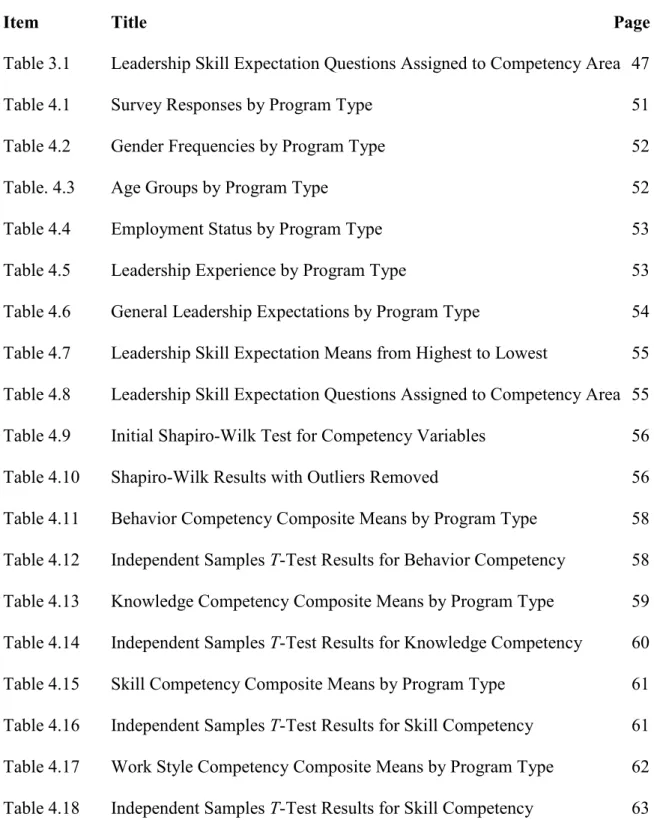
List of Tables
Item Title Page
Table 3.1 Leadership Skill Expectation Questions Assigned to Competency Area 47
Table 4.1 Survey Responses by Program Type 51
Table 4.2 Gender Frequencies by Program Type 52
Table. 4.3 Age Groups by Program Type 52
Table 4.4 Employment Status by Program Type 53
Table 4.5 Leadership Experience by Program Type 53
Table 4.6 General Leadership Expectations by Program Type 54 Table 4.7 Leadership Skill Expectation Means from Highest to Lowest 55 Table 4.8 Leadership Skill Expectation Questions Assigned to Competency Area 55 Table 4.9 Initial Shapiro-Wilk Test for Competency Variables 56
Table 4.10 Shapiro-Wilk Results with Outliers Removed 56
Table 4.11 Behavior Competency Composite Means by Program Type 58 Table 4.12 Independent Samples T-Test Results for Behavior Competency 58 Table 4.13 Knowledge Competency Composite Means by Program Type 59 Table 4.14 Independent Samples T-Test Results for Knowledge Competency 60 Table 4.15 Skill Competency Composite Means by Program Type 61 Table 4.16 Independent Samples T-Test Results for Skill Competency 61 Table 4.17 Work Style Competency Composite Means by Program Type 62 Table 4.18 Independent Samples T-Test Results for Skill Competency 63
List of Figures
Item Title Page
Chapter 1: Introduction
The annual growth of online education course enrollments in higher education for the last 10 years (since 2007) has created both opportunities and challenges for higher education leadership, faculty, and students. Online education, originally described as a disrupter to higher education (Christensen & Eying, 2011), is now a strategic component of academic offerings in higher education.
In 2014, at public and private institutions, 2.8 million students, or 14% of the total, took coursework exclusively online. At the graduate level, one in four students was enrolled in an online course (Allen, Seaman, Poulin, & Straut, 2016). The National Student Clearinghouse Research Center (NSCRC, 2015) reported that 25% of all graduate degrees conferred in 2014 were in business management disciplines, which include the Master of Business Administration (MBA) degree. Enrollments in online MBA programs in the United States experienced a 9% increase between 2011 and 2014 (National Center for Education Statistics [NCES], 2014).
Students enrolling in MBA programs have an expectation that the degree will support the development of leadership skills (Rubin & Dierdorff, 2011). According to a national survey of prospective MBA students conducted by the Graduate Management Admissions Council (GMAC, 2016a), students expected the MBA degree would lead to careers with responsibilities that allow for making an impact, making a difference, and solving world problems. Student expectations for leadership development in MBA
next generation of leaders (Benjamin & O’Reilly, 2011; Bruce, 2010; Gupta & Smith, 2007; Rubin & Dierdorff, 2013). The results of an international corporate recruiter survey found that the number one reason companies planned to hire MBA graduates in 2016 was to build the leadership pipeline in their organizations (GMAC, 2016c).
In concert with student and employer expectations for developing leadership skills in MBA programs is the recruitment messaging of graduate business schools. Starkey and Tempest (2008) found that leadership development is often communicated as an outcome a student can expect from enrolling in an MBA program. In an editorial essay directed to business school leaders and employers regarding expectations for leadership development in schools of business, Morrison (2003) concisely framed the issue with the statement that “leadership is our business” (p. 4).
Scholars have attempted to categorize leadership skills into frameworks or competency areas to identify the knowledge, skills, abilities, and attitudes that, if acquired or developed, enable individuals to be effective leaders (Kalargyrou,
Pescosolido, & Kalargiros, 2012; Mayo, Kakarika, Pastor, & Brutus, 2012; Mumford, Campion, & Morgeson, 2007; Teijeiro, Rungo, & Freire, 2013). In the context of graduate business programs, Dierdorff and Rubin (2006) and Dierdorff, Rubin, and Morgeson (2009) conducted empirical analyses of competencies using data from the U.S. Department of Labor Occupational Information Network (O*NET). Dierdorff and
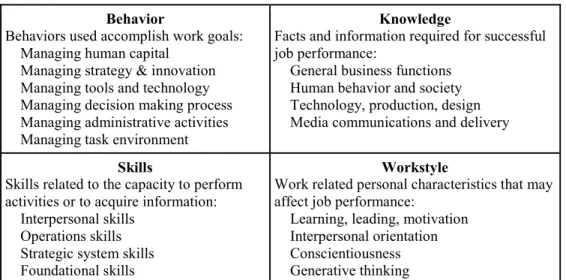
Rubin’s (2006) comprehensive study identified 18 skills required for managerial roles derived from employer responses to questionnaires related to the O*NET database. The researchers categorized the 18 skills into four competency areas labeled: behavior, knowledge, skills, and workstyle (Dierdorff & Rubin, 2006; Dierdorff et al., 2009).
The results of a national survey conducted by GMAC (2016a) indicated
prospective MBA students expressed expectations for leadership skills development in an MBA program. The GMAC report (2016a) also listed MBA program expectations by MBA program type, which revealed there may be differences in expectations between classroom-based students and students in professional MBA programs that include the online MBA degree programs. Appleton-Knapp and Krentler’s (2006) research claimed that student expectations for online education were an undervalued component for decision making in higher education. The literature review reveals little to no scholarly research of online MBA student expectations for leadership skills development in MBA programs, thus creating the need for this research study.
Problem Statement
Higher education is operating in a complex economic environment of reduced funding and increased competition as it delivers academic programming to an evolving, consumer-oriented student. State support for higher education decreased by 7.6% in 2012 (Center on Budget Policies and Priorities, 2015). Total enrollments in higher education decreased by 1.4% between 2012 and 2013 (NCES, 2014). The budget constraints of higher education are further pressured by cost disease, a termed coined by Bowen (2013) to describe the systematic growth of faculty payroll costs and institutional expenses. Administrators in higher education originally looked to growth in online enrollments as a method to reduce cost-per-student expenses (Guri-Rosenblit, 2006). However, research data does not support the premise of reduced costs and specifically cites the high delivery costs of online programs (Kilburn, Kilburn, & Cates, 2014; Neely, 2004; Neely &
In addition to economic challenges, higher education must cope with escalating competition for students. For-profit institutions, operating primarily online, garnered 13% of total enrollments in 2010 (Smith, 2015). The number of institutions offering online MBA degrees increased from 68 to 104 in the 5 years between 2010 and 2015 (Bal, Anistal, & Anistal, 2014). The Association for Accredited Collegiate Schools of Business (AACSB, 2015) reports there are over 700 MBA programs offered by AACSB accredited institutions. GMAC (2016a) reported that in 2014, 952 public and private institutions offered MBA degrees in multiple formats including full time, part time, year-round, traditional, classroom, online, executive, accelerated, flexible, or blended.
The institutional budget constraints and increased competition for students in higher education converge with the evolving consumer-oriented expectations of students (Granitz & Greene, 2003; Hubbell, 2015; Knoedler, 2015; Mark, 2013; Molesworth, Scullion & Nixon, 2009; Naidoo & Williams, 2015; Rolfe, 2002; Titus, 2008). A student with a consumer mindset views enrollment in a degree program as a consumer purchase and, consequently, has expectations for the delivery of the service to meet their individual needs or provide value for the price paid (Mark, 2013; Oliver, 1980). The increased use of third-party program endorsements, national rankings, faculty rating websites, course satisfaction guarantees, and demands for financial returns on tuition investment are evidence of a student consumer mentality similar to what may be experienced with the purchase of a retail product (Granitz & Greene, 2003; Hossain, 2009; Hubbell, 2015; Mark, 2013).
Also fueling the consumer orientation of students for higher education, particularly for an online education, are advancements to technology. Cost-effective
broadband networks, improved learning management systems (LMS), and the
proliferation of mobile devices are transforming student expectations for course design and access (Arbaugh, 2013; Knoedler, 2015). A Pew Research Center (2016) study reported that in 2015, 30% of smartphone users accessed educational content on their cell phones, creating challenges for instructional course designers.
For higher education and schools of business to successfully maneuver the landscape of constrained institutional budgets and increased competition for online programs, it is essential for higher education to understand and meet the expectations of the consumer-oriented student. Armed with a more in-depth understanding of student expectations for online programs, institutions will be better equipped to make decisions regarding the best use of organizational resources to meet the student expectations,
specifically for MBA online programs (Bowen, 2013; Christensen & Eyring, 2011; Cinar & Torenli, 2010; Mark, 2013).
GMAC’s (2016a, 2016b) national surveys of students and alumni identified leadership skills development as a student expectation for an MBA program. However, the preponderance of research literature is focused on student expectations for faculty, academic performance, and support services primarily in classroom settings. Research studies link understanding and meeting student expectations for online learning to positive effects on student enrollments (Heyman, 2015; Kilburn et al., 2014; Longden, 2006), academic performance (Holzweiss, Joyner, Fuller, Henderson, & Young, 2014; Lint, 2013), student satisfaction (Arbaugh, 2000; Endres, Chowdhury, Frye, & Hurtubis, 2009), and long-term organizational sustainability (Mark, 2013; Taylor, 2006).
The research studies for online programs are focused primarily on the
expectations for the technical aspects of course instruction in the online format. Research studies discuss student expectations for faculty course communication and presence (Arbaugh & Hwang, 2006), course design (Arbaugh, 2005), group work (Palloff & Pratt, 2003), technology use (Bailie, 2014; Davis, 2011), quality (Rapert, Smith, Velliquette, & Garretson, 2004), and faculty engagement (Roe, Toma, & RamMohan, 2015; Tanner, Noser, & Totaro, 2009). Research studies also discuss the demographics of graduate students enrolling in online MBA programs as more likely to be working professionals concerned with enhancing their career options (Cao & Sakchutchawan, 2011) and with the flexibility and convenience that an online education provides (Bocchi, Eastman, & Swift, 2004; Cao & Sakchutchawan, 2011; Cinar & Torenli, 2010).
Despite an assertion by Herrington (2010) that an MBA degree is a must have degree for individuals aspiring to leadership positions and a report from GMAC (2016a) that indicates MBA students have expectations for leadership outcomes, there is little or no research literature in terms of studying MBA students’ expectations for leadership skills development in online MBA programs. The research studies for leadership development in MBA programs are predominantly grounded in classroom-based
environments (Jenkins, 2016; Redpath, 2012). Nirenberg’s (2003) recommendations for leadership development in MBA programs proposed models with classroom instructional design methods. The extensive focus in the research literature on leadership development in MBA programs conducted in classroom environments provides for a very limited understanding of online MBA student expectations.
Therefore, as higher education faces increased competition for MBA students in a financially challenged environment, this study will contribute to a better understanding of the MBA students’ expectations for leadership development in MBA programs,
particularly online programs. This research will be able to provide support for decisions in schools of business that impact faculty and course-design resources for online
programs.
Theoretical Rationale
Support for understanding student expectations for online learning can be found within the theoretical framework of expectation confirmation theory (ECT) developed by Richard Oliver in 1977. The cognitive theory may help to explain the differences in student expectations for leadership skills development based on the type of MBA program delivery method selected by the student. This theory supports measuring expectations as an independent variable, which can help to explain the degree to which there may be importance of graduate students’ expectations for online learning
experiences.
Richard Oliver (1977, 1980) defined ECT as a framework with four components that include: expectations, perceived performance, disconfirmation of beliefs, and satisfaction. The theory posits that an individual’s expectations for a product or service, and the individual’s perceived performance of the product or service, are combined to make an evaluation of whether expectations were met. The individual’s evaluation ultimately impacts the individual’s satisfaction with the performance of the product or service.
According to Oliver (1977), expectations are the characteristics the person anticipates for the performance of a product or service. An individual’s expectations can be shaped by variables such as prior experiences, symbolic elements, brand connotations, or communications (Johnson, Anderson, & Fornell, 1995). The second component of ECT is the measurement of an individual’s perception of how a product or service performed. Oliver (1977) maintained that an individual’s perception of actual
performance of a product or service may be impacted by that individual’s expectations for the performance of the product or service.
ECT’s third component is labeled the disconfirmation of beliefs. This is a process where the individual compares the expectation for the performance of a product or service against how the individual perceived the actual performance of the product or service. The measured difference between expectations for the perceived performance of the service and the actual performance of the service is called disconfirmation.
If expectations exceed perceived performance, a positive disconfirmation results. If expectations are below perceived performance, negative disconfirmation occurs. If expectations for performance are met, disconfirmation is neutral. The theory maintains that the measurement between expectations of perceived and actual performance impacts the level of satisfaction an individual has with the performance of the product or service.
For the purposes of this study, ECT provides a framework to support the significant role that expectations have as an independent variable impacting future consumer behavior and attitudes toward a product or service (Oliver, 1980). For this research study, Oliver’s (1970) ECT theory provides support for a deeper understanding
of consumer-oriented student expectations for MBA programs, particularly programs delivered online.
Statement of Purpose
The purpose of this quantitative study is to determine to what degree there may be differences in the expectations of MBA online students and MBA classroom students for leadership skills development in an MBA program using Dierdorff and Rubin’s (2006) skill and competency framework.
Research Questions
The hypotheses for this study quantitatively explore MBA student expectations for leadership skills development utilizing the competency framework advanced in Dierdorff and Rubin’s (2006) research study. The hypotheses are:
H1: There is a statistically significant difference in expectations for leadership development related to developing leadership behaviors between MBA online students and MBA classroom students.
H2: There is a statistically significant difference in expectations for leadership development related to attaining leadership knowledge between MBA online students and MBA classroom students.
H3: There is a statistically significant difference in expectations for leadership development related to developing leadership skills between MBA online students and MBA classroom students.
H4: There is a statistically significant difference in expectations for leadership development related to developing work styles between MBA online students and MBA classroom students.
Potential Significance of the Study
Policy makers in higher education are confronted with the deployment of limited institutional resources in a highly competitive environment. Online education, originally viewed as an auxiliary program to help reduce the cost per student expense, is now considered by policy makers to be an integral program component of higher education’s long-term strategic planning with potential for impacting an organization’s financial sustainability. The growth in online programs is evidenced most predominantly in business schools where the demand for business degrees has outpaced all other degree programs at the graduate level since 2012 (NCES, 2014).
The GMAC’s survey of MBA prospects reported differences in student
expectations for MBA programs based on classroom or online delivery mode (GMAC, 2016a). Jenkins (2016) concluded that the study of leadership is predominantly grounded in classroom-based settings and that scholarly knowledge of leadership development in online settings is deficient. Although there is ample scholarly research of general student expectations for online learning in graduate programs and student expectations for leadership development in classroom business programs, little or no research exists that studies student expectations for leadership skills development in graduate business programs delivered in an online format.
This quantitative research study analyzes the MBA online student and MBA classroom student expectations for leadership skills development in an MBA program delivered online and, in the classroom, to determine to what degree differences in expectations for leadership skills development exist. Dierdorff and Rubin’s (2006) research provides a framework for categorizing skills into four competency areas of
behavior, knowledge, skills, and workstyles. The research results, based on this
framework, can provide insight into the differences between online and classroom student expectations for specific leadership skill set areas.
Business school leaders and program directors can use the results of this research to support decisions for allocating resources for faculty, course design, and technology to create equivalent experiences for leadership development in online graduate business programs. Faculty and instructional design practitioners can use the results of this
research to analyze how course content and design features can meet student expectations for leadership skills development in the online format. Students enrolling in online MBA programs will ultimately benefit from knowing that expectations for leadership skills development can be met in an online MBA format.
As the growth of business administration enrollments outpace other disciplines (NCES, 2015) and competition for MBA student enrollments increases, a research study that provides a deeper understanding of a student’s expectations for MBA online
programs may support more positive outcomes for the students, their employers, and the institution. Research that supports the effective use of institutional resources for the recruitment and retention of students by meeting student expectations for leadership skills development in graduate business programs may lead to positive outcomes for an
organization’s long-term stability and growth.
Christensen and Eyring (2011) and Bowen (2013) offered dramatic warnings of extinction to decision makers in higher education if they could not successfully
understand and maneuver the increased competition, budget constraints, technological advances, and the evolving student consumer expectations for online programs. As higher
education continues to include online programs in its long-term strategic initiatives, understanding and meeting the student consumer expectations for the online program format is essential for program success (Allen et al., 2016).
Definitions of Terms
For purposes of this research study, the terms are defined as follows: Behavior Competency – activities that incorporate behaviors used in accomplishing general work goals (Dierdorff & Rubin, 2006).
Classroom MBA – an MBA program where more than 60% of the courses are taught in a face-to-face classroom setting.
Competency – skills, abilities, knowledge, or attributes that can be taught or developed (Northouse, 2016).
Expectations – assumptions about the anticipated performance of a product or service (Oliver, 1977).
Knowledge Competency – a collection of facts and information about a particular field required for job performance (Dierdorff & Rubin, 2006).
Online Learning – an educational experience that is initiated and supported by the Internet, where the instructor and student are separated by time and distance with no required face-to-face in person sessions (Sener, 2015).
Online MBA – an MBA program where the courses are delivered online without face-to-face classroom interaction between faculty and students.
Student Expectations – attributes a student anticipates for a learning experience (Appleton-Knapp & Krentler, 2006).
Skill Competency – skills related to the capacity to perform learned activities and for acquiring information (Dierdorff & Rubin, 2006).
Workstyle Competency – personal characteristics or traits that may affect job performance.
Chapter Summary
Higher education is confronted with reduced funding, increased competition for enrollments, technological advances to its course delivery methods, and the expectations of a consumer-oriented student. The challenges are predominant in schools of business in higher education as business degrees, including the MBA degrees, experience the highest level of student demand among graduate disciplines (NCES, 2015). Understanding MBA student expectations for leadership skills development in MBA online and MBA
classroom programs contributes to achieving positive organizational outcomes for higher education. As student demand and resource requirements grow for MBA business
programs, meeting student expectations is essential to compete effectively.
Research studies provide evidence that leadership development is an expectation for business school curriculums. However, scholarly research of leadership development is focused predominantly on classroom environments with little or no research directed toward studying student expectations for leadership skills development in MBA online programs. This gap in the research literature provides support for researching student expectations for leadership development in online MBA programs, which may impact the allocation of resources and affect an organization’s ability to remain competitive and financially sustainable.
Chapter 2 reviews the literature discussing the growth of online programs and the stakeholder expectations for graduate business programs. Chapter 2 also examines student and employer expectations for leadership skills development in MBA programs and the leadership competency frameworks supporting this study.
Chapter 3 discusses the methodology for this study including the research context, participants, survey instrument, and data analysis procedures. Chapter 4 reviews the major findings, and Chapter 5 discusses the implications of the research results, the limitations of the study, and the recommendations for practice and further research.
Chapter 2: Review of the Literature Introduction and Purpose
Online education, termed a disrupter by Christensen and Eyring in 2011, is now considered an integral component of program planning in higher education as reported by Allen et al. (2016). As online enrollment grows, so do the challenges of managing online education in a competitive environment. The purpose of this literature review is to discuss the growth environment of online education and the evolving student
expectations for online programs in higher education’s graduate business schools. The review identifies a gap in the research literature addressing student expectations for leadership skills development in online graduate business programs including MBA programs.
Online Program Growth
Online learning has evolved and grown from the early practice of distance education. In the United States, the origins of distance education can be traced to 1873 when Anna Ticknow developed correspondence courses through the mail to reach women homemakers. Significant advances in technology have allowed for distance learning to transform using radio in 1921 and television in 1934. By 1985, Internet expansion created a new global platform available for online course delivery (Moore & Kearsley, 2011).
Since 2000, advancements in Internet technology and increased accessibility to that technology have transformed the online education platform into the disruptive
innovation predicted by Christensen and Eyring (2011). In 2014, 5.8 million students took at least one online course in higher education, which represented 28% of total enrollments, and it was 3.9% higher than the previous year (Allen & Seaman, 2015). Public institutions command the largest portion of the total enrollments for online
education with 72.7% of undergraduate and 38.7% of graduate online enrollments (Allen et al., 2016; NCES, 2015; NSCRC, 2015).
In a 2012 survey of 2,708 academic institutions, 1,895, or 65% of institutions, reported that academic programming was expanded to include at least one fully online program in addition to classroom-based programs (Allen & Seaman, 2015). In the same survey, 70% of chief academic officers reported that online learning was included in their long-term strategic planning (Allen & Seaman, 2015). One year earlier, Parker, Lenhart, and Moore (2011) cited a Pew Research Center survey, conducted in association with the Chronicle of Higher Education, which found that of 1,055 presidents of public and for-profit colleges and universities, 77% reported offering online courses. Based on a sample of 2,142 adults, ages 18 years and older, Parker et al. (2011) reported that 46% of those who had graduated from college in 2000 or later said they had taken an online class.
Competition. In contrast to the growth in online enrollments are the declines in overall enrollment in higher education. In fiscal 2013, there were 11.1 million full-time-equivalent students enrolled in a public postsecondary institution, which is 1.3% lower than the previous year (NCES, 2014). The college enrollment declines are indicative of demographic data from the U.S. Census Bureau (2014), which reported a population decrease between 2010 and 2013 of over 800,000 young adults in the college-eligible age group of 15- and 19-years old. According to Juday’s (2014) University of Virginia
Demographic Research Group report, the declines in the college-aged population are estimated to continue. Juday (2014) indicated that in 2011, there were 18.1 million people between the college ages of 18- and 21-years old, but by 2014, this number declined to 17.4 million.
Compounding the overall enrollment decline in higher education is the increased competition for students. In online education, for-profit organizations and new nonprofit models are impacting total enrollments in higher education (Bowen, 2013; Christensen & Eyring, 2011). Smith (2015) reported in Inside Higher Education that for-profit
organizations that operate online, such as the University of Phoenix, Walden, and Capella, garnered 13% of total college enrollments in 2010. Other established for-profit competitors who offer campus and online programs represented 7% of total enrollments in 2010, according to the Career Education Colleges and Universities Association (2014).
Non-traditional, for-profit online education organizations, such as Coursera, grew to 2% of total enrollments in 2010 using innovative instructional models such as skill certifications and competency badges (Christensen, Horn, Caldera, & Soares, 2011). Another type of competitor for online enrollment is the nonprofit consortium such as Western Governors University. The consortium delivers no courses directly but offers access to courses at more than 40 educational and corporate institutions using a
competency-based model. The increase in the number of providers of online education is reflected in the number of institutions offering MBA programs, which increased from 68 to 104 between 2010 and 2015 (Bal et al., 2014).
Institutional costs. Higher education is confronted with complex economic and competitive pressures. State support for higher education decreased by 7.6% in 2012,
according to the Center on Budget Policies and Programs (2015). According to Bowen (2013), institutional budgets are further pressured by the systematic annual growth of faculty payroll and institutional expenses. Administrators in higher education looked to the growth in online enrollments as a method to reduce cost-per-student expenses, but data from research studies did not support the premise (Kilburn et al., 2014).
Koenig (2011) conducted a research study with three higher-education institutions in New York State to analyze and compare costs for classroom and online delivery methods. Koenig’s (2011) study found costs were $10,000 higher for an online course, compared to a classroom course, and that online courses had a $500 higher cost per student compared to a classroom course.
Neely and Tucker (2010) conducted qualitative research using interviews to evaluate the costs of online course delivery and found that significant per-course costs were under accounted. Neely and Tucker (2010) concluded that hidden costs resulting from faculty and technology support were spread across institutional budgets and were not included in the cost-per-student calculation for online learning. Costs related to online course delivery were detailed in an online education research analysis by Guri-Rosenblit (2006), which cited the initial investments in technology and the recurring expenses of faculty training, instructional design, student support, maintenance, and production as high cost factors for online course delivery.
Similar findings related to higher faculty costs for online learning were found in Smith and Mitry’s (2008) investigation into costs and quality of online programs. Smith and Mitry (2008) concluded that the costs of online programs were not in building and facilities, which in most cases were fully amortized, but in the variable costs of faculty
hours spent in online courses over hours spent in classroom courses. Faculty were also a factor in Arbaugh and Duray’s (2002) empirical investigation of two online MBA programs to study student learning and satisfaction with web-based courses. The study concluded that the higher costs of online learning were impacted by the smaller class sizes required to maintain comparable learning outcomes and student satisfaction with online course delivery.
In contrast with the literature discussing the costs of delivering online programs, Estelami and Rezvani’s (2011) research into the pricing determinants of online MBA programs highlighted the revenue perspective of online MBA programs. In the study of 115 online MBA programs, Estelami and Restavi (2011) concluded that online programs had wider profit margins than classroom programs because of low technology costs and economies of scales without the institutional costs of securing real estate and maintaining physical facilities.
Student consumer. In the context of the competitive environment and
perspectives regarding the costs of delivering online education, Titus (2008) and Mark (2013) maintained that increased competition for students will force post-secondary institutions to be more responsive to customer satisfaction. Alves and Raposo (2007) tested a model of student satisfaction in their quantitative research with 2,687 university students. Although the study demonstrated that university image was the variable impacting student satisfaction in their study, Alves and Raposa’s (2007) analysis concluded that the impact of student expectations in the model was a warning to higher education to embrace a better orientation to the market. Hubbell’s (2015) research study, using grade point average and student evaluations at a business undergraduate program,
was framed in the context of a student consumer. Hubbell (2015) concluded that the course syllabus was a customer contract between student, faculty, and the institution.
Hossain’s (2009) quantitative study of 247 business students to investigate student’s shopping behavior, on faculty rating websites, concluded that a student-consumer perspective fueled the use of third-party portals. Gremler and McCollough’s (2002) empirical study of a consumer marketing concept and student satisfaction guarantees researched 262 business students at a Northwestern university. The researchers found that satisfaction guarantees were effective in impacting course evaluations and course satisfaction. Granitz and Greene (2003) further expanded the competitive customer orientation of students in higher education by applying an
electronic commerce marketing model to online learning. The Granitz and Greene (2003) model measured customer marketing concepts, such as customer service, customer experience, and self-service ease of use, in the research model.
The student consumer approach to higher education was also discussed in Estelami and Rezvani’s (2011) research of online MBA program pricing. The quantitative study of structural price determinants of 115 online MBA programs identified students’ reliance on third-party organization program endorsements as a consumer activity. The researchers concluded that third-party consumer-style program endorsements impacted the pricing of MBA programs.
Student Expectations
Student expectations are discussed in the literature from the students’ perspectives of satisfaction, technology, flexibility, and engagement with faculty and other students.
Satisfaction. In consumer literature, meeting customer expectations results in high levels of customer satisfaction, which is regarded as an indicator of successful consumer-orientated organizations (Szymanski & Henard, 2001). The consumer perspective in higher education creates an institutional focus on maintaining student satisfaction by meeting student expectations (Mark, 2013).
Low’s (2000) research of 423,000 student attitudes at 745 institutions to determine the levels of student satisfaction was based on consumer theory and posited that meeting student expectations can be measured by student satisfaction. Low (2000) concluded that meeting student expectations leads to higher rates of persistence or retention. In a similar study to research the impact of student expectations on retention rates, Longden (2006) analyzed the survey responses of 547 first-year students. Longden (2006) found that meeting student expectations for institutional services correlated to student satisfaction.
The effect of student expectations and student satisfaction on an organization’s long-term sustainability was highlighted in a quantitative study of student satisfaction by Endres et al. (2009). The study surveyed 277 online MBA students to measure student satisfaction with faculty, online tools, course materials, and engagement. The researchers concluded that student satisfaction is multifaceted and impacts the student’s intent to recommend the institution to other students. Kim, Liu, and Bonk (2005) found similar results in their study of 100 online MBA students. The research concluded that
satisfaction with meeting expectations for engagement and flexibility correlated with positive recommendations of the program.
Technology. Online learning’s unique characteristics of using technology as a delivery mode creates a differentiator for analysis of student expectations for online courses. Harris, Larrier, and Castano-Bishop (2011) developed a survey to measure student expectations for online learning. The 44-item survey, piloted with 17 online graduate students, found students had the highest expectations for technology-related items such as computer skills and proficiency with the course delivery platform.
Cinar and Torenli’s (2010) quantitative research of student expectations for online course design surveyed 125 two-year degree online students to measure expectations for online courses. The results identified technology attributes, such as video, web
conferencing, and technical support, as very important or important student expectations for online learning by over 70% of survey respondents. Cinar and Torenli (2010)
cautioned, however, that the results may have reflected a younger student demographic that is technologically experienced.
Arbaugh (2005) conducted empirical research to determine factors supporting an optimal design for online MBA courses by surveying 652 online MBA students at Midwest university. Arbaugh (2005) found that technological variables, such as electronic media variety in coursework, interactive communication tools, and
technology’s ease of use, had the highest correlation to student satisfaction with online learning. Student expectations for technology ease of use were also a finding in a research study of 195 online students by Sahin and Shelley (2008). The researchers concluded that student expectations for technology use explained 57% of variances in student satisfaction with online learning.
Flexibility. The ability for students to access course content without the
restrictions of time and distance in online learning provides flexibility for online learners. Student expectations for flexibility in online courses were found to be the predominant motivation or expectation for online learning in a quantitative study of perceptions of online learning by Wyatt (2005). The ability to work from home and accommodate work and class schedules were cited as two of the top three expectations of 120 randomly selected classroom and online students at a Midwestern university.
Bocchi et al. (2004) reached similar conclusions in a study that analyzed retention factors of three online MBA cohorts in Georgia. Survey responses from 64 students identified flexibility related to work schedules, family life demands, and travel costs as the leading motivations for enrolling in the program. Braun’s (2008) quantitative research further supported the importance of flexibility. In a study with 90 online graduate
students, Braun (2008) found that after financial reasons, schedule flexibility and the flexibility to work from home were cited by over 75% of respondents as an online program expectation.
Research results from Rydzewski, Eastman, and Bocchi’s (2010) survey of 105 online MBA students at a southern public university, found that flexibility and
availability were the highest characteristics that were important to online MBA students. Ilgaz and Gulbahar’s (2015) quantitative research in Turkey of student expectations for online learning also found that course accessibility and flexibility were the predominant expectations of students in four graduate online programs. Alexander, Perreault, Zhao, and Waldman (2009) compared changes between 2000 and 2006 in student and faculty expectations for the online learning experience and found that flexibility and accessibility
in course design and delivery continued to be high expectations for the online business program experience at AACSB schools of business.
Expectations for flexibility were also highlighted in two comparative studies of perceptions of online learning. Tanner et al. (2009) surveyed 893 classroom and online students at two southern regional universities and found that the highest expectations were for flexibility, no structured classes, and studying at one’s own pace. Similar
conclusions were found in Fish and Snodgrass’s (2015) quantitative comparative study of 107 classroom and online students at a private college in New York State. The study found that graduate online students had higher expectations for course flexibility and independence than classroom students.
Engagement. The technology platform in online learning creates a unique interface for faculty and student interaction, and it is discussed in student expectation research for online education. Holzweiss et al. (2014) researched perceptions of 60 online graduate students to analyze optimal learning experiences. Their qualitative study
research results identified engagement factors were central to students’ perception of successful online learning courses. Responses cited timely, regular feedback and statements of encouragement as key expectations for engagement levels in graduate online environments.
In a similar study of graduate online students at a southern research university, Deggs, Grover, and Kacirek (2010) used e-focus groups and found the strongest student expectation was for faculty communication and timely online feedback. Mupinga, Nora, and Yaw (2006) concluded from their research of student learning styles in an online environment with 87 undergraduate online students, that the top two expectations of
online students were for communication with the faculty and for faculty feedback. Bailie’s (2014) research also included online student expectations for engagement in a comparative study with 62 undergraduate students who completed an average of nine online courses. Bailie (2014) found that 55% of online students had expectations that faculty would engage in the online course each day of the week and that student expectations for faculty responses were expected to be within the same day. Graduate Business Programs
At the same time that distance education was developing in the late 1800s, the first business school, Wharton, was established at the University of Pennsylvania in 1881. Dartmouth established the Tuck School of Business in 1900 as the first graduate-level business school, followed by the establishment of the Harvard School of Business in 1908 (Roe et al., 2015). Early programs were designed as full-time, cohort models focused on technical management skills, such as accounting and industrial processes, to boost productivity. In 1910, a total of 110 advanced business degrees, master of science degrees in business, were awarded (Herrington, 2010).
Interest and popularity in advanced business degrees continued to grow as graduates achieved leadership positions in industry and government (Herrington, 2010). The MBA degree grew internationally in the 1950s as business schools in Canada, South Africa, France, and Korea began to offer the MBA degree. In 1986, technology was integrated into the classroom when the Crummer Graduate School in Florida became the first school to require each student have a laptop. By 1987, an online MBA was
introduced by Aspen University, a for-profit institution. In 1994, AthaBasca, a Canadian university, introduced an online MBA in an executive format (Roe et al., 2015).
Described as the go to degree for career mobility and improved earnings, MBA program enrollments grew, particularly for the working professional demographic (GMAC, 2016a). In a study to examine demographic profiles of adult master’s degree students, Frazier, Young, and Fuller (2012) surveyed 407 graduate-level business
students at a southern university and found that 56% were an older, working-professional student between the ages of 31 and 45 years, returning to graduate school part time for career advancement. Similar results were found in an empirical study of MBA student characteristics by Cao and Sakchutchawan (2011). The researchers analyzed
demographics of 2,531 MBA students at a western university and concluded that a similar older demographic, average age of 35.6 years, was enrolling in online MBA programs at a higher rate than for MBA classroom courses. Beqiri, Chase, and Bishka (2010) also found that the profile of an older, experienced student was attracted to online business graduate programs.
In addition to the growing working professional enrollments, there was a shift in gender balance in MBA programs from 1955 when 95% of graduate business degrees were awarded to males. Cao and Sakchutchawan’s (2011) empirical study of MBA student characteristics found female enrollments in MBA online courses at 50.1%
Graduate business program expectations. In addition to the studies of student expectations for online courses, research literature discusses expectations specific to graduate business programs from the perspectives of students, employers, and business schools. The GMAC is a nonprofit organization composed of graduate management business schools from around the world. The organization is the leading source of research for graduate management education. GMAC conducts annual surveys of
business school administrators, MBA student prospects, MBA graduates, employers, recruiters, and stakeholders relevant to specific research impacting graduate business education.
GMAC conducted a research study with MBA prospects to assess student
expectations for MBA programs to support analysis of recruitment and admission trends. The prospective student survey report was based on a sample taken from more than 10,000 MBA candidates registered for the Graduate Management Admission Test (GMAT). The report categorized responses by MBA program type and delivery mode, such as full-time classroom or professional MBA, which includes online programs. The survey results indicate that expectations of MBA prospects vary based on the program type the candidate is considering for admission. For example, 27% of prospects for full-time classroom MBA programs seek to enhance their career, compared with 35% of prospects for professional and online MBA programs who seek to enhance their career (GMAC, 2016a).
A difference in expectations was also reported for prospects interested in entrepreneurship. For full-time classroom prospects, 29% indicated expectations for entrepreneurship, compared to 22% of professional and online prospects. Networking was reported as a goal of full-time classroom students, but it was not reported by
professional online MBA prospects. Conversely, obtaining a credential and a promotion were reported as expectations by professional and online MBA prospects but not for full-time classroom-based prospects.
The expectations of employers and recruiters for graduate business programs was also studied by GMAC. In 2016, GMAC reported corporate recruiter survey results that
represented 842 employers in 530 companies and 40 countries (GMAC, 2016c). The data indicated that employers and recruiters ranked leadership potential of MBA graduates as the highest or second highest expectation for students being recruited for all industrial sectors (GMAC, 2016c).
The survey responses showed 88% of corporate recruiters who work directly with business schools, planned to hire MBA graduates in 2016 to fill leadership pipelines in organizations, an 8% increase over 2015 (GMAC, 2016c). GMAC also conducted a supplemental survey in 2015 of 1,282 employers in six countries, including the United States, which concluded that business schools attract employers who recruit MBA graduates to build leadership within organizations (GMAC, 2016c).
In a similar study to examine employer expectations for graduates of MBA programs, Muff (2010) conducted a qualitative survey of 30 chief executive officers and human resource directors in diverse industries. The researcher found that employer expectations had leadership skills as a key competency expected in MBA graduates. The research cited behavioral skills, such as self-management, adaptability, and
communications, as competencies sought by employers. The Prince, Burns, and Manolis (2014) analysis of 310 part-time MBA students at a public university found that
employers placed a high value on the future advancement prospects of workers enrolled in MBA programs.
Leadership development expectations. In addition to GMAC’s research of student and employer expectations for MBA programs, scholarly research discusses leadership development as a structural component of MBA programs and graduate business education (Rubin & Dierdorff, 2013). More specifically, research of
expectations for leadership development in graduate business programs is studied from the perspective of business schools, MBA students, and curriculum delivery, and it is grounded in classroom-based programs (Quigley, 2013; Rubin & Dierdorff, 2009).
Sowcik and Allen’s (2013) evaluation of the impact of the National Leadership Research Agenda on business schools reported that mission statements of top business schools include leadership development as a central theme for business programs. Sowcik and Allen (2014) cited Northwestern University’s mission statement to “educate, equip and inspire leaders” (p. 58) and MIT’s mission to “develop principled, innovative leaders” (p. 58) as demonstrations of how graduate business school programs create expectations for prospective students that graduate business programs will provide leadership development. Similar findings of business schools communicating
expectations for leadership development were found in studies by Muff (2010), Rubin and Dierdorff (2011), and Starkey and Tempest (2008).
Klimoski and Amos (2012) conducted a quantitative study of business school practices in delivering evidence-based leadership development education. Survey responses from 183 MBA program directors revealed that 72% of respondents indicated leadership skills development was fundamental to an MBA program. Klimoski and Amos (2012) recommended a new paradigm model for leadership development in business schools, in the conclusion of their research, but the model components were directed to full-time classroom MBA programs.
Benjamin and O’Reilly (2011) conducted an ethnographic study of leadership challenges faced by 55 MBA graduates in early career stages to examine leadership education factors in MBA programs impacting the graduates’ transitions to leadership
roles. Benjamin and O’Reilly (2011) concluded that MBA programs are focused primarily on developing student skills for general management and not leadership. The researchers discussed only classroom-based recommendations and suggested further research of methods to teach leadership competencies using face-to-face methodologies.
Toor’s (2011) qualitative study of leadership development in an MBA program reported data from 49 executive leaders from Singapore’s construction industry, enrolled in a classroom-based cohort program. The researcher concluded that business schools must first define leadership and management competencies for leadership development initiatives in business programs. In another classroom-based MBA cohort study,
Boyatzis, Passarelli, and Wei (2013) conducted an exploratory study of emotional, social, and cognitive competencies using 1,148 classroom students in 16 MBA cohorts. The researchers recommended intentional, pedagogical, interventions that would support leadership competency development for classroom-based MBA cohorts, particularly activities related to improving social intelligence and action learning.
Online MBA programs were not specifically highlighted in Bruce’s (2010) quantitative study when researching MBA graduate perceptions of the value of an MBA degree. Bruce (2010) used GMAC data from 16,268 MBA students in full-time, part-time, and executive classroom programs to measure attitudes about the value of an MBA degree relating to job performance and satisfaction. Collinson and Tourish’s (2015) essay outlined the need for critical leadership studies based on a pedagogical evaluation of traditional leadership classroom teaching methods such as case studies, team projects, in-class lectures, feedback sessions, and speaker series. Collinson and Tourish (2015) concluded that the classroom methods were lacking in meeting the needs of new
leadership education pedagogies, but they only offered conclusions focused on classroom methods without the discussion of the impact of online course delivery.
The Quintana, Ruiz, and Vila (2014) research developed a structural equation model for leadership competency development by analyzing data results from a 2005 survey entitled REFLEX, which was distributed to 40,000 individuals in 14 countries. Although leadership competencies developed in graduate business education were a component of the researchers’ model, the educational methods cited for competency development were not directed to online methods but to classroom-based activities such as in-class discussions and oral presentations.
A research study, also grounded in classroom-based activities with no online methods, was Varela, Burke, and Michel’s (2013) study of managerial competency development in MBA programs. The research used stage, action, and social learning theories to suggest a pedagogical framework to develop leadership competencies. Varela et al. (2013) concluded that MBA program curriculums could develop managerial competencies, but that development of leadership competencies could not be achieved in an MBA program, because leadership development was impacted by experience.
Research literature is limited for examining the development of leadership competencies in the online program format. However, two studies provide insight into online leadership development. The first study, by Levy (2005), is a comparative,
longitudinal competency study between an MBA online program and an MBA classroom program. Levy (2005) distributed a Learning Skills Profile (LSP) survey, which measures 12 managerial competencies, to 14 MBA online students and 32 MBA classroom
for six of the 12 competencies, including goal setting, information gathering, and sense making, in the MBA online program. For the MBA classroom program, only three competencies showed increased means. Levy (2005) concluded that although the study had limitations with sample size, the findings indicated that the online format for an MBA program may enhance development of leadership and management competencies. Levy (2005) also concluded that the findings were supported with prior research that students in online learning have a perceived higher level of skill development and interest in learning.
The Jenkins (2016) quantitative study found that instructional and assessment strategies for teaching leadership online are underdeveloped in the literature. Jenkins (2016) surveyed 118 instructors who taught leadership online, which included 81 instructors who taught at the graduate level. Jenkins (2016) concluded there were significant differences in the instructional methods used for online leadership
development and for classroom-based leadership courses. Jenkins (2016) cited the use of discussions and group work as heavily weighted elements in classroom leadership courses and found that the same elements were excluded from online leadership courses. Redpath’s (2012) comparative review of research of online learning concluded that the lack of research in online management education is a bias resulting from business schools’ focus on historic pedagogies grounded in traditional classroom models.
Leadership skill frameworks. A body of research has focused on understanding leadership skills with studies that develop or examine frameworks that identify and categorize skills and competency areas. Mumford et al. (2007) created a leadership skill
stratoplex with four categories of leadership skills in the research study of 1,023 professional employees at an international agency of the U.S. government.
The four leadership skills categories were cognitive, interpersonal, business, and strategic skills. According to Mumford et al. (2007), cognitive skills encompass basic skills such as reading, writing, comprehension, and the ability to adapt and think critically. Interpersonal skills include the social skills that relate to influencing or interacting with others. Business skills are specific functional skills such as managing personnel resources, managing material resources, and managing financial resources. Strategic leadership skills are considered highly conceptual and include problem identification skills, visioning, and identification of causes and consequences.
Kalargyrou et al. (2012) conducted a mixed-methods study with 236 hotel industry educators based on the four-competency stratoplex research of Mumford et al. (2007). Kalargyrou et al. (2012) recommended that a fifth competency of personal values be added to the four competency groups. The personal value competency included skills related to ethics, fairness, and responsibility.
Mayo et al. (2012) conducted a leadership competency survey of 221 MBA students in a classroom-based program in Spain. The study used a leadership skills framework with four competency groups to examine leadership self-image. The four competency groups were interpersonal understanding, which included skills for empathy and respect; behavioral flexibility, which encompassed skills to manage behaviors for different circumstances; self-confidence, which encompassed skills for decision making and organizational goal setting; and self-management, which included skills to work independently.
In a mixed-methods study to analyze competencies of business graduates, Azevedo, Apfelthaler, and Hurst (2012) identified a cluster of eight competencies required for business graduates. The study used 25 graduates and 14 employers in four European countries. The eight competency groups included influencing and persuasion, teamwork, relationship building, critical thinking, self- and time management, ability to see the big picture, presentation, and communication.
In a similar study of competencies required of business graduates, Teijeiro et al. (2013) surveyed 1,023 business graduates and 907 employers in Spain and classified skills into three competency areas. The competency areas included instrumental skills, which are cognitive skills necessary for understanding and operation of professional activities; interpersonal skills, which included the ability to interact and network with people and teams; and systematic skills, which included skills for conceptual
understanding and knowledge.
Dierdorff and Rubin (2006) competency framework. The purpose of Dierdorff and Rubin’s 2006 empirical research was to create a comprehensive model of managerial competencies. Leadership skills and leadership effectiveness are derived from, and positively correlated to, managerial skills and competencies (Lowe, Kroeck, &
Sivasubramaniam, 1996; Yukl, 1989). Dierdorff and Rubin (2006) used a sample of 52 managerial occupations within the U.S. Department of Labor Occupational Information Network (O*NET) database, representing data of 8,633 employers, to analyze four work role requirements. Dierdorff and Rubin (2006) derived the four-competency framework of behavior, knowledge, skills, and work styles from a factor analysis of the data.