DTX Series
CableAnalyzer
™warranty period for the mainframe is one year and begins on the date of purchase. Parts, accessories, product repairs and services are warranted for 90 days, unless otherwise stated. Ni-Cad, Ni-MH and Li-Ion batteries, cables or other peripherals are all considered parts or accessories. The warranty extends only to the original buyer or end user customer of a Fluke Networks authorized reseller, and does not apply to any product which, in Fluke Networks’ opinion, has been misused, abused, altered, neglected, contaminated, or damaged by accident or abnormal conditions of operation or handling. Fluke Networks warrants that software will operate substantially in accordance with its functional specifications for 90 days and that it has been properly recorded on non-defective media. Fluke Networks does not warrant that software will be error free or operate without interruption.
Fluke Networks authorized resellers shall extend this warranty on new and unused products to end-user customers only but have no authority to extend a greater or different warranty on behalf of Fluke Networks. Warranty support is available only if product is purchased through a Fluke Networks authorized sales outlet or Buyer has paid the applicable international price. Fluke Networks reserves the right to invoice Buyer for importation costs of repair/replacement parts when product purchased in one country is submitted for repair in another country.
Fluke Networks warranty obligation is limited, at Fluke Networks option, to refund of the purchase price, free of charge repair, or replacement of a defective product which is returned to a Fluke Networks authorized service center within the warranty period. To obtain warranty service, contact your nearest Fluke Networks authorized service center to obtain return authorization information, then send the product to that service center, with a description of the difficulty, postage and insurance prepaid (FOB destination). Fluke Networks assumes no risk for damage in transit. Following warranty repair, the product will be returned to Buyer, transportation prepaid (FOB destination). If Fluke Networks determines that failure was caused by neglect, misuse, contamination, alteration, accident or abnormal condition of operation or handling, or normal wear and tear of mechanical components, Fluke Networks will provide an estimate of repair costs and obtain authorization before commencing the work. Following repair, the product will be returned to the Buyer transportation prepaid and the Buyer will be billed for the repair and return transportation charges (FOB Shipping point). THIS WARRANTY IS BUYER’S SOLE AND EXCLUSIVE REMEDY AND IS IN LIEU OF ALL OTHER WARRANTIES, EXPRESS OR IMPLIED, INCLUDING BUT NOT LIMITED TO ANY IMPLIED WARRANTY OR MERCHANTABILITY OR FITNESS FOR A PARTICULAR PURPOSE. FLUKE NETWORKS SHALL NOT BE LIABLE FOR ANY SPECIAL, INDIRECT, INCIDENTAL OR CONSEQUENTIAL DAMAGES OR LOSSES, INCLUDING LOSS OF DATA, ARISING FROM ANY CAUSE OR THEORY.
Since some countries or states do not allow limitation of the term of an implied warranty, or exclusion or limitation of incidental or consequential damages, the limitations and exclusions of this warranty may not apply to every buyer. If any provision of this Warranty is held invalid or unenforceable by a court or other decision-maker of competent jurisdiction, such holding will not affect the validity or enforceability of any other provision.
4/04
Fluke Networks PO Box 777
Everett, WA 98206-0777 USA
Title Page
Overview of Features ... 1
Registration ... 2
Contacting Fluke Networks ... 2
Accessing the Technical Reference Handbook ... 3
Additional Resources for Cable Testing Information ... 3
Unpacking ... 4 DTX-1800 ... 4 DTX-1200 ... 4 DTX-LT ... 5 Safety Information ... 5 Getting Acquainted ... 8 Physical Features ... 8
Setting the Reference for Twisted Pair Cabling ... 20
Twisted Pair Test Settings ... 22
Autotest on Twisted Pair Cabling ... 25
Autotest Summary Results for Twisted Pair Cabling ... 29
PASS*/FAIL* Results ... 30
Automatic Diagnostics ... 31
Certifying Coaxial Cabling ... 32
Setting the Reference for Coaxial Cabling ... 32
Coaxial Test Settings ... 34
Autotest on Coaxial Cabling ... 36
Autotest Results for Coaxial Cabling ... 40
Cable ID Options ... 41
Verifying Network Service ... 42
Installing and Removing the Network Module and Optional SFP Module ... 43
Network Connectivity Test Settings ... 44
Testing for Network Connectivity ... 45
About Testing for PoE (Power Over Ethernet) ... 48
Pinging Network Devices ... 48
Monitoring Network Traffic ... 50
Blinking a Port Light ... 50
Identifying Links (twisted pair only) ... 52
Memory Functions ... 54
Formatting the Memory Card (DTX-1800 and DTX-1200) or Internal Memory ... 54
Setting the Storage Location (DTX-1800 and DTX-1200) ... 54
Viewing Results ... 55
Moving and Deleting Results ... 55
Uploading Results to a PC ... 56
Options and Accessories ... 57
About LinkWare and LinkWare Stats Software ... 62
Maintenance ... 63
Cleaning ... 63
Factory Calibration ... 63
Updating the Tester’s Software ... 64
Updating with a PC ... 64
Updating with Another Tester ... 66
Updating with a Memory Card (DTX-1800, DTX-1200) ... 67
Updating the Limits or Cable Types Database ... 67
Retraining the Battery Gauge ... 68
Certification and Compliance ... 69
CSA Standards ... 69
Safety ... 69
Regulatory Information ... 69
Figure Title Page
1. Tester Front Panel Features ... 8
2. Tester Side and Top Panel Features ... 10
3. Smart Remote Features... 12
4. Removing the Battery Pack... 15
5. Smart Remote Battery Status Shown After Power-Up... 15
6. Attaching and Removing Adapters... 16
7. Handling Guidelines for Permanent Link Adapters ... 17
8. Changing the Personality Module on DTX-PLA001 Adapters ... 18
9. Twisted Pair Reference Connections ... 21
10. Equipment for Certifying Twisted Pair Cabling... 25
11. Permanent Link Test Connections ... 27
12. Channel Test Connections... 28
18. Coaxial Network Cabling Test Connections ... 38
19. Coaxial Video Cabling Test Connections... 39
20. Autotest Results for Coaxial Cabling... 40
21. Network Module Features ... 42
22. Installing and Removing the Network and SFP Modules... 43
23. Network Test Connections ... 46
24. Network Connectivity Results Screen (DHCP example for twisted pair) ... 46
25. Ping Results Screen ... 49
26. Traffic Monitor Screen ... 51
27. Identifying Links with Optional LinkRunner Cable ID Locators... 53
28. Updating the Software with a PC ... 65
Overview of Features
The DTX Series CableAnalyzers are rugged, hand-held instruments used to certify, troubleshoot, and document copper and fiber cabling installations. The testers feature the following:
• The DTX-1800 and DTX-1200 certify twisted pair and coaxial cabling to Class F limits (600 MHz) in less than 25 seconds and Category 6 cabling in less than 10 seconds. Meets Level III and Level IV accuracy requirements.
• The DTX-LT certifies Category 6 cabling in less than 28 seconds. All models meet Level III and Level IV accuracy requirements.
• Color display clearly indicates PASS/FAIL results.
• Automatic diagnostics report distance to and likely causes of common faults.
• Toner feature helps you locate jacks and automatically starts an Autotest upon tone detection.
• Optional fiber modules let you certify multimode and singlemode fiber optic cabling.
• Optional DTX-OTDR modules let you locate and characterize reflective and loss events in optical fibers.
• Optional DTX-NSM module lets you verify network service.
• Optional DTX 10 Gig kit lets you test and certify Cat 6 and Augmented Cat 6 (Cat 6A) cabling for
10 Gigabit Ethernet applications.
• Stores up to 250 Cat 6 Autotest results, including graphical data, in internal memory.
• The DTX-1800 and DTX-1200 store up to 4000 Cat 6A Autotest results, including graphical data, on a 128 MB removable memory card. (See page 54 for storage recommendations.)
• Runs for at least 12 hours on the rechargeable lithium ion battery pack.
• Smart remote with optional fiber module can be used with Fluke Networks OF-500 OptiFiber® Certifying
OTDR for loss/length certification.
• LinkWare™ software lets you upload test results to a PC
to create professional-quality test reports. The LinkWare Stats option generates browsable, graphical reports of cable test statistics.
Registration
Registering your product with Fluke Networks gives you access to valuable information on product updates, troubleshooting tips, and other support services. To register, fill out the online registration form on the Fluke Networks website at www.flukenetworks.com/ registration.
Contacting Fluke Networks
NoteIf you contact Fluke Networks about your tester, have the tester’s software and hardware version numbers available if possible.
www.flukenetworks.com [email protected] Australia: 61 (2) 8850-3333 or 61 (3) 9329 0244 • Beijing: 86 (10) 6512-3435 • Brazil: 11 3759 7600 • Canada: 1-800-363-5853 • Europe: +44-(0)1923-281-300 • Hong Kong: 852 2721-3228 +1-425-446-4519
• Japan: 03-3434-0510
• Korea: 82 2 539-6311
• Singapore: 65-6799-5566
• Taiwan: (886) 2-227-83199
• USA: 1-800-283-5853
Visit our website for a complete list of phone numbers.
Accessing the Technical Reference
Handbook
The DTX CableAnalyzer Technical Reference Handbook provides additional information on the tester. The handbook is available on the DTX CableAnalyzer Product CD included with your tester and on the DTX
CableAnalyzer product page on the Fluke Networks website.
Additional Resources for Cable Testing
Information
The Fluke Networks Knowledge Base answers common questions about Fluke Networks products and provides articles on cable testing techniques and technology. To access the Knowledge Base, log on to
www.flukenetworks.com, then click knowledge base at the top of the page.
Unpacking
The DTX Series CableAnalyzers come with the accessories listed below. If something is damaged or missing, contact the place of purchase immediately.
DTX-1800
• DTX-1800 CableAnalyzer with lithium-ion battery pack
• DTX-1800 SmartRemote with lithium-ion battery pack
• Two Cat 6A/Class EA permanent link adapters
• Two Cat 6/Class E channel adapters
• Two headsets
• Carrying case
• Two carrying straps
• Memory card
• USB cable for PC communications
• DTX RS-232 serial cable for PC communications
• Two ac adapters
• DTX Series CableAnalyzer Users Manual
• DTX Series CableAnalyzer Product CD
• LinkWare Software CD
DTX-1200
• DTX-1200 CableAnalyzer with lithium-ion battery pack
• DTX-1200 SmartRemote with lithium-ion battery pack
• Two Cat 6A/Class EA permanent link adapters
• Two Cat 6/Class E channel adapters
• Two headsets
• Carrying case
• Two carrying straps
• USB cable for PC communications
• Two ac adapters
• DTX Series CableAnalyzer Users Manual
• DTX Series CableAnalyzer Product CD
DTX-LT
• DTX-LT CableAnalyzer with lithium-ion battery pack
• DTX-LT SmartRemote with lithium-ion battery pack
• Two Cat 6A/Class EA permanent link adapters
• One Cat 6/Class E channel adapter
• Carrying case
• Two carrying straps
• USB cable for PC communications
• Two ac adapters
• DTX Series CableAnalyzer Users Manual
• DTX Series CableAnalyzer Product CD
• LinkWare Software CD
Safety Information
Table 1 shows the international electrical symbols used on the tester or in this manual.
Table 1. International Electrical Symbols
X
Warning: Risk of fire, electric shock, or personal injury.W
Warning or Caution: Risk of damage or destruction to equipment or software. See explanations in the manuals.j
Do not connect this equipment to public communications networks, such as telephone systems.*
Warning: Class 1 laser (OUTPUT port). Risk of eye damage from hazardous radiation. Class 2 laser (VFL port). Do not stare into beam.
WX
Warning
To avoid possible fire, electric shock, or personal injury:
• Do not open the case; no user-serviceable parts
are inside.
• Do not modify the tester.
• Use only ac adapters approved by Fluke Networks
for use with the DTX tester to charge the battery or power the tester.
• When servicing the tester, use only specified
replacement parts.
• Do not use the tester if it is damaged. Inspect the
tester before use.
• If this equipment is used in a manner not specified
by the manufacturer, the protection provided by the equipment may be impaired.
• Never connect the tester to any telephony inputs,
systems, or equipment, including ISDN. Doing so is a misapplication of this product, which can result in damage to the tester and create a potential shock hazard to the user.
• Always turn on the tester before connecting it to
a cable. Turning the tester on activates the tool’s input protection circuitry.
• Do not use the tester if it operates abnormally.
Protection may be impaired.
W
Caution
To avoid disrupting network operation, to avoid damaging the tester or cables under test, to avoid data loss, and to ensure maximum accuracy of test results:
• Never connect the tester to an active network.
Doing so may disrupt network operation.
• Never attempt to insert any connector other
than an 8-pin modular (RJ45) connector into an adapter’s jack. Inserting other connectors, such as RJ11 (telephone) connectors, can
• Never operate portable transmitting devices, such as walkie-talkies and cell phones, during a cable test. Doing so might cause erroneous test results.
• To ensure maximum accuracy of copper cable
test results, perform the reference procedure every 30 days as described under “Setting the Reference”.
• The permanent link interface adapters may not
perform properly or may be damaged if they are handled improperly. See pages 16 and 17 for important handling information.
• Leave the module bay covers in place when the
fiber modules are not installed. See page 10.
• Turn off the tester before attaching or removing
modules.
• Never remove the memory card while the
memory card’s LED is on. Doing so can corrupt the data on the card.
• Memory cards may be lost, damaged, or
accidentally formatted, resulting in data loss. Therefore, Fluke Networks recommends saving no more than one day’s worth of test results on a memory card.
W*
Warning: Class 1 and Class 2 Laser
Products
To avoid possible eye damage caused by hazardous radiation, when using the fiber modules follow the safety guidelines given in the DTX-MFM2/GFM2/SFM2 Fiber Module Users
Manual or the DTX Series CableAnalyzer Technical Reference Handbook.
Getting Acquainted
The following sections introduce the tester’s basic features.
Physical Features
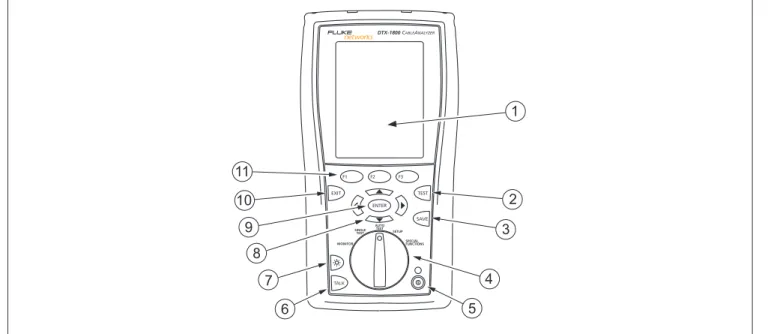
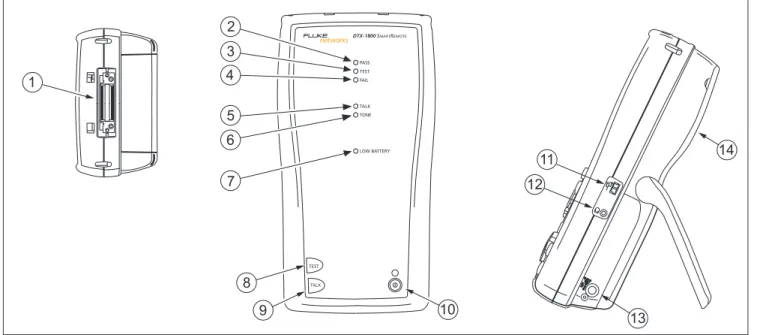
Figures 1 and 2 describe the tester’s features. Figure 3 describes the smart remote’s features.
amd29f.eps
Figure 1. Tester Front Panel Features
TALK MONITOR ENTER TEST SAVE SPECIAL FUNCTIONS SETUP AUTO TEST SINGLE TEST EXIT F1 F2 F3 1 2 3 4 5 6 7 8 9 10 11
Figure 1. Tester Front Panel Features (cont.)
A
LCD display with backlight and adjustable brightness.B
P: Starts the currently selected test. Activates the tone generator for twisted pair cabling if no smart remote is detected. The test starts when both testers areconnected.
C
N: Saves Autotest results in memory.D
Rotary switch selects the tester’s modes.E
M: On/off key.F
O: Press to use the headset to talk to the person at the other end of the link.G
G: Press to switch the backlight between bright and dim settings. Hold for 1 second to adjust the display contrast.H
B C A D: Arrow keys for navigating through screens and incrementing or decrementing alphanumeric values.I
H: Enter key selects the highlighted item from a menu.J
I: Exits the current screen without saving changes.K
A B C: The softkeys provide functions related to the current screen. The functions are shown on the screen above the keys.amd33f.eps
Figure 2. Tester Side and Top Panel Features (cont.)
A
Connector for twisted pair interface adapters.B
Cover for the module bay. Slide off the cover to install optional modules, such as the fiber module.C
Bail.D
DTX-1800 and DTX-1200: Slot and activity LED for the removable memory card. To eject the card, push in then release the card.E
USB ( ) and RS-232C ( : DTX-1800,DTX-1200) ports for uploading test reports to a PC and updating the tester’s software. The RS-232C port uses a custom DTX cable available from Fluke Networks.
F
Headset jack for talk mode.G
Connector for the ac adapter. The LED turns on when the tester is connected to ac power.• Red: Battery is charging.
• Green: Battery is charged.
• Flashing red: Charge timeout. The battery failed to reach full charge within 6 hours. See “Powering the Tester” on page 14.
amd30f.eps
Figure 3. Smart Remote Features (cont.)
W
Caution
All the LEDs flash if the smart remote detects excessive voltage on the cable. Unplug the cable immediately if this occurs.
Note
The LEDs also act as a battery gauge. See Figure 15 on page 15.
A
Connector for twisted pair interface adapters.B
Pass LED lights when a test passes.C
Test LED lights during cable tests.D
Fail LED lights when a test fails.E
Talk LED lights when the smart remote is in talk mode. Press Oto adjust the volume.F
Tone LED lights and the tone generator turns on when you press P, but the main tester is not connected.G
Low battery LED lights when the battery is low.H
P: Starts the test currently selected on the main unit. Activates the tone generator for twisted pair cabling if no main tester is detected. The test starts when both testers are connected.I
O: Press to use the headset to talk to the person at the other end of the link. Press again to adjust the volume. Press and hold to exit talk mode.J
M: On/off key.K
USB port for updating the tester’s software with a PC.L
Headset jack for talk mode.M
Connector for the ac adapter, as described in Figure 2.N
Cover for the module bay. Slide off the cover to install optional modules, such as the fiber module.Powering the Tester
• You may charge the battery when it is attached or detached from the tester. Figure 4 shows how to remove the battery.
• The battery charges fully in about 4 hours with the tester off. A fully-charged battery lasts for at least 12 hours of typical use.
Note
The battery will not charge at temperatures outside of 0 °C to 45 °C (32 °F to 113 °F). The battery charges at a reduced rate between 40 °C and 45 °C (104 °F and 113 °F).
• The battery status icon ( ) near the upper-right corner of main screens shows the battery’s charge level. The smart remote’s LEDs show the smart remote’s battery status at the end of the power-up cycle, as shown in Figure 5.
• For additional battery information, connect the main tester and smart remote through link adapters, turn the rotary switch to SPECIAL FUNCTIONS; then select
Battery Status. See page 68 for information on
retraining the battery gauge.
• If the battery does not reach full charge within 6 hours, the battery LED flashes red. Verify that the battery was within the temperature range given above during charging and that the correct ac adapter was used. Disconnect then reconnect ac power and try charging the battery again. If the battery does not charge the second time, retrain the battery gauge. See page 68.
Localizing the Tester
Local settings include Language, Date, Time, Numeric
Format, Length Units, and Power Line Frequency. 1 Turn the rotary switch to SETUP.
2 Use D to highlight Instrument Settings at the bottom of the list; then press H.
3 Use Cand D to find and highlight Language on the bottom of tab 2; then press H.
4 Use D to highlight the desired language; then press H.
5 Use the arrow keys and H to find and change other local settings on tabs 2, 3, and 4 under Instrument
amd32f.eps
Figure 4. Removing the Battery Pack
amd31f.eps
Figure 5. Smart Remote Battery Status Shown After Power-Up
TEST LOW BATTERY TONE TALK FAIL TEST PASS TALK LOW BA TONE TALK FAIL TEST PASS 0 % - 17 % 18 % - 33 % 34 % - 50 % 51 % - 66 % 67 % - 83 % 84 % - 100 %
About Link Interface Adapters
Link interface adapters provide the correct jacks and interface circuitry for testing different types of twisted pair LAN cabling. The channel and permanent link interface adapters provided are suitable for testing cabling up to Cat 6. Optional coaxial adapters let you test coaxial cabling.
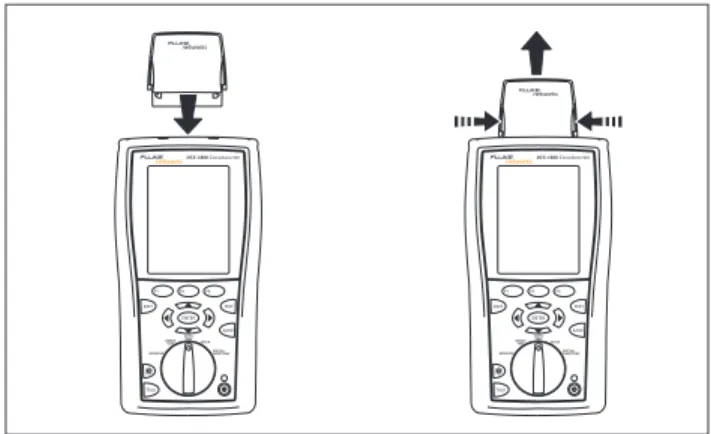
Figure 6 shows how to attach and remove adapters.
W
Caution
To avoid damaging the permanent link adapter and to ensure maximum accuracy of test results, never pinch, kink, or crush the adapter’s cable. Follow the handling guidelines given in Figure 7.
amd35f.eps
Figure 6. Attaching and Removing Adapters
TALK MONITOR ENTER TEST SAVE SPECIAL FUNCTIONS SETUP AUTO TEST SINGLE TEST EXIT F1 F2 F3 TALK MONITOR ENTER TEST SAVE SPECIAL FUNCTIONS SETUP AUTO TEST SINGLE TEST EXIT F1 F2 F3
amd36f.eps
The DTX-PLA001 universal permanent link adapter has a removable personality module. These may be changed to customize the adapter for different jack configurations. To change the personality module, do the following (refer to Figure 8):
1 Ground yourself by touching a grounded, conductive surface.
2 Remove the link interface adapter from the tester.
3 Use your fingers to unscrew the screw on the personality module.
4 Store the module in its original, static protection bag.
5 Put the new module in place and tighten the screw with your fingers.
W
Caution
Tighten the screw snugly with your fingers only. Do not overtighten. Doing so can damage the module or the end of the cable.
amd74f.eps
Figure 8. Changing the Personality Module on DTX-PLA001 Adapters
The optional DTX-PLCAL automated calibration kit lets you calibrate your permanent link adapters to compensate for physical changes that occur over time to the adapter’s cable and other components. Contact Fluke Networks for more information. Static sensitive device Personality module TALK MONITOR ENTER TEST SAVE SPECIAL FUNCTIONS SETUP AUTO TEST SINGLE TEST EXIT F1 F2 F3
Preparing to Save Tests
! Check the memory space available:
Insert a memory card (DTX-1800 and 1200), turn the rotary switch to SPECIAL FUNCTIONS; then select
Memory Status. Models DTX-1800 and 1200: press J
to switch between memory card and internal memory status. Use K to format the memory card or internal memory if necessary.
! Select a cable ID source:
You can select IDs from a pre-generated list or create an ID after each test. Turn the rotary switch to SETUP, select
Instrument Settings, select Cable ID Source; then select a
source. See “Cable ID Options” on page 41 for details.
! Set up a job folder:
On the Instrument Settings menu select the following:
• Result Storage Location (DTX-1800 and 1200): Select
Internal Memory or Memory Card (if present).
• Current Folder: Select an existing folder or press
! Set the plot data storage option:
On the Instrument Settings menu select Store Plot
Data. Select Standard to save plot data for the
frequency range required by the selected test limit. Select Extended to save data beyond the range required by the selected test limit. Select No to save data in text format only, which lets you save more results.
! Enter job information:
On the Instrument Settings menu press C to show the tab with the Operator, Site, and Company names. To enter a new name, select a setting, press J Create; then use the softkeys, BCAD, and H for editing. Press Nwhen you are finished.
! Enable Auto Save, if desired:
On the Instrument Settings menu press C to show the tab with the Auto Save Results setting. Select Yes to have the tester automatically save Autotests using the
Certifying Twisted Pair Cabling
Setting the Reference for Twisted Pair CablingThe reference procedure sets a baseline for insertion loss, ACR-F (ELFEXT), and dc resistance measurements. Run the tester’s reference procedure at the following times:
• When you want to use the tester with a different smart remote. You can reference the tester to two different smart remotes.
• Every 30 days. Doing so ensures maximum accuracy of test results.
You do not need to set the reference after changing link interface adapters.
Note
Turn on the tester and smart remote and let them sit for 1 minute before setting the reference. Set the reference only after the testers have reached an ambient temperature between 10 °C and 40 °C (50 °F and 104 °F).
To set the reference, do the following:
1 Attach permanent link and channel adapters and make the connections shown in Figure 9.
2 Turn the rotary switch to SPECIAL FUNCTIONS and turn on the smart remote.
3 Highlight Set Reference; then press H. If both a fiber module and copper adapter are attached, select
Link Interface Adapter next. 4 Press P.
amd41f.eps
Figure 9. Twisted Pair Reference Connections
Permanent link adapter Channel adapter TEST LOW BATTERY TONE TALK FAIL TEST PASS TALK TALK MONITOR ENTER TEST SAVE SPECIAL FUNCTIONS SETUP AUTO TEST SINGLE TEST EXIT F1 F2 F3
Twisted Pair Test Settings
Table 2 describes the settings that apply to twisted pair cabling tests.
To access the settings, turn the rotary switch to SETUP, use
D to highlight Twisted Pair; then press H.
Table 2. Twisted Pair Test Settings
Setting Description
Select the appropriate test limit for the job. Selecting Custom lets you create a test limit. See the Technical Reference Handbook for details.
Select a cable type appropriate for the type you will test. The cable types are organized by type and manufacturer. Selecting Custom lets you create a cable type. See the Technical Reference Handbook for details.
Nominal velocity of propagation, which is used with the measured propagation delay to determine cable length. The default value defined by the selected cable type represents the typical NVP for that cable type. You may enter a different value if necessary. To determine the actual value, change the NVP until the measured length matches the known length of a cable. Use a cable at least 30 m (100 ft) long.
Increasing the NVP increases measured length.
SETUP > Twisted Pair > Test Limit SETUP > Twisted Pair > Cable Type
SETUP > Twisted Pair > NVP
Table 2. Twisted Pair Test Settings (cont.) Setting Description T568A T568B Token Ring ATM/TP-PMD Straight ATM/TP-PMD Crossed Ethernet Ethernet Crossed 3 2 1 2 3 6 3 6 1 2 white/orange orange white/green green SETUP > Twisted Pair > Outlet Configuration
The Outlet Configuration setting determines which cable pairs are tested and which pair numbers are assigned to the pairs. To see the wire map for a configuration, press J Sample from the
Outlet Configuration screen. Selecting “Custom” lets you create a configuration. See the Technical
Reference Handbook for details.
USOC (1 or 2 Pair) 1 white/green 2 green 3 white/orange 4 blue 5 white/blue 6 orange 7 white/brown 8 brown 1 2 3 4 1 white/orange 2 orange 3 white/green 4 blue 5 white/blue 6 green 7 white/brown 8 brown 1 3 2 4 3 white/orange 4 blue 5 white/blue 6 orange 1 2 3 white/green 4 blue 5 white/blue 6 green 1 3 1 white/green 2 green 7 white/brown 8 brown 1 2 2 1 1 2 7 8 7 8 1 2 white/green green white/brown brown 1 white/orange 2 orange 3 white/green 6 green 3 2
Table 2. Twisted Pair Test Settings (cont.)
PASS*/FAIL Only: The tester shows HDTDX and HDTDR results only for Autotests with PASS*
or FAIL results.
All AUTOTESTs: The tester shows HDTDX and HDTDR for all Autotests.
Select Enable to test cabling through an unpowered mid-span PoE (Power over Ethernet) device. See the Technical Reference Handbook for details.
Standard: The tester displays and saves plot data for frequency-based tests such as NEXT,
return loss, and attenuation. The tester saves data for the frequency range required by the selected test limit.
Extended: The tester saves data beyond the frequency range required by the selected test
limit.
No: Plot data is not saved, which lets you save more results. Saved results show worst margins
and worst values for each pair.
The tester must be referenced to the smart remote the first time the two units are used together. You should also set the reference every 30 days. See “Setting the Reference for Twisted Pair Cabling” on page 20.
Settings for saving tests
See “Preparing to Save Tests” on page 19.
Setting Description
SETUP > Twisted Pair > HDTDX/HDTDR
SETUP > Twisted Pair > AC Wire Map
SETUP > Instrument Settings > Store Plot Data
SPECIAL FUNCTIONS > Set Reference
Autotest on Twisted Pair Cabling
Figure 10 shows the equipment needed for certifying twisted pair cabling.
Figure 10. Equipment for Certifying Twisted Pair Cabling
amd40f.eps
A
Tester and smart remote with battery packsB
Memory card (optional)C
Two ac adapters with line cords (optional)D
For testing permanent links: two permanent link adaptersE
For testing channels: two channel adapters1 2 3 4 5 TEST LOW BATTERY TONE TALK FAIL TEST PASS TALK TALK MONITOR ENTER TEST SAVE SPECIAL FUNCTIONS SETUP AUTO TEST SINGLE TEST EXIT F1 F2 F3
Autotest on Twisted Pair Cabling
1 Attach adapters appropriate for the job to the tester and the smart remote.
2 Turn the rotary switch to SETUP, then select Twisted
Pair. Set the following on the Twisted Pair tab:
• Cable Type: Select a list of cable types; then select the
cable type to be tested.
• Test Limit: Select the test limit required for the job.
The screen shows the last nine limits used. Press J
More to see other lists of limits.
3 Turn the rotary switch to AUTOTEST and turn on the smart remote. Connect to the cabling, as shown in Figure 11 for a permanent link or Figure 12 for a channel.
4 If a fiber module is installed, you may need to press
J Change Media to select Twisted Pair as the media type.
5 Press Pon the tester or smart remote. To stop the test at any time, press I.
Tip: Pressing Pon the tester or smart remote starts the
tone generator so you can use a tone probe before connecting, if necessary. The tone also activates a sleeping or powered-down tester connected to the other end of the cabling.
6 The tester shows the Autotest Summary screen when the test is complete (see Figure 13 on page 29). To view results for a specific parameter, use AD to highlight the parameter; then press H.
7 If the Autotest failed, press J Fault Info for possible causes of the failure.
8 To save the results, press N. Select or create a cable ID; then press N again.
Work area Optional
consolidation point
Patch panel Wall outlet Horizontal cabling End permanent link Start permanent link
Tester with permanent
link adapter permanent link adapterSmart remote with
ENTER TEST SAVE AUTO EXIT F1 F2 F3 LOW BATTERY TONE TALK FAIL TEST PASS
amd21f.eps
Figure 12. Channel Test Connections
Work area Optional consolidation point Patch panels Hub or switch Wall outlet Horizontal cabling End channel Tester with
channel adapter Smart remote withchannel adapter
Patch cord from PC Patch cord from hub or switch Start channel TEST LOW BATTERY TONE TALK FAIL TEST PASS TALK TALK MONITOR ENTER TEST SAVE SPECIAL FUNCTIONS SETUP AUTO TEST SINGLE TEST EXIT F1 F2 F3
Autotest Summary Results for Twisted Pair Cabling
Figure 13 describes the Autotest Summary screen.
A
PASS: All parameters are within limits.FAIL: One or more parameters exceed the limit.
PASS*/FAIL*: One or more parameters are within the tester’s
accuracy uncertainty range, and the “*” notation is required by the selected test standard. See “PASS*/FAIL* Results” on page 30.
B
Press K or L to scroll the screen.C
If the test failed, press J for diagnostic information.D
Action prompt for the screen. Use DA to highlight a parameter; then press H.E
E: The test passed.i: The parameter was measured, but has no PASS/FAIL limit in the selected test limit.
X: The test failed.
PASS*/FAIL* Results
A result marked with an asterisk means that
measurements are in the tester’s accuracy uncertainty range (Figure 14) and the “*” notation is required by the selected test standard. These results are considered marginal. Marginal passing and failing results are marked with blue and red asterisks, respectively.
A PASS* may be considered a passing result. A FAIL* should be considered a failure.
amd42f.eps
Figure 14. PASS* and FAIL* Results
Limit PASS
*
PASS*
FAIL*
Tester's accuracy uncertainty range FAIL FAIL*
PASSAutomatic Diagnostics
If an Autotest fails, press J Fault Info for diagnostic information about the failure. The diagnostic screens show likely causes of the failure and suggest actions you
can take to solve the problem. A failed test may produce more than one diagnostic screen. In this case, press
ADBC to see additional screens. Figure 15 shows examples of diagnostic screens.
Certifying Coaxial Cabling
Certifying coaxial cabling requires the optional DTX-COAX coaxial adapters.
Setting the Reference for Coaxial Cabling
The reference procedure sets a baseline for insertion loss measurements.
Run the tester’s reference procedure at the following times:
• When you want to use the tester with a different smart remote. You can reference the tester to two different smart remotes.
• Every 30 days. Doing so ensures maximum accuracy of test results.
You do not need to set the reference after changing link interface adapters.
Note
Turn on the tester and let it sit for 1 minute before setting the reference. Set the reference only after the testers have reached an ambient temperature between 10 °C and 40 °C (50 °F and 104 °F).
To set the reference, do the following:
1 Attach coaxial adapters to the main and remote testers, screw in the F-connector to BNC adapters; then make the connections shown in Figure 16.
2 Turn the rotary switch to SPECIAL FUNCTIONS and turn on the smart remote.
3 Highlight Set Reference; then press H. If both a fiber module and copper adapter are attached, select
Link Interface Adapter. 4 Press P. TEST LOW BATTERY TONE TALK FAIL TEST PASS TALK TALK MONITOR ENTER TEST SAVE SPECIAL FUNCTIONS SETUP AUTO TEST SINGLETEST EXIT F1 F2 F3
Coaxial Test Settings
Table 3 describes the settings that apply to coaxial cabling tests.
To access the settings, turn the rotary switch to SETUP, use
D to highlight Coaxial; then press H.
Table 3. Coaxial Cable Test Settings
Setting Description
Select the appropriate test limit for the job.
Select a cable type appropriate for the type you will test.
Nominal velocity of propagation, which is used with the measured propagation delay to determine cable length. The default value defined by the selected cable type represents the typical NVP for that cable type. You may enter a different value if necessary. To determine the actual value, change the NVP until the measured length matches the known length of a cable. Use a cable at least 30 m (100 ft) long.
Increasing the NVP increases measured length.
SETUP > Coaxial > Test Limit SETUP > Coaxial > Cable Type SETUP > Coaxial > NVP
Table 3. Coaxial Cable Test Settings (cont.)
Setting Description
Standard: The tester displays and saves plot data for insertion loss. The tester saves data for
the frequency range required by the selected test limit.
Extended: The tester saves data beyond the frequency range required by the selected test
limit.
No: Plot data is not saved, which lets you save more results. Saved results show only worst
margins and worst values for each pair.
The tester must be referenced to the smart remote the first time the two units are used together. You should also set the reference every 30 days. See “Setting the Reference for Coaxial Cabling” on page 32.
See “Preparing to Save Tests” on page 19.
SETUP > Instrument Settings > Store Plot Data
SPECIAL FUNCTIONS > Set Reference
Settings for saving tests
Autotest on Coaxial Cabling
Figure 17 shows the equipment needed for certifying coaxial cabling.
Figure 17. Equipment for Certifying Coaxial Cabling
amd138.eps
A
Tester and smart remote with battery packsB
Memory card (optional)C
DTX coaxial adapters with female-to-female F-connector adapters installedD
F-connector-to-BNC adapters (for testing network coaxial cabling)E
Two ac adapters with line cords (optional)1 2 3 4 TEST LOW BATTERY TONE TALK FAIL TEST PASS TALK TALK MONITOR ENTER TEST SAVE SPECIAL FUNCTIONS SETUP AUTO TEST SINGLE TEST EXIT F1 F2 F3 5
Autotest on Coaxial Cabling
1 Attach coaxial adapters to the tester and smart remote.
2 Turn the rotary switch to SETUP, then select Coaxial. Set the following on the Coaxial tab:
• Cable Type: Select a list of cable types; then select the
cable type to be tested.
• Test Limit: Select the test limit required for the job.
The screen shows the last nine limits used. Press J
More to see other lists of limits.
3 Turn the rotary switch to AUTOTEST and turn on the smart remote. Connect to the cabling, as shown in Figure 18 or 19.
4 If a fiber module is installed, you may need to press
J Change Media to select Coax as the media type.
5 Press Pon the tester or smart remote. To stop the test at any time, press I.
6 The tester shows the Autotest Summary screen when the test is complete (see Figure 20 on page 40). To view results for a specific parameter, use AD to highlight the parameter; then press H.
7 To save the results, press N. Select or create a cable ID; then press N again.
Note
If you turn off the main or remote unit while the two units are connected through coaxial adapters, the unit will turn on again.
amd139.eps
Figure 18. Coaxial Network Cabling Test Connections
TALK MONITOR ENTER TEST SAVE SPECIAL FUNCTIONS SETUP AUTO TEST SINGLETEST EXIT F1 F2 F3 TEST LOW BATTERY TONE TALK FAIL TEST PASS TALK
Female to female F-connector adapter
Tester with coaxial
adapter Smart remote withcoaxial adapter
ENTER TEST SAVE AUTO EXIT F1 F2 F3 Connection to coaxial cabling Female to female F-connector adapter LOW BATTERY TONE TALK FAIL TEST PASS Wall outlet
Autotest Results for Coaxial Cabling
Figure 20 describes the Autotest Summary screen.
Figure 20. Autotest Results for Coaxial Cabling
amd141f.eps
A
PASS: All parameters are within limits.FAIL: One or more parameters exceed the limit.
B
E: The test passed.i: The parameter was measured, but has no PASS/FAIL limit in the selected test limit.
X: The test failed.
Cable ID Options
You can select cable IDs from a pre-generated list or you can create an ID after each test.
To select a source for cable IDs, turn the rotary switch to
SETUP, select Instrument Settings, select Cable ID Source;
then select a source:
• Auto Increment: Increments the last character of the
ID each time you press N.
• List: Lets you use an ID list created in LinkWare
software and downloaded to the tester.
• Auto Sequence: Lets you use a list of sequential IDs
generated from a template. The horizontal, backbone, and campus templates follow the ID formats specified in the ANSI/TIA/EIA-606-A standard. The Free Form template lets you create your own pattern.
• None: Lets you create an ID each time you press N.
After you press N, you can also edit an existing ID before using it for saving results.
To create a list of sequential IDs, do the following:
1 On the Auto Sequence screen, select a template.
2 On the Auto Sequence screen, select Start ID. Use the softkeys, BCAD, and H to enter the first ID in the sequential list. Press Nwhen you are finished.
3 Select Stop ID. Use the softkeys, BCAD, and H to enter the last ID in the sequential list. Press Nwhen you are finished
4 PressLSample Listto see what the list will look like.
Verifying Network Service
The optional DTX-NSM Network Service Module lets you verify that a twisted pair or fiber link is connected to a network. The network tests include a ping function and a network traffic monitor.
Notes
Running network tests on a fiber link requires an optional SFP (small form pluggable) module. The DTX-NSM module does not support the Talk function.
Figure 21 describes the network module’s features.
Note
The network service tests will not run on links with ground loops, analog telephone voltages, ISDN voltages, or other voltages (except PoE voltage). The tester warns you if it detects these conditions.
Figure 21. Network Module Features
amd38f.eps
A
The link LED is green when the tester is receiving link pulses from the network.B
8-pin module jack (RJ45) for connecting to twisted pair networks.C
Port for inserting an optional small form pluggable (SFP) optical module for testing fiber links.Installing and Removing the Network Module and Optional SFP Module
Install the network module only in the main tester. See Figure 22. Install an optional SFP (small form pluggable) module to test fiber links. You may install or remove the SFP module while the tester is on.
W
Caution
Leave the module bay cover in place when a module is not installed.
Put the dust cap on the SFP port when an optical module is not installed. Put the dust cap on the optical module when not connected to a fiber.
Network Connectivity Test Settings
The tester needs various addresses to test a network connection, as described in Table 4.
To access these settings, turn the rotary switch to SETUP; then select Network Settings.
Table 4. Network Connectivity Test Settings
Setting Description
Select DHCP (Dynamic Host Configuration Protocol) to have the network’s server assign the tester’s address, gateway address, and DHCP and DNS (Domain Name System) server addresses. Most networks support DHCP.
Select Static to enter the tester’s address, subnet mask, gateway address (optional), and DNS server address (optional) manually. Enter the addresses on the second tab that appears after you select Static. These addresses are typically available from a network installer, administrator, technician, or from network documentation.
In Static mode, verify that the DTX Address is not used by another network device. Using a duplicate address can cause the other device to malfunction.
Optional. Enter a different Number of Pings (3 to 50) for the network connectivity test and optional ping tests.
Optional. Enter one or more addresses for ping tests. To enter addresses manually, use J Create. In LinkWare software, you can use Utilities > DTX Utilities > Ping Target List to
create and download addresses to the tester. See the LinkWare online help for details.
SETUP > Network Settings > IP Address Assignment
W
Caution
SETUP > Network Settings > Number of Pings SETUP > Network Settings > Target AddressesTesting for Network Connectivity
1 Select DHCP or Static mode and enter ping addresses in Setup, as described in Table 4.
2 Connect to the network as shown in Figure 23.
3 Turn the rotary switch to
4 MONITOR; then select Network Connectivity or
Network Connectivity w/ PoE.
5 Press P. Figure 24 describes the network connectivity results.
6 You can save the results in a new record or add them to existing cable test results for the same link. To save the results, press
N
. Create or select an ID; then pressN
again.
-continued-Figure 24. Network Connectivity Results Screen (DHCP example for twisted pair)
amd06.eps
A
Speeds supported by the switch or hub: 10 Mbit, 100 Mbit, 1000 Mbit. The current speed is green. Arrows show the connection’s duplex configuration:B
PoE shows if you ran the Network Connectivity w/ PoE test and thedevice appears to support Power over Ethernet. The tester requests power from suspected PoE devices. shows if the device did not supply power during the test.
Fiber shows for a fiber link.
C
Crossover indicator (twisted pair only):• Green: either the cable is straight-through, or the cable is a crossover and the hub or switch crossed pairs 12-36 (MDI on the
Negotiation Details screen).
• Orange: the tester compensated for a crossover cable by crossing pairs 12-36 (MDI-X on the Negotiation Details screen).
4 3 2 8 9 6 1 5 7
Figure 24. Network Connectivity Results Screen (DHCP example for twisted pair) (cont.)
D
Select Negotiation Details to see details.On the Negotiation Details screen, Yes for Pin Reversal indicates a reversed pair on the link, (such as wires 1 and 2 crossed). Run a wire map test on the link to check the wiring.
E
Select DTX Address to see details, including the subnet mask.F
Network addresses used during the test:• Gateway: Address of the network device that joins
networks using different protocols or passes data between networks.
• DHCP Server: Dynamic Host Configuration Protocol
server address. Shown only in DHCP mode.
• DNS Server: Domain Name System server address.
In DHCP mode, the addresses above show as 0.0.0.0 if the DHCP server does not provide them.
To see ping results for the above devices, highlight a device; then press H. See Figure 25.
The checkmarks and Xs indicate how many replies the tester received to its three pings:
: Green: Ping replies received for all requests. : Orange: At least one ping reply received. : No ping replies received, indicating a problem with the connection.
G
<Target Address name>: appears if you use L Pingto ping a device. See page 48.
H
See “Monitoring Network Traffic” on page 50 and “Blinking a Port Light” on page 50.About Testing for PoE (Power Over Ethernet)
Select Network Connectivity w/ PoE from the MONITOR menu to check a link for PoE devices when testing network connectivity.
If you are sure no PoE device is connected, select Network
Connectivity for faster testing that does not check for PoE
devices.
Select PoE Only to test a mid-span PoE device when there is no switch connected to the link or when you want to check only for PoE capability.
Pinging Network Devices
The ping test verifies connectivity to devices on the network.
1 Enter ping addresses in Setup. See Table 4 on page 44.
2 Connect to the network as shown in Figure 23.
3 Turn the rotary switch to MONITOR, select Network
Connectivity; then press P.
4 Press L Ping.
5 Do one of the following:
• To ping one device, highlight the device; then press
P.
• To ping all devices in the list, press J Ping All.
6 To see ping details (Figure 25), highlight a device; then press H.
7 To save the ping results, press N. Ping results are saved as part of the connectivity results.
Figure 25. Ping Results Screen
amd16.eps
A
The name and IP address of the device that was pinged.B
Number of pings sent and received. Since ping requests are low-priority traffic, devices may not respond to all requests.C
The minimum, average, and maximum times taken for the ping requests to travel to the target address and back to the tester (Round Trip Time).RTT Std Dev. is the standard deviation of the RTTs. This tells, on average,
how far RTT values are from the average RTT value.
To evaluate ping times, you should compare current results with results taken when the network was operating normally.
1
2 3
Monitoring Network Traffic
The traffic monitor lets you identify active cables and check a network’s basic health.
1 Turn on the tester; then connect to the network as shown in Figure 23 on page 45.
2 Turn the rotary switch to MONITOR; then run the
Network Connectivity test.
3 Press J Traffic. Figure 26 describes the traffic monitor screen.
Note
Traffic monitor results cannot be saved.
Blinking a Port Light
The Port Blink function helps you quickly locate a link’s port at a switch or hub. This function generates a link pulse on pairs 12 and 36 to blink the port’s activity LED.
1 Connect to the network as shown in Figure 23 on page 45.
2 Turn the rotary switch to MONITOR, select Network
Connectivity; then press P.
3 Press K Port Blink. A square on the hub/switch icon on the Network Connectivity screen blinks when the port blink function is active.
amd08.eps
A
The time the test has been running.B
Traffic characteristics for the last 1 second, and the average and peak values since the test began:• Utilization: Percentage of the network’s bandwidth used. This indicates
the traffic density on the network. Utilization averaging over 40 % may indicate a problem.
• Collisions: The percentage of collision frames as compared to the total
number of frames detected in the last 1 second. Collisions occur when two devices attempt to transmit at the same time. A collision rate averaging over 5 % may indicate a problem. A full-duplex link should show 0 % collisions.
• Errors: Includes short frames, bad FCS (frame check sequence), late
collisions, and jabber. An error rate above 0 % indicates a problem.
• Broadcasts: Percentage of frames addressed to all devices. Acceptable
broadcast rates vary among networks.
C
Toggles a sound that indicates the utilization level.D
Stops the test.E
Resets all statistics to zero.2
5 4
3 1
Identifying Links (twisted pair only)
The ID Locator function helps you quickly identify link connections at a patch panel. This function requires one or more optional Fluke Networks LinkRunner™ Cable ID locators.
Note ID locator results cannot be saved.
1 Connect the tester and ID locator(s) as shown in Figure 27.
2 Turn the rotary switch to MONITOR, select ID Locator; then press P.
3 Connect the tester to different jacks, pressing P to rescan each time, until Found Cable ID and the identifier’s number appears.
Note
Wiring faults may cause the tester to misidentify the ID locator’s number, or prevent the tester from detecting the locator.
Memory Functions
All DTX testers have internal memory that can store at least 250 Autotest results, including graphical data. The maximum capacity of internal memory depends on the space taken by the tester’s software.
The DTX-1800 and DTX-1200 testers can also store up to 4000 Cat 6A Autotest results, including graphical data, on a 128 MB card. The testers can also use secure digital (SD) memory cards.
The card capacities supported depend on the DTX software version. See the Fluke Networks Knowledge Base on the Fluke Networks website for details.
W
Caution
Memory cards may be lost, damaged, or accidentally formatted, resulting in data loss. Therefore, Fluke Networks recommends saving no more than one day’s worth of test results on a memory card.
Formatting the Memory Card (1800 and DTX-1200) or Internal Memory
Formatting erases all contents of the memory card or internal memory.
To format the memory card or internal memory:
1 Turn the rotary switch to SPECIAL FUNCTIONS, then select Memory Status.
2 For a DTX-1800 or DTX-1200 with a memory card installed, press J to select the memory card or internal memory.
3 Press K Format.
Setting the Storage Location (1800 and DTX-1200)
To set the destination for saved results turn the rotary switch to SETUP, select Instrument Settings, select Result
Storage Location; then select Internal Memory or Memory Card (if present).
Note
If you change the Result Storage Location, and the selected Current Folder does not exist in the new location, the tester creates a new folder with the current folder’s name in the new location. Viewing Results
To view saved results, do the following:
1 Turn the rotary switch to SPECIAL FUNCTIONS; then select View/Delete Results.
2 If necessary, press J Change Folder to find the result you want to view.
3 Highlight the result; then press H.
Moving and Deleting Results
DTX-1800, DTX-1200
To move or copy all results from internal memory to the memory card, turn the rotary switch to SPECIAL
FUNCTIONS, select Move/Copy Internal Results; then
select an option:
• Move to Memory Card: Moves all results and their
folders to the memory card and deletes all results from internal memory.
• Copy to Memory Card: Copies all results and their
folders to the memory card.
• Delete from Internal Memory: Deletes all results from
All Models
To delete results or folders, do the following:
1 Turn the rotary switch to SPECIAL FUNCTIONS, then select View/Delete Results.
2 If necessary, press J Change Folder to find the results you want to delete.
3 Do one of the following:
• To delete one result, highlight it, press K Delete, press L Delete; then press L Yes.
• To delete all results in the current folder, the current folder, or all results in the tester (internal memory), press K Delete; then select an option.
Uploading Results to a PC
To upload results to a PC, do the following:
1 Install the latest version of LinkWare software on your PC.
2 Turn on the tester.
3 Connect the tester to the PC with the USB cable included or the DTX serial cable available from Fluke Networks.
or
Insert the memory card containing results into the PC’s memory card reader.
4 Start LinkWare software on the PC.
5 Click Import on the LinkWare toolbar. Select the tester’s model from the list.
or
Select Memory card or folder on PC.
Options and Accessories
Table 5 shows options and accessories available for the DTX Series CableAnalyzers.
For a complete list of options and accessories visit the Fluke Networks website at www.flukenetworks.com. To order options or accessories, contact Fluke Networks as described on page 2.
Table 5. Options and Accessories
Option or Accessory Fluke Networks Model Number
Cat 6/Class E Channel Adapter DTX-CHA001
Cat 6/Class E Channel Adapters, set of 2 DTX-CHA001S
Universal Permanent Link Adapter, Cat 6/Class E DTX-PLA001
Universal Permanent Link Adapters, Cat 6/Class E, set of 2 DTX-PLA001S
Cat 6 Centered Personality Module DSP-PM06
Universal Permanent Link Adapter, Cat 6A/Class EA* DTX-PLA002
Universal Permanent Link Adapters, Cat 6A/Class EA, set of 2* DTX-PLA002S
Personality modules for IDC and legacy cabling systems
Many models are available. Contact Fluke Networks or visit the Fluke Networks website for details.
Table 5. Options and Accessories (cont.)
Option or Accessory Fluke Networks Model Number
Siemon Tera Channel Adapter* DTX-CHA011
Siemon Tera Permanent Link Adapter* DTX-PLA011
Siemon Tera Adapter Kit* DTX-TERA
Nexans GG45 Channel Adapter* DTX-CHA012
Patch Cord Adapter Kit DTX-PCU6S
DTX-COAX Coaxial Adapter Kit DTX-COAX
Alien Crosstalk Analyzer Kit for the DTX-1800 DTX-10GKIT DTX-MFM2 Multimode Fiber Module, 850 nm/1300 nm DTX-MFM2 DTX-GFM2 Gigabit Fiber Module, 850 nm/1310 nm DTX-GFM2 DTX-SFM2 Singlemode Fiber Module, 1310 nm/1550 nm DTX-SFM2 DTX-OTDR-QUAD Optical Time Domain Reflectometry Module,
850 nm/1300 nm/1310 nm/1550 nm
DTX-OTDR-QMOD
Launch fibers for DTX-OTDR modules Visit the Fluke Networks Website for the latest list of available launch fibers
Table 5. Options and Accessories (cont.)
Option or Accessory Fluke Networks Model Number
DTX-FTK Fiber Test Kit
Fiber optic meter module and 850 nm/1300 nm SimpliFiber™ source. Measures
power and loss at 850 nm/1300 nm (1310 nm/1550 nm with optional source).
DTX-FTK
DTX-NSM Network Service Module DTX-NSM
SFP optical module for DTX-NSM module Visit the Fluke Networks Website for the latest list of available modules DTX-FOM Fiber Optic Meter Module
Measures power and loss at 850 nm/1300 nm and 1310 nm/1550 nm.
DTX-FOM
Permanent Link Calibration Kit for DTX-PLA002 adapters DTX-PLCAL
Permanent Link Calibration Kit for DTX-PLA001 adapters DSP-PLCAL LinkRunner Cable ID Locator Kit (ID locators 1 through 8) CABLE ID KIT
Lithium Ion Battery Pack DTX-LION
DTX RS-232 Serial Cable (DB-9 to IEEE 1394) DTX-SER
Table 5. Options and Accessories (cont.)
Option or Accessory Fluke Networks Model Number
Carrying Case DTX-CASE
AC Charger, North America, 120VAC DTX-ACNA
AC Charger, Universal, 120-240VAC DTX-ACUN
Headset for DSP and DTX CableAnalyzers DTX-TSET
32 MB SD Memory Card DTX-SDC32
64 MB SD Memory Card DTX-SDC64
128 MB SD Memory Card DTX-SDC128
Memory Card Reader, USB DSP-MCR-U
Memory Card Carry Case MMC CASE
Table 5. Options and Accessories (cont.)
Option or Accessory Fluke Networks Model Number
LinkWare Cable Test Management Software
(You may download this at no charge from the Fluke Networks website.)
LinkWare
LinkWare Stats Statistical Report Option LinkWare-Stats
DTX-1800 Main Unit Replacement with Battery Pack DTX-1800/MU
DTX-1800 Smart Remote Replacement with Battery Pack DTX-1800/RU
DTX-1200 Main Replacement with Battery Pack DTX-1200/MU
DTX-1200 Smart Remote Replacement with Battery Pack DTX-1200/RU
DTX-LT Main Replacement with Battery Pack DTX-LT/MU
About LinkWare and LinkWare Stats
Software
The LinkWare™ Cable Test Management software included
with your tester lets you do the following:
• Upload test records to PC.
• View test results.
• Add ANSI/TIA/EIA-606-A administration information to records.
• Organize, customize, and print professional-quality test reports.
• Update the tester’s software.
• Create and download data to the DTX, such as Setup data and cable ID lists.
• Calibrate the permanent link adapters (DTX-PLCAL kit required for DTX-PLA002 adapters. DSP-PLCAL kit required for DTX-PLA001 adapters.)
• Transfer custom limits between testers.
Details about using LinkWare software are provided in the
LinkWare Getting Started Guide and the online help
available under Help on the LinkWare menu.
Updates to LinkWare software are available on the Fluke Networks website.
The LinkWare Stats Statistical Report option for LinkWare software provides statistical analysis of cable test reports and generates browsable, graphical reports. LinkWare software includes a demo version of LinkWare Stats. Contact Fluke Networks or visit the Fluke Networks website for more information on LinkWare Stats.
Maintenance
WX
Warning
To avoid possible fire, electric shock, personal injury, or damage to the tester:
• Do not open the case. No user-serviceable parts
are inside.
• Replacing electrical parts yourself will void the
tester’s warranty and might compromise its safety features.
• Use only specified replacement parts for
user-replaceable items.
• Use only Fluke Networks authorized service
centers.
W
Caution
Replacing electrical parts yourself might void the tester’s calibration and compromise its accuracy. If the calibration is void, cable
Cleaning
Clean the display with glass cleaner and a soft, lint-free cloth. Clean the case with a soft cloth dampened with water or water and a mild soap.
W
Caution
To avoid damaging the display or the case, do not use solvents or abrasive cleansers.
Factory Calibration
The tester requires calibration at a service center once a year to ensure that it meets or exceeds the published accuracy specifications. Contact an authorized Fluke Networks Service Center for information on getting your tester calibrated.