Preprint submitted to Journal of Information Processing and Management
A Hybrid Semantic Knowledgebase-Machine Learning
Approach for Opinion Mining
Rowida Alfrjani a, Taha Osman a,1*, Georgina Cosma a
a School of Science and Technology, Nottingham Trent University, Nottingham, NG11 8NS,
5
United Kingdom
Abstract
Opinion mining tools enable users to efficiently process a large number of online reviews in order to determine the underlying opinions. This paper presents a Hybrid
10
Semantic Knowledgebase-Machine Learning approach for mining opinions at the domain feature level and classifying the overall opinion on a multi-point scale. The proposed approach benefits from the advantages of deploying a novel Semantic Knowledgebase approach to analyse a collection of reviews at the domain feature level and produce a set of structured information that associates the expressed opinions with
15
specific domain features. The information in the knowledgebase is further supplemented with domain-relevant facts sourced from public Semantic datasets, and the enriched semantically-tagged information is then used to infer valuable semantic information about the domain as well as the expressed opinions on the domain features by summarising the overall opinions about the domain across multiple reviews, and by
20
averaging the overall opinions about other cinematic features. The retrieved semantic information represents a valuable resource for modelling a machine learning classifier to predict the numerical rating of each review. Experimental evaluation revealed that the proposed Hybrid Semantic Knowledgebase-Machine Learning approach improved the precision and recall of the extracted domain features, and hence proved suitable for
25
producing an enriched dataset of semantic features that resulted in higher classification accuracy.
Keywords: Feature Extraction, Classification, Semantic Web, Knowledgebase
1.
Introduction
30Consumers often consult the opinion of others when considering purchasing decisions. For instance, it is common to seek out the opinion of friends, favourite bloggers and reviewers to make a decision about purchasing a product, voting for a political candidate or choosing a movie. Opinions, often in the form of reviews, are increasingly being published on websites, blogs and social media outlets. Organisations
35
invest considerable resources to collate and analyse online material in order to analyse the underlying user trends regarding consumer sentiments, and use such information to improve their products and services and to shape their production strategies and marketing campaigns. The challenge is that online opinions are predominantly expressed in natural language text, and hence opinion mining tools are required to
40
facilitate the effective extraction and analysis of opinions from unstructured text. Such tools often adopt algorithms from Natural Language Processing, Information Retrieval and Machine Learning disciplines.
Opinion mining is commonly implemented by extracting contents for a specific domain (e.g. movie, music, and product) and performing opinion mining at various
45
levels of text granularity: document, sentence or domain feature level. At document and sentence level, opinion mining aims to classify the overall sentiment orientation that is expressed in a document [10], [23], [24] or a sentence [6], [17]. Opinion mining at the domain feature level is considered to be a difficult task because it requires deep understanding of the sentence structure and knowledge of the problem domain (e.g.
50
movie reviews) in order to correctly classify sentences based on their polarity. Particularly challenging is the extraction of the domain feature mentions (e.g. actress, show, script, story) from the reviews and associating each domain feature with its corresponding sentiment to determine its polarity score (e.g. the beauty of the script +1; Bulletproof Heart is not an excellent movie -1; The great Matt Craven will probably
55
be forever remembered +1). Opinion mining at domain feature level can be further considered for enhancing the opinion classification task via summing or averaging the polarity score of each extracted domain feature to determine the numerical rating of the review (e.g. 4,3,2,1 and 0 for very positive, positive, neutral, negative, and very negative respectively).
Opinion mining research at domain feature level employs different approaches such as Association Rule Mining, Machine Learning and Semantic Knowledgebase approaches to primarily improve the outcome of the domain feature extraction task, which consequently enhances the performance of opinion classification task. Association Rule Mining approaches primarily rely on Natural Language Processing
65
techniques to identify nouns and noun phrases to be domain features, whereas Machine Learning approaches rely on a large set of training data to learn domain features from reviews. More recently, Semantic Knowledgebase approaches have been deployed for domain feature extraction with promising success. The Semantic Knowledgebase approaches are based on utilising domain knowledgebase to extract domain features
70
from reviews, which contains a conceptualized knowledge background of the domain. The Domain Knowledge captures the key concepts and relations of the problem domain’s environment, which is then populated with entities and facts/events that subscribe to the modelled concepts and relations [9]. Such domain knowledge can be utilised to improve the performance of domain feature extraction task. Semantic Web
75
technologies organise knowledge in a formalised Semantic Knowledgebase that provides efficient support for linking and sharing data between resources, and presenting data in a way that computer machines can process. In addition, the formalised Semantic Knowledgebase is capable of presenting the domain knowledge in a structured and consistent manner which facilitates the qualitative interpretation of
80
domain specific contents in a way that people can understand. Moreover, Semantic Web technologies provide support for enriching the modelled domain knowledgebase with relevant ground facts from public-sourced Linked Open Data resources. A chief challenge for the Semantic Knowledgebase approaches is the collection of sufficient domain-related data to produce a sufficiently rich Semantic Knowledgebase that drives
85
the domain feature extraction task [3].
Recently, the integration of Semantic knowledgebase and Machine Learning methods has emerged as an effective approach for improving the process of opinion mining at domain feature level, in particular, for enhancing the opinion classification task [32], [36]. However, the reported efforts have mainly focused on binary
90
opinion. The work presented in this paper is principally motivated by the need to develop a Hybrid Semantic Knowledgebase-Machine Learning approach to enhance the performance of opinion mining at domain feature level and to improve opinion classification on a multi-point scale (i.e., multi-class classification). The proposed
95
approach has been applied to the movie reviews problem domain.
The remainder of the paper is organised as follows: research contribution is presented in Section 2 and related work is discussed in Section 3. Section 4 discusses in detail the proposed Hybrid Semantic Knowledgebase-Machine Learning approach for opinion mining, which covers capturing domain knowledgebase, extracting and
100
classification processes. Section 5 discusses the experimental evaluation, and Section 6 provides an overview of the proposed approach and how it can be applied to other domains. Finally, a conclusion and discussion of future work are presented in Section 7.
2.
Contribution
105The contribution of the proposed Hybrid Semantic Knowledgebase-Machine Learning approach can be summarised as follows:
1) A new Domain Feature Extraction algorithm that improves the precision and recall of the extracted domain features. The Domain Feature Extraction algorithm utilises a comprehensive knowledge of the chosen domain (key
110
concepts and their synonyms and ground facts) and public Linked Open Data sources such as DBpedia and Internet Movie Database (IMDb). 2) A new Domain Feature-Sentiment Association algorithm that removes
false positive opinions (i.e., the domain feature-sentiment pairs) that objectively describe factual information using a generated sentiment
115
lexicon for each domain feature.
3) A new Opinion Classification algorithm that delivers enhanced opinion classification on a multi-point scale. The Opinion Classification algorithm generates an enriched set of semantic data from a modelled Semantic Knowledgebase and merge it with a statistical dataset and then use that as
input into machine learning algorithms. The Opinion Classification algorithm appears to be the first study that presents such kind of combination between Semantic Knowledgebase and Machine Learning approaches for classifying opinions on a multi-point scale.
3.
Related Work
125
This section discusses related literature in opinion mining with a focus on methods for extracting domain features from natural language text reviews, and methods for classifying opinions.
3.1
Domain feature extraction
The Association Rule Mining approach, which primarily relies on Natural Language
130
Processing techniques, is the most popular for domain feature extraction. Hu and Liu [16] extracted frequent nouns or noun-phrases to be domain features using an Apriori algorithm, whereas the approach by Eirinaki et al. [12] involved initially extracting nouns, and then computing the score for each noun with respect to the total number of their nearest adjectives in all reviews. Nouns with scores less than a particular threshold
135
were removed and the rest were determined to be domain features. The work done by to Ghorashi et al. [14] was similar to that of Hu and Liu [16] except that they applied the H-Mine algorithm instead of the Apriori algorithm. Yang et al. [40] extracted domain features utilising a semi-automatic constructed knowledgebase that contains the top hundreds of frequently normalized nouns and noun phrases which were extracted
140
from a collection of pre-processed reviews.
Association Rule Mining approaches extract domain features without performing human pre-processing tasks (e.g. preparing manually training dataset) because automatic natural language pre-processing is used to identify nouns and noun phrases to be domain features. However, the extracted domain features tend to be frequent
145
domain features, whereas infrequent domain features are ignored, which can result in a reduced recall rate. In addition, some of the extracted nouns and noun phrases may not
be domain features even if these occur more frequently in reviews, and this can affect the precision of the domain feature extraction task.
Machine Learning approaches require large trained datasets in order to perform the
150
feature extraction with satisfactory accuracy. Zhuang et al. [42] extracted domain features by statistical analysis that is based on manually labelled reviews with the domain frequent features (key concepts and ground facts). Ma et al. [21] extracted domain features by training Latent Dirichlet Allocation algorithm on automatically labelled reviews with nouns or noun phrases, which were tagged via part of speech
155
tagger and the learned domain features were expanded with synonyms, then the obtained candidate domain features were filtered by removing non-relevant domain features. Agarwal, et al. [2] extracted domain features by training a machine learning model to identify the semantic information and relations between terms in a text, which were detected by utilising dependency parse tree and Concept Net knowledgebase.
160
Thereafter, the irrelevant domain features were removed using Minimum Redundancy and Maximum Relevance techniques. In general, Machine Learning approaches deliver significant results for domain feature extraction task using training datasets that have been manually annotated by a human expert. However, this can be an extremely time-consuming task as the required size of the training dataset should be sufficiently large
165
to bootstrap the learning algorithms.
More recently, a new trend of studies has utilised Semantic Knowledgebase approaches that are mainly based on the knowledge of the problem domain. These approaches commonly translate the knowledge background of a chosen domain into a Semantic Knowledgebase, and then utilise this Semantic Knowledgebase to extract
170
domain features from the pre-processed reviews. However, their approaches are different regarding the coverage of the problem domain. Zhao and Li [41] constructed a Semantic Knowledgebase that contained only the domain’s key concepts and their synonyms. Martínez et al. [30] adopted a general Semantic Knowledgebase of a chosen domain that contained the domain’s key concepts and their synonyms and collected
175
ground facts from IMDb resources. Agarwal, Mittal, et al. [1] constructed a Semantic Knowledgebase for a specific domain using concepts from the top four levels of
Concept Net knowledgebase, then the Semantic Knowledgebase was expanded with synonyms from WordNet.
Semantic Knowledgebase approaches have demonstrated improved performance for
180
domain feature extraction when the knowledge of the domain of interest is utilised to extract domain features. However, the success of these techniques largely depends on the domain knowledge coverage, and the conducted investigation into the state-of-the-art approaches showed that the domain knowledge coverage is often limited and incomprehensive.
185
3.2
Multi-class classification of opinions
The problem of classifying opinions using a multi-point scale (also referred to as the rating inference problem) has been an interesting research area in the recent years. Early published research focused on binary classification of the overall polarity of the opinion, i.e., whether it is positive or negative [33], [25]. The obtained results of such
190
studies indicated that Machine Learning algorithms outperformed humans on the task of binary classification of opinions [34]. More recently, researchers have focused on classifying opinions on multi-point scale rating using Machine Learning algorithms in particular supervised learning algorithms [39]. In general, these approaches are based on training a classifier on a dataset of features that have been extracted from textual
195
contents and the corresponding target outputs (i.e., numeric rating). Then, the built classifier is tested on a dataset of features without the target outputs. Finally, the obtained outputs are compared against the real target outputs in order to evaluate the classifier [28], [31], [38]. Various techniques have been developed to improve the accuracy of the classifier’s results as well as decrease the dimensionality of dataset.
200
Lunardi, et al. [20] have proposed an approach for multiclass classification that is based on using Nested dichotomies algorithm to perform successive stages of binary classification processes. Asghar [5] has built various multi-class classifiers based on a combination of four types of extracted features (unigrams, bigrams, trigrams and latent semantic indexing) with four types of Machine Learning algorithms which are: Naïve
205
Classifier. Cosma and Acampora [7] have introduced an innovative computational intelligence framework to predict customer opinions rating, which is based on using information retrieval approaches to extract features and then using an integration of Singular Value Decomposition, dimensionality reduction, genetic algorithms and
210
different fuzzy algorithms for opinion classification on a multi-point-scale rating. The same authors have presented their updated framework via applying fuzzy C-Means and the adaptive neuro-fuzzy inference algorithms for opinion classification on a multi-point-scale rating [8]. Shirani-Mehr [47] has introduced Low-Rank Recursive Neural Tensor Networks for multi-class sentiment analysis that resulted in significant savings
215
in computational costs. Lu et al. [48] have proposed a novel P-LSTM model for sentiment classification. P-LSTM is based on a long short-term memory recurrent neural network which uses a three-word phrase embedding instead of a single word embedding for improved classification performance.
Until recently, Machine Learning approaches have been frequently adopted for the
220
process of opinion classification as they deliver outstanding performance, and this is because they are trained using an effective dataset of features. However, Machine Learning approaches deliver poor performance when their training dataset features are simple such as single words, character Ngrams and word Ngrams; or a combination of them [35]. The Semantic Knowledgebase approach uses a Semantic Knowledgebase
225
that represents a shared understanding of the domain of interest, hence, the Semantic Knowledgebase approach can be used to enrich a dataset with semantic features, which can improve the performance of opinion classification task. Semantic Knowledgebase approaches rely mainly on capturing the knowledge background of a chosen domain in order to extract the domain features from reviews. These domain features are then
230
utilised to build a Machine Learning classifier in order to classify the overall opinion of the reviews as positive or negative as in [32] and [36]. However, there appear to be no studies that investigate the use of Semantic Knowledgebase approaches to produce dataset of semantic features and then use it to build a Machine Learning classifier to classify the opinions on multi-point rating scale.
4.
A New Hybrid Semantic Knowledgebase-Machine Learning
Approach for Opinion Mining
The new Hybrid Semantic Knowledgebase-Machine Learning approach presents the integration of the Semantic Knowledgebase approach with Machine Learning approach to improve the performance of opinion mining process. In particular, improving the
240
main tasks of opinion mining that include extracting domain features, associating them with their corresponding sentiments and opinion classification (i.e., solving the rating inference problem on a multi-point scale).
The new Hybrid Semantic Knowledgebase-Machine Learning approach processes unstructured textual contents, extracts domain features, and then associates the
245
extracted domain features with relevant sentiments. Thereafter, the new Hybrid Semantic Knowledgebase-Machine Learning approach calculates the polarity for each associated feature-sentiment pair and inserts all the obtained information into a modelled domain knowledgebase. The modelled domain knowledgebase is used by the new Hybrid Semantic Knowledgebase-Machine Learning approach to further produce
250
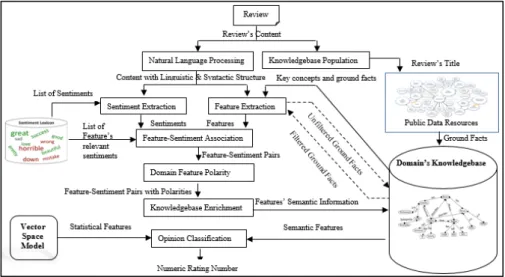
a semantic feature dataset, which it is merged with a statistical dataset and then used as input to Machine Learning classifier that delivers multi-point scale rating for the processed contents. Fig. 1 illustrates the architecture of the proposed new Hybrid Semantic Knowledgebase-Machine Learning approach, which comprises the following main components: knowledgebase Population, Natural Language Processing, Domain
255
Feature Extraction, Sentiment Extraction, Domain Feature-Sentiment Association, Domain Feature Polarity, Knowledgebase Enrichment and Opinion Classification. Detailed account of the role of each component will be explained using a running example of a review about a movie called THE ADDICTION_1995 as is shown in Fig. 2. The following three subsections illustrate the methodology of capturing a domain
260
knowledgebase for the proposed approach, the functionality of the proposed approach for extracting domain features and sentiments, and the procedure of associating the domain feature with their corresponding sentiments, calculating the polarity of the extracted domain feature and determining the rating class of the textual content (i.e., classification process).
Fig. 1. A Hybrid Semantic Knowledgebase-Machine Learning Framework for Opinion Mining
Fig. 2. Example of Movie Review 270
4.1
Capturing domain knowledge
Opinion mining of movie reviews is considered a challenging topic because movie reviews tend to include a rich set of domain features (actors, script, plot, etc.). Furthermore, the popularity of the movie domain provides for the opportunity to exploit the ever-increasing crowd-sourced Linked Open Data repository corresponding to the
275
movie and celebrity industry.
Using movie reviews as the target problem domain, this section describes the methodology for modelling the domain knowledge into a Semantic Knowledgebase that will be used for the domain feature extraction and opinion classification tasks. The section also describes the methodology for generating sentiment lexicons for movie’s
280
features, which will be used for associating domain features with their corresponding sentiments.
ADDICTION, THE (1995)
ADDICTION, THE is an excellent movie. From Spike Lee’s very first movie, ADDICTION, THE, he has demonstrated fresh and interesting approaches to standard material…The script is good and provides several large laughs…The great Katie Virant will probably be forever remembered. She
4.1.1 Semantic modelling of knowledge
Domain Knowledge is knowledge about a domain’s environment that contains
285
information such as key concepts and their synonyms and ground facts, as well as the relation between them [9]. Information from a domain's semantic knowledgebase can be utilised to improve the performance of opinion mining process, in particular, the domain feature extraction task. Constructing a semantic knowledgebase starts with modelling the domain knowledge before translating the knowledge map into formal
290
ontologies that represent the schemata for populating the knowledgebase with structured information. The semantic structure of the knowledgebase provides for obtaining data from other public sources that use similar standards for data structuring such as Linked Open Datasets, which can be used, for instance, to populate the proposed use-case knowledgebase with dynamic ground facts about movies, actors etc.
295
The conceptual model for the movie-review knowledgebase was based on the key concepts of the Movie, Opinion and Review domains and the interaction (relationships) between them as illustrated in Fig. 3.
The movie-review conceptual model was translated into a formal semantic ontology that represents the template box (T-Box) of the movie-review knowledgebase. The
300
movie-review knowledgebase comprises a comprehensive knowledge of the movie domain with approximately 504 concepts related to movie domain such as actor, sound, script, performance, etc. as well as their synonyms and the relationships between them, which were distributed as classes, object properties, data properties and annotations.
305
The advantage of utilising Semantic Web technologies is that they provide for the formal representation of the domain’s key concepts, their synonyms and ground facts, and then link them using typed object properties (relationships). For example, the ABOUT property links a review to movie, the EXTRACTED-FROM property links an
310
opinion to a review, and the DESCRIBE-FEATURE property links between an opinion and a movie. Moreover, there is a SYNONYM annotation for each concept and instance that has a synonym word. Such information can be used to infer valuable semantic information about the main domain concepts (such as movie) as well as the expressed opinions on its constituent features. Therefore, it is possible to compute the overall
315
opinions about a movie across multiple reviews as well as for the cinematic features (actors, script, sound effects, etc.). For example, all movies that have a positive screenplay review can be retrieved by firing one query against the enriched movie-review knowledgebase.
320
4.1.2 Generating sentiment lexicons for domain features
Most opinion mining approaches involve using publically available sentiment lexicons (e.g. SentiWordNet) for the domain feature-sentiment association task. Some authors developed special sentiment lexicons for specific tasks. For example, Ghiassi et al. [13] developed a sentiment lexicon that contained sentiment terms as well as
325
emoticons to be used for analysing Twitter messages. In the proposed Hybrid Semantic Knowledgebase-Machine Learning approach, 6800 positive and negative sentiments were obtained from a public repository opinion lexicon [43] and a sentiment lexicon was generated for each domain feature that belongs to the chosen movie reviews. Each generated sentiment lexicon contains a list of sentiments that can be used only to
330
express a subjective opinion for a specific domain feature. Different domain features may have a different list of sentiments. For example, the sentiment “horrific” in the sentence “It was a horrific scene“ expresses a descriptive opinion on the domain feature “scene”, whereas, in the sentence “It was a horrific movie” expresses a subjective opinion on the domain feature “movie”. Thus, for the “scene” feature, a sentiment
335
lexicon was generated that did not contain the sentiment “horrific”, whereas it was included within a generated sentiment lexicon for the “movie” feature. Moreover, each list of sentiments can be applied to the same group of domain features. Hence, one
sentiment lexicon was generated for each group of domain features that have the same classification. Table 1 shows an example of some movie’s features and their relevant
340
sentiments. Column 1 indicates a different group of movie’s features, and column 2 indicates the relevant sentiments for each group.
Table 1
Example of Grouped Movies’ Features and their Relevant Sentiments.
345
Key Concepts and Associated Ground Facts Sentiments
The concept “Movie” and movies’ names such as
“Meet the Deedles” Admirable, Undelivered, Horrific, Slow, Long
The concepts “Star, Writer, Editor, Director” and names of people who are stars, writer, etc.
Admirable, Able, Handsome, Gorgeous The concepts “Writing, Screenplay, plot, script,
story, idea” Admirable, Undelivered, Well-Populated
The concept “Performance” Admirable, Undelivered, Well, Well-Populated
The concepts “Special Effects, Visual Effects,
Scene” Admirable, Undelivered, Loud, Well-Crafted
4.2
The extraction stage
The purpose of this stage is to improve the performance of the domain feature extraction and the feature-sentiment association tasks. The extraction process exploits public data sources such as DBpedia to populate the generated movie-review knowledgebase with relevant ground facts about movies, actors, directors, prizes, etc.
350
Then, the movie-review knowledgebase is utilised to extract the movie’s features from movie reviews. The next step deploys co-referencing to identify non-explicit domain features. The movie-review knowledgebase is used also to eliminate irrelevant (i.e., false positive) domain features. Finally, the false positive opinions that express descriptive statements have been removed using the generated sentiment lexicons for
355
each group of movie’s features.
4.2.1 Knowledgebase population
The aim of populating the knowledgebase is to construct semantically structured information about each movie, which will be used for the domain feature extraction task. Thus, for each movie review, the proposed Hybrid Semantic
Knowledgebase-360
Machine Learning approach populates the movie-review knowledgebase with the relevant ground facts (movie’s name, released date, running time, country and
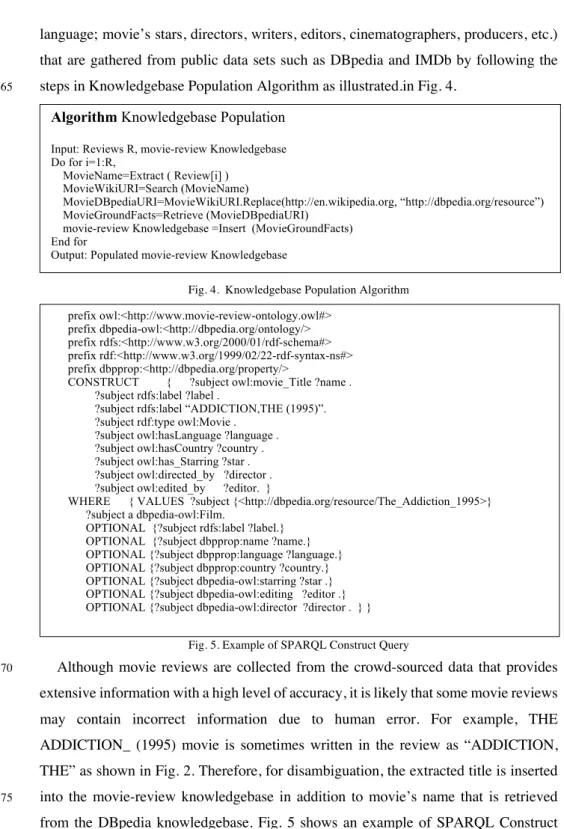
language; movie’s stars, directors, writers, editors, cinematographers, producers, etc.) that are gathered from public data sets such as DBpedia and IMDb by following the steps in Knowledgebase Population Algorithm as illustrated.in Fig. 4.
365
Fig. 4. Knowledgebase Population Algorithm
Fig. 5. Example of SPARQL Construct Query
Although movie reviews are collected from the crowd-sourced data that provides
370
extensive information with a high level of accuracy, it is likely that some movie reviews may contain incorrect information due to human error. For example, THE ADDICTION_ (1995) movie is sometimes written in the review as “ADDICTION, THE” as shown in Fig. 2. Therefore, for disambiguation, the extracted title is inserted into the movie-review knowledgebase in addition to movie’s name that is retrieved
375
from the DBpedia knowledgebase. Fig. 5 shows an example of SPARQL Construct
Algorithm Knowledgebase Population Input: Reviews R, movie-review Knowledgebase Do for i=1:R,
MovieName=Extract ( Review[i] ) MovieWikiURI=Search (MovieName)
MovieDBpediaURI=MovieWikiURI.Replace(http://en.wikipedia.org, “http://dbpedia.org/resource”) MovieGroundFacts=Retrieve (MovieDBpediaURI)
movie-review Knowledgebase =Insert (MovieGroundFacts) End for
Output: Populated movie-review Knowledgebase
prefix owl:<http://www.movie-review-ontology.owl#> prefix dbpedia-owl:<http://dbpedia.org/ontology/> prefix rdfs:<http://www.w3.org/2000/01/rdf-schema#> prefix rdf:<http://www.w3.org/1999/02/22-rdf-syntax-ns#> prefix dbpprop:<http://dbpedia.org/property/>
CONSTRUCT { ?subject owl:movie_Title ?name . ?subject rdfs:label ?label .
?subject rdfs:label “ADDICTION,THE (1995)”. ?subject rdf:type owl:Movie .
?subject owl:hasLanguage ?language . ?subject owl:hasCountry ?country . ?subject owl:has_Starring ?star . ?subject owl:directed_by ?director . ?subject owl:edited_by ?editor. }
WHERE { VALUES ?subject {<http://dbpedia.org/resource/The_Addiction_1995>} ?subject a dbpedia-owl:Film.
OPTIONAL {?subject rdfs:label ?label.} OPTIONAL {?subject dbpprop:name ?name.} OPTIONAL {?subject dbpprop:language ?language.} OPTIONAL {?subject dbpprop:country ?country.} OPTIONAL {?subject dbpedia-owl:starring ?star .} OPTIONAL {?subject dbpedia-owl:editing ?editor .} OPTIONAL {?subject dbpedia-owl:director ?director . } }
Query for retrieving the movie’s ground facts and inserting them into the movie-review knowledgebase. Fig. 6 presents a snapshot of the populated semantic information about THE ADDICTION (1995) movie into the movie-review knowledgebase.
380
Fig. 6. A snapshot of Populated Semantic Information into movie-review knowledgebase about THE ADDICTION Movie
4.2.2 Natural language pre-processing
The main objective of this process is to obtain the linguistic and syntactic structure of the textual review. Hence, Natural Language Processing tools have been
385
implemented within the proposed Hybrid Semantic Knowledgebase-Machine Learning approach via the GATE framework [45]. Fig. 7 illustrates the linguistic and syntactic analysis including tokenisation, sentence splitting, part of speech tagging, morphological analysis, and syntax parsing, which were carried out by the Natural Language Processing components for the first sentence of the provided review in Fig.
390
2.
The obtained grammatical categories from these analyses are used to enhance the domain feature extraction task. For example, many words in reviews cannot be matched
395
to the conceptualised domain features in the movie-review knowledgebase because they are found as nouns (singular and plural) or verbs. Hence, morphological analysis is performed to lemmatise each word in the review to enable the matching with the domain features via the common base. Also, as part of the Natural Language Processing process, dependency relations are analysed to determine the relation between the
400
domain feature and a sentiment in a sentence. For example, dependency relations are used to identify adjectival and noun subject phrases respectively, which intend to contain a domain feature and its corresponding sentiment.
4.2.3 Domain feature extraction
The proposed Hybrid Semantic Knowledgebase-Machine Learning approach
405
performs the domain feature extraction task using the proposed new Domain Feature Extraction algorithm that is illustrated in Fig. 8, which is primarily driven by the movie-review knowledgebase.
As illustrated in the Domain Feature Extraction algorithm, the process contains the steps described below.
410
4.2.3.1 Identifying domain features by the movie-review knowledgebase
The movie-review knowledgebase was utilised to link between its conceptualised knowledge (domain’s key concepts and their synonyms and ground facts) and the lemmatised words in the review. Synonyms are matched to their key concepts in the movie-review knowledgebase. For example, the word (movie) and synonymous words
415
(film, show and picture) are matched to the same key concept (MOVIE) in the movie-review knowledgebase. Words that represent ground facts such as movie names, names of stars, writers, and editors are matched to the same individuals in the movie-review knowledgebase. In the use-case review (Fig. 2), the identified domain features by the movie-review knowledgebase are (ADDICTION THE (1995), THE ADDICTION,
420
movie, Spike Lee, movie, ADDICTION THE, script, Katie Virant and performance) respectively.
4.2.3.2 Extracting non-explicit domain features using co-reference resolution process
Once domain features are identified by the movie-review knowledgebase,
co-425
reference resolution is applied to identify non-explicit domain features from movie reviews such as names of people related to the movie (stars, editors, writers, etc.), which are found within the expressed opinions as single names or pronouns. According to the conducted observation in this research on movie reviews, reviewers tend to mention the full name of people at the first time of expressing opinions on them, and then only single
430
names or pronoun are mentioned to express opinions. The conducted experiment in [15] revealed that the target domain feature is presented by a pronoun within 14% of the expressed opinions. Hence, identifying such non-explicit domain features is essential to enhance the domain feature extraction task, which leads to improving the process of opinion mining at domain feature level. The proposed co-reference resolution process
435
is based on determining the orthographic relation between two names that refer to the same person in which one name is mentioned in a full name such as “Spike Lee”, whereas the other name is mentioned in a single name such as “Lee” or “Spike”. In addition, it is based on detecting the pronominal relation between a person name and a pronoun. For example, in the sentence “Spike Lee is a great director. Also, he is an
440
amazing actor” the anaphor “he” follows the expression to which it refers, i.e., Spike Lee. Detecting the orthographic relation and pronominal relation requires a Person annotation to be generated first; this entails grouping all names (full names and single names) and pronouns (he and she) under a Person annotation, which in turn can ensure performing an accurate matching. Full names of stars, editors, writers, and so forth are
445
matched by the movie-review knowledgebase as mentioned in the previous step, whereas single names and pronouns are identified using hand-crafted JAPE rules with the aid of GATE’s named entity component called ANNIE Transducer. Secondly, GATE’s referencing components have been used to perform matching and co-referencing between the annotated full names, single names and pronouns. Finally, the
450
co-referenced single names and pronouns are mapped to their corresponding individuals in the movie-review knowledgebase, where the mapped individuals present full names of people who are related to movies. For example, after determining the pronominal relation, the pronouns, he and she in the mentioned review in Fig. 2 will be
mapped to the director “Spike Lee” and actress “Katie Virant” respectively, which are
455
individuals in the movie-review knowledgebase.
Algorithm Domain Feature Extraction
Input: Pre-Processed Reviews R, movie-review Knowledgebase contains key concepts, synonyms, and ground facts
Do for i=1: R,
//Extracting Domain features
KeyConcepts=Extract (Review [i], movie-review) // Key Concept such as movie, film, script GroundFacts=Extract (Review [i], movie-review) // Ground Facts such as Joanne Rowling MovieNames=Extract (Review [i], movie-review) // Movie Name such as HARRY POTTER
//Extracting Non-explicit Domain Feature FullNamePeople=Identify (GroundFacts) SingleNamePeople=Identify (GroundFacts) Pronouns=Identify (Reviews[i])
CoReferencedSingleNames=InheritOrthographic(FullNamePeople, SingleNamePeople) CoReferencedPronouns=InheritPronominal (FullNamePeople, Pronouns)
ExpandedGroundFacts=Specify (GroundFacts,CoReferencedSingleNames,CoReferencedPronouns) //Filtering Domain features
K= Count (KeyConcepts) Do for j=1: K,
If (KeyConcepts[j] is Uppercase Letter), // such as STAR, PICTURE
Discard (KeyConcepts[j]) // discard because they are movie names and not features End if
End for
K= Count (ExpandedGroundFacts) Do for j=1: K,
If (ExpandedGroundFacts[j] is not related to the reviewed movie in review[i]), // such as mentioning the star Jay Baruchel within a movie review about HARRY POTTER
Discard (ExpandedGroundFacts[j]) End if
End for
K= Count (MovieNames) Do for j=1: K,
If (MovieNames[j] is not related to the reviewed movie in review[i]),
// such as mentioning the movie name COCO within a movie review about HARRY POTTER Discard (MovieNames[j])
End if
If (MovieNames[j] is Lowercase Letter), // such as star, picture
Discard (MovieNames[j]) // because they are movie features not names End if
End for
Domain-Features=Specify (KeyConcepts,ExpandedGroundFacts, MovieNames) End for
Fig. 8. Domain Feature Extraction Algorithm
4.2.3.3 Filtering out the non-relevant extracted domain features using SPARQL’s 460
ASK queries
It has been observed that characteristic of reviews for movie domain is the use of uppercase letters for movie names; hence hand-crafted rules were applied to discard matched movie names that are typed in lowercase. In addition, to deal with matched
465
movie features that are typed in upper case letters (similar to movie names). For example, in the sentence “Although Spike Lee’s PICTURE, for which he won an Academy Award for the writing, is arguably his best-known film, his picture MALCOLM X, starring Denzel Washington, remains my personal favorite”, the term “PICTURE” points to movie name, whereas the term “picture” is a movie’s feature.
470
Moreover, it has been observed that movie reviews contain opinions on movie’s features such as (movie names and names of stars, writers, editors, etc.) that belong to the target movie as well as to other movies that are sometimes discussed in the review. Hence, the relevant semantically structured ground facts about the target movie were exploited to discard irrelevant domain features. SPARQL’s ASK query was used to
475
investigate each matched domain feature against the relevant semantically structured ground facts in the movie-review knowledgebase as illustrated in Fig. 9. In the query, the extracted name of a person is checked whether it is relevant to the target movie or not (i.e., a star, writer, editor, director, producer or cinematographer, etc.).
480
Fig. 9. ASK SPARQL Query for Examining the Relevant and Irrelevant Domain features
4.2.4 Sentiment extraction
In this stage, sentiments are identified using a list of sentiments (positive and negative) that were obtained from Opinion Lexicon in [43]. The particular list has been
485
used widely in many studies [16], [19]. For example, the words (excellent, first, fresh, interesting, good, large, great, fantastic and amazing) were extracted from the provided review in Fig. 2 and annotated as sentiments. Following the identification of sentiments,
The Query:
prefix:owl:<http://www.movie-review-ontology.org/movieontology.owl#> ASK
{owl:The_Addiction_1995 ?Relation owl:Spike_Lee. }
any adjacent shifters (negation or adverb) were taken into account to moderate the sentiment’s score accordingly. For example, in the sentence “This is not a great movie”,
490
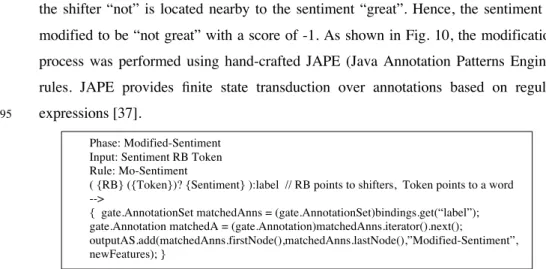
the shifter “not” is located nearby to the sentiment “great”. Hence, the sentiment is modified to be “not great” with a score of -1. As shown in Fig. 10, the modification process was performed using hand-crafted JAPE (Java Annotation Patterns Engine) rules. JAPE provides finite state transduction over annotations based on regular expressions [37].
495
Fig. 10. Jape Rules for Associating Sentiment with Shifter
4.3
Classification process
The classification process implemented in this stage aims to addresses the rating inference problem on a multi-point scale (i.e., opinion classification) by integrating an
500
enriched set of semantic data generated from the modelled movie-review knowledgebase with a statistical dataset contains the frequency of the refined term in textual reviews; the integrated data is then used to train machine learning classification algorithms.
4.3.1 Domain feature-sentiment association
505
In this stage, the extracted filtered domain features are associated with their corresponding extracted sentiments (feature-sentiment pairs). In other words, in each review all the mentioned statements that contain sentiments about the domain features are identified. The association process was initially performed by implementing dependency pattern rules (see Table 2) using the syntactical structure of the content
510
where the grammatical relationships between tokens in a sentence are identified such as “amod” and “nsubj” for adjectival phrase (i.e., serves to modify the meaning of the noun phrase such as “great script”) and noun subject phrase (i.e., the syntactic subject
Phase: Modified-Sentiment Input: Sentiment RB Token Rule: Mo-Sentiment
( {RB} ({Token})? {Sentiment} ):label // RB points to shifters, Token points to a word -->
{ gate.AnnotationSet matchedAnns = (gate.AnnotationSet)bindings.get(“label”); gate.Annotation matchedA = (gate.Annotation)matchedAnns.iterator().next();
outputAS.add(matchedAnns.firstNode(),matchedAnns.lastNode(),”Modified-Sentiment”, newFeatures); }
of a clause such as “the actor is good”) respectively. Then, retaining only the patterns that contain both domain feature and sentiment. Finally, the associated
feature-515
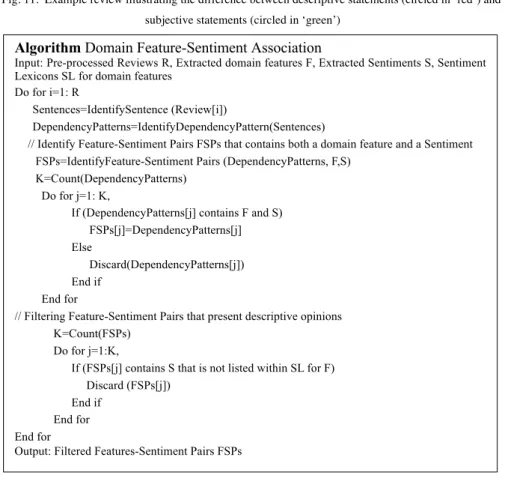
sentiment pairs (i.e., retained patterns) that hold descriptive statements were discarded using the generated sentiment lexicons for the domain features. For example, using the review example in Fig. 11, the opinion phrase “first movie” represents a descriptive statement, hence, it is discarded. Other opinion phrases such as “excellent movie, the script is good, great Katie Virant, she is fantastic, performance is amazing” represent
520
subjective statements, and because their domain features are associated with their sentiments they are retained. A new Domain Feature-Sentiment Association algorithm, shown in Fig. 12, illustrates the association process in detail.
Table 2
Dependency Pattern Rules.
525
Dependency Relation Pattern Rules Example
Nsubj : a noun phrase which is the syntactic subject of
a clause
Domain feature(NN), Sentiment(JJ)
The movie is great
Dobj : the noun phrase which is the (accusative) object
of the verb
Sentiment(V), domain feature(NN)
I hate this music
Prep-of + NN : Prepositional phrases followed by a
noun
Sentiment(NN)+ “of”, Domain feature(NN)
The beauty of the script
Amod : Adjectival phrase that serves to modify the
meaning of the noun phrase
Sentiment(JJ), domain feature(NN)
It is a nicescript
NN=Noun, JJ= adjective, V=Verb,
4.3.2 Domain feature polarity
In this phase, the polarity of each extracted domain feature that has been associated with its sentiment in the previous stage is calculated using the sentiment aggregation
530
function, which was adopted in various studies in the literature for calculating the polarity of domain features. The devised function assigns a score (weight) that indicates the proximity (distance) of the sentiment to the identified corresponding domain feature in the opinion phrase. Adopting sentiment aggregation function for domain features polarity is more effective than relying solely on syntactic dependencies that can indicate
535
the right relation between a domain feature and a sentiment, but may not always yield accurate results, as the associated dependency patterns do not cover all the sentiments and shifters that express the opinion [11]. For example, in sentences “It is a great movie,
however, it is not”, “I do not think that this movie is great” and “I am not sure whether this movie is good or not”, the dependency relations can be used to identify the
540
underlined opinion phrases in order to associate domain features with their sentiments. However, the dependency relations cannot be used to accurately indicate the polarity score because they do not take into account the negation shifters.
Fig. 11. Example review illustrating the difference between descriptive statements (circled in ‘red’) and 545
subjective statements (circled in ‘green’)
Fig. 12. Domain Feature-Sentiment Association Algorithm
The sentiment aggregation Score function as presented in Function (1) is based on determining the final polarity score for each extracted domain feature in a sentence.
550
Algorithm Domain Feature-Sentiment Association
Input: Pre-processed Reviews R, Extracted domain features F, Extracted Sentiments S, Sentiment Lexicons SL for domain features
Do for i=1: R
Sentences=IdentifySentence (Review[i])
DependencyPatterns=IdentifyDependencyPattern(Sentences)
// Identify Feature-Sentiment Pairs FSPs that contains both a domain feature and a Sentiment FSPs=IdentifyFeature-Sentiment Pairs (DependencyPatterns, F,S)
K=Count(DependencyPatterns) Do for j=1: K,
If (DependencyPatterns[j] contains F and S) FSPs[j]=DependencyPatterns[j] Else
Discard(DependencyPatterns[j]) End if
End for
// Filtering Feature-Sentiment Pairs that present descriptive opinions K=Count(FSPs)
Do for j=1:K,
If (FSPs[j] contains S that is not listed within SL for F) Discard (FSPs[j])
End if End for End for
Output: Filtered Features-Sentiment Pairs FSPs
Score(𝑓#,s)=%
𝑠'. 𝑠𝑣 𝑑𝑖𝑠𝑡(𝑠', 𝑓#) ./∈.
(1) Let S be a sentence (e.g. I do not think that this movie is great) that contains a set of domain features fi (e.g. movie), and a set of sentiments sj (e.g. not and great); let sj.sv be
the assigned score value to si (e.g. not=-1 and great = +1); and let dist(sj,fi) be the
distance between sj andfi (e.g. 4 steps between not and movie; and 2 steps between movie
and great). The multiplicative inverse (sj.sv ÷ dist(sj,fi)) is used to give lower weights to
555
the extracted sentiments sj that are far away from the extracted domain feature fi . Finally,
the domain feature fi is assigned the final calculated polarity score after summing the
multiplicative inverse of each fi and sj (e.g. ((-1÷4) + (1÷2)) = 0.25) as well as it is
assigned the polarity level (e.g. positive) using the condition below: • Polarity level= Very Positive if 0.5 < polarity score ≤ 1
560
• Polarity level= Positive if 0 < polarity score ≤ 0.5 • Polarity level= Neutral if polarity score = 0 • Polarity level= Negative if -0.5 <polarity score < 0 • Polarity level= Very Negative if -1 ≥ polarity score ≤ -0.5
Dealing with negation terms or shifters such as not, no, never, none, nobody,
565
nowhere and neither can be sometimes problematic when these shifters are mentioned without the associated succeeding sentiments [11]. That is because there are not any fixed rules for them. Therefore, they were treated as sentiments by assigning them a negative score value -1 and counting their distance from the specified domain feature, then aggregate them with other scores. Whereas the score of each sentiment that is
570
preceded by a shifter in case they are adjacent such as (not good) was shifted (+1 to -1 or -1 to +1). Then, the sentiment aggregation, Function (1) was applied.
4.3.3 Knowledgebase enrichment
In this stage, the initial movie-review knowledgebase that was used to bootstrap the domain feature extraction process is further enriched with new semantic information
575
related to the analysed review and the corresponding extracted domain features. Firstly, the review ID and the name of reviewer who wrote the review were inserted into the movie-review knowledgebase. Secondly, new semantic relations are injected into the movie-review knowledgebase for each extracted domain feature that was associated with a sentiment.
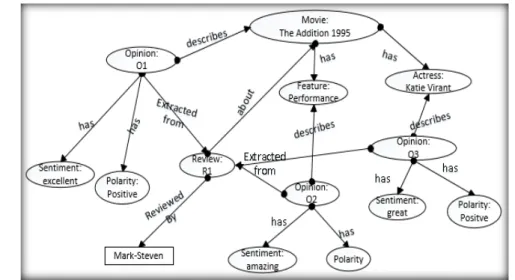
Fig. 13 illustrates a concept map for some of the injected semantic information into the movie-review knowledgebase, which is related to a review about THE ADDICTION movie. The labels in the concept map that contain “The Addition 1995”, “Katie Virant” and “Performance” indicate the movie domain’s key concepts and ground facts that were used to extract domain features, whereas, the rest of the labels
585
indicate to the semantically-tagged information and relations about the analysed review and the extracted domain features such as the polarity level (such as very positive, positive, neutral, negative, very negative) of the extracted domain feature, and the sentiment term that was used to describe the domain feature.
590
Fig. 13. A Concept Map for the Injected Semantic Information into the movie-review knowledgebase The resulting movie-review knowledgebase will be accumulatively enriched with the semantically annotated movie’s features and sentiments extracted from the review, and hence will represent a valuable resource not only for predicting general opinion about a movie, but also for sophisticated retrieval of opinions associated with a specific
595
movie’s feature. For instance, the movie-review knowledgebase should be able to answer a query about movies with the favourable screenplay, filtered by a specific genre, actor, origin, etc.
4.3.4 Opinion classification
In order to use the enriched movie-review knowledgebase for conducting the opinion
600
classification task, it was necessary to represent the semantic information of the enriched movie-review knowledgebase in a semantic feature matrix; which will be
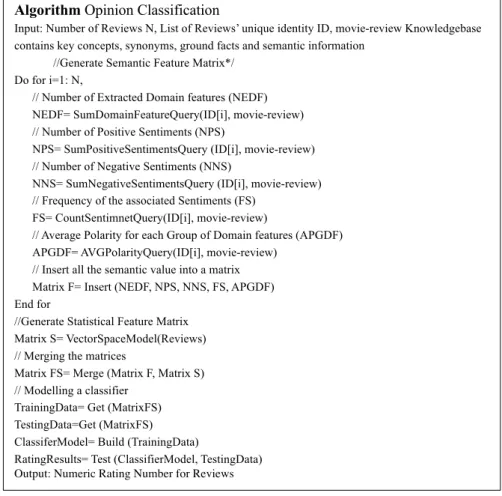
input into the Machine Learning algorithm after merging it with another statistical feature matrix that are generated from the same analysed reviews via applying standard Vector Space Model [29]. A new Opinion Classification algorithm illustrates the
605
classification process in detail as showed in Fig. 14. As illustrated in the Opinion Classification algorithm, the process contains the steps described below.
4.3.4.1 Generating the semantic feature matrix
The generated semantic features present facts of the semantically structured opinions
610
such as number of extracted domain features. Let mxn be a semantic feature by review matrix Fmxn= [fij] where each row i holds a semantic value about the extracted domain
features from textual reviews, and each column j represents a textual review. Hence, each cell fij of matrix F contains a semantic value at which a domain feature i appear in
a review j. The semantic values contained in matrix F were retrieved from the enriched
615
movie-review knowledgebase, in which each semantic value presents a specific type of information as listed below:
• Number of extracted Domain Features per a review (NDF) • Number of Positive Sentiments mentioned in the review (NPS) • Number of Negative Sentiments mentioned in the review (NNS)
620
• Frequency of each Sentiments that were Associated with Domain Features per review (FSADF)
• Average Polarity of each group of domain features (AvgP- i)
An example of the average polarity in 5) above is that the average polarity value will be ‘1’ for a grouped domain feature i in a review j when the grouped domain features i 625
(e.g. script, story, screenplay) were extracted from a review j and associated with their corresponding sentiments (e.g. “the beauty of the script”, “lovely story”, “the screenplay was fantastic”), and their calculated polarity values are +1, +1 and +1. Although the polarity value for each extracted domain feature can be obtained via running a query on each domain feature individually, a single query was performed on
630
each group of domain features. Grouping the domain features is based on the structure of the modelled domain key concepts in the movie-review knowledgebase. For example, the movie’s features “staring, writer, editor, etc.” are specified as a person, hence, instead of performing an individual query for each of them, one query is applied
for these movie’s features in order to combine their polarities and derive the average
635
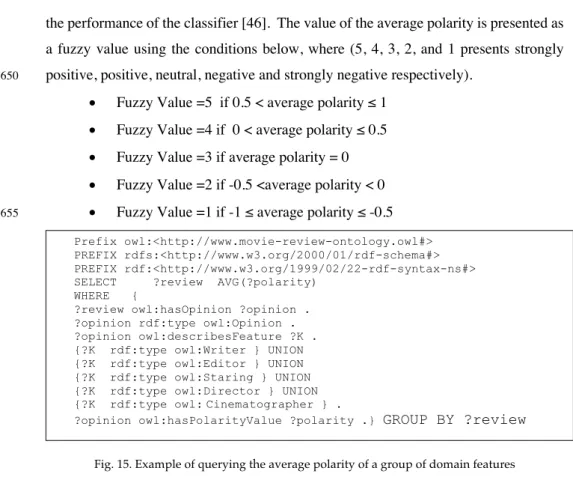
value as shown in Fig. 15.
Fig. 14. Opinion Classification Algorithm
The aim of grouping the polarity value of domain features is to reduce the number of zeros values in the matrix as a technique for improving the quality of matrices passed
640
into the classifier. Prior to grouping the polarity value of domain features, the matrices were Sparse, meaning that most of their elements were zero values. Users often express their opinions on certain domain features and focus less on other domain features and this resulted in Sparse matrices. Sparse training matrices can have impact on the performance of the Machine Learning classifier because they do not contain sufficient
645
data for training the classifier (i.e., have many zeros). Hence, minimizing the zero values would improve the quality of the training data and as a consequence will improve
Algorithm Opinion Classification
Input: Number of Reviews N, List of Reviews’ unique identity ID, movie-review Knowledgebase contains key concepts, synonyms, ground facts and semantic information
//Generate Semantic Feature Matrix*/ Do for i=1: N,
// Number of Extracted Domain features (NEDF) NEDF= SumDomainFeatureQuery(ID[i], movie-review)
// Number of Positive Sentiments (NPS)
NPS= SumPositiveSentimentsQuery (ID[i], movie-review) // Number of Negative Sentiments (NNS)
NNS= SumNegativeSentimentsQuery (ID[i], movie-review) // Frequency of the associated Sentiments (FS)
FS= CountSentimnetQuery(ID[i], movie-review)
// Average Polarity for each Group of Domain features (APGDF) APGDF= AVGPolarityQuery(ID[i], movie-review)
// Insert all the semantic value into a matrix Matrix F= Insert (NEDF, NPS, NNS, FS, APGDF) End for
//Generate Statistical Feature Matrix Matrix S= VectorSpaceModel(Reviews) // Merging the matrices
Matrix FS= Merge (Matrix F, Matrix S) // Modelling a classifier
TrainingData= Get (MatrixFS) TestingData=Get (MatrixFS) ClassiferModel= Build (TrainingData)
RatingResults= Test (ClassifierModel, TestingData)
the performance of the classifier [46]. The value of the average polarity is presented as a fuzzy value using the conditions below, where (5, 4, 3, 2, and 1 presents strongly positive, positive, neutral, negative and strongly negative respectively).
650
• Fuzzy Value =5 if 0.5 < average polarity ≤ 1 • Fuzzy Value =4 if 0 < average polarity ≤ 0.5 • Fuzzy Value =3 if average polarity = 0 • Fuzzy Value =2 if -0.5 <average polarity < 0 • Fuzzy Value =1 if -1 ≤ average polarity ≤ -0.5
655
Fig. 15. Example of querying the average polarity of a group of domain features
Table 3
Generated Semantic Features Matrix
F R F1 F2 F3 F4 F5 F6 F7 F8 F9 F10 F11 F12 F13 R1 3 2 1 1 1 0 0 0 0 0 5 0 5 R2 2 2 0 0 0 1 1 0 0 0 5 5 0 R3 2 0 2 0 0 0 0 1 1 0 1 1 0 R4 2 1 1 0 0 1 1 0 0 0 0 5 1 R5 2 2 0 0 0 1 0 0 0 1 0 5 0 660
Table 3 presents the generated semantic feature matrix from few examples of movie reviews that are listed below. The matrix presents the total number of extracted domain features (F1), positive sentiments (F2) and negative sentiments (F3); the frequency of each sentiment that is used to express subjective opinions in each review (F4, F5, F6, F7, F8, F9 and F10 for like, beauty, great, amazing, hate, bad and nice respectively);
665
and the average polarity of each group of domain features for example story and script
Prefix owl:<http://www.movie-review-ontology.owl#> PREFIX rdfs:<http://www.w3.org/2000/01/rdf-schema#> PREFIX rdf:<http://www.w3.org/1999/02/22-rdf-syntax-ns#> SELECT ?review AVG(?polarity)
WHERE {
?review owl:hasOpinion ?opinion . ?opinion rdf:type owl:Opinion . ?opinion owl:describesFeature ?K . {?K rdf:type owl:Writer } UNION {?K rdf:type owl:Editor } UNION {?K rdf:type owl:Staring } UNION {?K rdf:type owl:Director } UNION {?K rdf:type owl:Cinematographer } .
are grouped together (F11, F12 and F13 for the group movie and film; the group performance and acting; and the group script and story respectively).
• Review1: I liked this movie … the beauty of the script… horrific scene. • Review2: This movie is great … the performance is amazing.
670
• Review3: I hate this movie … the performance is very bad. • Review4: The story is not great … the acting is amazing. • Review5: This is a nice film … the acting is great. 4.3.4.2 Generating a statistical feature matrix
The generated statistical features represent the frequency of the refined terms in
675
textual reviews. Let mxn be a statistical feature by review matrix Smxn= [sij] where each
row i holds the frequency of the refined term in textual reviews, and each column j
represents a textual review. Hence, each cell sij of S contains the frequency value (i.e.,
0 for the absence or 1 for the presence) at which a term i appears in a review j. The statistical values contained in Matrix S were generated from the textual reviews as
680
follows:
1) Tokenising each review’s contents into a list of tokens;
2) Filtering the list of tokens by removing stop words, punctuations marks, semicolons, colons, numbers, tokens with length equal to one, tokens contain numbers and tokens that occur in only one review;
685
3) Stemming the list of filtered tokens by formatting each token to its root and converting each token to lowercase letters; and
4) Creating a Vector Space Model [29] that represents the frequency of each refined token across all reviews.
Table 4 presents the generated statistical feature matrix from few examples of movie
690
reviews that are listed below. The matrix presents the frequency value of the refined terms that occur in more than one review (T1, T2, T3, T4 and T5 for the refined terms movie, great, performance, amazing and acting respectively).
• Review1: I liked this movie … the beauty of the script… horrific scene. • Review2: This movie is great … the performance is amazing.
695
• Review3: I hate this movie … the performance is very bad. • Review4: The story is not great … the acting is amazing.
• Review5: This is a nice film … the acting is great.
Table 4
Generated Statistical Features Matrix
700 T R T1 T2 T3 T4 T5 R1 1 0 0 0 0 R2 1 1 1 1 0 R3 1 0 1 0 0 R4 0 1 0 1 1 R5 0 1 0 0 1
4.3.4.3 Merging semantic and statistical feature matrices
The matrix Fmxn and Smxn were concatenated together horizontally to produce a new matrix
FSmxn, in which concatenates rows of matrix F with rows of matrix S as both matrices
have the same number of rows. Hence, the generated new matrix is considered a ‘review
705
by a semantic-statistical feature’ matrix FSmxn=[fsij] where each row i represents a textual
review, and each column j holds a semantic feature or a statistical feature as illustrated in Table 5. After concatenating matrices, normalisation process was performed by deploying feature scaling (i.e., each column) and instance scaling (i.e., each raw). Finally, the normalized FS matrix was passed to machine learning classifiers such as
710
Support Vector Machine in order to result the rating inference for each review.
Table 5
Merging Semantic and Statistical Features Matrices
F/T R F1 F2 F3 … F13 T1 T2 T3 T4 T5 R1 3 2 1 … 5 1 0 0 0 0 R2 2 2 0 … 0 1 1 1 1 0 R3 2 0 2 … 0 1 0 1 0 0 R4 2 1 1 … 1 0 1 0 1 1 R5 2 2 0 … 0 0 1 0 0 1
5.
Experimental Evaluation
This section presents the conducted experiments on a movie review dataset as a case
715
study in order to evaluate the performance of the proposed Hybrid Semantic Knowledgebase-Machine Learning approach for improving the performance of domain
feature extraction, the domain feature-sentiment association and opinion classification tasks. The experiments were conducted using a computer system with a processor (Intel® Core™ i5-4570 CPU @3.20GHz 3.20 GHz), memory RAM 32.0GB and
64-720
bit operating system. In addition, the GATE 8.0, Protégé 4.3, Weka 3.6 and NetBeans 8.0.1 software were installed on the system.
5.1
Datasets
A dataset of movie reviews [44] was used for the experiments, and this dataset has been widely used in the sentiment analysis literature [4], [18], [26]. The dataset contains
725
1770 reviews written by the same author. Each review is accompanied by a numerical rating based on its polarity. Table 6 presents the characteristics of the chosen dataset.
Table 6
Dataset Characteristics for 3-class Classification.
730 Rating Count 0 413 1 648 2 709 Total 1770
In order to perform evaluations for the domain feature extraction and the domain feature-sentiment association tasks, a total of 475 sentences containing 9301 words were selected from the downloaded dataset, and then from the selected sentences 422 domain features (277 Key concepts and synonyms, 18 movies’ names, 91 names of
735
people related to movies, 36 pronouns) were manually extracted and then associated with their corresponding sentiments (107 domain feature-sentiment pairs). The manually identified domain feature baseline and the feature-sentiment pairs baseline were used to evaluate the obtained domain features and domain feature-sentiment pairs via the proposed Hybrid Semantic Knowledgebase-Machine Learning approach.
740
In terms of the evaluation of opinion classification task, the downloaded dataset contains 1770 movie reviews and their corresponding numerical ratings for 3-class classification (0, 1and 2). The numerical ratings of the chosen dataset will be used as
reviews’ rating baseline to evaluate the obtained reviews’ rating via the proposed Hybrid Semantic Knowledgebase-Machine Learning approach.
745
5.2
Methodology
The obtained movie reviews were processed using the proposed Hybrid Semantic Knowledgebase-Machine Learning approach. Firstly, the modelled movie-review knowledgebase was populated with relevant ground facts from public datasets. Then, the movie reviews were processed linguistically and syntactically to tokenise, tag and
750
lemmatise words as well as to determine the relation between them. After that, the target domain features were extracted from reviews and filtered to remove irrelevant extracted domain features by the proposed Domain Feature Extraction algorithm. In addition, sentiments were extracted from movie reviews and then modified to take into account any preceding shifters that might modify their polarity. Thereafter, the filtered
755
domain features were associated with their corresponding sentiments using the proposed Domain Feature-Sentiment Association algorithm, and then their polarities were counted. Further, the movie-review knowledgebase was enriched with the obtained new semantic information and relations that belong to the processed movie reviews and the extracted domain features from them. Then, the semantic matrix F was
760
generated from the movie-review knowledgebase, and it was merged with the statistical matrix S that was generated via standard Vector Space Model [29]. Finally, the matrix FS was normalised by deploying feature scaling (i.e., each column) and instance scaling (i.e., each raw). After that, the normalised FS matrix was used to build a Support Vector Machine and Naïve Bayes classifiers to classify each review at numerical rating scale.
765
5.3
Experimental results
This subsection describes the results of the domain feature extraction task, the domain feature-sentiment association task, and the opinion classification task.
5.3.1 Evaluation of the domain feature extraction task
The evaluation is based on comparing the performance of the proposed Domain Feature Extraction algorithm against the prepared domain feature baseline results as well as against two existing approaches that adopt Semantic Knowledgebase technique.
775
In particular, three experiments were performed using the proposed Domain Feature Extraction algorithm on the same selected sentences from the downloaded reviews for three modelled knowledgebases. In the first experiment (EXP1), the modelled movie-review knowledgebase for the proposed Hybrid Semantic Knowledgebase-Machine Learning approach was utilised, which contains a comprehensive knowledge about
780
movie domain (key concepts, synonyms and ground facts that are collected from DBpedia and IMDb resources) as described in Section 4.2.1. In the second (EXP2) and third (EXP3) experiments, two knowledgebases K1 and K2 were modelled and used as described by Zhao and Li in [41], and by Peñalver-Martinez et.al in [30]. The K1 knowledgebase contains only the movie domain’s key concepts and their synonyms
785
while the K2 knowledgebase is a general movie domain knowledgebase that contains few number of movie’s key concepts, synonyms and ground facts that were collected from IMDb resources.
In all experiments (EXP1, EXP2 and EXP3), the main focus was on evaluating the number of the retrieved domain features (Recall) via different coverage of the used
790
knowledgebase. Functions (2) was used to compute the Recall of the extracted domain features.
Recall= |{relevant domain features} ∩ {retrieved domain features}| |{relevant domain features}|
(2)
The results indicate that the proposed Domain Feature Extraction algorithm for Hybrid Semantic Knowledgebase-Machine Learning approach achieved high overall
795
recall (86%) even before considering the co-reference resolution in EXP1 in the case that the proposed comprehensive movie-review knowledgebase was utilised, whereas the Domain Feature Extraction algorithm achieved 64% and 57% recall in EXP2 and EXP3 when the K1 and K2 knowledgebases were utilised. In terms of the precision, the results were less relevant for critical analysis as all the experiments EXP1, EXP2 and