Availability of Health Care Data for Variation Research and Policy Analysis
The experience of the Wennberg International Collaborative
Dana C. Wilkinson, Ph.D. David Goodman, MD, MS
The Dartmouth Institute for Health Policy & Clinical Practice
Regional and provider unwarranted variation (i.e. not explained by patient needs or preferences) in health care quality and efficiency is a worldwide problem. Local communities, patients and health systems all benefit from the availability of high-quality data and information concerning the epidemiology of health care, as such information helps researchers identify: (1) problems in care;; (2) regions, areas and providers that lag or lead in quality and efficiency;; (3) underlying causes leading to unwarranted variation;; and (4) the magnitude of public benefit and whether identified problems in care have been remedied. Transparency through public reporting is key to accelerating patient care improvements and reductions in health care costs.
In many countries, however, this critical information about health system performance is not routinely available. Many of the researchers attending the Wennberg International Collaborative meetings have expressed difficulties in obtaining access to health care data. To better
document these barriers, the Collaborative conducted a survey.
Access to Health Care Data Survey
In June 2015 a survey consisting of eighteen questions was developed and distributed to 80 members of the Wennberg International Collaborative (WIC). The aim of this survey was to assess the experiences of WIC members amongst countries.
Four central themes were threaded within the survey questions: (1) existence of health care variation data;; (2) ease of access to existing data (if applicable) – e.g. who is granted
permission to access data and data affordability;; (3) identification of the main servicer(s) of data;; and (4) importance of transparency in health system performance within national policy
agendas. The survey had a 44% response rate with 35 colleagues representing 23 separate countries contributing their input.
Presentation of data findings
Findings from the survey support the argument that both the existence of and permissible access to data of publicly funded health care is greatly uneven not only across multiple
countries but also across jurisdictions within a single country. Many respondents share similar barriers with regard to access to data (e.g. servicers of data, unavailable types of data, lack of a single health care data database). However, there is also noticeable variation regarding the priority given within national policy agendas to the goal of transparent and public availability of health care data as well as the process one must navigate to gain permission to access data sets.
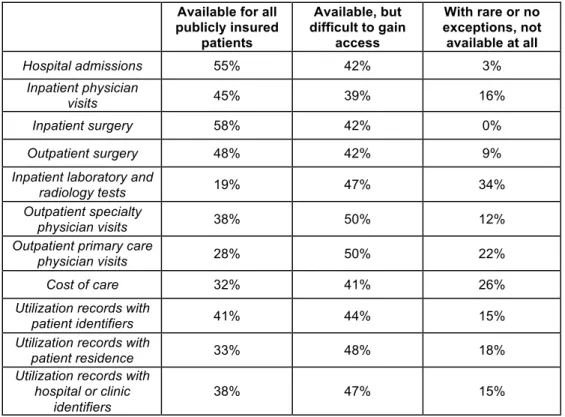
Table 1: Availability of research data of publicly founded health care by data type
Available for all publicly insured
patients
Available, but difficult to gain
access
With rare or no exceptions, not available at all
Hospital admissions 55% 42% 3%
Inpatient physician
visits 45% 39% 16%
Inpatient surgery 58% 42% 0%
Outpatient surgery 48% 42% 9%
Inpatient laboratory and
radiology tests 19% 47% 34%
Outpatient specialty
physician visits 38% 50% 12%
Outpatient primary care
physician visits 28% 50% 22%
Cost of care 32% 41% 26%
Utilization records with
patient identifiers 41% 44% 15%
Utilization records with
patient residence 33% 48% 18%
Utilization records with hospital or clinic
identifiers
38% 47% 15%
As seen in Table 1, outpatient physician visits, patient utilization records (of any kind) and inpatient laboratory and radiology tests are the most inaccessible forms of data within the majority of countries. Respondents commented that, while data may be available, in some cases it is only available in hard copy, might not contain vital information such as diagnoses, or be assessable to a restricted user group (e.g. those who have contracts through the English National Health Service).
On a scale of one to five, with one being ‘definitely disagree’ and five meaning ‘definitely agree’, respondents rate that at the national health care policy-making level, access to health care data for independent research (average = 3.35) as well as seeking transparency and availability of utilization, costs and outcome measures (µ=3.58) vary considerably across differing countries’ policy agendas. Twenty-nine percent “definitely agree” and 6% who ‘definitely disagree’ that transparency and public availability of utilization, costs and outcome measures is of high policy importance. Colleagues have remarked that ‘there are many references made to transparency but less evidence of this happening in a systematic and coordinated way’ and that ‘views are so polarized (e.g. protecting patient privacy vs. need for data for research/health care
improvement)’ that this issue is just at ‘the edge of jumping forward’. Sixteen percent “definitely agree” and 3% who ‘definitely disagree’ that Access to healthcare data for independent
research is high on the policy agenda.
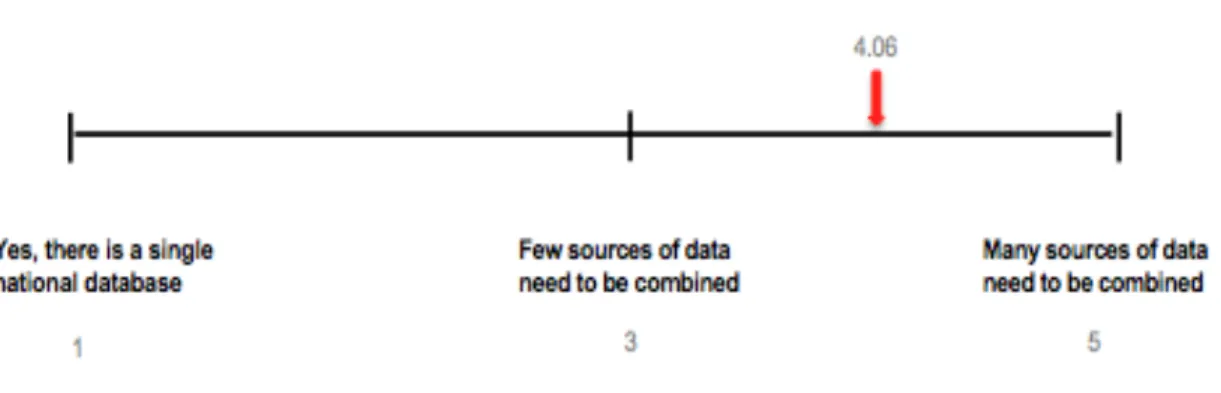
Although data is difficult to access the quality of health care data appears to be relatively high. As seen on the scale in Figure 1, the weighted mean score of survey respondents is 4.13. Roughly 81% of survey respondents rate the quality of his or her country’s health care data as
Figure 1: Quality of health care data in survey respondents’ countries
Deficiencies within the data are said to include: a lack of standardized coding procedure;; gaps in ambulance and social care data;; a primary focus on claims data instead of clinical data;; outdated data;; incomplete coverage of content of care;; and no data on quality and measurement of outcomes.
Although servicers or ‘gatekeepers’ of health care data vary across the WIC countries (Table 2) different levels of government (national or regional) dominate the control of access.
Table 2: Servicers who control access to health care data
Controllers of data Percentage of survey responses
The national government 87%
The regional government 53%
Social insurers (i.e. public or not for profit) 43%
Private insurers 33%
Other 27%
Also evident (see: Table 2) is the variation in social and private insurer role in access to data. This variation is arguably due to some countries operating with a budgeted national health service, some countries utilizing a more pluralistic system of social insurers, and other countries relying on market- based, privatized systems of health care. Provider organizations such as hospitals, associations related to statutory health insurance physicians, and independent administrative authorities (at the national level) have also been identified as having control over access to health care data. While specific servicers ‘control’ health care data, that doesn’t stop others from ‘blocking’ or making data access difficult.
Table 3: Servicers of data that block or make access to health care data difficult 1 (Definitely disagree) 2 (Neutral) 3 4 (Definitely 5 agree) I don't know Weighted average National government 17% 10% 28% 28% 17% 0% 3.17 Regional government 36% 18% 14% 21% 7% 4% 2.36
Providers of care
(hospitals and physicians) 22% 15% 15% 41% 7% 0% 2.96 Payers and insurers of
care 18% 21% 18% 18% 25% 0% 3.11
While 87% of survey respondents indicated the national government as one of the primary controllers of health care research data (see: Table 2), only 44% o ‘somewhat’ to ‘definitely agree’ that the national government is blocking access to data. Survey findings also identify a clear difference in the level of difficulty WIC colleagues have experienced with regional governments as well as providers of care (e.g. hospitals and physicians) ‘blocking’ access to health care data.
Figure 2: Weighted average of countries that have health care data collected and organized into one single database
On a five-point scale exploring whether health care data in each colleague’s country are collected and organized into one single database, only one colleague replied that their country has a single national health care data database. Roughly 65% of survey respondents indicated that there are ‘several’ to ‘many’ sources of data that need to be combined, while 26% state that only a ‘few’ sources of data need to be combined. Overall, health care data is not cohesively organized nor stored in an easily accessible or deliverable manner.
Table 4: Feasibility of obtaining data to calculate rates across regions 1 (Definitely disagree) 2 (Medium) 3 4 (Definitely 5 agree) I don't
know Weighted average Hospital admission rates 3% 3% 10% 13% 70% 0% 4.43 Inpatient surgical procedures 3% 3% 13% 17% 63% 0% 4.33 Outpatient surgical procedures 10% 13% 17% 13% 47% 0% 3.73 Physician visits 13% 20% 7% 17% 40% 3% 3.4 Outpatient pharmaceutical use 10% 10% 21% 21% 34% 3% 3.48
Cost or charges of
care 13% 7% 27% 23% 27% 3% 3.33
Hospice care 10% 7% 30% 13% 23% 17% 2.83
As seen circled in yellow, there is wide-ranging variability in the feasibility of accessing certain types of data to calculate simple cross-sectional rates across regions. While a majority (70%) of colleagues ‘definitely agree’ that it is possible to compare hospital rates from differing regions, feasibility is lower when trying to measure outpatient-related care, with physician visit data being the least feasible. Some respondents stated that obtaining data from multiple regions largely depends on ‘who you are’ and the network connections one has developed, as well as whether there are sizeable gaps of available data due to differing laws governing private insurers and what they must report.
Respondents also listed a number of other barriers limiting data availability. These include: (1) differing aims for the usage of data (e.g. national government wants to use data to control regions vs. regional government wants to use data to manage health care services);; (2) the bureaucracy of ethics approval systems;; (3) data is often times ‘owned’ by several parties or private organizations;; and (4) differing computer systems and lack of a standardized coding system make data analysis difficult.
Summary
The availability of health care data for independent research and analysis is adequate in some countries and for certain types of health care, such as hospitalization data. More commonly data is not available at all or is difficult to obtain. Often data needs to be obtained from multiple sources through administrative processes that are unpredictable.