DIPLOMARBEIT
Titel der Diplomarbeit
"Microfinance in Developing Countries"
Verfasserin
Heide Maria Schörghofer
angestrebter akademischer Grad
Magister der Sozial- und Wirtschaftswissenschaften
Mag.rer.soc.oec.
Wien, im Juni 2008
Studienkennzahl lt. Studienblatt: A 157
Studienrichtung lt. Studienblatt: Internationale Betriebswirtschaftslehre Betreuer: o. Univ.-Prof. Mag. Dr. Josef Zechner
Eidesstattliche Erklärung
Ich erkläre hiermit an Eides Statt, dass ich die vorliegende Arbeit selbständig und ohne Benutzung anderer als der angegebenen Hilfsmittel
angefertigt habe. Die aus fremden Quellen direkt oder indirekt übernommenen Gedanken sind als solche kenntlich gemacht.
Die Arbeit wurde bisher in gleicher oder ähnlicher Form keiner anderen Prüfungsbehörde vorgelegt und auch noch nicht veröentlicht. Wien, im Juni 2008
List of Figures
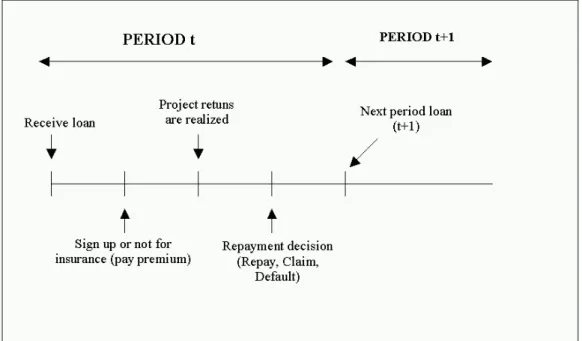
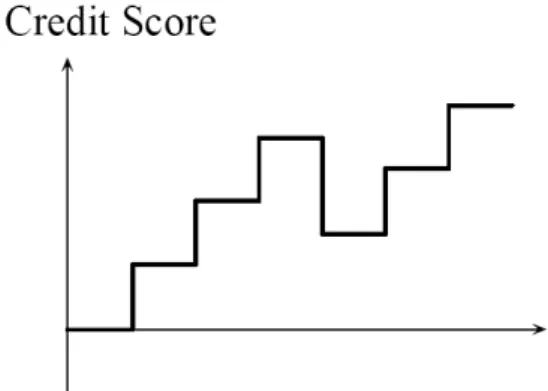
1 Stages of Loan and Insurance Contract . . . 22 2 Evolution of Borrower Reputation . . . 23 3 Evolution of Borrower Reputation µ[T] . . . 26
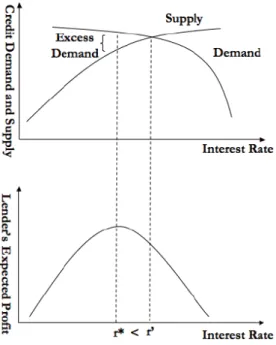
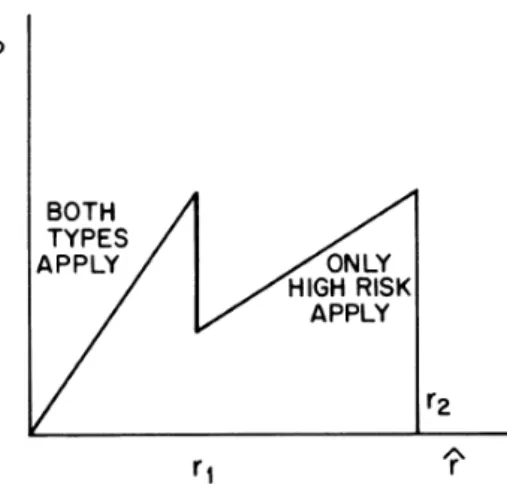
4 Due to credit rationing the optimal interest rate is below the equilibrium interest rate. A special interest rate exists which maximizes the expected return to the lender. . . 31 5 Adverse-selection Eect . . . 34 6 Degree of Credit Rationing in Uganda . . . 51
"Micronance has proved its value, in many countries, as a weapon against poverty and hunger. It really can change peoples' lives for the better espe-cially the lives of those who need it most."
Contents
1 Introduction 3
2 Background of Micronance 5
2.1 The Development of Micronance . . . 5
2.1.1 The Beginnings of Micronance in Europa . . . 5
2.1.2 Current Situation of Micronance in Developed Coun-tries . . . 6
2.2 Contractual Features of Micronance . . . 8
2.2.1 Individual Versus Group Loans . . . 10
2.2.2 Grameen Bank Group Lending System . . . 12
3 Screening Mechansims for Group Lending Programs 13 3.1 Assortative Matching . . . 13
3.1.1 The Model . . . 13
3.1.2 Group Formation Game . . . 14
3.2 Monitoring . . . 15
3.2.1 Problem of Undermonitoring . . . 16
3.2.2 The Contracting Process . . . 18
4 Microcredit Repayment Insurance 20 4.1 Incorporating Insurance in Loan Contracts . . . 20
4.2 Two Sources of Abuse . . . 23
4.2.1 Excluding Undesirable borrowers . . . 24
4.2.2 Fraudulent Claims . . . 25
5 Problems of Micronance 28 5.1 Asymmetric Information . . . 28
5.2 Why is there Credit Rationing? . . . 29
5.2.1 The Model of Stiglitz and Weiss . . . 30
5.2.2 Eect of Adverse-Selection . . . 32
5.3 Moral Hazard . . . 34
6 Microcredit Interest Rates 36 6.1 Why are Micronance Interest Rates so High? . . . 36
6.2 Subsidization of Interest Rates . . . 38
6.3 Interest Rate Ceilings . . . 39
6.4 Competition on Microcredit Markets . . . 41
6.5 Setting Lending Interest Rates . . . 42
7 Micronance in Uganda 46 7.1 Financial Sector . . . 47
7.2 Credit Rationing . . . 49
7.2.1 Interest Rate Ceilings . . . 51
7.2.2 Interest Rates and Competition . . . 53
8 Conclusion 55 References 57 Websources 62 Appendix 63 A) Abstract . . . 63 B) Kurzfassung . . . 64 C) Curriculum Vitae . . . 65
1 Introduction
The concept of micronance, to provide low scale nancial services to low income people, is much older than generally known. This is an important fact since it shows how informal nancial services in developed countries evolved to a commercial and private banking sector. It helps to understand what kind of consequences micronance movements can have on the economical development processes in developing countries.
At the beginning, non-prot and charitable lenders dominated the mi-cronance sector. Their objective was to reach as many poor people with low scale nancial services as possible. However, over the years new lend-ing techniques, such as individual and joint liability contracts, evolved and created a new market which is now partially prot-making. Particularly the Grameen Bank and its group lending contract have received extensive academic attention in recent years.
The rst part of this thesis compares the dierent contractual features of micronance with a special focus on Grameen Bank. Subsequently, the focus will be put on how these lending possibilities help the poor to improve their social standards. Especially the improvement of women's situation is discussed. In addition the thesis takes a closer look at possible extensions to microcredit contracts, which would help to improve the quality of nancial services.
Having found a way to serve low income people with small micronance loans, new problems come up. On the one hand the nancial market has to deal with market failure, namely that of asymmetric information. In the case of developing countries this problem becomes more severe since nancial institutions have to deal with lack of information and data about potential borrowers. On the other hand, micronance institutions (MFIs) are not able
to handle the tremendous demand for low scale nancial services, which in the end leads to credit rationing. These problems will be anlayzed more closely in the second part of the thesis. Furthermore, the reasons MFIs have to charge interest rates which are frequently higher than those of bank interest rates will be given.
It is very interesting to study how the theoretical models of micronance are used in dierent developing countries. In this thesis micronance tech-niques are investigated using the example of Uganda. By means of looking at the Ugandan nancial sector, the most frequently applied lending meth-odes will be analyzed as well as MFIs ability to meet the total demand for nancial services of the rural population. In conclusion Ugandan's interest rate situtation charged by MFIs will be dealt with.
2 Background of Micronance
2.1 The Development of Micronance
2.1.1 The Beginnings of Micronance in EuropaMicronance is not a recent development since today's developed countries can look back on a long history of micronance. The beginning of micro-nance in Europe dates back to the 16th and 17th century. At that point in
time poverty increased extraordinarily. As a reaction in a number of Euro-pean countries a micronance sector started to evolve as a type of banking for the poor. Almost right from the start, micronance was seen as a nacial intermediation between microsavings and microcredit. Furthermore, due to legal recognition, prudential regulation and mandatory supervision micro-nance experienced a process of mainstreaming during the 20th century. As a
result of this develpoment micronance became part of the formal banking sector1.
In this context especially Ireland's micronance system is remarkable, since it prospered in a market where credit services were very dicult to obtain due to extreme macroeconomic instability and a high emigration rate throughout the 19th century. Micronance in Ireland covers the period from 1720 to 1950, where a network of non-prot banks oered loans to the poor without collateral2.
The so-called Irish Loan Funds, which emerged in the 1720s, were a long-lived, self-sustaining, large-scale micronance organization. It issued millions of loans to the poor, without making them provide any collateral. At rst, those loan funds were intended as charities which were funded by donated
re-1see Seibel, 2005, p.1
sources, but over time they were replaced by nancial intermedation between savers and borrowers.
By the middle of the 19th century loan funds had become one of the most important nancial institutions in the country. They covered approximately 20% of all households, far more than commercial banks. Furthermore, the deposit rates of those funds were three times higher than those of commercial banks, whereas loan funds charged higher interest rates. Since the loan funds became a serious threat to commercial banks in 1843, these institutions in-duced the government to put a ceiling on the interest rate which lead to the loss of the loan funds' competitive advantage. The end of the story was a substantial decline of scale until they nally disappeared in the 1950s3.
2.1.2 Current Situation of Micronance in Developed Countries Political development in several countries created an environment in which small micronance beginnings evolved into huge networks of local nancial institutions which are now part of the formal banking system. Nonetheless, the problem that poor households are excluded from the mainstream formal credit market up to now, could not have been completely solved in developed countries. Therefore, how do poor households deal with borrowing barriers in developed countries nowadays?
For example, in the United States an extensive set of credit markets for the poor operates apart from the mainstream credit markets. It is about the so-called "fringe banking", which consists of pawnshops, payday loan rms and cheque-cashing rms. "Fringe banking" is of great importance, since the Unites States provide a weak social safety net.
The clients of fringe banking come from a variety of socio-economic
grounds but all of them are of low income. They have limited access to formal credit markets because of bad credit histories or the fact that they have reached the limit of their borrowing capacity already. Fringe nancial services issue short-term nancing to people in need because of job loss, un-expected expenses, income shortfalls and other personal problems. Thus, fringe banking generally represents the ultimate borrowing possibility to low income people in order to keep themselves liquid.
In the last decade important changes have occurred in the modality of small-scale lending to poor households. According to Caskey, a major shift away from lending by pawnshops to so-called payday lending could be ob-served. One reason is that payday lenders are willing to make larger loans to poor households - their loans average about $ 250 versus about $75 for pawnshops - than pawnbrokers. In addition, payday lending is considered to be more practical since the borrower does not have to provide a security in the form of a personal possession to the lender.
Payday lending refers to very short term loans taken out by workers who run out of cash before payday. The borrower writes a personal check made out to the lender and in exchange the payday lender receives a cash payment. Before the loan matures, the borrower can pay back the face value of the check in cash and the debt is cleared. If the borrower can not repay, the lender will deposit the check. The opinions about payday lending as a useful service to low-income individuals dier. Critics argue that payday lenders provide extremely expensive short-term loans to people who have no better alternatives. Furthermore, they state that many lenders do not use payday loans once but in fact take out such loans frequently.
Another fringe banking service, that low income people rely on, are so-called "check cashing outlets" (CCOs). Most charge a check-cashing fee that
is a percentage of the face value of the check. Many clients of CCOs are less well educated than those who use banks and are not provided with bank accounts. In recent years many CCOs started to oer payday loans.
In conclusion, it can be said that the strong growth in payday lending proves that many low-income people are willing to accept higher interest rates. The reason for that phenomenon can be found in their desire to be supplied with short-term loans whenever they need them. In the future, electronic payment trends are expected to further change the shape of payday lending, pawnbroking and commercial check cashing4.
2.2 Contractual Features of Micronance
The modern micronance movement began as an economic development tool in the 1970s. It rapidly gained prominence in the 1980s and 1990s since a rethink, concerning the image of the poor, has taken place. In former times poor people were mostly seen as unproductive individuals who could only be helped through donor nanced programs and subsidies, but micronance disproved this assumption. It appeared that the poor can become active and viable actors in the economy, when endowed with appropriate surrounding conditions. Over the years microcredit programs advanced from being an experimental alternative to a serious model for lending to the poor5.
Until recently large groups of society in poor and developing countries were excluded from the credit market. They did not have any access to -nancial services such as bank saving accounts, credit facilities or insurances. It was almost impossible for them to apply for micro loans, which they nec-essarily needed, for improving their self-employment opportunities. As a
4see Credit Markets for the Poor, 2005, p. 18 5see Credit Markets for the Poor, 2005, p. 199
consequence, self-employment became impossible to realize or if they had already started their businesses they suered from undernancing and were not able to expand their businesses.
The reasons for exclusion were multifarious. One reason stems from the fact, that lending institutions typically have limited information on the qual-ity and behaviour of their clients, particularly of those with small informal businesses6. Furthermore resource-poor enterpreneurs, who cannot provide
any collateral, are unable to demonstrate their creditworthiness to the banks. This makes it impossible for banks, who grant loans only by collateral, to as-sess borrowers risk. Moreover, people who run small scale businesses mostly ask for small loan sizes. In the formal banking system however it is not pos-sible to substitute lacking collaterals by additional screening or monitoring eorts. The reasons are that on the one hand the thereby added costs exceed the potential revenues and that on the other hand most institutional lenders of the formal banking sector consider the allocation of micro loans as highly inecient7.
However, micronance institutions, also known as MFIs, which oer -nancial services to impoverished people, have shown that informational and collateral problems of poor people can be overcome by oering special con-tracts. Loan contracts are a sequence of uncollateralized loans which grow over time. Through periodical loan repayments, the borrowers obtain access to further loans but if a borrower defaults he will be excluded. Thus, bor-rowers repayment incentive is created by their desire to maintain access to further micronance loans8.
6see Sadoulet/Carpenter, 2001, p. 4 7see Kritikos/Vigenina, 2005, p. 213-214 8see Sadoulet/Carpenter, 2002, p. 4
2.2.1 Individual Versus Group Loans
Most MFIs apply two types of loan contracts, in order to deliver nancial services to their clients: the individual loan contract and the joint-liability loan contract, which is also known as group contract.
In the individual loan contract borrowers are individually repsonsible for their loan. However, in the group contract borrowers are jointly reliable for the loan. The rst thing a borrower needs to do, before being considered for a group loan, is to become a member of a group. In the majority of cases, the credit group must consist out of ve or seven individuals. Then each group member receives a loan on her own, but all group members are held jointly liable for the entirety of the group loan. This means that if one group member get's into nancial problems, all other group members are considered in default too and are punished by the lending institution9.
The great majority of MFIs rely on group lending contracts. Especially Grameen Bank and its group lending contract have received a lot of academic attention in recent years. A reason for this was the success of the Grameen Bank in Bangladesh, since it raised hopes that group lending schemes can be used to provide the rural poor with formal sector credits10. According to
the Grameen Bank homepage, the repayment rate amounts to 97%, which is higher than other schemes that lend money to the rural poor. In addition, Grameen Bank's default rate is about 2%, which is lower than the default rates of commercial banks in Bangladesh. There, commercial banks suer a default rate of about 70% for agricultural loans and 90% for industrial loans. According to Muhammad Yunus, the reason for such a big dierence can be found in the psychology of the borrowers. The rich can aord the
9see Credit Markets for the Poor, 2005, p. 229 10Chowdhury, 2005, p 416
consequences of non-repayment, whereby the poor cannot11.
For a better understanding how group lending schemes work, the Grameen Bank group lending scheme will be examined more closely. Muhammad Yunus, founder of the Grameen Bank (Bangladesh), realized that poor peo-ple have the potential to help themselves if given access to the benets of ecient nancial markets. His solution to the lack of nancial services in areas of severe rural poverty was the following: First, Grameen Bank hires agents which travel through the countryside at regular intervals, making loans and collecting loan repayments. Secondly, only women who belong to the Grameen's loan circles are eligible for future loans12.
Loans disbursed by the Grameen Bank are small, but sucient for women to nance micro-enterprises like rice-husking, machine repairing, purchase of rickshaws, buying of milk cows, goats, cloth, pottery and much more. Giving women ownership of assets helps them to reduce their dependency on their husbands and makes it possible for them to improve their homes and the nutritional standards of their children. Moreover, Grameen Bank pays at-tention that the ownership of houses or businesses, which were built through their loans, remain with the borrowers who are mainly women. Today about 97% of Grameen Bank's borrowers are female.
The Grameen bank lending system is based on the voluntary formation of small groups of ve people. They help to establish morally binding group guarantees instead of collateral, which is required by conventional banks. In other words, social cohesion between group members give rise to norms and sanctions to prevent borrowers from defaulting. Especially in small villages with high poverty rates and limited availability of collateral social capital
11see http://www.gdrc.org/icm/grameen-article4.html, availability date: June 16, 2008 12see Article Feiner, 2006
has become an important factor for the successful implementation of group lending contracts13.
2.2.2 Grameen Bank Group Lending System
At the Grameen Bank, not all group members are provided with credit at the same time period. At rst only two group members are eligible for a loan and receive it. Subsequently the group is observed for a month, in order to see whether the members are acting upon the rules of the bank. Not till the rst two borrowers begin to repay the principal plus interest over a period of six weeks, the other members of the group will become eligible for a loan themselves. Through these restrictions, group pressure is built up and contributes to keeping individual records clear. In this sense, mutual responsibility of the group serves as a collateral on the loan.
If serious repayment problems emerge, all group members will be cut o from future borrowing. In practice, group members often step in for a defaulting group member with the intention of collecting the money from the defaulted member at a later point in time. Such a behaviour is encour-aged by Grameen's policy of not extending any further credit to a group in which a member defaults. However when no problems come up, borrowers are oered a larger loan repayable in the next "loan cycle"14. Thus, if the
relationship between the Grameen Bank and their borrowers persists, loan sizes will start to grow and credit histories will be built up. Eventually, loans may be large enough to realize bigger investments like building, repairing a house or sending a child to university 15.
13see http://www.grameen-info.org/bank/bcycle.html, availability date: March 26, 2008 14Loan cycle = from initial disbursement to repayment of the nal installment
15see http://www.grameen-info.org/bank/cds.html, availability date: March 26, 2008;
3 Screening Mechansims for Group Lending
Pro-grams
3.1 Assortative Matching
One of the problems, in the context of group lending contracts, is concerned with adverse selection. Adverse selection describes an incident, when bor-rowers have personal attributes that are unobservable to the lender but aect their repayment probability of the loan. MFIs try to overcome the problem of adverse selection by oering credit terms that only attract safe borrowers. The common approach for nancial institutions to separate safe from risky borrowers is to ask the borrower to pledge collateral. In developing countries it presents a great problem, since poor borrowers are not in the position to provide collateral. Thus, MFIs have problems to distinguish safe from risky borrowers. However, Ghatak (1999, 2000) proposes a solution to that by showing how MFIs can take advantage of borrowers knowledge about each other's risk type, that is information which is unobservable to MFIs. 3.1.1 The Model
Let us suppose that there are risk-neutral borrowers which are of two types, safe (s) and risky (r). Both borrowers are endowed with an investment project. Since borrowers lack sucient collateral each borrower has to take a loan in order to nance the project. Each project has a probability of success
pi (i= s, r), where ps > pr. For simplicity, it's assumed that one's project
return does not depend on the other's project return (they are uncorrelated). A borrower's project can take two values, either income (H), if successful or zero, if it fails. The borrower takes a loan of one unit of capital and repay
r > 1. In other words, at the end of the loan time period the borrower has
to pay principal plus interest.
For keeping this model simple, it limits the group size to 2 in which borrowers form groups voluntarily and take a loan. Under a joint-liability credit contract, the borrower pays nothing to the lender when his project fails due to the limited-liability constraint16. However, if the borrower's project
is successful, then beside paying her own debt to the lender, she is obliged to pay an extra amount c > 0 for the team member whose project failed. The
parameter c simply measures the degree of joint liability. 3.1.2 Group Formation Game
Now the aim is to show, how the group formation game works. It will be pointed out how the instrument of joint liability can be used to induce self-selection of groups. In other words, why do joint liability borrowers always come up with partners of the same risk type? At this, Ghatak talks about the positive assortative matching in the group formation game.
Under joint-liability lending the risk type of a group member is of less importance until the partner's project fails. In that case, every borrower prefers a safe borrower compared to a risky borrower since a safe partner causes lower expected joint liability payments than a risky partner. However, just as a borrower herself succeeds she realizes the benet of having a safe rather than a risky partner. As a result, a safe borrower's preference to form a group with another safe borrower is bigger than the risky borrower's preference to form a group with a safe borrower. The reason is based on the fact, that the safe borrowers probability of success is higher than that
16The limited-liability constraint implies that the borrower cannot repay more than their
of a risky borrower. Therefore, safe borrowers appreciate safe partners more than risky borrowers, since they repay more often. This implies that safe borrowers are willing to pay bigger side payments for having a safe partner than risky borrowers. In summary, if borrowers are allowed to form their own groups, they will sort them into realtively homogenous groups of "safe" and "risky" borrowers. In the end this leads to homogenous matching.
In real life there is a possibility, that a risky borrower makes side payments to a safe borrower in order to make him accept as a partner. However, ac-cording to the proof of Ghatak, the maximum side payment a risky borrower is willing to pay, in order to be accepted as a partner of a safe borrower, is less than the minimum amount a safe borrower will need to be paid in order to be compensated for having a risky partner17.
3.2 Monitoring
Monitoring is a process of gathering information and imposing punishment. Through its application to individual or group lending contracts the basic problem of information asymmetries can be diminished. Monitoring helps to reveal which project a borrower chooses and in addition penalties are set by the monitor in case the chosen project is too risky.
Under individual lending, the lender either monitors the borrower directly and gets to know the identity of the project with some probability or she delegates the task of monitoring to another agent. Under group lending the
17Side payments are feasible also under the assumption that borrowers have no wealth
that can be used as collateral. However, borrowers within a group can make transfers to each other in ways that are not possible with an outsider (namely, the bank) like free labour service.
borrowers can monitor each other. By comparing these diverse monitoring methodes, it will be discovered that lender monitoring is relatively costly compared to group monitoring, where two borrowers can monitor each other at a lower cost.
In a monitoring process, with some probability, the monitor detects the identity of the borrower's project. This means, that the monitor either de-tects the risk type of the borrower's project or she dede-tects nothing. In the case monitoring is successful - the monitor observes that the borrower chooses a risky project - she can impose a form of punishment like to conscate the realized returns on the project. At this, the expected punishment, which the borrower may face, can vary because of the levle of uncertainty or the form of punishment imposed in case of detection. Therefore, the monitor chooses the certainty equivalent of the expected punishment, that is the probability of detection times punishment imposed by the monitor in case of detection. The borrowers who montior each other, know the level of being monitored and therefore exactly know what kind of punishment they have to await at the moment they choose the projects. In many cases, the threat of being punished is an appropriate methode in order to prevent borrowers from selecting risky projects and in the end the punishment does not need to be realized18.
3.2.1 Problem of Undermonitoring
In group lending, the level of monitoring among two borrowers are strategic complements. This means that if borrower j monitors, then borrower i has an incentive to monitor herself. However, if borrower j decides not to monitor then borrower i is free to invest in the second project and has no incentive to monitor herself. The consequence will be, that both borrowers choose the
second project and the lender makes a loss. The problem occuring here can be denoted as "undermonitoring". Through the involvement of either sequential nancing schemes or a combination of joint liability and active monitoring, the lender may be in position to resolve the problem of undermonitoring. The latter concept is applied by the Grameen Bank. Through the arrangement of weekly group meetings at which Grameen Bank employees participate and train the group members condence between the villagers and the bank can be built. In general, the problems can be resolved on the spot.
Now, let us consider how this problem can be resolved by means of a sequential nancing concept. Let us assume we have a group of two bor-rowers, borrower 1 takes on the role of a monitor and borrower 2 represents a normal borrower, who the bank initially lends 1 dollar. In addition, the dollar is randomly allocated to one of the two borrowers. In the rst stage, the assigned borrower invests the loan in her rst project. The project fails and both borrowers end up with a payo of zero due to the limited liability. However, when the project succeeds, the roles of the borrowers are reversed. In that case, the payo depends on the outcome of the second project. Now, the project of borrower 2 is nanced by the lender and borrower 1 takes on the role of the monitor19.
The outcome of the sequential nancing concept is easily understandable. The decisive point is, that if borrower 1 does not monitor and borrower 2 receives the loan, then borrower 2 will invest into the risky project and borrower 1 will have a payo of zero. However in the case of monitoring, the monitor may force borrower 2 to invest in the safe project, so the lender can be repaid and borrower 1 receives a loan in the second period. This in turn
creates a greater incentive for borrower 2 to monitor herself20.
3.2.2 The Contracting Process
The lender of a micro loan sets up the contractual conditions of individual or joint liability credit contracts. In this context, the most relevant parameters consist of the loan size and the payment which the borrower has to make and which depends on the outcome observable to the lender without monitoring. Then, the borrowers have to take the decision whether to accept or reject the contract oer. Thus, when they accept, borrowers start to play the follow-ing non-cooperative game: In the rst phase both borrowers simultaneously commit themselves to levels of expected punishment. In addition, borrowers begin to observe each other's actions, whereas lenders do not monitor, and choose projects. In the end returns are realized and payments are made.
In an individual liability contract borrowers do not monitor each other. It follows that it is incumbent upon the lender to decide on the level of monitoring. Borrowers choose their projects on the basis of their utility and independently of the other borrowers' choices. Each borrower will only choose a safe project if the expected utility by implementing a safe project is equal or bigger as the expected utility of a risky project.
In the case of joint liability contracts borrowers act as monitors - observe each other's actions - but lenders do not monitor. Borrowers are free in im-plementing strategies, xing the level of monitoring and in choosing projects which constitute the subgame perfect Nash equilibrium21, also known as
(SPNE), of this game.
On closer examination this game features three possible SPNE:
20see Chowdhury, 2005, p. 418
21Nash euqilibrium can only be constituted through symmetric strategies, because
1. Neither of the borrowers monitor and both choose the risky project 2. Both borrowers monitor and choose the safe project
3. Both monitor and choose the risky project
Let us take a closer look on the rst subgame in which borrowers un-dertake projects after they agreed upon not to monitor each other. If one borrower chooses the risky project, the probability that she will have to pay the liability declines and in turn the probability of the borrower who chooses the safe project will rise. The consequence is that the safe borrower ob-tains the same gain as the risky borrower by chossing the risky project and additionally experiences a decrease in the probability of having to pay the liability. Thus, the key feature of that subgame is, if one chooses the risky project the other one will do as well.
The second possible Nash equilibrium exists in the subgame in which both borrowers choose the safe project after both borrowers agree to moni-tor. It is a Nash equilibrium because the borrower who monitors selects an appropriate level of monitoring, namely the other borrower chooses the safe project as well. Furthermore, this subgame perfect Nash equilibrium is the pareto dominant one.
The last possible Nash equilibrium concerns the subgame in which both borrowers monitor and both choose the risky project. At this it is also about the only Nash equilibrium in each of the subgames after asymmetric monitoring decisions 22.
4 Microcredit Repayment Insurance
So far micro-nance institutions (MFI) and programs focused on providing uncollateralized, inexpensive loans to the poor, to which they maintain access as long as the borrowers repay. However, in case of default they will be punished by losing further access to these loans. By and by, MFI practitioners and promoters realised that providing credit is not enough in order to assure sustainable development to the people. Therefore, MFIs started to provide a range of other nancial services like insurances beside their microcredit services.
In the past, insurances were never considered as an option for the poor, since formal insurance services were not aordable by them because of high insurance premiums. In addition, they were considered to be uninsurable due to a wide variety of risks like death, illness, injury and natural disasters. The insurance contract that MFIs propose allow them to provide insur-ance to the poor whenever they suer from liquidity shocks. The contract aims to cover borrowers repayment obligations when they nd themselves unable to repay. The idea behind, is to reduce the vulnerability of borrow-ers assets to credit risk by increasing repayment rates to lending institutions simultaneously. Thus, by adding insurance clauses to credit contracts credit risk will be transfered back to MFIs. In other words, it is about a sim-ple credit-with-insurance contract that MFIs imsim-plement in environments in which insurance mechanisms are incomplete.
4.1 Incorporating Insurance in Loan Contracts
Due to the fact that borrowers are vulnerable to repayment risk, MFIs in-troduce an insurance contract which is tied to the individual loan. The
insurance contract is based on the main incentive mechanism in microlend-ing contracts, that of loan repetition. This means that borrowers repay in order to maintain access to bigger future loans.
The main idea of the contract is to award an insurance conditional on the basis of the borrowers reputation. Individual borrowers build up a credit record by means of their loan repayment behaviour. As long as borrowers past repayment behaviour is good, their insurance claims will be honored and thus protect them from default. However, borrowers with bad credit records do not qualify for insurance.
Let's take a closer look on the timing of the loan and insurance contract, which is illustrated in gure 1. At the beginning of each loan issuance, bor-rowers with good credit records receive a loan. If they qualify for insurance, they will have to take the decision whether to sign up for the insurance con-tract or not. In the case they subscribe, they will have to pay an insurance premium. The remaining money - loan minus insurance premium - will be invested in one of their projects, which can succeed or fail. At the moment, the borrowers get to know the outcome of their project, they have to make a repayment decision which will be inuenced by their desire to maintain access to future loans. If the borrower decides to repay, she remains in good standing and can receive a loan in the next period. Otherwise the borrower will be excluded from the business relationship forever. After that process, the rst loan cycle ends and the business relationship moves on to the next period.
Since borrowers do not possess any assets or other sources of income, they are unable to signal their type of risk, that of being a risky or safe borrower, by any investment. Thus, MFIs initially do not have any information on any
Figure 1: Stages of Loan and Insurance Contract Source: Loïc Sadoulet (2003)
particular borrower and all borrowers start at the same reputation µi23. At
regular intervals, MFIs update the borrowers reputations according to their repayment observations. Successful repayment of a loan increases borrower reputation while default leads to a decrease in reputation. Figure 2 gives an example of a possible evolution of borrower reputation24.
Being able to nance the insurance MFIs claim an insurance premium. The premium need to be paid when the loans are issued. MFIs generally charge a fair premium to each subscriber. Therefore the following pricing rule can be applied: "the institution cannot charge more than the minimum
23It need to be recorded that MFIs mostly start with some prior distribution of borrower
risk. The initial value of µi can for example be the average of the institutions prior
distribution of types.
Figure 2: Evolution of Borrower Reputation Source: Loïc Sadoulet (2003)
premium that would make the insurance contract incentive compatible"25.
Thus the premium for the borrower is mainly dependent on her reputation. From period to period the premium will be updated as more information becomes available.
Due to the fact that borrowers must have been succesful in all periods before they can qualify for insurance for the rst time, the premium that borrowers face before signing up for the rst time decreases by and by and tends downwards to zero. Thus, the premium will eventually become low enough that any borrower who values future loans will be able to sign up.
4.2 Two Sources of Abuse
Due to the problem of asymmetric information between lenders and borrow-ers26, MFIs are faced with to two sorts of abuse. One stems from undesirable
borrowers whose ambition is to sign up for insurance in order to have access
25see Credit Markets for the Poor, 2005, p. 224
26Lenders have diculties to assess the true riskiness of loans they extend since they
to more loans before they get excluded from the credit scheme at last. The other sort of abuse are fraudulent claims.
4.2.1 Excluding Undesirable borrowers
Undesirable borrowers can be described as borrowers who are excessively risky and default strategically. If they were granted a loan without insur-ance, they would directly go into default after one period, since the cost of repaying a loan balances the benet of maintaining access to future loans. However, the implementation of an insurance permits these borrowers to de-fault several times before they are nally excluded from the program. Thus, these undesirable borrowers want to sign up for the insurance contract in order to benet from a second loan on which they default, as long as the payable insurance premium is not too large.
A way of avoiding this adverse selection problem is to award insurance coverage only to borrowers who can show a reputation above a certain thresh-old. The threshold must be set at a level so that it takes a couple of pre-liminary rounds of successful loan repayments to reach it. Thereby, MFIs are given a chance to sort out borrowers who would otherwise strategically default on the insurance contract. The ocurring waiting period serves as a deterrent to the riskier borrowers. This means, the longer the waiting period the fewer the number of undesirable borrowers who will in fact bear up the waiting period.
The insurance contract must provide some incentive mechanisms that induce borrowers to claim insurance only when they need it. Therefore the insurance contract is made up with the following two restrictions:
• No borrower with a reputation below some cuto is insured; • There is no insurance in the rst round loans;
The aim is to keep undesirable borrowers from participating and in order to achieve it, MFIs put an entry cost on the insurance contract for screening out undesirable borrowers. Entry costs can either take the form of sucient rounds of successful loan repayments or the form of a series of high insurance premium until the borrower has established a reputation as a willing repayer. Anyway, not all strategic borrowers can be excluded, since eliminating all strategic defaulters would take an innite waiting period.
Nonetheless, in comparison to no-insurance contracts, MFIs can reduce the cost of adverse selection in the insurance contract. The reason is the following: If the waiting period is long enough to discourage risky borrowers from participating, the cost of adverse selection becomes consistent with the cost in the no-insurance case. This means, that strategic borrowers either default on the rst loan or they repay T-1 loans before defaulting on two loans in a row. Therefore, for a waiting period that is long enough, the losses in the insurance case will be smaller than in the no-insurance case. That outcome can be traced back to the fact, that risky borrowers will repay a few loans before defaulting on two27.
4.2.2 Fraudulent Claims
The gains and losses in reputation for borrowers are greatest in the early rounds of the loans because there MFIs do not have much information on borrowers. Each repayment or insurance claim represents a part of the in-formation which is available to MFIs to assess borrowers. With incremental loan rounds, the gains and losses in reputation shrink to the point that it becomes negligible. Thus, the risk of a decline in reputation, as a deterrent for false insurance claims, diminishes by and by.
Figure 3: Evolution of Borrower Reputation µ[T]
Source: Loïc Sadoulet (2003)
Figure 3 illustrates borrowers' potential reputation as a function of the numbers of loans repaid. The outer curve describes a borrower's reputation with no default, the second curve a borrower's reputation with one default and so on. In other words, any default reduces the reputation of the borrower and drops the borrower down one curve.
Borrowers who make use of fraudulent claims do not repay the current loan and the insurance premium. This leads to an increase in the future insurance premium due to a loss of reputation and to an increase in the probability of falling below the reputation threshold after repeated failures. It is notable that after enough loan repetitions these two loss eects become innitesimal. Therefore an extra cost, beyond simple loss of reputation, for claiming insurance must be imposed to discourage borrowers from applying false claims28.
What form can extra costs take? Let us consider the US-style credit-card system, in which only customers with stable incomes and credit records
without great blemish receive credit cards. If a customer cannot meet his obligations, the issuing bank either restricts or even stops the customer's credit card use. However, by and by customers are able to build up a reputa-tion as good customers by means of responsible use and timely payments. In return banks are more likely to increase customers credit limits and accept late payments. However, the occuring cost to the holder is the late payment fee and a negative entry in the holder's record if the late payments happen recurrently. A few missed payments are already sucient to cause the MFI to deny the credit card holder any further credit service. It will take quite a long time for the credit card holder to make the bank forget the bad credit record.
Credit-with-insurance contracts cannot in every detail be compared to US credit-card contracts since credit-card companies issue temporary loans to borrowers of good standing and they allow late payments. However, some parallels can be drawn in conjunction with reputation and sanctioning mech-anisms. The sanctioning mechanisms to prevent moral hazard behaviours are equivalent to downgrading a borrower's reputation and reducing her acquired "experience"29.
5 Problems of Micronance
One of the most serious economic problems for low development countries is that many poor people do not have access to formal credit markets. This ex-clusion holds back many potential entrepreneurs with viable business plans from realizing their own potential. The problem arises from the inability of formal sector banks, including both private and government banks, to protably lend money to poor people. In recent years the concept of "micro-nance" has succeeded in expanding the availability of credit30.
However, access to credit in low development countries does not neces-sarily imply that the demand for credit will as well be satised. It is up to the lender how much credit to allocate, based on the probability of loan default. More precisely, the probability of default is inuenced by the ex-pected returns of the project, the terms of the loan, market imperfections and borrower characteristics31.
5.1 Asymmetric Information
The problem of asymmetric information, based on the work of George Akerlof (1970), can also be assigned on the informal credit market. Credit markets are characterized by information asymmetries between lenders and borrowers, which signies that borrowers are better informed about their risk of default than lenders. Information asymmetries in credit markets arise because gain-ing information of potential borrowers in such markets is dicult. Normally, lenders like to know, whether potential borrowers have repaid their debts in the past, whether they have a reputation as reliable borrowers, whether the prospective borrowers can be trusted with the money or whether the
borrow-30see Kahlmann/Odeen, 2005, p. 5 31see Okurut/Schoombee/Berg, 2004, p. 7
ers owe money to anyone else, but in low development credit markets credit histories of borrowers are not documented.
Acquiring accurate information on the quality of borrowers can either be obtained by the potential borrower himself or by questioning other people like close friends and family member of the borrower. If lenders collect in-formation about potential borrowers in this way, they will run the risk of getting a truthless view of borrowers creditworthiness or will be confronted with mistrust and the questioned people will withhold information, if the person who wants to nd out such information is a stranger. It is extremely costly for lenders to obtain reliable information because of long journeys to faraway villages and multiple interviews with sources of dubious reliability32.
Therefore, if lenders would increase the lending rate to compensate for the higher cost of information gathering or the level of reliability of the informa-tion, it may result in adverse selection and moral hazard. In this case it is about borrowers' behaviour which may negatively aect the lenders' return33.
5.2 Why is there Credit Rationing?
Credit rationing refers to a situation in which the lender refuses to extend a credit to a borrower at a certain interest rate that was appointed by the lender to a borrower type. However credit rationing should not be mistaken for the phenomenon whereby a potential borrower refuses to accept credit because of too high interest rates. The key feature of credit rationing is that credit is denied at interest rates which were proposed by the lender himself. Even if the borrower was willing to pay a higher interest rate as asked, credit would still be refused by the lender34.
32see Jaer, 1999, p. 8
When credit is rationed an unsatised demand for credit at a certain interest rate occures. This shows that credit demand exeeds supply at that interest rate. For economists credit rationing is ridiculous, since prices -interest rates - shift demand and supply up or down until demand and supply are equated at the new equilibrium. So if prices do their job, no lasting rationing should be able to exist.
An explanation why asymmetric information may lead to "credit ra-tioning" is given in the paper of Stiglitz and Weiss (1981). Stiglitz and Weiss show that the interest rate does not fulll the market-clearing func-tion under certain condifunc-tions, which signies that credit supply and demand will not always end up in equilibrium. In addition the paper explains, that in equilibrium a credit market may be characterized by credit rationing. In conclusion, it will be showed that credit rationing can be an optimal strategy for lenders to distinguish between good and bad borrowers.
5.2.1 The Model of Stiglitz and Weiss
MFIs, which are issuing loans, are concerned about the interest rate they receive and the riskiness of the loan. At rst, a theoretical view will be taken on the model of Stiglitz and Weiss. As illustrated in gure 4, credit interest rates announced by MFIs for a particular borrower type are called the optimal interest rate r∗. The MFIs probability distribution of returns,
that is the relationship between the interest rate charged and the expected return to the lender, can be described as a concave function. Therefore the expected return to the lender starts to increase less rapidly than the interest rate and beyond a certain point the expected return may start to decrease.
in-Figure 4: Due to credit rationing the optimal interest rate is above the equilibrium interest rate. A special interest rate exists which maximizes the expected return to the lender.
Source: see Kahlmann/Odeen, 2005, p. 11
terest rate whereas the supply is determined by the expected return at r,35.
If demand exceeds the supply of loans traditional analysis would allow un-satised borrowers to pay a higher price - interest rate - in order to reach a new equilibrium of supply and demand. However, in informal credit markets that methode cannot be applied since supply does not equal demand at the optimal interest rate. Lenders would not be willing to lend to a borrower who oers to pay more than the optimal interest rate because the expected return to the lender at an interest rate above r∗ is lower than the expected return
to the lender at the optimal interest rate36. Therefore the lender keeps her 35The expected return corresponds to the market clearing rate.
interest rate at some level below the market-clearing level. In other words, the bank will engage in "credit rationing", whereby it will not raise its in-terest rates even though some of the borrowers would be willing to pay more than the optimal interest rate37.
In their paper, Stiglitz and Weiss show that the interest rate can inuence the credit risk in a way which may attract bad borrowers under certain circumstances ("adverse selection") and it may induce borrowers to riskier actions ("moral hazard").
5.2.2 Eect of Adverse-Selection
In an informal credit market two types of information hurdels occure: 1. Lenders cannot distinguish between borrowers who are of dierent risk
levels, even after they have analyzed each borrower's nancial standard. 2. Lenders cannot totally control borrowers actions and this induces the
borrower to increase the project risk38.
Because of the predominant information gap that exists between lenders and borrowers, a lender uses the interest rate as a screening device which sorts good borrowers from bad. The theory indicates that after a certain point higher interest rates lead to "adverse selection" in the pool of potential borrowers. This phenomenon occures because lenders try to set adequate interest rates for borrowers with good credit records, but simultaneously attracts people with little motivation to repay. As a consequence the bank raises its interest rates to scare o "bad" borrowers but ends up losing more of the "good" borrowers and attracting more risky borrowers with higher
37see Jaer, 1999, p. 12
probability of default. "Good" borrowers react more sensitively to interest rate variations. Thus, the bank is caught in a process where it is impossible for them to get rid of "bad" borrowers without losing "good" borrowers39.
The eect of assortative matching is best illustrated by an example. Let us consider two potential borrowers who can either be "safe" or "risky" and the lender cannot tell who is who. Both borrowers do not have wealth of their own and so they need to borrow money for carrying out their investment projects. A project requires $100 of investment and once the loan is given it needs to be repayed at the end of the year. Let us assume that the "safe" borrower succeeds in 100% of the cases which implies a return of $110 before loan repayment. However the "risky" borrower succeeds only in 10% of the cases and may yield $160 but has a 90% chance of yielding zero return. The "safe" borrower is willing to pay an interest rate of let us say 9% and his project yields enough to cover the principal plus interest and still leave a residual of $1. On the other hand, the "risky" borrower only cares about the outcome in which the project yields more than the credit amount, because if the project yields less than the amount the losses fall entirely on the lender because of the borrower's limited liability. Knowing that the "risky" borrower is willing to pay a higher interest rate of let's say 59%.
The crucial point here is that the lender is unable to ex ante distinguish between the dierent types of borrowers. The only thing the lender knows is that increasing interest rates will become counterproductive at a certain point according to the model of Stiglitz and Weiss40.
On the one hand, increasing interest rates raise the return of successful projects but on the other hand they may drive valuable borrowers out of
39http://www.santafe.edu/education/reu/2003/les/goldberg.pdf, availability date:
June 16, 2008
Figure 5: Adverse-selection Eect Source: Stiglitz/Weiss
the credit market. Figure 5 illustrates, that "safe" borrowers will only lend money at an interest rate belowr1and "risky" borrowers are willing to borrow
money at relatively high interest rates, belowr2. Already a slight increase of
the interest rate abover1 will have a dramatic eect on the pool of potential
borrowers. It can be seen that all "low risk" borrowers do not participate in the credit market any more41.
5.3 Moral Hazard
Moral Hazard occures after the transaction, that is after the loan has been disbursed, since lenders do not know how the given money will be invested. In other words, it refers to situations in which the lender cannot observe the eort or action undertaken by the borrower or the realization of project returns42.
An increase in the interest rate may worsen the moral hazard problem
41see Stiglitz/Weiss, 1981, p. 397 42see Armendáriz/Morduch, 2005, p. 43
since borrowers with low risk projects will be more likely to invest in high risk projects which leads to a higher default probability. This may mean a lower prot for the lender at higher interest rates. Thus, lenders realize that it does not make much sense to increase the loan interest rate since its expected prot is maximized at the interest rate level at which credit demand exeeds supply (see gure 4)43. As a consequence lenders who have
to struggle with information asymmetries and lack control over the actions of borrowers are forced to design credit contracts that induce borrowers to set actions that enlarge their repayment probability and also attract more low risk borrowers. For this reason, lenders may nd it better to charge lower interest rates than the optimal interest rate and use other mechanisms than the interest rate to ration credit44.
Even if a borrower has once accepted a loan at an interest rate level it can still come to a diculty for the lender. The reason is simple, since if the interest rate is high the borrower's incentive to cheat on the lender will increase. If the prot, which the borrower may realize, is not high enough and if the borrower has no possibility to increase her potential prot by changing the project she may simply stop exerting eort into the project. The lender will then lose everthing apart from what she can repossess from the project since the borrower has limited liability45.
Therefore lenders do not lend at high rates even if the borrowers are initially willing to accept the interest rates46.
43see Greenbaum/Thakor, 1995, p.270 44see Ho/Stiglitz, 1990, 238
6 Microcredit Interest Rates
6.1 Why are Micronance Interest Rates so High?
The main objective of Micronance Institutions is to ensure that poor people have permanent access to nancial services whenever they require it. The realization of this plan mainly depends on the MFIs' ability to generate enough income in order to cover all costs. Interest rates charged on micro loans mark the main income source to MFIs. Therefore MFIs have to charge interest rates that are high enough to cover all of their costs. Three types of costs can be associated with the lending process, namely the cost of funds for on-lending, the cost of risk (loan loss) and all administrative costs (identifying and screening clients, processing loan applications, disbursing payments and collecting repayments).The majority of the administrative process of commercial banks is carried out by technology. This means that computeraided credit scoring, commu-nication with clientes and payment processes facilitate the administrative processing. By contrast, MFIs lack technology and therefore are heavily de-pendent on personal contact for issuing and recovering loans. This is very time-consuming and resource intensive. In addition, MFIs have to deal with poor physical infrastructure, like inadequate road networks, transportation and telecommunication systems, which contributes to an increase in admin-strative costs and adds signicantly to the overall cost of micronance oper-ations47.
Beside high administrative costs, lending costs are proportionally higher for micro loans than for commercial bank loans. While a developed commer-cial institution may lend a large sum of money to one borrower, a microlender
will lend a very small sum to many borrowers. The following example, de-scribed by the CGAP Donor Brief No. 6, clearly illustrates the principle of the microcredit cost structure:
"Compare the costs of two hypothetical lenders, Big Lender and Mi-croLender, each of which lends US $1,000,000. Big Lender makes a single loan, while MicroLender makes 10,000 loans of US $100 each"48.
• "If the actual cost per loan is $25, the percentage cost is 0.25 percent for a $10,000 loan, but 25 percent for a $100 loan.
• The percentage cost of making microloans is even higher because clients generally have no credit history, no collateral, are frequently illiterate, and often live in remote areas. It is expensive to go to these clients' doorsteps and intensively monitor repayments"49.
Even if the interest rates of microloans are high, they still have a positive eect on borrowers in low development countries. Since they generally do not have any access to formal nancial credit markets, impoverished people attach great importance to micro loans. Therefore they are willing to pay higher interest rates.
Even though, the MFIs' interest rates are higher than those of commer-cial banks they are still below those charged by so-called credit sharks, like money-lenders or other informal sources50. According to the paper of Mr.
Fernando, the nominal interest rates charged by most MFIs in the Asian and Pacic region range from 30% to 70% a year. However the eective interest rates are even higher because of commissions and fees charged by MFIs. By contrast, a standard moneylender loan in the Philippines, also known as the
48see CGAP Occasional Paper No. 9, 2004,p. 2 49see CGAP Donor Brief No. 6, 2002, p.1
"5/6" loan, amounts to a daily interest rate of 20 percent. In other words, for every ve peso borrowed in the morning, six must be repaid in the evening51
6.2 Subsidization of Interest Rates
In order to make up for the lack of commercial banks in rural or agricultural areas, governments designed special rural credit programs or institutions. The main task of these programs was to issue loans to the poor at articially low interest rates which are below the market rates. It was assumed that subsidised interest rates lower credit costs and increase the supply of credit. In addition it was argued, that the economic growth and rural development can be brought forward in low development countries. For example: Accord-ing to the paper of Mr. Okuma, Uganda's introduced programs included the Rural Farmers Scheme implemented through the Uganda Commercial Bank (UCB) during the late 1980s and early 1990s, the Entandikwa Credit Scheme instituted in 1994 and the current loans extended by Micronance Support Center Limited. All of these programs targeted for subsidized lending interest rates.
Over the years a lot of literature examined the outcomes of subsidized interest rates on nancial services to the poor. It was found that govern-mental support of lending programs had a negative eect on the provision of nancial services. It was based on cheap funds which lead to an excess in de-mand and as a consequence made rationing mechanisms on subsidized loans necessary. Another problem that came up was that borrowers often viewed these subsidized loans as grants or gifts and this lead to low repayment rates since borrowers were less likely to repay those loans. Moreover, low interest rates contributed to the MFIs' inability to cover their operating costs and
thus lead to a dependence on private-donors or governments. This implied that lending institutions could only survive when provided with permanent new subsidies.
Knowing all that, it can be said that subsidized programs are only ben-ecial to a small number of borrowers for a short period of time. If the governmental support disappears, the MFI will be forced to raise its interest rates in order to survive. In comparison, MFIs with clients who pay inter-est rates show that fundig can also be achieved from commercial sources. The outcome is sustainable growth without being dependent on subsidized funding sources, which are often unpredictable.
After the examination of all negative eects of subsidies on MFIs it is time to think about situations in which subsidies are necessary. Especially during the start-up phase of MFIs subsidies are important. They are used to cover operating costs, to build MFI systems and sta capacity. The reason is that it may take several years for MFIs to reach a certain scale which allows them to cover their costs from interest rate income only. During the set up phase MFIs are therefore dependent on donors who provide the capital base needed for optimal growth, the increase in leverage and the ability to serve a larger number of clients on a sustainable base.
6.3 Interest Rate Ceilings
Many developing countries have imposed interest rate ceilings for protecting the poor from so-called credit sharks - unscrupulous lenders. However, inter-est rate ceilings do not help to increase the availability of aordable nancial services for the poor52.
Interest rate ceilings have a negative eect on the poor, especially when
they are set too low. Then it is impossible to sustain micronance services since interest rate ceilings ration people's access to nancial services. Fur-thermore, MFIs incur losses since too low interest rates make it impossible to acquire enough income in order to cover all their operating costs. As a consequence MFIs are forced to withdraw from the market or to reduce their services in rural areas. Also the set-up phase for new MFIs will be made more dicult since potential investors will be discouraged from supporting the industry. Another important aspect of interest rate ceilings is that they aect the creditworthiness of MFIs since it limits the MFIs' ability to borrow from the market for nancing their operations. Interest rate ceilings also in-uence the lending nature of MFIs, which means that more short term loans than long-term loans will be given. Interest rate ceilings contribute to an increase in policy risk and an additional expected increase in ination will lead to an enlargement of the risk in long-term loans. Finally, interest rate ceilings often create an artically high demand for microcredit relative to the amount supplied, which leads to credit rationg through MFIs53.
In the case of Bangladesh, the government has imposed an interest rate ceiling for government-run microcredit programmes, which amounts to 11 per cent at at rate and about 22 per cent at declining basis. By the example of the Grameen Bank it can be seen that the interest rate charged on micro loans, is lower than the government rate. According to the Grameen Bank homepage, it charges an annual interest rate of 20% (on a declining basis) for its main credit product namely income generating loans, 8% for housing loans, 5% for student loans, and 0% (interest-free) loans for Struggling Mem-bers. In addition, all interest rates charged by the Grameen Bank are simple interest and calculated on a declining balance method.
In his paper, Mr. Fernando states that the interst rate charged by the Grameen Bank was below their cost recovery levels and in turn lead to losses. Moreover, their incured losses could only be absorbed by the big subsidies it received through government and private donors. In addition, Grameen Bank's interest rates may not be compared with those of other MFIs, since other MFIs have not received similar amounts of subsidies.
6.4 Competition on Microcredit Markets
Economists have nearly always supported policies that favor competition, since competition helps to lower equilibrium interest rates for consumers54.
In the formal market sector new rms will be attracted in as soon as rms make excess prots and as a result rms will reduce the prices of their services. If no rms enter the market, threat of entry will act as a deterrent for rms from oering higher prices. However, through the lowering of prices rms may prevent new rms from entering the market since their excess prot will be reduced to a level where their incentive to enter the market disappears.
Competition in credit markets is not limited to pricing since it oers consumers greater access to providers, a wider choice of appropriate products and better services55. Knowing that, it could be expected that an increase in
competition between MFIs would lead to greater advantages for the poor56.
However, the eect of competition in micronance markets diers from the theory as the following paragraphs show.
In formal credit markets prot-maximizing rms compete with each other, however in microcredit markets the lenders' behaviour is inuenced by non-governmental organizations (NGO) which do not aim to maximize their
prof-54see McIntosh, 2004, p. 271 55see CGAP Focus Note, 2006, p. 1
its. Furthermore donors and government-controlled wholesale funders have a great inuence on the competitive behaviour of the micronance sector be-cause of their controlling function over funds. "For example, when external funders impose restraints on pricing, microlenders are no longer free to make fully competitive pricing decisions"57.
McIntosh and Wydick analyzed the eects of competition on microcredit markets. They designed a model in which a single client-maximizing MFI competes with an existing informal moneylender. At this they examined the eects when new MFIs enter the same pool of borrowers. The rst nding was that new entering MFIs reduce the ability of a socially motivated lender to generate loans that foster lending to the poorest borrowers. The second nding was that missing grant funding restrictions to poor borrowers may lead to a behaviour in which client-maximizing non-prot institutions under-cut prot-maximizers by capturing the most protable borrowers in a given pool. The last negative eect of competition among MFIs is that asymmetric information between lenders will be increased. The more MFIs there are in a market, the more complicated it gets to share information between lenders. Therefore, many borrowers would be tempted to take multiple loans which in turn would increase average debt levels among borrowers and decrease the expected equilibrium repayment rate on all loan transactions. In the end all borrowers would be worse o58.
6.5 Setting Lending Interest Rates
The appropriate pricing of nancial services is decisive for the short- and long-term success of MFIs. Over the years several theories have been put
57see CGAP Focus Note, 2006, p. 3 58see McIntosh, 2004, p. 272
forward that dealt with the problem of how to set MFIs' interest rates since some donor-nanced programs which set interest rates at very low levels had to struggle with nancial viability when donations were interrupted. It has been found out that the most important requirement for MFIs to maintain long-term viability is to charge interest rates that are high enough to cover all operational and nancial costs of MFIs59.
Three dierent types of lending interest rates can be distinguished, namely nominal, real and eective interest rate. The nominal interest rate is nor-mally charged to borrowers, while the real interest rate takes the ination into account. The real interest rate can be approximated as follows:
Real Interest Rate = Nominal Interest Rate - Rate of Ination
A nominal interest rate larger than the rate of ination indicates a positive real interest rate, which is essential for the MFI to be able to maintain the value of its loan fund. However, in the borrowers' perspective a positive interest rate is a service in return for using the lenders' money.
According to Richard Rosenberg an eective interest rate is the rate that a borrower really pays, based on the amount of actual interest yield in the borrower's hand during each period of the life of the loan. The formula for calculating the eective interest rate is:
Eective Interest Rate60 = T otal interest and f ees Average balance outstanding x
P eriods in a year P eriods in the loan term
Through changing any of the following factors an increase in the eective interest rate as well as an increase in the MFIs' yield can be achieved.
59see http://depts.washington.edu/mnance/ru/curriculum/docs/55_pricing.pdf,
availability date: May 20, 2008
60http://depts.washington.edu/mnance/ru/curriculum/docs/55_pricing.pdf,
• Requiring payment of interest at the beginning of the loan, as a deduc-tion from the amount of principal disbursed to the borrower.
• Requiring that a portion of the loan amount be deposited with the lender as compulsory savings either prior or after the loan disbursement. • Charging an initial comission or a fee in addition to the interest. • More frequent payment of principal and interest, like quoting a monthly
interest rate but collecting principal and interest weekly.61
The amount of a microcredit interest rate that a borrower has to pay depends on the quoted interest rate and on the applied calculation methode. Two general calculation techniques are used, namely the declining balance methode and the "at" methode. The dierence between these two methodes is due to the fact that the declining balance methode imposes lower costs on the borrower as the "at" methode does. Furthermore, the declining balance methode generates lower yield on a MFI's portfolio as as the "at" methode62.
The Consultative Groupe to Assist the Poor (CGAP) has designed a methode which enables MFIs to determine appropriate interest rates that ensure their nancial viability. The model presented by the CGAP is simpli-ed and therefore a little imprecise. However, the model provides an approx-imation that should be of good use for many MFIs. The eective interest rate (R) required for nancial sustainability is made up of ve elements:
• Administrative Expenses(AE)
- calculated by dividing total annual administrative expenses by the average outstanding loan portfolio;
61see Occasional Paper No. 1, 2002, p. 5
62see http://depts.washington.edu/mnance/ru/curriculum/docs/55_pricing.pdf,
![Figure 3: Evolution of Borrower Reputation µ [T ] Source: Loïc Sadoulet (2003)](https://thumb-us.123doks.com/thumbv2/123dok_us/9973561.2489908/30.892.252.638.197.436/figure-evolution-borrower-reputation-µ-source-loïc-sadoulet.webp)