S T U D Y P R O T O C O L
Open Access
An effectiveness-implementation hybrid
trial study protocol targeting posttraumatic
stress disorder and comorbidity
Douglas F. Zatzick
1,5*, Joan Russo
1, Doyanne Darnell
1, David A. Chambers
2, Lawrence Palinkas
3, Erik Van Eaton
4,
Jin Wang
5, Leah M. Ingraham
1, Roxanne Guiney
1, Patrick Heagerty
6, Bryan Comstock
6, Lauren K. Whiteside
7and Gregory Jurkovich
8Abstract
Background:
Each year in the USA, 1.5
–
2.5 million Americans are so severely injured that they require inpatient
hospitalization. Multiple conditions including posttraumatic stress disorder (PTSD), alcohol and drug use problems,
depression, and chronic medical conditions are endemic among physical trauma survivors with and without
traumatic brain injuries.
Methods/design:
The trauma survivors outcomes and support (TSOS) effectiveness-implementation hybrid
trial is designed to test the delivery of high-quality screening and intervention for PTSD and comorbidities
across 24 US level I trauma center sites. The pragmatic trial aims to recruit 960 patients. The TSOS
investigation employs a stepped wedge cluster randomized design in which sites are randomized
sequentially to initiate the intervention. Patients identified by a 10-domain electronic health record screen
as high risk for PTSD are formally assessed with the PTSD Checklist for study entry. Patients randomized to the
intervention condition will receive stepped collaborative care, while patients randomized to the control condition will
receive enhanced usual care. The intervention training begins with a 1-day on-site workshop in the collaborative care
intervention core elements that include care management, medication, cognitive behavioral therapy, and
motivational-interviewing elements targeting PTSD and comorbidity. The training is followed by site supervision from the study team.
The investigation aims to determine if intervention patients demonstrate significant reductions in PTSD and depressive
symptoms, suicidal ideation, alcohol consumption, and improvements in physical function when compared to control
patients. The study uses implementation science conceptual frameworks to evaluate the uptake of the intervention
model. At the completion of the pragmatic trial, results will be presented at an American College of Surgeons
’
policy
summit. Twenty-four representative US level I trauma centers have been selected for the study, and the protocol is being
rolled out nationally.
(Continued on next page)
* Correspondence:[email protected] 1
Department of Psychiatry & Behavioral Sciences, University of Washington, 325 Ninth Ave, Box 359911, Seattle, WA 98104, USA
5Harborview Injury Prevention Research Center, University of Washington, 325 Ninth Ave, Box 359960, Seattle, WA 98104, USA
Full list of author information is available at the end of the article
(Continued from previous page)
Discussion:
The TSOS pragmatic trial simultaneously aims to establish the effectiveness of the collaborative care
intervention targeting PTSD and comorbidity while also addressing sustainable implementation through American
College of Surgeons
’
regulatory policy. The TSOS effectiveness-implementation hybrid design highlights the importance
of partnerships with professional societies that can provide regulatory mandates targeting enhanced health care system
sustainability of pragmatic trial results.
Trial registration:
ClinicalTrials.gov NCT02655354. Registered 27 July 2015.
Keywords:
Traumatic injury, Multiple chronic conditions, Posttraumatic stress disorder, Depression, Suicidal ideation,
Substance abuse, Effectiveness-implementation hybrid, Pragmatic clinical trial, American College of Surgeons, Policy
Background
The overarching goal of the trauma survivors outcomes
and support (TSOS) effectiveness-implementation
hy-brid clinical trial is to develop and implement a large
scale, cluster randomized pragmatic demonstration
pro-ject that directly informs national trauma care system
policy targeting injured patients with presentations of
posttraumatic stress disorder (PTSD) and related
comor-bidity. Physical injury occurs frequently in the USA and
constitutes both a substantial source of individual
suffer-ing and a significant public health burden. Each year in
the USA, over 30 million individuals present to acute
care medical trauma center and emergency department
settings for the treatment of traumatic physical injury
[1
–
5]. Injured trauma survivors present to acute care
medical settings after both intentional (e.g., gunshots,
stabbings, physical assaults) and unintentional (natural
disasters, motor vehicle crashes) injury events [6].
Annu-ally, 1.5
–
2.5 million Americans are so severely injured
that they require inpatient hospitalization [1
–
5].
Esti-mates suggest that approximately 1.5 million American
youth and adults experience traumatic brain injury (TBI)
annually [7, 8]. Physical injury with and without TBI
constitutes a major public health problem for both
civil-ian and veteran patient populations [9, 10]. Globally,
traumatic injury accounts for approximately 16 % of the
world
’
s burden of disease [11
–
13].
Multiple chronic conditions appear to be endemic
among physical trauma survivors treated in US trauma
care systems [14
–
16]. Recent commentary has explicated
chronic conditions as conditions that last 1 year or more
and require ongoing medical attention and/or limit
activ-ities of daily living [17
–
19]. Highly prevalent comorbidities
include enduring PTSD, depression, and associated suicidal
ideation, alcohol, and drug use problems, TBI, and chronic
medical conditions such as hypertension, coronary artery
disease, diabetes, and pulmonary disease [14, 20, 21].
Evidence-based, collaborative care intervention models
for PTSD and related comorbidities exist [16, 22
–
25].
Col-laborative care treatment models however, have yet to be
broadly implemented throughout US trauma care systems;
prior investigation by members of the interdisciplinary
study team suggest that less than 10 % of US trauma
cen-ters routinely provide post-injury screening or integrated
care management treatment targeting the cluster of
PTSD and related comorbidities [26]. The enduring
challenges presented by the chronic disease cluster of
PTSD and comorbidities after injury require
innova-tive research approaches that cut across the
trad-itional domains of multiple NIH institutes (https://
www.nihcollaboratory.org).
The investigation is designed as an
effectiveness-implementation hybrid pragmatic trial that
simultan-eously aims to assess the treatment outcomes of the
collaborative care intervention targeting PTSD and
co-morbidity, while also assessing the potential utility of
the implementation strategy [27]. The study aims to
de-termine if injured patients receiving the collaborative
care intervention demonstrate significant reductions in
PTSD symptoms when compared to control patients
receiving care as usual. The study also aims to
deter-mine if intervention patients, when compared to
con-trol patients, will demonstrate significant reductions in
depressive symptoms and associated suicidal ideation,
alcohol use problems, and improvements in physical
function.
Over the past decade, the study team has established a
stakeholder partnership with the American College of
Sur-geons
’
Committee on Trauma, whereby the results of
prag-matic comparative effectiveness trials can be directly
translated into policy mandates and best practice guidelines
for the regulation of US trauma care systems [26, 28
–
31].
The investigative team will employ implementation science
conceptual frameworks to better understand the potential
uptake of the intervention model by trauma care systems
nationwide.
Implementation science and randomized clinical trial
conceptual frameworks informing the TSOS trial
a systematic selection of optimal approaches for a
particu-lar investigation or health care delivery system [32
–
34].
By necessity, multiple theoretical and applied
perspec-tives inform the conceptual framework underlying the
TSOS pragmatic trial design and implementation [32]
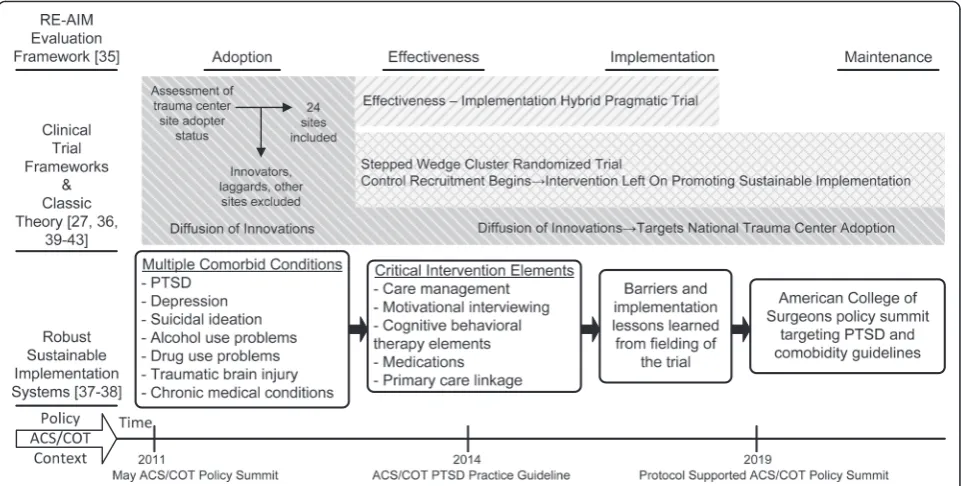
(Fig. 1). The TSOS pragmatic trial design and
implemen-tation incorporates implemenimplemen-tation science evaluation
frameworks [35], and classic theories [36], as well as
frameworks that address sustainable health care system
change [37, 38]. The TSOS study is also informed by
effectiveness-implementation hybrid design [27],
prag-matic trials [39], and stepped wedge [40
–
43] clinical trial
design considerations.
The implementation science conceptual frameworks
in-fluencing study design begin with the reach effectiveness
adoption implementation maintenance (RE-AIM)
evalu-ation framework that outlines clear stages of assessment
for both effectiveness and implementation outcomes
(Fig. 1). The RE-AIM framework provides a model for the
integration of pragmatic trial results into routine trauma
center practice [37]. Diffusion of innovation theory, which
emphasizes the factors related to the intervention and
set-ting characteristics, aids in the framing of the
population-based sampling and adoption of trauma centers as well as
descriptions of maintenance, based on the trial
’
s ability to
target American College of Surgeons
’
policy in order to
shift
“
S-shaped
”
adopter curves nationally [36].
Clinical trial specific constructs and design features
also contribute to the conceptual framework informing
the TSOS study (Fig. 1). These include the emerging
effectiveness-implementation hybrid design construct
[27]. The TSOS trial simultaneously aims to determine
the effectiveness of the stepped collaborative care
inter-vention model in reducing PTSD symptoms and
comor-bid conditions, while also assessing the potential utility
of the implementation strategy that uses American
Col-lege of Surgeons
’
policy to target regulatory mandates
for trauma care systems nationally [37, 44].
The pragmatic-explanatory continuum indicator
sum-mary (PRECIS) pragmatic trial framework also informs the
TSOS study [39]. Gold standards for pragmatic trial design
and implementation include broad participant eligibility
criteria, flexible intervention delivery, application by the
full range of practitioners, and incorporation of rigorous
prospective controls, preferably by randomization. Usual
practice comparison conditions are frequently used in
pragmatic trials [39, 44
–
48]. The optimal pragmatic trial is
characterized by an intent-to-treat data analytic approach
that includes all patients regardless of adherence [39]. The
TSOS trial encompasses these pragmatic trial attributes by
fielding a readily implementable collaborative care
inter-vention that targets injured patients with the full spectrum
of PTSD and related comorbidity with minimal
exclusion-ary criteria.
Pragmatic trial process and outcome assessments have
been conceptualized to be centrally measured, clinically
meaningful, and require minimal adjudication [39, 44
–
48].
With regard to pragmatic trials in US trauma care
sys-tems, no one or even multiple administrative databases
can be used to track outcomes among injured trauma
survivors; thus for trauma care system pragmatic trials,
scheduled telephone outcome assessments may by
neces-sity occur as an addition to naturalistic follow-up. The
PRECIS framework suggests that for some trials, outcome
assessments must by necessity be obtained through
con-tact with participants [39]. Similarly, the PRECIS
frame-work takes into consideration the observation that in
some trials that rely heavily on patient reported outcomes,
some training in the assessment and adjudication may be
desirable [39].
As an integrative model (Fig. 1), the Robust, Sustainable,
Implementation Systems Framework [37] aids in
combin-ing the implementation science, pragmatic trial, and
health care systems change conceptual frameworks that
inform the TSOS study; conceptually the Robust,
Sustain-able, Implementation Systems Framework integrates
elements of process and implementation models,
deter-minant frameworks, and clinical trial frameworks (e.g.,
multiple comorbid condition targets and critical
interven-tion elements) as well as the RE-AIM evaluainterven-tion
frame-work [32, 37] (Fig. 1). A further advantage of the
framework is the flexible integration of recent work on
barriers and facilitators of acute care medical screening
and intervention guideline implementation ([49
–
51]).
Pol-icy relevance that ultimately enhances clinical trial
popula-tion impact is also relevant to the Robust, Sustainable,
Implementation Systems Framework [37, 52, 53]).
Methods/design
Design overview
The TSOS trial aims to recruit 960 patients, 40 at each
trauma center site. The TSOS investigation employs a
stepped wedge cluster randomized design in which sites
are randomized sequentially to initiate the intervention.
Patients are assessed at baseline in the emergency
de-partment or as trauma inpatients and again 3, 6, and
12 months after the injury. All sites have worked with
the study team to implement an electronic health record
(EHR) initial PTSD risk evaluation. Patients identified by
the EHR evaluation as high risk for PTSD are formally
assessed with the PTSD Checklist for study entry.
Pa-tients in the control condition will receive enhanced
trauma center care as usual. Patients in the intervention
condition will receive a stepped collaborative care
inter-vention targeting PTSD and related comorbidities. The
intervention begins with a 1-day workshop training in
the collaborative care intervention core elements that
in-clude care management, medication, cognitive
behav-ioral therapy (CBT), and motivational interviewing
targeting PTSD and comorbidity. After the 1-day
work-shop, the site will receive supervision from the study
team. Outcome analyses will incorporate both
effective-ness and implementation spectrum assessments.
Injury cohort definition, exclusions, and PTSD risk screening
Prior to the initiation of recruitment for the TSOS study,
the investigative team worked with each trauma center
site to define injury cohorts, characterize inclusion and
exclusion phenotypes within the EHR [54], and
imple-ment the 10 domain EHR PTSD risk screen [16, 55].
The procedures used to define injury cohorts and
characterize potential emergency department and trauma
inpatient subjects for the recruitment process varied across
sites depending on the capacity of individual sites to
auto-mate the screening procedure within or external to the
EHR [56]. The automated form of the evaluation can be
performed using EHR data queries or scheduled reports,
while the manual form of the abstraction procedure
involves reviewing individual health records; many sites
have combined automated and manual procedures into a
partially automated (i.e., hybrid) 10-domain risk screen.
Injured patients of both genders over the age of 18 are
included in the trial (Fig. 2). Prisoners and non-English
speaking patients, will be excluded. Patients whose index
injury was self-inflicted or are psychotic will receive
im-mediate psychiatric treatment and will also be excluded
from the trial. In order to assure adequate follow-up
rates, patients must be able to provide two pieces of
follow-up contact information.
Consent PTSD Checklist administered
Medical record 10 domain PTSD risk screen
Patient approach for consent
Defer:
Cognitive impairment Injury admissions
age ≥ 18
Exclude: Acute psychiatric Prisoners
Non-English speaking
Exclude: < 3 risk score on 10 domain PTSD screen
Exclude: < 2 contacts
Exclude:
< 35 PTSD Checklist
Include PTSD Checklist > 35
Patients identified by EHR evaluation as at-risk for
high early PTSD symptom levels with a score of >3
risk domains positive will then be formally screened
for study entry with the PTSD Checklist Civilian
Ver-sion [57, 58]. Patients scoring >35 on the PTSD
Checklist will be followed longitudinally in the clinical
trial portion of the investigation.
Randomization
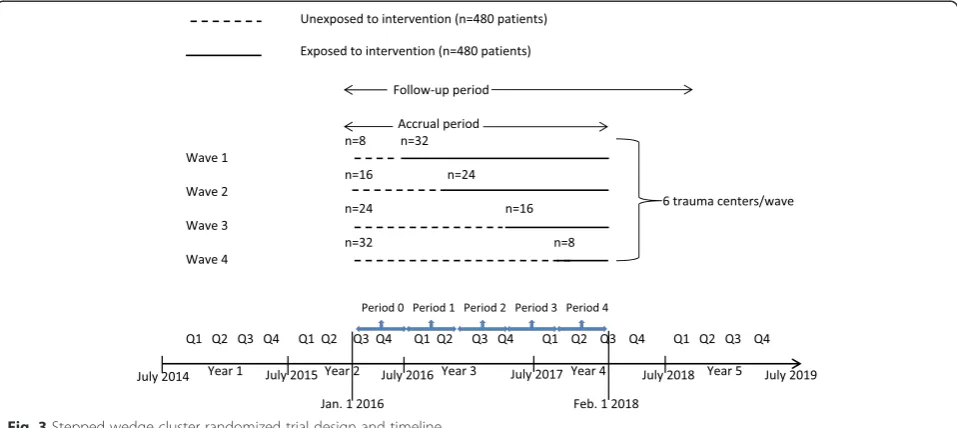
Prior to initiation of patient recruitment, each of the 24
sites was randomized to one of four waves in the
stepped wedge design. Each wave was assigned a
spe-cific proportion of control and intervention patient
re-cruitment (Fig. 3). The study biostatistician randomized
sites to waves using a computer generated algorithm.
All interviewers conducting follow-up assessments will
be blinded to patient intervention and control group
status.
Enhanced usual care control condition
The control patient subjects will receive enhanced usual
trauma center care. Prior investigation suggests that
usual posttraumatic care includes routine surgical,
pri-mary care, and emergency department visits, as well as
the occasional use of specialty mental health services.
The enhanced aspect of the usual care will consist of the
recruiting provider informing the ward nurse currently
covering the patient subject
’
s care of any distress they
are experiencing as identified by a PTSD Checklist score
of >35 or Patient Health Questionnaire (PHQ-9) item
9 > 1 indicating suicidal ideation, administered during
the baseline interview.
Stepped collaborative care intervention [16, 22
–
25]
Collaborative care treatment models that combine
effective intervention elements and incorporate IT
innovations have the potential to be flexibly
imple-mented in order to prevent the development of the
chronic condition cluster that includes PTSD and
related
comorbidity;
collaborative
care
treatment
models may also be effective in mitigating the
im-pact of the acute injury event on symptom
exacerba-tions in the large subpopulation of injury survivors
who already carry a substantial pre-injury burden of
chronic medical and other conditions [22, 25, 59
–
63]
(Table 1).
A large body of research has established the
effective-ness of integrated care delivery models such as
collab-orative care in reducing depressive, anxiety, pain, and
other somatic symptom presentations in conjunction
with comorbid medical conditions in primary care
settings [22, 23, 25, 61, 64
–
78]. Collaborative care
treat-ments bring together effective medication and
psycho-therapeutic intervention elements with care management
strategies that target reductions in care fragmentation and
enhanced care coordination for patients with multiple
chronic conditions (Table 1). A series of single site acute
care medical studies now support the effectiveness of
col-laborative care models in targeting the PTSD and
comor-bidity chronic condition cluster [16, 22
–
25].
Study staff will visit the trauma center sites in order to
perform a 1-day intervention workshop training. The
workshop will provide an overview of the core elements
of the PTSD and comorbidity intervention (Table 1).
The trainers will review the intervention elements
in-cluding care management, medications, motivational
interviewing (MI) and CBT elements, and community
linkage. Specific intervention procedures have been
de-tailed previously [16, 22
–
25].
After the 1-day workshop training, the study team will
initiate regular site care management supervisory calls in
which the site interventionists will present cases to the
supervisory team [16, 79]. These sessions will include
coaching in concern elicitation, CBT, and MI elements
embedded within care management, as well as
problem-solving barriers to screening and intervention
implemen-tation for PTSD and related comorbidity. These calls will
also include coaching on evidence-based medication
pre-scription and supervisory team written feedback. The care
managers will be able to contact MD and PhD study team
members on a 24-h study cell phone or study assistance
email should more urgent questions arise. While final
pa-tient subject follow-up interviews take place
approxi-mately 12 months post-consent, intervention activities are
anticipated to conclude approximately 6 months after
pa-tient subjects consent into the trial. During the final
months of treatment, the interventionist will discuss with
the patient strategies for maintaining treatment gains.
This means proper handoff of medication prescription
management to a patient subject
’
s preferred primary care
or other medical provider, linkage to community
re-sources, engaging family and community support, and
when indicated psychotherapy referrals.
Assessments
The TSOS assessment approach incorporates both
effectiveness and implementation outcome evaluations
[80]. The timing and content of the TSOS outcome
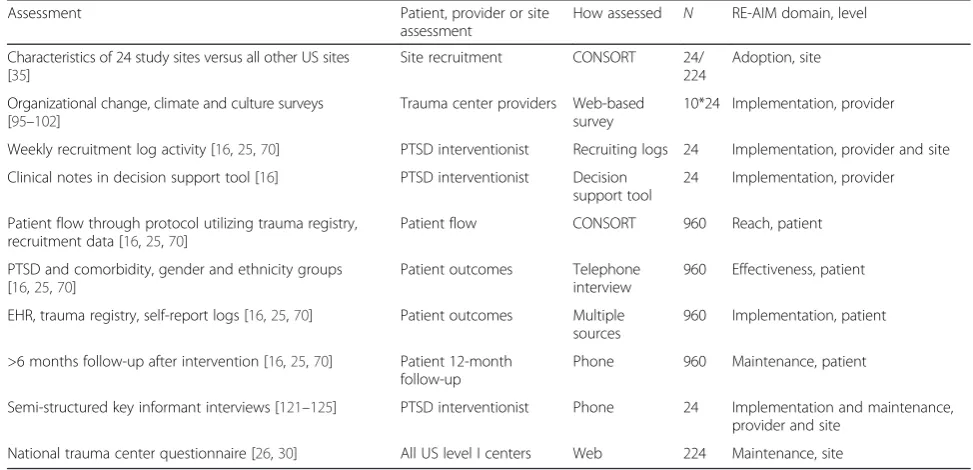
as-sessments are delineated in Tables 2 and 3. The primary
effectiveness evaluations are patient-reported outcome
measures that include assessments of the study primary
and secondary outcomes (Table 2). The RE-AIM
evalu-ation framework informs the implementevalu-ation outcome
assessments [35] (Table 3). Selected outcome
assess-ments are described in further detail below.
A. Primary study patient-reported outcome: PTSD
symptom assessment [
58
,
81
]
The PTSD Checklist is a 17-item self-report
ques-tionnaire that will be used to assess PTSD
symp-toms. A series of investigations have demonstrated
the reliability and validity of the PTSD Checklist
across trauma-exposed populations. PTSD Checklist
scores of >35 in the days and weeks after injury
ad-mission have been shown to be associated with the
development of higher PTSD symptom levels over
the course of the year after injury [
55
].
B. Secondary study patient-reported outcomes: depressive
symptoms, suicidal ideation, alcohol use problems, and
physical function
Table 1
Core elements of collaborative care intervention targeting PTSD and comorbidity after injury
Essential element Which disorders targeted MCC strategic framework goals addresseda
Population-based EHR PTSD and comorbidity risk prediction
PTSD, depression, suicidal ideation, alcohol and drug use problems, TBI and chronic medical conditions after acute injury
Goal 1 objective D implement and efficiently use health information technology; EHR screening efficiently identifies constellation of PTSD and comorbidity in injured populations
Care management with trauma center to primary care linkage
Coordination of acute injury mental health and pre-existing chronic medical condition care
Goal 2 facilitate use of community based services and self-care management
Early post-injury medication history, reconciliation, and care
coordination
PTSD, depression, pain, and TBI symptoms prevention. Chronic medical condition reconciliation and coordination
Goal 1 objective E prevent occurrence of new chronic conditions and mitigate the consequences of existing conditions
Goal 2 objective C provide tools for medication management
Evidence-based MI embedded within care management
Targets alcohol and drug use problems and enhanced patient engagement
Goal 1 objective E prevent occurrence of new chronic conditions and mitigate the consequences of existing conditions
Evidence-based CBT embedded within care management
Targets PTSD, depression, pain, and TBI symptoms. Also targets enhanced patient self-efficacy
Goal 1 objective E prevent occurrence of new chronic conditions and mitigate the consequences of existing conditions
Goal 2 objective A facilitate self-care management
Patient and caregiver-centered posttraumatic concern elicitation and improvement
Patient-centered concerns elicitation and
improvement targets patient and family engagement in care of full MCC constellation
Goal 2 optimize self-care management and coordinated use of services by patient and caregivers
Caseload supervision and stepped measurement-based care implementation
PTSD, depression and associated suicidal ideation, alcohol and drug use problems, chronic medical conditions and acute physical injury
Goal 3 provide better information and education on treatment of MCCs to health care workers
MCCmultiple chronic condition,EHRelectronic health record,PTSDposttraumatic stress disorder,TBItraumatic brain injury,MImotivational interviewing,CBT cognitive behavioral therapy
a
Table 2
Effectiveness assessments and timing of administration
Study measure Baseline 3 months 6 months 12 months
EHR 10 item PTSD evaluation [55] X
ICD injury severity X
ICD TBI severity X
ICD/self-report chronic medical conditions X X
EHR and self-reported demographics X
Consciousness/Glasgow Coma Scale [144,145] X
PTSD (PTSD Checklist DSM-IV & DSM-5) [58,81] X X X X
Depression (PHQ-9) [82] X X X X
Suicidal ideation (PHQ-9 item 9) [82,84]
Alcohol (AUDIT) [85] X X X X
Illegal and prescription drug use (DAST) [146] X X X X
Pain (Brief Pain Inventory) [147,148] X X X X
Postconcussive symptoms [90,149,150] X X X X
Functioning (MOS SF12/36) [88] X X X X
Violence risk behaviors [24] X X X X
Pre-injury trauma [6,106,107] X
Recurrent traumatic events [6,106,107] X X
Reactions to research participation [25] X X X X
Satisfaction with care [16,25] X X X X
Health services, work and cost [14,151–154] X X X X
Medication use [14,16,25,151] X X X X
EHR/trauma registry data [14,151] Ongoing automated data
EHRelectronic health record,PTSDposttraumatic stress disorder,ICDinternational classification of diseases,DSMDiagnostic and Statistical Manual of Mental Disorders,PHQ-9Patient Health Questionnaire,AUDITAlcohol Use Disorders Identification Test,DASTDrug Abuse Screen Test,MOS SFMedical Outcomes Study Short Form
Table 3
TSOS implementation assessments and corresponding RE-AIM framework domains
Assessment Patient, provider or site
assessment
How assessed N RE-AIM domain, level
Characteristics of 24 study sites versus all other US sites [35]
Site recruitment CONSORT 24/
224
Adoption, site
Organizational change, climate and culture surveys [95–102]
Trauma center providers Web-based survey
10*24 Implementation, provider
Weekly recruitment log activity [16,25,70] PTSD interventionist Recruiting logs 24 Implementation, provider and site
Clinical notes in decision support tool [16] PTSD interventionist Decision support tool
24 Implementation, provider
Patient flow through protocol utilizing trauma registry, recruitment data [16,25,70]
Patient flow CONSORT 960 Reach, patient
PTSD and comorbidity, gender and ethnicity groups [16,25,70]
Patient outcomes Telephone interview
960 Effectiveness, patient
EHR, trauma registry, self-report logs [16,25,70] Patient outcomes Multiple sources
960 Implementation, patient
>6 months follow-up after intervention [16,25,70] Patient 12-month follow-up
Phone 960 Maintenance, patient
Semi-structured key informant interviews [121–125] PTSD interventionist Phone 24 Implementation and maintenance, provider and site
Depressive symptoms
. The 9-item Patient Health
Questionnaire (PHQ-9) brief depression severity
measure will be used to assess depressive symptoms
[
82
]. The PHQ-9 has established reliability and validity
in acute and primary care medical patients [
16
,
25
,
83
].
Suicidal ideation
. The PHQ-9, item 9, will be used
to assess for suicidal ideation [
84
].
Alcohol use problems
. The Alcohol Use Disorder
Identification Test (AUDIT), a ten-item screening
instrument for the early identification of problem
drinkers will be used to assess alcohol use problems
before and after the injury hospitalization [
85
]. The
AUDIT
’
s reliability and validity are well established,
and the scale has been widely used in acute and
pri-mary care medical settings [
16
,
25
,
85
–
87
].
Limitations in physical function
. The investigation
will use the Medical Outcomes Study Short Form
(MOS SF) SF-12 at baseline and SF-36 at 3-, 6-, and
12-month follow-up to assess physical, role, and
so-cial functional outcomes. The SF-12/36 has
estab-lished reliability and validity [
88
], and the measure
has been used extensively with traumatically injured
populations [
89
–
91
].
C. Baseline patient trauma center/emergency
department electronic health record (EHR)
assessment
EHR data will be collected from each of the 24 sites
during the recruitment of study patients. Similarly,
trauma registry data will be obtained from each of
the 24 sites that will contain EHR derived
international classification of diseases (ICD) codes
and other clinical data.
EHR 10 item PTSD risk factor screen
. A previously
developed EHR screen will be used to assess
admitted injured trauma survivors at risk for the
development of PTSD [
55
]. The screen utilized ten
data elements that are both associated with
increased risk for PTSD and that are readily
available in any robust EHR system. When the ten
data elements were used to predict scores on the
PTSD Checklist of >35, the EHR screen
demonstrated adequate sensitivity (0.71), specificity
(0.66), and area under the ROC curve (0.72) [
55
].
Injury severity
. Injury severity will be abstracted
from the medical record using a conversion software
program that transforms recognized ICD codes into
the Abbreviated Injury Scale (AIS) and subsequent
injury severity scores (ISS) [
92
].
Traumatic brain injury (TBI)
. Mild, moderate, and
severe TBI will be identified and categorized from
electronic record abstracted ICD codes indicative of
traumatic injury.
Medical conditions
. Comorbid chronic medical
conditions will also be taken from medical record
and trauma registry data and will be derived from
ICD diagnostic codes [
93
,
94
]. Chronic medical
comorbidity will also be assessed through patient
self-report during the follow-up interviews.
D. Provider assessments
Trauma center organizational assessments
[
95
–
100
].
The study will modify previously developed
organizational culture and climate assessment scales
to evaluate trauma center organizational
characteristics related to PTSD and comorbidity
service implementation [
95
,
101
,
102
].
Organizational implementation scales will assess the
extent to which trauma centers were able to adapt to
the changes required by PTSD and comorbidity
screening and intervention service development
[
96
,
101
]. Trauma center provider attrition from the
study and turnover will also be examined. Following
the procedure established in the study team
’
s previous
Disseminating Organizational Screening and Brief
Intervention Services (DO-SBIS) pragmatic trial, ten
providers from each of the 24 sites will be identified
through an organizational mapping procedure to be
part of the organizational work unit impacted by
screening and intervention service delivery [
101
,
103
].
These ten providers will complete the organizational
assessment prior to beginning intervention activities
and again in study year 4 after all patient intervention
is complete.
Trauma center provider exposure to critical incidents
and job stress
[
104
,
105
]. Previously developed items
will be used to assess trauma center provider
job-related stress (e.g., call frequency, work volume)
[
104
]. Provider secondary traumatic stress, lifetime
trauma, and PTSD symptoms will also be assessed
[
6
,
58
,
81
,
106
,
107
].
Intervention provider standardized patient
assessments
[
108
]. In the study team
’
s prior DO-SBIS
pragmatic trial focusing on alcohol screening and
intervention, standardized patient fidelity
assess-ments were used to assess fidelity to MI
interven-tions delivered by front-line trauma center providers.
Each standardized patient interview was scored
using the Motivational Interviewing Treatment
In-tegrity (MITI) coding system. The MITI will again
be used to code patient standardized interviews in
the current TSOS study.
E. Exploratory health economic evaluation
the following: (1) the costs of intervention
imple-mentation and delivery, (2) post-injury health service
utilization costs (e.g., inpatient, skilled nursing
facil-ity, emergency room, and outpatient utilization), and
(3) the costs of patient medications post-injury.
Costs of intervention are likely to be dwarfed by the
total costs of post-injury care, which would make it
difficult to estimate the incremental costs of
inter-vention precisely, given our sample size. The health
care resource utilization and cost analyses constitute
an important exploratory aim of the investigation.
F. Study team logging procedures
The approach to trial logging simultaneously aimed
to satisfy the pragmatic trial requisite for the
minimization of time intensive research methods
that require extensive adjudication [
39
] and the
implementation science goal of understanding and
documentation of trial processes that could yield
sustainable maintenance of screening and
intervention procedures [
27
].
Because pragmatic trials tacitly aim to provide
health care delivery settings with readily
implementable intervention models, logging
procedures that differentiate study team activities
related to (1) the fielding of the trial, (2) the
implementation of evidence-based interventions, (3)
costing and economic analyses, and (4) regulatory
procedures may be critical for pragmatic trial design
and implementation. Previously articulated
proce-dures for the logging of clinical trial and
implemen-tation activities were adapted for the current
pragmatic trial approach [
119
,
120
]. A pragmatic
trial framework that emphasized time efficiency and
minimal adjudication of logged activities argued for
optimizing parsimony in the logging approach [
39
].
All study research team site contacts, including
email, phone, and in-person site contacts, and all
study team consultant (e.g., trauma surgery
cham-pion) contact with sites are logged. Both 24 site
spe-cific logs and domain spespe-cific logs (i.e., trial spespe-cific
activities, evidence-based intervention
implementa-tion, sustainability, and economic considerations)
will be maintained. As part of the study
’
s mixed
method assessment procedures, the logs and field
notes will be reviewed on an approximately monthly
basis with the investigation
’
s mixed methods
con-sultant [
70
,
121
–
123
].
G. Semi-structured provider interviews [
124
,
125
]
After the completion of recruitment and
intervention activities, semi-structured interviews
will be conducted with interventionists from each of
the 24 trauma center sites. The interviews will
ex-plore barriers and facilitators of implementation of
screening, intervention, and quality documentation
procedures for PTSD and comorbidity at trauma
center sites. The interviews will also explore the
po-tential sustainability of study procedures.
Statistical analysis plan
Study aims and hypotheses
The primary hypothesis is that the intervention group
when compared to the control group will demonstrate
significant reductions in PTSD symptoms over the
course of the year after injury. Secondary hypotheses are
that intervention patients when compared to control
patients will demonstrate significant reductions in
de-pressive symptoms and associated suicidal ideation,
significant reductions in alcohol use problems, and
im-proved post-injury physical function.
All primary statistical analyses will be conducted using
intent-to-treat methods. The primary goal of the
statis-tical analyses is to examine and compare trends over
time in the symptoms of PTSD. This analytic approach
will be replicated for all secondary outcomes; secondary
analyses will examine trends over time for depression,
alcohol use, and physical function. The major outcome
variables are the continuous and dichotomous
assess-ments of PTSD (PTSD Checklist [81]), depression
(PHQ-9 [82]), alcohol use problems (AUDIT [85]), and
physical function (MOS SF-36 PCS [88, 126]).
The study team will use mixed effects regression
models to test the hypotheses. The investigative group
has extensive experience with these analytic approaches
in the analyses of longitudinal data after injury. These
analytic approaches allow for the modeling of
longitu-dinal data on patients, nested within trauma center sites
(see also sample size and power discussion below for a
more in-depth explanation of clustering). An important
potential advantage of using longitudinal mixed models
is the ability to use partial data on those subjects with
missing data, and therefore potentially ameliorate
selec-tion bias due to drop out. In addiselec-tion, mixed models
naturally structure patient and trauma center
heterogen-eity specifically allowing for random effects such as
indi-vidual intercepts and slopes over time. Longitudinal
regression models also allow the use of baseline
covari-ates that may be prognostic or reflective of the study
design.
Exploratory analyses will assess the impact of the
intervention on primary and secondary outcomes for
pa-tients with and without pre-injury chronic medical
con-ditions and those with and without TBI. Exploratory
analyses will also assess for significant reductions in
sui-cidal ideation, pain, and drug use problems in
interven-tion patients when compared to control patients.
impact rates of recruitment (e.g., admission volumes,
EHR capacity), rates of PTSD (e.g., percentages of
pa-tients with violent injury admissions, intensive care unit
admission rates), and the ability to follow patients
longi-tudinally (e.g., patient demographic characteristics such
as being homeless, clinical characteristics such as
sub-stance use problems). The stepped wedge design
ran-domizes level I trauma center sites to sequentially
initiate the intervention, thus allowing within site
pre-and post-intervention comparisons, as well as between
site comparisons. An additional advantage of the stepped
wedge design for the protocol is that it would be
imprac-tical to roll out the entire intervention at 24 sites
simul-taneously. Finally, from an implementation science
perspective, there is an advantage to having the
interven-tion ongoing at the end of the study at every site, should
the intervention demonstrate a significant impact on
PTSD and comorbidity (Fig. 1). Given that there is little
threat of contamination at each site across intervention
and control patients and that the UH3 can
accommo-date the increased potential length of active recruitment
and follow-up, the stepped wedge design appears to be
an optimal choice for the TSOS protocol.
Sample size and power
A number of issues specific to the design and analyses of
cluster randomized trials are addressed by the current
power analyses [127
–
131]. A key consideration for the
trial is the nesting of patients within trauma center sites
and the ascertainment of associated intraclass
correla-tions (ICC). The study team has extensive experience
with prior multisite trauma center observational and
pragmatic clinical trial investigations. Sample size
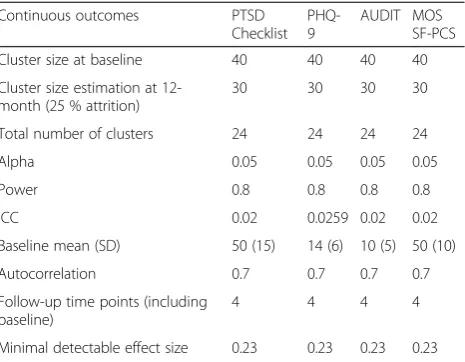
esti-mates were therefore adjusted for the clustering of
pa-tients within trauma center sites, using appropriate ICCs
derived from the study team
’
s prior multisite
investiga-tions (Table 4).
Some attrition is expected in the study sample due to
the research context and the population under study
(i.e., low income, ethnoculturally diverse, injured trauma
survivors). Prior studies by the investigative group have
consistently achieved follow-up completion rates >75
–
80 % at 6
–
12 months post-injury with this population
[16, 24, 25, 132]. Estimates derived from these rates are
incorporated into the descriptions of subject flow and
power analyses. Table 4 delineates the parameters used
to estimate power for the PTSD Checklist, PHQ-9,
AUDIT, and MOS SF-PCS. Sample size estimates were
derived using the STATA statistical package [133]. With
each of the 24 trauma center sites recruiting 40 patients
into the study, the study has 80 % power to detect effect
sizes of 0.23. These effect sizes are smaller than our
pre-viously observed treatment effect for PTSD symptoms of
0.34. In prior investigations, PTSD treatment effects of
0.34 have been associated with clinically significant and
policy relevant functional outcome improvements [25].
Mixed method analysis
Mixed methods will be used to integrate the findings from
the key informant interviews with pragmatic trial results.
The design taxonomy follows a sequential (QUAN
→
qual) structure in which qualitative data collected from
key informants will be used to explain quantitative data
results from the pragmatic trial [134, 135]. Qualitative
data will therefore be used to expand upon the results of
the pragmatic trial in order to understand the
implemen-tation and policy processes as experienced by key
stake-holders. Second, the sequential QUAN
→
qual mixed
methods design will be used to provide an understanding
of pragmatic trial results that require further explanation
(e.g., control patients that demonstrate substantial
im-provement in outcomes, despite not receiving
interven-tion). Results of the mixed method analyses will be
presented through a number of modalities that may
in-clude key informant narratives, tabular representation of
themes with illustrative quotes, and thematic counts
[136
–
139].
Trial status
Over the course of the pre-recruitment phase, the TSOS
study team has enrolled the 24 trauma center sites that
will participate in the trial. The goal of the selection
process was to recruit 24 level I trauma centers
nation-ally that would be capable of efficiently implementing
the study procedures. The study team sent notification
emails and/or contacted by telephone individuals at all
US level I trauma centers (Fig. 4). Responding centers
were asked questions about current PTSD screening and
Table 4
Stepped wedge power for TSOS outcomes
Continuous outcomes PTSD
Checklist PHQ-9
AUDIT MOS SF-PCS
Cluster size at baseline 40 40 40 40
Cluster size estimation at 12-month (25 % attrition)
30 30 30 30
Total number of clusters 24 24 24 24
Alpha 0.05 0.05 0.05 0.05
Power 0.8 0.8 0.8 0.8
ICC 0.02 0.0259 0.02 0.02
Baseline mean (SD) 50 (15) 14 (6) 10 (5) 50 (10)
Autocorrelation 0.7 0.7 0.7 0.7
Follow-up time points (including baseline)
4 4 4 4
intervention practices; the study excluded the less than
10 % of
“
innovator
”
sites nationally that were already
routinely screening and intervening for PTSD and
re-lated comorbidity [26]. Pediatric specialty trauma centers
were also excluded from the investigation, as elements
of the intervention (e.g., the administration of
psycho-pharmacological agents targeting PTSD) are less well
established for patients under the age of 18.
With the exception of pediatric trauma center
spe-cialty status, the organizational characteristics of the 24
participating sites does not substantially differ from the
characteristics of all US level I trauma centers potentially
eligible for the study (Table 5). Broad adoption and site
level generalizability is an important aim of the
investi-gation as it targets American College of Surgeons
’
policy
for PTSD and comorbidity screening and intervention
for all trauma centers nationwide.
Discussion
The current effectiveness-implementation hybrid is
innovative in its combination of pragmatic trial and
implementation science conceptual frameworks. The
effectiveness-implementation trial is a
“
hybrid type II
”
design that uses a novel, yet time-tested, American
Col-lege of Surgeons
’
policy mechanism as a targeted
imple-mentation strategy [27]. Curran and colleagues note that
to enhance the relevance of pragmatic studies,
compara-tive effeccompara-tiveness trials may require modification in order
to have increased policy relevance [27]. Curran and
col-leagues also critique pragmatic comparative effectiveness
studies for exclusively targeting effectiveness outcomes
with little attention to the implementation processes
relevant to general practice settings; these authors note
that in contrast, implementation trials focus on the
uptake and adoption of clinical interventions by
pro-viders and systems of care [27].
As part of the study
’
s emphasis on implementation, an
American College of Surgeons
’
policy summit is scheduled
in the final years of the trial. The aim of the policy summit
is to facilitate rapid translation of trial results into national
policy. The College oversees the development of national
policy mandates and clinical best practice guidelines that
inform the integrated operation of US trauma centers and
affiliated trauma care systems [28, 29, 140]. The College
has successfully linked trauma center funding to
verifica-tion site visits and other quality indicators [28, 141, 142].
In January of 2005, the College made a landmark
pol-icy decision to mandate health services targeting
screen-ing and intervention for alcohol-related disorders as a
requisite for trauma center accreditation [28]. Prior
pragmatic randomized clinical trial investigations from
the study team provided evidence supporting the
Col-lege
’
s alcohol mandate [22, 30, 143]. In May of 2011, the
investigators presented results from effective, NIH
funded, PTSD screening and intervention trials at a
Col-lege policy summit [22
–
24, 70]. For the first time, the
College has included PTSD screening and intervention
Assessed for participation=88Enrolled=24
Declined after assessment=22 US level I trauma centers
contacted=224
Excluded=31
Children’s hospitals=19 Prior pragmatic trial=12
Declined assessment=105
Excluded, e.g., PTSD innovator=13
Waitlisted=29
Fig. 4Site recruitment consort.PTSDposttraumatic stress disorder
Table 5
Organizational characteristics of TSOS study versus
other US level I trauma centers (
N
= 222)
aCharacteristic TSOS TC
n= 24n(%)
Other TCs
n= 198n(%)
P
American College of Surgeons accredited
17 (70.8) 74 (37.4) 0.01
Region of country 0.40
Midwest 7 (29.2) 64 (32.3)
South/Southeast 4 (16.7) 30 (15.2)
Northeast/East 5 (20.8) 63 (31.8)
West 4 (16.7) 28 (14.1)
Central 4 (16.7) 13 (6.6)
Rural status 3 (12.5) 24 (12.1) 1.0
Population served 0.03
Adult 7 (29.2) 92 (46.5)
Adult and pediatrics 17 (70.8) 82 (41.4)
Pediatrics 0 (0.0) 23 (11.6)
Missing 0 (0.0) 1 (0.5)
Teaching hospital 23 (95.8) 162 (81.8) 0.14
Council of teaching hospitals 22 (91.7) 143 (72.2) 0.04
University affiliation 24 (100.0) 189 (95.5) 0.60
Median (IQR)
Number of interns/residents 327 (282) 224 (297) 0.11
Number of hospital beds 575 (296) 534 (318) 0.40
Number of inpatient admits 26,971 (16,311)
25,699 (14,978)
0.28
TCtrauma center,IQRinterquartile range a
as a best practice level recommendation in national
guidelines for trauma center care. These new College
clinical
guidelines
set
the
stage
for
the
current
effectiveness-implementation hybrid trial that tests high
quality, feasibly implemented, screening and intervention
procedures for PTSD and related comorbidity.
Simultan-eously, as the investigation is being conducted, the study
team will be actively developing a policy agenda targeting
the use of pragmatic trial results to directly inform the
pol-icy discussion in the final years of the grant.
The potential for a policy target sets up a novel staged
implementation context whereby the fielding of the trial
and the implementation of the evidence-based
interven-tion can yield insight into the sustainable delivery of
PTSD screening and intervention procedures for trauma
centers nationwide. In this context, previously described
Rapid Assessment Procedures that harness clinical
ethnographic methods to embed participant observation
within front-line implementation teams have great
po-tential utility [70, 121
–
123]. These methods rely on the
study team collection of implementation logs and field
notes; these logs and field notes can be productively
reviewed on a regular basis with the study mixed
method consultant in order to maximally harness field
observations. This Rapid Assessment Procedures
ap-proach simultaneously satisfies the pragmatic trial
requisite for minimization of time intensive research
methods that require extensive adjudication and the
im-plementation science goal of understanding and
docu-mentation of trial processes that could yield sustainable
maintenance of screening and intervention procedures.
In summary, a hybrid effectiveness-implementation
spectrum pragmatic trial targeting screening and
inter-vention for PTSD and comorbidity can be readily
de-signed and feasibly implemented across US level I
trauma centers. These findings highlight the importance
of partnerships with professional societies such as the
American College of Surgeons
’
that can provide
regula-tory mandates in order to enhance widespread
imple-mentation of pragmatic trials results.
Abbreviations
CBT:cognitive behavioral therapy; DO-SBIS: disseminating organizational screening and brief intervention services; DSM: diagnostic and statistical manual; EHR: electronic health record; ICC: intraclass correlation; ICD: international classification of diseases; MI: motivational interviewing; PRECIS: pragmatic-explanatory continuum indicator summary;
PTSD: posttraumatic stress disorder; RE-AIM: reach effectiveness adoption implementation maintenance; SD: standard deviations; TBI: traumatic brain injury; TSOS: trauma survivors outcomes and support.
Competing interests
The authors declare that they have no competing interests
Authors’contributions
DFZ, JR, DD, DC, EVE, PH, BC, and GJ conceptualized and designed the study. DFZ, JR, DD, JW, LI, RG, and LW acquired the data. JR and JW analyzed the data. DFZ, JR, DD, DC, LP, EVE, JW, LI, RG, PH, BC, LW, and GJ interpreted the
data. DFZ, JR, DD, DC, LP, EVE, JW, LI, RG, PH, BC, LW, and GJ drafted and critically revised the manuscript. DFZ, JR, DD, DC, LP, EVE, JW, LI, RG, PH, BC, LW, and GJ approved the final manuscript.
Authors’information
DFZ is a medical doctor and Professor at the University of Washington. JR is a PhD degree holder and an Associate Professor at the University of Washington. DD is a PhD degree holder and an Acting Professor at the University of Washington. DC is a DPhil degree holder and Deputy Director for Implementation Science at the National Cancer Institute. LP is a PhD degree holder and Professor at the University of Southern California. EVE is a medical doctor and Associate Professor at the University of Washington. JW is a PhD degree holder and Research Consultant at the University of Washington. LI is a BS degree holder and a Research Coordinator at the University of Washington. RG is a BA degree holder and a Research Coordinator at the University of Washington. PH is a PhD degree holder, Professor and Chair of the Department of Biostatistics at the University of Washington. BC is a MS degree holder and Senior Biostatistician at the University of Washington. LW is a medical doctor and Acting Assistant Professor at the University of Washington. GJ is a medical doctor, Professor, and Vice Chairman of the Department of Surgery at the University of California in Davis.
Acknowledgements
We thank Research Coordinator Jeff Love for his help in setting up the study. The investigators also wish to acknowledge participating trauma centers and site champions, including Baylor University Medical Center (Michael Foreman, MD, and Ann Marie Warren, PhD); Cedars-Sinai Medical Center (Megan Harada, BA, Heidi Hotz, RN, and Dan Margulies, MD); Eskenazi Health (Gerardo Gomez, MD, and Michelle Laughlin, MD); Georgia Regents University (Steven Holsten, MD); Harbor University of California Los Angeles Medical Center (Dennis Kim, MD); Hartford Hospital (D’Andrea Joseph, MD); Honor Health (Melanie Brewer, DNSc, RN, and Charles Hu, MD); Inova Regional Trauma Center (Maggie Griffin, MD, and Jill Watras, MD); Jacobi Medical Center (Noe Romo, MD, and Sheldon Teperman, MD); Louisiana State University (Erich Conrad, MD, and Alan Marr, MD); North Memorial Medical Center (Greg Beilman, MD); Ohio State University Wexner Medical Center (David Evans, MD); Regions Hospital (Michael McGonigal, MD, and Keith Moench, MD); Santa Clara Valley Medical Center (John Sherck, MD); University of California Davis Medical Center (Joseph Galante, MD, and Gregory Jurkovich, MD); University of Cincinnati (Jason Schrager, MD); University of Iowa (Gerald Kealey, MD, and Dionne Skeete, MD); University of Kentucky Chandler Medical Center (Andrew Bernard, MD); University of Rochester Medical Center (Julius Cheng, MD); University of Texas Medical Branch at Galveston (Bill Mileski, MD); University of Texas Southwestern Medical Center (Joseph Minei, MD, and Brian Williams, MD); University of Utah (Giavonni Lewis, MD, and Ram Nirula, MD); University of Vermont Medical Center (Bill Cheresh, MD, and Matthew Price, PhD); University of Wisconsin Madison (Suresh Agarwal, MD); and Wake Forest University Health Sciences (Preston Miller, MD, and Laura Veach, PhD).
Funding
This work is supported by the National Institutes of Health (NIH) Common Fund, through cooperative agreements (U54 AT007748, 1UH2MH106338-01/ 4UH3MH106338-02) from the Office of Strategic Coordination within the Office of the NIH Director, and the National Institute of Mental Health (1
K24MH086814-01A1). The views presented here are solely the responsibility of the authors and do not necessarily represent the official views of the National Institutes of Health.
Author details
University of Washington, 25 Ninth Ave, Box 359702, Seattle, WA 98104, USA. 8Department of Surgery, University of California in Davis, 2221 Stockton Blvd, Cypress #3111, Sacramento, CA 95817, USA.
Received: 7 April 2016 Accepted: 20 April 2016
References
1. Bonnie RJ, Fulco CE, Liverman CT, editors. Reducing the burden of injury: advancing prevention and treatment. Washington, DC: National Academy Press; 1999.
2. McCaig LF. National hospital ambulatory medical care survey: 1992 emergency department summary. Advance data from vital and health statistics. Hyattsville: National Center for Health Statistics; 1994. 3. Rice DP, MacKenzie EJ, Jones AS, Associates. Cost of injury in the United
States: a report to congress. San Francisco: Institute for Health and Aging, University of California. Baltimore, Md: Injury Prevention Center, The Johns Hopkins University; 1989.
4. Bergen GS, National Center for Health Statistics (U.S.). Injury in the United States: 2007 chartbook. DHHS publication no. 2008–1033, U.S. Department of Health and Human Services, Centers for Disease Control and Prevention, . Hyattsville: National Center for Health Statistics; 2008.
5. National Center for Injury Prevention. CDC 2012. In: Office of Statistics and Programming. Atlanta, GA: Center for Disease Control and Prevention; 2012. 6. Ramstad SM, Russo J, Zatzick D. Is it an accident? Recurrent traumatic life
events in level I trauma center patients compared to the general population. J Trauma Stress. 2004;17(6):529–34.
7. Bergman K, Maltz S, Fletcher J. Evaluation of moderate traumatic brain injury. J Trauma Nurs. 2010;17(2):102–8. doi:10.1097/JTN.0b013e3181ecc452. 8. Faul M, Xu L, Wald MM, Coronado VG. Traumatic brain injury in the
United States: emergency department visits, hospitalizations, and deaths 2002–2006. Atlanta, GA: Center for Disease Control and Prevention. National Center for Injury Prevention and Control. 2010. 9. United States. President’s Commission on Care for America’s Returning
Wounded Warriors. Serve, support, simplify: report of the President’s Commission on Care for America’s Returning Wounded Warriors. Washington, DC: President’s Commission on Care for America’s Returning Wounded Warriors; 2007.
10. National Institute of Neurological Disorders and Stroke. Traumatic brain injury: hope through research. Bethesda: National Institute of Health; 2009. 11. Krug EG, Sharma GK, Lozano R. The global burden of injuries. Am J Public
Health. 2000;90(4):523–6.
12. World Health Organization. Disease and injury country estimates. 2012. http://www.who.int/healthinfo/global_burden_disease/estimates_country/ en/index.html. Accessed 5 Jul 2013.
13. Norton R, Kobusingye O. Injuries. N Engl J Med. 2013;368(18):1723–30. doi: 10.1056/NEJMra1109343.
14. MacKenzie EJ, Rivara FP, Jurkovich GJ, Nathens AB, Frey KP, Egleston BL, et al. A national evaluation of the effect of trauma-center care on mortality. N Engl J Med. 2006;354(4):366–78. doi:10.1056/NEJMsa052049.
15. Zatzick D, Rivara FP, Nathens AB, Jurkovich GJ, Wang J, Fan MY, et al. A nationwide US study of post-traumatic stress after hospitalization for physical injury. Psychol Med. 2007;37(10):1469–80. doi:10.1017/ S0033291707000943.
16. Zatzick D, O’Connor SS, Russo J, Wang J, Bush N, Love J, et al. Technology enhanced stepped collaborative care targeting posttraumatic stress disorder and comorbidity after injury: a randomized controlled trial. J Trauma Stress. 2015;28(5):391–400. doi:10.1002/jts.22041.
17. Parekh AK, Goodman RA, Gordon C, Koh HK. Managing multiple chronic conditions: a strategic framework for improving health outcomes and quality of life. Public Health Rep. 2011;126(4):460–71.
18. U. S. Department of Health and Human Services. Multiple chronic conditions—a strategic framework: optimum health and quality of life for individuals with multiple chronic conditions.
Washington, DC. 2010.
19. Wallace RB, Salive ME. The dimensions of multiple chronic conditions: where do we go from here? A commentary on the special collection of preventing chronic disease. Cent Dis Control Prev. 2013;10:5.
20. Soderstrom CA, Smith GS, Dischinger PC, McDuff DR, Hebel JR, Gorelick DA, et al. Psychoactive substance use disorders among seriously injured trauma center patients. JAMA. 1997;277(22):1769–74.
21. Zatzick D, Donovan D, Dunn C, Russo J, Wang J, Jurkovich G, et al. Substance use and PTSD in trauma center patients receiving mandated alcohol SBI. J Subst Abuse Treat. 2012;43(4):410–7.
22. Zatzick D, Roy-Byrne P, Russo J, Rivara F, Droesch R, Wagner A, et al. A randomized effectiveness trial of stepped collaborative care for acutely injured trauma survivors. Arch Gen Psychiat. 2004;61(5):498–506. doi:10. 1001/archpsyc.61.5.498.
23. Zatzick D, Roy-Byrne P, Russo J, Rivara FP, Koike A, Jurkovich GJ, et al. Collaborative interventions for physically injured trauma survivors: a pilot randomized effectiveness trial. Gen Hosp Psychiat.
2001;23(3):114–23.
24. Zatzick D, Russo J, Lord SP, Varley C, Wang J, Berliner L, et al. Collaborative care intervention targeting violence risk behaviors, substance use, and posttraumatic stress and depressive symptoms in injured adolescents: a randomized clinical trial. JAMA Pediatr. 2014; 168(6):532–9. doi:10.1001/jamapediatrics.2013.4784.
25. Zatzick D, Jurkovich G, Rivara FP, Russo J, Wagner A, Wang J, et al. A randomized stepped care intervention trial targeting posttraumatic stress disorder for surgically hospitalized injury survivors. Ann Surg. 2013;257(3):390–9. doi:10.1097/SLA.0b013e31826bc313.
26. Love J, Zatzick D. Screening and intervention for comorbid substance disorders, PTSD, depression, and suicide: a trauma center survey. Psychiatr Serv. 2014;65(7):918–23. doi:10.1176/appi.ps.201300399.
27. Curran GM, Bauer M, Mittman B, Pyne JM, Stetler C. Effectiveness-implementation hybrid designs: combining elements of clinical effectiveness and implementation research to enhance public health impact. Med Care. 2012;50(3):217–26. doi:10. 1097/MLR.0b013e3182408812.
28. American College of Surgeons Committee on Trauma. Resources for optimal care of the injured patient. Washington DC: American College of Surgeons; 2006.
29. American College of Surgeons Committee on Trauma. Resources for optimal care of the injured patient. Washington, DC. 2014.
30. Terrell F, Zatzick DF, Jurkovich GJ, Rivara FP, Donovan DM, Dunn CW, et al. Nationwide survey of alcohol screening and brief intervention practices at US Level I trauma centers. J Am Coll Surg. 2008;207(5):630–8. doi:10.1016/j. jamcollsurg.2008.05.021.
31. Johnson KE, Tachibana C, Coronado GD, Dember LM, Glasgow RE, Huang SS, et al. A guide to research partnerships for pragmatic clinical trials. BMJ. 2014; 349:g6826. doi:10.1136/bmj.g6826.
32. Nilsen P. Making sense of implementation theories, models and frameworks. Implement Sci. 2015;10:53. doi:10.1186/s13012-015-0242-0.
33. Grol RP, Bosch MC, Hulscher ME, Eccles MP, Wensing M. Planning and studying improvement in patient care: the use of theoretical perspectives. Milbank Q. 2007;85(1):93–138.
34. Greenhalgh T, Robert G, Macfarlane F, Bate P, Kyriakidou O. Diffusion of innovations in service organizations: systematic review and
recommendations. Milbank Q. 2004;82(4):581–629.
35. Glasgow RE, Vogt TM, Boles SM. Evaluating the public health impact of health promotion interventions: the RE-AIM framework. Am J Public Health. 1999;89(9):1322–7. doi:10.2105/AJPH.89.9.1322.
36. Rogers EM. Diffusion of innovations. 4th ed. New York: The Free Press; 1995. 37. Glasgow RE, Chambers D. Developing robust, sustainable, implementation
systems using rigorous, rapid and relevant science. Clin Transl Sci. 2012;5(1): 48–55. doi:10.1111/j.1752-8062.2011.00383.x.
38. Institute of Medicine. Learning healthcare systems concept. Washington D.C. 2008.
39. Thorpe KE, Zwarenstein M, Oxman AD, Treweek S, Furberg CD, Altman DG, et al. A pragmatic-explanatory continuum indicator summary (PRECIS): a tool to help trial designers. J Clin Epidemiol. 2009;62(5):464–75. doi:10.1016/ j.jclinepi.2008.12.011.
40. Hussey MA, Hughes JP. Design and analysis of stepped wedge cluster randomized trials. Contemp Clin Trials. 2007;28(2):182–91. doi:10.1016/j.cct. 2006.05.007.
41. Mdege ND, Man MS, Taylor Nee Brown CA, Torgerson DJ. Systematic review of stepped wedge cluster randomized trials shows that design is particularly used to evaluate interventions during routine implementation. J Clin Epidemiol. 2011;64(9):936–48. doi:10.1016/j.jclinepi.2010.12.003. 42. Woertman W, de Hoop E, Moerbeek M, Zuidema SU, Gerritsen DL,
43. Hughes JP, Granston TS, Heagerty PJ. Current issues in the design and analysis of stepped wedge trials. Contemp Clin Trials. 2015;45(Pt A):55–60. doi:10.1016/j.cct.2015.07.006.
44. National Center for Complementary and Alternative Medicine. NIH Health Care Systems Research Collaboratory—Pragmatic Clinical Trials
Demonstration Projects (UH2/UH3): National Center for Complementary and Alternative Medicine, 2012 Contract No.: RFA-RM-12-002.
45. Tunis SR, Stryer DB, Clancy CM. Practical clinical trials: increasing the value of clinical research for decision making in clinical and health policy. JAMA. 2003;290(12):1624–32.
46. March J, Kraemer HC, Trivedi M, Csernansky J, Davis J, Ketter TA, et al. What have we learned about trial design from NIMH-funded pragmatic trials? Neuropsychopharmacology. 2010;35(13):2491–501. doi:10.1038/npp.2010.115.
47. Zwarenstein M, Treweek S, Gagnier JJ, Altman DG, Tunis S, Haynes B, et al. Improving the reporting of pragmatic trials: an extension of the CONSORT statement. BMJ. 2008;337:a2390.
48. Federal Coordinating Council for Comparative Effectiveness Research. Report to the President and the Congress. In: US Department of Health and Human Services, editor. Washington, D. C. 2009.
49. Bosch M, McKenzie JE, Mortimer D, Tavender EJ, Francis JJ, Brennan SE, et al. Implementing evidence-based recommended practices for the
management of patients with mild traumatic brain injuries in Australian emergency care departments: study protocol for a cluster randomised controlled trial. Trials. 2014;15:281. doi:10.1186/1745-6215-15-281. 50. Tavender EJ, Bosch M, Gruen RL, Green SE, Knott J, Francis JJ, et al.
Understanding practice: the factors that influence management of mild traumatic brain injury in the emergency department—a qualitative study using the Theoretical Domains Framework. Implement Sci. 2014;9(8). 51. Tavender EJ, Bosch M, Gruen RL, Green SE, Michie S, Brennan SE, et al.
Developing a targeted, theory-informed implementation intervention using two theoretical frameworks to address health professional and
organisational factors: a case study to improve the management of mild traumatic brain injury in the emergency department. Implement Sci. 2015; 10(74):22. doi:10.1186/s13012-015-0264-7.
52. Koepsell TD, Zatzick DF, Rivara FP. Estimating the population impact of preventive interventions from randomized trials. Am J Prev Med. 2011;40(2): 191–8. doi:10.1016/j.amepre.2010.10.022.
53. Zatzick D, Koepsell T, Rivara FP. Using target population specification, effect size, and reach to estimate and compare the population impact of two PTSD preventive interventions. Psychiatry. 2009;72(4):346–59.
54. Richesson RL, Hammond WE, Nahm M, Wixted D, Simon GE, Robinson JG, et al. Electronic health records based phenotyping in next-generation clinical trials: a perspective from the NIH Health Care Systems Collaboratory. J Am Med Inform Assoc. 2013. doi:10.1136/ amiajnl-2013-001926.
55. Russo J, Katon W, Zatzick D. The development of a population-based automated screening procedure for PTSD in acutely injured hospitalized trauma survivors. Gen Hosp Psychiatry. 2013;35(5):485–91. doi:10.1016/j. genhosppsych.2013.04.016.
56. Van Eaton EG, Zatzick D, Gallagher T, Flum D, Tarczy-Hornoch P, Rivara F, et al. A nationwide survey of trauma center information technology and electronic medical record leverage capacity. J Am Chem Soc. 2014;219(3): 505–10. doi:10.1016/j.jamcollsurg.2014.02.032.
57. Weathers F, Ford J. Psychometric review of PTSD Checklist (PCL-C, PCL-S. PCL-M, PCL-PR). In: Stamm B, editor. Measurement of stress, trauma, and adaptation. Lutherville: Sidran Press; 1996. p. 250–1.
58. Weathers FW, Huska JA, Keane TM. The PTSD checklist-civilian version, The National Center For PTSD. Boston, Ma: Boston VA Medical Center; 1991. 59. Katon W. Health reform, research pave way for collaborative care for mental
illness. JAMA. 2013;309(23):2425–6. doi:10.1001/jama.2013.6494. Interview by Bridge M Kuehn.
60. Peek CJ. A collaborative care lexicon for asking practice and research development questions. Rockville: Agency for Healthcare Research and Quality; 2011.
61. Dobscha SK, Corson K, Perrin NA, Hanson GC, Leibowitz RQ, Doak MN, et al. Collaborative care for chronic pain in primary care: a cluster randomized trial. JAMA. 2009;301(12):1242–52. doi:10.1001/jama.2009.377.
62. Finley EP, Bollinger M, Noel PH, Amuan ME, Copeland LA, Pugh JA, et al. A national cohort study of the association between the polytrauma clinical triad and suicide-related behavior among US Veterans who served in Iraq
and Afghanistan. Am J Public Health. 2015;105(2):380–7. doi:10.2105/AJPH. 2014.301957.
63. Pugh MJ, Finley EP, Copeland LA, Wang CP, Noel PH, Amuan ME, et al. Complex comorbidity clusters in OEF/OIF veterans: the polytrauma clinical triad and beyond. Med Care. 2014;52(2):172–81. doi:10.1097/mlr. 0000000000000059.
64. Zatzick D, Simon GE, Wagner AW. Developing and implementing randomized effectiveness trials in general medical settings. Clin Psychol: Sci Pr. 2006;13:53–68. doi:10.1111/j.1468-2850.2006.00006.x.
65. Rollman BL, Belnap BH, LeMenager MS, Mazumdar S, Houck PR, Counihan PJ, et al. Telephone-delivered collaborative care for treating post-CABG depression: a randomized controlled trial. JAMA. 2009;302(19):2095–103. doi:10. 1001/jama.2009.1670.
66. Rollman BL, Belnap BH, Mazumdar S, Houck PR, Zhu F, Gardner W, et al. A randomized trial to improve the quality of treatment for panic and generalized anxiety disorders in primary care. Arch Gen Psychiatry. 2005; 62(12):1332–41. doi:10.1001/archpsyc.62.12.1332.
67. Bruce ML, Ten Have TR, Reynolds 3rd CF, Katz II, Schulberg HC, Mulsant BH, et al. Reducing suicidal ideation and depressive symptoms in depressed older primary care patients: a randomized controlled trial. JAMA. 2004; 291(9):1081–91. doi:10.1001/jama.291.9.1081291/9/1081.
68. Katon W, Von Korff M, Lin E, Walker E, Simon GE, Bush TB, et al. Collaborative management to achieve treatment guidelines: impact on depression in primary care. JAMA. 1995;273(13):1026–31.
69. Katon WJ, Lin EH, Von Korff M, Ciechanowski P, Ludman EJ, Young B, et al. Collaborative care for patients with depression and chronic illnesses. N Engl J Med. 2010;363(27):2611–20.
70. Zatzick D, Rivara F, Jurkovich G, Russo J, Trusz SG, Wang J, et al. Enhancing the population impact of collaborative care interventions: mixed method development and implementation of stepped care targeting posttraumatic stress disorder and related comorbidities after acute trauma. Gen Hosp Psychiatry. 2011;33(2):123–34. doi:10.1016/j.genhosppsych.2011.01.001. 71. Roy-Byrne P, Craske MG, Sullivan G, Rose RD, Edlund MJ, Lang AJ,
et al. Delivery of evidence-based treatment for multiple anxiety disorders in primary care: a randomized controlled trial. JAMA. 2010;303(19):1921–8.
72. Katon W, Von Korff M, Lin E, Simon G, Walker E
![Fig. 2 Patient flow through protocol. PTSD posttraumatic stressdisorder. PTSD Checklist Civilian Version [58]](https://thumb-us.123doks.com/thumbv2/123dok_us/670223.1563136/4.595.305.538.396.706/patient-protocol-ptsd-posttraumatic-stressdisorder-checklist-civilian-version.webp)