O R I G I N A L R E S E A R C H A R T I C L E
Open Access
Practice patterns among thyroid cancer
surgeons: implications of performing a
prophylactic central neck dissection
Michael W. Deutschmann
1, Laura Chin-Lenn
2, Steven C. Nakoneshny
3, Joseph C. Dort
3,4, Janice L. Pasieka
2,5and Shamir P. Chandarana
3,4*Abstract
Background:Indications for performing a prophylactic central neck dissection (pCND) in papillary thyroid cancer (PTC) remain controversial. It is unclear how identification of lymph node (LN) metastases should impact the decision to treat with radioactive iodine (RAI). The goals of this study were to identify indications for performing pCND and identify factors that predict the use of adjuvant RAI.
Methods:This was a population based cross-sectional analysis. A prospectively collected database identified 594 patients who underwent total thyroidectomy +/−CND. A multivariate model was constructed to identify indications for pCND and predictors of the use of RAI.
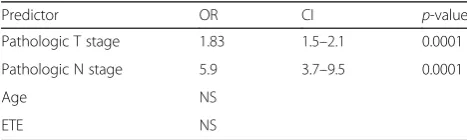
Results:425 CNDs were performed of which 224 were prophylactic. Conventional risk factors (age, tumor size, extra-thyroidal extension)were notassociated with performing a pCND. The presence of clinically suspicious lymphadenopathy was the only factor associated with performing CND, thus rendering the CND therapeutic. Positive LNs were retrieved in 39 % of pCND’s, upstaging 87 patients. Among all peri-operative predictors of receiving RAI, presence of LN metastases was the strongest predictor [OR = 5.9 (3.7–9.5)], while tumor size was a modest predictor [OR = 1.8 (1.5–2.1)]. Other conventional risk factorsdid notpredict use of adjuvant RAI.
Conclusions:Conventional risk factors were not indications for performing a pCND, implying that the decision was based on individual surgeon preference. Performing pCND upstaged 39 % of patients from cN0 to pN1a, increasing the likelihood of receiving RAI 6-fold. Conventional risk factors were not predictors of receiving adjuvant RAI. This highlights the need for a unified approach to performing a pCND and administering RAI. Keywords:Thyroid cancer, Central neck dissection, Radioactive iodine, Epidemiology, Lymph node metastasis
Background
Central neck dissection (CND) has an important, but controversial role in the treatment of papillary thyroid cancer (PTC). The central neck is the first nodal basin to which PTC spreads and when central neck nodes are affected, between 20 and 90 % of patients develop lateral
neck compartment metastases [1, 2]. Therapeutic CND (tCND) in patients with clinically suspicious lymph node (LN) metastases is a well-established intervention. It is when patients have no clinically suspicious metastatic LNs that the role of prophylactic CND (pCND) becomes unclear. The American Thyroid Association (ATA) 2015 guidelines identify that the impact of pCND on survival is unclear, given that the survival in these patients is ex-cellent overall [1, 3].
The 2009 ATA guideline recommended consideration of a pCND on those who have advanced primary tumors (T3 or T4), clinically involved lateral neck nodes (cN1b), or if the information will be used to plan further steps in therapy [1]. Following the publication of these guidelines,
* Correspondence:[email protected]
Presentations: Presented at the 2nd World Congress on Thyroid Cancer in Toronto, Ontario, Canada, July 10–14, 2013
3Ohlson Research Initiative, Arnie Charbonneau Cancer Institute, Cumming
School of Medicine, University of Calgary, Calgary, Canada
4Division of Otolaryngology-Head and Neck Surgery and Surgical Oncology,
Department of Surgery, Cumming School of Medicine, University of Calgary, Calgary, Canada
Full list of author information is available at the end of the article
there was much debate in the surgical community as to the value of pCND in all or even in high risk PTC patients. Metastatic central compartment LN’s have been shown to be associated with risk factors such as gender, primary tumor size, BRAF mutations, primary extrathyroidal extension and evidence of lateral cervical LN metastases, leading some authors to utilize these features as indica-tions for performing a pCND [4–6]. Small studies dem-onstrated that cervical LN metastases may affect overall survival in well differentiated thyroid cancer (WDTC) [7, 8]. In contrast, however, other large epidemiologic studies do not support the impact of performing a pCND on survival [9, 10]. A recent randomized con-trolled trial looking at the use of pCND in PTC showed undergoing pCND required fewer repeat doses of radio-active iodine (RAI), but significantly higher rates of permanent hypoparathyroidism [11]. The conflicting nature of the data led most surgeons to devise personal algorithms for when to perform a pCND, as well as the extent of the pCND (unilateral vs. bilateral CND).
Therefore, the objective of this study was to identify the pre-operative indications associated with performing a pCND among surgeons in the province of Alberta. We hypothesized that surgical decision-making was consist-ent with the ATA guidelines, with high-risk factors such as advanced age, larger primary tumor and evidence of extrathyroidal extension influencing a surgeon to per-form a pCND. The second goal of this study was to de-termine predictors of receiving adjuvant RAI. We hypothesized that conventional risk factors would pre-dict the use of RAI.
Methods
Thyroid surgeons in the province of Alberta have the ability to record pre- and intra-operative data pertaining to patients undergoing thyroid surgery using a prospect-ively collected synoptic operative reporting system, known as the Alberta WebSMR. [12] The resulting data includes pre-operative parameters such as demograph-ics, pre-operative staging, and evidence of any clinically suspicious LNs in the neck. It also contains peri-operative information such as size of the tumor, intra-operative findings, and intra-intra-operative complications. This database was used to identify our patient cohort, and to provide pre-operative and peri-operative data.
All patients identified via the Alberta WebSMR database with a diagnosis of PTC who underwent, at minimum, completion or total thyroidectomy, with or without CND between January 1, 2009 and July 31, 2012 were included for analysis. Patient demographic data including gender and age were collected. Surgical data such as stage of can-cer, type of surgery performed, extent of CND (unilateral vs. bilateral) and evidence of extrathyroidal extension were also collected. Pathology reports were reviewed to collect
overall LN yield, number of pathologic LNs identified in the neck dissection sample, and final pathologic stage. The use and dosage of RAI was also recorded.
Statistical analysis
Patient demographics, as well as pre-operative and intra-operative variables were compared between those who did and did not receive CND to determine associations between these factors and performing a CND. Categor-ical variables were compared using either a chi square or Fisher exact test as appropriate, while continuous variables were compared using either a Student’s t-test or Wilcoxon rank-sum test as appropriate. Ap-value of less than or equal to 0.05 was deemed significant for all analyses.
With respect to identifying factors that predicted the use of RAI, a multivariable logistic regression model was constructed using ‘high-risk’predictors (from the litera-ture) as well as those predictors that met with statistical significance on univariate analysis. Odds ratios and confidence intervals for significant predictors were cal-culated. All final multivariable regression models were evaluated for goodness-of fit, model stability and influ-ential observations.
Statistical analysis was performed using Stata (version 12.1, StataCorp LP, College Station, TX).
This study was reviewed and approved by the Alberta Cancer Research Ethics Committee.
Results
Table 1 illustrates demographic and tumor characteris-tics, stratified by whether or not a patient underwent a CND. In total, 594 patients treated by 18 surgeons were included in our initial cohort. Of those, 425 (72 %) patients underwent CND. There were 313 uni-lateral and 112 biuni-lateral CND with mean total LN yields of 7.4 +/−6.3 nodes and 11.9 +/− 7.5 nodes re-spectively. Of the 425 patients that underwent CND, 224 (53 %) underwent a pCND and 201 (47 %) a tCND. In the 224 patients undergoing a pCND, none of the con-ventional risk factors, such as pathologic tumor size, age, or evidence of extrathyroidal extension were identified as factors that influenced the decision to perform a pCND. Overall, only the presence of pre-operative clinically suspi-cious LNs was associated with a CND (p< 0.0001), thus rendering the CND therapeutic.
had a clinical N0 neck. On multivariate analysis, T stage was a modest predictor of receiving RAI [OR 1.83 (1.5–2.1)], while pathologic N Stage was the strongest predictor [OR 5.9 (3.7–9.5)]. The act of perform-ing a pCND was found to be collinear with pathologic N stage, implying that performing a pCND increases the likelihood of receiving adjuvant RAI, due to the high chance of identification of LN metastases.
When stratifying patients based on number of nodes retrieved, patients with greater than 5 positive
nodes were the most likely to receive RAI [OR = 23.3 (8.3, 65.3)], followed by patients with 1 to 5 nodes identified [OR = 5.9 (3.8, 9.3)].
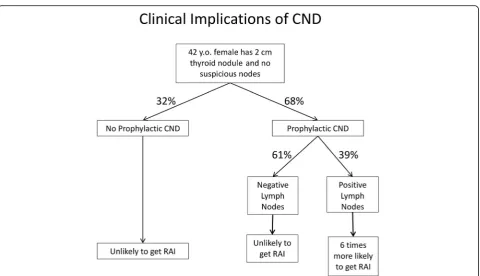
The flow chart in Fig. 1 demonstrates how a surgeon’s decision to perform a prophylactic CND affects a pa-tient’s management in our cohort. In the province of Al-berta, 68 % of patients without clinical evidence of LN metastasis received a pCND. After having performed the pCND, occult LN metastasis would be discovered in 39 %, thus upstaging the patient. As a result of having pathologically positive LNs, these patients are almost 6 times more likely to receive RAI.
Discussion
The role of pCND has become a much-debated topic over the last several years. While there is little debate about how to manage clinically apparent central LN me-tastasis, the role of pCND is unclear [1–3]. A recent meta-analysis concluded that performing routine pCND increases the risk of temporary hypocalcaemia and does not improve loco-regional control [10]. This would argue that CND has some morbidity, but questionable efficacy. However, CND can provide prognostic informa-tion and influence the decision to administer RAI, lead-ing some to advocate for more comprehensive staglead-ing and risk stratification [3, 13]. Current literature reflects that conventional risk factors such as age of patient, tumor size, extrathyroidal invasion, and lateral neck ease are associated with a higher likelihood of occult dis-ease in the central LN’s, and as such are utilized as guidelines for performing a pCND [4–6].
In the initial analysis tumors were divided into six categories based on T-stage, and there was no correl-ation between tumor size and pCND. In order to en-sure that our analysis was not limited by the fact that some sub-categories of T-stage had a limited sample size, a separate post-hoc analysis was performed by first dichotomizing patients into only two groups based on T –stage (T1-2 vs. T3-4). There was a non-significant trend toward increased likelihood of pCND in the T3-4 group. We also dichotomized patients based on age (age <45 vs. age >45) and again, found no association between dichotomized age and pCND.
In contrast to what is assumed to be the reason behind the adoption of pCND in Alberta following the publica-tion of the ATA guidelines in 2009, we were unable to identify any conventional risk factors that influenced the decision to perform a pCND. Three-hundred-twenty-nine patients had no suspicious nodes pre-operatively, and in this subset, factors such as advanced tumor size, age and evidence of extrathyroidal extension failed to differentiate those who did receive a pCND from those who did not. This deviation from the ATA demonstrates
Table 2Logistic regression: Factors that predict administration of adjuvant RAI
Predictor OR CI p-value Pathologic T stage 1.83 1.5–2.1 0.0001 Pathologic N stage 5.9 3.7–9.5 0.0001
Age NS
ETE NS
RAIradioactive iodine ablation,ETEextrathyroidal extension
Table 1Clinical and pathologic patient factors stratified by whether patient received CND or not
No CND CND pvalue No. of patients 169 425
Age (years) 46.3 45.6 ns Sex
Male 43 100 ns Female 126 325 Clinically suspicious lymph nodes in central neck
Yes 6 81 <0.0001
No 105 224
Procedure
Total Thyroidectomy or Completion Thyroidectomy alone
169 0 Total Thyroidectomy with Ipsilateral CND 0 313 Total Thyroidectomy with Bilateral CND 0 112 T stage
T1a 32 79 ns
T1b 46 106
T2 43 96
T3 20 93
T4a 2 14
T4b 0 2
M stage
M0 157 414 ns
M1 0 2
Tumor size (largest dimension in centimeters) 2.0 2.2 ns Extrathyroidal Extension present 3 20 ns
that surgeons have developed a more surgeon-specific approach to performing a CND.
A recent study by the ATA showed that the number of pathologic LNs obtained in a CND may have more prog-nostic significance than simply the presence of any LN metastases [13]. This review found that prognosis chan-ged only if 5 or more metastatic LNs were identified, emphasizing the need to perform a comprehensive CND. Previous work published by our group confirmed that comprehensive CNDs are being performed across our province [14]. It was the belief of the senior authors that by providing better staging material, patients who might otherwise have been candidates for adjuvant ther-apy in the past could now be observed.
However this study demonstrated that the decision to perform a pCND lead to a downstream decision to ad-minister adjuvant therapy. The strongest predictor of re-ceiving adjuvant RAI was the presence of LN metastasis (pN stage), while tumor size (pT stage) was only a mod-est predictor. In the province of Alberta, 68 % of patients without clinical evidence of LN metastasis received a pCND, whereby occult LN metastases were discovered in 39 %, thus significantly upstaging the patient. In pa-tients with pathologically positive LNs, the likelihood of receiving RAI was almost 6 times higher. While the ad-verse effects of RAI are relatively low, the potential benefit from this intervention has not been clarified in
the intermediate-risk patient population with a limited number of LN metastases. It is possible that a large number of these patients are being over-treated with ad-juvant RAI [15].
The new 2015 guidelines suggest that patients are con-sidered low risk if they are clinically N0 or have ≤5 pathologic lymph nodes with micrometastasis (<0.2 cm in largest dimension), whereas patients that are clinically N1 or have >5 pathologic lymph nodes are considered intermediate risk. Patients with intermediate level of risk may derive some benefit from RAI. In our cohort, pa-tients with greater than 5 positive nodes were the most likely group to receive RAI. Despite the fact that our co-hort was assembled prior to the release of these updated guidelines, it would appear we are compliant with the current risk stratification. With further improvements in compliance to this proposed risk stratification, future pa-tients may either be appropriately spared adjuvant RAI, or may more clearly warrant the use of adjuvant RAI, depending on risk level.
into the database, we believe that for those surgeons who do enter patients into the database, all consecutive patients are entered.
Although data for this study was collected over a short 3-year period, during this time endocrinologists in our province began to use baseline, post-operative stimulated thyroglobulin and low dose I131 whole body scans prior to administration of therapeutic doses of RAI. Therefore, it was not feasible to look at baseline stimulated thyro-globulin and whole body scans as factors that may pre-dict the use of RAI in our cohort. It is therefore possible that there were other factors that influenced the admin-istration of RAI then was analyzed.
This study is unique in that we were able to assess practice patterns among surgeons from different institu-tions and surgical disciplines. The homogeneity of the large sample size selected from the provincial population base of 3.6 million enables us to generalize our findings beyond institutional borders and renders the evaluation of a large number of independent predictors feasible. This study highlights the lack of consensus across the province both with respect to indications for performing a pCND as well as for receiving adjuvant RAI. Although the ATA guidelines are frequently referred to in address-ing practice management, specialists in our province were not uniform in adherence. Rather, specialists ap-peared to develop individual, practice-based treatment algorithms as it relates to performing a pCND and ad-ministering RAI. With the recent publication of the 2015 ATA guidelines, refinement of the indications for pCND, risk stratification and utilization of RAI adminis-tration will need to be addressed within our provincial group of specialists. While there is often a lag time in guideline adherence, with the results from this study, our group is now ideally situated to institute an inter-vention that would improve consistency among special-ists, and thus standardize treatment across the province.
Conclusions
Indications for performing a pCND appear to vary among surgeons across the province, and were not always consist-ent with convconsist-entional risk factors for high risk PTC. Cur-rently, the only consistent factor that influences the decision to perform a CND is the presence of clinically de-tected suspicious lymphadenopathy. In the setting where no pre-operative suspicious nodes were apparent, 39 % of patients who underwent pCND had their nodal status upstaged and in these patients, the likelihood of receiving adjuvant RAI was increased 6-fold because of the identifi-cation of one or more metastatic LNs.
Acknowledgments
We would like to acknowledge Cancer Surgery Alberta for providing us access and use of their data and the Ohlson Research Initiative at the Cumming School of Medicine for their assistance in analyzing the data.
Funding Not applicable.
Availability of data and materials
The datasets analyzed during the current study available from the corresponding author on reasonable request.
Authors’contributions
MD, JP, and SC developed the initial concept and design, as well as analyzed and interpreted the data, and were major contributors to writing and preparing of the manuscript. JD analyzed and interpreted the data, and was a major contributor to writing of the manuscript. LL analyzed and interpreted the data and was a minor contributor to writing the manuscript. SN was primarily responsible for data analysis and was a minor contributor to writing the manuscript. All authors gave final approval for the manuscript to be published.
Competing interests
The authors declare that they have no competing interests.
Consent for publication Not applicable.
Ethics approval and consent to participate
This study was reviewed and approved by the Alberta Cancer Research Ethics Committee. There is a statement of this within the Methods section of the manuscript.
Author details
1Division of Otolaryngology-Head & Neck Surgery, Department of Surgery,
Red Deer Regional Hospital Center, Red Deer, Alberta, Canada.2Division of
General Surgery and Surgical Oncology, Department of Surgery, Cumming School of Medicine, University of Calgary, Calgary, Canada.3Ohlson Research Initiative, Arnie Charbonneau Cancer Institute, Cumming School of Medicine, University of Calgary, Calgary, Canada.4Division of Otolaryngology-Head and
Neck Surgery and Surgical Oncology, Department of Surgery, Cumming School of Medicine, University of Calgary, Calgary, Canada.5Division of Endocrinology, Department of Medicine, University of Calgary, Calgary, Alberta, Canada.
Received: 27 August 2016 Accepted: 24 October 2016
References
1. American Thyroid Association (ATA) Guidelines Taskforce on Thyroid Nodules and Differentiated Thyroid Cancer, Cooper DS, Doherty GM, Haugen BR, Kloos RT, Mandel SJ, Mazzaferri EL, et al. Revised american thyroid association management guidelines for patients with thyroid nodules and differentiated thyroid cancer. Thyroid. 2009;19(11):1167–214. 2. American Thyroid Association Surgery Working Group, American Association
of Endocrine Surgeons, American Academy of Otolaryngology-Head and Neck Surgery, American Head and Neck Society, Carty SE, Cooper DS, Doherty GM, et al. Consensus statement on the terminology and classification of central neck dissection for thyroid cancer. Thyroid. 2009; 19(11):1153–8.
3. American Thyroid Association (ATA) Guidelines Taskforce on Thyroid Nodules and Differentiated Thyroid Cancer, Haugen BR, Alexander EK, Bible KC, Doherty GM, Mandel SJ, Nikiforov YE, et al. The 2015 American Thyroid Association management guidelines for adult patients with thyroid nodules and differentiated thyroid cancer. Thyroid. 2016;26(1):1–133.
4. Jiang LH, Chen C, Tan Z, Lu XX, Hu SS, Wang QL, et al. Clinical characteristics related to central lymph node metastasis in cN0 papillary thyroid carcinoma: a retrospective study of 916 patients. Int J Endocrinol. 2014;2014:385787. 5. Howell GM, Nikiforova MN, Carty SE, Armstong MJ, Hodak SP, Stang MT,
et al. BRAF V600E mutation independently predicts central compartment lymph node metastasis in patients with papillary thyroid cancer. Ann Surg Oncol. 2013;20(1):47–52.
7. Podnos YD, Smith D, Wagman LD, Ellenhorn JD. The implication of lymph node metastasis on survival in patients with well-differentiated thyroid cancer. Am Surg. 2005;71(9):731–4.
8. Zaydfudim V, Feurer ID, Griffin MR, Phay JE. The impact of lymph node involvement on survival in patients with papillary and follicular thyroid carcinoma. Surgery. 2008;144(6):1070.
9. Roh JL, Park JY, Park CI. Total thyroidectomy plus neck dissection in differentiated papillary thyroid carcinoma patients: pattern of nodal metastasis, morbidity, recurrence, and postoperative levels of serum parathyroid hormone. Ann Surg. 2007;245(4):604–10.
10. Shan CX, Zhang W, Jiang DZ, Zheng XM, Liu S, Qiu M. Routine central neck dissection in differentiated thyroid carcinoma: a systematic review and meta-analysis. Laryngoscope. 2012;122(4):797–804.
11. Viola D, Materazzi G, Valerio L, Molinaro E, Agate L, Faviana P, et al. Prophylactic central compartment lymph node dissection in papillary thyroid carcinoma: clinical implications derived from the first prospective randomized controlled single institution study. J Clin Endocrinol Metab. 2015;100(4):1316–24.
12. Chambers AJ, Pasieka JL, Temple WJ. Improvement in the accuracy of reporting key prognostic and anatomic findings during thyroidectomy by using a novel Web-based synoptic operative reporting system. Surgery. 2009;146(6):1090–8.
13. Randolph GW, Duh QY, Heller KS, LiVolsi VA, Mandel SJ, Steward DL, et al. The prognostic significance of nodal metastases from papillary thyroid carcinoma can be stratified based on the size and number of metastatic lymph nodes, as well as the presence of extranodal extension. Thyroid. 2012;22(11):1144–52.
14. Deutschmann MW, Chin-Lenn L, Au J, Brilz A, Nakoneshny S, Dort JC, et al. Extent of central neck dissection among thyroid cancer surgeons: a cross-sectional analysis. Head Neck. 2016;38 Suppl 1:E328–32.
15. Haymart MR, Muenz DG, Stewart AK, Griggs JJ, Banerjee M. Disease severity and radioactive iodine use for thyroid cancer. J Clin Endocrinol Metab. 2013; 98(2):678–86.
• We accept pre-submission inquiries
• Our selector tool helps you to find the most relevant journal
• We provide round the clock customer support
• Convenient online submission
• Thorough peer review
• Inclusion in PubMed and all major indexing services
• Maximum visibility for your research
Submit your manuscript at www.biomedcentral.com/submit