S T U D Y P R O T O C O L
Open Access
The Australian Research Council Longevity
Intervention (ARCLI) study protocol
(ANZCTR12611000487910) addendum:
neuroimaging and gut microbiota protocol
Tamara Simpson
1, Saurenne Deleuil
1, Nicole Echeverria
1, Mrudhula Komanduri
1, Helen Macpherson
1,3, Chao Suo
2,
Shakuntla Gondalia
1, Masoumeh Tangestani Fard
1, Andrew Pipingas
1, Andrew Scholey
1and Con Stough
1*Abstract
Background:The Australian Research Council Longevity Intervention (ARCLI) was designed to investigate the effects of two active supplements, Pycnogenol andBacopa monnieri(CDRI08) on cognitive performance in a cohort of elderly participants. An additional antioxidant supplement has been included into the trial. A neuroimaging component has also been added to the ARCLI study to investigate the neurochemical biomarkers of oxidative stress in vivo, as well as structural and functional changes associated with ageing and oxidative stress.Faecal biomarkers of gut microflora will also be analysed to investigate if gut microbiota are associated with domains of cognition (e.g., attention, processing speed, memory), mood or other ARCLI outcome variables. The aim of this paper is to update the published methods of the ARCLI clinical trial before it is completed, and data analysis commences.
Methods:ARCLI is a randomised, placebo controlled, double-blind, now 4-arm clinical trial including neuroimaging and gut microflora sub-studies. Along with the demographic, haematological, mood, cardiovascular and cognitive assessments described in the initial protocol, 80 eligible participants from the overall study pool of ~ 400 will be recruited into the neuroimaging study and undergo scans at baseline, 3 months and 12 months. Proton magnetic resonance spectroscopy, resting state functional connectivity and arterial spin labelled perfusion sequences are neuroimaging techniques included for each MRI visit in the study. Similarly, approximately 300 participants from the main study pool will be recruited to provide faecal samples at baseline, 3 months and 12 months so that the gut microbiome can be studied.
Discussion:ARCLI is 12-month intervention study, currently underway with a group of older adults, investigating a range of outcomes and their association with ageing. The additional measurements in the ARCLI trial will further the understanding of the underlying mechanisms associated with healthy ageing and may provide insights into novel preventative therapeutic strategies for maintaining cognitive and brain health into old age.
Trial registration:Australia and New Zealand Clinical Trials Register (ANZCTR):ACTRN12611000487970.
Keywords:Antioxidant, Neuroimaging, Pycnogenol, Bacopa, Glutathione, Cognition, Ageing, Magnetic resonance spectroscopy, Magnetic resonance imaging
* Correspondence:[email protected]
1Centre for Human Psychopharmacology, Swinburne University of
Technology, PO Box 218, Hawthorn, Victoria, Melbourne, Australia Full list of author information is available at the end of the article
Background and rationale
Studies have identified a link between alterations in brain neurochemicals and differences in cognitive func-tion using the brain imaging technique of proton mag-netic resonance spectroscopy (1H MRS) e.g. [1, 2]. Magnetic resonance spectroscopy (MRS) is a useful non-invasive technique to study in vivo neurometabolite concentrations. Understanding how nutritional supple-ments can modulate changes within the ageing brain will help to elucidate the biological processes involved in ageing. Using the neuroimaging modality of MRS may be a unique and sensitive measure of short and long-term in vivo intervention effects. The addition of an antioxidant rich supplement to the Australian Re-search Longevity Intervention (ARCLI) study will enable our group to extend our investigation to the cognitive, cardiovascular and general health benefits of antioxi-dants in an elderly cohort. The cognitive enhancing ef-fects of vitamins and minerals have focussed on vitamin C, beta carotene and/or vitamin E [3] or a combination of nutrients in the form of a multivitamin [4,5] with few studies using a complex antioxidant formula. A com-bined antioxidant formula may reduce the effects of oxi-dative stress, therefore improve cognitive function and assist older adults to live cognitively active lives.
Add-itionally, Bacopa monnieri and Pycnogenol have been
extensively studied in vitro to elucidate its antibacterial properties against various bacteria related to human health [6–8]. There is the possibility that these supple-ments have the capacity to modulate the gut microbiota and can affect the overall gut health and improve an in-dividual’s general health status.
Addition of an antioxidant combination supplement
The body employs complex interactions to negate oxida-tive stress. For instance, it utilises antioxidants which are either derived naturally within (endogenously) the body or provided externally (exogenously) through foods [9]. Antioxidants supplied through nutrition are the most important source to help endogenous antioxidants coun-teract oxidative stress reactions [10]. Nutritional antioxi-dants protect against increased oxidative stress by mainly scavenging free radicals to counteract free radi-cals, reduce peroxides and repair oxidized membranes, quench iron to reduce the creation of reactive oxygen species (ROS), and counteract ROS with short-chain fatty acids, via lipid metabolism [11].
Good nutrition from a varied diet and healthy vitamin and mineral status is integral to the biochemical pro-cesses that occur in the central nervous system, to main-tain the brain’s structure and normal cognitive function [12]. In situations where the availability of endogenous antioxidants is insufficient to maintain cellular functions,
exogenous antioxidants in the form of dietary supple-ments may be required to maintain optimal overall health and well-being [13]. The combined administra-tion of alpha lipoic acid (LA) with other antioxidants such as acetyl-L-carnitine and Coenzyme Q10 (CoQ10), rather than the administration of LA in isolation, ap-pears superior in attenuating cognitive and mitochon-drial dysfunction [14]. The co-administration of a complex antioxidant blend containing 34 antioxidants when compared to placebo lowered serum homocysteine and improve declarative and non-declarative memory after four months in a group of older adults [15]. This suggests that there are synergistic benefits associated with the co-administration of different antioxidants. In a review of antioxidant use in human and animal studies, Kamat and colleagues [16] concluded that while animal models of antioxidant therapies were successful, the out-comes did not translate into human intervention re-search or clinical trials. One reason contributing to this lack of clarity in the literature is that ageing is likely to affect a myriad of metabolic sites whereby a single anti-oxidant supplement (eg. Vitamin C, Vitamin E, CoQ10) is unlikely to contribute to biochemical processes that form complex interactions. Targeting multiple metabolic sites may be a better method for effecting change in cog-nitive and health factors for older adults. There is a pau-city of literature in ageing studies reporting findings of a blended antioxidant supplement. We therefore believe the efficacy of a combined antioxidant supplement to improve cognitive functioning and reduce the prevalence of risk factors associated with aging warrants further in-vestigation, which is why a combined antioxidant sup-plement is now included in the ARCLI study.
Rationale for the inclusion of neuroimaging Neuroimaging will be conducted in the ARLCI trial with a subset of ~ 80 participants to explore in vivo neurochem-ical modes of action ofBacopa monnieri (CDR108), and Pycnogenol. As previously described in the main protocol, the results identified in human trials examining the effects of Bacopa monnieri and Pycnogenol on cardiovascular function and peripheral biochemical markers of inflamma-tion and oxidainflamma-tion provide promising outcomes [17–20]. Studies like this inform possible peripheral biological mechanisms underpinning the actions of these supple-ments. However, to date, no studies have examined the in vivo brain effects using neuroimaging.
1
HMRS is a magnetic resonance imaging (MRI) tech-nique that will be used to measure the potential in vivo brain effects of these supplements by estimating regional concentrations of various neurometabolites. The
metab-olites most commonly measured with 1HMRS are
which represent underlying processes within the brain [21]. For example, NAA is considered to be a neural marker, Cr a marker of energy metabolism, Cho a marker of cellular turnover, mI a marker of inflamma-tion and Glx a marker of metabolic activity [22]. Few studies have investigated the in vivo effects of natural supplement interventions on brain chemistry as
mea-sured with1HMRS, thus these commonly measured
me-tabolites will be investigated in the ARCLI study. Recently, omega-3 fatty acid supplementation was re-ported to increase the chemical concentration of gluta-thione (GSH; an endogenous antioxidant) in the temporal lobe of first-episode psychosis patients, with this increase in GSH (the most abundant antioxidant in the body), correlating with improvement in negative symptoms [23]. GSH plays an integral role in protecting cells against reactive oxygen species [24] and is becom-ing a popular brain metabolite for researchers to investi-gate the integrity of antioxidant mechanisms and oxidative stress in vivo e.g. [25–27]. This popularity is most likely due to the negative effects of oxidative stress being implicated in chronic diseases and clinical disor-ders like depression [28], schizophrenia [29] and bipolar disorder [30] and neurodegenerative disorders like Alz-heimer’s disease [31] where GSH as a biomarker is in-formative regarding the pathological neuronal changes occurring in the brain. GSH concentration will therefore be investigated in the ARCLI trial.
Rationale for the examination of faecal biomarkers of gut microflora
Recently the human gut microbiota has become the sub-ject of extensive research. The knowledge of the com-plex microbial community within the human intestinal tract and their functional capacity is rapidly growing. Gut microbiota influences human well-being, metabol-ism, physiology, nutrition, and immune function [32, 33]. Collectively studies now indicate that a disruption in the composition of the gastrointestinal microorgan-isms (or dysbiosis) can contribute to disease conditions such as diabetes [34], inflammatory bowel diseases [35], obesity [36], and malnutrition [37]; communicating through the central nervous system’s immune, neural and endocrine pathways [38–40]. As people age, the functionality of the immune system declines and can cause low level inflammation in the gut and in turn in-crease the permeability of the intestines [41]. Emerging literature suggests that the gut microbiota plays a role in the development of neurodegenerative disorders affect-ing cognition, particularly Alzheimer’s Disease [41, 42]. Therefore, it is apparent that any change to the micro-bial community can have a profound effect of both beneficial and harmful consequences for human health and cognition.
Interestingly in animal models, the role of gut microbiota has been studied using germ-free and specific pathogen free mice to investigate anxiety-like behaviour and to see how normal gut microbiota can modulate brain development and behaviour. Heijtz and colleagues [39] observed that normal gut microbiota affected normal brain development and behavioural functions in mice. They concluded that the alteration of proteins within the gut could lead to long term modification of synaptic transmission affecting motor con-trol and anxiety-like behaviour in adult life. In their seminal study, Sudo and colleagues [43] identified a link between microbiota and hypothalamic-pituitary-adrenal reaction to restraint stress. Exaggerated corticosterone and adrenocor-ticotrophin response, indicators of increased stress reactiv-ity, was found in these mice. This study was the first to identify that microbes can affect the neural network re-sponsible for controlling stress responses and it became the motivation for neuroscientists to consider the importance of gut microbiota in central nervous system function. Gut microbiota analysis in the ARCLI study will be useful to in-vestigate links between gut microbiota with mood and cog-nitive measures as well as seeing whether there are any alterations in gut microbial composition in response to nutraceutical supplementation.
Aims and study hypotheses
The aim of the neuroimaging sub-study is to investigate neurochemical, structural and functional changes that may underpin participants’cognitive performance due to intervention. It is hypothesised that there will be a posi-tive correlation between brain neurochemicals and cog-nitive performance measures. It is also expected that there will be an improvement in cognitive performance and a change in the concentration levels of
neurochemi-cals after 3 and 12 months intervention with Bacopa
monnieri(CDRI08), Pycnogenol, or a combined antioxi-dant formula, when compared to placebo.
The aim of the gut microflora sub-study is to investigate the effect of dietary supplements with gut microbial compos-ition and how this composcompos-ition relates to mood, cognitive performance and other health measures. It is hypothesised that the interventions will correlate with positive change in the gastrointestinal microbial composition. It is expected that a positive change in gut microbial composition will correlate with improved mood, better cognitive performance measures and other health measures included in the study.
Design and methodology
Design
Centres
ARCLI is being conducted at the Centre for Human
Psy-chopharmacology, Swinburne University, Melbourne,
Australia. Neuroimaging will only be conducted through the Neuroimaging Facility located at Swinburne University.
Participants
It is expected that from the overall sample of over 400 par-ticipants recruited into the ARCLI trial, prior to treatment randomisation, ~ 80 of these eligible participants (20 per arm) will elect to take part in the recently devised neuroim-aging sub-study. Participants will only be included in the neuroimaging sub-study if they fulfil eligibility requirements for the main study [see 44] and do not have any metallic implants including, for example, cardiac pacemaker, coch-lea implant or suffer from claustrophobia which would ren-der them unsafe to unren-dergo an MRI scan. Similarly, prior to randomisation, it is expected that from the overall sam-ple of over 400 participants recruited into the ARCLI trial, ~ 300 of these participants will provide faecal stool samples at baseline for the gut microflora sub-study. All participants will provide written informed consent. The study was ethic-ally approved by the Swinburne University Research Ethics Committee (project number 2010/106). The trial has been registered with the Australian and New Zealand Clinical Trials Registry (ACTRN12611000487910).
Procedure
The procedure remains consistent with the main study described in the previous manuscript [44]. The proced-ure for the neuroimaging and gastrointestinal microflora sub-studies is described below.
Neuroimaging sub-study
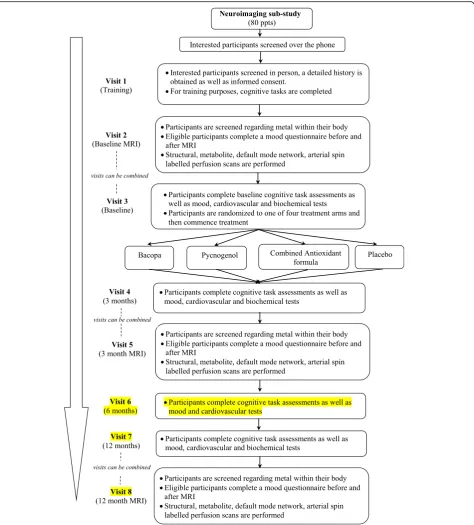
Participants involved in the neuroimaging sub-study (~ 80, 20 per arm) will be required for an additional hour and a half at three time points, on either the same or separate days to their attendance at The Centre for Hu-man Psychopharmacology, Swinburne University of Technology, for the main component of the trial [main protocol refer to 44; see Fig.1.integrated flow diagram]. Additional screening for eligibility to undergo MRI scans will be conducted to ensure participant safety with re-spect to any metallic implants within this environment. Participants will be asked to complete the “trait” and “state” assessments of the Spielberger State-Trait Anx-iety Inventory prior to the MRI scans to assess a baseline anxiety level [45]. This scale is commonly used to meas-ure fluctuating levels of anxiety. The “state” portion of the measure will be completed again, after the MRI scan, to measure participant’s anxiety levels. With the partici-pant lying in the scanner, different imaging techniques will be utilized to look at brain structure, brain metabol-ite levels, blood flow and resting state connectivity.
As part of the new neuroimaging sub-study, neuroim-aging measures will be collected between the training day (Visit 1) and baseline (Visit 2) assessments, and no later than a week after the 3 month (Visit 4) and 12 month assessments (Visit 7). Where possible, neuroim-aging visits can be conducted on the same day as the main study assessments. Please refer to the neuroimag-ing protocol flow diagram, Fig.1.
MRI scans will be collected using a Siemens 3 Tesla Tim Trio MRI scanner (Erlargen, Germany) located at the Neuroimaging Facility of Swinburne University of Tech-nology, Hawthorn, Australia. For all participants, a high resolution (1x1x1 mm) T1-weighted structural scan will be acquired as a reference image for some of the following sequences (MRS) as well as to determine any structural changes in response to the intervention. Scanning in a resting state condition, with eyes open, looking at a fix-ation cross will occur to investigate intrinsic brain activity and functional networks (eg., default mode network (DMN)), using a standard echo planar imaging sequence (TE/TR = 30/2500, 3.5 × 3.5 × 3 mm, 40 slices, 144 vol-umes) sensitive to blood-oxygen-level-dependent contrast. Single voxel 1HMRS will be conducted at two regions of interest: left dorsolateral prefrontal cortex (LDLPFC; 15x12x15 mm); and posterior cingulate cortex (PC; 20x20x20 mm) using standard PRESS sequence (TE/TR = 30/2000, Ave (PC) = 124, Ave (LDLPFC) = 192, followed by two un-water supressed MRS scans at the same two ROIs to estimate the water signal. A separate MRS scan using a modified MEGA-PRESS sequence (TE/TR = 131/ 2000, Ave = 160, edit Pulse Frequency/Bandwidth =4.56 ppm/44 Hz) at the PC region will then be conducted to allow us to investigate oxidative stress in vivo by investi-gating GSH levels. An un-water-suppressed scan will then be performed with identical location and setup as above, with 12 averages, to estimate the water signal. Following MRS, to investigate the brain’s tissue perfusion, a 5-min arterial spin labelled perfusion sequence (TE/TR = 13/ 3000, Inversion time 1/2 = 700/1500 ms, FOV = 220 mm, 3.4 × 3.4 × 5 mm, 14 slices, with 1.25 m gap) will be per-formed. Participants will be in the scanner for the dur-ation of 1 h.
Gastrointestinal microflora sub-study
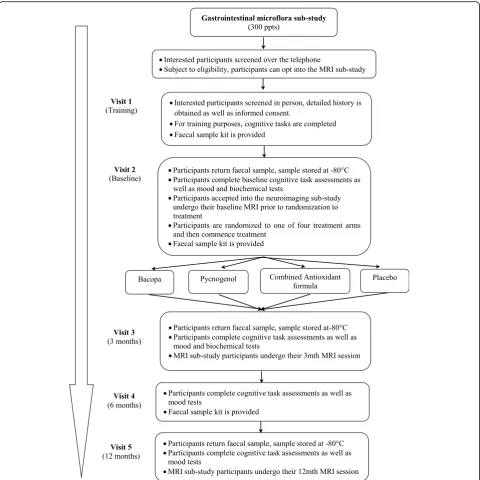
advance by the participant) and stored in a freezer prior to returning to the Centre for Human Psychopharma-cology, Swinburne University, at their next visit. Upon receipt of the faecal sample, the container will be stored at−80 °C until microbiota analysis will be carried out by utilising deep next-generation shotgun sequencing [34] of DNA extracted from collected faecal samples.
Discussion
(physical or psychiatric) conditions that could have an impact on cognitive and brain performance. The last participant was recruited in October 2018. Taking into account the possible rescheduling/cancelling of visits we anticipate the study will finish in November 2019. More than 400 participants will have been randomized into this trial by October 2019 and given the large array of measures ranging from cognitive, psychological, diet, sleep, cardiovascular, genetic, oxidative stress, inflamma-tory, biochemistry, mood and well-being, and neuroim-aging amongst many others, ARCLI will constitute one
our team has started writing papers on the relationship between biological parameters and cognition (e.g. the relationship between oxidative stress and cognition [46] or oxidative stress and processing speed [47]. The base-line data is a rich and invaluable source of information. We expect more than 30 baseline papers to be written before the intervention data is finalised in August 2019. The addition of the microbiome and neuroimaging data using Magnetic Resonance Spectroscopy (MRS) is par-ticularly exciting given the rich battery of cognitive measures used in ARCLI both at baseline and again at 3 and 12 months. Researchers interested in testing rela-tionships between cognition and other variables col-lected at ARCLI would be welcome to collaborate on papers with our team.
There are some methodological considerations in conducting a trial of this size. The rigorous inclusion/ exclusion criteria for participation in this study is lim-ited to those who are healthy within the age range of 60-75 yrs. where it may be challenging to recruit the healthiest within this cohort, however, with the avail-ability of social media avenues to advertise the trial, we have been able to broaden the reach of the study to as-sist in participant recruitment. Furthermore, future studies could adapt this protocol to different cohorts to investigate the outcomes of the supplements to broaden the generalisability of the population. The addition of a neuroimaging component to the trial adds an extra time commitment for participants who elect to undergo MRI scans. Prior to commencing recruitment for this sub-study we decided it would be best to offer partici-pants the option of combining their MRI scan on the same day they complete their cognitive, mood, cardio-vascular and biochemical assessments. Offering flexibil-ity and being able to split the visits if required, may assist in less attrition rates for such a long and involved study and reduce study day fatigue. For the gastrointes-tinal microflora sub-study the composition of the gut microflora can be altered after probiotic and prebiotic use, increasing the growth of beneficial bacteria associ-ated with health promotion [48]. On the other hand, antibiotics have been found to decrease intestinal mi-crobial communities [49]. While at each study visit any changes to the participant’s medication and health sta-tus is recorded, this information is reliant upon partici-pant recall and self-report if at any stage in the preceding 3mths they took this type of medication. It might be that despite every effort to record medication use there may be instances where study staff or re-searchers are unaware of this type of medication use when participants provided their stool sample. Future studies might consider providing participants with a diary to record this information and for it to be handed in at each visit.
Conclusions
It is possible that the trajectory of ageing is malleable and that nutraceutical supplements that work on the antioxidant pathways may reduce brain and cognitive ageing. Such interventions may be a cost efficient and practical method for older adults to optimise their qual-ity of life with advancing age. The results of this study may assist to elucidate the relationship between less known in vivo brain and gut variables in relation to cog-nition as well as changes in these variables due to the interventions.
Trial status
The trial is currently recruiting.
Abbreviations
1
HMRS:Proton magnetic resonance spectroscopy; ANZCTR: Australia and New Zealand Clinical Trials Registry; ARCLI: Australian Research Council Longevity Intervention; Cho: Choline; Cre: Creatine; DMN: Default mode network; GLX: Glutamate & Glutamine; GSH: Glutathione; MEGA-PRESS: MEshcher-GArwood-Point RESolved spectroscopy; mI: Myo-inositol; MRI: Magnetic resonance imaging; MRS: Magnetic resonance spectroscopy; NAA: N-aceytl aspartate; PRESS: Point resolved spectroscopy;
RCT: Randomised controlled trial
Acknowledgements
The authors acknowledge the Swinburne Neuroimaging (SNI) Facility’s flagship funding from the National Imaging Facility (NIF) under the National Collaborative Researcher Infrastructure Strategy (NCRIS) implemented by the Australian Government.
Funding
The study is funded by an Australian Research Council Discovery Grant to CStough, AS and KC (DP1093825), with additional funding from Horphag, Soho Flordis International-Research and Blackmores Australia. The study was also supported by philanthropic grants from Doug Mitchell and Roderic O’Connor and from the Equity Trustees (for the Phyllis Connor Trust). TS, MTF, and KN are recipients of an Australian Government Postgraduate Research Scholarship.
Availability of data and materials
The data sets generated and/or analysed during the current study are not publicly available as this is an ongoing study, however at the end of the RCT data will be made available from the corresponding author upon reasonable request.
Authors’contributions
TS and CSuo contributed to the conception and design of the neuroimaging sub-study. CStough and SG conceived the gut microflora sub-sub-study. TS wrote the manuscript with the assistance of critical review and editing from CSuo, HM, AP, MTF, AS and CStough. TS, KN, NE, and SD have made substantial contributions to the enrolment of participants, collection of data, data analysis and interpretation of data. MK and SG are responsible for the gut microbiota analysis. All authors read and approved the final manuscript.
Ethics approval and consent to participate
This study was approved by the Swinburne University Human Ethics Research Committee which is a formally constituted ethics committee of the Australian National Health and Medical Research Committee. Ethics Number 2010/106. Informed written consent will be obtained from participants prior to enrolment.
Competing interests
The authors conduct studies onBacopa monnierithat are funded by Soho Flordis-International-Research. Soho Flordis International-Reserach were not involved at any stage of the project including study design, analysis of results, or decision to publish. The same applies for Blackmores Australia and Horphag
Publisher’s Note
Springer Nature remains neutral with regard to jurisdictional claims in published maps and institutional affiliations.
Author details
1
Centre for Human Psychopharmacology, Swinburne University of Technology, PO Box 218, Hawthorn, Victoria, Melbourne, Australia.2Brain and
Mental Health Laboratory, Monash Institute of Cognitive and Clinical Neurosciences, School of Psychological Sciences, Monash University, Melbourne, Australia.3Institute for Physical Activity and Nutrition Research, Deakin University, Melbourne, Australia.
Received: 26 July 2018 Accepted: 20 December 2018
References
1. Ferguson KJ, MacLullich MJ, Marshall I, Deary IJ, Starr JM, Seckl JR, Wardlaw JM. Magnetic resonance spectroscopy and cognitive function in healthy elderly men. Brain. 2002;125:2743–9.
2. Grachev ID, Vania Apkarian A. Aging alters regional mutlichemical profile of the human brain: anin vivo1H-MRS study of young versus middle-aged
subjects. J Neurochem. 2001;76:582–93.
3. Kang JH, Cook NR, Manson JE, Buring JE, Albert CM, Grodstein F, Vitamin E, Vitamin C, Carotene B. Cognitive function among women with or at risk of cardiovascular disease: the women's antioxidant and cardiovascular study. Circulation. 2009;119:2772–80.
4. Macpherson H, Ellis KA, Sali A, Pipingas A. Memory improvements in elderly women following 16 weeks treatment with a combined multivitamin, mineral and herbal supplement: a randomized controlled trial. Psychopharmacology. 2012;220:351–65.
5. Harris E, Kirk J, Roswell R, Vitetta L, Sali A, Scholey A, Pipingas A. The effect of mulitvitamin supplementation on mood and stress in healthy older men. Human Psychopharmacology. 2011;26:560–7.
6. Rohdewald P, Beil W. In vitro inhibition of helicobacter pylori growth and adherence to gastric mucosal cells by Pycnogenol®. Phytother Res. 2008;22:685–8.
7. Torras MAC, Faura CA, Schönlau F, Rohdewald P. Antimicrobial activity of Pycnogenol®. Phytother Res. 2005;19:647–8.
8. Khan AV, Ahmed QU, Shukla I, Khan AA. Antibacterial efficacy ofBacopa monnierileaf extracts against pathogenic bacteria; 2010.
9. Rao S, Kalva S, Yerramilli A, Mamidi S. Free radicals and tissue damage: role of antioxidants. Free Radicals and Antioxidants. 2011;1:2–5.
10. Fusco D, Colloca G, Lo Monaco MR, Cesari M. Effects of antioxidant supplementation on the aging process. Clin Interv Aging. 2007;2:377–87. 11. Parke DV. Nutritional antioxidants in disease prevention: mechanisms of
action. In: Basu T, Temple N, Garg M, editors. Antioxidants in human health and disease. New York: CABI Publisher; 1999. p. 1–13.
12. Bourre JM. Effects of nutrients (in food) on the structure and function of the nervous system: update on dietary requirements for brain. Part 1: micronutrients. The Journal of Nutrition, Health and Aging. 2006;10:377–85. 13. Rahman K. Studies on free radicals, antioxidants, and co-factors. Clin Interv
Aging. 2007;2:219–36.
14. Liu J. The effects and mechanisms of mitochondrial nutrient a-lipoic acid on improving age-associated mitrochondrial and cognitive dysfunction: an overview. Neurochem Res. 2008;33:194–203.
15. Summers WK, Martin RL, Cunningham M, Deboynton VL, Marsh GM. Complex antioxidant blend improves memory in community-dwelling seniors. J Alzheimers Dis. 2010;19:429–39.
16. Kamat CD, Gadal S, Mhatre M, Williamson KS, Pye QN, Hensley K. Antioxidants in central nervous system diseases: preclinical promise and translational challenges. J Alzheimers Dis. 2008;15:473–93.
17. Stough C, Lloyd J, Clarke J, Downey LA, Hutchison CW, Rodgers T, Nathan PJ. The chronic effects of an extract of Bacopa monniera (Brahmi) on cognitive function in healthy human subjects. Psychopharmacology. 2001; 156:481–4.
18. Stough C, Downey LA, Lloyd J, Silber B, Redman S, Hutchison C, Wesnes K, Nathan PJ. Examining the nootropic effects of a special extract of Bacopa monniera on human cognitive functioning: 90 day double-blind placebo-controlled randomized trial. Phytother Res. 2008;22:1629–34.
19. Calabrese C, Gregory WL, Leo M, Kraemer D, Bone K, Oken B. Effects of a standardized Bacopa monnieri extract on cognitive performance, anxiety, and depression in the elderly: a randomized, double-blind, placebo-controlled trial. J Altern Complement Med. 2008;14:707–13. 20. Ryan J, Croft K, Mori T, Wesnes K, Spong J, Downey L, Kure C, Lloyd J,
Stough C. An examination of the effects of the antioxidant Pycnogenol(R) on cognitive performance, serum lipid profile, endocrinological and oxidative stress biomarkers in an elderly population. J Psychopharmacol. 2008;22:553–62.
21. Haga KK, Khor YP, Farrall A, Wardlaw JM. A systematic review of brain metabolite changes, measured with 1H magnetic resonance spectroscopy, in healthy aging. Neurobiol Aging. 2009;30:353–63.
22. Rae C. A guide to the metabolic pathways and function of metabolites observed in human brain 1H magnetic resonance spectra. Neurochem Res. 2014;39:1–36.
23. Berger GE, Wood SJ, Wellard RM, Proffitt TM, McConchie M, Amminger GP, Jackson GD, Velakoulis D, Pantelis C, McGorry PD. Ethyl-eicosapentaenoic acid in first-episode psychosis. A 1H-MRS study. Neuropsychopharmacology. 2008;33:2467–73.
24. Zhao T, Heberlein K, Jonas C, Jones DP, Hu X. New double quantum coherence filter for localized detection of glutathione in vivo. Magn Reson Med. 2006;55:676–80.
25. Mandal PK, Tripathi M, Sugunan S. Brain oxidative stress: detection and mapping of anti-oxidant marker 'Glutathione' in different brain regions of healthy male/femal, MCI and Alzheimer patients using non-invasive magnetic resonance spectroscopy. Biochem Biophys Res Commun. 2012;417:43–8. 26. Wijtenburg SA, Gaston FE, Spieker EA, Korenic SA, Kochunov P, Hong LE,
Rowland LM. Reproducibility of phase rotation STEAM at 3T: focus on glutathione. Magn Reson Med. 2014;72:603–9.
27. Duffy SL, Lagopoulos J, Hickie IB, Diamond K, Graeber MB, Lewis SJG, Naismith SL. Glutathione relates to neuropsychological functioning in mild cognitive impairment. Alzheimers Dement. 2013;10:67–75.
28. Auer DP, Pütz B, Kraft E, Lipinski B, Schill J, Holsboer F. Reduced glutamate in the anterior cingulate cortex in depression: an in vivo protoon magnetic resonance spectroscopy study. Society of Biological Psychiatry. 2000;47:305–13. 29. Wood SJ, Berger GE, Wellard RM, Profitt TM, McConchie M, Berk M, McGorry
PD, Pantelis C. Medial temporal lobe glutathione concentration in first episode psychosis: a 1H-MRS investigation. Neurobiol Dis. 2009;33:354–7. 30. Chitty KM, Lagopoulos J, Hickie IB, Hermens DF. Investigating the role of
glutathione in mismatch negativity: an insight into NMDA receptor disturbances in bipolar disorder. Clin Neurophysiol. 2014;126:1178–84. 31. Schott JM, Frost C, MacManus DG, Ibrahim F, Waldman AD, Fox NC. Short
echo time proton magnetic resonance spectroscopy in Alzheimer's disease: a longitudinal multiple time point study. Brain. 2010;133:3315–22. 32. Wickens K, Black PN, Stanley TV, Mitchell E, Fitzharris P, Tannock GW, Purdie
G, Crane J. A differential effect of 2 probiotics in the prevention of eczema and atopy: a double-blind, randomized, placebo-controlled trial. J Allergy Clin Immunol. 2008;122:788–94.
33. Tlaskalová-Hogenová H,Štěpánková R, Hudcovic T, Tučková L, Cukrowska B, Lodinová-Žádńıková R, Kozáková H, Rossmann P, Bártová J, Sokol D, et al. Commensal bacteria (normal microflora), mucosal immunity and chronic inflammatory and autoimmune diseases. Immunol Lett. 2004;93:97–108. 34. Qin J, Li Y, Cai Z, Li S, Zhu J, Zhang F, Liang S, Zhang W, Guan Y, Shen D,
et al. A metagenome-wide association study of gut microbiota in type 2 diabetes. Nature. 2012;490:55–60.
35. Frank DN, St. Amand AL, Feldman RA, Boedeker EC, Harpaz N, Pace NR. Molecular-phylogenetic characterization of microbial community imbalances in human inflammatory bowel diseases. Proc Natl Acad Sci. 2007;104:13780–5.
36. Zhang H, DiBaise JK, Zuccolo A, Kudrna D, Braidotti M, Yu Y, Parameswaran P, Crowell MD, Wing R, Rittmann BE, Krajmalnik-Brown R. Human gut microbiota in obesity and after gastric bypass. Proc Natl Acad Sci. 2009;106:2365–70. 37. Kau AL, Ahern PP, Griffin NW, Goodman AL, Gordon JI. Human nutrition, the
gut microbiome and the immune system. Nature. 2011;474:327–36. 38. Clemente Jose C, Ursell Luke K, Parfrey Laura W, Knight R. The impact
39. Heijtz RD, Wang S, Anuar F, Qian Y, Björkholm B, Samuelsson A, Hibberd ML, Forssberg H, Pettersson S. Normal gut microbiota modulates brain development and behavior. Proc Natl Acad Sci. 2011;108:3047–52. 40. Sekirov I, Russell SL, Antunes LCM, Finlay BB. Gut microbiota in health and
disease. Physiol Rev. 2010;90:859–904.
41. Hu X, Wang T, Jin F. Alzheimer’s disease and gut microbiota. Sci China Life Sci. 2016;59:1006–23.
42. Jiang C, Li G, Huang P, Liu Z, Zhao B. The gut microbiota and Alzhiemer's disease. J Alzheimers Dis. 2017;58:1–15.
43. Sudo N, Chida Y, Aiba Y, Sonoda J, Oyama N, Yu X-N, Kubo C, Koga Y. Postnatal microbial colonization programs the hypothalamic–pituitary– adrenal system for stress response in mice. J Physiol. 2004;558:263–75. 44. Stough C, Pase M, Cropley V, Myers S, Nolidin K, King R, Camfield D, Wesnes
K, Pipingas A, Croft K, et al. A randomized controlled trial investigating the effect of Pycnogenol and Bacopa CDRI08 herbal medicines on cognitive, cardiovascular, and biochemical functioning in cognitively healthy elderly people: the Australian Research Council longevity intervention (ARCLI) study protocol (ANZCTR12611000487910). Nutr J. 2012;11:11.
45. Spielberger C, Gorsuch R, Lushene R. Manual for the state-trait anxiety inventory. Palo Alto. 1970.
46. Downey LA, Simpson T, Timmer J, Nolidin K, Croft K, Wesnes KA, Scholey A, Deleuil S, Stough C. Impaired verbal episodic memory in healthy older adults is marked by increased F2-Isoprostanes. Prostaglandins Leukot Essent Fat Acids. 2018;129:32–7.
47. Camfield D, Nolidin K, Savage K, Timmer J, Croft K, Tangestani T, Simpson T, Downey L, Scholey A, Pipingas A, et al. Higher plasma levels of F2-isoprostanes are associated with slower psychomotor speed in healthy older adults.Free Radical ResearchIn Press.
48. De Preter V, Hamer HM, Windey K, Verbeke K. The impact of pre- and/or probiotics on human colonic metabolism: does it affect human health? Mol Nutr Food Res. 2011;55:46–57.