PATTERNS AND PROCESSES OF SPATIAL DEVELOPMENT; THE CASE OF UGANDA*
C.]. BAKWESEGHA Mak.eJteJte Un,[VeJL6,uy, Kampa.to.
I n.tJw du.c;t.W n
The "core-periphery"
~el
that has been recently coined by John Friedmannland arrplified by Edward Soja appears to have rome as a reaction against earlier theoretical approaches to regional developrent. For while fomer theories of
regi-anal develo~t cxxnplerrent each other in rrany ways, and may each be relevant for specific ~ds of planning analysis, none of them can be, as rogently argued by
Friedmann, accepted as a sharp tool for regional developrent planning in its carpre-hensi ve fOnTI.
The primary purpose of this article is to outline the major therres of
Friedmann's "core-periphery" nodel, as inrorporated with the amplifications and
rrodi-fications of it by Soja, and to present i t as a basis for discussion on Patterns and Processes of Spatial Develop!Ellt in Uganda.
The "CoJr.e-PeJUpheJI.y" Model.: A Rev,tI!VJ
Friedmann' s ;rcore-periphery Ft m:x:lel calls for a recognition of developnent as
a process of innovation diffusion that leads to the structural transfonnation of social systems in society. The m:x:lel presents developlEIlt as a "discontinous, cumulative process that occurs
as
a seY"~es Of elementary innovations which become organised into innovative clusters and finally into large-scale systems of innovationl/.But where a society fails to achieve this transformation, it is tourd either to get stranded in its growth or degenerate as a result of cumulative disorder and chaos.
Development normally arerges out of a situation in which IIleading, innovative forces arise from or are injected into an existing mould of traditional structures".
The furtherance of this innovative diffusion process is usually accorrpanied by marked discrepancies between I/core;t and "periphery 1/. These discrepancies are caused by "deviation-amplifying I: mechanisms (Le., forces that in the develorment process lead to an emargence of nodal points of roncentrated develop!Ellt amidst lagging areas on the development surface of a roUl1try) inherent in the developrrent process itself. Regional inequalities are intensified as the peripheral dependency on
the
core increases in terms of institutional as well as organizational authority. The eronomies of agglorreration roupled with multiplier effects resulting fran the initial establishrrent of investment (whether in eoonomic, political, or social tenns) will lead to an increased roncentration of authority and the attributes of develop-ment in a fe-; cnre-areas of an organised spatial system.*
Information for this study was gathered before the policy of liindigenization of Ugandan economy tr was implemented in Augus't 1972.by
S
ab
in
et
G
at
ew
ay
u
nd
er
li
ce
nc
e
gr
an
te
d
by
th
e
Pu
bl
is
he
r (
da
te
d
20
11
PATTERNS AND PROCESSES OF SPATIAL DEVELOPMENT: THE CASE OF UGANDA
later cx:m.flicts over "authority-dependency relations" will begin to ensue from the "deviation-amplifying" p:rocesses ooup1ed with increasing social oonscious-ness and social IlDhilization largely springing from cx:m.stant migratoIY operations between "core" and "periphery". The situation is often a:mpmmded by CXIlpetitive political party systerrs and free elections. There is no forIlU.lla, tn.iever, regarding at what point in t:I.Jre this crucial threshold takes place since i t is a typical reflection of the social, eoonanic and political oond.itions prevailing in a given oo\D'ltIY .
'Iile outCDIOOS of these oonf4icts between "aore" and "periphery" have been succintly docurrented by Friedmann. They are:
1. Suppre8fJoion - whereby the peripheral elites are obstructed in their attenpts
to gain positions of authority. This perpetuates the system, but i t reduces the overall potentials for deve1qxrent.
2. Neutralization - whereby acceptance of "\he demands of the peripheral elites
takes place in a highly discrimina.toIY manner. Here oonflicts are not eliminated.
3. Co-operation - whereby the peripheral elites are offered acccmrcdation in
the established structure of authority. Here although the peripheral elites are al1CM'ed to share to a limited degree in the exercise of established authority, access to authority is ruch greater than in the case of neutrali-zation. In the case of co-operation, too, there is a high probability for a II'Ore balanced grCMth whereby investJrents begin to penetrate the peripheIY from the oore. Essentially, here the transfonnation of the social bases for the stable and integrated equilibrium tends to take place in the fonn of a gradual and evo1utioncu:y p:rocess.
4. Rep laaemen t - whereby the oo~eli tes are either by peaceful neans or
:revolutionary activities substituted for by the erstwhile neglected peri-pheral elites. The r e i elites are l'lCM at liberty to establish new
"authority-dependenay relations"; and the trends of grCMth thereafter will
be detennined purely on the basis of their discretion. Ibwever, an intro-duction of the predominance of the "deviation-aounteraating" nechanisms
(Le., forces that lead to the spread of deve10prent from its nodal points of ooncentration to the surrounding lagging areas) within the spatial system will take place; and, indeed, the turning point in the developrent process will be fully realised. For at this point fresh internal oonflicts will ensue between the oore-elites (the haves or the "early adopters of
moderni-zatioon") and the peripheral elites (the have-nots or the "late adopters
Of TTr)dernization"). The fOrm!r (the oore-elites) do not want to have their
already relatively dev£:loped position in the oo\D'ltIY tanpe:red with; while the latter (the peripheral elites) rise out of their erstwhile neglected state of affairs and belatedly begin to demand their fair share of the
natio-nal eoonomic "aake". A tug-of-war th~s deve1apes between the oore-elites
and peripheral elites for l'lCM each of these t'IiO oontending parties wants to drive the destiny of the deve10prent process of the nation.
~ points ought to be spelled out here. First, the tug-of-war that develops
between the oore and the peripheral elites is essentially based on the
"ego-foauaed image of ahangell wlDse ~lication is sinp1y that: what one
47
at
ew
ay
u
nd
er
li
ce
nc
e
gr
an
te
d
by
th
e
Pu
bl
is
he
r (
da
te
d
20
11
exacezbated when the co:re-elites belong to a cultural tradition different from, or at least considered "superior" to, that of the peripheral elites. It is
the aWTlUUltive resolution of these conflicts that propels a given countty
tcMards that state of affairs: the stable and integrated equilibrium, which
is perhaps never achieved in real world situations, but every countty is at least presurred to be struggling to achieve it in the long nm.
N::M a question arises: does the "core-periphery" nodel as reviewed in the preceding pages fonn a basis on which the problerrs of social change and spatial organization in Uganda's developrrent process can be analysed?
AppUc.a;ti,.oYL 06
t:he Mod~: AhMtoM.c.al
peJl1lpec.tive06
Uganda'~ ~pa;ti.af.devwpment.
(ttl
Hypot:hel.>-u :
At the very outset of this discussion on Uganda I s spatial developrrent process, it is pertinent to posit a hypothesis arot.md which the discussion will revolve. The discussion treats both modernization and national integration as irrp:lrtant variables in the spatial developiEIlt process of Uganda. The former (rcodernization) is here taken to mean the complex transformation of the economic, political and socio-cultural systerrs of traditional society aimed at achieving the level of developiEIlt that has already
b€en
attained by the nore developed societies which are considered technologically superior. The . latter (national integration) is taken to rrean the creation of functional interaction and inter-dependence, the mutual benefits, anong the various SOCial, political and spatial elerents within a national entity to fonn a single unified system.Thus the discussion maintains that !lDde:rnisation may be a necessary but not sufficient condition for integrating the traditional multi-ethnic societies of a countty into one cormon national entity. Here we are talking of "integration" in teI!l5 of saale. For realizing that ethnicity is a continuously evolving pattern of group identity, we guess that each of Uganda's ethnic groups must have been somehow integrated prior to !lDdernization. But nodernization was necessary for creating linkages between the discrete ethnic groups and turning them into one integrated national entity. In other words, as the saale of integration increases, it is necessary to have "modernization" also increase. Indeed, the process of !lDde:rniza-tion is capable 'of creating or, at least, intensifying rela!lDde:rniza-tionships of contact between the discrete ethnic groups within a country. Roads and railways, for
instance, can be constructed tt> open up an erstwhile closed society, by linking one ethnic group with another. Similarly, buildings can be erected for people of different ethnic backgrounds to meet in. But this relationship of contact does, not necessarily guarantee ethnic/national co-operation or integration.
In a society where this relationship of contact only results in violent clashes and persistent unresolved conflicts, the end-product is bound to be disintegration rather·than integration. 'Precisely, the process of rrodernization has an inherent potential for ethnic integration. Yet, paradoxically, it can also lead to disinte-gration resulting from unresolved internal conflicts.
In order to gain further insights into the hypothesiS, the folla,..ring figure is provided: the figure is intended to represent a country that has been exposed to !lDdernization for the first time. Let the abscissa (X) represent modernization, and the ordinate (Y) represent national integrotion. ~ imagine that these two
by
S
ab
in
et
G
at
ew
ay
u
nd
er
li
ce
nc
e
gr
an
te
d
by
th
e
Pu
bl
is
he
r (
da
te
d
20
11
PATTERNS AND PROCESSES OF SPATIAL DEVELOPMENT: THE CASE OF UGANDA
49
processes oould be neasured in temE; of numbers. Conceptually, the subSEqUent developrent process of such a oountzy may follow one of the follCMirg patterns.
y
a/{
NATIONAL INTEGRATION
._._._._---_._._--.
"
"
"
B
,
~IDEALIZED DEVELOPMENT PATTERN
a
=
NATIONAL INTEGRATION RE.CEDESo
POINTS OF HEIGHTENED CONFLICTS... ACTUAL DEVELOPMENT PATH
__ • TENDENCIES TOWAR DS DISINTEGRATION
FIG.1
Note: It may be questioned whether the process of modernization may only
monoto-nically increase. Examples of contemporary societies where modernization has not monotonically increased are not easy to find; but perhaps, one could cite Buganda at the time of the religious wars as such an example.
at
ew
ay
u
nd
er
li
ce
nc
e
gr
an
te
d
by
th
e
Pu
bl
is
he
r (
da
te
d
20
11
First, developrent may follow the pattern. represented by vector L A. Here rrodernization is assurred to have been accepted by the various ethnic groups in the OOtmtry without any resistance (i.e. ethnic oontact has automatically led to ethnic oo-operation). Developnent is, therefore, assurred to follow a "linear" and
"unidirectional" path.
yever,
"due to the partial independence~ of 'personalities'and'societies' as 8ystems"~ evidence for this state of affairs is very slim indeed.
Seoond, developreI1t may follow the pattern. represented in vector L B, Le.,
a "linear" and "unidirectional" path. Here rrodernization proceeds but integration
does not take place at all. In such a situation rrodernization has, indeed, created a relationship of oontacti but because of the aco::mpanying unresolved oonflicts, national integration does not take place. But here, aga,in, evidence for this ~bbes war of each against all" is very difficult to find.
In African plural societies, patterns have been supposed to oscillate between the two aforementioned extrerre developreI1t patterns. But it would appear that developrrent patterns in rrost African oountries tend to oscillate between vectors
L X and L A, rather than L B and L X. In other words, where there is rrodernization there is also bound to be sorre degree of intra-ethnic as well as inter-ethnic inte-gration. The oscillation of this development pattern. between L A and L X is due to a series of intennittent oonflicts in the social system usually ariSing fram acute regional irrbalances. This kind of situation usually obtains in the early stages of develq::rnent - during which tirre the process of rrodernization tends to be selective.
I f these conflicts are successfully resolved, national integration will be maintained; if not, the developreI1t pattern. will oscillate beyond vector L X towards L B. Once this takes place, then absolute disintegration may be said to have occurred. I f
Eastern. Nigeria had recently succeeded in seceding from the rest of Nigeria this would have been an im.tance of oorrplete diSintegration.
In the case of Uganda, the development pattern. seans to have been essentially oscillating between L X and L A. By virtue of the fact that rrodernization first occurred in a highly selective manner - a clear reflection of the oolonial goals of the British woo oolonised the oountry at the turn of the 19th century - regional nodernization has worked against ethnic-national integration. The last one hundred years or so have featured all sorts of oonflicts ensuing as the rrodernizing egants have been struggling to legitimize their :fXMer, and to establish a frarrework within which modern.ization would operate.
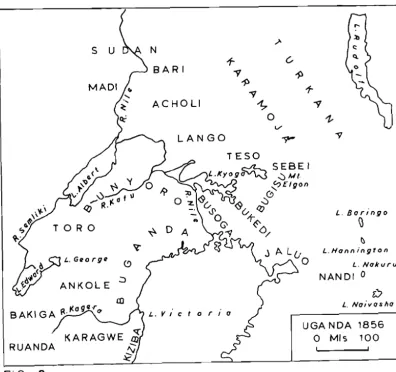
Prior to oolonial inception, Uganda consisted of a number of kingdorrs and territories which were neither united under one rule, nor had properly defined bound-aries (Fig. 2). By the turn of the 19th century, oolonialism had arrived in Uganda in the fom of missionaries, soldiers and administrators. On their arrival the British oolonialists wasted ro tirre in fonning an alliance with Buganda, through the system of "indirect rule", under the guise that Britain would use "the Baganda as
the maj9r indigenous administrative force" to integrate all the ethnic groups of
Uganda.
by
S
ab
in
et
G
at
ew
ay
u
nd
er
li
ce
nc
e
gr
an
te
d
by
th
e
Pu
bl
is
he
r (
da
te
d
20
11
PATTERNS AND PROCESSES OF SPATIAL DEVELOPM[NT: THE CASE OF UGANDA
S
1-~-P
~ACHOLI
~
0
LANGO
L. Gila rgll
V i c t o r
RUANDA
FIG. 2
/<
(..
~
v
Y'- 1-~
1--~
L. Barfngo
~
~L.Hannington
L. Nokuru
NANDI 0
P
L. Naivasha
UGA NDA 1856
a
Mis 100 51Thus ... ith the help of the B:lganda the British ( ... ith their superior technolo-gical innovations) . proceedEd to Subjugate the minor ethnic groups of Uganda, and
prepared the terrain for the errergence of a m::x:lern state. In the process the inward-looking ethnic groups of what is ncJN knc:1Nn as m::x:lern D:Jarrla were systematically rrobi-lized, and forced to assurre a new geographical setting that would appear largely . arbitrary. Consider, for instance, those ethnic groups that were I.IDSparingly shattered in the process of carving the national boundaries (Fig. 3): for is it rot true that the Karamajong ethnic cluster of northeastern Uganda are \TOre like the Turkana of northwestern Kenya than like, say, the Bantu ethnic groups of southern Uganda? Then, too, recall the absence of genuine efforts by the British colonialists to unite the ethnic groups within Uganda itself: for is it not true that the internal
at
ew
ay
u
nd
er
li
ce
nc
e
gr
an
te
d
by
th
e
Pu
bl
is
he
r (
da
te
d
20
11
structure of the oounUy, for instance, was, with the exception of Bukedi and West Nile, designed in a manner that carmot help but accentuate ethnic oonsciousness
(since district roundaries were nade to ooincide with tribal roundaries).
o
Mis !CONGO
(ZAIRE)
and
:···(Vict6ria .:: ... ::.:
."
.".
. 'KENYA
UGANDA MAIN ETHNIC GROUPS (Tribal and Language group
D
BANTU ~ NILO-HAMITICmm
NILOTICEt:ITIl
SVDANIC _._. -District boundaryOne thing that is clear it; that all this was, under the shado.-l of the twofold principle of "divide-and :rulerl and /lget-picb.-quickl/~ tdone not only to oonfuse the
Ilnatives" that they were, indeed, "alien" to each other, but ·also for the furtherance
of oolonial ecploitative programres. Indeed, it is fair to suppose that the British
did not COIle to Uganda purposely to ensure "social equity" Cbalancedaregional growth) ,
E!:!!:.
rather "economic efficiency" (overall national eoonanic grarth). It was in pursuit of the goal of "economic efficiency" that Britain proceeded. to concentrate her developnent efforts in the nest promising areas (hereafter referred to as the"favouped. aPea/?" or the "cope") of Buganda and (though to a less extent) Busoga, Toro,
by
S
ab
in
et
G
at
ew
ay
u
nd
er
li
ce
nc
e
gr
an
te
d
by
th
e
Pu
bl
is
he
r (
da
te
d
20
11
PATTERNS AND PROCESSES OF SPATIAL DEVELOPMENT: THE CASE OF UGANDA
53
Bunyoro and Anko1e for maximum returns on invest:rcEnt, and virtually neglected the rest of the oountry (hereafter referred to as the "le88
favoured areas"
or the"periphery").
With these two crucial decisions of se1ec::tive invest:rcEnt and the fonration of an alliance with Buganda, ooup1ed with the capability of the people within the9
"favoured areas"
(especially the Baganda) to adopt rapidly (though selectively )Westem innovations, British oo1on1alism set forth basic strategies for polarized developrent
ill
Ugama spelled out in the declaration of 1901, namely:In the opinion of His Majesty's G:>vernxrent, it is not desirable to push too quickly anongst tribes in (the) outlying districts (or northem Uganda) who have little to offer at the present in the way of ocmrerce, and who have not yet beoome accustarec1 to the sojoum of the white men in their midst •••••
Suah tribes should rather be attraated to Zazage1' aent1'es (the "favoured areas")
where they will see the work of aivilisation i!oPl'Og1'ess
andbegin
to
app1'eaiate its advantage8.
(Drphasis added).Thus the
"favou1'ed areas"
foW'Xl themselves in a relatively advantageous situation for their subsequent progreSs. For as Friedmarm postulates:The adoption of an innovation will
ina1'ease the potential
power of the adopting unit over portions of its environnent. For instance, the fanner adopting a neM fom of hybrid rice will increase his income and may oonse-quently enlarge his fann by buying the lam of the non-adopting, p:lOrer fanner adj acent to hispioperty •.•.•
Since the adoption process occurs
over time,
early adopters are likelyto gain an advantage of power over late adopters. Because these
leads
amlags
in the adoption process have a oorrespondingspatial expression,
areascharacterized by predcminantly early adopters will enhance their potential power (as a spatial systE!ll), relative to that of areas with a high frequency of late adopters. The differences will be acute where the diffusion process itself tends to be slow, resulting in substantial t:ilte lags between early and
late adopting areas. Thus countries (or national oore areas) which are the first to adopt industrial technology are likely to
maintain a st1'uatural lead
11OVer
oountries (or regions) whose industrial history is of rrore recent origin.In short, then, such were sane of the events that took place and subsequently caused Ug~s deve10pteIlt surface to asSlm:! a geographically asynmetrical develop-ment setting similar to that which has been postulated by Deutsch that:
The shift of an 9OO!lOII¥ and culture based on wider interchange takes place at different ti.nes and different rates of speed in different regions. The result is often the existence of rro:r9'
"advanaed"
regions side by side with rrore"undeveloped"
ones. The fonner are then often in a position to function as centers of cultural am eoanom1c attraction for some of the populations of the latter, and thus to becane much of further integration. The''when''
is thus often as :inp:>rtant and sanetilres rrore iltportant than the''where'',
and the process of social IrObl1ization and partial integration are truly historical in the sense that each st~3depends to a significant extent to the outo::xne of the step that went before.at
ew
ay
u
nd
er
li
ce
nc
e
gr
an
te
d
by
th
e
Pu
bl
is
he
r (
da
te
d
20
11
•
Kitgum
1914
.-.
/
...
\
,....
.
J
I
/
P"'.
.
\Lira
J
·1914./
\ \
\ .f
Soroti
\
\
.r
1914
.
~\'()e
.I1'.
~~/-'-'
... :.,..-1906
eMt;ale
\i
.Hoima
~
'-.-.-/ (
,.-.-.-
...
Namasagali \,
Bundlbugy6--"M
b
~.
. 1927
X
.
orot"o
1939,. •
.
.?u
190
enS {e
Kam u II. .IGAt-JGA
1921
1914
t.
c.1902
Ft.Portal
1906
",.
.
~. t-J.
I
Kampala.
JlnJa
•
~s
a s'a . ' . ' -'\.
1890
1
1901
·~~9S
",,'
I
.""
.
EntC2
b be
(Mbarara
•
•
\1906
I
•
~Masaka
. 1906
1
1903
L. VICTORI A
UGANDA:MAIN COLONIAL TOWNS AND
TOWNSHIPS AND DATES OF ESTABLISHMENT
o
Mis 50
by
S
ab
in
et
G
at
ew
ay
u
nd
er
li
ce
nc
e
gr
an
te
d
by
th
e
Pu
bl
is
he
r (
da
te
d
20
11
PATTERNS AND PROCESSES OF SPATIAL DEVELOPMENT; THE CASE OF UGANDA
FIG. 5
L.
Victoria
DISTRICTS 1 Wrzst Nifrz 2Modi
3Acholi
4
Koromojo5
Bu nyoro6
Lango7
Trzso8S<zbrzi
9
Bugisu 10 Bukrzdi 11 Busoga 12 Mrzngo 13 Masaka 14Mu
b<zndrz 15 Toro 16 Ankol<z 17 KigrzziUGANDA: LEVELS OF REGIONAL ECONOMIC DEVELOPMENT c 1967
. . Cor<z
~ ~ Upward TranSitional . . 0 Mis 100
i:;~:~:l:~:j
R<zsourcrz Frontirzr: : } Downward Tron"(;onol
c::=J
Backward or Sp<zciol ProblrzmIt .is o:mceivable that geographic disparities existed in Uganda prior to oolonial inception. But, as in Il'Ost parts of the world wh:i.ch were once oolonized, oolonialism had much to do with the accentuation of these geographic disparities. For one thing, in Uganda the colon.ial system disooura,ga:l the possihEi ty of I!Oderr..i-zing the cotmtry in a "comprehensive and thorough way. /I II'. order to rule Uganda,
the British colonialists had obviously to change it. But it was in their interest 55
to See to it that I!Odernization affected just a part of the population, and even there - only superficially. For while Buganda, and (to a less extent) Busoga, Toro,
Ankole and Blmyoro may be said to have acquired a lion I s share of this I!Odernization there, in these regiOns, renained forces of traditionalism that were to be reckoned
at
ew
ay
u
nd
er
li
ce
nc
e
gr
an
te
d
by
th
e
Pu
bl
is
he
r (
da
te
d
20
11
with. These, indeed, manifested themselves in the existence of traditional rulers (tre Kabaka of Bugaroa, the Omugahe of Ankole, the Omukama of Toro, and the
Kyabazinga of Busoga), with all rights and privileges a::>nferred upon than, until
their demise m 1966. Then, too, although Buganda is said to have ranked highest on the process of noaerni.zation in Uganda, sate parts within Buganda itself were hardly affected by' this rrodernization. Both the counties of Singo and Buruli are cases in point.
With these developrent policies that essentially favoured Buganda and its neightours one can vie.; the northern part of Uganda which, to the British rolonialists of the early 20th century, only constituted a congeries of "tribes whose organization
and customs" were beyond their a:xrprehension; lIDreover, an area that was inhabited by
people who were (according to the colonialists' thinking) not as "industI'ious~
inte-ZUgent and progr~ssive" as the Baganda or any other ethnic group of central and
southern Uganda. Thus it was this northern part of the oountry that was, at least during the early pericxi of colonial establisiYnent, left in a backwater by the colonial regirre. The majority of the people there continued to live in their traditional agrarian econany, only surviving on IMrginal inc:x:mes chiefly obtained fran the selling of a CI:M, a goat, or a chicken. In this regard perhaps Karanoja, where traditional pastoralism still ranks as the hallmark of eoonanic activity, has been
singularly the IlDst neglected part in Uganda ever since the dawn of noderni:zation.
Soja postulates that once favoured regiOns are established, they tend to generate backwash effects which only help to accentuate existing inequalities.
AcaY-rding to hi:n backwash effects involve migration of resoysces (people, skills, capital) fran the periphery to the major centers of developrent. In the same vein,
Friedmann asserts that:
Under conditions of rural/urban disjunction or economic dualism, urban genera--ted surpluses tend not to be used by developing the rural sector (which <XlI1tains a majority of the rural population), but are accumulated, in part to build up the ITOdern industiral-oorrmercial cnnplex at the core and in part, to be expatriated to the hare country of the intruding elite. By the same token, innovations will be oontained largely within the core because contact
n~rks and investnent resources will also tend to be ethnically (and
culturally) GXmtrolled. As a result, the remainder of the country will supply the rore _with focxi, reM materi~s, and labour providing markets for certain rore region products in turn.
The rorallary here is that these same productive resources drifting from the periphery to the rore may actually be used to build up "sub-core areas" in the periphery. '1'0 illustrate, some urban migrants may still have eronamic oomni tments with their relatives or friends on the oountryside - oomnitments that may only be taken care of by these migrants sending part of their inrome earned in
town
to their respective areas of origin in the periphery. With part of his inrome a migrant may thus decide to inprove his standards of living, or those in his neighl:x)urh:xxj, by, say, building an iron-roofed house to replace his grass-thatched muse; opening upa smp; donating for building a ne.; church, a IlDsque or school, or forming a
politi-cal or oo-operative organization in-the area; or paying school fees for his children.
I t is all this that may lead to an errergence of "sub-core areas" of developrrent within the periphery. Such a process may be referred to as 'b'eeping modernization".
Where the gap between "core" and "periphery" is accentuated is when the
errergence of such "sub-oores" in the periphery increasingly lags far behind the rate of developrent in the national "core(s)"; when, for instance, due to Government
by
S
ab
in
et
G
at
ew
ay
u
nd
er
li
ce
nc
e
gr
an
te
d
by
th
e
Pu
bl
is
he
r (
da
te
d
20
11
PATTERNS AND PROCESSES OF SPATIAL DEVELOPMENT:
THE CASE OF UGANDA
FOlicy the urban migrant workers are paid hardly anything aOOve what they can subsist on. Alternatively, the gap between "core" and "perphery" may be narIXMed if the errergence of "sub-r::ores" in the periphezy is enoouraged by govenurent poliCYi for instance, by paying the urban migrant labourers quite a lot above their subsistence and enoouraging them to invest their roney in their areas of origin in the peri.phezy, or the govenin'ent itself investing in the periphery. New what happened in Uganda?
57
Cblonial intrusion in Uganda introduced two significant elenents in the spatial system of this enuntry, which ought to be spelled out here. First, Uganda, as a periphery of !;mother" Britain began to function as a centre for "production and
export of a few (agricultural)
raw
materials (cotton and coffee) for processing inthe factories Of deveLoped industrial countries; and the import of manufactured
consumer goods". Second "the favoured al'eas" (Buganda in particular) in Uganda began
to ftmction as a "Uft pwrrp" whereby the peripheral populace enenuraged by enlonial policy, started a lasting enntribution of their efforts to the progress of the
"favoured area" through cheap, and unskilled miCJI~t labour, and vprkers to work
for wages that bCU'ely covered their subsistence. This, for sure, r~resents the
first seeds of the accentuation of regional inequalities in Uganda.
Of crucial importance here is that these migrants, woo had to rove back-and-forth every so often between the oore and the periphery, becarre causes of innovations in the oourse of t.irre. Yet i t was not only through labour migration that the peripheral populace got exp:1sed to this kind of "creeping moderliization". For h::Jw'
about thJse fathers in the periphery who, having heard of the "magic" of the white-rran I s education got excited and decided to send their children to school - i f only later their children oould secure jobs in the governnent? Since the centre for educational institutions (particularly secorx:1ary schools and ~~ere - the only univerSity in the nation) was in the oore region of the south, the children in the periphery had to <Dver long distances to avail thansel ves of these innovations. As they usually had to go back for vacation in their respective districts of origin, it is (xmceivable that they, too, carried with them waves of modernization that subsequently enntributed to the erergence of "sub-core areas" of development in the periphery. This diffusion of 'innovations through .labour and educational migratory
trends is a case l~presenting a "transi tion from a clos ed corporate (Jorrmuni ty to an
open (Jommwzi ty " •
Furthernore, we must not ignore the role of enlonial tcwns as nodernizing agents within the periphezy in uganda. I t is notewothy that the periphery was, during the colonial regime (1894-1962), ptmctuated by a series of tams (Fig. 5) whose primary ftmctions were administrative and o::rorrercial - largely for the benefits of oolonialism. These to,.ms were "The peripheral transmitters of imported
innova-tions - a money e(Jonomy~ a common (though foreignJLanguage, a (Jommon administrative
system~omodern rail and motor transitJ health services, postal and radio
communica-tion". Ibwever, unevenly these manifestations of rrodernity, ha.-lever much t.irre
they took to reach the periphery, the oolonial to,.ms seem to have played a significant role in modernizing the periphery. Yet, paradoxically, fran their evolution and structure, they failed to act as integrative nechanisms in the plural society of Ugarrlai and for one thing: they were not initially designed to do so. Their internal structures were essentially designed to serve the interests and desires of a non-indigenous class (Europeans and Indians) which lived in these tONllS then.
Note that the first consideration of the enlonial policy was to. ensure that
at
ew
ay
u
nd
er
li
ce
nc
e
gr
an
te
d
by
th
e
Pu
bl
is
he
r (
da
te
d
20
11
identified as the "European quarters" in which were to be found the "European"
hospital, the "European"church, or the "top" club (for "top" people) - a feature that helped to distinguish very clearly a rich (European) urban-dweller vis-a""'\Tis a poor
(African) peri -urban dweller. Surely, oould there have been a better exanple 6f social class stratification in the urban eoology than this?
Indians, too, had their own way of exerting their culture on the urban norpD:>-logy of Ugarxla, particularly, since oolonial poliCies forced them to live within the oonfines of towns. Ugarxla' s present townscape is, in a nost interesting way, PW'lC-tuated by building clusters which. essentially stand out as perfect transplants of buildings in Pornbay, Delhi, Bangalore, Vitayawada am such like
towns
in lelia. For in Uganda, once looians arrived, they erected huge walled CXlTp:)unds in which they lived and oonducted their lucrative businesses, am engraved their narres on the walls of their buildings as, perhaps, a style of exhibiting pennanent property ownership and oontrol. Then beyooo their walled CXlTp:)unds were sanetiIres to be foum sign-posts sorre.mere bearing inscriptions like: DEIJ:II, or B::MB\Y GARDENS (:) - -arx>ther instance of property ownershipam
oontrol exhibition.Of the segregated lives, led by European administrators am lelian traders in oolonial Ugaman towns, Richards has this to offer:
British irrrnigrants took little part in agriculture
am
lived nostly in tcMns,ofte.T1 in housing "zoned" on racial lines
am
not facilitating oontact with other groups. Standards of housing", furnishingam
entertaimlent wereyery
unifonn, chiefly because British civil servants were recruited predan1nate1y
(sid) from the professional middle class and were usually the product of British public schools •.•..
The British ...•. were part of one social network in
tams.
They had their own clubsam
Ittribal associations", which celebrated St. George's, st. Andrew's and St. David's days. Asians am Africans belonged to different networks. The British were intent on intxoducing many elements of their culture to Africans, suchas
their religion, political ideas, educational system.... , am
cla.ined that this was their justification for oolonizing. Curiously enough, they did not attempt to alter the culture of the Asians,who
for themost parhhad their own schools, and retained their
own
culture (EfIllhasisadded ).
Of crucial .i.n;lortance here is not only the fact regarding the isolationist temencies of the British
am
Asians in oolonial Ugarxla, but also the fact that while these alien elerrents were appropriating themselves as llUlch a:xnfort as they required, the indigenous populace were being wantonly shoveled right at the peripheries of the urban centres where they were de=z~ed to stay thereafter - sharing poverty, disease, am ignorance anongst therrselves. Perhaps the only exception to this rule was when institutional provisiOns were made in which certain categories of Africans like the police am the railway workers were W'lSparingly dunped.All in all, oolonial towns in Ugarxla admittedly STerged as centres of
rrt:Jderni-zation. Yet, paradoxically, they failed to act
as
organs of social integration;and as such, therefore, they, in a way, oontributed to the asyrmnetrieaZ deve Zopment
patterns of this OOW'ltry.
Ibo1ever, the exposure of the African Ugandans to lTOdernization (particularly as a result of study tours in overseas ooW'ltries where they came to learn, perhaps for the first ti.rre, of their disadvantaged position within the international developIe'1t.
by
S
ab
in
et
G
at
ew
ay
u
nd
er
li
ce
nc
e
gr
an
te
d
by
th
e
Pu
bl
is
he
r (
da
te
d
20
11
PATTERNS AND PROCESSES OF SPATIAL DEVELOPMENT:
THE CASE OF UGANDA
59spectrurr.; and where they cane to learn of the ldnds of infquities and injustices done
by rolonialism in their 1Dne COUIltzy) pratpted Ugaroan nationals to dsnand national independence fran the then existing autlX>rlties (the British elites). .Such were the
events that precipitated the fo:mation of p:>litical parties of the 1950's in Uganda. For as Deutsch has observed:
• • • • •• the rise of nationalism and the gro..rth of nations have sare sE!ni-autaratic features •••••• As the distribution of scarce r9\7ards is made unequal by e:x>tx:mic or historic processes; as men learn to desire the sane ldnds of rewards; as they fail tobe assimilated to the language and culture of the d::Ininant group; as they succeed in becaning aSSimilated with other men
who possess cultural and langua<je habits nore ac:npatible with their own - as all these processes go on, situations ~ucive to nationalis[lI are created without anyone's deliberate intention.
yet, while in rountries like Kenya there arose "an energetic African
counter-elite ccrpable (under the shadow of nationalism) ~ challenging the pnvaiZing
authorities and the order they had eetabliehed", in Uganda the demand for national
in:iepem~ by the nationals
was
based on gradual processes, for the rolonialiststhemselves knew that this denand would one day crme, and saretimes they slvwed sane signs for their wanting the Ugandan nationals
to
govern thaTsel ves - as long as natiooal integration would be viewed as the corner-stone of national develcpnent.Precisely, while in Kenya and Malawi, anongst others, the "replacement" process of the then existing colonial elites. by the African counter-elites was by
violent neans, in Uganda the issue was negotiable. IIReplacement" was through'
peaceful neasures, for the British there were but transients. The ronfli.cts that acxx:mpani.ed the "replaaementll of the British elites by the African Ugandans arose
mainly {rom, and was largely shared anongst, the indigerKlUS Africans who had divided themselves into btio canp; that were dianetrically opposed to each other. On one hard was the oore-region elites (mainly the Baganda tmder their kabaka). These wanted to perpetuate their privileged position. On the other hand was the peripheral elites (mainly the non-Baganda, for instance, Orote and Akena lldoko of lango, Onama
of West Nile, and Chaudry of Karanoja - who hmd perhaps go~ aCX}Uainted with each other while at sch::lol, say, in Makerere University). These plus a hardful of educated Baganda proceeded to p:>liticize the periphery with the intention of fighting their oounter-parts (the core-region elites) fron a position of rollective
(hence greater) strength, and to break the status quo. Significantly, each of these two canps wanted to engineer the destiny of the developnent process of rrodern Uganda. Indeed, the oolonial authorities in uganda were, essentially, replaced by the peri-pheral elites at Independence Day in 1962. But as the events that imnediately followed this Independence suggest, this IIreplacement" neither marked the end of
internal oonflicts, nor the establishrrent of a oonsensus on national goals by the various ethnic groups of Uganda.
M:Jre than fifteen years ago, Baker raised an irrp::lrtant question regarding Uganda t s asymret.rkal eo:manic developnent. 'lb qu::>te him: /ITo ;vhat extent is the
concent~tion of economic activity in Buganda, and more especially on
thi
fertile arc,lik?ly to reTTrlin a feature ofihe economy - and the polity - of the Uganda economy?/I Tten he remarked:
The ge:Jgraphical tendencies are strongly favourable to such oontinued cxmce-ntration in the Lake Victoria region, of which Buganda has the largest share.
at
ew
ay
u
nd
er
li
ce
nc
e
gr
an
te
d
by
th
e
Pu
bl
is
he
r (
da
te
d
20
11
It has to be rea:>gnised that geographic disparities in Uganda ~ay appear to be even nore pron01.IDced than they were at the time Baker was writing. But the politics of readjust:Irent involved in these gec::.graphic disparities is a phenanenon that has not only left -the external observer with a marked inpression, but has also threatenoo. national unity in Uganda.
Uganda's post-colonial develoJ:Xl1eIlt trends have a:me to be associatoo. with two
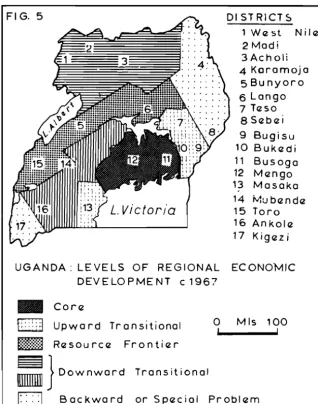
sources of conflict. First, the ethnic groups of the "less favoured areas" evide-ntly have been conscious and undertandably envious of the (x:mSi~trated ~elf-rein-forcing economic developrent of the "favoured areas (Fig. 6):' For where the distribution of wealth (and pcwer) only favours a small proportion of the total population, internal conflicts, disintegrative tendencies, and lack of aonsensus on national goals are bound to exist. And it is in the spirit of this view that the
two well-known terms: "the richli and "the poor" lands appear to have been coined.
In Uganda conflicts have been ensuing essentially frem the peoples within the
"less favoured areas" belatedly demanding their share of the national economic
"cake". These conflicts, which have been calling for an urgent readjust:Irent of
Uganda's spatial systans as a whole, seem to have been thrown in Ir.)tion by the diffusion of innovations of nodernization through, as indicated earlier, penetration of the urban centres in the periphery, educational tours overseas, and migrants
from the "less favoured areas" to the periphe.ty in search for arployment, educati-onal as well as health facilities, adventure, and the like, who eventually came to recognise the dichotomy in the spatial develoJ:Xl1eIlt of Uganda. For as Friedmann has hyp:!thesized:
Sustained contact of the periphery (the "less favoured area") with the core region ( the "favoured area") will tend to arouse portions of the peripheral population, not only to possible new ways of life, but also to their own comparative disadvantage in gaining access to them. New desires and frustra-tions will encourage demands for greater regional autonomy in areas of vital decision and may lead to prolonged conflict with the core... Individuals
and groups rrost directly exposed to infonnation originating in core regions will gradually awake to the periphery's and their own dependency (and power-lessness) and will be arrong the first to insist upon greater autoncxny for the periphery. Alternatively, they will emigrat~8to the core to be drawn there into the established structures of authority.
A second set of conflicts in Uganda has been emanating frem the dominant ethnic group (Buganda) whose expectation of a self-perpetuating privileged position has -not been satisfied.
Discussing the process of develo):irel1t in countries that were once exposed to colonial intrusion and inperial domination, Gunnar Myrdal once COlm\eI1ted:
A main interest of netropolitan country was orda- and social stability. By an alrrost automatic logic it therefore regularly carre to ally itself with the privileged classes in the dependent country sOIllCciuJeS such classes were created
for this purpose. These favoured groups were, }yY and large, primarily intere-stoo. in preserving the social status goo under v>h:i_ch they were privileg~ and
they would normally not press •..•• for a natiar,al irltegration policy.
In the case of uganda throughout the colonial period:
Buganda remained in thoory, and in the popular visV', a protected tribal state. Many of the early develo):irel1ts in Uganda strengt1:ened the Baganda's
conscious-by
S
ab
in
et
G
at
ew
ay
u
nd
er
li
ce
nc
e
gr
an
te
d
by
th
e
Pu
bl
is
he
r (
da
te
d
20
11
PATTERNS AND PROCESSES OF SPATIAL DEVELOPMENT:
THE CASE OF UGANDA
ness of their special status. Inevitably, the educational and evangelizing activities of t.. .... e churches were concentrated in Buganda. So, too, was the early developrrent of cotton. In consequence the Western irrpact tended ... to widen the gap between the Bagarrla and other peoples of Uganda. />breover, roth the Cbvernrrent arrl the missions relied on Buganda in their early efforts in other areas. Baganda teachers, ministers, and catechists carried the new learning and the new faith throughout the whole Protectorate. Thus greater wealth,greater learning, and greater responsibilities all hel§Od to keep alive the separatists and exclusivist sentiments of the Baganda.
It, therefore, carre as a shock to the Baganda when later developrrents began to creep fran Buganda region into the other parts of Uganda. Conse:::JUently:
Buganda becarre rrore separatist and rerrote from the rest of the country as her ecDnornic and social institutions were rrore thoroughly intenreshed with the rest of the country, and with Asian and European populations. As the Kiganda pattern of political organization in local governrrents were transpo-sed to the districts of uganda, as her carrrercial activity brought her into closer contact with foreigners, and newly introduced cash crops, coffee and cotton, international trade, her political institutions becarre nore fornal, rer political leaders becane nore stiff, and the attitudes of her people nore ethnocentric. For every success in ecDncmic and political lines brought a danger, 3the danger of subrrerging Buganda and her institutions in a sea of change.
In sum the British su=eeded in nndernizing Uganda. Indeed, in Uganda the British created bustling and brightly lit towns. They built railways, roads, post offices, banks, hospitals, schools and colleges, hotels and restaurants, churches and cathedrals, 1. parlianent, and provided many other aspects of nndernization. Yet
iliey failed to integrate Buganda, as a special area, and Uganda as a nation.
With her diffening policies over the distribution of power and wealth (be i t in terrrs of land tenure, social services, agricultural production, or whatever) , Britain mmaged to accentuate feelings of ethnic parochialisms thereby hanpering the developrrent of a consensual acceptance of national goals. Herein lies the Cl"UX of the matter: it is one thing to rrodernize a society, it is yet another to create conditions of sustained developIl"Elt. It is, perhaps, this kind of logic that Eisenstadt had in mind when he gave the tit~~; 'iModernization and Conditions of Sustained Growth", to his valuable article.
Significantly, then, Uganda should be viewed as a country that bears the stanp of what Coleman has said:
... differential developrrent of groups or areas within territories has been
malintegrati ve in bt.D ways: the less developed groups fear danination in the new territorial systerrs, and the nore highly developed groups do not want either affluence diluted, or .their traditional statll3310wered through merger with ecDnomically depressed and lower status groups.
In Uganda, because the British were so much obsessed with the twofold notion. of "divide-and-pule" ethnic conflicts were only suppressed. Consequently, they spiralled into a continuous series of vicious circles which are now attempting to
61
at
ew
ay
u
nd
er
li
ce
nc
e
gr
an
te
d
by
th
e
Pu
bl
is
he
r (
da
te
d
20
11
Co nclu.6,i.,o n6 and
Po-U.t!y Rec.omme.nda.tW
n6'Ihls article does rot subscribe to the view presUl'!ai in cxmtatporary theories of regional develq.arent, narrely, that developnent occurs as a natural phenareD::>n which, left undisturbed, will autanatically arrive at a stable equilibrllE.. With the exanple of Uqan::ia, the article has daronstrated that at least in the early stages of cievelop1B'lt, the developlent process of a nodemizing society will be normally characterized by forces of "deviation-amplification" largely based on l.ocational advantages. As the countzy continues to rrodernize, a distinct core--periphezy
dicb:>tcrr¥
often E!'Ier9es on the developrent surface whereby the fomer (the core),because of its organizational and institutional capacities, colonizes and depletes the latter (the periphezy) of its human and material resources. Cbntinued contact and interactioos between core and peripheJ::y will, in the course of time, awaken the periIf1eral masses to their relatively disadvantaged position. This autanatically introduces "devi.ation-cou:nteraction" forces in the developYent systsn based on the politics of spatial readjustnent, whereby the "late adopters of moderniaation" be:]in seriously to demand their share of the national ecoranic "cake" flXm the
"early adopters Of rrr:Jdemiaation" who are rot prepared to part with their
"hard-won" cake.
This, then, becDres, perl1aps, the nnst exacting narent in the long-run histoJ:y
of the devel.opIent process of a countzy a:imI..ng at lmifying or integrating its multi-ethnic groups into one national entity. Not \D1til the sources of these internal
cx:nflicts attendant on the process of nodemization are clearly identified, 'and the cxmflicts tharselves judiciously resolved~ will the spatial systems of a given countzy evolve towards that state of affairs (albeit, perl1aps,
never
achieved): the stable integrated equilibrium.Herein lies a nnst puzzling question to the devel.oprent planner in Uqanda today: hati best can ooe grapple with the grcMing problem of the core-periph&y dic:hotat¥ currently existing in the develOJ:llellt surface of this countzy?
To perpetuate this didlot:aI!i would be to nerely exac:exbate ethnic antagonisns (and lack. of consensus on national goals) between the peoples of the core region and
the periphery on matters pertaining to resourse allocation. This strategy could
even lead to a destruction of even the little devel.oplent that the oountzy has thus far achieved. Furthenrore, to perpetuate this oore-periphery
dic:hot:al¥
in Uqanda. 's spatial devel.oprent system -1iOUld be to identify with the forner colCllial masters whoseprincipal goal was that of "economic efficiency" - at all costs - and rot ethnic/ national integration.
Then, too, to aim at rapid "regional equity" (balanced regional gzo.Tth) ~uld be to tzy to achieve the \D1adri.evable. For one thing, present Uqanda, with her
slender resources may rot be able to affOId the doctrine of even distribution of resources throughout all her various parts. Even in the nnst developed CO\Dltries of the world, pockets of underdevel~t are comtonplace. Were this not the case, then the tmited States of Alrerica ~uld rot be having the lagging areas of Mississippi and Awalachia, ror would Italy be having its depressed section of the Meaaogiorno.
The policy that 'Ne would recxxmend for Uganda's spatial devel~t would rot be that of tzying to eliminate the core-periphery
dic:OOton!f
altogether and overnight, since this does rot seem to be feasible. Rather, we should aim at a gradualreduc-tion of the dimension of this core-periph&y dichotcl!!{, by making trade-offs from the core to the periphery, up to a point when, hopefully, we can achieve a consensual
by
S
ab
in
et
G
at
ew
ay
u
nd
er
li
ce
nc
e
gr
an
te
d
by
th
e
Pu
bl
is
he
r (
da
te
d
20
11
EAST AFRICAN GEOGRAPHICAL REVIEW
acoeptance on national devel.oprent goals. This is by no
means
aneasy,
but all thesane a possible, task.
NOTES
1. Friedmann, J., 1972, ,~ General Theory of Po'Larized Deve"Lopment"~ in Niles M. Hansen (ed.), GrOll1th Centres in Regional Eoonorrtic
Deve"Lop-ment. New York: The Free Press, pp. 82-107.
2. Soja, E., and Tobin, Richard, 1973, "The Geography of Modernisation: Paths~
3.
Patterns~ and Processe8 of Spatial Change in Developing
Countrie8", in Brunner, Ronald, and Brewer, Garry, (eds.),
A PoZiay Approach to the Study of PoZitical Development and
Change. New York: The Free Press.
Friedmann, "A General Theory
.
. . .
..
"
,
pp. 821'.4. Ibid., pp. 83-84.
5. Hirschman, A.O., 1958, The Strategy of Economic Development. New Haven: Yale University Press,
PP.
12-19.6. Fallers. L.A., 1956, Bantu Bureaucracy: A Century of Political Evolution
Among the Basoga of Uganda. Chi cago : The Uni vers i ty Pres s ,
p.1.
7. Shepherd, G. W. (Jr.), 1966, ''Modernization in Uganda: The Struggle for
Unity", in Diamond, S., and Burke, F.G. (eds.), The
Trans-f01'lTN2tion of East Af'rica. New York: Basic Books, p. 317.
8. Barber, J.P., "The Moving Frontier of Briti8h Irrrperiali8m in Northern Uganda
1898-1919", Uganda Journal, 29, No.1. 1965, p. 29.
9. For example, the Baganda were, in most instances, prepared to adopt western innovations as long as the position of their traditional king was not tampered with.
10. Quoted in Barber, op. cit., p. 29.
ll. Friedmann. J., "The Spatial Organization of POlI1er and the Deve"Lopment of
Urban Systems", (University of Cali1'ornia Los Angeles
mimeographed), p. 21.
12. For maps on Uganda's asymmetrical development surface see Jones. A.H. '~he Spatial Dimension of Modernization in Uganda: Basic Aspects
and IrrrpUcations", in East African Geographical Review~
No.9, April 1971, pp. 87-93.
13. Deutsch, K.W. ,"The GrOll1th of Nations: Some Current Patte;r7U! Of Political
and Social Integration", World Politic8~ 5 (1953) pp. 173-74.
63
at
ew
ay
u
nd
er
li
ce
nc
e
gr
an
te
d
by
th
e
Pu
bl
is
he
r (
da
te
d
20
11
14. Barber, op. cit., pp. 31-32.
15. Soja and Tobin, op. cit., p. 12.
16. Friedmann, "The Spatial 01'(Janizati~{1'J of Power ••••• ", p. 21.
17. Seidman, A. W., "Comparative Development Strategies in East Africa".. East
African Journal, (April, 1970), p. 14.
lB.
In many parts of Africa, schools were initially located in the urban centres. In Uganda; the urban complex of the South has been having the greatest number of schools and colleges plus the only univer-sity in the country.19. Cf. Safa, H.I., 1971, "Education, Modernization, and the Process of National
Integration", in Wax, M.L., et al, (eds.), Anthropological
Perspectives on Education: Nations and Enclaves. New York:
Basic Books, p. 216.
20. Cf. Friedmann, J., 1970, "Towards a National Urbanization Policy: Problems,
Decisions, and Consequences." University of California
Los Angeles, Mimeographed, p.
lB.
21. Richards, A.I., (ed.), 1969, The Multicultural States of East Africa. Montreal: McGill, Queen's University Press, pp.
27-2B.
22. Great Britain, Colonial Office, East Africa Royal commission, 1953-1955
Report. (London: Her Majesty's Stationery Office, 1961).
23. Deutsch, op. cit., p. 180.
24. Friedmann, "Towards a National Urbanization Policy .•.. ". p.
lB ..
25. Baker, S.J .K., "Buganda: A Geographical AppraisaL", The Institute ofBritish Geographers, No. 22 (1956), p.
17B.
26. Lang1ands, B.W., "On the Disparity in the Distribution Of Economic Activity
in Uganda", Social Sciences Council Conference 1968-69,
Geography Papers, M.I.S.R.
27. For further treatment of this topic see:
(a) Bakwesegha, C.J., 1973, "Mbdernization and National Integration in
Uganda". Unpublished Ph.D. dissertation, Rutgers University,
Department of Urban Planning and Policy Development, pp. 136-140.
(b) Bakwesegha, C.J., 1974 "Patterns, Causes and Consequences. of Polarized
Deve lopment in Uganda", in El-Shakhs, Salah, and Obudho,
Robert, (eds.), Urbanization. National Development and
Regional Planning in Africa. New York: Praeger.
28. Friedmann, "A General Theory ••••• ", p. 95.
29. Myrdal, G., 1957, Rich LandS and Poor. New York: Harper and Row Publishers
p. 59. .
30. LoW, D.A., and Pratt, R.C., 1960, Buganda and British Overrule 1900-1955. London: Oxford Univ~rsity Press, p.
25B.
by
S
ab
in
et
G
at
ew
ay
u
nd
er
li
ce
nc
e
gr
an
te
d
by
th
e
Pu
bl
is
he
r (
da
te
d
20
11