ISSN: 2231-5381
http://www.ijettjournal.org
Page 218Lifetime Maximization in Wireless Sensor Network
N. Veeranji Reddy1, J.Lydia Jeba2
1 M.E Student, Computer Science & Engineering, Sathyabama University, Chennai.
2 Assist.Professor, Computer Science & Engineering, Sathyabama University, Chennai.
ABSTRACT: Network lifetime predictability is an essential system requirement for the type of wireless sensor network (WSN) used in safety-critical and highly reliable applications basically wireless sensor networks are battery power operated. When the power consumption is low then the network lifetime of sensor network is high. Clustering sensors into groups is a popular strategy for maximizing the network lifetime. Introduce Sequence (FIFO), all the messages are stored into an order by the sequence. Base station uses this technique. Here reliable data communication is reached. The network simulator 2 (NS2) is used for simulation results.
Index Terms: - Base station, wireless sensor networks, cluster head, cluster formation.
I.INTRODUCTION:
Wireless networks are of two types, they are
A.INFRASTRUCTURENETWORKS:
This infrastructure has fixed network topology. Wireless nodes connect through the fixed point known as base station or access point. All of the wireless connections must pass from the base station. Whenever a node is in the range of a number of base stations it connects to any one on the basis criteria.
Ex: GSM, WSNs, Wireless Local Area Networks. B.INFRASTRUCTURE LESS:
Ad hoc networks also called infrastructure less networks are complex distributed systems consist of wireless links between the nodes and each node also works as a router to forwards the data on behalf of other nodes. Ex: Mantes
A wireless sensor network is a collection of nodes organized into a co-operative network. Each node consists of processing capability (on or more micro controllers, (CPUs), may contain memory unit and have a RF transceiver have a power source (Ex: Batteries).
The purpose of transceiver is used to sense a given physical quantity with predefined precision processor for local processing, memory unit for storage of data and transceiver to transmit and receive data. This wireless technology is exciting with unlimited potential for numerous application areas including environmental, health check, military, transportation, amusement, crisis management, homeland defense and smart spaces. In the literature, researchers have applied them in applications. Such as target tracking systems [1], pollution monitoring [2], healthcare [4], [6]. They are briefly discussed below.
1. In target tracking systems, such as wild life monitoring systems, border security surveillance systems, sensor nodes may be required to detect and classify a fast moving target within one second before it moves out of the sensing range.
ISSN: 2231-5381
http://www.ijettjournal.org
Page 219 II.RELATED WORKLEACH is a hierarchical protocol in which most nodes broadcast to cluster heads, and the cluster heads collective and compress the data and forward it to the base station (sink). Each node uses a stochastic algorithm at each round to determine whether it will become a cluster head in this encompassing. LEACH assumes that each node has a radio powerful enough to directly reach the base station or the nearest cluster head, but that using this broadcasting at full power all the time would waste energy. Nodes that have been cluster heads cannot become cluster heads again for P rounds, where P is the beloved percentage of cluster heads. Thereafter, each node has a 1/P chance of becoming a cluster head in each round . At the end of each round, each node that is not a cluster head selects the closest cluster head and joins that cluster. The cluster head then creates a plan for each node in its cluster to transmit its data. All nodes that are not cluster heads only communicate with the cluster head in a TDMA manner, according to the schedule created by the cluster head. They do so using the lowest amount energy needed to attain the cluster head, and only need to stay their radios on during their point in time slot. LEACH also uses CDMA so that each cluster uses a different set of CDMA codes, to diminish intervention between clusters. LEACH estimates the node energy. It is developed by neural networking.
Distinct Cluster Head selection algorithms for HC-WSNs
There are many cluster head selection process that do not consider the energyinformation for selecting the cluster head cluster selection process for this type of (HC-WSNs).In Lower ID CH selection process in this cluster head is selected based on the Lower ID [8], (Lower password).Another cluster head selection process is Trust-based, where secret ballot are used to votes are identify a node that receives the majority.
CIPRA proposed by Chu et al., requires that each node to know three pieces of information: the total number of sensor nodes, its own unique ID (ranging from 0 to n-1), and the current round number, LEACH (Low Energy Adaptive Clustering Hierarchy) selects the cluster head randomly. None of above cluster head selection processes improves the network lifetime. Without energy awareness low energy sensor node selected as a cluster head, causes reduced network lifetime.
PROBLEM STATEMENT
High Energy First (HEF) clustering algorithm selects cluster heads based on residual energy.
This cluster head selection process improves the network lifetime better than the above algorithms.
Datacommunication problem arises when the sensor node moves from one cluster to another cluster and reliable data transfer is not possible.
III.PROPOSED WORK
The High Energy First (HEF) clustering algorithm with FIFO concept, selects the cluster head based on the residual energy information. It selects the set of N cluster heads based on highest ranking energy .HEF improves the lifetime of the sensornetwork. Researchers claimed that HEF is an efficient cluster selection algorithm that prolongs network lifetime based on simulations.
Conditions of HEF Algorithm:
1) Each node works as a clustered node or a regular sensor node in a round.
2) The energy consumptions of Ec and Er are constant during the whole process, everywhere Ec >=Er
Where Ec -energy consumption for cluster rate. Er- refers energy consumption for regular node. Steps of HEF Algorithm:
ISSN: 2231-5381
http://www.ijettjournal.org
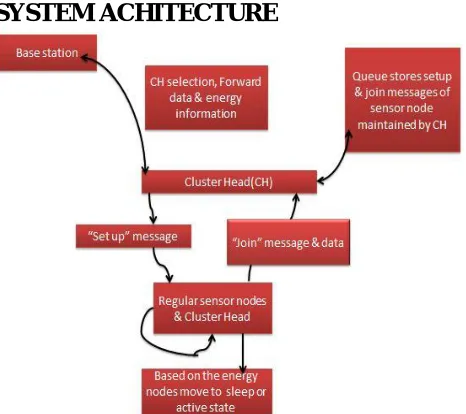
Page 2202) The cluster head of each group sends the “setup” message inviting the neighbour sensor node to join its group.
3) After receiving the setup message at this cycle, the regular sensors send the join message to its corresponding cluster head to commit to associate with the group.
4) Each cluster head receive the salutation for commitment, and sends TDMA schedule to its cluster members.
5) All sensors perform its sensing, processing and communication tasks cooperatively at round. Each sensor node sends its energy information to its cluster head at the end of this round.
6) Regular sensor nodes can operate in two states such as sleep state and active state. The low power sensor nodes goes to the sleep state and doesn’t receive or forward the messages , active state sensor nodes receive and forward the messages.
7) The setup and join messages are stored in Sequence (FIFO), when any sensor node moves from one cluster to another, it gives data to cluster head. The cluster head checks the request and join messages.Information not available it sent to another cluster head.
8) By using this FIFO concept reliable data communication is achieved.
SYSTEM ACHITECTURE
Fig:System architecture
IV.SIMULATION RESULTS
The result of our model is evaluated by using the Network Simulator 2(NS2).
SIMULATION PARAMETERS:- Parameter Value
Simulation area 2000*1000
Simulation time 1500 seconds
Number of nodes 50
Traffic type CBR/UDP
Maximum speed 10 metes/sec
Results:
The following diagrams are experimental results of this model
ISSN: 2231-5381
http://www.ijettjournal.org
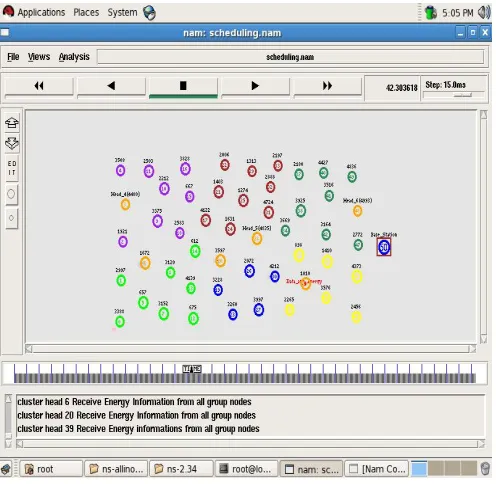
Page 221Fig 3: Shows cluster heads sending “setup” messages to its cluster members
Fig 4: Cluster heads receiving the” join” messages from their cluster members with the their energy information
Fig 5: The base station receives the information sent by the cluster heads
ISSN: 2231-5381
http://www.ijettjournal.org
Page 222 V.CONCLUSIONThe HEF algorithm extends the network lifetime. This paper follows the HEF with FIFO concept. The join messages and setup messages are checked, if the data accepted reliable data communication reached.
References
[1] Bo-Chao Cheng, and Ping-Hai Hsu,” Schedulability Analysis for Hard Network Lifetime Wireless Sensor Networks With High Energy First Clustering” IEEE
Transactions on Reliability, vol. 60, no. 3, September 2010.
[2] Haier and J. Baek,“A strategic deployment and cluster-header selection for wireless sensor networks,” IEEE Transactions on Consumer Electronics, vol. 55, no. 4, November 2008.
[3] H. Chen, C.-S. Wu, Y.-S.Chu, C.-C.Cheng, and L.-K. Tsai, “Energy Residue Aware (ERA) clustering algorithm for leach-based wireless”,IEEETranctions on clustering, vol 60, no. 2,September 2011.
[4] K. Saleem1, N. Fisal2, S. Hafizah3, S. Kamilah4, and R. A. Rashid5,” A Self-Optimized Multipath Routing Protocol for Wireless Sensor Networks,” International Journal of Recent Trends in Engineering, Vol 2, No. 1, November 2010.
[5] H. Chen, C. K. Tse, and J. Feng, “Impact of topology on performance and energy efficiency in wireless sensor networks for source extraction,”IEEE Transactions on Parallel and Distributed Systems, vol. 20,no. 6, June 2007.
[6] H. Chen, C.-S. Wu, Y.-S.Chu, C.-C.Cheng, and L.-K. Tsai, “Energy Residue Aware (ERA) clustering algorithm for leach-based wirelesssensor networks,” in Second International Conference on Systems and Networks Communications (ICSNC 2007) , pp. 40–45, 2007.
[7] B. Kim, Y. Kim, I. S. Lee, and I. You, “Design and Implementation of a Ubiquitous ECG Monitoring System Using SIP and the Zigbee Network,” in Future
Generation Communication and Networking (FGCN 2007), 2009, pp. 599–604.
[8] W. Wang and A. Jantsch, “An algorithm for electing cluster heads based on maximum residual energy,” in international conference on communications and Mobile Computing, July 03-06, 2004.