In W. Anderson, C. P. Biggam, C. A. Hough, C. J. Kay (Eds.), Colour Studies. A Broad Spectrum (pp. 225-239). Amsterdam/Philadelphia: John Benjamins (2014).
Gender differences in colour naming
Dimitris Mylonas*, Galina V. Paramei** and Lindsay MacDonald** *University College London, UK; **Liverpool Hope University, UK
Abstract
1. Introduction: gender differences in colour vocabulary, colour naming
and colour perception
The importance of richness and variety of colour experience cannot be underestimated. Colour has an affective value and, in everyday life, is used to code, match and identify objects as well as to communicate.
Numerous linguistic studies have demonstrated gender differences in colour lexicon: women were invariably shown to possess a more extensive and more elaborate colour vocabulary than men (Lin, Luo, MacDonald and Tarrant, 2001; Nowaczyk, 1982; Rich, 1977; Thomas, Curtis and Bolton, 1978). In addition to basic colour terms (BCTs; Berlin and Kay, 1999) women use significantly more elaborate terms, or BCT hyponyms, such as mauve, scarlet, chartreuse or beige. Females also offer many more “fancy” colour terms, like emerald green or cerise pink (Nowaczyk, 1982; Rich, 1977; Simpson and Tarrant, 1991) and more BCT qualifiers related to hue and saturation (Bonnardel, Miller, Wardle and Drews, 2002). In comparison, men tend to use predominantly BCTs accompanied by various modifiers, as well as compound names comprising BCTs.
sorbet, daffodil yellow, blush) while ‘men’s colors’ are simple, straightforward, conventional, real-world (royal blue, gold, grey)”.
In psycholinguistic tasks, which evoke responses to an array of colour stimuli, already in early childhood (2.5–6 years of age) girls identify primary colours by name better than boys do (Anyan and Quillian, 1971; Johnson, 1977). In adulthood, women have been found to be more accurate, compared to men, in ascribing colour names to colour samples (Greene and Gynther, 1995; Nowaczyk, 1982; Swaringen, Layman and Wilson, 1978); more consistent in their choice of a colour sample matching a given colour name (Chapanis, 1965); and reveal a greater colour-naming consensus (Moore, Romney and Hsia, 2002; Sayim, Jameson, Alvarado and Szeszel, 2005). Temporal characteristics of colour-naming performance indicate, too, that women are faster in a speeded colour-naming task, exceeding men in retrieving colour labels (DuBois, 1939; Golden, 1974; Ligon, 1932; Saucier, Elias and Nylen, 2002; Shen, 2005).
Gordon, Feldman and Chavarga, 2012). In colour-matching tasks, females were found to have superior abilities relative to males, in particular with regards to hue and saturation (Pérez-Carpinell, Baldovi, de Fez and Castro, 1998). In judging suprathreshold colour differences, women were shown to place more weighton inter-stimulus separation along a red-green axis while males place more weight along a lightness axis (Bimler, Kirkland and Jameson, 2004).
Notably, almost all earlier studies on gender differences in evoked colour names employed a relatively low number of participants, used a constrained number (3–26) of standard reflectance chips and, as a rule, restricted the colour name options to the four chromatic primary BCTs. (An exception is the study by Chapanis (1965) who used 1359 colour samples densely representing Munsell space and allowed 233 colour names.) These design limitations are understandable in the pre-computer era of experimentation: “If you do not limit the number of color terms you allow the observer to use, you will generally end up with such a large assortment of different names, with and without qualifiers, that it is difficult to know what to do with them. There is no easy way of quantifying the outcome of an experiment of that type.” (Chapanis, 1965, 335)
limitations by using a significantly larger set of colour samples; involving a great number of participants, and employing an unconstrained colour-naming method. The data analysis enables assessment of gender differences in: (i) the magnitude of colour vocabulary; (ii) frequency and predominance of certain colour terms; (iii) frequency of colour descriptor categories; and (iv) response times of producing individual colour names. In addition, it allows a validation of the data collected in the online experiment (under less-controlled viewing conditions) against those obtained in rigorous laboratory conditions and using standard pigmented samples.
2. Method
2.1 Interface of the web-based colour-naming experiment
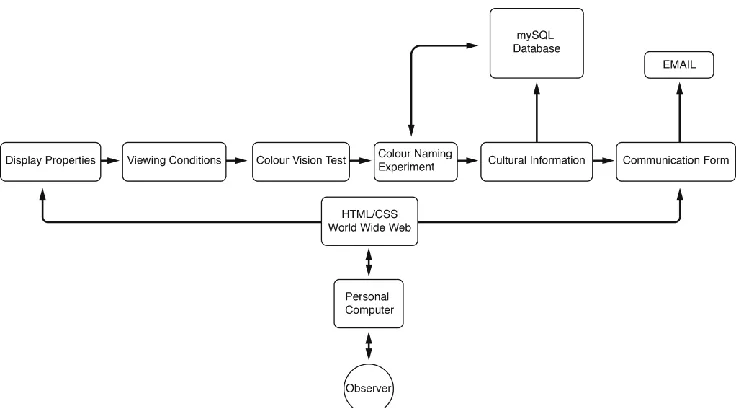
The fourth and main part (Figure 1) is the unconstrained colour-naming task: any colour descriptor, either a single word, or a compound, or terms(s) with modifiers can be produced to describe each of twenty presented colour samples. A few colours are presented twice, to check consistency of the participant’s responses. Along with the colour name typed on a keyboard, response times (RTs) of onset of typing are recorded, defined as the interval between presentation of the colour stimulus and the first keystroke.
Figure 1. Schematic diagram of the web-based colour-naming experiment
2.2 Colour stimuli
The colour-naming experiment makes use of distributed psychophysics and each participant is presented with a sequence of twenty colours randomly selected from 600 total samples from the Munsell Renotation Data. Following the suggestions of Billmeyer in Sturges and Whitfield (1995), the 600 (approximately) uniformly distributed samples were selected from a variable number of hues at different levels of Value and Chroma. The colour stimuli were specified in the sRGB colour space and presented against a mid-neutral grey. Each colour sample was presented across all observers on average 9.04 times (σ=3.04). Stimulus size on the display was 147 by 94 pixels. Detailed specification of the experimental procedure and colour stimuli can be found in Mylonas and MacDonald (2010).
2.3 Data analysis
involved incomplete or numerical terms or words written in non-English alphabets. The dataset was analysed as follows:
• Validation of the online experimental methodology
• Total and gender-split numbers of colour descriptors offered • Total and gender-split percentage of occurrence of:
• colour descriptors of one-word through four-word colour descriptors • most frequent colour terms
• basic colour terms (BCTs) • monolexemic non-BCTs • colour terms with one modifier
• colour descriptors containing ≥ 3 words • Gender-split consistency of colour naming • Gender-split medians of response times (RTs):
• for BCTs
• for most frequent non-BCTs
• Gender-split segmentation of colour space reflecting most frequently used colour names.
3. Results
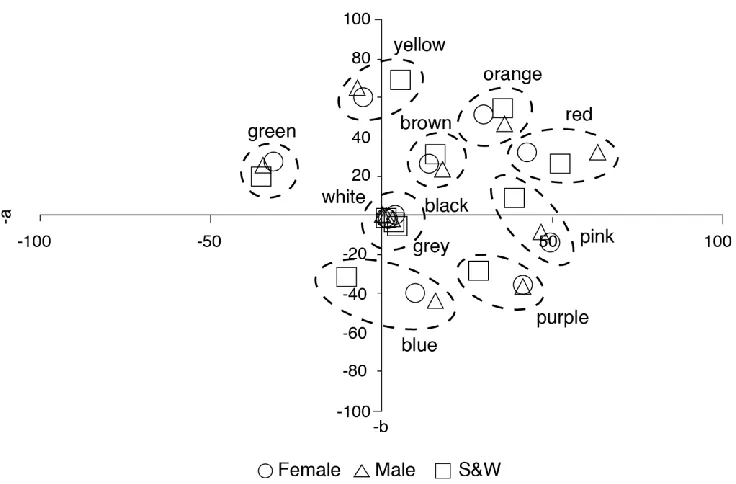
To validate the experimental methodology, we compared the locations of centroids for BCTs in the present study to those obtained under rigorously controlled laboratory conditions (Sturges and Whitfield, 1995). Figure 2 (graphically) and Table 1 (quantitatively) indicate a good correspondence between the centroids calculated for the web-based female and male participants and the centroids in the Sturges and Whitfield study. It is worth noting that the mean colour difference E*ab =12.5 (for females) or 12.6
(for males) is comparable to inter-individual differences in the Sturges and Whitfield sample. The discrepancy in the blue category might be influenced by the monolexemic nature of Sturges and Whitfield’s constrained experiment. The mean colour difference between females and males BCTs was found to be E*ab =6.3. A larger difference of hue angle was found in
Figure 2. Location of centroids of BCTs in a*–b* plane (CIELAB) for females and males in the web-based study vs. the Sturges and Whitfield (S&W, 1995) study.
Table 1. Mean colour differences (ΔE*ab; CIELAB) in the location of
centroids for BCTs for females (F) vs. males (M) in the present web-based study, for females vs. Sturges and Whitfield (1995) (S&W) and for males vs. Sturges and Whitfield (1995).
F vs. M F vs. S&W M vs. S&W
To validate an extended colour vocabulary, results of the present study were compared with those of the parallel web-based experiment of Moroney (2003). In CIELAB terms, the location of centroids for the twenty-seven most frequent chromatic colour words showed a high linear correlation between the two datasets: for hue angles (hab) R2=0.995, for lightness (L*)
R2=0.94, and for chroma (C*ab) R2=0.74 (Mylonas and MacDonald, 2010).
3.2 Number of words in colour descriptors: females vs. males
For the total respondent population, the refined dataset resulted in 5428 responses with 1226 unique colour descriptors. The occurrence of colour descriptors with varying word number was: BCTs 29%; monolexemic non-BCTs 23%; colour terms with one modifier 42%; colour descriptors containing ≥ 3 words 6%.
Figure 3. Number of words in colour descriptors for females and males.
Of the total of 1226 unique colour descriptors, females revealed a richer colour vocabulary, NF = 822 (67%), than males NM = 610 (48%). In
particular, females offered more monolexemic non-BCTs (hyponyms) than males, in accord with previous findings (Nowaczyk, 1982; Rich, 1977; Simpson and Tarrant, 1991). Conversely, males produced more colour descriptors containing a monolexemic term accompanied by one modifier (cf. Bonnardel et al., 2002; Frank, 1990).
3.3 Occurrence of most frequent colour names: females vs. males
were high in frequency for men (rank 7 and 11 respectively), but did not occur at all among women’s frequent names.
Figure 4. Percentage of occurrence of most frequent colour names for
females (top) and males (bottom).
Frequency of occurrence of the eleven BCTs was comparable for both genders: NF = 939 (29.61%), NM = 615 (27.25%), as was the case in Bonnardel et al.’s (2002) study. In the present dataset, however, blue and pink occurred slightly less often for men, and purple less often for women (Figure 5).
Figure 5. Percentage of occurrence of the eleven BCTs for females (light
grey) and males (dark grey).
3.5 Consistency of colour descriptors: females vs. males
Figure 6. Consistency of responses to repeated colour samples for females and males.
3.6 Response times for BCTs and frequent non-BCTs: females vs. males
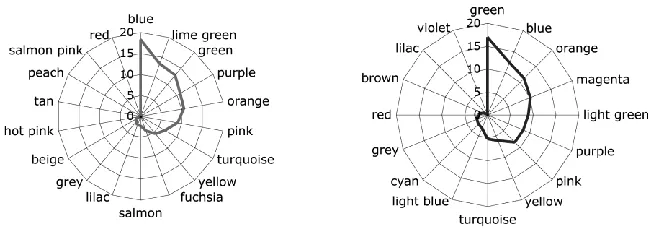
Figure 7. Median RTs of onset of typing for BCTs (left) and most frequent non-basic colour names (right) for females (grey) and males (black).
3.7 Synthetic image: Colour naming segmentation by females vs. males
identifications in the cool area of colour space. Figure 9 reveals the area covered in the synthetic image by each predicted colour name for females and males.
Figure 8. Segmentation of colour space synthetic image using a colour
naming algorithm (Mylonas et al., 2010): synthetic image (left); segmentation for females (centre) and males (right).
Figure 9. Area in the colour space synthetic image lexicalized by most
4. Discussion
The online experimental methodology provided satisfactory agreement when validated against a previous experiment conducted in a laboratory controlled environment (Sturges and Whitfield, 1995) and a similar web-based experiment (Moroney, 2003).
The analysis of gender differences in the outcome of the present web-based colour-naming experiment confirmed the findings of previous off-line studies that women exceed men in the richness of their colour lexicon, in the variety of elaborate colour terms (Arthur et al., 2007; Frank, 1990; Nowaczyk, 1982; Rich, 1977; Simpson and Tarrant, 1991; Swaringen et al., 1978; Thomas et al., 1978; Yang, 2001), and in speed of naming colours (DuBois, 1939; Golden, 1974; Ligon, 1932; Saucier et al., 2002; Shen, 2005).
named orange and brown by men is differentiated in women’s naming into orange, salmon, peach, salmon pink, beige and tan.
In addition, the genders differ in the repertoire of the most frequent non-BCTs (see Figures 8 and 9). For instance, magenta, ranking 7 for men, does not figure among higher-ranking hyponyms for women who name this area of colour space by the “fancy” terms fuchsia and hot pink. Conversely, the blue-green area segregated by men into turquoise, cyan and light blue is named singularly turquoise by women.
Further work is still required to investigate gender differences in the extended colour vocabulary, as well as age- and vocation-dependent differences for each gender.
The gender difference in speed of naming colours is suggested to reflect the speed advantage of females in identifying colour concepts (Shor, 1971) and in naming objects more generally (Saucier et al., 2002).
More recent studies offer an explanation that refers to the female “nature”. These differences are suggested to reflect genetic variation in the opponent system responses (Kuehni, 2001) or heterozygosity in X-chromosome allele genes coding for cone photopigments common among females (Rodríguez-Carmona et al, 2008).
Further, genetic differences were found with regards to dimorphisms of the X-chromosome genes that encode retinal long- (L) and middle- (M) wavelength photopigments (the inherited feature observed in ca. 15% of Caucasian women). Such dimorphism in females is considered to result in more refined colour perception and enhanced ability to discriminate colour differences along the red-green axis (Jameson, Highnote and Wasserman, 2001; Jordan, Deeb, Bosten and Mollon, 2010). This proposition is supported by the findings of Sayim et al. (2005, 457) who demonstrated that females with dimorphism of both L- and M-opsin genes exhibited
significantly higher consensus in their judgements of colours or colour
words compared with three other female genotypes (with no opsin gene
diversity or with dimorphism of either L- or M-opsin gene).
whether women present an advantageous colour-naming behaviour across cultures.
5. References
Abramov, Israel, James Gordon, Olga Feldman, and Alla Chavarga. 2012. “Sex and Vision II: Color Appearance of Monochromatic Lights.” Biology of Sex Differences 3: 21.
http://www.bsd-journal.com/content/3/1/21
Anyan, Walter R., and Warren W. Quillian. 1971. “The Naming of Primary Colors by Children.” Child Development 42: 1629–1632.
Arthur, Heather, Gail Johnson, and Adena Young. 2007. “Gender Differences and Color: Content and Emotion of Written Descriptions.” Social Behavior and Personality 35: 827–834.
Barbur, John L. 2004. “ ‘Double-Blindsight’ Revealed Through the Processing of Color and Luminance Contrast Defined Motion Signals.” Progress in Brain Research 144: 243–260.
http://www.city.ac.uk/health/research/research-areas/optometry/a-new-web-based-colour-vision-test
Bimler, David L., John Kirkland, and Kimberly A. Jameson. 2004. “Quantifying Variations in Personal Color Spaces: Are There Sex Differences in Color Vision?” Color Research and Application 29: 128–134.
Bonnardel, Valerie, Sue Miller, Lisa Wardle, and Etta Drews. 2002. “Gender Differences in Colour-Naming Task.” Perception 31 (Supplement): 71.
Chapanis, Alphonse. 1965. “Color Names for Color Space.” American Scientist 53: 327–346.
DuBois, Philip H. 1939. “The Sex Difference on the Color-Naming Test.” The American Journal of Psychology 52: 380–382.
Frank, Jane. 1990. “Gender Differences in Color Naming: Direct Mail Order Advertisements.” American Speech 65: 114–126.
Golden, Charles J. 1974. “Sex Differences in Performance on the Stroop Color and Word Test.” Perceptual and Motor Skills 39: 1067–1070. Greene, Katherine S., and Malcolm D. Gynther. 1995. “Blue versus
Periwinkle: Color Identification and Gender.” Perceptual and Motor Skills 80: 27–32.
Johnson, E. G. 1977. “The Development of Color Knowledge in Preschool Children.” Child Development 48: 308–311.
Jordan, Gabriele, Samir S. Deeb, Jenny N. Bosten, and John D. Mollon. 2010. “The Dimensionality of Color Vision in Carriers of Anomalous
Trichromacy.” Journal of Vision 10(8):12.
http://www.journalofvision.org/content/10/8/12
Kuehni, Rolf G. 2001. “Determination of Unique Hues using Munsell Color Chips.” Color Research and Application 26: 61–66.
Ligon, Ernest M. 1932. “A Genetic Study of Color Naming and Word Reading.” The American Journal of Psychology 44: 103–122.
Lin, Helen, M. Ronnier Luo, Lindsay W. MacDonald, and Arthur W. S. Tarrant. 2001. “A Cross-Cultural Colour-Naming Study. Part I: Using an Unconstrained Method.” Color Research and Application 26: 40– 60.
Moore, Carmella C., A. Kimball Romney, and Ti-Lien Hsia. 2002. “Cultural, Gender, and Individual Differences in Perceptual and Semantic Structures of Basic Colors in Chinese and English.” Journal of Cognition and Culture 2: 1-28.
Mylonas, Dimitris, and Lindsay W. MacDonald. 2009. Online Colour Naming Experiment.
http://colornaming.net
Mylonas, Dimitris, and Lindsay MacDonald. 2010. “Online Colour Naming Experiment Using Munsell Colour Samples.” In Proceedings of the 5th
European Conference on Colour in Graphics, Imaging, and Vision (CGIV), 27–32. Joensuu, Finland: IS&T, Springfield.
Mylonas, Dimitris, Lindsay MacDonald, and Sophie Wuerger. 2010. “Towards an Online Color Naming Model.” In CIC18 2010. Proceedings of the 18th Color and Imaging Conference: Color Science and Engineering Systems, Technologies, and Applications, ed. by F. H. Imai, and E. Langendijk, 140–144. San Antonio, TX: IS&T, Springfield.
Nowaczyk, Ronald H. 1982. “Sex-Related Differences in the Color Lexicon.” Language and Speech 25: 257–265.
Pérez-Carpinell, Joaquín, Rosa Baldovi, M. Dolores de Fez, and José Castro. 1998. “Color Memory Matching: Time Effect and Other Factors.” Color Research and Application 23: 234–247.
Rodríguez-Carmona, Marisa, Lindsay T. Sharpe, J. Alister Harlow, and John L. Barbur. 2008. “Sex-Related Differences in Chromatic Sensitivity.” Visual Neuroscience 25: 433–440.
Ryabina, Elena. 2009. “Sex-Related Differences in the Colour Vocabulary of Udmurts.” Wiener elektronische Beiträge des Instituts für Finno-Ugristik, 1-16.
http://webfu.univie.ac.at/wp/510
Saucier, Deborah M., Lorin J. Elias, and Kirk Nylen. 2002. “Are Colours Special? An Examination of the Female Advantage for Speeded Colour Naming.” Personality and Individual Differences 32: 27–35. Sayim, Bilge, Kimberly A. Jameson, Nancy Alvarado, and Monika K.
Szeszel. 2005. “Semantic and Perceptual Representations of Color: Evidence of a Shared Color-Naming Function.” Journal of Cognition and Culture 5: 427–486.
Shen, Xuezhu. 2005. “Sex Differences in Perceptual Processing Performance on the Color-Kanji Stroop Tasks of Visual Stimuli.” International Journal of Neuroscience 115: 1631–1641.
Shor, Ronald E. 1971. “Symbol Processing Speed Differences and Symbol Interference Effects in a Variety of Concept Domains.” Journal of General Psychology 85: 187–205.
Sturges, Julia, and T. W. Allan Whitfield. 1995. “Locating Basic Colours in the Munsell Space.” Color Research and Application 20: 364–376. Swaringen, Sandra, Stephanie Layman, and Alan Wilson. 1978. “Sex
Differences in Color Naming.” Perceptual and Motor Skills 47: 440– 442.
Thomas, Lynn L., Anne T. Curtis, and Ralph Bolton. 1978. “Sex Differences in Elicited Color Lexicon Size.” Perceptual & Motor Skills 47: 77–78.
Weijer van der, Joost, Cordelia Schmid, Jacob Verbeek, and Diane Larlus. 2009. “Learning Color Names for Real-World Applications.” IEEE Transactions on Image Processing 18: 1512–1523.