M-learning in Higher Education in Bahrain: the Educators’
view
Evangelia Marinakou
Royal University for Women, Kingdom of Bahrain
Charalampos Giousmpasoglou
Bahrain Polytechnic, Kingdom of Bahrain
Abstract
Universities in the oil-rich Gulf Cooperation Countries (GCC) have shown particular interest in m-learning which currently is treated as fashion, but at the same time is considered by
corporations and educational institutions to be very promising. This papers investigates the adoption of m-learning at universities in the Kingdom of Bahrain, and explores the educators’ views and perceptions of m-learning, as well as its future potential in higher education. A survey questionnaire was distributed to instructors in four universities in the Kingdom of Bahrain, both private and public. This papers presents the pilot study, which includes the results of 45
responses. The findings suggest that although most of the educators understand the concept and they use M-Learning tools to some limited extent, there is a long way until we reach full
integration with curriculum and the blended learning approach. In addition, despite the fact that most educators understand the necessity and role of M-Learning in content delivery, they do not seem to embrace at its full potential, as it is mainly used for communication purposes and navigation. The paper proposes that m-learning provides opportunities for more creativity in designing and delivering the course with further enhancement of the student experience, but it will be utilized in its full potential in the area within the next 5 years. This study provides guidance to instructors on the potential of m-learning and the need to change the teaching and learning culture to student-oriented for more effective and appropriate use of m-learning. TI highlights the need for institutions to invest in faculty and staff training, and in technology as well as provides suggestions to other stakeholders on the need to incorporate m-learning in decision-making for further development in the region.
Keywords: mobile learning, technology, education, innovation, teaching and learning
1.
Introduction
The emergence of the World Wide Web supported the development and the popularity of e-learning (Peng et al., 2009). In addition, mobile devices such as mobile phones, laptops have increased drastically and are widely used in e-learning (Iqbal and Qureshi, 2012; Koszalka and Ntloedibe-Kuswani, 2010). Most studies in m-learning focus on its acceptance by students in developing countries (i.e. Rhema and Sztendur, 2013; Wang et al., 2009) but very few focus on its acceptance by instructors or on their perceptions of m-learning and its future potential.
2.
Literature Review
M-learning or mobile learning is an evolving phase of learning (Peng et al., 2009), as
transmission”. Kukulska-Hulme and Traxler (2007) suggest that m-learning emphasizes the ability to facilitate the learning process without being tied to a physical location.
M-learning has attracted attention due to the increasing number of available mobile devices, which are affordable and their costs are increasingly decreasing making them more accessible to people. At the same time these devices have multiple features and capabilities, such as making phone calls, taking pictures and making videos, storing data and of course accessing the internet (Sarrab et al., 2013). Maccallum and Jeffery (2009) propose that all these capabilities may be used in teaching and learning, for example for classroom activities (Dawabi et al., 2003). These mobile devices can be used for learning purposes via interactive games, for brainstorming, quizzing and are widely used to support and develop students’ own learning and collaborative learning (Iqbal and Qureshi, 2012). Moreover, they are available to users at any time and all time (Giousmpasoglou and Marinakou, 2013). Kukulska-Hulme and Traxler (2007) present several case studies that report and support the experience of educators with mobile technologies in universities. Zawacki-Richter et al. (2009) claim that e-learning and m-learning provide a wide range of opportunities for learners and teachers. However, Herrington et al., (2009, p.1) claim that it is not still clear whether “m-learning is used in pedagogically appropriate ways”.
M-learning is widely used in distance learning as it supports the access to the teaching material for a large number of students, independent of time and space, at low costs. Moura and Carvalho (2009, p. 90) suggest that “the development of m-learning as a new strategy for education has implications on the way students learn, on the role of the teachers as well as in the educational institution”. Hence, for the purpose of this paper m-learning is studied as an element of
e-learning and blended e-learning in general not necessarily as a tool for distance e-learning, as it also helps in constructing problem-based learning as well as any related assignments and projects that meets the students’ interest (Kukulska-Hulme and Traxler, 2007). M-learning allows student-centered learning in which students are able to modify the access and transfer of information to strengthen the knowledge and skills of students to meet their educational goals (Giousmpasoglou and Marinakou, 2013; Sharples et al., 2007). In addition, it can support ubiquitous learning and can make the educational process more comfortable and flexible (Sarrab et al., 2013, p. 828). The challenges of the use of m-learning are many for all stakeholders as it may have many technological restrictions. For instructors m-learning is a challenge as they should be familiar with technology, not only to use it for teaching and learning but also to support developers who are challenged by the limited memory, the lack of keyboard, the small displays especially when compared to computers and laptops (Iqbal and Qureshi, 2012; Wang et al., 2009). Instructors should adapt the design of the courses to integrate ICT; this design should be dynamic, easily scalable and should be applied at all times and places (Marwan et al., 2013). Moreover, Marwan et al. (2013) suggest that instructors face the lack of time to prepare for class.
There is concern on the educators’ ability to understand and respond to digital learning
challenges in emerging m-learning environments and facilitate insights to support their design and use of m-learning resources.
Students usually have access to the internet and other applications via their mobile devices such as Facebook, YouTube, MySpace and other. They are also familiar with its use, hence being well introduced to m-learning may lead to its wide use in their own learning. Nowadays students are active and innovative in terms of their learning, they expect a quick response from the tutor and want an interactive learning, student-centered, authentic, collaborative and effective learning with the use of ICT (Marwan et al., 2013). According to Mirza and Al-Abdulkareem (2011, p. 88) “the learner’s attitude and lack of prior knowledge of IT use are major factors that affect the acceptance of e-learning by students”.
Previous research suggests that there are various factors that contribute to the adoption of learning. Ju et al. (2007) claim that the perceived usefulness influences the intention to adopt m-learning. On top of usefulness, Wang et al. (2009) and Sarrab et al. (2013) identified other factors such as the self-managed pace of learning, the social influence, the performance and the effort expectancy. Venkatesh et al. (2003) added the available infrastructure to support the use of any m-learning system, and Liu and Li (2010) add the playfulness. The interface makes the use of mobile devices more interesting for students, as the learning is personalized, more fun, spontaneous, and engaging users to contribute and share (Sarrab et al., 2013). Marwan et al. (2013) add the interactive learning process, the integrated learning information and the high learning needs. Thornton and Houser (2002 in Moura and Carvalho, 2009) propose that recordings, communication and access to information in the local set, sending reminders or relevant information for students are good options of the use of m-learning. Attewell (2011) propose that m-learning assists in the development of the learners’ literacy and numerical skills. In addition, m-learning students are able to experience a dynamic class via interaction. To understand the factors that contribute to the adoption of m-learning will help stakeholders (educators, software developers and technicians) to incorporate these factors into the design of the m-learning systems.
Challenges and restrictions of the use of m-learning include the lack of standardization, the low bandwidth, the limited processor speed and small screen size, low storage, short battery life, lack of data input capability (Sarrab et al., 2013; Maniar and Bennett, 2002), low display resolution, limited memory and less computational power (Shiau et al., 2001). Marwan et al. (2013) claim that classes are difficult to be rescheduled with m-learning. Weber (2011) supports that in the MENA region instructors are concerned about the security of the educational data, and parents are concerned about the use of chats and the safety of the online environment. Mirza and Al-Abdulkareem (2011, p.84) add that exposure to material from the internet “could be considered dangerous to youths and to the religious moral values of those nations”.
A study in the Middle East reveals that only 49% of society members are aware of e-learning (CITC, 2007) and the main reason for the limited use of e-learning and m-learning in the region is the low public and teachers’ esteem for online learning (Mirza and Al-Abdulkareem, 2011). In Saudi Arabia, the rapid advancement in mobile technologies, wireless networks and the acceptance of new smart devices have increased the interest in m-learning. In fact, The Ministry of Higher Education (MOHE) has launched a national project “AAFQ” to develop a long term plan for HE in order to address future challenges including m learning.
Nevertheless, universities in the oil-rich GCC have shown particular interest in m-learning which currently is treated as fashion (Mohammad and Job, 2013), but at the same time is considered by corporations and educational institutions to be very promising (Sharrab et al., 2013; Unesco, 2012). Although, there is increased interest in m-learning adoption in teaching and learning in the region, there is limited research conducted (Iqbal and Qureshi, 2012; Mirza and
Al-Abdulkareem, 2011). Most studies focus on the learners’ perceptions and use of m-learning with very little research conducted in the instructors’ views (Mirza and Al-Abdulkareem, 2011). Hence, the authors decided to investigate the adoption of m-learning at universities in the Kingdom of Bahrain, and explore the educators’ views and perception of m-learning, their intention to use it, as well as its future potential in higher education. This paper aims to provide an overview of the challenges that instructors face with the use of m-learning and of insights and recommendations on strategies for the use of mobile learning to change and enhance the
pedagogies in HE.
3.
Research Methodology
This paper presents the findings of the pilot study of the questionnaire conducted in four out of eight universities in Bahrain; both private and public universities were included in the survey. In order to address the aim and the research questions of the study, Zawachi-Richter et al.’s (2009) questionnaire titled ‘Mobile Learning: From single project status into the mainstream?’ was used after having acquired the authors’ permission for its use. Instructors were asked to rate the mobile learning and teaching experience of distance educators, the development and growth of mobile learning, the impact of mobile technologies on teaching and learning, mobile learning applications and mobile learning activities, mobile learning and access to (higher) education, and the future development of mobile learning with a 5 Likert scale from (1) strongly disagree to (5) strongly agree.
For the pilot study, a total of 45 questionnaires were collected between April and June 2013, in which educators were asked to provide their attitudes regarding m-learning as a tool in their teaching. The participants in the study were from different faculties such as Business, ICT, Humanities, Art and Design, and from different academic rankings, with the majority being PhD holders (53.3%). 35.6% were female and 64.4% were male.
In order to identify the instructors’ perceptions of m-learning frequencies, means and standard deviations were calculated. Moreover to identify the main ideas about the future of m-learning the frequencies of responses were calculated.
4.
Results
Table 1: M-learning status at institution level
Response (N=45) Frequency (%)
C1 A traditional face-to-face or contact-based teaching institution
34 (75.6)
C2 Non-existent 27 (60)
C3 No, there are no institutional plans for
developing course materials for use on mobile devices
27 (60)
C4 No, there is no institutional support. 14 (31.1) Yes, a new unit at the organisation/institution
has been created for this purpose.
14 (31.1)
It is evident from the above that the majority of the institutions in the study were face-to-face with limited use of e-learning. M-learning was non-existent and most did not have any plans in developing m-learning. In addition, there was no technical support or in the cases that there was, it was limited.
In reference to the current status on m-learning the participants expressed their opinions on their knowledge on m-learning and on the use of mobile devices. The results are shown in Table 2.
Table 2: Current personal status
Response (N=45) Frequency
(%) B1 Yes, I am personally doing research on mobile learning 7 15,6
Yes, but I am not personally doing research on mobile learning. 11 24,4 Yes, I am involved in mobile learning projects. 2 4,4 I have read a number of articles and papers on mobile learning 4 8,9 No, but other persons in my institution are knowledgeable. 14 31,1 No, I have not heard about mobile learning. 7 15,6 Interestingly, most respondents are aware of m-learning, but only 15.6% are currently doing research. Similarly, 15.6% of the respondents have not heard about mobile learning.
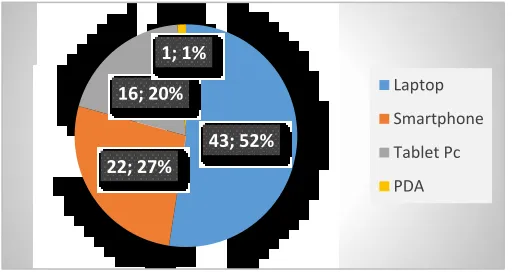
The use of mobile devices is shown in the following graph.
Graph 1: Mobile devices
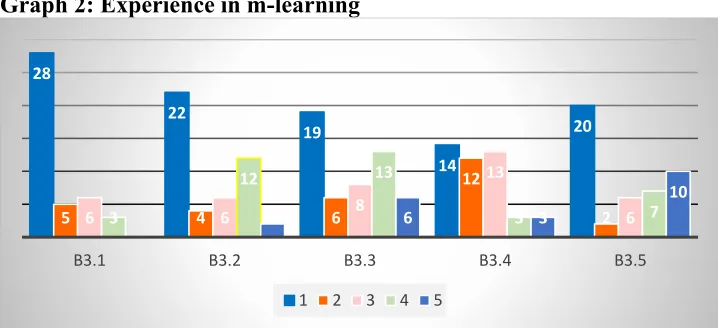
Most of the respondents (95.6%) used a laptop for connecting to the internet, and then their smartphone (48/9%). Moreover the participants were asked to evaluate their experience in m-learning. The results are shown in the following graph.
43; 52% 22; 27%
16; 20% 1; 1%
Laptop
Smartphone
Tablet Pc
Graph 2: Experience in m-learning
The majority of the responses to this question were towards the strongly disagree (1) area, which shows that the participants are not involved in m-learning projects, and they have not been exposed to any projects relevant to m-learning.
Further, respondents were asked to rate the importance of learning tools for students, the learning activities that are appropriate for mobile devices and the importance of applications. The findings are shown in the following table.
Table 3: Importance rating of importance for tools (B4), learning activities (B5), applications (B6) and learning tools (B7)
Item (N=45)
1 (Freq) 2 (Freq) 3 (Freq) 4 (Freq) 5 (Freq)
B4.1 7 (15.6) 7 (15.6) 10 (22.2) 10 (22.2) 11 (24.4)
B4.2 7 (15.6) 8 (17.8) 13 (28.9) 10 (22.2) 7 (15.6)
B4.3 5 (11.1) 12 (26.7) 18 (40.0) 10 (22.2)
B4.4 3 (6.7) 1 (2.2) 5 (11.1) 18 (40.0) 18 (40.0)
B4.5 3 (6.7) 1 (2.2) 3 (6.7) 14 (31.1) 24 (53.3)
B5.1 6 (13.3) 7 (15.6) 10 (22.2) 6 (13.3) 16 (35.6)
B5.2 3 (6.7) 12 (26.7) 5 (11.1) 12 (26.7) 13 (28.9)
B5.3 2 (4.4) 3 (6.7) 7 (15.6) 19 (42.2) 14 (31.1)
B5.4 5 (11.1) 12 (26.7) 18 (40.0) 10 (22.2)
B5.5 4 (8.9) 10 (22.2) 10 (22.2) 21 (46.7)
B6.1 5 (11.1) 5 (11.1) 7 (15.6) 9 (20.0) 19 (42.2)
B6.2 2 (4.4) 6 (13.3) 8 (17.8) 10 (22.2) 19 (42.2)
B6.3 2 (4.4) 4 (8.9) 15 (33.3) 7 (15.6) 17 (37.8)
B6.4 2 (4.4) 7 (15.6) 10 (22.2) 12 (26.7) 14 (31.1)
B6.5 2 (4.4) 1 (2.2) 11 (24.4) 15 (33.3) 16 (35.6)
B6.6 2 (4.4) 2 (4.4) 7 (15.6) 34 (75.6)
B7.1 1 (2.2) 7 (15.6) 12 (26.7) 11 (24.4) 14 (31.1)
B7.2 2 (4.4) 3 (6.7) 11 (24.4) 15 (33.3) 14 (31.3)
B7.3 1 (2.2) 9 (20.0) 10 (22.2) 12 (26.7) 13 (28.9)
B7.4 1 (2.2) 8 (17.8) 8 (17.8) 15 (33.3) 13 (28.9)
B7.5 1 (2.2) 1 (2.2) 5 (11.1) 10 (22.2) 28 (62.2)
28
22
19
14
20
5 4 6
12
2
6 6 8
13
6 3
12 13
3 7
2 6 3
10
B3.1 B3.2 B3.3 B3.4 B3.5
The findings suggest that the respondents found very important ‘being connected anywhere, anytime’ (B4.5), and ‘sharing texts, notes and documents’ (B4.4), hence they did not find the text messaging or voice calls and e-mails as highly important tools for students. Moreover, they identified as appropriate learning activities for mobile devices ‘coursework’ (B5.1),
‘collaborative learning’ (B5.3) and ‘information retrieval’ (B5.5). The applications found to be more important were all those included in the questionnaire such as mobile office (B6.1), diary and scheduling (B6.2), audio and video applications (B6.3), imaging (B6.4), other accessories (B6.5) and online data services (B6.6). Finally, the most useful tools were accessing information such as notes, documents etc (B7.2) and again ‘being connected anywhere, anytime’ (B7.5). The respondents were asked to rate the new strategies and methodologies that are facilitated by m-learning. The results are shown in the following table.
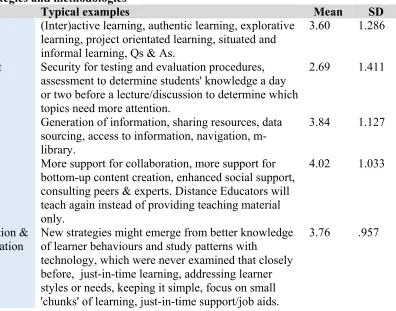
Table 4: Strategies and methodologies
Category Typical examples Mean SD Learning
activities
(Inter)active learning, authentic learning, explorative learning, project orientated learning, situated and informal learning, Qs & As.
3.60 1.286
Assessment Security for testing and evaluation procedures, assessment to determine students' knowledge a day or two before a lecture/discussion to determine which topics need more attention.
2.69 1.411
Resources Generation of information, sharing resources, data sourcing, access to information, navigation, m-library.
3.84 1.127
Interaction More support for collaboration, more support for bottom-up content creation, enhanced social support, consulting peers & experts. Distance Educators will teach again instead of providing teaching material only.
4.02 1.033
Personalisation &
individualisation New strategies might emerge from better knowledge of learner behaviours and study patterns with technology, which were never examined that closely before, just-in-time learning, addressing learner styles or needs, keeping it simple, focus on small 'chunks' of learning, just-in-time support/job aids.
3.76 .957
Except the ‘assessment’ (B8.2), the rest of the variables were rated close to agree and strongly agree responses. Interaction (B8.4) (Mean=4.02) was the most important of all the strategies that are facilitated by m-learning. The least important was ‘assessment’ (B8.2) (Mean=2.69).
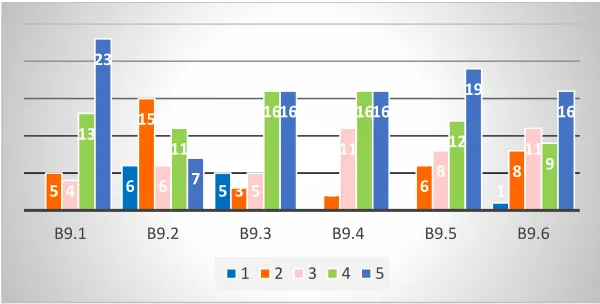
The major weaknesses of mobile devices that might hinder m-learning were also rated by the respondents as shown in graph 3.
Most of the respondents agreed or strongly agreed with all the variables except the screen size (B9.2). This showed that the size of the screen of mobile devices was not considered to be a hindering factor for m-learning. On the contrary, the small size of the displays was found to be a challenge for m-learning activities. Similarly, the costs of network, the memory size, the device capabilities and the limited battery time were among the most important challenges for applying m-learning.
When respondents were asked their views on the latest trends and developments in teaching and learning as well as on when m-learning will be an integral part of mainstream in HE they
responded as follows.
Table 5: Respondents’ views on trends and developments in m-learning (and in years)
Responses Technology changes should not have an impact on our teaching and learning strategies and methodologies. Technology changes should have an impact on our teaching and learning strategies and methodologies, but this is currently not the case at present. Teaching and learning strategies and methodologies adapt continuously due to new affordances that technology provides. Technology changes brings about radical changes to our teaching and learning strategies and methodologies.
Frequency 2 23 12 8
Percent 4.4 51.1 26.7 17.8
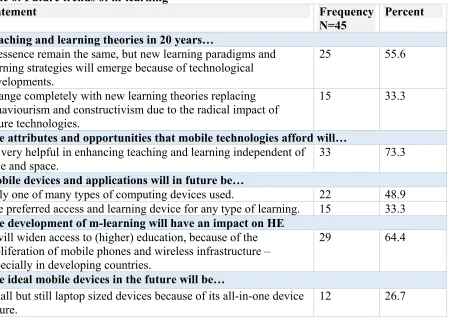
Most of the respondents (51.1%) supported the view that although the technology should impact on the teaching and learning, currently this was not the case. In addition, most of the respondents (75.6%) believed that m-learning will become an integral part of mainstream HE within 5 years. Finally the participants were asked to present their views on the future trends of m-learning. For the purpose of this paper only the majority of responses are illustrated in the following table.
6 5 1
5
15
3 2 6
8
4 6 5
11 8 11 13 11 16 16 12 9 23 7 16 16 19 16
B9.1 B9.2 B9.3 B9.4 B9.5 B9.6
Table 6: Future trends of m-learning
Statement Frequency
N=45
Percent
Teaching and learning theories in 20 years…
In essence remain the same, but new learning paradigms and learning strategies will emerge because of technological developments.
25 55.6
Change completely with new learning theories replacing behaviourism and constructivism due to the radical impact of future technologies.
15 33.3
The attributes and opportunities that mobile technologies afford will…
Be very helpful in enhancing teaching and learning independent of
time and space. 33 73.3
Mobile devices and applications will in future be…
Only one of many types of computing devices used. 22 48.9 The preferred access and learning device for any type of learning. 15 33.3
The development of m-learning will have an impact on HE
It will widen access to (higher) education, because of the proliferation of mobile phones and wireless infrastructure – especially in developing countries.
29 64.4
The ideal mobile devices in the future will be…
Small but still laptop sized devices because of its all-in-one device nature.
12 26.7
The majority of the respondents (55.6%) supported the view that new teaching and learning strategies will emerge due to IT developments. In addition, they proposed that they will enhance the teaching and learning, nevertheless, they proposed that the mobile devices will be the
preferred device for learning. They also supported that m-learning will widen access to HE, because of the profileration of mobile phones and wireless infrastructure and the devices are expected to be small in size. Most of the respondents (84.4%) agreed that m-learning will facilitate new strategies and methodologies for learner support.
5.
Implications for Future Research
The purpose of this paper was to investigate the instructors’ views on m-learning and its use in teaching and learning in higher education in Bahrain. It is evident from the above that m-learning plays an important role in teaching and learning strategies. Although, most of the participants work in institutions that do not offer m-learning strategies and they use face-to-face teaching, the instructors are considering its use, and some already conduct research in m-learning.
Nevertheless, it was interesting that the majority of the respondents have not heard of m-learning.
agrees with Venkatesh et al. (2003) that the available support and infrastructure are important for the use of e-learning and m-learning. Similarly to Sarrab et al. (2013), the main weaknesses identified include the small size of displays, the cost of network, the memory size and the mobile devices capabilities. However, the participants proposed that the new technologies should have an impact on teaching and learning in HE, and they believed that new may emerge, as they may enhance the learning and the teaching strategies. Macallum and Jeffery (2009) also propose that mobile devices may enhance m-learning, and the teaching and learning pedagogies.
Understanding the factors that contribute to the effective use of m-learning may help
stakeholders to incorporate those in the design and implementation of m-learning. It is necessary to identify the practices in terms of instructional design and adapt them to reflect the number of changes that have taken place in education from the use of e-learning and m-learning. A
transformation towards m-learning requires not only the use of the devices but also awareness and familiarity with new technologies (Wang et al., 2009), hence mobile tools should be aligned with the course objectives, and instructors should be aligned with m-learning requirements. M-learning should be used appropriately in order to be effective (Herrington et al., 2009), thus instructors should have the technical know-how as they are an essential part of m-learning. This study proposes that informative meetings and instructors’ training on m-learning can enhance the perception and the use of m-learning in higher education in Bahrain. Nevertheless, more empirical research is required to test the effectiveness of e-learning.
Future studies can focus on identifying the factors, challenges and weaknesses in specific disciplines as the use of technology varies depending on the field of study for example it can be limited in liberal arts. It would also be interesting to explore the above findings in terms of gender differences.
References
Attewell, J. 2011. From research and development to mobile learning: tools for education and training providers and their learners’. Available at:
http://www.mlearn.org.za/CD/papers/Attewell.pdf (Accessed May 25, 2013).
Dawabi, P., Wessner, M. and Neuhold, E. 2003. Using mobile devices for the classroom of the future. In J. Attewell, and C. Savill-Smith (eds), Learning with mobile devices. London: Research and Development, Learning and Skills Development Agency.
Giousmpasoglou, C. and Marinakou, E. 2013. ‘The future is here: m-learning in higher education’, Computer Technology and Application, 4(6), 317-322.
Hadj Hamou, N., Anwar, S.A. and Benhadria, M., A new paradigm for e-learing in the Arab Middle East: Reflections on e-books and e-Reader devices. In Goh, T-T., Seet, B-C., & Sun, P-C. (Eds) (2012). E-Books & E-Readers for E-Learning. Wellington: Victoria Business School.
Iqbal, S. and Qureshi, I.A. 2012. ‘M-learning adoption: A perspective from a developing country’, The International Review of Research in Open and Distance Learning, Vol 13 No 3, pp. 147-164.
Ju, T.L., Sriprapaipong, W. and Minh, D.N. 2007. On the success factors of mobile learning, Paper presented at 5th Conference on ICT and Higher Education, Bangkok. Available at: http://www.mendeley.com/research/success-factors-mobile-learning/
Koszalka, T.A. and Ntloedibe-Kuswani, G.S. 2010. ‘Literature on the safe and disruptive learning potential of mobile technologies’, Distance Education, Vol 31 No 2, pp. 139-157.
Kukulska-Hulme, A. and Traxler, J., 2007. Designing for mobile and wireless learning. London: Routledge.
Liu, Y. and Li, H. 2010. ‘Mobile internet diffusion in China: An empirical study’, Industrial Management and Data Systems, Vol 110 No 3, pp. 309-324.
MacCallum, K. and Jeffrey, L. 2009. ‘Identifying discriminating variables that determine mobile learning adoption by educators: An initial study’, In Same places, different spaces. Proceedings ascilite Auckland 2009. Available at:
http://www.ascilite.org.au/conferences/auckland09/procs/maccallum.pdf
Maniar, N. and Bennett, E. 2007. ‘Media influence on m-learning?’, Proceedings of VideoFunet Conference, Tampere, Finland.
Marwan, M.E., Madar, A.R. and Fuad, N., 2013. ‘An overview of mobile application in learning for student of Kolejpoly-tech Mara (KPTM) by using mobile phone’, Journal of Asian Scientific Research, Vol 3 No 6, pp. 527-537.
Mirza, A.A. and Al-Abdulkareem, M., 2011. ‘Models of e-learning adopted in the Middle East’, Applied Computing and Informatics, Vol 9, pp. 83-93.
Moura, A. and Carvalho, A., 2009. ‘Mobile learning: two experiments on teaching and learning with mobile phones’, Advanced Learning, Available at:
http://www.intechopen.com/download/get/type/pdfs/id/8593.
Orr, G. 2010. ‘Review of the literature in mobile learning: Affordances and constraints’, The 6th IEEE International Conference on Wireless, Mobile and Ubiquitous Technologies in Education, Taiwan, 107-111.
Sarrab, M., Al-Shihi, H. and Rehman, O.M.H. 2013. ‘Exploring major challenges and benefits of m-learning adoption’, British Journal of Applied Science and Technology, Vol 3 No 4, pp. 826-839.
Serin, O., 2012. ‘Mobile learning perceptions of the prospective teachers (Turkish Republic of Nothern Cyprus sampling)’, TOJET: The Turkish Online Journal of Educational Technology, Vol 11 No 3, pp. 222-233.
Sharples, M., Taylor, J. and Vavoula, G., 2007. ‘A theory of learning for the mobile age’. London: Sage Publications.
Siau, K., Lim, E.P. and Shen, Z. 2001. ‘Mobile commerce: Promises, challenges, and research agenda’, Journal of Database Management, Vol 12 No 3, pp. 4-13.
Weber, A.S., 2011. ‘Research program for next-gen e-learning in MENA region’, Paper for the 7th International Scientific Conference eLearning and Software for Education, Bucharest, April.