1
1
2
Transforming vaccine development
34
Steve Black1, David E. Bloom2, David C. Kaslow3, Simone Pecetta4 and Rino Rappuoli4,5* 5
6
1 Cincinnati Children’s Hospital, Cincinnati, OH 45229, USA 7
2 Harvard T.H. Chan School of Public Health, Harvard University, Boston MA 02115, USA 8
3 PATH, Seattle WA 98121, USA 9
4 GSK, 53100 Siena, Italy 10
5 Imperial College London, London SW7 2AZ, UK 11
*corresponding author: [email protected] 12
13
Keywords: COVID-19; vaccine; vaccine development; vaccine discovery; systems biology; machine learning; platform 14
technologies; adjuvants; smart clinical trials; human genetics; regulatory convergence; real world evidence; vaccines 15
safety 16
17
Abstract 18
The urgency to develop vaccines against Covid-19 is putting pressure on the long and expensive 19
development timelines which are normally required for development of lifesaving vaccines. There is 20
a unique opportunity to take advantage of new technologies, smart and flexible design of clinical 21
trials, and evolving regulatory science to speed up vaccine development against Covid-19 and 22
transform vaccine development altogether. 23
Introduction 24
Vaccines have had a tremendous positive effect on public health and well-being. Today, the desperate 25
need for vaccines to protect people from the pandemic caused by the 2019 novel coronavirus (SARS-26
CoV-2, cause of COVID-19 disease), is a strong reminder for the value of vaccines, and of the 27
importance of being able to develop and scale-up their use in a timely manner. Indeed, vaccines can 28
not only save lives but also prevent the impact of infectious diseases on the global economy that in 29
the case of Covid-19 has already killed more than 250,000 people, caused the unemployment of 25 30
million people in the USA alone and a loss of several trillion dollars to the global economy. 31
In addition to the immediate need for Covid-19, vaccines have the potential to address many other 32
pathogens such as respiratory syncytial virus, cytomegalovirus, human immunodeficiency virus 33
(HIV), and pandemic and seasonal influenza, as well as other viral emerging infections such as Ebola, 34
Nipah, Zika, dengue, Lassa, and Middle East Respiratory Syndrome. Vaccines also offer the potential 35
to address the mounting threat of antimicrobial resistance by targeting tuberculosis, Salmonella spp, 36
Shigella spp, Staphylococcus aureus, Neisseria gonorrhoeae, carbapenem-resistant 37
Organization (WHO); they can also target other bacteria, viruses, funguses, and parasites that are 39
frequently treated (whether appropriately or inappropriately) with antimicrobials, thereby promoting 40
resistance in colonizing pathogens. If all or many of these opportunities for vaccine development are 41
brought to fruition, the resulting impact on mortality, quality of life, and poverty could be 42
transformative (1). 43
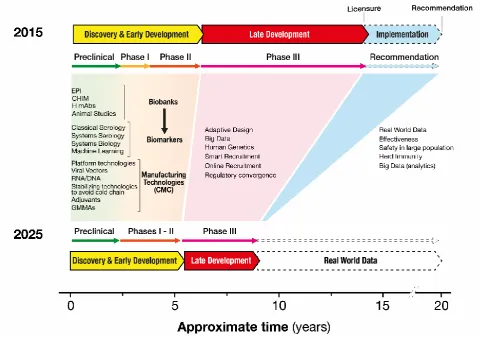
Usually 15-20 years are required between the initial scientific discovery and vaccine licensure and 44
policy recommendation (Fig. 1). Indeed, the trend over the past 30 years, for national regulatory 45
agencies, policy-making bodies, and manufacturers has been to require a growing number of clinical 46
studies of increasing size and complexity before licensure and recommendation; more recently, yet 47
additional post-licensure studies have been required before broad recommendation of vaccine use. As 48
a result, promising vaccine candidates that have established clinical proof-of-concept and 49
demonstrated the potential for significant public health impact failed to reach people who needed 50
them in a timely manner, leaving many unnecessarily at risk for years. Even in the case of a Public 51
Health Emergency of International Concern (PHEIC), such as Ebola, it took 5 years, from 2014 to 52
2019, to get a licensed vaccine. The long timelines and the huge investments required discourage 53
vaccine manufacturers (and their actual and potential shareholders) from investing in innovation. 54
Today, the awareness that the Covid-19 pandemic will only be controlled when vaccines are made 55
broadly available for all people, is an incredible challenge to the classical vaccine development 56
timelines. Below we provide a list of possible opportunities that can be considered to fast track 57
development of vaccines for Covid-19, but also transform forever the way we develop vaccines. 58
Discovery and early development. 59
The first opportunity comes in the discovery and early development phases described in Figure 1. 60
Here a number of technological advances now make it possible to accelerate this dramatically. For 61
instance, the availability of the genomic sequence makes possible to generate synthetic genes and 62
nucleic acid vaccines (based on DNA or RNA) for laboratory testing in a week (2). In addition, the 63
availability of the atomic structure allows the structure-based design of optimized antigens within the 64
same timeframe (3). Optimized, synthetic genes can also be spliced into viral vectors (such as human 65
or chimpanzee Adenoviruses, Measles, Vesicular Stomatitis Virus, and others) to rapidly produce a 66
vaccine or used to engineer mammalian, insect or plant cells to produce recombinant proteins that 67
can be used alone or with adjuvants in a vaccine. All these acceleration opportunities that have been 68
used to fast track Covid-19 vaccines during the last few months and can also be used for other 69
vaccines. High-throughput analysis of genomes from bacteria, viruses, and parasites isolated 70
worldwide can provide early knowledge of the global epidemiology of diseases and the same time, 71
combined with structural biology, and human monoclonal antibodies, allow to identify protective 72
74
Figure 1. Innovative scientific approaches to accelerate vaccine development, divided by discovery and early
75
development (yellow), late development (red), and implementation (blue). Phase I, Phase II, and Phase III 76
indicate Phase I clinical trials, Phase II clinical trials, and Phase III clinical trials, respectively. EPI = 77
epidemiological studies; CHIM = controlled human infection model studies; H mAbs = human monoclonal 78
antibodies; GMMAs = general modules for membrane antigens; CMC = chemistry and manufacturing controls. 79
80 81
The discovery and early development phase (containing preclinical, Phase I and Phase II in Figure 1) 82
can also be used to address many of the questions that until today have been addressed later in 83
development using large clinical studies. For instance, in the case of Covid-19 it is imperative to 84
obtain biobanks of blood and possibly tissue samples collected from natural disease, from appropriate 85
animal models and possibly from controlled human infection challenge models (CHIMs) to identify 86
biomarkers that can support the regulatory decision-making processes. In the case of Covid-19 the 87
most pressing need is to identify the virus neutralizing titer that confers protection. For Group B 88
streptococcal infection, epidemiological studies analyzing the immune status of people who become 89
ill compared with that of those who remained healthy in spite of being in the same environment 90
revealed that high antibody levels in pregnant women correlated with protection from Group B 91
Streptococcus disease in their newborns (4). CHIM studies, presently in discussion for Covid-19 (5), 92
are being developed for an increasing number of diseases, and in the case of cholera, results from a 93
CHIM provided pivotal data for vaccine licensure (6). 94
Biobanks of sera and cells from the types of studies mentioned above can also be used to perform 95
against bacteria. They can also be a source of materials for systems serology and systems biology, 97
which offer powerful new tools to generate hypotheses for the identification of new biomarkers. 98
Systems biology approaches, which use multi-omics data sets such as transcriptomics, metabolomics, 99
high dimensional flow cytometry to discover mechanisms and correlates of vaccine efficacy (7, 8), 100
including systems serology techniques to assess serological responses, have been used to find 101
correlates of protection and/or risks for the malaria RTS,S vaccine and for the HIV RV144 vaccine 102
candidate. Both correlates can be used as biomarkers to predict vaccine efficacy (19, 20). Systems 103
biology is also becoming increasingly important to predict safety and protection in vaccinated people 104
(9). 105
Finally, the recent innovation of high-throughput cloning of human B cells from convalescent or 106
vaccinated people provides an additional unprecedented means of both accelerating vaccine 107
development and developing therapeutic antibodies at the same time. For instance, the human 108
monoclonals recently recommended by the WHO for treatment of Ebola (10), which were developed 109
in less than five years, have also provided definitive evidence that antibodies alone can protect people 110
from disease and that the protective level of the antibodies can be used as a biomarker to license 111
future vaccines. Indeed, the clinical development of human monoclonals anticipates many of the 112
scientific questions such as correlates of protection that can inform clinical and regulatory questions 113
and endpoints that otherwise would need to be developed later for vaccine development (11). Human 114
monoclonal antibodies derived from memory B cells of Covid-19 convalescent people are being 115
developed (12), and are likely going to be among the first drugs to approach approval for Covid-19 116
therapy and prevention. 117
In addition, the overall vaccine development timeline can be accelerated by using vaccine 118
technologies that can be applied to manufacture different vaccines (platform technologies), so that 119
the technical, regulatory and manufacturing experience and capacity can be applied to new vaccines. 120
In the case of Covid-19, RNA and vector-based vaccines, already in clinical development for many 121
other targets, allowed developers to reach phase I clinical studies in record time of 65 days1. In 122
addition, the long experience with safe and effective protein-based vaccines and adjuvants is likely 123
going to make it easier to develop vaccines based on the recombinant Covid-19 spike protein. 124
Another platform technology presently in development are General Modules for Membrane Antigens 125
(GMMAs) for bacterial vaccines (13). 126
Late Development. 127
The second opportunity comes in the design of clinical trials and late development (Fig. 1). The 128
classical pathway of doing Phase I clinical studies, followed by increasingly large Phase II and then 129
Phase III studies can be replaced by smart and flexible trials by implementing adaptive trial designs 130
where the information gained throughout a trial can be used to modify its design as the trial is being 131
executed. This approach, already successfully implemented for drug trials, requires that information 132
derived from biomarkers becomes available quickly during trial execution. Usually predictive 133
biomarkers are not routinely available in early vaccine development, however today we should be 134
able to identify them and make the information available in real time, by modifying the design of the 135
trials and using new technologies, especially systems serology and systems biology, supported by 136
evidence from relevant animal models when those exist. Trial enrollment should also be accelerated. 137
In the case of Covid-19 internet-based recruitment is easily providing a long list of volunteers eager 138
to get protection against this pandemic virus 1. However, similar tools could be used for many other 139
vaccines thanks to the increased knowledge of human genetics and databases that identify people 140
susceptible to a given disease or at risk of side effects. For instance, the U.K. biobank has been used 141
to identify individuals who are susceptible to tuberculosis, while particular genotypes have been 142
shown to predict susceptibility to severe adverse reactions to measles, mumps, and rubella (MMR) 143
and yellow fever live-attenuated virus vaccines (14). 144
The ability to design trials differently and to collect more data from each individual could have a 145
profound influence on the late development stage by enabling smaller and shorter trials that provide 146
the necessary information for licensure and recommendation; a more comprehensive assessment of 147
safety and efficacy, which requires upwards of many tens of thousands of people because of the 148
expected rarity of certain adverse events, could then be quickly and accurately made after vaccine 149
implementation. Employment of large clinical databases and statistical techniques, such as 150
maximized sequential probability ratio testing (15), could further accelerate and enhance the process 151
of post-licensure safety and effectiveness assessment. 152
It is not yet clear what is the optimum approach to acquire sufficient evidence of efficacy to license 153
and recommend Covid-19 vaccines. The traditional approach to pre-licensure evaluation of efficacy 154
and safety is based upon the premise that very large phase III studies are the best way to generate 155
objective and robust information on vaccines’ safety and efficacy. While double-blind placebo-156
controlled clinical studies are the conventional gold standard and that they should be used in all 157
situations in which they are appropriate, in some instances, especially thanks to the new technologies, 158
alternative approaches can provide results that are at least as reliable, and faster. Below are some 159
examples where alternative approaches were used because double blind-placebo controlled trials were 160
not possible or required unacceptable time or investments. In the case for Ebola, ring vaccination was 161
used to acquire the evidence for vaccine licensure (16), and in the case of cholera CHIM studies were 162
used (6). In other circumstances correlates of protection have been used for vaccine licensure and 163
recommendation and the impact of vaccination has been collected later by real world evidence. 164
Examples that this approach can greatly accelerate the development process and provide a more 165
realistic safety assessment derive from the experiences of introducing meningococcus C (MenC) and 166
meningococcus B (MenB) vaccinations in the United Kingdom. In 1999, the MenC vaccine was 167
licensed based on safety and immunogenicity data from phase II clinical data and then used to 168
vaccinate the entire U.K. population aged two months to 18 years. Serum bactericidal assay, which 169
was broadly accepted as a regulatory biomarker for meningococcal polysaccharide vaccines but not 170
previously used for conjugate vaccines, was the basis for licensure. The real-world evidence showed 171
that the disease had virtually disappeared from the country just one year after introduction and that 172
the herd immunity induced by vaccination had reduced the circulation of this serogroup in the entire 173
country, thus protecting nonvaccinated cohorts (17). Unfortunately, this demonstration of the value 174
of herd immunity had an unintended consequence, as health economists and recommending bodies 175
have since requested demonstration of herd effects before issuing broad recommendations resulting 176
in long delays. Even more recently, the value of rapid vaccine implementation followed by real-177
world evidence was again confirmed in the U.K. through the introduction and post-licensure testing 178
of the MenB vaccine (18). Following licensure, the vaccine was introduced in the national 179
immunization program in 2015. After three years and the administration of millions of doses, the 180
study reported a 75% reduction in disease in the vaccinated population and provided robust data about 181
the general safety of the vaccine. 182
Health economics. 183
The third opportunity resides in the health economics behind the regulatory approaches required for 184
licensure and recommendation of vaccines. These considerations clearly depend on the risk/benefit 185
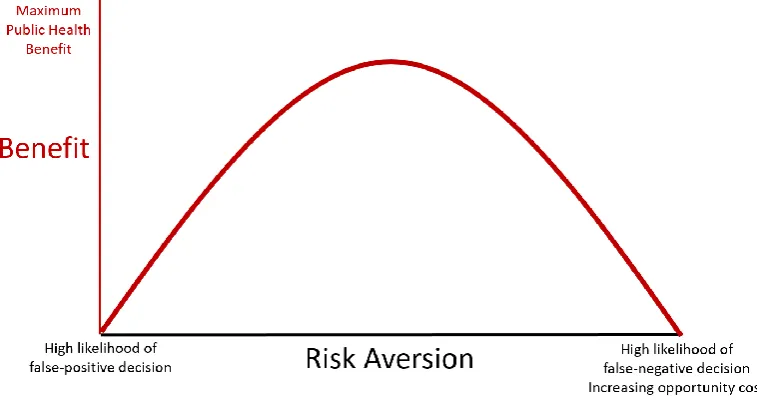
balance. This balance is illustrated in Figure 2. As shown, while a moderate risk aversion results in 186
a great increase of public health benefit, an excessive risk aversion rapidly decreases the benefit. In 187
the case of Covid-19 the pressure is high to move fast. This justifies an appropriate but not excessive 188
risk aversion because the loss of lives and the economic impact of every additional day needed to 189
make the vaccine available are self-evident. However, during routine vaccine development many of 190
these factors are often overlooked and while it is easy to include in the analysis the costs of 191
implementing vaccine programs, it is also easy to forget the opportunity costs associated with the 192
large expenditure of time and resources necessitated by very large trials, and the cost in terms of lives 193
and productivity lost in the target population because of the length of time taken to develop and 194
introduce a new vaccine. The consequence is that a traditional vaccine development timeline requires 195
15-20 years and a cost of US$1 billion, which clearly impact how many vaccines a pharmaceutical 196
company can develop, favor development of vaccines that target high-income populations, and make 197
the development and implementation of novel vaccines for public immunization programs in low- 198
and middle-income countries (LMICs) either unattractive or unsustainable (19). The need to speed 199
up vaccine development could be increased by including these data in a more comprehensive health 200
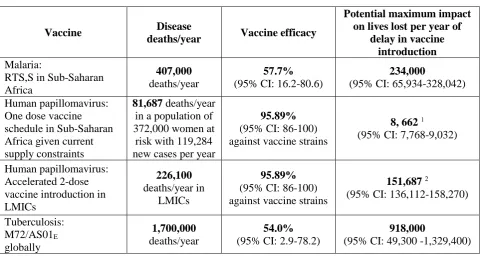
economic analysis. As an example, in Table 1 we report the theoretical lives that would be saved for 201
a few vaccines in the ideal situation in which vaccines were introduced after licensure in all target 202
geographies and assuming immediate availability of vaccines for all target populations. We estimate, 203
for example, that every year the introduction of a malaria vaccine is delayed would result in up to 204
234,000 (95% CI = 65,934 – 328,042) lives lost in Sub-Saharan Africa alone (20, 21). A more 205
conservative estimate from a modeling study comprised of four models still indicated the impact of 206
RTS,S to be between 16,933-34,400 averted deaths per year (22) assuming partial coverage; which, 207
over the multi-year delay for this vaccine, is still a substantial number of lives. Similarly, the delay 208
in the use of a one-dose schedule for human papillomavirus (HPV) vaccination in high-risk areas in 209
Africa has resulted in an estimated 8,991 lives lost per year (23, 24), while the impact of the delay of 210
a two-dose vaccine in LMICs would be up to 151,687 lives lost per year. Furthermore, recent 211
advances in tuberculosis vaccine development suggest that almost 1 million deaths per year could be 212
214
Figure 2. Net public health benefits versus risk aversion in product development. The relationship between risk aversion 215
by regulators on the x-axis, and the expected net public health benefits on the y-axis. The desire to minimize the likelihood 216
of accepting products with unpredicted product-induced adverse effects drives the request for larger and larger safety 217
datasets. By continuing to move to the right and beyond a ‘sweet spot’ of maximum efficiency, increased risk aversion 218
or requests for more data are anticipated to result in diminishing net public health gains from product research and 219
development. The unintended consequences are false-negative decision to deny licensure or restrict a product when actual 220
use would result in more good than harm and increased opportunity costs (25). 221
222
Regulatory environment. 223
Regulatory agencies are generally and increasingly open to embracing innovation and accepting 224
evidence from new technologies, provided that the innovation has been properly validated. In fact, 225
some agencies are already moving toward implementation of several of the tools and techniques 226
mentioned here in other areas of pharmaceutical development, especially with respect to cancer drugs 227
(26, 27). Recent agency-sponsored workshops (for example, the U.S. FDA’s Identification and Use 228
of Biomarkers to Advance Development of Preventive Vaccines: Public Workshop 1) have provided 229
insights and written guidelines on how to implement adaptive trial design, how to use biomarkers, 230
and how to use real-world data for the development of certain therapies (28-30). 231
In the case of Covid-19 the major regulatory agencies are having a good dialog and overall a common 232
and collaborative approach, however this is not the case in most circumstances. Establishing an 233
agreement between regulatory agencies from around the world on the evidence necessary for vaccine 234
licensure is of paramount importance to facilitate and accelerate development and introduction of 235
new vaccines globally. This regulatory convergence would avoid unnecessary duplications of clinical 236
trials and of regulatory information required for vaccine licensure in different countries. 237
Development of master protocols, providing single “umbrella trial designs” that can be applied to 238
multiple vaccines, with pre-specified methods for planning or modifying the sample size, dropping 239
an arm, or other adaptive strategies; and endorsed by the different relevant national regulatory 240
authorities could be a first step in this direction (31). 241
Covid-19 could also provide the opportunity to explore new ways of collecting data from multiple 242
vaccine development programs. For instance, a public dataset with detailed information on the history 243
of regulatory review and approval status for every vaccine would offer significant social value by 244
facilitating research, shed light on cross-national differences in standards, procedures, and timelines; 245
and allow for the identification of bottlenecks—ultimately leading to improved vaccine access and 246
innovation. 247
The dataset could be maintained and hosted by an academic institution (in a similar fashion to the 248
Institute for Health Metrics and Evaluation at the University of Washington) or by a non-249
governmental organization such as Gavi, the Vaccine Alliance. Ultimately, by facilitating research 250
that could accelerate regulatory processes and by providing vaccine manufacturers with more 251
certainty regarding prospective new markets, such a dataset could meaningfully contribute to greater 252
vaccination access and innovation. 253
While we are strongly convinced of the opportunities that are ahead of us, we also realize that the 254
approaches proposed in this article have several limitations. For instance, some of the technologies 255
described are not yet mature and have not yet proven their value. At the same time, since different 256
regulatory agencies may have different approaches, some of the suggestions we make may be already 257
accepted by some regulatory agencies while they may be useful suggestions for others. Also, we 258
acknowledge that the numbers reported in Table 1, which show the full potential benefit of 259
acceleration, were generated using very optimistic scenarios such as 100% coverage immediately 260
after licensure; to date, this has happened only in very exceptional circumstances such as the 261
implementation of the conjugate vaccines against meningococcus A and C in sub-Saharan Africa and 262
the U.K., respectively. 263
In conclusion, the need to develop safe and effective Covid-19 vaccines in the shortest time possible, 264
provides a unique opportunity to challenge the status quo and to introduce new tools such as smarter 265
designs for clinical trials and new regulatory and health economic sciences. The tools suggest here 266
and summarized in Figure 1 may be transformative and allow licensure of Covid-19 vaccines in 18 267
months from the beginning of vaccine development and reduce the time of normal vaccine 268
development and recommendation to ten years or less. At the same time, adopting some or all of these 269
recommendations would likely free up human and financial resources for R&D organizations to 270
develop more and better vaccines. 271
Acknowledgements 273
The authors wish to thank Daniel Cadarette, John Regan, and Nicola Groth for helpful comments and 274
discussions during the preparation of this paper and Giorgio Corsi for the artwork. 275
Conflict of interest 276
S.B. reports personal fees from GSK. 277
D.E.B. reports grants, travel grants, and/or personal fees from Bill and Melinda Gates Foundation, 278
IVI, GSK, Pfizer, Merck, Sanofi - outside the submitted work. 279
R.R. and S.P. are full-time employees of the GSK group of companies. GSK is a company that has a 280
direct financial interest in producing and marketing vaccines. 281
282
Table 1. Estimated morbidity and mortality costs of delayed vaccine introduction a 284
285
Vaccine Disease
deaths/year Vaccine efficacy
Potential maximum impact on lives lost per year of
delay in vaccine introduction
Malaria:
RTS,S in Sub-Saharan Africa
407,000
deaths/year
57.7%
(95% CI: 16.2-80.6)
234,000
(95% CI: 65,934-328,042)
Human papillomavirus: One dose vaccine schedule in Sub-Saharan Africa given current supply constraints
81,687 deaths/year
in a population of 372,000 women at
risk with 119,284 new cases per year
95.89%
(95% CI: 86-100) against vaccine strains
8, 6621
(95% CI: 7,768-9,032)
Human papillomavirus: Accelerated 2-dose vaccine introduction in LMICs
226,100
deaths/year in LMICs
95.89%
(95% CI: 86-100) against vaccine strains
151,6872
(95% CI: 136,112-158,270)
Tuberculosis: M72/AS01E globally
1,700,000
deaths/year
54.0%
(95% CI: 2.9-78.2)
918,000
(95% CI: 49,300 -1,329,400)
286
a To highlight the maximum potential impact of vaccination, the estimates report the theoretical lives 287
per year that would be saved in the ideal situation of achieving 100% vaccination coverage 288
immediately after licensure in all target geographies. 289
290
291
1 The UN estimates that the female population aged 10-14 in Sub-Saharan Africa is 67,248,900 (https://population.un.org/wpp/, accessed on May 6th, 2020). Given the mortality due to cervical cancer in Sub-Saharan Africa of 20/100,000 population and 70% coverage against cancer-causing strains and 95.5% vaccine efficacy against those strains, 8,991 is the number of additional deaths due to the extended use of a two-dose schedule given current capacity limits. HPV estimate based upon a global supply as of 2019 constrained to 30 million doses (WHO). Use of a one-dose schedule would double the population that could be vaccinated. Several studies indicate that effectiveness against long-term infection with HPV 16/18 is the same as a two-dose schedule (32). Currently, the program is capacity-limited to a one-year age group cohort with two doses rather than the five-year age group target population recommended by the WHO. Thus, by vaccinating with a one-dose schedule, vaccination could be expanded to two target cohorts. The mortality above represents the lives lost due to non-vaccination of this additional age group/year.
2 Estimation of global mortality rate of HPV from https://www.gavi.org/sites/default/files/board/minutes/2016/7-dec/presentations/12%20-%20Review%20of%20Gavi%20support%20for%20HPV%20vaccine%20presentation.pdf
References 292
1. D. E. Bloom, V. Y. Fan, J. P. Sevilla, The broad socioeconomic benefits of vaccination. Sci Transl
293
Med10, (2018). 294
2. A. Hekele et al., Rapidly produced SAM((R)) vaccine against H7N9 influenza is immunogenic in 295
mice. Emerg Microbes Infect2, e52 (2013). 296
3. D. Wrapp et al., Cryo-EM structure of the 2019-nCoV spike in the prefusion conformation. Science
297
367, 1260-1263 (2020). 298
4. F. Y. Lin et al., Level of maternal IgG anti-group B streptococcus type III antibody correlated with 299
protection of neonates against early-onset disease caused by this pathogen. J Infect Dis190, 928-934 300
(2004). 301
5. N. Eyal, M. Lipsitch, P. G. Smith, Human challenge studies to accelerate coronavirus vaccine 302
licensure. J Infect Dis, (2020). 303
6. W. H. Chen et al., Single-dose Live Oral Cholera Vaccine CVD 103-HgR Protects Against Human 304
Experimental Infection With Vibrio cholerae O1 El Tor. Clin Infect Dis62, 1329-1335 (2016). 305
7. S. Li et al., Metabolic Phenotypes of Response to Vaccination in Humans. Cell169, 862-877 e817 306
(2017). 307
8. T. D. Querec et al., Systems biology approach predicts immunogenicity of the yellow fever vaccine 308
in humans. Nat Immunol10, 116-125 (2009). 309
9. J. Weiner et al., Characterization of potential biomarkers of reactogenicity of licensed antiviral 310
vaccines: randomized controlled clinical trials conducted by the BIOVACSAFE consortium. Sci Rep
311
9, 20362 (2019). 312
10. K. Kupferschmidt, Successful Ebola treatments promise to tame outbreak. Science365, 628-629 313
(2019). 314
11. E. Andreano, A. Seubert, R. Rappuoli, Human monoclonal antibodies for discovery, therapy, and 315
vaccine acceleration. Curr Opin Immunol59, 130-134 (2019). 316
12. X. Chen et al., Human monoclonal antibodies block the binding of SARS-CoV-2 spike protein to 317
angiotensin converting enzyme 2 receptor. Cell Mol Immunol, (2020). 318
13. F. Micoli et al., Comparative immunogenicity and efficacy of equivalent outer membrane vesicle 319
and glycoconjugate vaccines against nontyphoidal Salmonella. Proc Natl Acad Sci U S A115, 320
10428-10433 (2018). 321
14. N. Hernandez et al., Inherited IFNAR1 deficiency in otherwise healthy patients with adverse 322
reaction to measles and yellow fever live vaccines. The Journal of experimental medicine216, 2057-323
2070 (2019). 324
15. T. A. Lieu et al., Real-time vaccine safety surveillance for the early detection of adverse events. Med
325
Care45, S89-95 (2007). 326
16. A. M. Henao-Restrepo et al., Efficacy and effectiveness of an rVSV-vectored vaccine in preventing 327
Ebola virus disease: final results from the Guinea ring vaccination, open-label, cluster-randomised 328
trial (Ebola Ca Suffit!). Lancet389, 505-518 (2017). 329
17. P. Balmer, R. Borrow, E. Miller, Impact of meningococcal C conjugate vaccine in the UK. J Med
330
Microbiol51, 717-722 (2002). 331
18. S. N. Ladhani et al., Vaccination of Infants with Meningococcal Group B Vaccine (4CMenB) in 332
England. N Engl J Med382, 309-317 (2020). 333
19. R. Rappuoli, S. Black, D. E. Bloom, Vaccines and global health: In search of a sustainable model for 334
vaccine development and delivery. Sci Transl Med11, eaaw2888 (2019). 335
20. A. K. Rowe et al., The burden of malaria mortality among African children in the year 2000. Int J
336
Epidemiol35, 691-704 (2006). 337
21. P. L. Alonso et al., Efficacy of the RTS,S/AS02A vaccine against Plasmodium falciparum infection 338
and disease in young African children: randomised controlled trial. Lancet364, 1411-1420 (2004). 339
22. Gavi the Vaccine Alliance, Vaccine Investment Strategy, Programme & Policy Committee Meeting, 340
18-19 October 2018. Appendix 3: Malaria Vaccine. 341
https://www.gavi.org/sites/default/files/document/ppc-meeting-18-19-october-2018---vis-appendix-342
3--malaria-vaccine-analysispdf.pdf. 343
23. L. Bruni et al., ICO/IARC Information Centre on HPV and Cancer (HPV Information Centre). 344
24. D. M. Harper et al., Efficacy of a bivalent L1 virus-like particle vaccine in prevention of infection 346
with human papillomavirus types 16 and 18 in young women: a randomised controlled trial. Lancet
347
364, 1757-1765 (2004). 348
25. H. G. Eichler et al., The risks of risk aversion in drug regulation. Nat Rev Drug Discov12, 907-916 349
(2013). 350
26. J. J. Darrow, J. Avorn, A. S. Kesselheim, FDA Approval and Regulation of Pharmaceuticals, 1983-351
2018. JAMA323, 164-176 (2020). 352
27. J. M. Sharfstein, Reform at the FDA-In Need of Reform. JAMA323, 123-124 (2020). 353
28. U.S. Food and Drug Administration (FDA), Guidance document: Adaptive Design Clinical Trials for 354
Drugs and Biologics. November 2019. https://www.fda.gov/regulatory-information/search-fda-355
guidance-documents/adaptive-design-clinical-trials-drugs-and-biologics-guidance-industry. 356
29. U.S. Food and Drug Administration (FDA), Guidance document: Biomarker Qualification: 357
Evidentiary Framework. December 2018. https://www.fda.gov/regulatory-information/search-fda-358
guidance-documents/biomarker-qualification-evidentiary-framework. 359
30. U.S. Food and Drug Administration (FDA), Guidance document: Real World Data / Real World 360
Evidence RWD/RWE. July 2018. https://www.fda.gov/regulatory-information/search-fda-guidance-361
documents/real-world-data-real-world-evidence-rwdrwe. 362
31. U.S. Food and Drug Administration (FDA), Master Protocols: Efficient Clinical Trial Design 363
Strategies To Expedite Development of Oncology Drugs and Biologics. October 2018. 364
https://www.fda.gov/regulatory-information/search-fda-guidance-documents/master-protocols-365
efficient-clinical-trial-design-strategies-expedite-development-oncology-drugs-and. 366
32. A. R. Kreimer et al., Proof-of-principle evaluation of the efficacy of fewer than three doses of a 367
bivalent HPV16/18 vaccine. J Natl Cancer Inst103, 1444-1451 (2011). 368
33. N. G. Campos et al., The health and economic impact of scaling cervical cancer prevention in 50 369
low- and lower-middle-income countries. Int J Gynaecol Obstet138 Suppl 1, 47-56 (2017). 370