INTERNAL MARKET
ORIENTATION:
A SOLUTION TO STRATEGY
IMPLEMENTATION
IN ORGANISATIONS
Jose Ruizalba Robledo
|
University of West London, UK
Take care of your people and your people will take care of your business. Internal
Market Orientation as business logic facilitates job satisfaction and commitment
oichiro Honda, founder of Honda Motor Company, learned a lesson from his employees when the company decided to develop a low-emissions automobile engine. He affirmed that the new engine would allow the company to beat the ‘Big Three’ automakers in the United-States, General Motors, Ford and Chrysler. This purely business-focused aim did not seem to enthuse his employees. Nonaka and Takeuchi recount how one of Honda’s young engineers objected to the founder, saying that he would work in the development of this engine, but that he would only do it to fulfil what he believed to be his social and environmental responsibilities. Another employee indicated that he would do it for his children. Mr Honda felt so embarrassed when he heard the objections that he decided that it was time for him to retire (Nonaka and Takeuchi, 2011: 65).
What can we learn from this anecdote? Managers may set very good business goals and design strategies, which can be implemented in many ways, but the attitude of employees will always play a crucial role in promoting their success. Without their commitment, strategy implementation becomes mission impossible. This is why it is so important to know what motivates employees and the impact on customer satisfaction.
Is customer satisfaction possible without employee satisfaction?
Most companies place much effort in measuring and understanding customer satisfaction and their motivations, but less energy in knowing what causes employee satisfaction. If they do not get employees’ satisfaction and commitment, there are less likely to get customer satisfaction (Gummesson, 2000). If only 13% of employees are engaged at work (Gallup, 2013), could a more engaged workforce make a difference?
S
Employees assess what they receive from the companies they work for and also what the firm obtains from them, hence if what they receive is less than what they give, probably they will leave the company. Therefore, managers should monitor this relation of value interchange (Gounaris, 2006). If exchange is at the basis of marketing, it is likely that the same rule applies to the relationships between employees and employers in an internal market context.
In order to satisfy needs, companies offer value through the provision of products or services and, in many cases, a bundle or combination of both product and services. However, from a customer’s perspective it is clear that they mainly seek solutions. Therefore, companies that focus on offering solutions to customers have higher possibilities of success. These solutions come through well-trained and motivated employees who, as Grönroos explains in an interview, ‘keep the promises made to the market’ (Ruizalba and Hafeez, 2015: 40). Solutions come from talented people, which is why competition for the best talent is so high. Solving problems and satisfying needs is a means to achieving high levels of customer satisfaction. This can only be achieved with the best talent to implement the strategy.
People at the core of strategy implementation
The building blocks and heart of good execution are people, strategy and operations (Bossidy and Charan, 2009). Energy, passion, initiative and commitment are the key drivers, which make companies, grow and will lead them to accomplish their goals. There is frequently a gap between managers’ expectations and the capabilities and commitment of employees to fulfil them. Employees with high engagement can exceed customers’ expectations and become real ambassadors of their brands.
Take care of your people and your people will take care of your customers
J.W. Marriot, the founder of Marriot Hotels’ used to say, ‘take care of your people and your people will take care of your customers’. This was his motto to generate customer satisfaction (Katzenbach, 2000: 173).
From an academic perspective, Berry and Parasuranam (1991) developed the notion of ‘internal market’ – i.e treating employees as internal customers to enhance business performance. Years later, Gummesson (2000) stated that achieving internal customer satisfaction is a prerequisite to increase external customer satisfaction. However, pressure to achieve results and market aggressiveness can lead to short-sightedness in managers who then ignore their employees’ needs, and the consequences for their businesses.
Gummesson stated that achieving internal
customer satisfaction is a prerequisite to increase
external customer satisfaction. However, pressure
to achieve results and market aggressiveness
can lead to short-sightedness in managers
who then ignore their employees’ needs,
and the consequences for their businesses
‘Internal market orientation’: The company seen from the perspective of the internal customer
Recently, researchers identified the concept of ‘internal market orientation’ (IMO) grounded on the market orientation paradigm (Kholi and Jaworski, 1990). In the context of internal market, and considering employees as internal customers, three dimensions were proposed to measure IMO: 1) internal market intelligence generation; 2) internal market intelligence communication; and 3) response to intelligence.
Lings and Greenley (2005) and Gounaris (2006) conducted empirical research on the impact of IMO in companies. The main factors analysed were: value interchange between employers and employees; internal segmentation; internal targeting; working conditions; internal communication (vertical and horizontal); training; management concern and, recently also work-family balance (Ruizalba et al., 2014).
Based on Drucker (1974) who defined marketing as the company seen from the customers’ point of view, I propose the concept of ‘internal marketing’ as the company seen from the internal customers’ point of view, that is, the employees. As ‘internal marketing’ is built on trust, when employees trust that the firm is going to deliver what they promise. This approach facilitates that employees develop behaviours that lead to higher quality, which in turn will enrich the service delivery processes and the offer of value.
Gummesson (2000) introduced the term part-time marketers to refer to those employees who, without belonging to the marketing department, however play an important role in promoting a business due to their level of interaction with customers. For this reason, ‘internal marketing’ should contribute to develop internal service mentality at all levels and help employees to advance in the same direction as that of the company strategy. Following
What are the implications of IMO for firms?
Strategy includes design and implementation, and there is often a difference between what top management proclaims and what frontline employees do. Strategy execution can be more important than design itself. IMO plays an important role in strategy implementation, in particular in services as it facilitates customer orientation. One of the findings of research on IMO is that it has a positive influence on job satisfaction and employees’ commitment and the three main factors that influence IMO are internal communication, management concern, and training (Ruizalba
et al. 2014). Therefore, a first recommendation to managers is to implement action plans to improve those aspects of the business as this will also have an impact on customer orientation. Five implications for businesses that could help to take direct action in their strategy are summarised in Table 1:
IMO can improve job satisfaction and employees’ commitment.
Improvement in job satisfaction and employees’ commitment can contribute to higher servicequality.
Improvement in servicequality helps to increase customersatisfaction.
Customersatisfaction can boost economic performance.
IMO can be beneficial to improve firmperformance and employees’ professionalandindividualdevelopment.
TABLE 1Five implications of IMO and firm performances
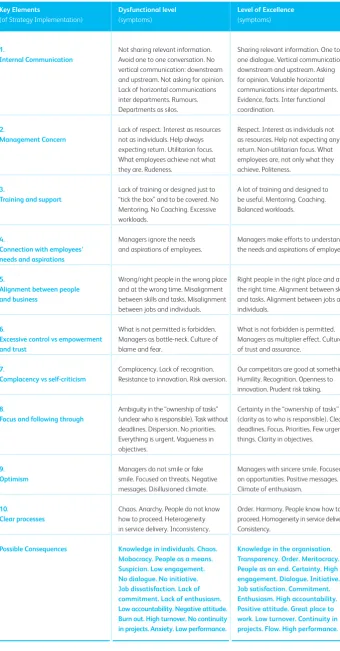
Ten key diagnostic elements to assess strategy implementation
Based on IMO factors, ten key diagnostics elements for strategy implementation can be used to analyse organisations:
1. Internal communication
2. Management concern
3. Training and support
4. Connection with employees’ needs
and aspirations
5. Alignment between people and business
6. Excessive control vs empowerment and trust
7. Complacency vs self-criticism
8. Focus and following through
9. Optimism
10. Clear processes
1
2
3
4
5
Image
© Druck
er F
ound
Key Elements
(of Strategy Implementation)
Dysfunctional level (symptoms)
Level of Excellence (symptoms) Continuity of people and strategy
implementation
Talent management is what makes exceptional organisations different from the rest. Lewis and Heckman (2006) describe talent management as a ‘mindset’ and an attempt to ensure that everyone at all levels works to the top of their potential. This includes attracting and retaining talent, making employees perform better, and engaging them in the design and implementation of the strategy in the long-term. IMO facilitates talent management, through the three main dimensions described before. IMO permits talent management not in general, but managing the talent inherent in each individual, for that reason IMO also plays an important role in job satisfaction and employee’s commitment: two crucial outcomes of talent management that affect retention. Increasing talent retention is decisive because strategy implementation becomes difficult without continuity of people.
Taking care of employees is not in contradiction with being demanding with people as professionals. It is about establishing relationships that respect individuals’ views, and where professional and personal development is a good indicator of excellent management.
References
Berry, L. and Parasuranam, A. (1991) Competing through quality. Free Press: New York
Bossidy, L. and Charan, R. (2009) Execution: the discipline of getting things done. New York: Crown Business Drucker, P. (1974) Management: tasks, responsibilities, practices. London: Heinemann Professional Publishing Gallup (2013) State of the Global Workplace. Online: http:// www.gallup.com/services/178517/state-global-workplace.aspx [Accessed February 2016]
Gounaris, S. (2006) Internal-market orientation and its measurement. Journal of Business Research 59: 432–448 Gummesson, E. (2000) Internal marketing in the light of relationship marketing and network organizations. In R. J. Varey and B.R. Lewis ‘Internal Marketing’: Directions for Management. New York: Routledge: 27-42
Katzenbach, J.R. (2000) Peak Performance: Aligning the Hearts and Minds of your Employees. Boston, Massachusetts: Harvard Business School Press
Kohli, A. and Jaworsky, B. (1990) Market orientation: the construct, research propositions and managerial implication Report No. 90-113. Cambridge, MA: Marketing Science Institute
Levitt, T. (1960) Marketing myopia. Harvard Business Review
38(4): 24-47
Lewis, R. E. and Heckman, R. J. (2006) Talent management: a critical review. Human Resource Management Review 16: 139-154
Lings, I.N. and Greenley, G.E. (2005) Measuring internal market orientation. Journal of Service Research 7 (3): 290–305 Nonaka, I. and Takeuchi, H. (2011) The wise leader. Harvard Business Review 89 (5): 58-67
Ruizalba, J., Bermúdez, G., Rodríguez-Molina, M. and Blanca, M. (2014) Internal Market Orientation: An empirical research in hotel sector. International Journal of Hospitality Management 38: 11-19
Ruizalba, J. and Hafeez, K. (2015). Keeping promises: interview with Professor Christian Grönroos. New Vistas 1(1): 38-43 About the authors
Dr Jose Ruizalba Robledo is Senior Lecturer in Business and Management at the Claude Littner Business School, University of West London
Keywords
Internal market orientation; commitment; job satisfaction; internal communication; strategy implementation.
TABLE 2Key elements of strategy implementation: dysfunctional and excellence levels
1.
Internal Communication
2.
Management Concern
3.
Training and support
4.
Connection with employees’ needs and aspirations
5.
Alignment between people and business
6.
Excessive control vs empowerment and trust
7.
Complacency vs self-criticism
8.
Focus and following through
9. Optimism
10.
Clear processes
Possible Consequences
Not sharing relevant information. Avoid one to one conversation. No vertical communication: downstream and upstream. Not asking for opinion. Lack of horizontal communications inter departments. Rumours. Departments as silos.
Lack of respect. Interest as resources not as individuals. Help always expecting return. Utilitarian focus. What employees achieve not what they are. Rudeness.
Lack of training or designed just to “tick the box” and to be covered. No Mentoring. No Coaching. Excessive workloads.
Managers ignore the needs and aspirations of employees.
Wrong/right people in the wrong place and at the wrong time. Misalignment between skills and tasks. Misalignment between jobs and individuals.
What is not permitted is forbidden. Managers as bottle-neck. Culture of blame and fear.
Complacency. Lack of recognition. Resistance to innovation. Risk aversion.
Ambiguity in the “ownership of tasks” (unclear who is responsible). Task without deadlines. Dispersion. No priorities. Everything is urgent. Vagueness in objectives.
Managers do not smile or fake smile. Focused on threats. Negative messages. Disillusioned climate.
Chaos. Anarchy. People do not know how to proceed. Heterogeneity in service delivery. Inconsistency.
Knowledge in individuals. Chaos. Mobocracy. People as a means. Suspicion. Low engagement. No dialogue. No initiative. Job dissatisfaction. Lack of commitment. Lack of enthusiasm. Low accountability. Negative attitude. Burn out. High turnover. No continuity in projects. Anxiety. Low performance.
Sharing relevant information. One to one dialogue. Vertical communication: downstream and upstream. Asking for opinion. Valuable horizontal communications inter departments. Evidence, facts. Inter functional coordination.
Respect. Interest as individuals not as resources. Help not expecting any return. Non-utilitarian focus. What employees are, not only what they achieve. Politeness.
A lot of training and designed to be useful. Mentoring. Coaching. Balanced workloads.
Managers make efforts to understand the needs and aspirations of employees.
Right people in the right place and at the right time. Alignment between skills and tasks. Alignment between jobs and individuals.
What is not forbidden is permitted. Managers as multiplier effect. Culture of trust and assurance.
Our competitors are good at something. Humility. Recognition. Openness to innovation. Prudent risk taking.
Certainty in the “ownership of tasks” (clarity as to who is responsible). Clear deadlines. Focus. Priorities. Few urgent things. Clarity in objectives.
Managers with sincere smile. Focused on opportunities. Positive messages. Climate of enthusiasm.
Order. Harmony. People know how to proceed. Homogeneity in service delivery. Consistency.