Article
Axial Diffusion of the Higher Order Scheme on the
Numerical Simulation of Non-steady Partial
Differential Equation in the Human Pulmonary
Capillaries
Azim Aminataei and Mohammadhossein Derakhshan *
1
2
3
4
5
6
7
8
9
10
11
Faculty of Mathematics, K. N. Toosi University of Technology, P.O. Box: 1676-53381, Tehran, Iran; [email protected]
* Correspondence:[email protected]
Abstract: Inthepresentstudy,amathematicalmodelofnon-steadypartialdifferentialequationfrom theprocessofoxygenmasstransportinthehumanpulmonarycirculationisproposed.Mathematical modellingof thiskindofproblems leadto anon-steadypartialdifferential equationandforits numericalsimulation,wehaveusedfinitedifferences.Theaimoftheprocessistheexactnumerical analysisofthestudy,whereinconsistency,stabilityandconvergenceisproposed.Thenecessityof doingtheprocessisthat,wewouldliketoincreasetheorderofnumericalsolutiontoahigherorder scheme. Anincrementintheorderofnumericalsolutionmakes thenumericalsimulationmore accurate,alsomakesthenumericalsimulationbeingmorecomplicated.Inaddition,theprocessof numericalanalysisofthestudyinthisorderofsolutionneedsmoreresearchwork.
Keywords: non-steady partialdifferential equation; higherorderfinited ifferences cheme;axial diffusion;convergence;consistency;stability
MSC:Primary:35-02,35B30,35B35,35B65.Secondary:92B05
12
1. Introduction 13
A brief review literature is given as follows: Wu et al. [1] have presented a numerical simulation of
14
blood flow in two anarysmal vessels, using mixture theory, the velocity fields and spatial distribution
15
of the red blood cell-induced platelet transport in Saccular Aneurysms and the plasma are predicted.
16
Bridges et al. [2] have studied the flow of a shear-thinning, chemically-reacting fluid that could be used
17
to model the flow of the synovial fluid. They have solved the balance of linear momentum together with
18
a convection-diffusion equation. Hund and Antaki [3] have proposed an extended convection-diffusion
19
model based on the diffusive balance of a fictitious field potential, that accounts for the gradients of both
20
the dilute phase and the local hematocrit. Wu and Massoudi [4] have studied the effects of dissipation
21
in the couette flow and heat transfer in a drilling fluid, and explore the effects of concentration and
22
the shear-rate and temperature-dependent viscosity, along with a variable thermal conductivity .
23
Massoudi and Antaki [5] have developed a model for blood using the theory of interacting continua,
24
that is, the mixture theory. They have discussed, a framework for modelling the rheological behavior of
25
blood. Skorczewski et al. [6] have considered computational simulations using a 2D lattice-Boltzmann
26
immersed boundary method were conducted to investigate the motion of platelets near a vessel wall
27
and close to an intravascular thrombus. Burger’s equation [7] (Johannes Martinus Burger), a Dutch
28
scientist, devised a simplified form of Navier–Stokes equation, in the presence of convective term and
29
diffusive term wherein uses the study of opposite effects of convection and diffusion at a basic level.
30
This equation is fundamental in modelling shockes and has found immense application in area of
31
viscous flow, such as blood flow in a creeping fluid. Zhan and Wang [8] have studied mathematical
32
modelling of convection enhanced delivery (CED) of chemo-therapeutic drugs which can successfully
33
bypass the blood-brain barrier. The modelling demonstrates the advantages of convection enhanced
34
delivery in enhancing the convective flow of intenstitial fluid and reducing the drug concentration
35
dilution caused by the fluid loss from blood stream in the tumour region around the infusion site.
36
The delivery outcomes of the drug in CED treatments are strongly dependent on its physico-chemical
37
properties. Kaesler et al. [9] computed computational modelling of oxygen transfer in artificial lungs.
38
Their study introduces an approach to model the oxygen transfer in blood on a fiber level with CFD.
39
Plasma and RBCs were implemented as two phases and the reaction of hemoglobin and oxygen to
40
oxyhemoglobin was included in the convection-diffision equation in form of a source term. Melnik and
41
Jenkins [10] concentrated on computational control of flow in airblast atomisers for pulmonary drug
42
delivery. In the paper, PDD systems based on airblast atomisation have been analysed mathematically.
43
Mountrakis et al. [11] simulated RBCs and platelets to explore their transport behavior in aneurysmal
44
geometries. They considered two aneurysms with different aspect ratios in presence of fast and slow
45
blood flows, and examined the distributions of the cells. Whittle et al. [12] suggest that the presence
46
of intra-aneurysmal clot in giant intracranial aneurysms has little prognostic significance and does
47
not alter the management or outcome after treatment. Hirabayashi et al. [13] considered a lattice
48
Boltzmann simulation of blood flow in a vessel deformed by the presence of an aneurysm. They
49
propose a stent positioning factor as characterizing tool for stent pore design in order to describe the
50
flow reduction effect and reveal the several flow reduction mechanisms using this effect. Weir [14] is
51
reviewed the pathological, radiological, and clinical information regarding unruptured intracranial
52
aneurysm. The author concluded that the current state of knowledge about unruptured aneurysms
53
does not support the use. The largest diameter of the lesion as the sole criterim on which to base
54
treatment decisions, although it is undoubted importance.
55
Now, apart from the above discussion on convective-diffusion equations and in the remaining
56
short span of the time and pages in this study, we try to examine higher order finite difference scheme
57
to approximate time-dependent partial differential equation including axial and radial diffusions
58
with convective effect of the blood. The standard convection-diffusion model is based on continuum
59
approach wherein we are using here. Also, our approach want to examine the effect of axial diffusion
60
since normally most of the models consider only radial diffusion as we did in our previous studies.
61
Here, it should be mentioned that, to our knowledge this happens for the first time in this order
62
of magnitude. Further, this kind of equation has application in bio-engineering problems, e.g.,
63
propagation of material [15], boundary layer of fluids, electrical circuits in cables and the mass transfer
64
problems with respect to the conditions [16–26]. In addition, our discussion is on the convergence,
65
consistency, and stability [27] of finite differences equations which describe the model.
66
2. Mathematical Description of the Model as a Whole 67
Let us consider at first, the RBC distribution and the blood flow transport. When we have
68
succeeded, we can add aneurysms wherein it has been described in the different literature in
69
introduction in our future study.
70
In the pulmonary capillaries, we have:
∂ci(p,t)
∂t =−∇.Ji(p,t) +Ri(p,t), (1)
whereci(p,t)is the concentration of the i-th species (i.e., oxygen or carbondioxide) at the positionp
and the timet. Position p in Cartesian co-ordinate is(x,y,ζ)or in polar co-ordinate is(r,θ,ζ)with
an origin [22]. The quantity Ji(p,t)is equivalent to the sum of the fluxes of species andRi(p,t)is the
of convection and diffusion and is according the Fick’s first law of diffusion. Hence, the mass balance in the Equation (1) for thei-th species is[24]:
∂ci(p,t)
∂t =−∇.
v(p,t)ci(p,t)−Di(p)∇ci(p,t)
+Ri(p,t), (2) even due Equation (2) is in capillaries, it can be written more precisely as:
∂ci(x,r,t)
∂t =−v(r)
∂ci(x,r,t) ∂x +Di∇
2ci(x,r,t) +Ri(x,r,t), (3)
where∇2= ∂2
∂r2 +r−1∂∂r+ ∂ 2
∂x2. 71
Initial condition ci(x,r, 0) can be taken arbitrary, or with the solution of the steady-state
72
Equation (3) as a whole. Boundary conditions could be as the following:
73
(i) concentration in the beginning is zero or finite and for the flux (radial) ∂ci(x,r,t)
∂x atx=L(at the end
74
of capillary) is constant,
75
(ii) ∂ci(x,0,t)
∂r =0 (symmetry at the center of capillary), and 76
(iii) another condition is at the capillary wall where the derivative of the equations will be considered,
77
wherein depend on the species. For oxygen which is combined with the hemoglobin inside RBCs,
78
concentration in Equation (3) is the concentrations of plasma and RBCs. Hence, the diffusion has two
79
components, first diffusion in plasma and the second, diffusion of oxygen which is corresponded to
80
the diffusion of oxygen in the RBCs.
81
2.1. In the Tissues 82
We have the following:
∂ci(p,t) ∂t =∇.
Di(p)∇ci(p,t)+Ri(p,t), (4)
hence, in tissue and at polar co-ordinate, we have:
∂c(x,r,t) ∂t =D∇
2c(x,r,t) +R(t). (5)
2.2. Transport Inside the Components 83
Differential equations is inside the tissues, and if we want the space of the cells, we should add again boundary conditions. A condition in connection of blood concentration and tissue condition which is regarding the influence of capillary wall. With continuity assumption of the capillary wall, we have:
c(x,a,t)|b= c(x,a,t)
α |t, (6)
D∂c(x,a,t) ∂r |b=D
∂c(x,a,t)
∂r |t, (7)
wherebandtstands for blood and tissue. Equation (6) announce that blood in the capillary wall is equivalent to that of tissue (with a coefficient ofα) and Equation (7) expresses that there is a balance
between capillary and the tissue. If the capillary wall has a permeability, the Equations (6) and (7) will be:
−
D∂c(x,a,t) ∂r
|b=p(x)cb(x,a,t)−ct(x,a,t) α
=
−
D∂c(x,a,t) ∂r
At the end, mathematical models for the description of transport equations in the pulmonary capillary
84
and surrounding tissue is considered in this section. Equations (1)–(7) show the vector flux of the
85
convection and diffusion which is based on Fick’s first law of diffusion. These equations are described
86
in Cartesian and polar co-ordinates. For solution of equation, arbitrary initial condition and boundary
87
conditions of (i) to (iii) is required. If capillary wall has a permeability, Equation (8) can be used [29].
88
3. Mathematical Description of the Model in the Present Study 89
New, we consider the following time-dependent partial differential equation as a simplification of section 2. Such an equation occurs in the transport of oxygen in a slab of capillary which depends on the unsteady transport by convection and the unsteady diffusion (axial as well as radial in the directions). The capillary is assumed to be a 2D channel of thickness 2aanda=1, respectively. Hence, the equation is:
ct+ucy=D(cxx+cyy), (9)
for 0≤ x ≤1; 0 ≤y ≤1 andt >0. In the capillary slab, the flow is laminar and is assumed to be
90
uniform with an average velocityu=0.4, and the diffusion coefficient of oxygen is considered as a
91
constant quantity,D=0.24. The first and second terms on the left-side are respectively the rate of
92
change of concentration per unit time and the transport due to convection whereas the terms on the
93
right-side indicate the free molecular diffusion in the radial as well as axial directions. Equation (9) is
94
to be solved under the following boundary, entrance and initial conditions.
95
(i) Boundary conditions:
96
(a) the flux of flow during the line of symmetry is zero, e.g.,
97
cx(0,y,t) =0; for∀tand 0≤y≤1, (9a)
98
(b) at the wall of horizontal line, we have:
99
c(1,y,t) =1; for∀tand 0≤y≤1, (9b)
100
(ii) Entrance conditions:
101
(c) in the start of axial direction, we have:
102
c(x, 0,t) =0; for∀tand 0≤x≤1, (9c)
103
(d) and at the wall of axial direction for the flux, we have:
104
cy(x, 1,t) =1; for∀tand 0≤x ≤1, (9d)
105
(iii) Initial condition:
106
(e) for the initial condition, we have:
107
c(x,y, 0) =0; forx≥0 andy≥0. (9e)
108
3.1. Description of the Domain Using Finite Difference Scheme 109
For the finite difference method, we divide the domain of interest into different meshes of net sizes∆x,∆yand∆tin thex,y, andtdirections respectively. Any node of the mesh can be represented as:
xi =i∆x;i=0, 1, 2, . . . ,(I−1), . . . ,n, yj =j∆y;j=1, 2, . . . ,(J−1), . . . ,m, tk =k∆t;k=1, 2, . . . ,
wherein n∆x = 1 andm∆y = 1. In the finite difference approximation, by applying the central,
110
backward and forward finite differences for each partial derivative in Equation (9), we obtain different
111
difference equations, which are an approximate solution of Equation (9). In this study, with application
112
of some of these difference equations, we consider the consistency and stability of these equations
113
because there is an important connection between the consistency of a stable finite difference scheme
114
and the convergence of its solution to that of the partial differential equation it approximates. Lax’s
115
equivalence theorem [30] states that if a finite difference approximation to a well-posed linear initial
value problem is consistent, then stability is a necessary and sufficient condition for convergence.
117
The two restrictions which apply to this theorem should be carefully noted. Firstly, the initial value
118
problem must be well-posed; that is, the solution of the partial differential equation must depend
119
continuously on the initial data. Secondly, the theorem only applies to linear problems. The important
120
feature of linear equations is the sum of separate solutions are also a solution of the equation, which
121
leads to the fact that the error terms themselves satisfy the homogeneous form of the finite difference
122
equation which approximates the given differential equation. This theorem is of considerable practical
123
importance. For while, it is relatively easy to show that a finite difference equation is stable and
124
that it is consistent with a partial differential equation. It is usually very difficult to show that the
125
solution of a finite difference equation converges to the solution of the partial differential equation
126
that it approximates. Lax’s equivalence theorem is needed to prove convergence in order to the finite
127
difference approximation to the unsteady convective-diffusion Equation of (9), because the given
128
differential equation is linear and is well-posed, it is sufficient to prove consistency and stability of the
129
finite difference approximations of the Equation (9).
130
3.2. Appearance of Difference Equation by Application of Crank–Nicolson Method 131
For the partial derivatives in the Equation (9), we use central finite differences at the points
(i∆x,j∆y,(k+12)∆t)as follows:
ct= 1
∆t(c
k+1
i,j −c
k
i,j) +O{(∆t)2}, cy= 1
2
c k
i,j+1−cik,j−1
2∆y +
cki,+1j+1−cki,+1j−1
2∆y
+O{(∆y)2},
cxx= 1
2
c k
i+1,j−2cki,j+cki−1,j (∆x)2 +
cik+1,+1j−2cki,+1j +cki−+11,j (∆x)2
+O{(∆x)2}, and
cyy= 1
2
c k
i,j+1−2cki,j+cki,j−1
(∆y)2 +
cik,+1j+1−2cki,+1j +cki,+1j−1 (∆y)2
+O{(∆y)2},
we put these approximations in Equation (9):
cki,+1j −cik,j
∆t +
u
2
c k
i,j+1−cki,j−1
2∆y +
cki,+1j+1−cki,+1j−1
2∆y
= D
2
c k
i+1,j−2cki,j+cki−1,j (∆x)2 +
cik+1,+1j−2cki,+1j +cki−+11,j (∆x)2
+ D
2
c k
i,j+1−2cik,j+cki,j−1
(∆y)2 +
cik,+1j+1−2cki,+1j +cki,+1j−1 (∆y)2
.
Hence, we have:
cki,+1j −cki,j
∆t +
u
4∆y
(cik,j+1−cik,j−1) + (cik,+1j+1−cki,+1j−1)
= D
2(∆x)2
(cki+1,j−2cki,j+cki−1,j) + (cki+1,+1j−2cki,+1j +cki−+11,j)
+ D
2(∆y)2
(cki,j+1−2cki,j+cki,j−1) + (cki,+1j+1−2cki,+1j +cki,+1j−1)
which is the difference equation of Equation (9). By taking,p= (u∆∆yt)andq= (D∆t)
(∆x)2 = (D∆t)
(∆y)2 wherein
∆x=∆y, we have:
cki,+1j −cki,j+ p
4
(cki,j+1−cki,j−1) + (cki,+1j+1−cki,+1j−1) = q
2
(cki+1,j−2cki,j+cki−1,j) + (cki+1,+1j−2c k+1
i,j +c
k+1
i−1,j)
+q
2
(cki,j+1−2cki,j+cki,j−1) + (cki,+1j+1−2c
k+1
i,j +c
k+1
i,j−1)
,
wherein, we have:
4cki,+1j −4cki,j+p
(cki,j+1−cki,j−1) + (cki,+1j+1−cki,+1j−1) =2q
(cki+1,j−2cki,j+cki−1,j) + (cki+1,+1j−2cki,+1j +cki−+11,j) +2q
(cki,j+1−2cki,j+cki,j−1) + (cki,+1j+1−2c
k+1
i,j +c
k+1
i,j−1)
,
and
−2qcki−+11,j+ (4+8q)cki,+1j −2qcik+1,+1j =2qcki−1,j+ (4−8q)cki,j+2qcki+1,j
+p(cki,j−1−cki,j+1) +2q(cki,j−1+cki,j+1) +p(cki,+1j−1−cki,+1j+1) +2q(cki,+1j−1+cki,+1j+1), (10) where,i = 0, 1, . . . ,n−1;j = 1, 2, . . . ,mandk = 0, 1, 2, . . .. With application of the boundary and initial conditions, we have: with respect to Equation (9b) for eachjandk, we have:
ckn,j=1, (11)
with respect to Equation (9c) for eachiandk, we have:
cki,0=0. (12)
Here, for numerical solution, we consider m=10. Therefore, by using central differences and with respect to Equation (9d), for eachiandk, we have:
cy= 1
2
c k
i,j+1−cki,j−1
2∆y +
cki,+1j+1−cki,+1j−1
2∆y
+O{(∆y)2},
andj=m=10.⇒∆y= m1,⇒∆y=0.1. Thus,
1= 1
2
c k i,11−cki,9
0.2 +
cki,11+1−cki,9+1
0.2
, (13)
and
cki,11+1+cki,11=0.4+cki,9+1+cki,9; (14) where we use the termscki,11+1+cki,11from Equation (14) in the numerical solution of Equation (9). With respect to Equation (9e) for eachiandj, we have:
and with respect to Equation (9a) for eachjandk, we have:
cx= 1
2
c k
i+1,j−cki−1,j
2∆x +
cki+1,+1j−cki−+11,j
2∆x
+O{(∆x)2}, ati=0, we have:
0= 1
2
c k
1,j−ck−1,j
2∆x +
ck1,+1j −ck−+11,j
2∆x
,
and therefore,
ck−+11,j+ck−1,j=ck1,+1j +ck1,j. (16)
Now in Equation(10), we have:
−2qck−+11,j+ (4+8q)ck0,+1j −2qc1,k+1j =2qck−1,j+ (4−8q)c0,kj+2qck1,j +p(c0,kj−1−c0,kj+1) +2q(ck0,j−1+ck0,j+1) +p(ck0,+1j−1−c
k+1
0,j+1) +2q(c
k+1
0,j−1+c
k+1
0,j+1),
with application of Equation (16), we have:
−2q(ck1,+1j +ck1,j) + (4+8q)c0,k+1j −2qck1,+1j = (4−8q)ck0,j+2qck1,j+p(ck0,j−1−ck0,j+1) +2q(ck0,j−1+ck0,j+1) +p(ck0,+1j−1−ck
+1
0,j+1) +2q(ck +1 0,j−1+ck
+1 0,j+1),
wherein,
(4+8q)ck0,+1j −4qck1,+1j = (4−8q)ck0,j+4qc1,kj+p(ck0,j−1−ck0,j+1)
+2q(ck0,j−1+ck0,j+1) +p(ck0,+1j−1−c0,k+1j+1) +2q(ck0,+1j−1+ck0,+1j+1). (17) Now by puttingi=n−1, in Equation (10), we have:
−2qckn−+12,j+ (4+8q)ckn−+11,j−2qckn+1,j =2qckn−2,j+ (4−8q)ckn−1,j+2qckn,j
+p(ckn−1,j−1−ckn−1,j+1) +2q(ckn−1,j−1+ckn−1,j+1) +p(ckn−+11,j−1−ckn−+11,j+1) +2q(ckn−+11,j−1+ckn−+11,j+1), and with application of Equation (11), we have:
−2qckn−+12,j+ (4+8q)ckn−+11,j−2q=2qckn−2,j+ (4−8q)ckn−1,j+2q
+p(ckn−1,j−1−ckn−1,j+1) +2q(ckn−1,j−1+ckn−1,j+1) +p(ckn−+11,j−1−ckn−+11,j+1) +2q(ckn−+11,j−1+ckn−+11,j+1), hence, we have:
−2qckn−+12,j+ (4+8q)ckn−+11,j =2qckn−2,j+ (4−8q)ckn−1,j+p(cn−k 1,j−1−ckn−1,j+1)
+2q(ckn−1,j−1+ckn−1,j+1) +p(ckn−+11,j−1−c
k+1
n−1,j+1)
+2q(ckn−+11,j−1+cn−k+11,j+1) +4q. (18) Now with application of Equations (10), (17) and (18), the matrix form of Equation (9) can be as follows:
Acj,k+1=Bcj,k+p[cj−1,k−cj+1,k] +2q[cj−1,k+cj+1,k]
where,AandBare square matrices of tri-diagonal dimensions of ordernas follows:
A=
4+8q −4q
−2q 4+8q −2q
. .. . .. . ..
−2q 4+8q −2q
−2q 4+8q
,
and
B=
4−8q 4q
2q 4−8q 2q
. .. . .. . ..
2q 4−8q 2q
2q 4−8q
,
dandcj,k+1are column vectors of ordernas bellows:
d=
0, 0, . . . , 0, 4q T
, cj,k+1=
c0,k+1j ,c1,k+1j , . . . ,ckn−+11,j T
,
wherein with the solution of this system by using Gauss elimination method or Gauss-Seidel method
132
or Thomas algorithm, thecj,k+1can be find. 133
3.3. The Truncation Error and Consistency 134
Difference equation of Equation (9) is as follows:
Fik,j(c) = 1
∆t(c
k+1
i,j −c
k i,j) +
u
4∆y
(cik,j+1−cki,j−1) + (cki,+1j+1−c
k+1
i,j−1)
− D
2(∆x)2
(cki+1,j−2cki,j+cki−1,j) + (cki+1,+1j−2cki,+1j +ci−k+11,j)
− D
2(∆y)2
(cki,j+1−2cki,j+cki,j−1) + (cki,+1j+1−2c
k+1
i,j +c
k+1
i,j−1)
SinceΓki,j = Fik,j(c); therefore by takings= ∆t,r = ∆yandh = ∆xand applying Taylor series [30] about the point(i∆x,j∆y,k∆t), we have:
∗cik,+1j =cki,j+s∂c ∂t|
k i,j+
s2
2!
∂2c ∂t2|
k
i,j+. . . , (20)
∗cik,j+1=cki,j+r∂c ∂y|
k i,j+
r2
2!
∂2c ∂y2|
k i,j+
r3
3!
∂3c ∂y3|
k i,j+. . . ,
∗cik,j−1=cki,j−r ∂c ∂y|
k i,j+
r2
2!
∂2c ∂y2|
k i,j−
r3
3!
∂3c ∂y3|
k i,j+. . . ,
∗cik+1,j =cki,j+h∂c ∂x|
k i,j+
h2
2!
∂2c ∂x2|
k i,j+
h3
3!
∂3c ∂x3|
k i,j+. . . ,
∗ci−k 1,j =cki,j−h ∂c ∂x|
k i,j+
h2
2!
∂2c ∂x2|
k i,j−
h3
3!
∂3c ∂x3|
k i,j+. . . ,
∗cki,+1j+1=cki,j+s∂c ∂t|
k i,j+r
∂c ∂y|
k i,j+
s2
2!
∂2c ∂t2|
k i,j+
2sr
2!
∂2c ∂t∂y|
k i,j
+r
2
2!
∂2c ∂y2|
k i,j+
s3
3!
∂3c ∂t3|
k i,j+
3s2r
3!
∂3c ∂t2∂y|
k i,j+
3sr2
3!
∂3c ∂t∂y2|
k i,j
+r
3
3!
∂3c ∂y3|
k i,j+
s4
4!
∂4c ∂t4
|k i,j+
r4
4!
∂4c ∂y4
|k i,j+. . . ,
∗cki,+1j−1=cki,j+s∂c ∂t|
k i,j−r
∂c ∂y|
k i,j+
s2
2!
∂2c ∂t2|
k i,j−
2sr
2!
∂2c ∂t∂y|
k i,j
+r
2
2!
∂2c ∂y2|
k i,j+
s3
3!
∂3c ∂t3|
k i,j−
3s2r
3!
∂3c ∂t2∂y|
k i,j+
3sr2
3!
∂3c ∂t∂y2|
k i,j
−r
3
3!
∂3c ∂y3|
k i,j+. . . ,
∗cki+1,+1j =cki,j+s∂c ∂t|
k i,j+h
∂c ∂x|
k i,j+
s2
2!
∂2c ∂t2|
k i,j+
2sh
2!
∂2c ∂t∂x|
k i,j
+h
2
2!
∂2c ∂x2|
k i,j+
s3
3!
∂3c ∂t3|
k i,j+
3s2h
3!
∂3c ∂t2∂x|
k i,j+
3sh2
3!
∂3c ∂t∂x2|
k i,j
+h
3
3!
∂3c ∂x3|
k i,j+. . . ,
∗cki−+11,j =cki,j+s∂c ∂t|
k i,j−h
∂c ∂x|
k i,j+
s2
2!
∂2c ∂t2|
k i,j−
2sh
2!
∂2c ∂t∂x|
k i,j
+h
2
2!
∂2c ∂x2|
k i,j+
s3
3!
∂3c ∂t3|
k i,j−
3s2h
3!
∂3c ∂t2∂x|
k i,j+
3sh2
3!
∂3c ∂t∂x2|
k i,j
−h
3
3!
∂3c ∂x3|
In the following expressions, we can findΓki,j.
Fik,j(c) = 1 s
cik,+1j −cki,j + u
4r
(cik,j+1−cki,j−1) + (cik,+1j+1−cki,+1j−1)
− D
2h2
(cki+1,j−cki,j) + (ci−k 1,j−cki,j) + (cki+1,+1j−cki,+1j ) + (ci−k+11,j−cki,+1j )
− D
2r2
(cki,j+1−cik,j) + (cki,j−1−cki,j) + (cki,+1j+1−c
k+1
i,j ) + (c
k+1
i,j−1−c
k+1
i,j )
,
⇒Fik,j(c) = 1 s c
k i,j+s
∂c ∂t k i,j+
s2
2!
∂2c ∂t2 k i,j+
s3
3!
∂3c ∂t3 k
i,j+. . .−c k i,j
+ u
4r
cki,j+r∂c ∂y k i,j+
r2
2!
∂2c ∂y2 k i,j+
r3
3!
∂3c ∂y3 k
i,j+. . .−c k i,j
− cki,j−r∂c ∂y k i,j+
r2
2!
∂2c ∂y2 k i,j−
r3
3!
∂3c ∂y3 k
i,j+. . .−c k i,j
+ cki,+1j +r∂c ∂y
k+1
i,j +
r2
2!
∂2c ∂y2
k+1
i,j +
r3
3!
∂3c ∂y3
k+1
i,j +. . .−c
k+1
i,j
− cki,+1j −r∂c ∂y
k+1
i,j +
r2
2!
∂2c ∂y2
k+1
i,j −
r3
3!
∂3c ∂y3
k+1
i,j +. . .−c
k+1
i,j
− D
2h2
cki,j+h∂c ∂x k i,j+
h2
2!
∂2c ∂x2 k i,j+
h3
3!
∂3c ∂x3 k
i,j+. . .−c k i,j
+ cki,j−h∂c ∂x k i,j+
h2
2!
∂2c ∂x2 k i,j−
h3
3!
∂3c ∂x3 k
i,j+. . .−c k i,j
+ cki,+1j +h∂c ∂x
k+1
i,j +
h2
2!
∂2c ∂x2
k+1
i,j +
h3
3!
∂3c ∂x3
k+1
i,j +. . .−c
k+1
i,j
+ cki,+1j −h∂c ∂x
k+1
i,j +
h2
2!
∂2c ∂x2
k+1
i,j −
h3
3!
∂3c ∂x3
k+1
i,j +. . .−c
k+1
i,j
− D
2r2
cki,j+r∂c ∂y k i,j+
r2
2!
∂2c ∂y2 k i,j+
r3
3!
∂3c ∂y3 k
i,j+. . .−c k i,j
+ cki,j−r∂c ∂y k i,j+
r2
2!
∂2c ∂y2 k i,j−
r3
3!
∂3c ∂y3 k
i,j+. . .−c k i,j
+ cki,+1j +r∂c ∂y
k+1
i,j +
r2
2!
∂2c ∂y2
k+1
i,j +
r3
3!
∂3c ∂y3
k+1
i,j +. . .−c
k+1
i,j
+ cki,+1j −r∂c ∂y
k+1
i,j +
r2
2!
∂2c ∂y2
k+1
i,j −
r3
3!
∂3c ∂y3
k+1
i,j +. . .−c
k+1
i,j
,
⇒Fik,j(c) = ∂c ∂t k i,j+
s
2!
∂2c ∂t2 k i,j+
s2
3!
∂3c ∂t3 k
i,j+. . .+ u 4 ∂c ∂y k i,j+
r2
3!
∂3c ∂y3 k
i,j+. . .+ ∂c ∂y k i,j+
r2
3!
∂3c ∂y3|
k i,j+. . .
+ ∂c ∂y
k+1
i,j +
r2
3!
∂3c ∂y3|
k+1
i,j +. . .+ ∂c ∂y
k+1
i,j +
r2
3!
∂3c ∂y3|
k+1
i,j +. . .
−D
2
1
2
∂2c ∂x2|
k i,j+
h2
4!
∂4c ∂x4|
k i,j+. . .
+1
2
∂2c ∂x2|
k i,j+
h2
4!
∂4c ∂x4|
k
i,j+. . .+
1 2
∂2c ∂x2|
k+1
i,j +
h2
4!
∂4c ∂x4|
k+1
i,j +. . .
+1
2
∂2c ∂x2|
k+1
i,j +
h2
4!
∂4c ∂x4|
k+1
i,j +. . . −D 2 1 2
∂2c ∂y2|
k i,j+
r2
4!
∂4c ∂y4|
k
i,j+. . .+
1 2
∂2c ∂y2|
k i,j+
r2
4!
∂4c ∂y4|
k i,j+. . .
+1
2
∂2c ∂y2|
k+1
i,j +
r2
4!
∂4c ∂y4|
k+1
i,j +. . .+
1 2
∂2c ∂y2|
k+1
i,j +
r2
4!
∂4c ∂y4|
k+1
i,j +. . .
⇒Fik,j(c) = ∂c ∂t k i,j+
s
2!
∂2c ∂t2 k i,j+
s2
3!
∂3c ∂t3 k
i,j+. . .+ u 4 ∂c ∂y k i,j+
r2
3!
∂3c ∂y3|
k
i,j+. . .+ ∂c ∂y k i,j+
r2
3!
∂3c ∂y3|
k i,j+. . .
+ ∂c ∂y k i,j+s
∂2c ∂t∂y
k i,j+. . .
+r
2
3!
∂3c ∂y3|
k i,j+s
∂4c ∂t∂y3
k i,j+. . .
+ ∂c ∂y k i,j+s
∂2c ∂t∂y|
k i,j+. . .
+r
2
3!
∂3c ∂y3|
k i,j+s
∂4c ∂t∂y3|
k i,j+. . .
−D 2 1 2
∂2c ∂x2|
k i,j+
h2
4!
∂4c ∂x4|
k i,j+. . .
+1
2
∂2c ∂x2|
k i,j+
h2
4!
∂4c ∂x4|
k
i,j+. . .+
1 2
∂2c ∂x2|
k i,j+s
∂3c ∂t∂x2|
k i,j+. . .
+h
2
4!
∂4c ∂x4|
k i,j+s
∂5c ∂t∂x4|
k i,j+. . .
+1
2
∂2c ∂x2|
k i,j+s
∂3c ∂t∂x2|
k i,j+. . .
+h
2
4!
∂4c ∂x4
|k i,j+s
∂5c ∂t∂x4
|k i,j+. . .
− D 2 1 2
∂2c ∂y2|
k i,j+
r2
4!
∂4c ∂y4
|k i,j+. . .
+1
2
∂2c ∂y2|
k i,j+
r2
4!
∂4c ∂y4|
k i,j+. . .
+1
2
∂2c ∂y2|
k i,j+s
∂3c ∂t∂y2|
k i,j+. . .
+r
2
4!
∂4c ∂y4|
k i,j+s
∂5c ∂t∂y4|
k i,j+. . .
+1
2
∂2c ∂y2|
k i,j+s
∂3c ∂t∂y2|
k i,j+. . .
+r
2
4!
∂4c ∂y4|
k i,j+s
∂5c ∂t∂y4|
k i,j+. . .
,
⇒Fik,j(c) = ∂c ∂t k i,j+
s
2!
∂2c ∂t2 k i,j+
s2
3!
∂3c ∂t3 k i,j
+u
4
4∂c
∂y k i,j+2s
∂2c ∂t∂y|
k i,j+
4r2
3!
∂3c ∂y3 k i,j+
2r2
3! 2s
∂4c ∂t∂y3
k i,j
−D 2 2∂ 2c ∂x2 k i,j+s
∂3c ∂t∂x2|
k i,j+
h2
3!
∂4c ∂x4 k i,j+2
h2
4!s
∂5c ∂t∂x4
k i,j
−D 2 2∂ 2c ∂y2 k i,j+s
∂3c ∂t∂y2|
k i,j+
r2
3!
∂4c ∂y4 k i,j+2
r2
4!s
∂5c ∂t∂y4
k i,j
,
⇒Fik,j(c) = ∂c ∂t k i,j+u
∂c ∂y k
i,j−D
∂2c ∂x2 k
i,j−D
∂2c ∂y2 k i,j+
s
2
∂2c ∂t2 k i,j
+ s
2u
∂2c ∂t∂y
k i,j−
s
2D
∂3c ∂t∂x2
k i,j−
s
2D
∂3c ∂t∂y2
k i,j+
s2
3!
∂3c ∂t3 k i,j
+u
4 4r2
3!
∂3c ∂y3 k i,j+
4r2
4! s
∂4c ∂t∂y3
k i,j
− D
2
h2
3!
∂4c ∂x4 k i,j+
2h2
4! s
∂5c ∂t∂x4
k i,j
−D
2
r2
3!
∂4c ∂y4 k i,j
+2r
2
4! s
∂5c ∂t∂y4
k i,j
,
with respect to Equation (9),we have:
∂c ∂t +u
∂c ∂y −D
∂2c ∂x2 −D
∂2c ∂y2 =0.
And by obtaining derivative with respect to timet, we have:
∂2c ∂t2 +u
∂2c ∂t∂y −D
∂3c ∂t∂x2−D
therefore, we have:
Fik,j(c) = s
2
3!
∂3c ∂t3 k i,j+u
r2
3!
∂3c ∂y3 k i,j+
r2
3!s
∂4c ∂t∂y3
k i,j
−D h
2
3!
∂4c ∂x4 k i,j+
2h2
4! s
∂5c ∂t∂x4
k i,j
−D r
2
3!
∂4c ∂y4 k i,j+
2r2
4! s
∂5c ∂t∂y4
k i,j
.
Hence, the introduced difference equation is consistent with the unsteady convective-diffusion (in both
135
directions) partial differential Equation (9) and has the error of order ofO (∆t)2+ (∆x)2+ (∆y)2 136
wherein we want to achieve.
137
3.4. Stability of the Mathematical Model 138
With respect to the matrix form of Equation (19) and the boundary conditions ony, we have:
−(−p+2q)ckj+1+1+Ackj+1−(p+2q)ckj−+11 = (−p+2q)ckj+1+Bckj+ (p+2q)ckj−1+d, (21)
forj=2, 3, . . . ,m−2; and inj=1, we have:
−(−p+2q)ck2+1+Ack1+1= (−p+2q)ck2+Bck1+d, (22) and inj=m−1, we have:
1 2
ckm+1−ckm−+12
2∆y
+1
2
ck
m−ckm−2
2∆y
=1.
Hence,
Acm−k+11−4qcm−k+12=Bckm−1+4qckm−2+d+ (−p+2q)4∆y. (23)
The relations (21), (22) and (23) in matrix form can be written as follows:
Mck+1=Nck+Q, where,
M=
A (p−2q)I
−(p+2q)I A (p−2q)I
. .. . .. . ..
−(p+2q)I A (p−2q)I
−4qI A
m2×m2
,
ck+1=
ck1,1+1,c2,1k+1, . . . ,ckm+1,1,c1,2k+1,ck2,2+1, . . . ,cmk+1,2, . . . ,ckm+1,m T
m2×1
,
ck=
ck1,1,ck2,1, . . . ,ckm,1,c1,2k ,ck2,2, . . . ,ckm,2, . . . ,ckm,m T
m2×1
N=
B (−p+2q)I
(p+2q)I B (−p+2q)I
. .. . .. . ..
(p+2q)I B (−p+2q)I
(p+2q)I B
m2×m2
;
Under matrixQ:
Q=
d d
.. .
d+ f
m2×1
,
and f = 4(−p+2q)∆yI. With respect to the stability concept by [32], here we pursue the suitable stability condition for the above difference equation. Suppose at first, for a small perturbation, we put
ck∗+1instead ofck+1andck∗instead ofck. Then, we consider:
M(ck+1−ck∗+1) =N(ck−ck∗) +Q−Q;
For, ek+1 = ck+1−ck∗+1, we have: Mek+1 = Nek; therefore, ek+1 = M−1Nek; hence, kek+1k1 =
kM−1Nekk
1≤ kM−1Nk1kekk1= kM−1Nk1k+1ke0k1; also, we have: kM−1Nk1≤ kM−1k1kNk1(we
takek.k1[33]). Since matrix M is strictly diagonally dominant, it is invertible andkM−1k16=0. Define
T= kMM+Ik
1,kTk1≤1. Obviously, we have:kM+Ik16=0 (whereinkM+Ik1= p+2q+3),
I−(T−I)T−1
I+T−I = I,
kT−1k1=kI−(T−I)T−1k1≤ kIk1+kT−Ik1kT−1k1,
(1− kT−Ik1)kT−1k1≤1;(kT−Ik1≤1)−→ kT−1k1≤ 1
1− kT−Ik1.
Now, by substitution of kMM+Ik
1, we have:
k( M
kM+Ik1)
−1k
1=kM+Ik1kM−1k1≤
1
1− k M
kM+Ik−Ik1
;
⇒ kM−1k1≤ k 1
M+Ik1− kM− kM+Ik1Ik1;
⇒ kM−1k1kNk1≤ kNk1
kM+Ik1− kM− kM+Ik1Ik1 ≤ 4+14q+2p
4+18q+2p <1.
Hence, for real and positive values ofpandq, the difference scheme is unconditionally stable.
139
This means that for each∆t,∆xand∆y, the difference scheme is unconditionally stable.
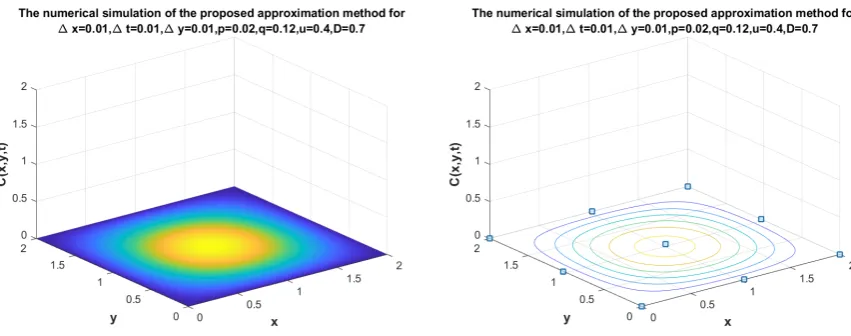
Figure 1. The numerical simulation of the proposed approximation method for equation (9) with ∆x=0.01,∆t=0.01,∆y=0.01,p=0.02,q=0.12,u=0.4,D=0.24
Figure 2. The numerical simulation of the proposed approximation method for equation (9) with ∆x=0.05,∆t=0.05,∆y=0.05,p=0.02,q=0.12,u=0.4,D=0.3
0 0.2 0.4 0.6 0.8 1 1.2 1.4 1.6 1.8 2
x
0 0.5 1 1.5 2 2.5 3
c(x,y,t)
D=0.24 D=0.4 D=0.7 D=0.9 Exact
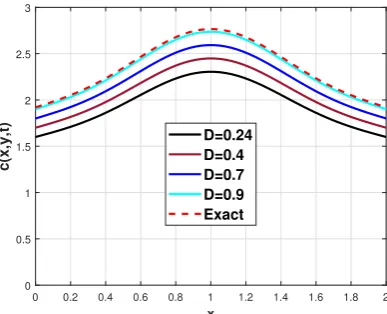
Figure 4.The comparison of the obtained solutions of the proposed approximation method and exat solution for equation (9) with various values ofD.
Figure 5.Comparison between exact and approximate solution for equation (9) with various values of D.
0 10 20 30 40 50 60 70 80 90
t -0.1
-0.08 -0.06 -0.04 -0.02 0 0.02
Stability
D=0.5
0 10 20 30 40 50 60 70 80 90
t -1.2
-1 -0.8 -0.6 -0.4 -0.2 0 0.2 0.4
Stability
D=0.8
4. Numerical Investigation of the Present Study 141
In the present study, the unsteady convective-diffusion (in the both directions) partial differential
142
equation (9) together with the boundary (9a, b), entrance (9c, d) and initial (9e) conditions is solved
143
numerically by the finite difference scheme. For this, the first order derivative in time is approximated
144
by the second order difference formula and the diffusion terms in axial and radial directions is
145
expressed by the second order Crank-Nicolson difference operator. On one hand, the approximation of
146
convective term in the governing equation by central differences provides the non-physical oscillation
147
in the solution. On the other hand, upwind finite difference scheme gives the solution free from
148
the oscillation but it reduces the accuracy of the solution. Thus, for retaining the second order
149
accuracy of the solution for convective term, the Crank-Nicolson second order accuracy of the finite
150
difference scheme is used to approximate the convective term which provides the solution free from
151
the oscillations. The finite difference formulation leads to a system of linear algebraic equations which
152
needs a technique for computing the solution. It may be noted that the system has the tri-diagonal
153
character [34]. Such a system can be solved by the point iterative methods. However, the convergence
154
of the point iterative methods is very slow. In order to achieve faster convergence, we can use the line
155
iterative method. This method uses the tri-diagonal character of the coefficient matrix of equation, and
156
is easy to solve by the Thomas algorithm. Further, it may be noted that, by using this technique, the
157
equation involves an unknown c at every row for a fixed time level which saves the storage on the
158
computer. According to the Lax’s equivalence theorem, mathematical proofs of the numerical solution
159
technique were obtained. Hence, the consistency and stability of the equations were investigated which
160
assure the convergences. Computations have been done for ten intervals with x=0.1 in the positive
161
x direction, the step size y=0.1 in the positive y direction and the time step t=0.05 in the positive t
162
direction. The programs were tested even for the smaller step sizes. The technique described here can
163
be used to solve any linear system of unsteady convective-diffusion partial differential equation where
164
the axial diffusion term is ignored. Further, we may point out that the technique works in the equations
165
including axial diffusion term as well wherein we have done here in the form of the equation(9).
166
5. Numerical results 167
In this section, we show the numerical simulation of the proposed approximation method for
168
various values ofD,u,∆x,∆y,∆t,p,qto verify the efficiency of the proposed numerical method. The
169
numerical simulation of the proposed approximation method in Figures 1to 4are shown. The
170
behaviour of the obtained error for different values ofDare presented in Figure5. In Figure6stability
171
of the approximate solution for equation (9) with various values ofDare presented.
172
6. Conclusions 173
In the present study, we have considered a mathematical model for studying the non-steady
174
transport of oxygen in a slab of capillary. The capillary is assumed to be a two-dimensional channel
175
in dimensionless form. We have found that the difference equation which is described here, has the
176
same higher order of accuracy, wherein we want to achieve. We have increased the order of accuracy
177
from our previous studyO[(∆t) + (∆y) + (∆x)2][35], to the present higher order scheme using the
178
Crank–Nicolson method, i.e.,O[(∆t)2+ (∆x)2+ (∆y)2]. For stability condition, we have seen that, the
179
equations presented in the previous sections, are all stable and the results converges well. Further,
180
numerical results show that the axial diffusion does not effect the process of the oxygenation in a slab
181
of the capillary.
182
Acknowledgments 183
The authors wish to thank the unknown referees for their valuable comments and suggestions.
References 185
1. Wu, W.T.; Li, Y.; Aubry, N.; Massoudi, M.; Antaki, J.F. Numerical simulation of red blood cell-induced 186
platelet transport in saccular aneurysms.Appl. Sci.2017,7, 484. 187
2. Bridges, C.; Karra, S.; Rajagopal, K.R. On modelling the response of the synovial fluid: Unsteady flow of a 188
shear-thinning , chemically-reacting fluid mixture.Comput. Math. Appl.2010,60, 2333. 189
3. Hund, S.J.; Antaki, J.F. An extended convection diffusion model for red blood cell-enhanced transport of 190
thrombocytes and leukocytes.Phys. Med. Biol.2009,54, 6415. 191
4. Wu, W.T.; Massoudi, M. Heat transfer and dissipation effects in the flow of a drilling fluid.Fluids2016,1, 4. 192
5. Massoudi, M.; Antaki, J. An anisotropic constitutive equation for the stress tensor of blood based on mixture 193
theory.Math. Probl. Eng., doi:10.1155/2008/579172. 194
6. Skorczewski, T.; Erickson, L.C.; Fogelson, A.L. Platelet motion near a vessel wall or thrombus surface in 195
two-dimensional whole blood simulations.Biophysical J.2013,104, 1764. 196
7. Burger, J.M. Numerical study on non-linear Burger’s and modified Burger’s equations using B-Splines. 197
Internet Connection. 198
8. Zhan, W.; Wang, C.H. Convection enhanced delivery of chemotherapeutic drugs into brain tumour.J. Control. 199
Release2018,271, 74.
200
9. Kaesler, A.; Rosen, M.; Schmitz-Rode, T.; Steinseifer, U.; Arens, J. Computational modelling of oxygen 201
transfer in artificial lungs.Artif. Organs2018, doi:10.1111/aor.13146. 202
10. Melnik, R.V.N.; Jenkins, D.R. On computational control of flow in airblast atomisers for pulmonary drug 203
delivery.Int. J. Pharm.2002,239, 23. 204
11. Mountrakis, L.; Lorenz, E.; Hoekstra, A.G. Where do the platelets go? A simulation study of fully resolved 205
blood flow through aneurysmal vessels.Interface Focus2013, doi:10.1098/rsfs.2012.0089. 206
12. Whittle, I.R.; Dorsch, N.W.; Besser, M. Spontaneous thrombosis in giant intracranial aneurysms.J. Neurol. 207
Neurosurg. Psychiatry1982,45, 1040.
208
13. Hirabayashi, M.; Ohta, M.; Rüfenacht, D.A.; Chopard, B. Characterization of flow reduction properties in an 209
aneurysm due to a stent.Phys. Rev. E2003,68, 021918. 210
14. Weir, B. Unruptured intracranial aneurysms: A review.J. Neurosurg.2002,96, 3. 211
15. Desai, C.S.; Johnson, L.D. Evaluation of some numerical schemes for consolidation.Int. J. Numer. Methods 212
Eng.1973,7, 243.
213
16. Aminataei, A.; Sharan, M.; Singh, M.P. A numerical solution for the non-linear convective facilitated diffusion 214
reaction problem for the process of blood oxygenation in the lungs.J. Nat. Acad. Math.1985,3, 182. 215
17. Aminataei, A.; Sharan, M.; Singh, M.P. A numerical model for the process of gas exchange in the pulmonary 216
capillaries.Ind. J. Pure. Appl. Math.1987,18, 1040. 217
18. Aminataei, A.; Sharan, M.; Singh, M.P. Two layer model for the process of blood oxygenation in the 218
pulmonary capillaries-parabolic profiles in the core as well as in the plasma layer.Appl. Math. Modelling. 219
1988,12, 601.
220
19. Aminataei, A. A numerical two layer model for blood oxygenation in lungs.Amir-Kabir J. Sci. Tech.2001,12, 221
63. 222
20. A. Aminataei, Comparision of explicit and implicit approaches to numerical solution of uni-dimensional 223
equation of diffusion,J. of Sci., Al-Zahra Univ.2002,1, 15. 224
21. A. Aminataei, Blood oxygenation in the pulmonary circulation: a review,Euro. J. Scien. Res.2005,10, 55. 225
22. A. Aminataei, A numerical simulation of the unsteady convective-diffusion equation,The J. of Damghan Univ. 226
of Basic Scis.2008,1, 73.
227
23. A. Aminataei and S. Hassani, An efficient numerical method for the solution of initial and boundary values 228
problems,J. of Sci., Al-Zahra Univ.2009,22, 13. 229
24. E.F. Leonard and S.B. Jørgensen, The analysis of convection and diffusion in capillary beds,Annu. Rev. 230
Biophys. Bioeng.1974,3, 293.
231
25. A. Aminataei, Simulation of the breathing gases in the airways,J. Advan. Math. Model.2012,1, 51. 232
26. Aminataei, A. A mathematical model for oxygen dissociation curve in the blood.Eur. J. Sci. Res.2005,6, 5. 233
27. Lapidus, L.; Pinder, G.F.Numerical Solution of Partial Differential Equations in Science and Engineering; John 234
Wiley & Sons: New York, NY, USA, 1982. 235
29. Sharan, M.; Singh, M.P.; Aminataei, A. A numerical model for blood oxygenation in the pulmonary 237
capillaries-effect of pulmonary membrane resistance.BioSystems1987,20, 355. 238
30. Lax, P.D.; Richtmyer, R.D. Survey of the stability of linear finite difference equations.Commun. Pure Appl. 239
Math.1959,9, 267.
240
31. Evans, G.; Blackledge, J.; Yardleg, P.Numerical Methods for Partial Differential Equations; Springer-Verlag: 241
London, UK, 2000. 242
32. Smith, G.D.Numerical Solution of Partial Differential Equations: Finite Difference Methods; Oxford University 243
Press: Oxford, UK, 1993. 244
33. Noye, J.Numerical Simulation of Fluid Motion; North-Holland: Amsterdam, The Netherlands, 1978. 245
34. Thomas, L.H. Elliptic Problems in Linear Difference Equations Over a Network. Watson Scientific Computing 246
Laboratory, New York, Columbia University, 1949. 247
35. Aminataei, A. Numerical simulation of the process of oxygen mass transport in the human pulmonary 248