Article
Exploring Teacher Perceptions on Incorporating
Socially Embedded Science Contexts – Development
of a Valid and Reliable Instrument
TBM Chowdhury 1, *, Jack Holbrook2, Pedro Reis 3 and Miia Rannikmäe 4 1 University of Tartu; [email protected]
2 University of Tartu, [email protected]
3 Instituto de Educação, Universidade de Lisboa, [email protected] 4 University of Tartu, [email protected]
* Correspondence: [email protected]; Tel.:
Received: date; Accepted: date; Published: date
Abstract: The study recognizes the growing concern to incorporate social aspects in science education, going beyond the classroom practice and promoting collective participation in achieving sustainable development of the society. To address this concern, the 4-stage teaching model based on contextualization, de-contextualization, re-contextualization and trans-contextualization of science education aims to address the desired active informed citizenry. Interviews carried out earlier to this study reveals that teachers’ perspectives come as the most significant factor in incorporating social aspects in science teaching for achieving active informed citizenry. This study primarily seeks to develop and instrument to explore the extent of current practice of incorporating social aspects in science teaching through the 4-stage model and their perceived importance to address the promotion of students’ awareness, participation with the aim to prepare an informed and active citizenry. The instrument was piloted among 110 teachers who share the similar community of practice to address the students’ awareness and participation for social benefit. Through expert validation, Cronbach’s Alpha and exploratory factor analysis, the questionnaire was finalised as a valid and reliable instrument to explore teachers’ perspectives to use 4-stage teaching model to promote active informed citizenry for sustainable development of the society.
Keywords: science education; active informed citizenry; socially embedded science context; teacher perceptions; context based learning; questionnaire
1. Introduction
Educators have advocated paying attention to citizenship aspects through science education [1] in addressing the growing concern to promote global citizenship [2] through education for the sustainable development of the society [3]. In doing so, science educators have emphasized the need to promote a scientifically informed citizenship [4]–[6] who are actively engaged [7], [8] and collectively participate for the benefit of the society [9]. This can be seen as contributing towards a perception of a desired citizenry [10] in acquiring personally responsible, participatory, justice oriented and politically concerned attributes [11], [12].
In addressing the need for science education to play its role in promoting a desired citizenry, socially embedded science contexts play a significant role, requiring science education to develop a sense of social engagement among learners [13]. Socially embedded science contexts include a wide range of considerations, i.e. social motivation, social relevant ‘social interaction’ [4], or ‘socio-affective
experiences’ [14]. However, in order to incorporate these social aspects, education, including science education, needs to encompasses experiences beyond school cognition learning even to the extent of incorporating a beyond- school focus and to develop a sense of a need for collectivization for informed action [15].
While recent literature promotes the need to incorporate more socially embedded science contexts in science teaching, for teachers to play a crucial role their perspectives become influential factor [16]. For example, teacher perspectives become critical aspect in addressing students’ motivation [17], constructive science learning processes [18], socio-scientific skills (i.e. argumentation, reasoning, consensus decision making) [19], [20] and self-actualisation for using learning outcomes for sustainable development of the society.
Teacher perceptions are one of the most significant factors in incorporating social contexts. Teacher perspectives can be envisaged as teachers’ impression of, or even evaluation on, their primary perceived teaching expectations. For this, teacher competence [21] and self-efficacy [22] are influenced by their beliefs [23]. Other factors that may also play a role include experience of teaching including their own learning [24], involvement in continuous development programmes [22] and even their views on the expectancy on the outcome of their teaching [25].
Several studies have investigated teachers’ perspectives and beliefs and their subsequent practices through a various of research approaches e.g. semi-structured interviews [26], in-depth interviews [27], a longitudinal case study [28], a detailed case study [29], participation in SSI programmes [14], focused groups followed by a questionnaire [30], small group discussion on SSI before and after intervention [31], group interviews followed by a questionnaire [32], questionnaire followed by interviews [33], [34], teachers’ belief questionnaire [35], naturalistic investigation [36]. However, few investigations reflect on the various perspectives on how to operationalize social integration into science teaching.
The aim of this study is to develop a valid and reliable instrument to explore teachers’ perspectives in promoting various dimensions of social aspects enabling science education to become more transdisciplinary towards meeting society needs. The instrument is intended to answer the following research questions:
1. What are the teachers’ current practices and perceived importance of incorporating social contexts in science education?
2. In what approaches do teachers recognize an inside classroom dimension and an outside learning institutional environment functioning to promote students’ awareness and students’ collective participation in meeting society issues addressing sustainability of the society through science education?
2. Literature Review
Social context
Literature recognizes the importance of a teacher emphasis on including social aspects in line with a shift of focus in the curriculum towards inclusiveness and intercultural factors in order to promote the social and intercultural skills of learners [37]. A social context can aid the promotion social skills like: moral reasoning [38], informed argumentation [39], decision making [40], as aspects with science education. In fact, in referring to the importance of considering social contexts within socially embedded in science teaching, it is pointed out that the context is in fact a significant factor and that it is:
‘not just a backdrop against which learning takes place’ (p. 3) [41].
Social context-based science education
A social context, or the inclusion of social foci, address society relevant concerns to intrigue student motivation [17], [48] adding to interest for science learning [49] and actualization of relevance of science within everyday life [50], as well as determining their prior knowledge on the science topic [51]. This social framework further enables students to develop their argumentation [52], moral reasoning [53], values [54], ethics [27] and informed decision making skills [47] in relevant social issues.
Context-based learning approaches
Context based learning (CBL) is considered as a very pragmatic approach to bridge the gap between students’ science learning and the application of the learning in their everyday life, social life and the dynamic technological advancements [55]. In doing so, CBL has been a significant influence in science teaching and learning in providing a framework for student to have an opportunity to encounter, discuss, or even deal with a socially embedded focal issue [49]. The issue intends to stimulate students’ interest and motivation to not only acquire content [56], but also to promote active participation in socio-scientific situations [57]. Nevertheless, literature explains context as a formation by the participants, which includes the teachers, students, all tangible and intangible resources, including the ideology and strategy of the teaching learning activities [58].
In general, context-based learning requires a student-centred environment for promoting self-learning as active self-determination [57]. The implication of context-based self-learning not only addresses a perceived shift for science education to move towards a more social interrelationship [56], but also is hypothesized to address key challenges perceived over the last 20 years such as – promoting isolated facts, lack of relevance and inadequate emphasis [49], [56]. From several literature source [59]–[61], it can be suggested that the context has emerged as an influential and widespread tool for designing learning interventions.
3. Materials and Methods
This study seeks to develop a validated instrument to explore perceived importance of incorporating socio-scientific aspects in their teaching and teachers’ current practices. It was promoted in 4 stages.
(a) Initial teacher interviews, carried out to identify factors which influence teacher promotion of socio-scientific teaching.
(b) Instrument development
(c) Initial validation of the instrument.
(d) A pilot study to determine reliability of the instrument.
Samples:
Teacher interview: A purposeful sample of 10 teachers related to different expertise and experiences of teachers were identified as followed:
1. Highly experienced teachers having prior involvement in in-service courses (3 participants; Group A),
2. Experienced teachers without any involvements in projects or in-service courses (3 participants; Group B).
3. Teachers who recently completed a pre-service or in-service course (2 participants; Group C), and
4. Recently graduated teachers without any involvements in projects or in-service courses (2 participants; Group D).
Pilot study: 111 teachers were chosen purposefully for the pilot study, based on their willingness to participate in the study. All participants were involved in science teaching, sharing a similar community of practice through the ‘We act’ project, which promotes student awareness and activism in socio-scientific and socio-environmental issues [7], [62]–[64]. The participants, identified by the project coordinator, were contacted via email and all email recipients responded and participated in the study. The selected group of participants were selected, based on their experience gained in incorporating socially embedded science contexts.
The experience of the teachers for the pilot study ranged from less than a year to more than 35 years. All teachers had a master’s degree in their teaching topic, with 14.15% of the participants (15 teachers) having a doctoral degree. Among the participants, 16.04% (17 teachers) had not received any teacher training experience.
Instruments used:
Interview questions: The in-depth interviews with the 10 individual teachers explored their ownership in incorporating social aspects in science teaching [65]. The questions asked were based on 4 constructs related to teachers’ ownership to promote:
(i) students’ socio-scientific decision making;
(ii) establishing students’ social values through science teaching; (iii) students’ character development to play a role within society;
(iv) orientation towards recognizing, as teachers, the need to promote science related careers and economic and other social aspects, for example, addressing sustainable development through science education.
The conclusions from the in-depth interview (described in the results section) led to the primary focus of the questionnaire to explore the teachers’ perceived importance on incorporating socially embedded science context in their teaching.
Development of the questionnaire:
In developing the initial draft of the questionnaire, outcomes from the teacher interviews, plus a prior instrument used for a recent study exploring teachers’ perception of involvement in society for active citizenship [82] was taken under consideration for items development.
The intended instrument seeks to explore teachers’ perspectives on incorporating society embedded science topics in their science teaching. The purpose is to explore how far teachers see this approach being of value in helping students to address sustainable development goals within the society. The collected data intends to provide insights of current practice and teachers’ perceived importance of incorporating socially embedded science topics to address a need for active informed citizenry.
The questionnaire was developed in seeking to explore
• teachers’ perceived importance (Construct 1), perceived feasibility (Construct 2) and teachers current practice (Construct 3) of incorporating socially embedded science contexts 4 different orientations for addressing (1) student motivation, interest, relevance, and prior knowledge (C), (2) introducing scientific activities (D), (3) promoting socio-scientific decision making skills in classroom discussion (R) and (4) widening the application of those decisions outside classroom dimension (T).
• teachers’ perceived importance on incorporating socially embedded science contexts through classroom activities promote students’ social competences, i.e. (1) addressing student awareness of conceptual science embedded in local, national or global issues (SA), (2) developing their perception of values, morals, ethics in complex socio-scientific issues (VME), and (3) promoting student participation in addressing societal development issues through ill-structured, socio-scientific, cross-curricular contexts (SP). (Construct 4)
Based on the above-mentioned rationale, 5 constructs were developed as:
a. teachers’ perceived importance to incorporate socially embedded contexts within science teaching;
b. teachers’ current practice in incorporating socially embedded science contexts;
c. teachers’ perceived feasibility to incorporate socially embedded science contexts in their teaching;
d. teachers’ perceived importance to promote social competences through science education through three sub-constructs (SA, VME, SP) based on the expected outcomes of using social contexts in teaching, and
e. teachers’ perceived importance to promote students’ conceptualisation of science in society clustered into three sub-constructs on the expected outcomes (SA, VME, SP) of using social contexts through out-of-school promotion associated with science education.
The initial questionnaire is given in appendix A.
The initially devised questionnaire was subsequently revised, based on: (a) expert opinions before undertaking the pilot study;
(b) analysis of post data collection from the questionnaire, based on statistical findings indicating suitability.
Data Collection:
The teacher interview data were collected through semi-structured open-ended questions. Data was recorded and transcribed for analysis.
Expert opinions were solicited electronically via email. Expert validation of the questionnaire was based on critical comments to four specific questions:
a. Do the constructs follow the rationales, philosophy and purpose of the instrument? b. Do the items follow the constructs and intend to provide verified data?
c. What would be the appropriate Likert scale points in each case?
d. Is there any case where more specifications/explanations/examples will be helpful for better understanding the question?
Data collection for the pilot study was via a questionnaire devised electronically using Google Forms and sent via email.
Data analysis:
The interview data was transcribed, thematically analyzed to conclude to results.
The expert opinions were recorded electronically with their comments on each item and constructs in Microsoft Excel format.
The data from the pilot study were analyzed using SPSS.
Validity and reliability of the instrument:
The instrument was analyzed by experts to establish validity [66] and to measure the reliability of the questionnaire, responses were analyzed using Cronbach Alpha [67].
4. Results
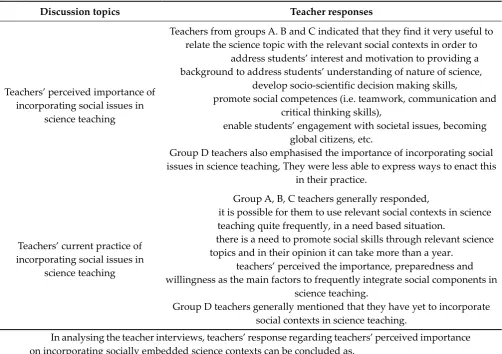
The following table compiles teachers’ opinion on the perceived importance and possibility to incorporate socially embedded science contexts.
Table 1. Responses from the teacher interview .
Discussion topics Teacher responses
Teachers’ perceived importance of incorporating social issues in
science teaching
Teachers from groups A. B and C indicated that they find it very useful to relate the science topic with the relevant social contexts in order to
address students’ interest and motivation to providing a background to address students’ understanding of nature of science,
develop socio-scientific decision making skills,
promote social competences (i.e. teamwork, communication and critical thinking skills),
enable students’ engagement with societal issues, becoming global citizens, etc.
Group D teachers also emphasised the importance of incorporating social issues in science teaching, They were less able to express ways to enact this
in their practice.
Teachers’ current practice of incorporating social issues in
science teaching
Group A, B, C teachers generally responded,
it is possible for them to use relevant social contexts in science teaching quite frequently, in a need based situation.
there is a need to promote social skills through relevant science topics and in their opinion it can take more than a year.
teachers’ perceived the importance, preparedness and willingness as the main factors to frequently integrate social components in
science teaching.
Group D teachers generally mentioned that they have yet to incorporate social contexts in science teaching.
In analysing the teacher interviews, teachers’ response regarding teachers’ perceived importance on incorporating socially embedded science contexts can be concluded as,
teachers’ perception is the most important factor while incorporating social contexts in the classroom.
teachers pointed out that teachers’ perceived importance regarding incorporating social contexts overcomes the barriers of teachers’ levels of experience, curriculum load, number of students.
in addition, teachers suggested that their involvement in professional development programmes (in this case, in-service or pre-service courses) had a significant impact on their perceived importance in incorporating social contexts in their teaching.
Expert validation: Validity of the questionnaire constructs and its items were based on reviewer suggestions, and the undertaking of relevant modifications. The expert opinions recommended:
justifying the constructs based on a greater number of literature sources establishing greater credibility;
simplifying wording of items;
modifying explanations for better understanding by the participants;
Reliability test: The overall Cronbach’s Alpha score for the instrument was 0.951, which shows higher reliability of the instrument. The value for each construct are amplified in Appendix B.
Exploratory factor analysis: EFA was carried out for defining the factors, eliminating similar items, identifying the co-relation. Steps associated with undertaking factor analysis are given below. Correlation Matrix: Responses to all questions correlated 0.3 or greater, Based on this, no question was removed from the analysis.
Kaiser-Meyer-Olkin Measure of Sampling Adequacy and Bartlett's test of sphericity: To determine the sampling adequacy, KMO & Bartlett's Test of Sphericity was conducted prior to any statistical analysis. The results of KMO and Bartlett’s tests are given in Appendix C. For this, the adequacy value for the Kaiser-Meyer-Olkin Measure of Sampling was taken to be, minimally, 0.6, with >0.8 being very good. The outcome for this pilot study was 0.867 indicating the variables were linearly related. Using Bartlett's Test of Sphericity, the p value was found to be 0.000 indicating it is suitable for EFA.
Communalities and Total Variance : The communalities, giving the extent in which an item co-relates with all other items, were measured to explore if all items have significant values in terms of communality for undertaking exploratory factor analysis. The eigenvalue for each item was determined providing the amount of variance in the original variables accounted for in the items. The results of Communalities and Total Variance were as given in Appendix D. Six components were determined with an initial eigenvalues (total) >1.0.
Component and rotated component matrix: Based on outcomes from the rotated component matrix, the analysis led to the speculation that the items from construct 5, seen as addressing teachers’ perceptions regarding their perceived importance in incorporating social contexts, actually within component 1. Items were revised following the EFA. The results are given in Appendix E.
Questionnaire results:
Table 2 gives the teacher questionnaire responses.
Table 2. Teacher responses to questionnaire items (N= 111).
Construct 1 Item
number
Item Context
Strongly
Agree Agree Neutral Disagree
Strongly Disagree
Perceived importance on including
socially embedded science contexts 1 C 70 39 2 - -
2 D 64 41 6 - -
3 R 57 44 8 2 -
4 T 52 46 12 1 -
Constructs 2 and 3 Item
Context Always Sometimes Never Perceived feasibility to include socially embedded science contexts
in science teaching 5 C 47 64 -
7 R 32 74 5
8 T 60 48 2
Current practice of including socially embedded science contexts in science teaching 9 C 58 53 -
10 D 49 59 3
11 R 52 58 1
12 T 50 59 2
Constructs 4 and 5 Item
Codes
Strongly
Agree Agree Neutral Disagree
Strongly Disagree Perceived importance to promote social
competences through science education within classroom context
13 SA 73 37 1 - -
14 VME 74 34 3 - -
15 SP 69 41 1 - -
16 VME 68 40 2 1 -
17 SP 67 39 5 - -
18 VME 81 29 1 - -
19 SP 87 20 4 -
-20 SA 70 38 3 -
-21 SP 71 37 3 -
-22 VME 84 24 3 -
-23 SA 85 23 3 -
-Perceived importance of science education enabling students to apply their gained knowledge
and skills in out-of-school contexts in addressing citizenship components for sustainable development
of the society
25 SP 76 31 4 -
-26 SA 78 30 3 -
-27 VME 83 25 3 -
-28 SA 81 26 4 -
-29 VME 76 29 5 - 1
30 SP 75 32 4 -
-31 SA 78 30 3 -
-32 SP 78 31 2 -
-33 SP 76 33 2 -
-34 SA 69 37 4 - 1
35 SP 75 31 4 1
-The final revised questionnaire based on the statistical analysis is given in Appendix F.
5. Discussion
The results from the interviews and the responses from the pilot study are triangulated below to analyze the consistency of the instrument.
Literature emphasize the role of appropriate teacher training to develop teachers’ perceived importance to include socially embedded science contexts [16]. The outcome from the teacher interview also concludes that teacher engagement in teacher development programmes influence their perceived importance on incorporating socially embedded science contexts in their teaching practice. The responses of the pilot study are analyzed to examine the validity of the responses with the base of the teachers’ opinion from the interview. All the participants of the pilot study have a shared community of teaching practice to incorporate social aspects in science teaching.
Teachers from the interview group emphasize that teachers’ perception acts as the main factor in incorporating social aspects in science teaching. From the results of this pilot study, a small percentage (less than 10% neither agreed nor disagree) of the teachers were not positive towards the idea that learning science through familiar social contexts motivates students to apply their gained learning in subsequent discussions about social issues. The outcomes seem to suggest that their perceived importance reflects on their teaching practice as, 4.6% of the teachers reported that they never use a social issue, which includes a science-related component, for discussion on social issues. On the other hand, 10.1% of the teachers were neutral and 0.9% of the teachers disagreed with the statement that science learning through decision-making in familiar social context initiates learning transfer and action-taking outside the school, while only 2.8% of the teachers reported that they never encourage the students to take meaningful and informed actions outside the classroom based on classroom learning.
Considering the inadequate existence of literature to show the classroom decision making on social issues actually promotes students’ participation in social aspects [68], the need to incorporate more dynamic and strategic teaching practices, which enable students (during their learning and perhaps more so on becoming adults) to take be educated to be able to stimulate, and see the valued need for, collective actions becomes more acute. The results do show relatively higher emphasis of teachers on incorporating social aspects for addressing the motivation part of the students and scientific activities (virtually all agree) than application of the gained knowledge and skills in classroom discussion (virtually all agree) and out of classroom activities (virtually all agree).
The results from the pilot study also shows ambitious responses from the teachers on their positive views towards incorporating social aspects in science education. It reflects teachers’ higher perceived importance to incorporate the trans-contextualization of science learning approach for promoting an active informed citizenry through science education. From the results of the pilot study, only 0.9% of the teachers disagreed that science education should enable the students to use their argumentation skills in order to influence other citizens’ beliefs/ viewpoints on socially embedded science issues and influence other citizens to undertake collective actions for social good, teachers mostly agreed and strongly agreed that the role of science education includes promoting social competences within classroom learning and out of school learning activities. Previous literature also aligns with the results, as teachers perceive their role to promote only dialogical approach through their teaching, not going beyond the classroom context [28].
Additionally, literature emphasizes that the inclusion of social aspects in science teaching needs to promote better citizenship aspects among the learners [69]. Yet from the responses from the teacher interviews indicate that a relatively very insignificant number of the teachers 0.9% strongly disagree with the idea of promoting students’ argumentation skills in order to influence other citizens’ beliefs/ viewpoints on socially embedded science issues, enabling students through science learning to influence other citizens to undertake collective actions for social good and prepare students to be willing and able to take socio-scientific actions collectively for the benefit of the society.
6. Conclusions
The study develops a valid and reliable instrument to explore teacher perceptions on incorporating socially embedded science contexts in their teaching practice. The instrument development was carried through literature consideration, in-depth interviews with teachers, expert validation, statistical analysis of pilot data.
Funding: Please add: “This research received no external funding”
Conflicts of Interest: “The authors declare no conflict of interest.”
Appendix A
Country of teaching practice: Major teaching subject: Teaching grade:
Years of teaching experience:
Involvement in projects/preservice or in-service courses: Yes/No Wish to be contacted later: Yes/No
E-mail address:
Please mark with an X the option you most agree with.
1. Degree of perceived importance of incorporating socially embedded science topics in science teaching
No. Statements
1.
The use of a familiar social context in beginning the teaching of a new science topic motivates students to
gain interest in related science topics.
1.
Science learning, embedded within a familiar social context, motivates students to wish to develop science
competence (i.e. problem solving, cognitive learning, investigating science issues etc.).
1.
The use of a familiar social contexts to stimulate both conceptual and operational science learning, motivates
students to apply their gained science learning in subsequent discussions about social issues.
1.
Science learning acquired and used in aiding the making of decisions on issues in a familiar social context, motivates students to seek ways to transfer their learning to stimulate action in the societal context
outside of the school.
1. Degree of acceptance of current practices to incorporate socially embedded science topics in science teaching
No. Statements
In my teaching,
1. I use a social context to introduce a science topic.
1. I propose science learning activities which are based on a social context.
1.
I use a social issue, which includes a science-related component, for discussion after the students have been
involved in learning the conceptual science.
1.
I encourage the students to take meaningful and informed actions on class decision made on resolving
social issues in their daily-life.
1. Degree of frequency, perceived as possible, of using social contexts in science teaching
In my teaching,
1. I find it possible to use social contexts which are
familiar to students when introducing a science topic.
1.
I find it possible to conduct science learning activities (problem solving, investigating, etc.) deriving from, or
associated with, a familiar social context.
1.
I find it possible to use a social context for students to discuss a potential role of science in making society decisions, after they construct the appropriate science
knowledge.
1.
I find it possible to promote ways which enable students to consider ways to transfer their socio-scientific decisions from their learning to the society
outside the school context.
1. Degree of agreement to promote social competences through science education
No. Statements
It is important in science teaching to:
1.
introduce students to social, economic and political aspects of socially embedded science issues (please see
footnote for explanation1).
1. engage students in group discussions regarding social
issues which relates to the science topic.
1. support students in searching for related information
regarding socially embedded science issues.
1. involve students in making justified decisions about
socially embedded science issues.
1. enable students’ discussion about socially embedded
science issues.
1. promote students’ argumentation skills in
discussing/debating socially embedded science issues.
1. encourage students to express and develop opinions
about socially embedded science issues.
1. promote students’ investigations on socially embedded
science issues.
1. promote students collaboration in resolving socially
embedded science issues.
1. promote in students a democratic attitude while
resolving a social issue.
1. promote students’ responsible actions towards society.
1. develop students’ critical reasoning skills about socially embedded science issues.
science education
No. Statements
It is important in science teaching to:
1. facilitate students in applying their science learning in everyday life situations.
1. encourage students to use their science learning in
future life decisions.
1.
promote awareness among the students regarding the need to act responsibly towards the community, the
society and global issues.
1. stimulate students to propose and plan actions for the
benefit of their community.
1.
promote students’ argumentation skills in order to influence other citizens related to their beliefs/ viewpoints on socially embedded science issues. 1. engage students in activities seeking to resolve social
issues related to the science topic.
1. facilitate the transfer of science learning to promote sustainable development within the society.
1. promote students’ active engagement in science-related
social activities for the benefit of their community.
1. encourage students to take collective actions for the
benefit of their community.
1.
enable students through science learning to influence other citizens into undertaking collective actions for
social good.
1.
prepare students to be willing and able to take socio-scientific actions collectively for the benefit of the
society.
Appendix B
Reliability test
Construct 1: Degree of perceived importance of incorporating socially embedded science topics in science teaching
The construct intends to explore how much the teachers agree with the importance of incorporating socially embedded science topics to their teaching. The items within each section are divided according to the 4 stages – contextualized learning, de-contextualized learning, re-contextualized and trans-contextual learning.
Reliability
Statistics
Cronbach's
Alpha
Cronbach's Alpha Based on
Standardized Items
N of Items
Item-Total
Statistics
Scale Mean if Item Deleted Scale Variance if Item
Deleted
Corrected Item-Total
Correlation
Squared Multiple
Correlation
Cronbach's Alpha if Item
Deleted
Q1.1 13.7273 2.818 .788 . .774
Q1.2 13.7273 2.818 .788 . .774
Q1.3 14.0000 2.400 .472 . .932
Q1.4 13.9091 2.091 .860 . .704
Construct 2: Degree of emphasis of current practices on incorporating socially embedded, science topics in science teaching
The instrument construct intends to determine the current practice of teachers, especially whether they use social contexts situations for introducing a science topic, but also whether there is follow-up associated with socio-scientific decision making plus its impact on student discussions inside the school and for potential active engagement for social benefit outside the school. The items are organized according to the four stages of the teaching model explained above.
Reliability
Statistics
Cronbach's
Alpha
Cronbach's Alpha Based on
Standardized Items
N of Items
-.978 -.802 3
Item-Total
Statistics
Scale Mean if Item Deleted Scale Variance if Item
Deleted
Corrected Item-Total
Correlation
Squared Multiple
Correlation
Cronbach's Alpha if Item
Deleted
Q2.1 3.1818 .564 -.533 .285 .516
Q2.3 2.9091 .291 -.083 .219 -1.625a
Q2.4 3.3636 .255 -.179 .234 -1.429a
Construct 3: Degree of frequency, perceived as possible, in using social contexts in science teaching It is anticipated that teachers might not always be able to find a familiar social context suitable for their science teaching. This construct intends to explore how frequently teachers find it possible to incorporate social contexts in their teaching. The items are organized according to 4 stages.
Reliability
Statistics
Cronbach's
Alpha
Cronbach's Alpha Based on
Standardized Items
.877 .880 4
Item-Total
Statistics
Scale Mean if Item Deleted Scale Variance if Item
Deleted
Corrected Item-Total
Correlation
Squared Multiple
Correlation
Cronbach's Alpha if Item
Deleted
Q3.1 6.8182 1.564 .626 .476 .890
Q3.2 7.0000 1.400 .838 .738 .799
Q3.3 7.0909 1.491 .829 .771 .805
Q3.4 7.1818 1.764 .677 .593 .866
Construct 4: Degree of agreement to promote social competences through science education, by implementing re-contextualisation
It is hypothesized that in some cases, where teaching might be oriented to public examinations and that teaching only consists of science conceptual learning. This instrument construct intends to explore teachers’ willingness and preparedness to incorporate science teaching within social issues to promote argumentation, reasoning and decision making skills within the classroom.
Reliability
Statistics
Cronbach's
Alpha
Cronbach's Alpha Based on
Standardized Items
N of Items
.974 .973 12
Item-Total
Statistics
Scale Mean if Item Deleted Scale Variance if Item
Deleted
Corrected Item-Total
Correlation
Squared Multiple
Correlation
Cronbach's Alpha if Item
Deleted
Q4.1 52.6364 16.655 .940 . .969
Q4.2 52.6364 16.655 .940 . .969
Q4.3 52.6364 16.655 .940 . .969
Q4.4 52.6364 16.655 .940 . .969
Q4.5 52.6364 16.655 .940 . .969
Q4.6 52.4545 18.673 .649 . .976
Q4.7 52.4545 18.673 .649 . .976
Q4.8 52.6364 17.655 .658 . .977
Q4.9 52.6364 16.655 .940 . .969
Q4.11 52.5455 17.273 .898 . .970
Q4.12 52.5455 17.273 .898 . .970
Construct 5: Degree of agreement to promote student’s recognition of the need to develop an active informed citizenry through science education by implementing trans-contextualisation
This instrument construct explores teachers’ perceptions and importance of trans-contextualizing students learning for sustainable social, economic and environmental development. The items are developed according to the necessary teaching focus within trans-contextualisation.
Reliability
Statistics
Cronbach's Alpha Cronbach's Alpha Based on
Standardized Items
N of Items
.973 .975 11
Item-Total
Statistics
Scale Mean if Item
Deleted
Scale Variance if
Item Deleted
Corrected
Item-Total Correlation
Squared Multiple
Correlation
Cronbach's Alpha if
Item Deleted
Q5.1 47.6364 15.655 .779 . .973
Q5.2 47.4545 15.873 .925 . .969
Q5.3 47.4545 15.873 .925 . .969
Q5.4 47.5455 16.073 .728 . .974
Q5.5 47.4545 15.873 .925 . .969
Q5.6 47.6364 15.855 .724 . .975
Q5.7 47.4545 15.873 .925 . .969
Q5.8 47.4545 15.873 .925 . .969
Q5.9 47.5455 15.473 .905 . .969
Q5.10 47.5455 15.473 .905 . .969
Q5.11 47.5455 15.473 .905 . .969
Appendix C
KMO and Bartlett’s test
Kaiser-Meyer-Olkin Measure of Sampling
Adequacy.
Bartlett's Test of Sphericity Approx. Chi-Square 3073.540
Df 595
Sig. .000
Appendix D
Communalities and Total Variance
Communalities
Item Initial
Eigenvalues
Extraction
Sums of
Squared
Loadings
Rotation
Sums of
Squared
Loadings
Questions Initial Extraction Total % of
Variance
Cumulative % Total % of
Variance
Cumulative % Total % of
Variance
Cumulative %
Q1.1 1.000 .790 1 15.229 43.510 43.510 15.229 43.510 43.510 8.648 24.707 24.707
Q1.2 1.000 .716 2 3.789 10.826 54.336 3.789 10.826 54.336 6.680 19.086 43.793
Q1.3 1.000 .781 3 2.436 6.961 61.297 2.436 6.961 61.297 3.455 9.871 53.664
Q1.4 1.000 .648 4 1.838 5.252 66.549 1.838 5.252 66.549 3.188 9.110 62.774
Q2.1 1.000 .746 5 1.033 2.952 69.501 1.033 2.952 69.501 2.272 6.491 69.265
Q2.2 1.000 .779 6 1.018 2.910 72.411 1.018 2.910 72.411 1.101 3.146 72.411
Q2.3 1.000 .709 7 .921 2.633 75.043
Q2.4 1.000 .496 8 .777 2.220 77.263
Q3.1 1.000 .712 9 .754 2.153 79.416
Q3.2 1.000 .757 10 .683 1.951 81.367
Q3.3 1.000 .797 11 .636 1.817 83.184
Q3.4 1.000 .616 12 .630 1.801 84.985
Q4.1 1.000 .750 13 .550 1.572 86.557
Q4.2 1.000 .644 14 .444 1.269 87.827
Q4.3 1.000 .729 15 .395 1.127 88.954
Q4.4 1.000 .615 16 .390 1.114 90.068
Q4.5 1.000 .760 17 .371 1.059 91.126
Q4.6 1.000 .620 18 .350 .999 92.125
Q4.7 1.000 .701 19 .324 .927 93.052
Q4.9 1.000 .813 21 .277 .791 94.681
Q4.10 1.000 .769 22 .240 .685 95.366
Q4.11 1.000 .618 23 .236 .673 96.039
Q4.12 1.000 .731 24 .202 .579 96.618
Q5.1 1.000 .654 25 .191 .545 97.163
Q5.2 1.000 .801 26 .164 .470 97.633
Q5.3 1.000 .741 27 .159 .453 98.086
Q5.4 1.000 .763 28 .128 .366 98.452
Q5.5 1.000 .678 29 .126 .360 98.813
Q5.6 1.000 .735 30 .102 .291 99.104
Q5.7 1.000 .689 31 .084 .241 99.345
Q5.8 1.000 .805 32 .084 .240 99.585
Q5.9 1.000 .831 33 .059 .168 99.753
Q5.10 1.000 .761 34 .049 .140 99.893
Q5.11 1.000 .842 35 .038 .107 100.000
Extraction
Method:
Principal
Component
Analysis.
Extraction
Method:
Principal
Component
Analysis.
Appendix E
Component Matrixa Rotated Component Matrix
Component Component
1 2 3 4 5 6 1 2 3 4 5 6
Q5.8 .813 -.366 Q5.11 .874
Q4.10 .805 Q5.8 .836
Q4.9 .805 Q5.2 .832
Q5.9 .803 -.368 Q5.9 .831
Q5.5 .800 Q5.4 .827
Q5.6 .799 Q5.6 .765
Q5.2 .794 -.362 Q5.10 .735 .359
Q5.10 .791 Q5.3 .727 .355
Q4.7 .786 Q5.5 .667 .400
Q5.11 .782 -.438 Q5.7 .626 .326
Q5.4 .767 -.411 Q4.11 .555 .523
Q4.12 .758 Q4.3 .819
Q4.5 .752 .331 Q4.5 .788
Q4.6 .732 Q4.2 .745
Q5.7 .729 Q4.8 .302 .707
Q5.1 .725 -.318 Q4.12 .435 .698
Q4.11 .704 Q4.10 .389 .677
Q4.8 .699 -.342 Q4.9 .508 .674
Q4.1 .678 .329 .360 Q4.1 .665 .428
Q1.1 .626 .344 .502 Q4.7 .449 .608
Q4.2 .626 .391 Q4.4 .596 .344
Q4.3 .613 .383 Q4.6 .434 .563
Q4.4 .608 Q2.2 .861
Q1.2 .559 .436 Q2.1 .825
Q1.4 .522 .402 .424 Q3.1 .720 .429
Q3.1 .760 Q2.3 .693
Q2.2 .746 .320 Q2.4 .520 .357
Q2.1 .704 .320 Q1.3 .774
Q2.3 .408 .620 Q1.1 .333 .773
Q3.2 .413 .620 Q1.2 .749
Q3.4 .366 .603 Q1.4 .698
Q3.3 .468 .544 -.483 Q3.3 .776
Q2.4 .307 .468 .370 Q3.2 .440 .663
Q1.3 .575 .612 Q3.4 .426 .636
Extraction Method: Principal
Component Analysis.
Rotation Method: Varimax with Kaiser
Normalization.
Appendix F
their science teaching
Please fill the boxes to provide your answers and choose the option that best fits your ideas and practices.
General Information (Please indicate)
1.1 Which school/college do you teach?
-
1.2 Which of the following subject(s) do you teach in general?
o Biology
o Chemistry
o Physics
o ICT
o General Science
1.3 What is the number of students in your classrooms in general?
o Approximately 30
o Approximately 50
o Approximately 100
o More than 100
1.4 Which of the followings represents the type of the classes you teach?
o Only boys’ classroom
o Only girls’ classroom
o Mixed/Co-educatio
1.5 What are the teaching grade(s) you teach?
o Grade 6
o Grade 7
o Grade 9
o Grade 10
o Grade 11
o Grade 12
1.6 What is your gender?
o Male
o Female
1.7 What is the latest academic degree you achieved?
-
1.8 How many years have you been involved in teaching?
o Less than 1 year
o 1-5 years
o 6-10 years
o 11-15 years
o More than 15 years
1.9 Have you been involved in any type of teacher development program?
o Yes
o No
1.10 If yes, please specify what kind of teacher development program you attended?
-
1.11 Do you wish to be contacted later for further discussion?
-
1.12 Your contact information (optional):
Survey Questions (Please respond)
Science and technology is everywhere. The development of science and technology is taking place to a greater and greater degree.
In many cases, science learning can play an important role in aiding our understanding, and being able to make decisions about, many concerns, or choices within everyday life, or in society.
With the above in mind, and related to your teaching of science or science subjects, where appropriate, please answer the following.
Please mark with an X the option you most agree with.
2. Indicate the degree of perceived importance to linking the teaching of each science topic to concerns within the society so as to:
No. Statements
1. motivate students in the learning of each new science topic.
1. facilitate the development of science concepts.
1. apply gained science learning in making justified decisions
which revolve around a concern with the society.
1. initiate the transfer of learning in science subject lessons to
the taking of action outside of school.
3. Indicate the frequency in which you try to include the following in your science subject teaching:
No. Statements
1. using a student familiar, society concern, when introducing a
new science topic.
1. after having involved students in science learning within a
topic (scientific problem solving, scientific experiments, etc.), extend the learning by guiding students to relate the science learning to a student familiar society concern.
1. include a social concern, which is related to the specific
science learning, so that students can use their science knowledge and skills in making decisions on the social concern.
1. encourage students to transfer their science learning from the
classroom to the society, outside the school context.
No. Statements
1. introducing students to social, economic and political aspects
of related social concerns when teaching a science topic.
1. engaging students in group discussions related to a social
concern when teaching a science topic.
1. encouraging students to search for related information
regarding a social concern when teaching a related science topic.
1. facilitating student discussions about social concerns where
they are able to relate this to the science topic being taught.
1. promote students’ argumentation skills in being able to
discuss/debate how to deal with a social concern in which a specific science topic relates.
1. encouraging students to express and develop opinions about
socially embedded concerns relating this to the science teaching taking place.
1. promoting the relevance of science learning when using
student experimentation within a science topic by relating this to a social concern.
1. 4.8 promoting students to collaborate when seeking to resolve
a social concern which relates to the science topic being taught.
1. promoting a democratic attitude in students in resolving a
social concern which relates to the science topic being taught.
1. paying attention to promoting students’ responsible actions
towards society as a part of science teaching.
1. developing students’ critical reasoning skills so as to
meaningfully resolve a social concern which relates to the science being taught.
1. Indicate the degree to which you agree that it is important to promote students as “active informed citizenry”, through their science learning, by:
No. Statements
1. guiding students to apply science learning to everyday life
situations.
useful for future life decisions.
1. promoting awareness among students regarding the need to
act responsibly in involving scientific understanding in addressing community, society and global society concerns.
1. stimulating students to propose and plan actions based on
gained scientific understanding for the benefit of their community.
1. promoting students’ ability to use argumentation skills in
order to influence other citizen's beliefs/viewpoints of others on social concerns which involve scientific understanding.
1. engaging students in activities seeking to be able to
meaningfully resolve social concerns which have scientific components.
1. facilitating the transfer of science learning so as to be able to
promote sustainable development within the society.
1. promoting students’ active engagement in social activities,
which include scientific understanding for the benefit of their community.
1. encouraging students to take actions collectively when
including scientific considerations for the benefit of their community.
1. enabling students through science learning to influence other
citizens to undertake collective actions for the social good.
References
1. Auld, E.; Morris, P. Science by Streetlight and the OECD’s Measure of Global Competence: A New Yardstick for Internationalisation? Policy Futur. Educ. 2019, 0 (0), 1478210318819246. https://doi.org/10.1177/1478210318819246.
2. United Nations. Transforming Our World: The 2030 Agenda for Sustainable Development; United Nations General Assembly New York, 2015.
3. UNESCO. World decade of education for sustainable development
https://en.unesco.org/themes/education-sustainable-development (accessed Nov 12, 2019).
4. Duschl, R. A.; Schweingruber, H. A.; Shouse, A. W. C. N.-L. . . T. 2007. Taking Science to School: Learning and Teaching Science in Grades K-8; National Academies Press, 2013; Vol. 45. https://doi.org/10.5860/choice.45-3327.
5. Linder, C.; Östman, L.; Wickman, P.-O. Promoting Scientific Literacy: Science Education Research in Transaction. In Linnaeus Tercentenary Symposium, May 28-29, Uppsala, Sweden; 2007.
to Make the World a Better Place? Int. J. Sci. Educ. 2016, 38 (1), 30–50. https://doi.org/10.1080/09500693.2015.1125035.
7. Science Education for Responsible Citizenship: Report to the European Commission of the Expert Group on Science Education; Hazelkorn, E., Ryan, C., Beernaert, Y., Constantinou, C. P., Deca, L., Grangeat, M., Karikorpi, M., Lazoudis, A., Casulleras, R. P., Welzel, M., Eds.; EUR; Publications Office of the European Union: Luxembourg, 2015.
8. Marques, A. R.; Reis, P. Based Collective Activism Through the Production and Dissemination of Vodcasts About Environmental Pollution in the 8th Grade. Sisyphus-Journal Educ.2017, 5 (2), 116–137. 9. Foster-Fishman, P. G.; Cantillon, D.; Pierce, S. J.; Van Egeren, L. A. Building an Active Citizenry: The
Role of Neighborhood Problems, Readiness, and Capacity for Change. Am. J. Community Psychol.2007,
39 (1), 91–106. https://doi.org/10.1007/s10464-007-9097-0.
10. Chowdhury, T. B. M.; Holbrook, J.; Rannikmäe, M. Socioscientific Issues within Science Education and Their Role in Promoting the Desired Citizenry. Sci. Educ. Int. 2020, 31 (2), 203–208. https://doi.org/https://doi.org/10.33828/sei.v31.i2.10.
11. Kahne, J.; Westheimer, J. The Limits of Political Efficacy: Educating Citizens for a Democratic Society.
PS Polit. Sci. Polit.2006, 39 (2), 289–296.
12. Westheimer, J.; Kahne, J. What Kind of Citizen? The Politics of Educating for Democracy. Am. Educ. Res. J.2004, 41 (2), 237–269. https://doi.org/10.3102/00028312041002237.
13. Zhai, J. Teaching Science in Out-of-School Settings. New York Springer2015, 10, 978–981.
14. Lee, H.; Chang, H.; Choi, K.; Kim, S. W.; Zeidler, D. L. Developing Character and Values for Global Citizens: Analysis of Pre-Service Science Teachers’ Moral Reasoning on Socioscientific Issues. Int. J. Sci. Educ.2012, 34 (6), 925–953. https://doi.org/10.1080/09500693.2011.625505.
15. Ideland, M. A Reflexive Handbook in Sustainable Development. Science & Education. Springer 2016, pp 741–743. https://doi.org/10.1007/s11191-016-9838-2.
16. Yahaya, J. M.; Nurulazam, A.; Karpudewan, M. College Students’ Attitudes towards Sexually Themed Science Content: A Socioscientific Issues Approach to Resolution. Int. J. Sci. Educ.2016, 38 (7), 1174–1196. https://doi.org/10.1080/09500693.2016.1174349.
17. OECD. PISA 2012 Results: Ready to Learn: Students’ Engagement, Drive and Self-Beliefs (Volume III); OECD, Paris, France, 2013; Vol. III. https://doi.org/10.1787/9789264201170-en.
18. Hong, J.-L.; Chang, N.-K. Analysis of Korean High School Students’ Decision-Making Processes in Solving a Problem Involving Biological Knowledge. Res. Sci. Educ. 2004, 34 (1), 97–111. https://doi.org/10.1023/B:RISE.0000020884.52240.2d.
19. Uskola, A.; Maguregi, G.; Jiménez-Aleixandre, M. The Use of Criteria in Argumentation and the Construction of Environmental Concepts: A University Case Study. Int. J. Sci. Educ.2010, 32 (17), 2311– 2333. https://doi.org/10.1080/09500690903501736.
20. Zeidler, D. L.; Sadler, T. D.; Applebaum, S.; Callahan, B. E. Advancing Reflective Judgment through Socioscientific Issues. J. Res. Sci. Teach.2009, 46 (1), 74–101. https://doi.org/10.1002/tea.20281.
21. Asmendri, A.; Sari, M. THE TEACHER’S PERCEPTION ABOUT PRINCIPAL COMPETENCE IN
ORGANIZING MADRASAH ACTIVITIES. PROCEEDING IAIN Batusangkar2019, 4 (1), 1–4.
22. You, S.; Kim, E. K.; Shin, K. Teachers’ Belief and Efficacy Toward Inclusive Education in Early Childhood Settings in Korea. Sustainability2019, 11 (5), 1489.
24. Bonner, S. M.; Diehl, K.; Trachtman, R. Teacher Belief and Agency Development in Bringing Change to Scale. J. Educ. Chang.2019, 1–22.
25. Wozney, L.; Venkatesh, V.; Abrami, P. Implementing Computer Technologies: Teachers’ Perceptions and Practices. J. Technol. Teach. Educ.2006, 14 (1), 173–207.
26. Sadler, T. D.; Amirshokoohi, A.; Kazempour, M.; Allspaw, K. M. Socioscience and Ethics in Science Classrooms: Teacher Perspectives and Strategies. J. Res. Sci. Teach. 2006, 43 (4), 353–376. https://doi.org/10.1002/tea.20142.
27. Barrett, S. E.; Nieswandt, M. Teaching about Ethics through Socioscientific Issues in Physics and Chemistry: Teacher Candidates’ Beliefs. J. Res. Sci. Teach. 2010, 47 (4), 380–401. https://doi.org/10.1002/tea.20343.
28. Kilinc, A.; Demiral, U.; Kartal, T. Resistance to Dialogic Discourse in SSI Teaching: The Effects of an Argumentation-Based Workshop, Teaching Practicum, and Induction on a Preservice Science Teacher. J. Res. Sci. Teach.2017, 54 (6), 764–789.
29. Lee, H.; Witz, K. G. Science Teachers’ Inspiration for Teaching Socio-Scientific Issues: Disconnection with Reform Efforts. Int. J. Sci. Educ.2009, 31 (7), 931–960.
30. Oulton, C.; Day, V.; Dillon, J.; Grace, M. Controversial Issues - Teachers’ Attitudes and Practices in the
Context of Citizenship Education. Oxford Rev. Educ. 2004, 30 (4), 489–507.
https://doi.org/10.1080/0305498042000303973.
31. Nam, Y.; Chen, Y.-C. Promoting Argumentative Practice in Socio-Scientific Issues through a Science Inquiry Activity. EURASIA J. Math. Sci. Technol. Educ.2017, 13 (7), 3431–3461.
32. Tidemand, S.; Nielsen, J. A. The Role of Socioscientific Issues in Biology Teaching: From the Perspective of Teachers. Int. J. Sci. Educ.2017, 39 (1), 44–61. https://doi.org/10.1080/09500693.2016.1264644.
33. Ekborg, M.; Ottander, C.; Silfver, E.; Simon, S. Teachers’ Experience of Working with Socio-Scientific Issues: A Large Scale and in Depth Study. Res. Sci. Educ. 2013, 43 (2), 599–617. https://doi.org/10.1007/s11165-011-9279-5.
34. Kilinç, A.; Kartal, T.; Eroǧ lu, B.; Demiral, Ü.; Afacan, Ö.; Polat, D.; Demirci Guler, M. P.; Görgülü, Ö. Preservice Science Teachers’ Efficacy Regarding a Socioscientific Issue: A Belief System Approach. Res. Sci. Educ.2013, 43 (6), 2455–2475. https://doi.org/10.1007/s11165-013-9368-8.
35. Kilinc, A.; Kelly, T.; Eroglu, B.; Demiral, U.; Kartal, T.; Sonmez, A.; Demirbag, M. Stickers to Facts, Imposers, Democracy Advocators, and Committed Impartialists: Preservice Science Teachers’ Beliefs About Teacher’s Roles in Socioscientific Discourses. Int. J. Sci. Math. Educ. 2017, 15 (2), 195–213. https://doi.org/10.1007/s10763-015-9682-x.
36. Klosterman, M. L.; Sadler, T. D.; Brown, J. Science Teachers’ Use of Mass Media to Address Socio-Scientific and Sustainability Issues. Res. Sci. Educ.2012, 42 (1), 51–74.
37. Nicolai, S.; Wales, J.; Aiazzi, E. Education, Migration and the 2030 Agenda for Sustainable Development.
2016.
38. Sadler, T. D.; Donnelly, L. A. Socioscientific Argumentation: The Effects of Content Knowledge and Morality. Int. J. Sci. Educ.2006, 28 (12), 1463–1488. https://doi.org/10.1080/09500690600708717.
39. Zohar, A.; Nemet, F. Fostering Students’ Knowledge and Argumentation Skills through Dilemmas in Human Genetics. J. Res. Sci. Teach.2002, 39 (1), 35–62. https://doi.org/10.1002/tea.10008.
41. Sadler, T. D. Socio-Scientific Issues in the Classroom: Teaching, Learning and Research; Sadler, T. D., Ed.; Springer: Dordrecht, 2011. https://doi.org/10.1007/978-94-007-1159-4.
42. Shea, N. A.; Duncan, R. G.; Stephenson, C. A Tri-Part Model for Genetics Literacy: Exploring Undergraduate Student Reasoning About Authentic Genetics Dilemmas. Res. Sci. Educ.2015, 45 (4), 485– 507. https://doi.org/10.1007/s11165-014-9433-y.
43. Zeidler, D. L.; Sadler, T. D.; Simmons, M. L.; Howes, E. V. Beyond STS: A Research-Based Framework for Socioscientific Issues Education. Sci. Educ.2005, 89 (3), 357–377. https://doi.org/10.1002/sce.20048. 44. Grace, M. Developing High Quality Decision-Making Discussions about Biological Conservation in a
Normal Classroom Setting. Int. J. Sci. Educ. 2009, 31 (4), 551–570.
https://doi.org/10.1080/09500690701744595.
45. Hodson, D. Becoming Part of the Solution: Learning about Activism, Learning through Activism, Learning from Activism. In Activist Science and Technology Education; Bencze, J., Alsop, S., Eds.; Springer Netherlands: Dordrecht, 2014; pp 67–98. https://doi.org/10.1007/978-94-007-4360-1_5.
46. Jime´nez-Aleixandre, M.-P. Knowledge Producers or Knowledge Consumers? Argumentation and Decision Making about Environmental Management. Int. J. Sci. Educ. 2002, 24 (11), 1171–1190. https://doi.org/10.1080/09500690210134857.
47. Sakschewski, M.; Eggert, S.; Schneider, S.; Bögeholz, S. Students’ Socioscientific Reasoning and Decision-Making on Energy-Related Issues—Development of a Measurement Instrument. Int. J. Sci. Educ.2014,
36 (14), 2291–2313. https://doi.org/10.1080/09500693.2014.920550.
48. Holbrook, J.; Rannikmäe, M. Contextualisation, de-Contextualisation, Recontextualisation--A Science Teaching Approach to Enhance Meaningful Learning for Scientific Literacy. Contemp. Sci. Educ.2010, 69– 82.
49. Sevian, H.; Dori, Y. J.; Parchmann, I. How Does STEM Context-Based Learning Work: What We Know and What We Still Do Not Know. Int. J. Sci. Educ. 2018, 40 (10), 1095–1107. https://doi.org/10.1080/09500693.2018.1470346.
50. Kang, J.; Keinonen, T.; Simon, S.; Rannikmäe, M.; Soobard, R.; Direito, I. Scenario Evaluation with Relevance and Interest (SERI): Development and Validation of a Scenario Measurement Tool for Context-Based Learning. Int. J. Sci. Math. Educ.2019, 17 (7), 1317–1338. https://doi.org/10.1007/s10763-018-9930-y.
51. Cook, M. P. Visual Representations in Science Education: The Influence of Prior Knowledge and Cognitive Load Theory on Instructional Design Principles. Sci. Educ. 2006, 90 (6), 1073–1091. https://doi.org/10.1002/sce.20164.
52. Sadler, T. D. Informal Reasoning Regarding Socioscientific Issues: A Critical Review of Research. J. Res. Sci. Teach.2004, 41 (5), 513–536. https://doi.org/10.1002/tea.20009.
53. Sadler, T. D.; Zeidler, D. L. The Morality of Socioscientific Issues: Construal and Resolution of Genetic Engineering Dilemmas. Sci. Educ.2004, 88 (1), 4–27. https://doi.org/10.1002/sce.10101.
54. Ratcliffe, M. Pupil Decision-making about Socio-scientific Issues within the Science Curriculum. Int. J. Sci. Educ.1997, 19 (2), 167–182. https://doi.org/10.1080/0950069970190203.
55. Podschuweit, S.; Bernholt, S. Composition-Effects of Context-Based Learning Opportunities on Students’ Understanding of Energy. Res. Sci. Educ.2018, 48 (4), 717–752.
58. Sadler, T. D. Situated Learning in Science Education: Socio-Scientific Issues as Contexts for Practice. Stud. Sci. Educ.2009, 45 (1), 1–42.
59. Barab, S. A.; Barnett, M.; Squire, K. Developing an Empirical Account of a Community of Practice: Characterizing the Essential Tensions. J. Learn. Sci.2002, 11 (4), 489–542.
60. King, D.; Henderson, S. Context-Based Learning in the Middle Years: Achieving Resonance between the Real-World Field and Environmental Science Concepts. Int. J. Sci. Educ.2018, 40 (10), 1221–1238. 61. Tinker, R.; Krajcik, J. Portable Technologies: Science Learning in Context; Springer Science & Business Media,
2012; Vol. 13.
62. Conceição, T.; Baptista, M.; Reis, P. La Contaminación de Los Recursos Hídricos Como Punto de Partida Para El Activismo Socio-Científico. Rev. Eureka sobre enseñanza y Divulg. las ciencias.2018, 16 (1), 1–13. https://doi.org/10.25267/rev_eureka_ensen_divulg_cienc.2019.v16.i1.1502.
63. Reis, P. Promoting Students’ Collective Socio-Scientific Activism: Teachers’ Perspectives. In Activist science and technology education; Springer, 2014; pp 547–574.
64. Chowdhury, T. B. M.; Holbrook, J.; Rannikmäe, M. Teachers’ Ownership Towards Using Socio-Scientific Issues for an Active Informed Citizenry. EDULEARN19 Proc. 2019, 1, 3834–3840. https://doi.org/10.21125/edulearn.2019.0989.
65. Marques, A. R.; Reis, P. Producción y Difusión de Vídeos Digitales Sobre Contaminación Ambiental. Estudio de Caso: Activismo Colectivo Basado En La Investigación. Rev. Eureka 2017, 14 (1), 215–226. https://doi.org/10.25267/Rev_Eureka_ensen_divulg_cienc.2017.v14.i1.16.
66. Taherdoost, H. Validity and Reliability of the Research Instrument; How to Test the Validation of a Questionnaire/Survey in a Research. How to Test Valid. a Quest. a Res. (August 10, 2016)2016.
67. Taber, K. S. The Use of Cronbach’s Alpha When Developing and Reporting Research Instruments in Science Education. Res. Sci. Educ.2018, 48 (6), 1273–1296.