Determining the migration
duration of rice leaf folder
(Cnaphalocrocis medinalis (Guenée))
moths using a trajectory analytical
approach
Feng-Ying Wang
1,2,*, Fan Yang
1,3,*, Ming-Hong Lu
4, Shan-Yu Luo
2, Bao-Ping Zhai
1,
Ka-Sing Lim
5, Caitríona E. McInerney
6& Gao Hu
1,5Many moths finish their long distance migration after consecutive nights, but little is known about migration duration and distance. This information is key to predicting migration pathways and understanding their evolution. Tethered flight experiments have shown that ovarian development of
rice leaf folder (Cnaphalocrocis medinalis [Guenée]) moths was accelerated and synchronized by flight in the first three nights, whereby most females were then matured for mating and reproduction. Thus, it was supposed that this moth might fly three nights to complete its migration. To test this hypothesis, 9 year’s field data for C. medinalis was collected from Nanning, Guangxi Autonomous Region in China. Forward trajectories indicated that most moths arrived at suitable breeding areas after three nights’ flight. Thus, for C. medinalis this migration duration and distance was a reasonable adaptation to the geographic distribution of suitable habitat. The development of female moth ovaries after three consecutive night flights appears to be a well-balanced survival strategy for this species to strike between migration and reproduction benefits. Hence, an optimum solution of migration-reproduction trade-offs in energy allocation evolved in response to the natural selection on migration route and
physiological traits.
Many insects undertake long-distance migrations to avoid adverse conditions and exploit temporary or patchy habitats1–3. Due to their limited flight capabilities, they perform their annual migration journey with the help
of the wind at heights of a hundred or even a thousand meters1,2,4,5. Their flight heights are much too high to be
seen by the naked eye. Besides, many of them fly in the dark1,2,6,7. Most insect windborne migrations are
there-fore invisible to a ground based observer. Although the entomological radar is a very useful tool to observe the movement of insects at high altitude, the farthest distance covered by the radar is only ten kilometers at horizon distance and therefore much less than the migratory insect’s flight distance6. Recent technological advancement
of high-resolution Global Positioning Systems and other sensors such as miniaturized tracking tags have dramat-ically improved our ability to describe animal movements. To date, only a few large day-flying insects have been tracked at low heights at distances of ten kilometers ranges8–11. Very little is therefore known about the distance
covered by insects during their migration. How far an insect can migrate is a fundamental question that needs to be answered to predict insect migration pathways.
Many small insects perform non-stop migration and complete their long-distance journey as one continuous flight1. For example, the flight duration of the brown planthopper was estimated to be over 36 h or more12,13. Based
1College of Plant Protection, Nanjing Agricultural University, Nanjing, China. 2Plant Protection Research Institute, Guangxi Academy of Agricultural Science and Technology, Nanning, China. 3Vegetable Research Institute, Wuhan Academy of Agricultural Science and Technology, Wuhan, China. 4Division of Pest Forecasting, China National Agro-Tech Extension and Service Center, Beijing, China. 5Agro-Ecology Department, Rothamsted Research, Harpenden, Hertfordshire, UK. 6Computational and Systems Biology, Rothamsted Research, Harpenden, Hertfordshire, UK. Received: 01 July 2016
Accepted: 29 November 2016
on previous studies, many nocturnal moths always take off at dusk, stop flight at the next dawn, and then take-off again at the next dusk. They refuel themselves by feeding on nectar to build up the energy needed for their next flight. They fly on consecutive nights in order to try to complete their long distance migration in as short a period as possible. This type of migration is known as multi-stop migration, and the Armyworm (Mythimna seperata [Walker]), Silver Y moth (Autographa gamma) and the rice leaf roller (Cnaphalocrocis medinalis [Guenée]) are known to adopt this migration strategy5,14,15. Studies have shown that these nocturnal migrants are capable of
travelling up to 300 km per night4,5,7, thus any inaccuracy in predicting the number of flight nights will produce a
dramatic error in predicting the migration pathway. Tethered flight experiments have been carried out to test the flight capability of migratory moths. It has been shown that C. medinalis can fly 4–5 and even up to 9 consecutive nights16. Results probably do not reflect the flying behavior of moths in the wild because tethered moths were
tested in an unnatural setting17,18.
For a small migratory insect, investments in flight organs are costly and it is widely accepted that this is a costly strategy in terms of reproduction output19. Competition for limited internal resources lead to physiological
management of migration-reproduction trade-offs in energy allocation20,21. Johnson (1963, 1969) described this
migration-mediated reproductive cost as the ‘oogenesis–flight syndrome’. Previous observations have shown that migration in many insects is restricted to the post-teneral, pre-reproductive period22–24. Therefore, approximate
flight capacity might be ascertained from studies on the oogenesis-flight relationship. A case in hand is C. medina-lis, a major migratory insect pest of rice that has had serious outbreaks in many Asian countries in recent decades, especially in China14,15,25. Their migration/reproduction trade-off and the oogenesis-flight relationship has been
well studied25,26. The ovarian development of young female C. medinalis moths was accelerated and oviposition
was synchronized by flight in the first three nights25 (F. Yang & G. Hu, unpublished). Ovaries of most females
was matured for mating and reproduction after three nights’ flight25 (F. Yang & G. Hu, unpublished). Thus, this
may indicate that this moth flies three nights to complete its migration. In addition, no significant differences in mating frequency and lifetime fecundity were observed among the unflown controls and those that had flown for 1–3 nights, but moths which took flight more than 3 consecutive nights had lower mating frequency and lifetime fecundity25. In other words, there were no negative influences of flight on reproduction if female moths flew 3 or
fewer nights.
As the ‘oogenesis–flight syndrome is produced from responses to natural selection in energy allocation27,
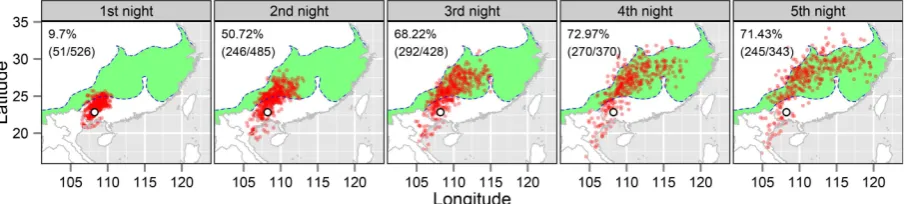
flight duration can be considered the optimum solution for migrants to complete their migration and maximize the benefits for their reproduction. Therefore, flight duration can be used to estimate migration distance. Flight duration is also directly affected by the distribution of suitable habitat in both space and time. Most migratory moths should be able to reach their preferred habitat within their flight capability time. Thus, three consecutive nights’ flight should be a reasonable amount of time for C. medinalis to complete its migration and arrive at suita-ble habitat. To test this hypothesis, 9-years field data were collected for C. medinalis from Nanning City, Guangxi Autonomous Region (1978, 1979, 1980, 1981, 2004, 2005, 2007, 2010 and 2011). The probabilities for C. medinalis to successfully arrive in its expected destination were calculated by forward trajectories (Fig. 1). By exploring the relationship between migration, reproduction and the geographic distribution of its habitat, in this study we aim to gain a better understanding of insect migration and its consequences.
Results
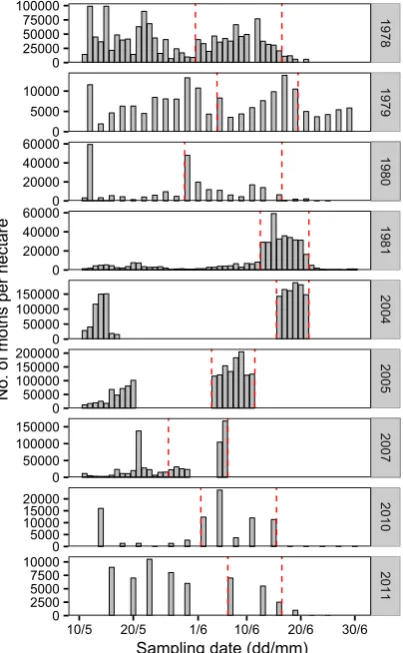
Population abundance data from field surveys indicated that there was an emerged peak of C. medinalis adult moths from the end of May to the middle June in Nanning each year (Fig. 2). During this peak, rice plants were at flowering stage and were not suitable for C. medinalis larva to feed on (Table 1). Females with ovarian devel-opment Level I - II accounted for more than 65% of the female population in every year (Table 2). This suggested that most adults emerged from the local population and would emigrate before their ovaries matured, according to the criteria described by Zhang et al.26.
Distributions of temperature and relative humidity in early and middle June indicated that the expected des-tination of migratory C. medinalis was located in the lower and middle reaches of the Yangtze River (Fig. 1). The rice planting schedules surveyed at Yongfu, Changsha, Huizhou and Huaining indicated that farmers practice both single- and double-cropping in this region (see Table 1). The early season rice in this area was at booting stage during this period and was harvested from middle July to early August. The late season rice was trans-planted after the harvest of early rice. Single cropping rice planting technique is also known as middle season rice planting. Middle season rice is generally planted later than early rice. The plants of middle season rice were transplanted from late May to early July irregularly and were at different stages from seedling to tillering in early and middle June (Table 1). In summary, the progeny produced from migratory C. medinalis would be able to find suitable host rice plants at the correct growth stage located in the lower and middle reaches of the Yangtze River during early and middle June.
Discussion
The morphological and physiological traits differences between migrant and non-migrant individuals of the same species have been studied widely27, especially within the context of the oogenesis-flight syndrome22. All
these migratory traits were thought to be the consequence of physiology and morphology to adapt to migratory behavior27. Many studies on bird migration have shown that migration distance plays an important role in the
expression of migratory traits, including fuel load and aerodynamic properties28–31. But studies on the driving
forces or factors to shape insect migratory traits have been limited. In this study, most C. medinalis moths arrived at suitable breeding areas within three nights of simulated flight, and this migration duration agreed with our supposition as derived from previous studies on its physiological traits of ovarian development25. The
distribu-tion of suitable habitat presents the migradistribu-tion distance of flyers should cover, thus our results suggest for the first time, that migration distance represents an important role in determining the migration duration of C. medinalis, which may in turn shape its oogenesis-flight syndrome.
The distributions of rice host, temperature and relative humidity suggested that the expected destination of migra-tory C. medinalis moths was located in the lower and middle reaches of the Yangtze River during early and middle June. This result was in agreement with previous studies on migration processes in 1977, 1979 and 198014,15. In these
three years, C. medinalis moth population peaks occurred simultaneously in a wide area in this region during late May and the middle of June14,15. Based on these observations, its northward migration to eastern Asia was divided
into 5 steps. Among these 5 steps, moths migrated from South China to the Yangtze River Valley in the third and fourth steps during late May to middle July14,15. The Yangtze River Valley is one of the most important rice-producing
regions in eastern Asia covering the Jiangxi, Anhui, Jiangsu, Zhejiang and Shanghai Provinces32. Thus, it is a very
important region available for C. medinalis to build and develop its population. Most individuals from the Yangtze River Valley population migrate to South China in autumn, except for a few individuals that migrate further north33.
Compared with the other migration steps, the migration distance of the third step also was the longest. In this paper, only the third migration step during late May and middle June was studied. Our conclusions are very credible and meaningful because this third migration step is the most important for C. medinalis to exploit suitable habitat.
Anqing
Wan'an Yongfu
Huizhou
Nanning
Changsha
120° E 115° E
110° E 105° E
100° E 95° E
35°
N
30°
N
25°
N
20°
N
15°
N
10°
N
0 250 500KM RH: 77 %
T: 22 °C T: 25 °C Yangtze River
Experiment sites Suitable habitat
Simulation domain of WRF
Figure 1. Study area examined using the WRF model to identify suitable habitat for migratory C. medinalis and locations of experimental sites in China. Suitable habitat was determined by examining temperature, relative humidity and rice plant data considering that (i) the optimal temperature and relative humidity range for C. medinalis eggs is 22–31 °C and 77–100%, respectively48 and (ii) only young rice plants are suitable. Early
season rice in southern China is most sensitive to low temperatures during the heading stage52 and rice plants
Due to changes in available resources through time and space, exploiting seasonal breeding habitats and escaping deteriorating conditions is the primary driver of the evolution of long-range migration7,27,34. Thus, the
spatiotemporal distribution of suitable habitat has a great influence on the determination of migratory pathways, especially for monophagous or oligophagous insects. As expected, major rice crop pests such as C. medinalis and two rice planthopper species Nilaparvata lugens (Stål) and Sogatella furcifera (Horváth) share similar migration pathways in eastern Asia14,15,35,36. Previous studies have shown that population dynamics and migration patterns
of C. medinalis and N. lugens have dramatically changed according to the change of rice planting systems32,37–39.
In the Yangtze River valley, double-cropping rice was mainly planted from 1960 s to 1990 s, but double-cropping technique has now been greatly reduced and single-cropping practice has been rapidly increasing since 199732.
Due to the high suitability of single cropping rice, populations of C. medinalis and N. lugens grew so quickly that it caused serious local damage in these regions and mass emigration to the Yangtze River Delta32,37–39. It can
there-fore be inferred that migration distances were determined greatly by the distribution of suitable migratory habitat. Previous studies also suggested that migration distance was related to body size, behavior strategy and mor-phological characteristics40,41. Compared to C. medinalis, rice planthoppers perform non-stop migration to finish
their long-distance journey in one continuous flight. They use a different migration strategy to cover a similar migration distance. Study between silver Y moths and passerines showed that they achieved extremely similar levels of travel speed and orientation performance during their nocturnal migratory flights in the northern tem-perate zone by different behavioral strategies3,4. Therefore, it is unclear whether the migration distance was driven
by a large variety in characteristics of morphology or animal behavior. Further work needs to be done to answer these complex questions. By contrast, our results suggest that migration distance could represent an important role to determine the migration duration of C. medinalis and to shape its oogenesis-flight syndrome. C. medinalis female moths developed their ovaries after three consecutive flight nights is a well-balanced surviving strategy to strike between migration and reproduction benefits. Hence, three nights’ flight seem to be an optimum solution of migration-reproduction trade-offs in energy allocation evolved in response to the natural selection on migra-tion route and physiological traits.
0 25000 50000 75000 100000
0 5000 10000
0 20000 40000 60000
0 20000 40000 60000
0 50000 100000 150000
0 50000 100000 150000 200000
0 50000 100000 150000
0 5000 10000 15000 20000
0 2500 5000 7500 10000
197
8
197
9
198
0
198
1
200
4
2005
2007
2010
2011
10/5 20/5 1/6 10/6 20/6 30/6
Sampling date (dd/mm)
No. of moths per hectar
e
Method
Survey Data of
C. medinalis.
Nine years of survey data of C. medinalis was collected from rice paddy fields in Nanning, Guangxi Autonomous Region in China (Fig. 1). Data was collected in May and June during the years 1978, 1979, 1980, 1981, 2004, 2005, 2007, 2010 and 2011, and comprises date recorded, moth abundance and ovary development. The abundance of moths was recorded based on a survey that was carried out in the morn-ing, beginning at 7:00 AM (Beijing Time, BJT). A 2 m stick was swept across the canopy of rice plants, and the number of disturbed moths flying away were counted by eye. The survey covered a sweep area of at least 40 m2 ofrice plants each morning. The number of moths per hectare was calculated and recorded. Ovary dissection data are available for the years 1978–1981 and 2007. Female moths of C. medinalis were collected from rice paddies and dissected daily to determine their stage of ovarian development according to the criteria described by Zhang et al.26. Females with ovarian development Level I–II were regarded as ‘sexually immature individuals’ and those
with Level III–V were regarded as ‘sexually mature individuals’. The proportion of females with ovarian develop-ment categorised as Level–I, Level–II and ≥ Level–III was tabulated.
Meteorological data and modelling.
The Weather Research and Forecasting (WRF) Model is a next-generation mesoscale numerical weather prediction system42. The model is designed to serve bothpheric research and operational forecasting needs. The model was used to produce a high resolution atmos-pheric background for the trajectory analysis carried out in this study. The dimensions of the model domain were 99 × 84 grid points in a resolution of 30 km. Twenty-nine vertical layers were available and the model ceiling was 100 hPa. The scheme selection and parameters used for the WRF are listed in Supplementary Table S1. National Centers for Environmental Prediction (NCEP) Final Analysis (FNL) Data was used as the meteorological data for the model input. FNL is a six-hourly, global, 1-degree grid meteorological dataset. The model forecast time is 72 h with data outputs at 1 h intervals, for horizontal and vertical wind speeds, temperature and precipitation.
Forward Trajectory Analysis.
We estimated suitable migratory landing areas for C. medinalis moth by con-structing their forward flight trajectories with the following assumptions. Firstly, no orientation pattern of C. medi-nalis was detected by radar, but moths displaced downwind33. Secondly, results from tethered flight experimentssuggested that its self-powered flight speed was about 0.8 m/s and it cannot fly in an atmospheric temperature below 12.9 °C43. Thirdly, C. medinalis take off at dusk, about 20:00 BJT33,43,44. Fourthly, few C. medinalis moths have been
observed by radar and aerial net after midnight33,45, and flight activity significantly decreases after 6 hours’
contin-uous flight (see Supplementary Fig. S1) leading most migrants to descend and land. Finally, the flight altitude of C. medinalis observed by radar was below 1000 m and most moths concentrated at about 500 m in autumn33,45. Forward
Site Latitude Rice varieties Growth period of rice Suitable for C. medinalis feeding
Nanning 22.85 Early season rice Heading No
Late season rice Not yet planted No
Yongfu 24.98 Early season rice Booting Yes
Late season rice Not yet planted No
Wan’an 26.46 Early season rice Booting to Heading Yes
Late season rice Sowing No
Changsha 28.20 Early season rice Booting to Heading Yes
Middle season rice Seedling No
Late season rice Sowing No
Huizhou 29.88 Middle season rice Tillering Yes
Late season rice Sowing No
Anqing 30.51 Early season rice Booting Yes
Middle season rice Transplanting No
Late season rice Sowing No
Table 1. Expected growth period of rice in selected sites in China during early and middle June.
Year Period No. of days observed per ha.No. of moths No. of moths dissected
Proportion (No.) of moths in each stage of ovarian development
Level - I Level - II ≥Level - III
1978 1–16 Jun 15 616200 852 74.88 (638) 7.16 (61) 17.96 (153)
1979 5–19 Jun 8 64020 272 60.66 (165) 10.29 (28) 29.04 (79)
1980 30 May–16 Jun 9 138675 304 74.01 (225) 8.22 (25) 17.76 (54)
1981 13–21 Jun 9 298650 998 88.48 (883) 8.72 (87) 2.81 (28)
2007 27 May–6 Jun 7 374460 176 36.93 (65) 28.98 (51) 34.09 (60)
using five different initial flight altitude heights: 500, 750, 1000, 1250 and 1500 m above mean sea level. The air speed of migrants was wind speed plus with its self-powered flight (0.8 m/s). Trajectories were terminated when the air temperature fell below 12.9 °C or flight duration was up to six hours. On the second migration night, trajectory anal-ysis continued from the last known locations of the first night’s trajectories with the same take off time and altitude. The complete forward trajectories analysis was calculated continuously for 5 consecutive nights.
This method was first introduced by Zhu and Liao46 with wind field and temperature data from the WRF output46,47.
Further details for this method was described by Hu et al. & Lu et al.12,47. The script for calculating this trajectory was
written in FORTRAN and run using the operating system Fedora 13 (Fedora Project, http://fedoraproject.org/).
Expected destination of migratory
C. medinalis.
Previous studies have suggested that the optimal temperature and relative humidity ranges for rice leaf folder eggs were 22–31 °C and 77–100%, respectively48.In addition, C. medinalis moths prefer to lay eggs on rice plants at tillering stage and its larva mostly feed on rice plants between tillering and booting stages49,50. Adult moths emigrate when the rice host is at a deteriorative or
heading stage14,51. Therefore, the expected destination of migratory moths should be to areas where rice plants
were between tillering and booting stages. In South China, early and late season rice are planted successively in the same year, a planting system known as double-cropping rice32. The early rice must be harvested as early as
possible in the summer, so that the fields can be ploughed and levelled for transplanting the late season rice. Rice plants are sensitive to low temperatures during the plant’s reproductive stage and the optimum temperature for indica rice heading is 25–35 °C52. Thus, no suitable rice hosts for C. medinalis larva would be available in areas
where the average temperature was greater than 25 °C in South China in the first half of the year. Based on the above analyses, the expected destination of migratory C. medinalis is to areas where the average temperature is 22–25 °C and the relative humidity was greater than 77%. Daily long-term mean temperature and relative humidity were derived from the Japanese 55-year Reanalysis datasets (http://jra.kishou.go.jp/JRA-55). The mete-orological information was applied to explore the range of suitable habitat of C. medinalis in South China. In addition, the rice planting schedules were surveyed at Nanning, Yongfu, Changsha, Huizhou and Huaining to check whether suitable rice host were growing (Fig. 1).
References
1. Dingle, H. Migration: the biology of life on the move. New York: Oxford University Press (1999).
2. Hu, G. Lim, K. S., Reynolds, D. R., Reynolds, A. M. & Chapman, J. W. Wind-related orientation patterns in diurnal, crepuscular and nocturnal high-altitude insect migrants. Front. Behav. Neurosci.10, 32 (2016).
3. Chapman, J. W., Reynolds, D. R. & Wilson, K. Long-range seasonal migration in insects: mechanisms, evolutionary drivers and ecological consequences. Ecol. Lett. 18, 287–302 (2015).
4. Alerstam, T. et al. Convergent patterns of long-distance nocturnal migration in noctuid moths and passerine birds. Proc. R. Soc. B 278, 3074–3080 (2011).
Figure 3. Distributions of endpoints of forward trajectories starting from Nanning, China. Red dots indicate the endpoints of the forward trajectories, and the green-filled region delineates the potential suitable habitat of C. medinalis (Fig. 1). The percentage of endpoints that successfully landed in suitable habitat is given with the number of all valid endpoints shown in parenthesis. Trajectory analysis was determined over 5 consecutive nights. (The map is made by R software, https://www.r-project.org/).
Height
Percent of valid endpoints (%)
1st night 2nd night 3rd night 4th night 5th night
500 m 10.20 (10/98) 30.99 (22/71) 41.18 (14/34) 26.67 (4/15) 0.00 (0/6) 750 m 15.89 (17/107) 46.81 (44/94) 67.09 (53/79) 59.62 (31/52) 56.41 (22/39) 1000 m 12.15 (13/107) 56.73 (59/104) 69.7 (69/99) 72.73 (64/88) 65.88 (56/85) 1250 m 7.48 (8/107) 57.41 (62/108) 73.83 (79/107) 78.1 (82/105) 75.00 (78/104) 1500 m 2.80 (3/107) 54.63 (59/108) 70.64 (77/109) 80.91 (89/110) 81.65 (89/109) Total 9.70 (51/526) 50.72 (246/485) 68.22 (292/428) 72.97 (270/370) 71.43 (245/343)
5. Chapman, J. W. et al. Flight orientation behaviors promote optimal migration trajectories in high-flying insects. Science327,
682–685 (2010).
6. Chapman, J. W., Drake, V. A. & Reynolds, D. R. Recent insights from radar studies of insect flight. Annu. Rev. Entomol.56, 337–356 (2011).
7. Chapman, J. W. et al. Animal orientation strategies for movement in flows. Curr. Biol.21, R861–R870 (2011).
8. Cant, E. T., Smith, A. D., Reynolds, D. R. & Osborne, J. L. Tracking butterfly flight paths across the landscape with harmonic radar.
Proc. R. Soc. B272, 785–790 (2005).
9. Wikelski, M. et al. Simple rules guide dragonfly migration. Biol. Lett.2, 325–329 (2006).
10. Kissling, W. D., Pattemore, D. E. & Hagen, M. Challenges and prospects in the telemetry of insects. Biol. Rev.89, 511–530 (2014). 11. Kays, R., Crofoot, M. C., Jetz, W. & Wikelski, M. Terrestrial animal tracking as an eye on life and planet. Science348, aaa2478 (2015). 12. Hu, G. et al. The influence of typhoon Khanun on the return migration of Nilaparvata lugens (Stål) in Eastern China. PLoS ONE8,
e57277 (2013).
13. Otuka, A. Migration of rice planthoppers and their vectored re-emerging and novel rice viruses in East Asia. Front Microbiol. 4, 309 (2013). 14. Chang, S. S. et al. Studies on the migration of rice leaf roller Cnaphalocrocis Medinalis Guenée. Acta Entomologica Sinica23, 130–140
(1980).
15. Zhang, X., Geng, J. & Zhou, W. A study on ecological mechanism of the migration of rice leaf roller Cnaphalocrocis Medinalis
Guenée. Journal of Nanjing Agricultural College4, 40–51 (1981).
16. Wang, F. Y., Zhang, X. X. & Zhai, B. P. Flight and re-migration capacity of the rice leaf folder moth Cnaphalocrocis Medinalis
(Guenée) (Lepidoptera Crambidae). Acta Entomologica Sinica, 53, 1265–1272 (2010).
17. Riley, J. R., Downham, M. C. A. & Cooter, R. J. Comparison of the performance of Cicadulina leafhoppers on flight mills with that to be expected in free flight. Entomol. Exp. Appl. 83, 317–322 (1997).
18. Jones, H. B. C., Lim, K. S., Bell, J. R., Hill, J. K. & Chapman, J. W. Quantifying interspecific variation in dispersal ability of noctuid moths using an advanced tethered flight technique. Ecol. Evol. 6, 181–190 (2015).
19. Roff, D. A. Dispersal in dipterans: its costs and consequences. J. Anim. Ecol.46, 443–456 (1977).
20. Rankin, M. A. & Burchsted, C. A. The cost of migration in insects. Annu. Rev. Entomol.37, 533–539 (1992).
21. Zera, A. J. Intermediary metabolism and life history trade-offs: lipid metabolism in lines of the wing-polymorphic cricket, Gryllus firmus, selected for flight capability vs. early age reproduction. Am. Nat.167, 889–900 (2006).
22. Johnson, C. G. Physiological factors in insect migration by flight. Nature198, 423–427 (1963). 23. Johnson, C. G. Migration and dispersal of insects by flight. Methuen, London (1969). 24. Kennedy, J. S. A turning point in the study of insect migration. Nature198, 785–791 (1961)
25. Zhang, L. et al. Accelerated and synchronized oviposition induced by flight of young females may intensify larval outbreaks of the rice leaf roller. PLoS ONE10, e0121821 (2015).
26. Zhang, X. X., Lu, Z. Q. & Geng, J. G. Application of ovarian dissection of female Cnaphalocrocis medinalis moths in prediction and forecasting system. Entomological Knowledge16, 97–99 (1979).
27. Dingle, H. & Drake, V. A. What is migration? BioScience57, 113–121 (2007).
28. Maggini, I. & Bairlein, F. Endogenous rhythms of seasonal migratory body mass changes and nocturnal restlessness in different populations of northern wheatear Oenanthe oenanthe. J. Biol. Rhythm.25, 268–276 (2010).
29. Delingat, J., Hobson, K., Dierschke, V., Schmaljohann, H. & Bairlein, F. Population differentiation of northern wheatears by means of morphometric data and stable isotopes. J. Ornithol.152, 383–395 (2011).
30. Förschler, M. I. & Bairlein, F. Morphological shifts of the external flight apparatus across the range of a passerine (northern wheatear) with diverging migratory behaviour. PLoS ONE6, e18732 (2011).
31. Corman, A. M., Bairlein, F. & Schmaljohann, H. The nature of the migration route shapes physiological traits and aerodynamic properties in a migratory songbird. Behav. Ecol. Sociobiol.68, 391–402 (2014).
32. Hu, G. et al. Rice planting systems, global warming and outbreaks of Nilaparvata lugens (Stål). B. Entomol. Res. 101, 187–199 (2011). 33. Riley, J. R. et al. Observations of the autumn migration of the rice leaf roller Cnaphalocrocis medinalis (Lepidoptera: Pyralidae) and
other moths in eastern China. B. Entomol. Res. 85, 397–414 (1995).
34. Alerstam, T., Hedenström, A. & Åkesson, S. Long-distance migration: evolution and determinants. Oikos103, 247–260 (2003). 35. Cheng, S. N. et al. Studies on the migrations of brown planthopper Nilaparvata lugens Stål. Acta Entomologica Sinica22, 1–21 (1979). 36. Lu, Z. Q., Shu, W. X., Zhu, S. D., Hu, M. & Yang, J. S. Synchronized migrations and population dynamics of rice leaf roller and white
backed planthopper. China Plant Protection. 11, 23–32 (1990).
37. Hu, G. et al. Outbreaks of the brown planthopper Nilaparvata lugens (Stål) in the Yangtze River Delta: immigration or local reproduction. PLoS One9, e88973 (2014).
38. Qi, G. J. et al. Occurrence of the third and fourth generations of Cnaphalocrocis medinalis in the mixed cropping rice region in Anqing, Anhui Province. Chinese J. Rice Sci. 22, 513–518 (2008).
39. Qi, G. J. et al. Effect of the change of rice planting system on the formation of outbreak population of brown planthopper, Nilaparvata lugens (Stål). Acta Phytophylacica Sinica. 37, 193–200 (2010).
40. Hein, A. M., Hou, C. & Gillooly, J. F. Energetic and biomechanical constraints on animal migration distance. Ecol. Lett. 15, 104–110 (2012). 41. Johansson, F., Söderquist, M. & Bokma, F. Insect wing shape evolution: independent effects of migratory and mate guarding flight
on dragonfly wings. Biol. J. Linn. Soc. 97, 362–372 (2009).
42. Skamarock, W. et al. A Description of the Advanced Research WRF Version 3. NCAR Technical Note NCAR/TN-475+ STR (2008). 43. Chen, Y. N. & Wang, Q. W. The observation of flight characteristics of Cnaphalocrocis medinalis III. The initiative of take-off and
passive of operation. Journal of Hunan Agricultural College, 6, 23–33 (1980).
44. Zhang, X. X., Zhou L. Y. & Cheng J. Y. Determination of the parameters for trajectory analysis of in Huaihe and Yangtze rice areas.
Journal of Nanjing Agricultural University, 17, 32–38 (1994).
45. Gao, Y. B. et al. Dynamic analysis on the migration of the rice leaf roller Cnaphalocrocis medinalis (Lepidoptera: Pyralidae) by Doppler Insect Monitoring Radar and numerical simulation. Acta Ecologica Sinica11, 5238–5247 (2008).
46. Zhu, Y. Q. & Liao, D. X. An investigation for computing three-dimensional trajectory. Quarterly Journal of Applied Meteorology3,
328–333 (1992).
47. Lu, F., Zhai, B. P. & Hu, G. Trajectory analysis methods for insect migration research. Chinese Journal of Applied Entomology50,
853–862 (2013).
48. Fang, Y. S., Liao, H. J., Qian, Q. & Liu, X. D. Combined effects of temperature and relative humidity on eggs of the rice leaf folder,
Cnaphalocrocis medinalis (Lepidoptera: Pyralidae). Acta Entomologica Sinica56, 786–791 (2013).
49. Wu, J. C. & Zhang, X. X. Effect s of temperature on the growth and the development of experimental populations of the rice leaf roller, Cnaphalocrocis medinalis Guenée. Journal of Nanjing Agricultural College7, 19–28 (1984).
50. Liao, H. J., Huang, J. R., Fang, Y. S. & Liu, X. D. Biological response of the rice leaf folder Cnaphalocrocis medinalis (Guenée) reared on rice and maize seedling to temperature. Acta Ecologica Sinica33, 409–415 (2013).
51. Wu, J. C. Effect of changing photoperiod, temperature and food quality on the migration of rice leaf roller Cnaphalocrocis medinalis
Guenée. Acta Entomologica Sinica, 28, 398–405 (1985).
Acknowledgements
This study was supported by the Fundamental Research Funds for the Central Universities (KJQN201434). GH’s visiting scholarship at Rothamsted was funded by the China Scholarship Council and the Priority Academic Program Development of Jiangsu Higher Education Institutions. Rothamsted Research is a national institute of bioscience strategically funded by the UK Biotechnology and Biological Sciences Research Council (BBSRC).
Author Contributions
G.H. and B.P.Z. designed the analysis, F.Y.W. and F.Y. performed the analysis with input from S.Y.L., F.Y.W. and M.H.L. All authors except S.Y.L. contributed to the interpretation of results and manuscript writing.
Additional Information
Supplementary information accompanies this paper at http://www.nature.com/srep Competing financial interests: The authors declare no competing financial interests.
How to cite this article: Wang, F.-Y. et al. Determining the migration duration of rice leaf folder (Cnaphalocrocis medinalis (Guenée)) moths using a trajectory analytical approach. Sci. Rep.7, 39853; doi: 10.1038/srep39853 (2017).
Publisher's note: Springer Nature remains neutral with regard to jurisdictional claims in published maps and institutional affiliations.
This work is licensed under a Creative Commons Attribution 4.0 International License. The images or other third party material in this article are included in the article’s Creative Commons license, unless indicated otherwise in the credit line; if the material is not included under the Creative Commons license, users will need to obtain permission from the license holder to reproduce the material. To view a copy of this license, visit http://creativecommons.org/licenses/by/4.0/