2019 Novel Coronavirus: Where We are and What We Know
Zhangkai J. Cheng1,* and Jing Shan2
1. Institute of Medical Physics, University of Sydney
2. Discipline of Child and Adolescence Health, the Faculty of Medicine and Health, University of Sydney
Abstract
There is a current worldwide outbreak of a new type of coronavirus (2019-nCoV), which originated from China and has now spread to 17 other countries. Governments are under increase pressure to stop the outbreak spiraling into a global health emergency. At this stage, preparedness, transparency and sharing of information are crucial to risk assessments and beginning outbreak control activities. This information should include reports from outbreak sites, and from laboratories supporting the investigation. This paper aggregates and consolidates the virology, epidemiology, clinical management strategies from both English and Chinese literature, official news channels and other official government documents. In addition, by fitting the number of infections with a single-term exponential model, we report that the infection is spreading at an exponential rate, with a doubling period of 1.8 days.
1. Introduction
On 12 December 2019, Wuhan Municipal Health Commission (WMHC) reported 27 cases of viral pneumonia with seven of them being critically ill. Most patients had a recent history of exposure to wildlife animals at the Huanan Seafood Wholesale Market in Wuhan, China, where poultry, snake, bats and other farm animals were also sold.
This was identified to be caused by a new type of coronavirus, tentatively named 2019-nCoV by World Health Organization (WHO). The pandemic is escalating rapidly. We searched the associated literature in both Chinese and English to summarize virology, epidemiology information; to calculate the mean doubling time value; to compare two guidelines of 2019-nCoV management (the WHO guideline and the Chinese 4th edition guideline which is currently being used).
2. Virology
2019-nCoV is the seventh member of the family of coronaviruses that infect humans, after MERS-nCoV and SARS-MERS-nCoV. Through genome sequencing, the genetic sequence of the 2019-MERS-nCoV became available to the WHO, which enabled different laboratories in to produce reverse-transcription diagnostic polymerase chain reaction (RT-PCR) test specifically for detection of viral RNA. The 2019-nCoV is a β CoV of group 2B with over 70% similarity in genetic sequence to SARS-2019-nCoV (1).
Since its outbreak, the source of the new coronavirus infection has been unknown. Ji and colleagues performed comprehensive sequence analysis and comparison in conjunction with relative synonymous codon usage (RSCU) bias among different animal species based on the 2019-nCoV RNA genome sequence, and the results showed that the virus to be a recombinant virus between the bat coronavirus and another coronavirus with unknown origin. They also suggested that snake is the
most probable animal reservoir due to the virus’s RSCU bias being closest to snake (2). Zhu and colleagues used deep learning algorithms to analyze the gene sequences of novel coronaviruses and other coronaviruses to predict potential viral hosts. Their results indicated that bats and minks may be the two potential hosts of the novel coronavirus, while minks may be the intermediate hosts of the virus (3). The novel coronavirus showed a similar pattern of infection to other coronaviruses in humans, particularly severe acute respiratory syndrome coronavirus (SARS-nCoV), Bat SARS-like CoV, and Middle East respiratory syndrome coronavirus (MERS-nCoV). After comparing coronaviruses in other vertebrates, the study found that the bat coronaviruses had the most similar infection patterns to the novel coronaviruses. After comparing the infection patterns of other vertebrate coronavirus hosts, the infection patterns of minks were found to be most similar to those of the novel coronavirus.
By modelling the spike protein of the receptor for 2019-nCoV, Xu and colleagues reported that Angiotensin-converting enzyme 2 (ACE2) could be the receptor for this virus (4). Similarly, ACE2 is also the receptor for SARS-nCoV and NL63 (5-7). According to their model, the binding strength between 2019-nCoV and ACE2 is higher than the threshold required for virus infection, albeit being weaker than that between SARS-nCoV and ACE2. Zhou and colleagues conducted virus infectivity studies and showed that ACE2 is essential for 2019-nCoV to enter HeLa cells (8). These data indicated that ACE2 is likely to be the receptor for 2019-nCoV. Zhao and colleagues analyzed normal lung tissue cells of eight healthy individuals, and found that the only Asian donor has over five times as much ACE2 expressing cell ratio than white and African American donors (9). These results point to a possible heightened susceptibility of Asian population, although more evidence is needed to draw such conclusion.
3. Epidemiology
A total of 515 environment samples were collected from businesses related to the patients and their neighborhood on 1 January 2020 and transported to Institute of Viral Disease, Chinese Center for Disease Control and Prevention (CCDC) for testing. On 12 January 2020, 70 more samples from wildlife shops in the seafood market were collected for testing. PCR testing results showed that out of the 585 samples, 33 were tested positive to contain 2019-nCoV, and the virus was successfully isolated from positive samples, suggesting that the virus originated from wildlife animals sold in the seafood market in southern China (10). However this idea was challenged by a Lancet report detailing the first 41 infected patients who were hospitalized between December 16, 2019 and January 2, 2020 (11), which stated “No epidemiological link was found between the first patient and later cases”. Their data also showed that, in total, 13 of the 41 cases had no link to the marketplace. Speaking to Science, Daniel Lucey from Georgetown University noted that since the virus seems to have an incubation period of up to 14 days and the first reported case emerged on Dec 1, it’s possible the initial human infection took place in November if not earlier. If so, the virus possibly spread silently between people in Wuhan before the cluster of cases from Huanan Seafood Wholesale Market was discovered in late December (12, 13). Tracing the source of the virus, controlling the source and clarifying the intermediate host of the virus are the key links to control the continuous transmission of the virus from animals to people. Work is currently underway to determine possible virus reservoirs.
Person-to-person transmission of the coronavirus was confirmed by Chan and colleagues, who reported a case of five patients in a family cluster (14). The estimates for reproduction number R0
light. WHO has published their estimation of R0 to be 1.4-2.5 using early information. Jonathan Read
and colleagues from Lancaster University fitted a deterministic Susceptible-Exposed-Infected-Recovered (SEIR) metapopulation transmission model of infection within and between major Chinese cities to the daily number of confirmed cases of 2019-nCoV in Chinese cities and cases reported in other countries/regions, using an assumption of Poisson-distributed daily time increments. They determined the R0 to be around 3.1 (15). Majumder and colleagues at Boston
Children’s Hospital used Incidence Decay and Exponential Adjustment (IDEA) model to estimate R0 to
be between 2.0-3.3 (16). A large group of researchers from multiple institutes led by Jianhong Wu from York University proposed a more general deterministic SEIR compartmental model using more parameters, and arrived at a much higher R0 number of 6.47 (17). Li and colleagues analysed data on
the first 425 confirm cases in Wuhan and found that R0 to be 2.2, without specifying their modelling
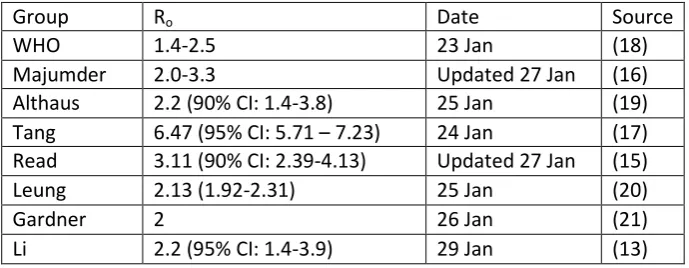
method (13). Table 1 compares the R0 values from studies conducted by different groups.
Group Ro Date Source
WHO 1.4-2.5 23 Jan (18)
Majumder 2.0-3.3 Updated 27 Jan (16)
Althaus 2.2 (90% CI: 1.4-3.8) 25 Jan (19)
Tang 6.47 (95% CI: 5.71 – 7.23) 24 Jan (17) Read 3.11 (90% CI: 2.39-4.13) Updated 27 Jan (15)
Leung 2.13 (1.92-2.31) 25 Jan (20)
Gardner 2 26 Jan (21)
Li 2.2 (95% CI: 1.4-3.9) 29 Jan (13)
Table 1. R0 estimations from different groups.
a b
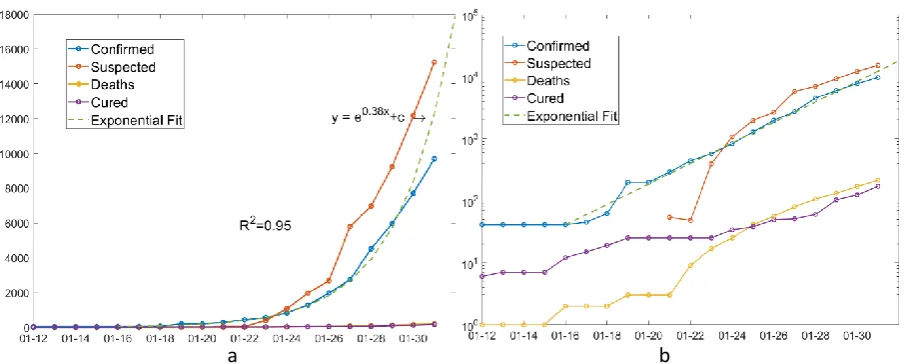
Figure 1. Number of confirmed cases, suspected cases, deaths and cure in China over time. (a)
Normal y axis. (b) log-scale y axis.
Currently, the virus has been spread to 17 other countries (23), with number of confirmed cases: Thailand (14), Japan (11), Singapore (10), Australia (9), Malaysia (8), USA (6), France (5), Germany (5), Korea (4), United Emirates (4), Canada (3), Vietnam (2), Nepal (1), Finland (1), Sri Lanka (1), India (1), Cambodia (1). Using back-calculation method, Nishiura has estimated the cumulative incidence in China in real time, allowing us to update and discuss the extent of transmission at the source (24). All age groups can be infected. According to Bin Cao, the Executive vice President at the Institute of Respiratory Medicine, Chinese Academy of Medical Sciences, 72% confirmed infection cases are aged 40 and above, 64% are male. 40% patients also have other underlying diseases such as diabetes and high blood pressure (25).
3.1 Modeling the spread
Lauren Gardner from Johns Hopkins University led a team of researchers to model the real time spread of the coronavirus. The team's new analysis was based on a model, the outbreak boundary control decision support framework, released last December, which integrates the dynamics of the outbreak and outbreak control of the new coronavirus pneumonia into a decision support tool to facilitate border control in the early stages of an outbreak to mitigate further spread. The team used a random set of population epidemic simulation tools to simulate the dynamics of the epidemic, and considered the border protection mechanism (immigration inspection) in the modeling process, which is mainly used to identify infected people or high-risk groups (21). The aggregation population model is mainly constructed based on the population network, which is divided into urban and intercity parts, and the edge of the network is the air line between different cities. At each node of the network, the researchers used a discrete-time Susceptible-Exposed-Infected-Recovered (SEIR) model to simulate the dynamics of an outbreak.
the country as of January 25 (the number reported at the time was nearly 2,000). Researchers also estimate that hundreds of people in Wuhan were infected in early December. The model is however limited by many factors, as explained by the team on their blog post. They are primarily due to the numbers being used are conservative estimates, the transmission of 2019-nCoV, such as the R0 value
and incubation period, being uncertain, asymptomatic infections are not covered and only air travel was included (21).
4. Clinical Guidelines
4.1 Severity Definitions
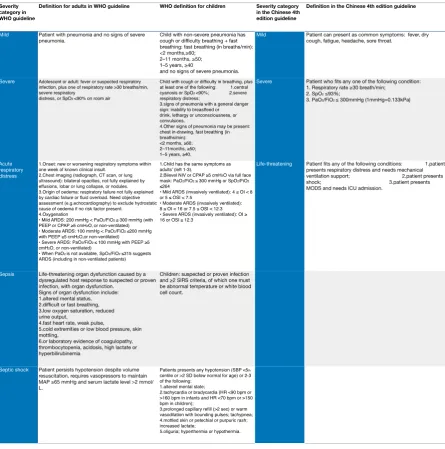
We compare the severity definitions between the WHO (26) and Chinese 4th edition guidelines (27). The categories of the severity of 2019-nCoV infection are very different in two guidelines. The WHO one shows five levels of severity: mild, severe, acute respiratory distress, sepsis and septic shock. It covers both the adult and child age groups. The children one is from <2 months to 5 years old. From mild to acute respiratory distress levels, the respiratory rate and SpO2 are two important parameters
for judging patients’ clinical condition. For sepsis in adults, the patients’ mental, circulating, and respiratory parameters are recommended to justify the severity; while in children, the systemic inflammatory response syndrome (SIRS) are recommended. In the septic shock adult patients, hypotension in adults is a substantial sign, or vasopressor maintenance for mean atrial pressure ≥65 mmHg with lactate level >2 mmol/L. In the septic shock children, the criteria are based on the guideline of hemodynamic support of paediatric and neonatal Septic Shock from the American College of Critical Care Medicine (28).
The Chinese 4th edition defined three levels of severity: mild, severe, and life-threatening. The parameters are simpler than the WHO one. Mild one is without any particular parameters; respiratory rate and SpO2 are recommended for severe level evaluation, and it is similar to the
Table 2. Summary of severity. Abbreviations: ARI, acute respiratory infection; BP, blood pressure; bpm, beats/minute; CPAP,
continuous positive airway pressure; FiO2, fraction of inspired oxygen; MAP, mean arterial pressure; NIV, non-invasive ventilation; SBP,
systolic blood pressure; SD, standard deviation; SIRS, systemic inflammatory response syndrome; SpO2, oxygen saturation; ARDS, acute
respiratory distress syndrome; HR, heart rate; PaO2, Partial Press of Oxygen; SBP, systolic blood pressure; ICU, intensive care unit; MODS,
multiple organ dysfunction syndrome; OI, Oxygenation Index; OSI, Oxygenation Index.
4.2 Management Guidelines
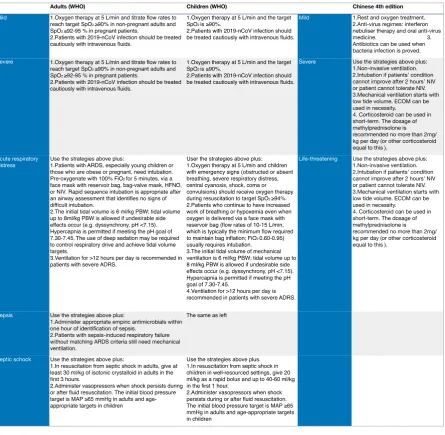
In the WHO guideline, the oxygen and intravenous fluid treatments are recommended to mild and severe cases. The targets are SpO2 ≥90% in non-pregnant adult or child, and SpO2 ≥92-95 % in
pregnant patients. Mechanical ventilation is recommended in the both adults and children with acute respiratory distress syndrome. The tide volume is recommended from 6 ml/kg. Hypercapnia is acceptable and longer than 12 hours ventilation per day is suggested to use in severe ARDS cases. The treatments of sepsis and septic shock are following the 2016 international guideline of sepsis and septic shock (29).
Extracorporeal membrane oxygenation (ECMO) can be used to reduce pulmonary impairment during the treatment period.
Table 3. Summary of managements. Abbreviations: ARI, acute respiratory infection; BP, blood pressure; bpm, beats/minute;
CPAP, continuous positive airway pressure; FiO2, fraction of inspired oxygen; MAP, mean arterial pressure; NIV, non-invasive ventilation;
SBP, systolic blood pressure; SD, standard deviation; SIRS, systemic inflammatory response syndrome; SpO2, oxygen saturation; ARDS,
acute respiratory distress syndrome; HR, heart rate; PaO2, Partial Press of Oxygen; SBP, systolic blood pressure; ICU, intensive care unit;
MODS, multiple organ dysfunction syndrome; ECOM, Extracorporeal membrane oxygenation; PBW, predicted body weight.
5. Discussion
Disneyland in both Shanghai and Hongkong, Forbidden City in Beijing, are now closed until further notice. We will not know for some time the consequences of the quarantine measures.
Multiple research groups studying the disease around the world are providing different values on R0,
using results obtained from their respective models. Morbidity varies in different environments, depending on factors like temperature, population density and susceptibility to a disease in a population, so R0 would change accordingly over time. More reliable and accurate R0 value should
appear as more information comes to light. We observe that the number of confirmed infections after 16 January 2020 grows at an exponential rate, with a doubling time of 1.8 days. This result is significantly different from the doubling time of 7.4 days found in Li’s group, which was obtained from analyzing the cases before 4 January 2020. This might be due to several factors: at early stages, the lack of awareness for the disease and lack of detection methods would have hindered the disease detection and confirmation. Low number of confirmed cases would result in high uncertainty of the calculation. At later stages, the increase in availability of PCR test kits and other clinical resources would result in higher confirmation rate than the true value.
Virology results indicate that Asian population may potentially be more susceptible to 2019-nCoV than other races (4, 8, 9), which is consistent with the observation that disproportionally higher number of Asian populations is infected, even in an international metropolitan like Shanghai, although more evidence is needed to draw such conclusion. Chen and colleagues found a greater number of men than women in the 99 cases of 2019-nCoV they reported. In previous SARS and MERS outbreaks, men were also more likely to be infected than women (30). This may have to do with the important role that a woman's X chromosome and sex hormones play in the body's immune system (31). Their study also suggests that older men with chronic diseases are more likely to be infected with the new coronavirus because of their weakened immune system.
The major difference between the WHO (26) and Chinese 4th edition guideline (27) is the standard in treating children with 2019-nCOV infection. Until now, a few cases of children infected have been reported with the youngest one is 10 years old. ARDS is a common progress in the 2019-nCoV infection cases. SpO2 and respiration rate check became very important in the clinical practice.
Mechanical ventilation is a major treatment of it, and it has been recommended in both. The low tidal volume, plateau pressure limitation, no oscillatory ventilation, and prone position has been evidenced as high-proof (32). The antivirus medicine is recommended in the Chinese 4th edition. A recent publication reported 99 cases in Jinyin-Tan hospital were given anti-virus medicine such as oseltamivir (75 mg every 12 h, orally), ganciclovir (0.25 g every 12 h, intravenously), and lopinavir and ritonavir tablets (500 mg twice daily, orally), and the influence of the outcome has been mentioned in detail (30). Short-term corticosteroids use is recommended in the Chinese 4th edition, the aim of which is to reduce the self-damage by over-reactive immune response. Antibiotic use is recommended when the patient has evidence of bacterial infection. Some patients in the 99 cases presented a rapid progress to ARDS; the benefits of short term use of methylprednisolone 1–2 mg/kg per day and intravenous immunoglobulin was observed in these patients (30). These two guidelines are currently being used; however, some of the contents are still controversial, especially the benefits of steroids and antibiotic. Further study should be continued in the clinical practice. Our summary of WHO guidelines just included recommended contents. The controversial contents are excluded.
References
1. Hui DS, E IA, Madani TA, Ntoumi F, Kock R, Dar O, et al. The continuing 2019-nCoV epidemic threat of novel coronaviruses to global health - The latest 2019 novel coronavirus outbreak in Wuhan, China. Int J Infect Dis. 2020;91:264-6.
2. Ji W, Wang W, Zhao X, Zai J, Li X. Homologous recombination within the spike glycoprotein of the newly identified coronavirus may boost cross-species transmission from snake to human. J Med Virol. 2020.
3. Guo Q, Li M, Wang C, Wang P, Fang Z, Tan J, et al. Host and infectivity prediction of Wuhan 2019 novel coronavirus using deep learning algorithm. bioRxiv. 2020.
4. Xu X, Chen P, Wang J, Feng J, Zhou H, Li X, et al. Evolution of the novel coronavirus from the ongoing Wuhan outbreak and modeling of its spike protein for risk of human transmission. SCIENCE CHINA Life Sciences. 2020;63.
5. Li W, Sui J, Huang I-C, Kuhn JH, Radoshitzky SR, Marasco WA, et al. The S proteins of human coronavirus NL63 and severe acute respiratory syndrome coronavirus bind overlapping regions of ACE2. Virology. 2007;367.
6. Wu K, Li W, Peng G, Li F. Crystal structure of NL63 respiratory coronavirus receptor-binding domain complexed with its human receptor. Proc Natl Acad Sci USA 2009;106.
7. He L, Ding Y, Zhang Q, Che X, He Y, Shen H, et al. Expression of elevated levels of
pro-inflammatory cytokines in SARS-CoV-infected ACE2+ cells in SARS patients: relation to the acute lung injury and pathogenesis of SARS. J Pathol. 2006;210(3):288-97.
8. Zhou P, Yang X-L, Wang X-G, Hu B, Zhang L, Zhang W, et al. Discovery of a novel coronavirus associated with the recent pneumonia outbreak in humans and its potential bat origin. bioRxiv. 2020. 9. Zhao Y, Zhao Z, Wang Y, Zhou Y, Ma Y, Zuo W. Single-cell RNA expression profiling of ACE2, the putative receptor of Wuhan 2019-nCov. bioRxiv preprint. 2020.
10. Xinhua. http://www.xinhuanet.com/2020-01/27/c_1125504355.htm. 2020.
11. Huang C, Wang Y, Li X, Ren L, Zhao J, Hu Y, et al. Clinical features of patients infected with 2019 novel coronavirus in Wuhan, China. Lancet. 2020.
12. Lucey D. https://wwwsciencemagorg/news/2020/01/wuhan-seafood-market-may-not-be-source-novel-virus-spreading-globally. 2020.
13. Li Q, Guan X, Wu P, Wang X, Zhou L, Tong Y, et al. Early Transmission Dynamics in Wuhan, China, of Novel Coronavirus-Infected Pneumonia. N Engl J Med. 2020.
14. Chan JF, Yuan S, Kok KH, To KK, Chu H, Yang J, et al. A familial cluster of pneumonia associated with the 2019 novel coronavirus indicating person-to-person transmission: a study of a family cluster. Lancet. 2020.
15. Read JM, Bridgen JRE, Cummings DAT, Ho A, Jewell CP. Novel coronavirus 2019-nCoV: early estimation of epidemiological parameters and epidemic predictions. Available at medRxiv preprint. 2020.
16. Majumder M, Mandl KD. Early Transmissibility Assessment of a Novel Coronavirus in Wuhan, China. Available at SSRN. 2020.
17. Tang B, Wang X, Li Q, Bragazzi NL, Tang S, Xiao Y, et al. Estimation of the Transmission Risk of 2019-nCov and Its Implication for Public Health Interventions. Available at SSRN. 2020.
18. WHO. Statement on the meeting of the International Health Regulations (2005) Emergency Committee regarding the outbreak of novel coronavirus (2019-nCoV). 2020.
19. Althaus C.
https://twittercom/C_Althaus/status/1220723566272045057?ref_src=twsrc%5Etfw%7Ctwcamp%5E tweetembed%7Ctwterm%5E1220723566272045057&ref_url=https%3A%2F%2Fwwwvoxcom%2F20 20%2F1%2F28%2F21079946%2Fcoronavirus-china-wuhan-deaths-pandemic. 2020.
21. Gardner L. Modeling the Spread of 2019-nCoV. Available at https://systemsjhuedu/wp-content/uploads/2020/01/Gardner-JHU_nCoV-Modeling-Report_Jan-26pdf. 2020.
22. NHC. 疫情通报. http://wwwnhcgovcn/xcs/yqtb/list_gzbdshtml. 2020.
23. DXY. 疫情地图. https://3gdxycn/newh5/view/pneumonia?from=timeline&isappinstalled=0. 2020.
24. Nishiura H, Jung Sm, Linton NM, Kinoshita R, Yang Y, Hayashi K, et al. The Extent of Transmission of Novel Coronavirus in Wuhan, China, 2020. Journal of Clinical Medicine. 2020. 25. Xinhua. http://www.xinhuanet.com/politics/2020-01/28/c_1125506707.htm. 2020. 26. Guidance W. Clinical management of severe acute respiratory infection when novel coronavirus (2019-nCoV) infection is suspected. WHO. 2020.
27. Guidance C. 新型冠状病毒感染的肺炎诊疗方案(试行第四版). Available at
http://wwwgovcn/zhengce/zhengceku/2020-01/28/5472673/files/0f96c10cc09d4d36a6f9a9f0b42d972bpdf. 2020.
28. Davis AL, Carcillo JA, Aneja RK, Deymann AJ, Lin JC, Nguyen TC, et al. American College of Critical Care Medicine Clinical Practice Parameters for Hemodynamic Support of Pediatric and Neonatal Septic Shock. Crit Care Med. 2017;45(6):1061-93.
29. Rhodes A, Evans LE, Alhazzani W, Levy MM, Antonelli M, Ferrer R, et al. Surviving Sepsis Campaign: International Guidelines for Management of Sepsis and Septic Shock: 2016. Intensive Care Med. 2017;43(3):304-77.
30. Chen PN, Zhou PM, Dong X, Qu PJ, Gong F. Epidemiological and clinical characteristics of 99 cases of 2019 novel coronavirus pneumonia in Wuhan, China: a descriptive study. Lancet. 2020. 31. Jaillon S, Berthenet K, Garlanda C. Sexual Dimorphism in Innate Immunity. Clin Rev Allergy Immunol. 2019;56(3):308-21.
32. Papazian L, Aubron C, Brochard L, Chiche JD, Combes A, Dreyfuss D, et al. Formal guidelines: management of acute respiratory distress syndrome. Annals of Intensive Care. 2019;69(9).