chiropractic students: A descriptive survey
Julie Lorence,
DC, MS1Dana J. Lawrence,
DC, MMedEd, MA2#Stacie A. Salsbury,
PhD, RN3Christine M. Goertz,
DC, PhD41 Doctoral student, Kinesiology and Community Health, University of Illinois, Huff Hall, 1206 S. Fourth Street, Champaign, IL 61820
2 Senior Director, Center for Teaching and Learning, Interim Senior Director for Continuing Education and Events, Palmer College of
Chiropractic, 1000 Brady Street, Davenport, IA 52803 # Corresponding author
3 Clinical Project Manager, Palmer Center for Chiropractic Research, Palmer College of Chiropractic. 741 Brady Street, Davenport, IA 52803
4 Vice Chancellor for Research and Health Policy, Palmer Center for Chiropractic Research, Palmer College of Chiropractic. 741 Brady Street,
Davenport, IA 52803 [email protected] ©JCCA 2014
Objective: Our purpose was to describe the financial
knowledge, habits and attitudes of chiropractic students.
Methods: We designed a cross-sectional survey to
measure basic financial knowledge, current financial habits, risk tolerance, and beliefs about future income among 250 students enrolled in business courses at one US chiropractic college. Descriptive statistical analyses were performed.
Results: We received 57 questionnaires (23%
response rate). Most respondents would accumulate over $125,000 in student loan debt by graduation. Financial knowledge was low (mean 77%). Most respondents (72%) scored as average financial risk takers.
Chiropractic students reported recommended short-term habits such as having checking accounts (90%) and health insurance (63%) or paying monthly bills (88%) and credit cards (60%). Few saved money for unplanned expenses (39%) or long-term goals (26%), kept written budgets (32%), or had retirement accounts (19%).
Objectif : Notre but était de décrire les connaissances,
les habitudes et les attitudes en matière de finances des étudiants en chiropratique.
Méthodologie : Nous avons conçu une étude
transversale pour mesurer les connaissances financières de base, les habitudes financières actuelles, la tolérance au risque, et les opinions sur les revenus futurs d’un groupe de 250 étudiants inscrits à des cours de commerce dans un collège de chiropratique aux États-Unis. Des analyses statistiques descriptives ont été effectuées.
Résultats : Nous avons reçu 57 questionnaires
Introduction
Students in doctor of chiropractic (DC) programs face many financial barriers to establishing successful clinical practices after graduation. Most new DC graduates carry with their diplomas significant student loan debt.1 More than 60% of DCs are self-employed, which may require additional commercial loans on top of student loan debt to begin practice.2 New DCs may be underprepared to balance the demands of being a health practitioner, busi-ness owner, financial planner, and office manager simul-taneously.3 While no reliable statistics on business failure rates exist for new chiropractic practices, 56% of all new small businesses fail within 4 years.4
The United States (US) Bureau of Labor Statistics (BLS) estimated the number of DC jobs as 52,600 in 2010 and projects employment for DCs to grow 28% between the years of 2010-2020, a faster than average rate for healthcare professions.5 Yet, consumer demand for chiro-practic services has shifted making the success of new chiropractic businesses more uncertain than in the past.6,7 The number of people seeking chiropractic care may have reached its pinnacle in the 1990s as evidenced by a 2.5% decrease in the chiropractic utilization rate.8
The average income for DCs has changed accordingly. Chiropractic practice surveys instituted in the 1960s by the American Chiropractic Association (ACA) suggest average incomes of DCs doubled from 1980 to 1989, with net incomes rising from $43,000 to $101,000, but then fell to $86,500 by 1997.9 In 2010, the Chiropractic
Eco-nomics annual salary surveys reported the average salary
of DC respondents at slightly over $87,000.2,10 In contrast, the BLS reported a median annual wage for DCs at just over $67,000 in 2010.5
The US economic climate in the 2000s followed one
of the worst recessions and periods of job loss since the 1930s, leading consumers to re-evaluate their financial behaviors.11 Many small businesses were hit hard due to the lack of financial planning for a decreased credit mar-ket in the rapidly changing, and potentially permanent, reorganization of consumer financial behaviors and prior-ities.12 The healthcare industry is more resilient to changes in the economy compared to other industries.13 However, the financial success of chiropractic practices often rests on out-of-pocket payments14,15 or health insurance cover-age16. Thus, economic downturns may affect chiropractic practices more strongly than they do conventional med-ical practices.
Chiropractic students enter the profession within a context of a competitive healthcare market, possibly sat-urated consumer demand for chiropractic services, and tightened salary prospects. While enrollment in chiro-practic colleges has dropped over the past decade17, US chiropractic colleges graduate over 2,500 new chiro-practors annually18. Therefore, chiropractic students will require strong business acumen to assure financially successful clinical practices. However, a recent survey of the business training of practicing DCs noted sig-nificant gaps in their existing knowledge and perceived need for additional education on topics such as account-ing, finance, human resources, managerial decision making and other key components of successful practice management.3 Similarly, a survey of DC students at two chiropractic colleges revealed self-perceived knowledge deficits in personal finance, practice management, and long-term investment strategies.19 The purposes of this study were to pilot test a survey instrument to measure financial health among chiropractic students and to de-scribe the financial attitudes, knowledge, and habits of
Conclusion: These chiropractic students demonstrated inadequate financial literacy and did not engage in many recommended financial habits.
(JCCA 2014;(58(1):58-65)
k e y w o r d s: chiropractic education; economics;
training support; student loans
Conclusion : Ces étudiants en chiropratique ont fait
preuve de connaissances financières insuffisantes et d’un manque d’engagement dans de nombreuses habitudes financières recommandées.
(JCCA 2014;(58(1):58-65)
m o t s c l é s : formation en chiropratique, économie,
DC students enrolled in business courses at one chiro-practic college.
Methods
We conducted a cross-sectional survey to identify finan-cial knowledge, money management habits, finanfinan-cial risk tolerance and beliefs about potential practice income among chiropractic students at the Palmer College of Chiropractic (PCC)-Davenport. The PCC Institutional Review Board approved this study. We received permis-sion to distribute the survey from the director of the busi-ness curriculum and from each course instructor. Partici-pant consent was assumed upon return of the completed questionnaire.
Survey Development
We developed an 81-item self-report questionnaire from existing tools2,19,20,21,22 and pre-tested the instrument with research staff. Demographics included age, gender, and trimester. We adapted a 31-item multiple-choice question-naire designed by the Federal Reserve to test the finan-cial knowledge of young adult and adult consumers.20 We chose this instrument for its on-line availability, readabil-ity levels, and previous use in adult surveys of financial literacy.20 We formulated questions on expected income, anticipated practice expenses, and the length of time in practice to reach financial success from the Chiropractic
Economics annual salary survey.2 We measured financial risk taking attitudes on a 10-item domain-specific psycho-metric scale that identified the likelihood of engaging in both positive and negative financial behaviors.21 This in-strument rated behaviors on a 5-point Likert-type scale in which 1=extremely unlikely, 2=likely, 3=unsure, 4=like-ly, and 5=extremely likely.21 The Rutgers Financial
Fit-ness Quiz22 identified current money management practi-ces such as developing a spending plan, setting financial goals, accumulating emergency savings, and drafting a will. The 20-item instrument is measured on a frequency scale with levels: 5=always, 4=usually, 3=sometimes, 2=seldom, and 1=never and scored as an aggregate.22 As is common in personal financial planning, we classified short-term financial practices as those that are ongoing or achievable under 1 year, mid-term financial practices as targeted for completion in 1 to 5 years, and long-term financial practices as those accomplished in 5 years or more.23
Survey Sample
A convenience sample of 250 chiropractic students en-rolled in business classes at PCC-Davenport during tri-mesters 1, 7, 8, 9, and 10 in December 2011 were eligible to participate. Students in trimesters 2-6 were ineligible because no business classes are required in the DC cur-riculum. No additional inclusion or exclusion criteria were applied.
Survey Implementation
The lead author presented each business class with an ex-planation of the study goals, estimated time (45 minutes) to complete the survey, assurance of confidentiality, and return instructions. A packet containing a cover letter, the survey instrument and a campus-addressed return envel-ope was distributed to each student present in class. Stu-dents returned completed surveys through campus mail. No identifiers were included on the survey form and no attempt was made to follow-up with students who chose not to return the survey.
Statistical Analysis
Survey responses were entered and analyzed using SPSS 18.0 (Chicago, IL). Values are reported as number and percentage unless otherwise noted. Results from the Fed-eral Reserve financial knowledge items are reported in aggregate by totaling the correct responses divided by the number possible resulting in a percentage correct. Responses to the Rutgers Financial Fitness Quiz were collapsed so always and usually are reported together, as well as seldom and never. Responses to the risk-taking behavior items extremely likely and likely were collapsed as were the responses unlikely and extremely unlikely due to the small number of responses in certain categories. Results that do not add up to 100% are due to missing data or rounding.
Results
Fifty-seven of 250 eligible DC students completed the survey, resulting in a 23% response rate. Approximately 59% of respondents were male and the mean age was 27.1 years (range 22 to 42 years) (Table 1). These demograph-ics are comparable to the average age of 26.4 years and 64% male at the institution.
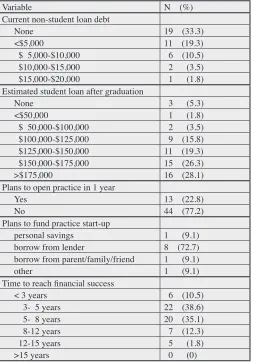
have no student loan debt at graduation. In contrast, 5% estimated they will owe less than $100,000, 15% between $100,000-125,000, 19% between $125,000-150,000, 26% between $150,000-175,000, and 28% estimated they will owe more than $175,000 in student loan debt. In total, 74% will owe more than $125,000 in student loans after chiropractic college.
A majority (77%) of respondents did not plan to start a practice within 1 year of graduation (Table 2). Of the respondents who planned to start a chiropractic practice within 1 year (13/57), only one planned to start the prac-tice with personal savings. The remainder anticipated additional debt from a commercial lender (n=8) or a par-ent, family, or friend (n=2).
A majority (65%) correctly identified the median range of income for a chiropractor (between $67,000 and $85,000) reported in the literature (Table 3). Only 21% identified this salary range as their personal definition of
financial success. Most participants (72%) defined per-sonal financial success as an income of $90,000 or higher.
When asked how many years it would take to achieve this salary level, 49% believed it would take them less than 5 years to reach this salary level, while 84% believed it would take 8 years or less (Table 2).
Respondents reported conservative attitudes towards financial risk, with 46% self-described as extremely low, very low or low risk takers, 40% as average risk takers, and 12% as high, very high or extremely high risk takers. Qualitative financial risk-taking descriptors were consist-ent with these categorizations. When asked to describe risk in a financial context, 51% chose the terms danger or uncertainty, while 25% selected opportunity or thrill. When asked how they feel after a large financial decision, 74% reported being somewhat optimistic or very
optimis-tic.
The domain-specific questionnaire also suggested re-spondents considered themselves average financial risk takers (Table 4). DC students preferred salaried positions to commission-only jobs. Most would be unlikely to in-vest in a business with a high chance of failure and few reported the likelihood of gambling, impulsive spending, co-signing loans, or loaning money to others.
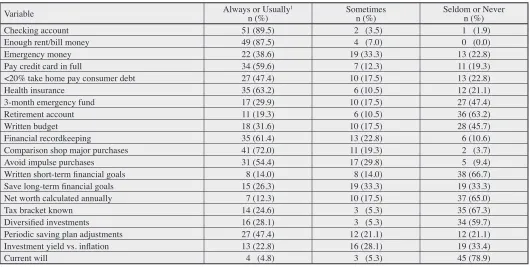
The Rutgers Financial Fitness Quiz results are pre-sented in Table 5. The mean score on this instrument was 77.6 (SD=10.12). Most DC students engaged in recom-mended short-range financial behaviors including having Table 1.
Demographic characteristics (N=57)
Demographic N (%) or Mean(SD) Age, in years 27.1 (4.3)
Range 22-42 years Sex
Male 34 (59.6)
Female 23 (40.4)
Trimester
One 7 (12.3)
Seven 10 (17.5)
Eight 15 (26.3)
Nine 9 (15.8)
Ten 16 (28.1)
Table 2.
Current personal debt and expected practice finances
Variable N (%)
Current non-student loan debt
None 19 (33.3)
<$5,000 11 (19.3)
$ 5,000-$10,000 6 (10.5) $10,000-$15,000 2 (3.5) $15,000-$20,000 1 (1.8) Estimated student loan after graduation
None 3 (5.3)
<$50,000 1 (1.8)
$ 50,000-$100,000 2 (3.5) $100,000-$125,000 9 (15.8) $125,000-$150,000 11 (19.3) $150,000-$175,000 15 (26.3)
>$175,000 16 (28.1)
Plans to open practice in 1 year
Yes 13 (22.8)
No 44 (77.2)
Plans to fund practice start-up
personal savings 1 (9.1) borrow from lender 8 (72.7) borrow from parent/family/friend 1 (9.1)
other 1 (9.1)
Time to reach financial success
< 3 years 6 (10.5)
3- 5 years 22 (38.6)
5- 8 years 20 (35.1)
8-12 years 7 (12.3) 12-15 years 5 (1.8)
Table 5.
Recommended financial behavior participation among chiropractic students (N=57)
Variable Always or Usuallyn (%) 1 Sometimes n (%) Seldom or Never n (%)
Checking account 51 (89.5) 2 (3.5) 1 (1.9)
Enough rent/bill money 49 (87.5) 4 (7.0) 0 (0.0)
Emergency money 22 (38.6) 19 (33.3) 13 (22.8)
Pay credit card in full 34 (59.6) 7 (12.3) 11 (19.3)
<20% take home pay consumer debt 27 (47.4) 10 (17.5) 13 (22.8)
Health insurance 35 (63.2) 6 (10.5) 12 (21.1)
3-month emergency fund 17 (29.9) 10 (17.5) 27 (47.4)
Retirement account 11 (19.3) 6 (10.5) 36 (63.2)
Written budget 18 (31.6) 10 (17.5) 28 (45.7)
Financial recordkeeping 35 (61.4) 13 (22.8) 6 (10.6)
Comparison shop major purchases 41 (72.0) 11 (19.3) 2 (3.7)
Avoid impulse purchases 31 (54.4) 17 (29.8) 5 (9.4)
Written short-term financial goals 8 (14.0) 8 (14.0) 38 (66.7) Save long-term financial goals 15 (26.3) 19 (33.3) 19 (33.3) Net worth calculated annually 7 (12.3) 10 (17.5) 37 (65.0)
Tax bracket known 14 (24.6) 3 (5.3) 35 (67.3)
Diversified investments 16 (28.1) 3 (5.3) 34 (59.7)
Periodic saving plan adjustments 27 (47.4) 12 (21.1) 12 (21.1) Investment yield vs. inflation 13 (22.8) 16 (28.1) 19 (33.4)
Current will 4 (4.8) 3 (5.3) 45 (78.9)
1Columns that do not add to 100% are due to rounding.
Table 3.
Estimated DC earnings and personal definition of financial success (N=57)
Income Range
Average DC Salary Estimate1
n (%)
Salary Level Defined as
Financial Success
n (%) <$50,000 1 (1.8) 1 (1.8) $ 50,000 – 70,000 14 (24.6) 3 (3.5) $ 70,000 – 90,000 23 (40.4) 9 (15.8) $ 90,000 – 120,000 12 (21.1) 16 (28.1) $120,000 – 150,000 2 (3.5) 11 (19.3) $150,000 – 175,000 1 (1.8) 5 (8.8) $175,000 – 225,000 2 (3.5) 2 (3.5) >$225,000 0 (0) 7 (12.3)
1Columns that do not add to 100% are due to
rounding.
Table 4.
Risky financial behavior participation among chiropractic students (N=57)
Variable Extremely Likely to Likely1
n (%)
Unsure n (%)
Unlikely to Extremely
Unlikely n (%) Employment in commission-only job 7 (12.3) 11 (19.3) 36 (63.1) Invest in business with high-failure risk 1 (1.8) 6 (10.5) 47 (82.5) Co-sign loans 1 (1.8) 9 (15.8) 44 (77.2) Loan a friend 1-month salary 1 (1.8) 12 (21.1) 40 (70.1) 10% blue chip stock investments 10 (17.6) 18 (31.6) 25 (43.9) 10% high risk stock 4 (7.0) 10 (17.5) 39 (68.4) 10% government bonds 9 (15.8) 16 (28.1) 29 (59.0) Impulsive spending habit 4 (7.0) 5 (8.8) 45 (79.0) Gamble 1-day pay at track 1 (1.8) 3 (5.3) 50 (87.7) Gamble 1-day pay at slots 0 (0.0) 5 (8.8) 48 (84.2)
a checking account, enough money for monthly bills, or health insurance; keeping financial records; paying credit cards in full; and avoiding impulse purchases. Fewer re-spondents engaged in medium-range financial habits such as spending less than 20% of take home pay on consumer debt, having money to cover unplanned expenses such as a car repair, or saving a 3-month emergency fund. Long-range financial habits, such as owing diversified invest-ments and retirement accounts, saving for financial goals such as a house or children’s educations, or having a cur-rent will were uncommon. Few respondents reported a written budget or short-term financial goals, calculated their net worth, or knew their tax bracket.
Discussion
Our survey builds upon a previous assessment of the fi-nancial attitudes and knowledge of chiropractic students19 and extends our understanding of DC student perceptions about their current financial health and economic pros-pects from a chiropractic practice. Our results suggest DC students enrolled at one chiropractic college have unreal-istic future salary expectations, high levels of actual and planned loan acquisition, an underestimation of their own risk tolerance, low levels of basic financial knowledge, and poor current money management skills.
While most respondents correctly identified the aver-age DC salary as less than $80,000 annually, nearly 72% equated financial success as an annual income of $90,000 to greater than $150,000. Our findings are similar to those recently reported by Gliedt et al24 of a survey of DC students at another mid-western chiropractic col-lege in which most respondents anticipated salaries in the range of $40,000-$100,000 within 1 year of gradua-tion, $60,000-$500,000 within 5 years of graduagradua-tion, and $100,000-$500,000 within 10 years of graduation. In a study of non-practicing chiropractors, 70% disagreed with the statement “salary surveys are realistically aligned with the real world of chiropractic practice”.7 Chiropractic stu-dents who believe they will earn more than the average DC may be heading to a similar disappointment in regards to future income.
Nearly 80% of our respondents did not plan to open a chiropractic practice within 1 year of graduation. This finding is consistent with a recent study of DC student post-graduation plans in which only 17% of the sample planned to open a solo practice immediately following
graduation.24 Respondents reported they were extremely unlikely to take employment in a commission-only job, which chiropractic practice is to some extent. Over 70% of respondents said they were extremely unlikely to in-vest in business with a high likelihood of failure. These findings suggest a possible mismatch between DC stu-dents’ understanding of chiropractic practice manage-ment and the actual risks involved in running a successful chiropractic clinic. For example, a recent study reported attrition rates among chiropractors in California rose from 10% for graduates licensed in 1970 to 20-25% for those licensed in 1992-1998.6 Concurrently, fewer people used chiropractic services and reimbursement rates fell, lead-ing to increased competition among chiropractors.6 The authors hypothesized this attrition also was influenced by increased tuition at chiropractic colleges, which outpaced inflation by 414% during this timeframe.25 Similarly, Mirtz, Herbert, and Wyatt surveyed chiropractors who no longer practice and determined most believed overhead expenses and student loans were a factor in practice suc-cess.7
can-not be discharged student loan debt through bankruptcy and such loans are rarely, if ever, forgiven.28
We used the Federal Reserve instrument to assess students’ knowledge of basic financial concepts.20 Re-spondents’ average score on this quiz was 77%, or a grade of “C”. These scores suggest these DC students do not demonstrate mastery of basic financial concepts. Respondents reported good short-term personal finan-cial behavior, but a high percentage of respondents did not engage in mid- and long-range financial behaviors critical to small business success, such as using a writ-ten budget, saving money for small financial emergencies and long-term financial goals, and understanding taxes. Chiropractic colleges may consider assessing students’ financial literacy and behaviors early in the chiropractic curriculum to raise students’ awareness of their own lim-ited knowledge and practical skills. In addition, colleges might teach foundational financial literacy concepts prior to introducing business management concepts to their stu-dents.
Study Limitations
Sampling biases and coverage errors are the primary lim-itations of this study. The sample size to achieve a 95% sampling error with + 0.05 standard error of measure was 152 respondents. Our sample was 57 respondents. Stu-dents who did not complete the survey may report dif-ferent financial habits and attitudes than those who re-sponded. Respondent characteristics were similar to the demographics of the DC student population at the insti-tution. Repeated distributions or reminders may have in-creased the response rate. Coverage and sampling errors were possible. Students not enrolled in business classes and those enrolled in other chiropractic colleges may re-port different financial habits or knowledge for those de-scribed here. Follow-up surveys of chiropractic students across chiropractic colleges would be informative. Additional limitations were due to the survey instru-ment itself. Huston notes the challenges of measuring fi-nancial literacy across testing circumstances.29 Previous financial research with chiropractic students did not use some survey components such as the Federal Reserve questions designed for high school students or the finan-cial risk items. These items may not be valid for the cur-rent sample. Some questions would benefit from better clarity, such as specification of gross or net income in the
questions regarding financial success. Additional items regarding student load debt, such as items about parental student load debt and default rates would be informative. Conclusion
This pilot study suggests significant gaps may exist in the financial knowledge, attitudes and practices of chiroprac-tic students. Students’ perception of expected profession-al income and preferred income sources poorly related with traditional chiropractic practice models. Overesti-mating business income may lead to financial liabilities, including unpaid student loan, additional commercial debt, stressful work environments, and possible business closure. Furthermore, these DC students did not engage in financial habits critical to the success of a small business. A larger multi-site study is needed to understand better the financial knowledge, attitudes and habits of chiroprac-tic students. Chiropracchiroprac-tic students may require a broader foundation of basic financial knowledge and the develop-ment of personal financial skills to support the practice of chiropractic as a financially viable option.
Acknowledgements
We thank Lance Corber of the Palmer Center for Chiro-practic Research for data management services. We ap-preciate Dr. Rita Nafziger, formerly of the Palmer College of Chiropractic, for approving the conduct of this survey and the teachers who allowed distribution of this survey in their business classes. We are grateful to colleagues who pre-tested our instrument, and to those students who anonymously contributed their time and effort to com-plete this survey.
References
1. Herman D. Financial success for the new private practice chiropractor. Lethbridge Undergraduate Res J. Available at http://www.lurj.org/article.php/vol4n2/chiropractor.xml, Accessed February 27, 2013.
2. Chiropractic Economics 13th annual salary and expense survey 2011 Jun 3 [cited 2011 Jul 19] Available from http://www.chiroeco.com/chiro-pdfs/ SalaryExpenceSurvey.pdf.
3. Henson S, Pressley M, Korfmann S. Business training and education needs of chiropractors. J Chiropr Educ. 2008;22:145-51.
5. Bureau of Labor Statistics Occupational Outlook Handbook, 2010-2011 2011 Jul 19 Available from http://www.http:// www.bls.gov/oco/ocos071.htmbls.gov/oco/ocos071.htm. 6. Foreman SM, Stahl MJ. The attrition rate of licensed
chiropractors in California: an exploratory ecological investigation of time-trend data. Chiropr Osteop. 2010;18:24.
7. Mirtz TA, Hebert JJ, Wyatt LH. Attitudes of non-practicing chiropractors: a pilot survey concerning factors related to attrition. Chiropr Osteop. 2010;18:29.
8. Tindle HA, Davis RB, Phillips RS, Eisenberg DM. Trends in use of complementary and alternative medicine by US adults: 1997-2002. Altern Ther Health Med. 2005;11:42-9. 9. The chiropractic practice – now, and then. ACA Survey
reveals dramatic changes over last 20 years. Dynamic Chiropr. 2011.
10. Erickson S. Are you back in black? Chiropr Econ. 2010:32-48.
11. Glick R, Lansing KJ. US household deleveraging and future consumption growth. FRBSF Economic Letter. 2009;16.
12. Sahin A, Kitao S, Cororaton A, Laiu S. Why small
businesses were hit harder by the recent recession. FRBNY Current Issues Econ Finance. 17:201.
13. Wood C. Employment in health care: a crutch for the ailing economy during the 2007-09 recession. Monthly Labor Review. 2011:13-18.
14. Bridevaux IP. A survey of patients’ out-of-pocket payments for complementary and alternative medicine therapies. Comple Ther Med. 2004;12:48-50.
15. Barnes P, Bloom B, Nahin RL. Complementary and alternative medicine use among adults and children. National Health Statistics Reports. 2008; December 10:12:1-24.
16. Lafferty WE. Insurance coverage and subsequent utilization of complementary and alternative medical providers. Am J Managed Care. 2006;12:397-404. 17. Fuller A. Chiropractic colleges seek legitimacy amid
financial owes. http://chronicle.com/article/Chiropractic-Colleges-Seek/131538/. Accessed July 1, 2013.
18. Bezold C, Rowley WR, Bettles C. The future of chiropractic revisited: 2005 to 2015. Alexandria, VA; Institute for Alternative Futures, 2005.
19. Zhang J, Rupert R, Nosco D, Tepe R. Financial experience, knowledge, and attitudes among chiropractic students in college. J Chiropr Educ. 2003;17:120-5.
20. Federal Reserve. Economic literacy test. http://www. federalreserveeducation.org/resources/detail.cfm?r_ id=023fb526-ea9b-4164-9721-21b090cf33bd) Accessed July 1, 2013.
21. Weber E, Blais AR, Betz NE. A domain-specific risk-attitude scale: measuring risk perceptions and riskbehaviors. J Behavioral Decision Making. 2002;15:263-90.
22. O’Neill B, Xiao JJ. Financial fitness quiz: a tool for analyzing financial behavior. Consumer Interests Annual. 2003;49:1-3.
23. The Free Dictionary – Farlex Financial Dictionary (2012). http://financial-dictionary.thefreedictionary.com/. Accessed July 1, 2013.
24. Gliedt JA, Briggs S, Williams JSM, Smith DP, Blampied J. Background, expectations and beliefs of a chiropractic student population: a cross-sectional survey. J Chiropr Educ. 2012;26:146-160.
25. Student Loans. http://www.finaid.org/loans/. Accessed July 19, 2011.
26. Weida NA, Phillips RL, Bazemore AW. Does graduate medical education also follow green? JAMA Intern Med. 2010;170:389-390.
27. Defaulted Borrowers, Health Education Assistance Loans, 2011. http://bhrp.hrsa.gov/scholarshipslaons/heal/ defaulters/index.html. Accessed July 1, 2013
28. Federal Student Aid. http://studentaid.ed.gov/. Accessed July 1, 2013.