Type of the Paper (Review)
1
A Survey on Access Control in the Age of IoT
2
Jing Qiu 1, Chunlai Du 2, Shen Su 1, *, Qi Zuo 3, * and Zhihong Tian 1
3
1 Cyberspace Institute of Advanced Technology, Guangzhou University; [email protected];
4
[email protected]; [email protected]
5
2 School of Computer,North China University of Technology; [email protected]
6
3 Beijing Computing Center; [email protected]
7
* Correspondence: Shen Su, [email protected]; Qi Zuo, [email protected]
8
9
Abstract: With the development of IoT technology, various information resources, such as social
10
resources and physical resources, are deeply integrated for different comprehensive applications.
11
Social networking, car networking, medical services, video surveillance and other forms of IoT
12
information Service model gradually change people's daily life. Facing the vast amounts of IoT
13
information data, IoT search technology is used to quickly find accurate information to meet
real-14
time search needs of users. However, IoT search requires to use a large number of user privacy
15
Information, such as personal health information, location information, social relations information,
16
to provide personalized services. User privacy information will meet security problems if an
17
effective access control mechanism is missing during the IoT search process. Access control
18
mechanism can effectively monitor the access activities of resources, and ensure authorized users to
19
access information resources under legitimate conditions. This survey examines the growing
20
literature on access control for IoT search. Problems and challenges of access control mechanism are
21
analyzed to facilitate the adoption of access control solutions in real-life settings. This paper aims to
22
provides theoretical, methodological and technical guidance for IoT search access control
23
mechanism in large-scale dynamic heterogeneous environment. Based on the literature study, we
24
also analyzed future development direction of access control in the age of IoT.
25
Keywords: IoT search; access control; attribute-based access control; survey
26
27
1. Introduction
28
IoT devices are collecting diverse data, such as electricity consumption, location information,
29
and sensor data, from Internet, sensor networks, and online social networks. The development of IoT
30
search realizes information sharing and improves the efficient use of devices. It can solve the problem
31
of information island, improve the comprehensive utilization rate of social resources, and reduce the
32
production and service costs. However, IoT search also collects, stores and analyses a large amount
33
of private data, while providing convenience to users. Therefore, IoT search is a "double-edged
34
sword". On the one hand, it will bring convenience to people's lives if it is used properly. On the other
35
hand, it’s also a serious threaten to personal privacy and national security.
36
Whether IoT search can be widely accepted and popularized depends on its ability of prevent
37
sensitive information leakage. Access control, as the backbone technology to ensure information
38
security, can effectively monitor the access of resources and prevent the unauthorized flow of
39
information. However, IoT search is a relatively new research field, traditional access control
40
methods and techniques cannot fully solve the access control problems faced by IoT search because
41
of node heterogeneity, open environment, multi-party sharing of resources.
42
In this survey, we present a thorough analysis of the current state-of-the-art technologies of
43
access control for IoT search. We also provide an overview of the research challenges in access control.
44
Such as, IoT search needs to integrate data from different data sources, so how to dynamic division
45
of authorization for different data sources and integrate different access control policies are big
46
challenges. The next section describes the background of access control for IoT search, which includes
47
development history of access control and the Attribute-based access control (ABAC) model. Section
48
3 reviews the ABAC-based access control policy integration technologies. Section 4 reviews the
49
ABAC-based access control policy authorization technologies. Section 5 reviews other ABAC-related
50
technologies. Section 6 identifies open issues and draws a roadmap for future research. Finally,
51
Section 7 concludes the article.
52
2. Background of Access Control for IoT Search
53
2.1. Access Control Background
54
While providing convenience to people, IoT search uses a large amount of authorized personal
55
privacy data. However, the protection of these privacy data is not enough. Once the privacy data is
56
leaked, it may bring huge losses to the organizations. Access control technology ensures that
57
resources can only be accessed by authorized users according to the pre-defined access control policy,
58
so it can prevent unauthorized access to privacy information.
59
By the 1970s, access control system is mainly used in mainframe system, such as BLP model [1]
60
and Biba model [2]. BLP model is designed according to the military security policy, which aims to
61
solve access control problem with confidential hierarchy information. It is the first mathematical
62
model of access control model with strict theoretical proof. BLP model is widely used to describe the
63
security of computer systems. Biba Model developed by Kenneth J. Biba in 1975. It is a formal state
64
transition system of computer security policy that describes a set of access control rules designed to
65
ensure data integrity. Data and subjects are grouped into ordered levels of integrity. The model is
66
designed so that subjects may not corrupt data in a level ranked higher than the subject, or be
67
corrupted by data from a lower level than the subject. Clark–Wilson model was described in 1987 by
68
Clark and Wilson. This model is used to control and audit subject’s state transition and run time
69
adjustment of low-water-mark policy parameters. Compared with Biba, Clark–Wilson model
70
provides a complete integrity protection by means of controlled state transaction, while Biba model
71
provides a simple multi-level integrity access control scheme but it needs the introduction of trusted
72
subject to ensure the usability.
73
By the 1980s, with the continuous improvement of requirements of the credibility of computer,
74
researches proposed more flexible access control mechanisms. One of the representative works is the
75
Trusted Computer System Evaluation Criteria (TCSEC) which is created by The United States
76
Government Department of Defense (DoD). TCSEC is a standard that sets basic requirements for
77
assessing the effectiveness of security. According to TCSEC, access control can be divided into
78
Discretionary Access Control (DAC) [3] and Mandatory Access Control (MAC) [4] depend on
79
different roles of access authority users. DAC model allows legitimate users to access objects as users
80
or groups, while preventing unauthorized users from accessing objects, some users can also
81
independently grant access rights to objects they own to other users. DAC model can meet the
82
security needs of resource owners, however, because of the way of access depends on user
83
authorization, the management of access authorities in DAC model is more decentralized. At the
84
same time, DAC needs to manage the users, authorities and resources manually, which makes it not
85
appropriate for IoT search due to the high complexity management works. MAC model is a means
86
of assigning access rights based on regulations by a central authority. This class of policies includes
87
examples from both industry and government. The applications of MAC are usually based on
multi-88
level security model. Although MAC model solves the problem of decentralized resource
89
management by centralizing authorization management, but for the users of IoT search, the
90
management efficiency of MAC model is lower.
91
Around 2000, with the development of Internet and increasing large-scale applications of
92
information system in enterprises, the traditional models of access control (i.e. DAC, MAC and its
93
extension models) are difficult to handle complex application layer access requirements. To solve this
94
users. The components of RBAC (i.e. role-permissions, user-role and role-role relationships) make it
96
simple to perform user assignments. Figure 1 shows the relationship between roles and users in
97
RBAC model. RBAC can be used to facilitate administration of security in large organizations, and
98
meeting the information integrity requirements of information systems. RBAC is different from MAC
99
and DAC, however it can enforce these policies without any complication.
100
101
Role Object 1
Object 2
102
Figure 1. Role and user relationship of RBAC.
103
Fast development of new computing environments such as IOT search brings big challenges to
104
the applications of access control technology. Traditional closed environment-oriented access control
105
models (i.e. DAC, MAC, RBAC) are not adapt to the new computing environments. In this case,
106
Attribute-Based Access Control (ABAC) [6] is proposed as an emerging form of access control, where
107
subject requests to perform operations on objects are granted or denied based on assigned attributes
108
of the subject, assigned attributes of the object, environmental conditions, and a set of policies that
109
are specified in terms of those attributes and conditions [7]. The concept of role is very common in
110
real life. Ferraiolo and Kuhn first introduced it into the Information System Access Control Research
111
Institute in 1992 and named it RBAC [5]. Such Different from the traditional access control models
112
which manual assignment of roles, ownership, or security labels by a system administrator, ABAC
113
allows for the creation of access policies based on the existing attributes of the users and objects in
114
the system.
115
Since attributes can describe entities in different views, it allows user to change access control
116
strategies according to actual situations. Temporal-RBAC (TRBAC) [8] is an extension of RBAC model,
117
which supports periodic role enabling, disabling, and temporal dependencies by using role triggers.
118
Concept Usage Control (UCON) was developed in [9], which enables finer-grained control over usage of
119
digital objects than that of traditional access control policies and models. The advantages of ABAC can
120
effectively solve the problem of fine-grained access control in dynamic large-scale environment. ABAC is
121
an ideal access control model in new computing environment, and has broad application prospects.
122
2.2. ABAC Background
123
ABAC makes access control decisions based on the attributes of access control entities. These
124
attributes are often represented by a four tuple <S O P E, , , >.
125
S Attributes (Subject Attributes). Attributes of the subjects of the system. Such as name, age,
126
home address, job title and so on.
127
O Attributes (Object Attributes). Attributes of the resources of the system. Such as documents,
128
pictures, audio files and so on.
129
P Attributes (Permission Attributes). Various operations on object resources. Such as files or
130
database read, write, create operations and so on.
131
E Attributes (Environment Attributes). Attributes derived from the current state of the
132
system’s environment. Such as session start time, system location and so on.
133
The ABAC system can be divided into two stages depending on the type of operation it
134
Policy Management is primarily responsible for the collection of attributes, and describing and
136
matching access control policies. The access control policy execution phase is primarily responsible
137
for responding to access requests.
138
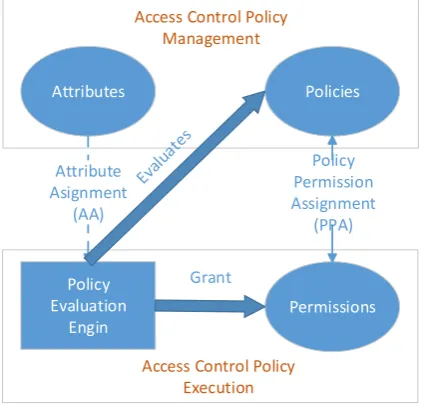
A simplified ABAC model is given in Figure 2, where Attribute Assignment (AA) aims to assign
139
attributes to subjects and objects, Policy Permission Relation (PPR) is the relation between policies
140
and the permissions they grant, Policy is the set of all policies that govern access in the system.
141
Access Control Policy Execution Access Control Policy
Management
Attributes Policies
Permissions Policy
Evaluation Engin Attribute Asignment
(AA)
Policy Permission Assignment
(PPA)
Grant
142
Figure 2. Core ABAC model. Attributes include both subject attributes and object attributes. Thin
143
solid arrows denote many-to-many relations, thick solid lines denote relation with policy engine, and
144
dotted lines denote information used by the policy engine to evaluate a certain policy.
145
Although ABAC achieves effective control over users' access to resources, the security of the
146
private data is not fully considered. Based on the idea of traditional ABAC, researchers have
147
proposed Attribute-Based Encryption (ABE) [10] where objects are encrypted based on
attribute-148
based access policies. ABE mainly consists of key-policy ABE (KP-ABE) [11] or ciphertext-policy ABE
149
(CP-ABE) [12]. In KP-ABE, the access structure used to describe the access control policy is combined
150
with the user's private key, and the attribute set is associated with the resource to be accessed. In this
151
model, user freedom is relatively high and data owner freedom is lower. Because only attributes can
152
be used to describe the data, the data owner cannot set the corresponding access control policies.
CP-153
ABE is the reverse of KP-ABE, using an attribute-based policy to encrypt an object, and the access
154
structure used to describe the access control policy is combined with resource to be accessed and the
155
attribute set is associated with the user's private key. In this model, the access control policy is set by
156
data owner, so that data owner freedom is higher.
157
3. Conflicts Resolution and IoT Application
158
3.1. Conflicts Resolution and Model Combination
159
In large scale network, different policies . Thus, the policy conflicts detection and resolution has
160
an important role in the ABAC, and there is a lot of research on it.
161
In the paper of XACML Policy Evaluation Engines design research [13], the authors mentioned
162
Kolovski et al.[14] formalize XACML policies with description logics (DLs), a decidable fragment of
163
the first-order logic, and exploit existing DL verifiers for policy verification, detecting redundant
164
XACML rules and removing redundant rules from XACML policies. Other scholars [15-19] proposed
165
other conflicts detection and resolution methods to
166
Servos D etc. [20] summarized research and open problems in ABAC. As they mentioned, hybrid
167
models of ABAC aim to combine attributes into existing models of access control or to extend the
168
proposed ARBAC (attribute- and role-based access control) that has an advantage of both ABAC and
170
RBAC to fulfill the needs of highly distributed network environment. They also have done a conflict
171
detection and policy optimization.
172
Servos and Osborn [21] attempted to create a formal general model of ABAC that provides a
173
group based hierarchical representation of object and user attributes. In this model, entitled
174
Hierarchical Group and Attribute-Based Access Control (HGABAC), attributes are assigned both
175
directly to access control entities and indirectly.
176
3.2. IoT Application
177
Much efforts have been done in application of traditional methods of access control to IoT
178
scenarios. N. Ye [22] introduced ABAC in web services into IoT networks to reduce the number of
179
rules resulting from role explosion.
180
Both in [23] and [24], scholars discussed the research direction in IoT. In [24], Sicari S etc.
181
summarized the security, privacy and trust in IoT, they discussed the limitation of RBAC and ABAC
182
in IoT. As mentioned in [24], Gusmeroli S etc. [25] affirm that authorization frameworks like RBAC
183
and ABAC (Attribute Based Access Control) do not provide sufficient scalable, manageable, and
184
effective mechanisms to support distributed systems with many interacting services and the dynamic
185
and scaling needs of IoT text. A problem common to ACLs (Access Control Lists), RBAC and ABAC
186
is that in these systems it is hard to enforce the principle of least privilege access.
187
Because of the large-scale network in the IoT area, there must be model combination and novel
188
strategy, such as blockchain. In addition, although the research on combined model of ABAC has
189
achieved certain research results, the application to IoT scenarios are lacking. The independent and
190
complete set of ABAC strategy application and content-based access control is the basis for building
191
access control system in IoT area. How to design an excellent algorithm to get the best mixed strategy
192
with low computational complexity is the key scientific problem to be solved in the future.
193
4. Access Control and Authorization
194
4.1. Attribute Discovery Mechanism
195
The accessing entities and the accessed entities have many intrinsic attributes. how to select
196
appropriate attributes directly affects performance of access control system. The conceptual model of
197
attribute aggregation fuses the many user attributes contained in multiple IdPs (Identity Providers)
198
and further generates a complete user attribute based on the reliability of the information provided
199
by each LS (Linking Service) [26]. Because not considering the dynamic changes of IdP’s reputation,
200
an attribute aggregation method based on multi-node cooperation [27] is proposed to obtain
201
attributes from multiple mutually cooperative nodes when an attribute that the system does not
202
recognize appears. The nodes participating in cooperation calculate the reputation values of the
203
neighboring nodes based on their background knowledge, and then upload the reputation value
204
when the SPs (service providers) makes the attribute query. After the SP calculates all the reputation
205
values, it determines whether the node providing data is trusted according to the preset threshold,
206
and filters the information provided by the untrusted node. This method solves the problem of
207
reputation in attribute aggregation. although solving multi-attribute aggregation problems by multi
208
vector convergence operator [28], but the solution does not consider the security (for example:
209
privacy exposure) caused by attribute aggregation. Thus, several recent researches have been
210
conducted for the privacy-preserving for the IoT based services. PAgIoT which is a Privacy
211
preserving Aggregation protocol suitable for IoT settings enables multi-attribute aggregation for
212
groups of entities while allowing for privacy-preserving value correlation [29]. This mechanism
213
enables aggregating data concerning several attributes of each entity in a single operation ensuring
214
data authenticity and privacy. Literature [30-31] achieves the scheme of attribute aggregation for
215
privacy protection with OpenID or pseudo-ID. Location anonymization attempts to make user’s
216
location indistinguishable from a certain number of other users in open environment so that it is one
217
anonymous attribute based on encryption technique [32]. Attribute discovery depends on data
219
aggregation which is responsible for increasing the network lifetime and reducing the energy
220
consumption [33]. Literature [34] proposed a method of lifetime balanced data aggregation, in which
221
the aggregation delays of adjacent devices are adjusted together in a collaborative fashion.
222
Because the data aggregation has an important role in the IoT, there is not any systematic and
223
comprehensive study about analyzing its important mechanisms [34]. In addition, although the
224
research on attribute discovery of IoT has achieved certain research results, the mining method of
225
independent and complete attribute for large scale data are lacking in noisy environments. The
226
independent and complete set of attributes is the basis for building ABAC. The independence of the
227
attributes ensures that the set of attributes required to build access control does not contain
228
redundant attributes with repeated meanings. And the completeness of the attributes ensures that
229
the attribute set includes all the attributes needed to accurately respond to the access request.
230
Therefore, under the condition of satisfying independent and complete constraints, how to design an
231
excellent algorithm to get the best query attribute set with low computational complexity is the key
232
scientific problem to be solved in the future.
233
4.2. Association Generation of Attribute and Permission
234
A wide variety of users and devices bring a huge variety of attributes in the IoT environment.
235
These attributes contain too many redundant attributes, which are not necessary to build the access
236
control system, to manually filter. Therefore, it is necessary to study the automated association
237
between user-attribute and attribute-privilege. Literature [35] discusses the security threats in IoT
238
including Authentication, Confidentiality and Access Control. Besides ABAC (Attribute-Based
239
Access Control) [36], RBAC (Role-Based Access Control) is also a policy mechanism which are based
240
on the role of users in the system and the permissions given to them [37]. Although RBAC is one of
241
the access control types [38], RBAC can be seen a single attribute special case of ABAC. RBAC is
242
suitable for scenarios where there is an easy identification of permitted tasks for each user or service
243
[37].
244
By drawing on the role engineering in RBAC, we can provide some ideas for the research of
245
attribute association. Role engineering can be divided into top-down and bottom-up. The top-down
246
method refers to the analysis of the security requirements and business processes by experts with the
247
help of relevant knowledge, abstracting the role set, completing the role-permission assignment
248
relationship, and ultimately achieving the goal of building a secure access control system. However,
249
these methods mainly rely on experts to understand the real application scenarios, and the artificial
250
dependence is strong. Using data mining techniques or matrix decomposition methods, the
bottom-251
up method automatically filters and generates candidate role sets based on the existing user-privilege
252
correspondence. Probabilistic approach is introduced into attribute extraction [39]. Literature [40]
253
proposes a probabilistic model to reflect the correlation between role and privileges. With top-down
254
and bottom-up methods, we can study the semantic relationship between the newly mined attributes,
255
measure the similarity between the newly mined attributes and the attributes in the original access
256
control system, and build the association between attribute and privilege.
257
For the generation and maintenance of ABAC rules, manually migrating to ABAC is more
258
difficult than migrating to RBAC. The changes like mergers and acquisitions can make the rules
259
inaccurate. If the change is too frequent, it is very difficult to manually specify or maintain an ABAC
260
rule set. Therefore, automatically mining ABAC rules is an alternative. Literature [41] presents an
261
ABAC policy mining algorithm which iterates over tuples in the given user-permission relation, uses
262
selected tuples as seeds to construct candidate rules, and generalizes each candidate rule to cover
263
additional tuples in the user-permission relation by replacing conjuncts in attribute expressions with
264
constraints.
265
Since access logs reflect not only access control rules but also requesters’ behaviors, so that
266
mining the access logs helps to reconstruct the access rule for reducing the cost of migration to ABAC.
267
Literature [42] analyzes that logs generally provide incomplete information about granted privilege
268
but summarize the log by the user-privilege relation induced by the log and the frequency function.
270
Literature [43] use RBMs (Restricted Boltzmann Machines) to infer ABAC access rules from logs.
271
RBMs are energy-based models capable to perform unsupervised learning so that they can work in
272
the scenarios that there are only positive examples.
273
The access logs required by mining algorithm are not sparse. Otherwise these mining algorithms
274
[41-43] as discussed above cannot mine useful ABAC policy. These sparse access logs maybe contain
275
only a fraction of all possible requests. How to utilize sparse logs to mine useful ABAC policy become
276
a requirement. Literature [44] proposes a mining algorithm Rhapsody which has been built on
277
APRIORI-SD by replacing its last two stages with two new stages. On one hand, Rhapsody computes
278
the reliability of each rule and removes those rules whose reliability value is below a given threshold.
279
on the other hand, Rhapsody removes those rules that have equivalent shorter rules. In order to test
280
the accuracy of mining algorithm, cross-validation is necessary which splits the log into a training
281
and a testing log. Cross-validation on logs is shown in Figure 1. The Arabic numerals describe the
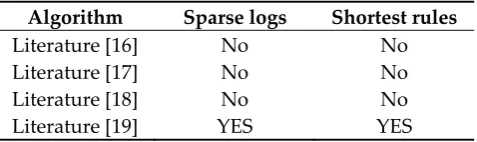
282
processing stage. Table 1 shows the comparison of mining algorithms mentioned above.
283
284
285
Figure 1. cross-validation
286
287
Table 1. State-of-the-art ABAC policy mining algorithms
288
Algorithm Sparse logs Shortest rules
Literature [16] No No
Literature [17] No No
Literature [18] No No
Literature [19] YES YES
289
There are two challenges. One is the limitations of existing approaches to policy mining is that
290
the logs contain negative authorizations with varying levels of incompleteness. Another is noise in
291
raw data which greatly affects the accuracy of results. How to deal with noise in raw data is a focus
292
in the future.
293
4.3. Policy Matching
294
An efficient access control model or algorithm for the IoT requires to select an appropriate access
295
policy language to implement corresponding access policies. The most well-known access control
296
schemes used in IoT environments are XACML (Extensible Access Control Markup Language),
297
OAuth (Open Authorization), and UMA (User-Managed Access). these protocols or frameworks will
298
accelerate policy matching.
299
The XACML provide a standardized description of access control policies and is used in many
300
IoT-related works such as [45]. XACML evaluation engine uses traversal matching so that Literature
301
[46] uses the statistical analysis to reorder the policies and rules, put the frequently invoked policies
302
and rules in front and cluster the policies, and clusters the policies and rules. Based on the XACML
303
logic model, a decision graph of multiple types of data is proposed to manage the XACML strategy
304
queries by rewriting queries and removing parts of violating access control rules, and evaluates the
306
re-written queries using subviews [48]. OAuth has been designed to provide an access control scheme
307
to Web Services and applications. OAuth provides OAuth-based solutions for IoT. Literature [49]
308
proposes a secure authentication policy, using OAuth 2.0 protocol. UMA which extends OAuth is a
309
promising mechanism for access control. Literature [50] proposes a multi-level cache optimization
310
mechanism that reduces the size of the strategy and digitizes the attribute values to improve the
311
matching speed. Literature [51] selects XACML for the proposed AdRBAC (Adaptive Risk-Based
312
Access Control) model. AdRBAC has four inputs which are user context, resource sensitivity, action
313
severity and risk history. These four factors are used to estimate the security risk associated with each
314
access request. The estimated risk value is then compared against the risk policies to make the final
315
access decision.
316
Literature [52] proposes a Blockchain-based framework for access authorizations. Although the
317
Blockchain was design for Bitcoin transactions, it uses the Blockchain to store access control rules,
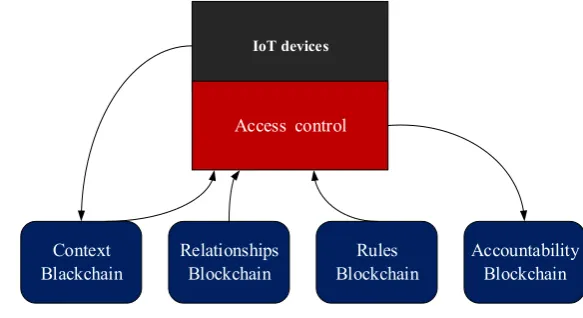
318
relationships, contexts and accountability information. Blockchain include Relationships Blockchain,
319
Context Blockchain, Accountability Blockchain and Rules Blockchain as shown in Figure 2. The access
320
information should be recorded on the Accountability Blockchain by the access control. It proposes
321
a Decoder but lacking details that how to translate ABAC model and rules to the four Blockchain.
322
Although authors do not explain the technical details of Decoder for which there is not theoretical
323
proof or experimental test [52], it is worth introducing Blockchain to the research of access control
324
of IoT.
325
326
Context Blackchain
Accountability Blockchain Relationships
Blockchain
Rules Blockchain IoT devices
Access control
327
328
Figure 2. Framework overview
329
5. Other ABAC Models
330
Permissions in ABAC are closely related to attributes, and changes in user attributes can lead to
331
corresponding changes in their access permissions. Access permission could be revoked on user level,
332
user attribute level, and system attribute level. In either permission revoke level, new access control
333
policies need to be generated when attributes are changed. The large-scale attributes and the
many-334
to-many relationship between attributes and permissions in IoT search increase the complexity of
335
permission updating.
336
Some researchers proposed to maintain attribute-permission list directly and manually. In [53],
337
a simple direct revocation is described. In this method, labels of the revoked attributes are reversed
338
to relate with permission policies to ensure these revoked attributes cannot be access by users.
339
However, this way increases the description complexity of access control policies. To solve this
340
problem, [54] proposed an attribute direct-revocable CP-ABE scheme with constant ciphertext length.
341
Although direct revocation can achieve fine-grained access control, it cannot achieve efficient
342
fine-grained management between attributes and permissions. To overcome this limitation,
343
researchers proposed indirect revocation. In [55], an identity-based encryption scheme was proposed
344
for the users at the same time. This method updates the access control policy periodically, and
346
revocation only occur when the period of user attributes is expired. Thus, indirectly increasing the
347
workload of authorization engine. To overcome this drawback, [56] describes an efficient and revocable
348
data access control scheme for multi-authority cloud storage systems. Multiple authorities co-exist in the
349
system, and each authority can issue attributes independently. A revocable multi-authority CP-ABE
350
scheme is also proposed in this article, which is applied as the underlying techniques to design the data
351
access control scheme. Indirect approach does not require a full list of users, however, the exchange of key and
352
data, and access control must be performed through a trusted third party. In article [57] He et al. limit attributes
353
to user credentials that have been verified by a trusted third party. Both static and dynamic delegation in the
354
context of the Role Graph Model are presented, and sessions are added to the RGM. Edge-labeling method is
355
using in RBAC model to achieve session-oriented dynamic delegation.
356
In ABAC systems, user permissions are only associated with attributes, users may not be known
357
until runtime due to this increased flexibility provided by attribute-based policies and the
identity-358
less nature. At present, the research on auditing techniques of user identity in ABAC mainly focuses
359
on Attribute-based Signature (ABS). Combined with the idea of digital signature, researchers
360
proposed the ABS mechanism. The introduction of digital signature technology, such as ring
361
signature [58] and group signature [59], guarantees the integrity of user attribute information. In
362
article [60], an adaptive-predicate unforgeable and private attribute-based signature (ABS) scheme is
363
described in the standard model. The ABS mechanism in multi-authority environment is designed
364
and the corresponding security proof is given in the paper. In [61], the first decentralized
multi-365
authority attribute-based signature (DMA-ABS) scheme is presented. No central authority and no
366
trusted setup are required in this scheme. However, due to the limitation of access structure, the
367
scheme is not suitable for large-scale environment. Although ABS mechanism protects the privacy of
368
signers, malicious users may use ABS's anonymity to perform malicious operations. Traceable ABS
369
mechanism is proposed to track user identity while ensure the privacy of signers. In [62], a traceable
370
ABS mechanism (Decentralized TABS, DTABS) is proposed in distributed environment. Based on
371
DTABS, paper [63] improve the state-of-art in three dimensions. The model proposed in the paper
372
minimizes the trust placed in attribute authorities and provides a stronger definition for
non-373
frameability. The model also captures the notion of tracing soundness.
374
6. Conclusions and Research Trends of Key Technologies
375
This article has introduced the background of access control and a taxonomy of current areas of
376
ABAC for IoT search, provided a literature review of different ABAC models, and identified a number of
377
open problems. Access control divided into Access control policy Management and Access control
378
policy execution phases in this paper. For the first phase, Section 3 provides the review of ABAC
379
oriented access control policy integration. For the second phase, the review of ABAC oriented access
380
control and authorization in Section 4 describes the Attribute discovery mechanism,
attribute-381
permission relation generation mechanism, and policy matching mechanism. Section 5 complements
382
other key technologies in ABAC mechanism. The open problems examined in Section 6 serve as
383
potential starting points for new research efforts.
384
The literature surveyed in this paper covered a number of different types of ABAC models.
385
However, as the application environment becomes more and more diverse and complex, there is still
386
challenge problems to be solved in ABAC research. One of the challenge problems to be solved is
387
policy conflict resolution which is caused by features of IoT search. To ensure the security of IoT
388
search and access control system, it is urgent to carry out related research. The other challenge
389
problem is noise data identification and elimination for user-permission relations, since the noise
390
data greatly affects the accuracy of the policy generation, and brings great security risks to access
391
control systems.
392
393
Author Contributions: Introduction, Background of Access Control for IoT Search, Other ABAC Models, and
394
Conclusions and Research Trends of Key Technologies, Jing Qiu and Zhihong Tian; Access Control and
395
Funding: This research was funded in part by the National Natural Science Foundation of China (61871140,
397
61572153, U1636215, 61572492, 61672020), the National Key research and Development Plan (Grant No.
398
2018YFB0803504), and Open Fund of Beijing Key Laboratory of IOT Information Security Technology
399
(J6V0011104).
400
Acknowledgments: The authors express their sincere appreciation to the editors and the anonymous reviewers
401
for their helpful comments.
402
References
403
1. Lapadula L. J., Bell D. E. Secure Computer Systems: Mathematical Foundations, MTR-2547, Volume 1,
404
November 1973.
405
2. Biba, K.J. Integrity Considerations for Secure Computer Systems, NTIS AD-A039 324, MTR
3153,ESD-TR-76-406
372, MITRE Corporation, Bedford, MA, 1977.
407
3. Downs D.D., Rub J.R., Kung K.C., Jordan C.S. Issues in Discretionary Access Control, Proceedings of the
408
IEEE Symposium on Security and Privacy, 1985, p. 208-218.
409
4. Bertino E., Jajodia S., Samarati P. Enforcing Mandatory Access Control in Object Bases, Proceedings of the
410
Conference Workshop on Security for Object-Oriented Systems, Berlin: Springer, 1993: 96-116.
411
5. Ferraiolo D. F., R. Sandhu. Proposed NIST standard for role-based access control. ACM Transactions on
412
Information and System Security, 2001, 4(3): 224-274.
413
6. Bonatti, P. A., Samarati, P. A uniform framework for regulating service access and information release on
414
the web. Journal of Computer Security, 2002, 10(3): 241-272.
415
7. Servos D., Osborn S. L. Current Research and Open Problems in Attribute-Based Access Control. ACM
416
Computing Survey, 2017, 49(4).
417
8. Bertino, E., Bonatti, P. A., Ferrari, E. TRBAC:A temporal role-based access control model. ACM Transactions
418
on Information and System Security, 2001, 4(3): 191-233.
419
9. Park, J., Ravi S. Towards usage control models: beyond traditional access control, Proceeding of the 7th
420
ACM Symposium on Access Control Models and Technologies, New York, 2002: 57-64.
421
10. Sahai, A., Waters, B. Fuzzy Identity-Based Encryption, Proceeding of the 24th Annual International
422
Conference on the Theory and Applications of Cryptographic Techniques, Berlin: Springer, 2005: 457-473.
423
11. Goyal V., Pandey O., Sahai A., Waters B. Attribute-based encryption for fine-grained access control of
424
encrypted data, Proceeding of the 13th ACM Conference on Computer and Communications Security, New
425
York, 2006: 89-98.
426
12. Bethencourt, J., Waters, B. Ciphertext-Policy Attribute-Based Encryption, Proceeding of IEEE Symposium
427
on Security and Privacy, Piscataway, NJ, 2007: 321-334.
428
13. Liu A X, Chen F, Hwang J H, et al. Designing Fast and Scalable XACML Policy Evaluation Engines[J]. IEEE
429
Transactions on Computers, 2011, 60(12):1802-1817.
430
14. V. Kolovski, J. Hendler, and B. Parsia, “Analyzing Web Access Control Policies,” Proc. Int’l Conf. World
431
Wide Web (WWW), pp. 677-686, 2007
432
15. Shu C C, Yang E Y, Arenas A E. Detecting Conflicts in ABAC Policies with Rule-Reduction and
Binary-433
Search Techniques[C]// IEEE International Symposium on Policies for Distributed Systems and Networks.
434
IEEE, 2009:182-185.
435
16. Liu J, Zhang H, Dai X, et al. A Static ABAC Policy Conflict Resolution Algorithm[C]// International
436
Conference on Multimedia Information NETWORKING & Security. IEEE Computer Society, 2012:83-86.
437
17. Bonatti, Piero, Vimercati D C D, et al. An algebra for composing access control policies[J]. ACM
438
Transactions on Information and System Security (TISSEC), 2002, 5(1):1-35.
439
18. Hu H, Ahn G J, Kulkarni K. Anomaly discovery and resolution in web access control policies[J]. IEEE
440
Transactions on Dependable & Secure Computing, 2013, 10(6):341-354.
441
19. Rao P., Lin D., Bertino E., et al. An algebra for fine-grained integration of XACML policies[C]// ACM
442
Symposium on Access Control MODELS and Technologies. ACM, 2009:63-72.
443
20. Servos D, Osborn S L. Current Research and Open Problems in Attribute-Based Access Control[J]. Acm
444
Computing Surveys, 2017, 49(4).
445
21. Servos D, Osborn S L. HGABAC: Towards a Formal Model of Hierarchical Attribute-Based Access
446
Control[C]// International Symposium on Foundations and Practice of Security. Springer, Cham,
2014:187-447
22. N. Ye, Y. Zhu, R.-c. Wang, R. Malekian, and L. Qiao-min, “An efficient authentication and access control
449
scheme for perception layer of internet of things,” Applied Mathematics & Information Sciences, vol. 8, no.
450
4, p. 1617, 2014.
451
23. Ranjan A K, Somani G. Access Control and Authentication in the Internet of Things Environment[M]//
452
Connectivity Frameworks for Smart Devices. Springer International Publishing, 2016.
453
24. Sicari S, Rizzardi A, Grieco L A, et al. Security, privacy and trust in Internet of Things[J]. Computer
454
Networks, 2015, 76(C):146-164.
455
25. Gusmeroli S, Piccione S, Rotondi D. A capability-based security approach to manage access control in the
456
Internet of Things[J]. Mathematical & Computer Modelling, 2013, 58(5-6):1189-1205.
457
26. Chadwick, D W, Inman G. The Trusted Attribute Aggregation Service. Proceedings of IEEE International
458
Conference on Availability, Reliability and Security, Pis-cataway. Pis-cataway, NJ: IEEE, 2013: 1-27.
459
27. [2] Jaewon Lee, Heeyoul Kim, Joon Sung Hong. An Attribute Aggregation Architecture with Trust-based
460
Evaluation for Access Control. Proceedings of IEEE Network Operations&Management Symposium.
461
Piscataway, NJ:2008: 1011-1014, DOI: 10.1109/NOMS.2008.4575270
462
28. [3] Ghiselli Ricci, R. Mesiar, R. Multi-Attribute Aggregation Operators. Fuzzy Sets and Systems, 2011,
463
181(1): 1-13.
464
29. [4] González-Manzano, J de Fuentes, S Pastrana, et al. PAgIoT-Privacy-preserving Aggregation protocol
465
for Internet of Things. Journal of Network and Computer Applications, 2016 (71): 59-71.
466
30. [5] Nakamura M, Nishimura T, Yamaji K, et al. Privacy Preserved Attribute Aggregation to Avoid
467
Correlation of User Activities across Shibboleth SPs. Proceedings of IEEE 37th Annual Computer Software
468
and Applications Conference, 2013:367-372.
469
31. [6] X. Zhu, H. Chi and S. Jiang. Using dynamic pseudo-IDs to protect privacy in location-based services.
470
Proceedings of IEEE International Conference on Communications (ICC), 2014: 2307-2312.
471
32. [7] J. Shao, R. Lu and X. Lin. FINE: A fine-grained privacy-preserving location-based service framework
472
for mobile devices. IEEE INFOCOM, 2014: 244-252.
473
33. [8] Behrouz Pourghebleh, Nima Jafari Navimipour. Data aggregation mechanisms in the Internet of things:
474
A systematic review of the literature and recommendations for future research. Journal of Network and
475
Computer Applications. 2017.
476
34. [9] Li, Z., Zhang, W., Qiao, D., Peng, Y., Lifetime balanced data aggregation for the internet of things.
477
Computers & Electrical Engineering. 2017.
478
35. [10] Sicari S, Rizzardi A, Grieco L, Coen-Porisini A. Security, privacy and trust in Internet of Things: The
479
road ahead. Computer networks. 2015(76): 146–164.
480
36. [11] Hemdi, M.; Deters, R. Using REST based protocol to enable ABAC within IoT systems. In Proceedings
481
of the 2016 IEEE 7th Annual Information Technology, Electronics and Mobile Communication
482
Conference.2016:1-7
483
37. [12] Luis Cruz-Piris, Diego Rivera, Ivan Marsa-Maestre, Enrique de la Hoz and Juan R. Velasco. Access
484
Control Mechanism for IoT Environments Based on Modelling Communication Procedures as Resources.
485
Sensors, 2018,18(3):1-21.
486
38. [13] Yunpeng Zhang and Xuqing Wu. Access Control in Internet of Things: A Survey. 2016,
487
URL:https://arxiv.org/abs/1610.01065 (accessed on 30/10/2018).
488
39. [14] Lee T, Wang H. Attribute Extraction and Scoring: A Probabilistic Approach. Proceedings of IEEE 29th
489
International Conference on Data Engineering. 2013:194-205.
490
40. [15] Frank M, Berkeley C. Role Mining with Probabilistic Models. ACM Transactions on Information and
491
System Security, 2013, 15(4): 378-397.
492
41. [16] Zhongyuan Xu and Scott D. Stoller. Mining Attribute-based Access Control Policies. IEEE Transactions
493
on Dependable and Secure Computing, 2015,12(5): 533-545.
494
42. [17] Zhongyuan Xu and Scott D. Stoller. Mining Attribute-Based Access Control Policies from Logs.
495
Proceedings of the 28th Annual IFIP WG 11.3 Working Conference on Data and Applications Security and
496
Privacy XXVIII. 2014: 276-291.
497
43. [18] Decebal Constantin Mocanu, Fatih Turkmen, Antonio Liotta. Towards ABAC Policy Mining from Logs
498
with Deep Learning. Proceedings of the 18th International Multiconference, Intelligent Systems, 2015.
499
44. [19] Carlos Cotrini, Thilo Weghorn, David Basin. Mining ABAC Rules from Sparse Logs. Proceedings of
500
45. [20] Seitz L, Selander G, Gehrmann C. Authorization framework for the internet-of-things. In Proceedings
502
of the 2013 IEEE 14th International Symposium and Workshops on a World of Wireless, Mobile and
503
Multimedia Networks (WoWMoM), 2013: 1–6.
504
46. [21] Said Marouf, Mohamed Shehab, Anna Squicciarini, Smitha Sundareswaran, et al. Adaptive reordering
505
and clustering-based framework for efficient XACML policy evaluation. IEEE Transactions on Services
506
Computing, 2011,4(4): 300-313.
507
47. [22] Canh Ngo, Yuri Demchenko, Cees de Laat. Decision Diagrams for XACML Policy Evaluation and
508
Management. Computers & Security, 2015,49(3):1-16.
509
48. [23] Manogna Thimma, Fang Liu, Jingqiang Lin, Bo Luo. HyXAC: Hybrid XML Access Control Integrating
510
View-Based and Query-Rewriting Approaches. IEEE Transactions on Knowledge and Data Engineering,
511
2015,27(8): 2190-2202.
512
49. [24] Shamini Emerson, Young-Kyu Choi, Dong-Yeop Hwang, Kang-Seok Kim, Ki-Hyung Kim. An oauth
513
based authentication mechanism for iot networks. Proceedings of the 2015 International Conference on
514
Information and Communication Technology Convergence (ICTC), 2015: 1072–1074.
515
50. [25] HPEngine: high performance XACML policy evaluation engine based on statistical analysis. journal
516
on Communications, 2014,35(8):206-215.
517
51. [26] Hany F Atlam, Madini O Alassafi, Ahmed Alenezi, Robert J Walters. XACML for Building Access
518
Control Policies in Internet of Things. Proceedings of 3rd International Conference on Internet of Things,
519
Big Data and Security (IoTBDS), 2018.
520
52. [27] Otto Julio Ahlert Pinno, André Ricardo Abed Grégio, Luis C E De Bona. ControlChain: Blockchain as
521
a Central Enabler for Access Control Authorizations in the IoT. Proceedings of IEEE Global
522
Communications Conference (GLOBECOM), Singapore, 2017.
523
53. Ostrovsky,R, Sahai,A.,Waters, B. Attribute-based encryption with non-monotonic access structures,
524
Proceeding of the 14th ACM Conference on Computer and Communications Security, New York, 2007:
195-525
203.
526
54. Zhang Y. H., Zheng D.,Jin L., Hui L., University X. Attribute Directly-revocable Attribute-based
527
Encryption with Constant Ciphertext Length. Journal of Cryptologic Research, 2014, 1(5): 465-480.
528
55. Boldyreva, A. Kumar, V. Identity-based encryption with efficient revocation, Proceeding of the 15th ACM
529
Conference on Computer and Communications Security, New York, 2008: 417-426.
530
56. Yang, K., Jia, X. Expressive, Efficient, and Revocable Data Access Control for Multi-Authority Cloud
531
Storage. IEEE Transactions on Parallel and Distributed Systems, 2014, 25(7): 1735-1744.
532
57. Wang H., Osborn S. Static and Dynamic Delegation in the Role Graph Model. IEEE Transactions on
533
Knowledge & Data Engineering, 2011 , 23 (10) :1569-1582.
534
58. Rivest R.L., Shamir A., Tauman. Y. How to Leak a Secret, Proceeding of the 7th International Conference on
535
the Theory and Application of Cryptology and Information Security, Berlin, 2001: 552-565.
536
59. Science, C. Group Signatures, Proceeding of Workshop on the Theory and Application of Cryptographic
537
Techniques, Berlin, 1991: 257-265.
538
60. Okamoto, T. Takashima, K. Efficient Attribute-Based Signatures for Non-monotone Predicates in the
539
Standard Model, Proceeding of International Workshop on Public Key Cryptography, Beilin, 2011: 35-52.
540
61. Okamoto T., Takashima, K. Decentralized Attribute-Based Signatures, Proceeding of the 16th International
541
Conference on Practice and Theory in Public-Key Cryptography, Berlin, 2013: 125-142.
542
62. Kaafarani, A. El, Ghadafi, E., Khader, D. Decentralized Traceable Attribute-Based Signatures, Proceeding
543
of Cryptographers5 Track at the RSA Conference, Cham, 2014: 327-348.
544
63. Ghadafi, E. Stronger Security Notions for Decentralized Traceable Attribute Based Signatures and More
545