Development of Cells for Generation
of Potential Difference from Aloe
Vera
Mr. G. S. Wajire1,* Dr. Y. B. Gandole2
1
Department of Electronics, Shri Shivaji College, Akola (M. S.) 2
Adarsha Science, J B Arts & Birla commerce Mahavidyalaya, Dhamangaon, Dist. Amravati (M. S.)
*Corresponding email: [email protected]
Abstract
Today’s need of this modern world is to introduce the renewable, sustainable, pollution free and an efficient energy sources. In this paper, some fundamental investigations are demonstrated for generating an electrical energy from living plants like Aloe Vera. The energy is generated by embedding the electrodes and cells into the plant to allow flow of ions using redox reaction. Here multiple tests have been conducted using different type of electrodes, cells and plants as an attempt to determine the characteristics of the generating system. Though the research work in this field is in infancy, we were able to produce the potential difference of about 1.221V using single pair of electrode and cell. Such hypothesis has been tested at different time of the day and different seasons of the year. Also, lots of new types of materials has been tested and used in combination to give better performance for the development of such a green energy. In future, this green energy could be used for low power electrical and electronic appliances for their operation.
1. INTRODUCTION
Electricity generation by the conventional method is one of the major reasons responsible for the serious issue of global warming. Because of the unbalanced eco-system, climate change is distributed around many part of the world. Even though, numerous science and technologies are booming, it is difficult to protect the world from global warming1 in an artificial way.
It has long been known that there is a sustained electrical potential difference (voltage) between the xylem, phloem and their leaves of many plants and between such parts had been routinely observed and reported for decades but the origin of this voltage remains controversial and a subject of considerable debate. A study led by the Massachusetts Institute of Technology (MIT) & University of Washington (UW), found that plants generate up to 250 millivolts when the proper electrodes and/or sensors are placed in a plant and the other in the surrounding soil. By using the voltage boost converter2 (a device that takes a low incoming voltage and stores it to produce a greater output), it produces an output voltage up to 1.1 volts. But by this method, we were able to produce the potential difference of about 1.221V using single pair of electrode and cell, without using any kind of boost converter or conditioning circuit.
If we produce electricity from plants or trees, everyone wants to be planting the trees in ones surroundings. Governments of many countries also motivated such a process of plantation of trees and plants. As a result, the number of trees in the globe will also increase, which indirectly will save our planet from the serious issue of global warming by the process of plantation. Plant & tree power is improbable to replace the power sources for the most of applications. But this kind of system could provide low cost, continuous, pollution free & natural option of the electricity or power source, which might be used for different applications in near future.
Selection of living plant:
The undertaken research work involves several steps for generation of optimum voltage (potential difference) from the plants and trees. For this stipulated purpose, it includes the classification of plants3 like Ficus, Cactus, Almus, Pinus, Acer, Yuca and so on. Out of all these, cactus type is selected for the following reasons:
Easily available throughout the world.
Cheap and affordable plant.
Can grown in farms, gardens, yards or even in pots.
Not consume directly by animals, pets or human beings.
More succulent plant with long life span.
Can grow and live in extreme environmental conditions.
Large surface area of leafs is available.
Large amount of sap flow is available.
Contents large amount of Minerals, Vitamins, Amino acids, Enzymes, Monosaccharide, Polysaccharides, Glucose, Plastoquinone, Ferredoxin, Carbohydrates, Water, sterols, lignin and many more4 .
Photosynthesis process taken place on large extent (fully in day & partially in night time).
2. MATERIALS AND METHODS
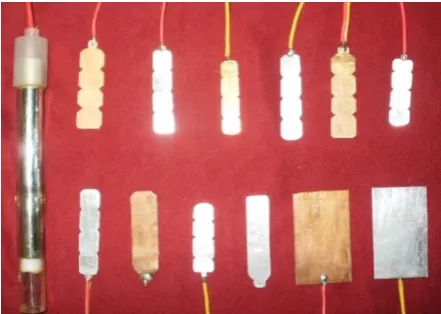
The plant material contents various types of organic and inorganic chemicals5 which are absorbed by their root systems. We have utilized these chemicals and minerals as an electrolyte material to occur the electrolysis process. For preparing the electrodes and cells, different types of materials like Copper, Aluminum, Zink, Lead, Iron, Carbon, Steel, Silver, Gold, Tungsten and Platinum were used. Also, the different type of shapes and sizes of the electrodes as well as cells were tested for the optimum output of potential difference. Within the cells, the dielectric materials like paper insulator, nylon grill and mica strips were used and tested under different conditions. The electrodes and cells were inserted into Aloe vera leaves wherein the sap flow works as an electrolyte6. The actual photographs of different sized and shaped electrodes as well as cells are shown in the following figure 1.
Figure 1: Electrodes and cells of different size & shape
3. RESULT AND DISCUSSION
3.1 Response of Electrode Pair and Single Cell
Table 1: Observed potential difference with time S.
N.
Silver positive and Zink negative electrodes
Time (Minute)
Potential difference (V)
1 Ag(+ ve) ; Zn(- ve) 00 0.821
2 Ag(+ ve) ; Zn(- ve) 04 0.893
3 Ag(+ ve) ; Zn(- ve) 08 0.952
4 Ag(+ ve) ; Zn(- ve) 12 0.995
5 Ag(+ ve) ; Zn(- ve) 16 1.124
6 Ag(+ ve) ; Zn(- ve) 20 1.153
7 Ag(+ ve) ; Zn(- ve) 24 1.175
8 Ag(+ ve) ; Zn(- ve) 28 1.188
9 Ag(+ ve) ; Zn(- ve) 32 1.201
10 Ag(+ ve) ; Zn(- ve) 36 1.213
11 Ag(+ ve) ; Zn(- ve) 40 1.221
12 Ag(+ ve) ; Zn(- ve) 45 1.221
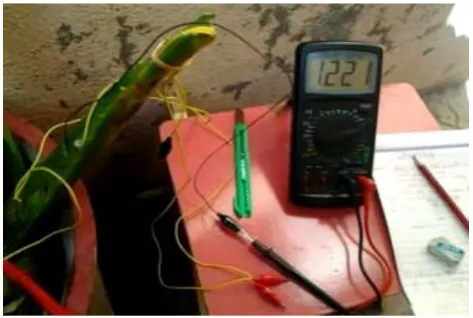
The photocopy of the experimental set up and the maximum reading obtained using Silver (Ag) - Zink(Zn) pair of electrode is shown in figure 2. In overall, the entire readings were taken within 50 minutes and thereafter the output became almost stable.
Figure 2: Experimental set up and optimum reading.
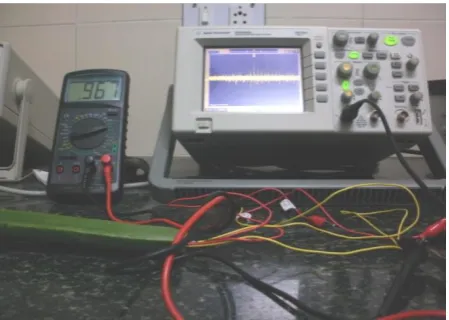
Figure 3: Response of Ag-Zn cell using DSO and DMM
3.2 Measurement of Electrical Parameters :
The 4294A, Precision Impedance Analyzer7, is an integrated solution for efficient impedance measurement and analysis of electronic components and circuits. The Ag-Zn cell was analyzed using Precision Impedance Analyzer (Model : 4294A M/S Agilent, USA), at University Instrumentation and Research Center. Various electrical parameters8 like impedance, resistance, capacitance, conductance, conductance, output voltage, output current and output power were measured for analysis before the insertion and after the insertion of cell into the Aloe Vera plant. These observations are briefly summarized in table 2 below.
Table 2: Measurement of Electrical parameters S.
N. Electrical Parameters Before Cell insertion After Cell insertion
1 Impedance (Z) High (MΩ) Low (mΩ)
2 Conductance (G) Low (µS) High (mS)
3 Resistance (R) High (KΩ) Low (mΩ)
4 Capacitance (C) Low (pF) High (nF)
5 Output Voltage (V) 0.00 Volt 0.967 Volt
6 Output Current (I) 0.00 mA 9.5 mA
7 Output Power (P) 0.00 mW 9.18 mW
The observed output current may be considered as short circuit current which is practically proportional to the corresponding potential difference or emf 9. Similarly, the potential difference, which is nothing but the output voltage is considered as open circuit voltage.
4. CONCLUSION
gadgets. Such types of cells are of low cost, reusable, less corrosive, pollution free and eco-friendly. Ultimately, the energy source becomes renewable, non-conventional, cheap and an emerging source of electricity12.
If more research open up new ways of using tree and plants power, our dependence on non-renewable energies can be reduced to a great extent. Our imagination may cross boundaries and we might be plugging into the surrounding trees and plants to charge our iPods and cell phones.
REFERENCES
[1] A. S. Joshi, I. Dincer, B. V. Reddy, “Role of Renewable Energy in Sustainable Development”, Global Warming, Springer US, 2010, pp 71-87.
[2] Science Daily, Electrical circuit runs entirely off power in trees, University of Washington, 9 Sept., 2009.
[3] Smith Alan R., Pryer Kathleen M., Schuettpelz E., Korall P., Schneider H., Wolf Paul G. (2006). "A classification for extant ferns". Taxon55 (3): 705–731.
[4] M. Mani Teja, M. Basha, N. Balanaidu; Green Electricity from Aloe Vera; International Journal & Magazine of Engineering, Technology & Research; Regd. No.: PENG/2011/47294, ISSN No: 2320-3706.
[5] Salisbury, F. B. and Ross, C. W. , Plant Physiology, Wadsworth Publishing Company, California (1992).
[6] Gilbert D, Mouel JLL, Lambs L, Nicollin F, Perrier F (2006) Sap Flow and Daily Electrical Potential Variations in a Tree Trunk. Plant Science 171: 572– 584.
[7] Agilent Application Notes 346-4 ; Agilent Technologies, Incorporation 2008 USA, Sept 9, 2008.
[8] Ksenzhek O, Petrova S, Kolodyazhny M (2004) Electrical Properties of Plant Tissues: Resistance of a Maize Leaf. Bulgarian Journal of Plant Physiology 30.
[9] Prajjal Datta, A Vegetative Voltaic Cell, Current science, Volume 85-3 (2003).
[11] 11) Mr. G. S. Wajire& Dr. Y. B. Gandole; Implications of living plants and trees as Green Electricity Sources – NCIGE :2013, pages 97-99.