Mediated Encryption: Analysis and Design
∗
I. Elashry, Y. Mu and W. Susilo
University of Wollongong, Wollongong, Australia 2500
Abstract
Boneh, Ding and Tsudik presented identity-based mediated RSA encryption and signature systems in which the users are not allowed to decrypt/sign messages without the authorisation of a security mediator. We show that ID-MRSA is not secure and we present a secure modified version of it which is as efficient as the original system. We also propose a generic mediated encryption that translates any identity based encryption to a mediated version of this IBE. It envelops an IBE encrypted message using a user’s identity into an IBE envelope using the identity of the SEM. We present two security models based on the role of the adversary whether it is a revoked user or a hacked SEM. We prove that GME is as secure as the SEM’s IBE against a revoked user and as secure as the user’s IBE against a hacked SEM. We also present two implementations of GME based on Boneh-Franklin FullIBE system which is a pairing-based system and Boneh, Gentry and Hamburg (BGH) system which is pairing-free system.
Keywords: Mediated Encryption, Key Revocation Problem, Identity-based Encryption
1. Introduction
For the last few years, the key revocation problem has received the attention of the cryptography community because the user’s public key cannot be used if the corresponding private key is compromised. This problem occurs in public key cryptography because it depends on digital certificates. Digital certificates are signatures issued by a trusted certificate authority (CA) that securely ties together a number of quantities. Typically, these quantities contain at least the ID of a user (U) and its public key (P K). Frequently, the CA comprises a serial number (SN) for managing certificates. The CA also binds the certificates to an issue dateD1and an expiration dateD2. By issuing the
signature ofSigCA(U , P K, SN , D1, D2), the CA provides
P Kbetween the current dateD1and the future dateD2.
A user’s public key may have to be revoked before its expiration date D2 if a user’s secret key
is accidentally leaked or an attacker successfully compromises it. A new key pair should be generated and the corresponding certificate should be issued.
If the CA can revoke a certificate, then third parties cannot depend on this certificate unless the CA
HThis paper is an extended version of the paper entitled ‘Generic
Mediated Encryption’ in Securecomm 2013.
shares certificate status information indicating whether this certificate is still valid. This certificate status information has to be recently generated and must be widely distributed. Sharing a great deal of fresh certificates periodically leads to the key revocation problem which consumes large amount of computation power and bandwidth. This is considered a hindrance to global application of public-key cryptography.
1.1. Some Previous Solutions to the Key Revocation
Problem
The most widely-known and a very ineffective way to solve the key revocation problem is the certificate revocation list (CRL) [10, 23] which is a list that contains revoked certificates. The CA produces this list periodically with its signature. Because the CA will probably revoke many of its certificates -say 10 %-if they are produced for a validity time of one year [14,20], the CRL will be too lengthy if the CA has many clients. Moreover, the complete CRL must be sent to any party that needs to carry out a certificate status check. There are improvements to this approach such as delta CRLs [5] which lists only those certificates revoked since the CA’s last update. But the consumed transmission bandwidth and computation costs of the transmission of these lists are still very high. Another method of solving the key revocation problem is the
Research
Article
RQ6HFXULW\DQG6DIHW\
Receivedon14February 2014;acceptedon 23December 2014, published on 30 January 2015
Copyright©2014I. Elashry et al., licensedtoICST.Thisisanopenaccessarticledistributedunderthetermsofthe Creative Commons Attribution license (http://creativecommons.org/licenses/by/3.0/), which permits unlimited use,distributionandreproductioninanymediumsolongastheoriginalworkisproperlycited.
online certificate status protocol (OCSP) [18]. If a client wants to check certificate status, he sends to the CA a certificate status query. The CA replies to this query by producing a fresh signature on the certificate’s current status. This omits the need to send a list of all revoked certificates and reduces the transmission costs to a single signature per query but it significantly increases computation costs. It also negatively affects security. If the CA is centralised, the system will have a single point of failure and consequently will become highly vulnerable to denial-of-service (DoS) attacks [14,20].
Kocher [17] suggested an improved version of OCSP called certificate revocation trees (CRTs). The CA can be considered as a global service provider and must be replicated using many servers in order to stand the entire load of certificate validation requests. The CA’s signing key must be distributed securely over many servers. This process is expensive and insecure. A solution to this problem is that a highly secure root CA sends a signed CRL-like data structure to other less-secure servers and then clients can query these servers for their certificate validation requests. The data structure is like a tree where the leaves are the revoked certificates and the root is a signature of the highly secure root CA. This structure is called a certificate revocation tree (CRT). If a user wants to check the validity of a certificate, he sends a request to the nearest less-secure CA server.
A disadvantage of the current CRT structure is that the whole CRT must be recalculated and sent to all servers if a new certificate is revoked. This problem can be solved if the CRT can be updated without the need to recalculate it. 2-3 trees proposed by Naor and Nissim [21], Aiello-Lodha-Ostrovsky [1] and skip-lists proposed by Goodrich [16] are two proposed solutions to this problem.
Micali [14, 19, 20] proposed a promising way to solve this problem. (See also [1, 12, 22].) Similar to previous PKI proposals, Micali’s Novomodo system includes a CA, one or more directories (to distribute the certification information) and the users. Despite this similarity, it is more efficient than CRLs and OCSP without sacrificing security.
The advantage of Novomodo over a CRL-based system is that a directory’s reply to a certificate status query is brief, only 160 bits per query (if T has cached SigCA(U , P K, SN , D1, D2, Xn)). On the
other hand, the length of a CRL increases with the number of certificates that have been revoked (i.e. number of clients). Novomodo has several advantages over OCSP. First, Novomodo depends on hashing
while OCSP depends on signing. Because hashing has lower computation costs than signing, the CA’s computational costs in Novomodo is typically much lower. Second, the directories in Novomodo do not have to be trusted unlike the distributed components of an OCSP CA. Instead of issuing signatures depending on third parties, the directories publish only hashed pre-images sent by the CA (which cannot be produced by Novomodo directories). Third, the directories do not perform any online computation and make Novomodo less vulnerable to DoS attacks. Finally, although OCSP does not consume too much bandwidth, Novomodo’s bandwidth consumption is typically even lower since public-key signatures are typically longer than 160 bits (length ofXn−isent per query).
A disadvantage of all the above techniques is relaying on third-party queries [14]. It is preferable to eliminate third-party queries for several reasons. First, since anyone can ask for third-party queries, each certificate server must be able to get the certificate status of every client in the system. The situation is much simpler if third-party queries are eliminated. Each server is only required to have certification proofs for the clients that it works for. In addition, multi-cast can be used to push certificate proofs to clients to reduce the transmission costs. Second, third-party queries multiply the query computation costs of the CA and/or its servers. For example, if each client queries the certificate status of Xclients per day, the system must processXN queries (where N is the number of clients). Third, from a business model perspective, non-client queries are not recommended because if T is not a client of the CA, he will not be motivated to deliver T fresh certificate status information. Finally, since the CA must reply to queries from non-clients, it becomes more vulnerable to DoS attacks and this is a security concern. In summary, removing third-party queries leads to a reduction in infrastructure costs, simplifies the business model and increases security. We can completely remove third-party queries by using an implicit certification such as identity-based encryption (IBE).
RSA insecure. Examples of RSA cryptanalysis with the same modulus used for different encryption/decryption pairs are [3, 26]. Sixteen years later, Sakai, Ohgishi and Kasahara [24] proposed the first identity-based cryptography and independently Boneh and Franklin [7] proposed the first reliable and provable identity-based cryptography identity-based on Weil pairings over elliptic curves. Cocks [9] presented a system that is based on factorisation of a composite integer. These cryptosystems opened a new era in cryptography.
Gentry presented the notion of certificate-based encryption (CBE) [14]. This system combines public-key encryption (PKE) and IBE while keeping most of the advantages of each. Using PKE, each client creates its own public-key/secret-key pair and asks for a certificate from the CA. The CA uses an IBE system to create the certificate. This certificate has all of the functionality of a conventional PKI certificate as well as a decryption key. This double encryption gives us implicit certification. If T wants to encrypt a message, it double encrypts it using PKI and IBE and then the decryptor uses both his secret key and an up-to-date certificate from his CA to decrypt the message. CBE has no escrow (since the CA does not know the user’s secret key) and it does not a have secret key distribution problem because the CA’s certificate needs not be kept secret. Although CBE consumes less computation and transmission costs than Novomodo, it is preferable to completely eliminate the use of certificates to preserve the infrastructure costs.
Boneh, Ding, Tsudik and Wong were the first to introduce the notion of mediated cryptosystems in [6]. They designed a variant of RSA that allows an immediate revocation of, for instance, an employee’s key by an employer for any reason. Their system is the first to propose a secure variant of identity-based RSA that shares a common modulus between different users. Their system is based on the so-called security mediator (SEM) architecture in which the SEM is a semi-trusted server. If an employee wants to decrypt/sign a message, he must co-operate with the SEM to do so. The idea behind their system is splitting the secret key of an employee between the employee himself and the SEM. Hence, without the SEM cooperation, the employee cannot sign or encrypt messages. This is also helpful to monitor the security of sent/received secure messages in the company. Later on, Ding and Tsudik presented a security proof for these systems. In particular, they stated that ‘IB-mRSA/OAEP encryption offers equivalent the semantic security to RSA/OAEP against adaptive chosen ciphertext attacks
in the random oracle model if the key generation function is division intractable’. To make the key generation function division intractable, Ding and Tsudik used a division intractable hash function to generate division intractable public keys.
The SEM architecture was proven useful [6] to sim-plify signature validation and enable key revocation in legacy systems. Although this system does not require a CA to create a certificate or send certificate status infor-mation and the computation and transmission costs are kept to minimum, it has two major security concerns. First, There is a security flaw in [11,15]. Second, since SEM is centralised, it represents a single point of failure for the system and hence the system is vulnerable to DOS attacks. Moreover, a hacked SEM can be a major threat to the system security because the SEM is a semi-trusted server.
1.2. Our Contribution
First, we investigate the mediated encryption [6, 11] by reviewing the security of the ID-MRSA. We show that hashing users’ identities using a division intractable hash function does not necessarily generate division intractable public keys. We show that an insider attacker can breach the ID-MRSA even if the hash function used is division intractable. We present two solutions that make the key generation function division intractable and hence, the ID-MRSA is secure. Second, we take the work of [6] one step further and present a generic mediation system that is capable of making any IBE system support key revocation. This idea is based on a letter-envelope technique. If UA
wants to encrypt a message toUB, he first encrypts it
normally using UB’s identity (letter) then he encrypts
the letter again using SEM identity (envelope) and sends the resulted ciphertext to UB. To decrypts the
ciphertext, UB sends the message to the SEM. If UB
is revoked, the SEM will not open the envelope for him. If UB is not revoked, the SEM will open the
envelope and send the letter to UB who decrypts the
setup algorithm,KG is the Key Generation Algorithm, Encis the encryption algorithm,Decis the decryption algorithm andris the private key.
The rest of the paper is organised as follows: Sec. 2 discusses the ID-MRSA encryption/signature systems and their implementations. Sec. 3 discusses the security flaw of the ID-MRSA. Sec. 4 proposes two solutions to overcome the ID-MRSA security flaw. The effect of using these solutions on the ID-MRSA are discussed in Sec. 5. Sec. 6 presents the generic mediated encryption (GME) and its security proof. Sec. 7 presents two implementations of GME, the first one is based on the BF IBE system [7] which is a pairing-based system and the second one is based on the BGH system [8] which is not a pairing-based system. The last section presents the conclusions of the paper.
2. The ID-MRSA
We review the structure of ID-MRSA as follows. In the setup phase, PKG produces two safe primes p, q then computes n=pq. He preserves p, q as secret system parameters while makes the modulus n public. Next, PKG produces the private key for UA by hashing his
identity to a valueKG() then the PKG padsKG() with one to get an odd public key forUA. After that, he makes
the corresponding full RSA private key forUAand splits
it betweenUAand the SEM.UB encrypts messagemto
UA normally using the public key ofUA. After getting
the encrypted messageC fromUB,UA directs it to the
SEM to partially decrypt it. IfUA is revoked, the SEM
declines to decrypt the message and returns ‘error’. Otherwise, the SEM partially decrypts the message to get P DS and sends it to UA. After receiving the
partially decrypted message P DS from the SEM, UA
computes his own partially decrypted version of the message P DU and then combines it with the SEM’s
partially decrypted message to get his fully decrypted message. The algorithms of key generation, encryption and decryption are shown below. The signature system has the same key generation as the encryption system. When UA signs a message to UB, he sends it to the
SEM to partially sign the message for him if he is not revoked.UA combines the partially signed message of
the SEM with his partially signed version of the message to get his own signature.UBcan verify the signature of
UAnormally as RSA.
3. The ID-MRSA Security
The ID-MRSA is assumed to be secure in the random oracle model based on [15] and [11]. However, there
Key Generation:
Input: two safe primespandq Output:rU,rS
n=pq(Generating the modulus) forUdo
s=k− |KG()| −1
e= 0s||KG()||1 (Padding the hashed identity with one)
r= 1e (modϕ(n)) (Calculating the private keyr) rU
R
←Zn−[0] (Choosing randomly an element rUfromZn−[0])
rS = (r−rU) (mod ϕ(n))
end
Encryption: Input:n, k, KG() Output:C s=k− |KG()| −1 e= 0s||KG()||1
C= Encrypt the message using RSA/OAEP
Decryption: Input:C,rU,rS
Output:m forSdo
ifU is Revokedthen return (ERROR) Exit
end
P DS =CrS (modn) (Calculate the partially
decrypted message of the SEM) end
forUdo
P DU =CrU (modn) (Calculate the partially
decrypted message of U)
M= (P DS×P DU) (mod n) (Decrypt the
message) end
m= OAEP Decoding of M
is a special attack that an insider user can initiate. He can modify the encrypted message so that it can be decrypted using his private key by finding a mapping functionf(CA) =CB.
Lemma 1.Assume that there are two users UA and UB,
UBis able to obtain a mapping functionf(CA) =CBand
decrypt/forge the encrypted message/signed message ofUAiffea|eb.
This lemma and its proof are presented in [11]. If ea|eb i.e. eb=k×ea, we can build a mapping function
Signing: Input:m, rU, rS
Output:h, S h=H(m) forSdo
ifU is revokedthen return (ERROR) Exit
end
P DS =hrS (modn)
end forUdo
P DU =crU (modn)
S= (P DS×P DU) (mod n)
end
Verification:
Input:h, S, n, k, KG() Output:h
s=k− |KG()| −1 e= 0s||KG()||1 h=Se (modn) ifh,hthen
return (ERROR) end
against this attack, the user’s public key cannot be a factor of the product of the other users’ public keys. To ensure that, Ding and Tsudik used a division intractable hash function to map a user’s identity to his public key (KG()). This notion of division intractable hash functions was presented by Gennaro et al. [13]. A hash function H() is division intractable if it is unfeasible to find a set of values (X1, X2, ..., Xn, Y) such
thatH(Y)|Q
i(H(Xi)).
In this section, we prove that the ID-MRSA is still vulnerable to this attack. A division intractable hash function does not necessarily produce division intractable public keys because the output of the hash function KG() is padded with a ‘one’. The public key is e=KG()k1 [11] or e=KG()k00000001 [4]. This means that e= 2KG() + 1 or e= 8KG() + 1. This multiplication and addition completely change the property of the public key and it is likely, with overwhelming probability, to no more becoming division intractable. For example, if|KG(ID1)|= 6 and |KG(ID2)|= 19, these two values are division intractable but if we calculatee1= 2|KG(ID1)|+ 1 = 2×6 + 1 = 13
and e2= 2|KG(ID2)|+ 1 = 2×19 + 1 = 39 we can see
that e1 and e2 are no longer division intractable (e2=
3e1) and consequently, lemma 1 can be used to attack
Table 1. Example of an attack on the ID-MRSA in real world
Variables Value
|KG(ID1)| A07B0C7AFE0A33D7A270D8A35B995B3546D77D6E |KG(ID2)| 808288FE7D6E2B83AD145D7AD059CE09A9BA8F717C
e1 140F618F5FC1467AF44E1B146B732B66A8DAEFADD
e2 1010511FCFADC57075A28BAF5A0B39C1353751EE2F9
e2/e1 CD
the ID-MRSA even though the hash function is division intractable. Real life values that represent the same idea are shown in table 1. These numbers are in hexadecimal.
We now demonstrate how an insider one-wayness adversary takes advantage of this simple notice to initiate two different attacks against the ID-MRSA. The first attack is a direct application of lemma 1. The second attack is a common modulus attack against the ID-MRSA. For the signature system, we prove that if such a mapping function exists, an insider attacker can forge the signature of another user without knowing his private key.
3.1. Attacks on the ID-MRSA Encryption
The first attack holds when the effect of using an intractable hash function is canceled by padding the output with one and the resulting public keys are in the form of (eB=k×eA). Under these conditions, UB can
obtain the message ofUAusing the following formula:
CB=C eB/eA
A (modn)
and then decrypt this message using his private key. This attack is executed as follows:
• The attackerUBchooses an identityIDBsuch that
eB=k×eAwhere k is an integer.
• At the challenge phase,UBsends to the challenger
any two messagesm0andm1and the identityIDA.
• The challenger tosses a fair coin b∈ {0,1} and sendsCA←Enc(mb) toUB.
• UBcalculatesCB=CAeB/eA (modn).
• UBsendsCBto the SEM for decryption.
• After decryption,UBcan successfully findb0=b.
The gravity of this attack is that it makes the ID-MRSA exposed against a one-wayness adversary; not only can UB distinguish between two messages m0 and m1, he
The second attack can be applied if the same message was sent to two users,UAandUB,UC with public key
satisfiesgcd(eA, eB)|eC can launch an attack to decrypt
this message as follows.
• Assuming that g=gcd(eA, eB)|eC, UC finds the
values of a and b such that a×eA+b×eB=g using the extended euclidian algorithm.
• After obtainingaandb,UC calculatesCg =CAa ×
CBb (modn) =maeA+beB (modn) =mg (modn)
• FromCg,UCobtains his version ofmas follows:
Cc = Cgec/g (modn)
= mgec/g (modn) = mec (modn)
and then he can decrypt it using his private key.
3.2. The attack on the ID-MRSA signature
In this subsection, we demonstrate an attack on the ID-MRSA signature system even with a division intractable hash function. We assume that there are two users,UA
andUBand show thatUBcan forge the signature ofUA
without knowing his private key using the following steps, as long as a mapping function between their public keys exists:
• UB signs the messagem with the SEM using his
private key.
• After obtaining his signed message (mB), he
calculates the forged signature of UA: mA=mkB
(modn) wherek=eB/eA.
• mAcan be verified using the public key ofUA.
The proof of the correctness of this attack is described as follows:
ebhb = 1 (modϕ(n))
eb = kea
keahb = 1 (modϕ(n))
ea(khb) = 1 (modϕ(n))
eaha = 1 (modϕ(n))
4. The ID-MRSA-V2
After showing the security flaw of the ID-MRSA encryption/signature systems, we present two solutions
that correctly make the ID-MRSA secure against these types of attacks. We denote the ID-MRSA with these solutions as the ID-MRSA-V2. Any solution to these attacks must satisfy the following conditions:
• There is a deterministic one-to-one mapping function that maps the identities of the users to their public keys.
• This function must be division intractable.
• The produced public keys must be co-prime with ϕ(n).
The first solution ensures that the maximum value of a public key is less than three times the smallest public key value, i.e.eM <3em. The subscriptMdenotes
maximum while the subscript m denotes minimum. One can see that this completely eliminates the problem. The relation between the hash function of the maximum and minimum public keys values must be:
eM < 3em
2|KGM|+ 1 < 3(2|KGm|+ 1) 2|KGM|+ 1 < 6|KGm|+ 3
2|KGM| < 6|KGm|+ 2 |KGM| < 3|KGm|+ 1
If the inequality |KGM|<3|KGM|+ 1 holds, then all public keys are division intractable. The disadvantage of this solution is that it limits the space of the hash function. The other solution to fix this security flaw is mapping the users’ identities to public keys that are primes. To generate primes from identities, we first calculatea=H(ID) and then apply the following function:
f(a) = (a−1)×step + 1.
wherestepis the value used to generate unique primes. After that, find the next smallest prime larger thanf(a). The algorithm is shown as follows.
a=H(ID)
f(a) = (a−1)×step + 1 iff(a)is not primethen f(a) =NxPrime(f(a)) end
return (f(a))
whereN xP rime(x) is a function that finds the smallest prime larger thanx.
Figure 1. The distribution of primes
• The hash function must be collision resistant i.e. it is unfeasible to find two different values X, Y such that a=H(Y) =H(X). This guarantees that each identity is mapped to a unique public key.
• The value of step is chosen carefully such that f(a)< Pa< f(a+ 1) for any value a. This will
guarantee that each identity will be mapped to a unique prime. Fig.1 shows this idea. The value of step can be determined by finding a value greater than the maximal prime gap which is the gap larger than the gaps of smaller primes. For primes less than 240, a value of step greater than 1476 can be safely used [2].
• If the mapping function satisfies the above conditions, it will overcome the first attack to the encryption system because primes satisfy the division intractable property. However, it cannot withstand the second attack because the greatest common divisor (gcd) between primes is one. The only solution for this attack is not to use the same OAEP padding when encrypting the same message to multiple users. For the signature systems, there is no mapping function exists between primes and consequently it will be safe from such attacks. After fixing these drawbacks, the ID-MRSA-V2 can be proven CCA2 secure in the random oracle model using the same methodology explained in [11] or [15].
5. Implementation
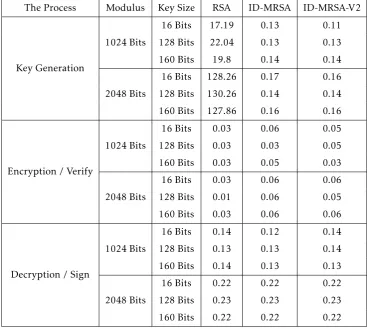
The ID-MRSA-V2 was programmed using MIRACL software C library and its performance was compared with the ID-MRSA and RSA. The PC used to run these tests has a processor Intel(R) Core(TM) i5-2410M CPU @ 2.30GHz (4 CPUs) and 4096MB RAM. Table 2 shows the test results. The results are in ms.
From these results, we can see that:
• The ID-MRSA-V2 has the same performance of the original ID-MRSA.
• The results of the key generation of RSA are larger than those of the ID-MRSA and the ID-MRSA-V2
because the key generation of the ID-MRSA and the ID-MRSA-V2 is for each user and it does not involve the prime key generation that exists in RSA key generation.
• The encryption time increases slightly with the key length so the key length is not problematic. This can be seen also in the encryption times of the ID-MRSA and IDMRSA-V2.
• The decryption times are longer than the encryption times in all systems. This drawback is actually inherited from RSA because the decryption keys are extremely large (of the length ofn).
• The times consumed by all these systems are proportional to the modulus size.
6. Generic Mediated Encryption
In this section, we take the idea of ID-MRSA one step ahead. Assume that there is a company XYZ and the security manager of this company wants to upgrade the currently-used IBE to one that supports key revocation. The security manager has two options. He can install a CBE system [14] but he has to uninstall the currently-used IBE and install a PKE. PKE certificates will lead to more computation and transmission costs. The other option is using mediated cryptosystem such as ID-MRSA [6, 15]. The security manager also has to uninstall the current IBE system and install ID-MRSA. The process of uninstalling the currently-used IBE and installing a new encryption system is time-consuming and expensive. It is like having a safe with a one-key lock and you want to replace it with a two-key lock, you will have to completely remove the old lock and install the new one. The question we address here is “Is there a way to make any IBE support key revocation without having to uninstall it?". We take the idea of ID-MRSA and make it generic and applicable to any encryption system. In the following section, we explain the security model and security proof of GME.
6.1. The Model
Definition 1.A Generic Mediated Encryption is a 6- tuple
of algorithms. These algorithms are (GenS,KGS,GenU,
KGU,Enc,DecS,DecU) such that:
• GenU(1k1): The private key generator (PKG) runs
Table 2. The time results
The Process Modulus Key Size RSA ID-MRSA ID-MRSA-V2
Key Generation
1024 Bits
16 Bits 17.19 0.13 0.11
128 Bits 22.04 0.13 0.13
160 Bits 19.8 0.14 0.14
2048 Bits
16 Bits 128.26 0.17 0.16
128 Bits 130.26 0.14 0.14
160 Bits 127.86 0.16 0.16
Encryption / Verify
1024 Bits
16 Bits 0.03 0.06 0.05
128 Bits 0.03 0.03 0.05
160 Bits 0.03 0.05 0.03
2048 Bits
16 Bits 0.03 0.06 0.06
128 Bits 0.01 0.06 0.05
160 Bits 0.03 0.06 0.06
Decryption / Sign
1024 Bits
16 Bits 0.14 0.12 0.14
128 Bits 0.13 0.13 0.14
160 Bits 0.14 0.13 0.13
2048 Bits
16 Bits 0.22 0.22 0.22
128 Bits 0.23 0.23 0.23
160 Bits 0.22 0.22 0.22
1k1. It returnsMSKS(the first PKG master secret) and public parametersPS.
• GenU(1k2): The PKG runs the probabilistic IBE key
generation algorithmGenU which takes as input
a security parameter 1k2. It returns MSK
U (the
second PKG master secret) and public parameters PU.
• KGS(MSKS, PS, IDS): This algorithm generates
the secret keyrSfor a SEM with identityIDSusing
PSandMSKS.
• KGU(MSKU, PU, IDU): This algorithm generates
the secret key rU for a user with identity IDU
usingPUandMSKU.
• Enc(PS, PU, IDU, IDS, m): The probabilistic
algo-rithm Enc takes PS, PU, IDU, IDS, m. It returns
a ciphertextC.
• DecS(PS, rS, C): The deterministic decryption
algorithm DecS takes (PS, rS, C) as input along
with the user revocation status. If the user is revoked,DecSreturns⊥. Otherwise it returnsCU.
• DecU(PU, rU, CU): The deterministic decryption
algorithm DecU takes (PU,rU,CU) as input and
returnsm.
6.2. Security
Our main concern is the GME security against two different types of attackers: 1) by a revoked user or 2) by a hacked SEM. GME must be secure against each of these individuals considering that each obtains ‘half’ of the information needed to decrypt. Correspondingly, we define IND-CCA security using two different games. The adversary selects the game to play. In the first game, Type 1, the adversary plays the role of a revoked user. After demonstrating knowledge of the private key related to his identity, the revoked user can makeDecS
compromised SEM can makeDecUqueries. We can say
that our system is secure if no adversary can win either Type 1 or Type 2.
Type 1:The challenger runsGenS(1k1) andGenU(1k2)
and gives PS and PU to the adversary. The adversary
then interleaves key extraction quires and decryption queries with a single challenge query. These queries are answered as follows:
• On key extraction queries (MSKU, PU, IDU,
PS, IDS), the challenger runs KGU, KGS and
outputsrU andrS corresponding to the identities
IDU andIDS.
• On decryption queries (PS, PU, IDU, IDS, rU, C),
the challenger checks that rU is the private key
related toIDU. If so, it generatesrS and outputs
DecU(DecS(C)).
• On challenge query (PS, PU, ID
∗
S, ID
∗
U, m0, m1), the
challenger checks thatrU∗ is the private key related to IDU∗ . Then, upon receiving two messages m0 and m1 from the adversary, the challenger
chooses random bitb∈ {0,1}and returnsEnc(mb) to the adversary. The adversary is allowed to make key extraction and decryption queries after submitting the challenge.
In the end, the adversary outputs a guess b0 ∈ {0,1}. The adversary wins the game ifb0
=b andIDS∗ andrS∗ were not subject of valid key extraction and decryption queries. The adversary’s advantage is defined to be the absolute value of the difference between 1/2 and its probability of winning.
Type 2:The challenger runsGenS(1k1) andGenU(1k2)
and gives PS and PU to the adversary. The adversary
then interleaves key extraction quires and decryption queries with a single challenge query. These queries are answered as follows:
• On key extraction queries (MSKU, PU, IDU,
PS, IDS), the challenger runs KGU, KGS and
outputsrU andrS corresponding to the identities
IDU andIDS.
• On decryption queries (PS, PU, IDU, IDS, rS, C),
the challenger checks that rS is the private key
related toIDS. If so, it generatesrU and outputs
DecU(DecS(C)).
• On challenge query (PS, PU, ID
∗
U, ID
∗
S, m0, m1), the
challenger checks that rS∗ is the private key related toIDS∗. Then, upon receiving two messages m0 and m1 from the adversary, the challenger
chooses random bitb∈ {0,1}and returnsEnc(mb) to the adversary. The adversary is allowed to make key extraction and decryption queries after submitting the challenge.
In the end, the adversary outputs a guess b0∈ { 0,1}. The adversary wins the game ifb0=bandIDU∗ andrU∗ were not subject of valid key extraction and decryption queries.The adversary’s advantage is defined to be the absolute value of the difference between 1/2 and its probability of winning.
Definition 2.A generic mediated encryption system is
secure against adaptive chosen ciphertext attack (IND-GME-CCA) if no PPT adversary has non-negligible advantage in either Type 1 or Type 2.
Remark: Type 1 and Type 2 are IND-GME-CCA secure if bothIBES andIBEU are IND-ID-CCA secure.
IfIBES andIBEU are IND-ID-CPA secure, then Type 1
and Type 2 are modified by eliminating the decryption queries to get IND-GME-CPA security.
6.3. Security Proof
The security proof of GME is defined by the following two theorems.
Theorem 1.If an adversary A who plays the role of a
revoked user has an advantageagainst GME, then this adversary has the same advantage againstIBES.
Theorem 2.If an adversary A who plays the role of a
hacked SEM has an advantageagainst GME, then this adversary has the same advantage againstIBEU.
Proof: Theorem 1 means that the game between an adversaryAwho plays the role of a revoked user with a challengerBagainstGME(Type 1) is identical to the game between the same adversaryAand the challenger B against IBES. To prove that, we rewrite Type 1 as
follows:
Type 1’:
• The Setup phase is the same as Type 1.
• Key extraction queries are the same as Type 1.
• Decryption queries are the same as Type 1.
• On challenge query (PS, PU, ID
∗
S, ID
∗
U, m0, m1), the
challenger checks thatrU∗ is the private key related to IDU∗ . Then, upon receiving two messages m0
andm1from the adversary, the challenger chooses
to the adversary. Since the revoked user has rU, he can partially decrypt the message to
get CS=EncS(m) where EncS is the SEM’s IBE
encryption algorithm.
In the end, the adversary outputs a guess b0 ∈ {0,1}. The adversary wins the game ifb0 =b andIDS∗ andrS∗ were not subject of valid key extraction and decryption queries. The adversary’s advantage is defined to be the absolute value of the difference between 1/2 and its probability of winning. This concludes Type 1’.
From Type 1’, we can see that:
• Type 1’ represents a game againstIBESbecause in
the challenge phase the adversaryAhas to attack CS =EncS(m) to get the messagem.
• The only difference between a game against GME (in the case of a revoked user) and IBES is the
excess information ofPU which does not give the
adversary any excessive information to identifym.
This concludes the proof of Theorem 1. The proof of Theorem 2 is similar.
7. Implementation of GME
Generally speaking, a GME system is produced by the combination of two IBE systems. To prove that GME is generic, we present GME in two different instantiations. The first one is based on the BF FullIBE [7] which is a pairing-based system. The other instantiation is based on BGH IBE system [8] which is not a pairing-based system. We first briefly review bilinear pairings and the bilinear Diffi-Helman assumption which is the base of the BF FullIBE security then we present GME using BF FullIBE. After that, we briefly review some of the security topics related to the BGH IBE system then we represent GME using BGH IBE system. We note here that the proposed GMEs systems use the same setup and key generation algorithms for both the users and SEM. I
7.1. Review on pairings
BF IBE [7] is based on bilinear map called a ‘pairing’. The pairing which is often used to construct BF IBE is a modified Weil or Tate pairing on a supersingular elliptic curve or Abelian variety. However, we review pairings and the related mathematics in a more general form here.
Let G1 and G2 be two cyclic groups of a large
prime order q. G1 is an additive group and G2 is a
multiplicative group.
Admissible pairings: ˆe is called an admissible pairing if ˆe:G1×G1→G2is a map with the following
properties:
• Bilinear: ˆe(aQ, bR)= ˆe(Q, R)ab for allQ, R∈G1and alla, b∈Z.
• Non-degenerate: ˆe(Q, R),1 for allQ, R∈G1.
• Computable: There is an efficient algorithm to compute ˆe(Q, R) for anyQ, R∈G1.
• Symmetric: ˆe(Q, R) = ˆe(R, Q) for anyQ, R∈G1.
Bilinear Diffie-Hellman (BDH) Parameter Generator: A randomized algorithm I G is a BDH parameter generator if I G takes a security parameter k >0, runs in time polynomial in k and outputs the description of two groupsG1andG2of the same prime
order q and the description of an admissible pairing ˆ
e:G1×G1→G2[7].
BDH Problem: Given a randomly chosen P ∈G1 as well as aP , bP and cP (for unknown randomly chosen a, b, c∈Zq), compute ˆe(P , P)abc.
For the BDH problem to be hard, G1 and G2 must
be chosen so that there is no known algorithm for efficiently solving the Diffie-Hellman problem in either G1orG2.
BDH Assumption: IfI Gis a BDH parameter generator, the advantage AdvI G(B) of algorithmB in solving the BDH problem is defined to be the probability that the algorithm B outputs ˆe(P , P)abc when the inputs to the
algorithm areG1,G2, ˆe,aP , bP andcP where (G1,G2, ˆe)
is I G’s output for large enough security parameter k, P is a random generator of G1 and a, b, care random
elements ofZq. The BDH assumption is thatAdvI G(B) is negligible for all efficient algorithmsB[7].
7.2.
GME
BFLet k be the security parameter given to the setup algorithm and letI Gbe a BDH parameter generator.
Setup: The public key generator (PKG) runs I G on input k to generate groups G1, G2 of some prime
orderqand an admissible pairing ˆe:G1×G1→G2. It
picks an arbitrary generatorP ∈G1and a master secret s∈Zq and sets Ppup=sP and chooses cryptographic hash functions H1{0,1}
∗→
G1, H2:G1→ {0,1}n,
H3:{0,1}n× {0,1}n→Zq and a hash function
H4:{0,1}n → {0,1}nfor somen. The system parameters
space isM={0,1}n. The master secret iss∈Zq.
KG: For given strings IDU, IDS ∈ {0,1}∗, the PKG
computes QS =H1(IDS) and QU =H1(IDU) and sets
the private keyrS =sQS andrU =sQU.
Enc: To encrypt a message mfor a user with public key IDU, compute QS =H1(IDS) and QU =H1(IDU).
After that, choose a random σ ∈ {0,1}n and set r= H3(σ , m). The ciphertextCis:
C=hrp, σ⊕H2(gr
U)⊕H2(gSr), m⊕H4(σ))i
wheregU= ˆe(QU, Ppub) andgS = ˆe(QS, Ppub).
Dec: To decryptC =hU , V , Wifor a user with public key IDU, the user sends C to the SEM. If the user is
revoked, the SEM returns⊥. If the user is not revoked, the SEM calculates
CU =hU , V ⊕H2( ˆe(dS, U)), Wi
and returns CU to the user. After receiving CU =
hU , VU, Wi, the user computes VU⊕H2( ˆe(dU, U)) =σ andW⊕H4(σ) =mand setsr=H3(σ , m). He outputsm as a decryption ofCifU =rp. This concludesGMEBF.
Remark: A symmetric encryptionEcan be used instead of Xor to encrypt the messagem[7].
7.3. Security Proof
Lemma 2.Let A be a IND-CCA adversary that has
advantage against GMEBF. This adversaryA can be
a revoked user or a hacked SEM. Then, there is an IND-CCA adversary B with the same probability against the BF FullIBE.
Proof.As shown in section 6.3.
7.4. Boneh-Gentry-Hanburg (BGH) system
Boneh, Gentry and Hamburg presented an anonymous IND-ID-CPA secure system (BGH) [8]. Unlike Boneh-Franklin system, this system is secure based on the interactive quadratic residuosity (IQR) assumption. In the following, we present the IQR assumption and the core algorithm of the BGH system, then we present GME based on that system.
7.5. The IQR assumption
For a positive integern, define the following set:
J(n) = [a∈Zn:a
n
= 1],
where an is the Jacobi symbol of a w.r.t n [8]. The Quadratic Residue setQR(n) is defined as follows
QR(n) = [a∈Zn:gcd(a, n) = 1∧x2≡a (modn) has a solution].
Definition 3.Interactive Quadratic Residuosity
Assump-tion: LetH be a collision free hash function such that H: [0,1]∗ →J(n). Let O be a square root oracle that picks un←J(n)\QR(n) and maps input pair (n, x) to
one ofHn(x)
1
2 orunHn(x)12 inZnbased on which value is quadratic residue. The interactive quadratic residuosity assumption holds for the pair (RSAgen, H) if for all PPT algorithmsA, the functionIQRAdvA,(RSAgen(λ),H)=
|Pr[(n, V)←PQR(λ) :AO(n, V) = 1]| − |Pr[(n, V)← PN QR(λ) :A
O
(n, V) = 1]|
is negligible. IQRAdvA,(RSAgen(λ),H) is the IQR
advan-tage ofAagainst (RSAgen, H) [8].
7.6.
Q
Algorithm
Q is a deterministic algorithm with inputs (n, u, R, T) wheren∈Z+ and R, u, T ∈Zn. This algorithm outputs four polynomial functions f , f , g, τ∈Zn. This algo-rithm must satisfy the following conditions :
• IfRandT are quadratic residues, thenf(r)g(t) is also quadratic residue for all values ofr←R12 and t←T12.
• If uR and T are quadratic residues, then f(r)g(t)τ(t) is also quadratic residue for all values ofr←uR12 andt←T12.
• If R is quadratic residue, then f(r)f(−r)T is quadratic residue for everyr←R12.
• If uR is quadratic residue, then f(r)f(−r)T is quadratic residue for everyr←uR12.
• IfT is quadratic residues, thenτ(t)τ(−t)uis also quadratic residue for all values oft←T12.
• τ is independent of R, that is Q(n, u, R1, T) and
Q(n, u, R2, T) produces the same value ofτfor any
value ofn, u, R1, R2, T.
An example ofQis explained [8] as follows:
• Find a solution (x, y)∈Z2
n to the equationRx2+
T y2≡1 (modn).
• Find a solution (α, β)∈Z2n to the equationuα2+ T β2≡1 (modn).
7.7.
GME
BGH• Setup(1k): Using RSAgen(1k), generate (p,q). Calculate the modulusn←pq. Chooseu∈J(n)\ QR(n) and choose a hash function H:ID× [1, l]→J(n). The public parametersP are [n, u, H]. The master secret MSK parameters are p, q and a secret keyK for a pseudorandom functionFK :
ID×[1, l]→[0,1,2,3].
• KG(MSK, IDU, IDS, l): Using the master secret
MSK, ID and the message length l, the private keys (rU ,i, rS,i) are generated using the key
generation algorithm.
Key Generation foreachi∈[1, l]do
RU ,i ←H(IDU, i)∈J(n)
RS,i ←H(IDS, i)∈J(n)
wU ←FK(IDU, i)∈[0,1,2,3]
wS ←FK(IDS, i)∈[0,1,2,3]
chooseaU∈[0,1] such thatuaURU ,i∈QR(n)
chooseaS ∈[0,1] such thatuaSRS,i∈QR(n)
let[zU ,0, zU ,1, zU ,2, zU ,3] be the four square roots
ofuaURU ,i ∈Zn
let[zS,0, zS,1, zS,2, zS,3] be the four square roots of
uaSR
S,i ∈Zn
rU ,i←zU ,wU rS,i←zS,wS end
The decryption key for the user U is dU ←
(P , rU ,1, ..., rU ,l) and the decryption key for the
SEM isdS ←(P , rS,1, ..., rS,l).
• Enc(P , IDU, IDS, m): Generate a random value
t←Zn and calculate T ←t2 and then encrypt m∈[−1,1]l using P as shown in the encryption algorithm. The ciphertext is C= (T , k, c) where c= [c1, c2,..., cl].
• Decrypt(C, dID): To decrypt a ciphertext C=
(T , k, c) for a user with public keyIDU, he sends
Cto the SEM. The SEM then does the following:
• ifU is revoked, the SEM returns⊥.
• if U is not revoked, the SEM Calculates cU ,i as
shown in SEM decryption algorithm.
and returnsCU= [CU ,1, CU ,2, ..., CU ,l] to the user.
Then he decrypts CU as shown in the user
decryption algorithm.
Encryption τ(t)←Q(n, u,1, T) k←τ(t)
n
foreachi∈[1, l]do
RU ,i ←H(IDU, i)∈J(n)
RS,i ←H(IDS, i)∈J(n)
[xU ,i, yU ,i]←Q(n, u, RU ,i, T)
[xS,i, yS,i]←Q(n, u, RS,i, T)
gU ,i(t)←2yU ,it+ 2
gS,i(t)←2yS,it+ 2
ci ←mi·
g
U ,i(t)
n
·
g
S,i(t)
n
end
SEM Decryption foreachi∈[1, l]do
RS,i ←H(IDS, i)∈J(n)
ifrS,i2 =RS,i then
[xS,i, yS,i]←Q(n, u, RS,i, T)
fS,i(rS,i)←xS,irS,i+ 1
cU ,i ←ci·
f
S,i(rS,i)
n
end
ifr2S,i =uRS,ithen
[xS,i, yS,i, α, β]←Q(n, u, RS,i, T)
fS,i(rS,i)←1 +T2i−1yS,iβ+αxS,irS,i
cU ,i ←ci·
f
S,i(rS,i)
n
·k
end end
User Decryption foreachi∈[1, l]do
RU ,i ←H(IDU, i)∈J(n)
ifrU ,i2 =RU ,i then
[xU ,i, yU ,i]←Q(n, u, RU ,i, T)
fU ,i(rU ,i)←xU ,irU ,i+ 1
mi ←ci·
f
U ,i(rU ,i)
n
end
ifr2U ,i=uRU ,ithen
[xU ,i, yU ,i, α, β]←Q(n, u, RU ,i, T)
fU ,i(rU ,i)←1 +T2i−1yU ,iβ+αxU ,irU ,i
mi ←ci·
f
U ,i(rU ,i)
n
·k
end end
7.8. Security Proof
Lemma 3.LetAbe an Anon-IND-CPA adversary that has
advantage against GMEBGH. This adversary A can
be a revoked user or hacked SEM. Then, there is an Anon-IND-CPA adversaryBwith the same probability against the BGH system.
Proof.As shown in section 6.3.
8. Conclusion
In this paper, we investigate the mediated structure of the ID-MRSA which is a solution to the key revocation problem. We showed that using a division intractable hash function does not necessarily guarantee that the generated public keys are also division intractable. Consequently, the system may not be secure even if the hash function used is division intractable. We proposed two solutions to overcome this drawback. After applying these modifications, the ID-MRSA is secure in the random oracle model if the mapping function parameters have been chosen correctly. After that, we extended the idea of the ID-MRSA to be generic by presenting a generic mediated encryption (GME) system that converts any IBE system to a mediated system. Although it is based on double encryption, our system is efficient. The ciphertext size is the same as a single IBE. It combines the advantage of CBE and SEM structures. Our system is more efficient than CBE because it does not depend on certificates and it is more secure than [6] and [15] because the SEM in GME is not a single point of failure and can be untrusted. We prove that GME is as secure as the IBE system used in the case of a revoked user or a hacked SEM.
References
[1] W. Aiello, S. Lodha, and R. Ostrovsky. Fast digital
identity revocation. In H. Krawczyk, editor,Advances in
Cryptology, CRYPTO ’98, volume 1462 ofLecture Notes
in Computer Science, pages 137–152. Springer Berlin
Heidelberg, 1998.
[2] J. K. Andersen. Maximal Prime Gap.
[3] D. Boneh and X. Boyen. Efficient Selective-ID Secure
Identity Based Encryption Without Random Oracles.
InAdvances in Cryptology—EUROCRYPT 2004, volume
3027 of Lecture Notes in Computer Science, pages 223–
238. Berlin: Springer-Verlag, 2004. Available athttp:
//www.cs.stanford.edu/~xb/eurocrypt04b/.
[4] D. Boneh, X. Ding, and G. Tsudik. Identity-based
mediated RSA. InIn Proceedings of the 3rd International Workshop on Information Security Applications(WISA’02) (Jeju Island, Korea), 2002.
[5] D. Boneh, X. Ding, and G. Tsudik. Fine-grained control of security capabilities. ACM Trans. Internet Technol., 4(1):60–82, Feb. 2004.
[6] D. Boneh, X. Ding, G. Tsudik, and C. M. Wong. A
method for fast revocation of public key certificates
and security capabilities. In Proceedings of the 10th
conference on USENIX Security Symposium - Volume
10, SSYM’01, pages 22–22, Berkeley, CA, USA, 2001.
USENIX Association.
[7] D. Boneh and M. Franklin. Identity-Based Encryption from the Weil Pairing. In J. Kilian, editor,Advances in Cryptology, CRYPTO 2001, volume 2139 ofLecture Notes
in Computer Science, pages 213–229. Springer Berlin
Heidelberg, 2001.
[8] D. Boneh, C. Gentry, and M. Hamburg.
Space-Efficient Identity Based Encryption Without Pairings.
In Proceedings of the 48th Annual IEEE Symposium
on Foundations of Computer Science, FOCS ’07, pages
647–657, Washington, DC, USA, 2007. IEEE Computer Society.
[9] C. Cocks. An Identity Based Encryption Scheme
Based on Quadratic Residues. In B. Honary, editor,
Cryptography and Coding, volume 2260 ofLecture Notes
in Computer Science, pages 360–363. Springer Berlin
Heidelberg, 2001.
[10] S. F. S. B. R. H. D. Cooper, S. Santesson and W. Polk. RFC5280: Internet X.509 Public Key Infrastructure Certificate and Certificate Revocation List (CRL) Profile, May 2008.
[11] X. Ding and G. Tsudik. Simple Identity-Based
Cryptography with Mediated RSA. In M. Joye, editor,
Topics in Cryptology, CT-RSA 2003, volume 2612 of
Lecture Notes in Computer Science, pages 193–210.
Springer Berlin Heidelberg, 2003.
[12] I. Gassko, P. Gemmell, and P. MacKenzie. Efficient and Fresh Certification. In H. Imai and Y. Zheng, editors,
Public Key Cryptography, volume 1751 of Lecture Notes
in Computer Science, pages 342–353. Springer Berlin
Heidelberg, 2000.
[13] R. Gennaro, S. Halevi, and T. Rabin. Secure Hash-and-Sign Hash-and-Signatures Without the Random Oracle. In J. Stern,
editor,Advances in Cryptology, EUROCRYPT99, volume
1592 of Lecture Notes in Computer Science, pages 123–
139. Springer Berlin Heidelberg, 1999.
[14] C. Gentry. Certificate-Based Encryption and the
Certificate Revocation Problem. In E. Biham, editor,
Advances in Cryptology, EUROCRYPT 2003, volume 2656
of Lecture Notes in Computer Science, pages 272–293.
Springer Berlin Heidelberg, 2003.
[15] C. Gentry. Practical Identity-Based Encryption Without
Random Oracles. In Advances in Cryptology -
[16] M. T. Goodrich, R. Tamassia, and A. Schwerin. Implementation of an Authenticated Dictionary with
Skip Lists and Commutative Hashing. DARPA
Information Survivability Conference and Exposition,, 2:1068, 2001.
[17] P. Kocher. On certificate revocation and
valida-tion. In R. Hirchfeld, editor, Financial Cryptography,
volume 1465 of Lecture Notes in Computer Science,
pages 172–177. Springer Berlin / Heidelberg, 1998. 10.1007/BFb0055481.
[18] A. M. S. G. a. C. A. M. Myers, R. Ankney. RFC 2560: Internet public key infrastructure online certificate status protocol - OCSP.
[19] S. Micali. Efficient Certificate Revocation. Technical report, Cambridge, MA, USA, 1996.
[20] S. Micali. Novomodo: Scalable Certificate Validation and
Simplified PKI Management. In1st Annual PKI Research
Workshop, pages 15–25, 2002.
[21] M. Naor and K. Nissim. Certificate revocation and
certificate update. InProceedings of the 7th conference on
USENIX Security Symposium - Volume 7, SSYM’98, pages
17–17, Berkeley, CA, USA, 1998. USENIX Association.
[22] M. Naor and K. Nissim. Certificate revocation and
certificate update. Selected Areas in Communications,
IEEE Journal on, 18(4):561–570, 2000.
[23] W. F. a. D. S. R. Housley, W. Polk. RFC3280:
Internet X.509 Public Key Infrastructure Certificate and Certificate Revocation List (CRL) Profile, April 2002. [24] K. O. R. Sakai and M. Kasahara. Cryptosystems based on
Pairing. InSymposium on Cryptography and Information
Security (SCIS 2000), Japan, 2000.
[25] A. Shamir. Identity-Based Cryptosystems and Signature
Schemes. In G. Blakley and D. Chaum, editors,Advances
in Cryptology, volume 196 ofLecture Notes in Computer Science, pages 47–53. Springer Berlin Heidelberg, 1985. [26] B. Waters. Efficient Identity-Based Encryption Without
Random Oracles. In R. Cramer, editor, Advances in
Cryptology, EUROCRYPT 2005, volume 3494 ofLecture
Notes in Computer Science, pages 114–127. Springer